
Judge, 1910-07-02 · page 10 of 16
Judge — July 2, 1910 — page 10: what you’re looking at
What you’re looking at
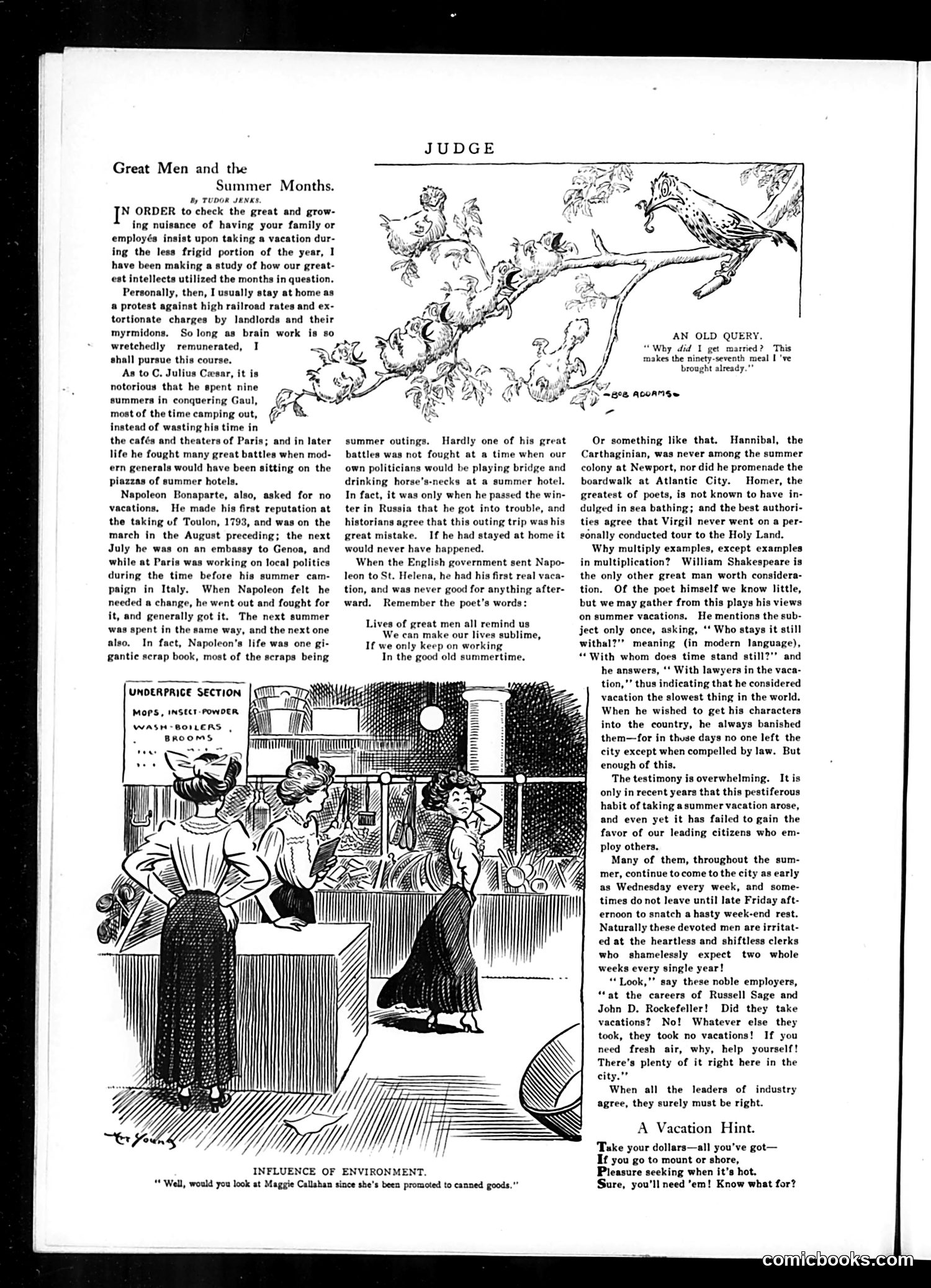
This article satirizes the growing expectation of summer vacations among workers and employees. Author Tudor Jenks argues that history's greatest figures—Julius Caesar, Napoleon Bonaparte, Homer, Hannibal, and Shakespeare—never took vacations. Instead, they worked through summer, achieving greatness through constant labor. The satire targets employers and the wealthy who resist granting time off to their workers. Jenks mockingly suggests vacations are a "pestiferous habit" that has failed to gain approval from "leading citizens who employ others." The historical examples are deliberately absurd (Napoleon "got into trouble" only during his winter Russian campaign, implying vacations cause failure). The accompanying cartoon "Influence of Environment" shows workers in an underprice section, likely mocking both labor conditions and class pretensions. The broader joke: wealthy employers cite history to deny workers rest while enjoying leisure themselves—a classic class-based hypocrisy Judge frequently lampooned.
📄 Transcribed text from this page (OCR, searchable)
Machine-transcribed from the original scan — historical spelling and the odd misread are preserved.
Great Men and the Summer Months. By TUDOR Jenks J ORDER to check the great and grow- ing nuisance of having your family or employés insist upon taking a vacation dur- ing the less frigid portion of the year, I have been making a study of how our great- est intellects utilized the months in question. Personally, then, I usually stay at home as a protest against high railroad rates and ex- tortionate charges by landlords and their myrmidons. So long as brain work is so wretchedly remunerated, I shall pursue this course. As to C. Julius Cosar, it is notorious that he spent nine summers in conquering Gaul, most of the time camping out, instead of wasting his time in the cafés and theaters of Paris; and in later life he fought many great battles when mod- ern generals would have been sitting on the piazzas of summer hotels. Napoleon Bonaparte, also, asked for no ions. He made his first reputation at the taking uf Toulon, 1793, and was on the march in the August preceding; the next July he was on an embassy to Genoa, and while at Paris was working on local politics during the time before his summer cam- paign in Italy, When Napoleon felt he needed a change, he went out and fought for it, and generally got it. The next summer was spent in the same way, and the next one also. In fact, Napoleon's life was one gi- gantic scrap book, most of the scraps being Hardly one of his great ime when our summer outings. battles was not fought at a own politicians would be playing bridge and drinking horse’s-necks at a summer hotel. In fact, it was only when he passed the win- ter in Russia that he got into trouble, and historians agree that this outing trip was his great mistake. If he had stayed at home it would never have happened. When the English government sent Napo- leon to St. Helena, he had his first real vaca- tion, and was never good for anything after- . Remember the poet's words: Lives of great men all remind us We can make our lives sublime, If we only keep on working In the good old summertime. UNDERPRICE SECTION IK Nin INFLUENCE OF ENVIRONMENT. “* Well, would you look at Maggie Callahan since she's been promoted to canned goods."” AN OLD QUERY. \ “Why did I get married? This \ makes the ninety-seventh meal I've 4 brought already." 888 AOUANSe - Or something like that. Hannibal, the Carthaginian, was never among the summer colony at Newport, nor did he promenade the boardwalk at Atlantic City. Homer, the greatest of poets, is not known to have in- dulged in sea bathing; and the best authori- agree that Virgil never went on a per- sonally conducted tour to the Holy Land. Why multiply examples, except examples in multiplication? William Shakespeare is the only other great man worth considera- tion. Of the poet himself we know little, but we may gather from this plays his views on summer vacations. He mentions the sub- ject only once, asking, ‘* Who stays it still withal?"” meaning (in modern language), “‘With whom does time stand still?"" and he answers, ‘* With lawyers in the vaca- tion,’’ thus indicating that he considered vacation the slowest thing in the world. When he wished to get his characters into the country, he always banished them—for in thuse days no one left the city except when compelled by law. But enough of this. The testimony is overwhelming. It is only in recent years that this pestiferous habit of taking asummer vacation arose, and even yet it has failed to gain the favor of our leading citizens who em- ploy others. Many of them, throughout the sum- mer, continue tocome to the city as early as Wednesday every week, and some- times do not leave until late Friday aft- ernoon to snatch a hasty week-end rest. Naturally these devoted men are irritat- ed at the heartless and shiftless clerks who shamelessly expect two whole weeks every single year! “Look,’” say these noble employers, “‘at the careers of Russell Sage and John D. Rockefeller!’ Did they take vacations? No! Whatever else they took, they took no vacations! If you need fresh air, why, help yourself! There's plenty of it right here in the city.”” When all the leaders of industry agree, they surely must be right. A A Vacation Hint. Take your dollars—all you’ve got— If you go to mount or shore, Pleasure seeking when it’s hot. Sure, you'll need ’em! Know what for?