
A complete issue · 16 pages · 1910
Judge — June 11, 1910
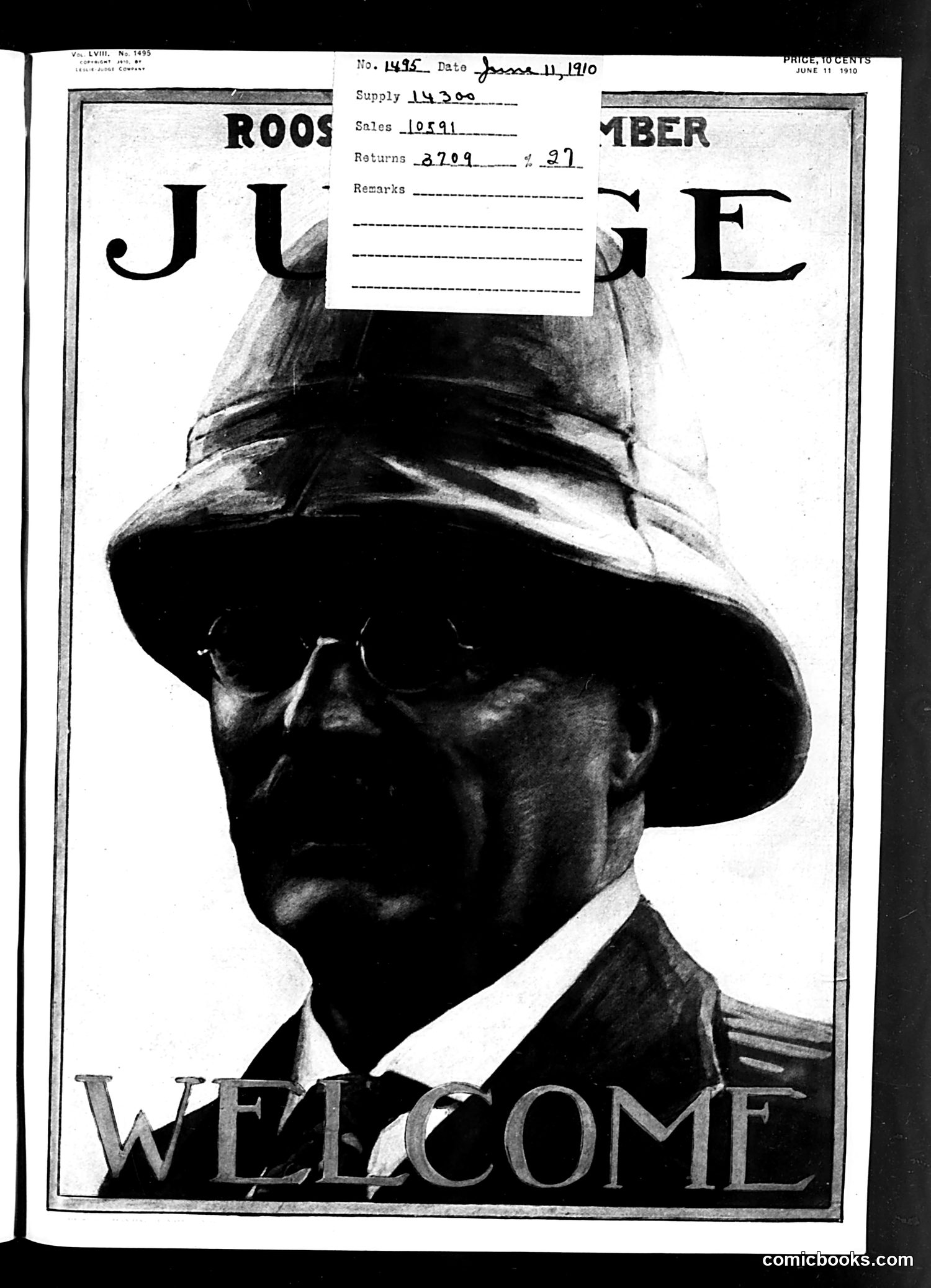
This appears to be a cover from **Judge magazine dated June 11, 1910**. The image shows a man in formal attire (suit and tie) wearing a wide-brimmed hat and sunglasses, photographed in profile. The text reads "JUDGE" (top), "WELCOME" (bottom), with partial words visible: "ROOS" and "MBER" (likely "ROOSEVELT" and "REMEMBER"). Given the 1910 date and "Roosevelt" reference, this likely depicts **Theodore Roosevelt**, who had recently returned from his African safari (1909-1910). The "welcome" text suggests the magazine is greeting his return to America. The sunglasses and hat appear to reference his famous expedition outfit, though the overall tone—obscuring his face behind dark glasses—suggests satirical commentary, possibly questioning or mocking his triumphant homecoming. The page includes publication data and financial figures (supply, sales, returns).
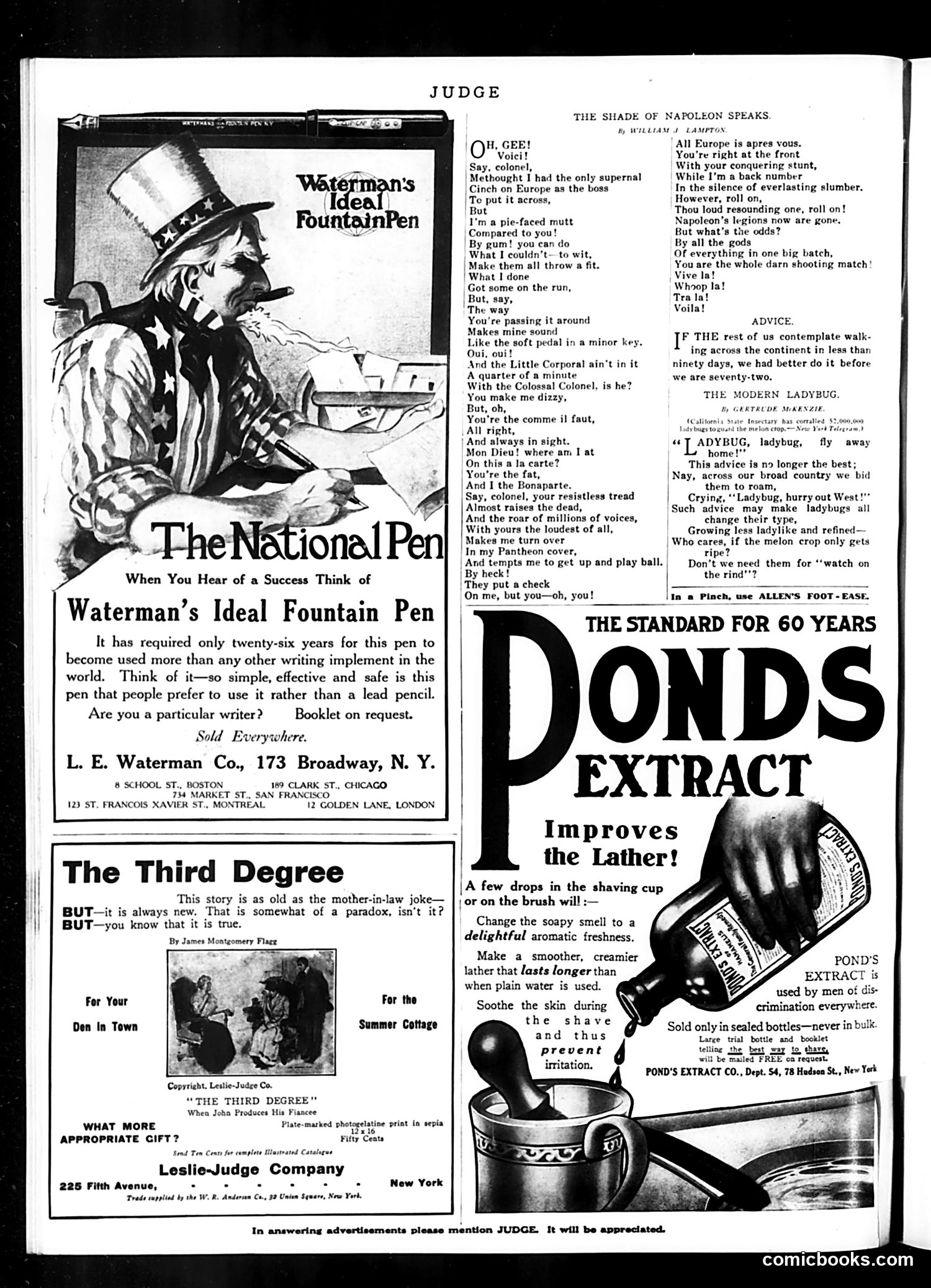
This page is **primarily advertising** with one satirical poem. The main content is "The Shade of Napoleon Speaks," a poem by William J. Lampton depicting Napoleon's ghost commenting on World War I European affairs. The ghost expresses surprise at modern military scale ("you can do / What I couldn't—to wit, / Make them all throw it"), suggesting the war has surpassed even Napoleon's imperial ambitions in destructiveness. The poem mocks contemporary military leadership by having history's greatest general acknowledge he's been outdone by current generals' capacity for carnage—satire criticizing WWI's unprecedented scale and apparent strategic futility compared to Napoleonic warfare. The remaining page space contains advertisements for Waterman's fountain pens, "The Third Degree" film, and Pond's Extract shaving product.
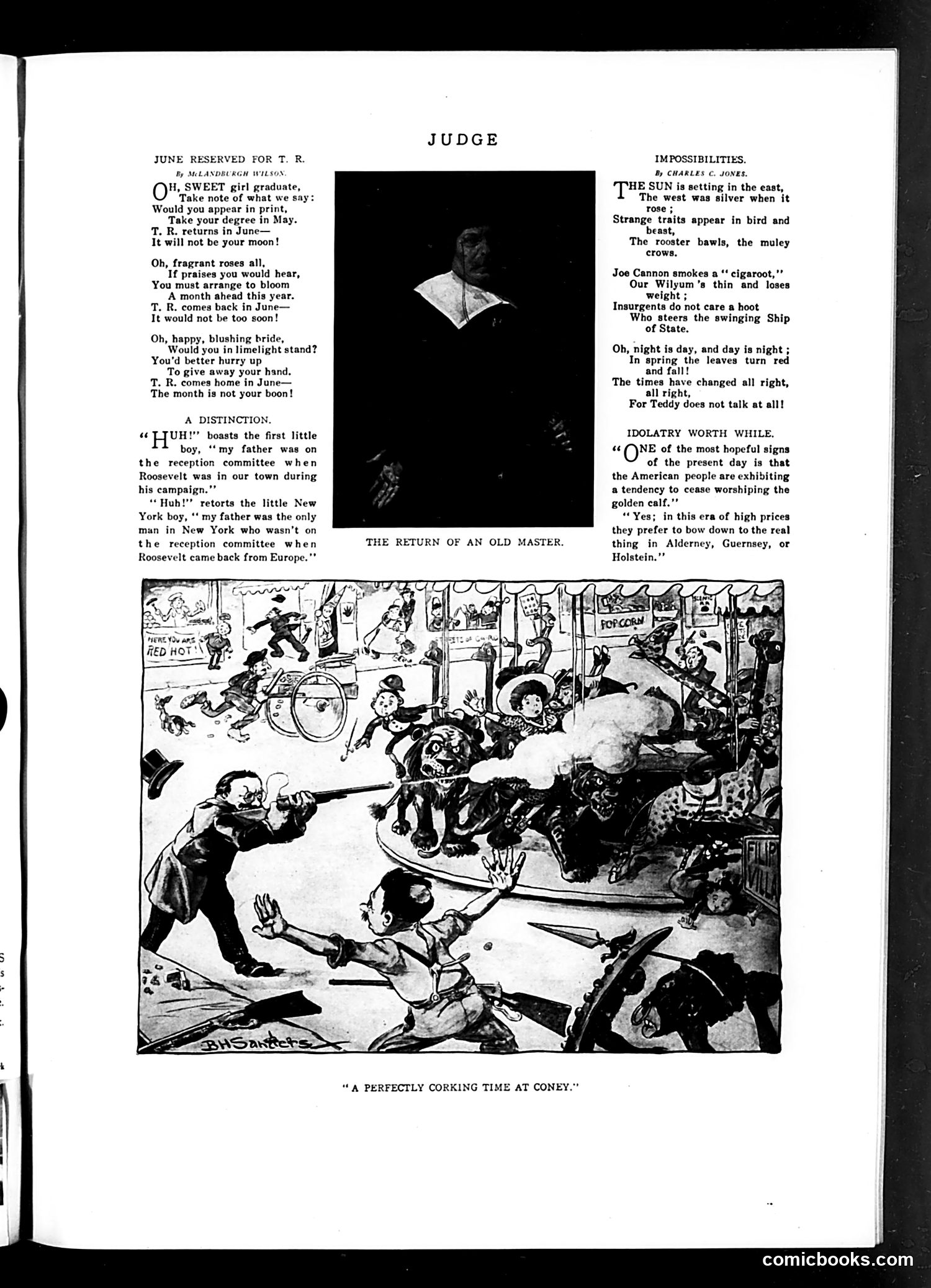
This cartoon depicts chaos at Coney Island, the famous Brooklyn amusement park. The large illustration shows crowds of visitors in pandemonium—people fleeing, a dog attacking, someone wielding what appears to be a gun or club, vendors' stalls (marked "POPCORN"), and general disorder. The satire appears to mock the crowded, hectic conditions at Coney Island during peak visiting season, portraying it as barely controlled bedlam rather than pleasant recreation. The title's sarcastic phrase "perfectly corking time" (meaning excellent) contrasts sharply with the mayhem depicted. This reflects turn-of-the-century anxieties about mass leisure, urban crowds, and the commercialization of amusement parks—suggesting that modern public recreation had become an unruly, dangerous experience rather than civilized entertainment.
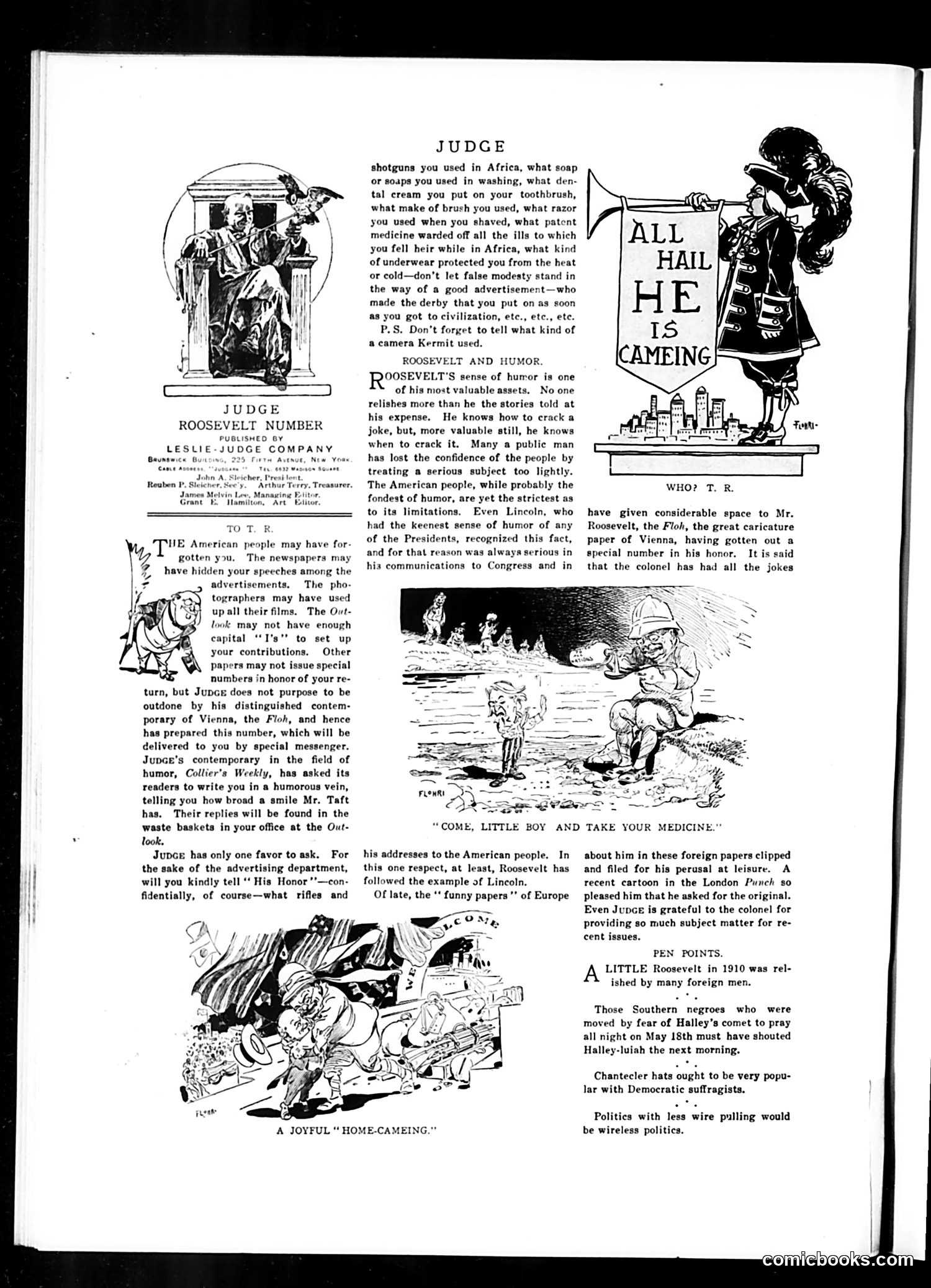
This page celebrates Theodore Roosevelt's humor as a political asset. The main cartoon titled "Judge: Roosevelt Number" praises Roosevelt's ability to tell jokes and crack humorous stories—presented as crucial for maintaining public confidence in leadership. The text contrasts Roosevelt favorably with Lincoln, noting both recognized humor's value in serious communications. However, the page criticizes European leaders for their "funny papers," suggesting American humor is superior and more refined. The illustrated cartoons below satirize Roosevelt's outdoor activities, particularly camping ("All Hail He Is Camping"). One sketch shows a child taking "medicine," likely referencing Roosevelt's vigorous, sometimes controversial policies presented as beneficial remedies. The overall message: Roosevelt's wit and public persona are strengths that distinguish American democratic leadership from European alternatives.
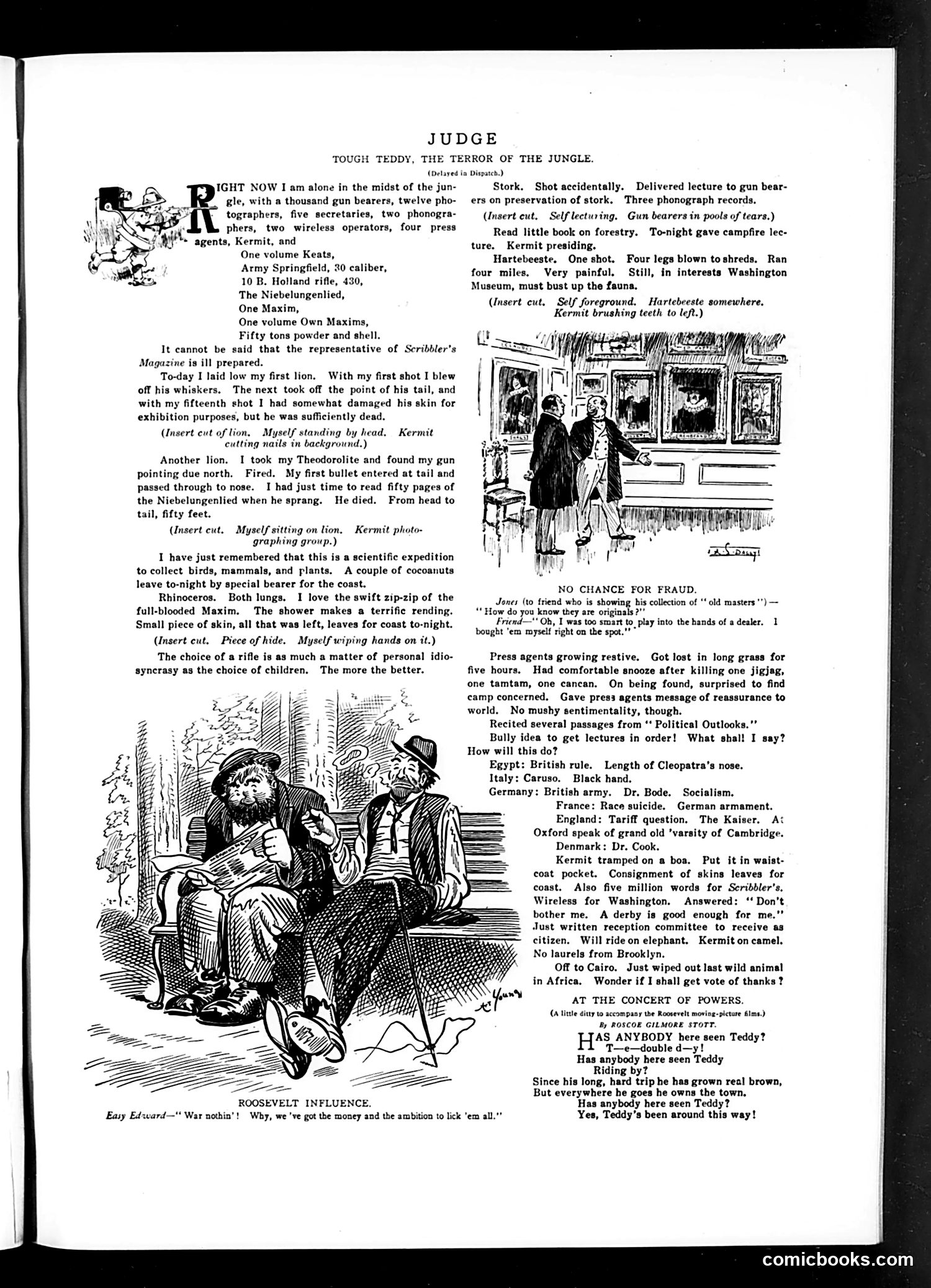
This page contains two distinct cartoons satirizing early 20th-century American politics and society. **"Roosevelt Influence"** (bottom cartoon): Shows two men in conversation, with one saying "War socks! Why, we got the money and the ambition to lick 'em all." This appears to reference Theodore Roosevelt's aggressive foreign policy and militaristic approach, suggesting his influence encouraged expansionist attitudes among Americans. **"At the Concert of Powers"** (top right): A poem questioning whether "Teddy" (Roosevelt) has been seen anywhere, referencing his physical prowess and outdoor reputation ("hard trip," "grown real brown"). The "Concert of Powers" likely alludes to international diplomatic arrangements. The overall page mocks Roosevelt's outsized influence on American culture and politics during his presidency or shortly after.
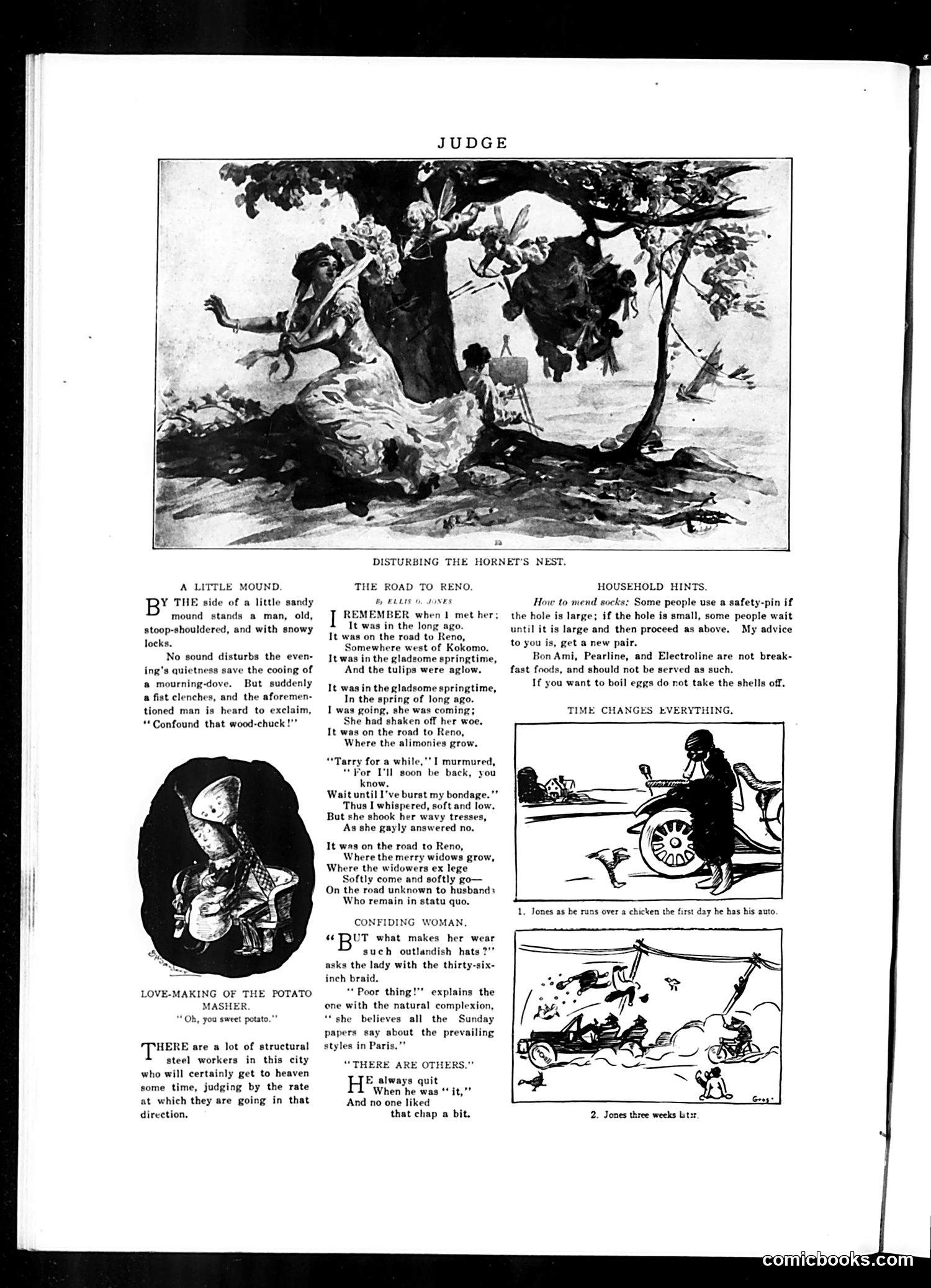
This page collects various satirical pieces typical of early 20th-century Judge magazine. The main social commentary centers on **divorce and remarriage**, particularly the "Road to Reno" poem about traveling to Nevada (famous for lenient divorce laws) to obtain separations. The poem mocks the prevalence of divorce and remarriage, referring to "merry widows" and "alimonies" as established phenomena. The cartoon series "Time Changes Everything" shows a man's relationship with his automobile evolving from novelty to worn-out burden—likely satirizing Americans' changing attitudes toward new technology. Secondary pieces mock fashion pretension (women blindly following Paris styles), structural workers' safety records, and other domestic absurdities. "Disturbing the Hornet's Nest" (top illustration) remains unclear without additional context, though it depicts confrontational activity. The humor targets contemporary social anxieties: divorce's normalization, fashion snobbery, and industrial progress.
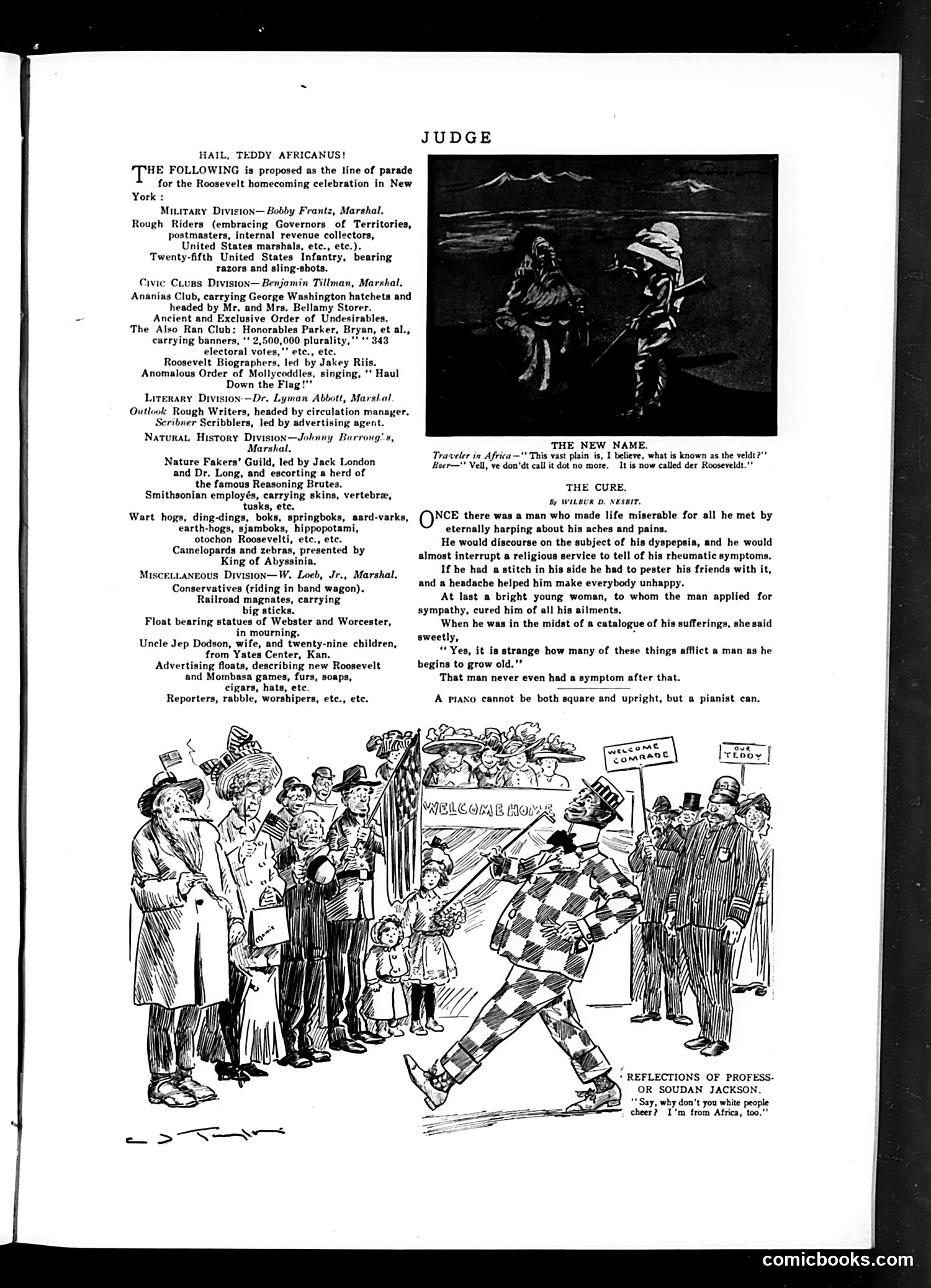
This page satirizes Theodore Roosevelt's triumphant return from his African safari (1909-1910). "Teddy Africanus" mocks his celebrity status by proposing an absurdly elaborate parade featuring farcical divisions. The satire targets Roosevelt's political allies and supporters: the "Rough Riders" (his cronies), the "Ananias Club" (referencing liars), the "Also Ran Club" (defeated rivals like William Jennings Bryan), and "Nature Fakers' Guild" (attacking those exaggerating African wildlife stories). The "Twenty-fifth United States Infantry" carrying "razors and sling-shots" appears to contain a racial caricature. The Boer cartoon mocks Roosevelt's outsized fame—even colonial Africa supposedly now calls the landscape "der Rooseveldt." "The Cure" satirizes hypochondriacs who constantly complain about ailments—apparently a contemporary social complaint. "Professor Soudan Jackson's" quip suggests Roosevelt's African adventure made him a celebrity figure even to African peoples, though the racial caricature here reflects the era's problematic attitudes.
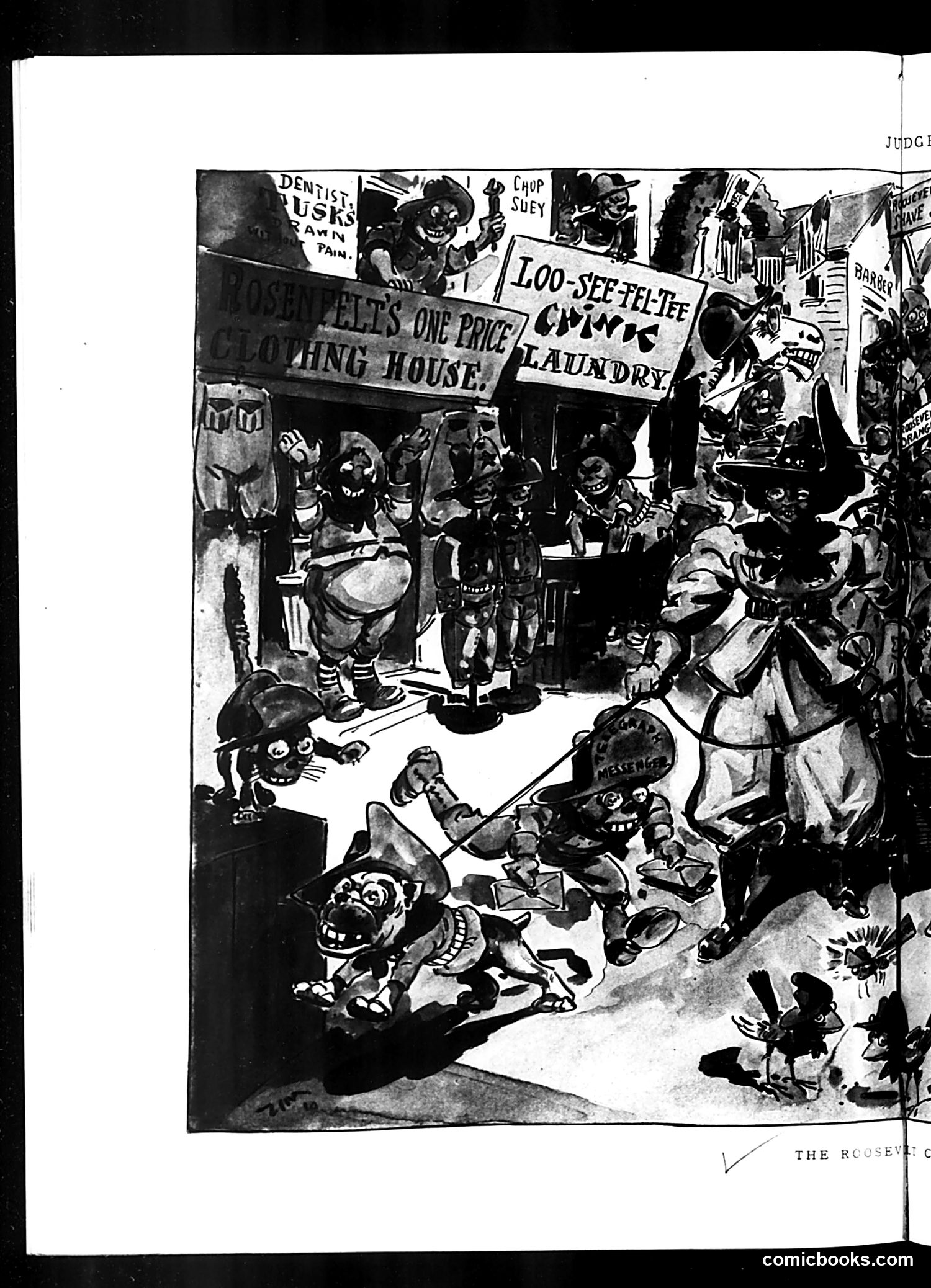
This appears to be a satirical cartoon from Judge magazine depicting a chaotic street scene populated by anthropomorphic animals and caricatured figures. Visible signs advertise "Loo-See-Tee Chink Laundry" and "Let's One Price Clothing House," suggesting commentary on immigrant-owned businesses, likely Chinese laundries which were common targets of American satirical humor during the late 19th/early 20th century. The crowded, tumultuous scene with exaggerated animal characters (including what appear to be rats, cats, and other creatures) satirizes urban disorder or ethnic tensions of the era. The cartoon likely critiques either immigrant communities or labor conditions in urban areas, though the exact political message remains unclear without additional context or caption text visible in this reproduction.
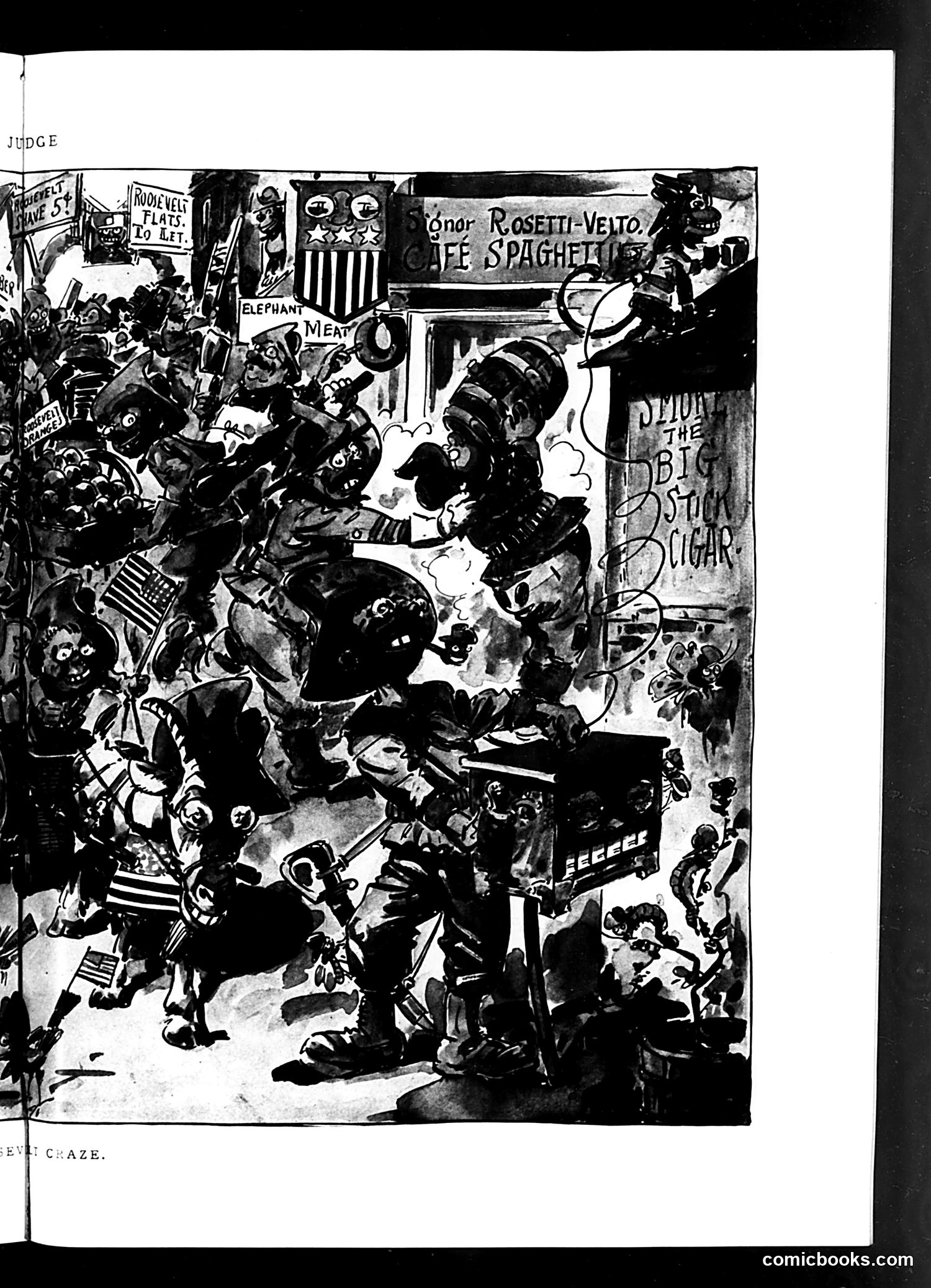
This Judge magazine cartoon satirizes Italian-American immigration and restaurant culture in early 20th-century America. The scene depicts a chaotic Italian establishment ("Onor Rosetti-Vetto Cafe Spaghetti") filled with exaggerated caricatures of Italian immigrants engaging in boisterous, stereotypical behavior—fighting, gesturing wildly, and generally creating disorder. The signs reference Roosevelt and political figures, while "Dump the Big Stogie Cigar" (right side) appears to mock prominent political personalities. The satire mocks both Italian-American communities as rowdy and uncivilized, and simultaneously pokes fun at American political leadership. This reflects period prejudices against Southern and Eastern European immigrants, portraying them as disruptive to American civic order.
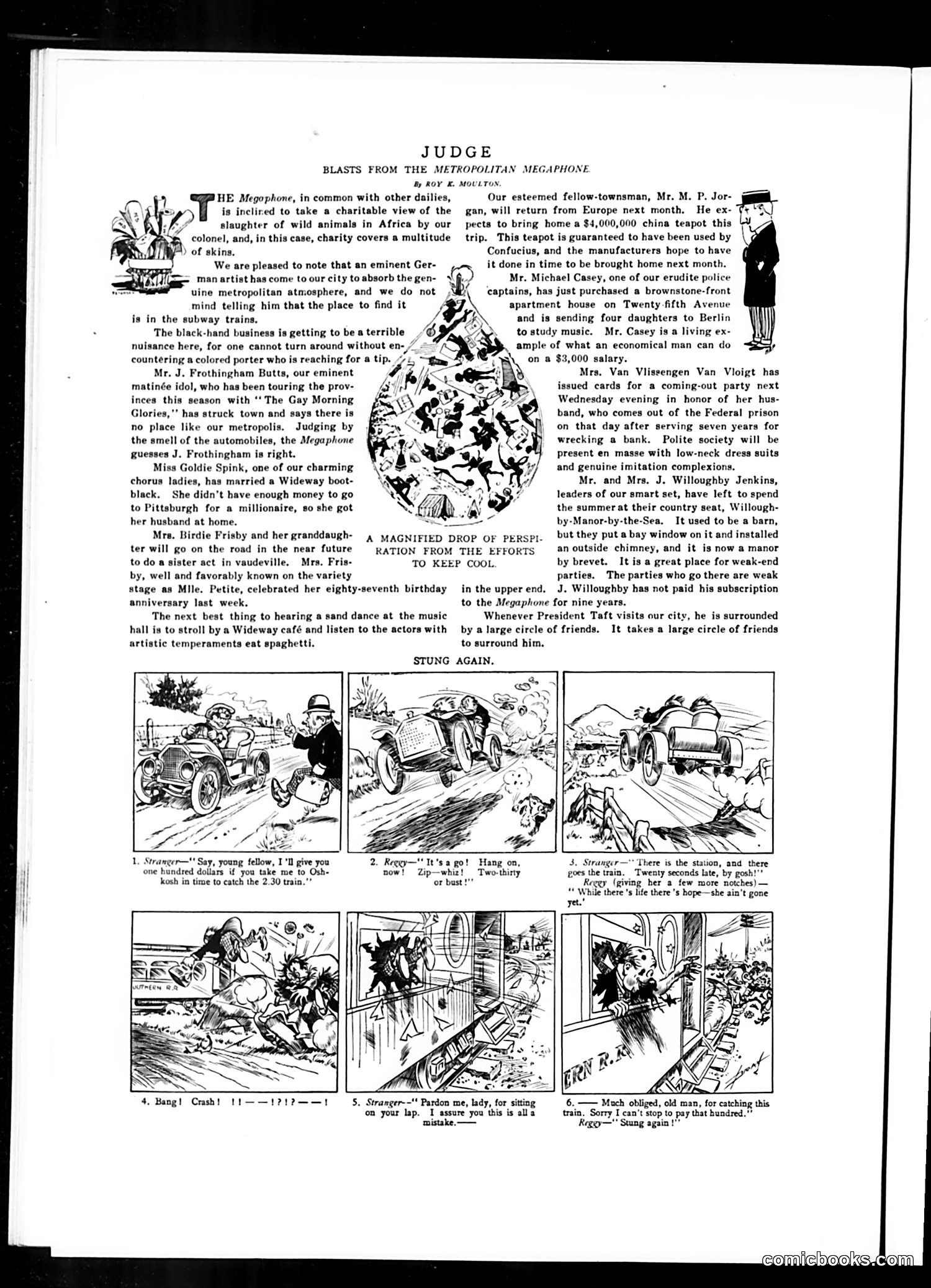
This page from Judge magazine contains society gossip and satirical commentary on early 20th-century New York life, plus a comic strip about reckless driving. **The gossip column** mocks wealthy New Yorkers through barbed observations: a police captain apparently earning $3,000 annually but somehow affording a brownstone (implying corruption); a socialite's husband being released from prison for bank-wrecking; wealthy people pretending a barn is a country manor; and editorial jabs at pretension generally. **The comic strip** ("Stung Again") depicts a stranger offering $100 to reach Oshkosh by 2:30 train, then being driven there recklessly by a motorist ("Recey") in a racing car. The vehicle crashes spectacularly. The satire targets the era's dangerous automobile culture and the willingness of drivers to risk lives for profit or speed. Overall, the page satirizes Gilded Age excess, corruption, social pretension, and the reckless new automobile industry—common Judge targets of the period.
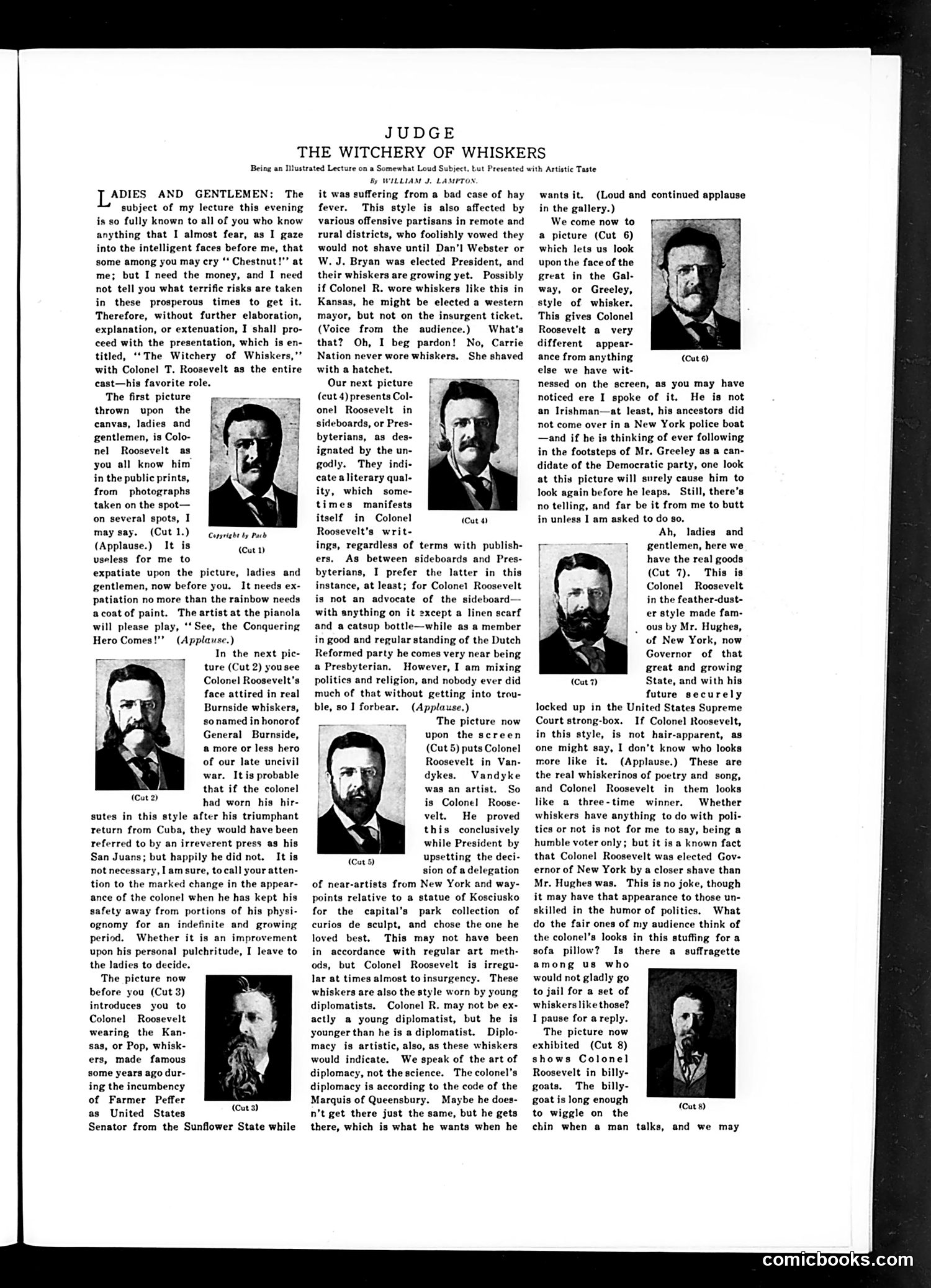
This is a satirical illustrated lecture by William J. Lampton mocking **Theodore Roosevelt** through different facial hair styles. The page presents multiple photographs of Roosevelt (labeled Cuts 1-5) wearing various whisker configurations: clean-shaven, Burnside whiskers, "Kansas Pop" whiskers, sideboards ("Presbyterians"), and Vandykes. The satire's point: Roosevelt's public image is so malleable and performative that simply changing his whiskers dramatically alters his appearance and perceived character. Each style is associated with different American political movements or stereotypes—Burnsides with Civil War nostalgia, Kansas whiskers with Populist farmers and William Jennings Bryan supporters, sideboards with literary pretension and Presbyterianism. The jokes reference Carrie Nation (the temperance activist) and farmer-politicians, mocking both Roosevelt's political ambitions and the gullibility of various constituencies. The underlying critique suggests Roosevelt's image is mere "witchery"—theatrical construction rather than substance.
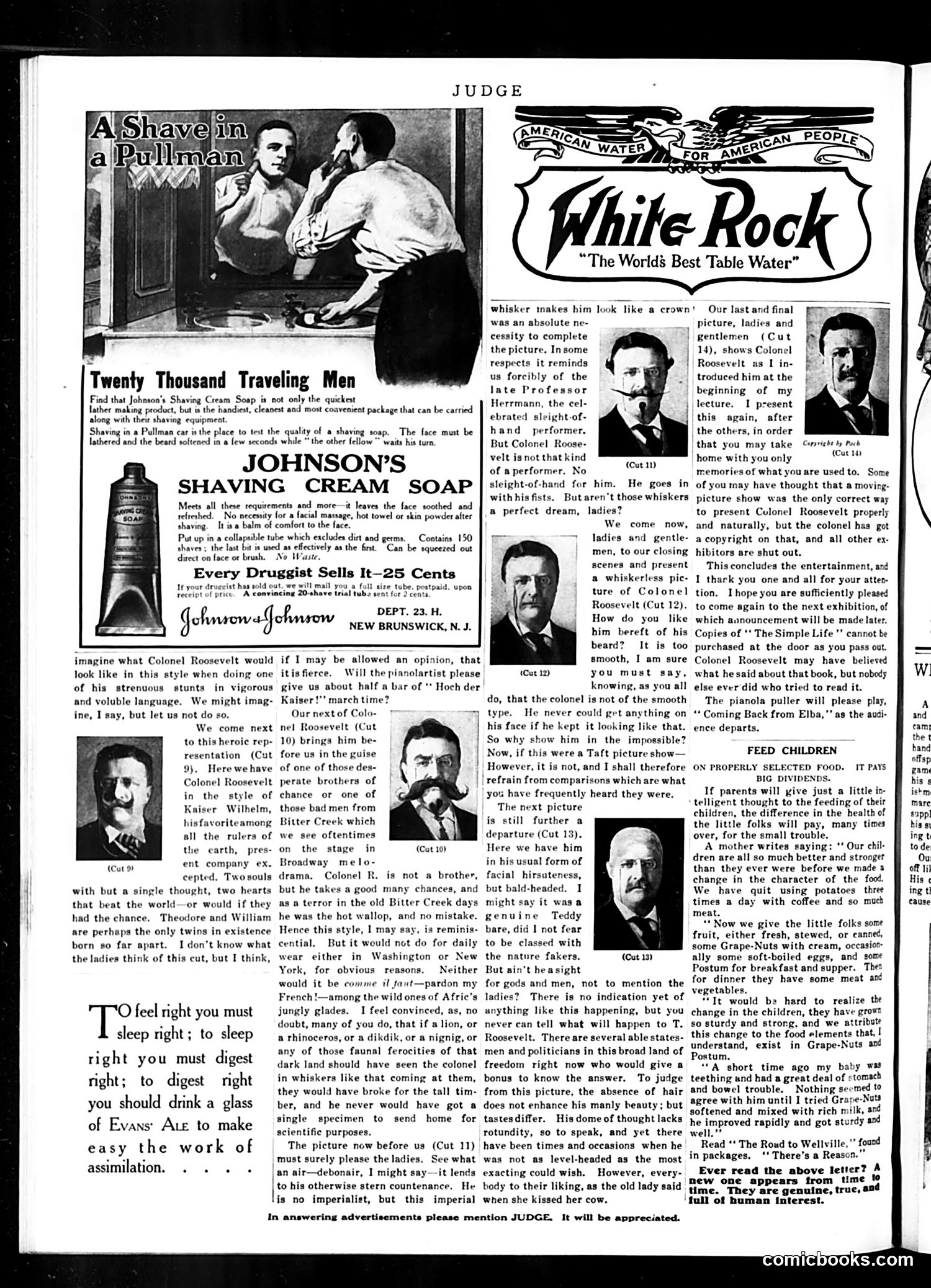
This page is primarily **advertising** for Johnson's Shaving Cream Soap and Evans' Ale, interspersed with a satirical article about Theodore Roosevelt. The main cartoon content mocks **Colonel Theodore Roosevelt** by showing him dressed in various exaggerated facial hair styles—as Kaiser Wilhelm II, as a Wild West outlaw from "Bitter Creek," and as a magician (Professor Herrmann). The satire's point: Roosevelt's public persona is so forceful and protean that he could convincingly adopt *any* style, no matter how incongruous. The article's tone is playful mockery of Roosevelt's famous vigor and international prominence. References to his African safari and his reputation for "strenuous" action support this. The comparison to Kaiser Wilhelm suggests Roosevelt shared that ruler's imperial ambitions—a dig at his expansionist foreign policy. The humor relies on Roosevelt's recognizability to Judge's contemporary audience and his larger-than-life public image as America's energetic, adventurous leader.
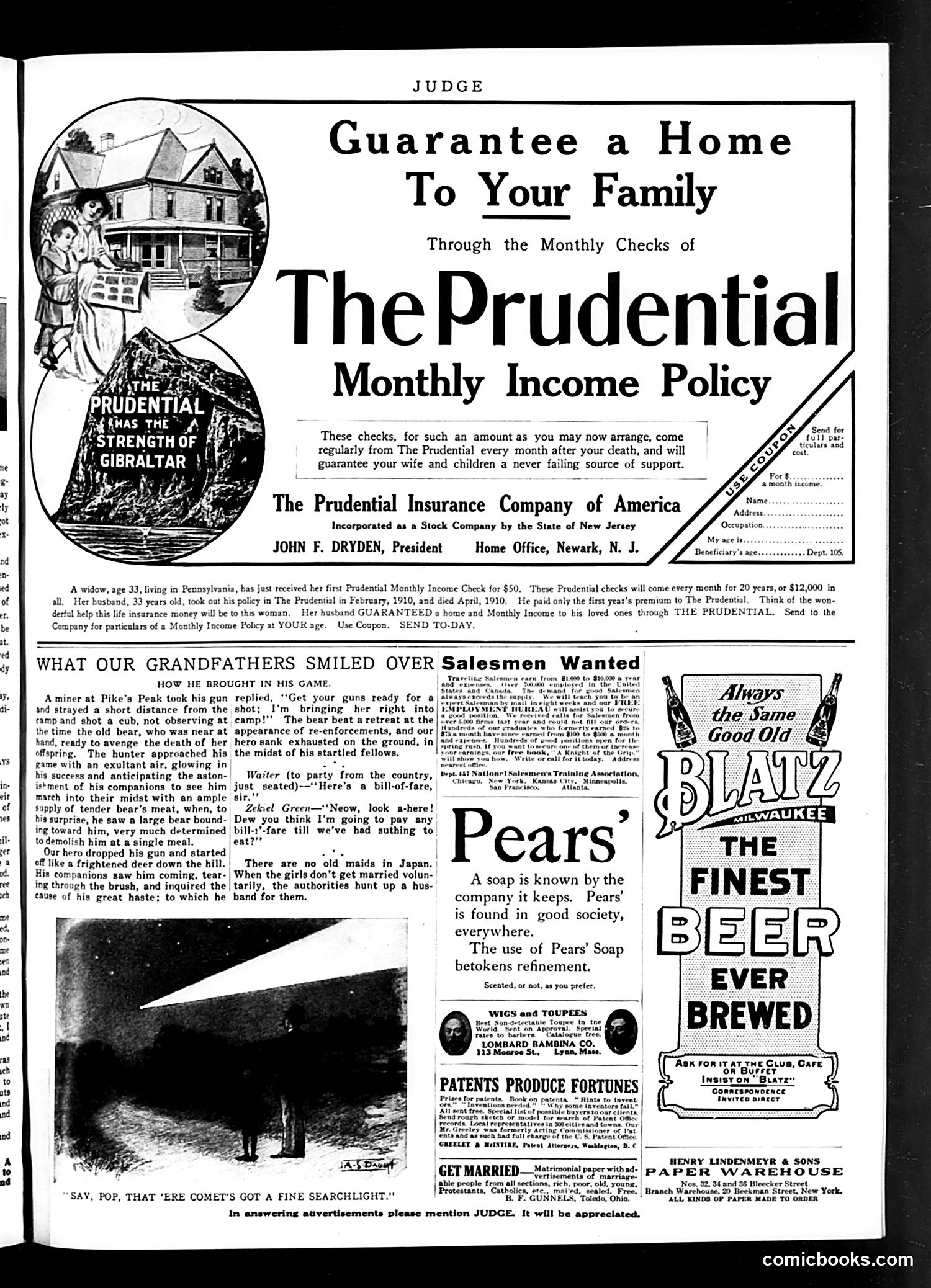
This page from *Judge* is primarily **advertising**, not political satire. The main content includes: **Top Advertisement:** The Prudential Insurance Company promotes its "Monthly Income Policy"—life insurance guaranteeing monthly payments to widows and children after a husband's death. A real case study (a 33-year-old Pennsylvania widow receiving $50 monthly) demonstrates the product's value. **Bottom Section ("What Our Grandfathers Smiled Over"):** A humorous anecdote about a miner at Pike's Peak who shoots a bear cub, then flees when the mother bear attacks—a tall tale meant to amuse readers with frontier exaggeration and slapstick. **Additional Ads:** Include Pears' Soap (emphasizing social refinement), Blatz Beer (Milwaukee), patent services, wigs/toupees, and paper warehouse services. The page reflects early-20th-century concerns: life insurance as financial security for families, nostalgia for frontier adventure stories, and consumption of luxury goods signaling respectability.
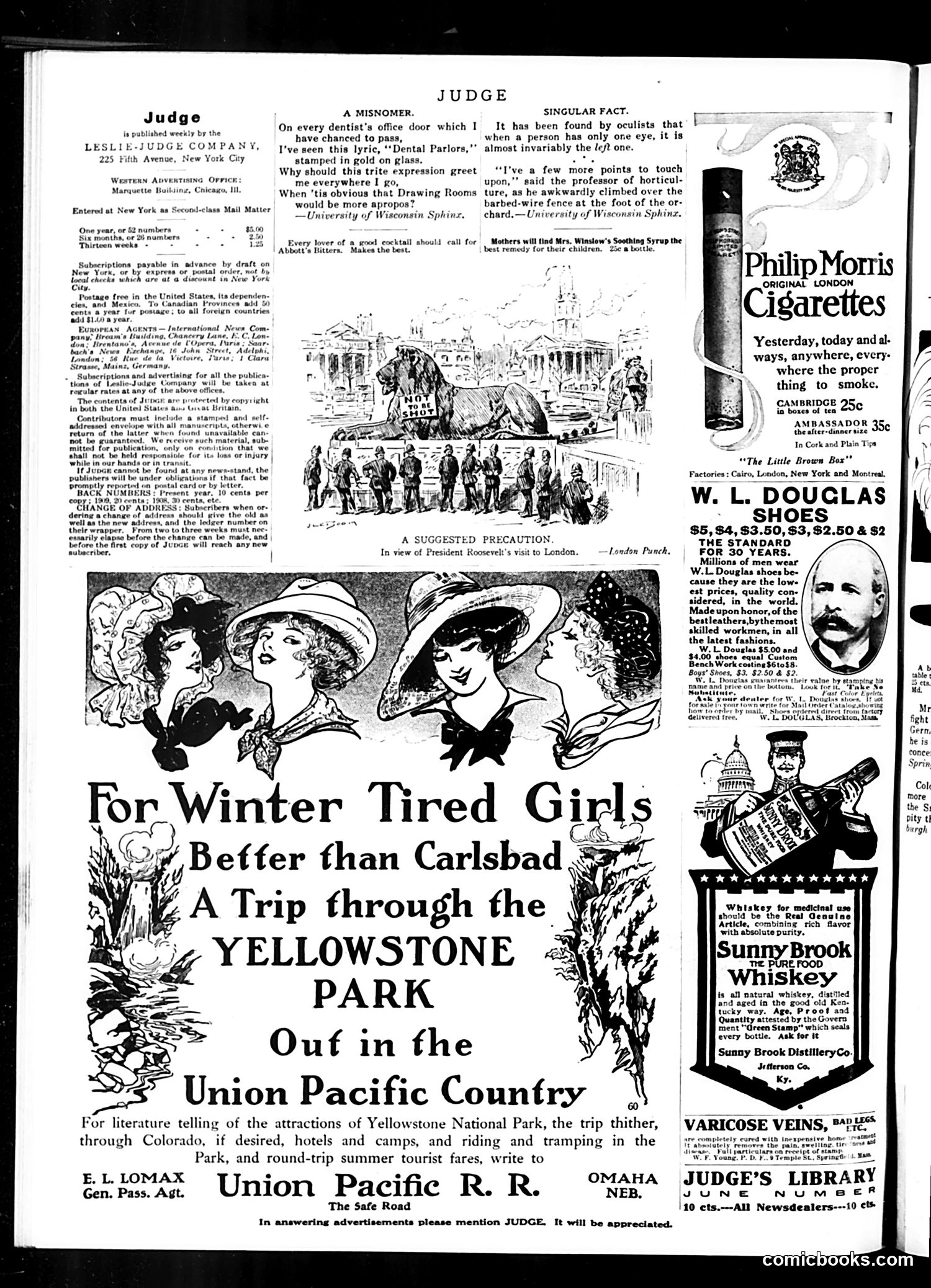
This is primarily an **advertising page** with brief satirical items. The main content consists of: **"A Misnomer"** and **"Singular Fact"**: Short humor pieces mocking professional jargon—dentists calling offices "Parlors" instead of "Drawing Rooms," and an absurd "scientific" claim that one-eyed people always lose the left eye. **"A Suggested Precaution"**: A cartoon referencing President Theodore Roosevelt's visit to London, showing four women in large hats. The humor likely plays on security concerns or social etiquette around a presidential visit, though the specific joke is unclear from context. The page is dominated by advertisements for **Philip Morris cigarettes**, **W.L. Douglas shoes**, **Abbott's Bitters**, **Sunny Brook whiskey**, and **Union Pacific Railroad** promoting Yellowstone tourism. The satirical content is minimal—mostly light wordplay rather than political commentary. This reflects Judge's character as a general-interest humor magazine mixing satire with commercial advertising.
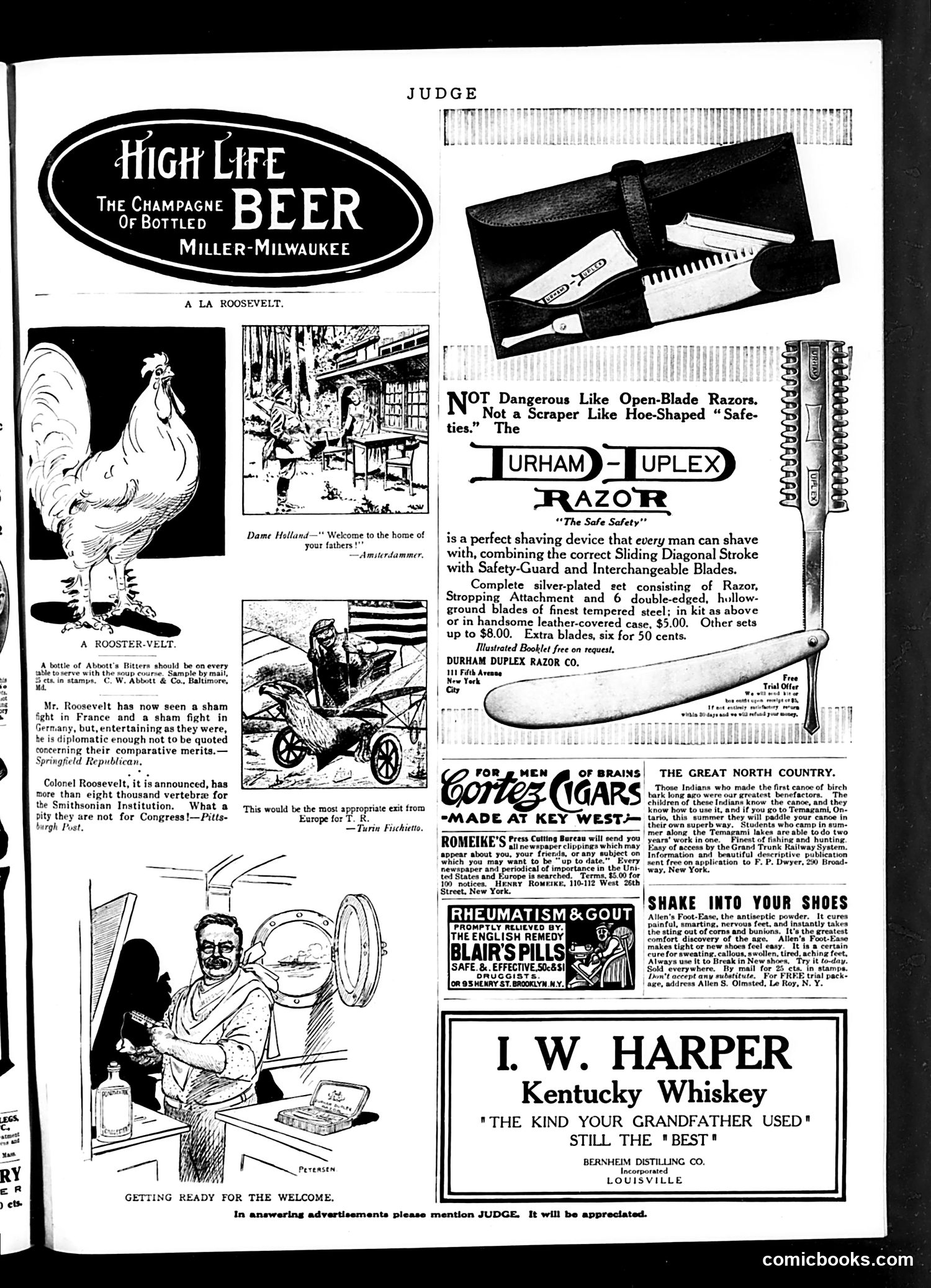
This page from Judge magazine features political cartoons mocking **Theodore Roosevelt's recent European tour**. The main cartoon, titled "Getting Ready for the Welcome," depicts Roosevelt preparing to return home after visiting France and Germany. The accompanying text satirizes his diplomatic caution about comparing the "sham fights" (military exercises) he witnessed, suggesting he's being appropriately circumspect. A second cartoon plays on his name: "A Rooster-Velt" shows a rooster, punning on Roosevelt while referencing Miller beer's "à la Roosevelt" branding. The page also includes a joke about Roosevelt collecting vertebrae for the Smithsonian Institution, implying even his skeletal remains would be valuable. The remainder consists of period advertisements for razors, cigars, whiskey, and patent medicines—typical Judge content mixing satire with commercial promotions. The overall tone reflects early 20th-century American humor lampooning a popular but occasionally pompous public figure.
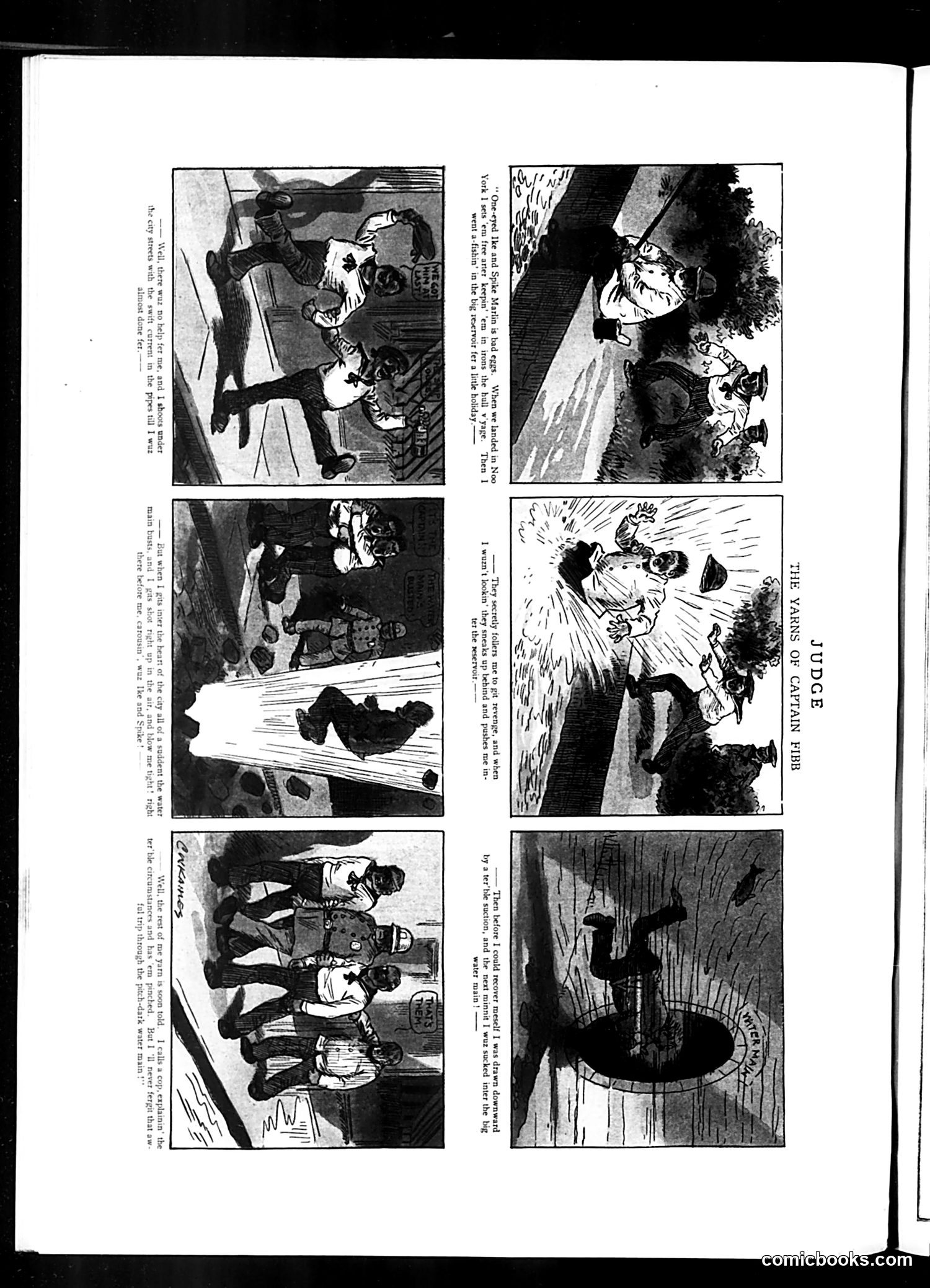
This appears to be a humorous serial comic strip titled "The Yarns of Captain Fibb," likely featuring a one-eyed sea captain character (suggested by the OCR text mentioning "One-eyed"). The six panels show various exaggerated adventures or tall tales, a classic format for satirizing boastful seafarers and their implausible stories. The visual style—crude woodcut-like illustrations—is typical of Judge magazine's political satire. Without clearer OCR text, the specific political references are unclear, but the strip likely mocks either a contemporary figure through the captain caricature, or more broadly satirizes maritime culture and the unreliability of sailors' accounts. The fragmented OCR suggests the caption text would clarify the joke, but it's largely illegible here.