
Judge, 1910-06-11 · page 11 of 16
Judge — June 11, 1910 — page 11: what you’re looking at
What you’re looking at
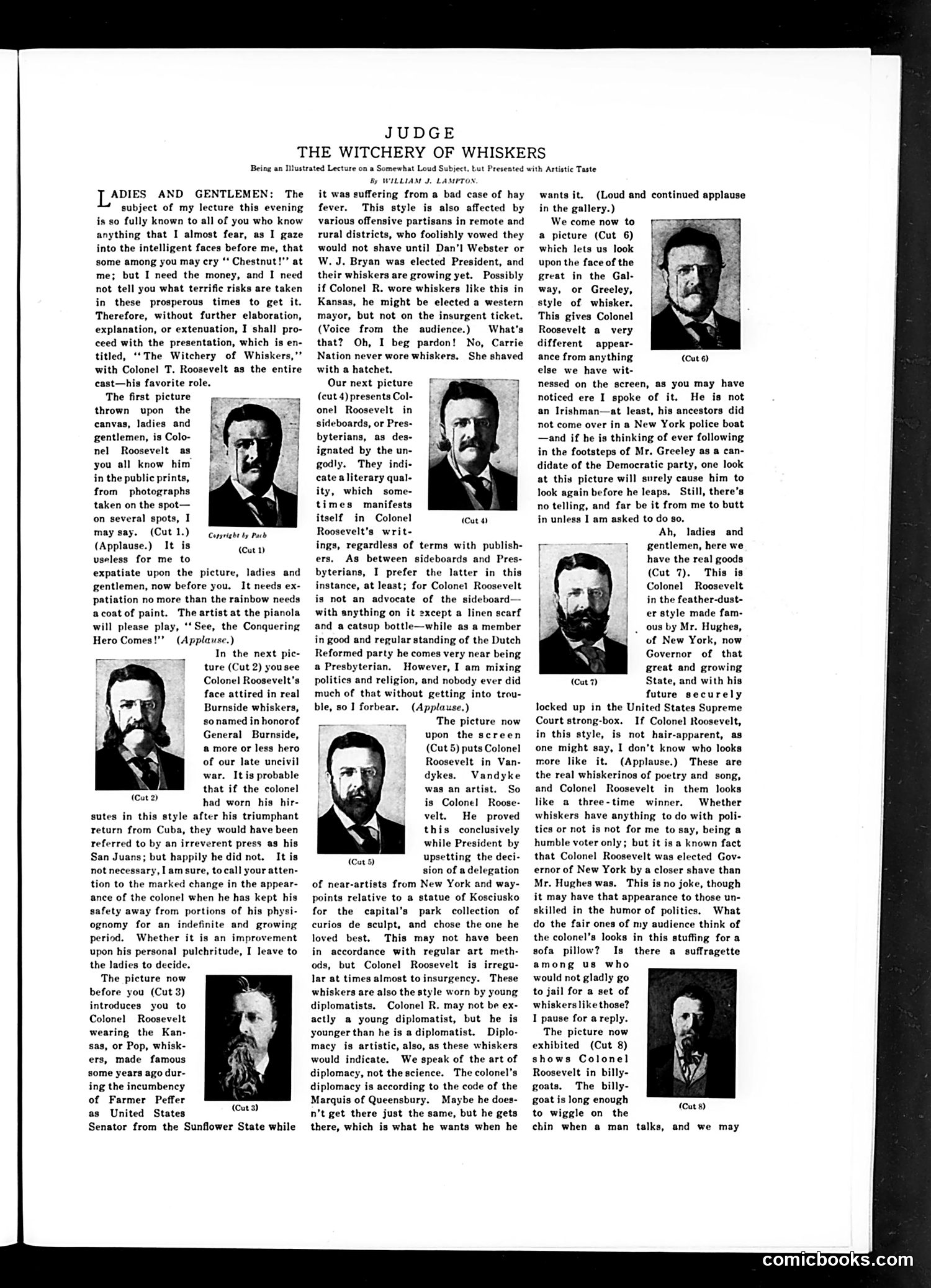
This is a satirical illustrated lecture by William J. Lampton mocking **Theodore Roosevelt** through different facial hair styles. The page presents multiple photographs of Roosevelt (labeled Cuts 1-5) wearing various whisker configurations: clean-shaven, Burnside whiskers, "Kansas Pop" whiskers, sideboards ("Presbyterians"), and Vandykes. The satire's point: Roosevelt's public image is so malleable and performative that simply changing his whiskers dramatically alters his appearance and perceived character. Each style is associated with different American political movements or stereotypes—Burnsides with Civil War nostalgia, Kansas whiskers with Populist farmers and William Jennings Bryan supporters, sideboards with literary pretension and Presbyterianism. The jokes reference Carrie Nation (the temperance activist) and farmer-politicians, mocking both Roosevelt's political ambitions and the gullibility of various constituencies. The underlying critique suggests Roosevelt's image is mere "witchery"—theatrical construction rather than substance.
📄 Transcribed text from this page (OCR, searchable)
Machine-transcribed from the original scan — historical spelling and the odd misread are preserved.
JUDGE THE WITCHERY OF WHISKERS Being an Illustrated Lecture on a Somewhat Loud Subject, Lut Presented with Artistic Taste ADIES AND GENTLEME! The subject of my lecture this evening is so fully known to all of you who know anything that I almost fear, as I gaze into the intelligent faces before me, that some among you may cry “‘ Chestnut!"’ at me; but I need the money, and I need not tell you what terrific risks are taken in these prosperous times to get it. Therefore, without further elaboration, ion, or extenuation, I shall pro- h the presentation, which is en- titled, ‘‘The Witchery of Whiskers,’’ with Colonel T. Roosevelt as the entire cast—his favorite role. The first picture thrown upon the canvas, ladies and gentlemen, is Colo- nel Roosevelt as you all know him in the public prints, from photographs taken on the spot— on several spots, I may say. (Cut 1.) (Applause.) It is useless for me to expatiate upon the picture, ladies and gentlemen, now before you. It needs ex- patiation no more than the rainbow needs acoatof paint. The artist at the pianola will please play, ‘*See, the Conquering Hero Comes!” (Applause.) In the next pic- ture (Cut 2) yousee Colonel Roosevelt's face attired in real Burnside whiskers, sonamed in honorof General Burnside, a more or less hero of our late uncivil war. Itis probable that if the colonel had worn his hir- sutes in this style after his triumphant return from Cuba, they would have been referred to by an irreverent press as his San Juans; but happily he did not. It is not necessary, I am sure, tocall your atten- tion to the marked change in the appear- ance of the colonel when he has kept his safety away from portions of his physi- ognomy for an indefinite and growing period. Whether it is an improvement upon his personal pulchritude, I leave to the ladies to decide. The picture now before you (Cut 3) introduces you to Colonel Roosevelt wearing the Kan- sas, or Pop, whisk- ers, made famous some years ago dur- ing the incumbency of Farmer Peffer as United States Senator from the Sunflower State while Copyright by Pach (cut (Cut 2) (Cut 3) By WILLIAM J. LAMPTON. it was suffering from a bad case of hay fever. This style is also affected by various offensive partisans in remote and rural districts, who foolishly vowed they would not shave until Dan’! Webster or W. J. Bryan was elected President, and their whiskers are growing yet. Possibly if Colonel R. wore whiskers like this in Kansas, he might be elected a western mayor, but not on the insurgent ticket. (Voice from the audience.) What's that? Oh, I beg pardon! No, Carrie Nation never wore whiskers. She shaved with a hatchet. Our next picture ff (cut 4)presentsCol- |. j onel Roosevelt in bet sideboards, or Pres- | byterians, as des- | ignated by the un- godly. They in cate a literary qu: which times manifests itself in Colonel Roosevelt's writ- ings, regardless of terms with publish- ers. As between sideboards and Pres- byterians, I prefer the latter in this instance, at least; for Colonel Roosevelt is not an advocate of the sideboard— with anything on it except a linen scarf and a catsup bottle—while as a member in good and regular standing of the Dutch Reformed party he comes very near being a Presbyterian. However, I am mixing politics and religion, and nobody ever did much of that without getting into trou- ble, so I forbear. (Applause.) The picture now upon the screen (Cut 5) puts Colonel Roosevelt in Van- dykes. Vandyke was an artist. So is Colonel Roose- velt. He proved this conclusively while President by upsetting the deci- sion of a delegation of near-artists from New York and way- points relative to a statue of Kosciusko for the capital's park collection of curios de sculpt, and chose the one he loved best. This may not have been in accordance with regular art meth- ods, but Colonel Roosevelt is irregu- lar at times almost to insurgency. These whiskers are also the style worn by young diplomatists. Colonel R. may not be ex- actly a young diplomatist, but he is younger than he is a diplomatist. Diplo- macy is artistic, also, as these whiskers would indicate. We speak of the art of diplomacy, not the science. The colonel’s diplomacy is according to the code of the Marquis of Queensbury. Maybe he does- n't get there just the same, but he gets there, which is what he wants when he some- «cura (Cut 5) wants it. (Loud and continued applause in the gallery.) We come now to a picture (Cut 6) which lets us look upon the face of the great in the Gal- way, or Greeley, style of whisker. This gives Colonel Roosevelt a very different appear- ance from anything else we have wit- nessed on the screen, as you may have noticed ere I spoke of it. He is not an Irishman—at least, his ancestors did not come over in a New York police boat —and if he is thinking of ever following in the footsteps of Mr. Greeley as a can- didate of the Democratic party, one look at this picture will surely cause him to look again before he leaps, Still, there's no telling, and far be it from me to butt in unless I am asked to do so, Ah, ladies and gentlemen, here we have the real goods (Cut 7). This is Colonel Roosevelt in the feather-dust- er style made fam- _ ous by Mr. Hughes, of New York, now Governor of that great and growing State, and with his future securely locked up in the United States Supreme Court strong-box. If Colonel Roosevelt, in this style, is not hair-apparent, as one might say, I don’t know who looks more like it. (Applause.) These are the real whiskerinos of poetry and song, and Colonel Roosevelt in them looks like a three-time winner. Whether whiskers have anything to do with poli- tics or not is not for me to say, being a humble voter only; but it isa known fact that Colonel Roosevelt was elected Gov- ernor of New York by a closer shave than Mr. Hughes was. This is no joke, though it may have that appearance to those un- skilled in the humor of politics. What do the fair ones of my audience think of the colonel’s looks in this stuffing for a sofa pillow? Is there a suffragette among us who would not gladly go to jail for a set of whiskers like those? I pause for a reply. The picture now exhibited (Cut 8) shows Colonel Roosevelt in billy- goats, The billy- goat is long enough to wiggle on the chin when a man talks, and we may (Cut 6) (cat 7) (Cut 8) comicbooks.com