
Judge, 1910-06-11 · page 4 of 16
Judge — June 11, 1910 — page 4: what you’re looking at
What you’re looking at
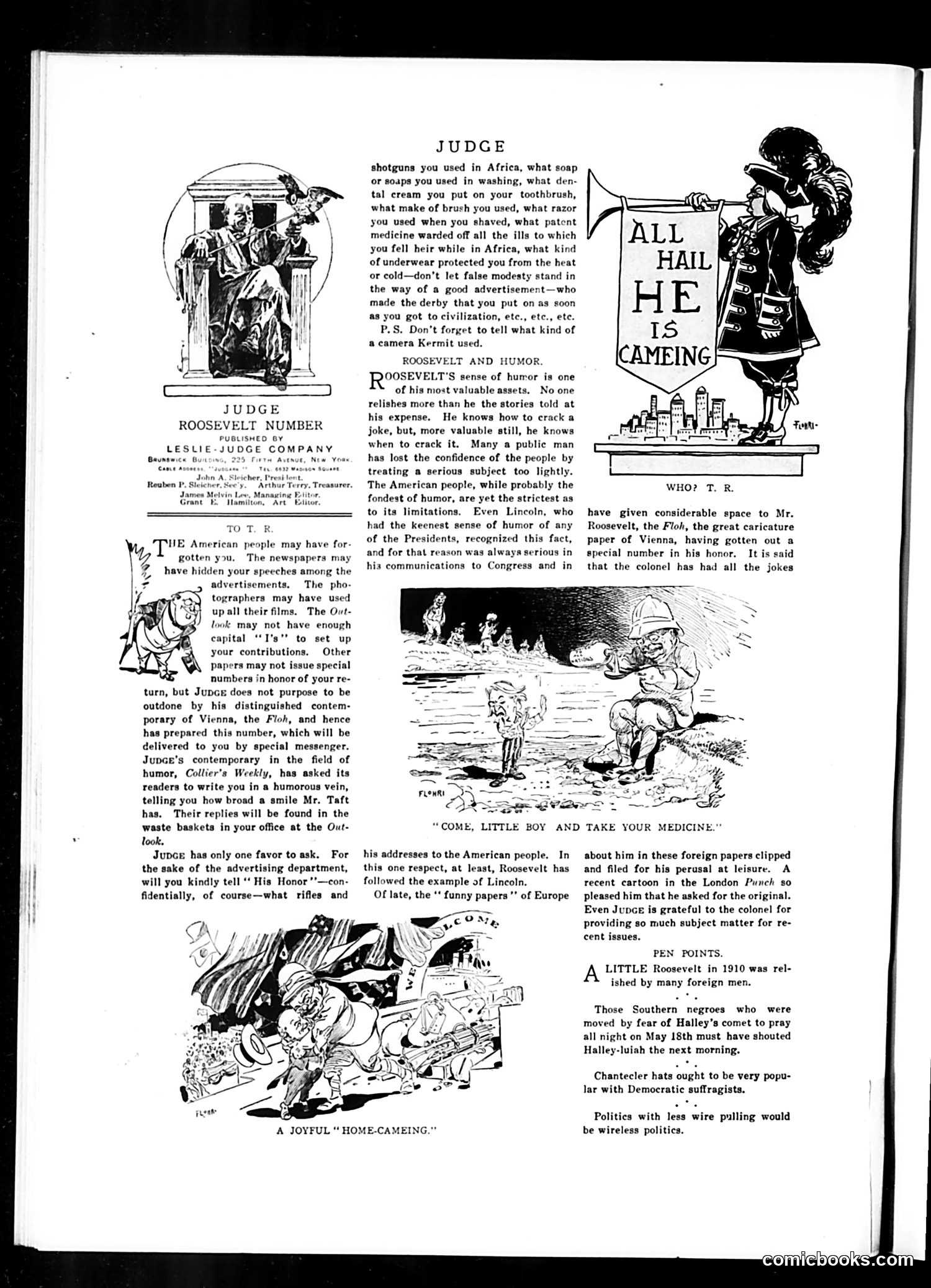
This page celebrates Theodore Roosevelt's humor as a political asset. The main cartoon titled "Judge: Roosevelt Number" praises Roosevelt's ability to tell jokes and crack humorous stories—presented as crucial for maintaining public confidence in leadership. The text contrasts Roosevelt favorably with Lincoln, noting both recognized humor's value in serious communications. However, the page criticizes European leaders for their "funny papers," suggesting American humor is superior and more refined. The illustrated cartoons below satirize Roosevelt's outdoor activities, particularly camping ("All Hail He Is Camping"). One sketch shows a child taking "medicine," likely referencing Roosevelt's vigorous, sometimes controversial policies presented as beneficial remedies. The overall message: Roosevelt's wit and public persona are strengths that distinguish American democratic leadership from European alternatives.
📄 Transcribed text from this page (OCR, searchable)
Machine-transcribed from the original scan — historical spelling and the odd misread are preserved.
ROOSEVELT NUMBER PUBLISHED BY LESLIE-JUDGE COMPANY TOT wT" American people may have for- gotten you, The newspapers may y have hidden your speeches among the advertisements. The pho- tographers may have used up all their films. The Out- look may not have enough capital ‘“I's" to set up your contributions. Other papers may not issue special E numbers in honor of your re- turn, but Jupce does not purpose to be outdone by his distinguished contem- porary of Vienna, the Floh, and hence has prepared this number, which will be delivered to you by special messenger. Jupce’s contemporary in the field of humor, Collier's Weekly, has asked its readers to write you in a humorous vein, telling you how broad a smile Mr. Taft has, Their replies will be found in the waste baskets in your office at the Out- * look, Jupnce has only one favor to ask. For the sake of the advertising department, will you kindly tell ‘‘ His Honor ’’—con- fidentially, of course—what rifles and JUDGE shotguns you used in Africa, what soap or soaps you used in washing, what den- tal cream you put on your toothbrush, what make of brush you used, what razor you used when you shaved, what patent medicine warded off all the ills to which you fell heir while in Africa, what kind of underwear protected you from the heat or cold—don’t let false modesty stand in the way of a good advertisement—who made the derby that you put on as soon ation, ete., ete., ete. et to tell what kind of a camera Kermit used. ROOSEVELT AND HUMOR OOSEVELT'S sense of humor is one of his most valuable assets. No one relishes more than he the stories told at his expense. He knows how to crack a joke, but, more valuable still, he knows when to crack it. Many a public man lost the confidence of the people by treating a serious subject too lightly. The American people, while probably the fondest of humor, are yet the strictest as to its limitations. Even Lincoln, who had the keenest sense of humor of any of the Presidents, recognized this fact, and for that reason was always serious in his communications to Congress and in rots SS a as Ze WHO? TR. have given considerable space to Mr. Roosevelt, the Floh, the great caricature paper of Vienna, having gotten out a special number in his honor. It is said that the colonel has had all the jokes “COME, LITTLE BOY AND TAKE YOUR MEDICINE.” his addresses to the American people. In this one respect, at least, Roosevelt has followed the example of Lincoln. Of late, the ‘* funny papers’ of Europe A JOYFUL " HOME-CAMEING.” about him in these foreign papers clipped and filed for his perusal at leisure. A recent cartoon in the London Punch so pleased him that he asked for the original. Even Jupce is grateful to the colonel for providing so much subject matter for re- cent issues. PEN POINTS. LITTLE Roosevelt in 1910 was rel- ished by many foreign men. Those Southern negroes who were moved by fear of Halley’s comet to pray all night on May 18th must have shouted Halley-luiah the next morning. Chantecler hats ought to be very popu- lar with Democratic suffragists. Politics with less wire pulling would be wireless politics.