
Judge, 1910-06-11 · page 6 of 16
Judge — June 11, 1910 — page 6: what you’re looking at
What you’re looking at
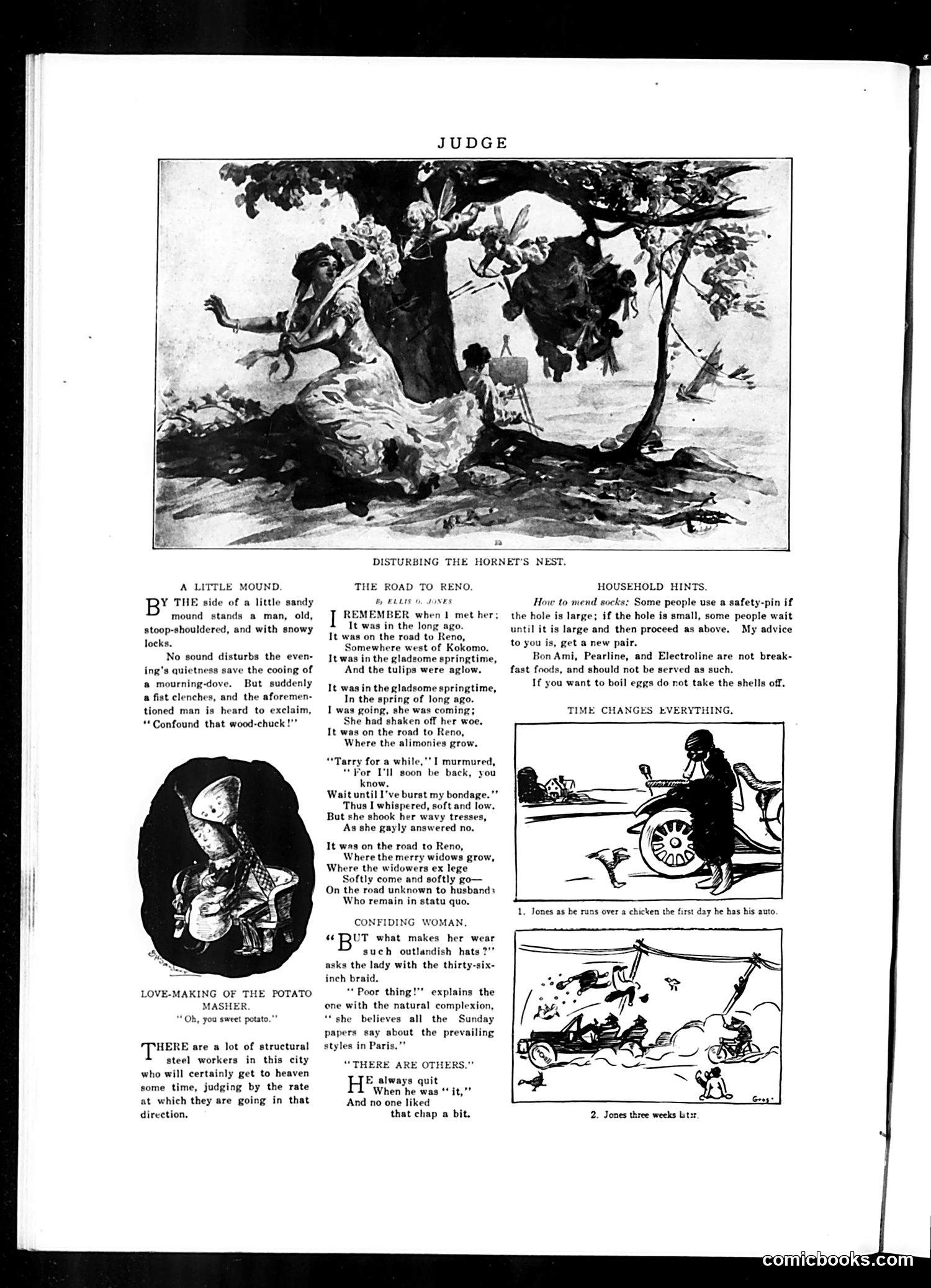
This page collects various satirical pieces typical of early 20th-century Judge magazine. The main social commentary centers on **divorce and remarriage**, particularly the "Road to Reno" poem about traveling to Nevada (famous for lenient divorce laws) to obtain separations. The poem mocks the prevalence of divorce and remarriage, referring to "merry widows" and "alimonies" as established phenomena. The cartoon series "Time Changes Everything" shows a man's relationship with his automobile evolving from novelty to worn-out burden—likely satirizing Americans' changing attitudes toward new technology. Secondary pieces mock fashion pretension (women blindly following Paris styles), structural workers' safety records, and other domestic absurdities. "Disturbing the Hornet's Nest" (top illustration) remains unclear without additional context, though it depicts confrontational activity. The humor targets contemporary social anxieties: divorce's normalization, fashion snobbery, and industrial progress.
📄 Transcribed text from this page (OCR, searchable)
Machine-transcribed from the original scan — historical spelling and the odd misread are preserved.
A LITTLE MOUND. Y THE side of a little sandy mound stands a man, old, stoop-shouldered, and with snowy locks. No sound disturbs the even- ing’s quietness save the cooing of a mourning-dove. But suddenly a fist clenches, and the aforemen- tioned man is heard to exclaim, “*Confound that wood-chuck !’” LOVE-MAKING OF THE POTATO MASHER “Ob, you sweet potato.”” HERE are a lot of structural steel workers in this city who will certainly get to heaven some time, judging by the rate at which they are going in that direction. DISTURBING THE HORNET'S NEST. THE ROAD TO RENO. By ELLIS 0. JONES ] REMEMBER when 1 met her; It was in the long ago. It was on the road to Reno, Somewhere west of Kokomo. It was in the gladeome springtime, And the tulips were aglow. It was in the gladsome springtime, In the spring of long ago. I was going, she was comin; She had shaken off her woe. It was on the road to Reno, Where the alimonies grow. “Tarry for a while,’ 1 murmured, “For I'll soon be back, you know. Wait until I’ve burst my bondage. Thus I whispered, soft and low. But she shook her wavy tresses, As she gayly answered no. It was on the road to Reno, Where the merry widows grow, Where the widowers ex lege Softly come and softly go— On the road unknown to husband: Who remain in statu quo, CONFIDING WOMAN. 4¢ QUT what makes her wear such outlandish hats?" asks the lady with the thirty-six- inch braid. ** Poor thing!’ explains the one with the natural complexion, ‘she believes all the Sunday papers say about the prevailing styles in Paris.”” “THERE ARE OTHERS.” always quit When he was “it,” And no one liked that chap a bit, HOUSEHOLD HINTS. How to mend socks: Some people use a safety-pi the hole is larg. until it is large and then proceed as above. to you is, get a new pair. Bon Ami, Pearline, and Electroline are fast foods, and should not be served as such. If you want to boil eggs do not take the TIME CHANGES EVERYTHING, ; if the hole is small, some people My advice not break- shells off. 1. 2. Jones three weeks ts.