
A complete issue · 16 pages · 1910
Judge — April 9, 1910
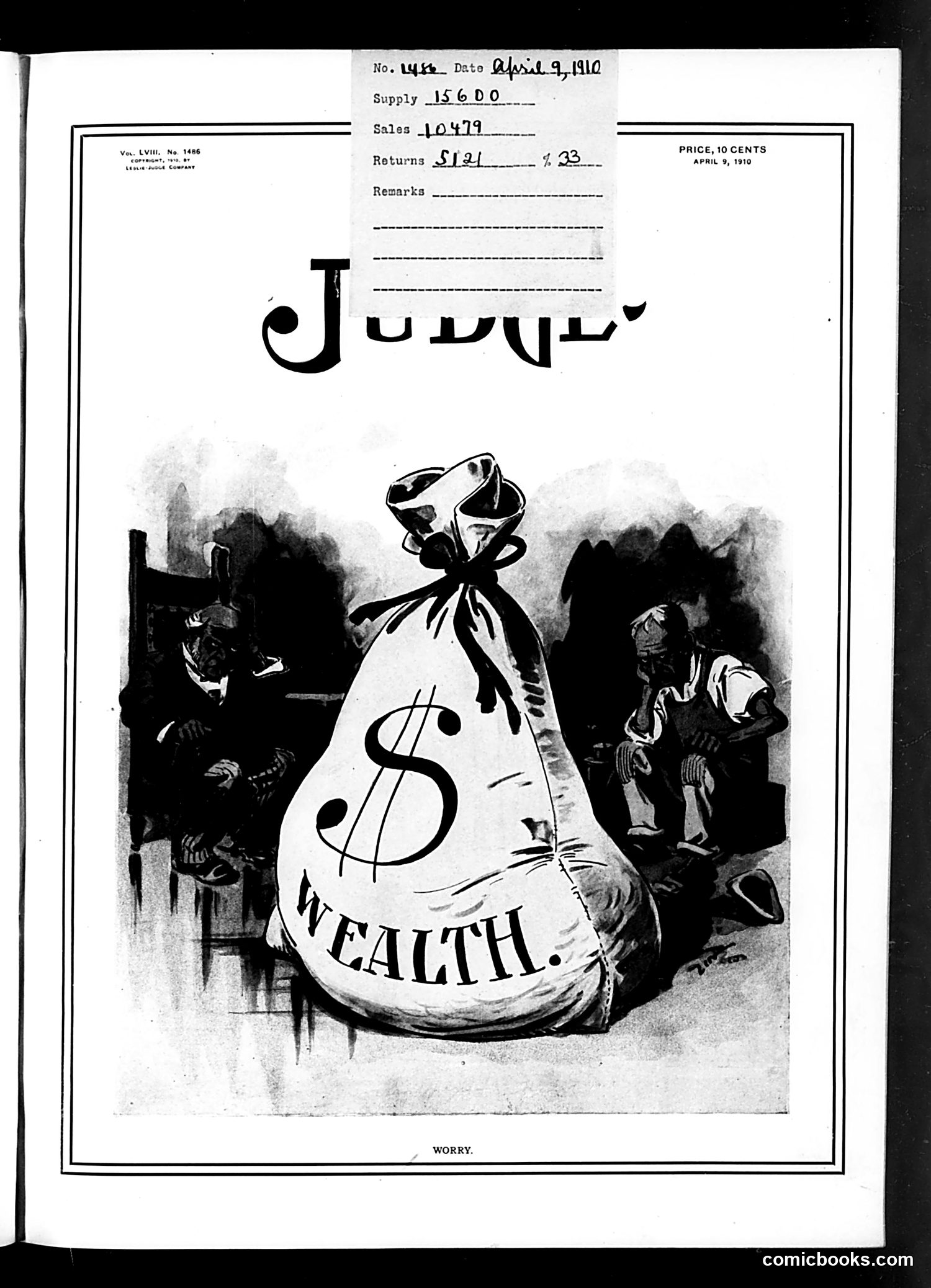
This cartoon depicts a large money bag labeled "$ WEALTH" as the central focus, surrounded by anxious figures in dark silhouettes. The title "WORRY" suggests the satirical point: wealthy individuals are consumed by anxiety despite (or because of) their riches. The figures appear to be wealthy people or financiers who, despite possessing substantial wealth, cannot escape worry and stress. This reflects early 20th-century social commentary about the psychological burden of maintaining wealth and status during an economically volatile period. The cartoon likely critiques either the inherent anxiety of the wealthy class or broader economic instability of the era. Without more specific historical context about April 1910 events, the exact target remains unclear, but the message about money failing to guarantee peace of mind is evident.
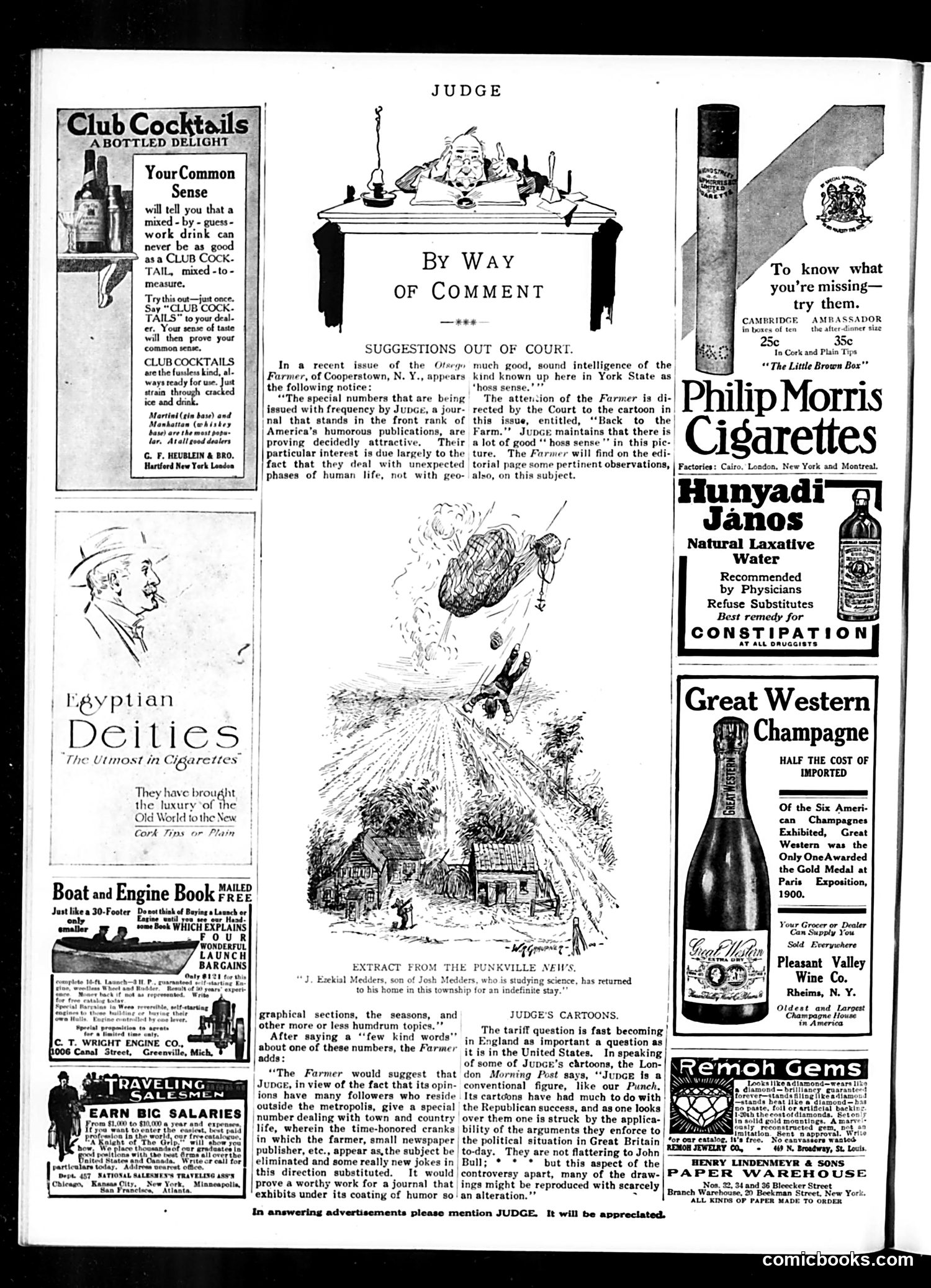
This page is primarily **advertisements and filler content** rather than substantial political satire. The main cartoon titled "By Way of Comment" shows a judge at his bench surrounded by scattered papers and objects, with a caption referencing "Suggestions Out of Court." The accompanying text discusses **tariff questions in England**, apparently contrasting The Farmer and The Farmer's opinion on trade policy. The piece appears to critique how political cartoons address these economic debates. The bulk of the page consists of **product advertisements**: Club Cocktails, Philip Morris Cigarettes, Egyptian Deillies cigarettes, Hunyadi János laxative water, Great Western Champagne, and various business services. Without clearer identification of the specific tariff debate or political figures referenced, the exact satirical point remains **unclear from this excerpt alone**.
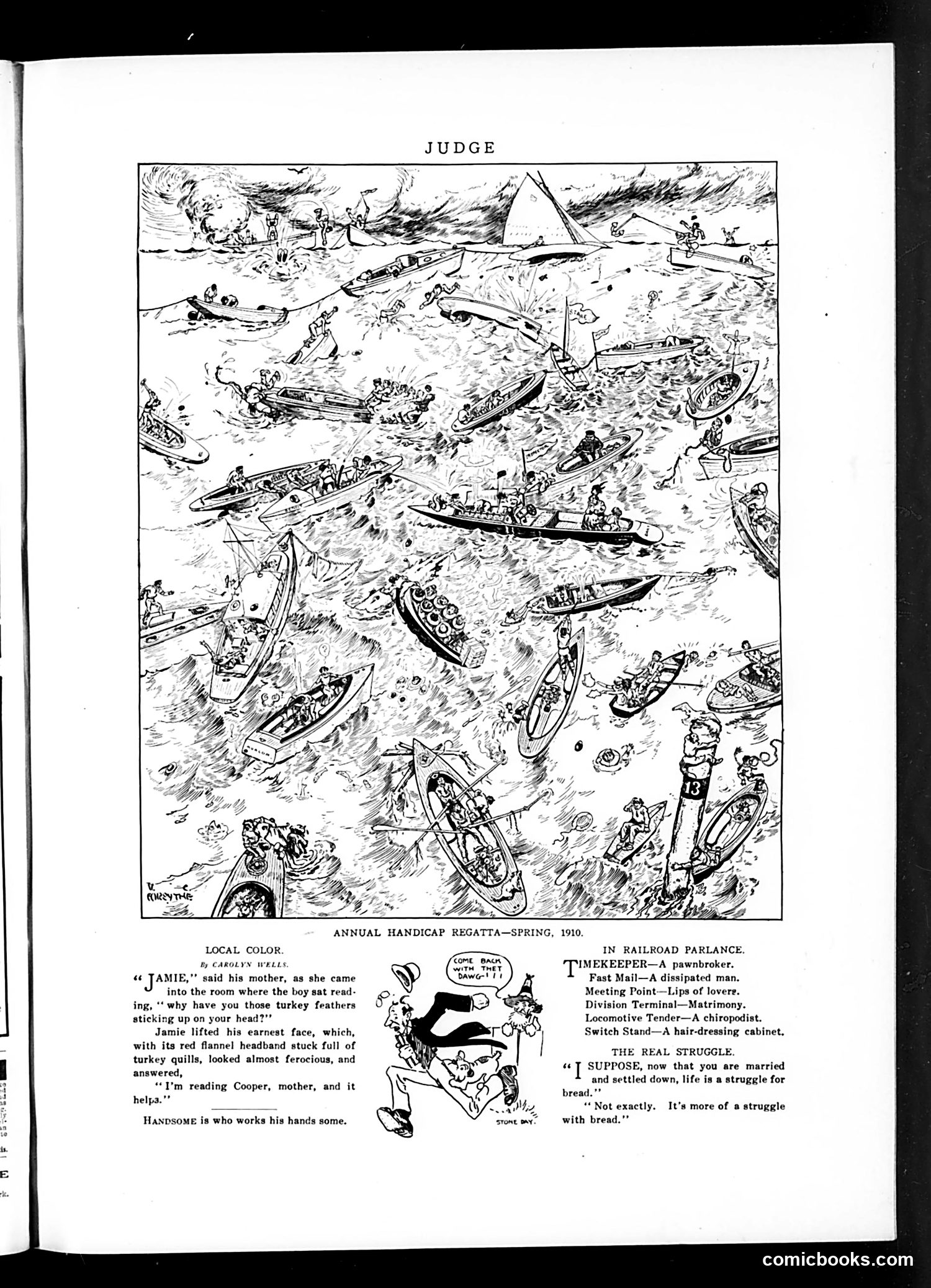
**Main Cartoon**: "Annual Handicap Regatta—Spring, 1910" depicts numerous small boats crowded in water, illustrating a chaotic scene of competition. **Sidebar Jokes**: 1. **"Local Color"**: A dialogue about "Jamie" — apparently someone with protruding ears who was told by his mother he'd "read Cooper" (likely Mark Twain's satirical reference to James Fenimore Cooper, the novelist). The joke plays on physical appearance and literary pretension. 2. **"Handsome"**: A pun defining "handsome" as someone who "works his hands some [sic]." 3. **"The Real Struggle"**: A brief exchange about married life and bread — suggesting marriage involves economic struggle rather than romantic ideals. The page uses wordplay and physical comedy typical of Judge's humor circa 1910, mixing visual satire with simple comedic definitions and domestic jokes.
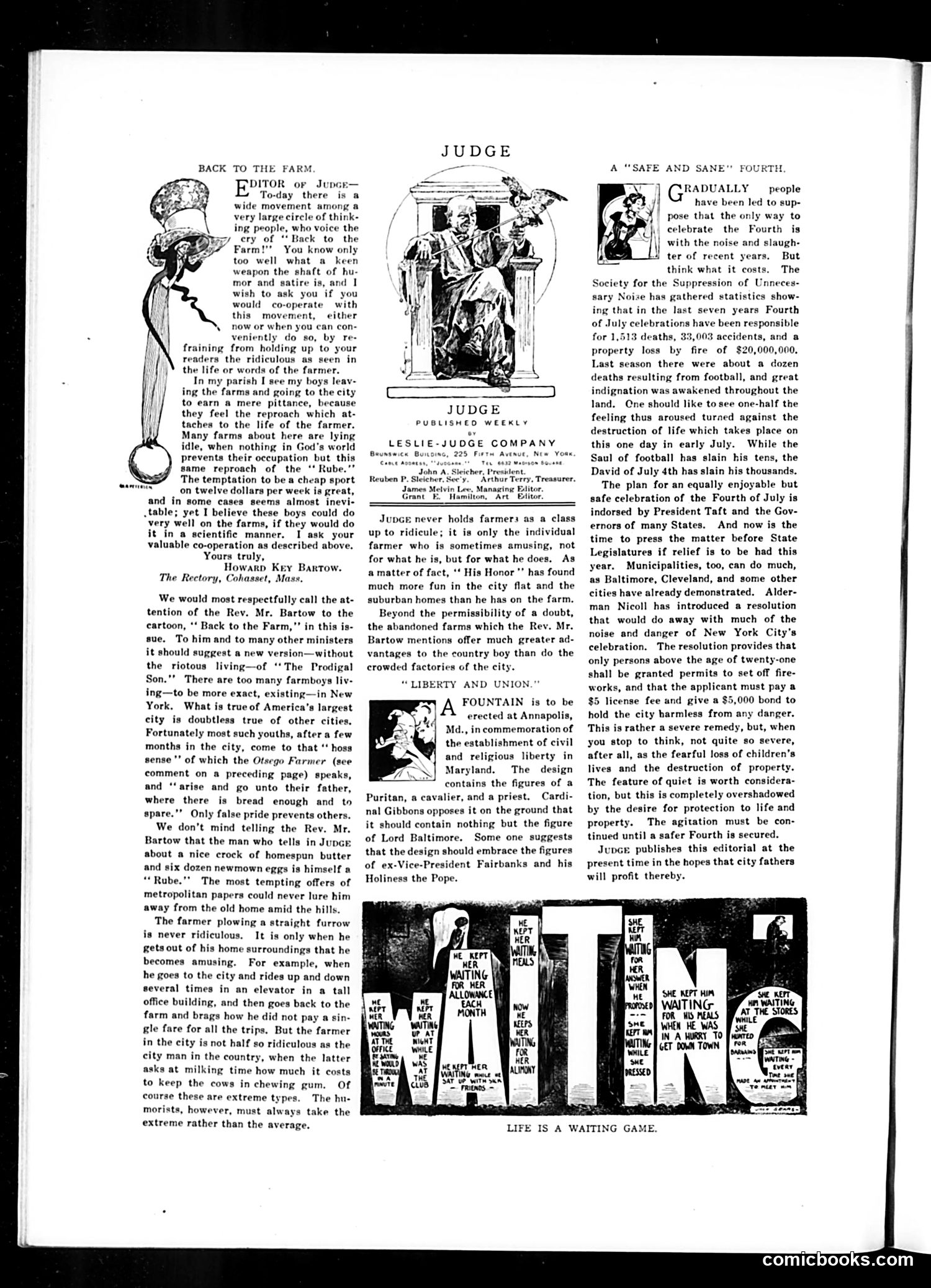
The page contains three distinct pieces: **"Back to the Farm"** (left): A satirical editorial by Howard Jay Barton criticizing the romanticization of farm life. The accompanying cartoon shows a figure in formal dress awkwardly positioned, suggesting the disconnect between city people and actual farming realities. Barton argues farmers deserve respect as individuals, not mockery, and that city dwellers who fetishize rural life lack understanding. **"A Safe and Sane Fourth"** (right): An editorial addressing Fourth of July celebrations, citing statistics on deaths and injuries. It advocates for regulated fireworks—requiring permits, licenses, and bonds—rather than banning celebrations entirely. The piece critiques both excessive noise and property damage. **"Life is a Waiting Game"** (bottom): A multi-panel cartoon depicting people waiting in various situations, likely satirizing patience and uncertainty in modern life.
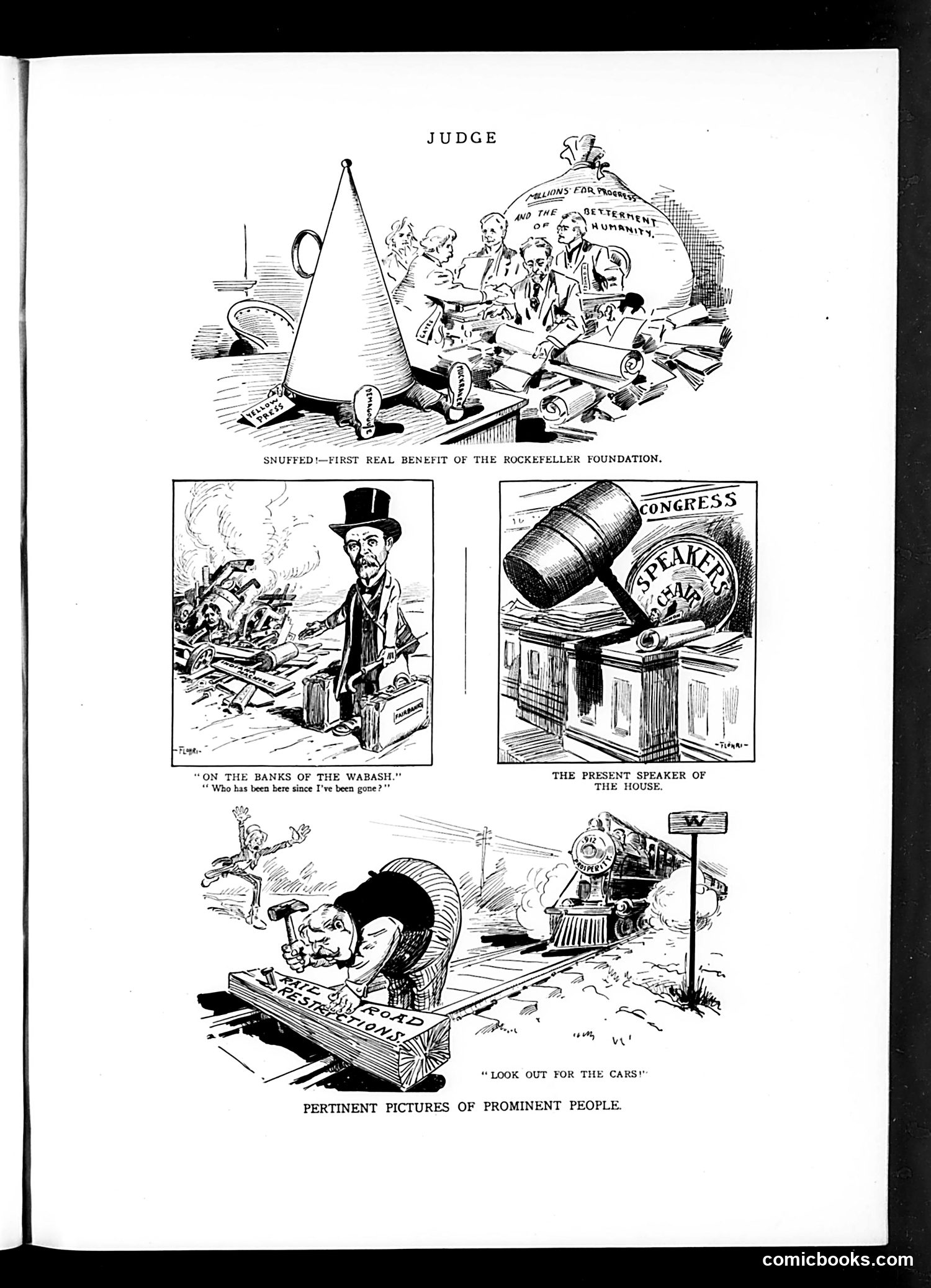
This page contains four political cartoons mocking prominent figures: 1. **Top cartoon**: "Snuffed!—First Real Benefit of the Rockefeller Foundation" depicts wealthy philanthropists extinguishing a charitable organization, sarcastically suggesting the foundation's true effect was destructive rather than beneficial. 2. **"On the Banks of the Wabash"**: Shows a figure amid wreckage, likely referencing a politician's fall from grace or failed policies. 3. **"The Present Speaker of the House"**: Depicts Congress's Speaker being struck by a hammer labeled "Congress," suggesting powerlessness or being controlled by legislative forces. 4. **"Look Out for the Cars!"**: Shows a figure on railroad tracks with an approaching train, likely satirizing reckless political behavior or dangerous policies. The overall theme appears to criticize wealthy philanthropists, political incompetence, and congressional dysfunction through exaggerated, darkly humorous imagery typical of Judge magazine's style.
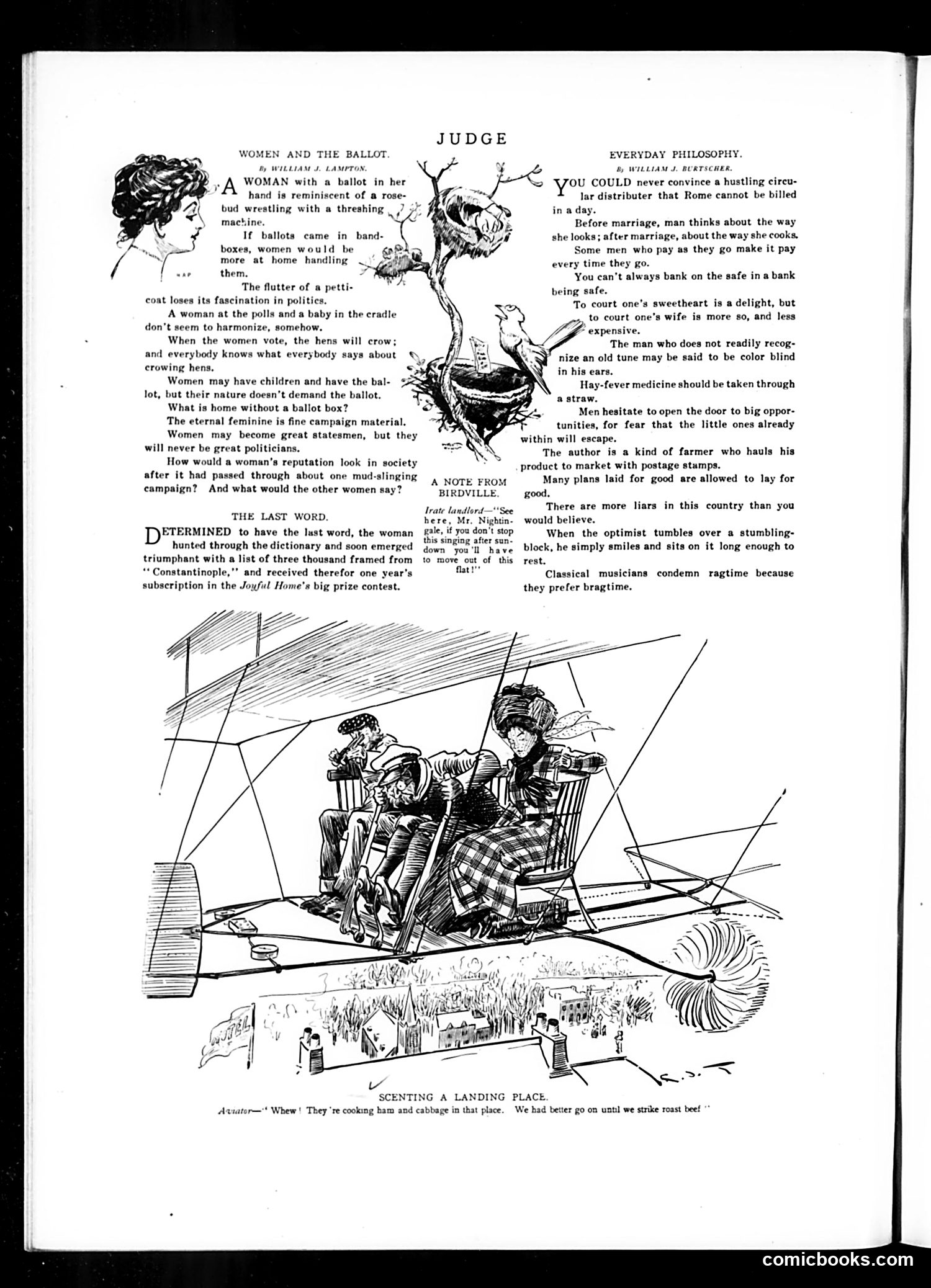
This page from *Judge* magazine contains three distinct pieces satirizing early 20th-century American society. **"Women and the Ballot"** mocks women's suffrage through absurdist comparisons—a woman with a ballot is "like a rosebud wrestling a threshing machine." The satire argues women are naturally unsuited to voting, claiming their domestic roles (motherhood, homemaking) are incompatible with political participation. This reflects anti-suffragist arguments common before women gained voting rights (1920). **"The Last Word"** humorously depicts a woman obsessively searching a dictionary to win a contest, stereotyping women as argumentative and prize-obsessed. **"Scenting a Landing Place"** shows an early aviator following cooking smells to find a suitable landing spot, satirizing the novelty and absurdity of aviation technology. The **"Everyday Philosophy"** column offers cynical observations on marriage, honesty, and human nature—typical of period humor magazines. Overall, the page reflects period attitudes toward women's rights, emerging aviation technology, and satirical social commentary typical of *Judge's* approach.
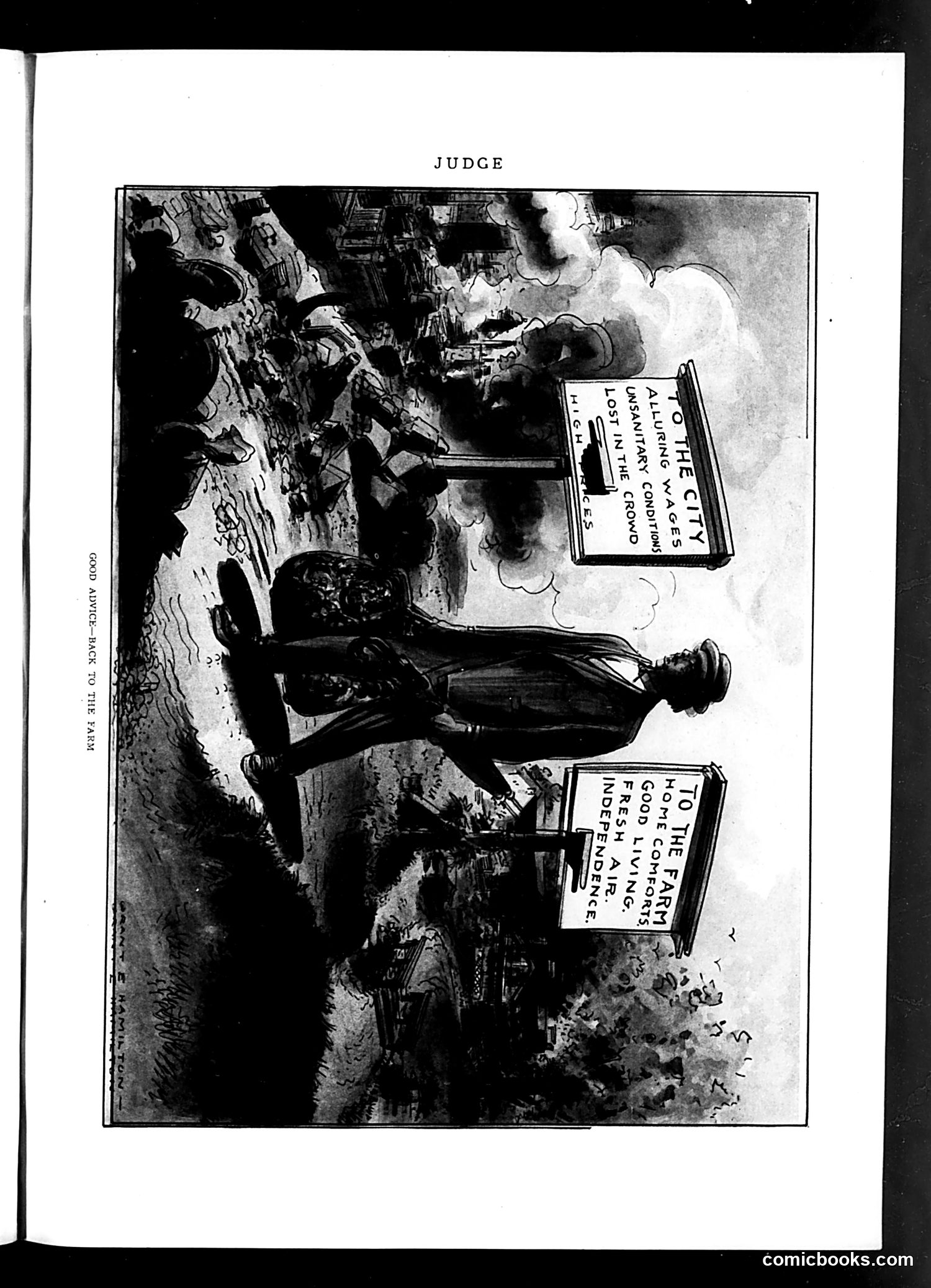
This page presents a political cartoon titled "Judge" with the subtitle "Good Advice—Back to the Farm." The image shows a well-dressed man in formal attire standing between two signage boxes in what appears to be an urban setting marked by decay and deterioration. The upper sign reads "ALL OF THE CITY'S UNEMPLOYED, VAGRANTS AND CRIMINAL ELEMENT IN THE CROWD" while the lower sign states "TO THE FARM—FOR GOOD LIVING AND INDEPENDENCE." The satire critiques a common suggestion during economic hardship (likely from the Great Depression era): that urban poor should simply relocate to farms. The cartoon suggests this advice is impractical or dismissive, implying the "judge" figure—perhaps representing politicians or the wealthy—offers patronizing solutions while standing amid the very urban blight and human suffering the advice ignores.
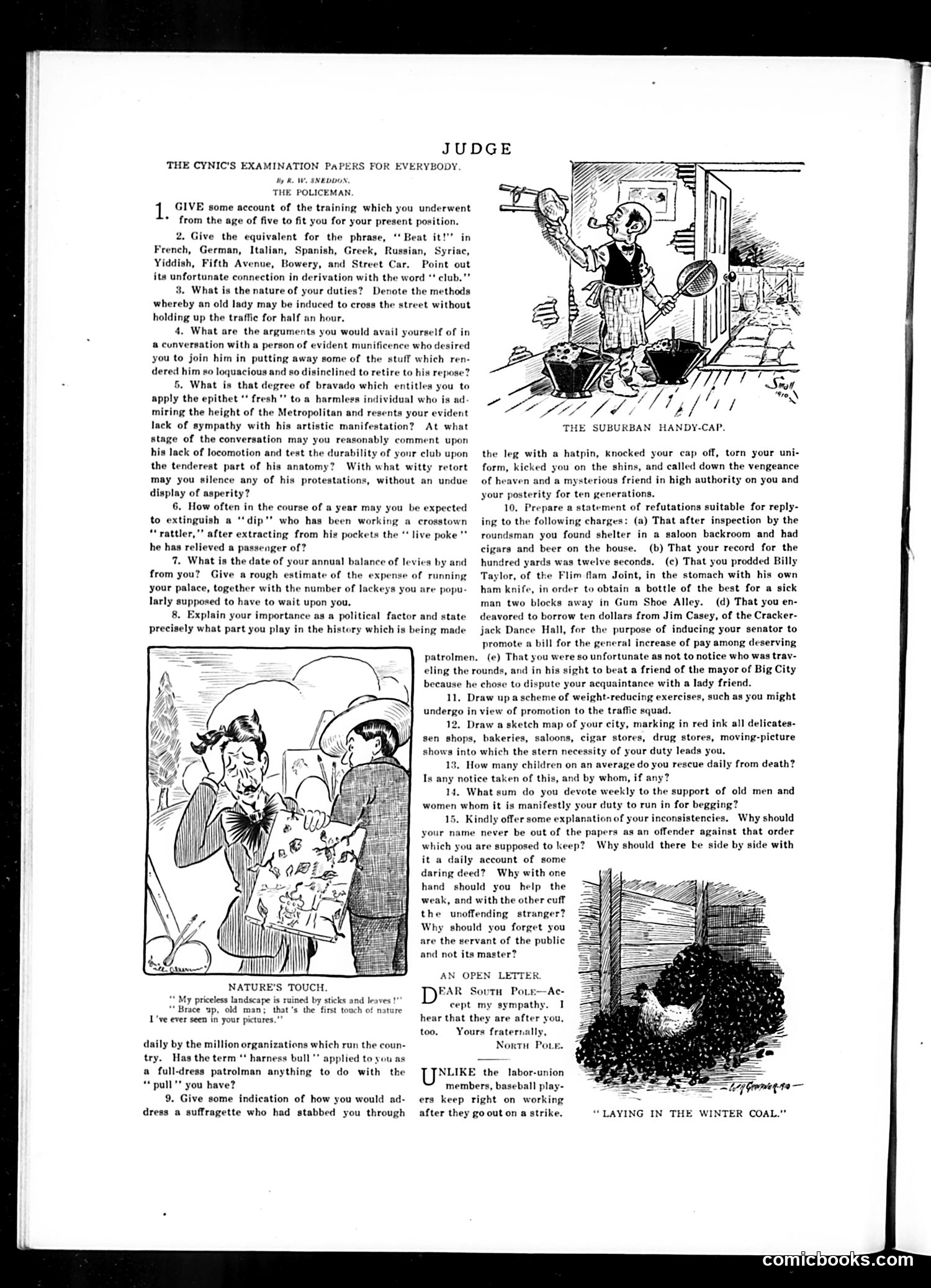
This page satirizes police corruption and misconduct in early 20th-century America. "The Cynic's Examination Papers for Everybody: The Policeman" is a mock exam questioning officers about their actual practices versus official duties. The satire covers: - **Bribery**: References to extracting money from drunk passengers ("live poke") - **Violence**: Questions about when officers can beat suspects with clubs - **Petty graft**: Implicit references to shakedowns and protection rackets - **Political patronage**: Questions about the "pull" (connections) required for promotion - **Double standards**: Asking why officers help the weak but beat "unoffending strangers" The cartoon "Nature's Touch" mocks artistic pretension—a painter complains about natural debris ruining his landscape; a friend notes this is the first genuine, unaffected thing in his work. The page reflects contemporary Progressive Era criticisms of urban police forces as corrupt institutions serving powerful interests rather than the public good.
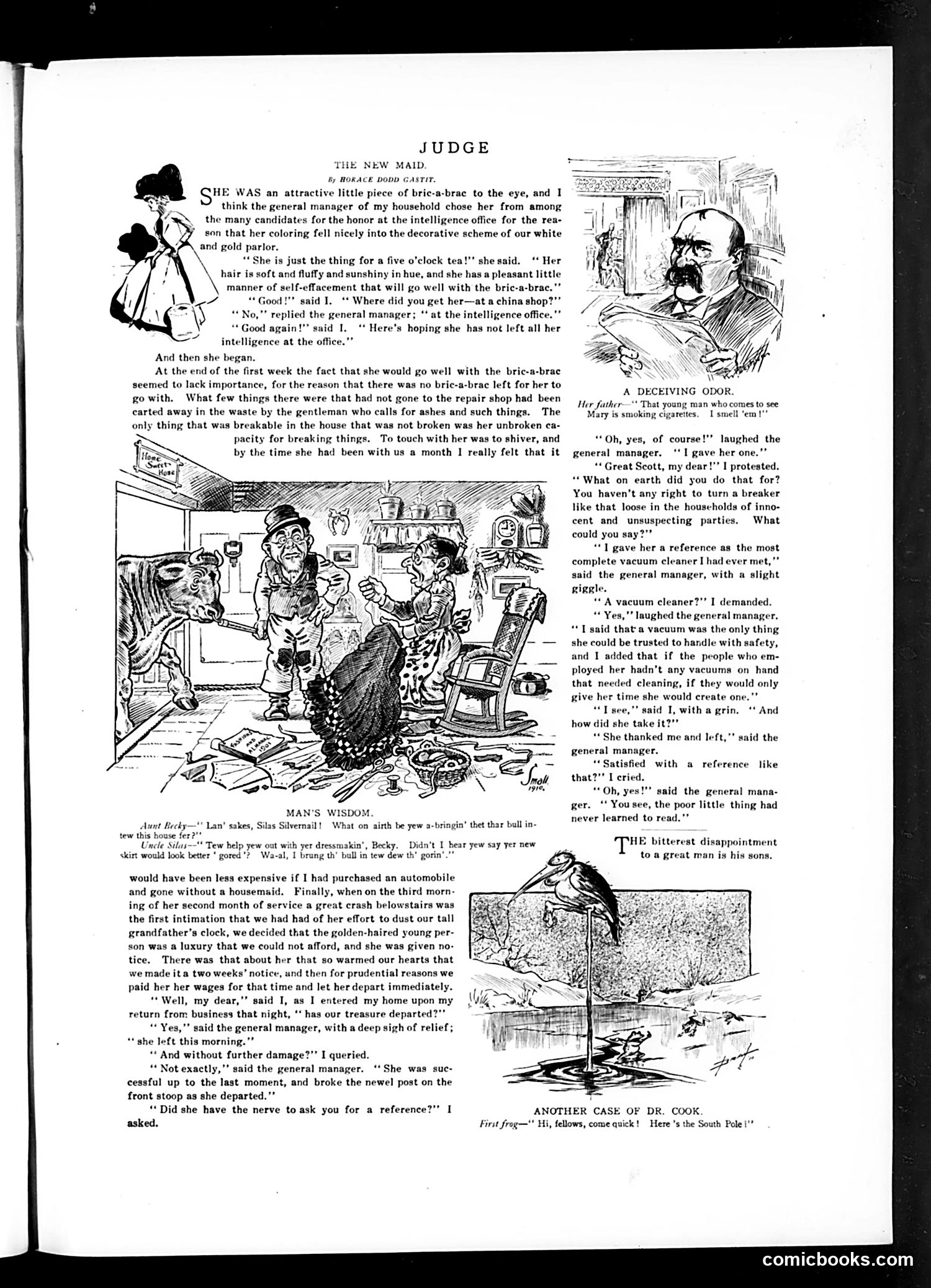
This satirical story mocks the hiring practices and class dynamics of early 20th-century wealthy households. The narrator's wife hires an attractive maid purely for decorative purposes—to complement the parlor's "white and gold" scheme—from an employment agency ("intelligence office"). The joke: the maid is catastrophically destructive and incompetent. She breaks virtually everything in the house within weeks. The wife later gives her a reference as "the most complete vacuum cleaner I had ever met"—a cruel pun suggesting the maid's only talent is destroying/emptying spaces. The satire targets the superficiality of upper-class employers who prioritize appearance over competence, and the exploitative nature of domestic service where workers could be dismissed without cause. The "vacuum cleaner" reference also mocks the dismissive attitude toward working-class people's literacy ("the poor little thing had never learned to read"). The companion cartoons joke about other domestic mishaps—a father smelling cigarettes and a farmer bringing a bull to "gore" (create gore/gores in) his wife's skirt.
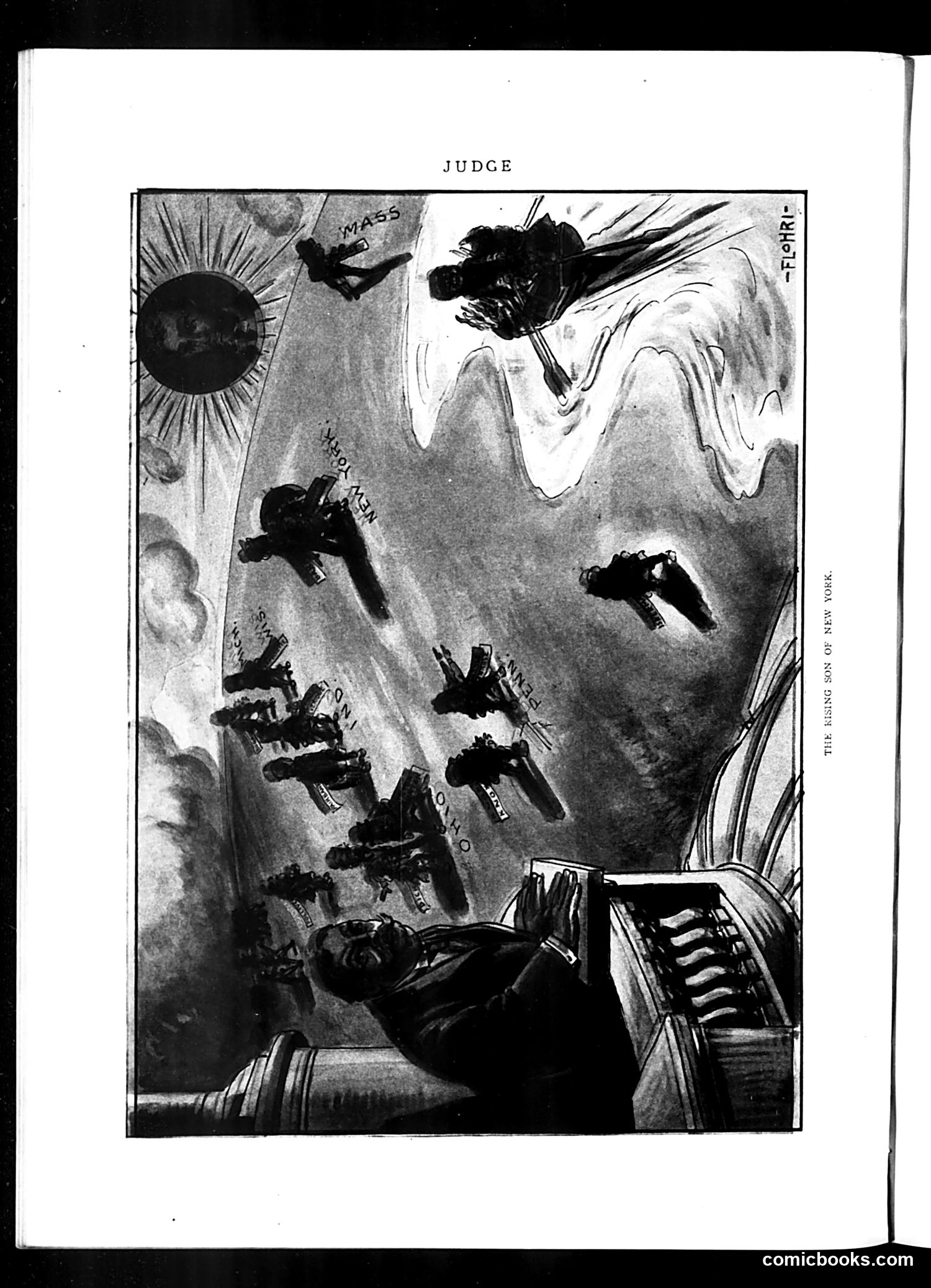
This Judge magazine cartoon depicts a courtroom scene titled "Judge" with what appears to be a judicial proceeding. A judge presides while multiple figures (shown in silhouette) stand before the bench. The labels visible include "MASS" and "KNOTT," though the OCR text is largely illegible, making specific identification difficult. The cartoon appears to satirize a legal case or trial of political significance, with the judge evaluating the defendants. Without clearer text or identifying details, I cannot definitively state which specific historical event, political figures, or scandal this references. The composition suggests criticism of either the accused parties or the judicial process itself—a common Judge magazine theme. The exact satirical point remains unclear without additional context about the publication date and visible captions.
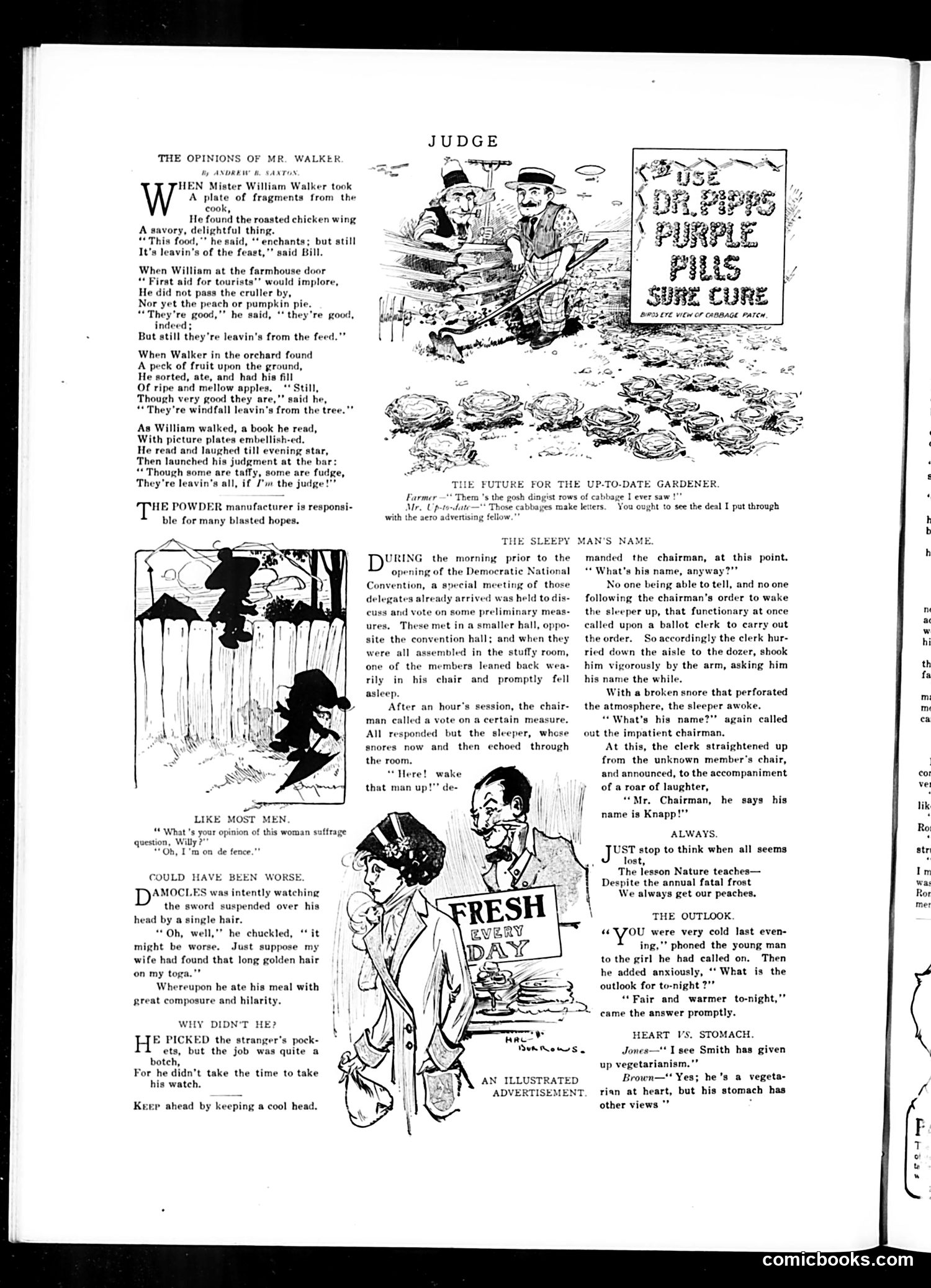
This page contains multiple short satirical pieces typical of early 20th-century Judge magazine humor: **"The Opinions of Mr. Walker"** presents a character who dismisses good food (chicken, fruit, pastries) as mere "leavings"—leftovers unworthy of serious consideration. The satire targets someone with pretentious or snobbish attitudes who cannot enjoy simple pleasures. **"The Sleepy Man's Name"** mocks Democratic National Convention proceedings, where a delegate sleeps through voting. When awakened to provide his name, he answers "Knapp"—likely a pun suggesting he's been napping. This satirizes the incompetence or indifference of political delegates. **"Could Have Been Worse"** uses the classical Damocles sword myth to joke about marital anxiety—a man worried about infidelity finds dark humor in his precarious situation. Remaining items are brief jokes about woman suffrage, vegetarianism, theft, and romance, with accompanying illustrations. The page is typical Judge humor: wordplay, domestic comedy, and light political mockery rather than serious satire.
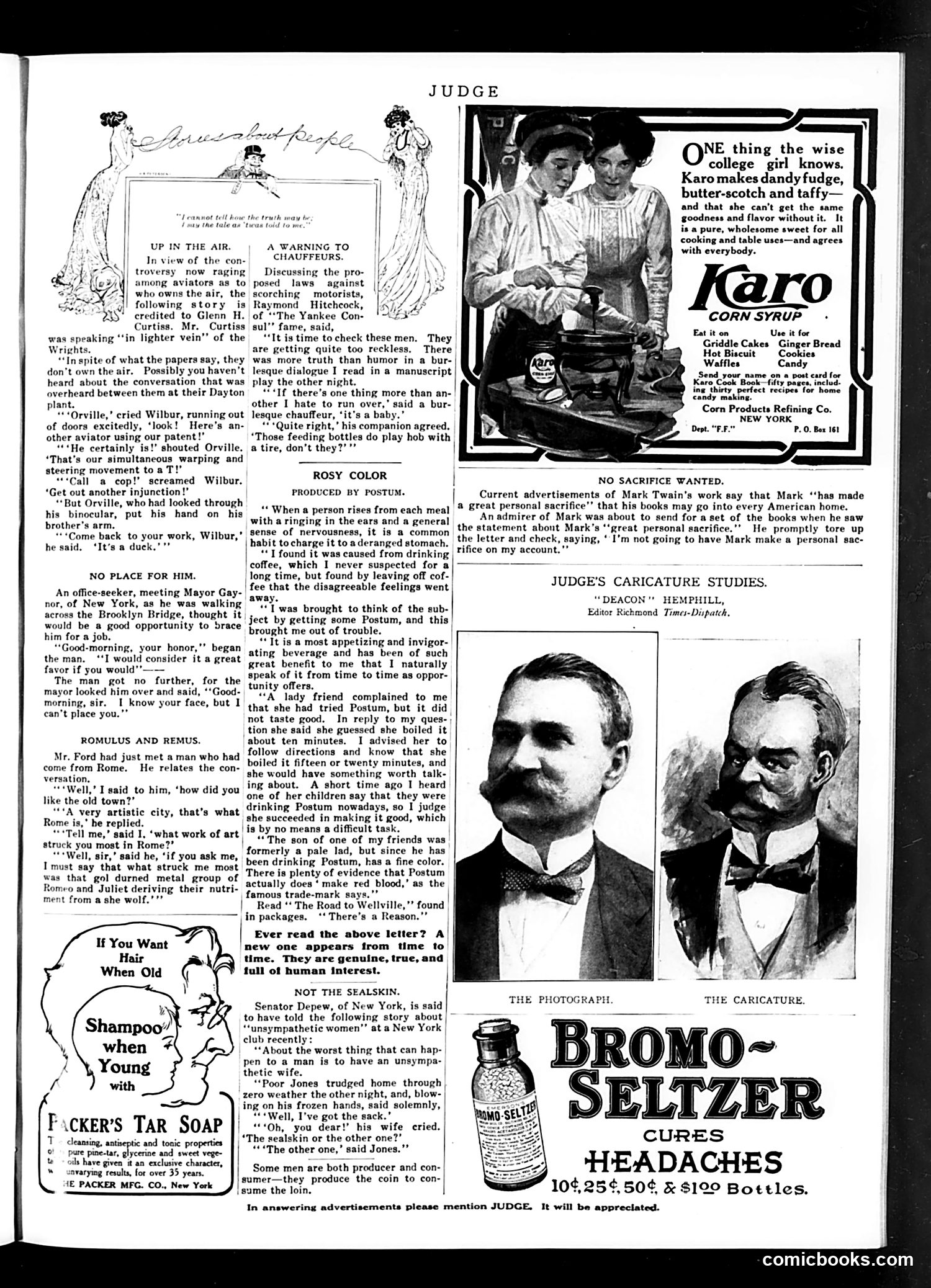
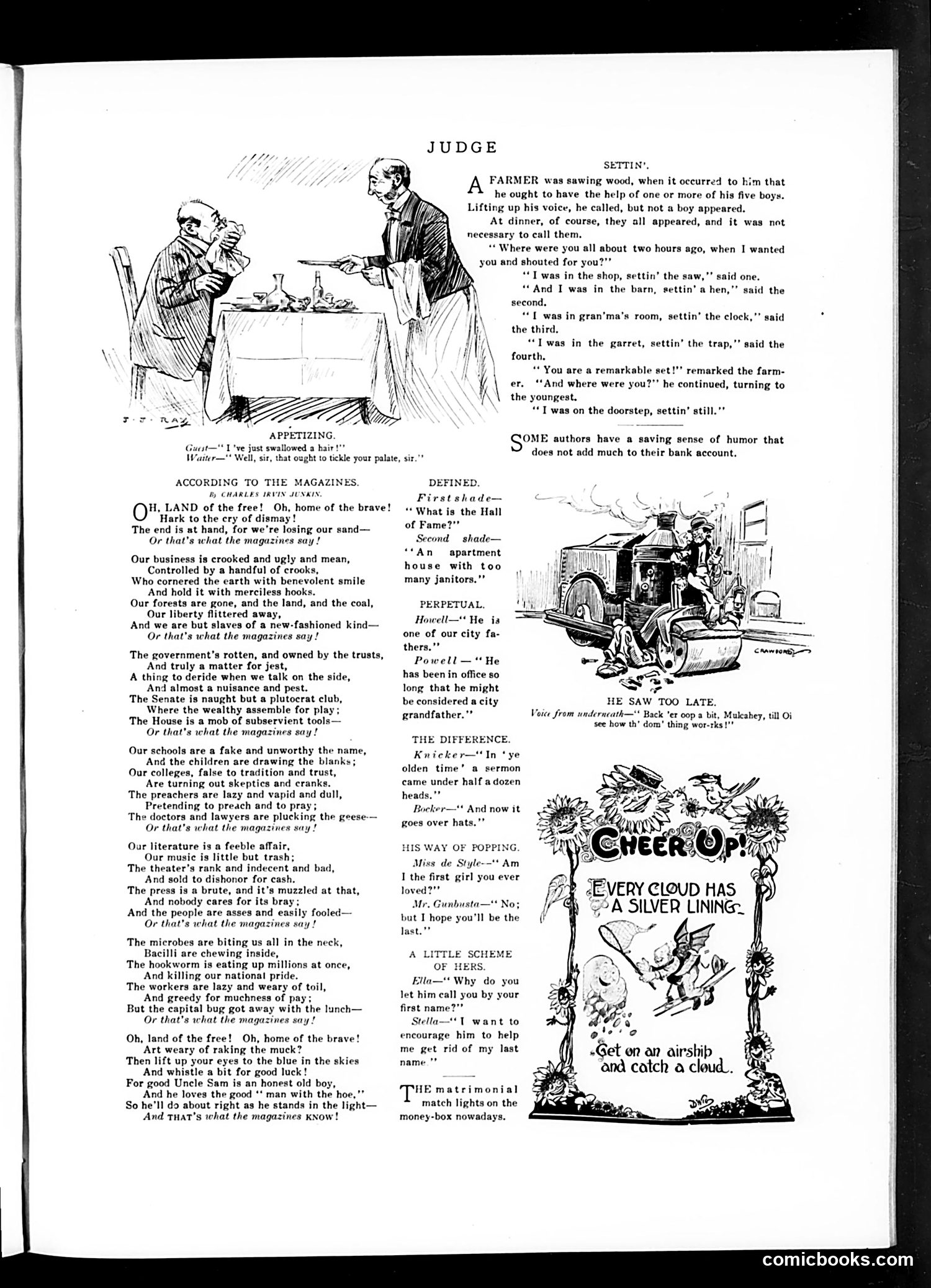
This page contains several humorous anecdotes satirizing early 20th-century American concerns: **"Up in the Air"** mocks the Wright Brothers' patent disputes over aviation technology. The joke: Orville and Wilbur spot what they believe is another aviator infringing their "simultaneous warping and steering" patent, only to discover it's a duck—deflating their litigious pretensions. **"No Place for Him"** satirizes office-seekers pestering New York Mayor Gaynor for jobs. The mayor's dismissive reply—acknowledging the man's face but claiming not to "place" him—is a cutting insult suggesting the man is forgettable and unworthy. **"A Warning to Chauffeurs"** references actor Raymond Hitchcock quoting a stage dialogue about reckless automobile drivers ("scorching motorists"), joking darkly about running over babies and damaging tires on feeding bottles. **"Romulus and Remus"** features a tourist confusing Rome's famous she-wolf sculpture (nursing Romulus and Remus) with "Romeo and Juliet," humorously illustrating American cultural ignorance. The remaining content is period advertising for patent medicines and household products.
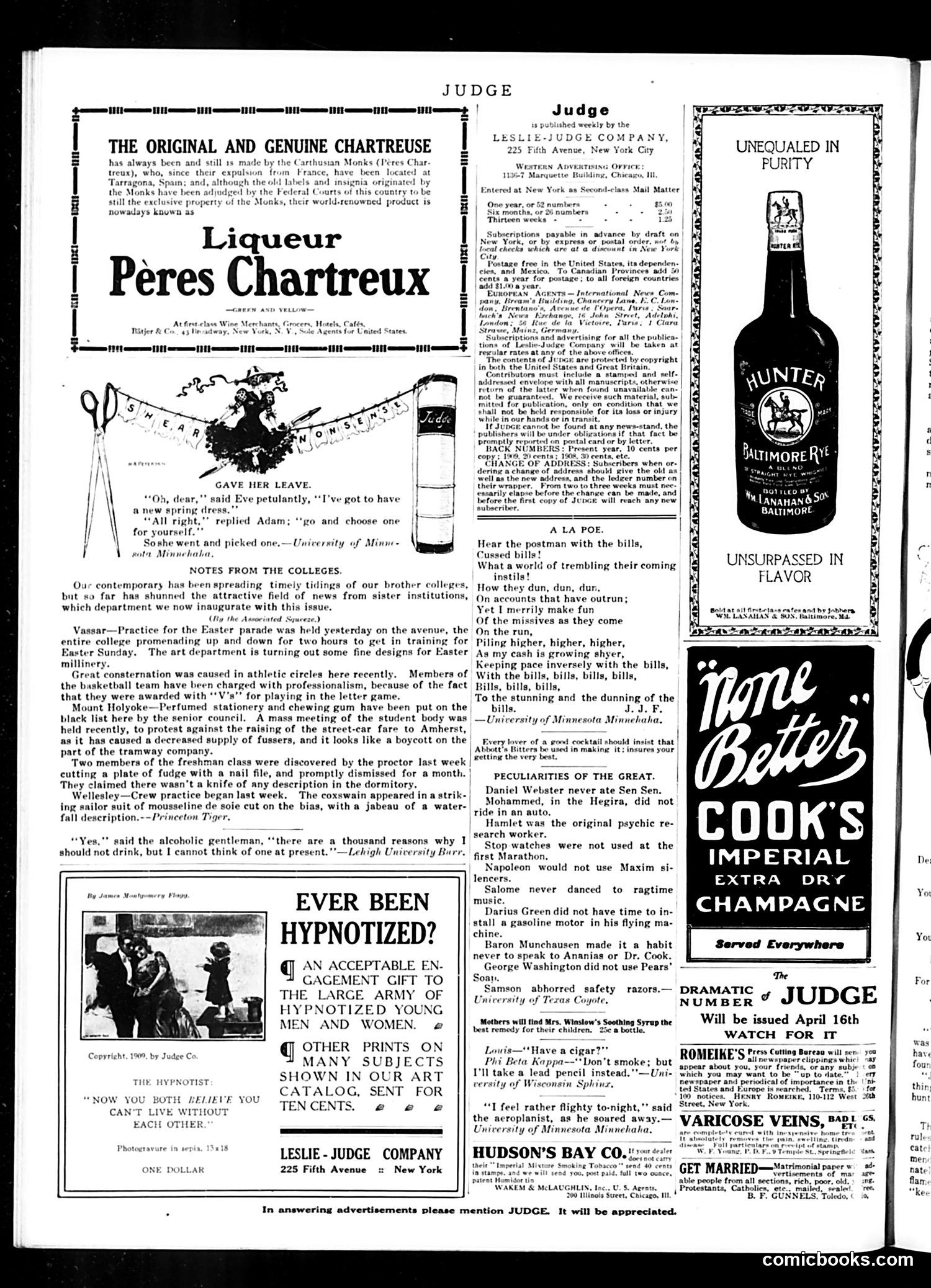
This page is primarily **advertising and magazine housekeeping**, not political satire. The dominant content includes: **Main Features:** - Advertisement for Pères Chartreux liqueur (the "original genuine" brand, apparently in a trademark dispute) - A mild joke about Eve and Adam choosing a spring dress - College humor column with anecdotes from Vassar, Mount Holyoke, and Princeton - Advertisement for a hypnotist-themed art print ("An Acceptable Engagement Gift") - Cook's champagne advertisement - Judge magazine's masthead and subscription information **The Humor:** The college notes mock student life—Easter fashion parades, professionalism concerns in athletics, dismissed students, and exaggerated fashion descriptions. The "hypnotist" ad appears to joke about young lovers being hypnotized into relationships. **Political/Social Context:** Minimal here. The page reflects early 20th-century collegiate concerns and marketing aimed at affluent readers. The liqueur advertisement suggests post-Prohibition era commerce. This is a typical interior page of a magazine primarily concerned with selling advertising space alongside light entertainment.
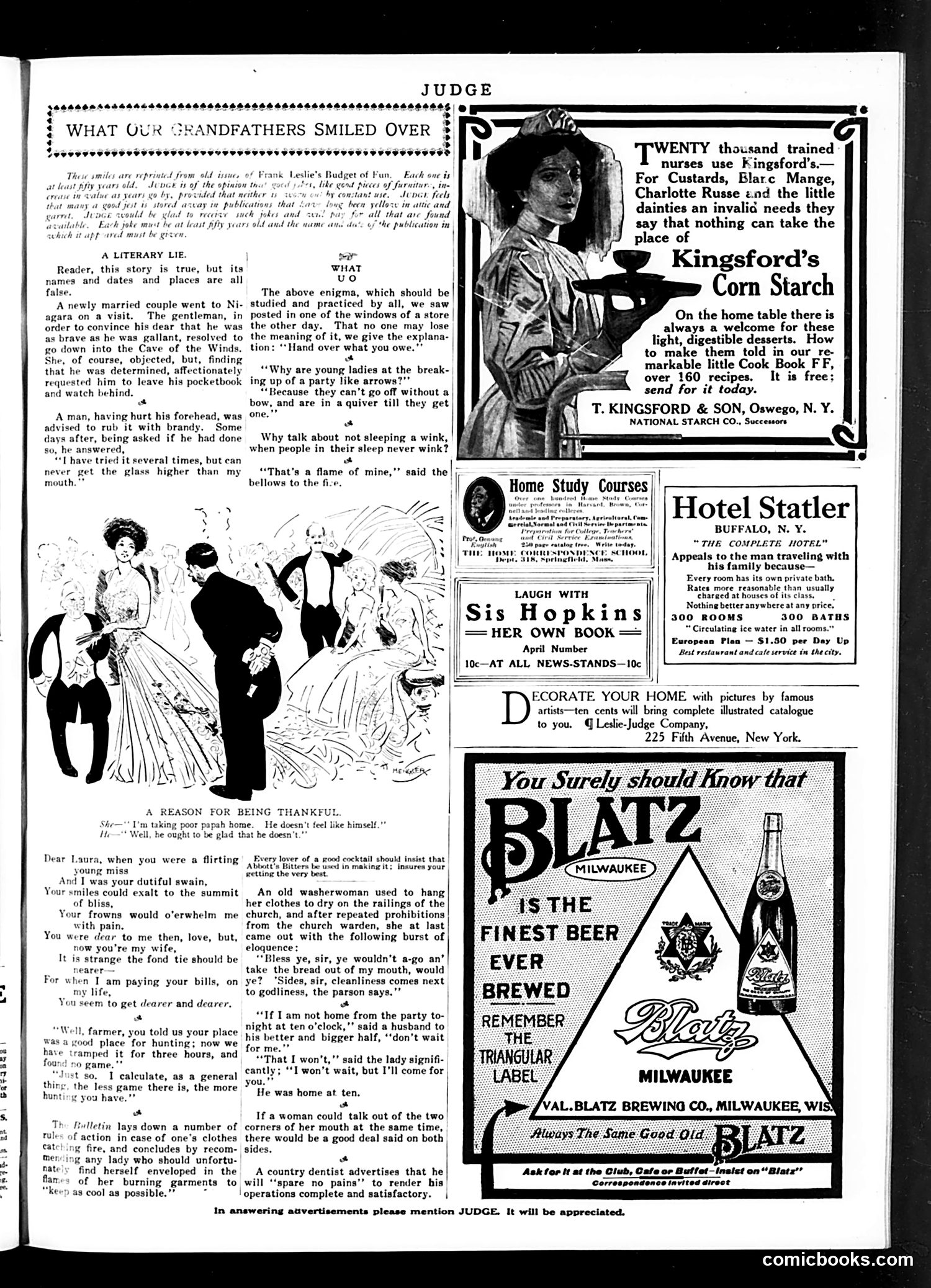
This page from Judge magazine reprints humorous anecdotes "at least fifty years old," presenting them as historical curiosities from an earlier era. The jokes are deliberately corny and rely on Victorian-era wordplay and domestic situations. The cartoons and text satirize turn-of-the-century life: a newlywed couple at Niagara Falls, a man rubbing brandy on a forehead wound, marital discord over bills, and a failed hunting trip. The humor is genteel and moralistic—poking fun at courting rituals, domestic hierarchies, and human vanity. The surrounding advertisements (Kingsford's Corn Starch, Blatz Beer, Hotel Statler) suggest this is aspirational middle-class content. By republishing old jokes, Judge positions itself as documenting popular culture's evolution while selling contemporary products to readers who appreciate "refined" humor and modern conveniences.
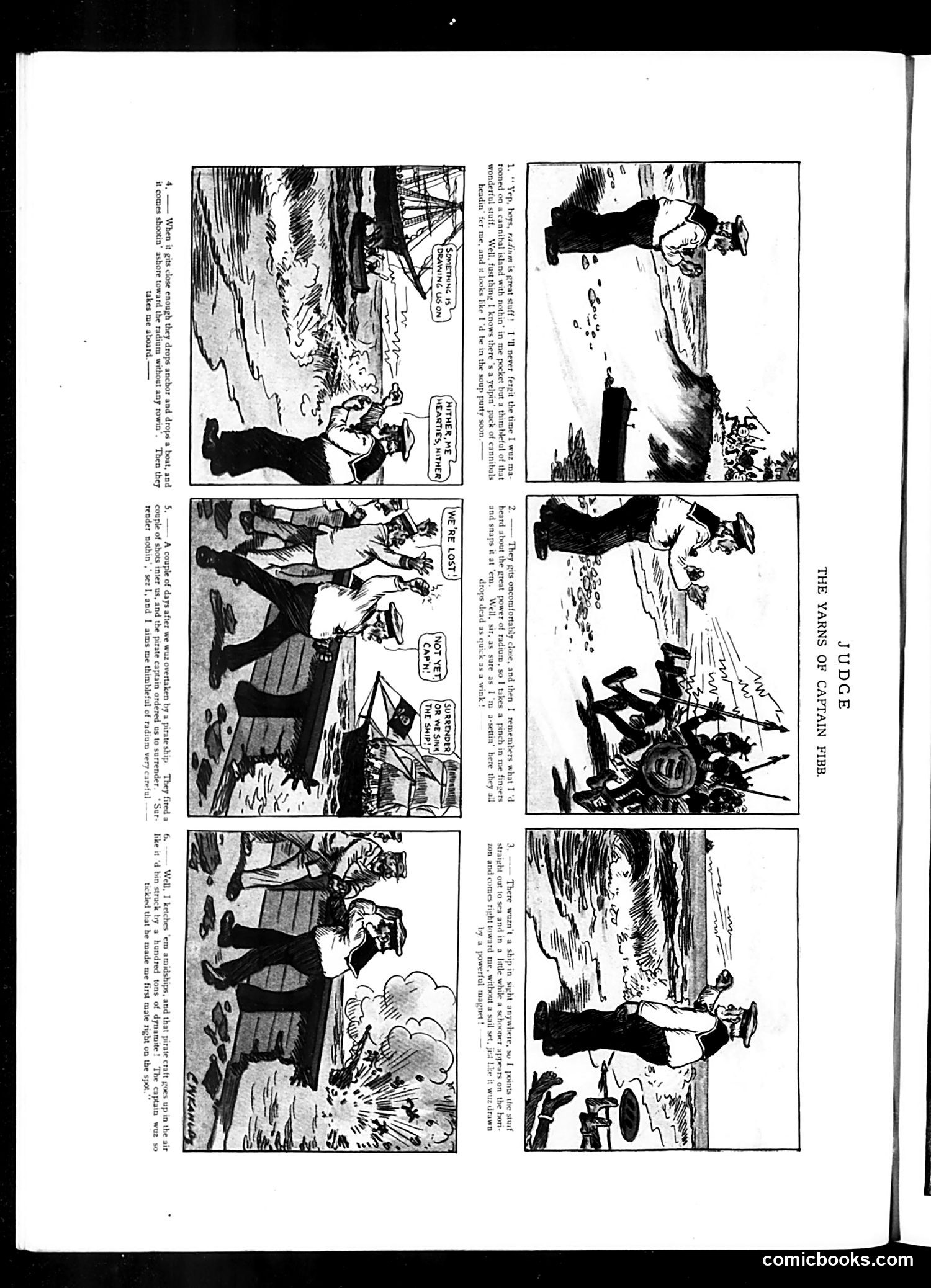
This is a comic strip titled "The Yarns of Captain Fibb" from *Judge* magazine. The strip appears to be a humorous tall-tale narrative, likely satirizing exaggerated storytelling—a common theme in American humor. "Captain Fibb" is a pun on "fibber" (liar), indicating the character tells outlandish lies. The six panels show various scenes involving a man in formal dress (presumably Captain Fibb) in increasingly absurd situations. While the OCR text is largely illegible, the visual progression suggests escalating, fantastical scenarios typical of exaggerated sailor's tales or boastful adventurer narratives. The satire mocks people who embellish their experiences with implausible claims. The strip format and character type were popular comedic conventions in early 20th-century American magazines.