
Judge, 1910-04-09 · page 4 of 16
Judge — April 9, 1910 — page 4: what you’re looking at
What you’re looking at
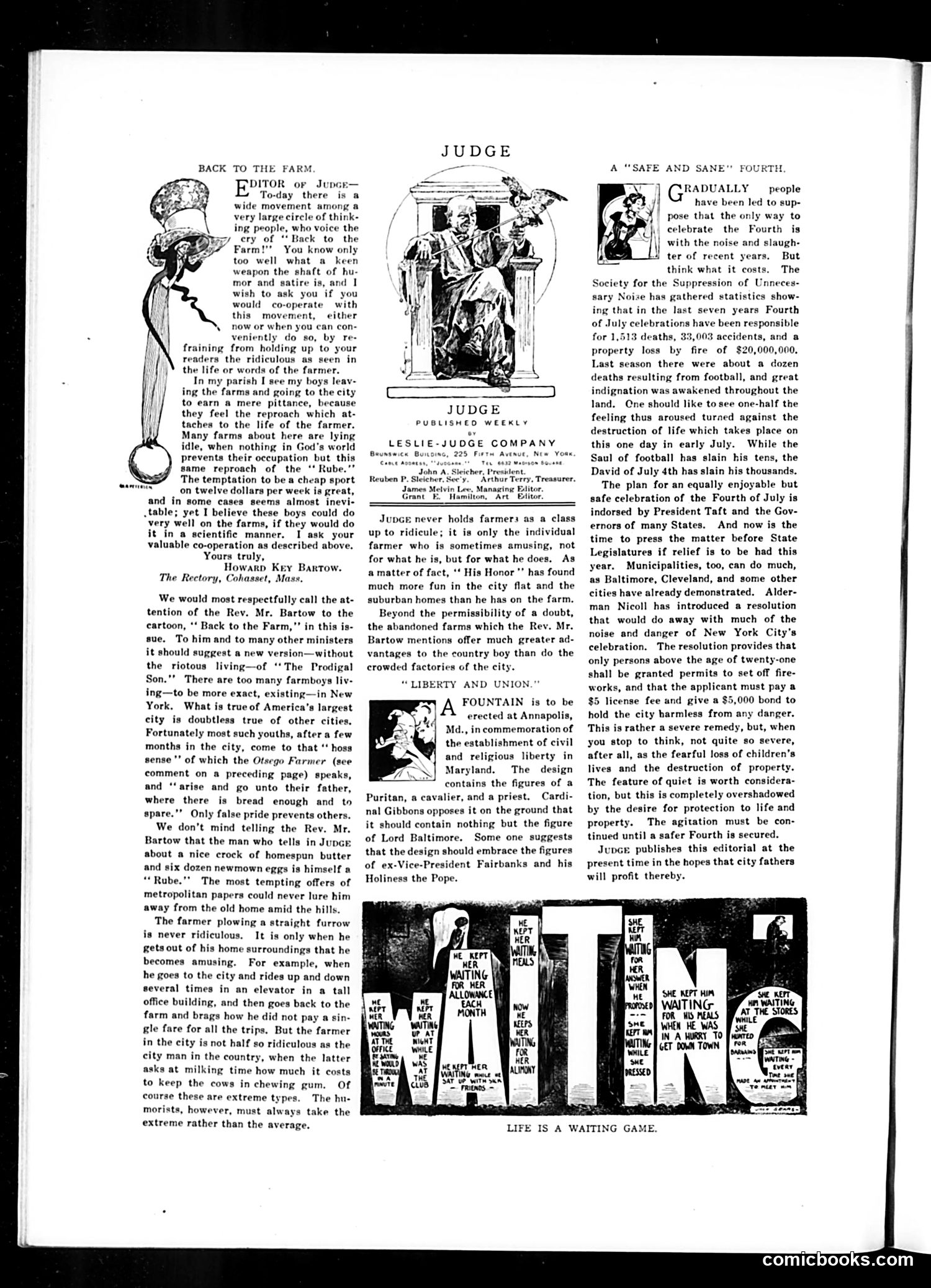
The page contains three distinct pieces: **"Back to the Farm"** (left): A satirical editorial by Howard Jay Barton criticizing the romanticization of farm life. The accompanying cartoon shows a figure in formal dress awkwardly positioned, suggesting the disconnect between city people and actual farming realities. Barton argues farmers deserve respect as individuals, not mockery, and that city dwellers who fetishize rural life lack understanding. **"A Safe and Sane Fourth"** (right): An editorial addressing Fourth of July celebrations, citing statistics on deaths and injuries. It advocates for regulated fireworks—requiring permits, licenses, and bonds—rather than banning celebrations entirely. The piece critiques both excessive noise and property damage. **"Life is a Waiting Game"** (bottom): A multi-panel cartoon depicting people waiting in various situations, likely satirizing patience and uncertainty in modern life.
📄 Transcribed text from this page (OCR, searchable)
Machine-transcribed from the original scan — historical spelling and the odd misread are preserved.
TO THE FARM. DITOR oF June To-day there is a wide movement among a y Back to the Farm!"’ You know only too well what a keen weapon the shaft of hu- mor and satire is, and I h to ask you if you would co-operate this movement, either now or when you can con- veniently do so, by re- fraining from holding up to your readers the ridiculous as seen in the life or words of the farme In my parish I see my boys leav- ing the farms and going to the city to earn a mere pittance, because they feel the reproach which at- taches to the life of the farmer. Many farms about here are lying idle, when nothing in God's world prevents their occupation but this same reproach of the ‘*Rube.’’ The temptation to be a cheap sport on twelve dollars per week is great and in some cases seems almost inevi- table; yet I believe these boys could do very well on the farms, if they would do it in @ scientific manner. I ask your valuable co-operation as described above. Yours truly, Howarp Key Bartow. The Rectory, Cohasset, Mass, We would most respectfully call the at- tention of the Rev. Mr. Bartow to the cartoon, ** Back to the Farm,"’ in this is- sue. To him and to many other ministers it should suggest a new version—without the riotous living—of ‘‘The Prodigal Son."’ There are too many farmboys liv: ing—to be more exact, existing—in New York. What is true of America’s largest city is doubtless true of other cities. Fortunately most such youths, after a few months in the city, come to that ‘hos sense" of which the Otsego Farmer (see comment on a preceding page) speaks, and ‘‘arise and go unto their father, where there is bread enough and to spare.’’ Only false pride prevents others. We don’t mind telling the Rev. Mr. Bartow that the man who tells in Jupce about a nice crock of homespun butter and six dozen newmown eggs is himself a “‘Rube."* The most tempting offers of metropolitan papers could never lure him away from the old home amid the hills. The farmer plowing a straight furrow is never ridiculous. It is only when he gets out of his home surroundings that he becomes amusing. For example, when he goes to the city and rides up and down several times in an elevator in a tall office building, and then goes back to the farm and brags how he did not pay a sin- gle fare for all the trips, But the farmer in the city is not half so ridiculous as the city man in the country, when the latter ay at milking time how much it costs to keep the cows in chewing gum. Of course these are extreme types. The hu- morists, however, must always take the verage. extreme rather than the JUDGE PUBLISHED WEEKLY LESLIE-JUDGE COMPANY New Youu Beunswice 8: holds farmers as a class it is only the individual farmer who sometimes amusing, not for what he is, but for what he does. As a matter of fact, ‘‘ His Honor "’ has found much more fun in the city flat and the suburban homes than he has on the farm, Beyond the permissibility of a doubt, the abandoned farms which the Rev. Mr. Bartow mentions offer much greater ad- vantages to the country boy than do the crowded factories of the city. “LIBERTY AND UNION." FOUNTAIN is to be erected at Annapolis, Md., incommemoration of the establishment of civ: and religious liberty in Maryland, The design contains the figures of a Puritan, a cavalier, and a priest. Cardi- nal Gibbons opposes it on the ground that it should contain nothing but the figure of Lord Baltimore. Some one suggests that the design should embrace the figures of ex-Vice-President Fairbanks and his Holiness the Pope. FOURTH, A “SAFE AND SANE" ] GRADUALLY people / have been led to sup- pose that the only way to celebrate the Fourth is h the noise and slaugh- ter of recent years, But it costs, The sary Noise has gathered statistics show- ing that in the last seven years Fourth of July celebrations have been responsible for 1,513 deaths, 33,003 accidents, and a property loss by fire of $20,000,000, Last season there were about a dozen deaths resulting from football, and great indignation was awakened throughout the land. Cne should like to see one-half the feeling thus aroused turned against the destruction of life which takes place on this one day in early July. While the Saul of football has slain his tens, the David of July 4th has slain his thousands. The plan for an equally enjoyable but safe celebration of the Fourth of July is indorsed by President Taft and the Gov- ernors of many States. And now is the time to press the matter before State Legislatures if relief is to be had this year. Municipalities, too, can do much, as Baltimore, Cleveland, and some other cities have already demonstrated. Alder- man Nicoll has introduced a resolution that would do away with much of the noise and danger of New York City’s celebration. The resolution provides that only persons above the age of twenty-one shall be granted permits to set off fire- works, and that the applicant must pay a $5 license fee and give a $5,000 bond to hold the city harmless from any danger. ‘This is rather a severe remedy, but, when you stop to think, not quite so severe, after all, as the fearful loss of children's lives and the destruction of property. The feature of quiet is worth considera- tion, but this is completely overshadowed by the desire for protection to life and property. The agitation must be con- tinued until a safer Fourth is secured. Jupce publishes this editorial at the present time in the hopes that city fathers will profit thereby. LIFE IS A WAITING GAME. comicbooks.com