
Judge, 1910-04-09 · page 8 of 16
Judge — April 9, 1910 — page 8: what you’re looking at
What you’re looking at
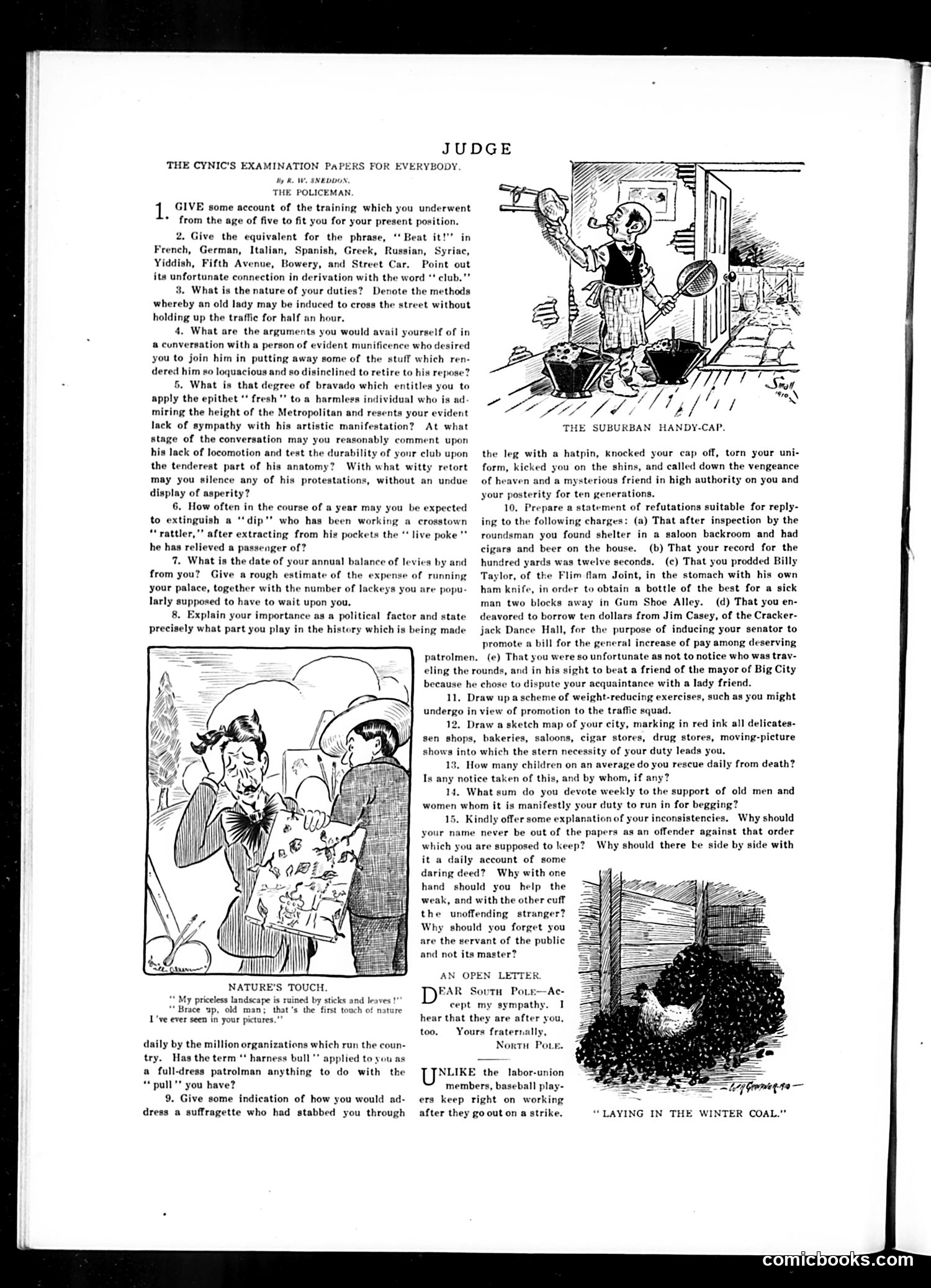
This page satirizes police corruption and misconduct in early 20th-century America. "The Cynic's Examination Papers for Everybody: The Policeman" is a mock exam questioning officers about their actual practices versus official duties. The satire covers: - **Bribery**: References to extracting money from drunk passengers ("live poke") - **Violence**: Questions about when officers can beat suspects with clubs - **Petty graft**: Implicit references to shakedowns and protection rackets - **Political patronage**: Questions about the "pull" (connections) required for promotion - **Double standards**: Asking why officers help the weak but beat "unoffending strangers" The cartoon "Nature's Touch" mocks artistic pretension—a painter complains about natural debris ruining his landscape; a friend notes this is the first genuine, unaffected thing in his work. The page reflects contemporary Progressive Era criticisms of urban police forces as corrupt institutions serving powerful interests rather than the public good.
📄 Transcribed text from this page (OCR, searchable)
Machine-transcribed from the original scan — historical spelling and the odd misread are preserved.
THE CYNIC'S EXAMINATION PAPERS FOR EVERYBODY by kW. SNEDDON THE POLICEMAN GIVE some account of the training which you underwent from the age of five to fit you for your present position. 2. Give the equivalent for the phrase, ‘‘ Beat it!’ in French, German, Italian, Spanish, Greek, Russian, Syriac, Yiddish, Fifth Avenue, Bowery, and Street Car. Point out its unfortunate connection in derivation with the word “ club."” What is the nature of your duties? Denote the methods whereby an old lady may be induced to cross the street without holding up the traffic for half an hour. 4. What are the arguments you would avail yourself of in @ cunversation with a person of evident munificence who desired you to join him in putting away some of the stuff which ren- dered him so loquacious and so disinclined to retire to his repose? 5. What is that degree of bravado which entitles you to apply the epithet ‘fresh’ to a harmless individual who is ad g the height of the Metropolitan and resents your evident lack of sympathy with his artistic manifestation? At what stage of the conversation may you reasonably comment upon his lack of locomotion and test the durability of your club upon the tenderest part of his anatomy? With what witty retort may you silence any of his protestations, without an undue display of asperity? 6. How often in the course of a year may you be expected to extinguish a ‘dip’? who has been working a crosstown “rattler,”’ after extracting from his pockets the ‘live poke" he has relieved a passenger of? 7. What is the date of your annual balance of lev from you? Give a rough estimate of the e: your palace, together with the number of Ia larly supposed to have to wait upon you. 8. Explain your importance as a political factor and state precisely what part you play in the history which is being made by and pense of running ‘Y8 you are popu- show! your na which 3 hand NATURE'S TOUCH. ‘* My priceless landscape is ruined by sticks and leaves !" “Brace ap, old man; that's the first touch of nature I've ever seen in your pictures."” too. daily by the million organizations which run the coun- try. Has the term ‘‘ harness bull "’ applied to you as a full-dress patrolman anything to do with the “pull” you have? 9. Give some indication of how you would ad- dress a suffragette who had stabbed you through JUDGE patrolmen. eling the rounds, and in hi because he chose to dispute your acquaintance with a lady friend. 11. Draw up ascheme of weight-reducing exercises, such as you might undergo in view of promotion to the traffic squad. 12, Draw a sketch map of your city, marking in red ink all delicates- sen shops, bakeries, saloons, cigar ste into which the stern necessity of your duty leads you, 3. How Is any notice taken of this, and by whom, if any? 14. What sum do you devote weekly to the support of old men and women whom it is manifestly your duty to run in for begging? 15. Kindly offer some explanation of your inconsistencies. ne never be out of the papers as an offender ag: uu are supposed to keep? it a daily account of some daring deed? should you help the weak, and with the other cuff the unoffending stranger? Why should you forget you are the servant of the public and not its master? AN OPEN LETTER. DFAR Sours cept my hear that they are aft Yours fraternally, NLIKE the members, baseball pl ers keep right on wor after they go out on a strike. SUBURBAN HANDY-CAP. THE the leg with a hatpin, knocked your cap off, torn your uni- form, kicked you on the shins, and called down the vengeance of heaven and a mysterious friend in high authority on you and your posterity for ten generations. 10. Prepare a statement of refutations suitable for reply- ing to the following charges: (a) That after inspection by the roundsman you found shelter in a saloon backroom and had cigars and beer on the house. (b) That your record for the hundred yards was twelve seconds. (c) That you prodded Billy Taylor, of the Flim flam Joint, in the stomach with his own ham knife, in order to obtain a bottle of the best for a sick man two blocks away in Gum Shoe Alley. (d) That you en- deavored to borrow ten dollars from Jim Casey, of the Cracker- jack Dance Hall, for the purpose of inducing your senator to promote a bill for the general increase of pay among deserving (e) That you were so unfortunate as not to notice who was trav- ight to beat a friend of the mayor of Big City drug stores, moving-picture y children on an average do you rescue daily from death? Why should inst that order Why should there be side by side with Why with one Pour—Ac- ympathy. 1 you, Nortu Pore. labor-union deel Sie WINTER COAL.” “LAYING IN THE