
A complete issue · 16 pages · 1910
Judge — March 12, 1910
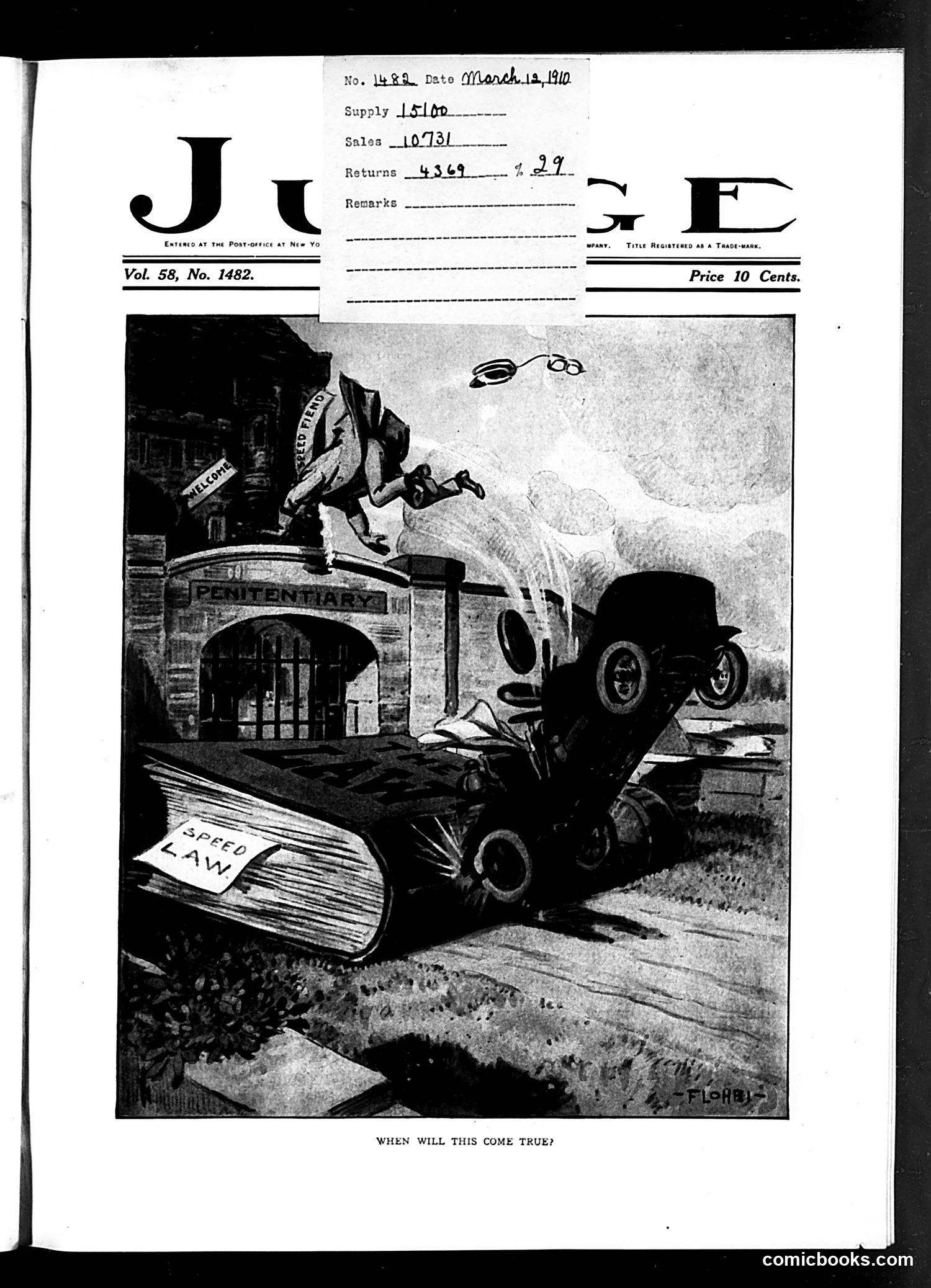
This 1910 Judge magazine cartoon satirizes speed laws and traffic safety. The image shows a reckless driver in a toy-like automobile crashing through a "Penitentiary" gate marked "Sped Law," while a police officer flies off a rooftop in pursuit. The caption asks "When Will This Come True?" The satire criticizes dangerous drivers who violate speed regulations—suggesting they deserve imprisonment. The exaggerated, chaotic scene emphasizes how automobile speeding posed a serious public hazard in the early motor-car era, when traffic laws were new and compliance was poor. The cartoon advocates for stricter enforcement of speed limits to protect public safety, mocking those who recklessly endanger others on the road.
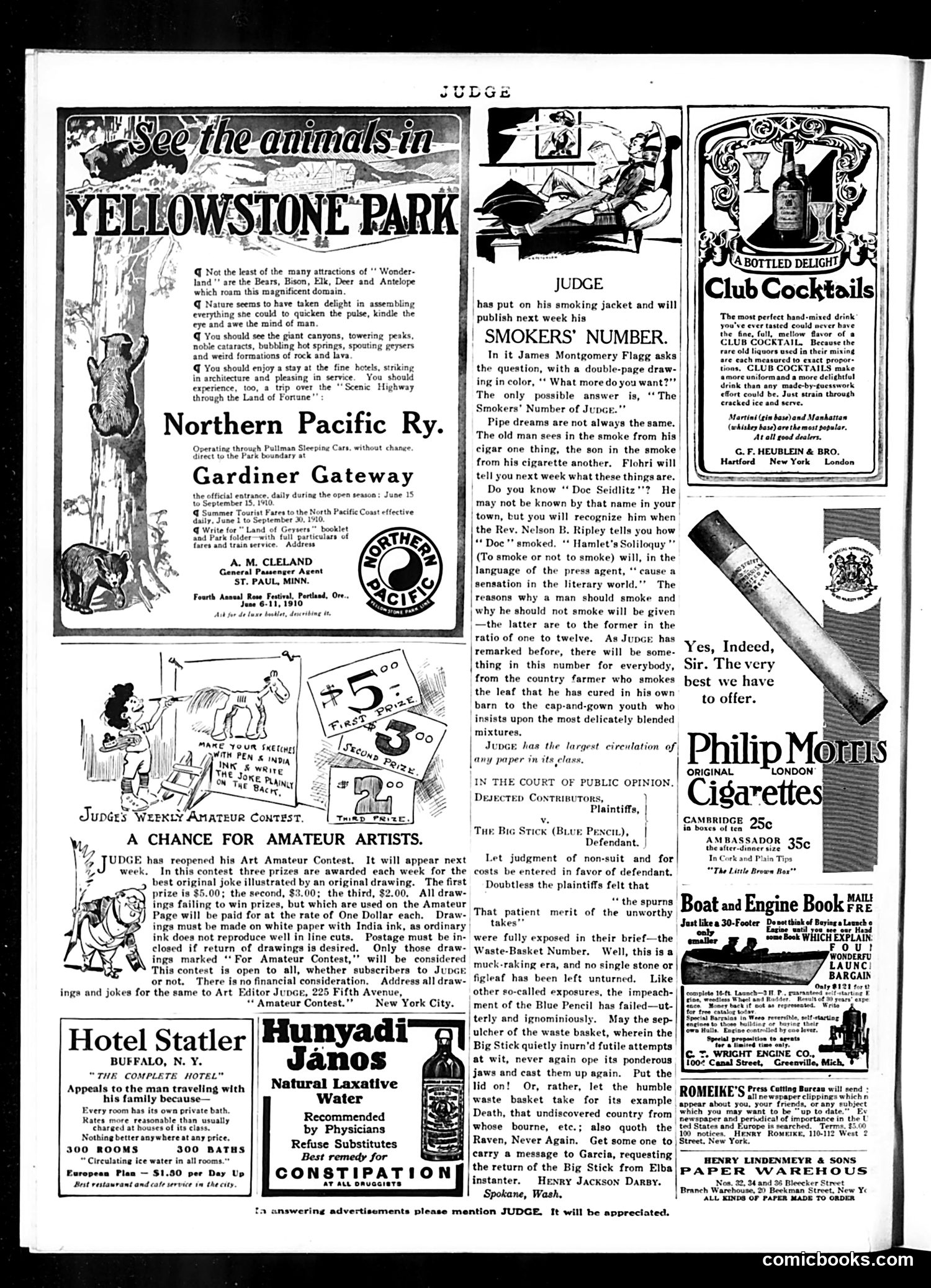
This page is predominantly **advertising and editorial content** rather than political satire. The main cartoon, "Judge's Weekly Amateur Contest," invites readers to submit original drawings for weekly prizes—a participatory feature for amateur artists rather than editorial commentary. The central article, "Smokers' Number," discusses why people smoke, referencing "The Smokers' Number of Judge" and mentioning various smoking-related anecdotes (pipe dreams, cigars, cigarettes). This appears to be promotional content for an upcoming themed issue. The remaining content consists almost entirely of **period advertisements**: Yellowstone Park travel, Northern Pacific Railway, Hotel Statler, Philip Morris cigarettes, and various other commercial products. There is **no clear political satire or social commentary** visible on this particular page.
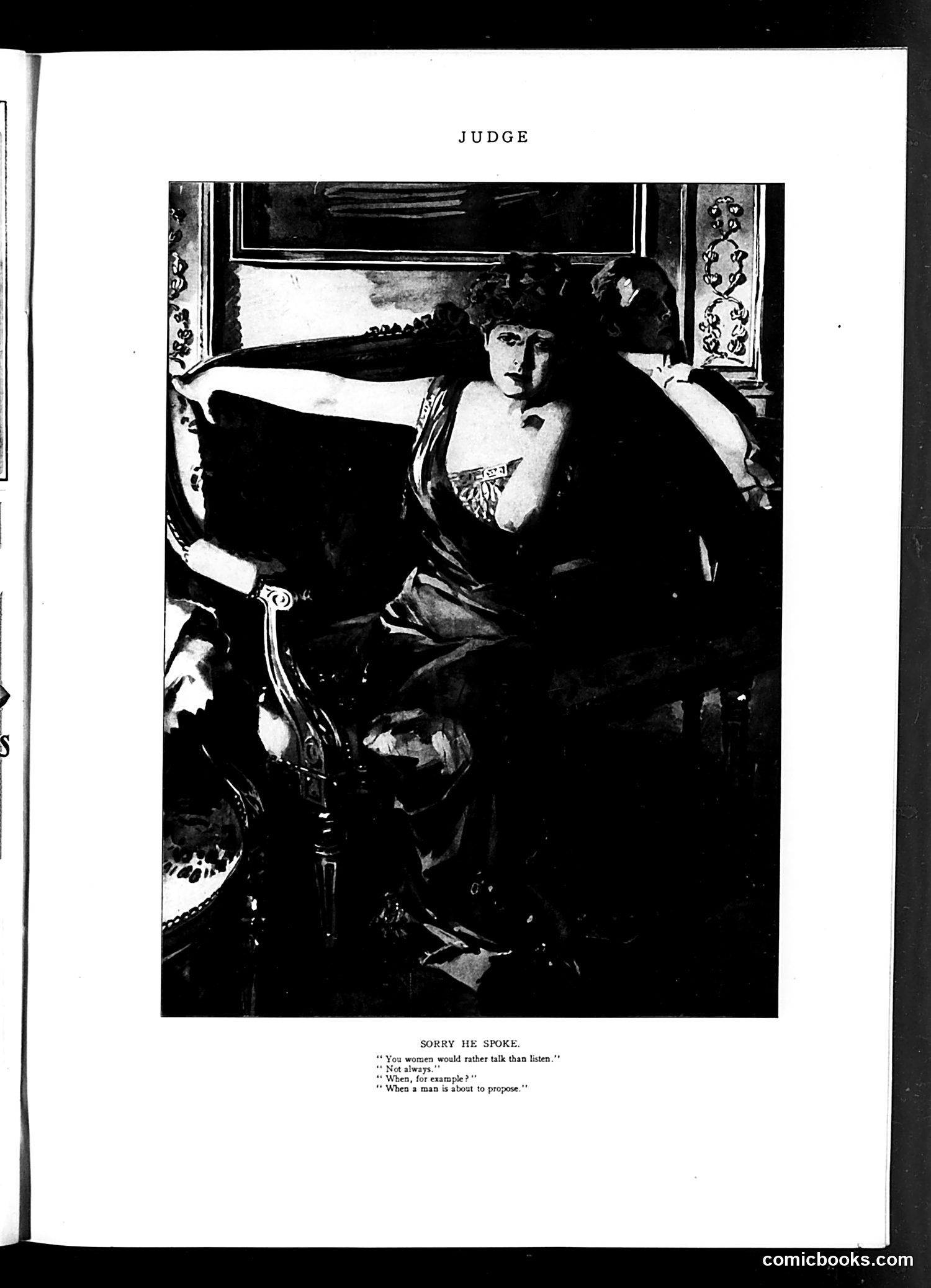
This page depicts a woman in an elegant interior setting, reclining in a contemplative pose. The title "SORRY HE SPOKE" with accompanying text—"You women would rather talk than listen," "Not always," "When, for example?" "When a man is about to propose"—presents a satirical commentary on gender relations. The joke plays on the stereotype that women are talkative while simultaneously suggesting that women strategically silence men to control romantic outcomes. The satire targets both masculine assumptions about female chattiness and feminine agency in courtship rituals. The woman's pose and setting suggest upper-class domesticity, indicating this satirizes middle-to-upper-class courtship conventions of the era. The humor relies on period assumptions about gender roles and romantic negotiation.
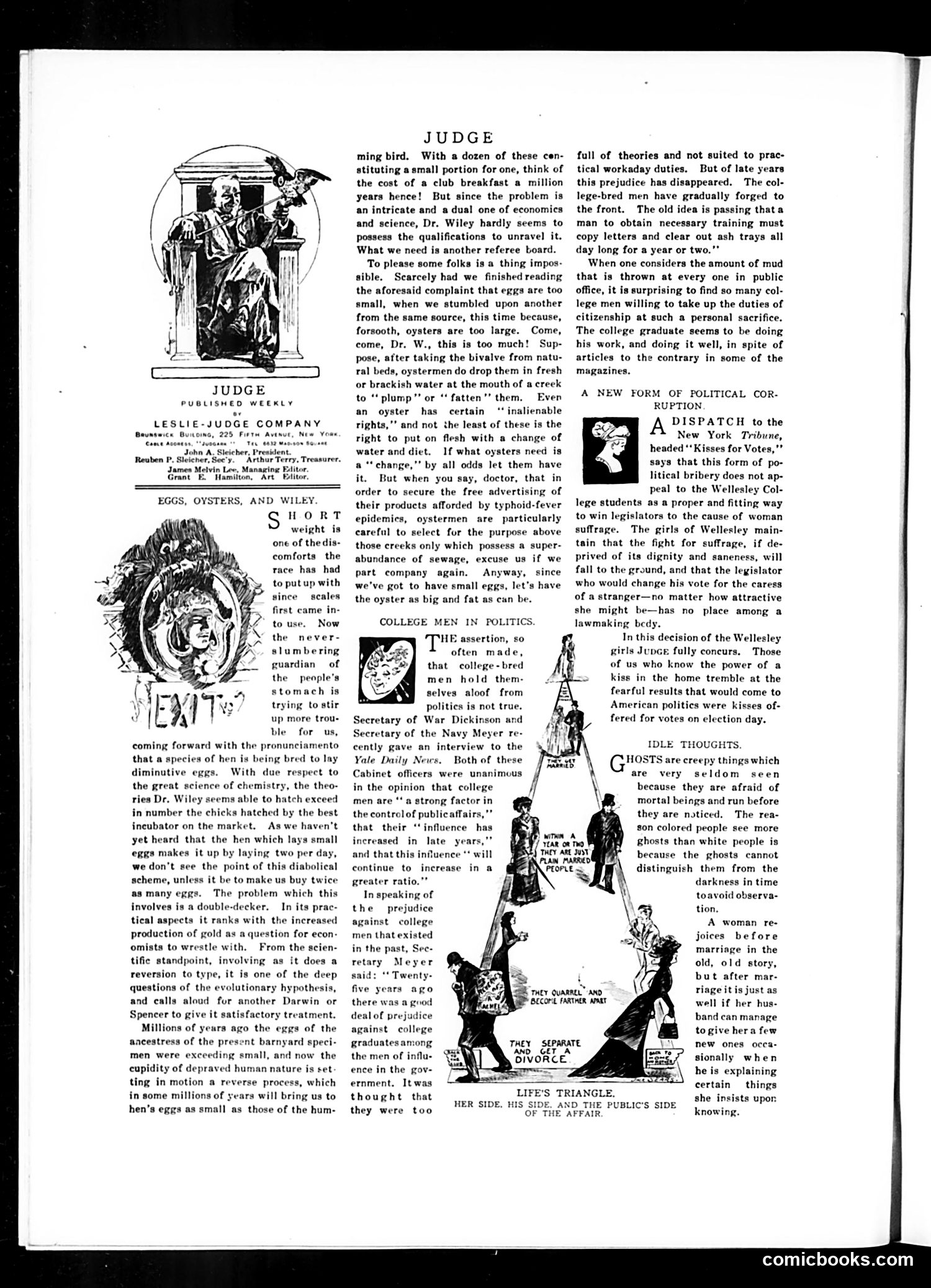
This page contains three distinct sections: 1. **"Judge" masthead and publication info** - The magazine's title and publisher details. 2. **"Eggs, Oysters, and a Short Story"** - Editorial content debating whether oysters and eggs should be larger/smaller, using these foods as metaphors for economic and scientific policy debates. The text references Dr. Wiley and oyster farming controversies. 3. **"Life's Triangle: His Side, Her Side, and the Public's Side"** - A political cartoon satirizing divorce proceedings and public scrutiny. The illustration shows figures labeled to represent a man, woman, and public opinion observing a separation/divorce case, suggesting Judge magazine's commentary on how personal marital disputes become public spectacles subject to social judgment and gossip. The overall tone critiques both scientific policy-making and societal fascination with private matters.
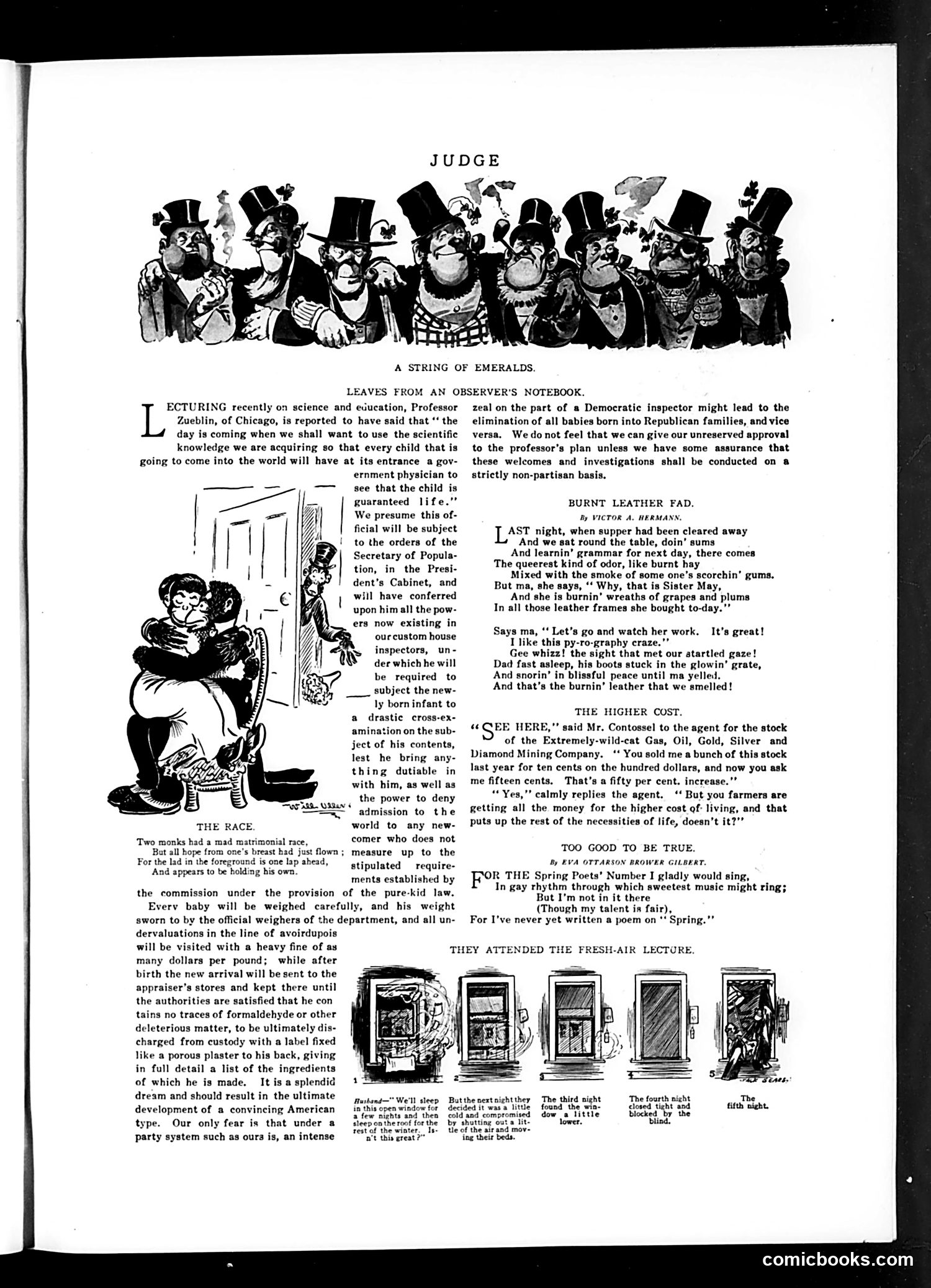
**"A String of Emeralds"** (top cartoon) depicts caricatured judges wearing top hats, likely satirizing judicial appointments or the legal system's integrity. **"The Race"** cartoon mocks what appears to be a proposal for government inspection of newborns, with the caption suggesting babies will be "weighed carefully" and subjected to official examination. This satirizes overreach by government bureaucrats into private family matters. **"Burnt Leather Fad"** is a humorous poem about a woman's burnt cooking smell. **"They Attended the Fresh-Air Lecture"** shows a sequential comic strip where people apparently sleep through or ignore an educational lecture about fresh air. The page reflects Progressive Era anxieties about expanding government power, scientific management of society, and bureaucratic intrusion into American family life.
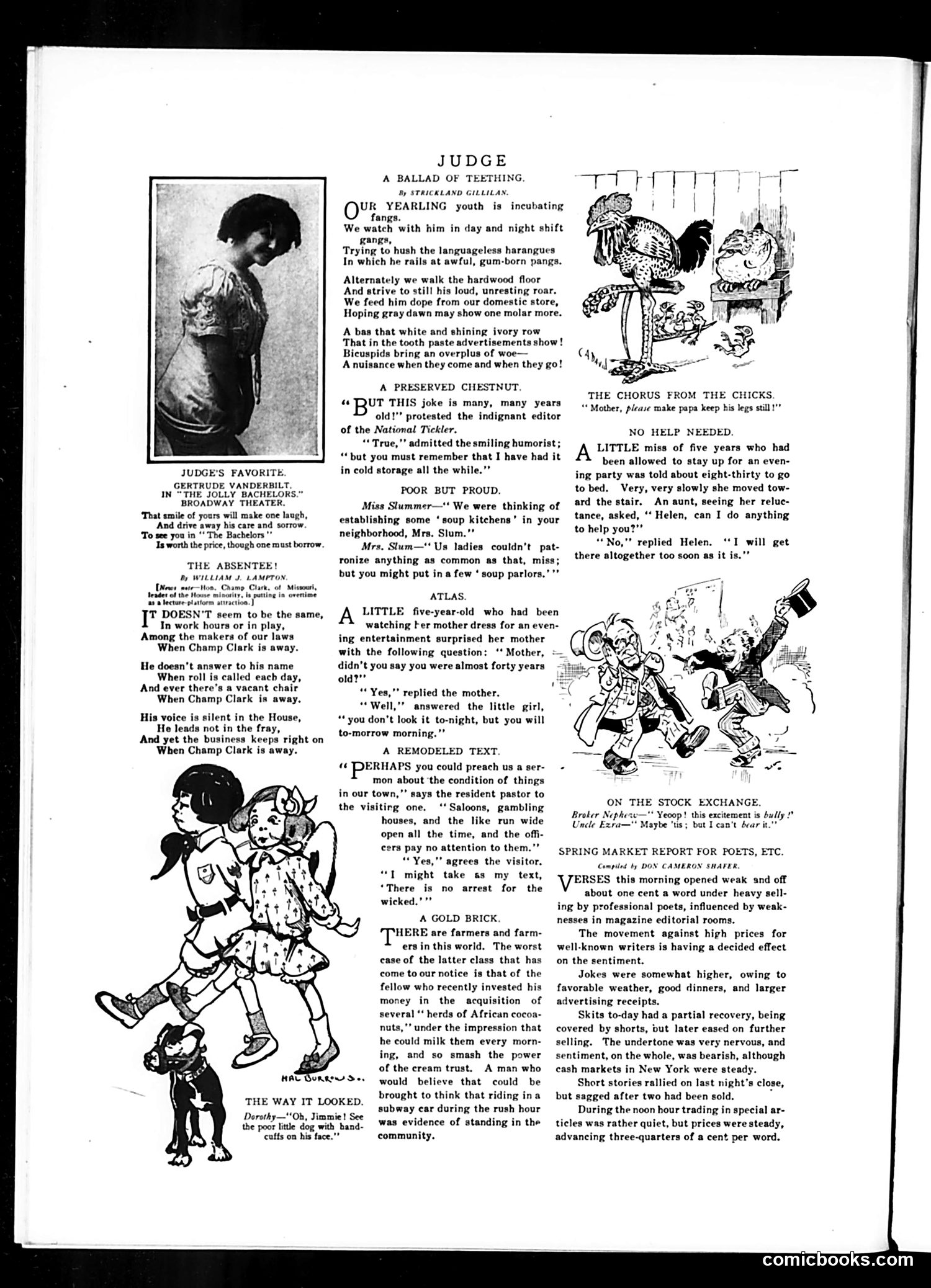
This page from the satirical magazine *Judge* contains multiple humor pieces targeting early 20th-century American life. **Political Content:** "The Absentee" by William J. Lampton mocks **Champ Clark**, a prominent Congressional figure, for frequently missing legislative sessions. The poem suggests the House functions fine without him—satirizing either his ineffectiveness or the redundancy of certain politicians. **Social Satire:** "Poor But Proud" ridicules working-class pretension: Mrs. Slum refuses a "soup kitchen" charity as too common, demanding a "soup parlor" instead—mocking how the poor adopt middle-class affectations to maintain dignity. "A Gold Brick" lampoons rural gullibility, describing a farmer duped into buying "African coconuts" he believed could be milked, attacking both agricultural ignorance and susceptibility to get-rich-quick schemes. **Other Content:** The page includes light domestic humor (teething baby complaints, a child's tactless comment about her mother's aging), theatrical promotion (Gertrude Vanderbilt), and stock market jokes—typical *Judge* fare mixing political commentary with genteel comedy.
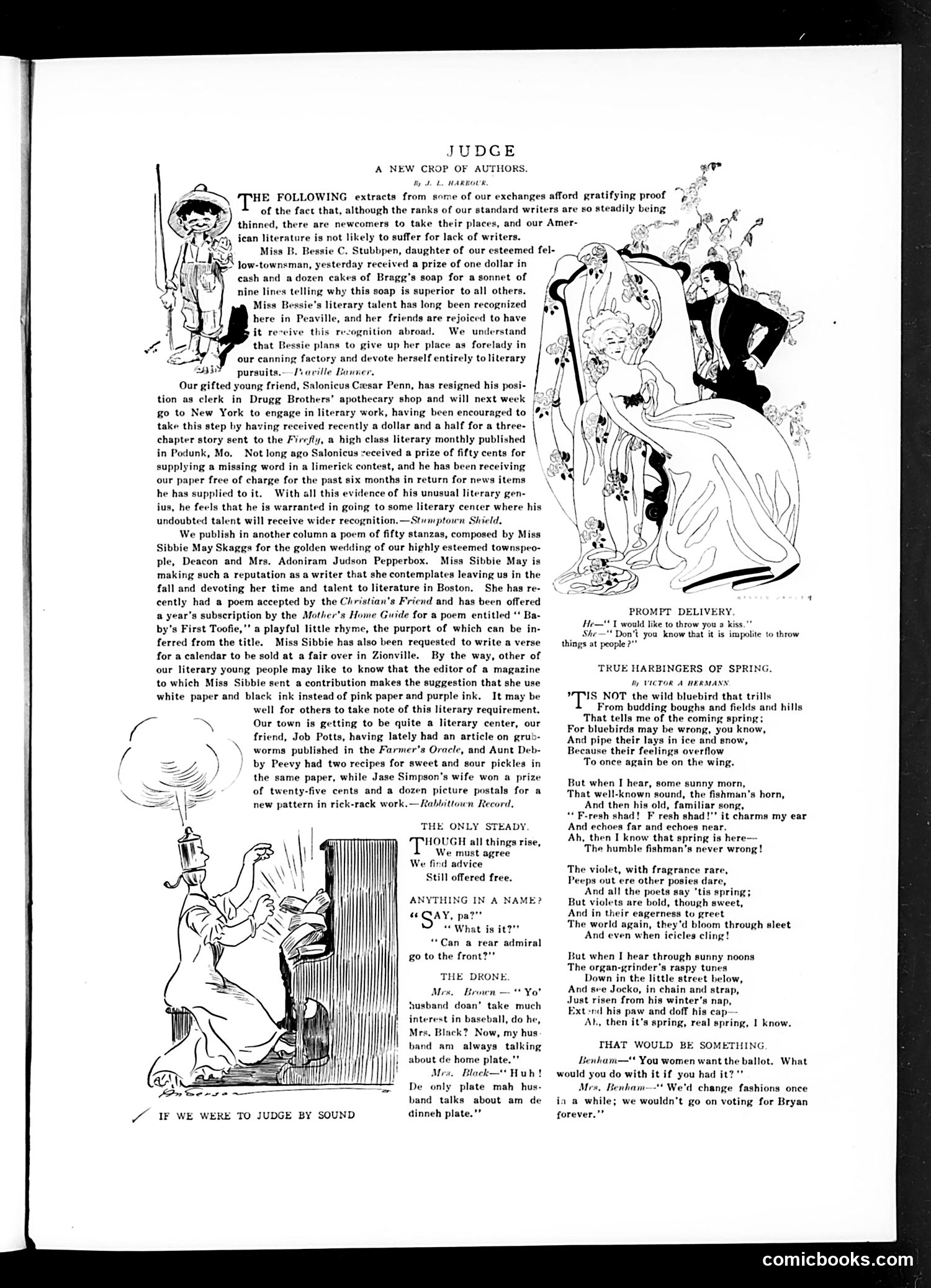
This page satirizes the phenomenon of amateur writers from small towns receiving modest prizes and then dramatically overestimating their literary talents. The satire targets the proliferation of mediocre local writers encouraged by minor publication victories. The examples are absurdly trivial: Miss Bessie wins a dollar and soap cakes for a nine-line poem advertising soap; Salonicus Cesar Penn quits his pharmacy job after earning $1.50 for a short story; Miss Sibbie May plans to move to Boston after selling a poem titled "Baby's First Toofie" and receiving a calendar commission. Judge mocks how these small-town newspapers breathlessly celebrate these nonachievements as evidence of burgeoning literary genius. The humor lies in the gap between the actual accomplishments (minor monetary rewards, local publications in places like "Podunk, Mo.") and the subjects' inflated self-regard—they believe these trivial successes justify abandoning employment for serious literary careers. The page's title, "A New Crop of Authors," satirizes America's apparent literary abundance while questioning its actual quality.
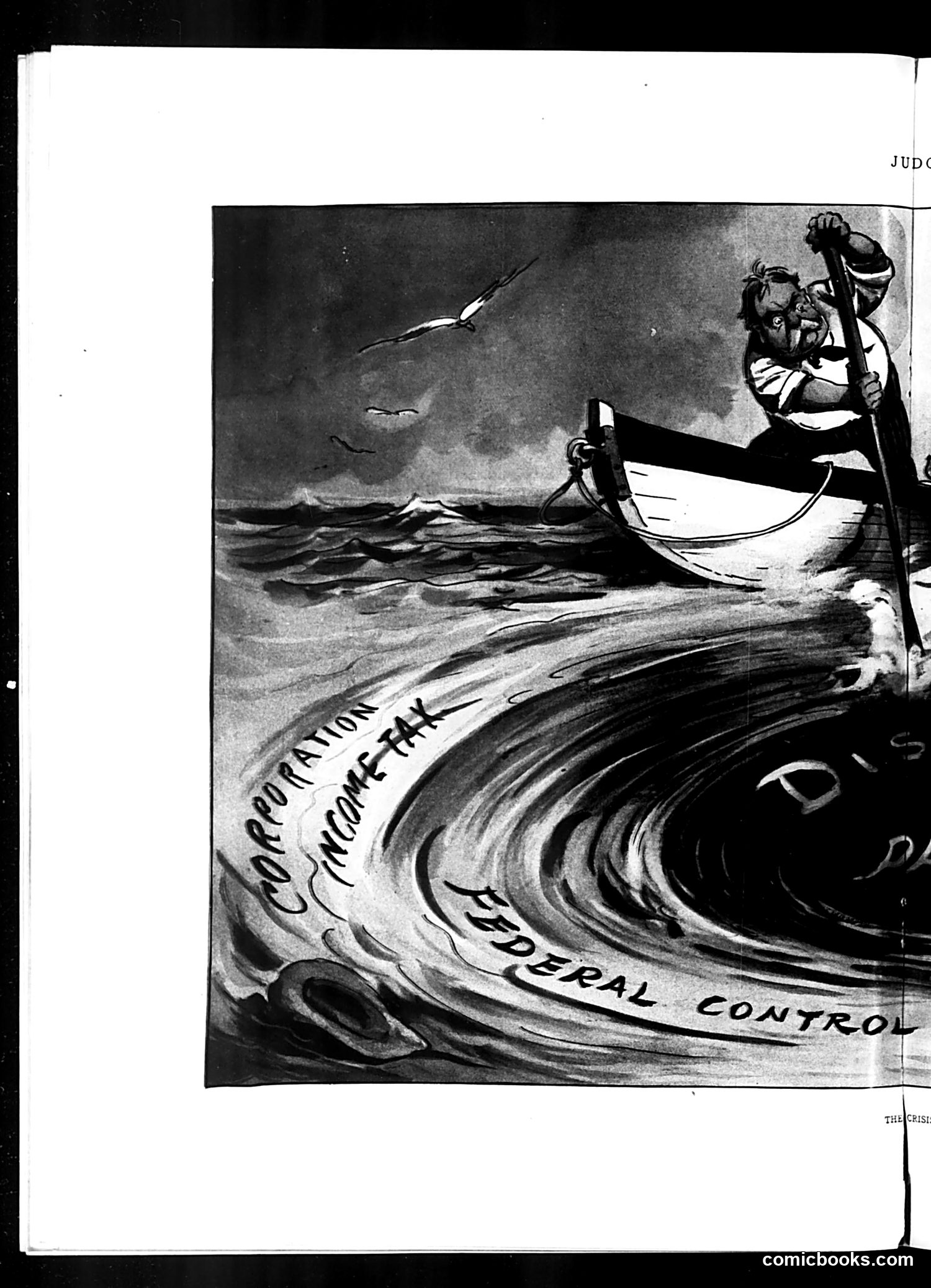
This Judge magazine cartoon depicts a figure in a small boat struggling against a massive whirlpool labeled "GENERAL CONTROL," "CORPORATION MONOPOLY," and "CORRUPTION" (text visible in the swirling waters). The lone boatman appears to be attempting to navigate or escape these overwhelming forces. The satire criticizes how individual citizens or reformers are powerless against systemic corruption, corporate monopolies, and concentrated governmental control. The tiny boat versus the enormous, inescapable whirlpool conveys the futility of resisting entrenched institutional corruption during the Gilded Age or Progressive Era—when Judge regularly attacked corporate excess and political corruption. The cartoon's message: individual effort cannot overcome structural systemic problems without major reform.
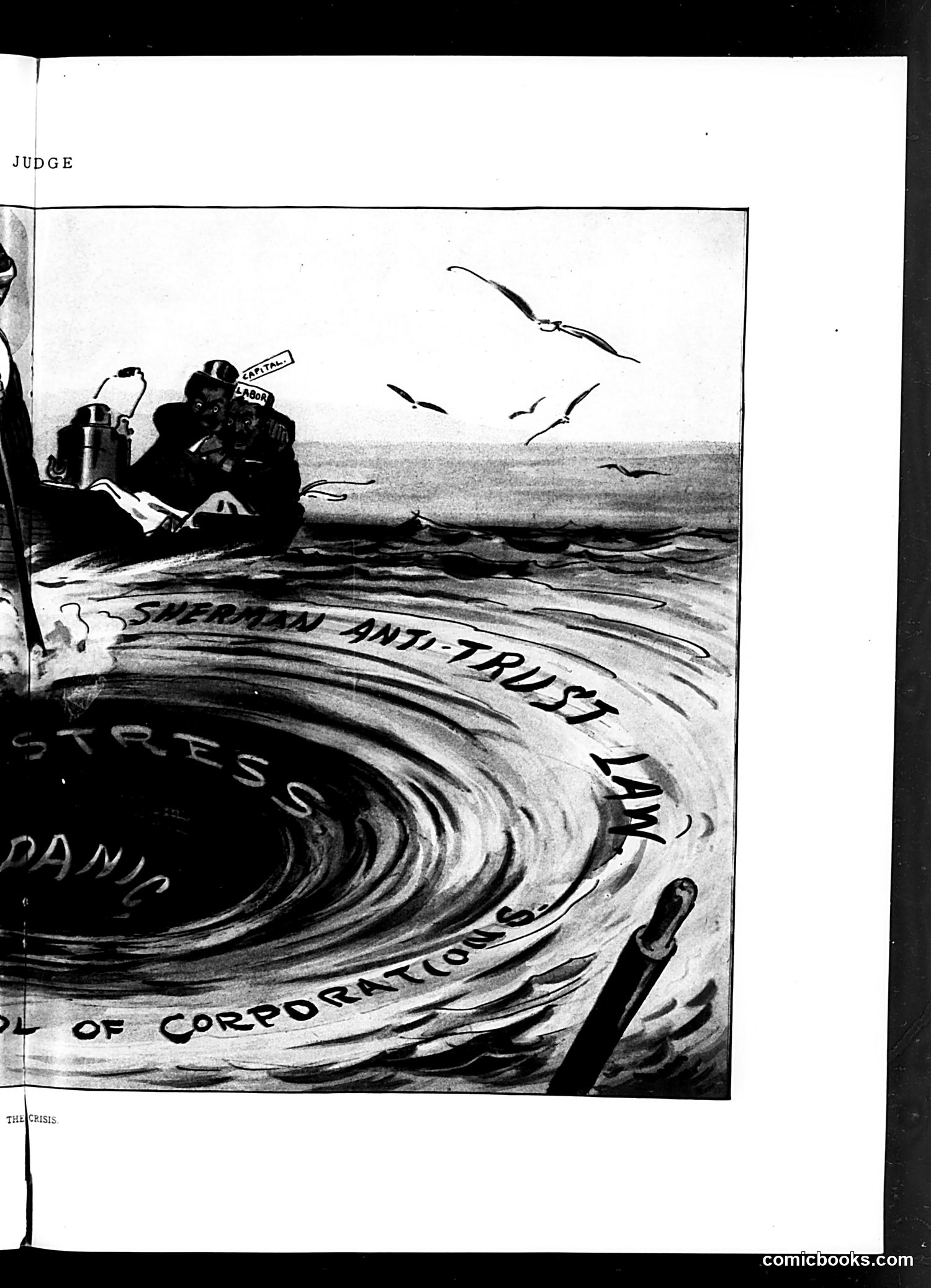
This Judge magazine cartoon depicts a judge or authority figure sitting atop a swirling whirlpool labeled "STRESS," "STRAIN," "ANTI-TRUST," and "OF CORPORATIONS." The figure appears to be observing or documenting the turbulent situation below, where birds (likely representing worried citizens or small businesses) fly overhead in distress. The satire criticizes corporate regulation during what appears to be the Progressive Era trust-busting period. The judge represents the legal system's attempt to manage corporate abuses, while the chaotic whirlpool symbolizes the destabilizing economic and social stress created by large corporations. The drowning figure and fleeing birds suggest that despite judicial intervention, ordinary people and small enterprises suffer amid the corporate turmoil. The cartoon critiques the inadequacy of legal remedies for corporate misconduct.
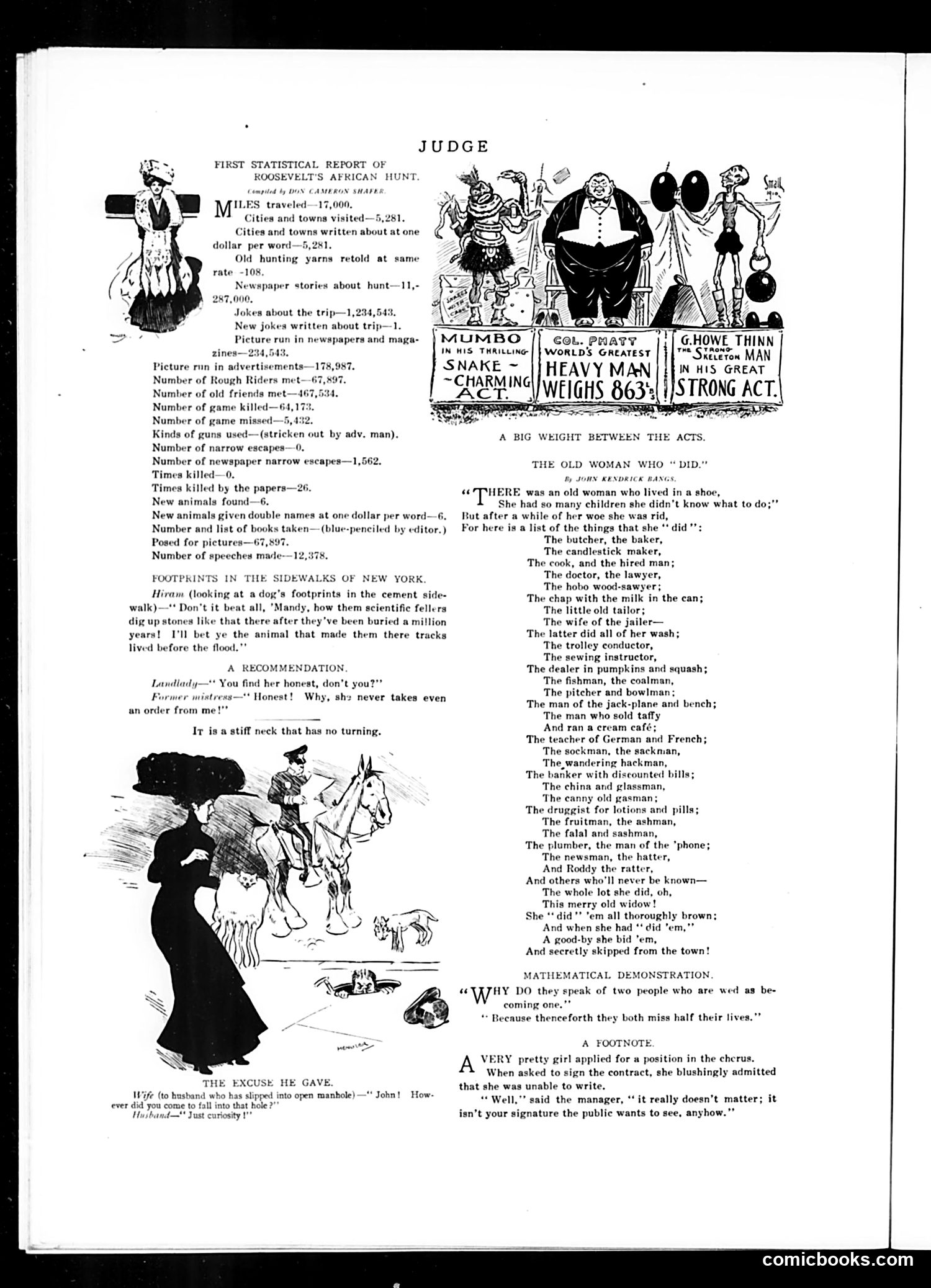
This page satirizes **Theodore Roosevelt's 1909-1910 African safari**, presenting a mock statistical report of his hunting expedition. The opening list ridicules how Roosevelt monetized his trip—tallying miles traveled, cities visited, "hunting yarns retold at one dollar per word," and crucially, **newspaper narrow escapes (1,562) versus actual narrow escapes (0)**. This jabs at media sensationalism and Roosevelt's self-promotion through press coverage. The "Big Weight Between the Acts" section features circus-style performers, using Roosevelt's physical stature as a visual joke about his outsized public persona. The remaining content consists of unrelated Judge humor: "The Old Woman Who 'Did'" (a nursery rhyme parody listing occupations), "Footprints in the Sidewalks of New York" (a rural character misunderstanding animal tracks), and various brief jokes about honesty, marriage, and women's capabilities. The satire targets Roosevelt's celebrity-hunting expedition and how newspapers amplified its drama while understating actual dangers.
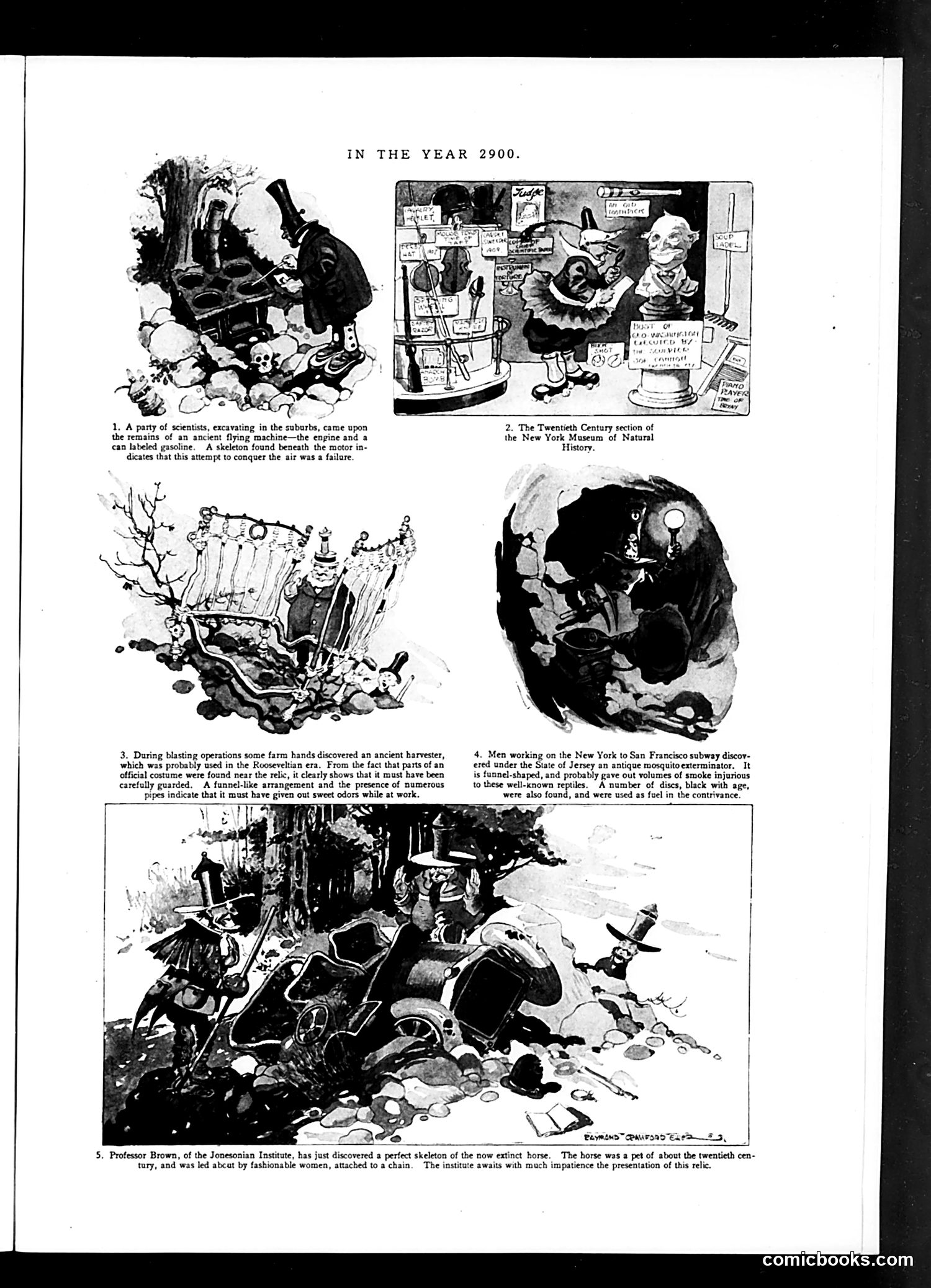
This five-panel satire imagines future archaeologists discovering the "ancient" artifacts of early-20th-century America, treating mundane modern inventions as mysterious relics. Panel 1 depicts a crashed early airplane as a failed death-trap. Panel 2 shows the "Twentieth Century section" of a future museum—satirizing contemporary progress as quaint history. Panel 3 mocks farm machinery from the "Rooseveltian era" (Theodore Roosevelt's presidency), treating it with archaeological reverence. Panel 4 ridicules early mosquito-control devices as primitive contraptions. Panel 5 jokes that horses will be extinct by 2900, preserved as museum curiosities despite being "pets...led about by fashionable women." The satire's target: Turn-of-the-century technological optimism and industrial pride. By projecting forward 900 years, Judge suggests today's marvels will seem absurdly primitive—mocking both contemporary faith in progress and the likelihood that future generations will view us with bemused condescension.
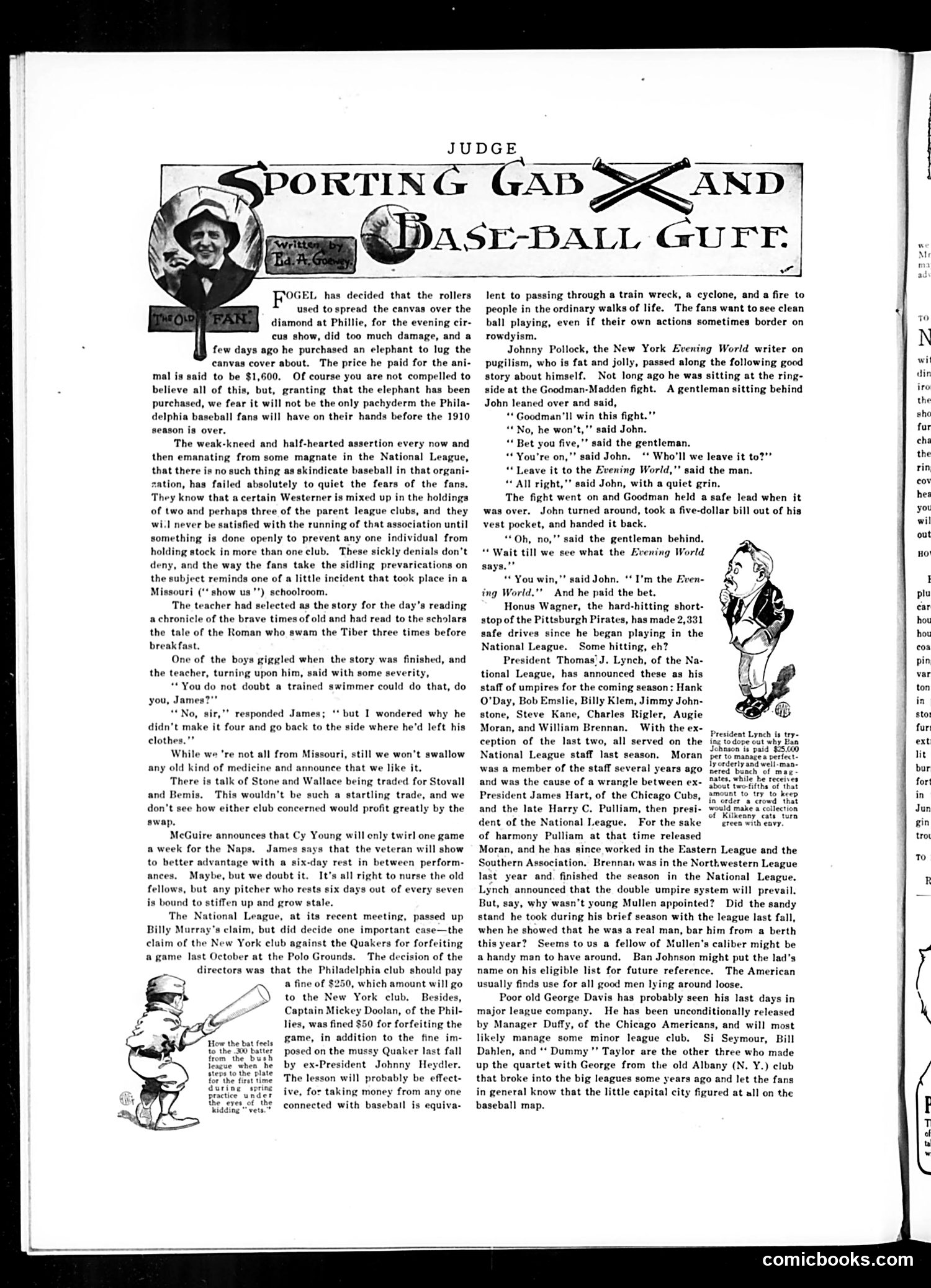
This satirical sports column criticizes corruption in Major League Baseball, particularly addressing the "Westerner" (likely a mogul) who secretly owns stock in multiple National League clubs. The author compares fans' acceptance of denial about this financial manipulation to a Missouri schoolroom joke: a student accepts a tale about a Roman swimming the Tiber three times before breakfast, then reasonably questions why he didn't make it four to reach his clothes—implying the denials are implausibly evasive. The piece also covers routine baseball transactions (trades, fines, umpire appointments) and mocks claims about managing aging player Cy Young with limited playing time. The underlying satire targets how baseball leadership brazenly conceals monopolistic practices while expecting fans to believe transparent lies. The magazine advocates for transparent ownership rules to restore "clean ball playing."
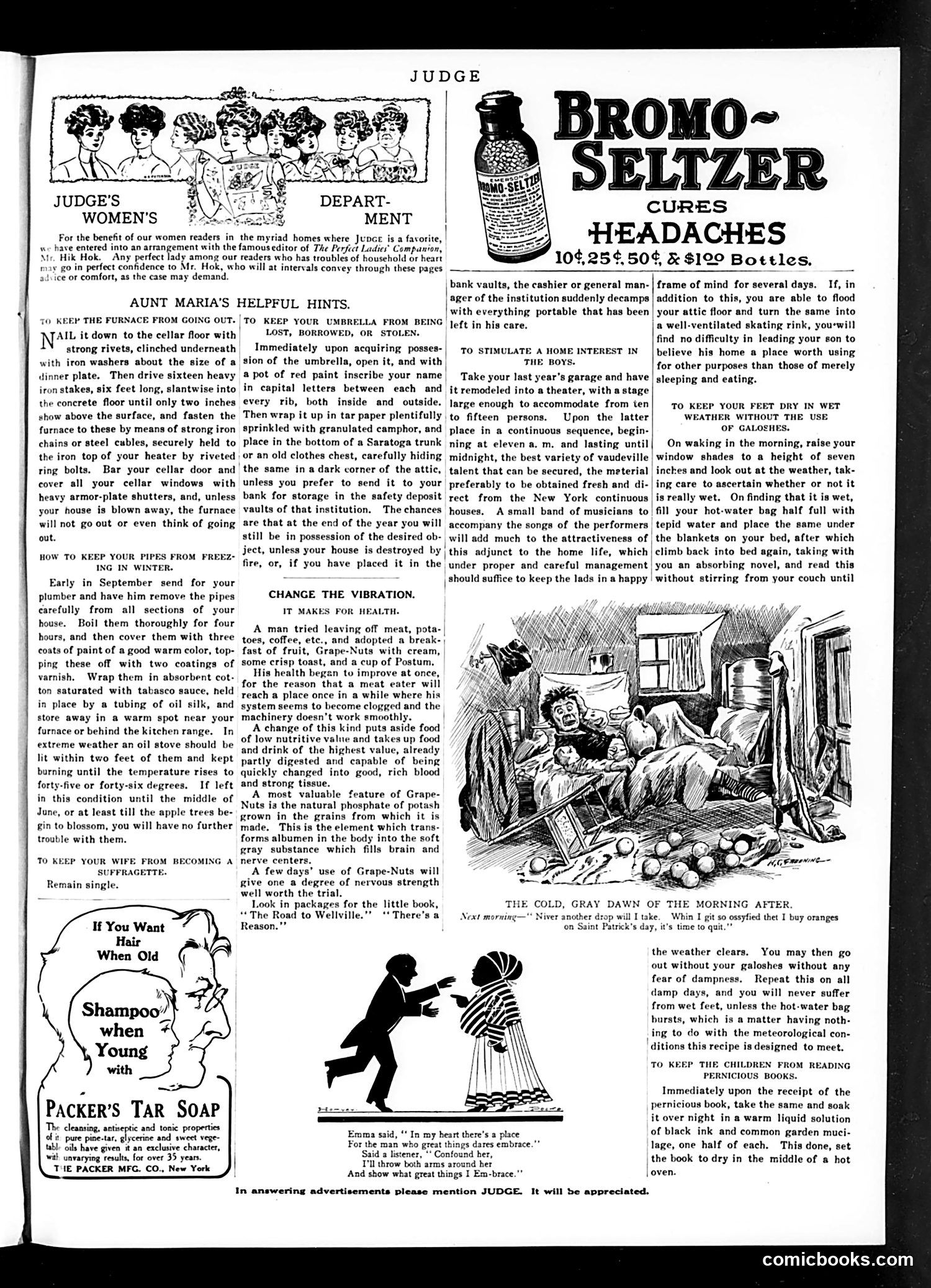
This page presents **"Aunt Maria's Helpful Hints,"** satirical domestic advice columns that mock overly complicated or absurd solutions to everyday household problems. The humor targets turn-of-the-century domestic advice literature by proposing deliberately impractical remedies: - **Keeping the furnace running**: Riveting it to the cellar floor with massive iron stakes - **Preventing umbrella theft**: Inscribing your name on every rib, wrapping in tar paper and camphor, hiding it in a trunk - **Stimulating boys' interest in home**: Converting the garage into a full vaudeville theater with live musicians running continuously until midnight The satire mocks the earnest, verbose style of actual ladies' magazines and domestic guides that promised solutions to household management. The joke is that these "solutions" are more elaborate and impractical than the original problems. The page also includes unrelated period advertisements (Bromo-Seltzer, Packer's Tar Soap), typical of Judge's format.
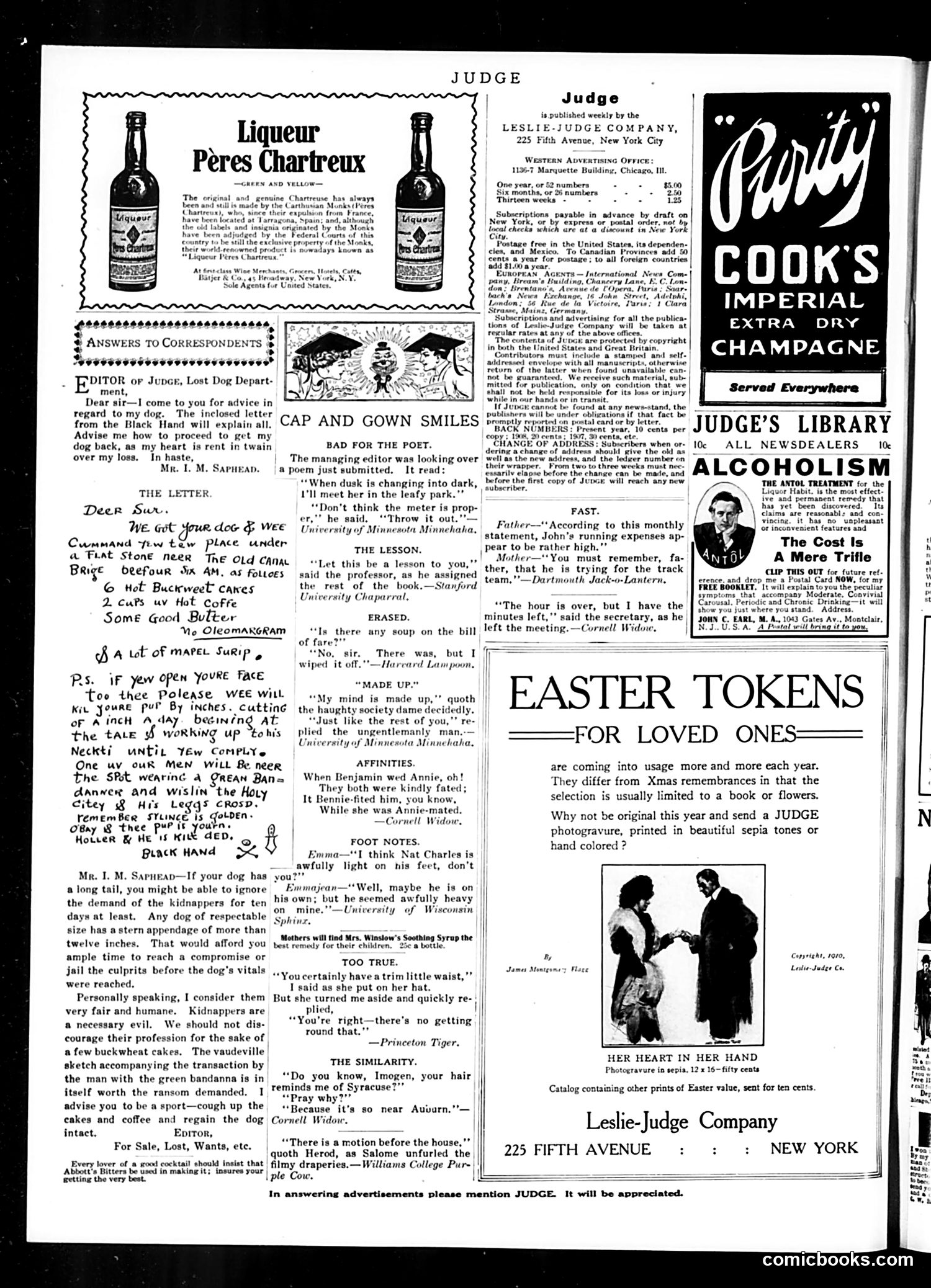
This page is primarily **filler content and advertisements** rather than coherent political satire. The main elements are: **"Answers to Correspondents"**: A humorous advice column where a reader asks about his dog being kidnapped by the "Black Hand" (Italian organized crime). The editor's absurdist response treats dog-napping as a "fair and humane" profession, joking that the dog's tail length determines negotiation time. **"Cap and Gown Smiles"**: A collection of college humor jokes mocking professors and students—entirely apolitical. **Various Advertisement**: Including Liqueur Peres Chartreux (French liqueur), Cook's Champagne, and Judge's Library on alcoholism. **Easter Tokens advertisement**: Promoting Judge-branded Easter cards. The satire is **mild and social rather than political**—targeting academia, pretentious society types, and absurd situations. No identifiable political figures or events are referenced. This appears to be a general-interest humor magazine page from the early 20th century, mixing ads with lightweight comic content.
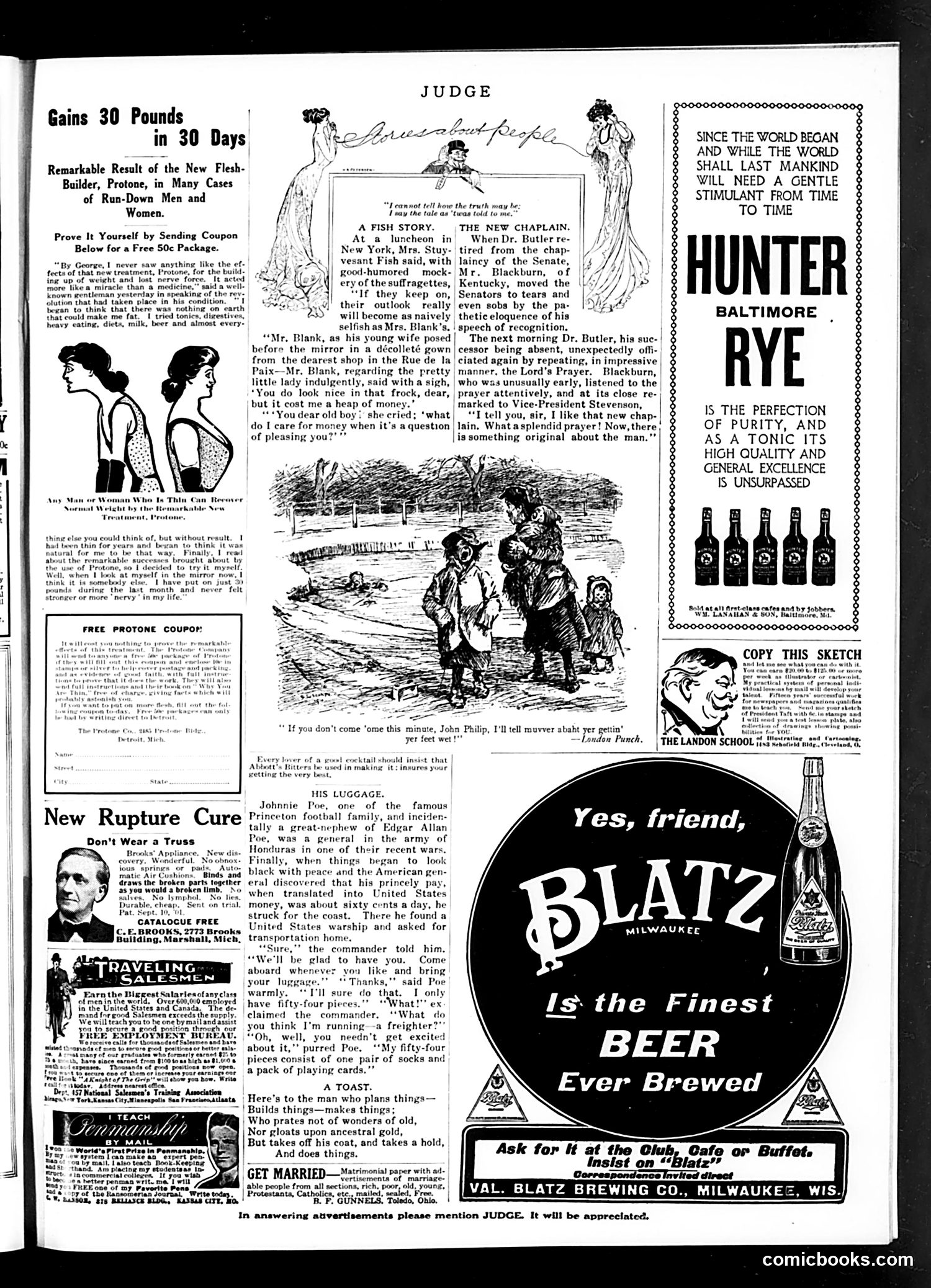
This page is primarily **advertising** for patent medicines and commercial products, with minimal satirical content. The main editorial cartoon, "The New Chaplain," depicts a Senate chaplain's prayer moving senators to tears. The humor appears gentle rather than biting—it contrasts Dr. Butler's emotional eloquence favorably with his predecessor's dry approach. Vice-President Stevenson is mentioned appreciatively, suggesting this is mild political commentary rather than satire. The other content includes: - A "Fish Story" anecdote about weight gain - A Johnnie Poe biographical sketch (referencing Edgar Allan Poe's family) - Extensive advertisements for dubious health products (rupture cures, weight-gain treatments) The page reflects early 20th-century magazine culture: mixing light humor with aggressive marketing for remedies we'd now recognize as quackery. The tone is promotional rather than satirical—Judge here functions as much as an advertising vehicle as a humor publication.
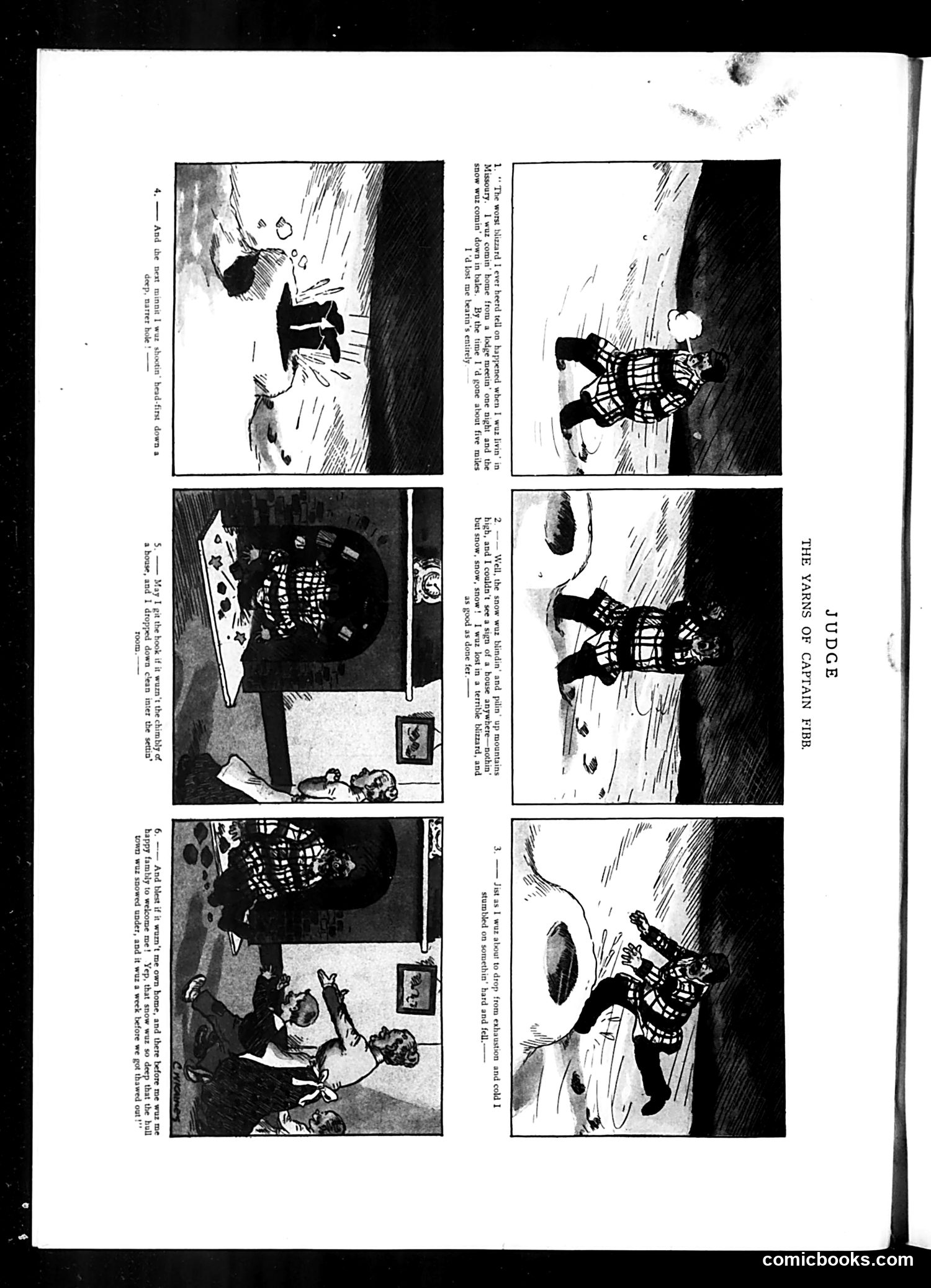
This is a comic strip featuring tall tales told by "Captain Fibb," a character whose name suggests he's a fibber (liar). The strip satirizes exaggerated adventure stories and fishermen's boasts—a common target of humor in the period. The visible panels show the Captain recounting an implausibly dramatic incident involving falling down a hole while shooting. The absurd narrative and increasingly ridiculous situations exemplify the "tall tale" tradition that Judge magazine mocked. The humor depends on readers recognizing the obvious fabrication and the Captain's earnest delivery of nonsensical adventures. This format was popular in early American comics—poking fun at masculine braggadocio and the unbelievable stories men told in bars or gathering places.