
Judge, 1910-03-12 · page 11 of 16
Judge — March 12, 1910 — page 11: what you’re looking at
What you’re looking at
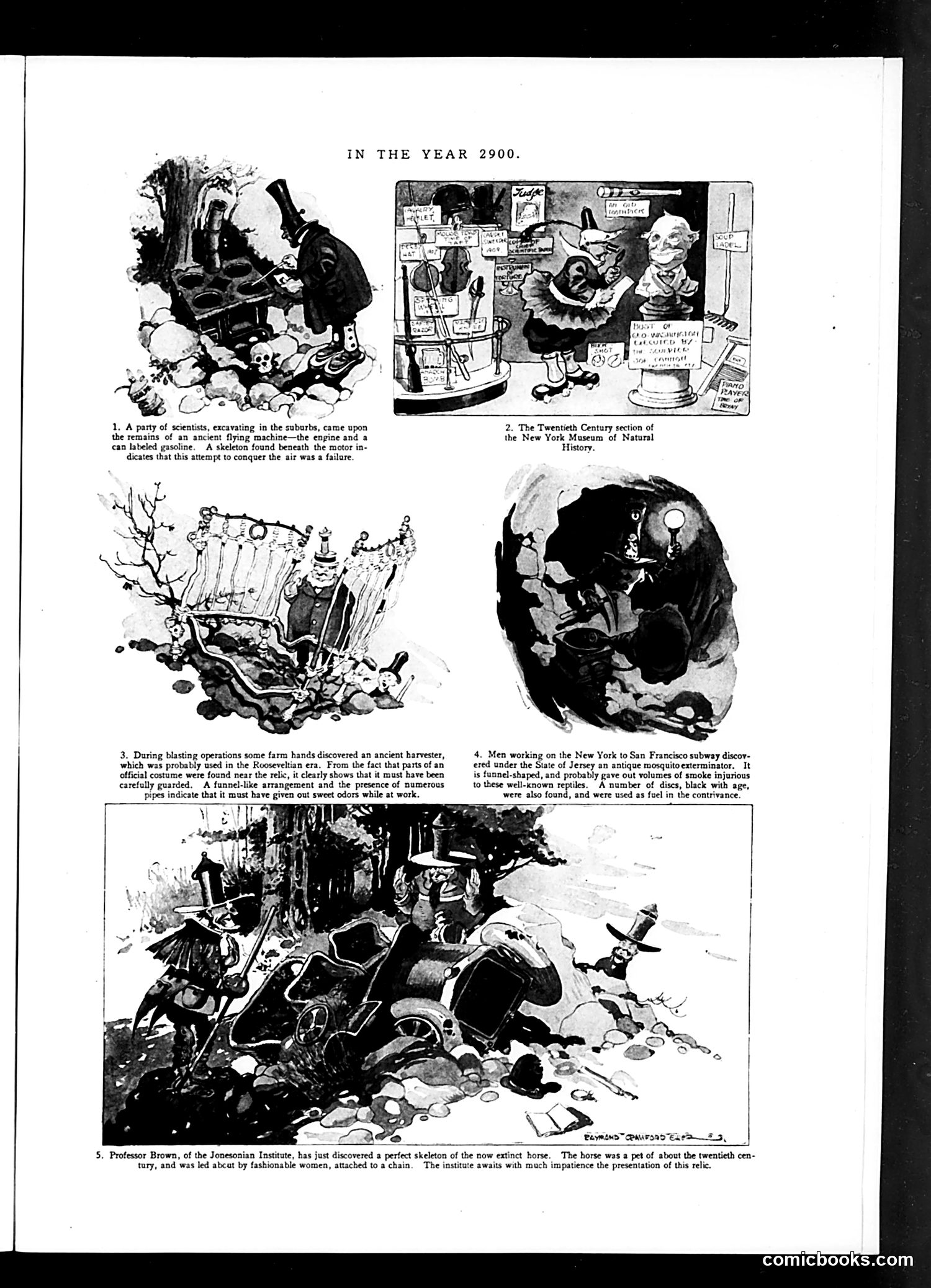
This five-panel satire imagines future archaeologists discovering the "ancient" artifacts of early-20th-century America, treating mundane modern inventions as mysterious relics. Panel 1 depicts a crashed early airplane as a failed death-trap. Panel 2 shows the "Twentieth Century section" of a future museum—satirizing contemporary progress as quaint history. Panel 3 mocks farm machinery from the "Rooseveltian era" (Theodore Roosevelt's presidency), treating it with archaeological reverence. Panel 4 ridicules early mosquito-control devices as primitive contraptions. Panel 5 jokes that horses will be extinct by 2900, preserved as museum curiosities despite being "pets...led about by fashionable women." The satire's target: Turn-of-the-century technological optimism and industrial pride. By projecting forward 900 years, Judge suggests today's marvels will seem absurdly primitive—mocking both contemporary faith in progress and the likelihood that future generations will view us with bemused condescension.
📄 Transcribed text from this page (OCR, searchable)
Machine-transcribed from the original scan — historical spelling and the odd misread are preserved.
IN THE YEAR 2900. Rano Paver 2. The Twentieth Century section of the New York Museum of Natural History. 1. A party of scientists, excavating in the suburbs, came upon the remains of an ancient flying machine—the engine and a can labeled gasoline. A skeleton found beneath the motor in- dicates that this attempt to conquer the air was a failure, 4. Men working on the New York to San Francisco subway discov- eed under the Siate of Jersey an antique mosquito extermin: I is funnel-shaped, and probably gave out volumes of smoke to these well-known reptiles. A number of discs, black with age, were also found, and were used as fuel in the contrivance. 3. During blasting operations some farm hands discovered an ancient harvester, which was probably used in the Rooseveltian era. From the fact that parts of an official costume were found near the relic, it clearly shows that it must have been carefully guarded. A funnel-like arrangement and the presence of numerous indicate that it must have given out sweet odors while at work. = : mea Pa 5. Professor Brown, of the Jonesonian Institute, has just discovered a perfect skeleton of the now extinct horse. The horse was a pet of about the twentieth cen- Paymind™” CPAursad Eira 23, tary, and was led abcat by fashionable women, attached to a chain. The institute awaits with much impatience the presentation of this relic.