
A complete issue · 16 pages · 1910
Judge — February 26, 1910
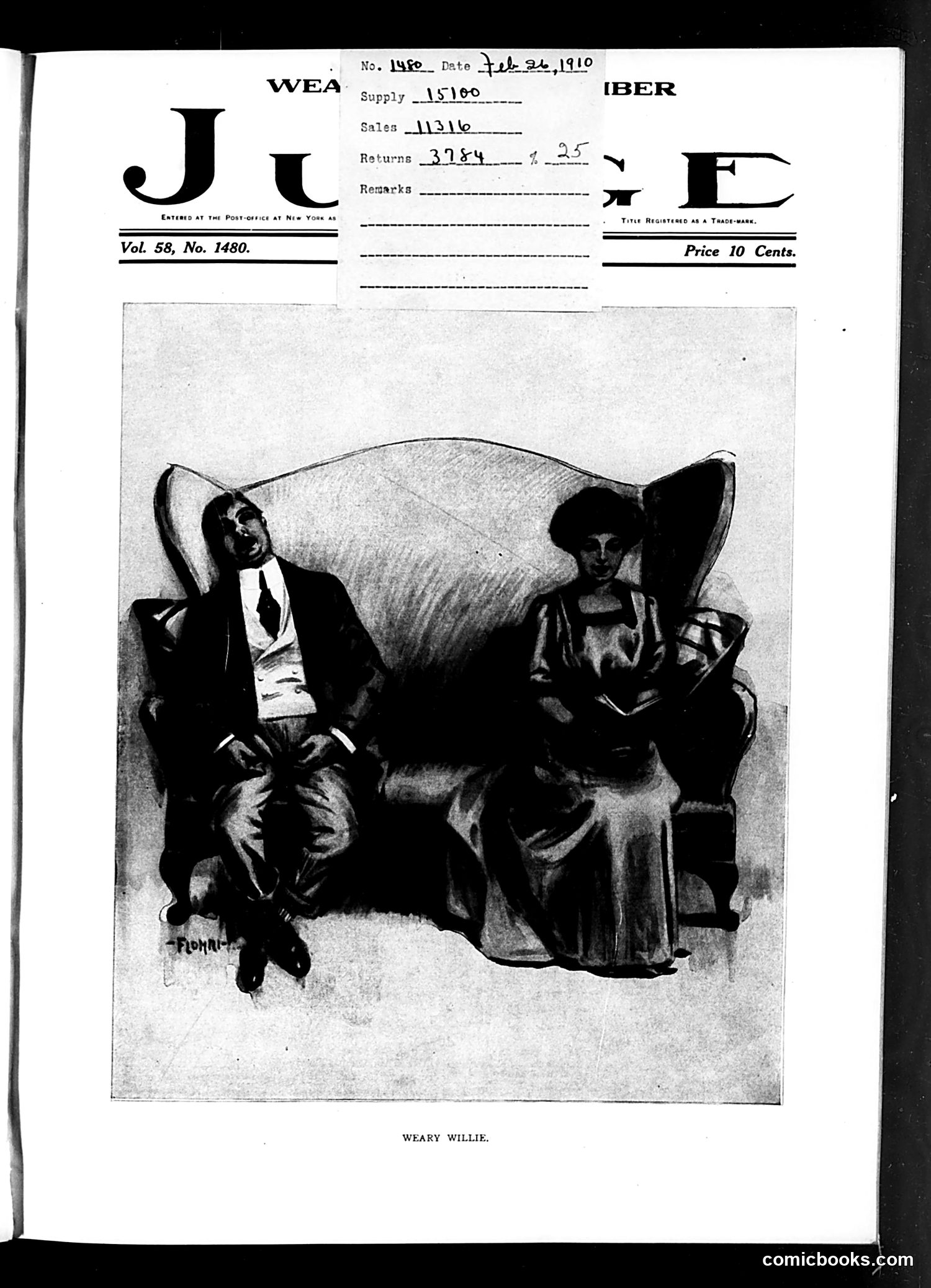
This cartoon depicts a man and woman sitting on a couch. The man, labeled "Weary Willie," appears exhausted and slouches backward with his hat tilted. The woman sits upright beside him. "Weary Willie" was a stock character in American humor of this era—a lazy, tired, or down-on-his-luck vagrant or loafer. The satire likely comments on marital dynamics or domestic life, suggesting the man is worn out, possibly by courtship, marriage, or domestic responsibilities. The contrast between his exhaustion and the woman's composed posture emphasizes the joke. Without additional context from the issue's date (February 24, 1910) or surrounding articles, the specific target of satire remains unclear, but the humor trades on period stereotypes about masculine fatigue and female expectations.
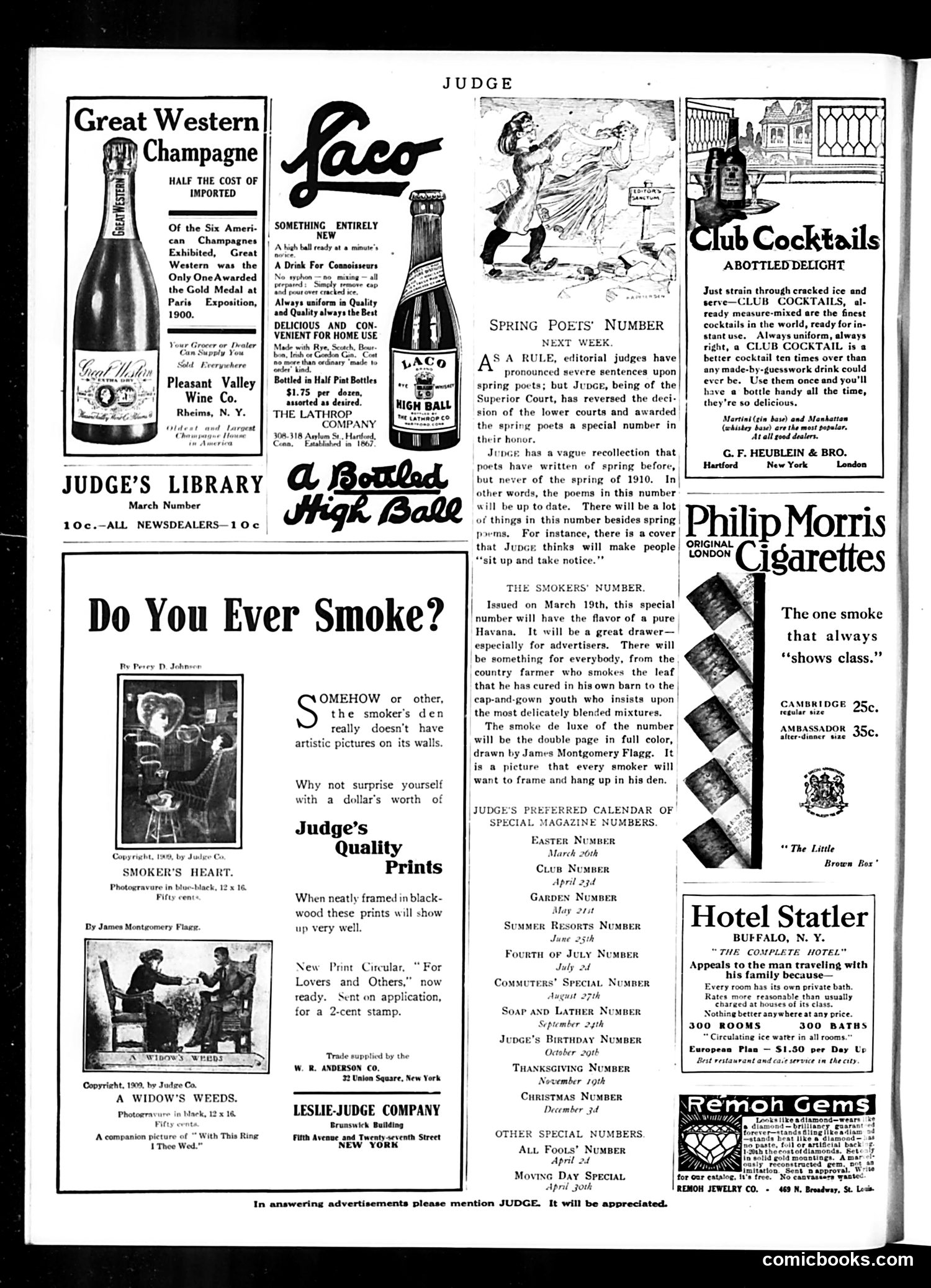
This page is primarily **advertising and editorial content** rather than political satire. The main cartoon titled "Do You Smoke?" by Percy D. Johnson depicts a woman photographing what appears to be an artist's studio, with accompanying text about framing prints—this is an advertisement for "Judge's Quality Prints" by the Leslie-Judge Company. The central editorial section announces upcoming special themed issues of Judge magazine (Easter, Club Number, Garden Number, etc.), standard magazine promotional content. The remaining space features product advertisements: champagne, Laco beverages, Club Cocktails, Philip Morris cigarettes, and Hotel Statler. These ads reflect early 20th-century consumer goods and leisure culture. No significant political commentary or satirical figures appear on this page.
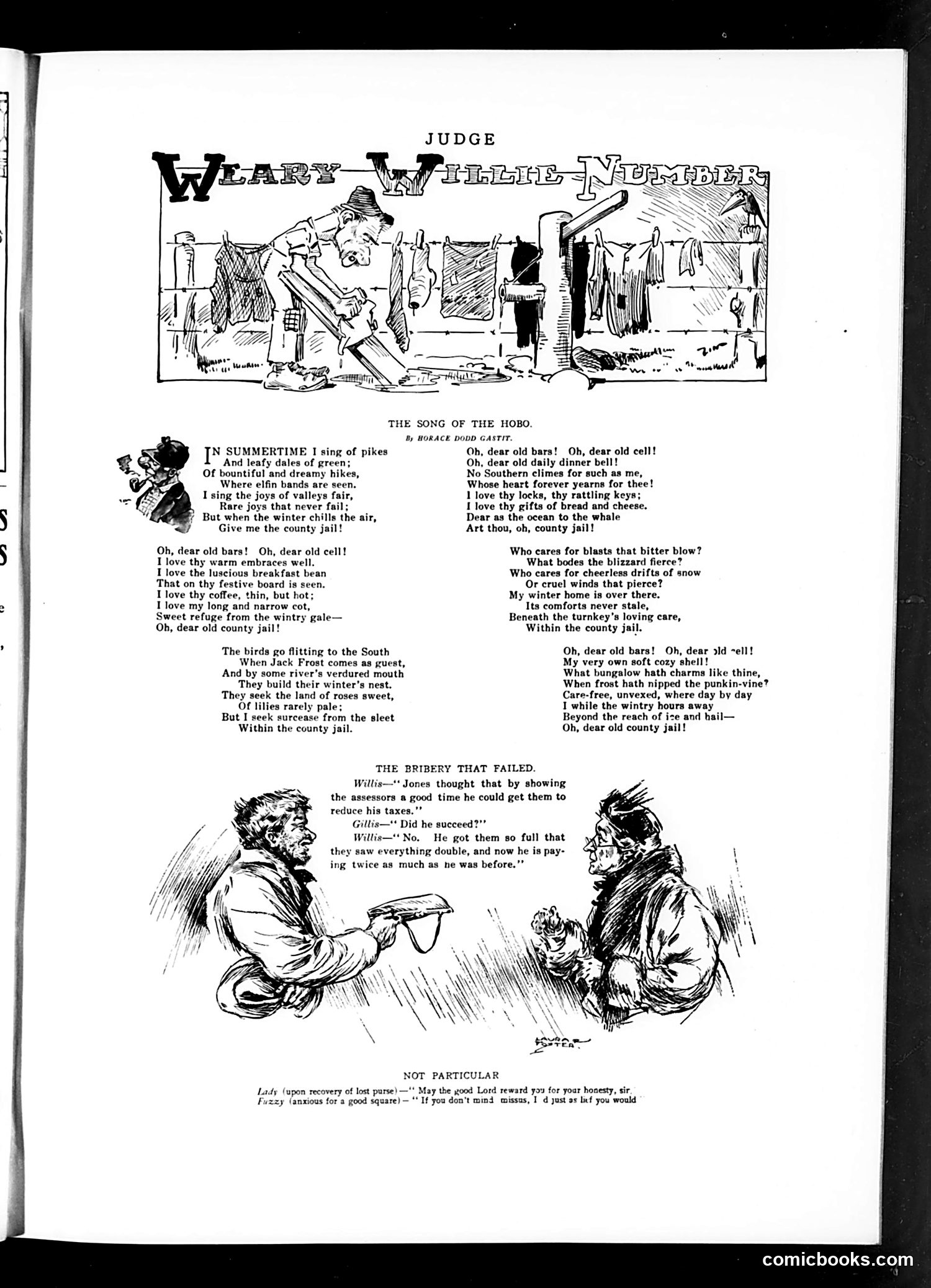
This page contains three separate pieces of satirical content: 1. **"Wary Willie Number"** (top): A illustrated song by Horace Dodd Gavit depicting a hobo's romanticized view of county jail as refuge from winter hardship. The cartoon shows laundry and vagrants, satirizing how the poor might prefer incarceration to homelessness. 2. **"The Bribery That Failed"** (middle): A joke about a taxpayer (Willis) attempting to bribe an assessor to reduce taxes by showing him "a good time," resulting in the assessor seeing everything doubled and now charging double taxes. The satire targets both tax evasion attempts and corrupt officials. 3. **"Not Particular"** (bottom): A brief quip about lost purses and honesty, likely mocking Victorian-era sentimentality about morality. The page satirizes poverty, corruption, and class issues common to Gilded Age America.
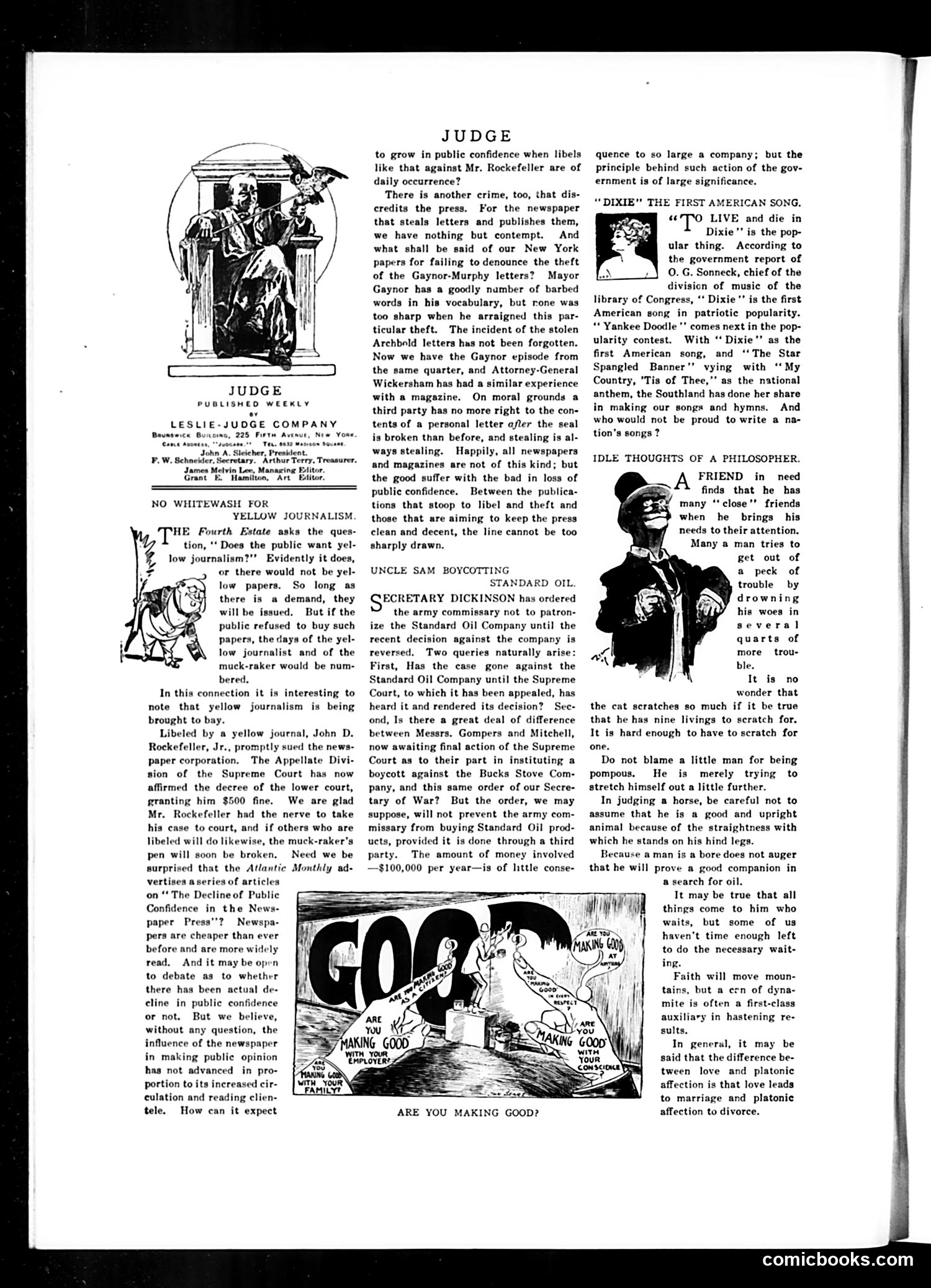
This page contains several distinct satirical sections: **"Judge" masthead**: Standard magazine header. **"No Whitewash for Yellow Journalism"**: Critiques sensationalist newspapers, specifically referencing John D. Rockefeller's legal troubles. The cartoon mocks "yellow journalists" for their inconsistent coverage—attacking Rockefeller's alleged wrongdoings while refusing to cover newspaper theft of personal letters. The satire argues newspapers hypocritically demand accountability from corporations while protecting their own misconduct. **"Uncle Sam Boycotting Standard Oil"**: Comments on Secretary Dickinson's order blocking military purchases from Standard Oil Company pending a Supreme Court appeal. The text debates whether this boycott will effectively pressure the company or merely inconvenience government purchasing. **"Are You Making Good?"**: A cartoon showing two figures, likely representing labor and capital, questioning mutual cooperation. The page satirizes media bias, corporate power, and government regulation circa early 1900s.
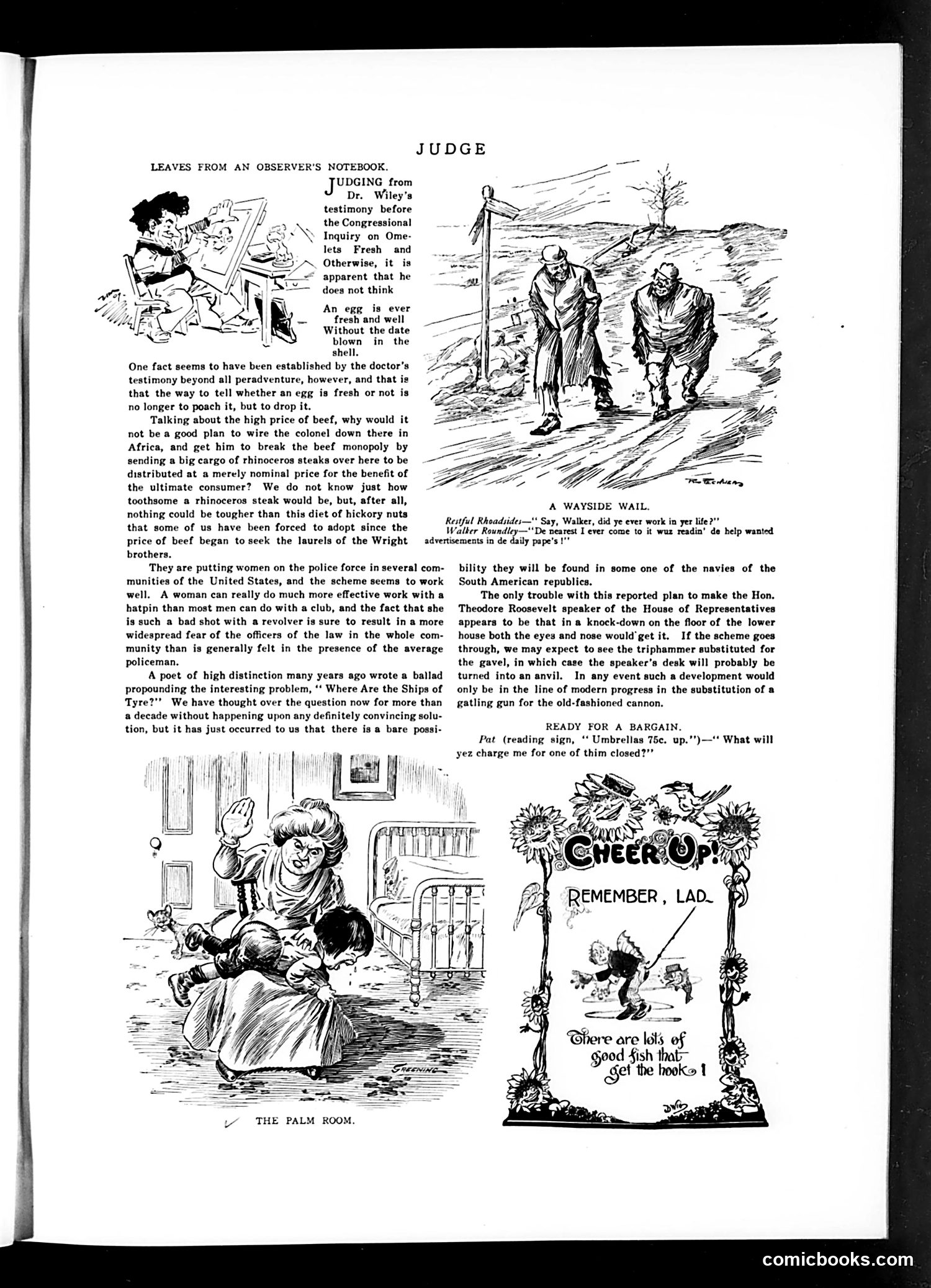
This page contains three distinct pieces: 1. **"Judge" (top right)**: A sketch of two men at a wayside wall, illustrating a dialogue between "Rudolf Rhoadsides" and "Walter Roadsidy" about roadside advertisements in daily papers. 2. **"Leaves from an Observer's Notebook"** (left): Commentary on Dr. Wiley's Congressional testimony about egg freshness, beef monopolies, and women joining police forces. The satire questions whether these reforms are practical or worth the effort. 3. **"The Palm Room"** (bottom left): A domestic cartoon showing a woman and child in what appears to be a flooded room—likely satirizing luxury amenities in homes. 4. **"Cheer Up! Remember, Lad"** (bottom right): An advertisement or cheerful reminder about fishing, with decorative sunflowers. The page's overall tone suggests turn-of-century Progressive Era skepticism toward reform efforts.
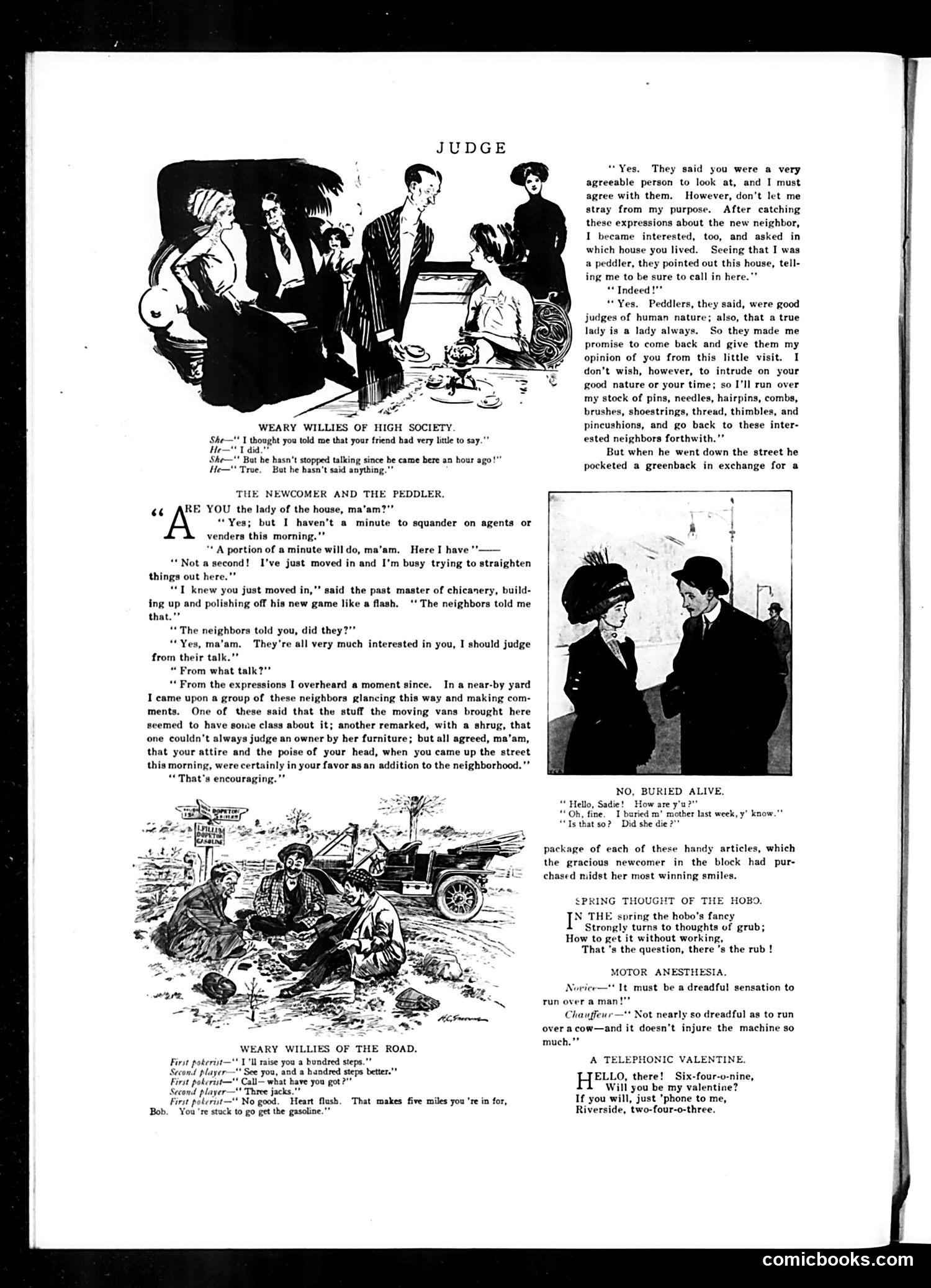
This page contains several humor pieces and cartoons satirizing early 20th-century American life: **"Weary Willies of High Society"** and **"Weary Willies of the Road"** appear to be recurring comic characters—down-on-their-luck vagrants or hobos making sardonic observations about wealth and social pretense. The jokes play on class contrasts and the absurdity of their situations. **"The Newcomer and the Fiddler"** depicts a peddler arriving in a neighborhood, with neighbors gossiping about the newcomer's status based on appearance and possessions—satirizing superficial social judgment and neighborhood nosiness. The bottom cartoons mock contemporary concerns: **"Motor Anesthesia"** jokes about cars hitting cows, and **"A Telephonic Valentine"** is light romantic humor. The overall tone targets class anxiety, gossip culture, and modern technology's awkward integration into society.
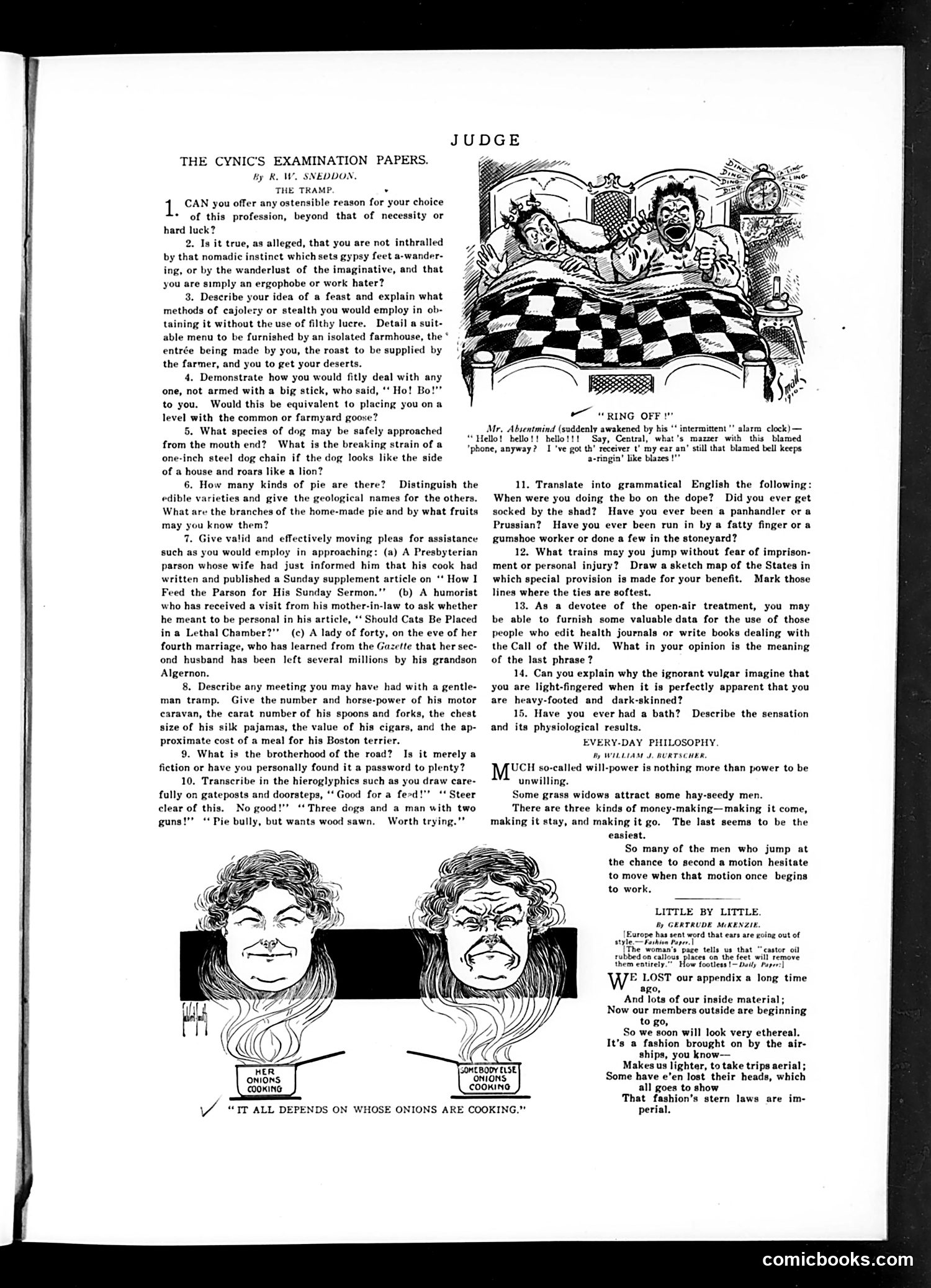
This satirical piece by R.W. Sneddon mocks vagrants and tramps through a fake academic exam. The "questions" absurdly demand tramps justify their lifestyle, describe begging techniques, explain hobo codes scratched on gateposts ("Good for a feed"), and detail encounters with other vagrant "gentlemen" and their possessions. The satire works on two levels: it ridicules both tramps (portraying them as work-hating parasites) AND the upper-class moralizing about poverty. By framing vagrancy as a "profession" requiring expert knowledge, Sneddon exposes the hypocrisy of treating homelessness as a character flaw rather than economic reality. The accompanying cartoons—showing an absentminded man arguing with his phone, and the "onions" joke about whose cooking causes tears—provide lighter satirical relief typical of *Judge* magazine's mixed format.
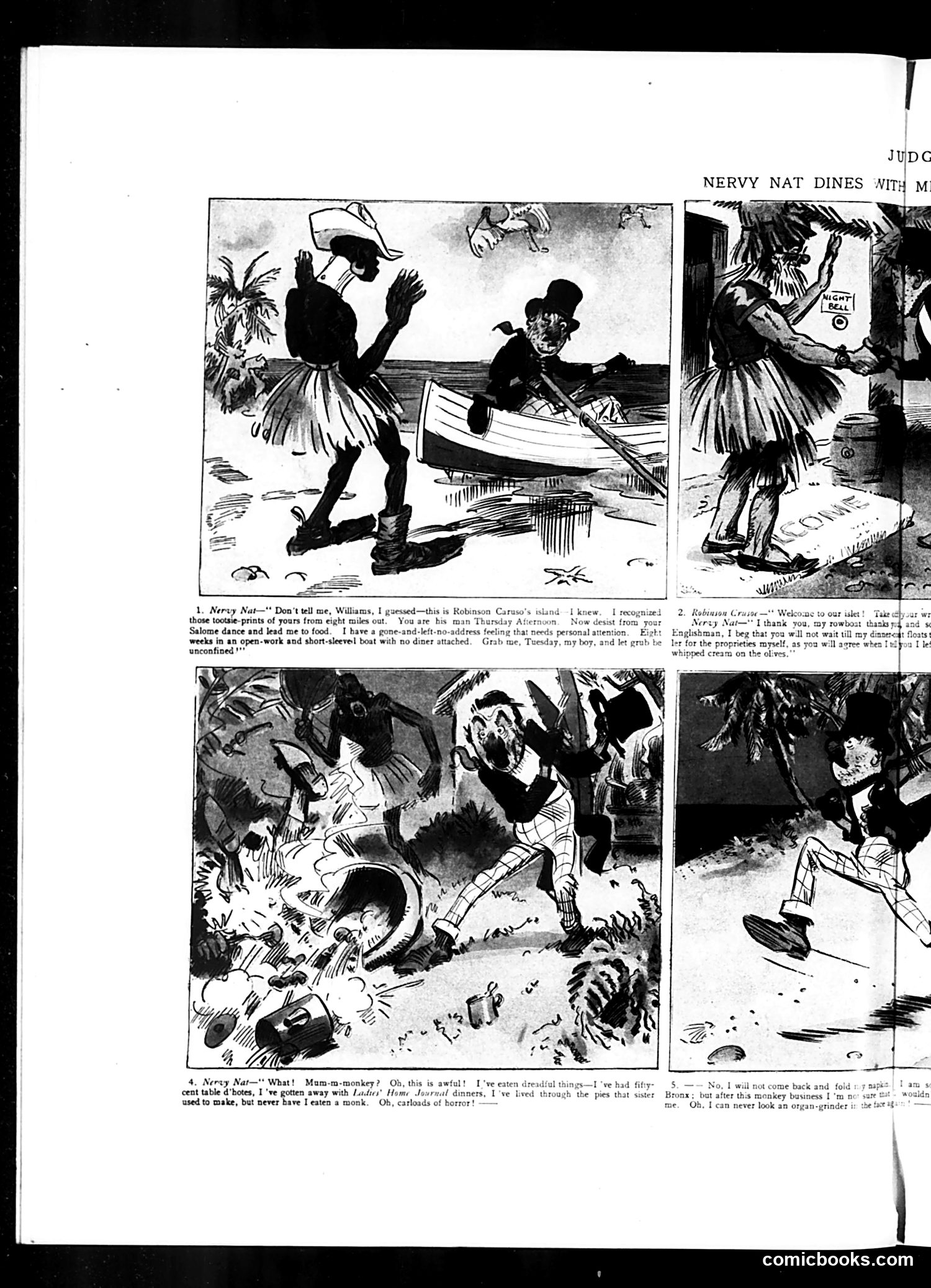
This appears to be a multi-panel "Nervy Nat" comic strip from *Judge* magazine, featuring a character navigating awkward social situations through crude humor. **Panel 1**: Nat encounters someone (Williams) on what appears to be a boat or island, making accusations about footprints and suggesting abandonment or infidelity. The joke involves crude sexual innuendo. **Panel 4**: Nat reacts with horror to discovering he's eaten monkey meat at a restaurant, expressing disgust that he's unknowingly consumed it despite previously eating at cheap establishments ("table d'hôtes"). **The Satire**: The humor relies on lowbrow comedy—misunderstandings, crude suggestions, and class-based jokes about cheap dining. "Nervy Nat" appears to be a character who finds himself in embarrassing predicaments through his own naiveté or poor judgment. The strip mocks both polite society's pretensions and working-class dining experiences. Without the full text clarity, specific historical context remains unclear, but this represents early 20th-century American satirical humor targeting middle and lower-class anxieties.
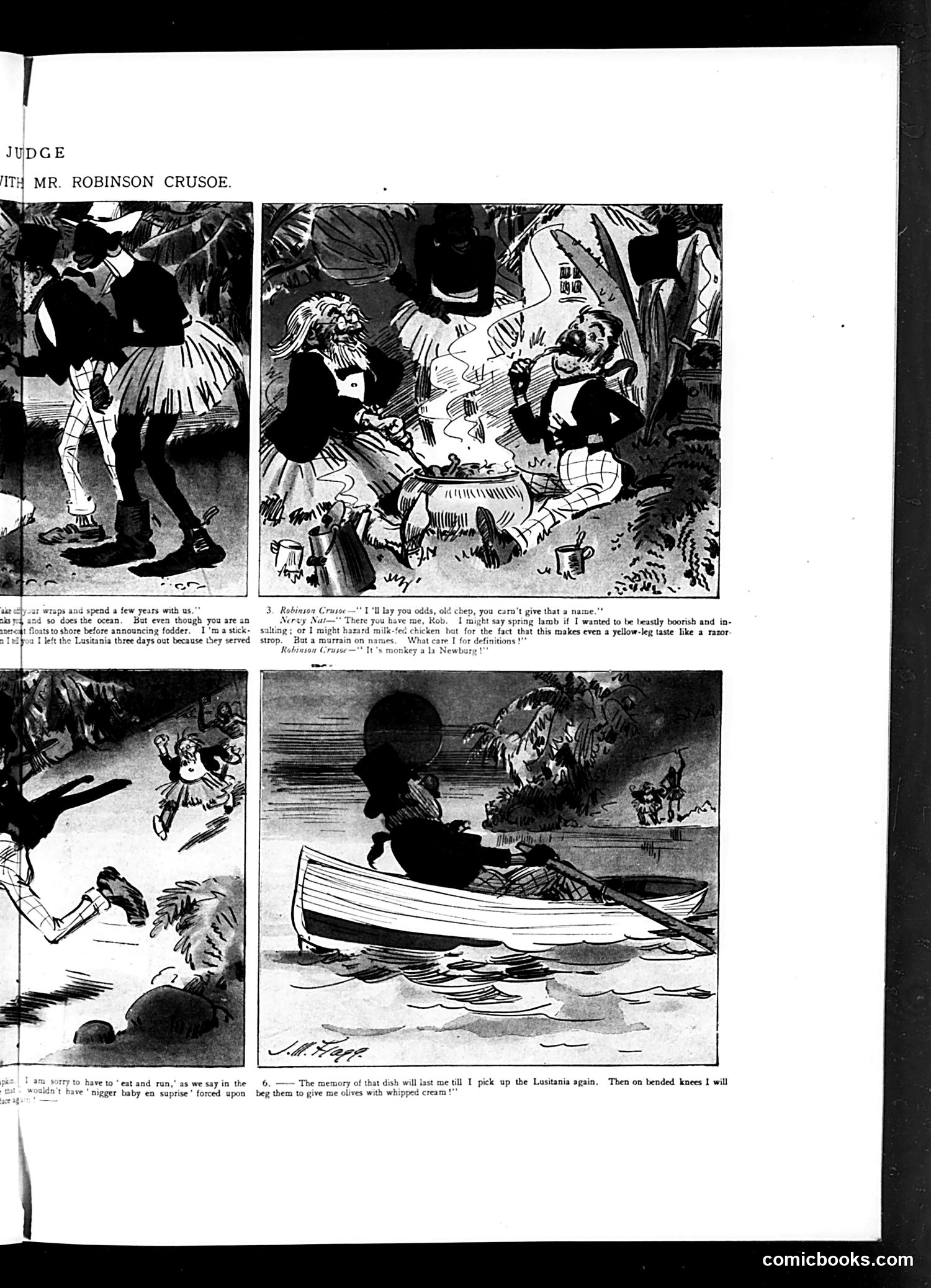
This is a satirical comic strip adaptation of *Robinson Crusoe* depicting the famous castaway's experiences. The panels show Crusoe interacting with what appears to be a native islander, with scenes of cooking, dining, and island life. The satire targets Victorian-era colonial attitudes and British dining customs. The dialogue mocks both primitive island cooking and British food snobbery—Crusoe complains about unpalatable island fare while fantasizing about returning to ship's food, then ironically pines for "olives with whipped cream," suggesting even "civilized" British cuisine is ridiculous. The comic also appears to satirize class pretension and the condescension embedded in colonial narratives. The crude depictions and offensive language reflect the magazine's era, though such content would be considered unacceptable today. The strip uses the famous adventure tale as a vehicle for social commentary on British imperialism, food culture, and class snobbery rather than straightforward storytelling.
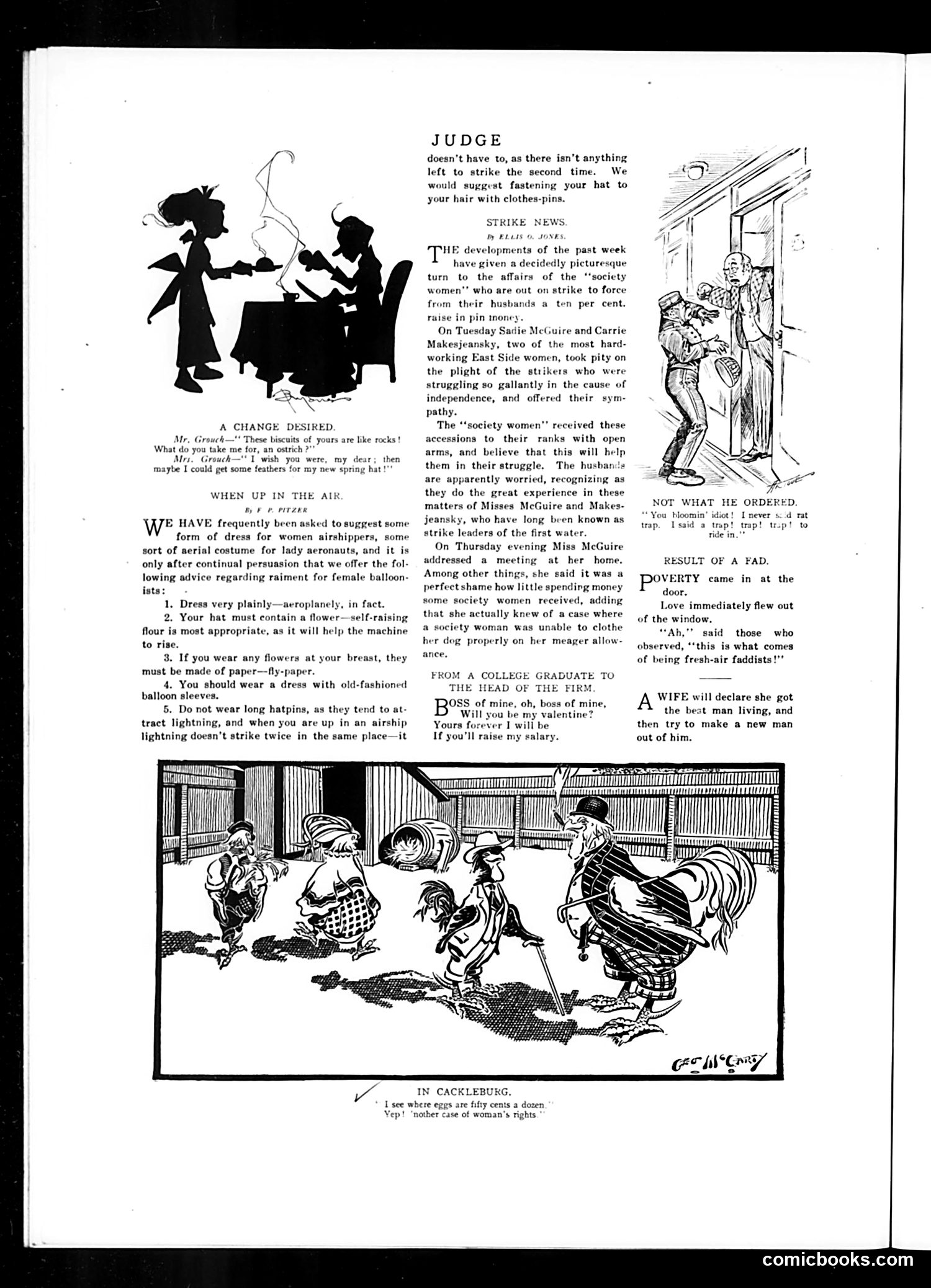
This page contains several satirical pieces mocking contemporary social issues, particularly women's strikes and emerging feminism. **"Strike News"** ridicules wealthy "society women" striking for a 10% raise in pin money (allowance) from husbands. The satire intensifies when working-class East Side women (Sadie McGuire and Carrie Makesjeansky) join the strike—presented as absurdly helping the cause because these women are known "strike leaders." The joke: privileged women demanding pin money while actual laborers struggle. **"When Up in the Air"** humorously advises female aviators on dress, with puns about balloon sleeves, fly-paper flowers, and self-raising flour in hats. The closing joke plays on lightning safety—a dark quip suggesting female aviators are expendable. The smaller quips mock marriage dynamics and gender relations: husbands frustrated by wives' incompetence, a college graduate's romantic overture reduced to salary negotiation, and wives attempting to remake their husbands. The overall tone: skeptical mockery of women's liberation movements and their perceived superficiality among the wealthy.
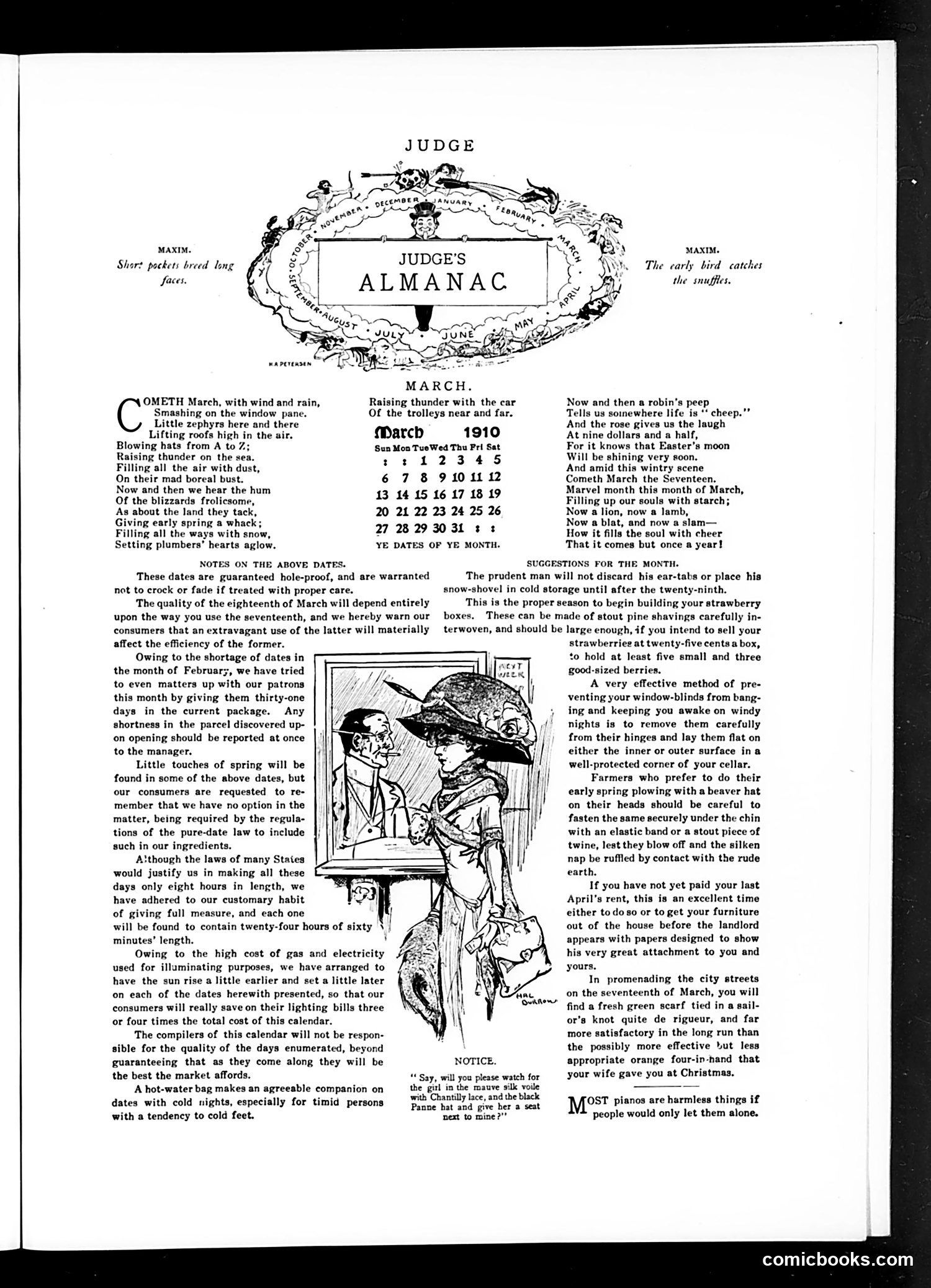
This is primarily an **almanac page** for March 1910, not a political cartoon. The main content is humorous commentary on the calendar itself, satirizing commercial almanac publishers' deceptive practices. The central joke: Judge presents March's dates as a commercial product, complete with warranty disclaimers and false advertising. It mocks publishers who manipulated calendars (adding extra hours, adjusting sunrise/sunset times) to appear to offer better value while actually deceiving consumers about actual time. The small illustration shows a couple in period dress, accompanying a "Notice" about watching for a specific woman—a social scene joke unrelated to the calendar satire. **For modern readers:** This reflects early-1900s consumer skepticism about misleading product marketing and false scientific claims by manufacturers. The satire specifically targets calendar and almanac fraud, which was apparently common enough to warrant mockery in a major magazine.
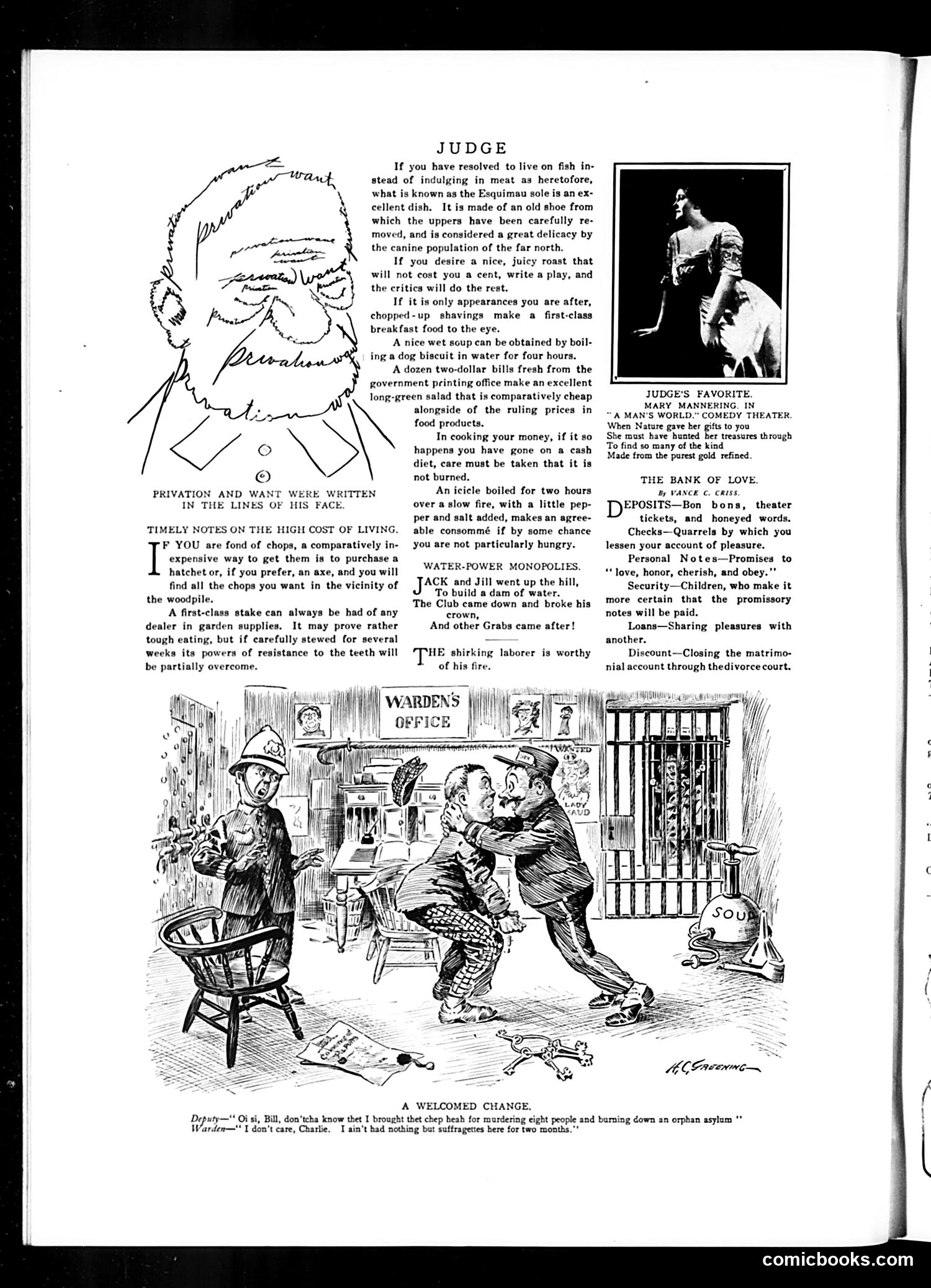
This page contains satirical commentary on two major contemporary issues: **"Timely Notes on the High Cost of Living"** (top): Mock recipes humorously address the severe economic hardship of working-class Americans facing inflation. Suggestions like cooking old shoes, dog biscuits, and icicles—alongside bitter jokes about eating money itself—skewer both the impossible financial straits of the poor and the inadequate advice from wealthy commentators disconnected from real suffering. **"Water-Power Monopolies"** (center): The nursery rhyme parody ("Jack and Jill") satirizes powerful corporate monopolies (represented by "the Club" and "other Grabs") controlling water resources and blocking public access, literally breaking citizens' attempts at independent development. **"A Welcomed Change"** (bottom): The warden's complaint that he'd "rather" deal with a murderer of eight people who burned down an orphanage than "suffragettes" expresses anti-women's-suffrage sentiment through dark humor—indicating Judge's conservative opposition to women's voting rights.
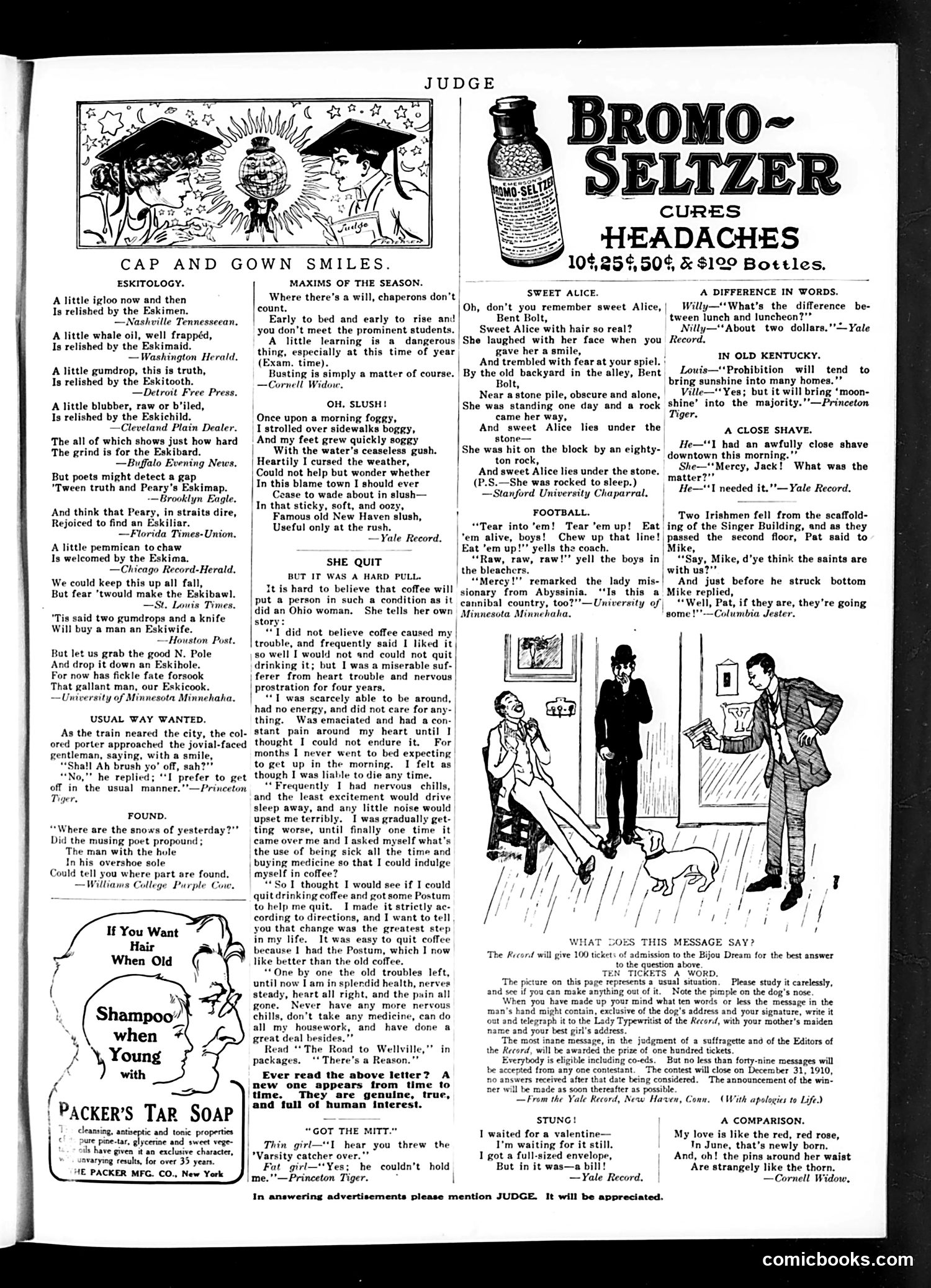
This page from Judge magazine (a satirical weekly) is primarily **advertising and humor columns**, not political cartoons. The main content includes: **"Eskitology"** — a running joke playing on explorer Robert Peary's Arctic expeditions. Various newspapers invented "Eski-" compound words (Eskibard, Eskiwife, Eskimap) to mock the trend of Peary-related coverage. The humor mocks both the explorer's fame and newspapers' excessive wordplay. **Bromo-Seltzer advertisement** — a prominent patent medicine ad for headache relief, typical of the era's unregulated drug marketing. **Miscellaneous humor pieces** including: - A coffee-quitting testimonial (satirizing health-claim advertising) - A football cheer joke playing on "eating" language to mock violent sports culture - Various collegiate humor snippets from university newspapers **The cartoon** (bottom right) appears unrelated to these texts — it shows figures in what seems a domestic scene, but its caption "What Does This Message Say?" suggests a puzzle or contest element. This is essentially a **humor and advertising magazine page** rather than political satire. The Peary jokes reflect contemporary celebrity obsession.
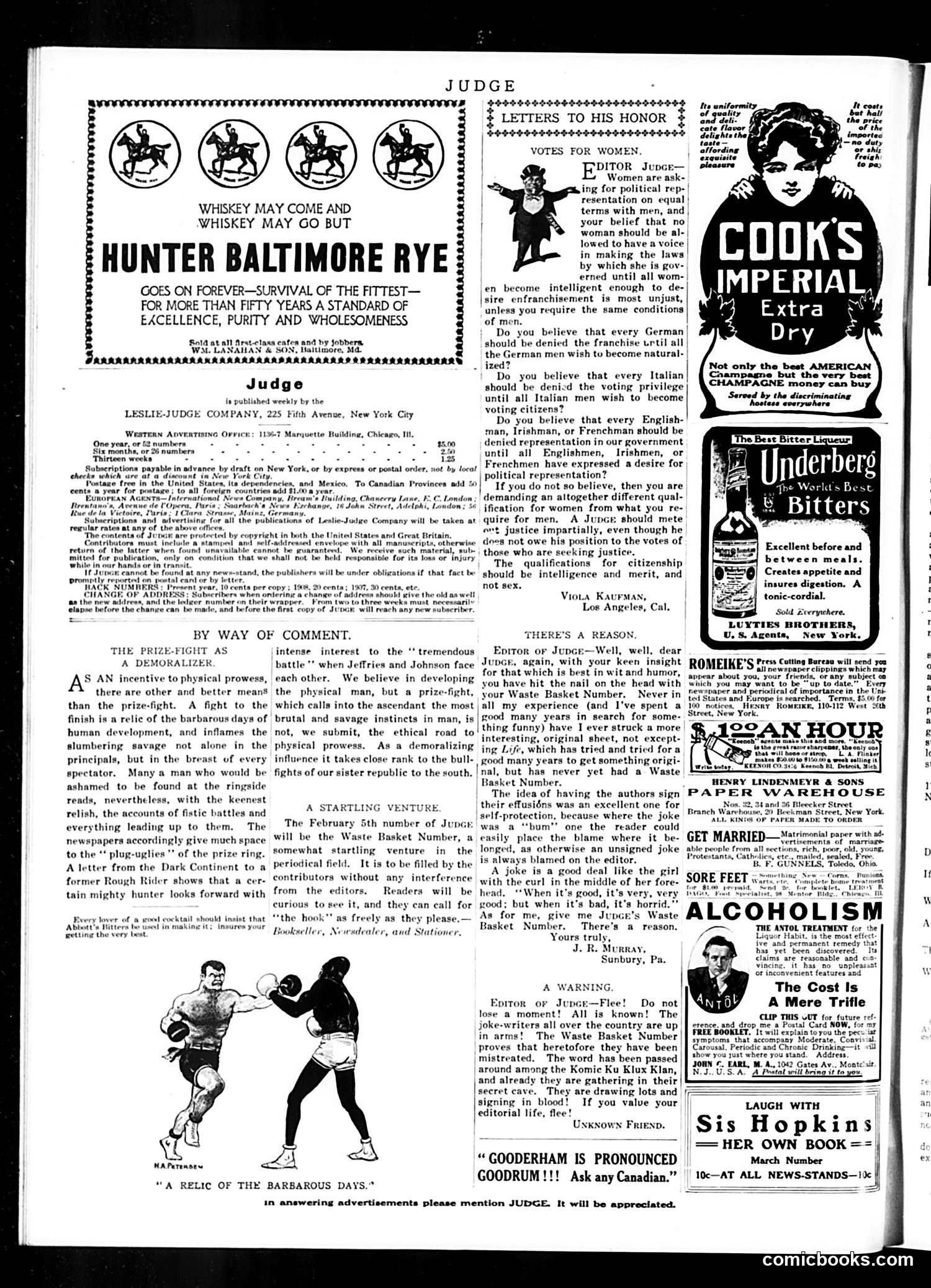
This page from *Judge* magazine combines satirical commentary with period advertising. The main content addresses **women's suffrage** through a letter challenging the editor's anti-feminist stance. The writer uses reductio ad absurdum: if women shouldn't vote until all women desire enfranchisement, shouldn't the same standard apply to immigrant men (Germans, Italians, Irish, French)? The implicit point is that such a standard would disenfranchise most men too—exposing the sexism of applying stricter requirements to women. The page also contains a brief editorial opposing prize-fighting as barbaric and demoralizing. The advertisements (Hunter Baltimore Rye whiskey, Cook's Imperial gin, Underberg bitters) reflect early 20th-century marketing, starkly ironic given the later Prohibition era and modern anti-alcohol campaigns. The overall effect typifies *Judge's* role: sophisticated satirical magazine using humor and logic to challenge social injustices, particularly gender inequality.
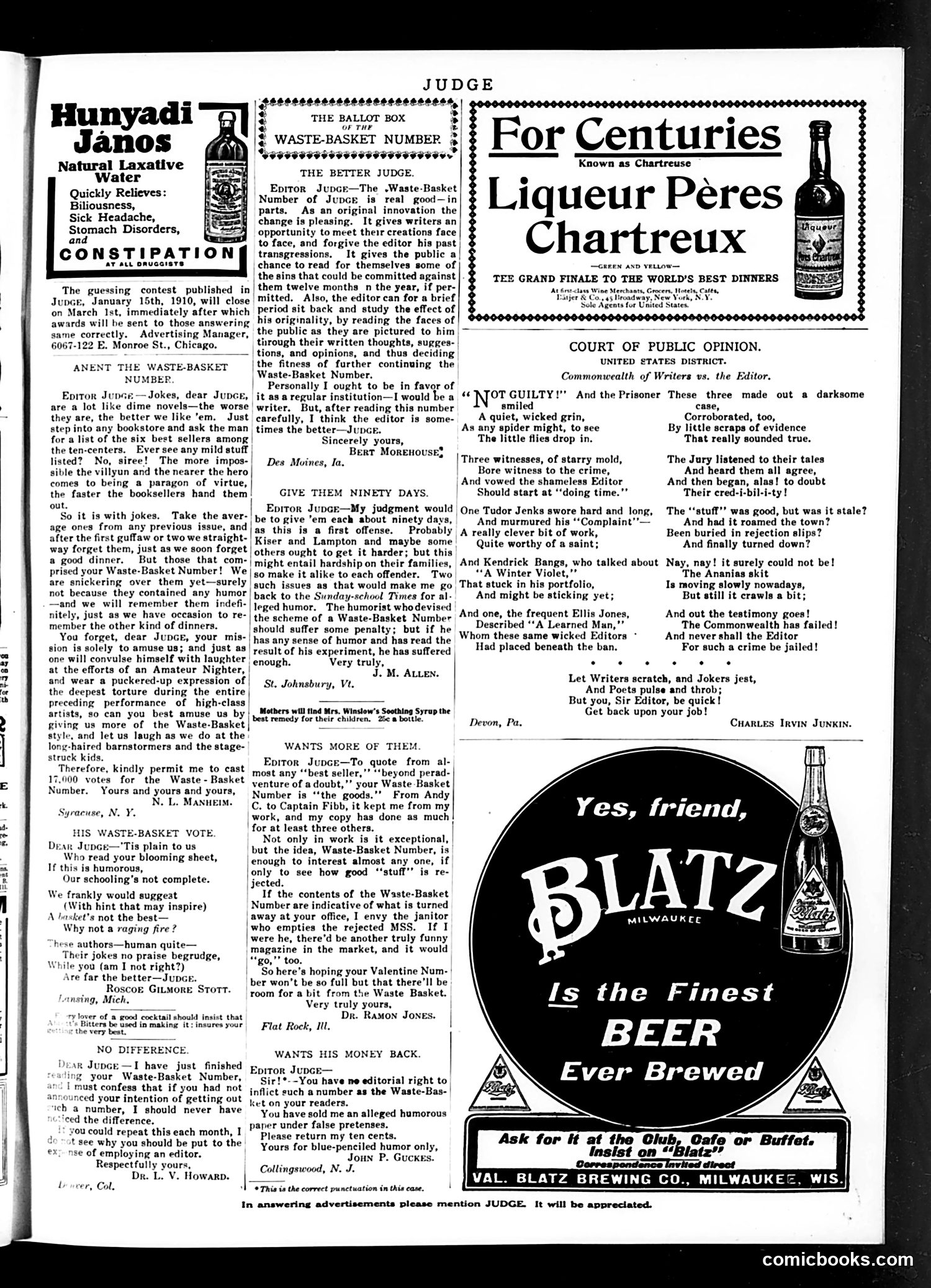
This is primarily **not a political cartoon page** — it's mostly **letters to the editor and advertisements** from Judge magazine's "Waste-Basket Number" (a special issue featuring reader submissions). The content shows a **meta-literary debate**: readers write to Editor Judge defending or criticizing the magazine's recent issue that published rejected jokes and content. The letters discuss whether publishing readers' rejected work was humorous or insulting — essentially, readers arguing about whether the joke was *on them*. There's a brief mock-legal section titled "Court of Public Opinion" featuring rhymed testimony about various writers (Bangs, Kiser, Lampton appear to be humorists) whose work was rejected or problematic. The page is dominated by **period advertisements** for laxatives, liqueur, and Blatz beer — typical of early 1900s magazines. **Bottom line**: This reflects Judge's self-referential humor and reader engagement, with minimal political content — mostly just the magazine poking fun at its own editorial decisions and readers' responses.
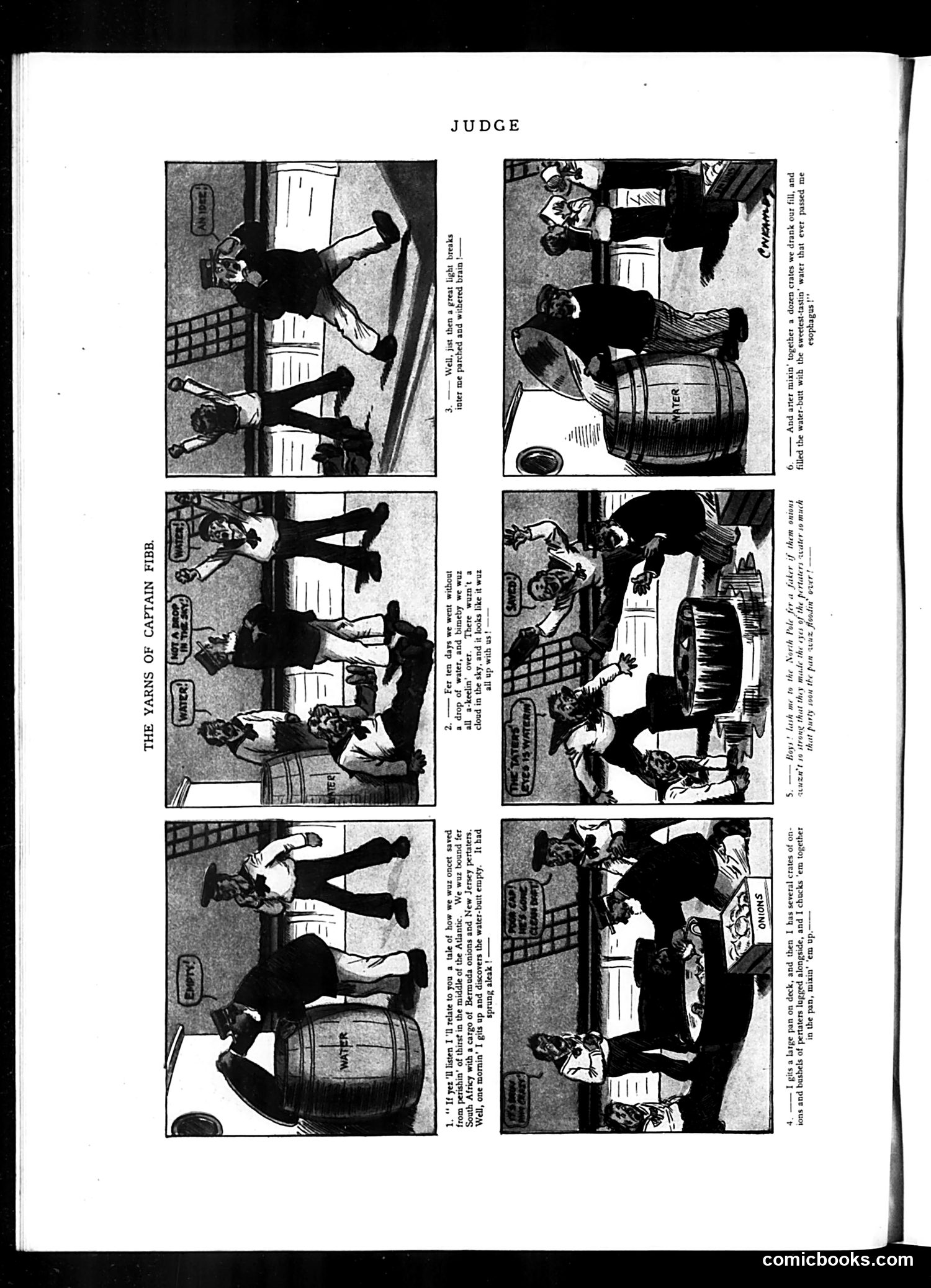
This page presents a multi-panel cartoon narrative titled "The Years of Captain Fibb," appearing to satirize a specific public figure through sequential scenes showing different life stages or situations. The OCR text is largely corrupted and illegible, making precise identification difficult. However, the visual format—multiple panels arranged vertically showing a character in various scenarios involving what appears to be barrels or containers and indoor settings—suggests a narrative commentary on someone's conduct or character arc. Without legible text, I cannot definitively identify who "Captain Fibb" represents or what specific political/social scandal or behavior is being mocked. The caricatured figure and exaggerated physical comedy suggest this targets a recognizable contemporary (to Judge's publication) public personality, but determining the exact reference requires readable source material. **I cannot reliably explain this cartoon's specific satirical point without clearer text.**