
Judge, 1910-02-26 · page 7 of 16
Judge — February 26, 1910 — page 7: what you’re looking at
What you’re looking at
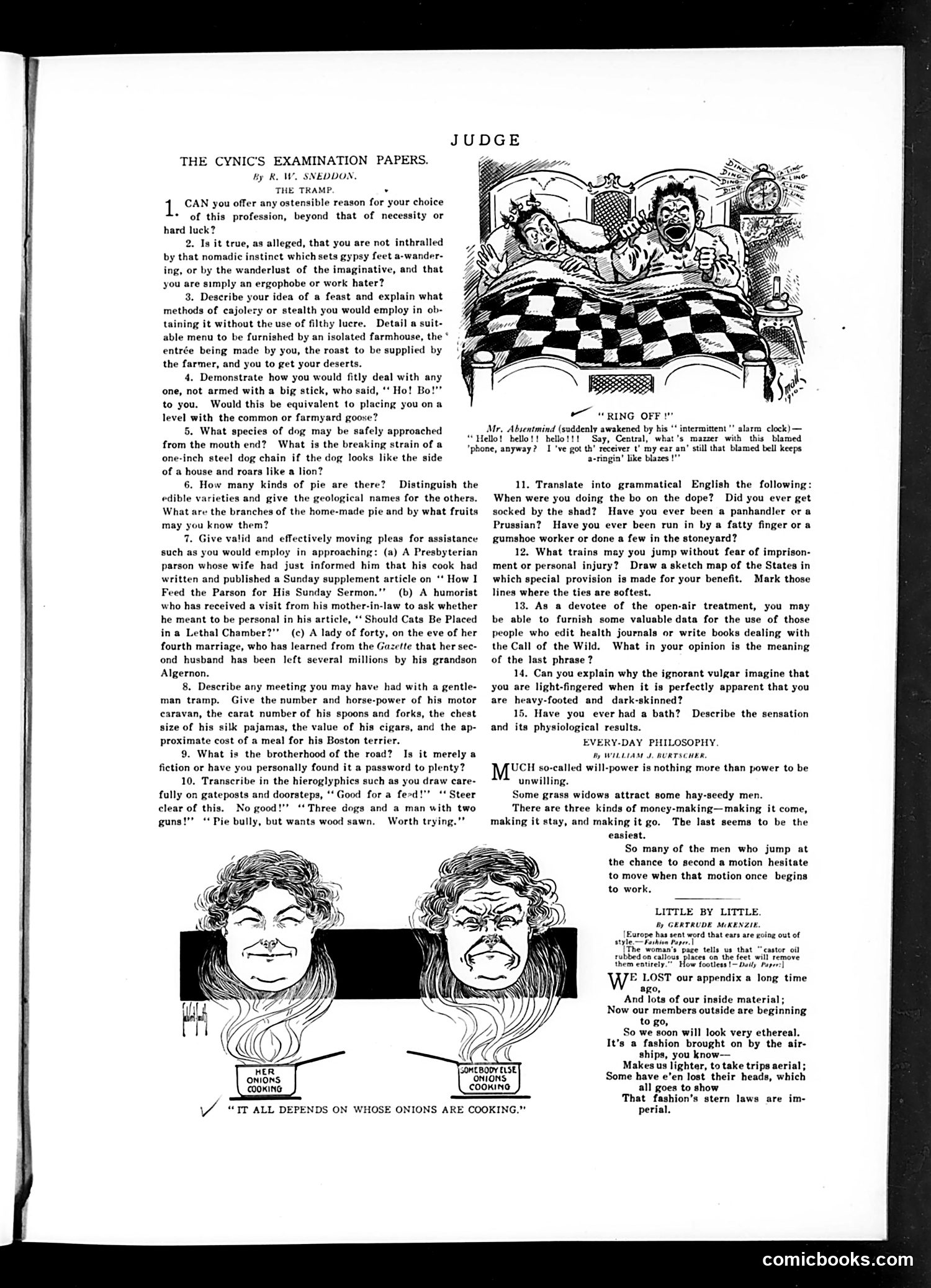
This satirical piece by R.W. Sneddon mocks vagrants and tramps through a fake academic exam. The "questions" absurdly demand tramps justify their lifestyle, describe begging techniques, explain hobo codes scratched on gateposts ("Good for a feed"), and detail encounters with other vagrant "gentlemen" and their possessions. The satire works on two levels: it ridicules both tramps (portraying them as work-hating parasites) AND the upper-class moralizing about poverty. By framing vagrancy as a "profession" requiring expert knowledge, Sneddon exposes the hypocrisy of treating homelessness as a character flaw rather than economic reality. The accompanying cartoons—showing an absentminded man arguing with his phone, and the "onions" joke about whose cooking causes tears—provide lighter satirical relief typical of *Judge* magazine's mixed format.
📄 Transcribed text from this page (OCR, searchable)
Machine-transcribed from the original scan — historical spelling and the odd misread are preserved.
THE CYNIC’S EXAMINATION PAPERS. By R. W. SNEDDON, THE TRAMP. . 1,, CAN you offer any ostensible reason for your choice + of this profession, beyond that of necessity or hard luck? 2. Is it true, as alleged, that you are not inthralled by that nomadic instinct which sets gypsy feet a-wander- ing, or by the wanderlust of the imaginative, and that you are simply an ergophobe or work hater? 3. Describe your idea of a feast and explain what methods of cajolery or stealth you would employ in ob- taining it without the use of filthy lucre. Detail a suit- able menu to be furnished by an isolated farmhouse, the entrée being made by you, the roast to be supplied by the farmer, and you to get your deserts. 4, Demonstrate how you would fitly deal with any one, not armed with a big stick, who said, ‘‘ Ho! Bo!’ to you. Would this be equivalent to placing you ona level with the common or farmyard goose? 5. What species of dog may be safely approached from the mouth end? What is the breaking strain of a one-inch steel dog chain if the dog looks like the side of a house and roars like a lion? 6. How many kinds of pie are there? Distinguish the edible varieties and give the geological names for the others. What are the branches of the home-made pie and by what fruits know them? ve valid and effectively moving pleas for assistance such as you would employ in approaching: (a) A Presbyterian parson whose wife had just informed him that his cook had written and published a Sunday supplement article on ‘“* How I Feed the Parson for His Sunday Sermon."’ (b) A humorist who has received a visit from his mother-in-law to ask whether he meant to be personal in his article, ‘‘ Should Cats Be Placed ina Lethal Chamber?” (c) A lady of forty, on the eve of her fourth marriage, who has learned from the Gazette that her sec- ond husband has been left several millions by his grandson Algernon. 8. Describe any meeting you may have had with a gentle- man tramp. Give the number and horse-power of his motor caravan, the carat number of his spoons and forks, the chest size of his silk pajamas, the value of his cigars, and the ap- proximate cost of a meal for his Boston terrier. 9. What is the brotherhood of the road? Is it merely a fiction or have you personally found it a password to plenty? 10. Transcribe in the hieroglyphics such as you draw care- fully on gateposts and doorsteps, ‘Good for a fe-d!"’ ‘* Steer No good!"? ‘Three dogs and a man with two guns!"” “Pie bully, but wants wood sawn, Worth trying.’” COOKING “ Hello! “hello ‘phone, anyway? I ‘ve got th’ receiver t’ my ear an’ still that blamed bell keeps COOKING — “RING OFF Mr, Absentmind (suddenly awakened by his ‘‘ intermittent "' alarm clock) — toh ‘Say, Central, what's mazzer with this blamed a-ringin’ like blazes !"" 11, Translate into grammatical English the followin When were you doing the bo on the dope? Did you ever get socked by the shad? Have you ever been a panhandler or a Prussian? Have you ever been run in by a fatty finger or a gumshoe worker or done a few in the stoneyard? 12, What trains may you jump without fear of imprison- Draw a sketch map of the States in Mark those ment or personal injury? which special provision is made for your benefit. lines where the ties are softest. 13. As a devotee of the open-air treatment, you may be able to furnish some valuable data for the use of those people who edit health journals or write books dealing with the Call of the Wild. What in your opinion is the meaning of the last phrase ? 14. Can you explain why the ignorant vulgar imagine that you are light-fingered when it is perfectly apparent that you are heavy-footed and dark-skinned? 15. Have you ever had a bath? and its physiological results. EVERY-DAY PHILOSOPHY By WILLIAM J. RURTSCHER. UCH so-called will-power is nothing more than power to be unwilling. Some grass widows attract some hay-seedy men. There are three kinds of money-making—making it come, making it stay, and making it go. The last seems to be the easiest. So many of the men who jump at the chance to second a motion hesitate to move when that motion once begins to work. Describe the sensation LITTLE BY LITTLE By GERTRUDE McKENZIE. [Europe has re going out of ¢ tells us that “castor oil an rubbed on callous places on the feet will remove them entirely.” How footless!— Daily Paper:] WE LOST our appendix a long time ago, And lots of our inside material; Now our members outside are beginning to go, So we soon will look very ethereal. It’s a fashion brought on by the air- ips, you know— Makes us lighter, to take trips aerial; Some have e’en lost their heads, which all goes to show That fashion’s stern laws are im- “TT ALL DEPENDS ON WHOSE ONIONS ARE COOKING.” comicbooks.com