
Judge, 1910-02-26 · page 4 of 16
Judge — February 26, 1910 — page 4: what you’re looking at
What you’re looking at
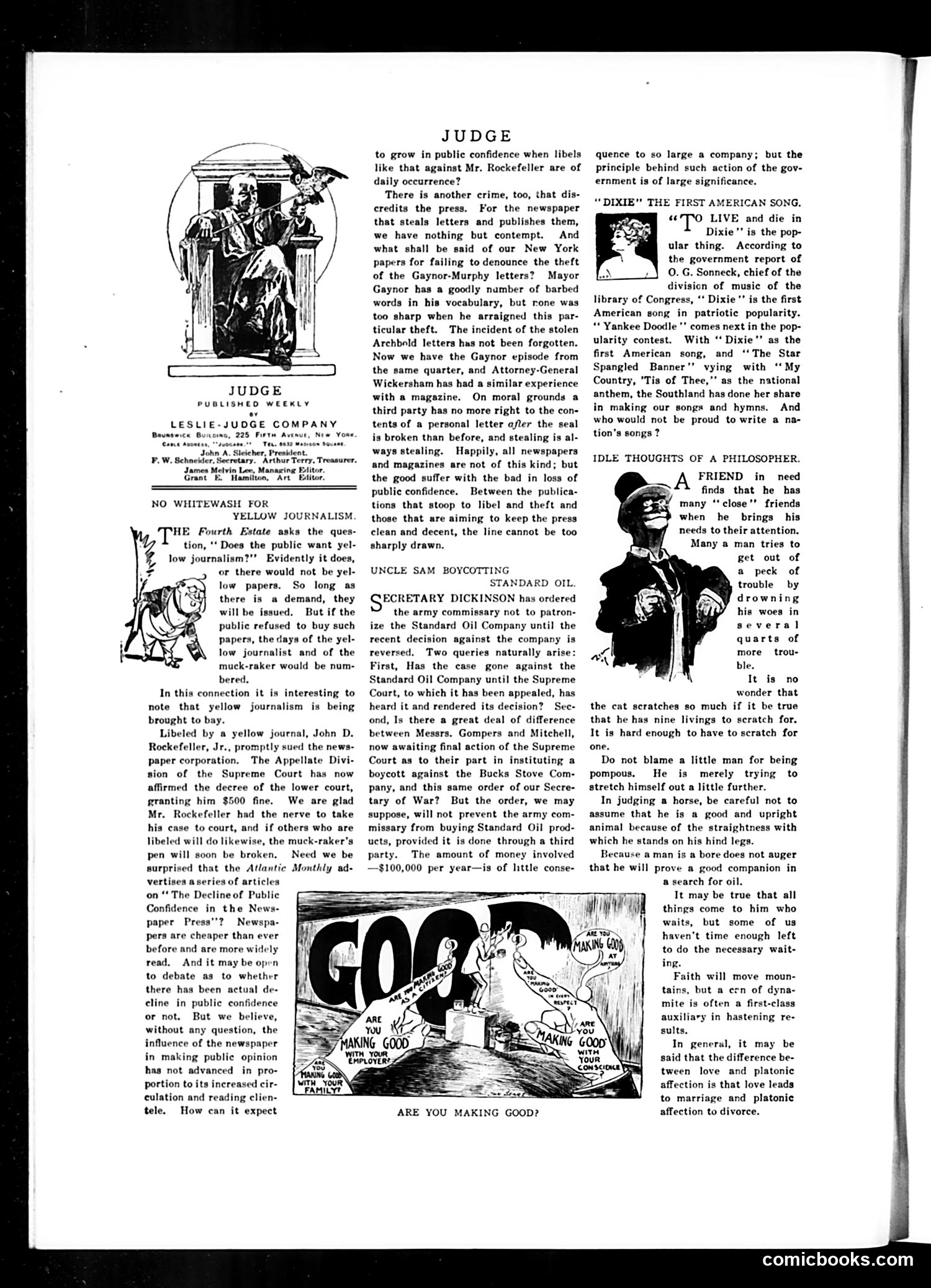
This page contains several distinct satirical sections: **"Judge" masthead**: Standard magazine header. **"No Whitewash for Yellow Journalism"**: Critiques sensationalist newspapers, specifically referencing John D. Rockefeller's legal troubles. The cartoon mocks "yellow journalists" for their inconsistent coverage—attacking Rockefeller's alleged wrongdoings while refusing to cover newspaper theft of personal letters. The satire argues newspapers hypocritically demand accountability from corporations while protecting their own misconduct. **"Uncle Sam Boycotting Standard Oil"**: Comments on Secretary Dickinson's order blocking military purchases from Standard Oil Company pending a Supreme Court appeal. The text debates whether this boycott will effectively pressure the company or merely inconvenience government purchasing. **"Are You Making Good?"**: A cartoon showing two figures, likely representing labor and capital, questioning mutual cooperation. The page satirizes media bias, corporate power, and government regulation circa early 1900s.
📄 Transcribed text from this page (OCR, searchable)
Machine-transcribed from the original scan — historical spelling and the odd misread are preserved.
PUBLISHED WEEKLY ov LESLIE-JUDGE COMPANY John A. F. W. Schneider, Secretary. Arthur T NO WHITEWASH FOR YELLOW JOURNALISM HE Fourth Estate asks the ques- tion, Does the public want yel- low journalism?"’ Evidently it does, or there would not be y low papers. So long as there is a demand, they willbe issued. But if the public refused to buy such papers, the days of the yel- low journalist and of the muck-raker would be num- bered. In this connection it is interesting to note that yellow journalism is being brought to bay. Libeled by a yellow journal, John D. Rockefeller, Jr., promptly sued the news- paper corporation. The Appellate Divi- sion of the Supreme Court has now affirmed the decree of the lower court, granting him $500 fine. We are glad Mr. Rockefeller had the nerve to take his case to court, and if others who are libeled will do likewise, the muck-raker’s pen will soon be broken, Need we be surprised that the Atlantic Monthly ad- vertises aseries of articles on ‘‘ The Decline of Public Confidence in the Ne paper Press’’? pers are cheaper than ever before and are more widely read, And it may be open to debate as to whether there has been actual di cline in public confidence or not. But we believe, without any question, the influence of the newspaper in making public opinion has not advanced in pro- portion to its increased cir- culation and reading clien- tele. How can it expect JUDGE to grow in public confidence when libels like that against Mr. Rockefeller are of daily occurrence? There is another crime, too, that dis- credits the press. For the newspaper that steals letters and publishes them, we have nothing but contempt. And what shall be said of our New York papers for failing to denounce the theft of the Gaynor-Murphy letters? Mayor Gaynor has a goodly number of barbed words in his vocabulary, but rone was too sharp when he arraigned this par- ticular theft. The incident of the stolen Archbold letters has not been forgotten. Now we have the Gaynor episode from the same quarter, and Attorney-General Wickersham has had a similar experience with a magazine. On moral grounds a third party has no more right to the con- tents of a personal letter after the seal is broken than before, and stealing is al- Happily, all newspapers and magazines are not of this kind; but the good suffer with the bad in loss of public confidence. Between the publica- tions that stoop to libel and theft and those that are aiming to keep the press clean and decent, the line cannot be too sharply drawn. UNCLE SAM BOYCOTTING STANDARD OIL. ECRETARY DICKINSON has ordered the army commissary not to patron- ize the Standard Oil Company until the recent decision against the company is reversed. Two queries naturally : First, Has the case gone against the Standard Oil Company until the Supreme Court, to which it has been appealed, has heard it and rendered its decision? Sec- ond, Is there a great deal of difference between Messrs. Gompers and Mitchell, ing final action of the Supreme Court as to their part in instituting a boycott against the Bucks Stove Com- pany, and this same order of our Secre- tary of War? But the order, we may suppose, will not prevent the army com- missary from buying Standard Oil prod- ucts, provided it is done through a third party. The amount of money involved —$100,000 per year—is of little conse- ARE YOU MAKING GOOD? quence to so large a company; but the principle behind such action of the gov- ernment is of large significance. “ DIXIE” THE FIRST AMERICAN SONG. oh “ LIVE and die in CRG Dixie’’ is the pop- Ms ular thing. According to the government report of 0. G. Sonneck, chief of the division of music of the library of Congress, “* Dixie" is the first American gong in patriotic popularity. “Yankee Doodle "’ comes next in the pop- ularity contest. With ‘* Dixie’’ as the first American song, and ‘The Star Spangled Banner’ vying with ‘My Country, "Tis of Thee,”’ as the national anthem, the Southland has done her share in making our songs and hymns. And who would not be proud to write a na- tion’s songs ? IDLE THOUGHTS OF A PHILOSOPHER. FRIEND in need finds that he has many ‘‘close’’ friends when he brings his needs to their attention. Many a man tries to get out of a peck of trouble by drowning his woes in several quarts of more trou- ble. It is no wonder that the cat scratches so much if it be true that he has nine livings to scratch for. It is hard enough to have to scratch for one. Do not blame a little man for being pompous. He is merely trying to stretch himself out a little further. In judging a horse, be careful not to assume that he is a good and upright animal because of the straightness with which he stands on his hind legs. Because a man is a bore does not auger that he will prove a good companion in a search for oil. It may be true that all things come to him who waits, but some of us haven't time enough left to do the necessary wait- ing. Faith will move moun- ns, but a ern of dyna- often a first-class auxiliary in hastening re- sults. In general, it may be said that the difference be- tween love and platonic affection is that love leads to marriage and platonic affection to divorce. comicbooks.com