
A complete issue · 16 pages · 1910
Judge — January 29, 1910
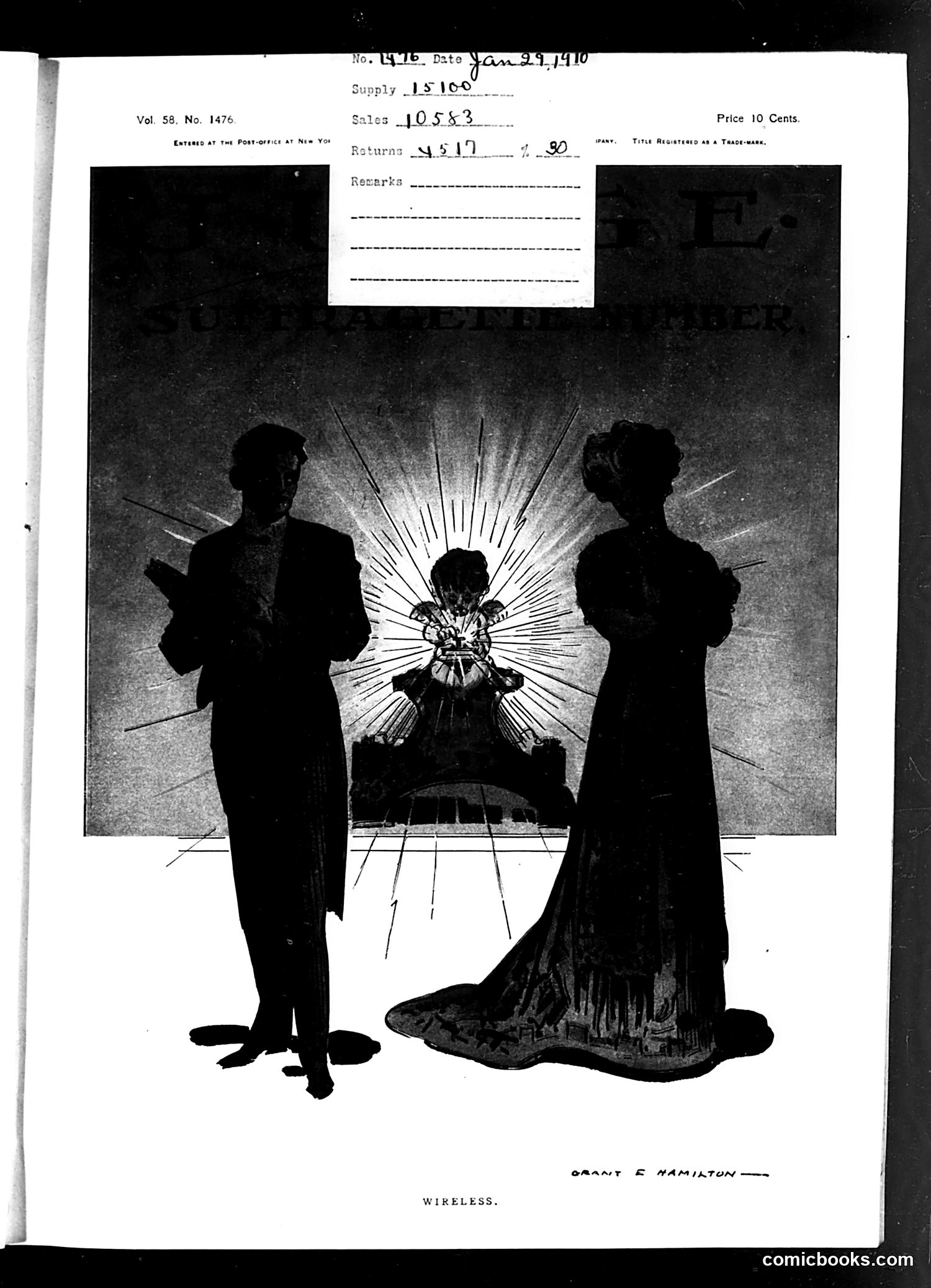
This 1910 satirical illustration depicts two silhouetted figures (a man in formal dress and a woman in an elaborate gown) gazing upon a glowing, radiant figure in the center. The title "WIRELESS" appears to satirize wireless telegraph technology, which was newly revolutionary at the time. The cartoon likely mocks either the romantic fascination with modern technology or critiques how wireless communication was being commercialized and glamorized in popular culture. The ethereal, almost religious depiction of the central figure suggests the public's awe and reverence for this technological innovation. The formal-dressed couple represents contemporary society being dazzled by progress. Artist credit appears to be Grant E. Hamilton.
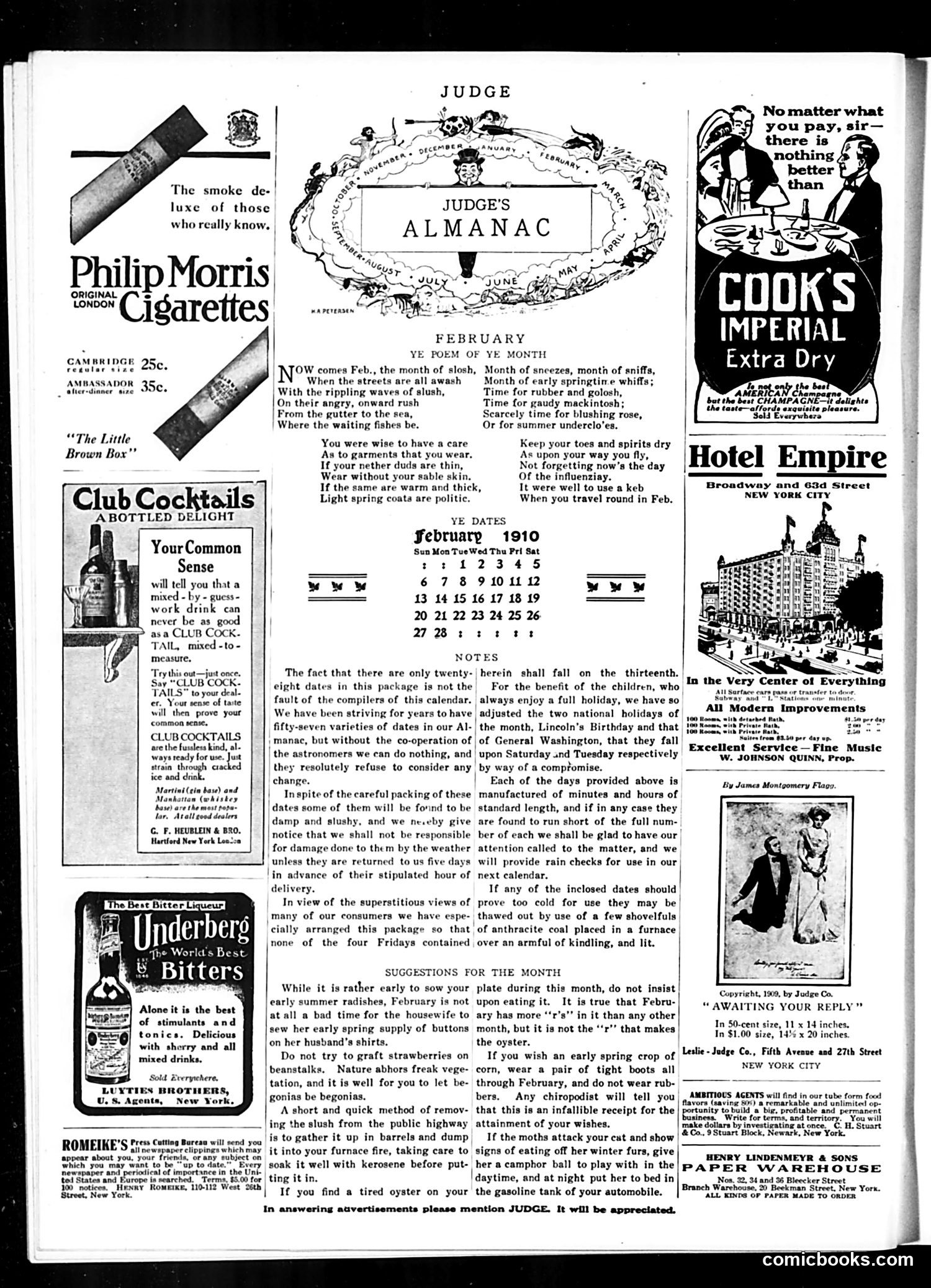
This page is primarily **advertising and almanac content**, not political satire. It features: **Main Content:** Judge's Almanac for February 1910, with calendar, weather advice ("month of slosh"), and practical household suggestions (sewing, spring planting, oyster care). **Advertisements:** Philip Morris cigarettes, Cook's Imperial champagne, Hotel Empire in New York, Club Cocktails, Underberg bitters, and other commercial products typical of 1910. **Small cartoon:** One illustration (lower right, captioned "Awaiting Your Reply") appears to show a domestic or romantic scenario, but lacks sufficient context to determine specific satire. The page reflects Judge's dual function as both satirical magazine and vehicle for luxury brand advertising to wealthy readers.
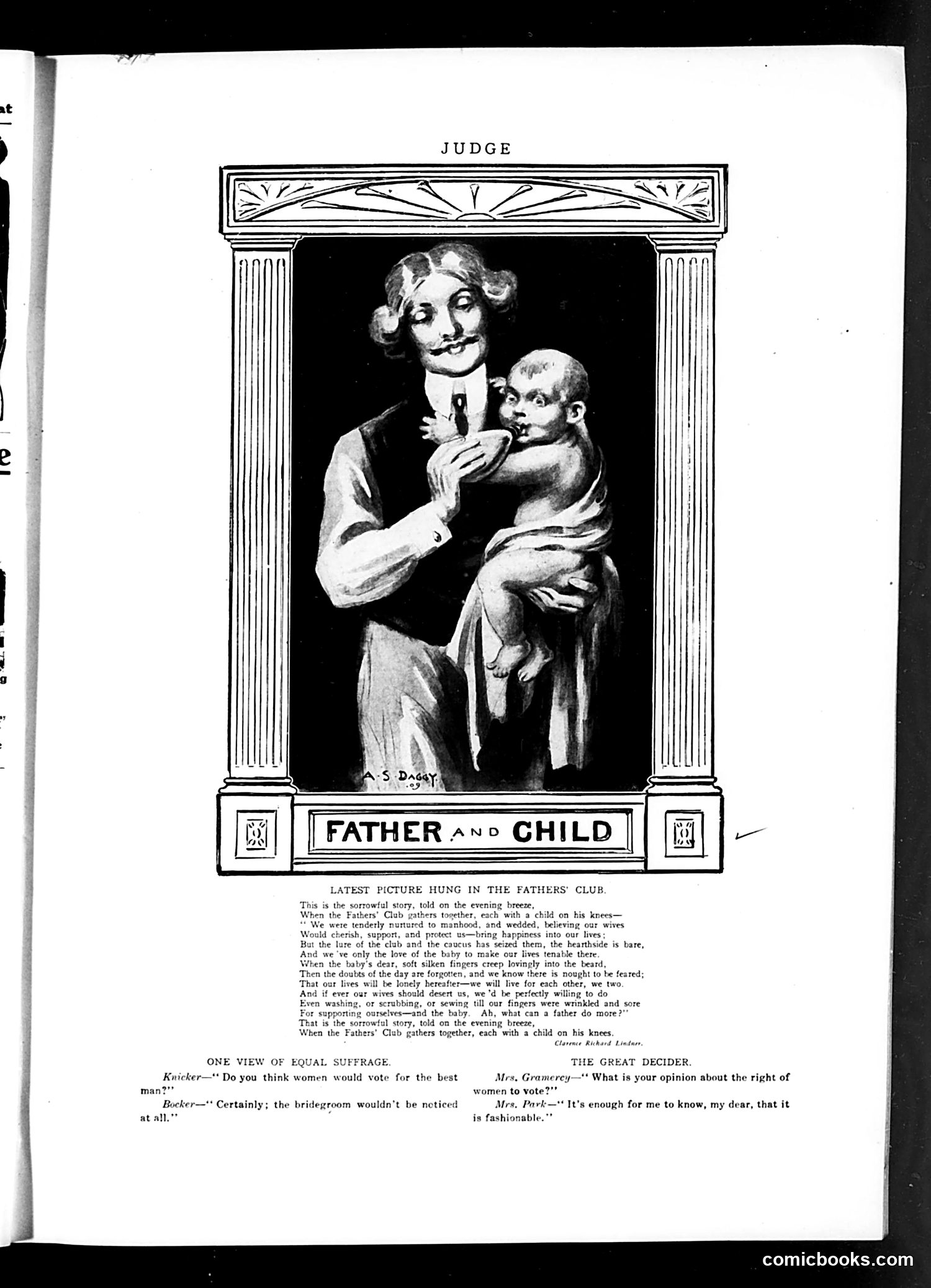
This page features "Father and Child," a satirical illustration by A.S. Daggett depicting a man holding an infant. The accompanying poem suggests the image comments on themes of paternal responsibility and emotional bonds between fathers and children. Below the main illustration are two brief satirical dialogues: "One View of Equal Suffrage" and "The Great Decider." These reference the women's suffrage debate—a major political issue of the early 20th century. The conversations mock both male assumptions about women's voting capabilities and women's apparent indifference to political participation, presenting satirical takes on contemporary gender politics and voting rights discussions. The magazine appears focused on social and political commentary through humor and illustration.
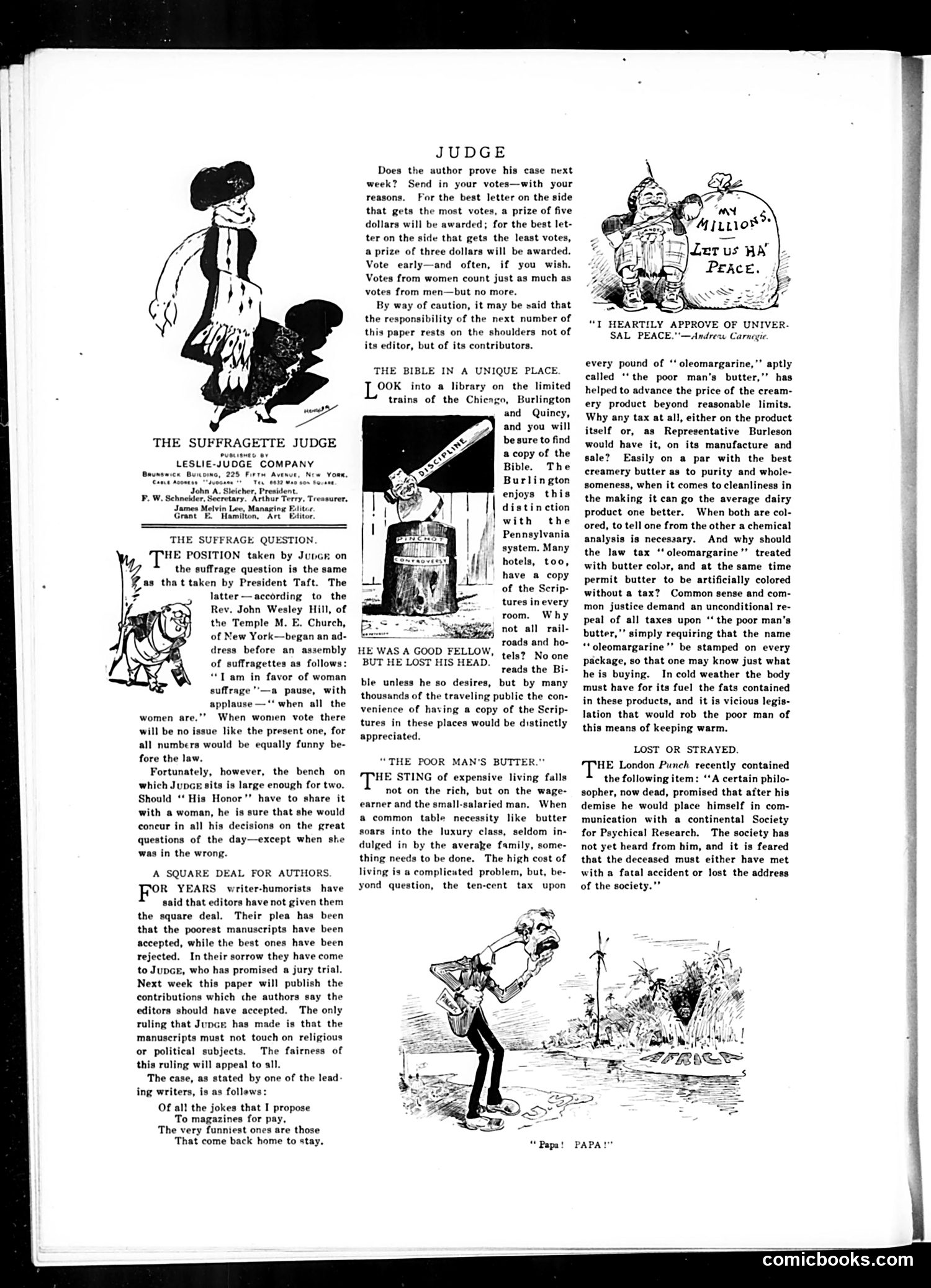
This page contains several distinct satirical pieces rather than one unified cartoon: **"The Suffragette Judge"** (left): A cartoon mocking women's suffrage advocates, showing a woman in exaggerated dress. The caption criticizes female voters, reflecting anti-suffrage sentiment common in Judge during this era. **"The Bible in a Unique Place"**: Commentary on the Burlington railroad's decision to place Bibles in hotel rooms—praised as a practical convenience for travelers. **"The Poor Man's Butter"**: Satirizes "oleomargarine," a cheap butter substitute, discussing its taxation and regulation as a class issue affecting working people versus the wealthy. **"A Square Deal for Authors"**: Critiques editors' treatment of rejected manuscripts, proposing stricter rules regarding religious/political content. The page reflects Judge's focus on contemporary early-20th-century debates: women's rights, labor economics, and publishing standards.
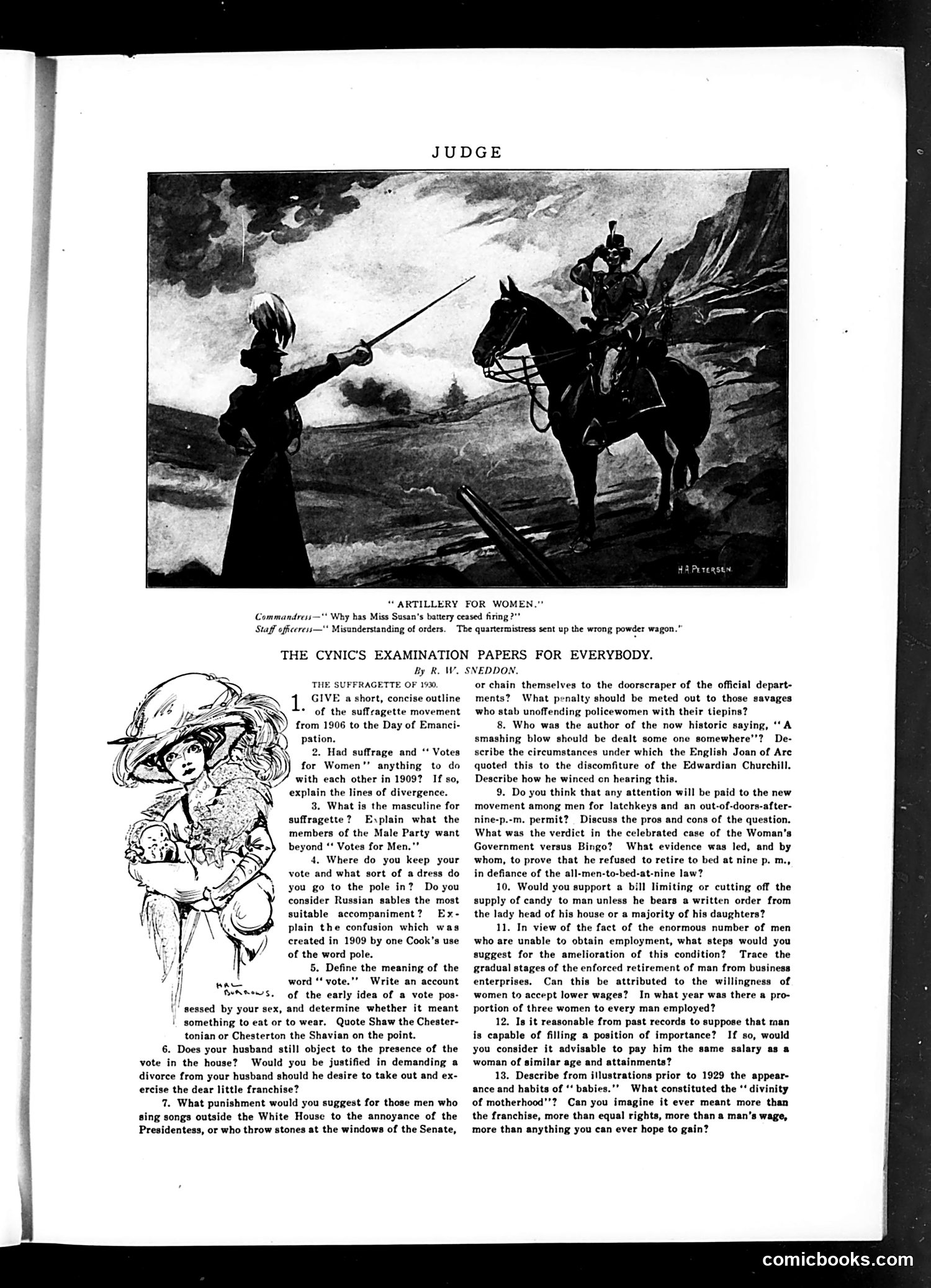
The cartoon titled "Artillery for Women" satirizes women's suffrage activism circa 1909-1920. The image shows a woman wielding a sword or lance while confronting a mounted military figure, visually parodying suffragettes as aggressive combatants. The accompanying examination questions mock the suffrage movement by framing women's political demands as unreasonable and comparing them to violent insurrection. References to "Votes for Women," Miss Susan B. Anthony (the suffragette), and debates about women's employment and equal pay indicate this targets the broader women's rights movement of the era. The satire's point: presenting female political activism as absurd, dangerous, and unladylike—a common anti-suffrage argument used to delegitimize women's legitimate demands for voting rights and economic equality.
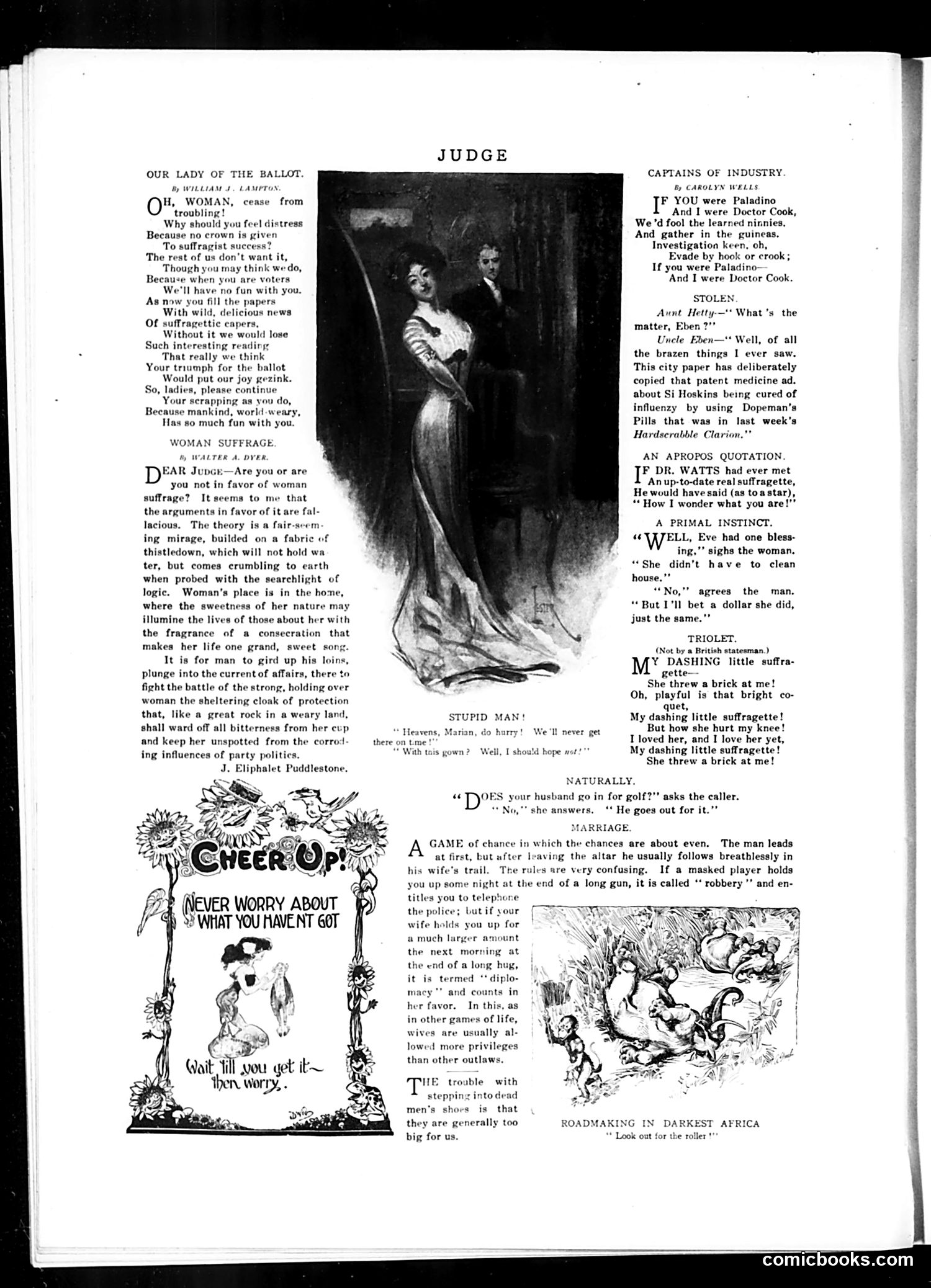
This Judge magazine page satirizes **woman suffrage** (the right to vote), a hotly contested issue in early 20th-century America. The main pieces mock suffragettes through condescension and dismissal. Lampton's poem suggests women shouldn't vote because their activism provides "interesting reading" and entertainment for men—implying women's actual grievances don't matter. Dyer's letter argues women belong in the home under male "protection," their minds unsuited for political logic. The cartoons reinforce this: one depicts suffragettes as violent ("She threw a brick at me!"), another references contemporary fraudsters **Paladino and Cook** to equate suffragettes with con artists. The page also includes unrelated jokes about marriage, golf, and colonial Africa—typical Judge filler. Overall, this reflects the era's mainstream male-dominated media opposition to women's political equality, dismissing advocates as either entertainingly foolish or dangerously aggressive rather than engaging with their arguments seriously.
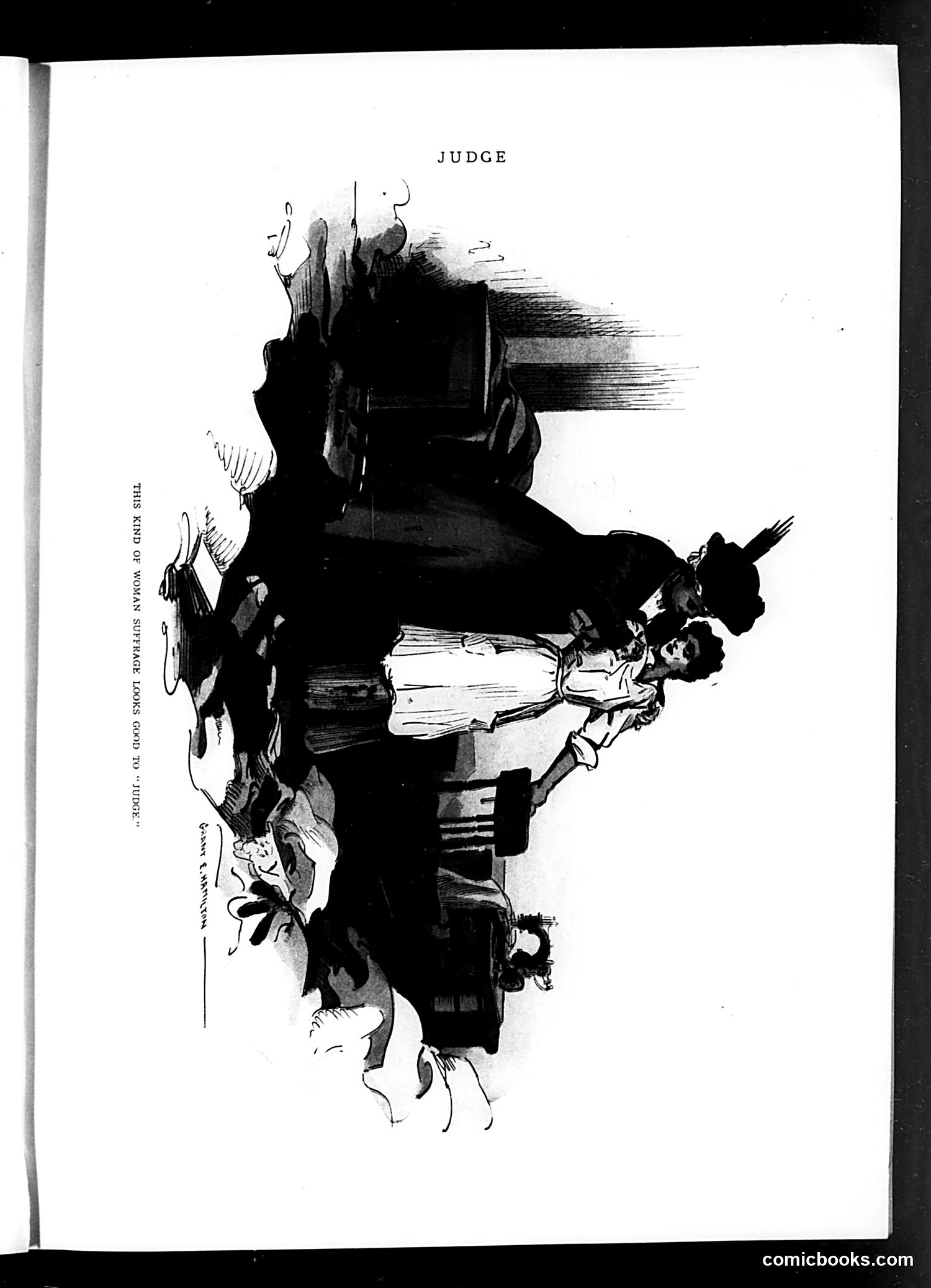
This satirical cartoon depicts a woman in classical robes (representing Justice or Lady Justice) sitting in a judge's chair, while a man in formal attire appears subordinate or diminished below her. The caption "This kind of woman suffrage looks good to 'Judge'" indicates this is commentary on women's voting rights. The satire suggests that while the magazine's editors support women having power in certain contexts—particularly judicial authority symbolized by the classical female figure—they may be mocking or expressing ironic approval of actual women's suffrage movements of the era. The image inverts typical power hierarchies, using the symbolic authority of Justice to comment on contemporary debates about women's political participation. The tone appears ambiguous—potentially supportive of women's authority in principle while remaining skeptical about real-world political equality.
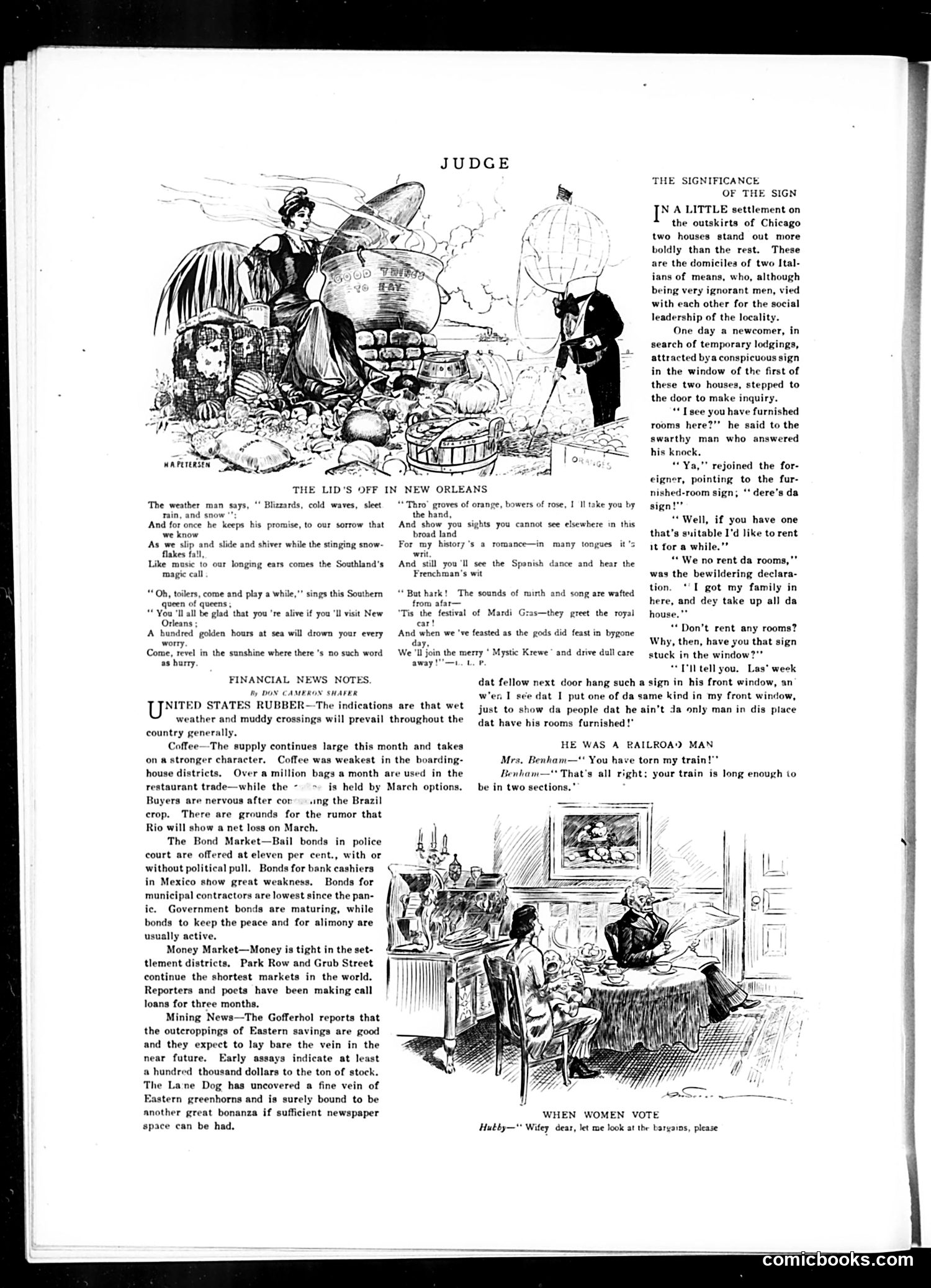
This cartoon satirizes immigrant ignorance and competitive vanity. Two wealthy but uneducated Italian immigrants on Chicago's outskirts compete for social status. When one places a "furnished rooms" sign in his window, the other copies it—not to actually rent rooms, but merely to match his rival's appearance of success. When a lodger inquires about renting, the homeowner reveals the sign's true purpose: it's purely decorative, meant to signal wealth and importance to neighbors, not to conduct business. The joke exploits period stereotypes of Italian immigrants as materialistic, status-conscious, and comically literal-minded. The broken English dialogue reinforces these caricatures. The satire ultimately mocks both the immigrants' pretensions and American competitive consumerism.
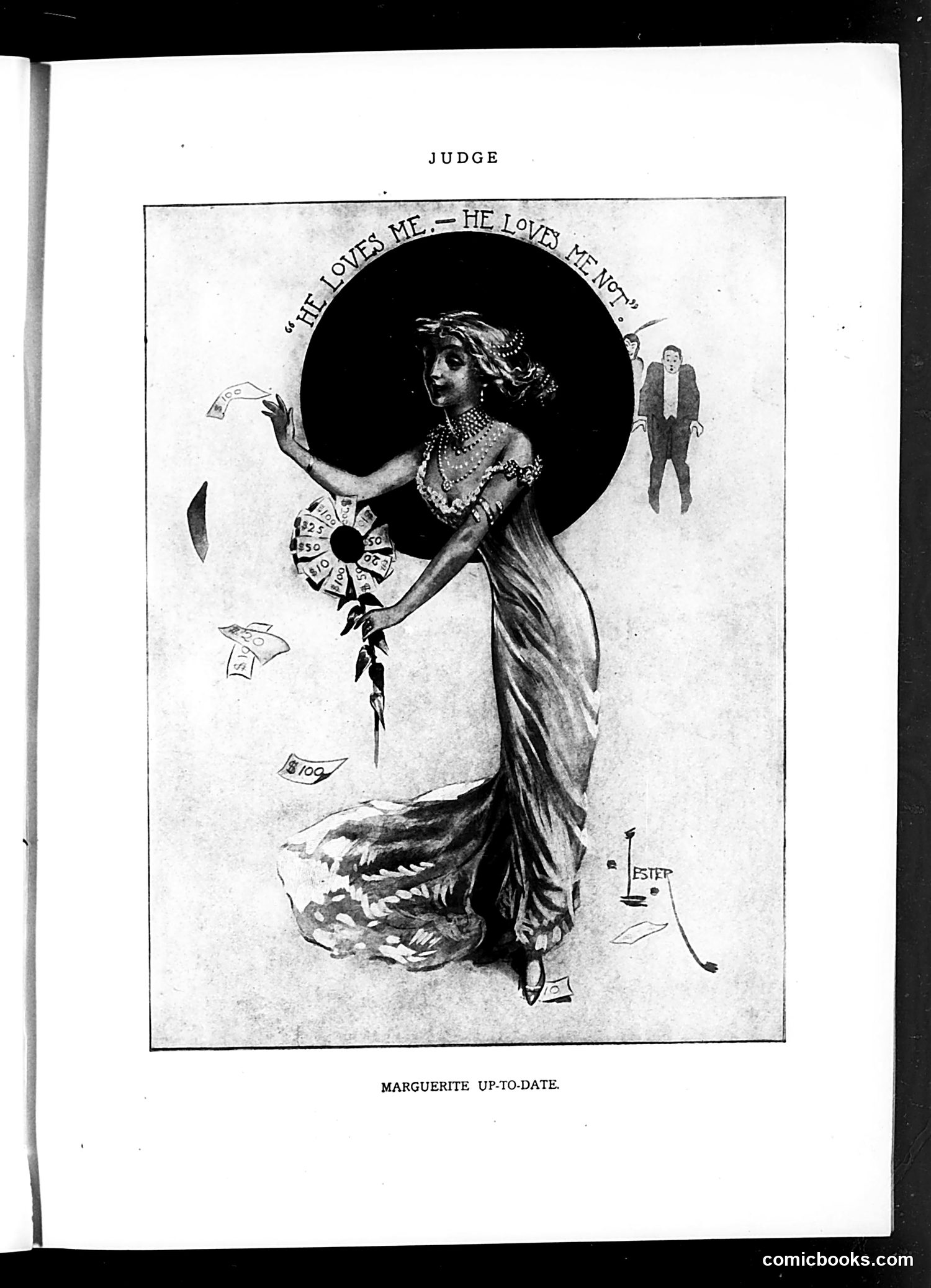
This Judge cartoon satirizes a woman named Marguerite through the classical allegorical figure of Justice (blindfolded, holding scales). The text arc reads "HE LOVES ME—HE LOVE ME NOT," referencing the flower-petal divination game used to determine romantic interest. The satire suggests Marguerite is obsessed with love and romance, using fortune-telling methods ("he loves me" petals visible). Money bills scatter around her feet, implying she's financially motivated or materialistic in her romantic pursuits. The well-dressed man in the background appears to be a potential suitor under her scrutiny. The "up-to-date" title suggests this critiques modern women's dating practices or materialism, presenting her romantic calculations as shallow and mercenary rather than genuine.
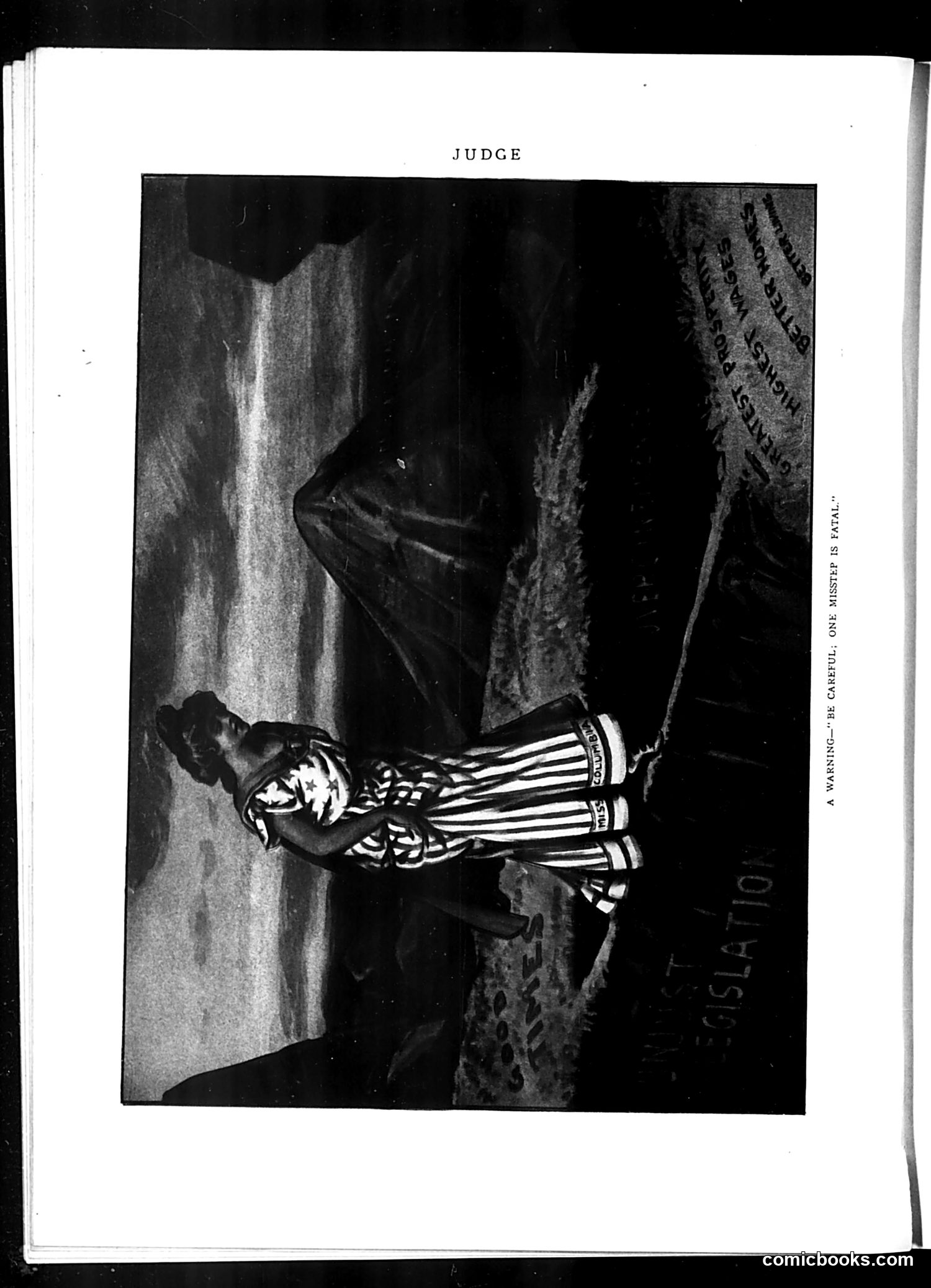
This page shows a single black-and-white photograph titled "JUDGE" at the top. The image depicts a figure in striped clothing (appearing to be a judge's or official's formal attire) positioned in what seems to be an interior setting with draped fabric in the background. The OCR text is largely garbled and illegible, making it impossible to determine the specific satire or social commentary intended. Without readable text or clearer visual context identifying the subject, I cannot reliably explain what political or social point this cartoon makes. The formal dress and title suggest judicial or governmental commentary typical of Judge magazine's satirical approach, but the specific target and joke remain unclear from this image alone.
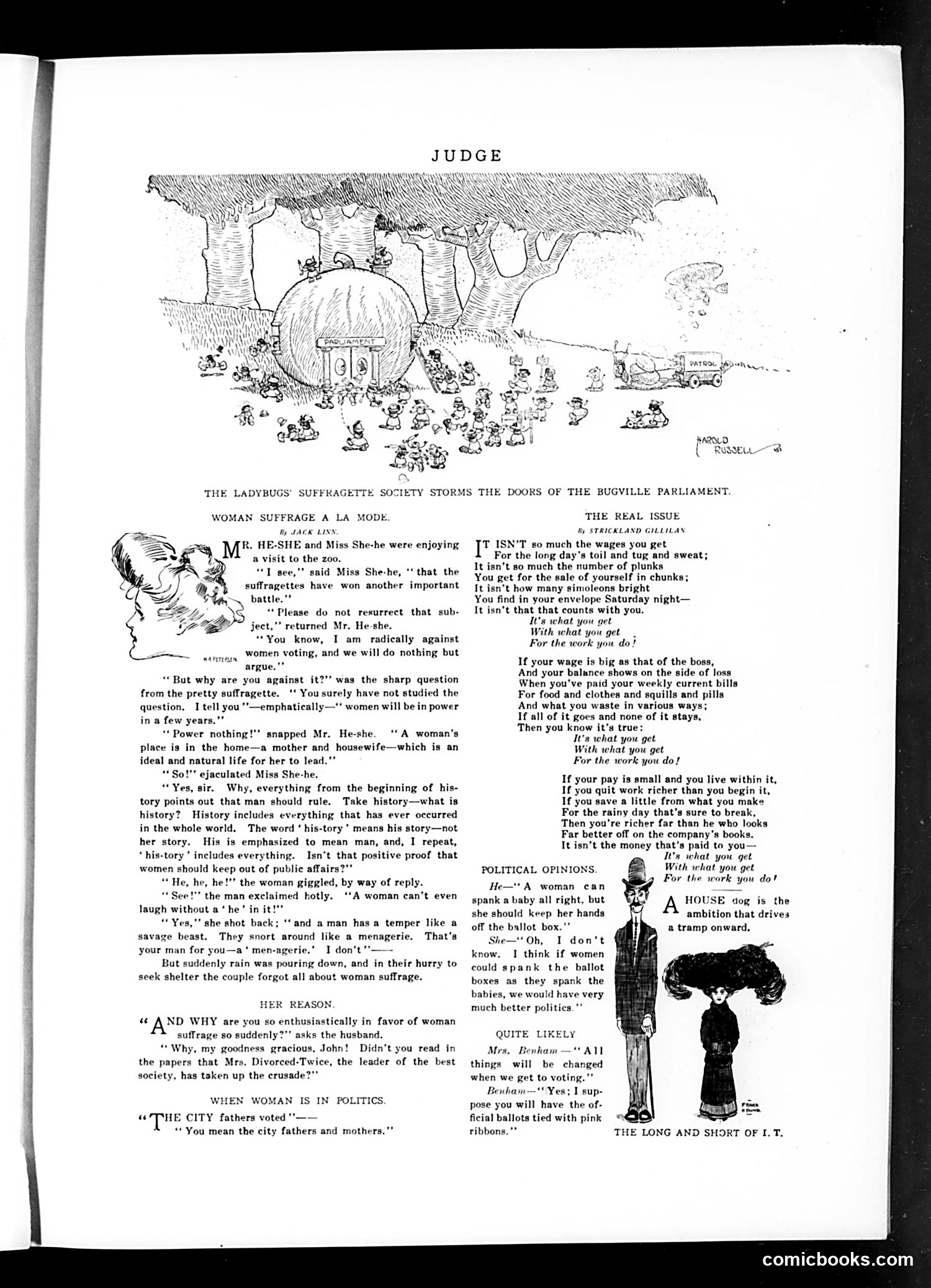
This page satirizes the women's suffrage movement through multiple pieces. The main cartoon shows a couple debating voting rights—the man opposes women voting, arguing women belong in the home and citing "history" (literally "his-tory") as proof men should rule. The satire mocks his circular logic. Other segments mock suffragettes themselves: one woman supports suffrage only after learning a twice-divorced society leader champions it. Political opinions depict women as emotionally unsuited for voting—better suited to spanking babies than ballots. The page ridicules both anti-suffrage arguments (showing them as absurd) and suffragettes (depicting them as frivolous and status-conscious). A poem about wages occupies significant space, shifting focus from politics to labor economics. Overall, *Judge* presents suffrage as a comic battleground where neither side emerges dignified—typical of the magazine's satirical approach to contemporary controversies.
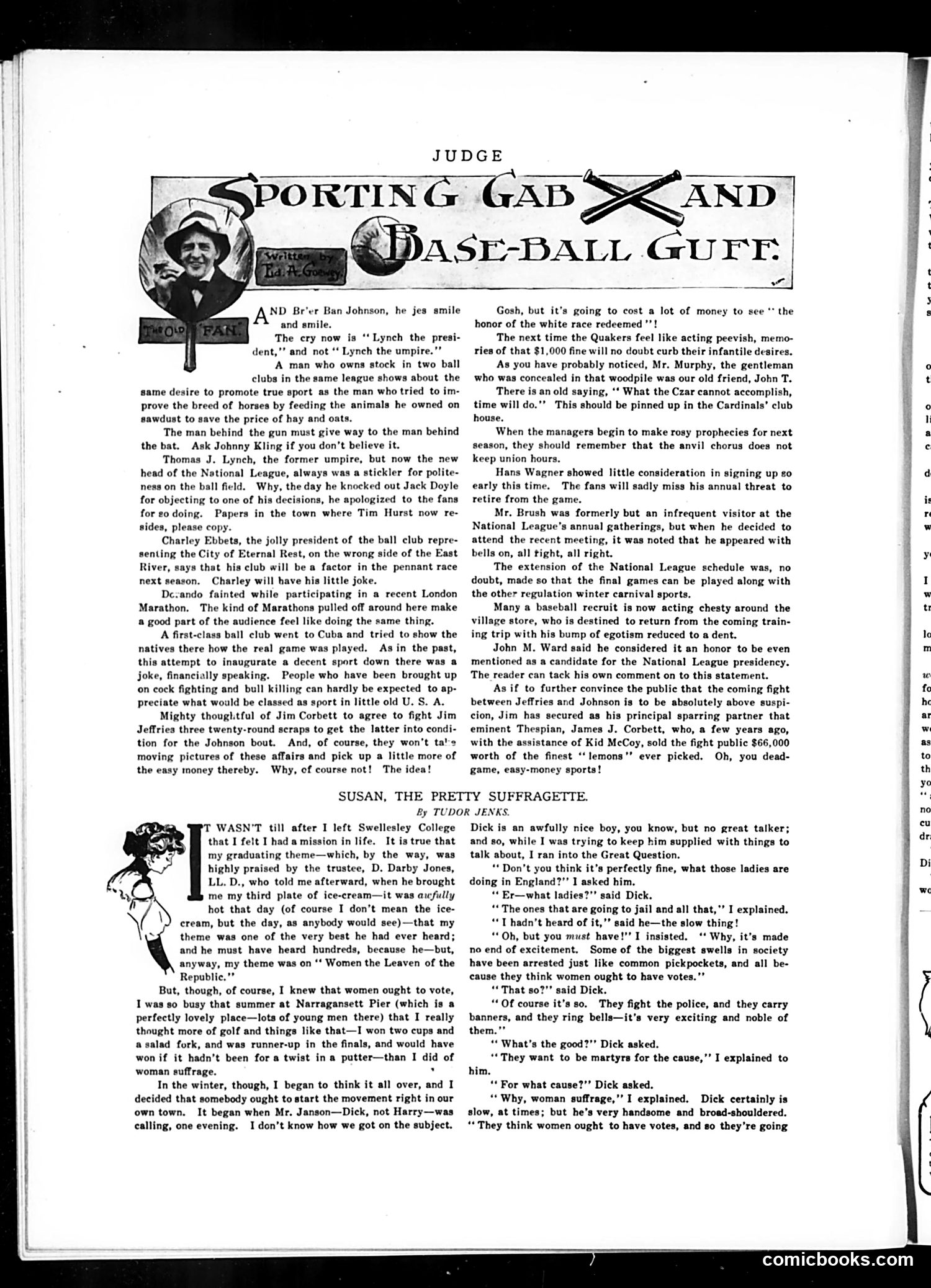
This page contains satirical commentary on early 20th-century baseball, likely around 1910. The main targets are: **Ban Johnson** (baseball league president): Mocked for being smile-prone while facing calls for his removal ("Lynch the president"). **Thomas J. Lynch** (former umpire, now National League head): Sarcastically praised for politeness despite having knocked out player Jack Doyle. **Charley Ebbets** (Brooklyn Dodgers president): Ridiculed for claiming his team would contend for the pennant. **Jim Corbett and Jim Jeffries**: Criticized for agreeing to fight Jack Johnson (the Black heavyweight champion) while profiting from film rights—the "honor of the white race redeemed" is dripping sarcasm about the racial anxieties surrounding Johnson's boxing dominance. The satirical tone attacks baseball's commercialism, racial prejudice, and management hypocrisy. The secondary article discusses women's suffrage activism.
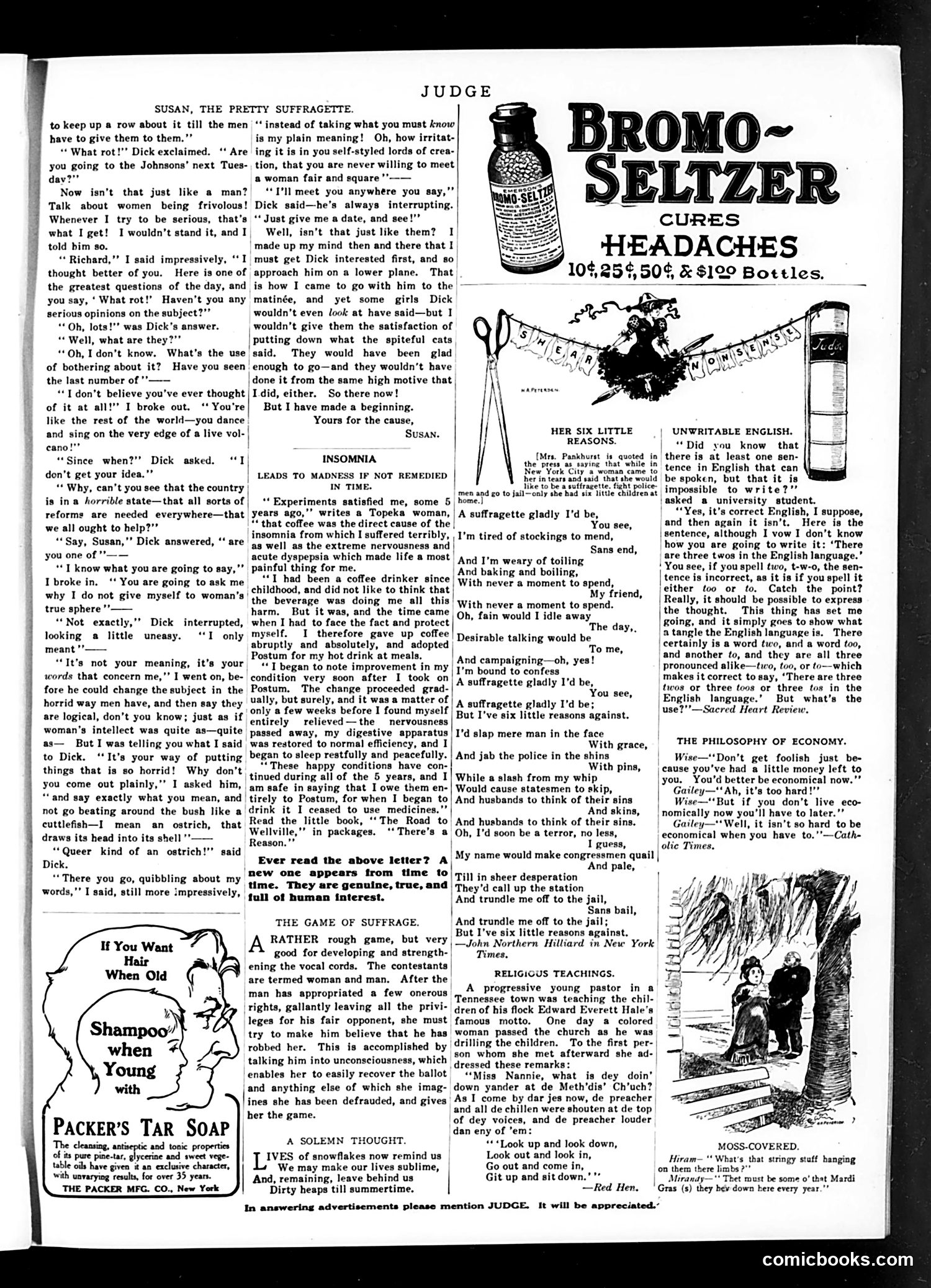
This story mocks early 20th-century women's suffrage advocates through the character Susan, presented as an earnest but tedious feminist who badgers her husband Dick about serious political reforms while he tries to avoid the conversation. The satire portrays her as self-righteously obsessed with women's rights, unable to engage in normal social discourse, and prone to dramatic pronouncements ("we all ought to help"). Dick's casual dismissiveness is played for comedy—he simply wants to discuss social plans—yet the narrative sides with his exasperation at her relentless preaching. The accompanying items (Bromo-Seltzer ad, a poem about a suffragette "gladly" accepting jail) and the crude caricature reinforce the message: suffragettes are humorless, annoying agitators. The humor relies on readers viewing women's political activism as laughably inappropriate compared to traditional "woman's sphere."
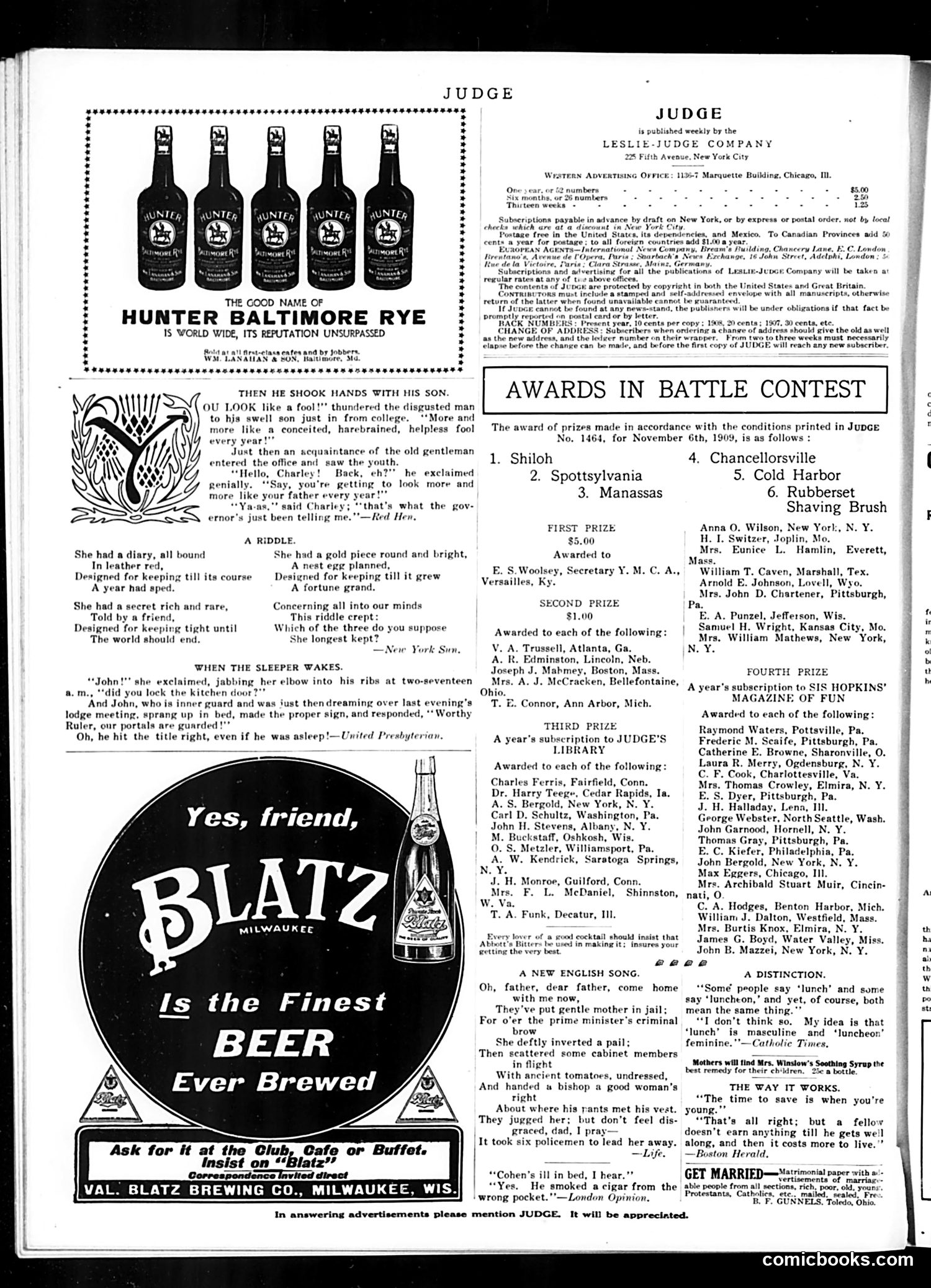
This page is primarily **advertisements and contest results**, with limited satirical content. ## Main Elements: **Advertisements:** Hunter Baltimore Rye whiskey and Blatz beer dominate the page, typical of early 1900s magazine advertising. **Short Humor Pieces:** Several brief comedic anecdotes appear, including: - A story about a father insulting his college-educated son, who responds by quoting Masonic lodge rituals - A riddle about a woman's possessions - A joke about a woman waking her sleeping husband **Battle Contest Results:** Judge ran a contest asking readers to name Civil War battles (Shiloh, Spottsylvania, Manassas won). Winners received cash prizes and magazine subscriptions. **Literary Content:** A satirical English song mocking suffragettes and politicians—women disrupting government with vegetables—reflects contemporary anxiety about the women's suffrage movement. The page reflects early 20th-century American magazine culture: commercial advertising funding editorial content, reader engagement through contests, and topical political humor targeting social reform movements.
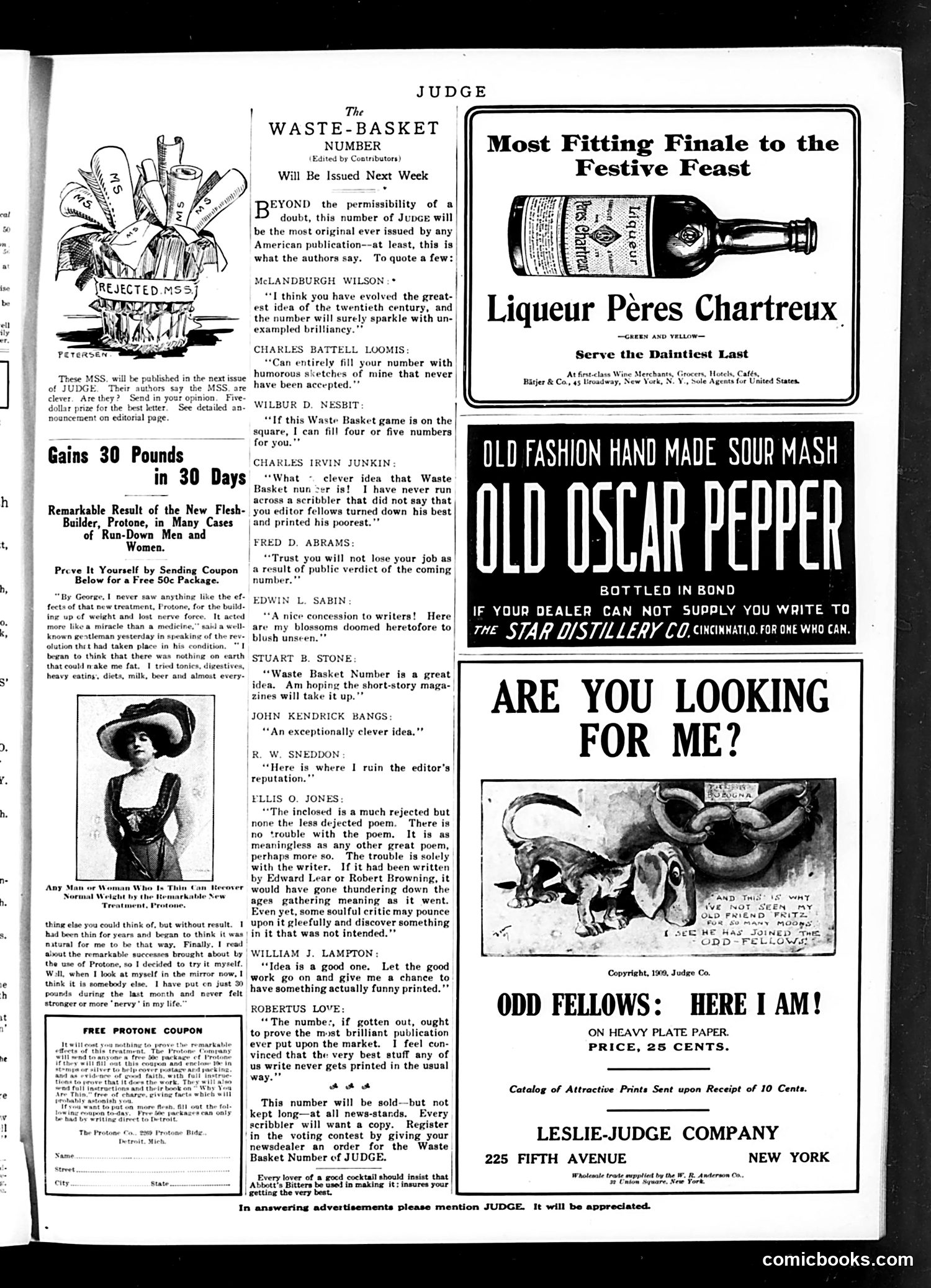
This is primarily a **promotional page** for Judge magazine's upcoming "Waste Basket" issue—not a political cartoon. The page announces a special issue featuring rejected manuscript submissions from writers, presented humorously as their own self-assessments. The joke is satirical: prominent authors and humorists are quoted praising this "brilliant" idea of publishing their previously rejected work. Their quotes drip with irony—they admit their pieces were "turned down," "rejected," or "doomed," yet claim the issue will be exceptionally clever. Ellis O. Jones's quote is particularly pointed: he calls his own rejected poem "meaningless," admitting the fault lies with the writer, not the editor. This mocks the literary pretensions of the era's professional writers while gently ribbing the editorial process. The "Waste Basket" metaphor refers to rejected submissions literally thrown away. The remainder of the page contains product advertisements (Protone for weight gain, liqueurs, Old Oscar Pepper whiskey) typical of period magazines.
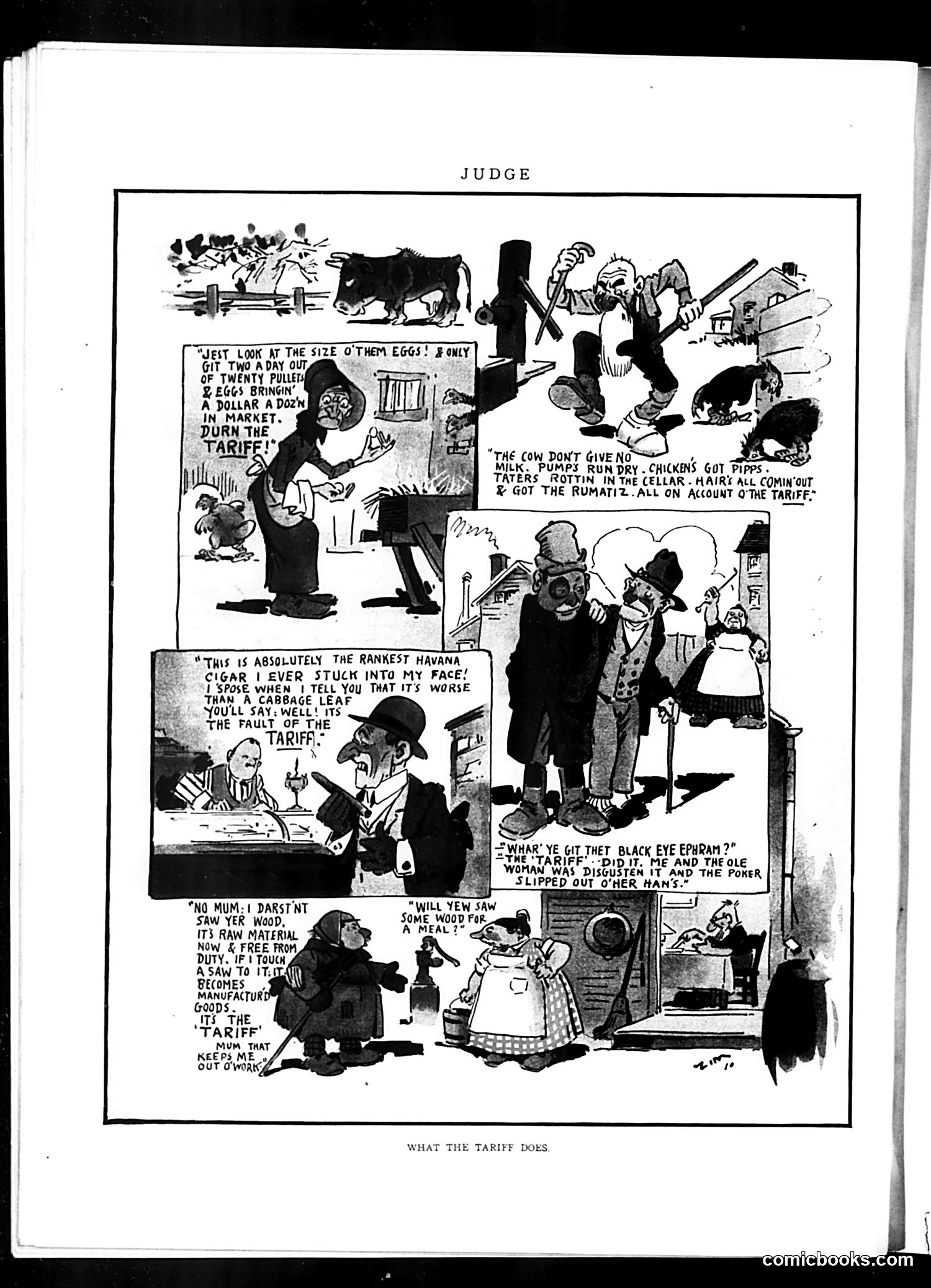
This Judge magazine cartoon satirizes the American protective tariff, likely from the late 19th/early 20th century. The multi-panel comic shows rural and working-class Americans blaming the tariff for their hardships: failing farm production (eggs, milk, potatoes), poor imported goods (Havana cigars taste like cabbage), and domestic violence (a man's black eye results from marital discord over tariffs). The satire suggests that tariff supporters falsely blamed external policies rather than accepting personal responsibility—farmers attribute crop failures to tariffs instead of poor farming, a man blames tariffs for bad cigars, and domestic conflict stems from tariff frustrations. The cartoon criticizes how the tariff became a convenient scapegoat for every American misfortune, mocking both the tariff itself and those who used it as an excuse.