
Judge, 1910-01-29 · page 13 of 16
Judge — January 29, 1910 — page 13: what you’re looking at
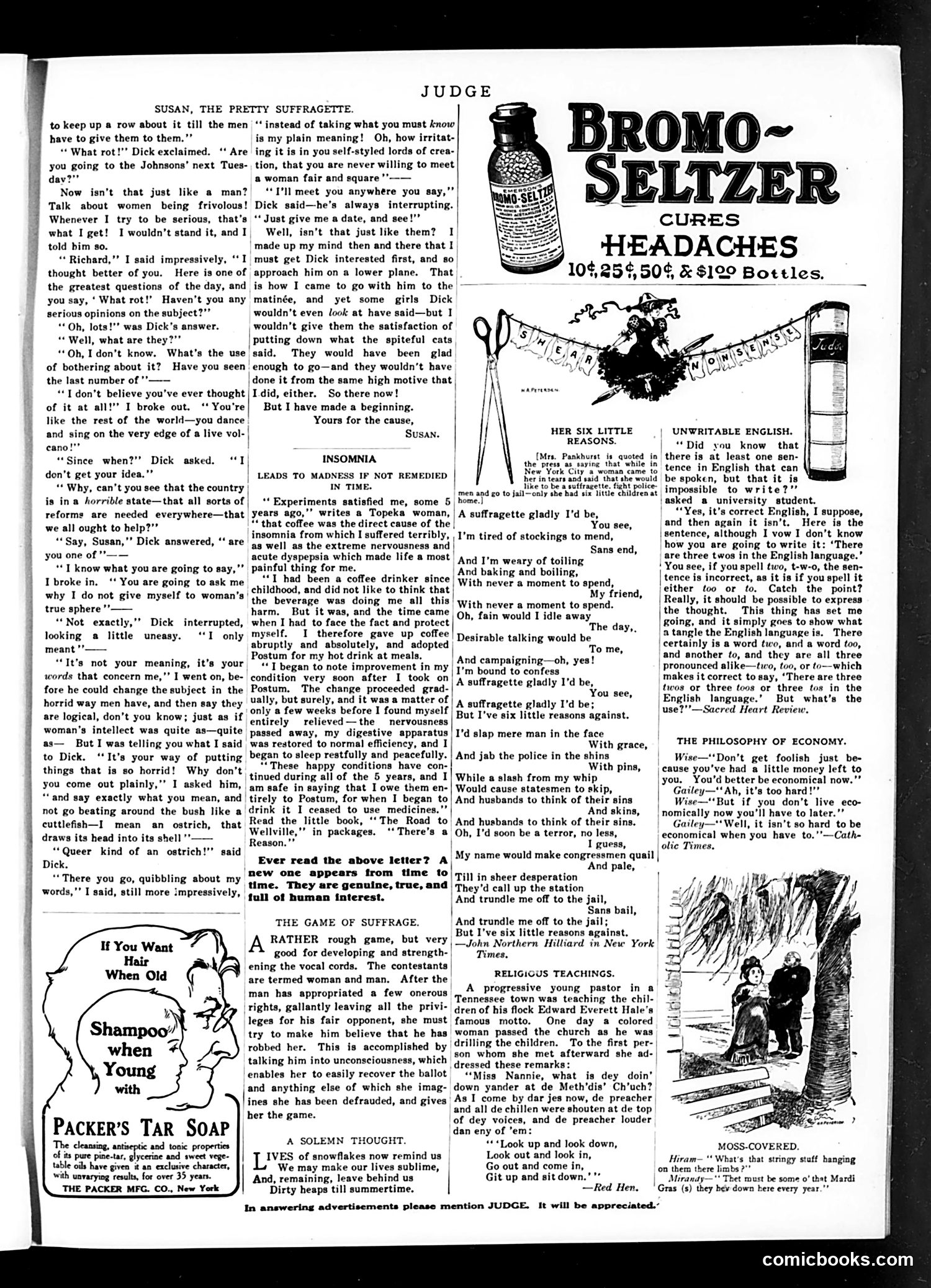
What you’re looking at
This story mocks early 20th-century women's suffrage advocates through the character Susan, presented as an earnest but tedious feminist who badgers her husband Dick about serious political reforms while he tries to avoid the conversation. The satire portrays her as self-righteously obsessed with women's rights, unable to engage in normal social discourse, and prone to dramatic pronouncements ("we all ought to help"). Dick's casual dismissiveness is played for comedy—he simply wants to discuss social plans—yet the narrative sides with his exasperation at her relentless preaching. The accompanying items (Bromo-Seltzer ad, a poem about a suffragette "gladly" accepting jail) and the crude caricature reinforce the message: suffragettes are humorless, annoying agitators. The humor relies on readers viewing women's political activism as laughably inappropriate compared to traditional "woman's sphere."
📄 Transcribed text from this page (OCR, searchable)
Machine-transcribed from the original scan — historical spelling and the odd misread are preserved.
to keep up a row about it till the men have to give them to them.”” “* What rot!"’ Dick exclaimed. ‘* Are you going to the Johnsons’ next Tues- dav?"" Now isn’t that just like a man? Talk about women being frivolous Whenever I try to be serious, that's what I get! I wouldn’t stand it, and I told bim so. “ Richard,’ I said impressively, ‘1 thought better of you. Here is one of the greatest questions of the day, and you say, ‘ What rot!” Haven't you any serious opinions on the subject?” “Oh, lots!’* was Dick’s answer. “Well, what are they?’ “Oh, I'don’t know. What's the use of bothering about it? Have you seen the last number of "’—— “don't believe you've ever thought of it at all!’ I broke out. ‘* You're like the rest of the world—you dance and sing on the very edge of a live vol-| eano ! “Since when?” Dick asked. ‘I don’t get your idea.’” | “Why, can’t you see that the country | is ina horrible state—that all sorts of | reforms are needed everywhere—that | we all ought to help?” “Say, Susan,"’ Dick answered, ‘ are you one of” “know what you are going to say,” I broke in. ‘* You are going to ask me why I do not give myself to woman’s true sphere ”— “Not exactly,” Dick interrupted, looking a little uneasy. “I only meant ""—— “It’s not your meaning, it’s your words that concern me,"’ I went on, be- fore he could change the subject in the horrid way men have, and then say they are logical, don’t you kno st as if woman's intellect was quite as—quite as— But I was telling you what I said to Dick. ‘*It’s your way of putting things that is so horrid! Why don’t you come out plainly,” I asked him, “‘and say exactly what you mean, and not go beating around the bush like a cuttlefish—I mean an ostrich, that draws its head into its shell ''—— “*Queer kind of an ostrich!’’ said Dick. “There you go, quibbling about my words,"’ I said, still more impressively, PACKER’S TAR SOAP The cleansing, ic and tonic properties || db pes poor, gyowne ad wen wae UI table oils have given it an exclusive character, | with uavarying result, for over 35 years. THE PACKER MFG. CO., New York SUSAN, THE PRETTY SUFFRAGETTE. “+ instead of taking what you must know is my plain meaning! Ob, how irritat- ing it is in you self-styled lords of crea- tion, that you are never willing to meet a woman fair and square ’—— “I'll meet you anywhere you say, Dick said—he’s always interrupting. «Just give me a date, and see!" Well, isn’t that just like them? I made up my mind then and there that I must get Dick interested first, and so approach him on a lower plane. That is how I came to go with him to the matinée, and yet some girls Dick wouldn't even look at have said—but I wouldn’t give them the satisfaction of putting down what the spiteful cats said. They would have been glad enough to go—and they wouldn’t have done it from the same high motive that, Idid, either. So there now! | But I have made a beginning. Yours for the cause, Susan. e REASONS. | ‘Did you know that INSOMNIA (Mrs. Pankhurst is quoted in there is at least one sen- ; She rises, ag tering, that wpile i" tence in English that can LEADS TO MADNESS IF NOT REMEDIED intears and said thatahe would be spoken, but that it is IN TIME. suftragette. fight police” impossible to write?” to only she had sii men and go to jai “Experiments satisfied me, some 5 home.) years ago,”’ writes a Topeka woman, | A suffragette gladly I'd be, “* that coffee was the direct cause of the, insomnia from which I suffered terribly, I’m tired of stockings to mend, as well as the extreme nervousness and | acute dyspepsia which made life a most painful thing for me. ““T had been a coffee drinker since childhood, and did not like to think that | And I’m weary of toiling And baking and boiling, the beverage was doing me all this! with never a moment to spend. fain would I idle away harm. But it was, and the time came BROMO~ SELTZER 104, HER SIX LITTLE | With never a moment to spend, CURES HEADACHES 254,504 & $129 Bottles. UNWRITABLE ENGLISH. x little children at jasked a university student. “Yes, it’s correct English, I suppose, and then again it isn’t. Here is the though I vow I don’t know how you are going to write it: ‘There are three twos in the English language.’ ‘ou see, if you spell two, t-w-o, the sen- | tence is incorrect, as it is if you spell it either too or to. Catch the point? | Really, it should be possible to express the thought. This thing has set me You see, Sans end, My friend, when I had to face the fact and protect myself. I therefore gave up coffee abruptly and absolutely, and adopted Postum for my hot drink at meals, “T began to note improvement in my condition very soon after I took on Postum. The change proceeded grad-| ually, but surely, and it was a matter of | only a few weeks before I found myself entirely relieved—the nervousness passed away, my digestive apparatus | i was restored to normal efficiency, and began to sleep restfully and peacefully. “These happy conditions have co tinued during all of the 5 years, and I| While a slash from my whip am safe in saying that I owe them en-| Would cause statesmen to skip, tirely to Postum, for when I began to| And husbands to think of their sins | drink it I ceased to use medicines. Read the little book, ‘‘The Road to Wellville,"” in packages. Reason.”” Ever read the above letter? A mew one appears from time to}q%1) in sheer desperation time. They are genuine, true, and full of human interest. THE GAME OF SUFFRAGE. A RATHER rough game, but very good for developing and strength- ening the vocal cords. The contestants are termed woman and man. After the man has appropriated a few onerous rights, gallantly leaving all the privi- leges for his fair opponent, she must try to make him believe that he has robbed her. This is accomplished by talking him into unconsciousness, which enables her to easily recover the ballot and anything else of which she imag- ines she has been defrauded, and gives her the game. A SOLEMN THOUGHT. IVES of snowflakes now remind us We may make our lives sublime, And, remaining, leave behind us Dirty heaps till summertime. In answering advertisements please mention JUDGE. It will be appreciated.’ |I’m bound to confess “There's a | And trundle me off to the | going, and it simply goes to show what ‘The day, n af ‘ * |atangle the English language is. There Desirable talking would Pe me certainly is a word two, and a word too, and another to, and they are all three pronounced alike—tico, too, or to—which makes it correct to say, ‘There are three twos or three toos or three tos in the English language.’ But what’s the use?"’—Sacred Heart Review. And campaigning—oh, yes! A suffragette gladly I’d be, You see, A suffragette gladly I'd be; | But I've six little reasons against. I’d slap mere man in the face THE PHILOSOPHY OF ECONOMY. With grace, And jab the police in the shins Wise—“Don't get foolish just be- With pins, | cause you've had a little money left to you. You'd better be economical now."* | Gailey—"'Ab, it’s too hard | Wise—“But if you don’t live eco- nomically now you'll have to later.’” ‘And skins, And husbands to think of their sins. Gailey—*Well, it isn’t so hard to be Oh, I'd soon be a terror, no less, economical when you have to.’’—Cath- I guess, olic Times. My name would make congressmen quail | And pale, They'd call up the station And trundle me off to the But I've six little reasons against. —John Northern Hilliard in New York Times, RELIGIOUS TEACHINGS. A progressive young pastor in a Tennessee town was teaching the ch dren of his flock Edward Everett Hale's famous motto. One day a colored woman passed the church as he was drilling the children. To the first per- son whom she met afterward she a dressed these remarks: “Miss Nannie, what is dey doin’ down yander at de Meth’dis’ Ch’uch? As I come by dar jes now, de preacher and all de chillen were shouten at de top of dey voices, and de preacher louder dan eny of ’e ***Look up and look down, Look out and look in, Go out and come in, Git up and sit down. —Red Hen. MOSS-COVERED. Hiram—“' What's that stringy stuff hanging on them there limbs 2"° |_ Miranay—"* Thet must be some o' that Mardi Gras (s) they bev down here every year."’ comicbooks.com