
Judge, 1910-01-29 · page 5 of 16
Judge — January 29, 1910 — page 5: what you’re looking at
What you’re looking at
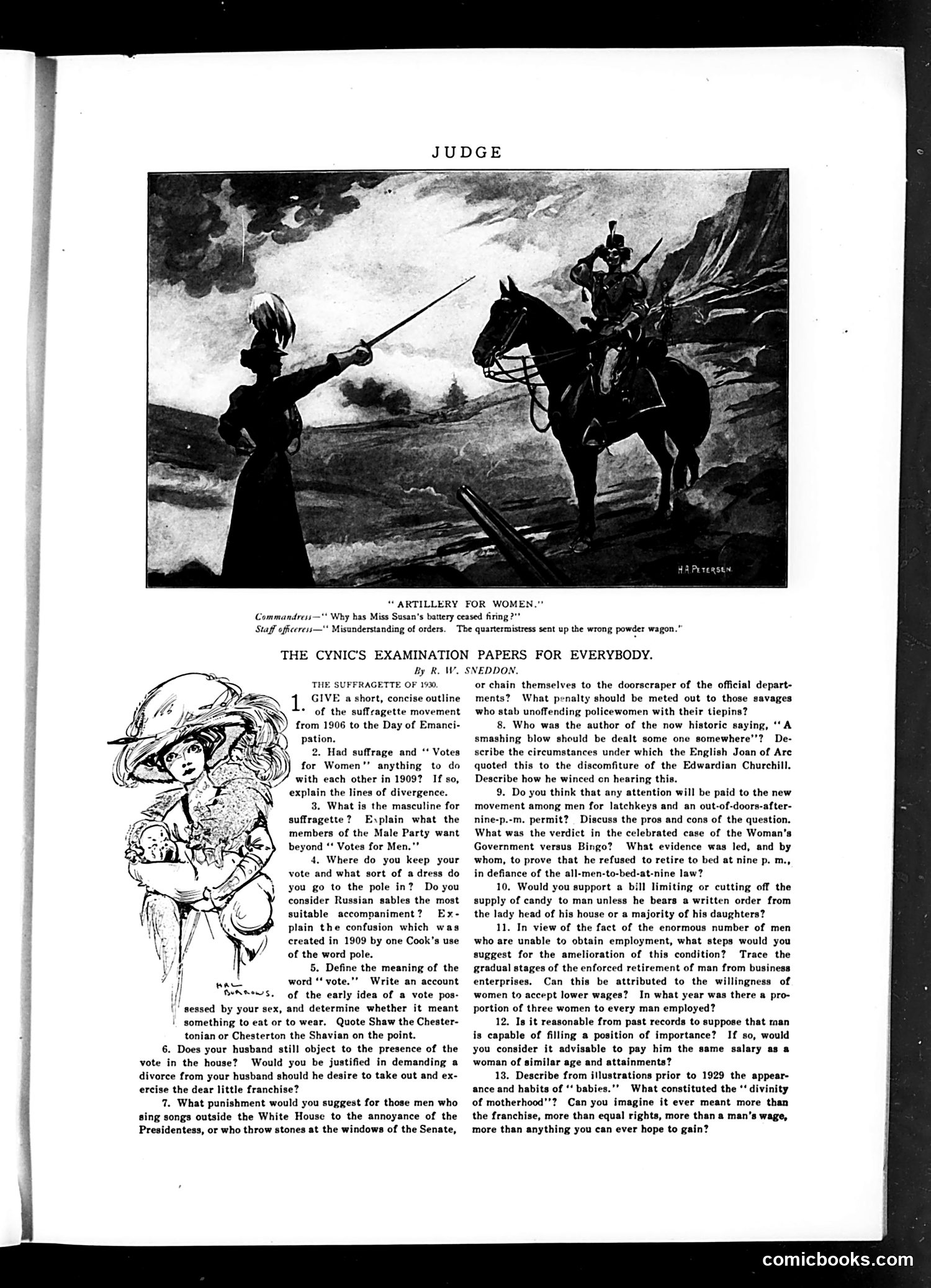
The cartoon titled "Artillery for Women" satirizes women's suffrage activism circa 1909-1920. The image shows a woman wielding a sword or lance while confronting a mounted military figure, visually parodying suffragettes as aggressive combatants. The accompanying examination questions mock the suffrage movement by framing women's political demands as unreasonable and comparing them to violent insurrection. References to "Votes for Women," Miss Susan B. Anthony (the suffragette), and debates about women's employment and equal pay indicate this targets the broader women's rights movement of the era. The satire's point: presenting female political activism as absurd, dangerous, and unladylike—a common anti-suffrage argument used to delegitimize women's legitimate demands for voting rights and economic equality.
📄 Transcribed text from this page (OCR, searchable)
Machine-transcribed from the original scan — historical spelling and the odd misread are preserved.
“ ARTILLERY Commandress—"* Why has Miss Susan's battery ceased firing ? FOR WOM Staff offceress—* Misunderstanding of orders. The quartermistress sent up the wrong powder wagon.” THE CYNIC’'S EXAMINATION PAPERS FOR EVERYBODY. By RW. THE SUFFRAGETTE OF 193. GIVE a short, concise outline * of the suffragette movement from 1906 to the Day of Emanci- pation. 2. Had suffrage and ‘* Votes for Women" anything to do with each other in 1909? If so, explain the lines of divergence. 3. What is the masculine for suffragette? Explain what the members of the Male Party want beyond ‘‘ Votes for Men."* 4. Where do you keep your vote and what sort of adress do you go to the pole in? Do you consider Russian sables the most suitable accompaniment? Ex- plain the confusion which was created in 1909 by one Cook's use of the word pole. 5. Define the meaning of the Pre word “vote”? Write an account BeAneS. of the early idea of a vote pos- ( sessed by your sex, and determine whether it meant something to eat or to wear. Quote Shaw the Chester- tonian or Chesterton the Shavian on the point. 6. Does your husband still object to the presence of the vote in the house? Would you be justified in demanding a divorce from your husband should he desire to take out and ex- ercise the dear little franchise? 7. What punishment would you suggest for those men who sing songs outside the White House to the annoyance of the Presidentess, or who throw stones at the windows of the Senate, i SNEDDON. or chain themselves to the doorscraper of the official depart- ments? What penalty should be meted out to those savages who stab unoffending policewomen with their tiepins? 8. Who was the author of the now historic saying, “A smashing blow should be dealt some one somewhere’? De- scribe the circumstances under which the English Joan of Arc quoted this to the discomfiture of the Edwardian Churchill. Describe how he winced on hearing this. 9. Do you think that any attention will be paid to the new movement among men for latchkeys and an out-of-doors-after- nine-p.-m. permit? Discuss the pros and cons of the question. What was the verdict in the celebrated case of the Woman's Government versus Bingo? What evidence was led, and by whom, to prove that he refused to retire to bed at nine p. m., in defiance of the all-men-to-bed-at-nine law? 10, Would you support a bill limiting or cutting off the supply of candy to man unless he bears a written order from the lady head of his house or a majority of his daughters? 11. In view of the fact of the enormous number of men who are unable to obtain employment, what steps would you suggest for the amelioration of this condition? Trace the gradual stages of the enforced retirement of man from business enterprises. Can this be attributed to the willingness of women to accept lower wages? In what year was there a pro- portion of three women to every man employed? 12, Is it reasonable from past records to suppose that man is capable of filling a position of importance? If so, would you consider it advisable to pay him the same salary as a woman of similar age and attainments? 13, Describe from illustrations prior to 1929 the appear- ance and habits of ‘‘ babies.’’ What constituted the ‘divinity of motherhood"? Can you imagine it ever meant more than the franchise, more than equal rights, more than a man’s wage, more than anything you can ever hope to gain? comicbooks.com