
Judge, 1910-01-29 · page 4 of 16
Judge — January 29, 1910 — page 4: what you’re looking at
What you’re looking at
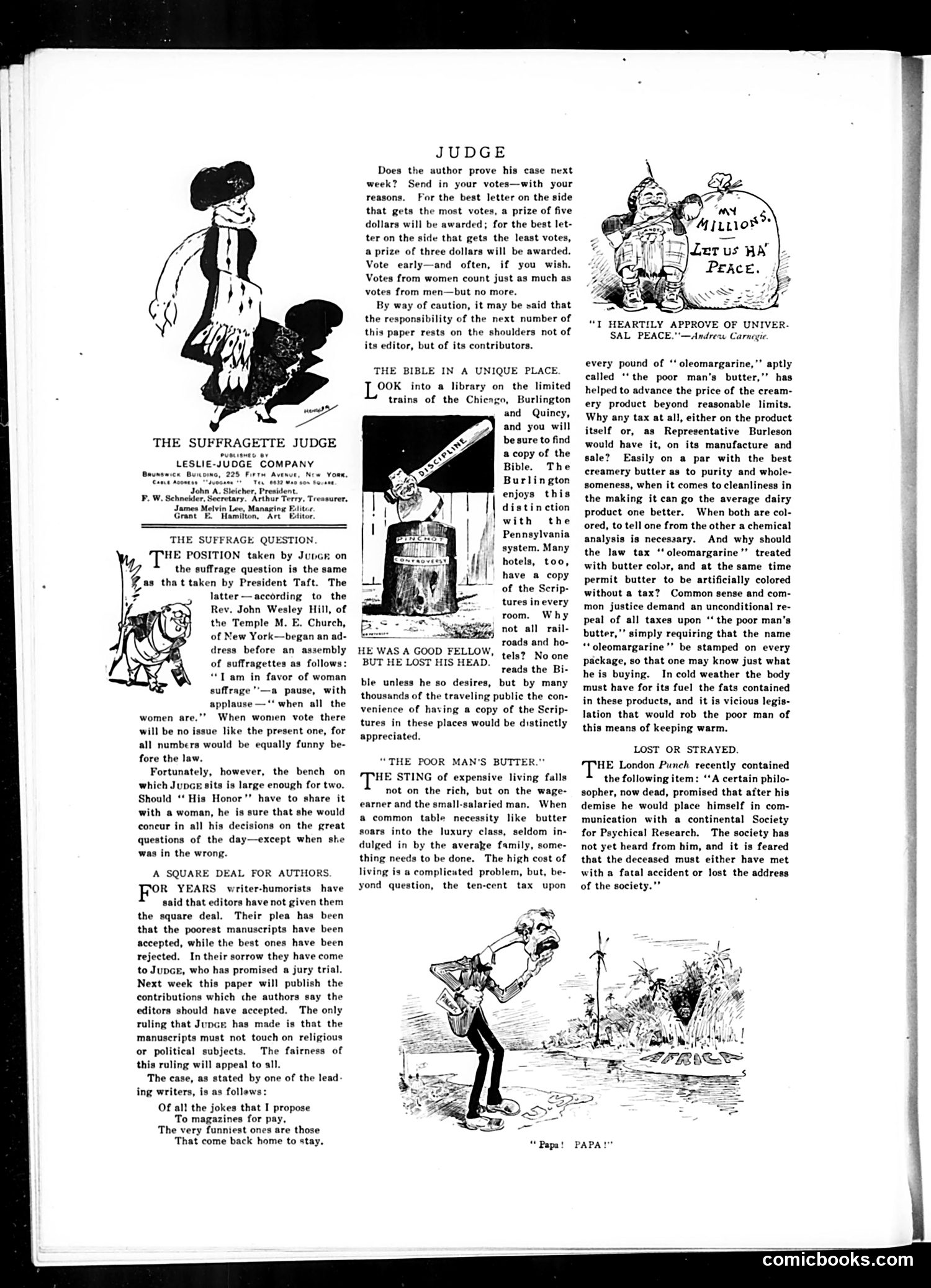
This page contains several distinct satirical pieces rather than one unified cartoon: **"The Suffragette Judge"** (left): A cartoon mocking women's suffrage advocates, showing a woman in exaggerated dress. The caption criticizes female voters, reflecting anti-suffrage sentiment common in Judge during this era. **"The Bible in a Unique Place"**: Commentary on the Burlington railroad's decision to place Bibles in hotel rooms—praised as a practical convenience for travelers. **"The Poor Man's Butter"**: Satirizes "oleomargarine," a cheap butter substitute, discussing its taxation and regulation as a class issue affecting working people versus the wealthy. **"A Square Deal for Authors"**: Critiques editors' treatment of rejected manuscripts, proposing stricter rules regarding religious/political content. The page reflects Judge's focus on contemporary early-20th-century debates: women's rights, labor economics, and publishing standards.
📄 Transcribed text from this page (OCR, searchable)
Machine-transcribed from the original scan — historical spelling and the odd misread are preserved.
THE SUFFRAGETTE JUDGE LESLIE-JUOGE COMPANY icher, President. John A. P. W. Schneider. Secretary. Arthur Terry, Treasurer, James Melvin Lee, Managing Grant E. Ham! THE SUFFRAGE QUESTION. HE POSITION taken by Jupcr on the suffrage question is the same Saal that taken by President Taft. The latter —according to the Rev. John Wesley Hill, of the Temple M. E. Church, of New York—began an ad- dress before an assembly of suffragettes as follows: “Tam in favor of woman suffrage "—a pause, with applause —‘‘ when all the women are.'’ When women vote there will be no issue like the present one, for all numbers would be equally funny be- fore the law. Fortunately, however, the bench on which Jupce sits is large enough for two. Should ‘‘ His Honor’’ have to share it with a woman, he is sure that she would concur in all his decisions on the great questions of the day—except when she was in the wrong. A SQUARE DEAL FOR AUTHORS. R YEARS writer-humorists have said that editors have not given them the square deal. Their plea has been that the poorest manuscripts have been accepted, while the best ones have been rejected. In their sorrow they have come to Jupce, who has promised a jury trial. Next week this paper will publish the contributions which che authors say the editors should have accepted. The only ruling that Jupce has made is that the manuscripts must not touch on religious or political subjects. The fairness of this ruling will appeal to all. The case, as stated by one of the lead ing writers, is as follews: Of all the jokes that I propose To magazines for pay, The very funniest ones are those That come back home to stay. « Bunoima, 225 Firte Avenue, New Yous, JUDGE Does the author prove his case next week? Send in your votes—with your reasons. For the best letter on the side that gets the most votes, a prize of five dollars will be awarded; for the best let- ter on the side that gets the least votes, a prize of three dollars will be awarded. Vote early—and often, if you wish. Votes from women count just as much as votes from men—but no more. By way of caution, it may be said that the responsibility of the next number of this paper rests on the shoulders not of its editor, but of its contributors. THE BIBLE IN A UNIQUE PLACE. OOK into a library on the limited trains of the Chicago, Burlington and Quincy, and you will be sure to find a copy of the Bible. The Burlington enjoys this distinction with the Pennsylvania ) system. Many hotels, too, have a copy of the Scrip- tures inevery room. Why not all rail- roads and ho- tels? No one reads the Bi- ble unless he so desires, but by many thousands of the traveling public the con- venience of having a copy of the Scrip- tures in these places would be distinctly appreciated. HE WAS A GOOD FELLOW, BUT HE LOST HIS HEAD. “THE POOR MAN'S BUTTER." HE STING of expensive living falls not on the rich, but on the wage- earner and the small-salaried man. When a common table necessity like butter soars into the luxury class, seldom in- dulged in by the averake family, some- thing needs to be done. The high cost of living is a complicated problem, but, be- yond question, the ten-cent tax upon “I HEARTILY APPROVE OF UNIVER- SAL PEACE."'—Andrew Carnegie every pound of ‘‘ oleomargarine,”’ aptly called ‘the poor man’s butter,’? has helped to advance the price of the cream- ery product beyond reasonable limits. Why any tax at all, either on the product itself or, as Representative Burleson would have it, on its manufacture and sale? Easily on a par with the best creamery butter as to purity and whole- someness, when it comes to cleanliness in the making it can go the average dairy product one better. When both are col- ored, to tell one from the other a chemical analysis is necessary. And why should the law tax ‘‘oleomargarine’’ treated with butter color, and at the same time permit butter to be artificially colored without a tax? Common sense and com- mon justice demand an unconditional re- peal of all taxes upon ‘‘ the poor man’s butter,”’ simply requiring that the name “oleomargarine"’ be stamped on every package, so that one may know just what he is buying. In cold weather the body must have for its fuel the fats contained in these products, and it is vicious legis- lation that would rob the poor man of. this means of keeping warm. LOST OR STRAYED. THE London Punch recently contained the following item: ‘*A certain philo- sopher, now dead, promised that after his demise he would place himself in com- munication with a continental Society for Psychical Research. The society has not yet heard from him, and it is feared that the deceased must either have met with a fatal accident or lost the address “ Papa! PAPA!" comicbooks.com | 1 | {