
A complete issue · 16 pages · 1910
Judge — January 8, 1910
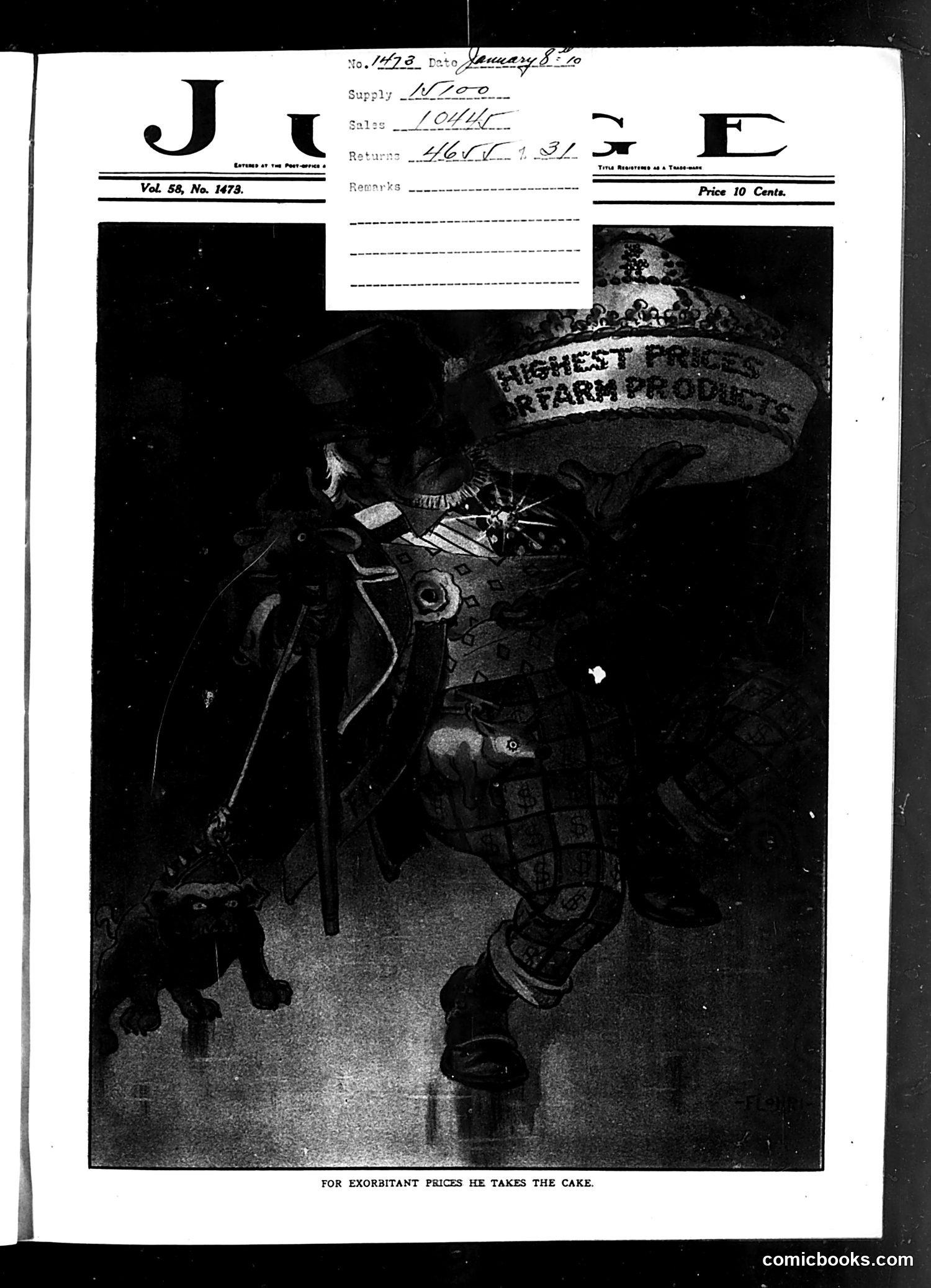
This appears to be a satirical cartoon from Judge magazine (Vol. 58, No. 1473) depicting a farmer or agricultural figure in formal/decorated clothing holding a large container labeled "HIGHEST FARM PRODUCTS" while standing over what appears to be a small animal or creature. The caption reads: "FOR EXORBITANT PRICES HE TAKES THE CAKE." The satire critiques farmers or agricultural producers who are charging excessive prices for farm goods. The figure's formal dress and prideful posture contrast with the humble origin of farm products, mocking the pretentiousness of demanding high prices. The phrase "takes the cake" suggests he's being particularly outrageous or winning a contest in greed. This likely reflects post-WWI agricultural price disputes or inflation concerns affecting American consumers during the early 1920s.
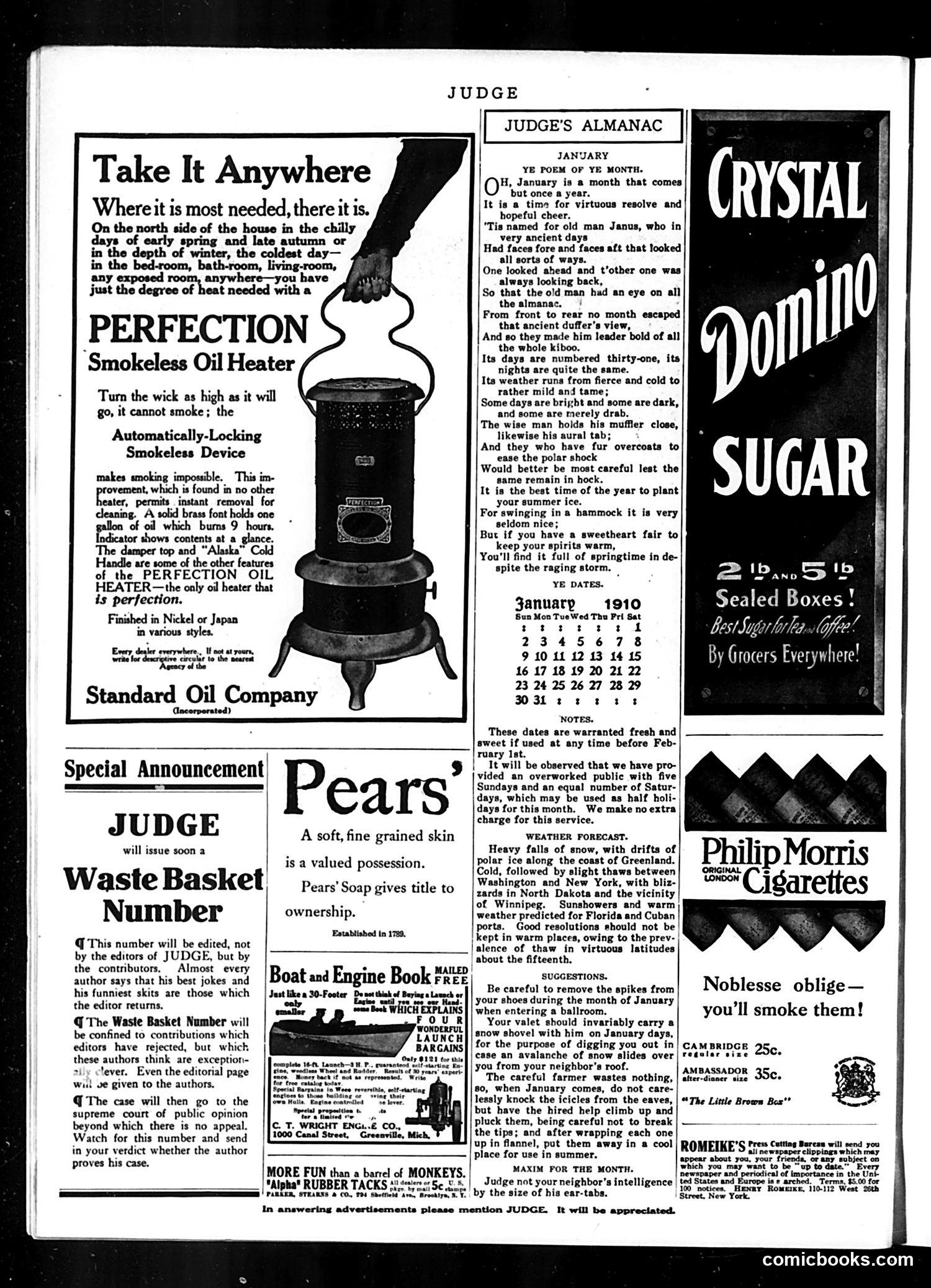
This page is primarily **advertising and almanac content**, not political satire. The layout features: **Main advertisements:** - Perfection Smokeless Oil Heater (Standard Oil Company) - Crystal Domino Sugar (2-5 lb boxes) - Philip Morris Cigarettes - Pears' Soap - Boat and Engine Book **Editorial content:** - "Judge's Almanac" for January 1910 with a poem about the month - A calendar - Weather forecast and practical suggestions for January activities - "Waste Basket Number" announcement (humorous rejected jokes to be published separately) The page reflects typical early-20th-century magazine economics: substantial advertising revenue supporting editorial content. There is **no identifiable political cartoon or social satire** on this particular page—it's a straightforward mix of commercial and almanac material typical of Judge's format during this era.
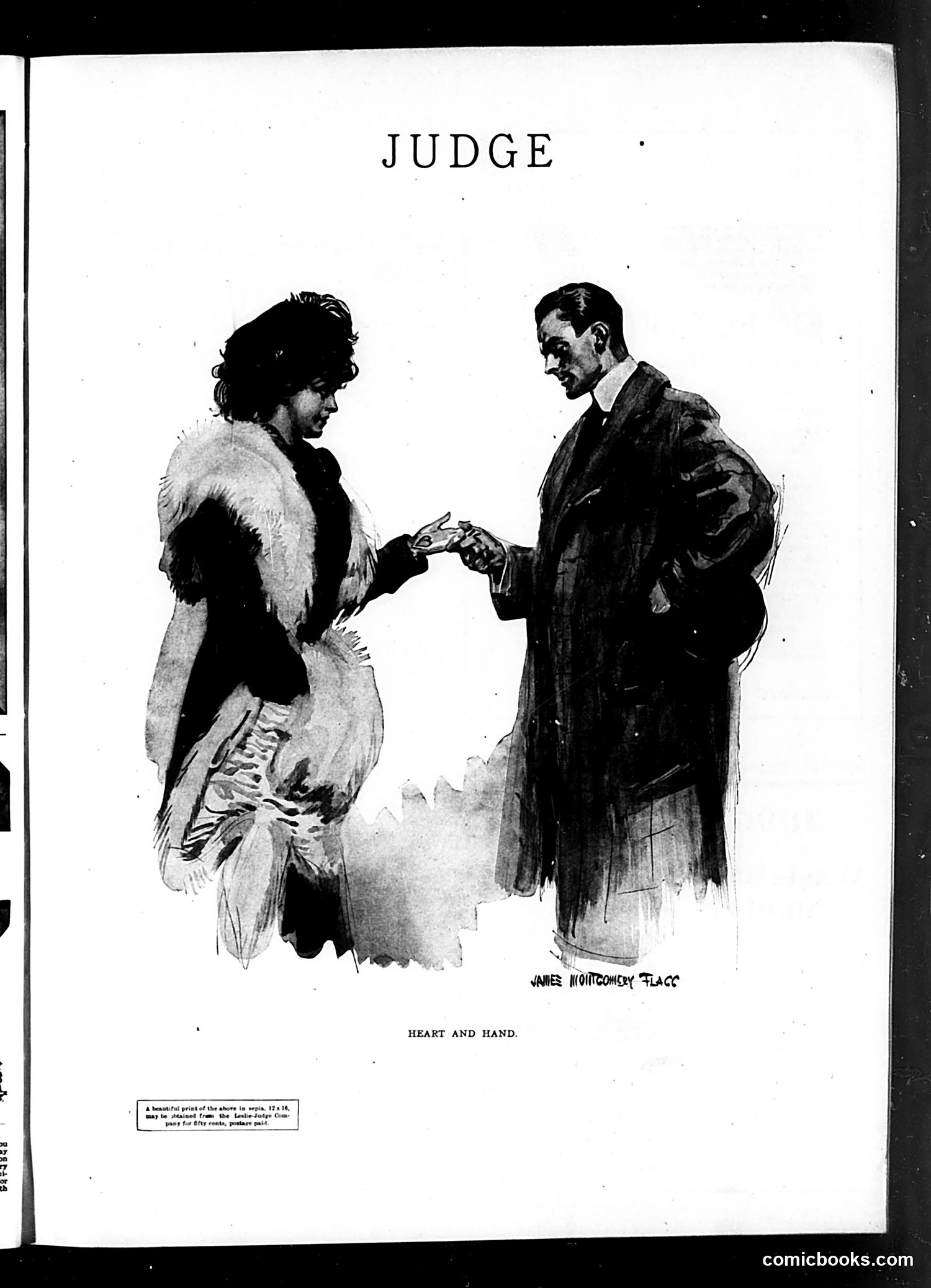
This illustration depicts a formal exchange between a well-dressed man and an elegantly attired woman wearing fur. The title "Heart and Hand" and the word "JUDGE" at the top suggest this is social commentary on courtship, marriage, or romantic negotiation. The artwork, credited to James Montgomery Flagg (a prominent illustrator of the era), appears to satirize the transactional nature of romance or marriage in upper-class society. The careful rendering of the woman's fashionable attire and the man's formal dress suggests commentary on wealth and social position as factors in romantic relationships. Without additional context about the specific issue date, the exact satirical point remains somewhat unclear, though it likely critiques materialism in courtship rituals of the period.
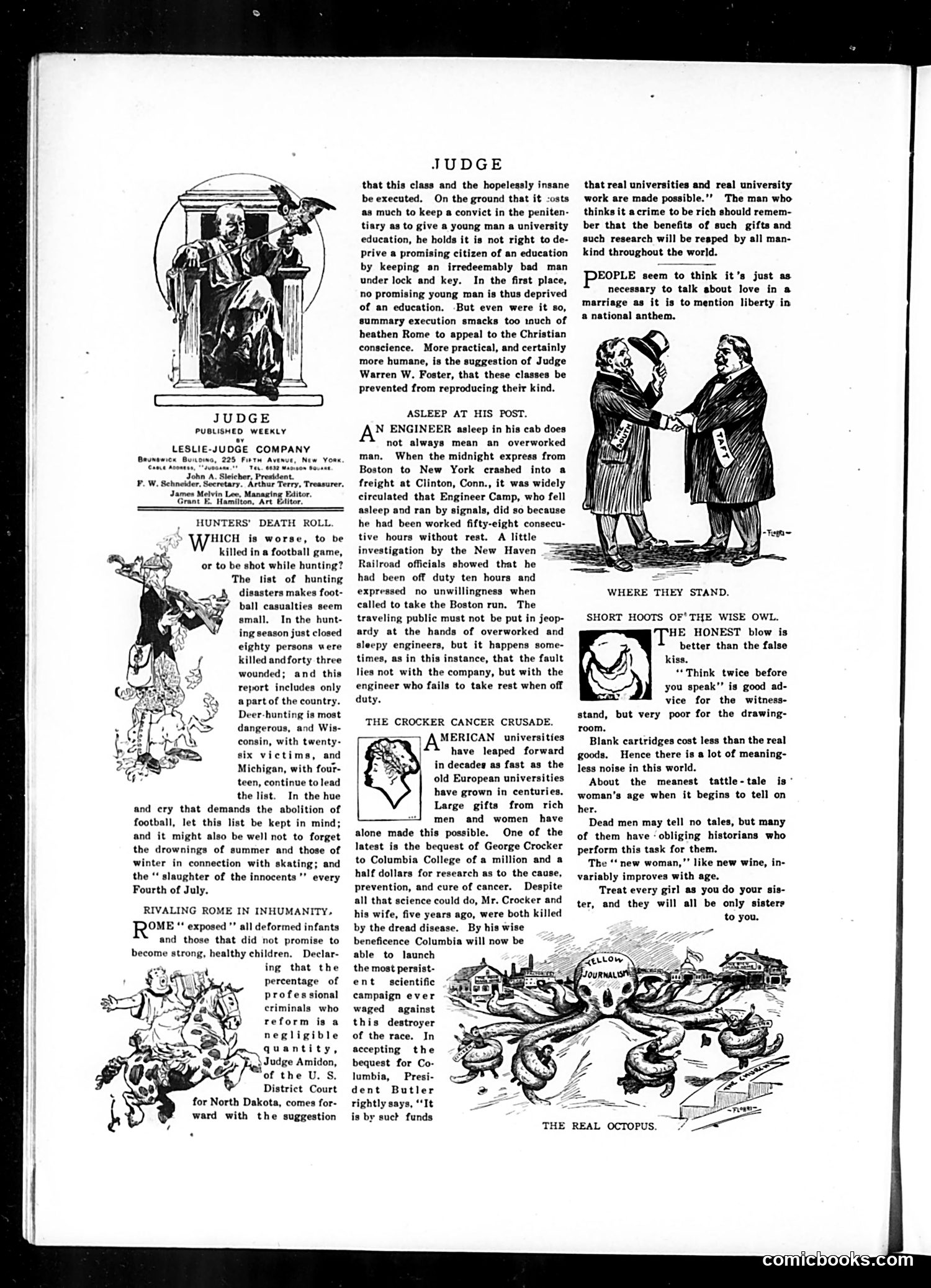
This page contains several satirical pieces typical of early 20th-century Judge magazine: **"Judge" (top left)**: An illustration of Lady Justice, establishing the page's editorial voice. **"Asleep at His Post"**: A cautionary tale about a railroad engineer who fell asleep, nearly causing disaster. The satire critiques overworked laborers and negligent companies—a common Progressive Era concern about worker safety and corporate responsibility. **"Hunters' Death Roll"**: Dark humor juxtaposing hunting accidents with football injuries, questioning which is more dangerous. **"The Crocker Cancer Crusade"**: Discusses George Crocker's million-dollar bequest to Columbia College for cancer research—celebrating philanthropic contributions to scientific progress. **"Rivaling Rome in Inhumanity"**: Criticizes criminal justice reform, sarcastically suggesting that helping deformed infants become healthy is somehow un-American. The cartoons employ typical Judge-style illustrations and ironic tone to comment on contemporary social issues.
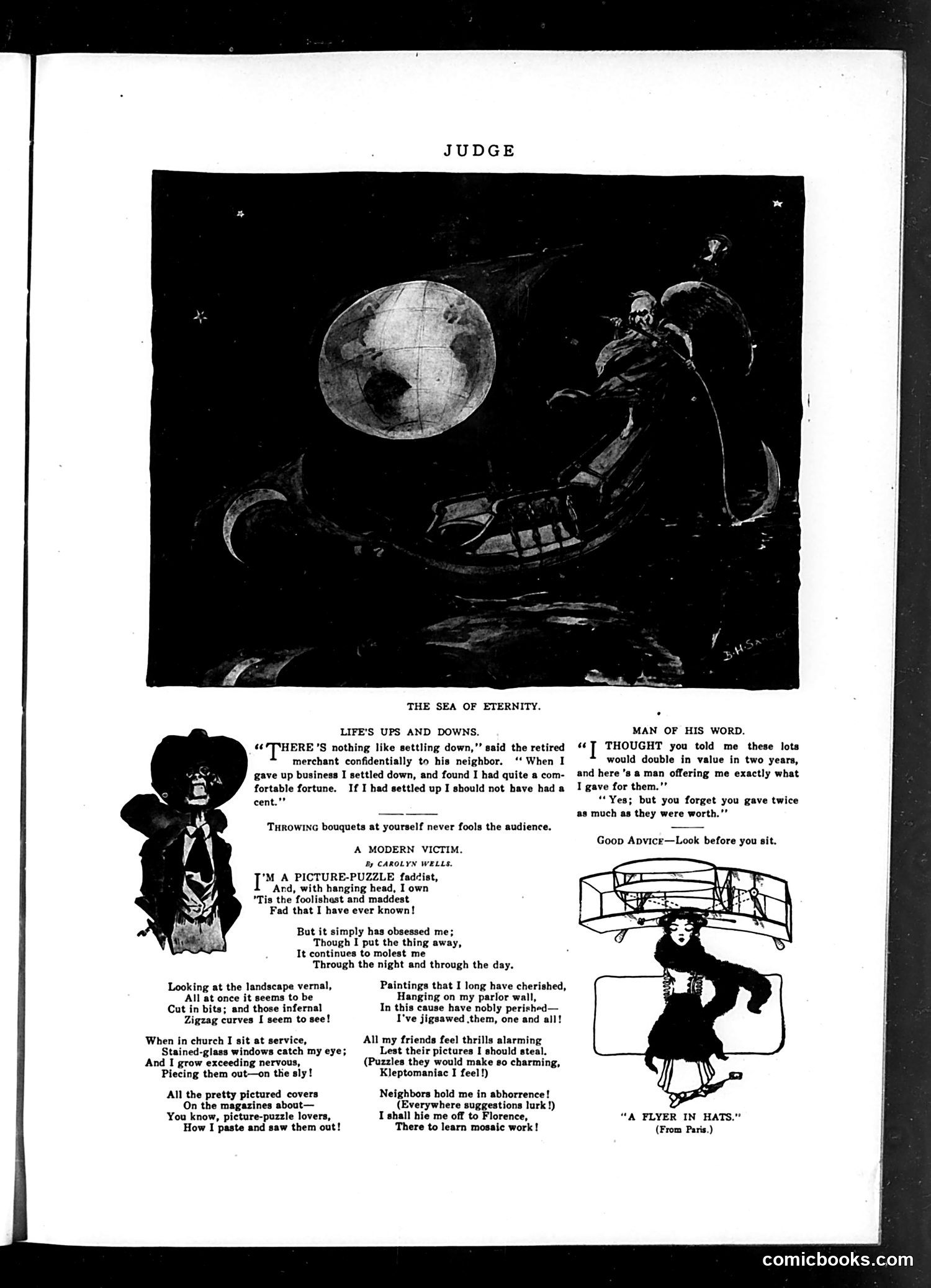
**Main Cartoon:** "The Sea of Eternity" depicts a figure in a boat navigating a globe, likely representing life's journey or mortality—a common symbolic theme in turn-of-the-century satire. **Text Features:** The page includes three separate pieces: 1. "Life's Ups and Downs" and "Man of His Word"—brief anecdotes about financial dealings and broken promises, satirizing business ethics. 2. "A Modern Victim" by Carolyn Wells—a poem mocking someone obsessed with picture puzzles, reflecting contemporary fads. 3. "A Flyer in Hats"—a small cartoon about fashion mishaps. The satire targets everyday social concerns: unreliable merchants, wasteful hobbies, and fashion absurdities. Without specific date context, the precise historical references remain unclear.
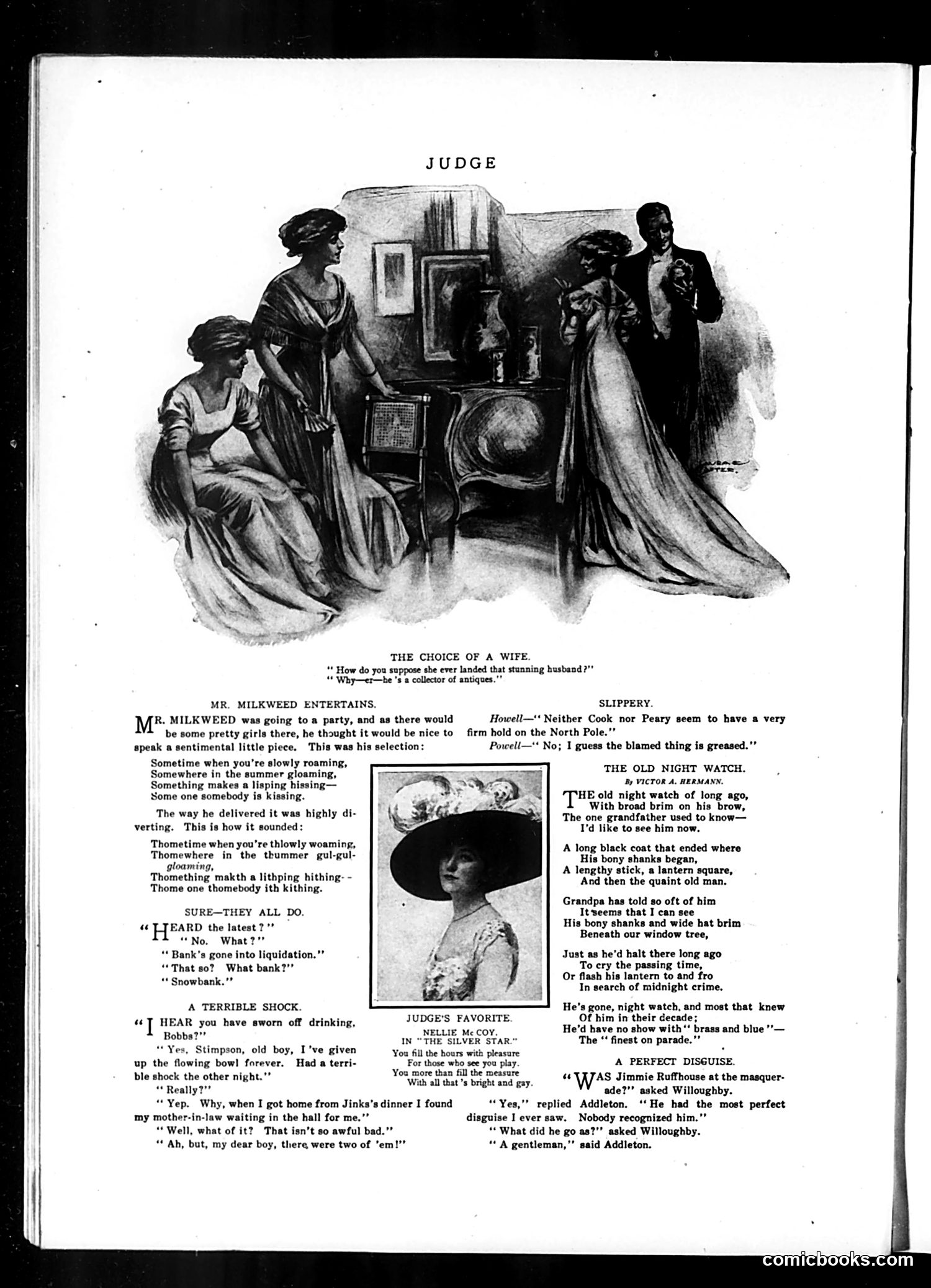
This page from Judge (a 19th-century American satirical magazine) contains several unrelated humorous pieces: **Main cartoon**: "The Choice of a Wife" depicts a woman married to an elderly man, joking that she "landed" him because he's a "collector of antiques"—the satire being that the husband himself *is* the antique. **Mr. Milkweed Entertains**: A man attempts to recite sentimental poetry at a party but has a severe speech impediment (lisping/stuttering), making "roaming" become "woaming" and "kissing" become "kithing." The humor is physical/embarrassing. **Other brief jokes**: Include puns about a bank's "liquidation" (Snowbank) and references to Cook and Peary's polar expeditions (then-current news), plus a masquerade joke where "a gentleman" is the ultimate disguise for someone unrecognizable. The page represents typical Judge humor: mild social satire, physical comedy, and wordplay aimed at middle-class readers.
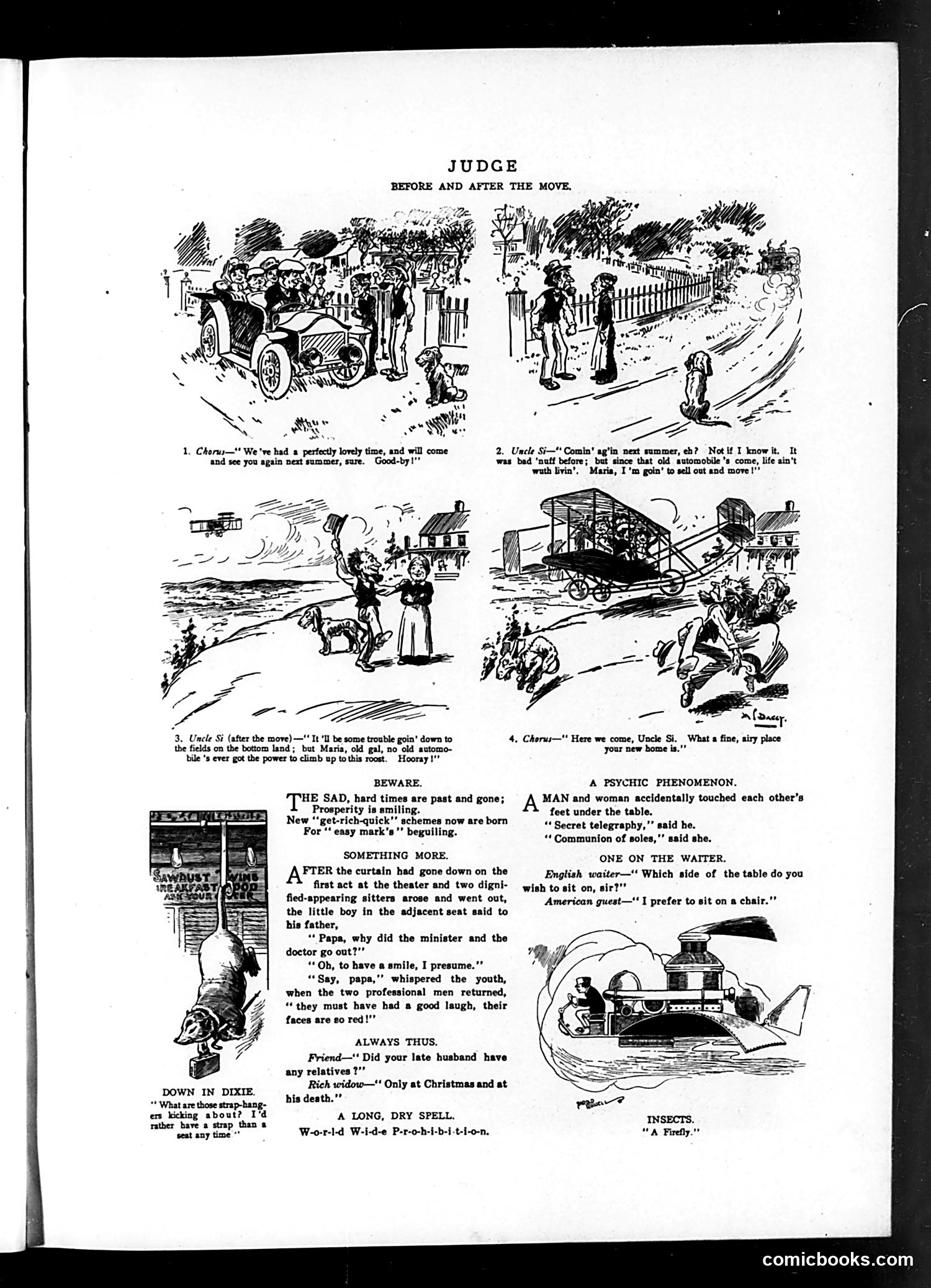
This page satirizes early 20th-century anxieties about automobiles disrupting rural life. The four-panel "Judge Before and After the Move" strip shows Uncle Si, a rural farmer, initially hosting pleasant summer visitors. However, once automobiles arrive ("that old automobile"), he finds life unbearable and moves to an isolated hilltop—only to discover the new location offers escape from automotive traffic. The satire targets two audiences: rural people resisting modernization, and urban motorists invading the countryside. Other brief jokes mock "get-rich-quick schemes," Prohibition ("World Wide Prohibition"), and social pretenses. The page reflects genuine period tensions: automobiles were rapidly transforming American society, creating conflict between rural traditionalists and urban progressives. Uncle Si's desperate retreat uphill represents rural resistance to inevitable change—a losing battle against modernity.
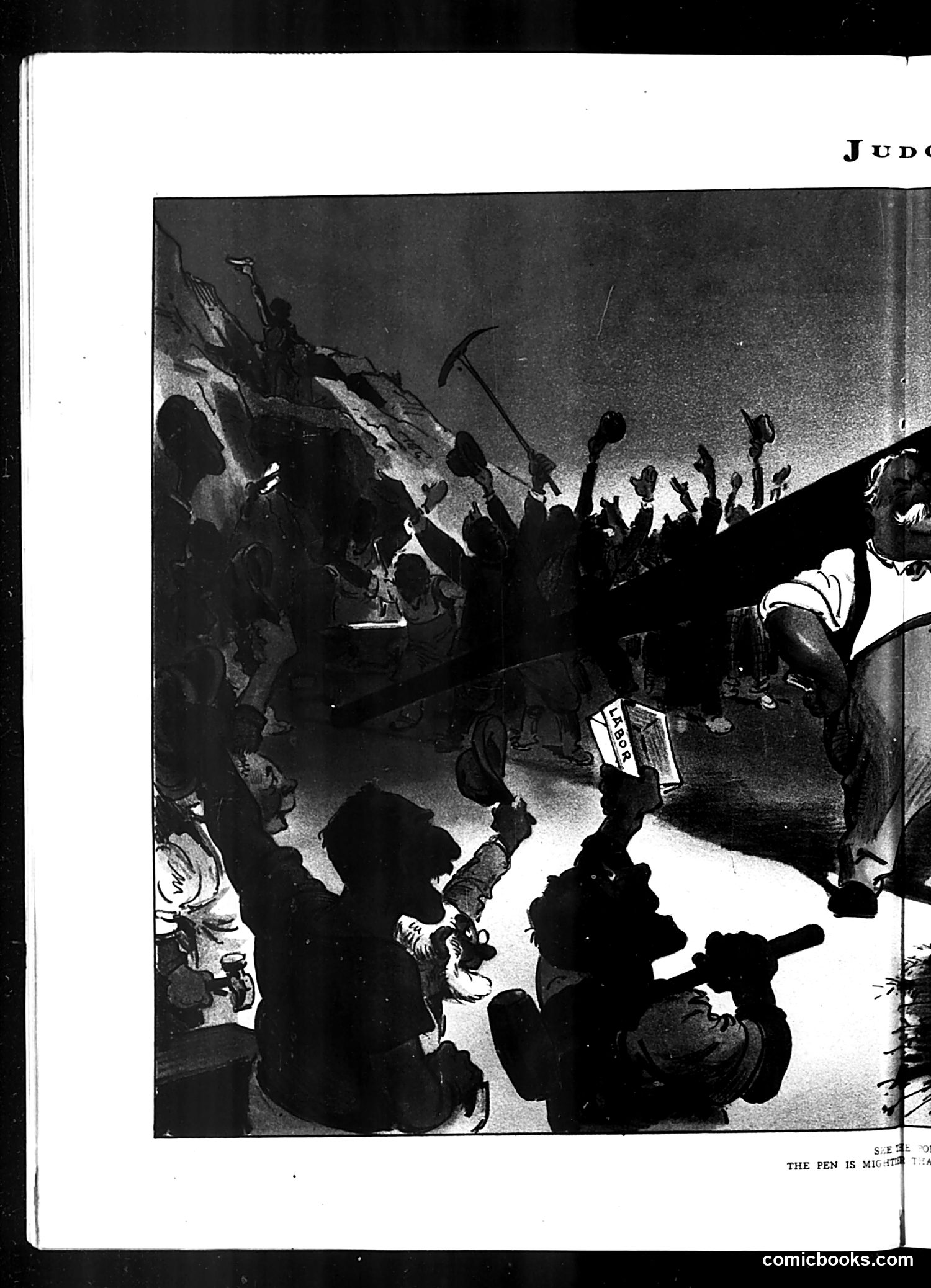
This appears to be a dramatic political cartoon from Judge magazine showing a confrontational scene. The caption reads "THE PEN IS MIGHTIER THAN THE SWORD" (partially visible as "THE PEN IS MIC[HTIER]"). The image depicts silhouetted figures in what looks like a violent or chaotic confrontation, with some figures wielding tools or weapons (possibly pickaxes or similar implements) against what appears to be a fortified position or cliff. The composition suggests conflict between opposing forces. However, the OCR text is heavily corrupted, making it impossible to identify specific political figures or determine the exact historical event being satirized. Without clearer text or visible labels identifying the subjects, I cannot confidently explain which specific political or social issue this cartoon addresses or who the caricatured figures represent.
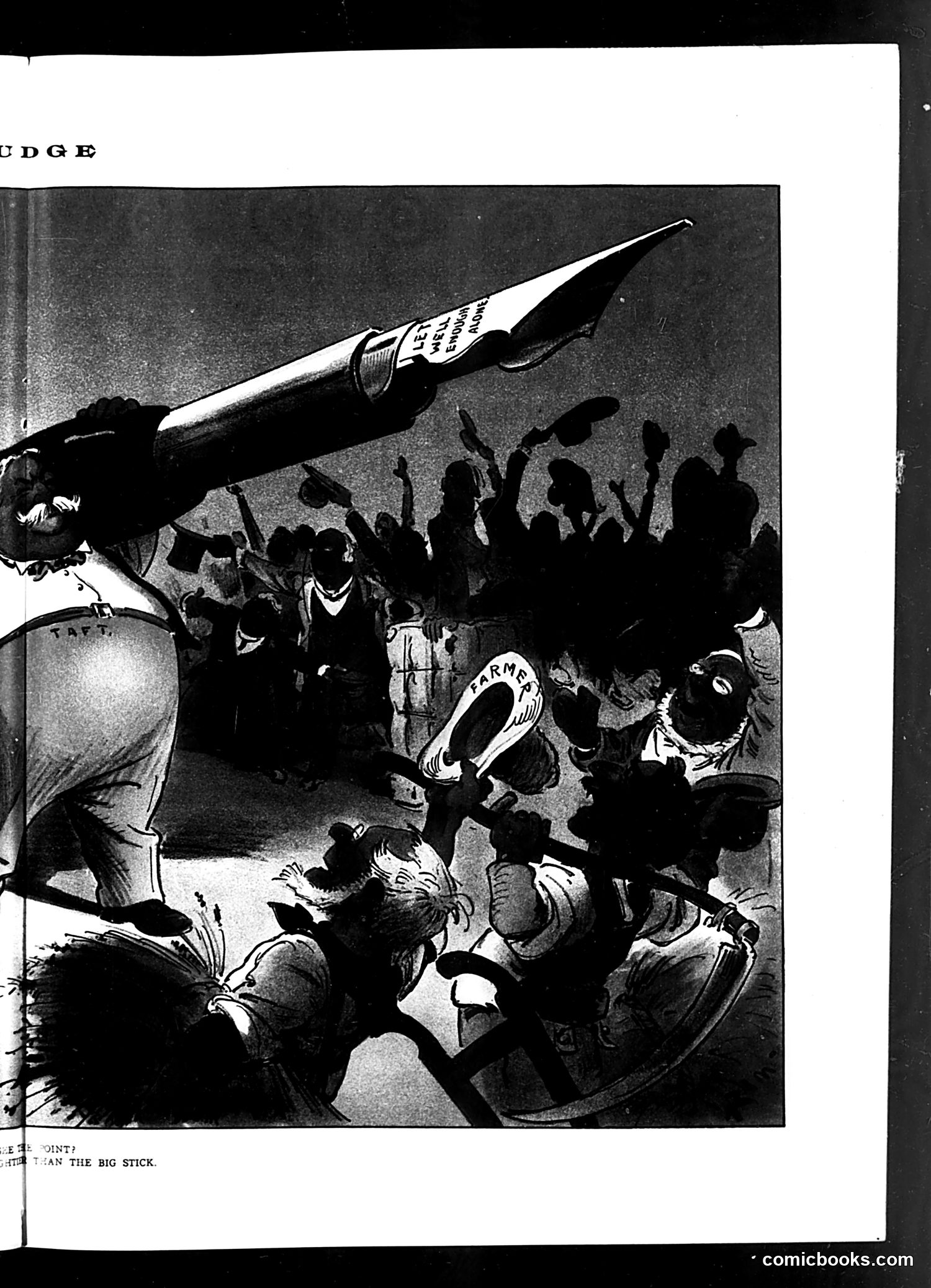
This is a satirical illustration from Judge magazine depicting a large cigar or "Big Stick" being wielded over a crowd of silhouetted figures. The visible text fragment mentions "THE BIG STICK," likely referencing Theodore Roosevelt's famous foreign policy motto of speaking softly while carrying a "big stick." The cartoon appears to satirize American imperial or interventionist power, showing the threat or dominance represented by this symbol looming over a gathered populace. The crowd's raised arms and dynamic poses suggest either celebration, protest, or coercion—the ambiguity itself is part of the satire. Without a clear date or additional context visible on this page, the specific historical moment being critiqued remains unclear, though the "Big Stick" reference suggests early 20th-century American foreign policy concerns.
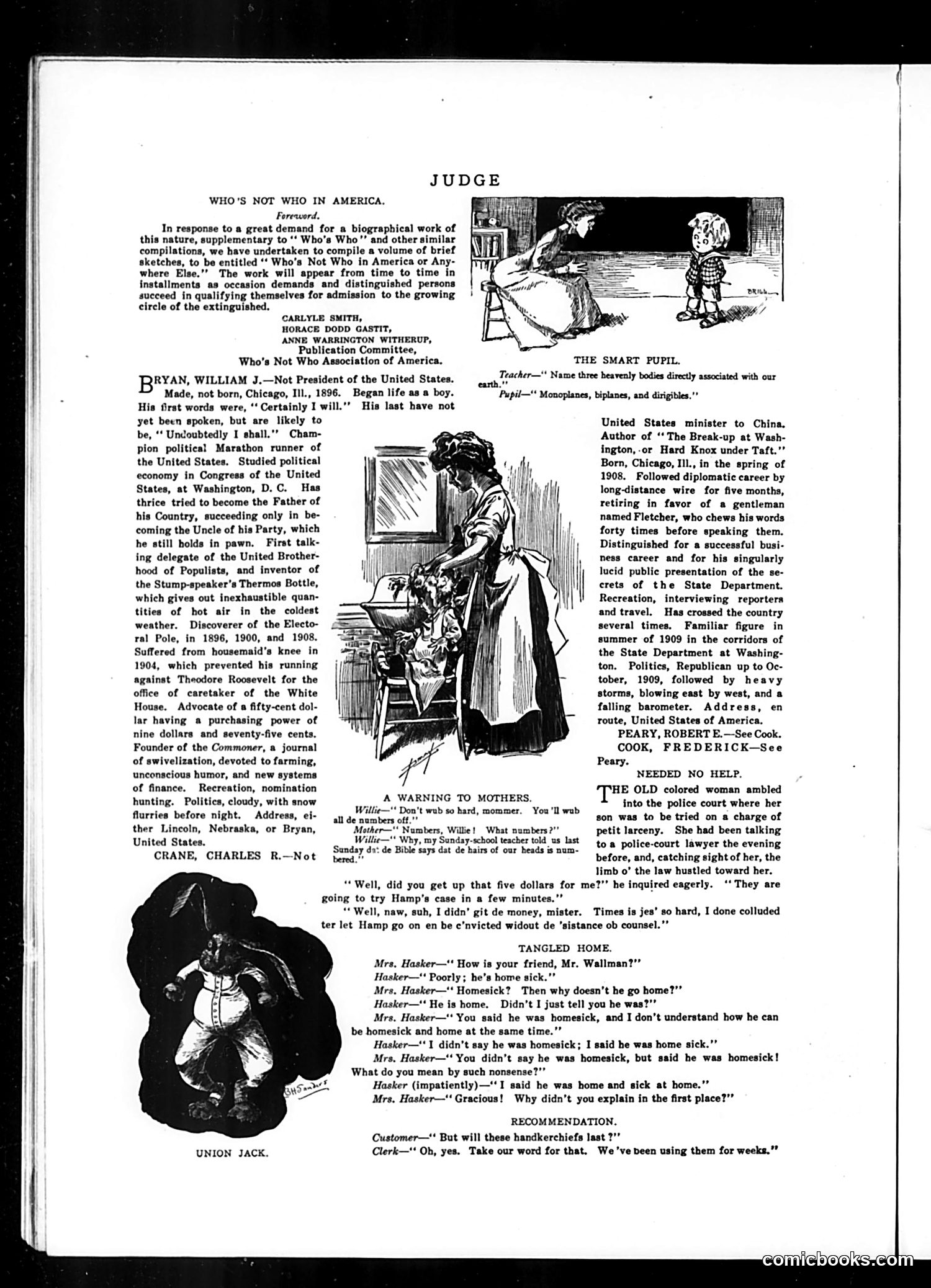
**This Judge magazine page satirizes various political and public figures in its "Who's Not Who in America" feature—a parody of the legitimate "Who's Who" biographical reference.** The main target appears to be **William Jennings Bryan** (identified as "Ryan"), the three-time presidential candidate known for populist politics. Judge mocks his relentless campaign efforts ("political Marathon runner"), failed presidencies, and advocacy of monetary reform ("fifty-cent dollar"). The Populist party reference and details about farming and "the Commoner" align with Bryan's actual career. Other figures lampooned include Charles Crane (diplomat under Taft) and explorers Robert Peary and Frederick Cook, who were rivals in polar exploration claims. The sidebars contain humorous dialogue pieces: "A Warning to Mothers" jokes about religious education, "The Smart Pupil" ridicules modern aviation fads as "heavenly bodies," and other anecdotes satirize common social confusions. The overall intent is witty ridicule of failed politicians and eccentric public figures through mock-biography.
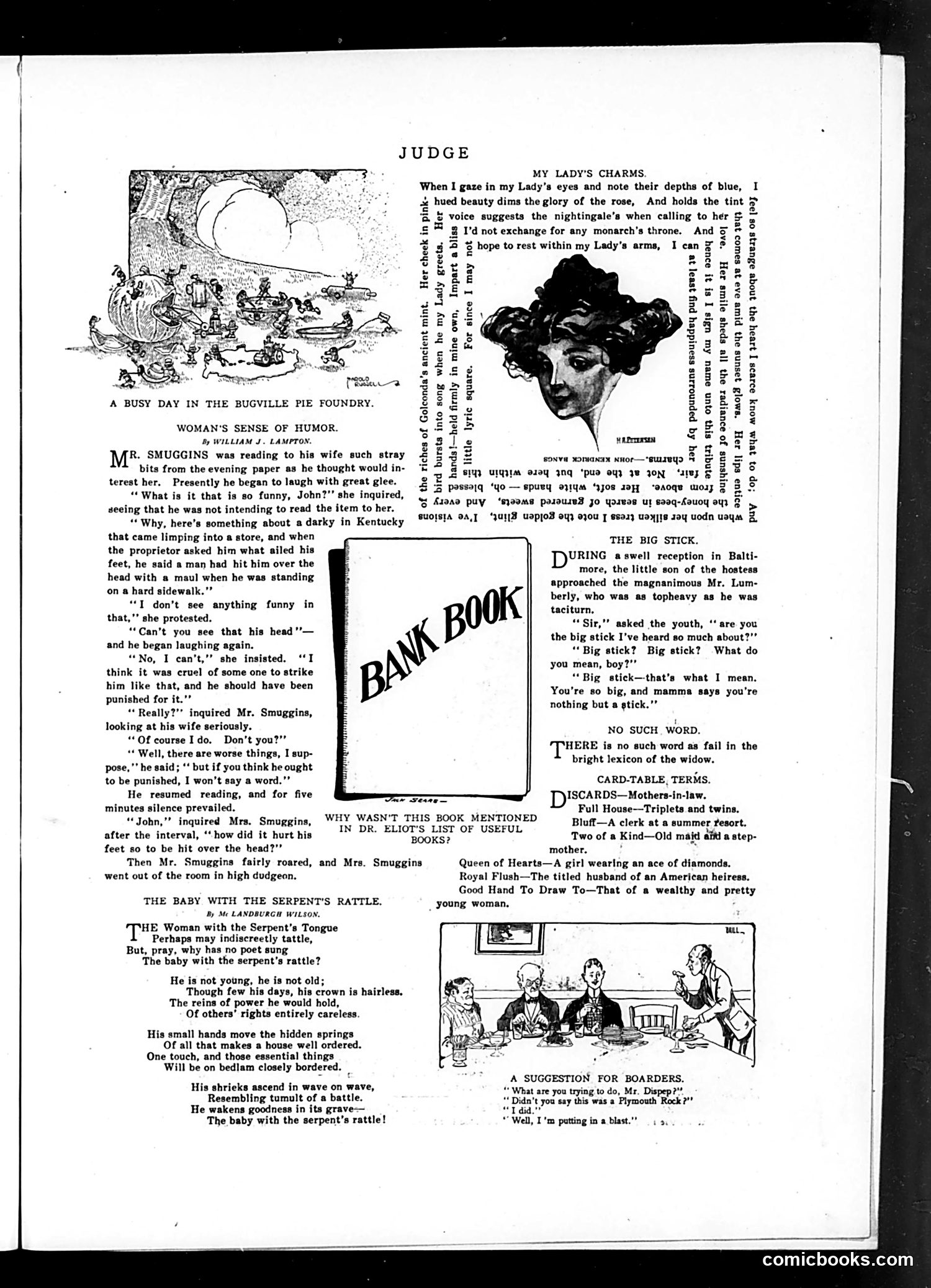
This page contains several humor pieces reflecting early-20th-century American satirical sensibilities: **"Woman's Sense of Humor"** presents a domestic comedy where Mr. Smuggins finds a joke funny (a Black man being hit on the head), but his wife finds it cruel and unfunny. When he tries to explain the "humor," she misses the point entirely, frustrating him. The satire appears to mock either the husband's questionable sense of humor or the wife's inability to understand it—likely both. **"The Big Stick"** references President Theodore Roosevelt's famous "Big Stick" diplomacy policy. A child mistakes a corpulent man for "the big stick" he's heard about, then reveals his mother called the man "nothing but a tick"—a pun-based insult. **Other pieces** include greeting-card style verses and card-game terminology jokes. The "Bank Book" advertisement occupies center space. The overall tone reflects genteel domestic humor typical of Judge's middle-class audience, mixing wordplay, marital comedy, and contemporary political references accessible only to readers familiar with Roosevelt-era news.
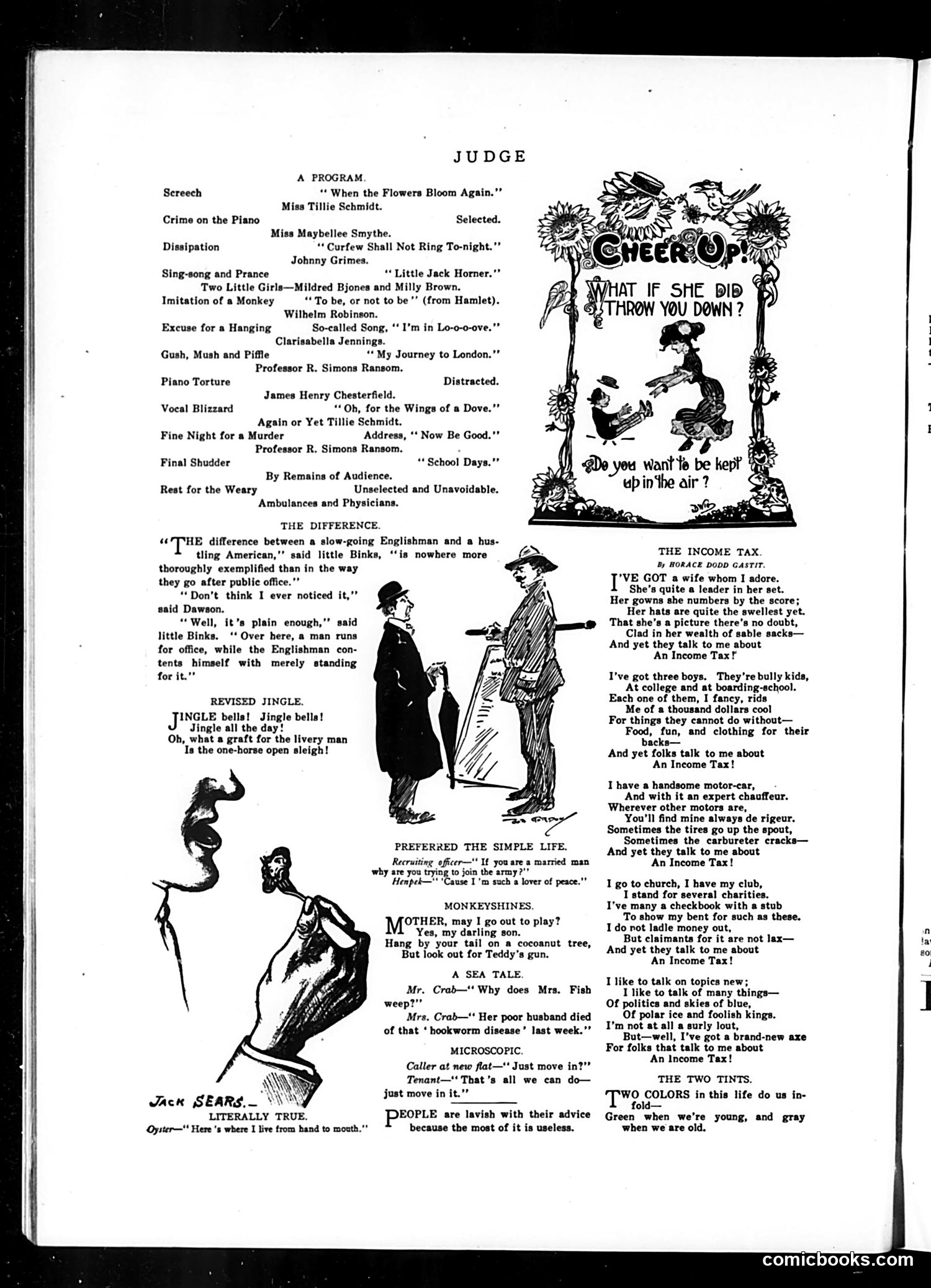
This page from the satirical magazine *Judge* contains several short humorous pieces mocking American social customs and contemporary issues. **"The Difference"** contrasts American and British political culture: Americans "run for office" with aggressive ambition, while Englishmen merely "stand for it"—a dig at perceived American hustlerism versus British reserve. **"The Income Tax"** is the centerpiece—a poem by Horace Dodd Gaskit satirizing wealthy complainers. A prosperous man with an expensive wife, three sons in elite schools, a luxury motor-car, and charitable donations gripes constantly about income taxes despite obvious wealth. The satire targets the hypocrisy of the rich claiming financial hardship. Other brief jokes mock marriage ("Preferred the Simple Life"), recruitment ("lover of peace"), and literal interpretations of phrases. The cartoon illustrations appear to be generic period humor rather than specific political caricatures. The income tax poem likely references debates around the newly-instituted federal income tax (post-1913), mocking wealthy Americans' resistance to taxation.
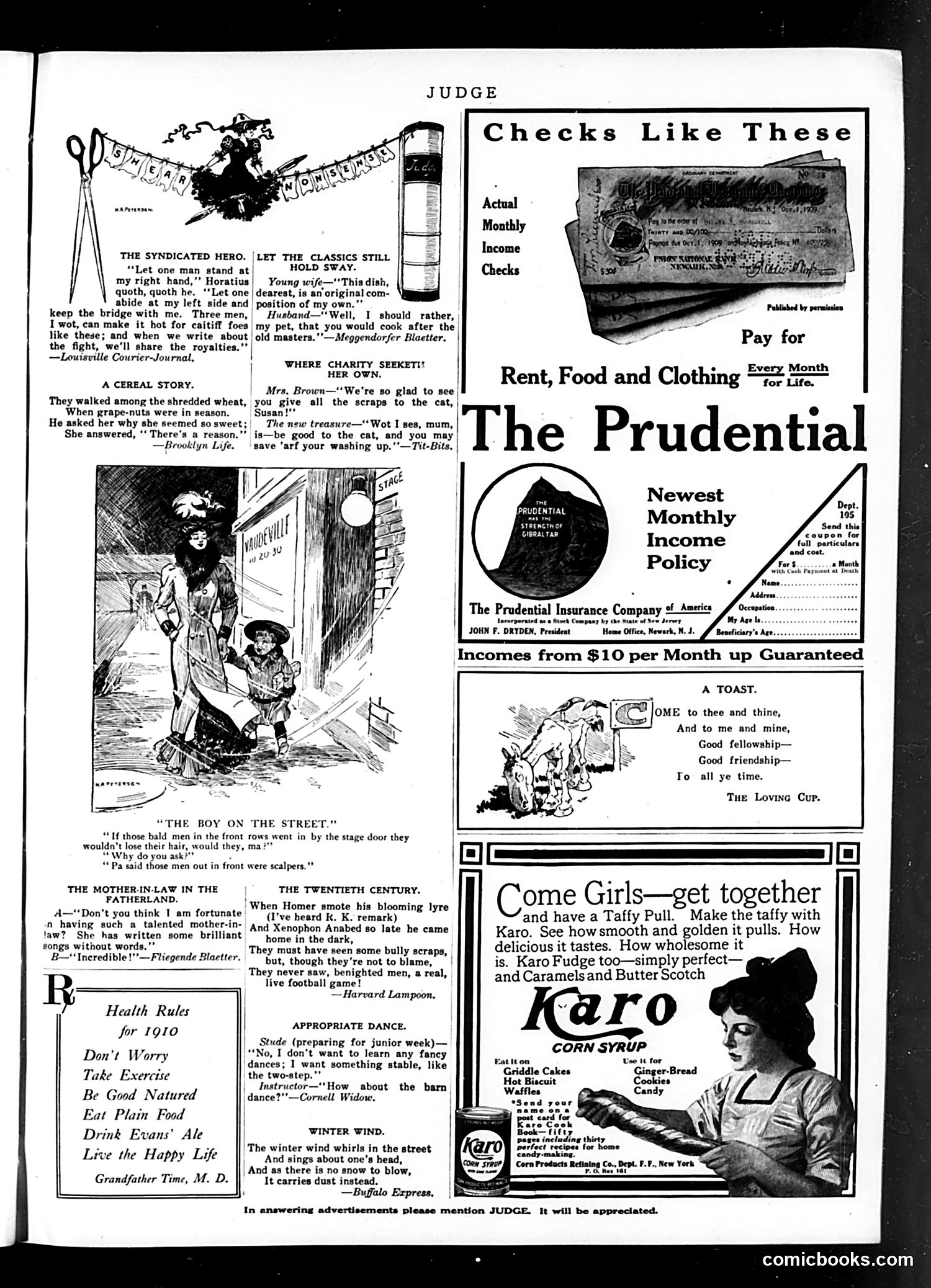
This page is primarily **advertising and miscellaneous humor content** rather than focused political satire. The main elements: **"The Syndicated Hero"** references classical literature (Horatius at the bridge) being commercialized—a dig at how syndicated newspaper content recycled literary classics for profit rather than originality. **"The Boy on the Street"** is a simple pun: a child misunderstands "scalpers" (ticket speculators who sit in front rows) as literally causing baldness. **Various brief jokes** mock marriage dynamics, cooking, and social pretension—standard early-20th-century domestic humor with no clear political target. The **dominant content is advertising**: The Prudential Insurance Company's monthly income policy (guaranteeing $10/month) and Karo Corn Syrup dominate the page, along with health advice and miscellaneous verse. This appears to be a typical Judge issue mixing light humor with commercial content—entertainment rather than sharp political commentary.
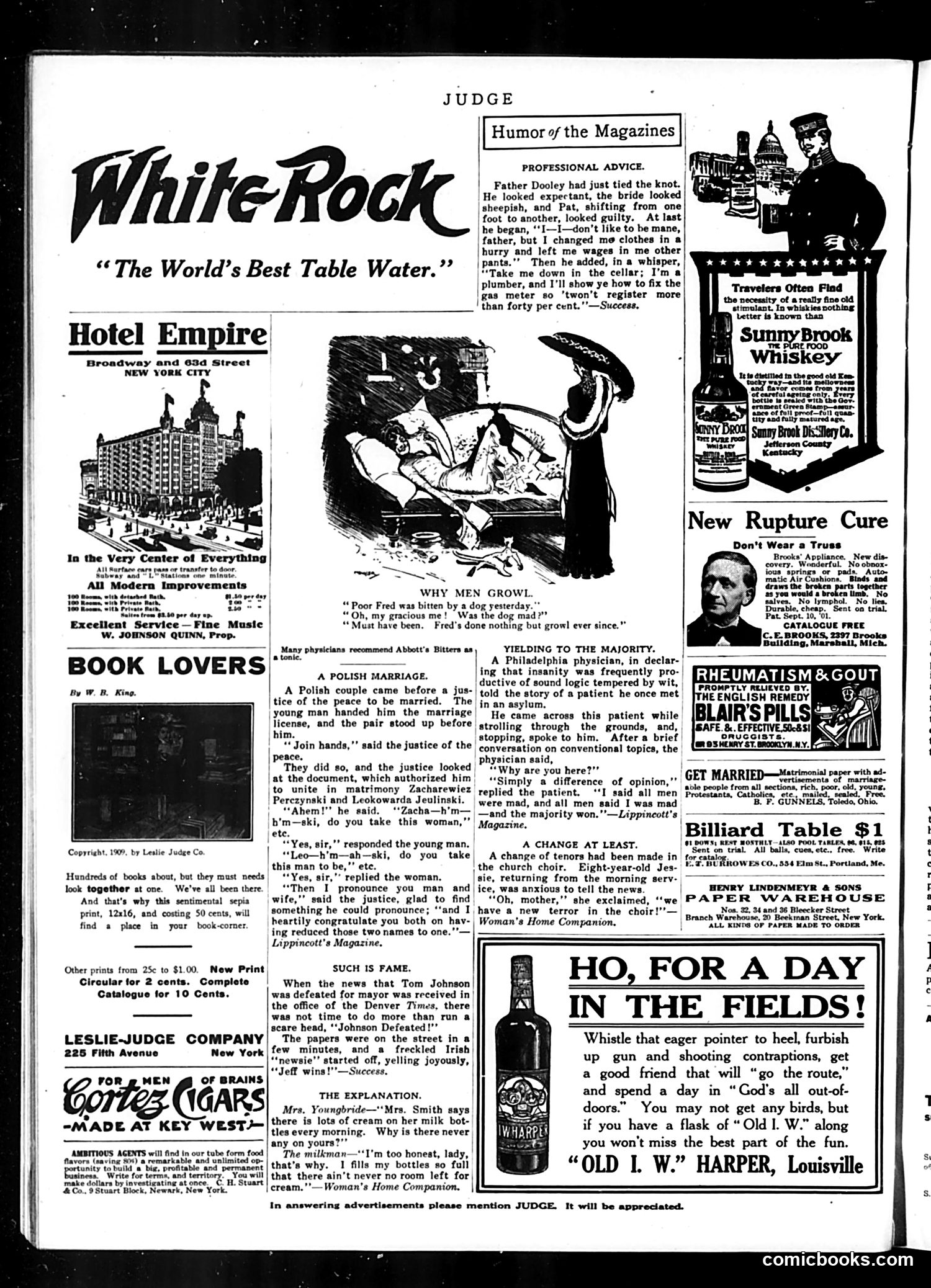
This page from *Judge* magazine contains period advertisements and short humorous pieces typical of early-1900s American satire: **Main Cartoon ("Why Men Growl"):** Shows a man's wife hitting him with an umbrella. The caption jokes that a dog that bit "poor Fred" must have been mad—yet Fred "done nothing but growl ever since," implying the real source of his aggravation is domestic, not the dog bite. The satire targets the common complaint of henpecked husbands. **"Yielding to the Majority"** depicts a wedding ceremony where an Irish couple's unpronounceable Polish surnames frustrate the justice of the peace until he can at least reduce them to one name—absurdist humor about immigration and bureaucratic exasperation with foreignness. **"Book Lovers"** shows people sharing a book, captioning the human need for companionship even while reading alone. The page is otherwise dominated by period medical advertisements (rupture cures, rheumatism pills) and business classifieds typical of *Judge's* revenue model.
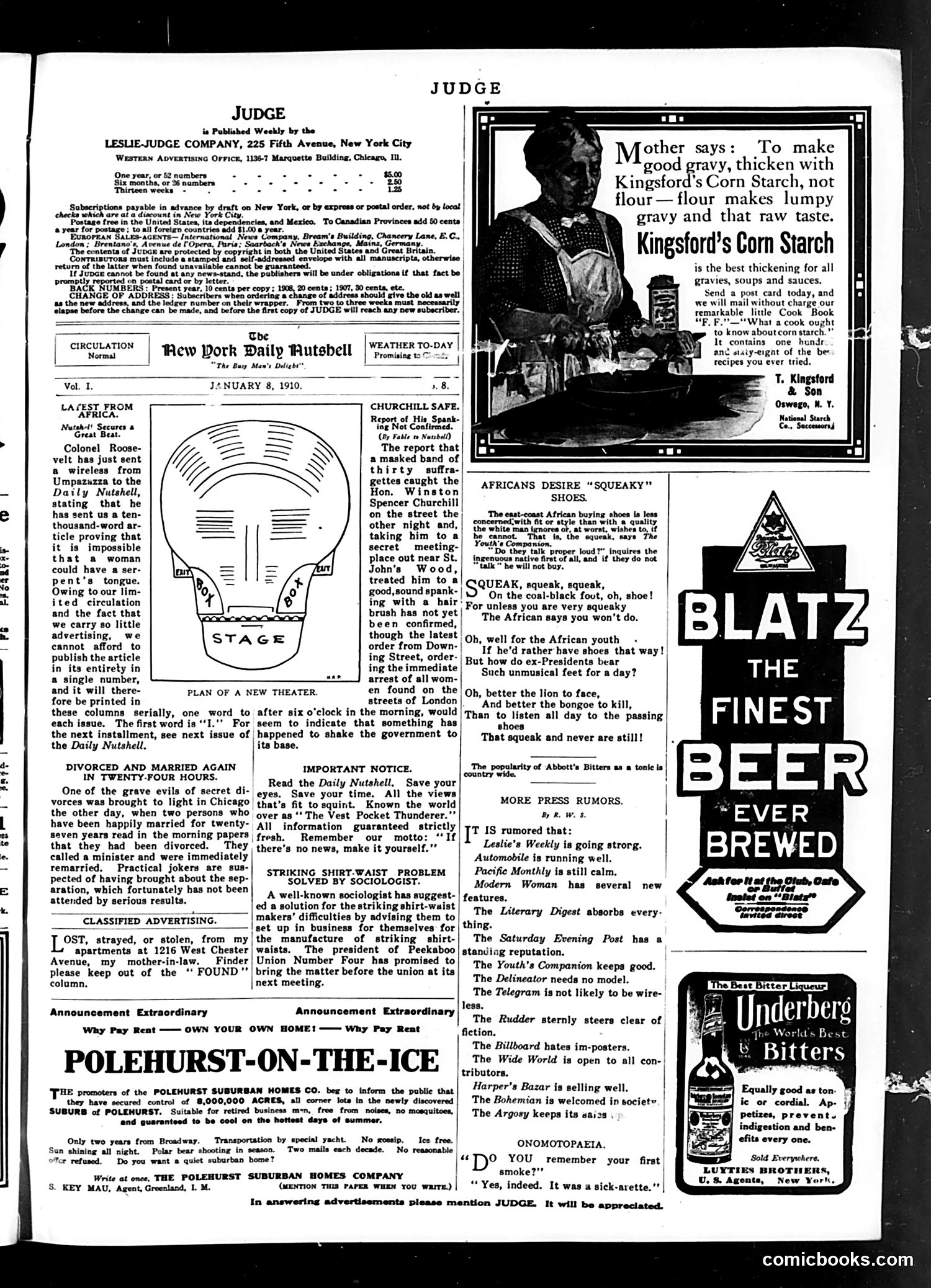
This is primarily a publication masthead and notices page, but it includes one notable political cartoon and several satirical items. **The Main Cartoon ("Plan of a New Theater"):** Shows a skull as a theater floor plan—a darkly humorous visual pun on "theatrical deaths" or failed theatrical ventures. **Political Reference:** The text mentions a "masked band of thirty suffragettes" allegedly accosting "the Hon. Spencer Churchill" on the street and spanking him. This references Winston Churchill and the pre-WWI women's suffrage movement in Britain, which indeed engaged in militant tactics. The article sarcastically notes that despite this alleged attack, an order to arrest women on London streets after 6 a.m. "would seem to indicate that something has happened." **The Humor:** Judge ridicules both the suffragettes' methods and the British government's absurdly draconian response, while simultaneously mocking the newspaper sensationalism around the incident. The page otherwise contains routine subscription information and satirical notices about other publications.
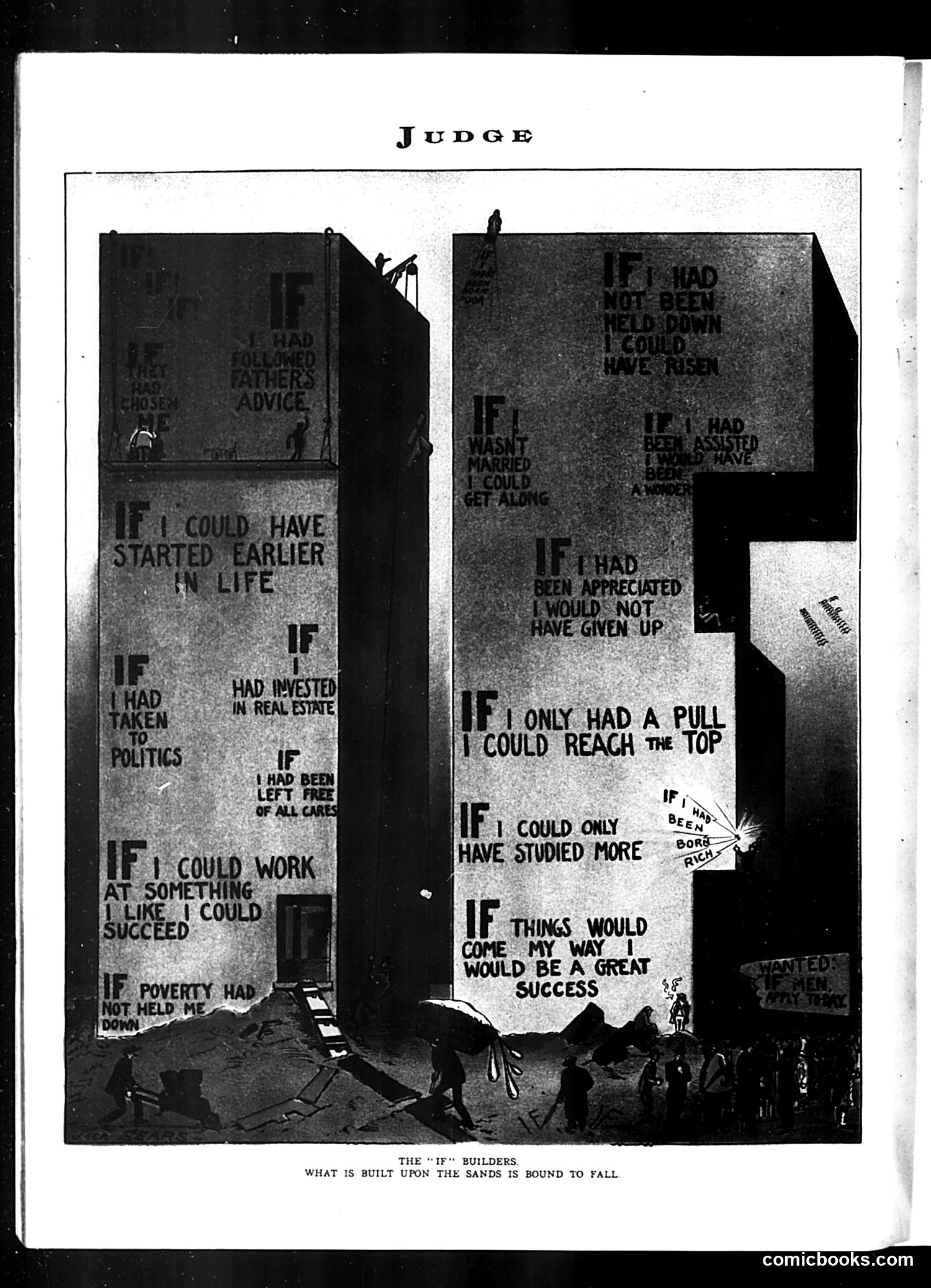
This political cartoon satirizes people who make excuses for their failures by imagining alternative circumstances. Two large structures are covered with conditional statements—"If I had taken to politics," "If I had invested in real estate," "If poverty had not held me down," etc. The cartoon's message, reinforced by the caption "What is built upon the sands is bound to fall," mocks those who blame external factors rather than accepting responsibility. The crumbling buildings suggest these excuses are unstable foundations for success. The satire targets a common human tendency: constructing elaborate hypothetical scenarios to explain lack of achievement rather than confronting one's own choices or limitations. It's a critique of excuse-making as inherently futile.