
Judge, 1910-01-08 · page 10 of 16
Judge — January 8, 1910 — page 10: what you’re looking at
What you’re looking at
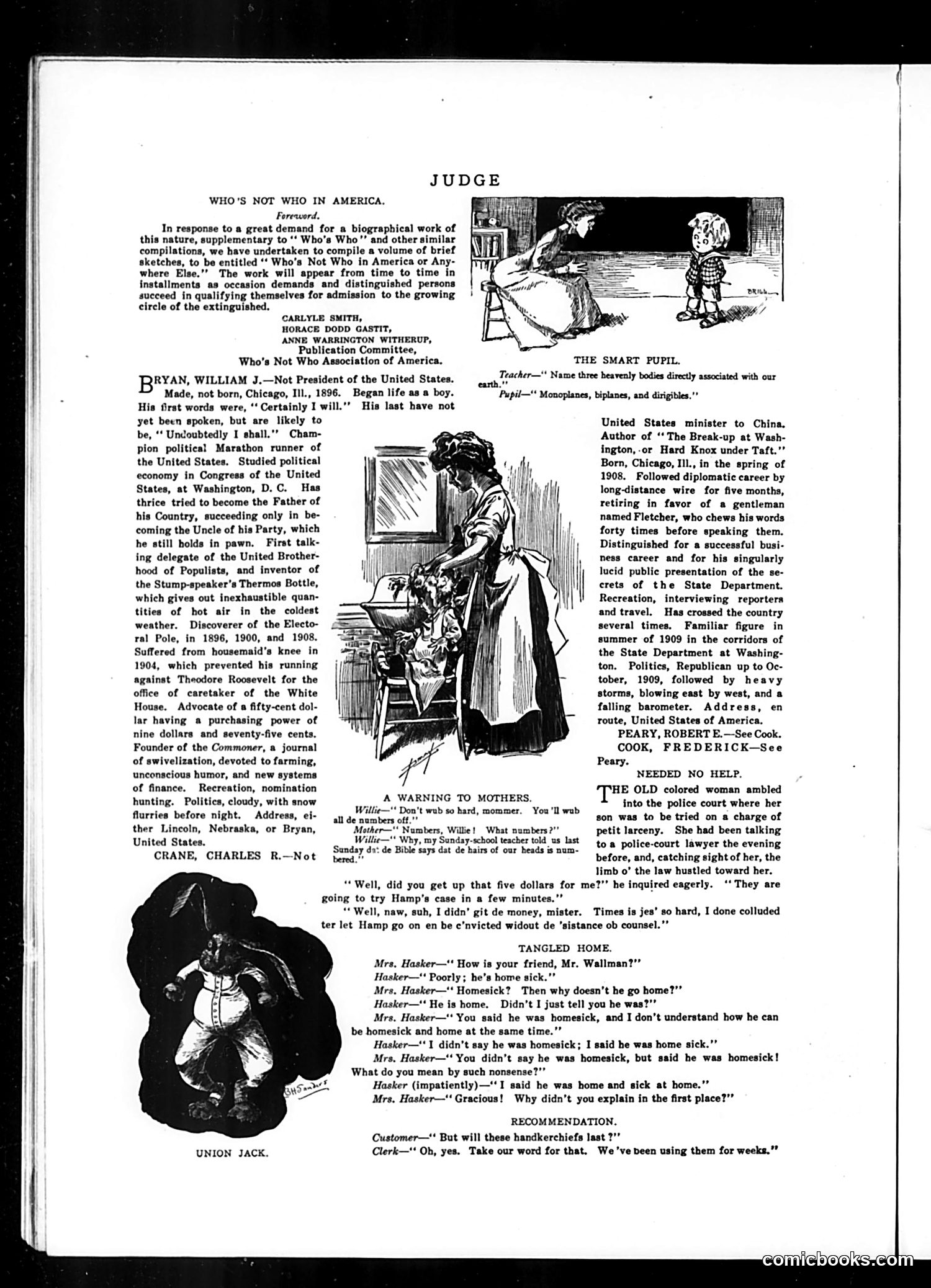
**This Judge magazine page satirizes various political and public figures in its "Who's Not Who in America" feature—a parody of the legitimate "Who's Who" biographical reference.** The main target appears to be **William Jennings Bryan** (identified as "Ryan"), the three-time presidential candidate known for populist politics. Judge mocks his relentless campaign efforts ("political Marathon runner"), failed presidencies, and advocacy of monetary reform ("fifty-cent dollar"). The Populist party reference and details about farming and "the Commoner" align with Bryan's actual career. Other figures lampooned include Charles Crane (diplomat under Taft) and explorers Robert Peary and Frederick Cook, who were rivals in polar exploration claims. The sidebars contain humorous dialogue pieces: "A Warning to Mothers" jokes about religious education, "The Smart Pupil" ridicules modern aviation fads as "heavenly bodies," and other anecdotes satirize common social confusions. The overall intent is witty ridicule of failed politicians and eccentric public figures through mock-biography.
📄 Transcribed text from this page (OCR, searchable)
Machine-transcribed from the original scan — historical spelling and the odd misread are preserved.
WHO'S NOT WHO IN AMERICA. Foreword. In response to a great demand for a biographical work of this nature, supplementary to ‘* Who’s Who" and other similar compilations, we have undertaken to compile a volume of brief sketches, to be entitled ‘‘ Who’s Not Who in America or Any- where Else.” The work will appear from time to time in installments as occasion demands and distinguished persons succeed in qualifying themselves for admission to the growing circle of the extinguished. CARLYLE SMITH, HORACE DODD GASTIT, ANNE WARRINGTON WITHERUP, Publication Committee, Who's Not Who Association of America. RYAN, WILLIAM J.—Not President of the United States. Began life as a boy. His last have not Made, not born, Chicago, Ill., 1896. His first words were, ‘ Certainly I will.” yet been spoken, but are likely to be, “‘ Undoubtedly I shall.” Cham- pion political Marathon runner of the United States, Studied political economy in Congress of the United States, at Washington, D.C. Has thrice tried to become the Father of his Country, succeeding only in be- coming the Uncle of his Party, which he still holds in pawn, First talk- ing delegate of the United Brother- hood of Populists, and inventor of the Stump-speaker’s Thermos Bottle, which gives out inexhaustible quan- tities of hot air in the coldest weather. Discoverer of the Electo- ral Pole, in 1896, 1900, and 1908. Suffered from housemaid’s knee in 1904, which prevented his running against Theodore Roosevelt for the office of caretaker of the White House. Advocate of a fifty-cent dol- lar having a purchasing power of nine dollars and seventy-five cents. Founder of the Commoner, a journal of swivelization, devoted to farming, unconscious humor, and new systems of finance. Recreation, nomination hunting. Politics, cloudy, with snow flurries before night. Address, ei- ther Lincoln, Nebraska, or Bryan, United States. CRANE, CHARLES R.—Not all de numbers off."" Sunday da: de Bible says dat de “Well, did you get up going to try Hamp’s case i ter let Hamp go on en be c’ Mrs. Hasker—"* H be homesick and home UNION JACK. Clerk—‘* Oh, yes. A WARNING TO MOTHERS, Willie—"* Don't wub so hard, mommer. You'll wab Mother—"' Numbers, Wille! Willie—"* Why, my Sunday-school teacher told us last ‘* Well, naw, suh, I didn’ git de money, mister. Hasker—‘ He is home. Mrs. Hasker—‘* You said he was homesick, and I don’t understand how he can Customer—‘ But will these handkerchi THE SMART PUPIL. Teacher—"' Name three heavenly bodies directly associated with our Pupi!—"* Monoplanes, biplanes, and dirigibles."* United States minister to China. Author of “The Break-up at Wash- ington,-or Hard Knox under Taft.’” Born, Chicago, Ill., in the spring of 1908. Followed diplomatic career by long-distance wire for five months, retiring in favor of a gentleman named Fletcher, who chews his words forty times before speaking them. Distinguished for a successful busi- ness career and for his singularly lucid public presentation of the se- crets of the State Department. Recreation, interviewing reporters and travel, Has crossed the country several times. Familiar figure in summer of 1909 in the corridors of the State Department at Washing- ton. Politics, Republican up to Oc- tober, 1909, followed by heavy storms, blowing east by west, and a falling barometer. Address, en route, United States of America. PEARY, ROBERT E.—See Cook. COOK, FREDERICK-—See Peary. NEEDED NO HELP. 'HE OLD colored woman ambled into the police court where her son was to be tried on a charge of petit larceny. She had been talking toa police-court lawyer the evening before, and, catching sight of her, the limb o’ the law hustled toward her. that five dollars for me?’ he inquired eagerly. ‘‘ They are in a few minutes."’ ‘What numbers?" irs of our heads is num- Times is jes’ so hard, I done colluded nvicted widout de ‘sistance ob counsel.’’ TANGLED HOME. Mrs. Hasker—" How is your friend, Mr. Wallman?”” Hasker—"* Poorly ; he’s home sick."’ lomesick? Then why doesn’t he go home?’’ Didn’t I just tell you he was?’” at the same time.”” Hasker—‘1 didn’t say he was homesick; I said he was home sick.”” Mrs. Hasker— You didn’t say he was homesick, but said he was homesick! What do you mean by such nonsens Hasker (impatiently)—‘‘ I said he was home and sick at home.’ Mrs. Hasker—"* Gracious! Why didn’t you explain in the first place?” RECOMMENDATION. fs last 2”” Take our word for that. We've been using them for weeks.”