
A complete issue · 20 pages · 1909
Judge — November 20, 1909
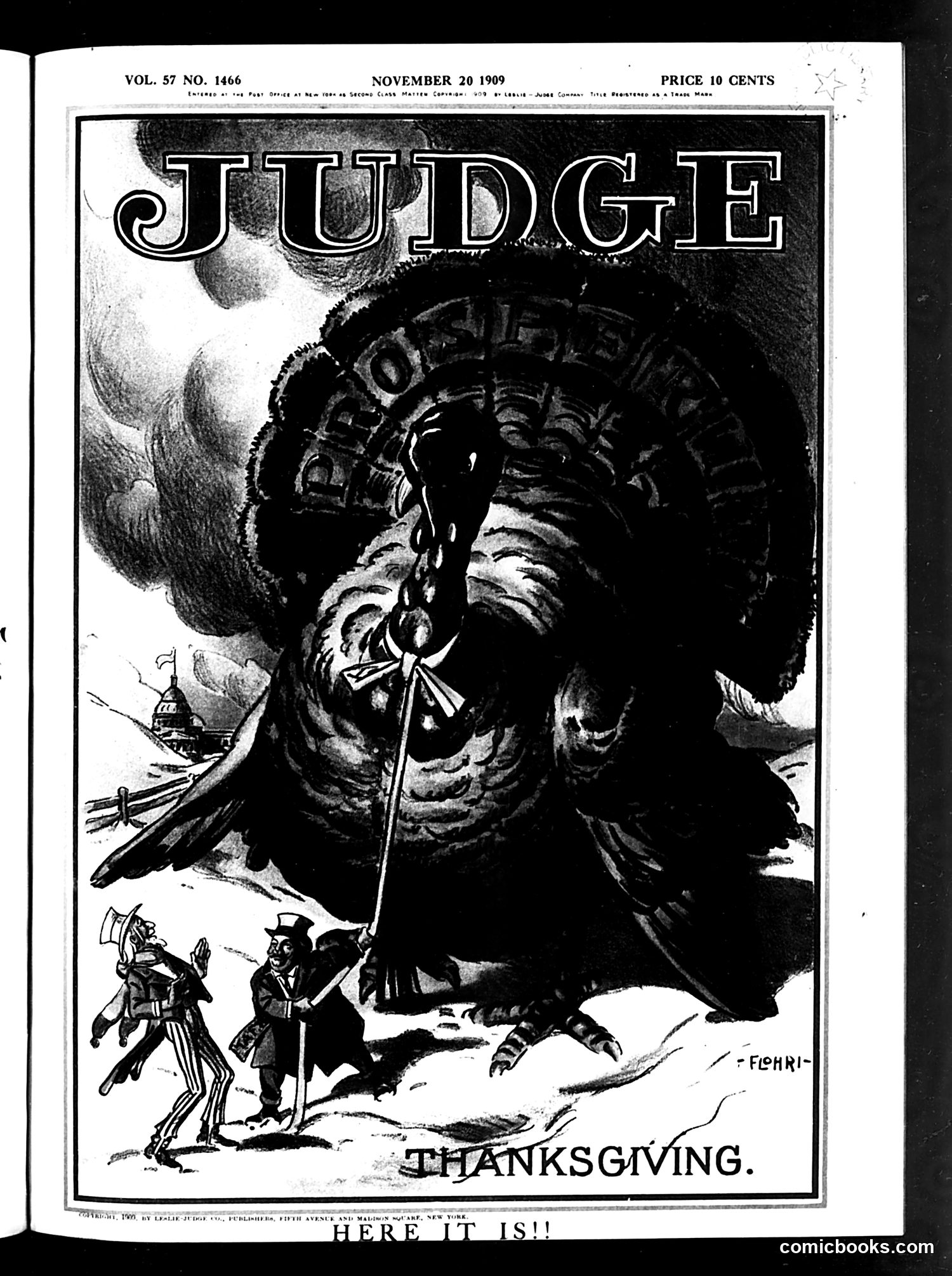
This Thanksgiving-themed cover depicts a giant turkey's head with "PROSPERITY" written on its body. Two small figures—appearing to represent Uncle Sam (in stars-and-stripes) and another American official—hold a ladle or spoon, seemingly feeding or stirring the bird. The satire suggests that American prosperity is being artificially maintained or "cooked up" by political leadership—possibly referencing tariff policies or economic management of the era. The implication appears critical: that the nation's prosperity isn't genuine abundance but rather something being actively manipulated or constructed by political figures for public consumption. The Thanksgiving imagery reinforces irony—presenting a carefully controlled narrative of national wealth rather than organic economic health.

This page is **primarily an advertisement**, not political satire. It's a full-page ad for Pond's Extract, a patent medicine marketed as a post-shaving product. The ad uses the phrase "After Shaving" and emphasizes that Pond's Extract "relieves irritation, prevents inflammation, assures comfort" for men's shaving needs. The visual shows shaving implements (brush, razor, mug) alongside a bottle of the product. The slogan "The best part of the shave is when you come to Pond's Extract" suggests the product provided soothing relief from razor irritation—a genuine concern in the pre-modern razor era. The claim it's "used by men of discrimination everywhere" appeals to masculine pride. This represents typical early-20th-century advertising for patent medicines, which made broad health claims that would face regulatory scrutiny today.
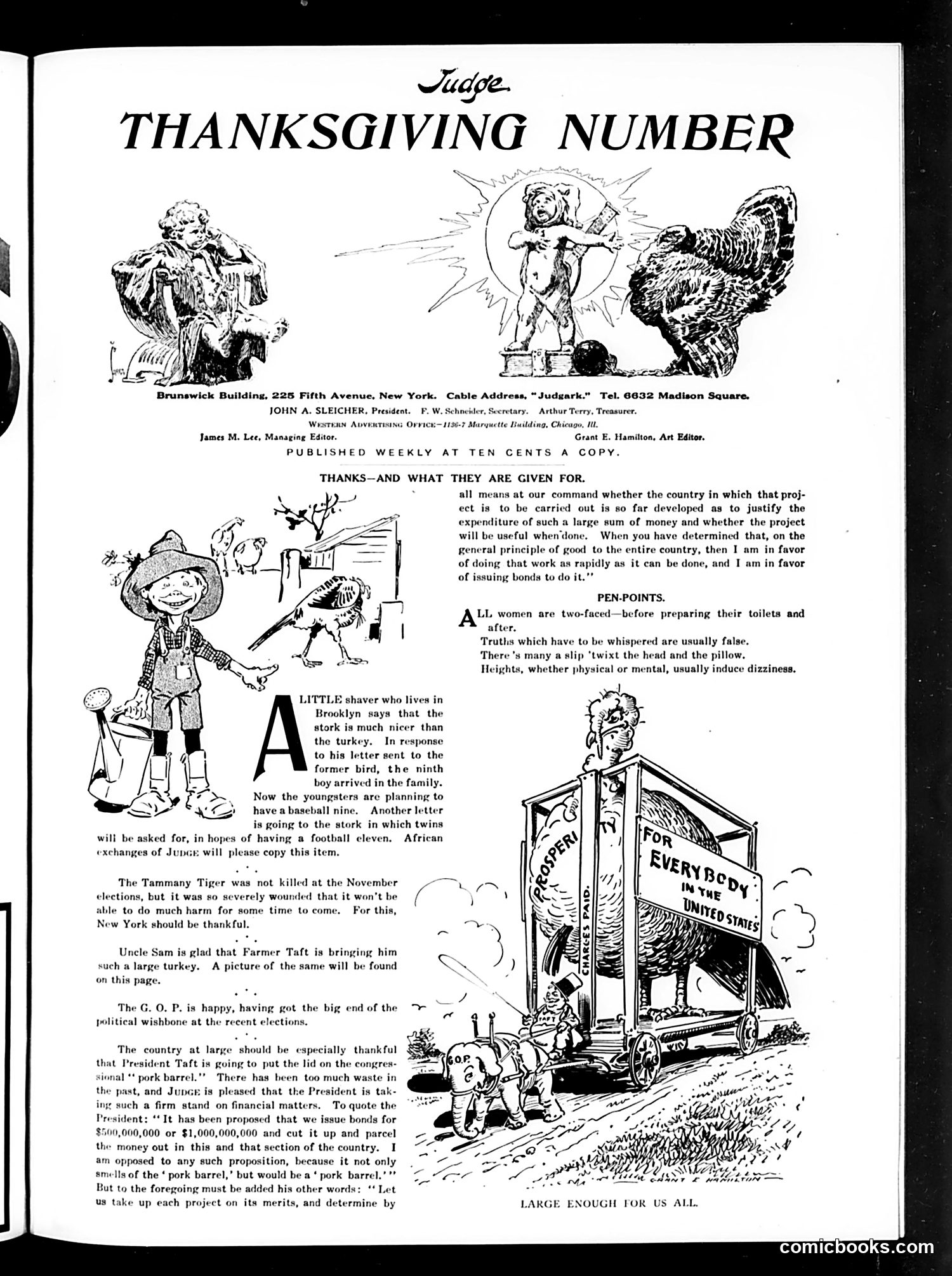
This is Judge's Thanksgiving issue featuring political satire. The main cartoon depicts a large structure labeled "Prosperity for Everybody in the United States" being constructed, with a small figure (likely representing a citizen or worker) standing beside it. The accompanying text discusses President Taft's recent election victory and praises his proposed bond issues to fund public works projects—particularly infrastructure and farm development. The satire suggests the GOP (Grand Old Party) views these expenditures as reasons for national thanksgiving. Supporting items reference a stork delivering a baby to a Brooklyn family and mention the Tammany Tiger (New York Democratic machine) being "wounded" in recent elections, reflecting contemporary political rivalries and Republican celebration of their electoral success.
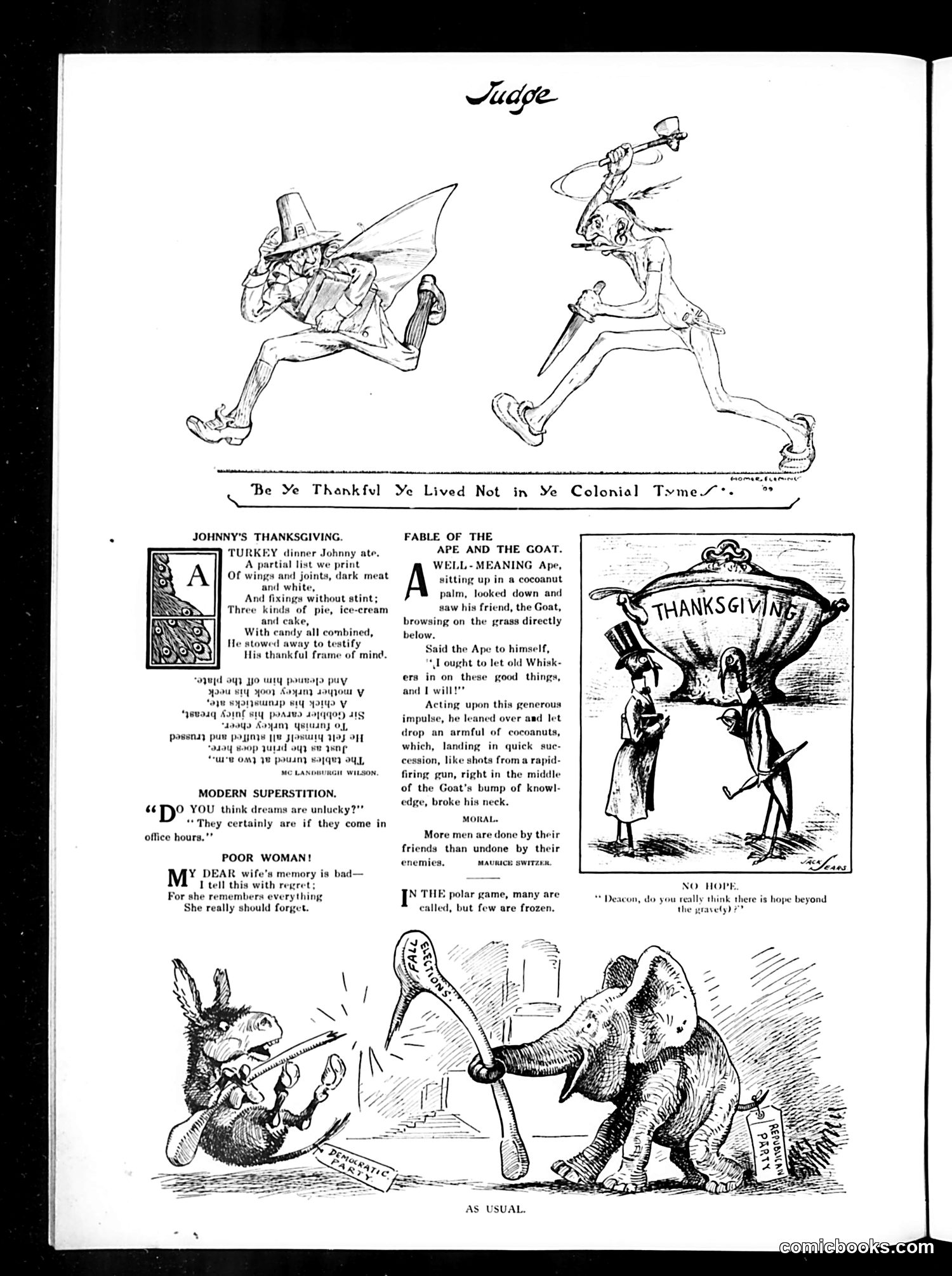
This Thanksgiving-themed page contains several satirical pieces: **Top illustrations**: Two figures in exaggerated poses with the caption "Be Ye Thankful Ye Lived Not in Ye Colonial Tyme," mocking colonial-era hardships through comedic contrast. **"Fable of the Ape and the Goat"**: A moral tale where a well-meaning ape tries to help a goat by dropping coconuts, accidentally killing it—illustrating how good intentions can cause harm. **"Modern Superstition"**: A brief joke about bad dreams being unlucky if dreamed during office hours. **Bottom cartoon ("As Usual")**: Depicts animals (appears to be a donkey and elephant) in conflict, likely representing Democratic-Republican political tensions, suggesting political gridlock persists even during Thanksgiving. The page uses humor to comment on American history, human nature, and contemporary politics.
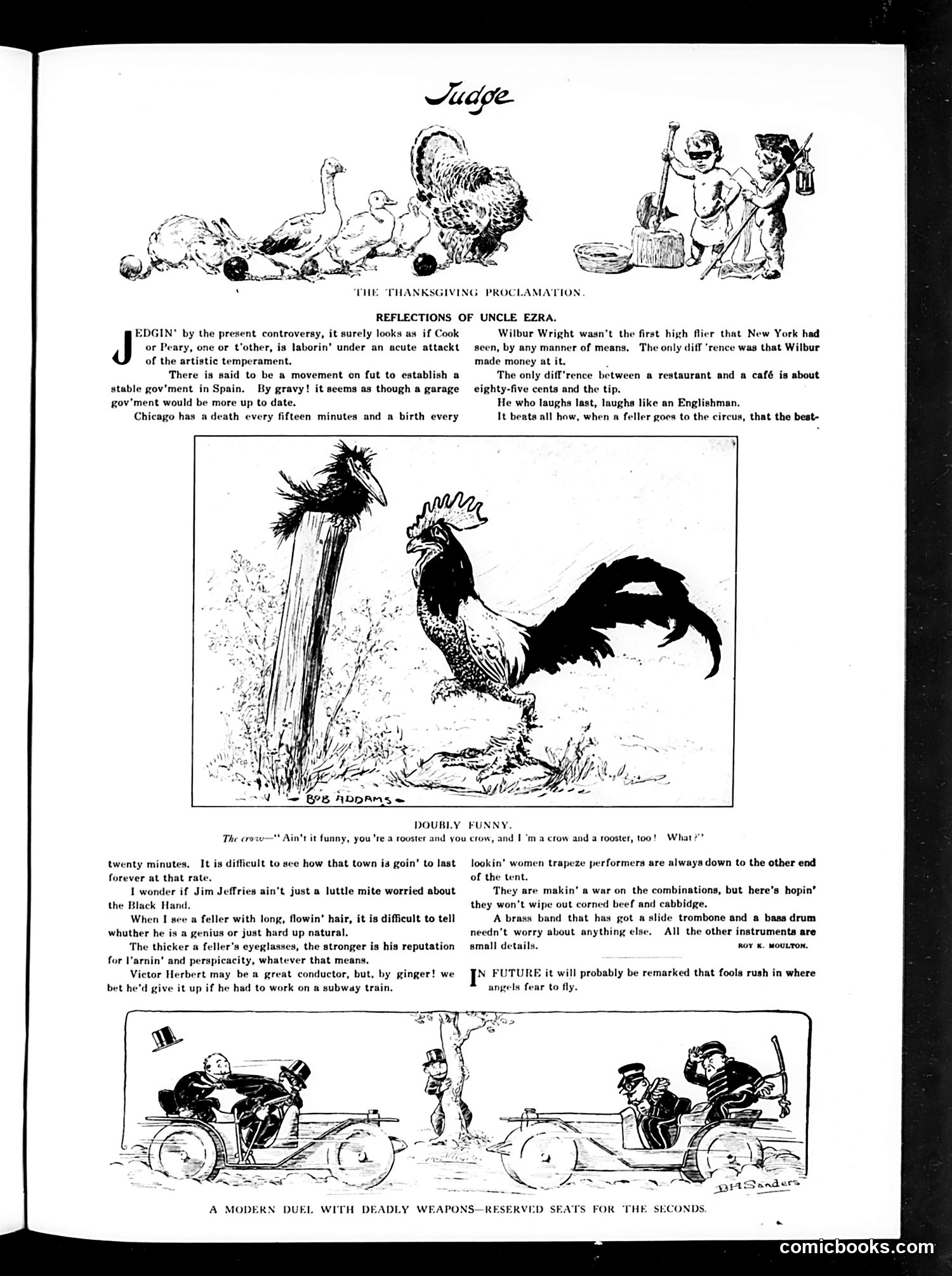
This page contains three distinct cartoons satirizing early 20th-century American life: 1. **"The Thanksgiving Proclamation"** (top): Shows poultry and cherubs, likely mocking holiday traditions or government proclamations. 2. **"Doubly Funny"** (middle): Features a rooster addressing a cow, with the joke being mutual accusations—each claims the other is equally responsible for their predicament. The accompanying text discusses circus performers and musicians, suggesting satire about vaudeville or entertainment industry absurdities. 3. **"A Modern Duel with Deadly Weapons"** (bottom): Depicts two automobiles in a racing confrontation, satirizing the then-new automobile culture and dangerous driving practices as a modern replacement for traditional dueling. The page reflects Judge's consistent satirical approach to contemporary American society, technology, and popular entertainment.
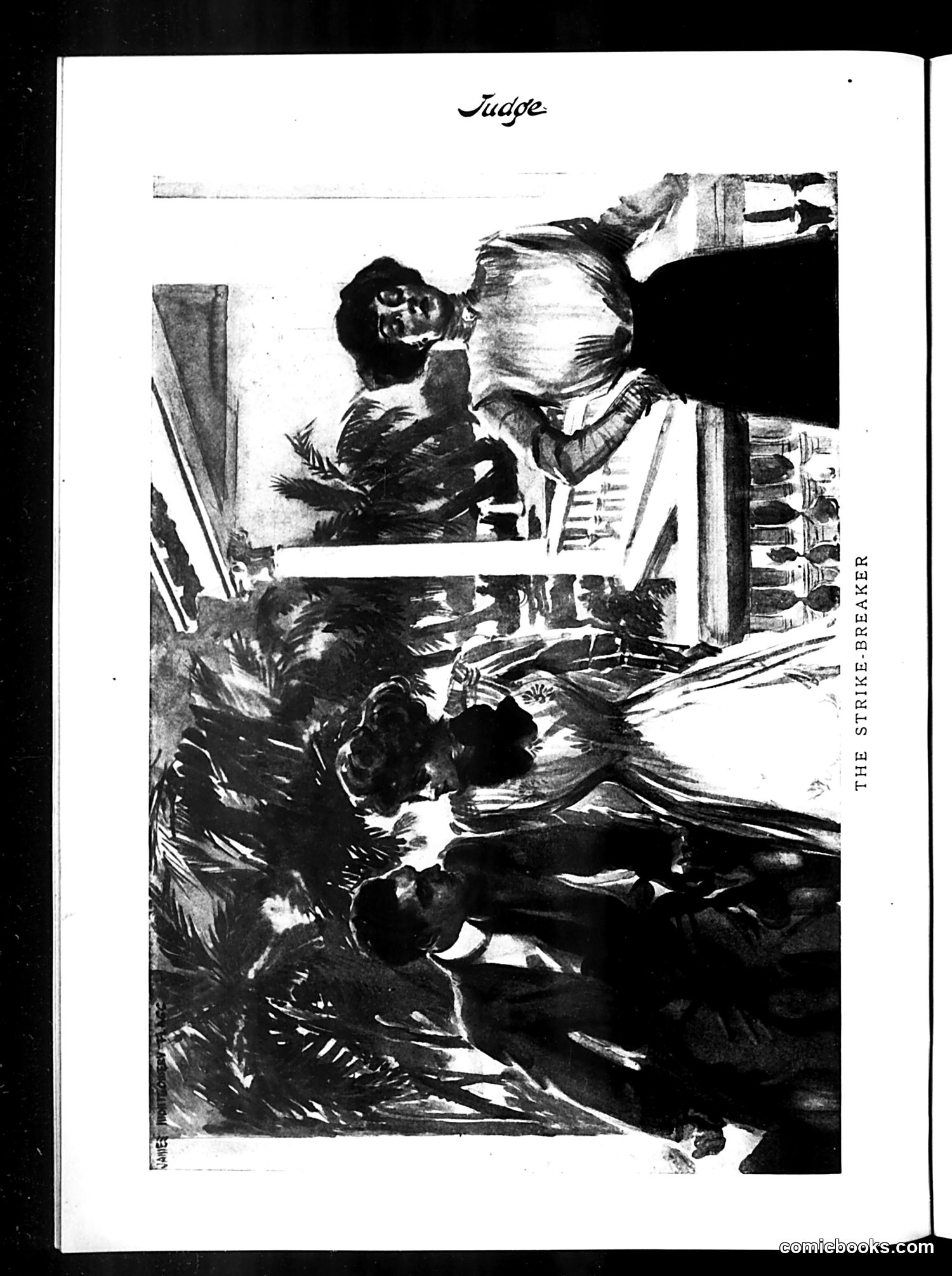
I can see this is a page from *Judge* magazine titled "THE STRIKEBREAKER" at the top. The image shows a political cartoon rotated 90 degrees, depicting what appears to be a confrontation scene with multiple figures in period dress (likely late 19th or early 20th century). However, the OCR text provided is largely corrupted and unreadable—it appears to be character encoding errors rather than actual text content. Without legible accompanying text, I cannot reliably identify the specific figures, the particular labor strike referenced, or the precise satirical point being made. The cartoon appears to address labor conflict and someone acting as a "strikebreaker," but I cannot confidently explain the specific political/social context or identify particular individuals without clearer source material.
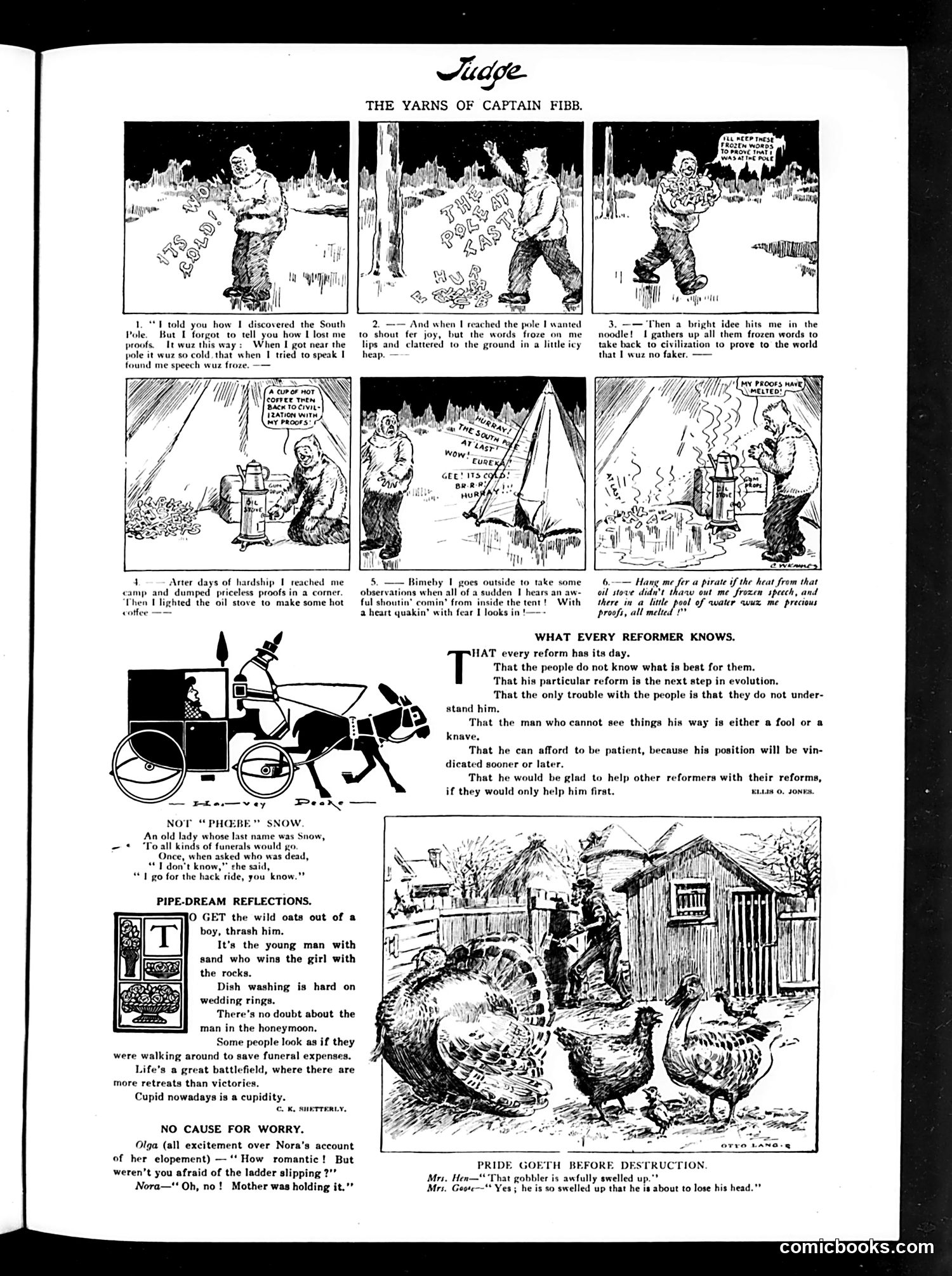
This Judge magazine page contains multiple satirical pieces: **"The Yarns of Captain Fibb"** is a tall-tale comic mocking fraudulent explorers. Captain Fibb claims to have discovered the South Pole, but his "proof"—frozen words—literally melts when exposed to heat from his oil stove, destroying his evidence. The satire targets con artists who fabricate exotic expedition claims without legitimate proof. **"What Every Reformer Knows"** is prose satire listing hypocritical traits of social reformers: they claim special insight into progress while dismissing dissenters as fools, demand patience for vindication, but won't reciprocate support for other reforms. It's a cynical critique of self-righteous activism. The remaining sections—"Pipe Dream Reflections," "No Cause for Worry," and "Pride Goeth Before Destruction" (showing turkeys)—are brief humorous observations about courtship, life advice, and domestic comedy, typical of Judge's miscellaneous humor format. The page represents early 20th-century American satirical magazine style: mixing political/social commentary with light domestic humor.
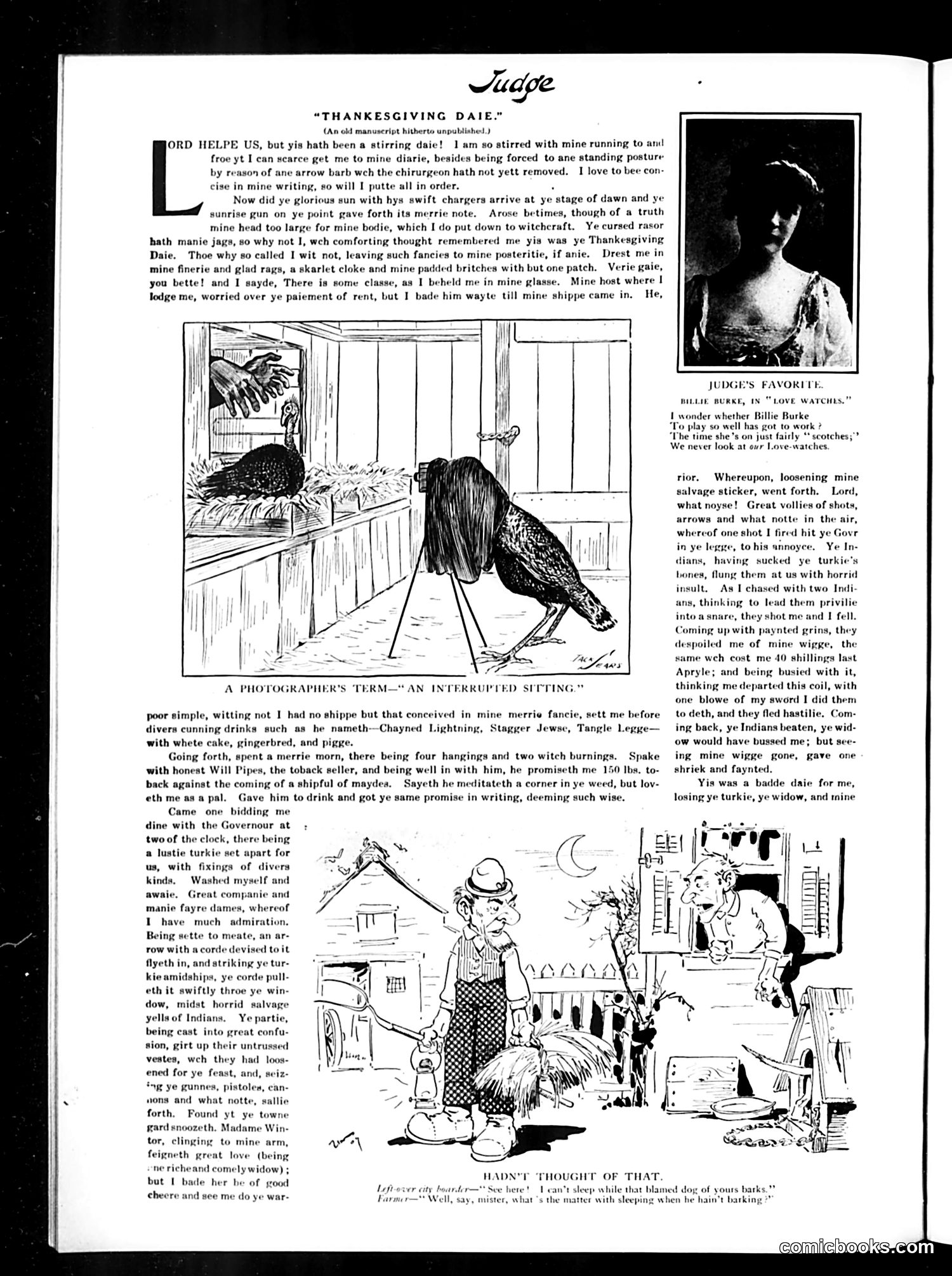
This page presents a humorous mock-historical account titled "Thanksgiving Daie," written in deliberately archaic language to parody old manuscripts. The main narrative describes a colonist's chaotic Thanksgiving celebration that devolves into violence and farce—featuring a wild turkey escaping through a window, followed by gunfire, Indian attacks, and general pandemonium. The satire targets several subjects: the romanticized narrative of early American settlement (treating Indigenous peoples as hostile threats), the pretensions of colonial "gentlemen," and the chaos lurking beneath civilized society. The absurd tone—complaints about a hangover, vanity about fine clothing, concern over a lost wig—deflates heroic frontier mythology by emphasizing petty human concerns over noble pioneer narratives. The accompanying illustrations and smaller cartoon feature "Judge's Favorite" actress Billie Burke in "Love Watches," representing typical period entertainment content mixed with political satire throughout the magazine.
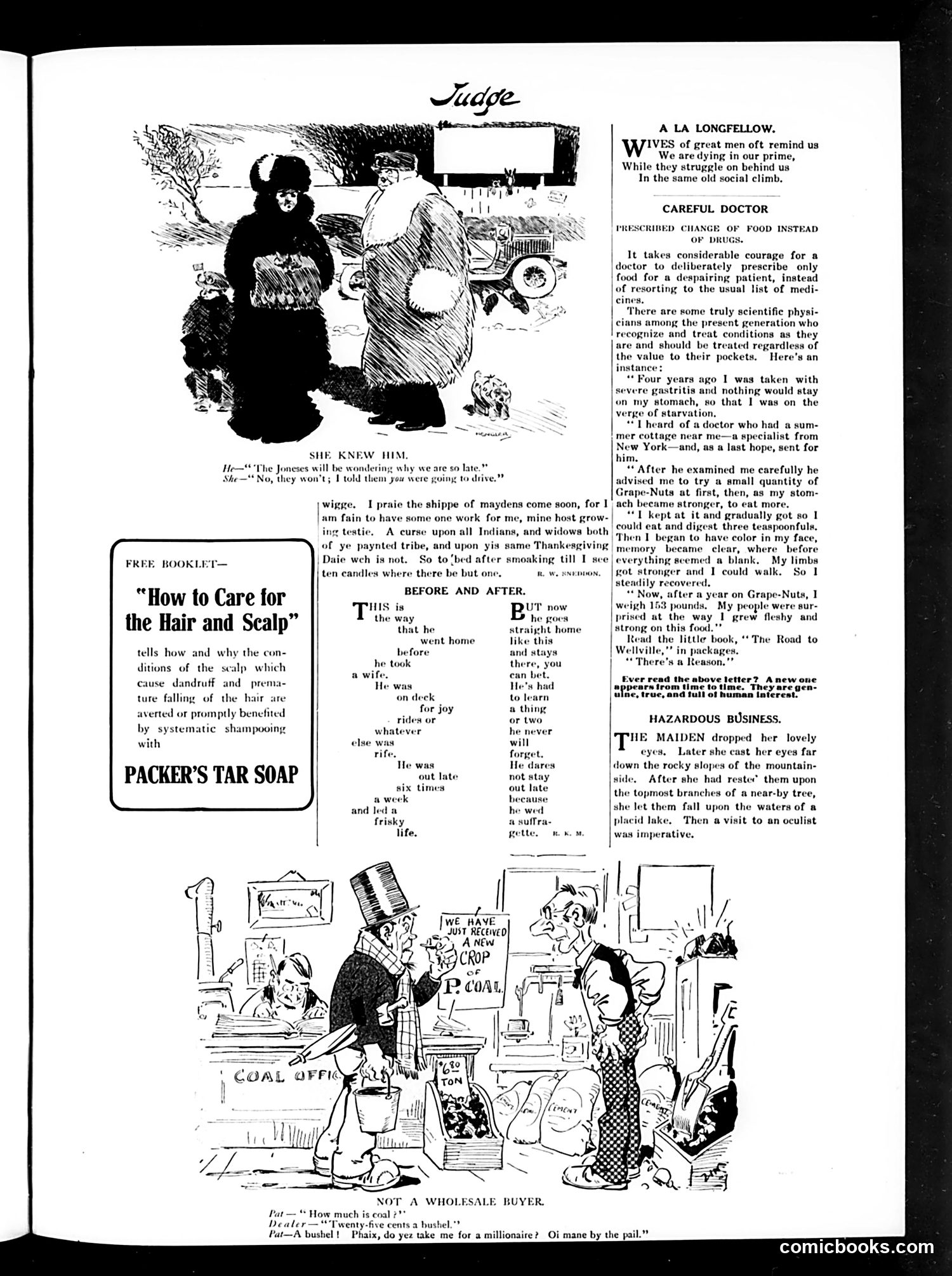
This page contains several satirical pieces typical of early Judge magazine: **Main Cartoons:** 1. **"She Knew Him"** (top): A domestic scene mocking marital dynamics—the wife knows her husband will inevitably go driving despite claiming otherwise. 2. **"Not a Wholesale Buyer"** (bottom): Satirizes coal pricing scams. A working-class buyer (likely Irish, suggested by dialect "Oi") is quoted an inflated "per bushel" price when coal is actually sold by the pail. The joke exposes merchants deliberately using misleading measurements to overcharge poor customers. 3. **"Hazardous Business"**: A humorous anecdote about a maiden straining her eyes by gazing into distant landscapes, requiring an oculist's visit. **Advertisement Content:** The page includes a testimonial for Grape-Nuts cereal, framed as a medical success story where dietary change allegedly cured severe gastritis—reflecting early 20th-century health faddism and food-as-medicine marketing. The overall tone mixes domestic humor, consumer fraud satire, and period advertising targeting working-class readers.
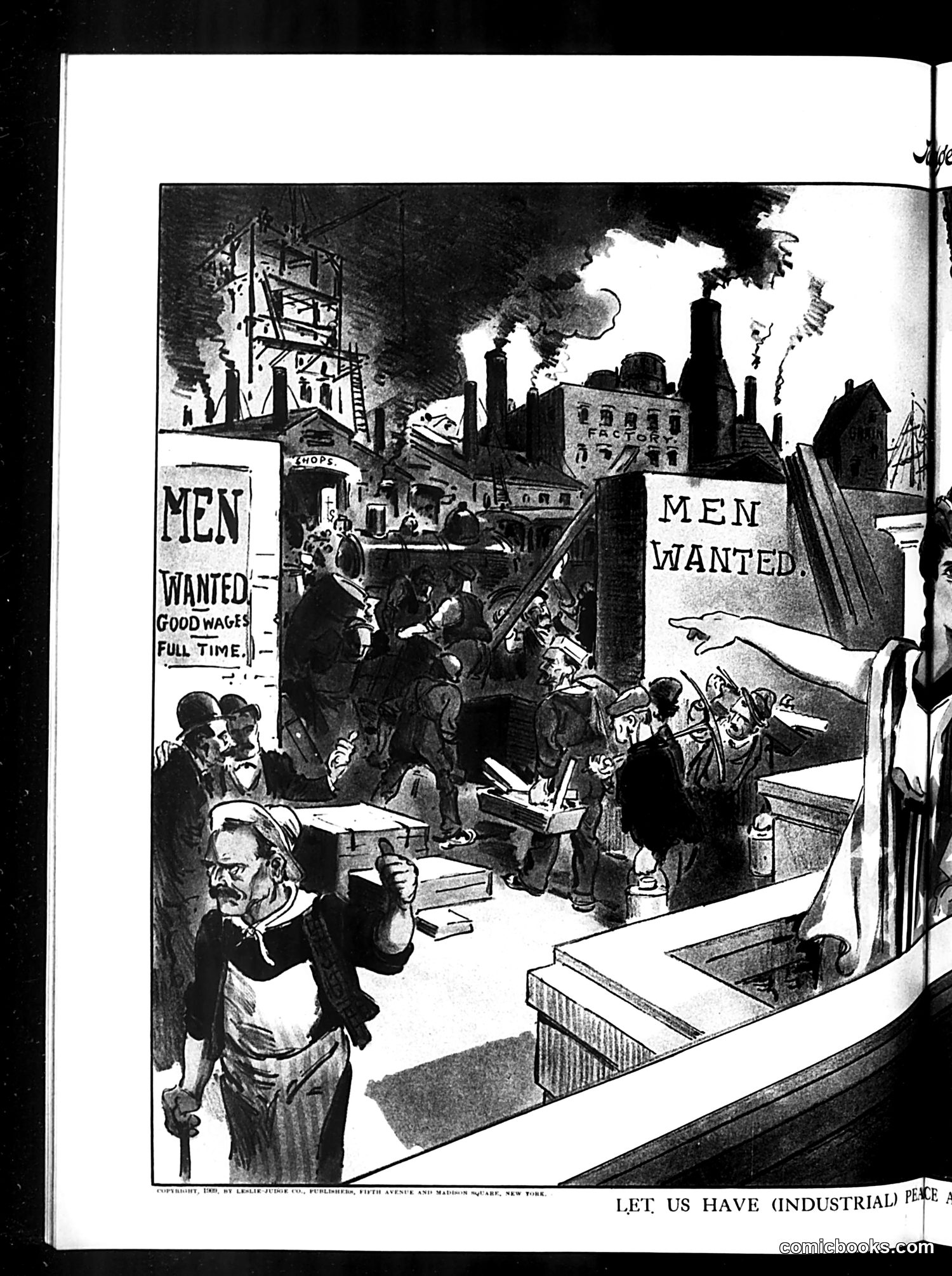
This satirical illustration depicts an industrial labor recruitment scene, likely from the early 20th century. The cartoon shows factory owners/recruiters advertising "Men Wanted—Good Wages, Full Time" at what appears to be a dockside or industrial area, with factory smokestacks prominent in the background. The caricatured figure in the foreground (left) appears to be a laborer or immigrant, possibly depicted with exaggerated features common to period satire. The title reads "Let Us Have (Industrial) Peace," suggesting the cartoon comments on labor-management relations and employment conditions of the era. The satire likely criticizes either the false promises of "good wages," exploitative working conditions, or tensions between industrial labor recruitment and actual worker treatment—central debates during early industrial-era America.
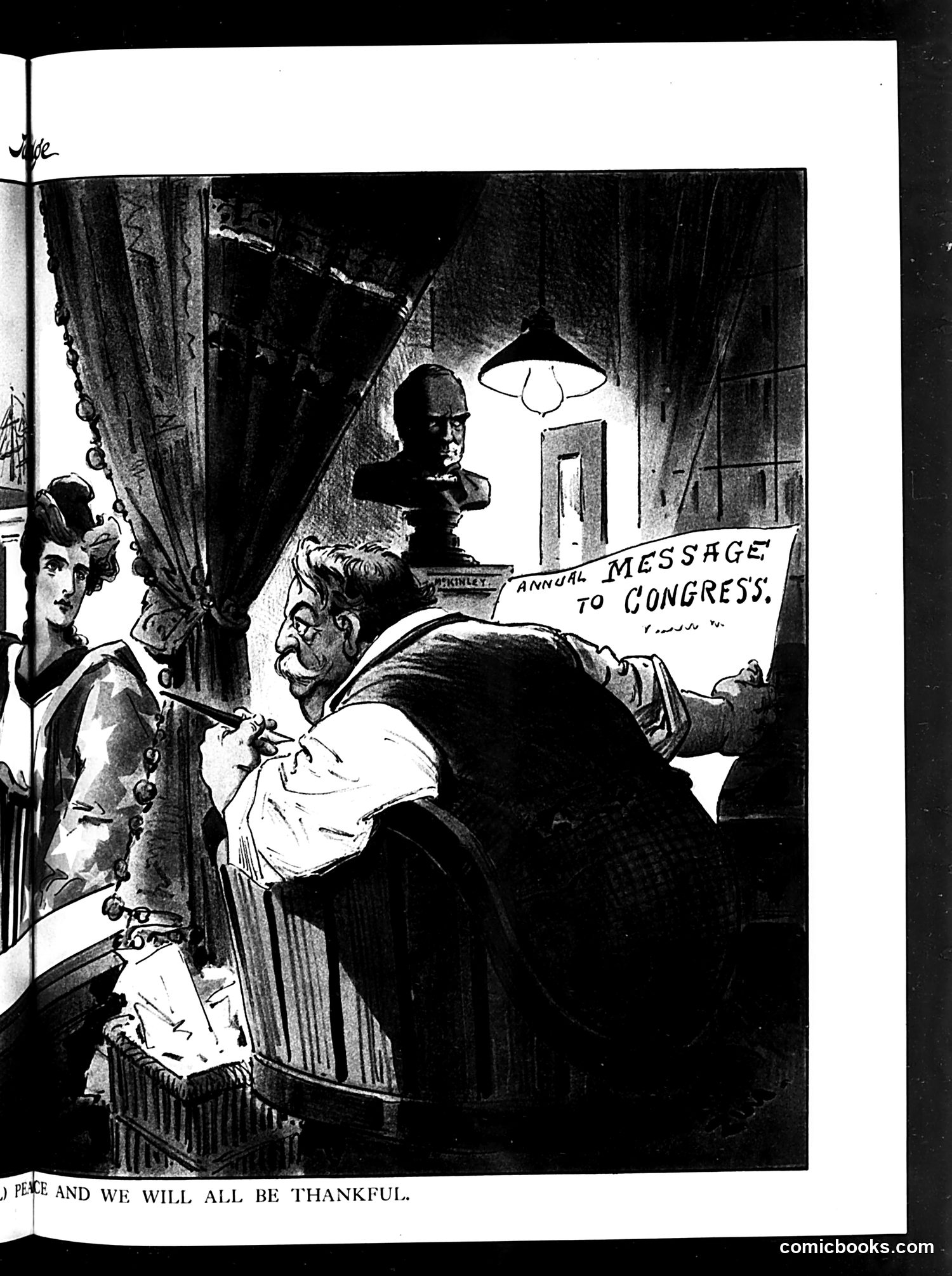
This Judge magazine cartoon satirizes the President's Annual Message to Congress. A rotund, caricatured figure (likely representing a political opponent or the President himself, depicted with exaggerated features suggesting ethnic stereotype) bends over a desk, appearing to write or strain over the "Annual Message to Congress" document. The scene includes well-dressed onlookers, suggesting this occurs in an official or formal setting. The caption at bottom reads "PEACE AND WE WILL ALL BE THANKFUL," indicating the cartoon mocks promises of peace in the official message—likely suggesting the writer lacks credibility or sincerity. The satire appears to critique either a specific President's foreign policy claims or the gap between official rhetoric and actual conduct. Without the magazine's date visible, the specific historical context remains unclear.
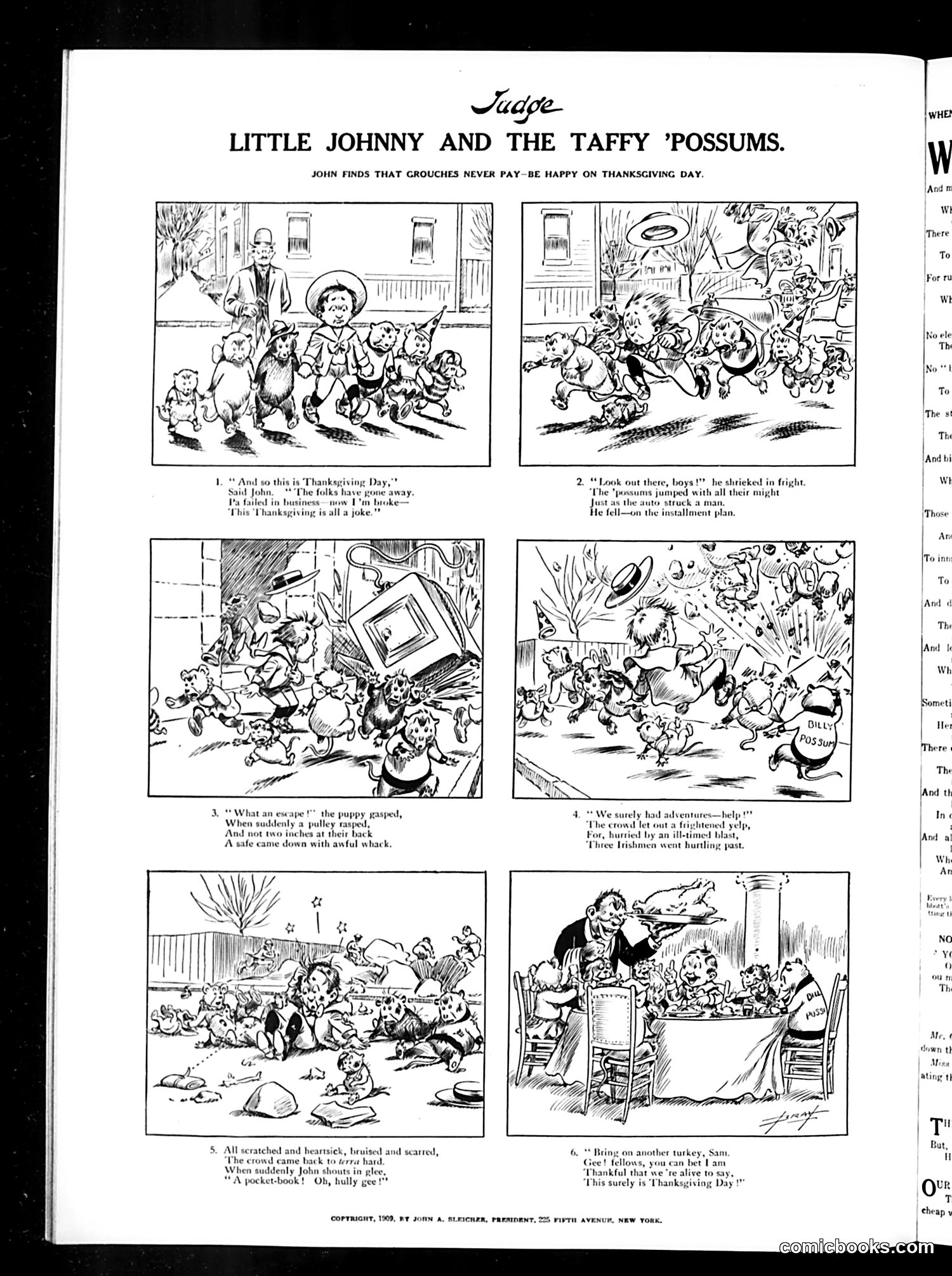
This is a humorous six-panel comic strip (not political satire) featuring a character named John and mischievous possum characters. The narrative shows John attempting to enjoy Thanksgiving Day with possums he's encountered, but chaos ensues: the animals escape, cause destruction indoors, create automotive accidents, and generally wreak havoc throughout the day. The title's concluding moral—"John finds that grouches never pay—be happy on Thanksgiving Day"—suggests the strip satirizes the difficulty of maintaining good humor during holiday celebrations when things go wrong. The repeated disasters serve as comedic commentary on how unexpected troubles (here, wild animals) can disrupt festive occasions, regardless of one's intentions to remain cheerful. This appears to be lighthearted domestic humor rather than social or political commentary.
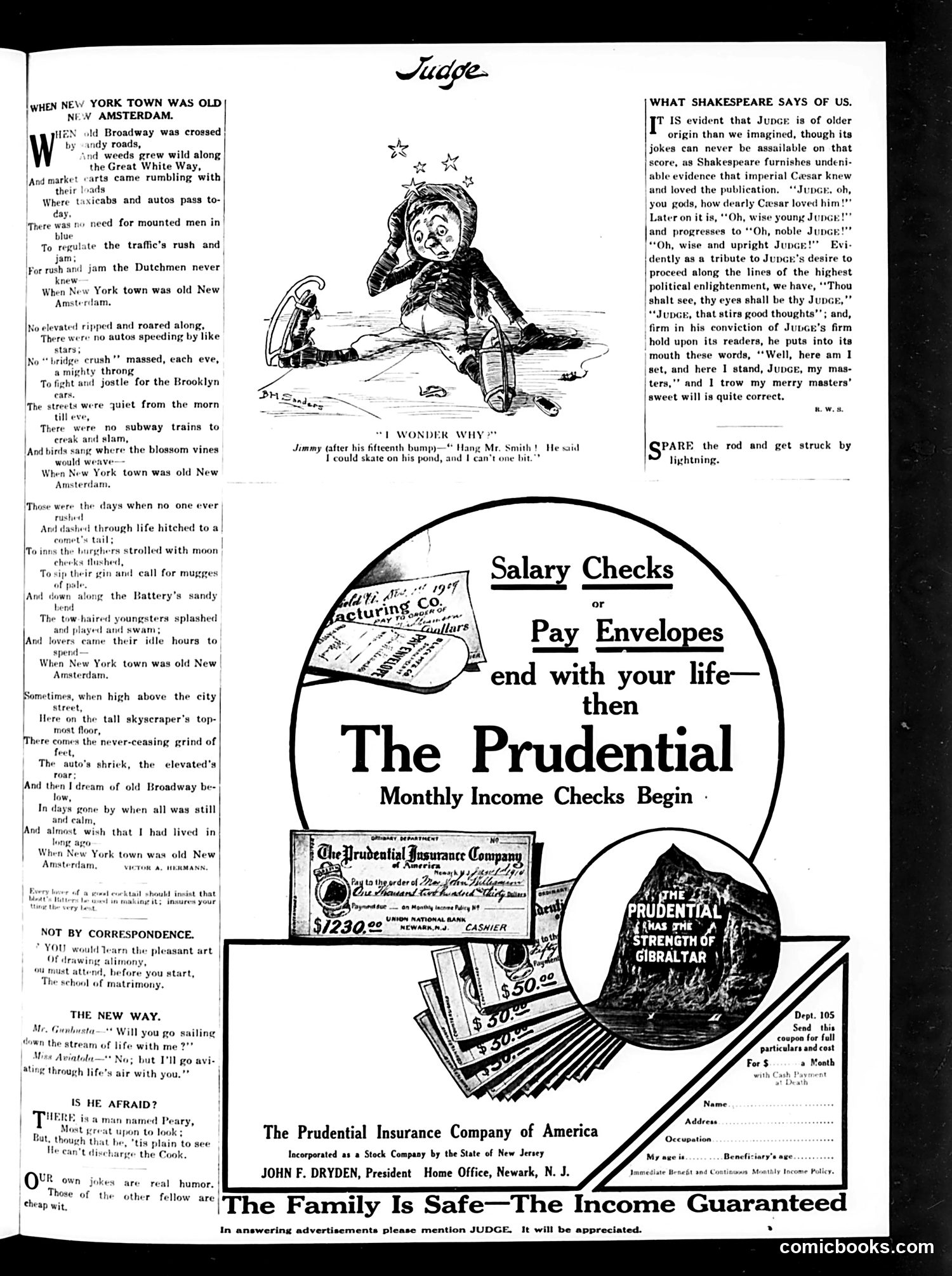
This page from *Judge* (a satirical magazine) contains several distinct elements: **Main Content:** The featured poem nostalgically contrasts old New Amsterdam (colonial New York) with the modern, chaotic metropolis—no traffic jams, no elevated trains, peaceful streets. It's social satire lamenting modernization's frenetic pace. **Central Cartoon:** "I Wonder Why?" shows a boy (Jimmy) repeatedly falling on ice after a man refuses skating permission. The joke plays on cause-and-effect irony: the man's refusal to let him skate on the pond ironically leads to Jimmy skating dangerously elsewhere. **Shakespeare Section:** Humorous commentary claiming *Judge* is so old that Shakespeare referenced it in his plays, using selective (fabricated) quotes. Pure comedic self-promotion. **Advertising:** The bulk of the page advertises Prudential Insurance's "Monthly Income Checks"—a policy ensuring dependents receive income after death. This reflects early-20th-century anxieties about financial security and family welfare. The page blends nostalgia, slapstick humor, and commercial messaging typical of the era's magazines.
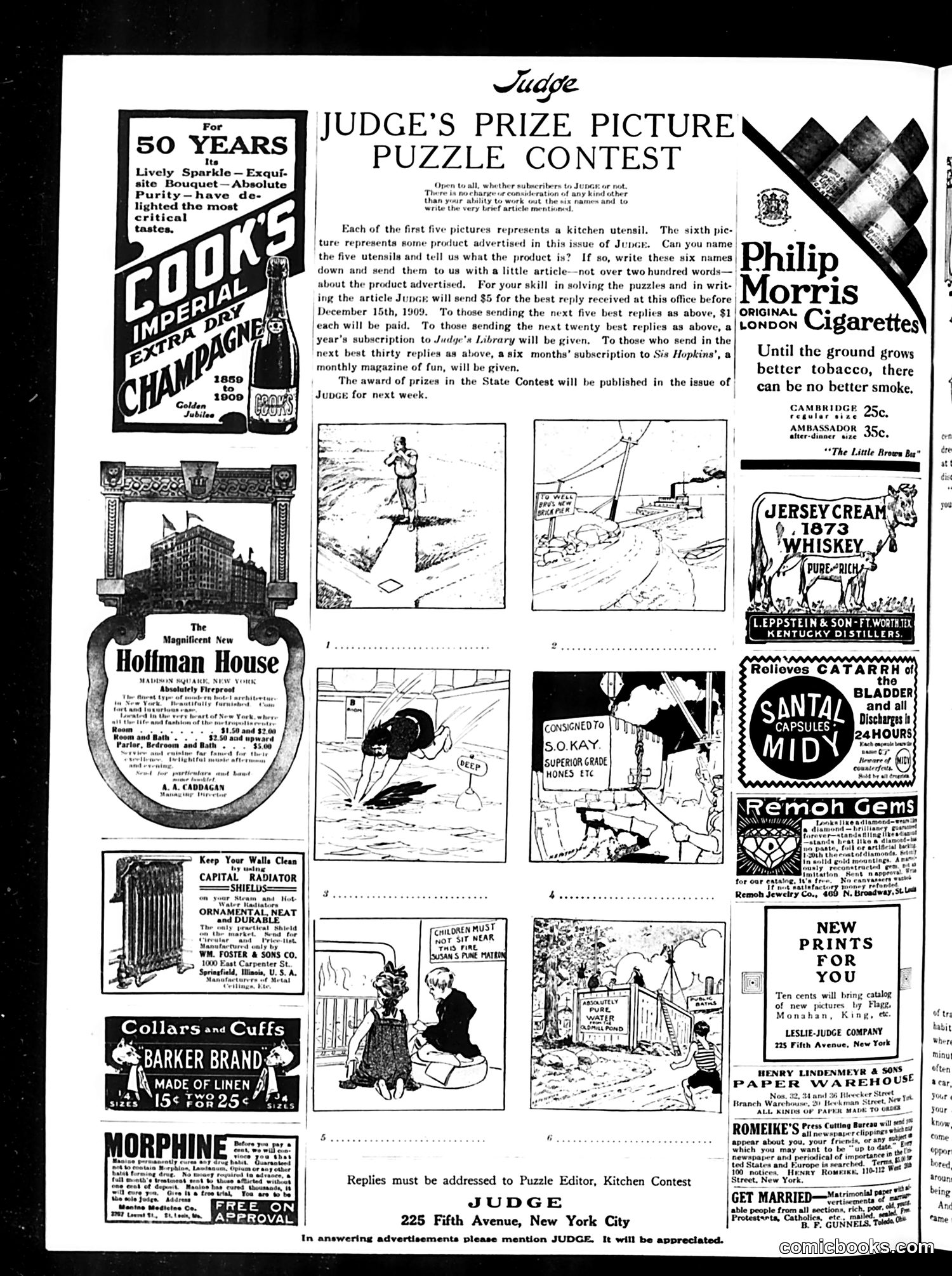
This page is primarily a **puzzle contest advertisement** rather than political satire. The central feature is Judge's "Prize Picture Puzzle Contest," inviting readers to identify five kitchen utensils depicted in line drawings and name a sixth advertised product, then write a short article about it. The contest offered cash prizes ($5 for the best entry, $1 for next five best, yearly subscriptions for subsequent entries) and was addressed to "Puzzle Editor, Kitchen Contest" at Judge's offices in New York City. The page is surrounded by period advertisements for consumer goods—cigars, collars, radiators, patent medicines—typical of early 1900s magazines. These ads, along with the puzzle contest structure, reflect how Judge magazine sustained itself through advertising revenue while engaging readers through interactive entertainment. This represents Judge's role as both satirical publication and popular periodical attracting middle-class audiences.
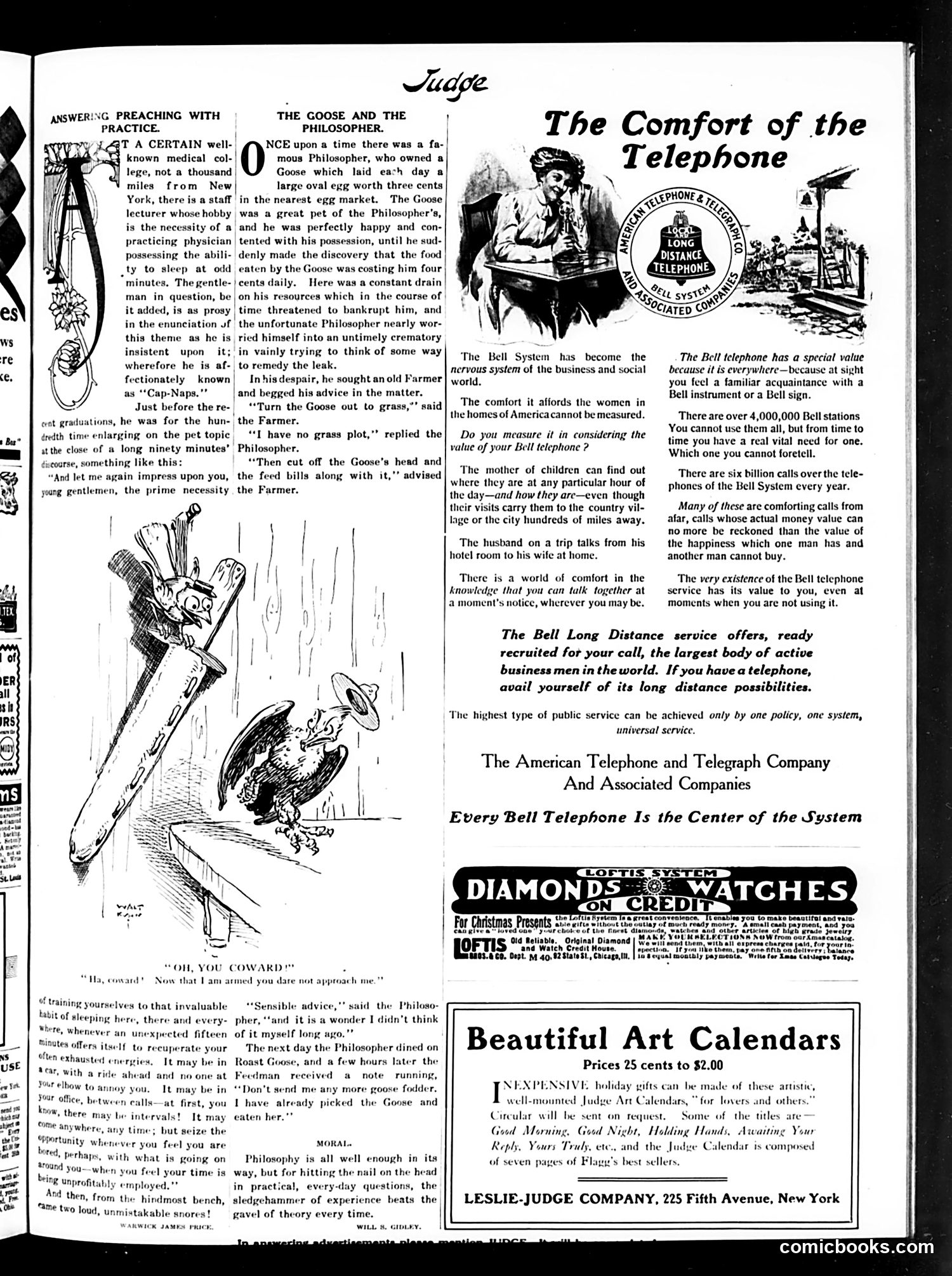
This page contains two distinct pieces: **"The Goose and the Philosopher"** (left column): A fable satirizing impractical intellectualism. A philosopher owns a goose laying valuable eggs but obsesses over its feed costs (4¢ daily vs. 3¢ egg value), nearly destroying himself with worry. A practical farmer offers brutal solutions: graze it or kill it. The satire mocks academics who overthink simple problems while missing obvious practical remedies—a common Judge theme criticizing ivory-tower thinking divorced from reality. **"The Comfort of the Telephone"** (right): An AT&T Bell System advertisement disguised as editorial content, celebrating the telephone's social value—allowing mothers to locate children, husbands to contact wives from travel, and families to connect across distances. It emphasizes billions of yearly calls and portrays the telephone as essential infrastructure ("nervous system of the business and social world"). The page juxtaposes impractical philosophy against practical modern technology—implicitly suggesting the telephone represents progress where philosophers merely theorize.
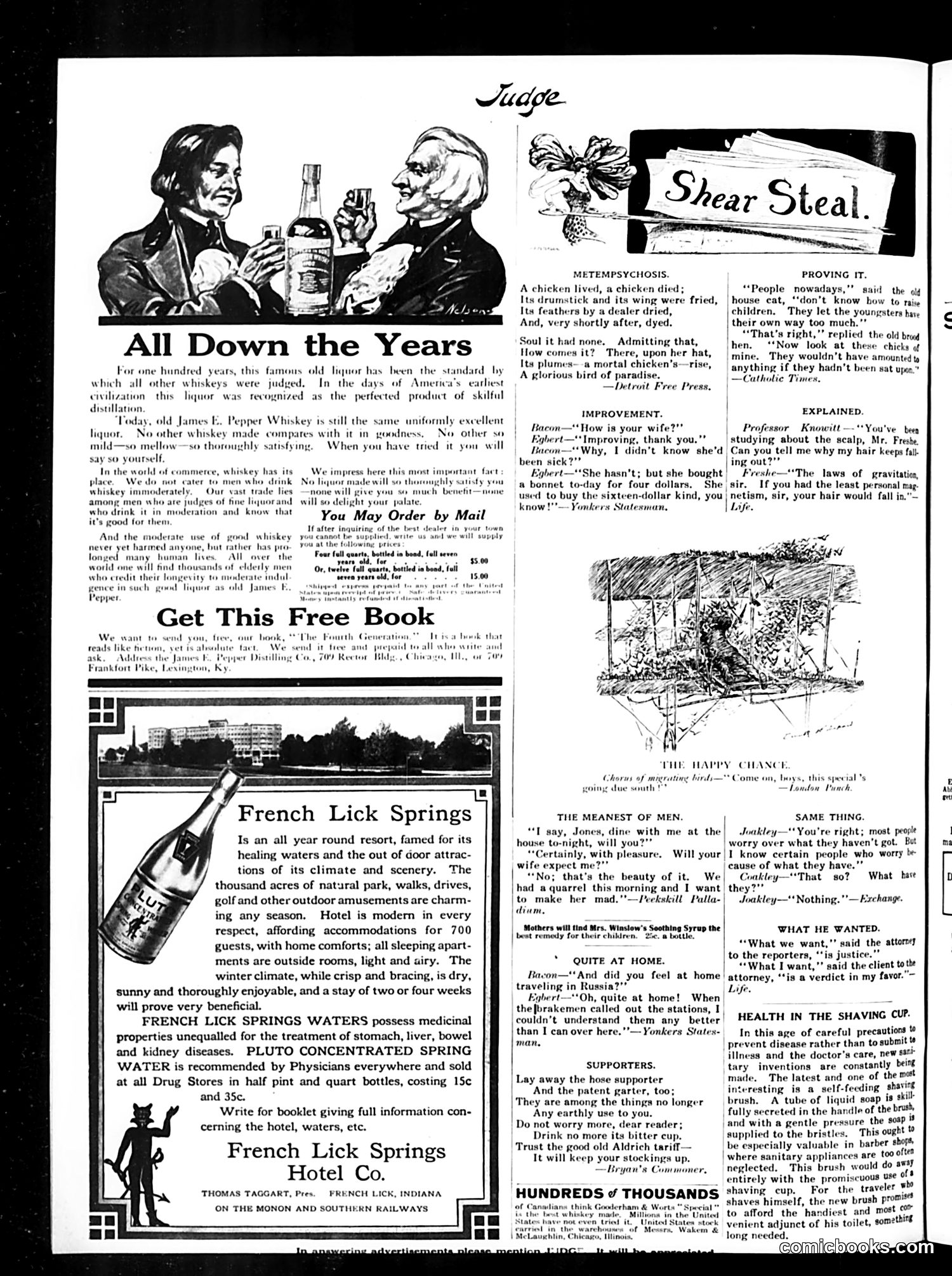
This page is primarily **advertising**, with small comic vignettes scattered throughout. The main visual satire is the opening illustration: two men drinking whiskey, labeled "All Down the Years," promoting James E. Pepper Whiskey as a 100-year tradition of American excellence. The small comic jokes below are typical early-20th-century domestic humor with no obvious political content: - **"Metempsychosis"**: A poem about chicken feathers becoming hat plumes—mocking the fashion of adorning women's hats with bird parts. - **"Improvement"**: A wife buying an expensive hat is humorously presented as "improvement" because she stopped buying the more expensive kind. - **"The Meanest of Men"**: A man invites another to dinner without telling his wife—situational humor about marital deception. The remaining jokes involve minor wordplay about hair loss, gravity, and domestic quarrels. The page also features substantial advertising for French Lick Springs Hotel in Indiana, promoting its mineral waters for medicinal purposes—a common patent medicine advertisement style of the era. This reflects the pre-FDA era when such claims were unregulated.
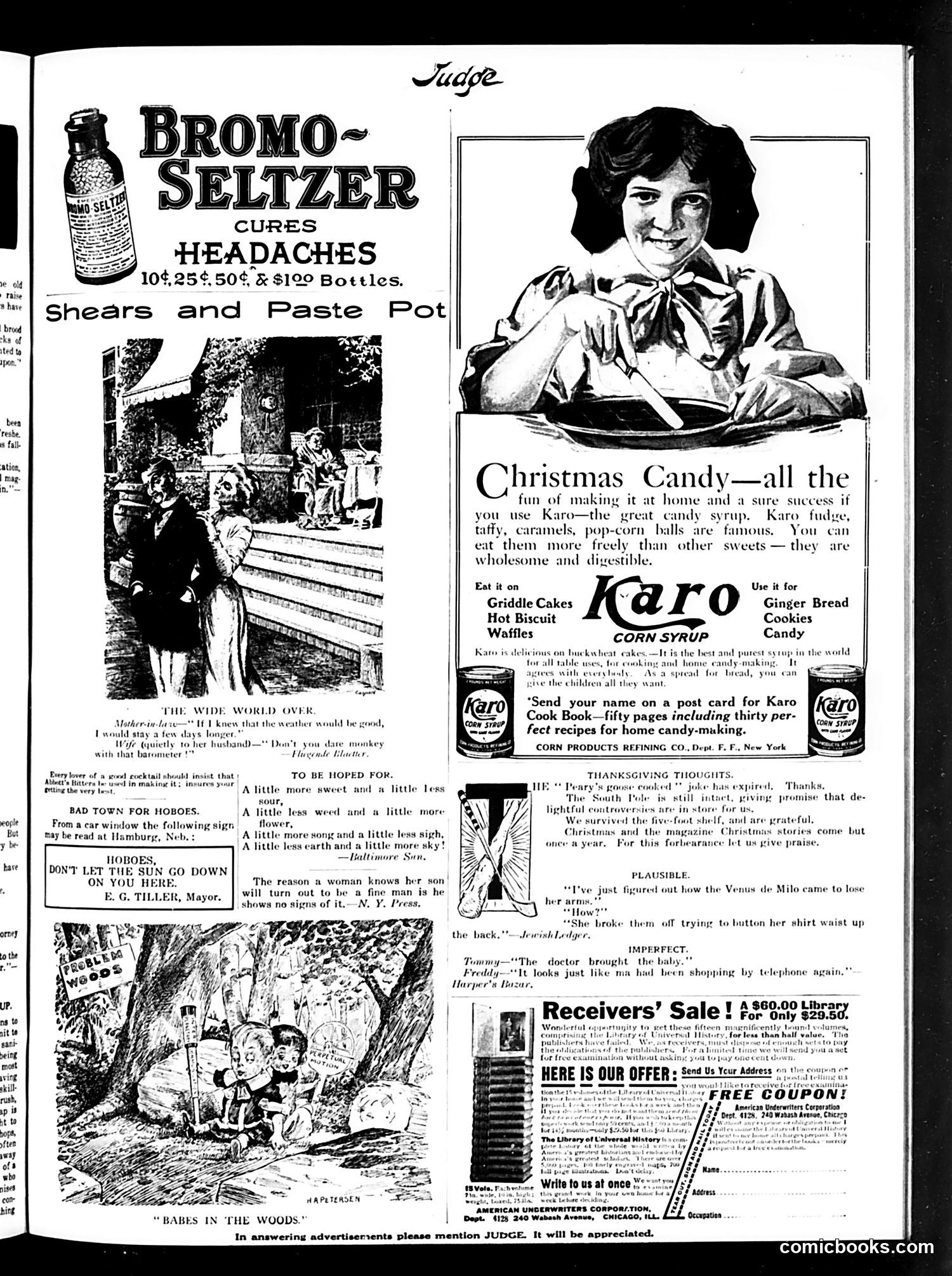
This is primarily an **advertising page** from Judge magazine, not a political cartoon. The page contains several commercial advertisements and light humor pieces: **Main content:** - **Bromo-Seltzer ad** (headache remedy) paired with a period-appropriate "Wide World Over" travel anecdote - **Karo corn syrup ad** featuring Christmas candy-making, emphasizing the product's wholesomeness - **Receivers' Sale ad** for discounted radio equipment **Humor sections** include brief jokes and observations: - A Hamburg, Illinois sign warning hoboes ("Don't let the sun go down on you here") - "Thanksgiving Thoughts" - gentle observations about life - Short jokes about doctors and parenting **Social context for modern readers:** This reflects early 20th-century advertising's emphasis on *purity* and *wholesomeness* in food products, and the era's casual attitudes toward vagrancy warnings. The humor is gentle, domestic, and moralistic rather than satirical. The page demonstrates Judge's mixed format: satirical commentary alongside mainstream consumer advertising.
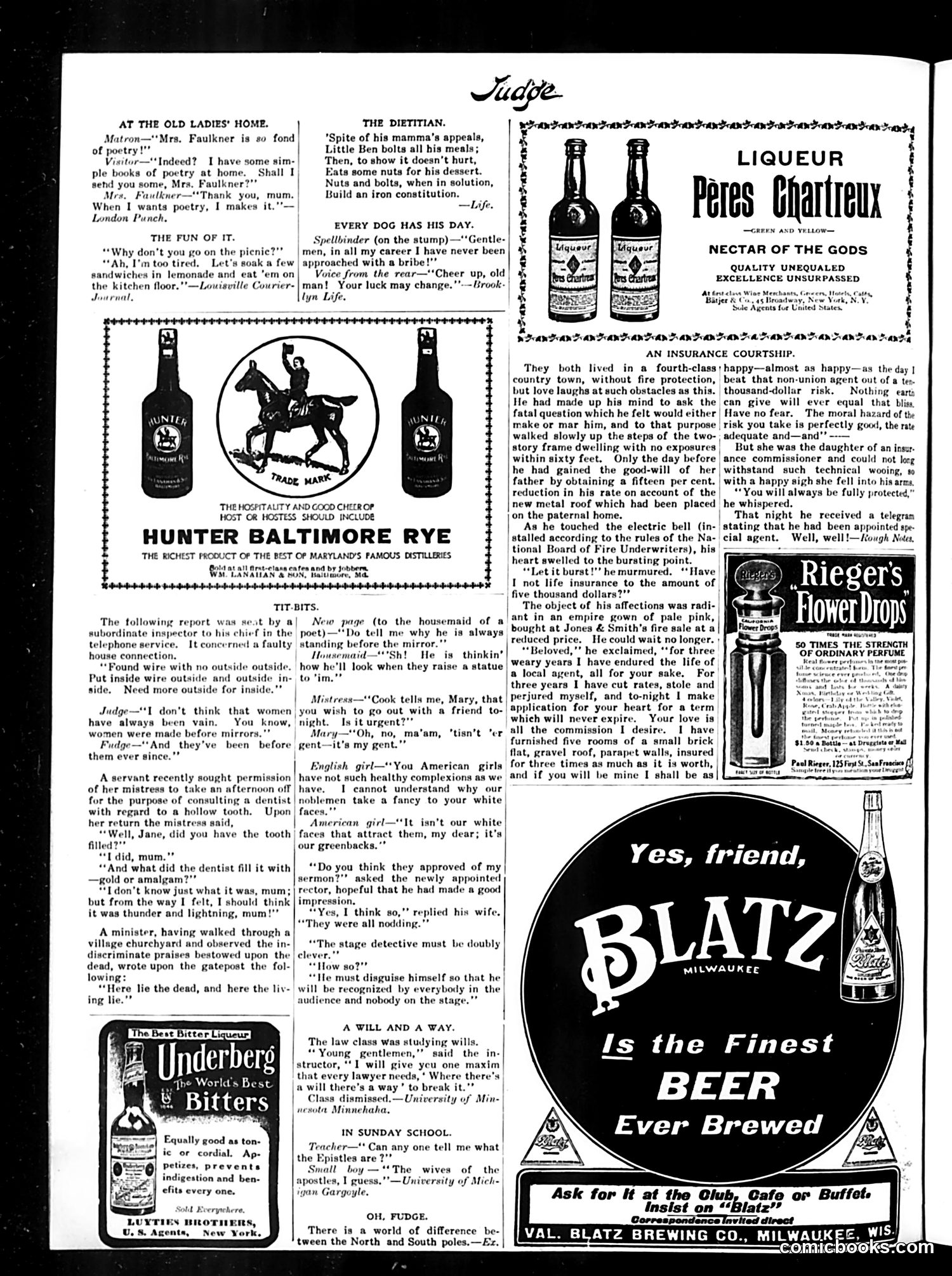
This is primarily an **advertising and humor page** from Judge magazine. The content includes: **Humor Pieces:** Short satirical jokes on everyday topics—an iron-stomached boy eating bolts, a politician surprised he's never been bribed, servants and their employers, and a rector pleased when parishioners fall asleep during his sermon. **Key Satire:** One joke mocks American women's materialism: an English girl asks why American women attract British noblemen despite lacking healthy complexions; the American replies, "It isn't our white faces...it's our greenbacks." This reflects period stereotypes about wealthy American heiresses. **Advertisements dominate:** Multiple liquor ads (Hunter Baltimore Rye, Underberg Bitters, Peres Chartreaux liqueur, Rieger's Flower Drops, Blatz Milwaukee beer) showcase Prohibition-era advertising (though the date is unclear). The humor is gentle, domestic, and class-conscious—typical of Judge's approach: poking fun at servants, immigrants, and American pretension while maintaining proper decorum for middle-class readers.
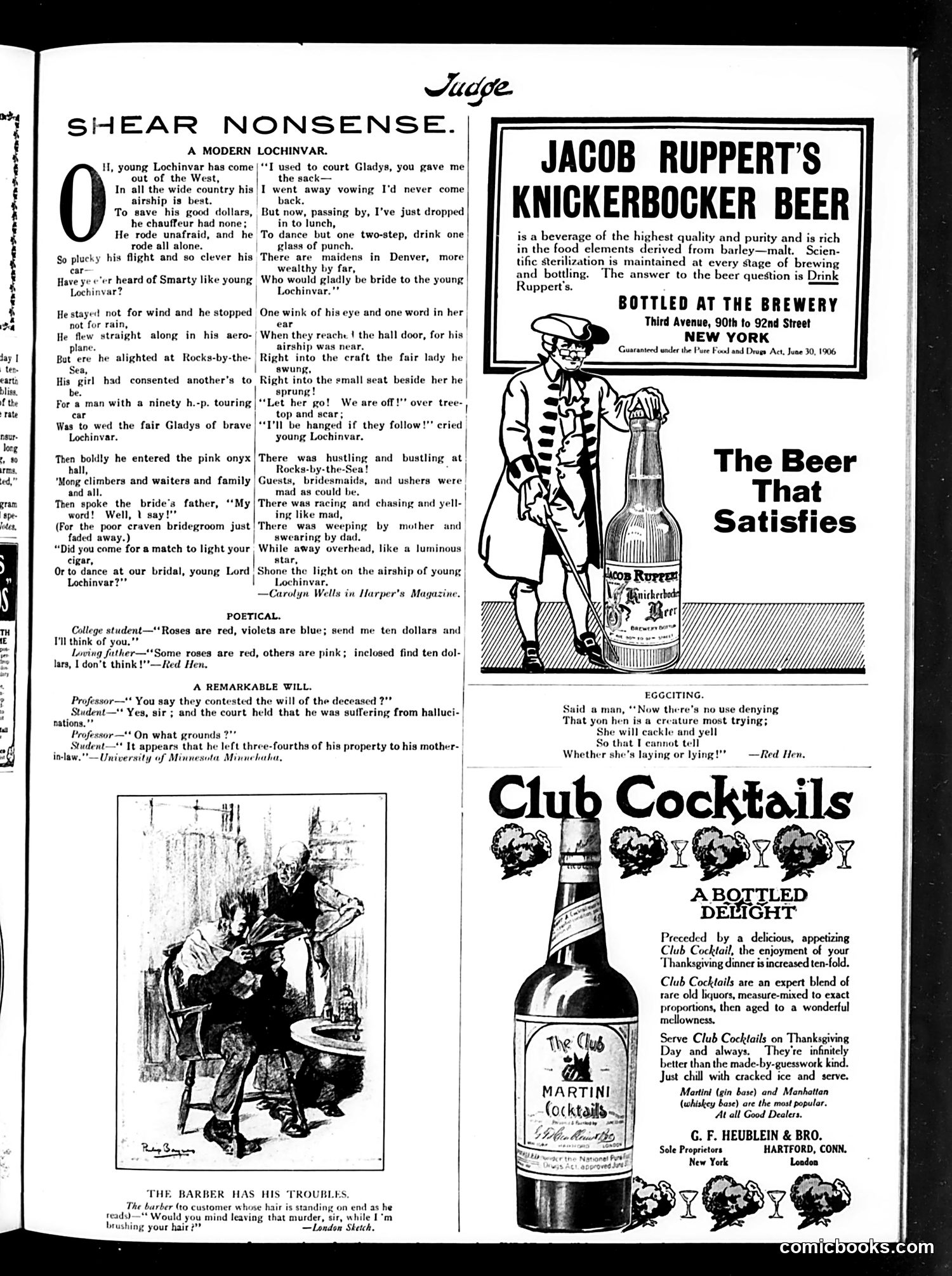
This page from Judge (circa 1906) consists primarily of **advertisements interspersed with light satirical content**. **Main Cartoon: "A Modern Lochinvar"** This poem parodies Sir Walter Scott's romantic "Lochinvar" ballad. A wealthy suitor in a motorcar (the modern equivalent of a knight on horseback) crashes a wedding to steal away the bride, succeeding where traditional romance would. The joke modernizes the Victorian romantic ideal—replacing horses with a "ninety h.-p. touring car" and wooing through automotive speed rather than chivalric prowess. It's gentle satire on contemporary courtship and automobile culture. **Shorter Humorous Bits:** - "Poetical" jokes about student-father correspondence and legal absurdities - "The Barber Has His Troubles" illustrates petty workplace frustrations **Advertisements:** The page is dominated by product ads for Jacob Ruppert's beer, Club Cocktails, and other beverages—typical Judge content mixing advertising revenue with entertainment.
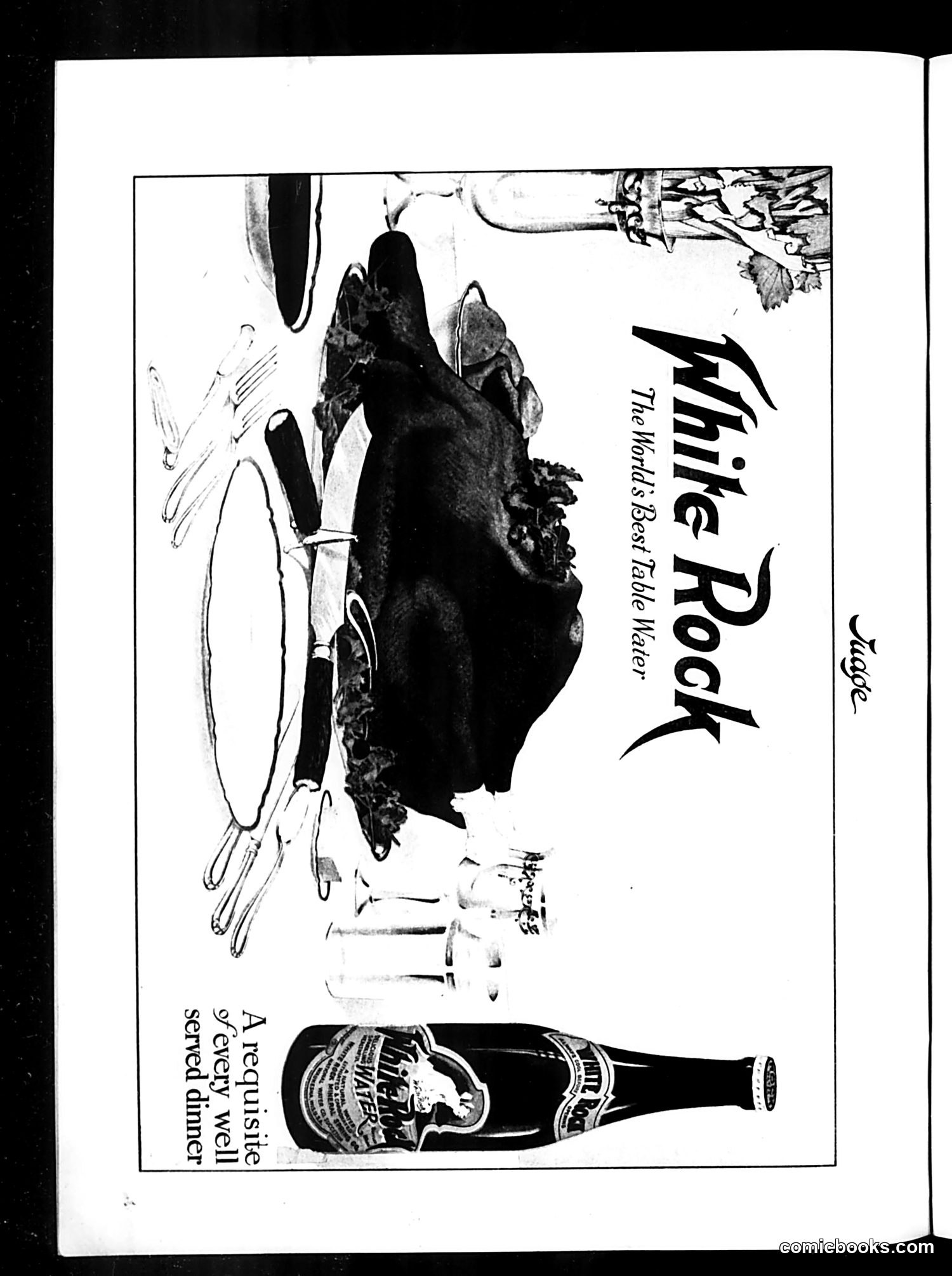
This appears to be a **magazine advertisement page** rather than a political cartoon. The page features "White Rock," a table water brand, positioned as an upscale dining essential. The central image shows an elegant bottle of White Rock mineral water alongside what appears to be a formal dinner setting or plated dish. The marketing copy emphasizes the product's status as "The World's Best Table Water" and "A requisite of every well served dinner"—positioning it as a luxury good for sophisticated consumers. The "Judge" magazine context suggests this ran in a satirical publication, though this particular page functions primarily as premium product advertising. The appeal targets affluent readers who would recognize fine dining conventions. No political satire is evident here; it's straightforward luxury marketing.