
A complete issue · 16 pages · 1909
Judge — November 13, 1909
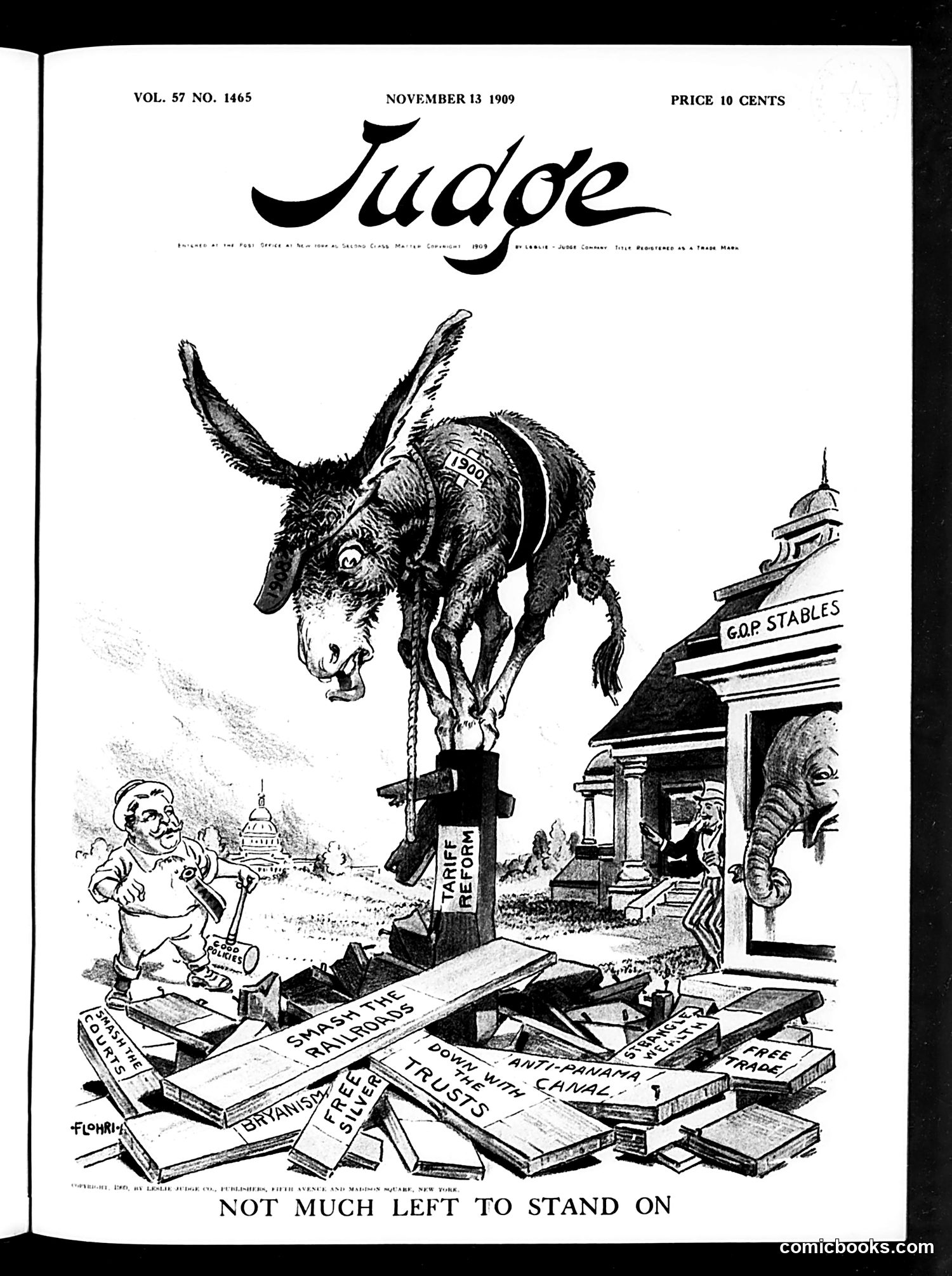
This November 1909 Judge cartoon depicts the Republican Party (symbolized by the donkey with "Tariff Reform" label) precariously balanced atop a crumbling platform. The wooden planks beneath are labeled with failed or controversial GOP policies: "Conservation," "Sherman Law," "Bryan's Free Trade," "Railroads," "Anti-Panana," "Trusts," "Dow and Wick," and "Free Trade." The cartoon satirizes the Republican establishment's weakening political foundation. A figure (likely President Taft) emerges from the "GOP Stables" building on the right, while a smaller figure (possibly representing a political rival or reformer) stands to the left near the Capitol, watching the GOP's precarious position. The overall message: Republican credibility has eroded, leaving little solid ground for the party to maintain power.
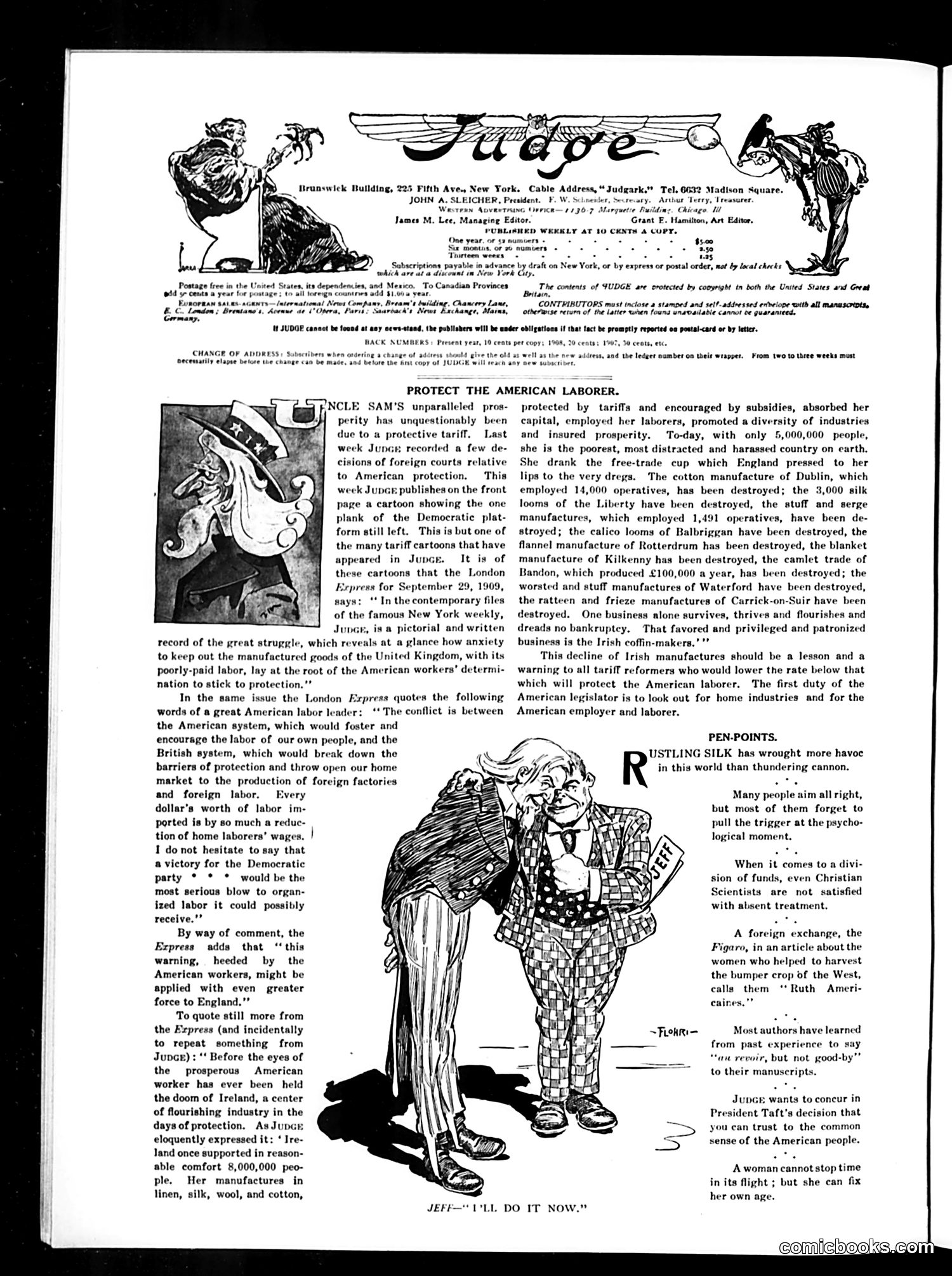
This page critiques American protectionist tariff policy. The main article "Protect the American Laborer" argues that high tariffs, meant to shield workers from foreign competition, have actually harmed American industries. It lists destroyed Irish manufacturers (linen, silk, wool, cotton) as evidence. The large cartoon depicts two figures—likely representing Ireland and Britain—in the caption "I'LL DO IT NOW," suggesting forced cooperation or submission regarding trade policy. The "Pen-Points" section offers brief satirical observations, including criticism of "rustling silk" and commentary on Christian charity and foreign exchange. The overall message: tariffs meant to protect American workers ironically damage international trade partners and ultimately backfire economically. This reflects late 19th/early 20th-century free-trade versus protectionist debates.
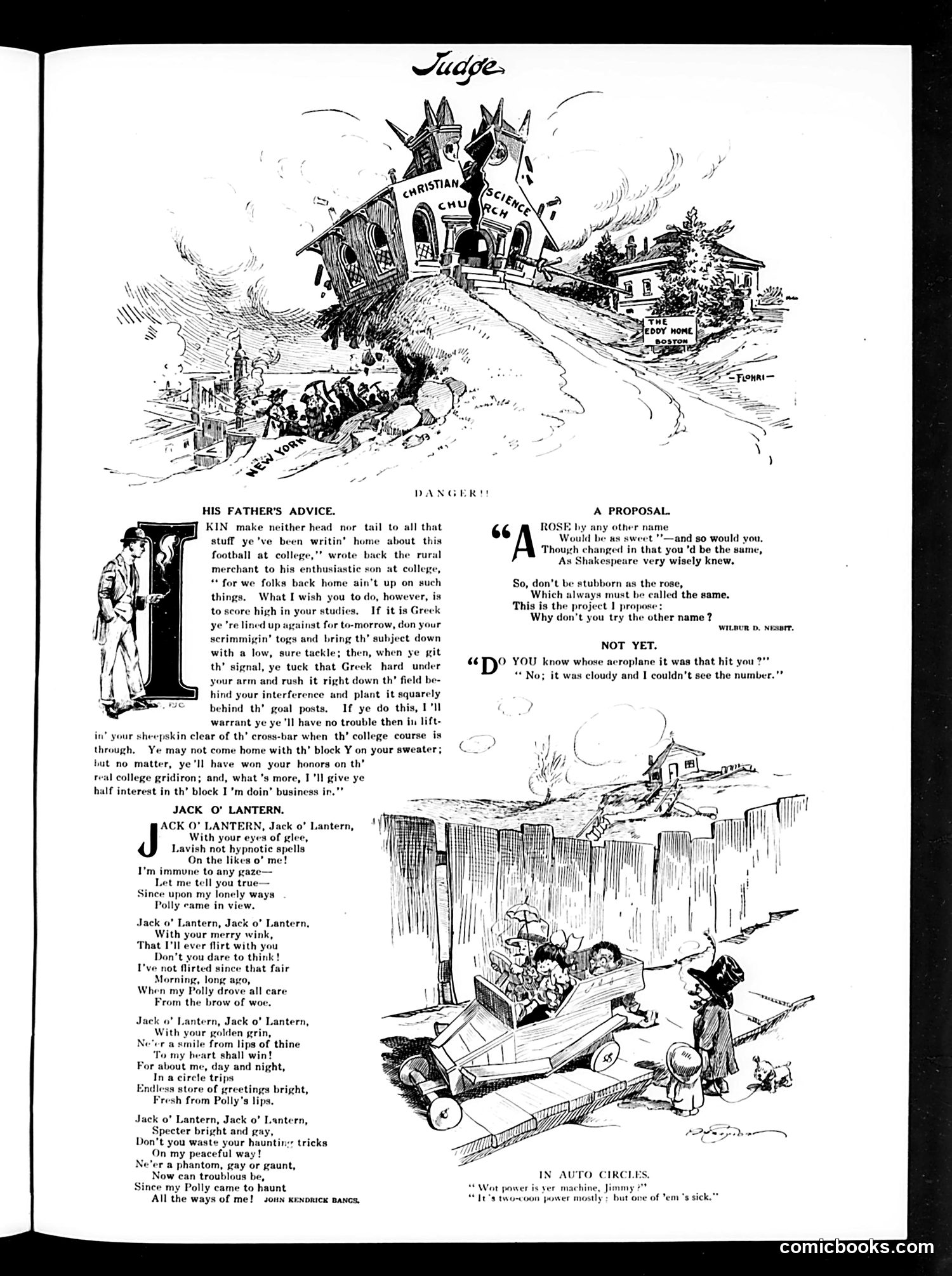
The top cartoon labeled "DANGER!!" depicts a precarious structure labeled "CHRISTIAN SCIENCE CHURCH" perched on a hill, with buildings below at risk. This satirizes concerns about Christian Science's rapid growth and institutional influence in the early 1900s—the cartoonist suggests it represents a destabilizing threat to established religious and social order. Below are humorous pieces: "His Father's Advice" offers paternal guidance about college; "A Proposal" contains Shakespeare quotes about rose-naming; "Not Yet" depicts a failed airplane proposal; and "Jack O'Lantern" is a lighthearted poem. The lower illustration shows children with a toy vehicle, captioned with dialogue about "power" and machines—reflecting contemporary fascination with automotive technology. The page primarily satirizes religious institutions while mixing lighter social commentary and emerging technological culture.
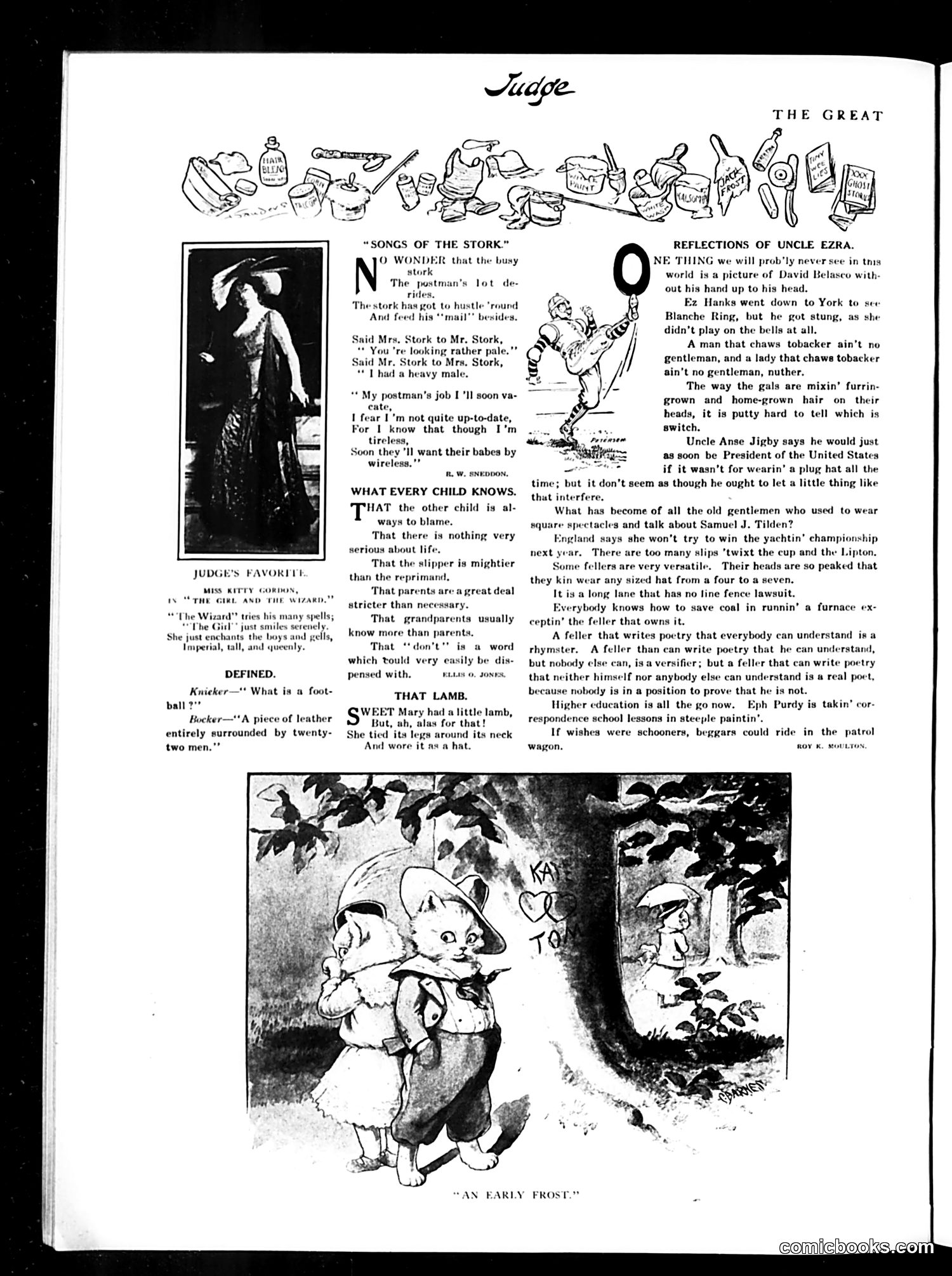
This page contains three unrelated humor pieces typical of Judge's satirical format: 1. **"Judge's Favorite"** (left): A photograph captioned about "His Kitty Carbons" - appears to be a humorous photo feature, though the specific reference is unclear today. 2. **"Songs of the Stork"** and **"Reflections of Uncle Ezra"** (center/right): Comic verses about domestic life and social commentary. Uncle Ezra's reflections mock pretension—critiquing women's fashion choices, men who chew tobacco, and celebrating plain-spoken rural wisdom over "higher education." 3. **"An Early Frost"** (bottom): An illustrated cartoon showing two anthropomorphic animals (possibly representing couples or characters) in winter clothing. The overall tone reflects early 20th-century American attitudes: anti-urban sophistication, pro-rural authenticity, and gentle mockery of modern social affectations.
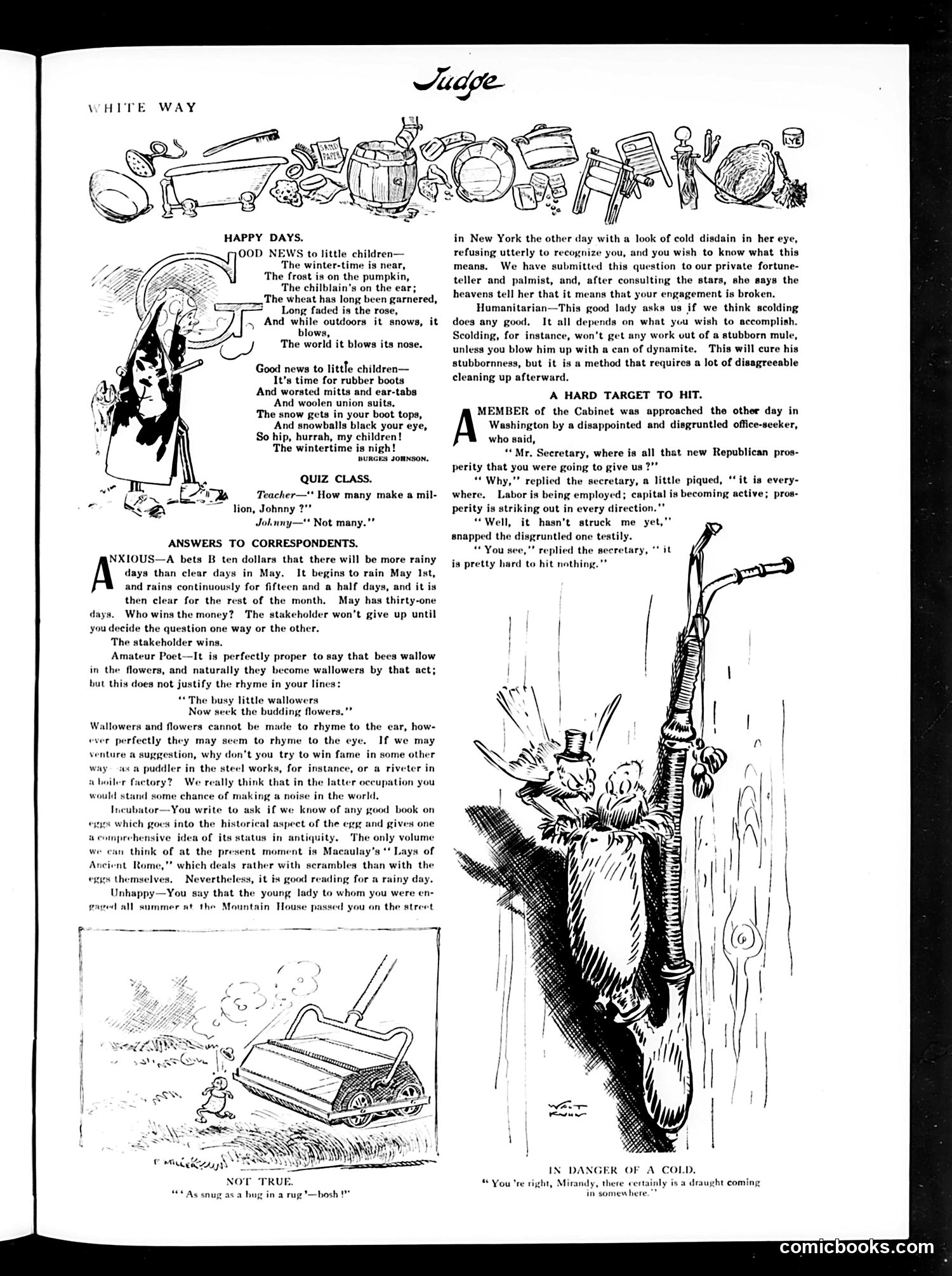
This page contains children's content and reader responses rather than political cartoons. The "Happy Days" poem celebrates childhood pleasures (muddy boots, snowballs). The "Quiz Class" poses riddles for young readers. The "Answers to Correspondents" section addresses reader questions about nature and poetry. Most notably, "A Hard Target to Hit" satirizes a Cabinet member's frustration with a Republican official who claims the new Republican administration has made Labor "strike out in every direction" while simultaneously "hasn't struck me yet"—mocking the administration's mixed economic messaging or ineffectiveness. "In Danger of a Cold" appears to be a humorous dialogue between characters (possibly Miranda and another figure), though context is unclear without more information. The page reflects Judge's dual mission: entertainment for families and political commentary for adults.
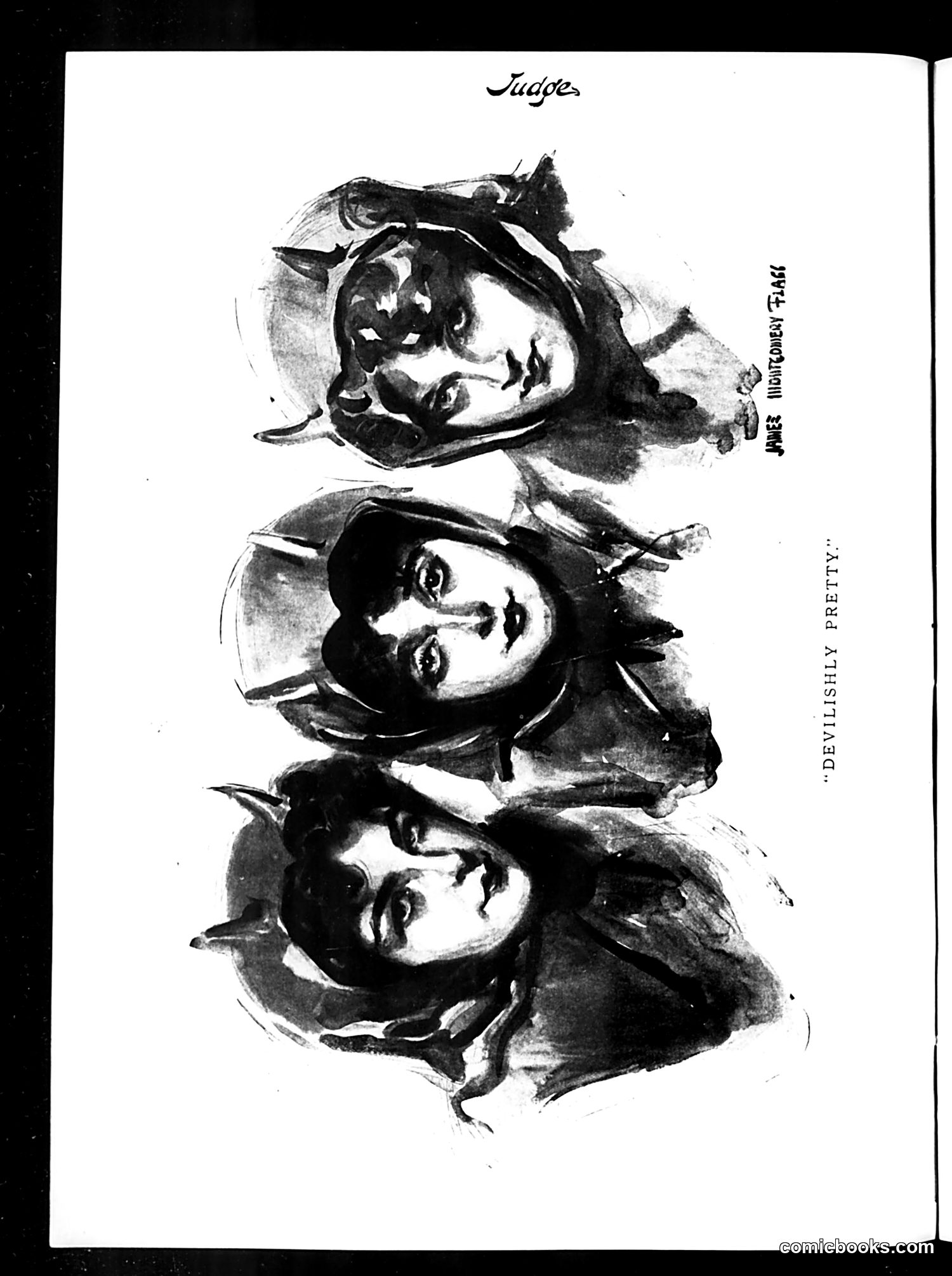
This page from the satirical magazine *Judge* displays three caricatured heads stacked vertically, labeled "DEVILISHLY PRETTY" on the right margin. The title "Judges" appears at the top. The three figures appear to be political or public figures of the era, depicted with exaggerated, demonic or devilish features—sharp expressions, prominent facial characteristics rendered in bold black ink. The "devilishly pretty" caption suggests satirical commentary on figures who possess superficial charm or attractiveness despite morally questionable character or actions. Without clearer identification of the specific individuals or the publication date, I cannot definitively identify which judges or politicians are being mocked. The satire criticizes these figures' hypocrisy between appearance and actual conduct.
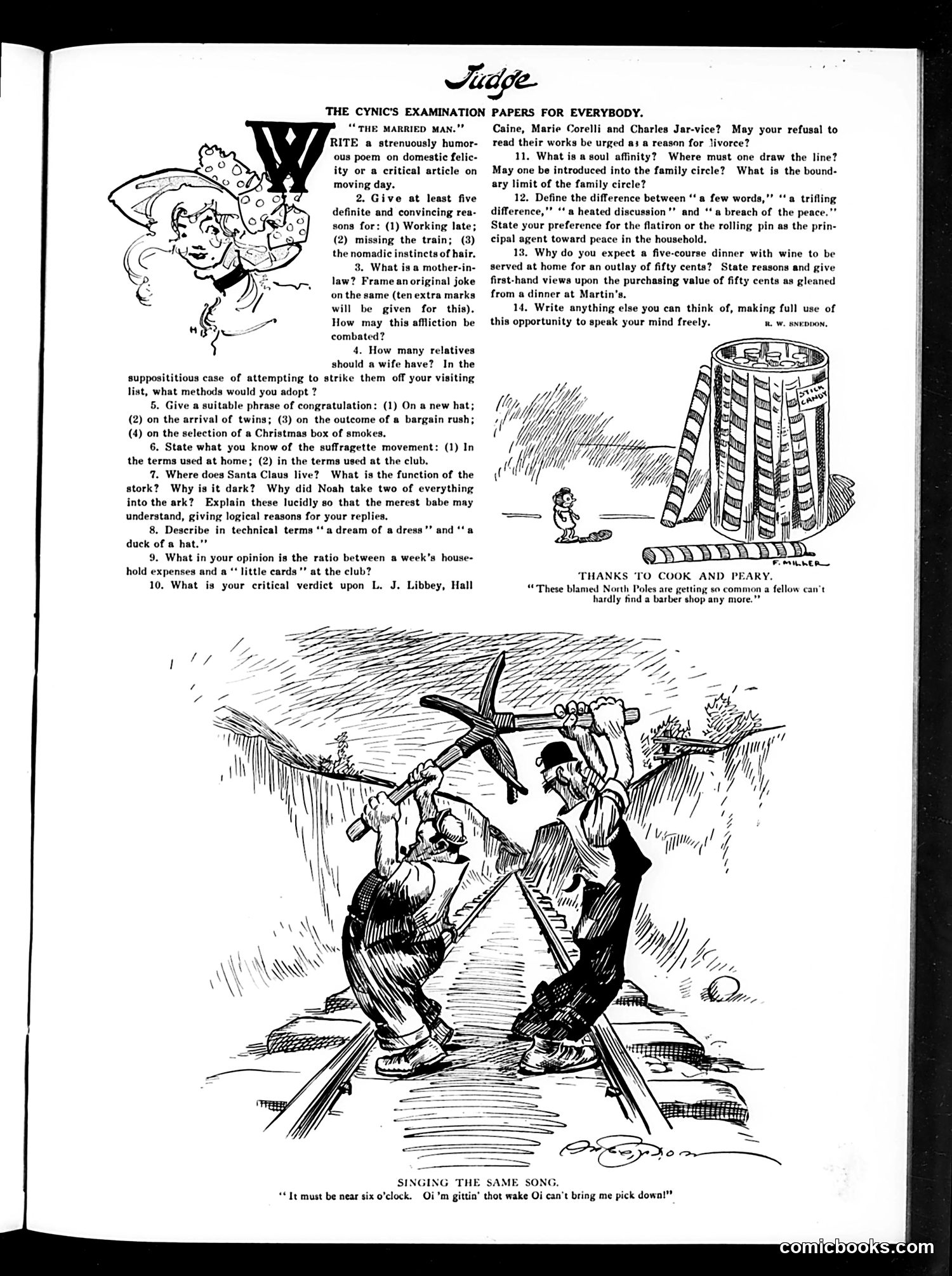
This page features **"The Cynic's Examination Papers for Everybody: The Married Man"**—a satirical mock-exam mocking domestic married life through absurdist questions about wives, mothers-in-law, household expenses, and marital conflicts. The humor targets the frustrations of married men: nagging wives, intrusive relatives, expensive household management, and the tension between home obligations and social club life. The cartoons reinforce this theme: the top illustration shows a cramped urban apartment building (mocking tight living quarters), while the bottom depicts two railroad workers arguing over a propeller, captioned about bringing a "pick down"—likely satirizing labor disputes or incompetent workers. The "North Poles" cartoon references contemporary Arctic exploration expeditions (possibly Peary's), joking that such explorations have become so common that even barber shops are disappearing—absurdist social commentary on modern progress's disruptive effects. Overall, the page targets married male anxieties and early-20th-century social change through cynical humor.
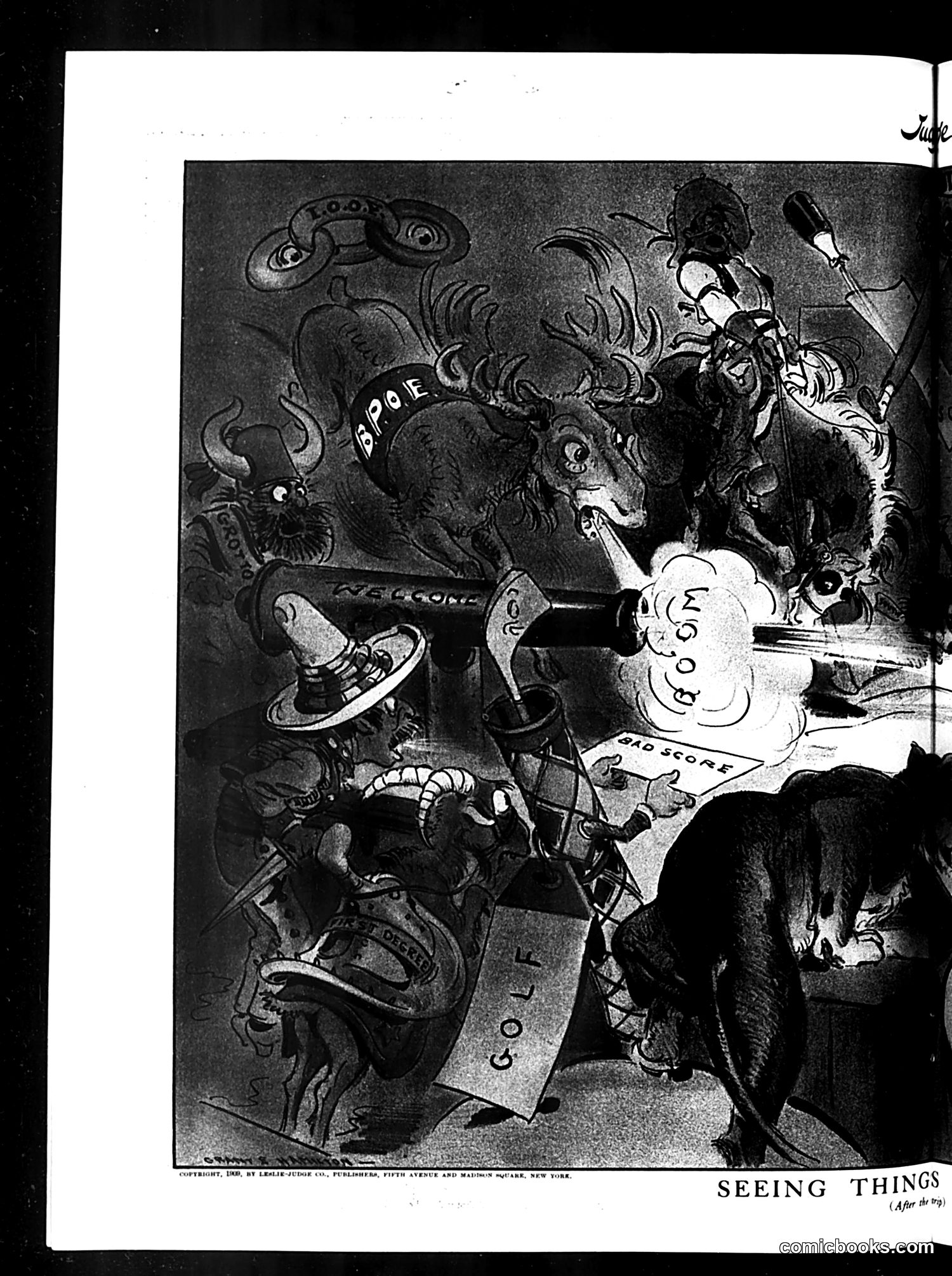
This satirical cartoon depicts a figure looking through a telescope at grotesque, demonic creatures and chaos. The title "Seeing Things" and subtitle "(After 9)" likely reference alcohol intoxication or delirium—a period-appropriate reference to seeing hallucinatory "things" when drunk. The demons and monsters emerging from the telescope suggest the speaker is experiencing drunken visions or paranoia. Various labels appear on the creatures and documents (including what appears to be "BAD SCORE"), though the specific text is difficult to read in this reproduction. The cartoon satirizes the consequences of excessive drinking, a common moralist theme in Judge magazine during the Prohibition era. The figure's distorted perceptions serve as commentary on alcohol's effects on judgment and sanity.
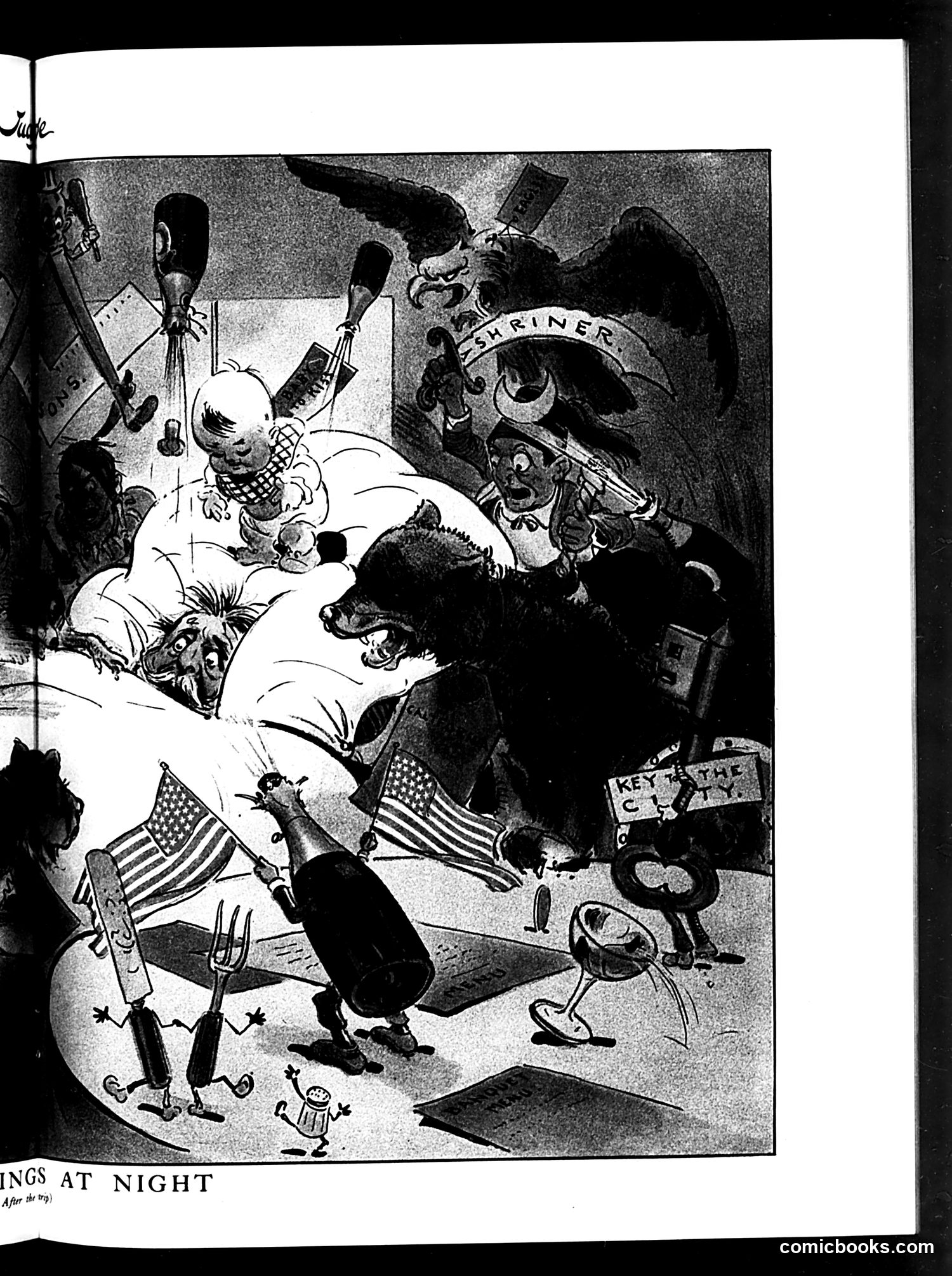
This appears to be a satirical cartoon titled "INGS AT NIGHT" (likely part of a longer title). The image depicts what seems to be a nighttime scene of civil unrest or invasion, with caricatured figures attacking a sleeping figure in bed. An eagle with a "SHRINЕР" banner appears overhead—likely representing an American patriotic symbol being invoked ironically. The cartoon includes American flags, weapons (fork and pitchfork), and aggressive animal figures (possibly dogs or wolves). The style suggests early-to-mid 20th century political commentary, likely critiquing either immigrant threats, labor unrest, or foreign invasion fears popular in that era's satirical press. Without the complete title or publication date visible, the exact political reference remains unclear, though the imagery suggests anxieties about national security or domestic disorder.
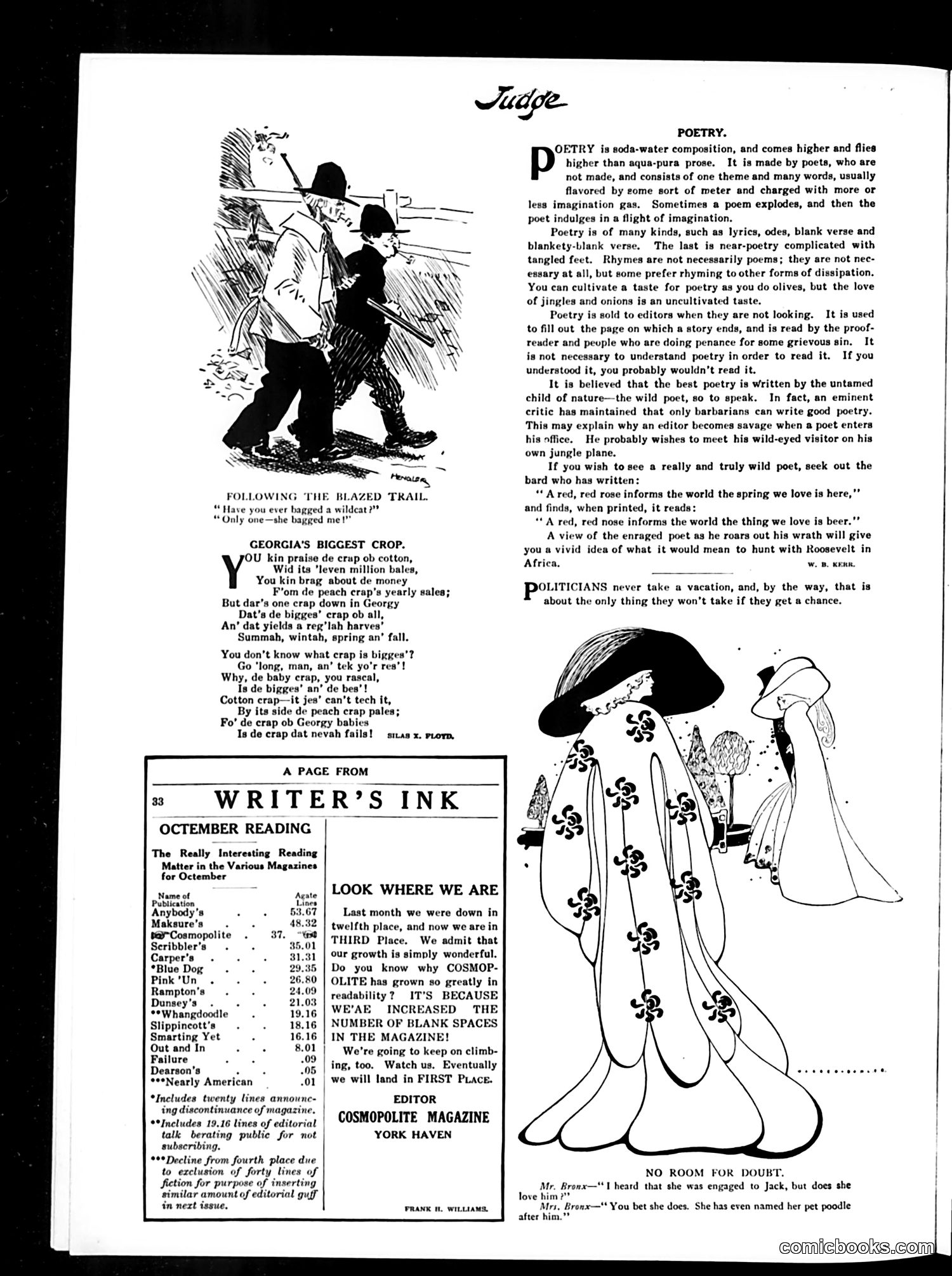
This page is primarily **editorial content and satire** rather than political cartooning. The main section is a **humorous essay on poetry**, mocking both poets and editors. It uses exaggerated definitions ("soda-water composition") and jokes about poetry's impracticality—that readers don't need to understand it, that editors use it to fill pages, and that the best poets are wild, uncivilized "barbarians." The essay satirizes the literary establishment's pretensions. Below is a **dialect poem about Georgia crops**, celebrating babies as Georgia's greatest "crop"—likely mocking rural Southern boasting or census pride. The **"Writer's Ink" section** tracks magazine circulation rankings, with Cosmopolite Magazine claiming impressive growth. The editor's note admits they've artificially inflated readability by adding "blank spaces"—a self-aware joke about padding magazines with white space to appear fuller. The cartoon illustrations and sidebar joke about a woman engaged to Jack are minor decorative elements with unclear specific reference. Overall, this page satirizes **literary pretension, editorial dishonesty, and magazine circulation games**.
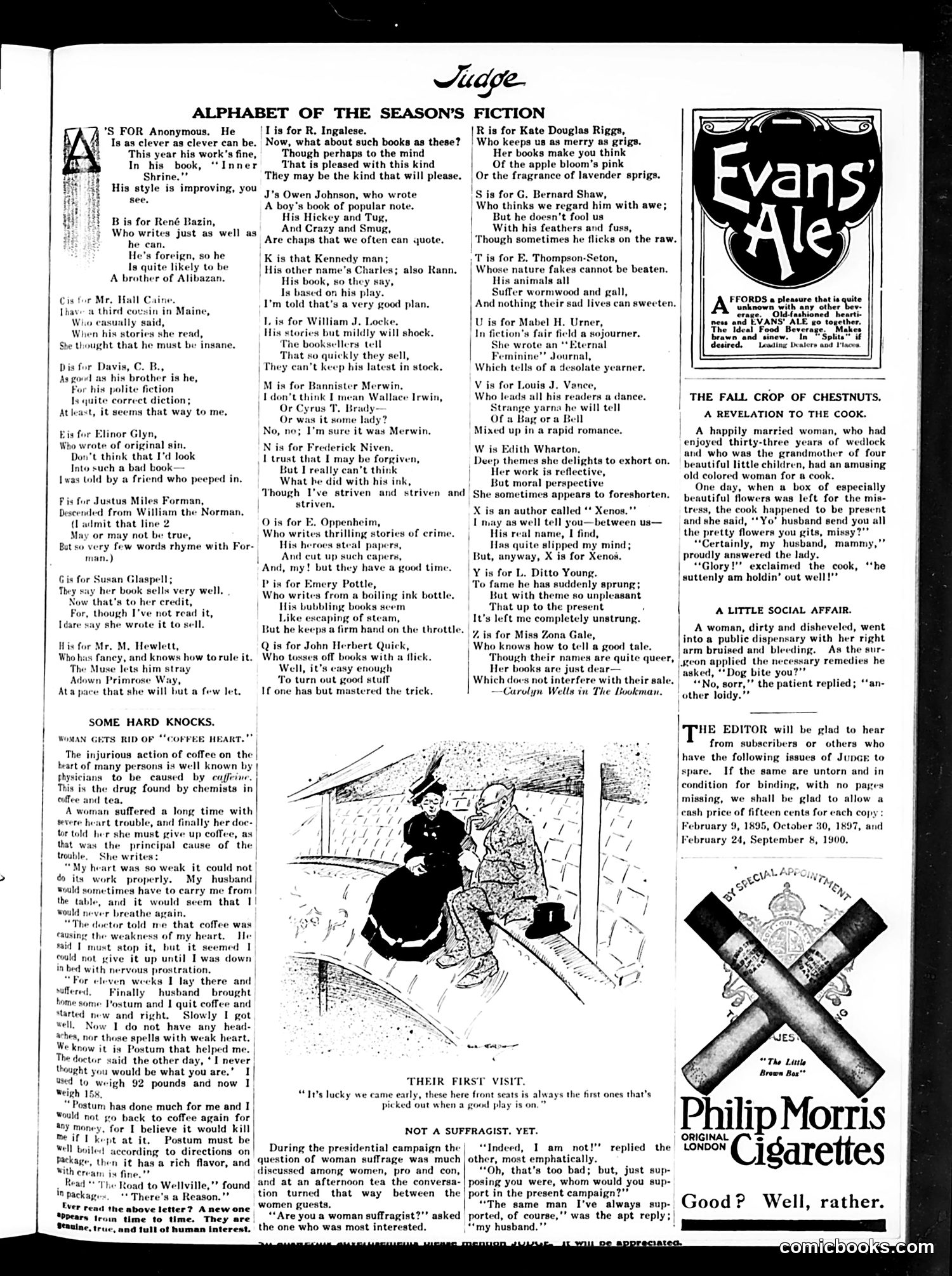
This page is primarily a satirical **"Alphabet of the Season's Fiction"** — a contemporary literary critique in verse form, mocking popular authors of the early 1900s. The cartoons illustrate two brief humor pieces: "Their First Visit" (showing theatergoers) and "Not a Suffragist, Yet" (a woman rejecting suffrage arguments at tea). The alphabet section ridicules well-known fiction writers of the era — Kate Douglas Riggs, G. Bernard Shaw, William J. Locke, Elinor Glyn, and E. Thompson-Seton among them — using lighthearted rhyming couplets. The satire targets their popularity, formulaic writing, and public personas. For instance, Thompson-Seton is mocked for "nature fakes" (fabricated animal stories), while Glyn's work is dismissed as scandalous. The page also includes a testimonial advertisement for Postum (a coffee substitute), which appears unrelated to the literary satire. The content reflects Judge's role as a satirical magazine lampooning cultural figures and contemporary trends for educated readers familiar with these bestselling authors.
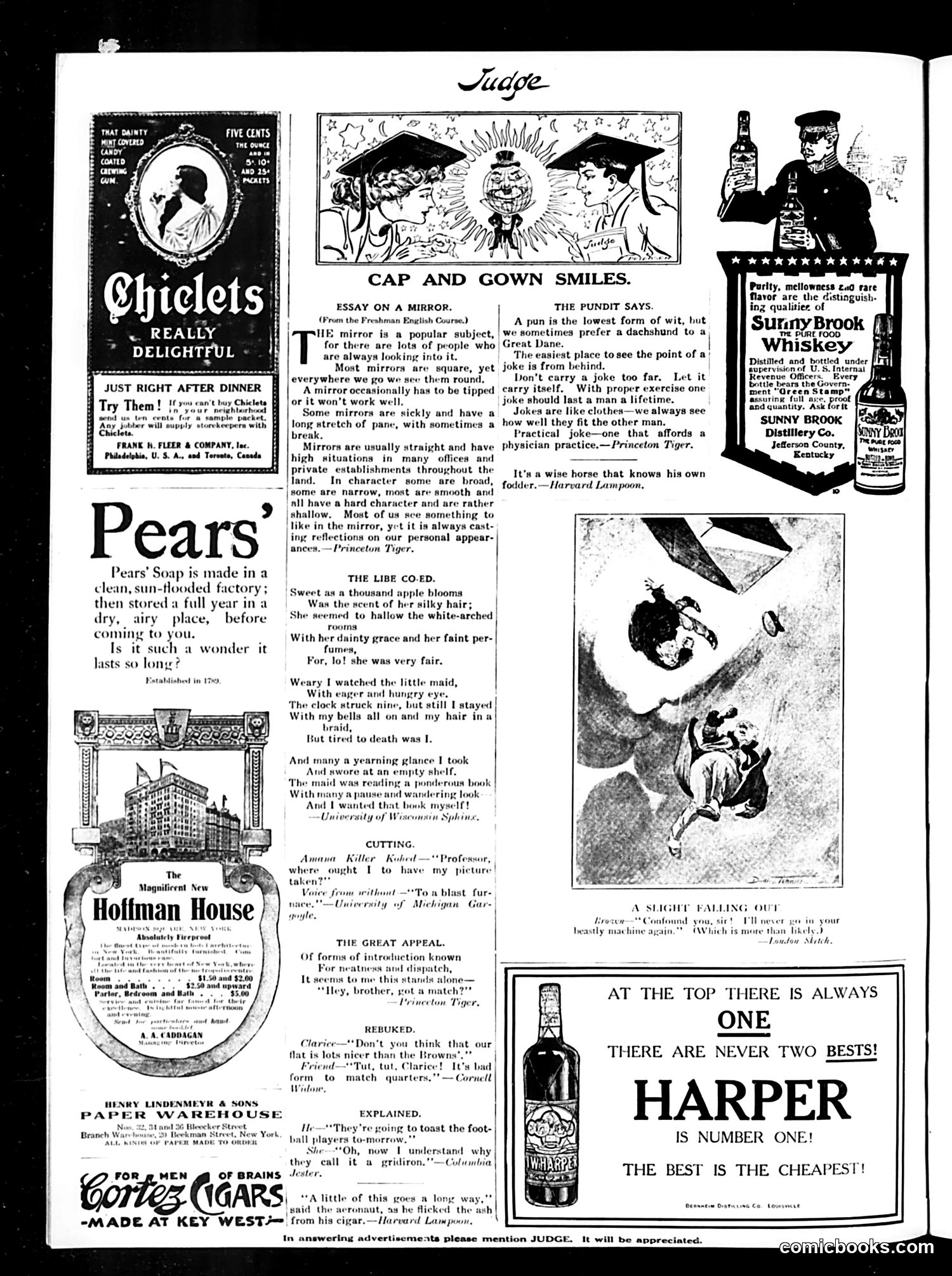
This page is primarily **advertisements and light humor** rather than political satire. The content includes: **Essays & Humor Pieces:** - "Essay on a Mirror" - a mock freshman composition using dry wit to describe mirrors while subtly mocking student writing - "The Libe Co-ed" - a poem about a tired librarian, likely poking fun at college life - Various short quips from college humor magazines (Princeton Tiger, Harvard Lampoon, etc.) about puns, jokes, and campus observations **Advertisements:** The page features ads for consumer goods (Chiclets gum, Pears' Soap, Sunny Brook Whiskey, Harper Whiskey, the Hoffman House hotel, and cigars). The Harper Whiskey ad uses emphatic ALL-CAPS messaging typical of early 20th-century advertising. **No Clear Political Cartoons:** The page lacks obvious political commentary. The illustration labeled "A Slight Falling Out" appears to show a domestic or social mishap but lacks context for interpretation. This appears to be a typical Judge issue blending college humor, advertisements, and light social observation rather than hard-hitting satire.
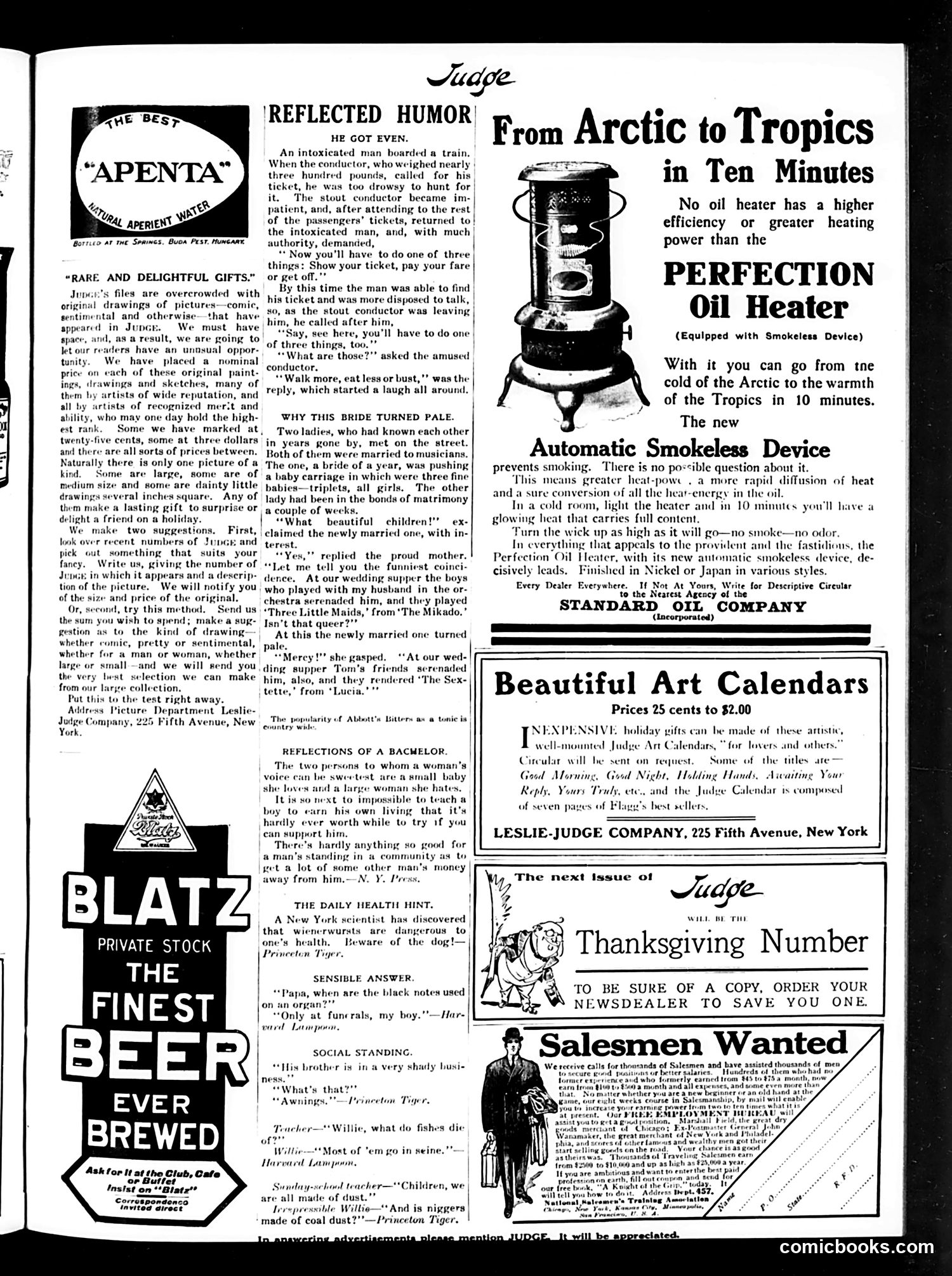
This appears to be a **mostly advertisement and humor section** from Judge magazine, not primarily political cartooning. The page contains: 1. **"Reflected Humor"** - A series of brief anecdotes satirizing everyday American life: an intoxicated passenger insulting a conductor, a bride learning her husband was serenaded with the same song as another groom, and various jokes about bachelors and social standing. 2. **Multiple advertisements** including the Perfection Oil Heater ("From Arctic to Tropics in Ten Minutes"), Apenta water, Blatz beer, and Leslie-Judge Company's art calendars. 3. **Small humor columns** with names like "Daily Health Hint" and "Social Standing" offering light satirical commentary. The satire is **gentle and domestic** rather than political—poking fun at marriage, social pretension, and urban manners. No specific political figures or events are referenced. This is representative of Judge's general appeal as a humor magazine aimed at middle-class readers rather than hard-hitting political satire.
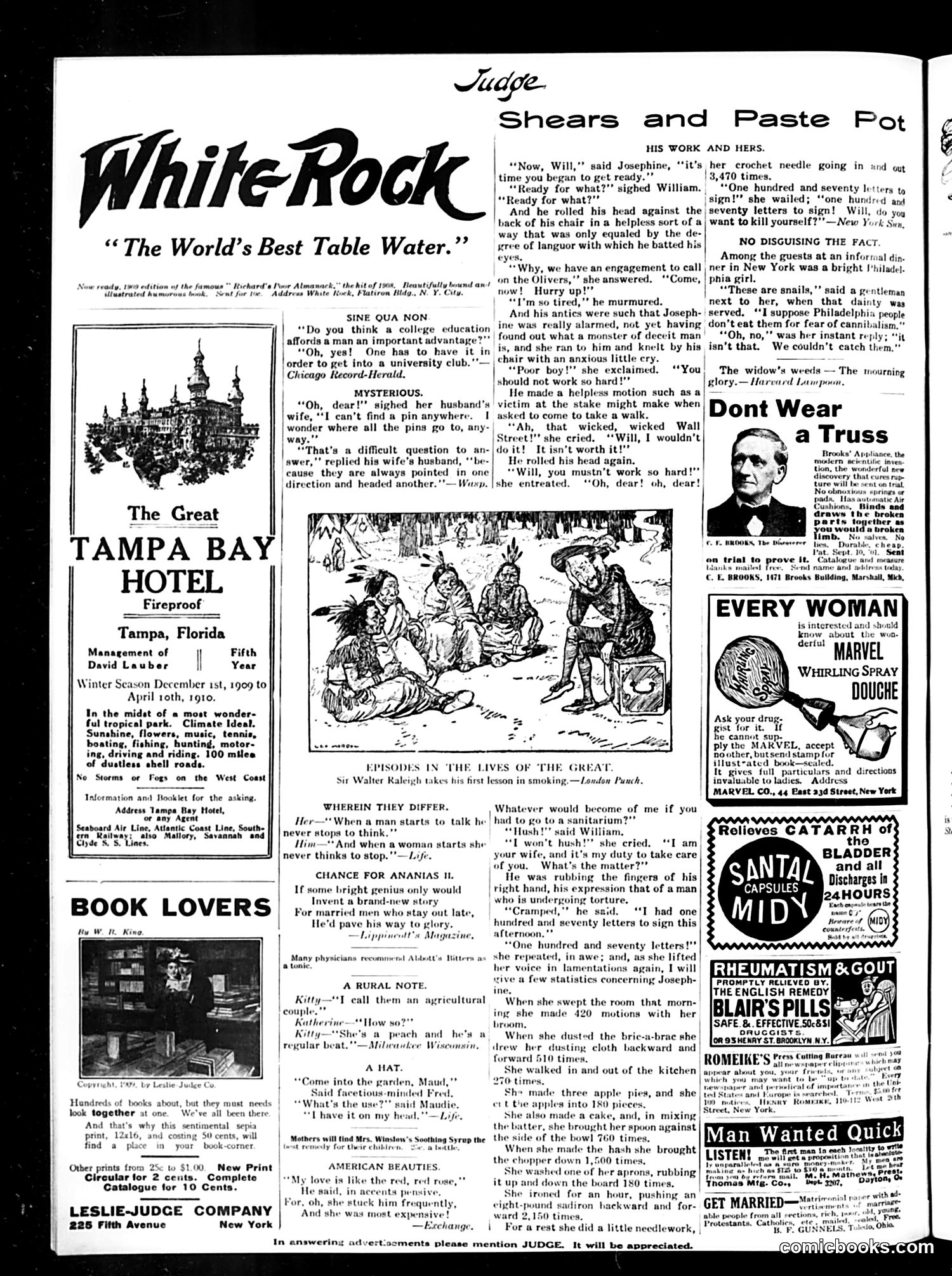
This page from Judge (c. 1909-1910) contains mostly brief humor pieces and advertisements typical of the era. **Main Content:** The largest cartoon, "Episodes in the Lives of the Great," depicts Sir Walter Raleigh smoking—a historical reference to Raleigh popularizing tobacco in England. The accompanying jokes contrast male and female behavior in relationships (men "start to think" when courting; women "never think to stop"). **Satirical Pieces:** "Sine Qua Non" mocks social climbing: a college education's real value is gaining admission to exclusive university clubs, not actual learning. "Shears and Paste Pot" satirizes marital dynamics—a husband avoiding work through theatrical helplessness while his wife fusses over him. "No Disguising the Fact" jokes about a Philadelphia woman's appetite for snails, implying regional eating habits. **Advertisements:** The page is dominated by ads for hotels (Tampa Bay), patent medicines (Winslow's Soothing Syrup), and other period products, reflecting Judge's primary revenue model. The humor relies on contemporary social conventions—gender roles, regional stereotypes, and class consciousness—now largely unfamiliar to modern readers.
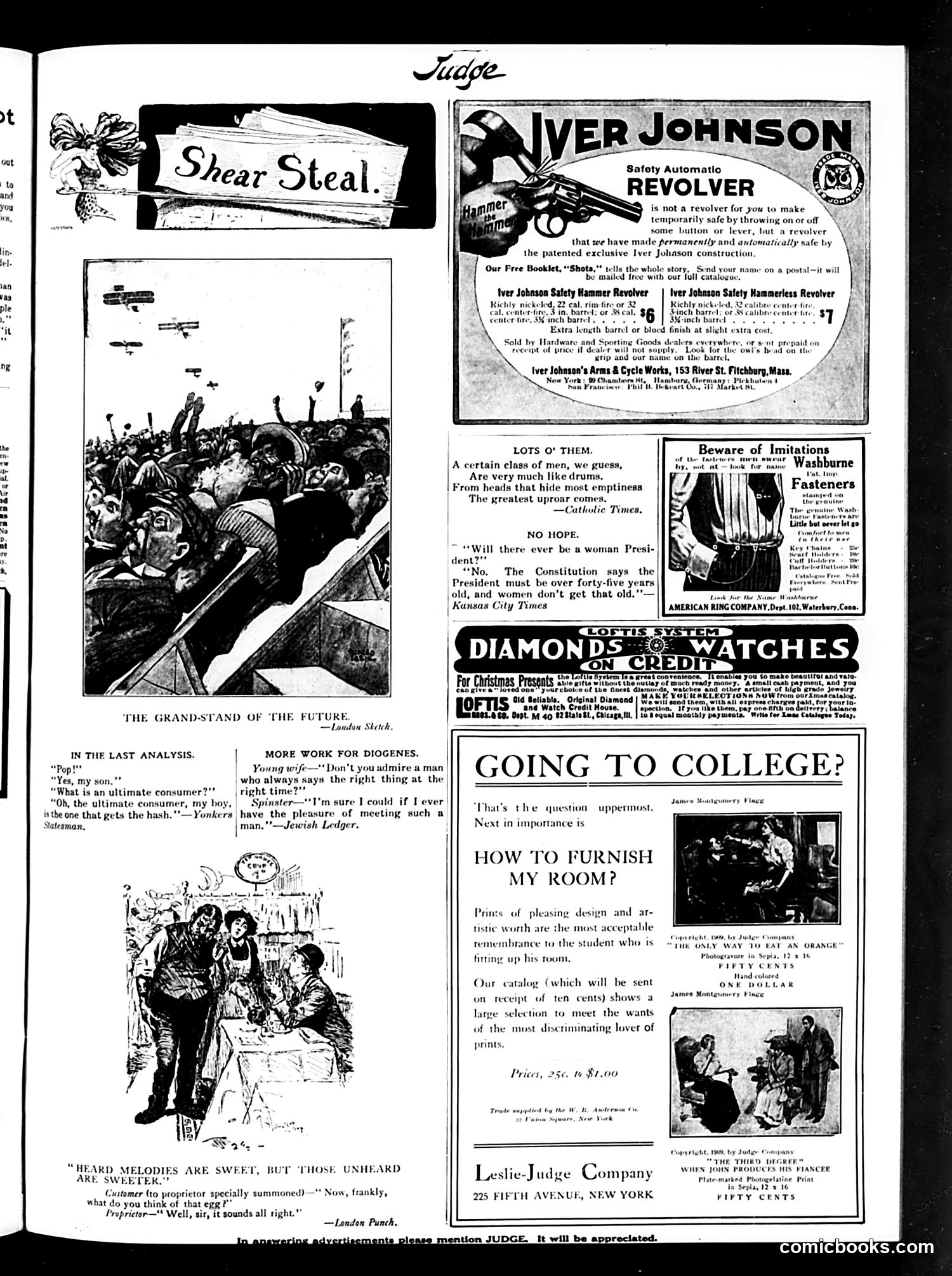
This page from *Judge* magazine contains several satirical cartoons and advertisements reflecting early 20th-century American social commentary. **"The Grand-Stand of the Future"** depicts a crowded mass of humanity—likely satirizing democratization or mass society, with the caption attributing it to "Landon Sketch" (a regular *Judge* contributor). **"In the Last Analysis"** jokes about the "ultimate consumer"—a period economic term—sardonically suggesting the common person is merely whoever "gets the hash" (leftovers/scraps), mocking class hierarchy. **"No Hope"** satirizes women's exclusion from presidential eligibility, noting constitutional age requirements made it impossible for women to serve (they couldn't "get that old" before losing viability as candidates)—social commentary on both sexism and ageism. **"Heard Melodies Are Sweet"** features a proprietor claiming an obviously bad egg "sounds all right"—satirizing willful ignorance or proprietorial dishonesty. The page also contains period advertisements for revolvers, fasteners, and college room furnishings, typical of *Judge's* mixed satirical and commercial content.
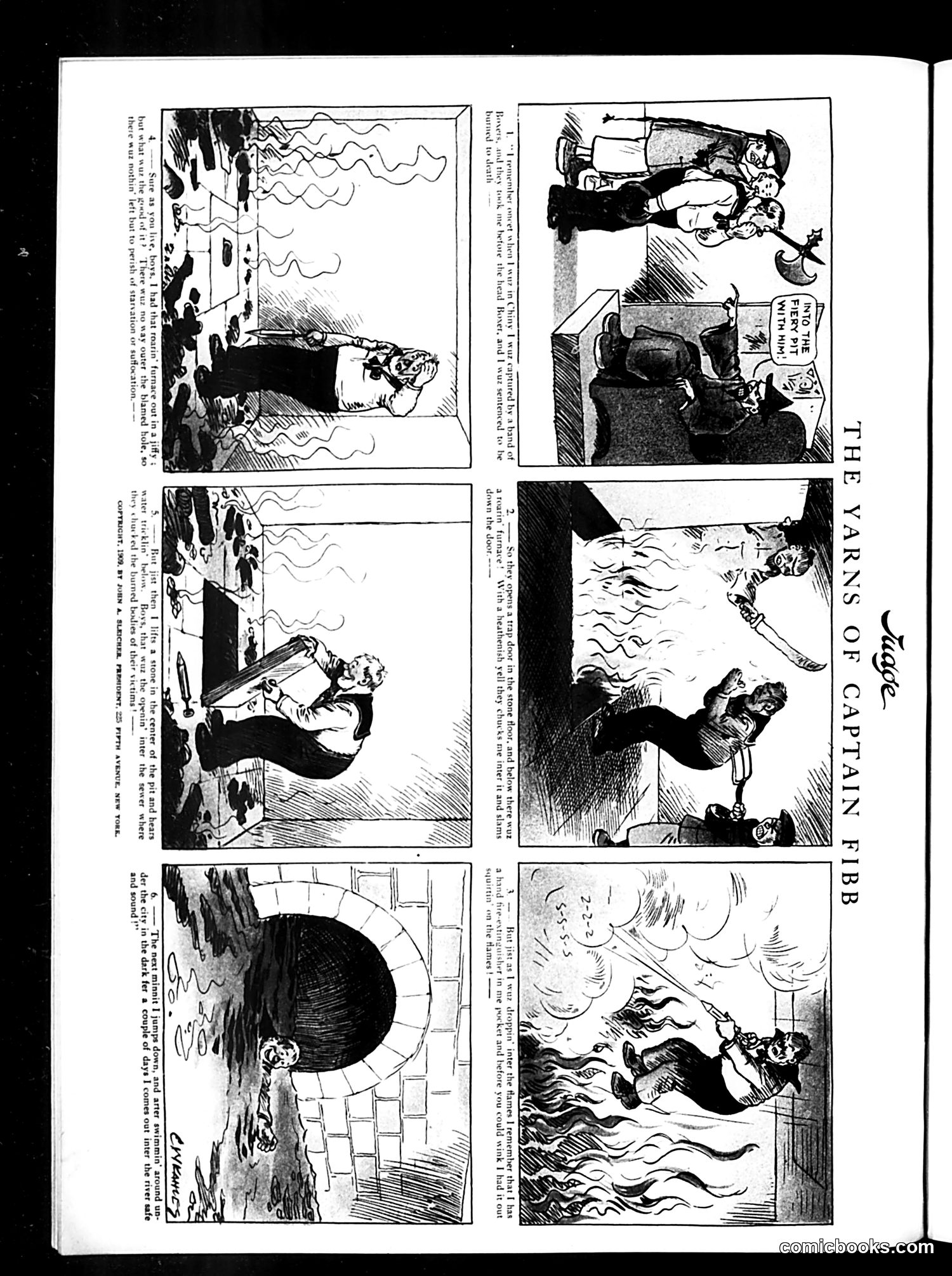
This is a humorous serial comic featuring Captain Fibb, an apparently unreliable storyteller. The OCR text "jumps down, and arter a couple of days I comes out" suggests Fibb is recounting an implausibly exaggerated adventure—jumping into a "fiery pit" and emerging unscathed days later. The comic mocks the tall-tale tradition and credulous audiences who accept outlandish stories. Judge magazine frequently satirized character types and social follies; here the target appears to be the boastful, untruthful narrator whose absurd claims strain belief. The format's sequential panels emphasize the escalating implausibility of Fibb's yarn, a comedic device familiar to Victorian/Edwardian audiences who enjoyed exposing fraudulent or self-aggrandizing storytellers.