
Judge, 1909-11-13 · page 2 of 16
Judge — November 13, 1909 — page 2: what you’re looking at
What you’re looking at
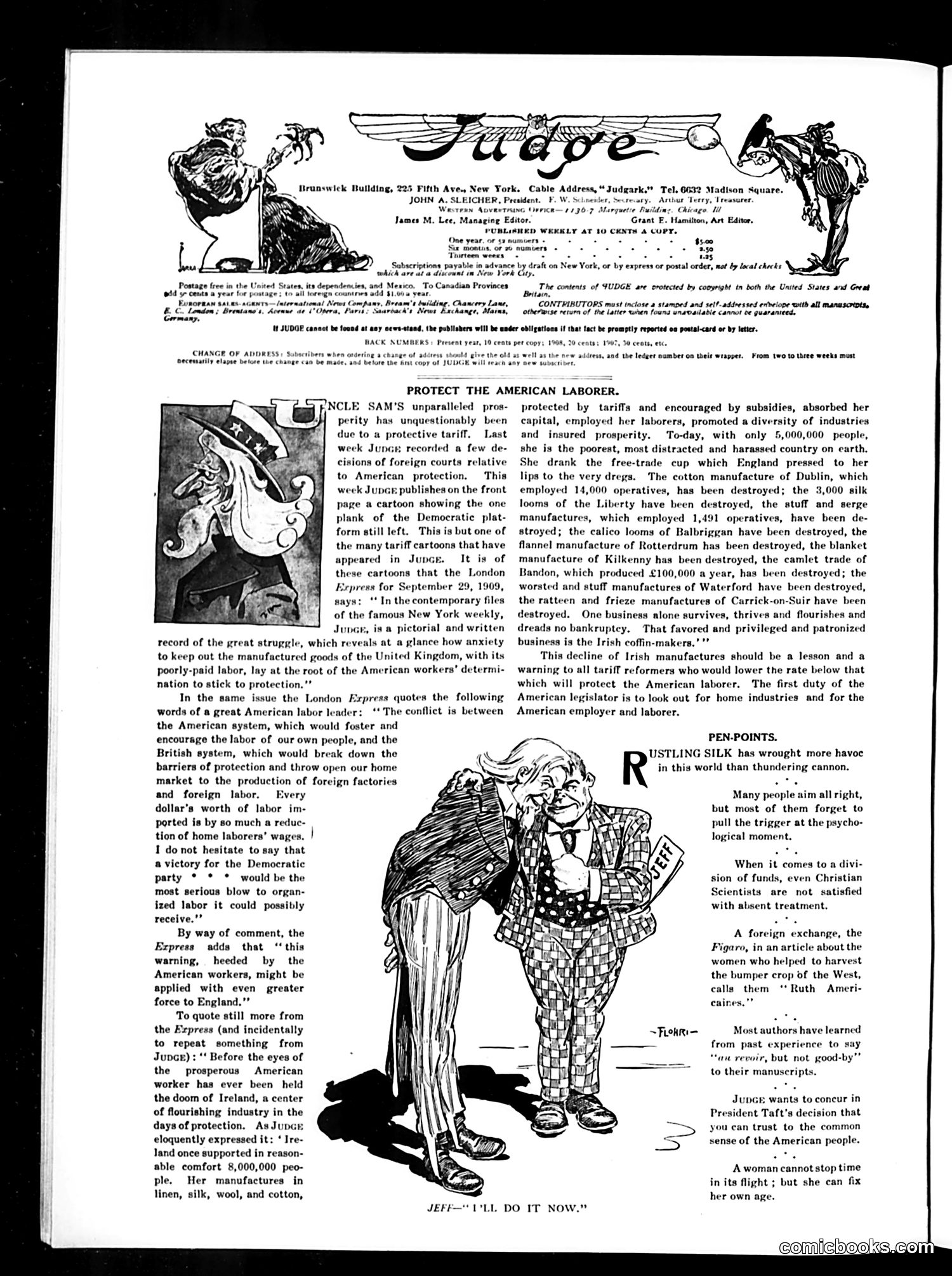
This page critiques American protectionist tariff policy. The main article "Protect the American Laborer" argues that high tariffs, meant to shield workers from foreign competition, have actually harmed American industries. It lists destroyed Irish manufacturers (linen, silk, wool, cotton) as evidence. The large cartoon depicts two figures—likely representing Ireland and Britain—in the caption "I'LL DO IT NOW," suggesting forced cooperation or submission regarding trade policy. The "Pen-Points" section offers brief satirical observations, including criticism of "rustling silk" and commentary on Christian charity and foreign exchange. The overall message: tariffs meant to protect American workers ironically damage international trade partners and ultimately backfire economically. This reflects late 19th/early 20th-century free-trade versus protectionist debates.
📄 Transcribed text from this page (OCR, searchable)
Machine-transcribed from the original scan — historical spelling and the odd misread are preserved.
Cable Address,“ Judgark." Tel. 6632 Madison Square. Arthur Terry, Treasurer, Tbe contents of FUDGE are erotected by conyright tn both the United States and Great CONTFIBUTORS must inciose a stamped and self-addvessed entveiope with all manascrtotss otherivise return of the Latter when founs unavailable cannot be guaranteed. JUDGE cannct be found at any news-stand, the publishers will be ander obligations if that tact be promptly reported on postal-card or by letter. BACK NUMBERS» Present year, 19 ceats pet copys 190 HANGER OF ADDRESS 0 ordering a atily elapve belote the change can be made, and belore the copy of JUDGE will teach any aew subs 4 the ledger oamber on theit wrapper. From two to three weeks mast Mast PROTECT THE AMERICAN LABORER. E SAM'S unparalleled pros- perity has unquestionably been due to a protective tariff. Last 2 recorded a few de- cisions of foreign courts relative to American protection. This week Jupce publishes on the front page a cartoon showing the one plank of the Democratic plat- form still left. This is but one of the many tariff cartoons that have appeared in Jupce. It is of these cartoons that the London Express for September 29, 1909, says: ‘* In thecontemporary files of the famous New York weekly, Jupce, is a pictorial and written record of the great struggle, which reveals at a glance how anxiety to keep out the manufactured goods of the United Kingdom, with its poorly-paid labor, lay at the root of the American workers’ determi- nation to stick to protection.” In the same issue the London Express quotes the following words of a great American labor lead “The conflict is between the American system, which would foster and encourage the labor of our own people, and the British system, which would br down the barriers of protection and throw open our home market to the production of foreign factories and foreign labor. Every dollar's worth of labor im- ported is by so much a reduc- tion of home laborers’ wages. | I do not hesitate to say that avictory for the Democratic party * * * would be the most serious blow to organ- ized labor it could possibly receive. By way of comment, the Express adds that “this warning, heeded by the American workers, might be applied with even greater force to England.”* To quote still more from the Express (and incidentally to repeat something from Junce) : Before the eyes of the prosperous American worker has ever been held the doom of Ireland, a center of flourishing industry in the days of protection. AsJu eloquently expressed it: ‘ Ire- land once supported in reason- able comfort 8,000,000 peo- ple. Her manufactures in linen, silk, wool, and cotton, JEFF" VL protected by tariffs and encouraged by subsidies, absorbed her capital, employed her laborers, promoted a diversity of industries and insured prosperity. To-day, with only 5,000,000 people, she is the poorest, most distracted and harassed country on earth. She drank the free-trade cup which England pressed to her lips to the very dregs. The cotton manufacture of Dublin, which employed 14,000 operatives, has been destroyed; the 3,000 silk looms of the Liberty have been destroyed, the stuff and serge manufactures, which employed 1,491 operatives, have been de- stroyed; the calico looms of Balbriggan have been destroyed, the flannel manufacture of Rotterdrum has been destroyed, the blanket manufacture of Kilkenny has been destroyed, the camlet trade of Bandon, which produced £100,000 a year, has been destroyed; the worsted and stuff manufactures of Waterford have been destroyed, the ratteen and frieze manufactures of Carrick-on-Suir have been destroyed. One business alone surv! » thrives and flourishes and dreads no bankruptcy. That favored and privileged and patronized business is the Irish coffin-makers.’"” This decline of Irish manufactures should be a lesson and a warning to all tariff reformers who would lower the rate below that which will protect the American laborer. The first duty of the American legislator is to look out for home industries and for the American employer and laborer. PEN-POINTS. Re SILK has wrought more havoc in this world than thundering cannon. Many people aim all right, but most of them forget to pull the trigger at the psycho- logical moment. When it comes to a divi- sion of funds, even Christian Scientists are not satisfied with absent treatment, n exchange, the Figaro, in an article about the women who helped to harvest the bumper crop of the West, calle them “Ruth Ameri- A for Most authors have learned from past experience to say vir, but not good-by”* to their manuscripts. an re Jupce wants to concur in President Taft's decision that you can trust to the common sense of the American people. Awoman cannot stop time in its flight ; but she can fix her own age. DO IT Now.”