
A complete issue · 16 pages · 1909
Judge — November 6, 1909
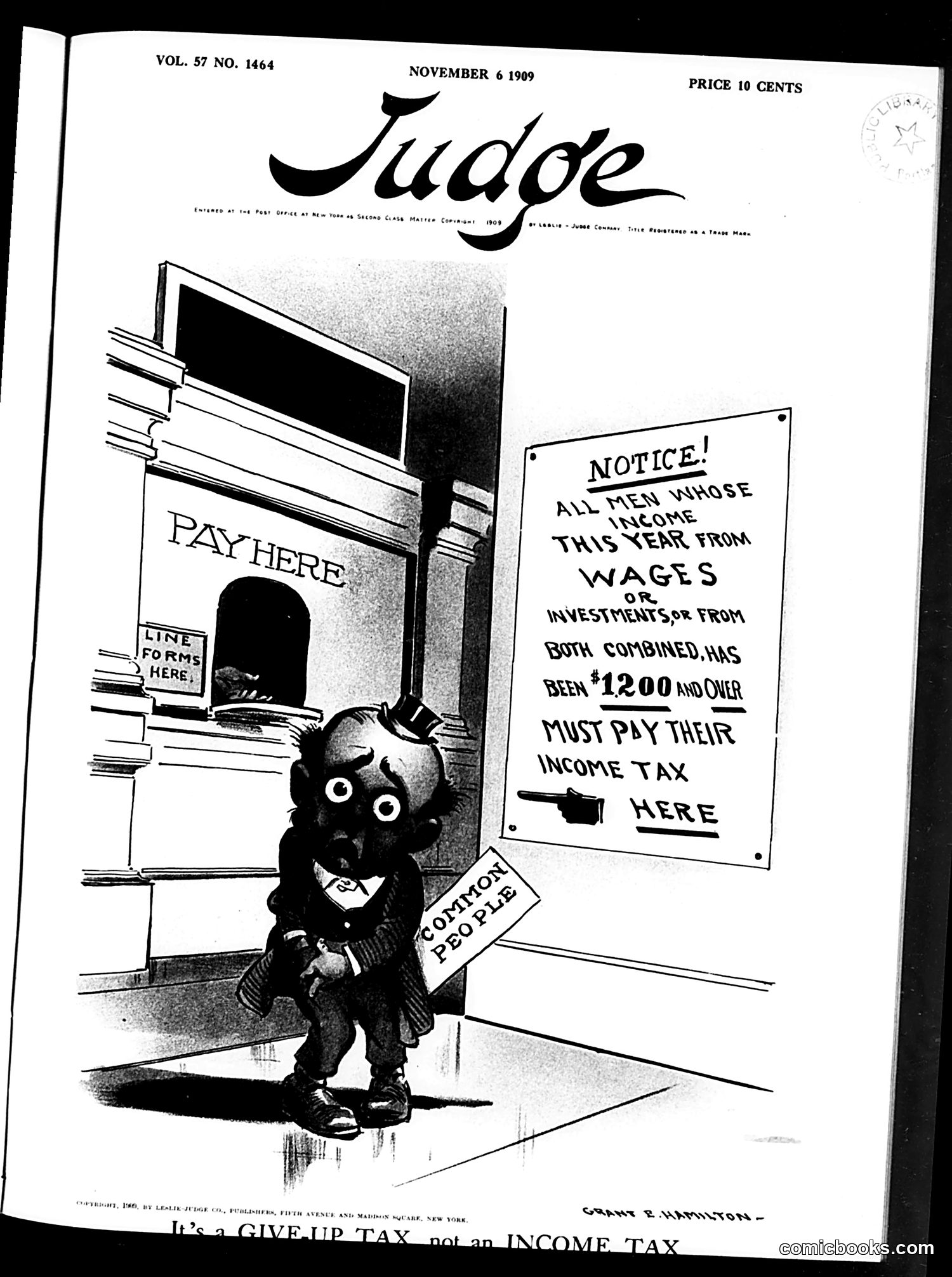
This cartoon satirizes the newly enacted federal income tax (ratified in 1913, but proposed earlier). A distressed figure labeled "Common People" stands at a tax collection booth marked "PAY HERE," confronted with a notice explaining that anyone earning $1,200+ annually must file and pay income tax. The cartoon criticizes the income tax as burdensome to ordinary workers, depicting the tax collector's office as an intimidating bureaucratic structure. The exaggerated, worried expression on the common person's face emphasizes the perceived injustice of the tax requirement. The caption "It's a Give-Up Tax, not an Income Tax" suggests the satirist views the tax as confiscatory—essentially forcing citizens to surrender their earnings rather than fairly taxing income.
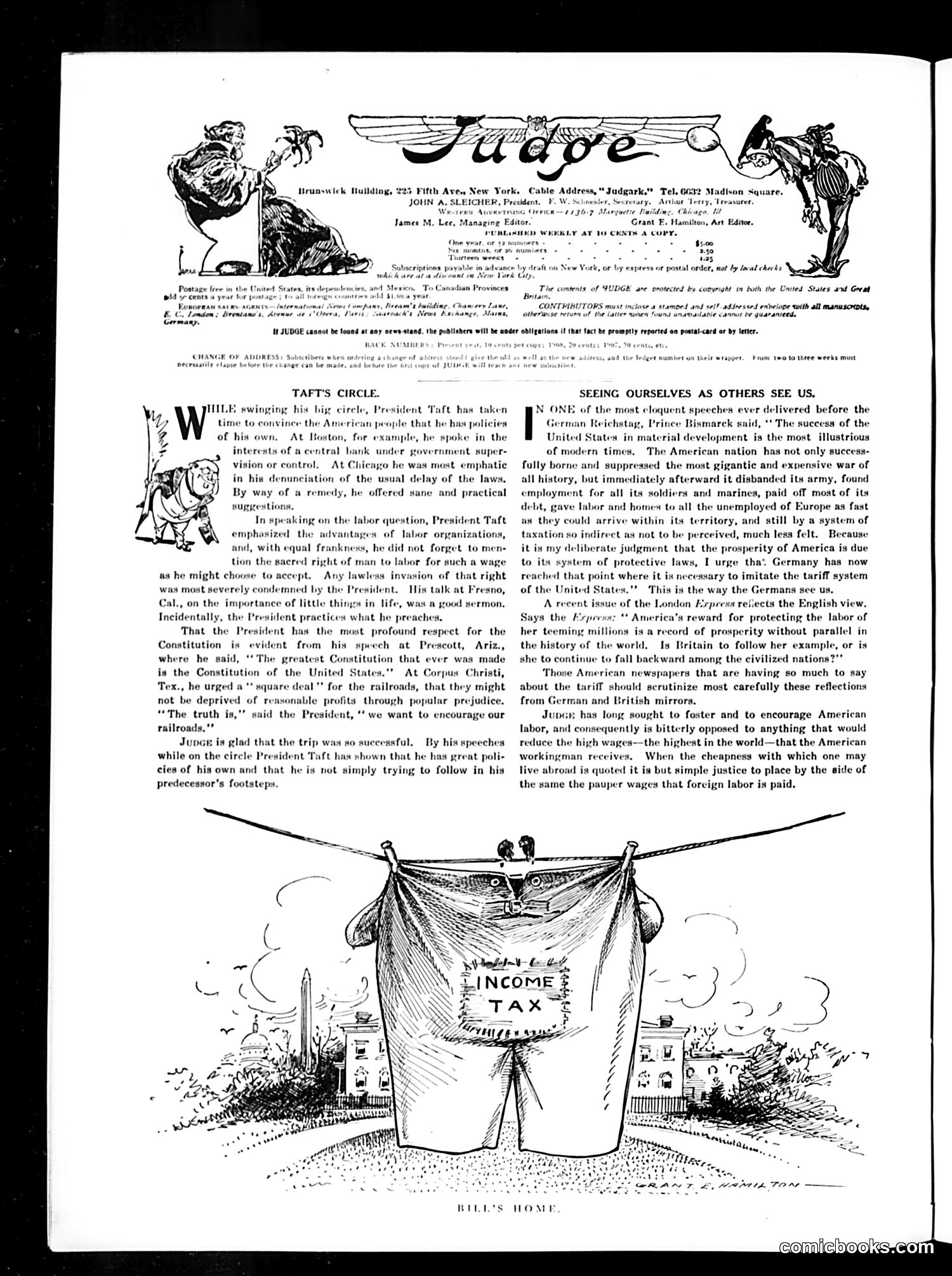
This Judge magazine page satirizes President Taft's policies through two sections: **"Taft's Circle"** (top left) praises Taft for convincing Americans of labor organization benefits and encouraging railroad development—presenting his perspective sympathetically. **"Seeing Ourselves as Others See Us"** (right) quotes German and British perspectives praising American wages and labor protections as superior to European standards. **"Bill's Home"** (bottom cartoon) shows an enormous income tax bill hanging on a clothesline like laundry, with the Capitol and Washington Monument visible. The cartoon ironically contrasts Taft's pro-labor, pro-business rhetoric with the reality of increased taxation burden on citizens. "Bill" likely represents the American public being figuratively washed by income tax obligations.
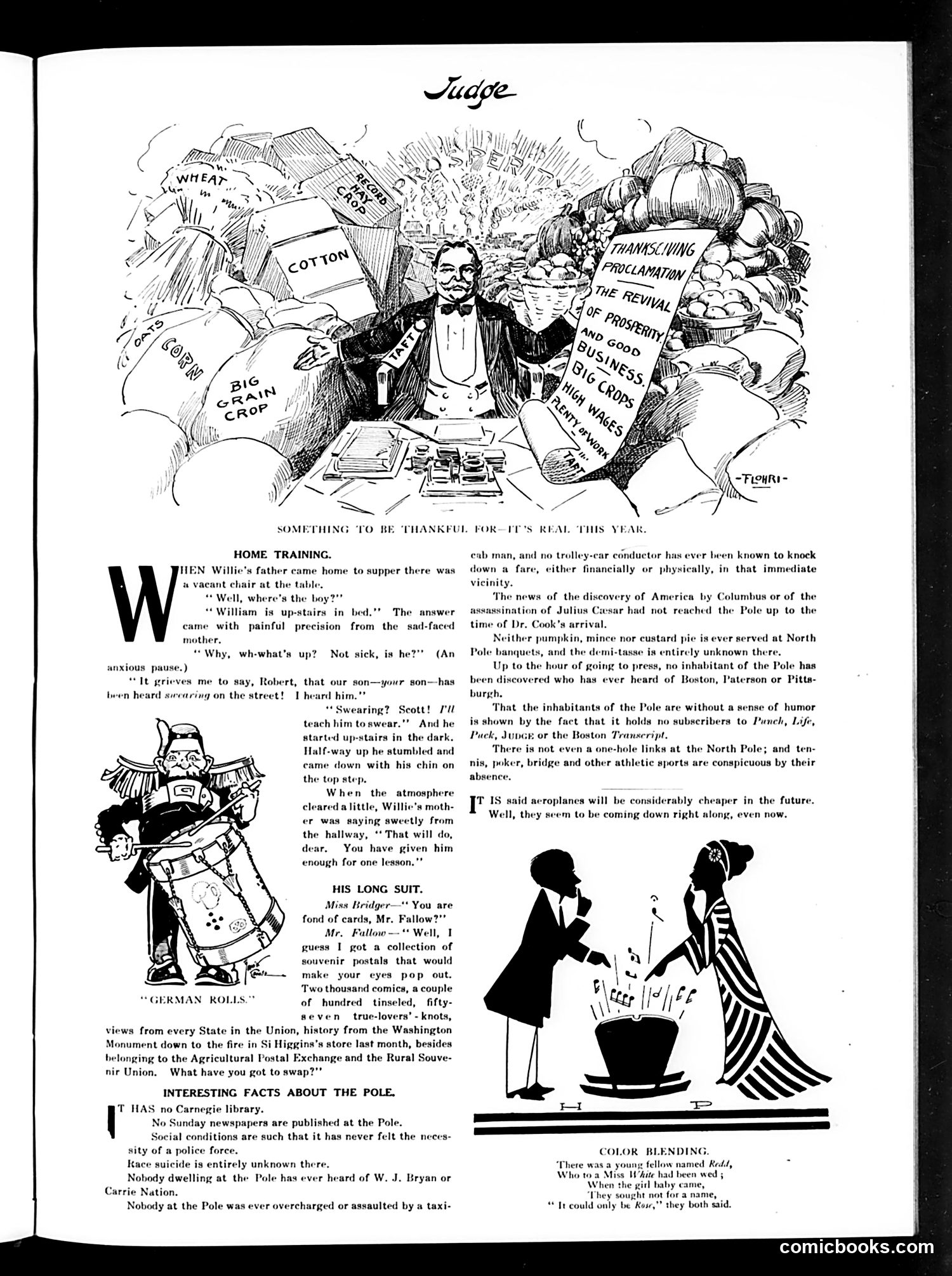
**Top Cartoon ("Judge"):** A well-dressed man sits at a desk surrounded by abundant agricultural products (wheat, cotton, corn, vegetables). Text labels reference "Thanksgiving Proclamation," "Revival of Prosperity," "Good Business," and "Higher Wages"—suggesting this depicts a government official or leader taking credit for economic abundance. The cartoon satirizes how political figures claim responsibility for national prosperity. **"Home Training" Section:** A humorous domestic dialogue where Willie's father discovers the boy has been "swearing on the street." The satirical commentary about "German Rolls" appears to mock immigrant cultural references or stereotypes of the period. **Bottom Cartoon:** A silhouetted couple discusses cards, with one mentioning a large collection of "souvenir postcards" and comics from various states—light social satire about collecting habits. The page mixes political satire with domestic humor typical of early 20th-century Judge magazine.
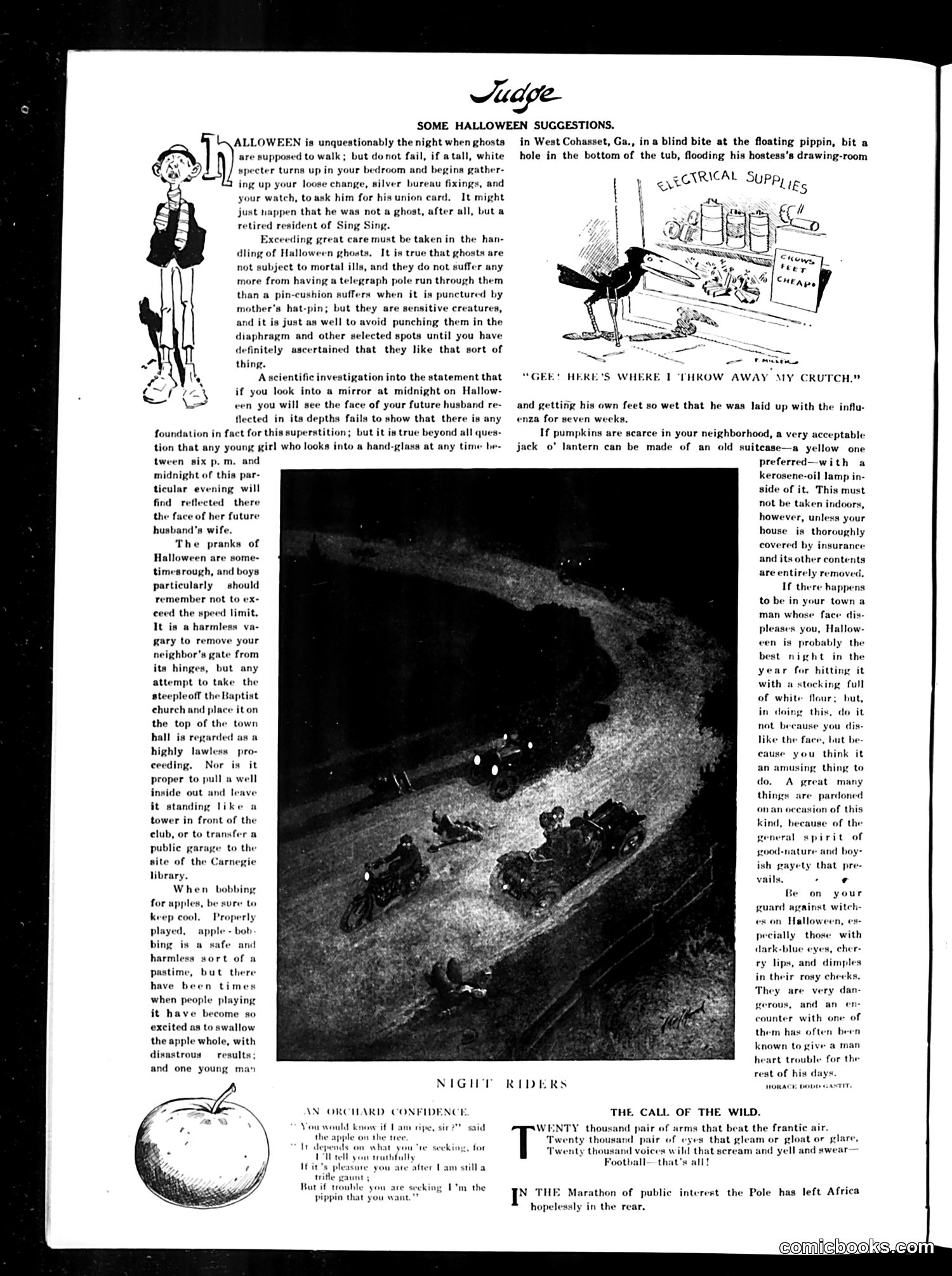
This page contains Halloween-themed humorous content rather than political satire. The main sections include: **"Some Halloween Suggestions"**: A lighthearted essay discussing Halloween pranks and superstitions, including folklore about seeing one's future husband in a mirror at midnight, and advice on harmless tricks like removing a neighbor's gate or bobbing for apples. **"Night Riders"**: A brief illustrated section with dialogue about apples, appearing to be a humorous domestic exchange. **"The Call of the Wild"**: References Poland's retreat from Africa during what appears to be a military conflict, though details are unclear from this excerpt alone. The page primarily offers entertainment and seasonal advice rather than political commentary, typical of Judge's lighter content during this era.
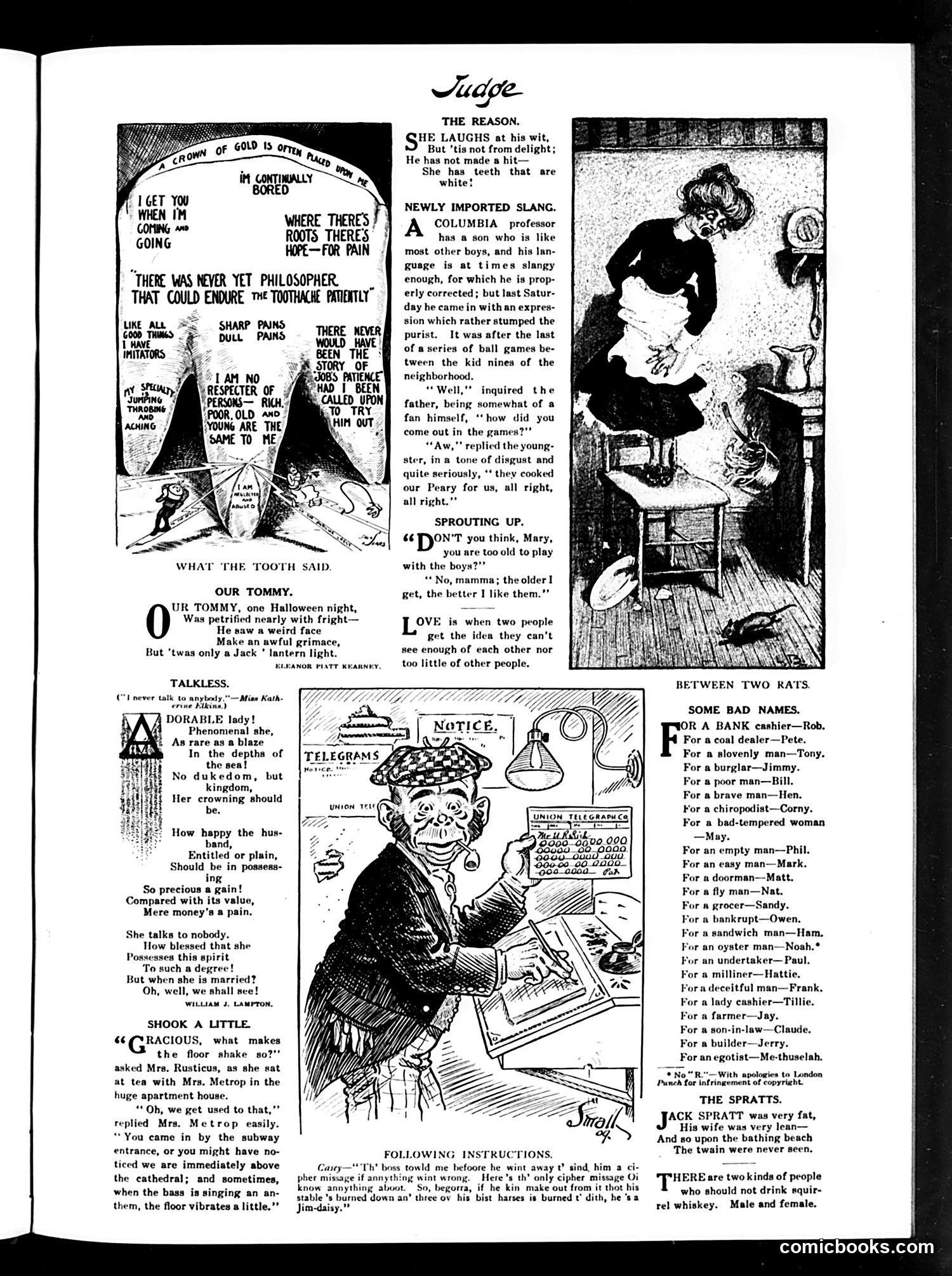
This page contains several unrelated humorous pieces typical of early-20th-century Judge magazine: **"What the Tooth Said"** (left cartoon) depicts anthropomorphized teeth debating philosophy, a whimsical piece with no clear political reference. **"Our Tommy"** is a sentimental poem about a boy frightened by a jack-o'-lantern on Halloween. **"Talkless"** presents a poem about a silent wife—social commentary on marriage dynamics. **Center cartoon** shows a telegraph operator, likely satirizing workplace or communication industry practices, though the specific reference is unclear. **"Some Bad Names"** is a humorous list matching occupations with insulting nicknames (a "bank cashier—Bob," "grocer—Sandy," etc.). **"Following Instructions"** discusses cipher messages. The page emphasizes humor, domestic life, and workplace satire rather than political commentary.
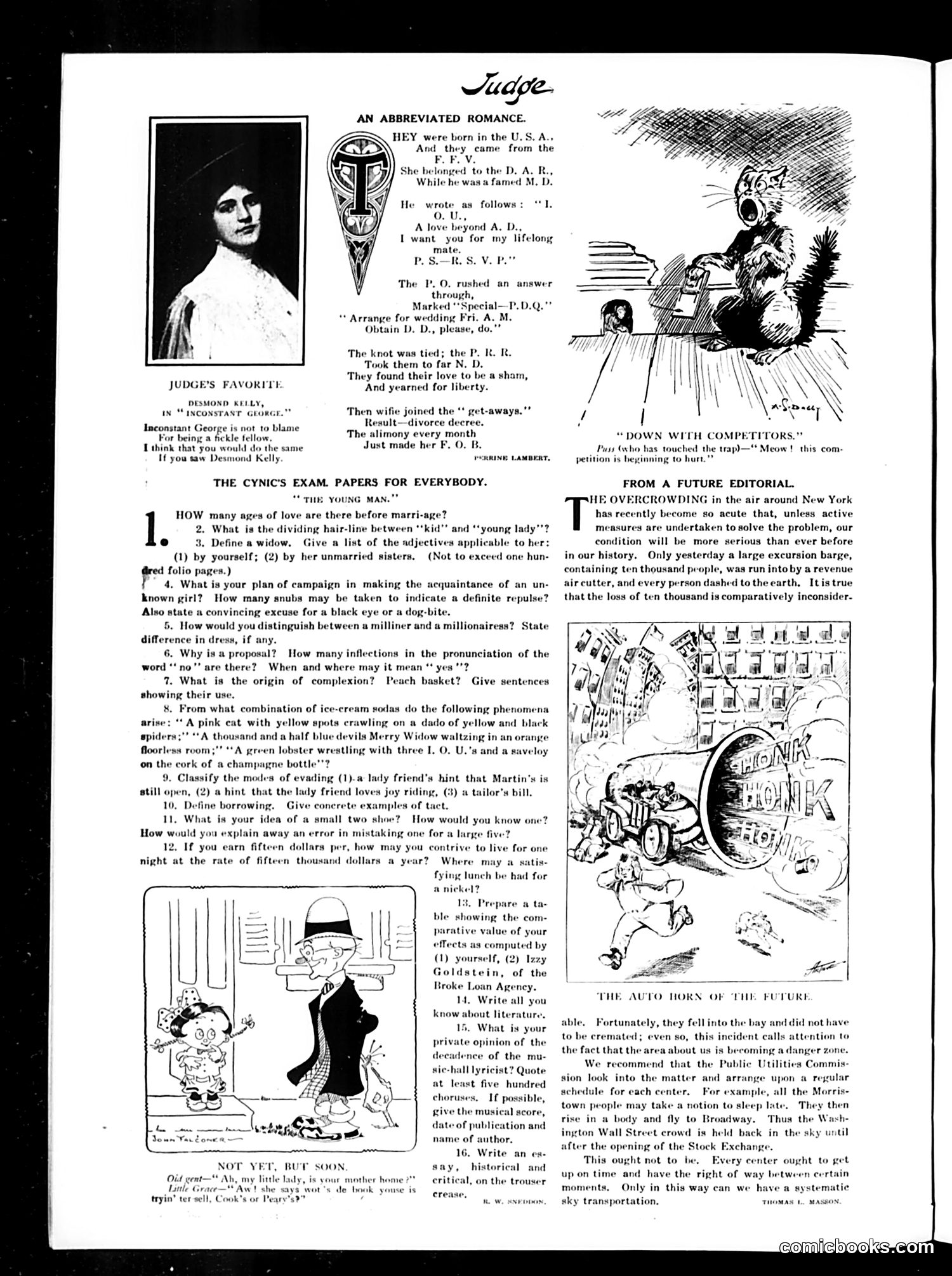
This page contains three distinct satirical pieces: **"An Abbreviated Romance"** (top): A cynical take on modern romance using abbreviations (U.S.A., D.A.R., M.D., F.P.V., P.O., N.D., F.O.B.). A woman from the D.A.R. (Daughters of the American Revolution) marries a famous M.D., but their love quickly becomes "a sham." She joins the "get-aways" (divorce movement), ending in divorce and alimony payments. The satire mocks both the frivolity of society marriages and the emerging divorce culture. **"The Cynic's Exam Papers"** (center): Humorous test questions about courtship, romance, and social climbing. Questions parody advice-column wisdom, asking about "ages of love" before marriage, how to meet unknown girls, and excuses for black eyes—mocking young men's romantic pursuits and social pretension. **"From a Future Editorial"** (right): A darkly comic prediction about dangerous air traffic congestion over New York, imagining aerial collisions killing thousands. This satirizes both futuristic technology anxiety and bureaucratic indifference to public safety. The overall tone is cynical about modern romance, courtship rituals, and technological progress.
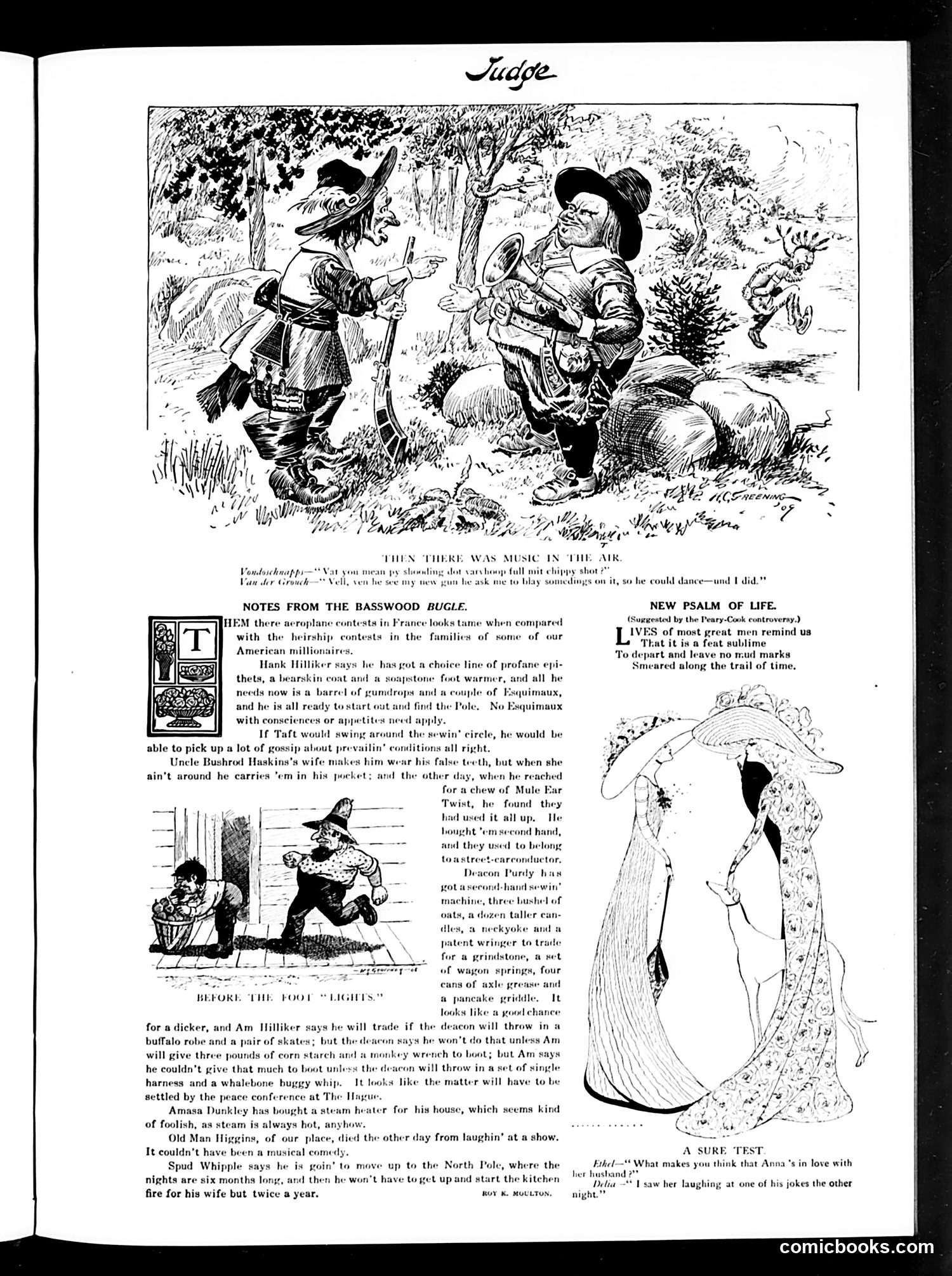
This page contains rural American humor typical of early 20th-century Judge magazine. The main cartoon depicts two rustic characters (likely named Vondoschnapps and Van der Grouch based on OCR text) in a woodland setting, appearing to be engaged in some kind of dispute or negotiation about trading goods. The accompanying text consists of folksy anecdotes about rural characters—Uncle Bushrod, Am Hilliker, the Deacon, Old Man Higgins, and Spud Whipple—trading various items (corn, buffalo robes, skates, harnesses). The humor relies on rural dialect and absurdist trading scenarios. One sidebar references the "Peary-Cook controversy," a real historical dispute over who first reached the North Pole (1909), suggesting this page dates from that era. The "Sure Test" cartoon illustrates a joke about whether a woman loves her husband based on laughing at his jokes. The satire targets rural simplicity and rustic trading customs rather than specific political figures or events.
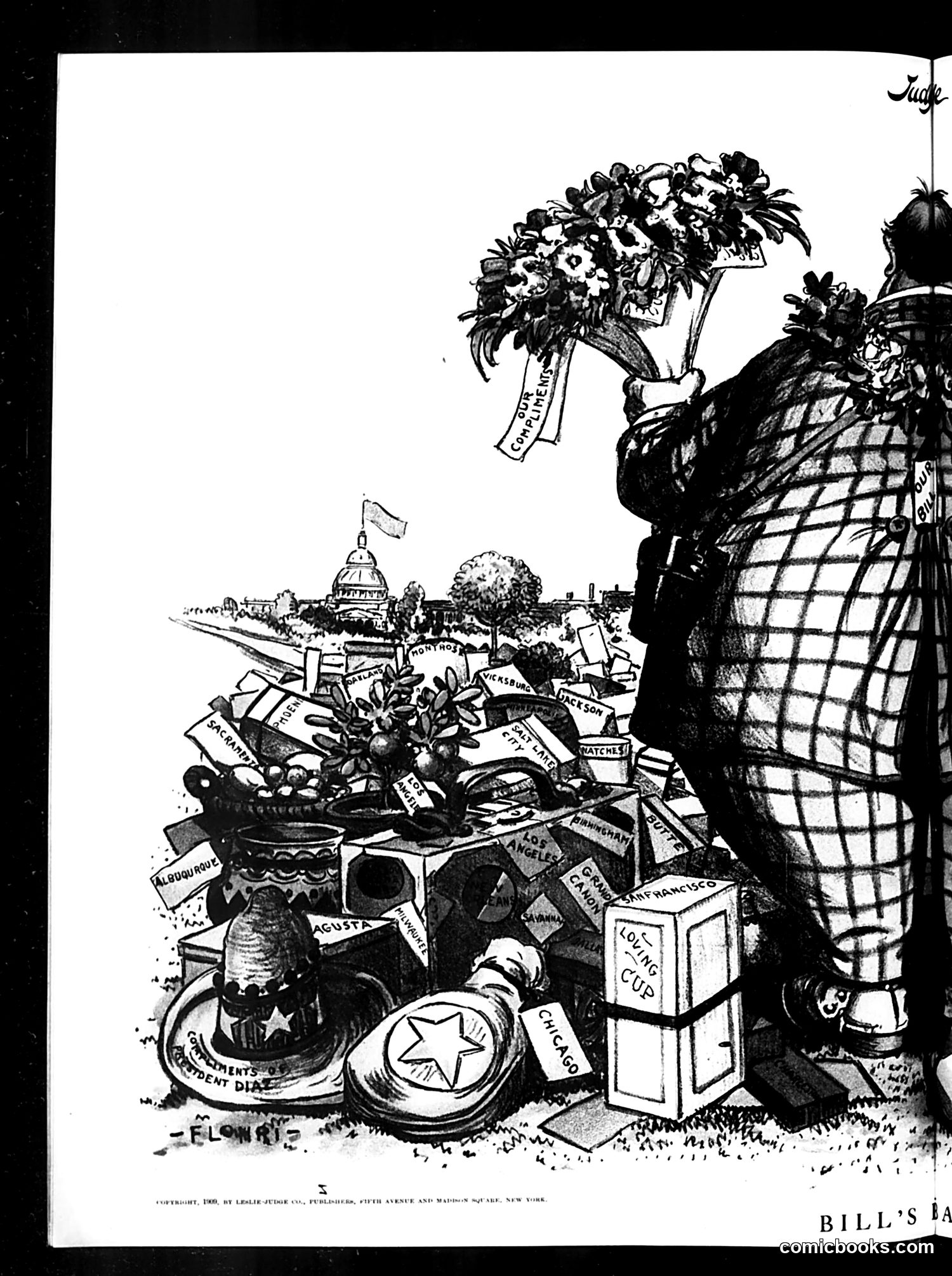
This appears to be a **Gilded Age political cartoon** satirizing congressional gift-giving or lobbying practices. The central figure (right side) is a well-dressed politician or congressman receiving an enormous bouquet of flowers labeled with various cities and states (visible text includes Augusta, Chicago, San Francisco, etc.). At his feet lies a heap of gifts, baskets, and boxes—likely representing bribes, favors, or district-specific presents from lobbyists and special interests. The Capitol building appears in the background, reinforcing the Washington D.C. setting. The cartoon's title "BILL'S" (likely referring to a specific bill under consideration) suggests this depicts how legislation becomes corrupted through regional patronage and constituent pressure. The satire mocks how politicians accumulated gifts and support by favoring particular districts or industries, illustrating the perceived corruption of the legislative process during this era.
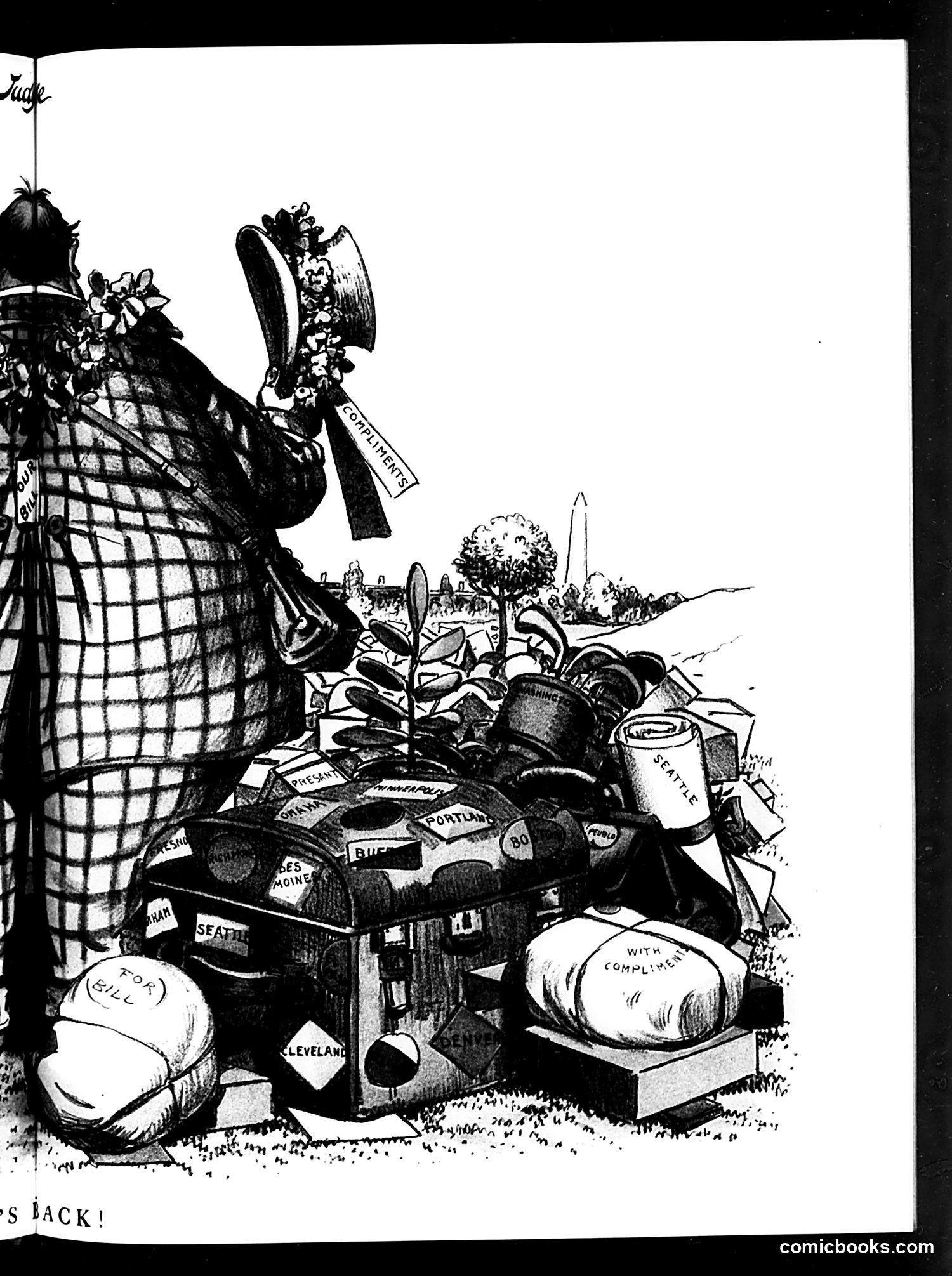
This Judge magazine cartoon depicts a large figure (left, wearing checkered clothing) presenting various American city souvenirs and goods to what appears to be a foreign visitor or dignitary. Visible labels include "Seattle," "Portland," "Chicago," "Cleveland," and "Boston" on various items—barrels, baskets, and containers. The figure holds a banner reading "Compliments" while presenting these regional products. In the background, the Washington Monument is visible, suggesting a diplomatic context in the nation's capital. The satire appears to mock American commercial boosterism and regional pride—the idea of aggressively marketing American goods and cities to visitors. The exaggerated presentation and abundance of labeled merchandise suggests commentary on American materialism or overselling of domestic products during what was likely the late 19th or early 20th century.
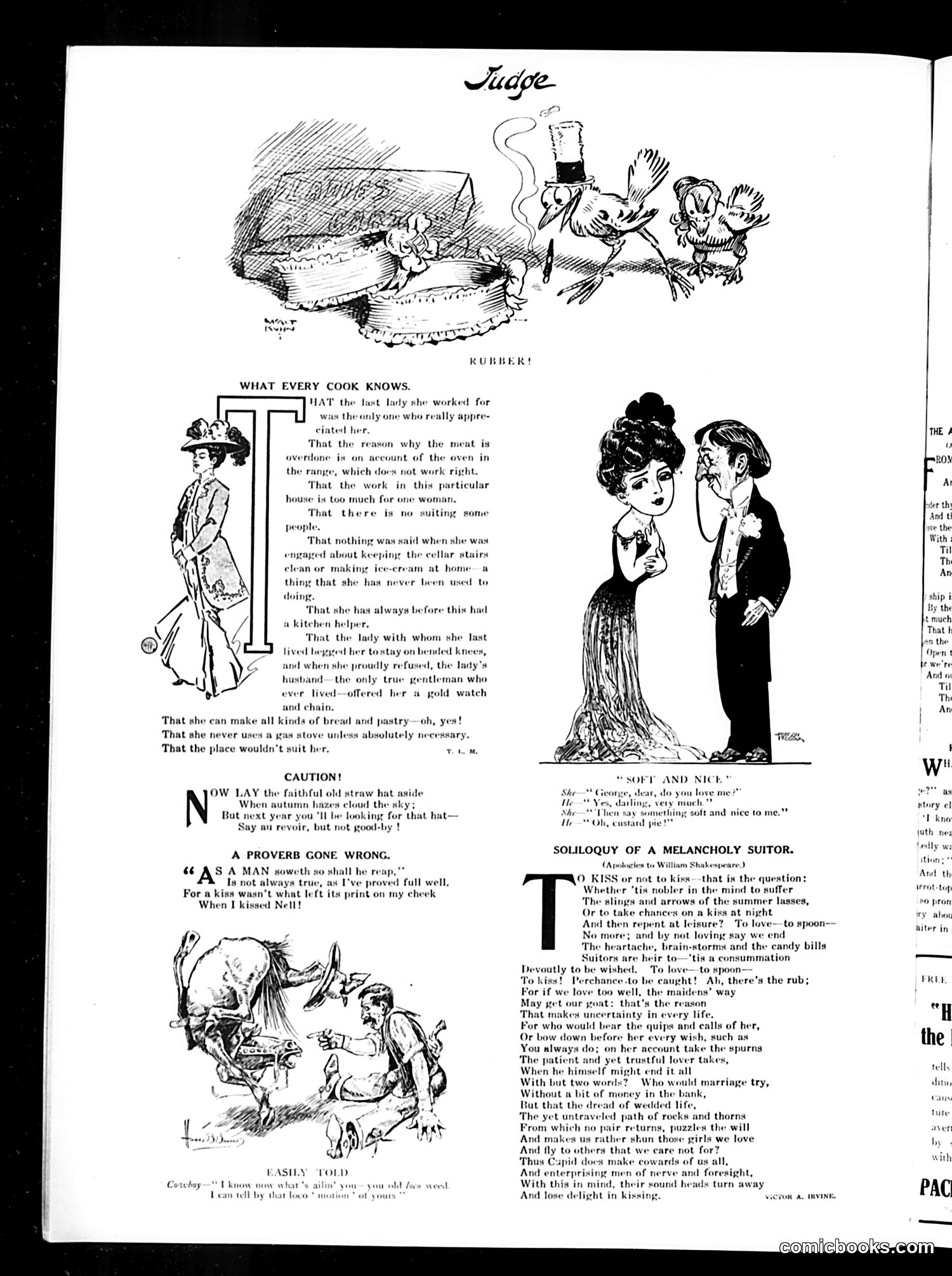
This page contains several satirical pieces typical of early 20th-century American humor: **"What Every Cook Knows"** mocks the impossible standards placed on domestic servants. It catalogs a cook's frustrations—her employer's complaints about housework, the broken equipment, lack of help—while sarcastically noting she's expected to produce elaborate meals anyway. The satire targets unreasonable employers who demand perfection from overworked servants. **"A Proverb Gone Wrong"** is a brief joke about kissing leaving a visible mark (lipstick or rouge) on the narrator's cheek—unexpected physical evidence contradicting the romantic proverb. **"Soliloquy of a Melancholy Suitor"** parodies Hamlet's "To be or not to be" soliloquy, applying it to romantic uncertainty: should he court women or avoid their complications? It's a humorous commentary on male ambivalence about relationships and marriage. The other pieces are short jokes about courtship and gender relations. Overall, the page satirizes domesticity, class relationships between employers and servants, and romantic complications—standard Judge magazine fare.
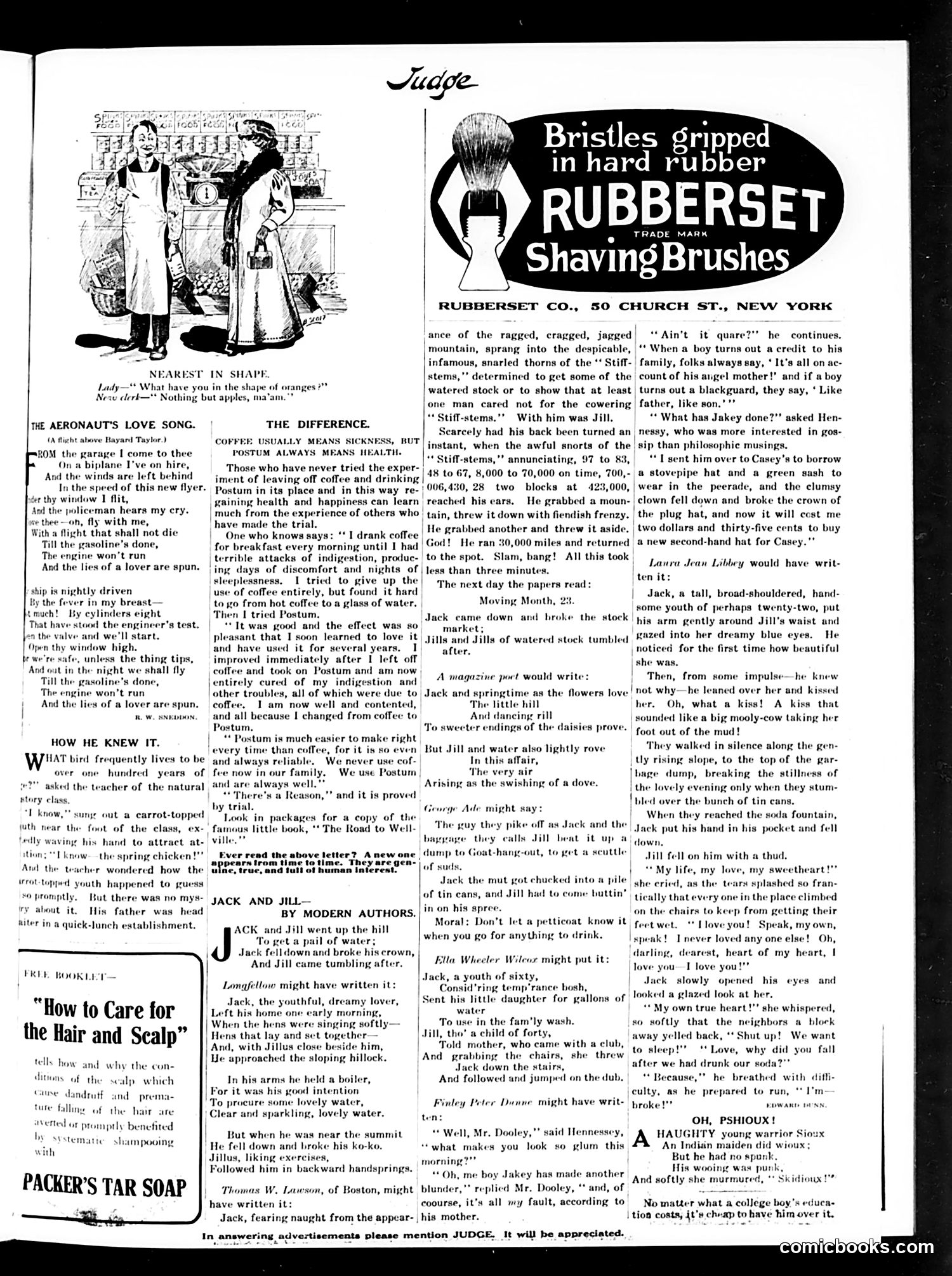
This page is primarily **advertising and serialized fiction**, not political satire. The main elements are: **Top Right**: A Rubberset shaving brush advertisement—a straightforward product pitch emphasizing rubber-gripped bristles for shaving. **Left Column**: "The Aeronaut's Love Song" and "How He Knew It"—light romantic poems about early aviation and courtship, reflecting early-1900s fascination with airplanes as novelties. **Center/Right**: A serialized romance story titled "Jack and Jill—By Modern Authors," featuring young lovers and melodramatic plot twists (stock market schemes, dramatic rescues). This was typical Judge magazine content—humor mixed with sentimental fiction. **Bottom Left**: A Packer's Tar Soap advertisement about hair care. The page reflects Judge's mixed format: advertisements subsidized the publication while serialized stories and light verse entertained readers. There's no evident political cartoon or sharp satire—just period commercial content and genteel romantic entertainment typical of early-20th-century American magazines.
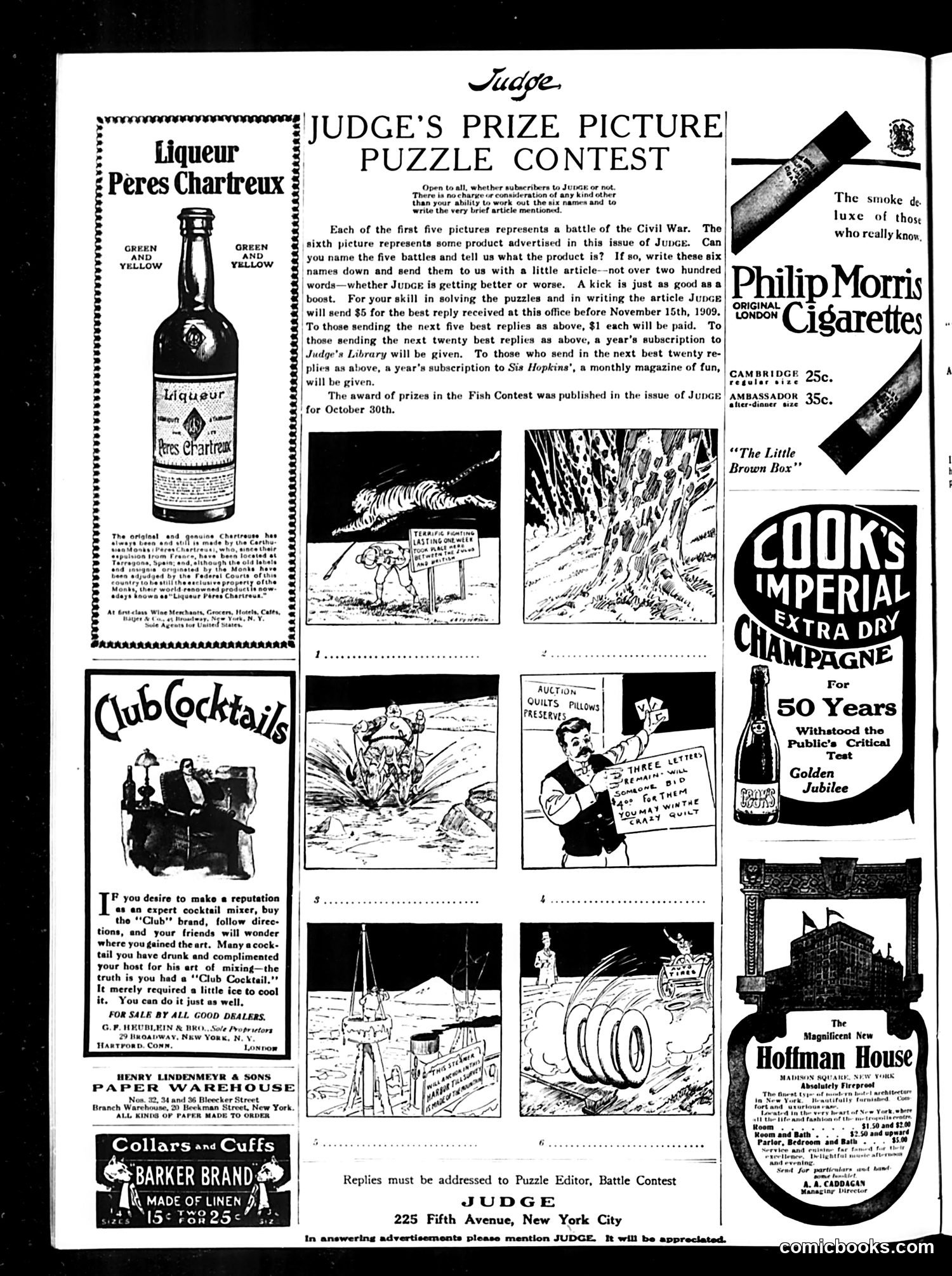
This page features a **puzzle competition** where readers identify five Civil War battles from cartoon illustrations, plus name an advertised product. The contest offered monetary prizes and magazine subscriptions to winners. The six images appear to depict **Civil War battle scenes** rendered as visual riddles—readers had to recognize which battles were represented and write a brief article evaluating whether *Judge* magazine was improving or declining in quality. Winners received $5 for the best entry, with additional prizes for subsequent submissions. The page is primarily an **advertising vehicle** for various products (liqueurs, cigarettes, champagne, collars) and establishments surrounding the puzzle contest. This was typical of *Judge*'s format: mixing satirical content with sponsored advertisements. The contest itself served dual purposes—engaging readers while promoting the magazine's brand and longevity.
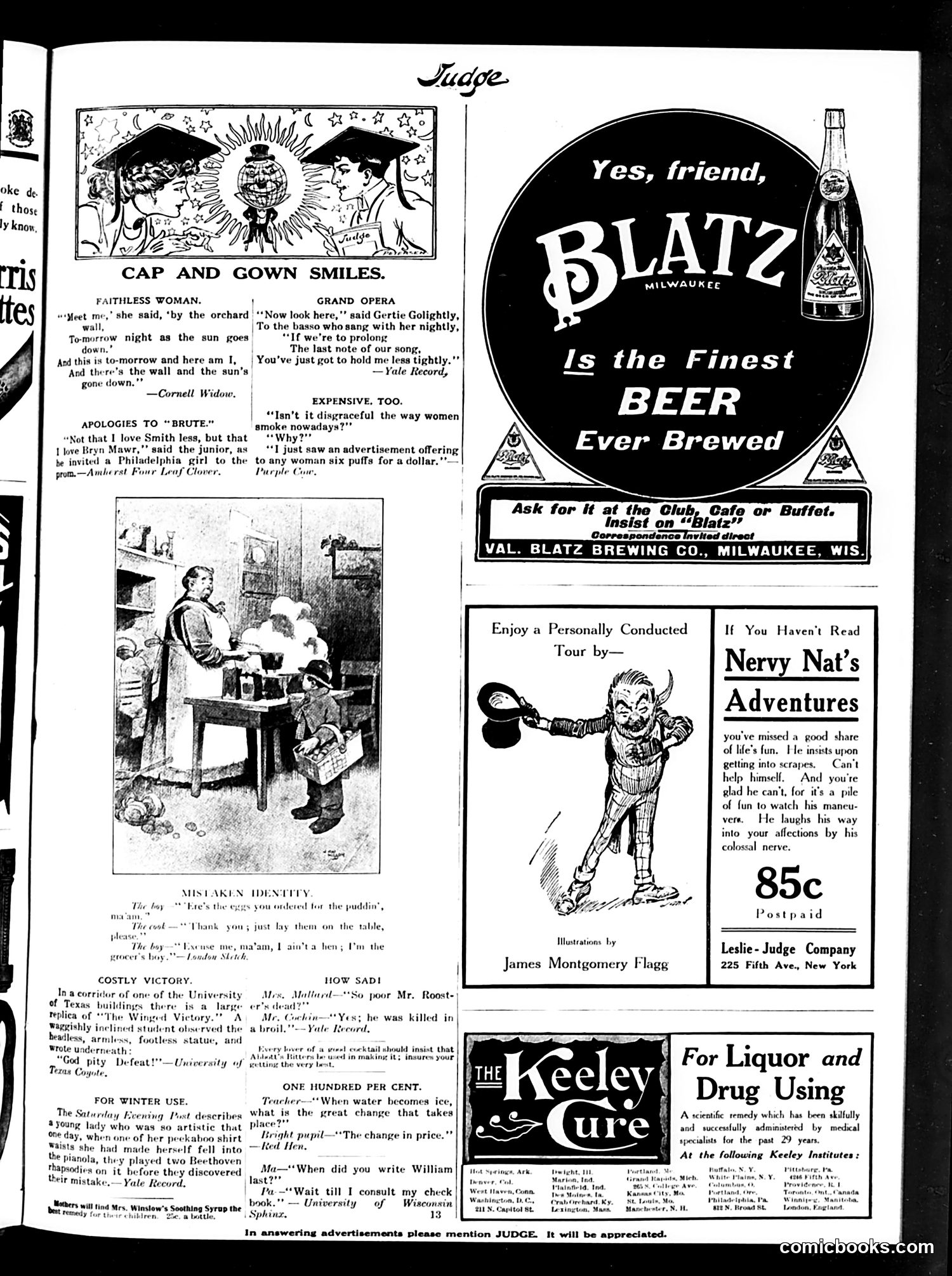
This Judge magazine page contains **humorous short jokes** from college newspapers (Cornell, Yale, Amherst, Wisconsin), plus advertisements. **The jokes** are gentle romantic or domestic humor typical of early 20th-century college life: a woman arranging a secret romantic meeting; an opera singer complaining about being held too tightly during performance; a junior choosing his college over his girlfriend; confusion over grocery delivery. **Key satirical content**: One joke mocks women smoking as a new fad, with an ad claiming cigarettes sold cheaply ("six puffs for a dollar"), suggesting wasteful consumption. Another pokes fun at a headless replica of the classical "Winged Victory" statue on a university campus—likely suggesting the irony of imitating classical art without understanding its meaning. **The advertisements** promote Blatz beer (Milwaukee brewing company), "Nervy Nat's Adventures" (children's book), and notably, the Keeley Institute—a real historical chain offering treatment for alcoholism and drug addiction, reflecting Progressive Era concerns about substance abuse. The page reflects early 1900s college humor and social anxieties.
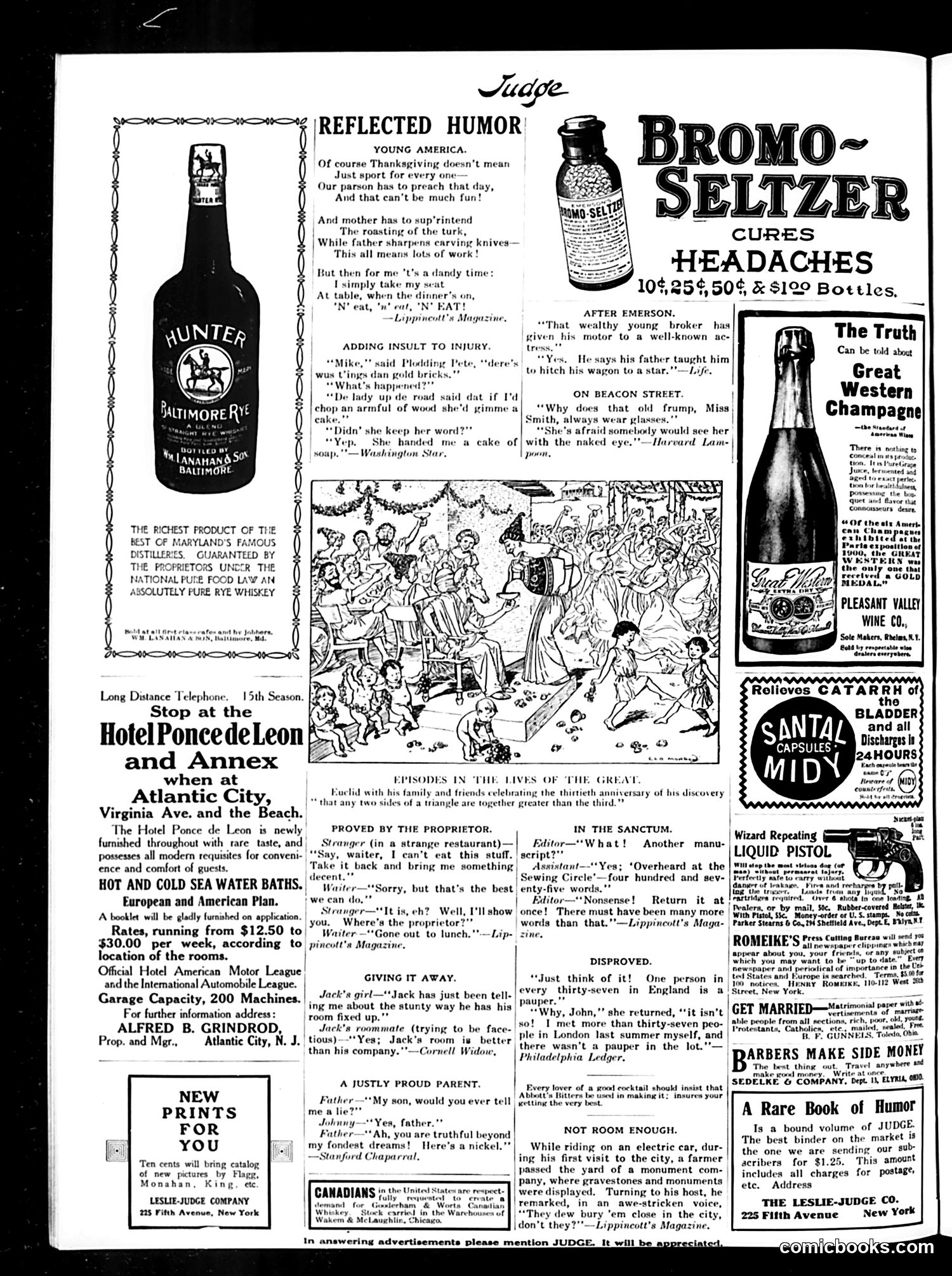
This page is primarily **advertisements and humorous fillers** rather than a unified political cartoon. The content reflects early 20th-century American life: **Main Image**: A crowded Thanksgiving scene depicts "Young America" - children enjoying the holiday while adults do labor (roasting turkeys, sharpening knives). The satire mocks how Thanksgiving is "sport for every one" except those who must work. **Humor Shorts**: Brief jokes scattered throughout poke fun at everyday situations - a servant promised cake but wasn't paid, a young woman afraid to be seen with a car, a man boasting about his messy room. These reflect period class dynamics and emerging automobile culture. **Advertisements**: Whiskey, Bromo-Seltzer, champagne, and hotels dominate, typical of Judge magazine's revenue model. The overall tone is gentle, middle-class satire—mocking pretension, laziness, and social awkwardness rather than advancing serious political critique.
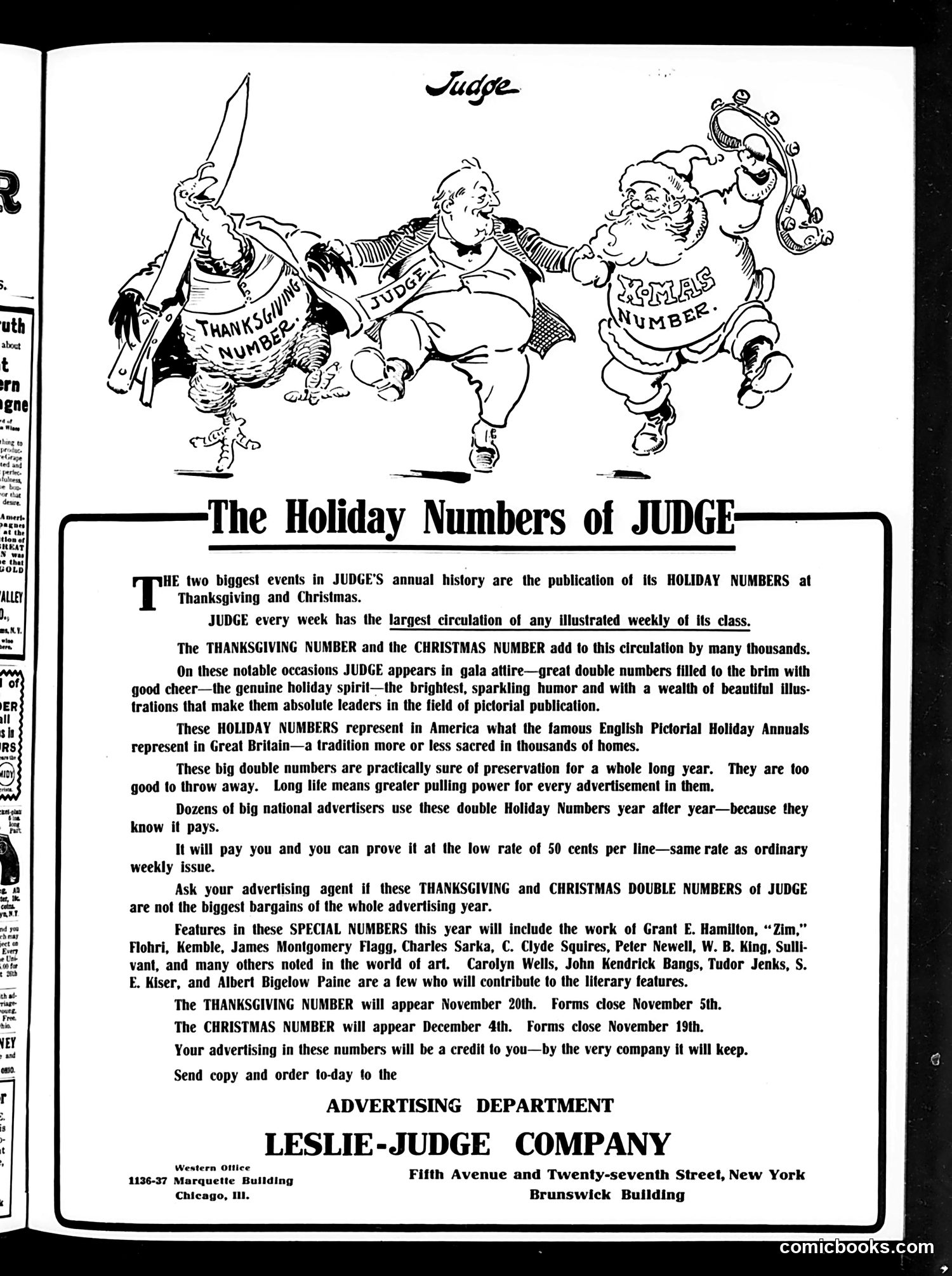
This is primarily a **sales advertisement** for *Judge* magazine's special Thanksgiving and Christmas issues, not a political cartoon. The illustration at top shows three jovial figures labeled "Thanksgiving Number," "Judge," and "Xmas Number" dancing together—a visual metaphor for the magazine's celebration. The text pitches advertisers on why these double issues are valuable: they have massively expanded circulation, get preserved in homes year-round (unlike regular weekly issues), and are therefore seen repeatedly by readers. The ad emphasizes that *Judge*'s holiday numbers rival England's prestigious pictorial holiday annuals and promises contributions from famous cartoonists and writers (Grant Hamilton, James Montgomery Flagg, etc.). Key detail: the advertising rate is 50 cents per line—identical to ordinary weekly issues—positioning this as an exceptional bargain for premium placement.
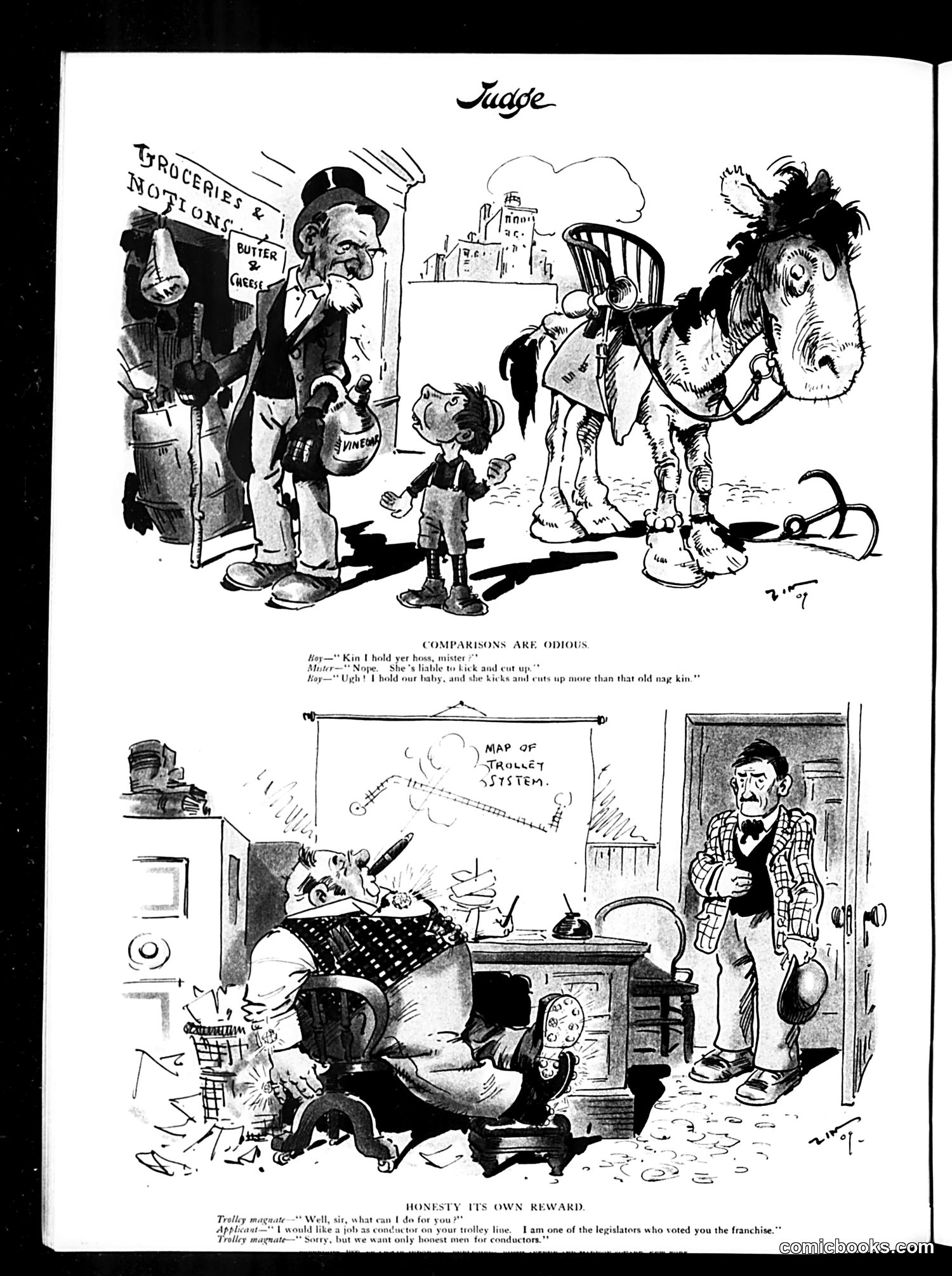
This page contains two satirical cartoons: **Top cartoon ("Comparisons Are Odious"):** A grocer with exaggerated features stands beside a scrawny horse. A small child compares the horse unfavorably to his mother, saying the horse "kicks and cuts up" more than she does. The satire mocks both the poor quality of goods/services and suggests commentary on family dynamics or parenting standards of the era. **Bottom cartoon ("Honesty Its Own Reward"):** A disheveled trolley conductor lies in bed, apparently injured or ill, surrounded by a messy room. A visitor arrives with what appears to be official business. The caption references "honest men" and a "franchise," suggesting satire about corrupt transit systems or the ironic fate of those who maintain integrity in corrupt municipal services. Both cartoons employ visual exaggeration typical of Judge's style to critique social and urban conditions.