
A complete issue · 16 pages · 1909
Judge — October 2, 1909
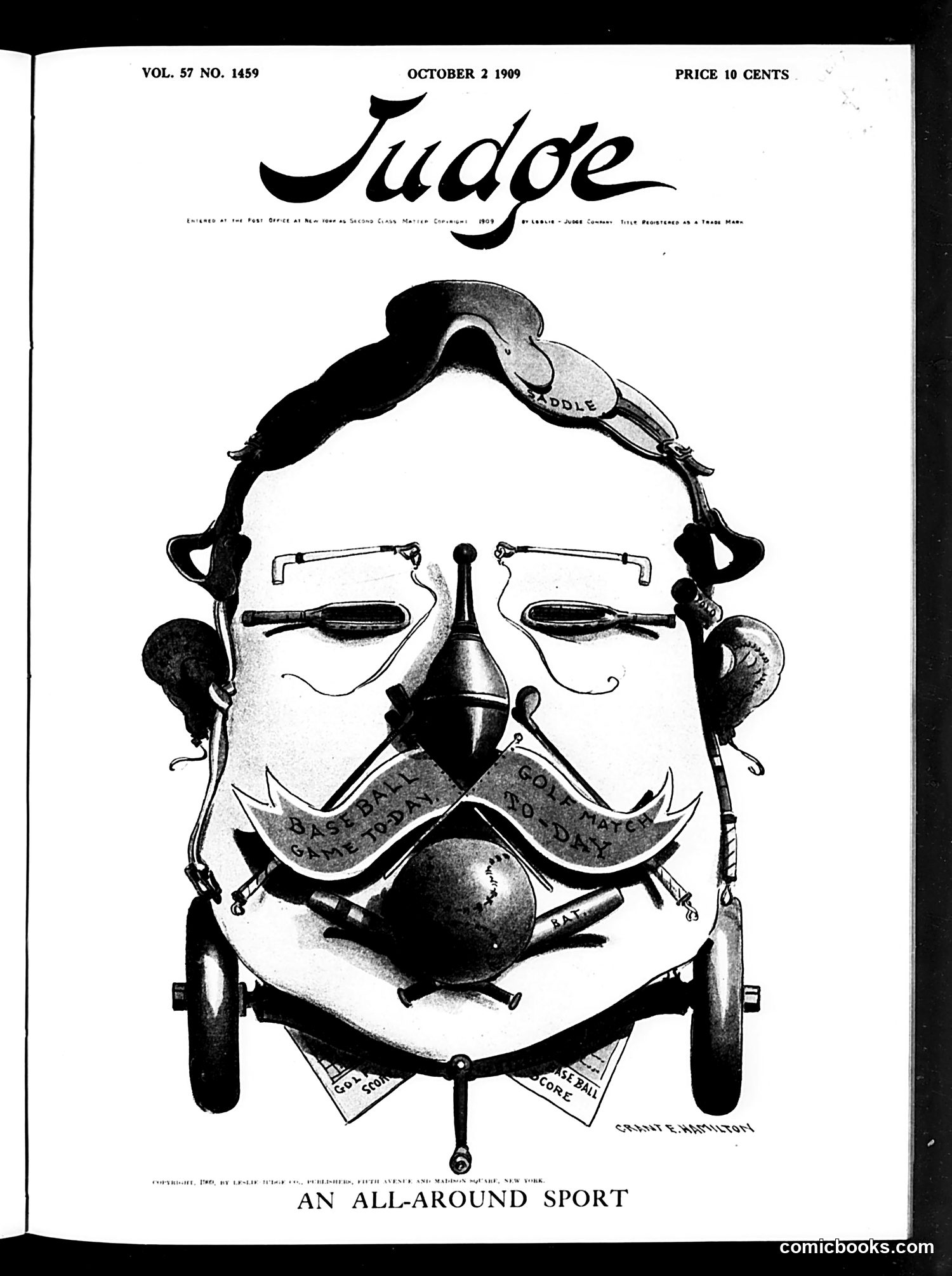
This surrealist political cartoon depicts a grotesque face assembled from sporting equipment. The features include: - **Eyes**: Eyeglasses with what appear to be fishing flies - **Nose**: A riding crop or whip - **Mustache**: Labeled text (partially legible) suggesting different sports - **Mouth**: A baseball - **Ears/sides**: Appears to show riding equipment and athletic gear - **Top**: A saddle - **Chin**: A polo mallet The title "An All-Around Sport" suggests satire about wealthy Americans' participation in multiple leisure pursuits—fishing, horseback riding, baseball, golf, and polo. This likely mocks the elite's obsession with various sporting activities as markers of social status. The grotesque composite face emphasizes how thoroughly sports dominated the identity and leisure time of the upper classes in the early 1900s.
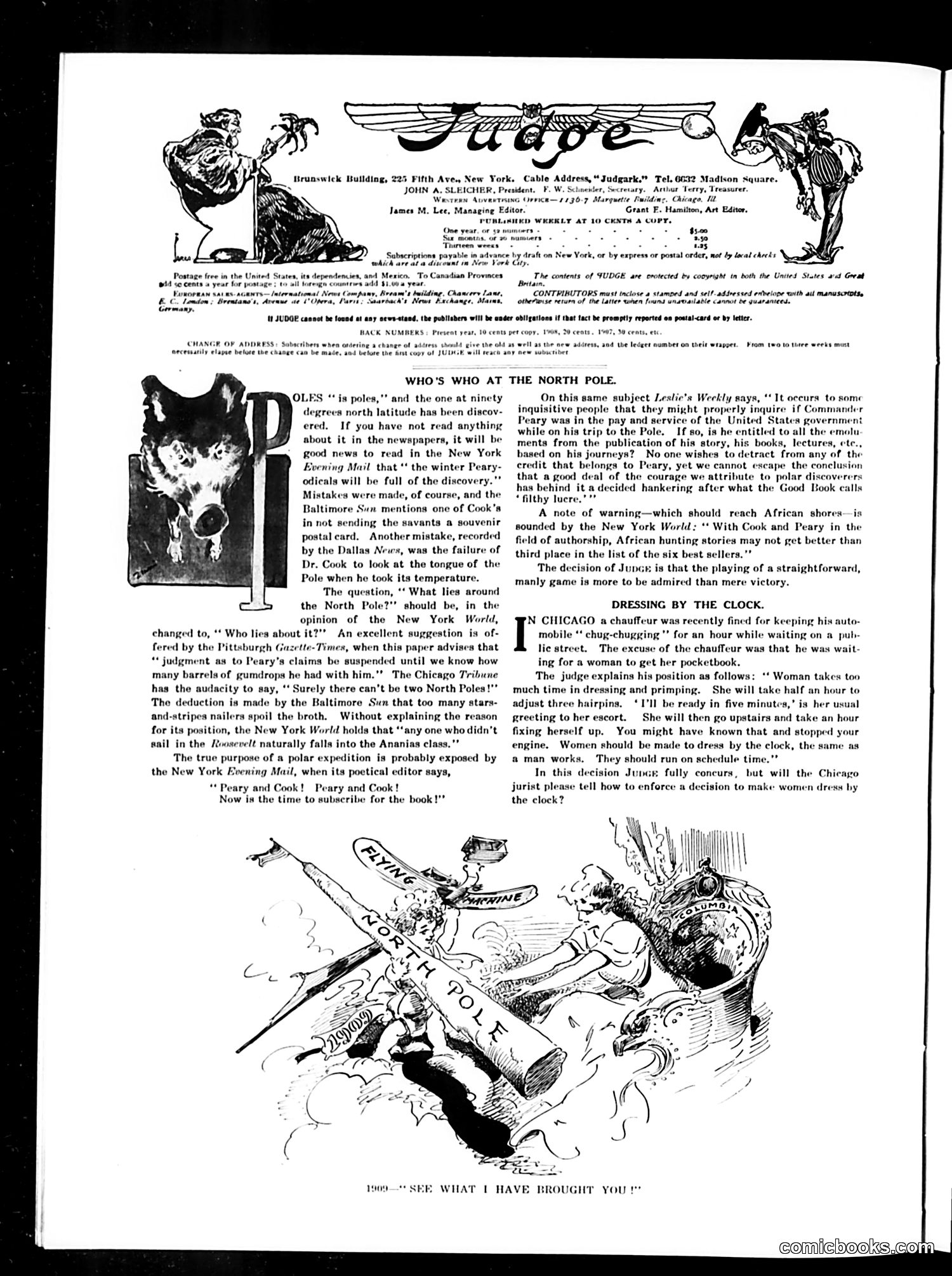
This page satirizes competing claims about Arctic exploration. The main article "Who's Who at the North Pole" addresses confusion over discovery credit, specifically debating whether Peary or Cook deserves recognition. The text references the "New York World" newspaper's coverage and notes that Cook's accomplishment was disputed. The bottom cartoon, titled "See What I Have Brought You!" depicts Arctic explorers in conflict—likely representing the Peary-Cook rivalry—with figures labeled "NORTH POLE," "PLUCK," and "RUNNING" tangled together. The satire mocks how both explorers' competing claims created chaos rather than clear achievement. The sidebar "Dressing by the Clock" jokes about a judge's ruling on women's dress schedules, an unrelated humorous piece typical of Judge's satirical magazine format.
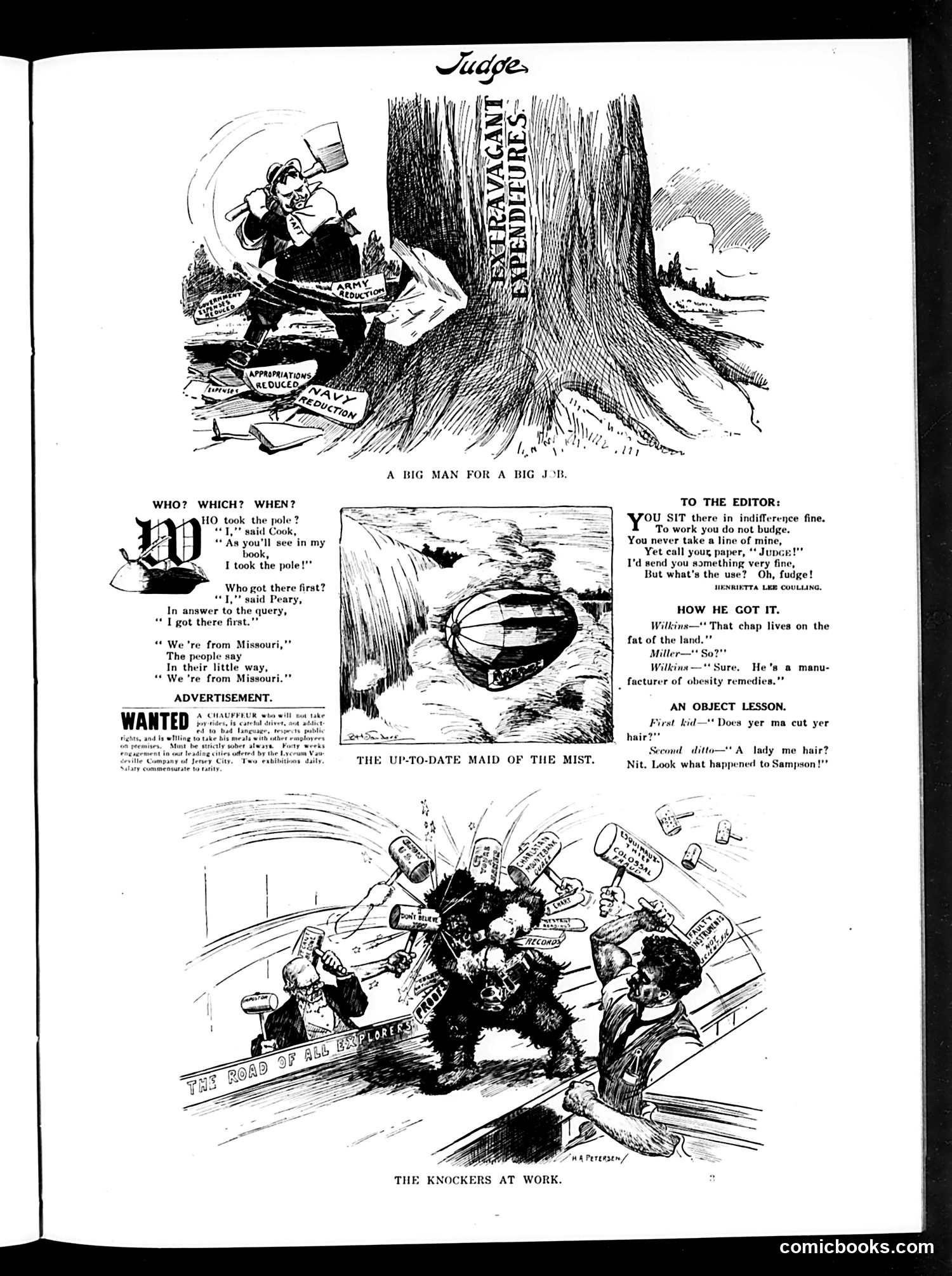
This page contains four political cartoons satirizing early 20th-century American issues: 1. **"A Big Man for a Big Job"**: A figure labeled "Extravagant Expenditures" chops at a massive tree marked "Reciprocal Duties," suggesting criticism of government spending and trade policies. 2. **"The Up-to-Date Maid of the Mist"**: Appears to reference tourism or modernization, though details are unclear. 3. **"The Knockers at Work"**: Shows a figure surrounded by bottles and documents labeled with various criticisms or complaints, satirizing vocal opponents or "knockers" (critics) attacking someone's work or policies. The page also includes joke items and reader letters. The cartoons use exaggeration and symbolic imagery typical of Judge's satirical approach to contemporary political and social controversies, though specific figures and exact historical context require additional information to identify with certainty.
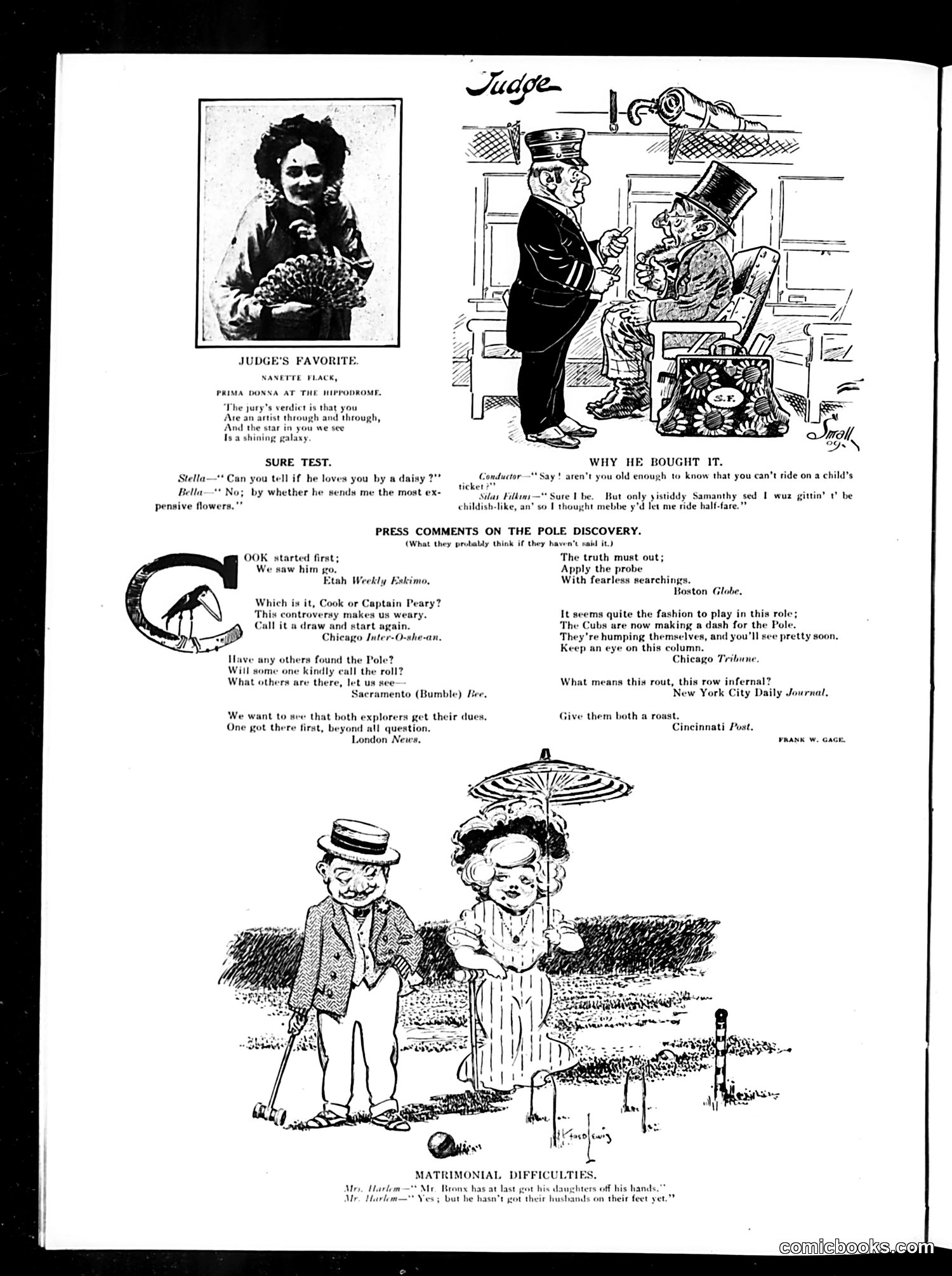
This page satirizes the 1909 Pole Discovery controversy. The top section features "Judge's Favorite," a photograph of a woman with a fan (likely a theatrical or public figure). The main content mocks competing claims by explorers Cook and Peary to have reached the North Pole first. The "Press Comments" section collects newspaper reactions, with publications questioning which explorer actually reached the Pole, calling for verification, and expressing skepticism about their competing claims. The bottom cartoon depicts "Matrimonial Difficulties"—a couple's marital troubles, where the husband's claim he "hasn't got his discharge off his hands" suggests unresolved domestic conflict, using the Pole discovery dispute as a metaphor for competing, unresolved claims in relationships. The satire targets both the explorers' disputed achievement and broader themes of verification and credibility.
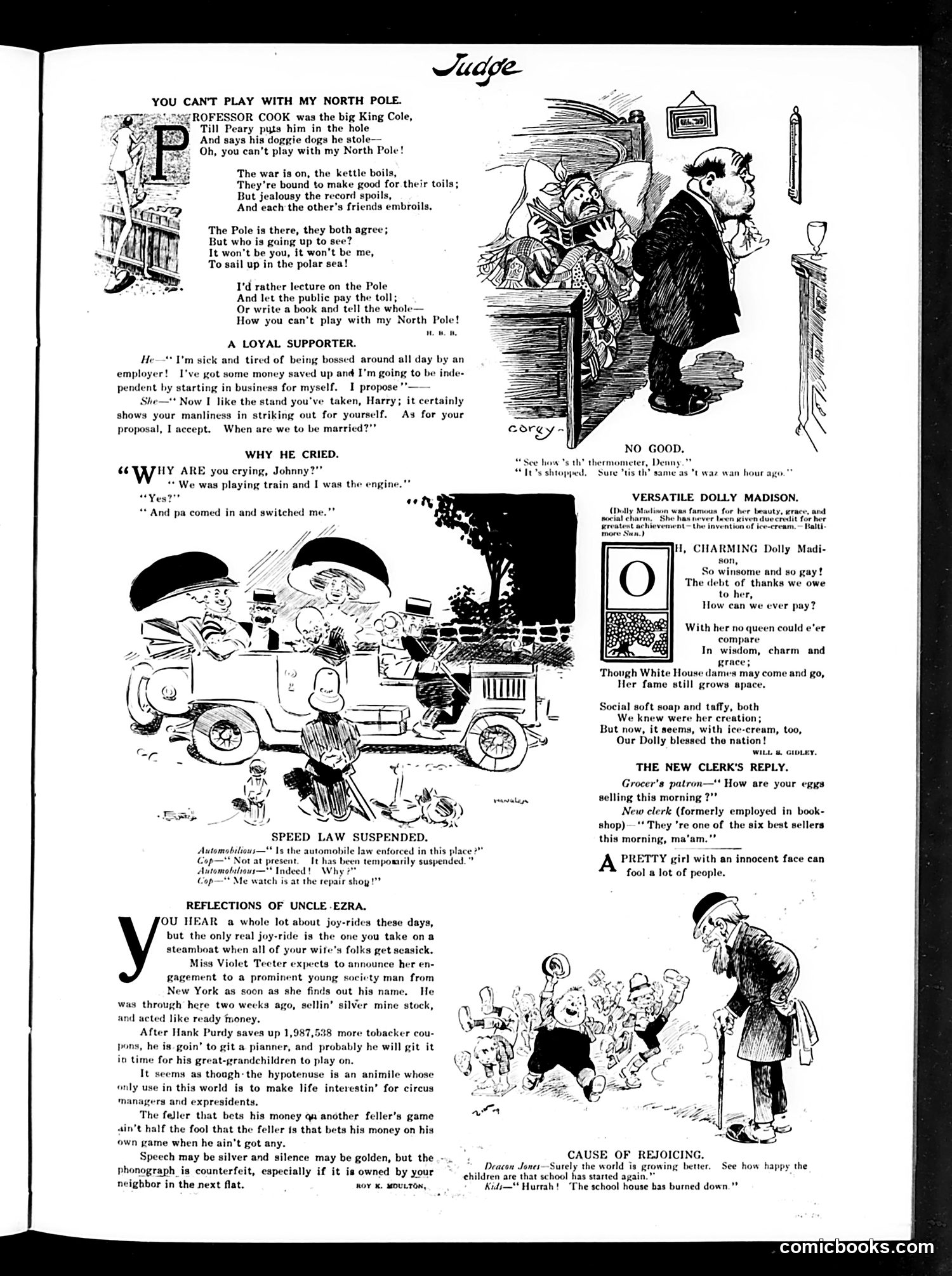
This page contains several satirical pieces typical of early 20th-century Judge magazine: **"You Can't Play with My North Pole"** mocks Professor Cook's disputed North Pole discovery claim through a children's playground quarrel, suggesting the competing explorers' rivalry was petty and unresolved. **"Why He Cried"** satirizes an engine driver's complaint about an employer, illustrating labor dissatisfaction—a common Progressive Era social concern. **"Speed Law Suspended"** ridicules automobile safety regulations being unenforced, suggesting legal hypocrisy. **"Reflections of Uncle Ezra"** and other sections offer social commentary on contemporary issues like women's behavior and financial schemes. The pieces employ humor to critique social institutions, legal enforcement, and public figures of the period. The illustrations use caricature and exaggeration typical of the era's satirical style.
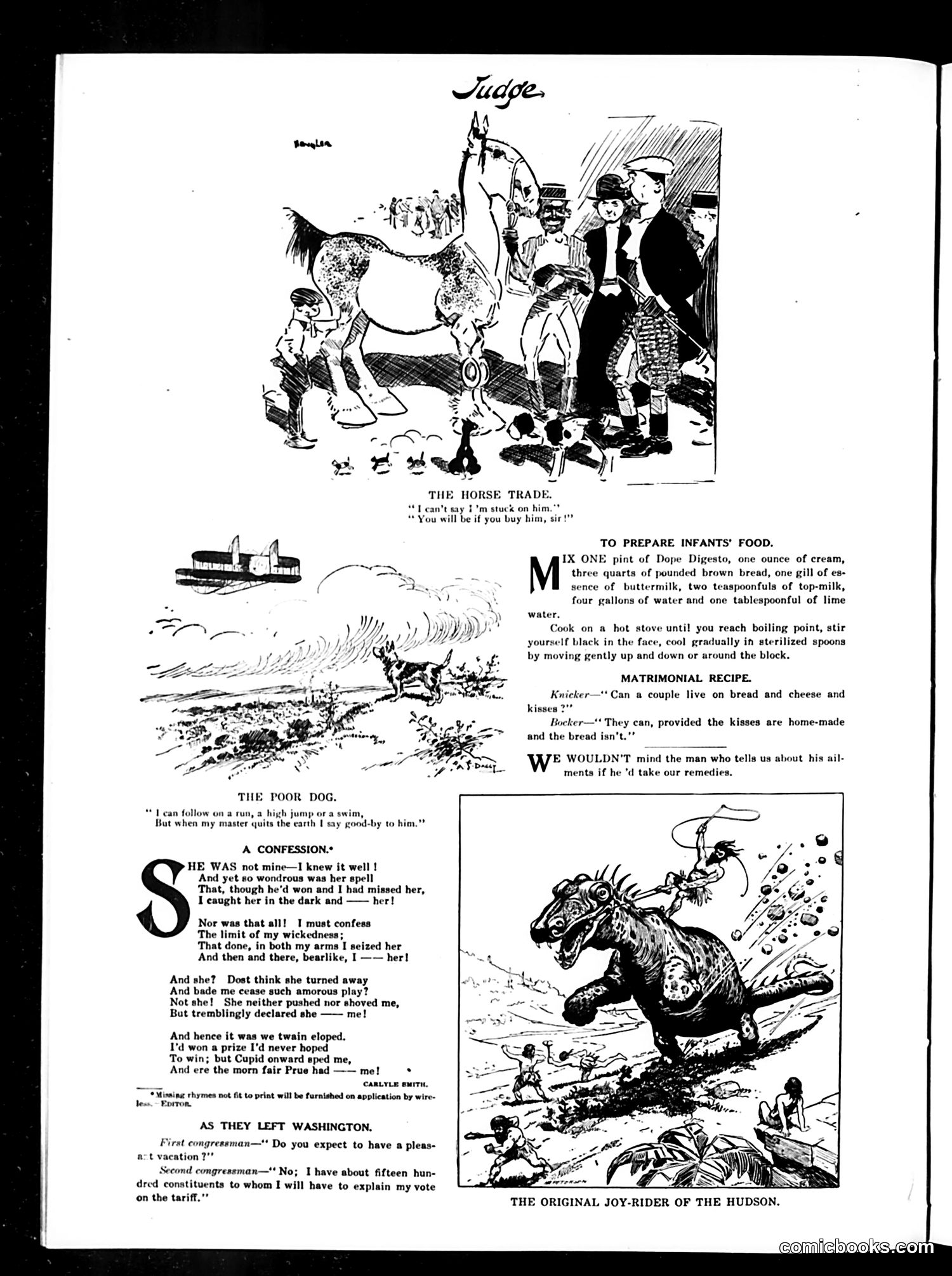
This page contains multiple satirical items typical of Judge's format: **"The Horse Trade"** cartoon mocks a dishonest transaction—the dealer warns a buyer won't be "stuck" on the horse, but will be if he purchases it (a pun on the horse being defective). **Recipe sections** parody advice columns with absurd "recipes"—one for infant food involving excessive lime water and stirring oneself "black in the face," another matrimonial recipe suggesting couples subsist on homemade items. **"A Confession"** is a humorous poem with deliberately omitted rhyming words (marked by dashes), playing on reader expectation of impropriety while actually describing innocent moments with someone named Prue. **"The Poor Dog"** is sentimental verse about a dog's loyalty. **"As They Left Washington"** jokes about congressmen dreading post-vacation constituent complaints about their tariff votes—satirizing the gap between political promises and difficult legislative realities. The page reflects Judge's mix of political commentary, domestic humor, and satirical verse aimed at educated readers.
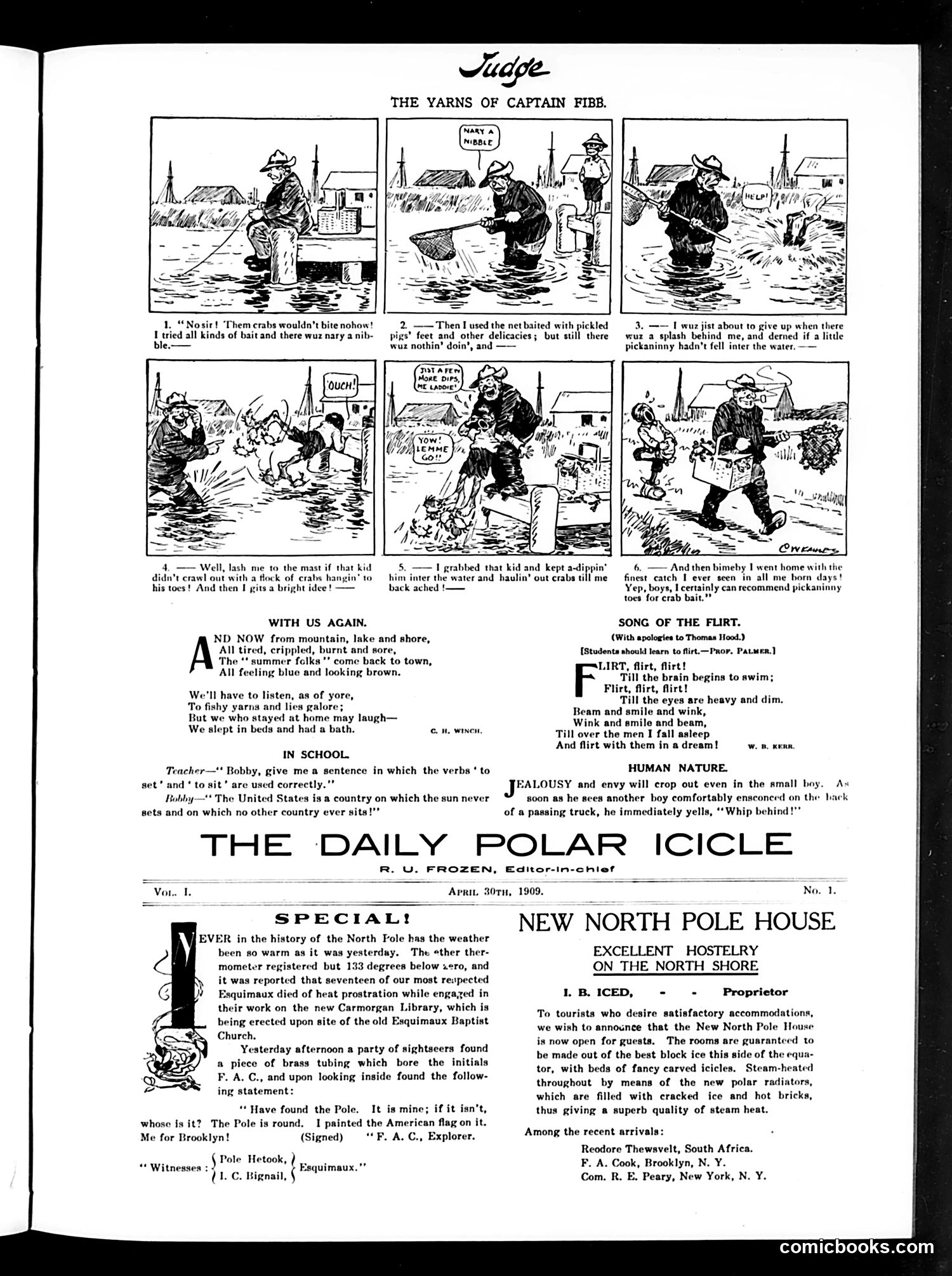
This page contains several unrelated humorous pieces typical of Judge's satirical content: **"The Yarns of Captain Fibb"** is a tall-tale comic strip about a boastful fisherman. The final panel's crude joke about using "pickaninny toes for crab bait" reflects the deeply racist humor common in early 1900s American publications—shocking to modern readers but normalized then. **"The Daily Polar Icicle"** satirizes recent North Pole exploration fever. The "Special!" section mocks the competing claims of explorers Frederick Cook and Robert Peary, both of whom claimed discovering the Pole around 1908-1909. The fictional note from "F.A.C." (Cook's initials) and the guest list mentioning both men suggests Judge was ridiculing their disputed claims. The absurd "New North Pole House" advertisement continues this mockery. Other sections include conventional period humor about returning summer visitors and schoolboy grammar jokes. The overall page reflects Judge's mix of political/scientific satire with crude racial comedy typical of the era.
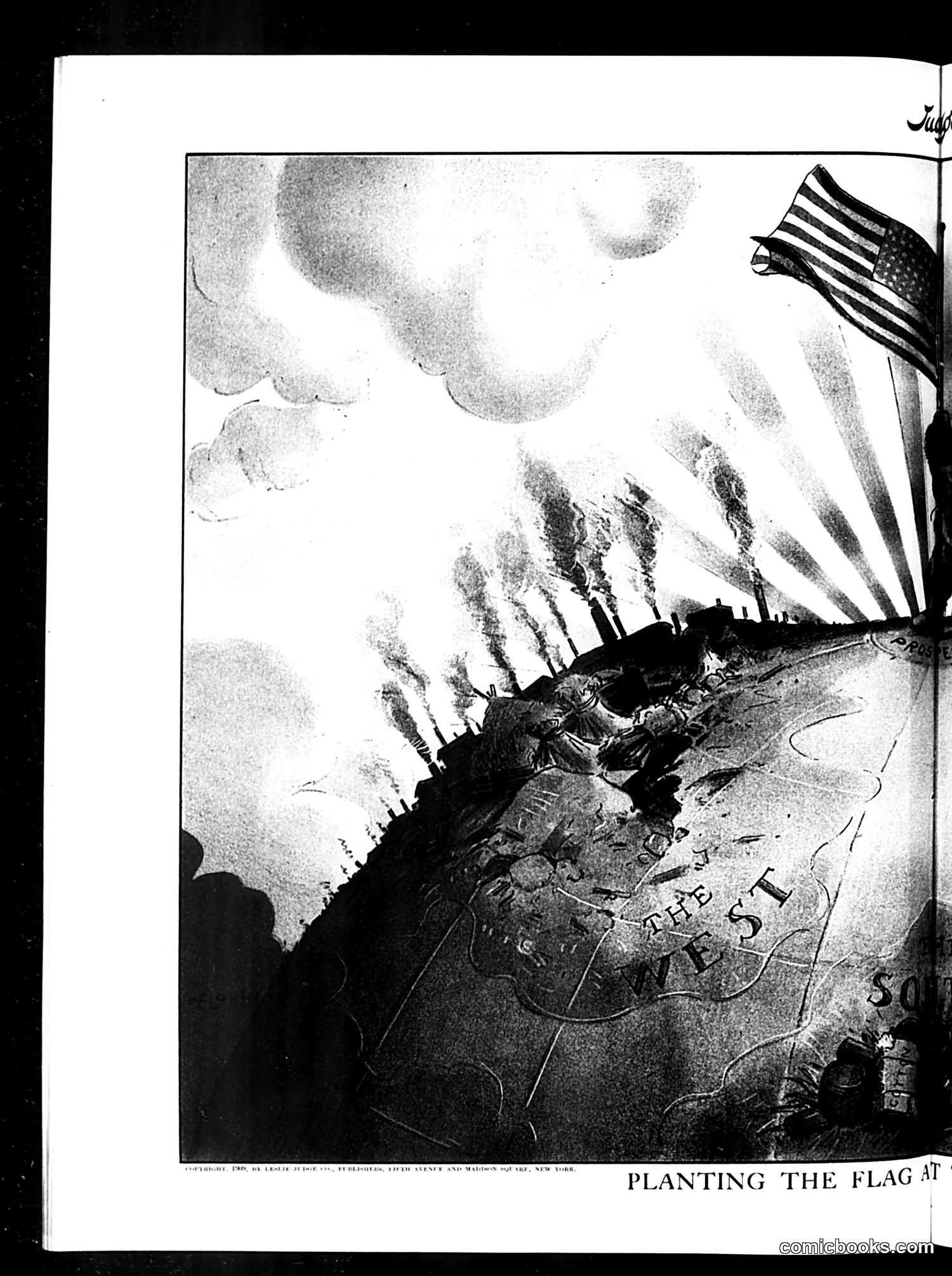
This political cartoon depicts soldiers planting an American flag on what appears to be a fortified position or trench during wartime. The dramatic composition—with soldiers climbing over earthworks while explosions burst overhead—suggests a scene of military conquest or defensive action. The title "Planting the Flag" uses patriotic language to frame military aggression. Without the publication date visible, the exact historical conflict is unclear, but Judge magazine frequently satirized American imperial ambitions and military interventions. The cartoon likely critiques either American expansionism or a specific military campaign as performative patriotism—literally "planting" nationalism rather than engaging in genuine defensive necessity. The chaotic, violent imagery contrasts sharply with the triumphant act of flag-raising, suggesting satirical commentary on war's glorification.
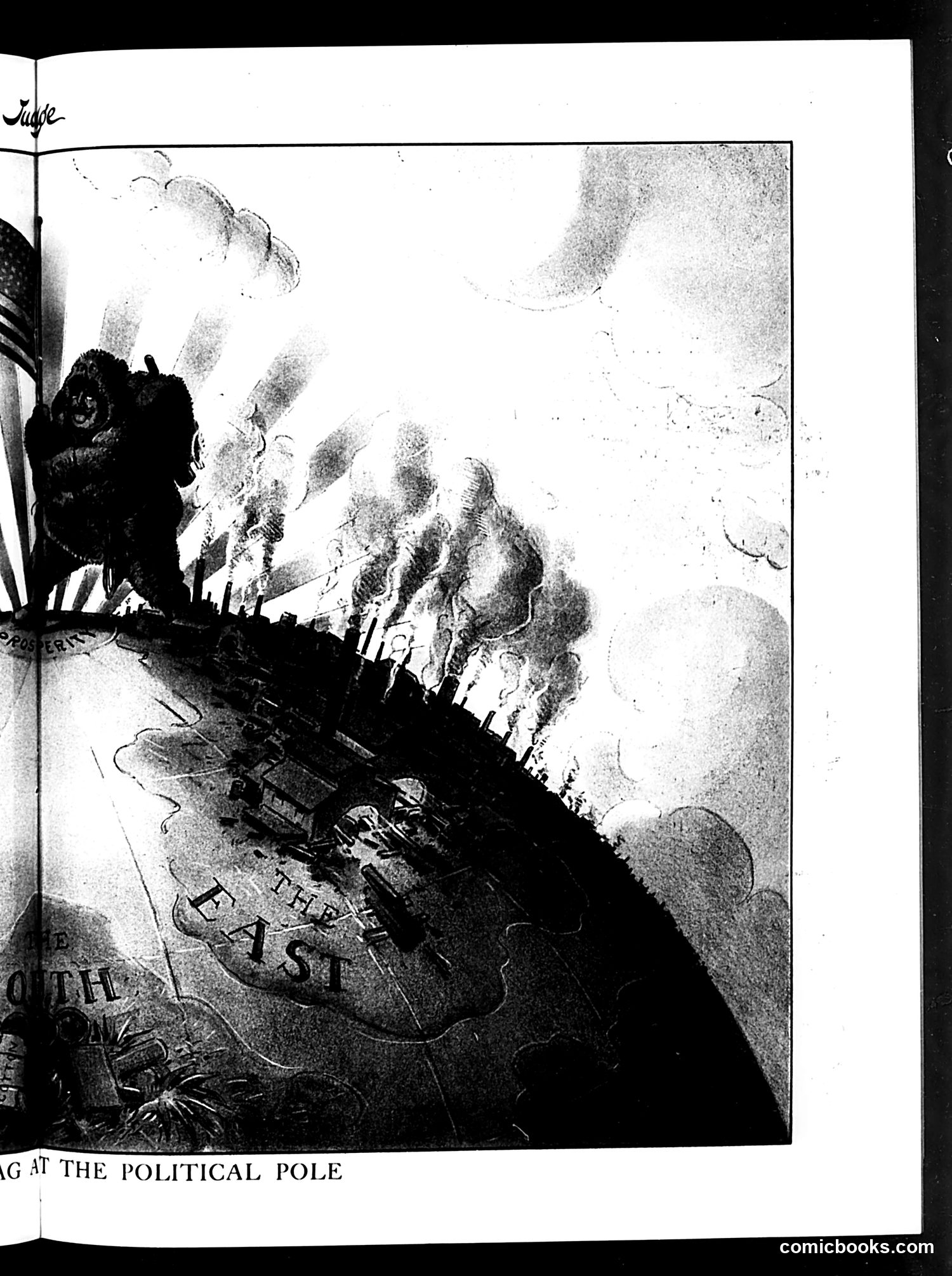
This Judge cartoon depicts figures gathered around a pole labeled "THE EAST" (visible in the image), apparently engaged in competitive struggle or "digging." The silhouetted figures appear to be political actors or nations metaphorically excavating or competing for influence or control of Eastern territories or interests. The cartoon's title suggests satire about political maneuvering and territorial competition—likely referencing late 19th or early 20th-century imperial rivalries in Asia or Eastern Europe, when multiple powers competed for dominance and resources in these regions. The dramatic black-and-white imagery, with figures shown in relief against a lighter sky, emphasizes the intensity and chaos of this political competition. Without clearer identification of specific figures, the exact historical moment remains uncertain.
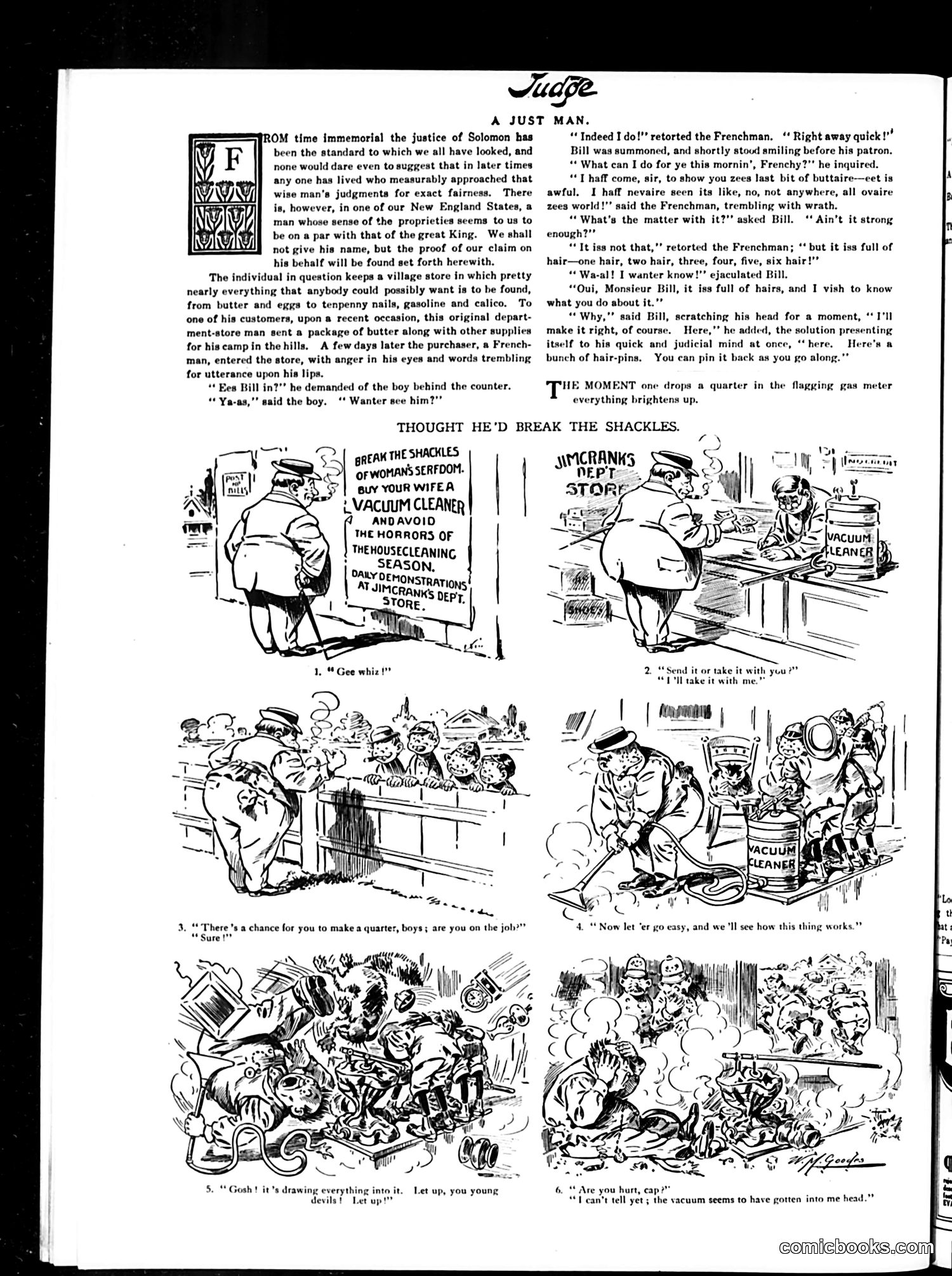
This page contains two satirical pieces: **"A Just Man"** (top text + first cartoon series): A humorous anecdote mocking rural New England practicality. A French customer complains to a village storekeeper that butter contains hair. The storekeeper's "solution"—giving him hairpins to pin the hair back as he eats—is absurd but presented as wise judgment, satirizing narrow-minded resourcefulness and the inability to acknowledge failure. **"Thought He'd Break the Shackles"** (six-panel comic strip): Satirizes early 20th-century consumerism and false feminist messaging. A man buys his wife a vacuum cleaner, believing it will "liberate" her from housecleaning drudgery. Instead, the vacuum becomes chaotic and dangerous, comically backfiring. The title mocks how commercial marketing co-opts feminist language ("breaking shackles") while actually trapping women in new forms of domestic labor and mechanical disasters. Both pieces use humor to critique masculine smugness and commercial gimmickry.
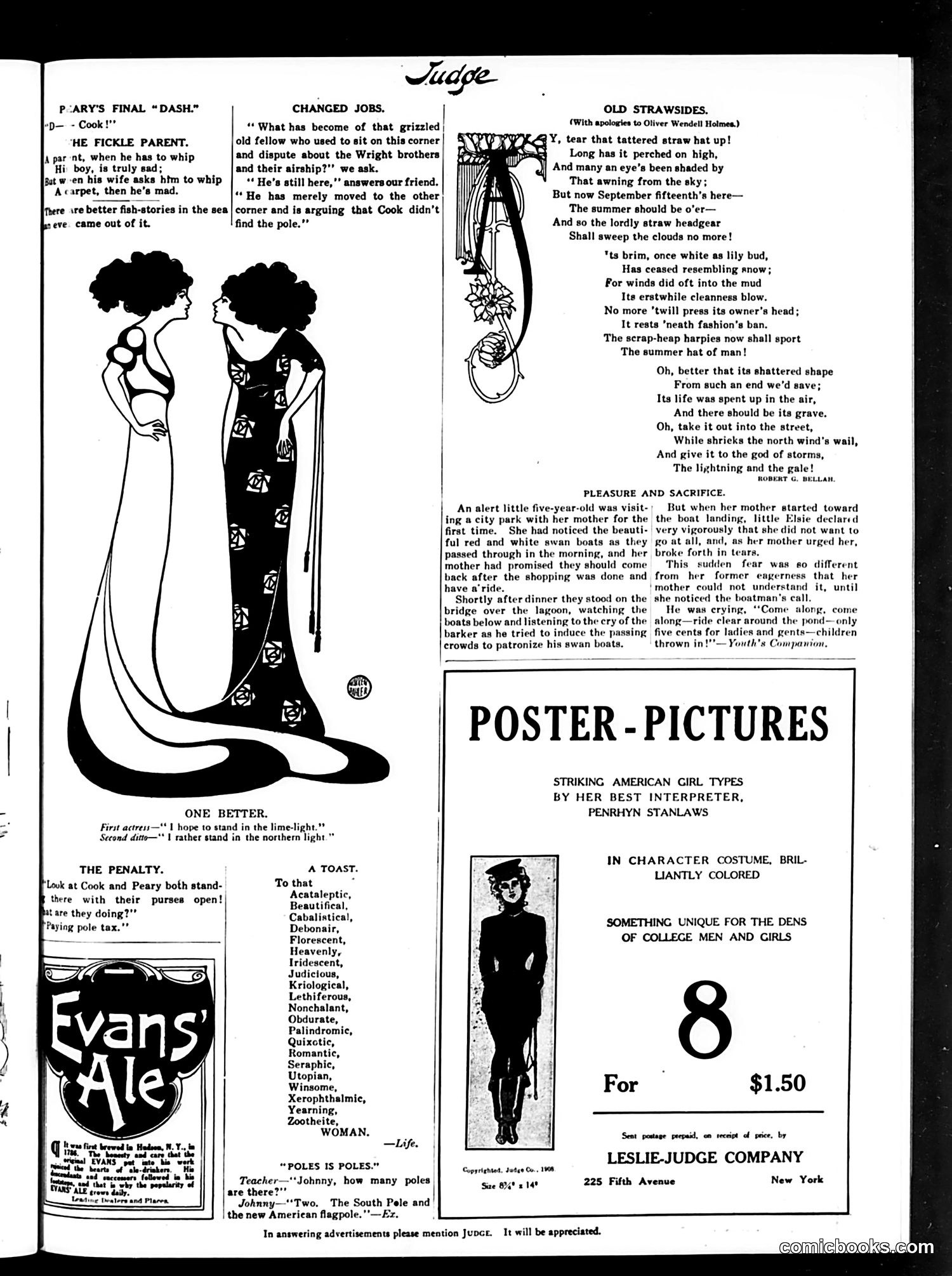
This page contains multiple satirical pieces about early 1900s American life: **"Changed Jobs"** mocks the endless public debate over polar exploration. A man who previously argued about the Wright brothers now disputes whether Cook discovered the North Pole—suggesting Americans obsess over the same argumentative topics regardless of current events. **"The Penalty"** jokes about Cook and Peary (the competing polar explorers) being taxed for their expeditions, depicted as literally paying a "pole tax." **"Poles Is Poles"** is a child's joke playing on the North Pole/South Pole versus the new American flagpole—topical humor referencing the era's intense polar exploration rivalry. **"Old Strawsides"** is a sentimental poem about discarding worn straw hats at summer's end, personifying the seasonal ritual. **"Pleasure and Sacrifice"** tells of a child afraid to ride swan boats after overhearing the barker cry "children thrown in!"—she misunderstands the sales pitch as literal. The page also advertises Penrhyn Stanlaws's poster pictures of "American girl types" ($1.50 for eight) and Evans' Ale. The humor reflects everyday early-1900s concerns and wordplay rather than specific political commentary.
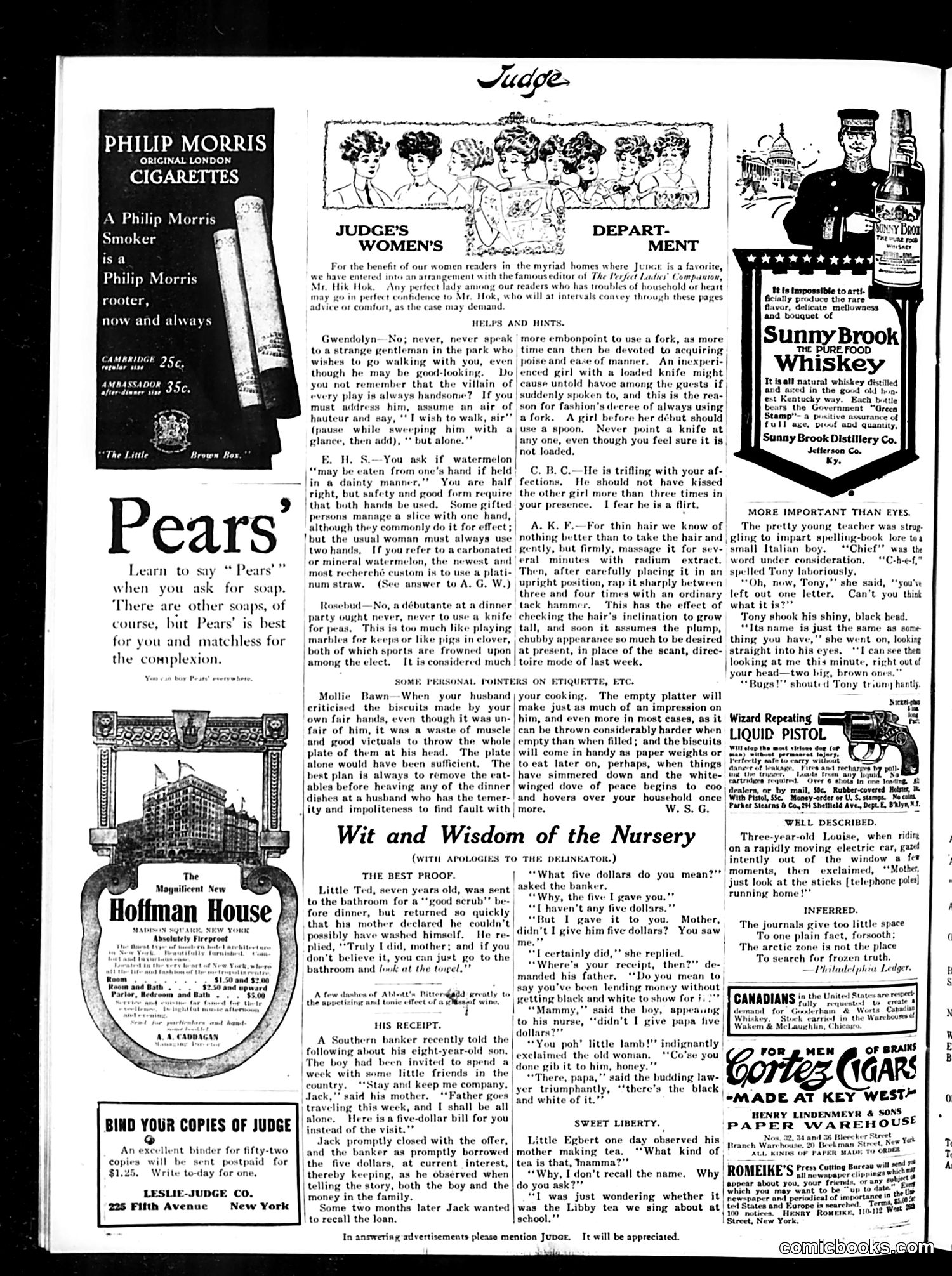
This page is primarily **advertising and advice columns** rather than political satire. The layout features: **Main Content:** - "Judge's Women's Department" — etiquette advice for female readers, addressing letters about proper behavior (fork usage, watermelon eating, husband management). The tone is humorous but reflects genuine early 20th-century social anxieties about feminine propriety. - "Wit and Wisdom of the Nursery" — lighthearted children's anecdotes, including one about a boy's "proof" of bathing and another about a banker keeping his son's borrowed money in the family. **Advertisements:** Multiple product ads (Philip Morris cigarettes, Pears' soap, Sunny Brook whiskey, Hoffman House hotel, Cortez cigars) occupy significant space. **The Satire:** Minimal political content. The humor derives from exaggerated domestic situations—wives throwing dinner plates at critical husbands, children's innocent logic—rather than current events or public figures. This reflects Judge's evolution toward lifestyle magazine content by this era.
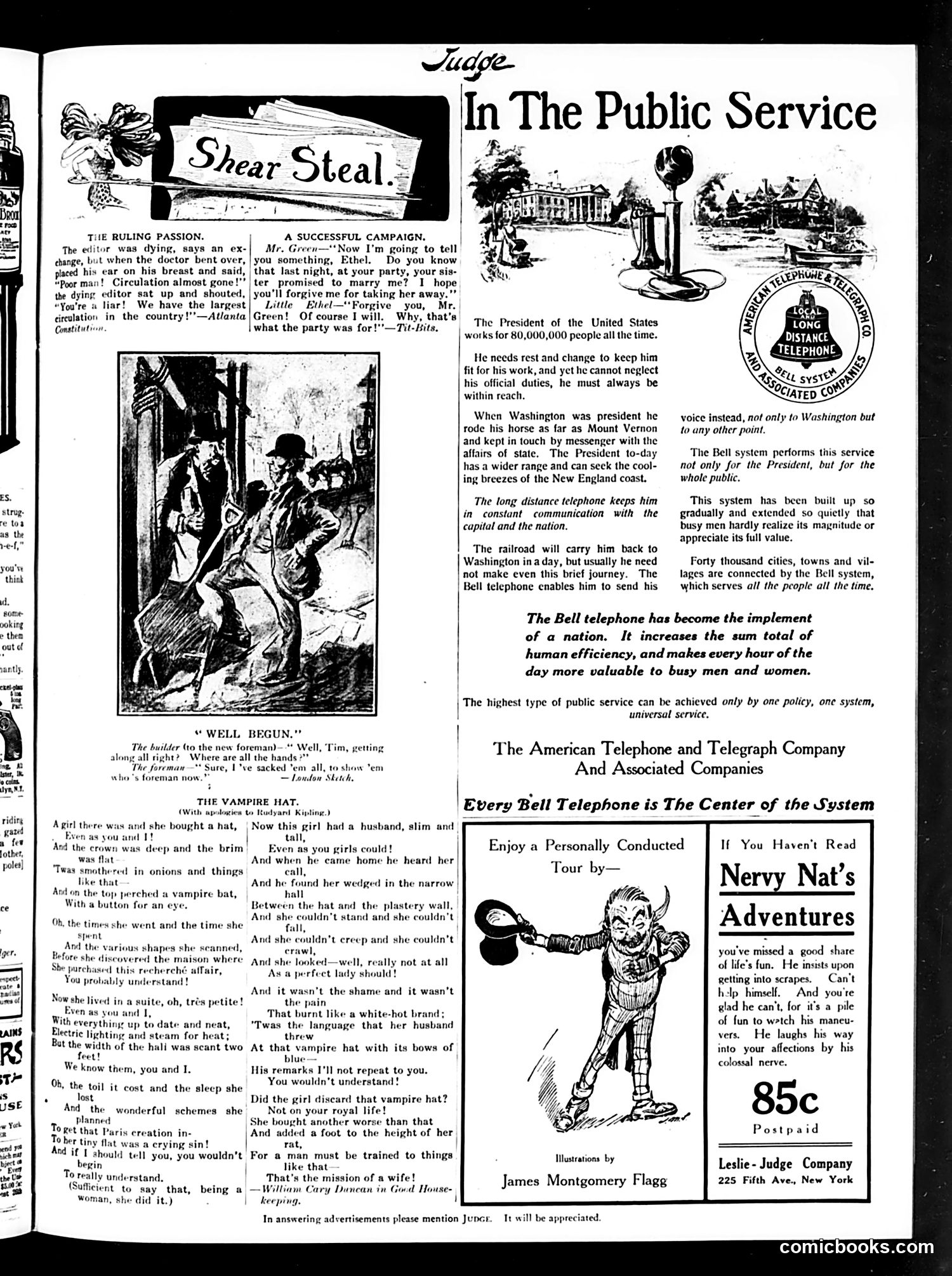
This Judge magazine page contains multiple satirical pieces plus a Bell Telephone advertisement disguised as public interest content. **"The Ruling Passion"** mocks a dying newspaper editor who, despite being critically ill, denies he's losing circulation—a pun playing on both bodily circulation and newspaper readership. The satire targets professional vanity. **"The Vampire Hat"** is a humorous poem about a woman who squeezes an enormous, bat-shaped hat into her tiny apartment, damaging herself and her husband's patience in the process. The satire critiques women's fashion obsession and impracticality, a common Judge theme. **"In The Public Service"** is essentially advertising masquerading as editorial content, praising Bell Telephone's infrastructure by claiming it enables the President to stay connected while traveling. This is early 20th-century corporate propaganda presenting monopoly infrastructure as patriotic necessity. The page reflects Judge's characteristic blend of humor, social commentary about gender and vanity, and advertiser-friendly content promoting new technology as inevitable progress.
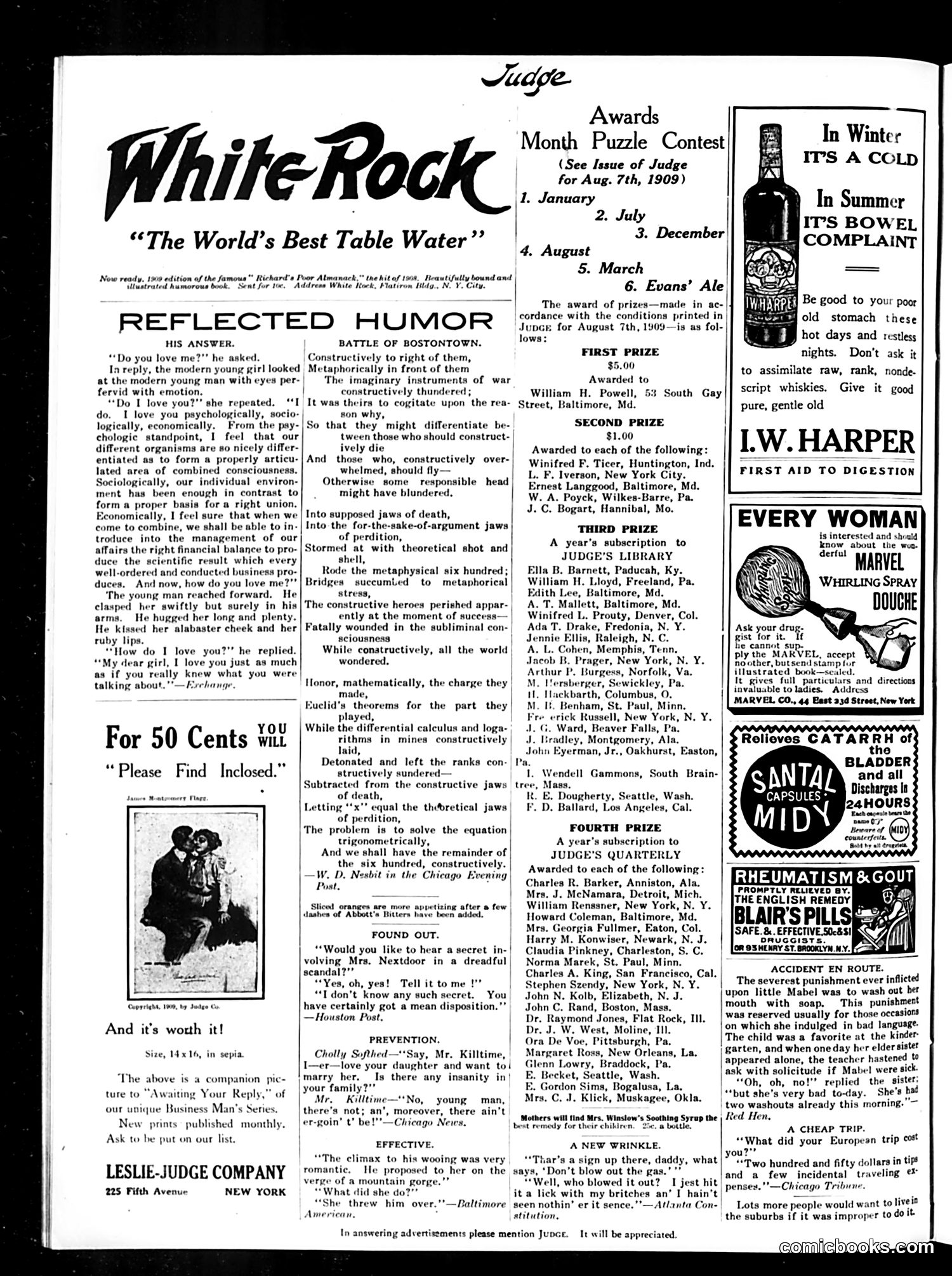
This page from Judge (circa 1909) contains three distinct humor pieces: **"REFLECTED HUMOR"** — A satire on early-20th-century progressive thinking. A young man asks "Do you love me?" and receives a pedantic response filled with jargon about "psychologic standpoint," "sociological," and "economic" factors — mocking how educated young women of the period adopted academic terminology. He responds with simple physical affection (a hug and kiss), satirizing the gap between overly intellectual modern youth and basic human expression. **"BATTLE OF BOSTONTOWN"** — Appears to parody the Charge of the Light Brigade (famous WWI poem) through increasingly absurd "constructive" language ("constructive death," "subliminal consciousness"), mocking bureaucratic military jargon and the disconnect between how war is discussed theoretically versus its actual human cost. **Short joke items** — Including "PREVENTION," where a suitor asks about family insanity, mocking paranoia about hereditary illness and eugenics concerns common to the era. Overall, the page satirizes modern intellectualism, academic pretension, and bureaucratic obfuscation.
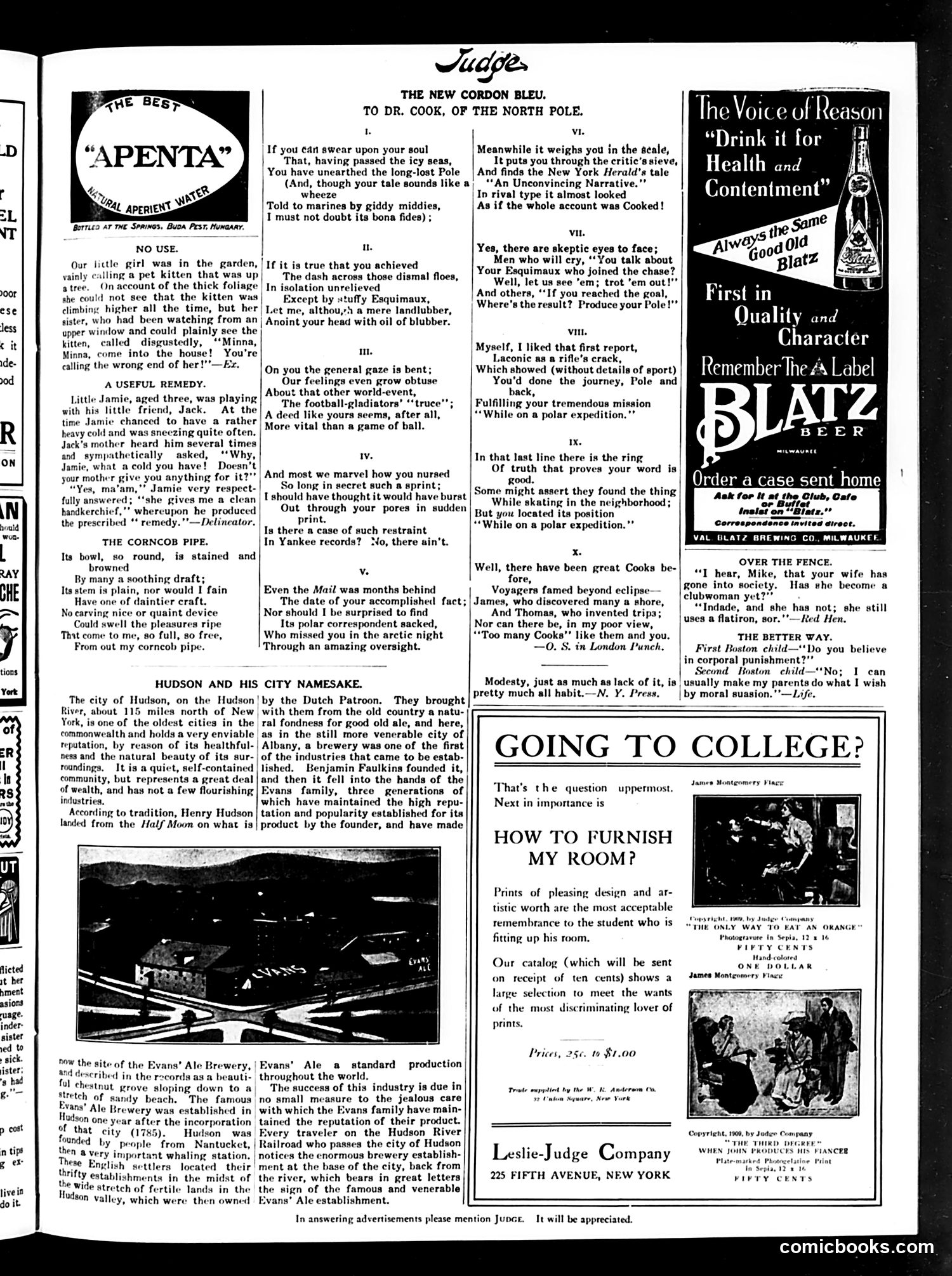
This page contains satirical poetry and humor pieces typical of early 1900s Judge magazine. The main cartoon, "The New Cordon Bleu," mocks **Dr. Frederick Cook's claim to have reached the North Pole**. Cook was a real explorer who claimed the discovery in 1908, sparking controversy (Robert Peary also claimed priority). The poem sardonically congratulates Cook while expressing skepticism about his "tale" and doubts about whether newspapers properly verified his achievement. It ridicules how Cook kept his journey secret, contrasting this with sensational press coverage. Other content includes minor humorous anecdotes about children and household life, poems about corncob pipes, and historical information about Hudson, New York and its brewing industry. The advertising dominates the right side, promoting Blatz beer and college room furnishings. The satire targets both explorer sensationalism and contemporary journalism's credibility problems.
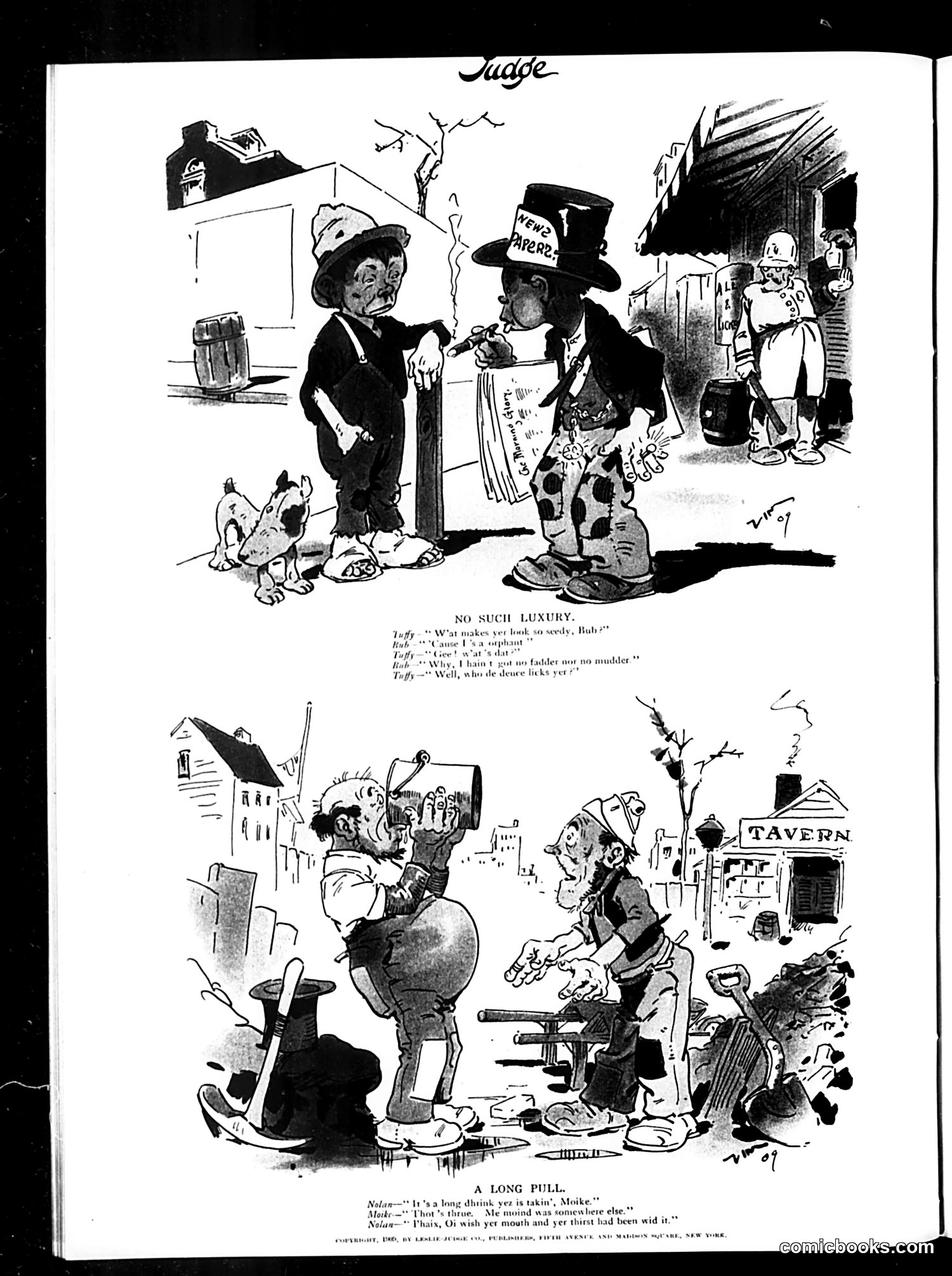
This page contains two satirical cartoons about poverty and hardship, likely from the early 20th century. **Top cartoon ("No Such Luxury"):** Two impoverished men in tattered clothes discuss wartime deprivation. One remarks that "War makes very look so seedy, Bab," while the other notes they can't afford basic necessities like shoes or muddler. The satire critiques how common people suffer material privations during wartime while others may profit. **Bottom cartoon ("A Long Pull"):** Shows desperate figures at a tavern and street scene, seemingly depicting unemployment or economic struggle. The dialogue references someone's mood and an unsuccessful prior attempt at something. Both cartoons use exaggerated caricature and grotesque figures typical of Judge's satirical style to mock social inequality and the gap between rich and poor during economic hardship or wartime.