
A complete issue · 16 pages · 1909
Judge — August 28, 1909
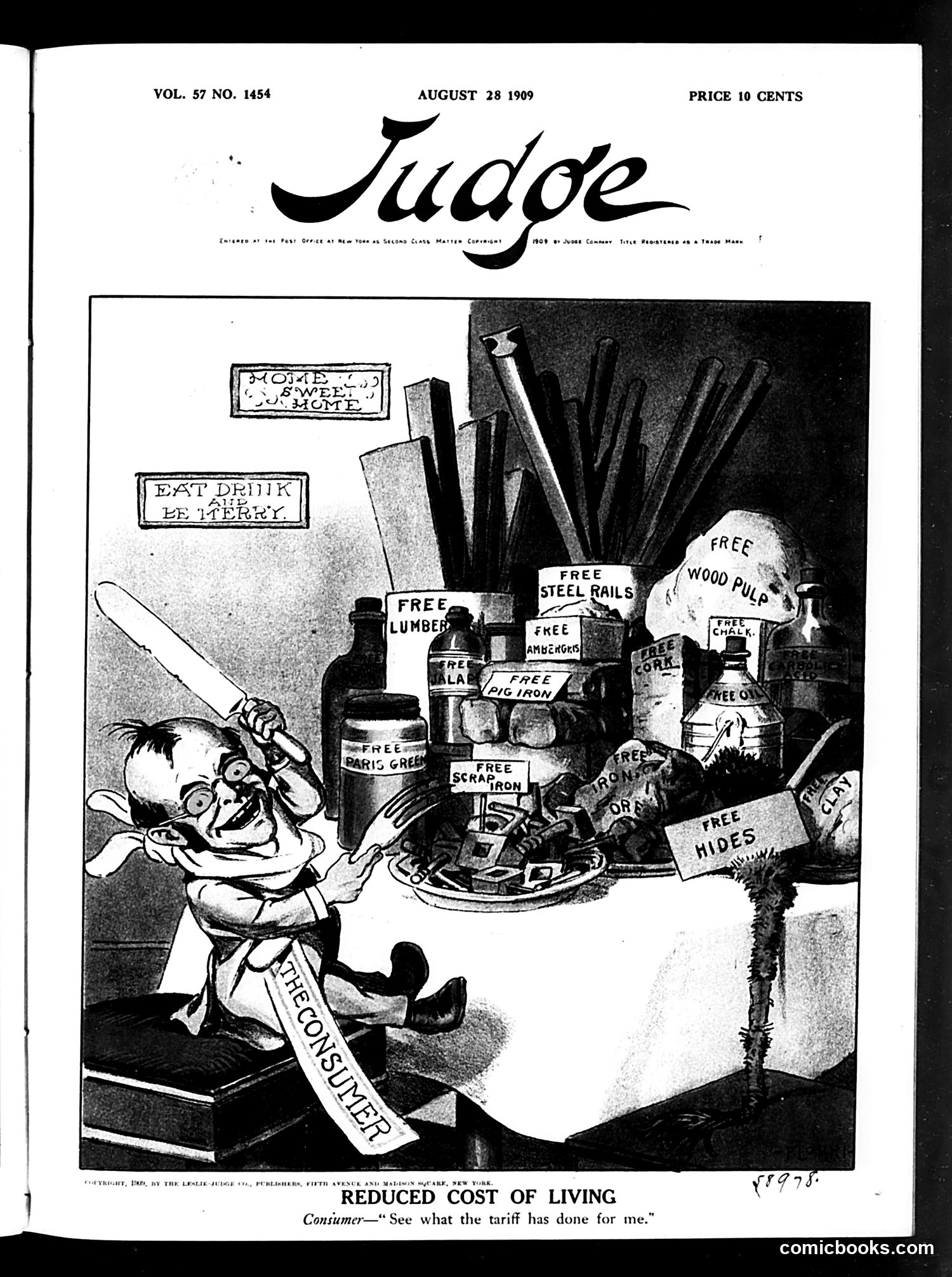
This political cartoon satirizes the protective tariff's effect on consumer prices. A cheerful, rotund figure labeled "THE CONSUMER" wields a large knife while surrounded by piled goods—lumber, steel rails, pig iron, scrap iron, Paris green (pesticide), chalk, hides, and other commodities—each marked "FREE" (from tariffs). The joke inverts expectations: the caption reads "See what the tariff has done for me," yet the cartoon ironically suggests the consumer must *cut through* or *fight* these tariffed goods to access them. The mottoes "HOME SWEET HOME" and "EAT DRINK BE MERRY" mock promises of consumer benefit. The satire argues that protective tariffs, intended to help Americans, actually burden ordinary consumers with inflated prices on basic goods and raw materials.
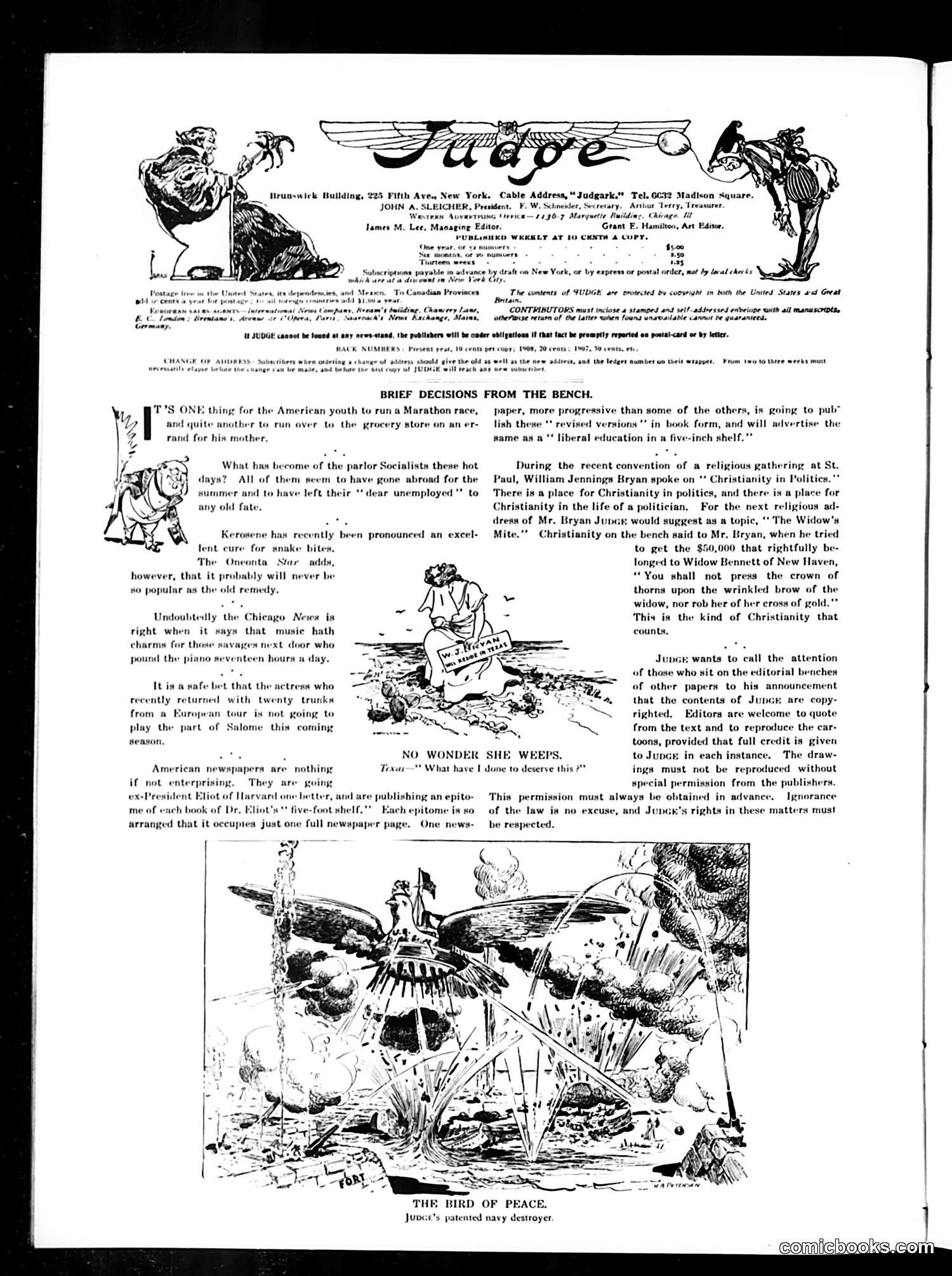
This page contains several editorial commentaries satirizing American politics and society: **"Brief Decisions from the Bench"** mocks the Socialist political movement, suggesting Socialist leaders have fled abroad rather than face unemployment. It ridicules the *Kerosene* publication and comments on the *Chicago News*. **"No Wonder She Weeps"** features an illustration of a woman crying over what appears to be scandal or misfortune, with accompanying political commentary. **"The Bird of Peace"** (bottom cartoon) depicts Judge's satirical take on a naval destroyer, likely criticizing naval policy or military spending. The page emphasizes Judge's editorial stance on copyright protection and welcomes editors reproducing cartoons with proper credit. Overall, the content reflects early 20th-century Progressive Era debates about socialism, women's issues, and military policy.
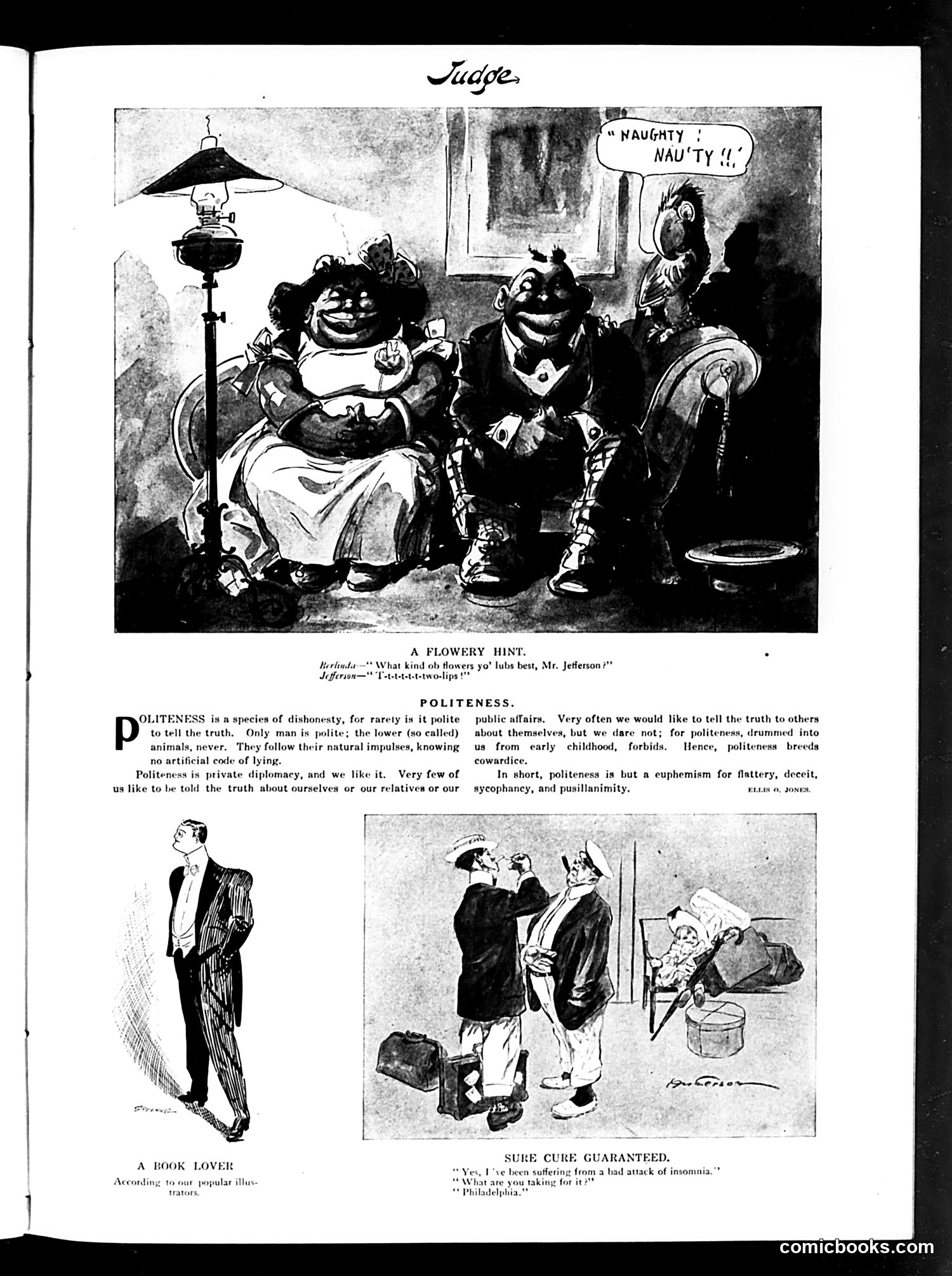
**Top cartoon "A Flowery Hint":** Shows caricatured figures (likely representing political figures or social types) in an interior scene. One character says "Naughty naughty!" suggesting mild scandal or impropriety. The caption references "flowers" and "Mr. Jefferson," possibly alluding to Thomas Jefferson, though the exact political reference is unclear without additional context. **Main article "Politeness":** By Ellis O. Jones, critiques politeness as dishonesty—a social mask that prevents truth-telling. The piece argues politeness is mere "euphemism for flattery, deceit, sycophancy, and pusillanimity." **Bottom illustrations:** Include "A Book Lover" (a well-dressed gentleman) and "Sure Cure Guaranteed" (showing what appears to be a medical or social remedy scenario with dialogue about insomnia and Philadelphia). The page satirizes social hypocrisy and false civility.
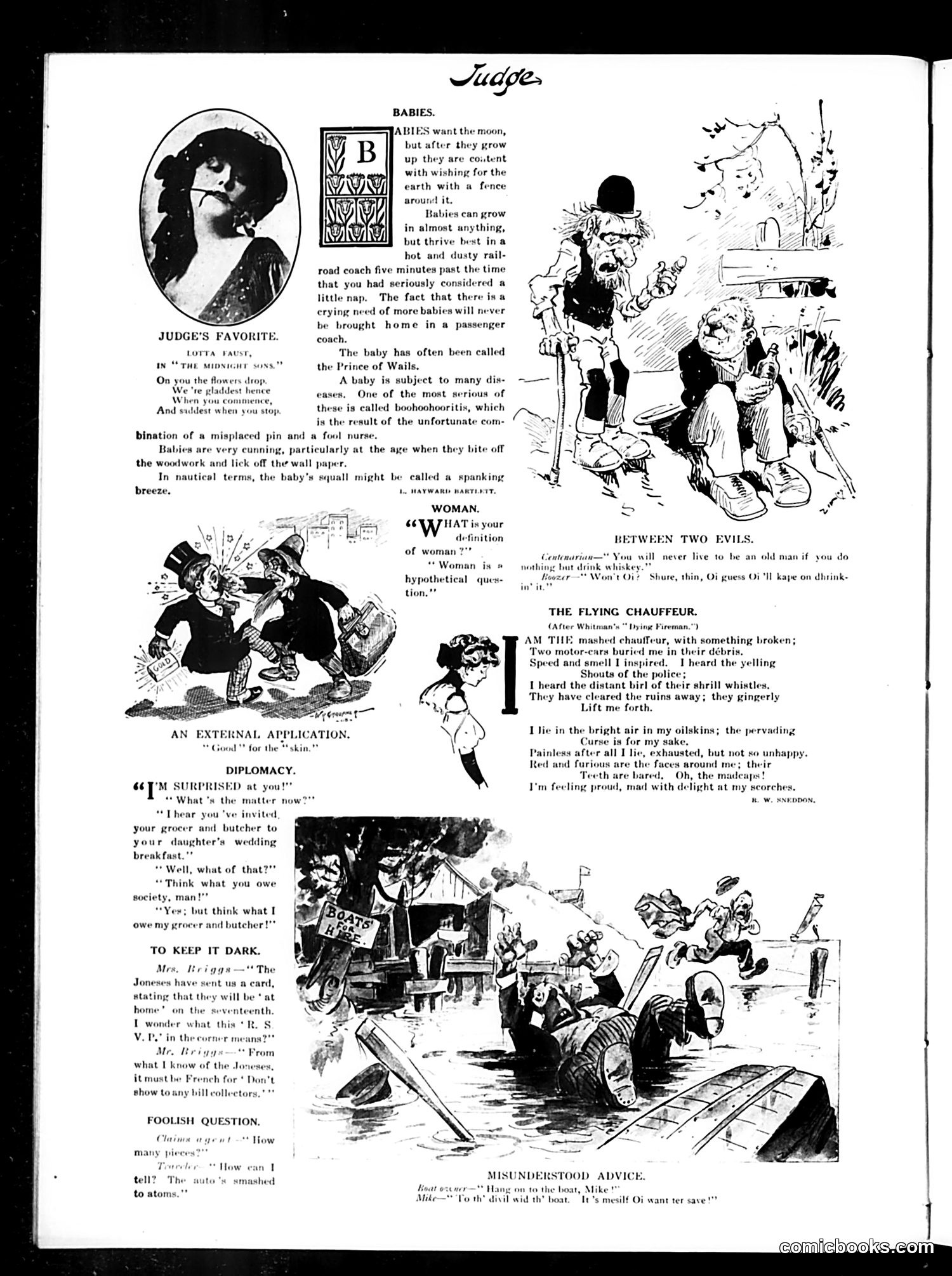
This page from the satirical magazine *Judge* contains several humorous sketches and commentary on early 20th-century social issues: **"Babies"** ridicules the impracticality of babies in modern life, particularly on railway travel—a common complaint among Victorian/Edwardian society. **"Woman"** presents a comedic definition of women as a "hypothetical question," reflecting contemporary attitudes treating women as philosophical abstractions rather than equals. **"The Flying Chauffeur"** satirizes dangerous automobile driving, a newly emerging social problem as motorized vehicles became common. **"Diplomacy"** mocks social pretension through a conversation about inviting one's grocer and butcher to a wedding breakfast. The remaining sketches address contemporary urban problems: tax collection, social climbing, and automobile safety. The overall tone reflects early 1900s anxiety about modernization's disruptions to traditional society.
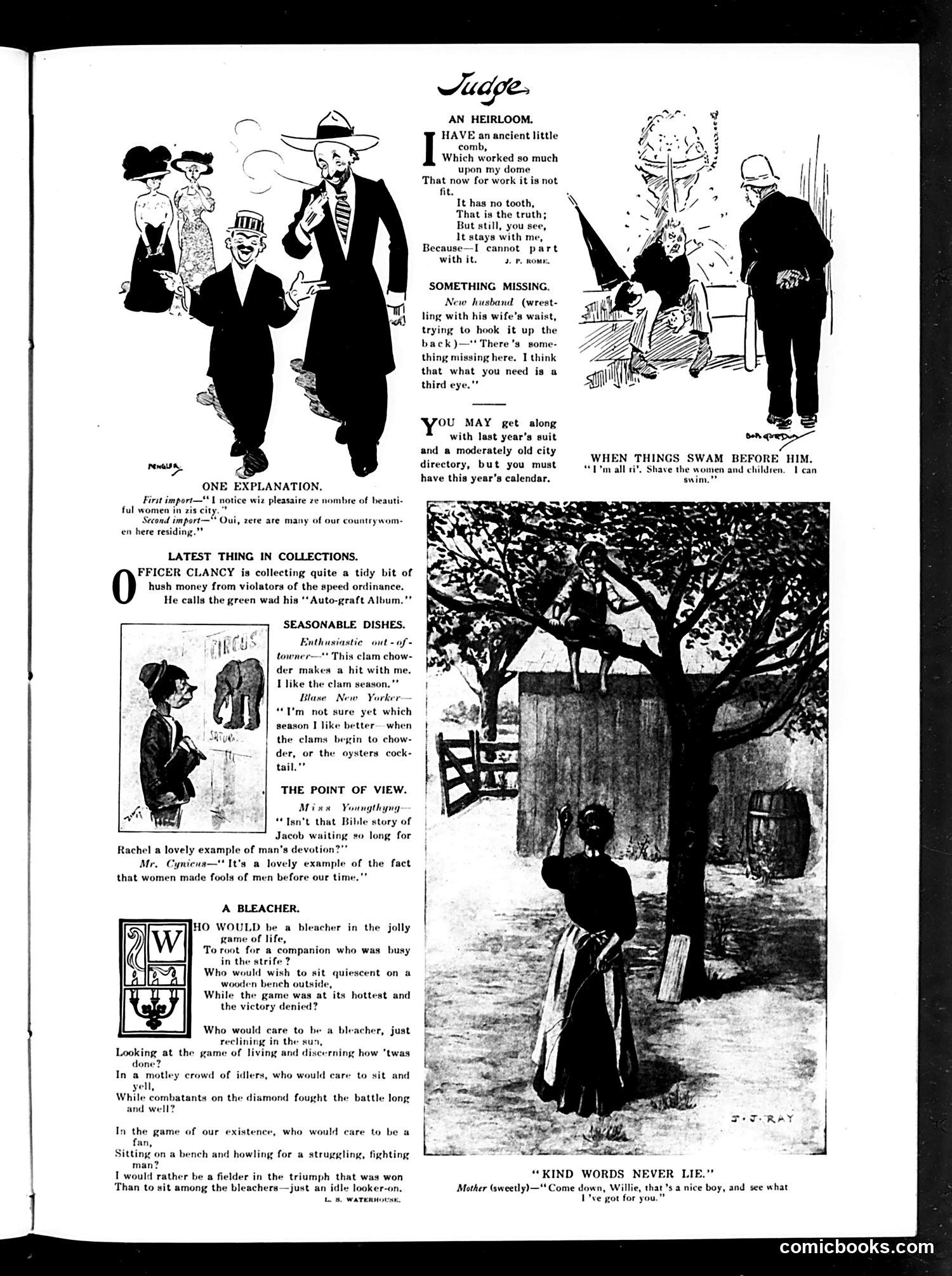
This page contains multiple satirical sketches and humorous anecdotes typical of early 20th-century Judge magazine content. The sketches mock everyday social situations: "An Heirloom" ridicules a man's attachment to a broken comb; "One Explanation" jokes about beautiful women in cities; "Latest Thing in Collections" features Officer Clancy collecting traffic violation fines; "Seasonable Dishes" comments on clam chowder preferences; and "A Bleacher" satirizes spectators at sports events who avoid participating in actual games. The large photograph with caption "Kind Words Never Lie" shows a mother and child, illustrating conventional domestic sentimentality that the magazine likely intended to gently mock or juxtapose against its cynical humor. Overall, the page represents Judge's formula of light social satire targeting middle-class American life and urban manners, rather than serious political commentary.
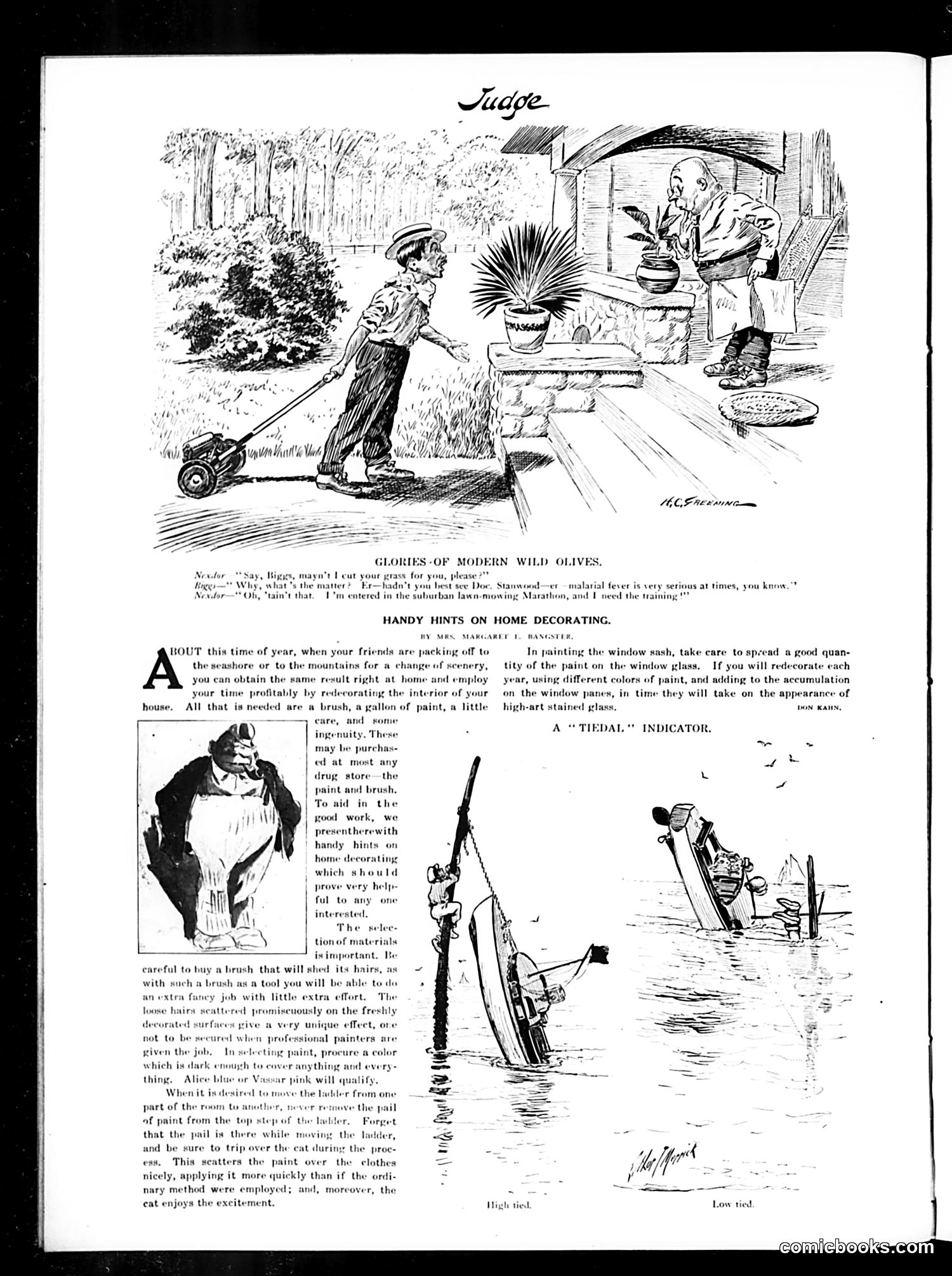
**Top Cartoon ("Glories of Modern Wild Olives"):** This appears to be a satire about modern athletic training or physical culture. A uniformed figure (possibly a coach or trainer) operates a mechanical device on a man's legs while an older man watches from a porch. The dialogue references "Marathon" training and suggests mockery of contemporary fitness fads—the joke being that absurd mechanical contraptions are being sold as shortcuts to athletic achievement, when traditional training methods would suffice. **Bottom Section ("Handy Hints on Home Decorating"):** This is instructional content by Margaret L. Sangster offering practical advice on home painting during vacation season. It recommends purchasing quality brushes, choosing appropriate paint colors (noting that "blue or Vassar pink will qualify"), and applying careful technique. The accompanying illustrations labeled "High tied" and "Low tied" appear to demonstrate proper painting technique or ladder positioning—not satirical, but genuinely helpful domestic advice typical of Judge's practical columns. The page blends satire (top) with genuine household guidance (bottom), a common Judge format.
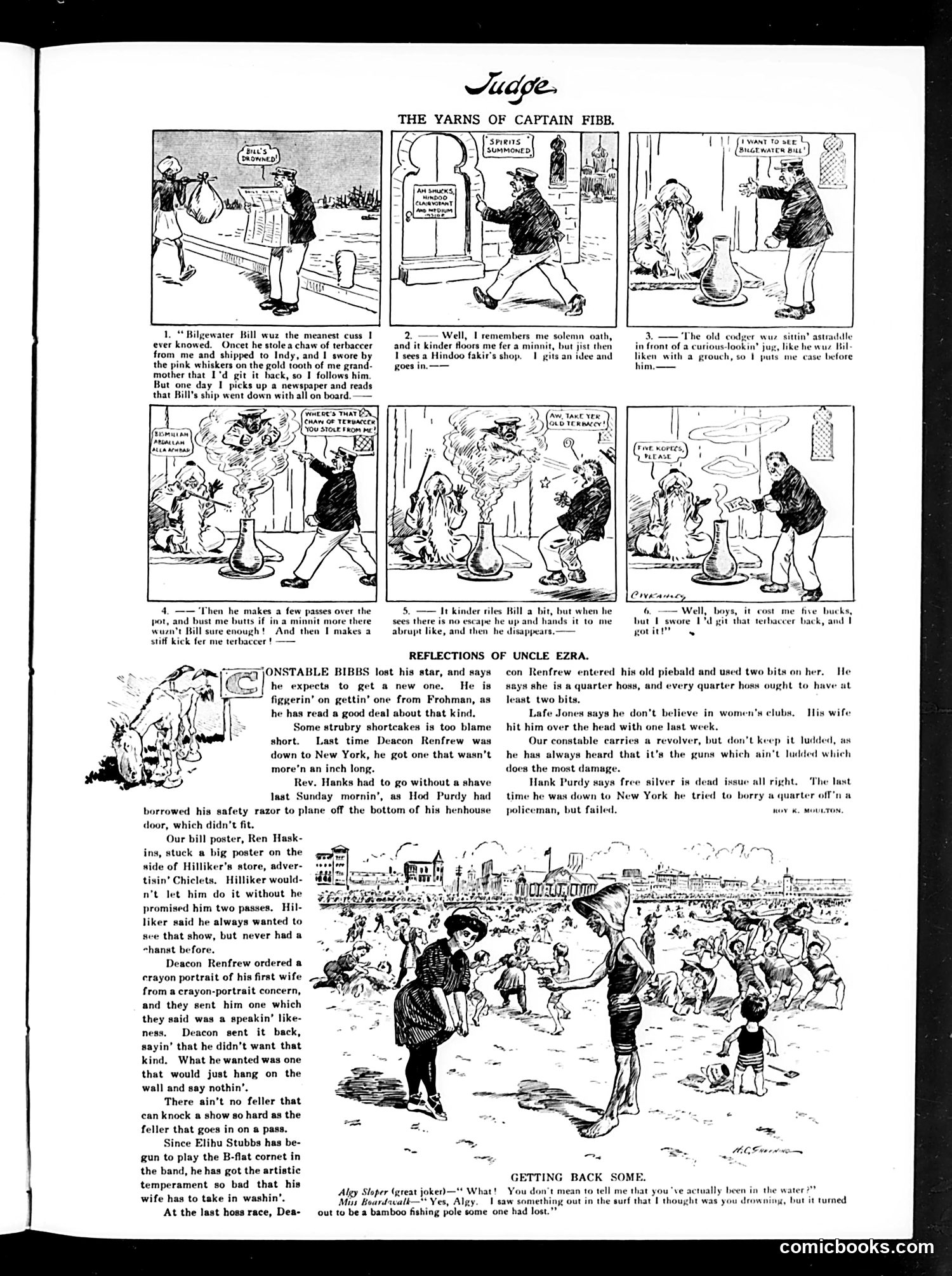
This Judge page contains two separate humor features typical of early 20th-century American comic magazines. **"The Yarns of Captain Fibb"** is a tall-tale comic strip where a sailor recounts stealing tobacco from "Bilgewater Bill," who later ships out. The sailor visits a Hindu fakir (magician) and uses magic to conjure Bill from a pot, recovering his stolen chew. The humor relies on exaggerated dialect, magical sleight-of-hand, and absurdist revenge—common working-class entertainment humor of the era. **"Reflections of Uncle Ezra"** is a prose humor column featuring small-town anecdotes and aphorisms, poking fun at local characters (the constable, deacon, bill poster) and rural life. References include "free silver" (a defunct 1890s political issue) and Frohman (theatrical producer), suggesting topical awareness mixed with folksy wisdom. Both sections exemplify Judge's formula: crude dialect humor, slapstick situations, and gentle mockery of American rural and working-class life—entertainment designed for contemporary readers but largely opaque to modern audiences unfamiliar with period conventions and slang.
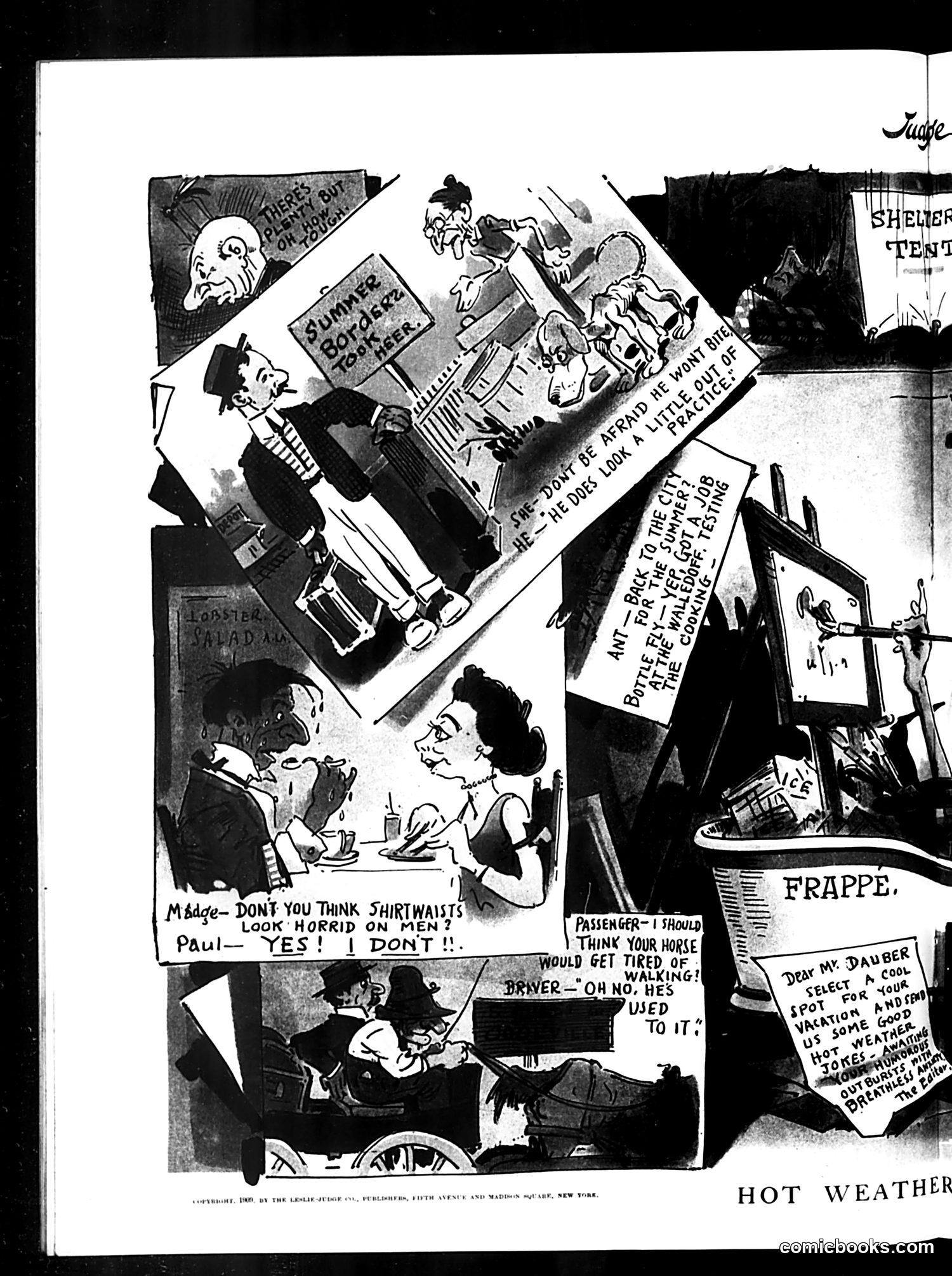
This page presents satirical vignettes about hot weather, a common Judge magazine theme. The main cartoon shows a couple discussing fashion—the woman (Madge) asks if shirtwaists look "horrid on men," and Paul agrees they do. The joke mocks men's fashion choices during summer heat. Other panels depict travelers complaining about heat-related discomforts: a passenger questioning whether a horse gets tired from walking; a driver defending his horse's stamina; and what appears to be a "Dear Mr. Dauber" advice column addressing vacation complaints about hot weather and related travel frustrations. The satire targets how people—and their animals—struggle during summer, offering commentary on both fashion absurdities and the general irritability heat produces in travelers and the public.
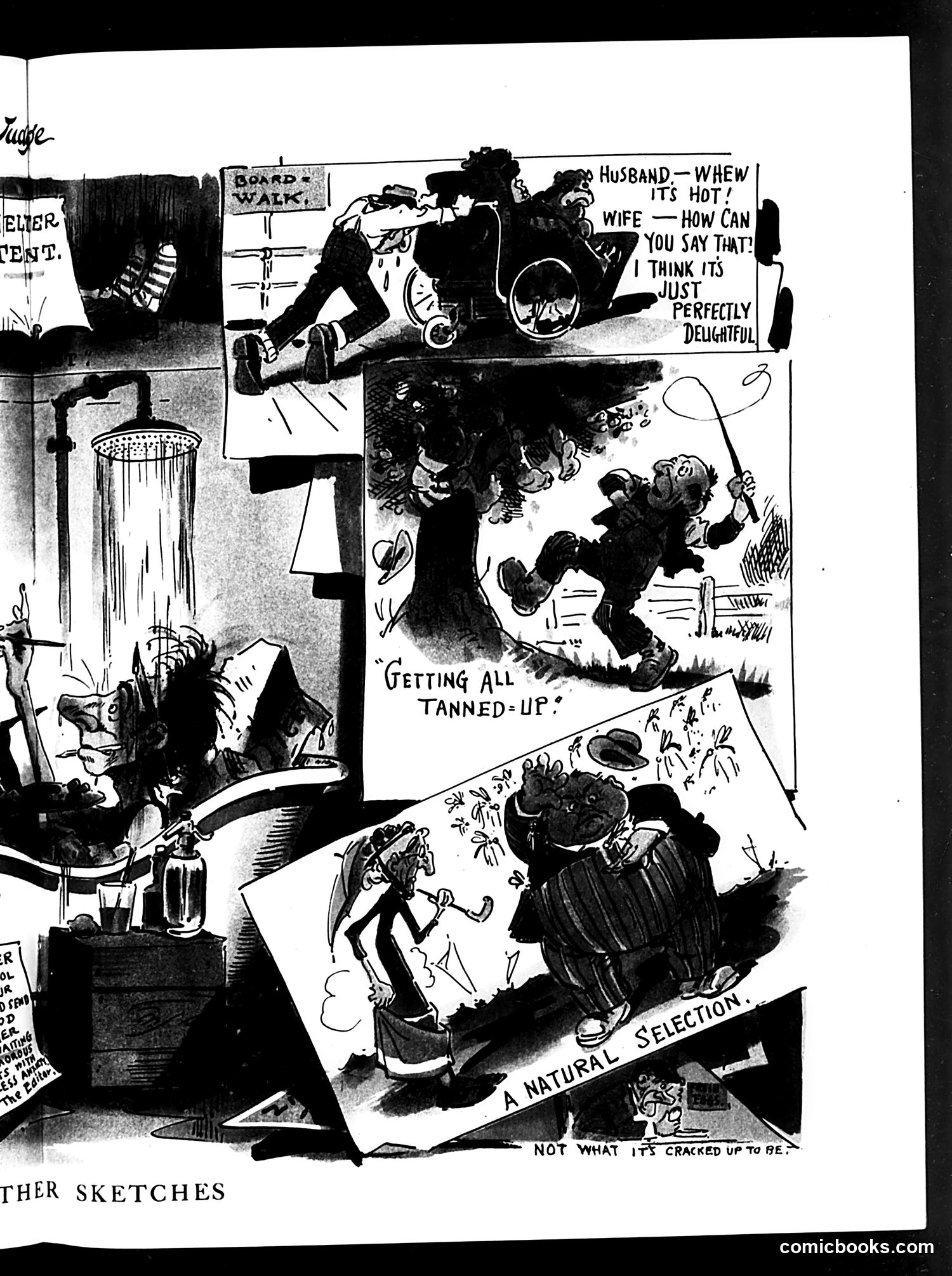
This page contains multiple comic vignettes satirizing domestic life and social conventions. The main sketch shows a husband and wife disagreeing about hot weather—he finds it unbearably hot while she insists it's "perfectly delightful." Below, another sketch titled "Getting All Tanned-Up" depicts a figure being sun-scorched, labeled "A Natural Selection," with the caption "Not What It's Cracked Up to Be." The satire targets Victorian-era gender dynamics and social pretense: wives performing contentment while husbands suffer, and the fashionable trend of tanned skin (signaling leisure and wealth) being humorously presented as painful sunburn instead. The "natural selection" reference invokes Darwinian evolution, mocking how social fashions are treated as inevitable progress.
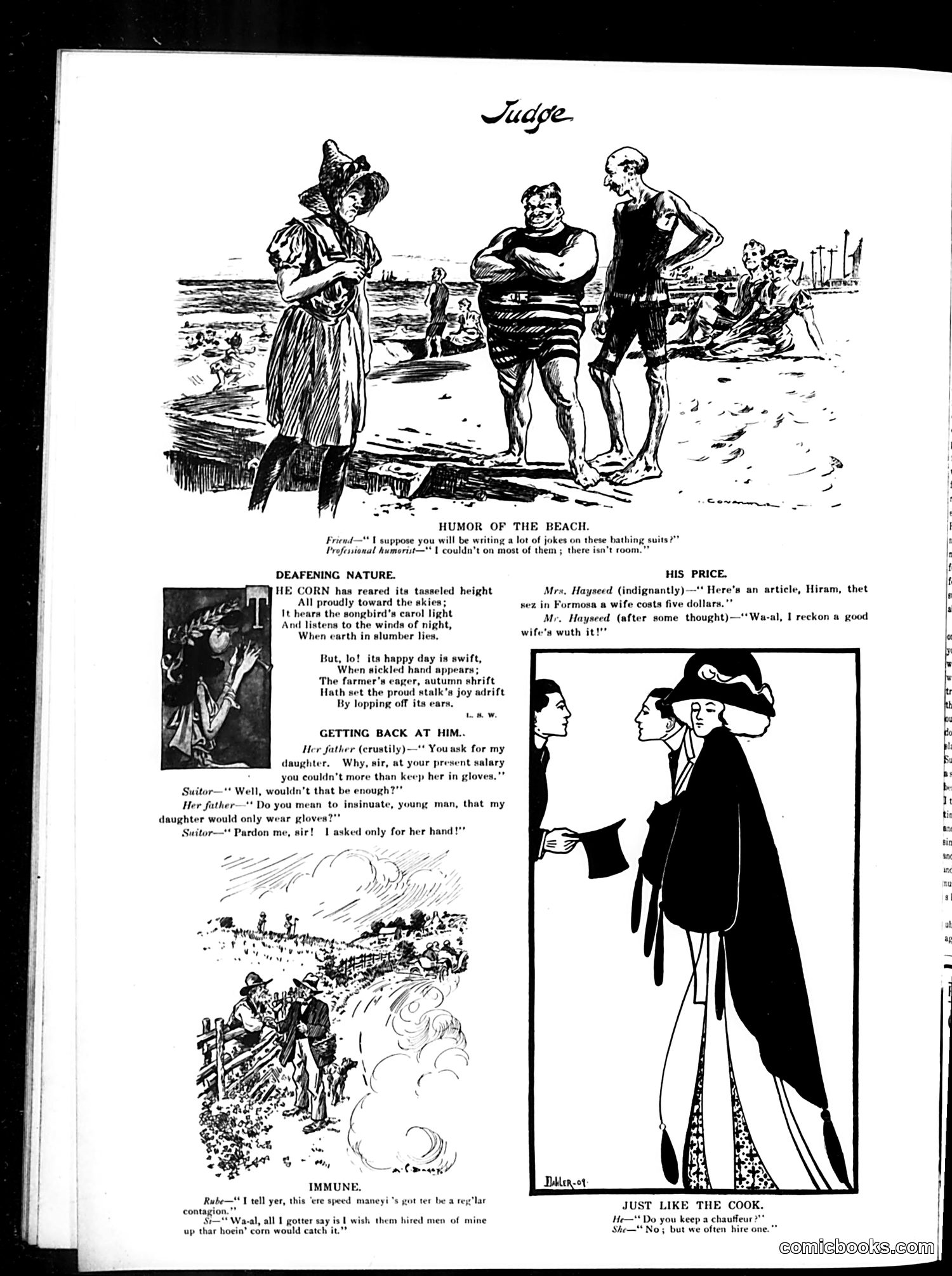
This page contains three separate humor pieces typical of early 20th-century American satire: **"Humor of the Beach"**: A joke about women's bathing suits being so revealing or scanty that there's insufficient fabric to write jokes on them—poking fun at the increasing brevity of swimwear fashions. **"Deafening Nature"**: A poem using corn as metaphor for human pride humbled by fate, with the farmer's harvest as the "deafening" blow to nature's proud display. **"Getting Back at Him"** and **"His Price"**: Two domestic comedy pieces. The first plays on a suitor's clever wordplay about keeping a daughter "in gloves" (financially supporting her in luxury). The second depicts rural characters discussing a newspaper article about cheap wives in Formosa, with the husband accepting the low value as reasonable. **"Just Like the Cook"**: A brief joke about servants—suggesting households hire temporary help rather than maintaining permanent staff. These represent typical Judge humor: domestic situations, class commentary, and jokes targeting emerging social changes around fashion and gender roles.
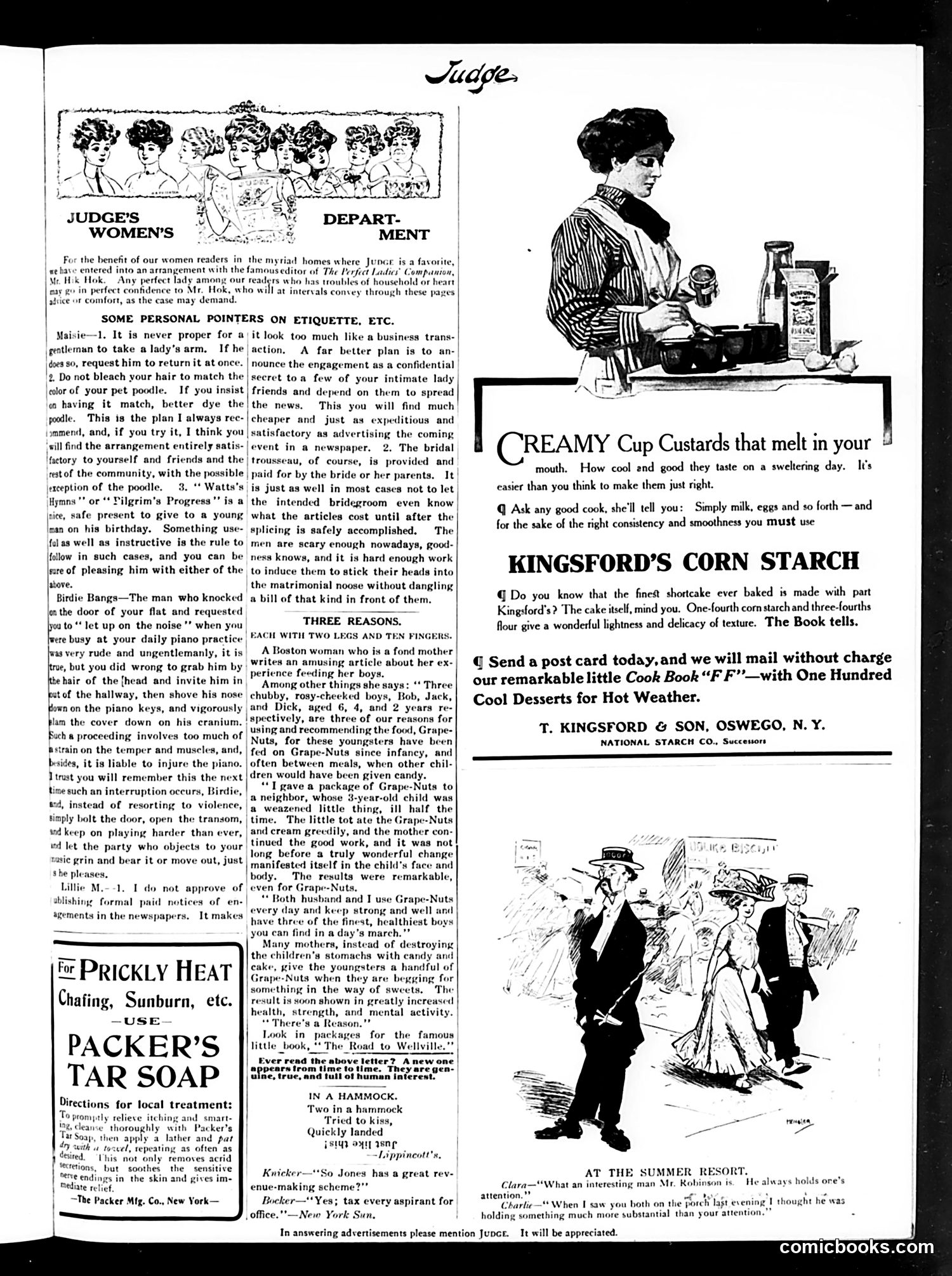
This page combines etiquette advice with advertising. The main content is "Judge's Women's Department," where an advice columnist (Mr. Hok, editor of "The Perfect Ladies' Companion") addresses reader questions about proper behavior. The satire targets genteel Victorian etiquette through exaggerated scenarios. One piece mocks excessive propriety by advising against arm-taking, suggesting readers dye their poodles rather than bleach hair to match them, and recommending hymn books as birthday gifts. Another humorously addresses a woman who violently assaulted a neighbor complaining about her piano practice—the columnist advises she should have simply ignored him rather than grabbing his hair and slamming his head on keys, as this might "injure the piano." The engagement announcement section satirizes women's social networks by suggesting they announce engagements as "confidential secrets" spread through gossip rather than formal notices—cheaper and equally effective. The page also features product advertisements, including Kingsford's Corn Starch and Packer's Tar Soap, typical of early-20th-century magazine content.
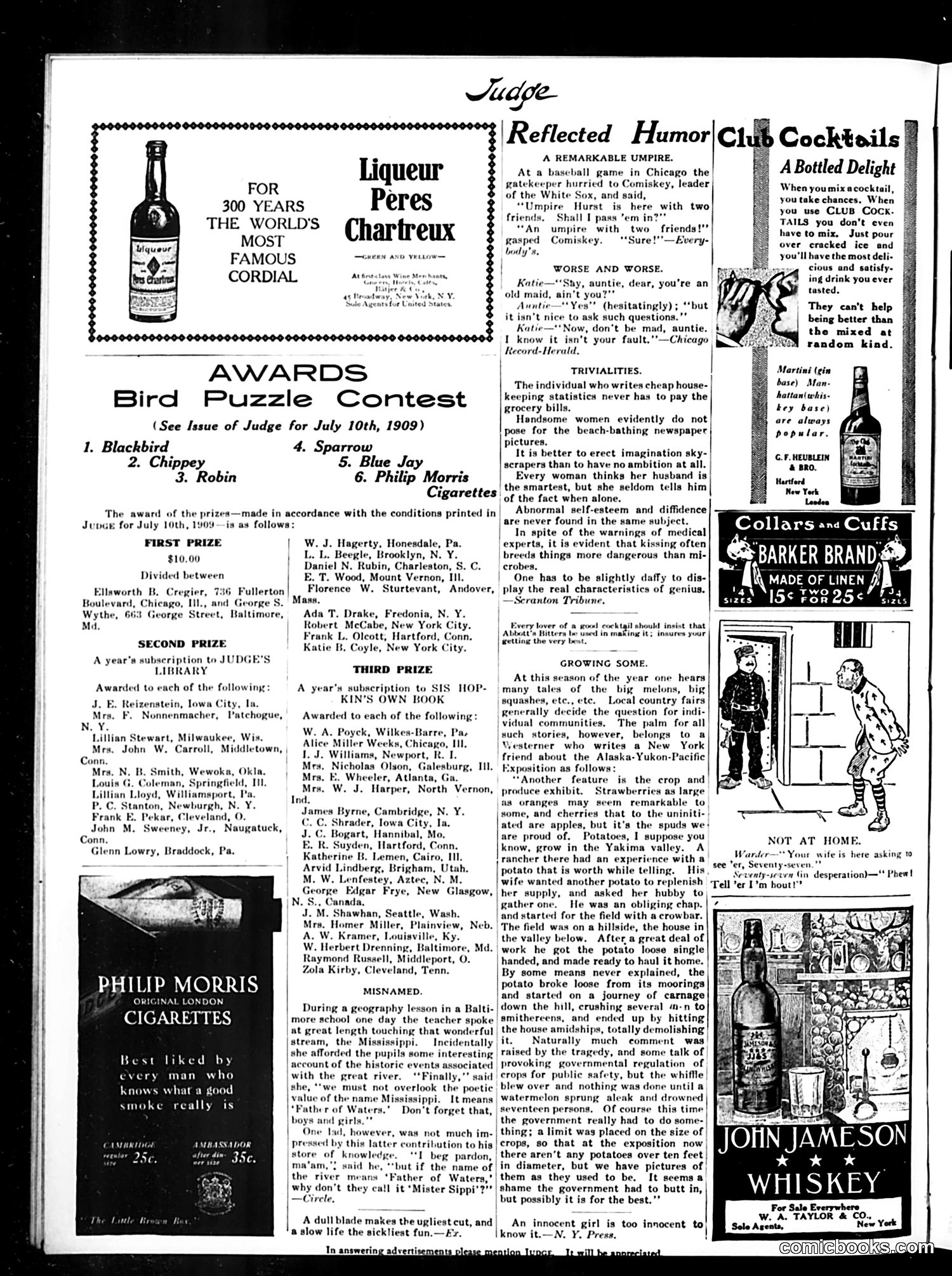
This page is primarily **advertisements and contest results**, not political satire. The main content announces winners of Judge's "Bird Puzzle Contest" from July 10, 1909—readers had to identify six bird illustrations, one of which was cunningly labeled "Philip Morris Cigarettes" (a visual pun, since Philip Morris is a cigarette brand, not an actual bird). The scattered humor pieces are light social comedy: an anecdote about a baseball umpire bringing two friends to a game; a child's innocent but rude question to an elderly aunt; a schoolboy's joke about the Mississippi River being "Mister Sippi." These are gentle domestic humor typical of Judge's content. The advertisements for liqueurs, Philip Morris Cigarettes, Barker Brand collars, and John Jameson Whiskey dominate the layout. There is **no political satire or caricature** on this page—it's a standard issue mixing advertising revenue with light entertainment and contest results.
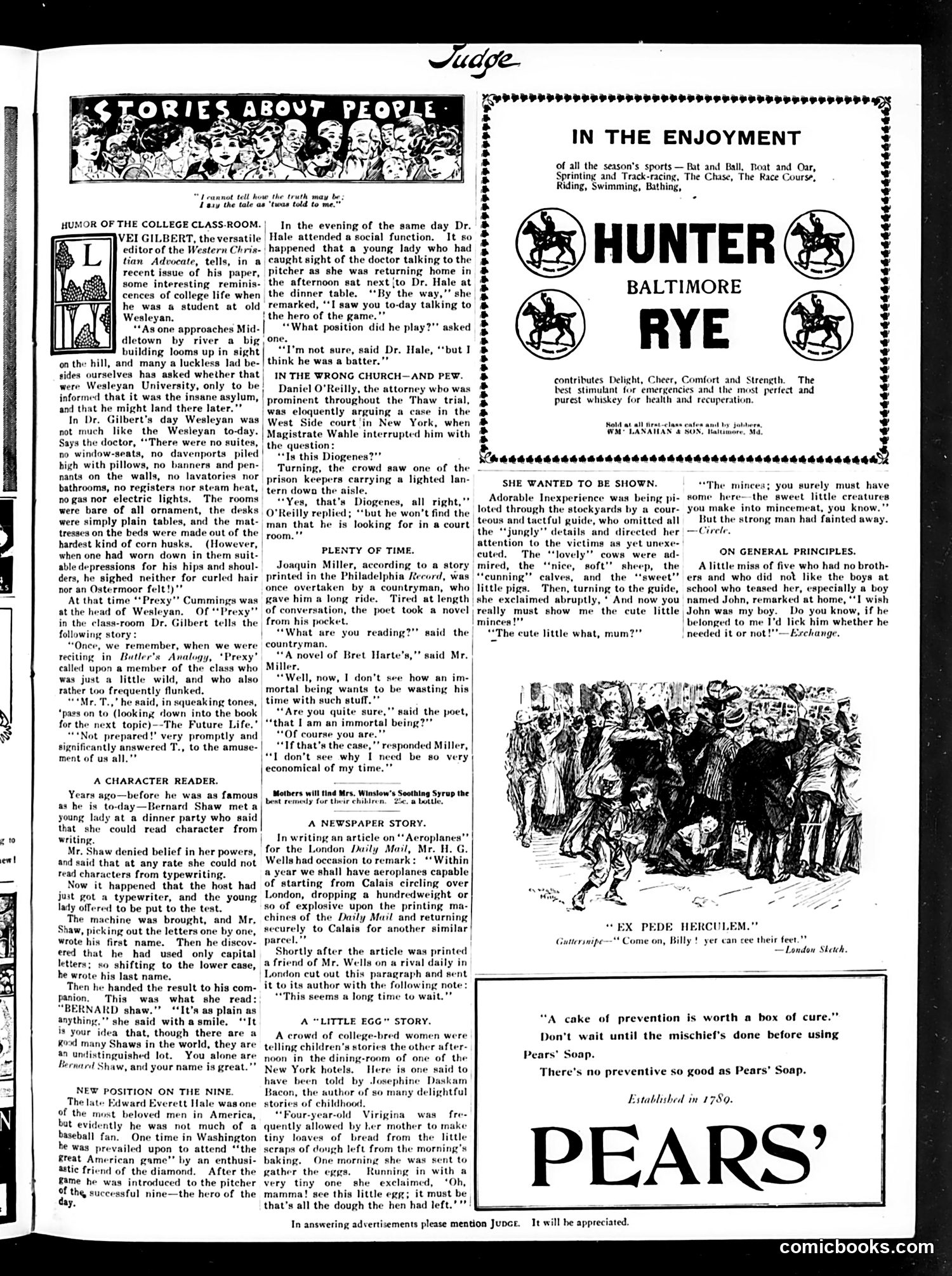
This page contains separate humorous anecdotes rather than political cartoons. The pieces mock academic pretension and intellectual pomposity through dialogue: **"Humor of the College Class-Room"** ridicules overly formal academic language. A college president ("Prexy") quizzes a student on philosophy, and the student's blunt deflection about "the future life" suggests academic discussion often lacks practical meaning. **"In the Wrong Church—and Pew"** references the Thaw trial (a famous 1906 murder case) and satirizes a verbose lawyer, Daniel O'Reilly, who constantly quotes Diogenes the philosopher searching for an honest man—implying lawyers themselves can't be trusted to find truth even in courtrooms. **"Plenty of Time"** features poet Joaquin Miller in a witty exchange about immortality: a countryman questions whether Miller, reading frivolous novels, should waste time on trivial pursuits if he's immortal. Miller's response—if he's immortal, he needn't be economical—mocks philosophical pretension. All three pieces use intellectual figures and classical allusions to puncture self-importance and hypocrisy among educated classes.
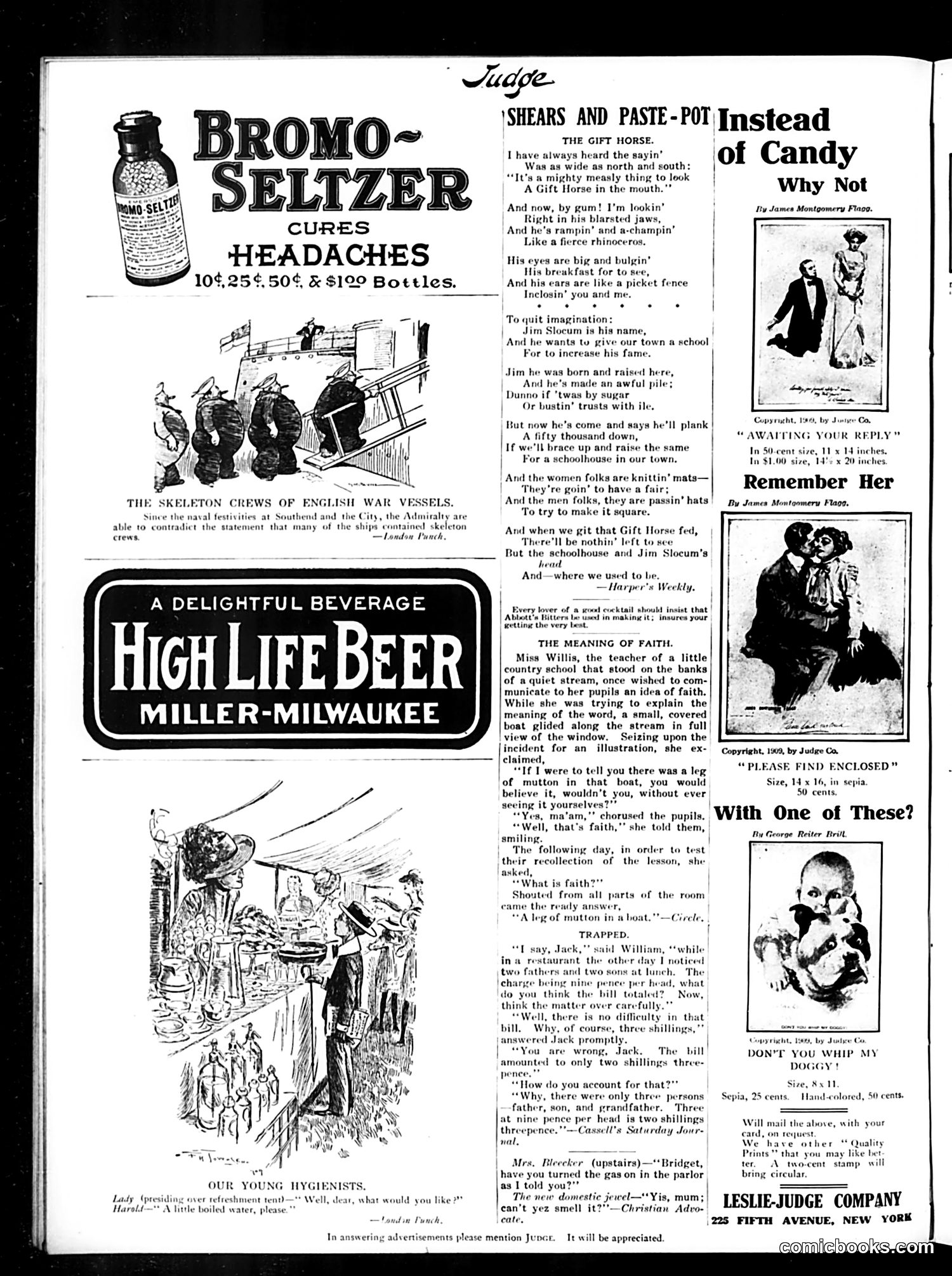
This page contains mostly **advertisements and short fiction/humor pieces** rather than political cartoons. The key content includes: **"The Gift Horse"** — A James Montgomery Flagg poem about Jim Slocum, a wealthy industrialist offering to fund a schoolhouse in his hometown. The satire mocks both Slocum's self-aggrandizing charity (wanting fame for the gift) and the townspeople's mercenary acceptance of it. The poem's title ironically references the proverb "don't look a gift horse in the mouth"—suggesting citizens shouldn't scrutinize motives of wealthy benefactors, though the satire suggests they should. **Other content** includes advertisements (Bromo-Seltzer, High Life Beer), short humor pieces about faith and logic, and illustrations by James Montgomery Flagg (a prominent American illustrator). The page reflects early 20th-century attitudes toward industrial wealth, philanthropy, and small-town aspirations—gently mocking both the wealthy donor's vanity and communities' eagerness to accept patronage for public improvements.
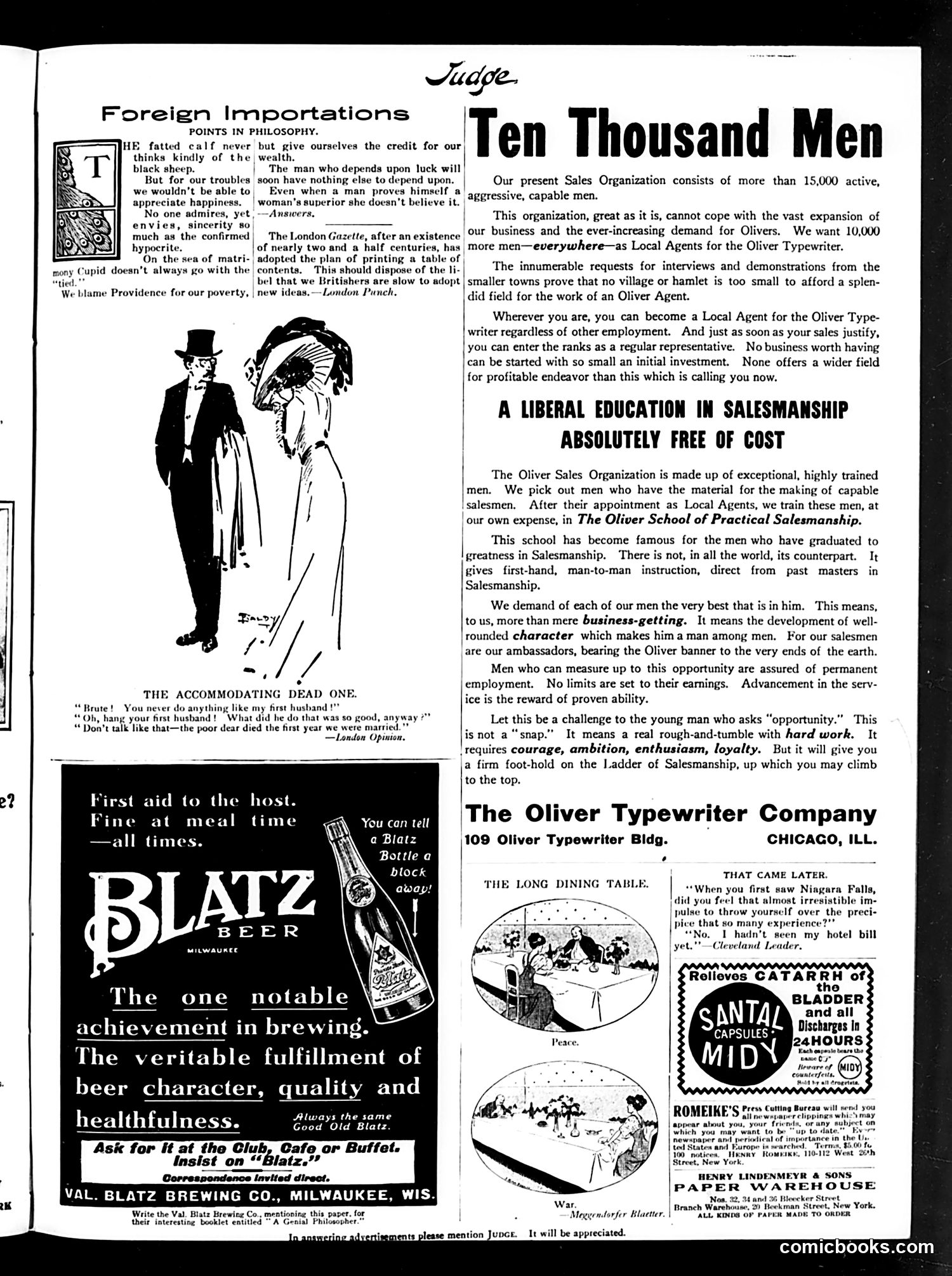
This page mixes satirical content with advertising. The main cartoon, "The Accommodating Dead One," shows a domestic dispute where a wife criticizes her husband by favorably comparing him to her deceased first husband. The satire targets marital discord and selective memory—the wife conveniently forgets her first husband's faults now that he's dead, using his memory as a weapon against her living spouse. This reflects early 20th-century humor about marriage dynamics and female domesticity. The "Foreign Importations" section quotes from British publications (London Gazette, Punch, Opinion) offering cynical observations about human nature—dependency, hypocrisy, and marriage—typical of Judge's imported philosophy humor. The page is otherwise dominated by advertisements: Blatz Beer emphasizes quality and consistency, while the Oliver Typewriter Company's large recruitment ad seeks 10,000 salesmen, promising free training and advancement opportunities. These ads reflect the era's industrial expansion and sales-driven business culture.
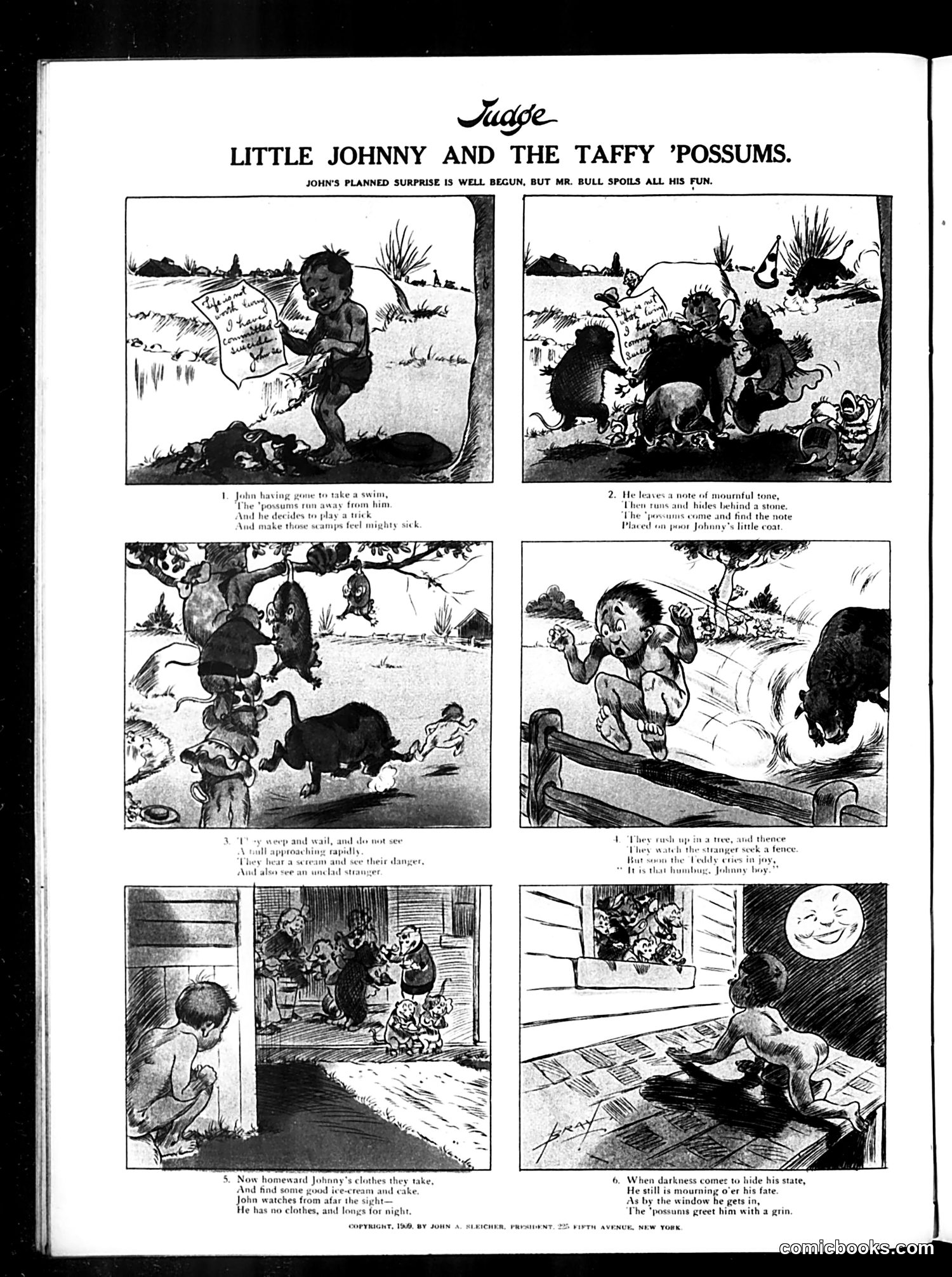
This is a children's comic strip, not political satire. It tells a straightforward narrative: Little Johnny plans a surprise involving taffy candies for some possums, but "Mr. Bull" disrupts his scheme. The story progresses through six panels showing Johnny leaving a note for the possums, them discovering the treat, Johnny's clothes being stolen while he swims, him chasing after the animals, and finally Johnny mourning his lost clothes at night while the possums mock him from outside. The humor is slapstick and moralistic—teaching that mischievous pranks backfire. "Mr. Bull" appears to be simply another character who interferes. This appears to be typical early-20th-century children's entertainment from *Judge* magazine, relying on animal antics and comeuppance rather than political commentary.