
A complete issue · 16 pages · 1908
Judge — November 28, 1908
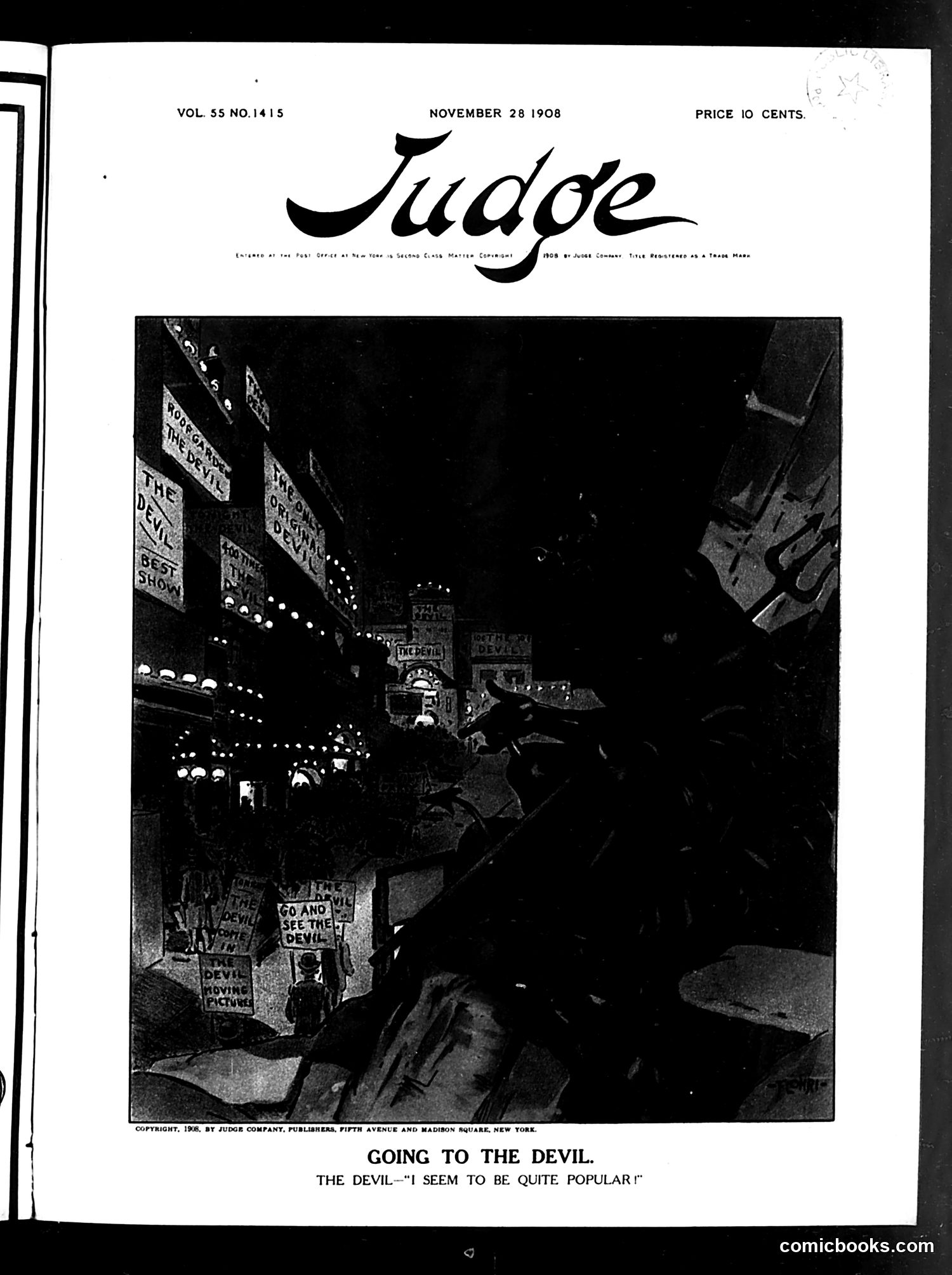
This satirical image depicts a nighttime theater district (likely Broadway), with illuminated marquees advertising "The Devil" as a popular entertainment attraction. Crowds gather outside theaters showing what appears to be a play or film titled "The Devil." The caption's joke—"I seem to be quite popular!"—is a personified Devil commenting on the theatrical success of devil-themed entertainment. The satire critiques either: 1. The public's fascination with sensational, morally questionable entertainment, or 2. Contemporary religious anxieties about commercial theater promoting vice and immorality. The crowded, glittering theater district suggests Americans are literally "going to the devil" by patronizing such shows—a common Progressive-era concern about urban entertainment and moral decline.
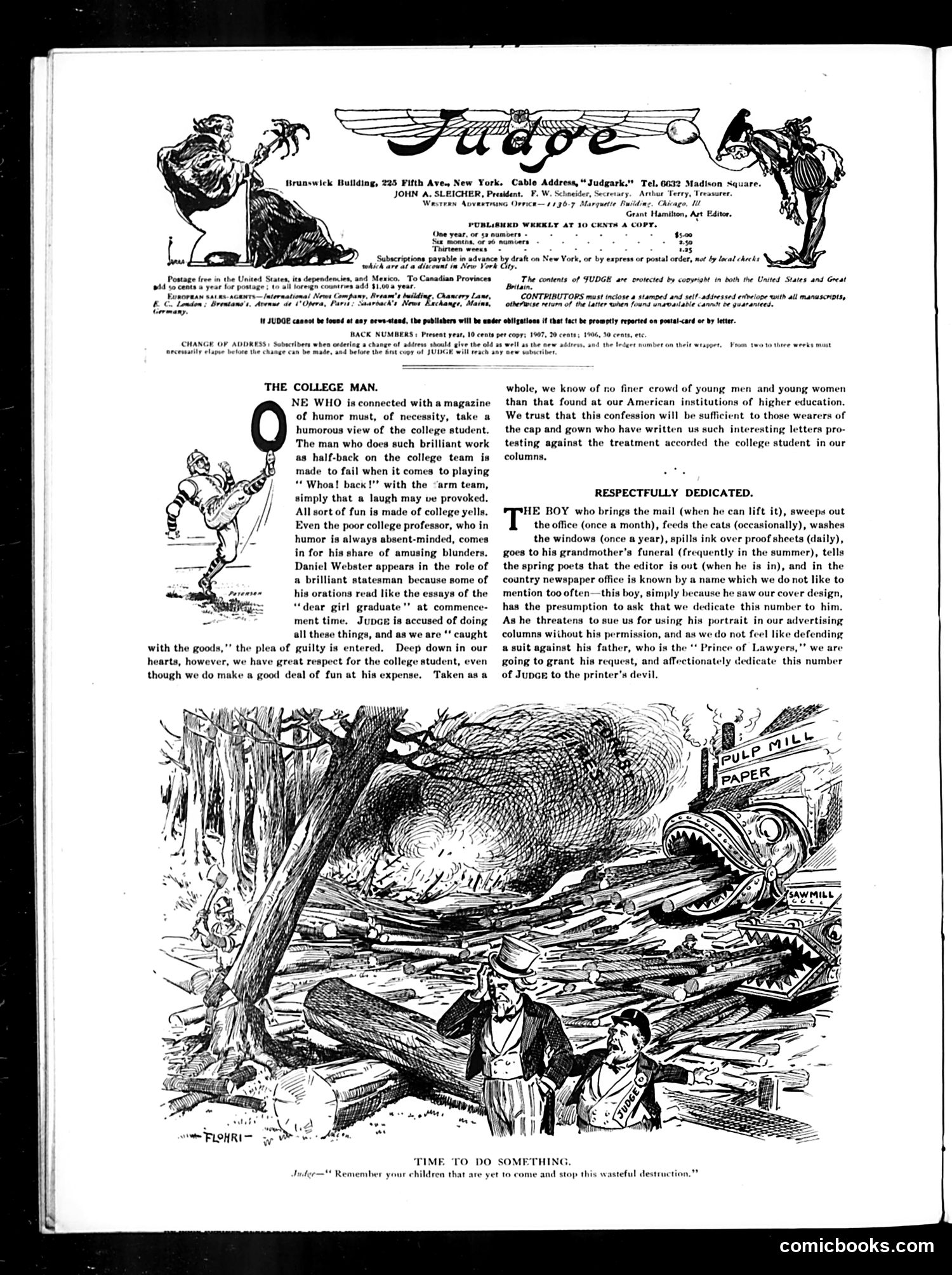
This page contains two main editorial cartoons addressing early 20th-century concerns: **"The College Man"** (top) satirizes college students' frivolous behavior and their contributions to humor magazines. The text defends Judge against accusations of mocking college life, arguing the publication actually respects educated youth while gently ridiculing their antics. **"Time to Do Something"** (bottom) depicts industrial waste and deforestation, with Judge—personified as a stern authority figure—confronting two men amid logs and a pulp mill. The caption warns about "wasteful destruction," suggesting the cartoon protests environmental degradation and resource depletion caused by industrial expansion, particularly logging operations. Both pieces reflect Judge's self-positioning as a voice of social criticism targeting both upper-class frivolity and industrial excess.
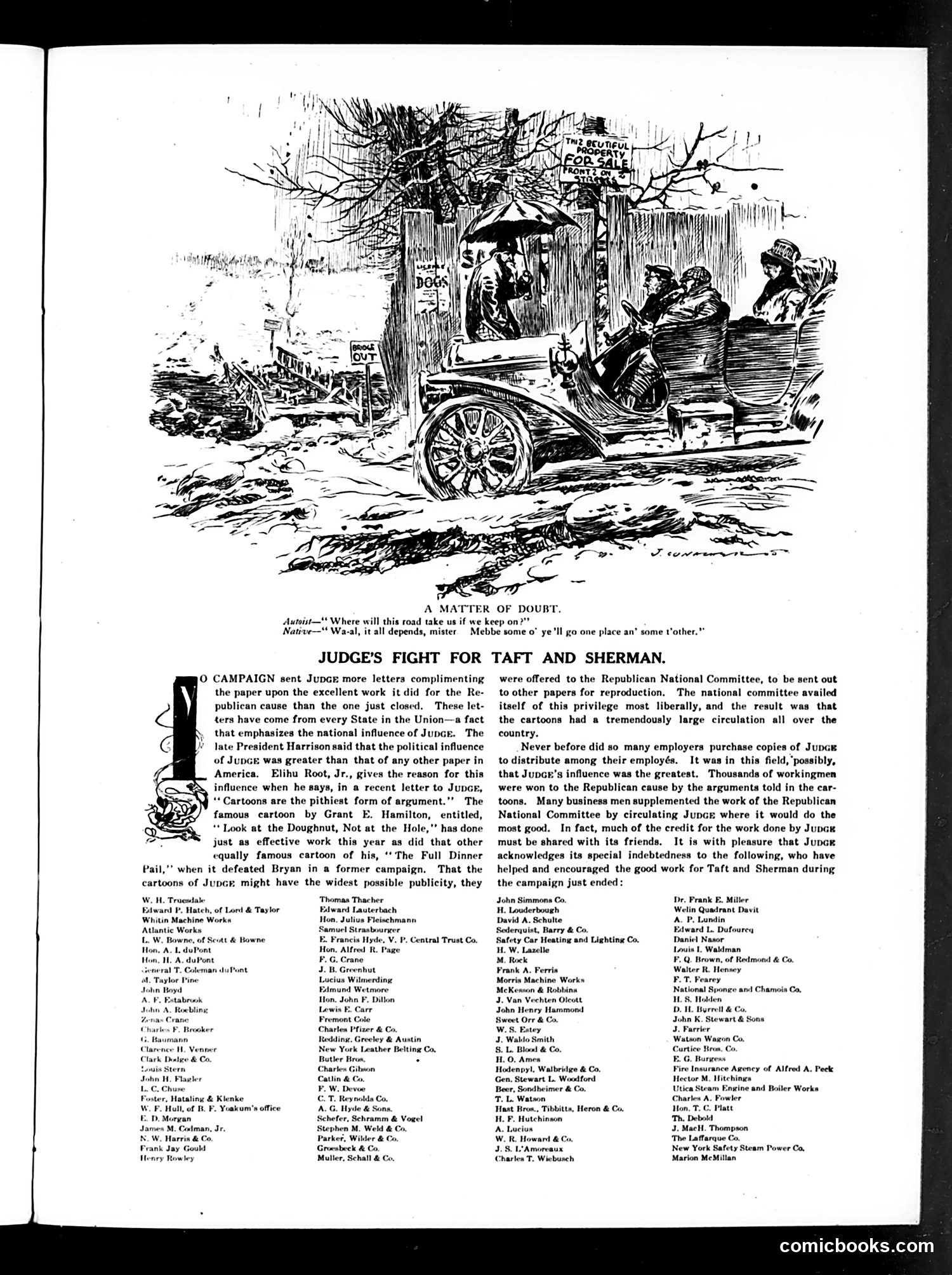
The cartoon depicts a roadside scene where a driver (in an early automobile) asks directions from what appears to be a rural figure. The driver asks, "Where will this road take us if we keep on?" The response is, "Waal, it all depends, mister. Maybe some o' ye'll go one place an' some t'other." The ambiguity suggests uncertainty about the political direction being taken. The text below discusses **Judge's influence on the 1912 campaign for Taft and Sherman** (Republican candidates), emphasizing how the magazine's cartoons swayed employers and businessmen to support them. The rural figure's wishy-washy answer likely satirizes political uncertainty or contradictory messaging in that election cycle.
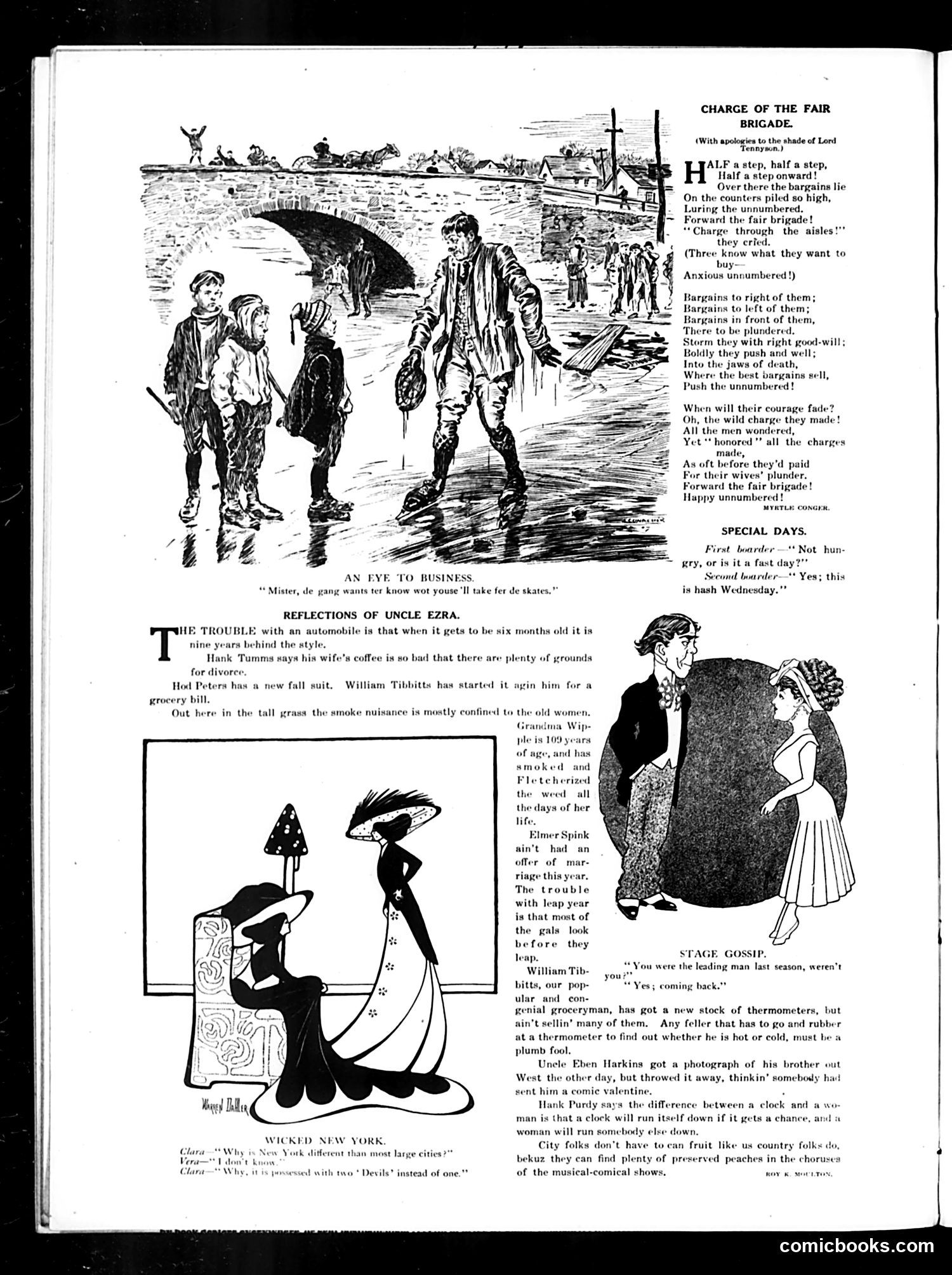
This page contains several satirical pieces typical of early 20th-century Judge magazine: **"Charge of the Fair Brigade"** (top): A poem satirizing women's aggressive bargain-hunting at sales, using mock-heroic language. The illustration shows women charging forward to grab merchandise, with the poem asking "When will their courage fade?" It's social satire about consumerism and female shopping behavior. **"Reflections of Uncle Ezra"** (middle): Gossip-style commentary on local scandals—automobiles causing divorces, a grocer's bill, and smoke nuisance from grass-burning. **"Wicked New York"** (bottom): A fashion-focused cartoon mocking New York women's pretensions, contrasting their appearance with claims of sophistication. **"Stage Gossip"**: Theater column chitchat. The page is primarily satirical social commentary on urban American life, particularly targeting women's behavior and fashion.
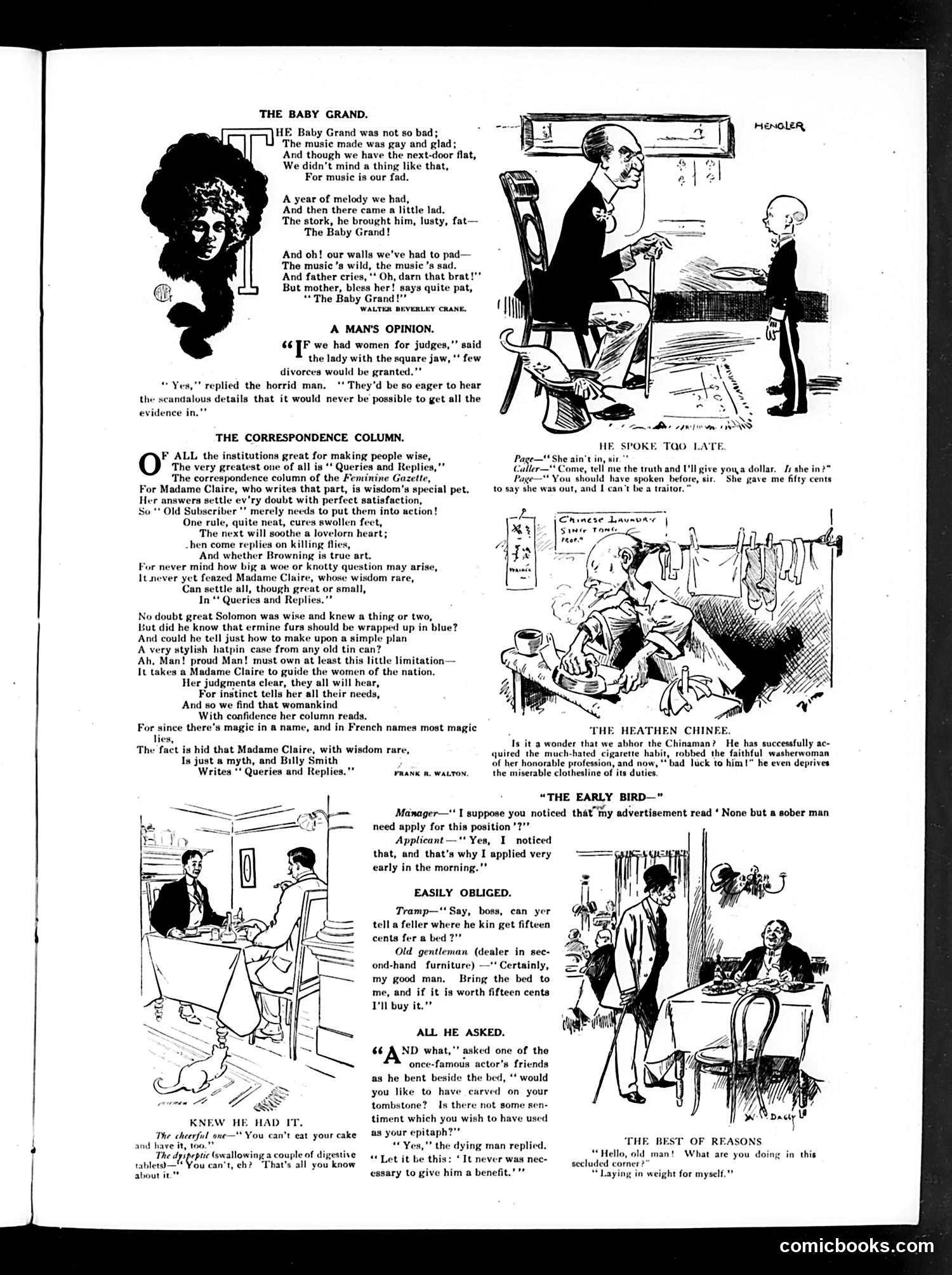
This page contains several short satirical pieces and cartoons typical of early 20th-century Judge magazine humor: **"The Baby Grand"** mocks a family's purchase of a baby grand piano as a status symbol, with the poem suggesting their walls suffered from the "wild" music played on it. **"A Man's Opinion"** presents a brief joke about divorce, with a man arguing that if women were judges, divorce would be granted more easily. **"The Correspondence Column"** features advice-column satire, poking fun at earnest problem-solving through letters to newspapers. The remaining cartoons appear to be brief comedic vignettes about everyday situations—a job interview, furniture dealing, and social awkwardness—using visual humor common to Judge's style of mocking middle-class pretension and domestic absurdities.
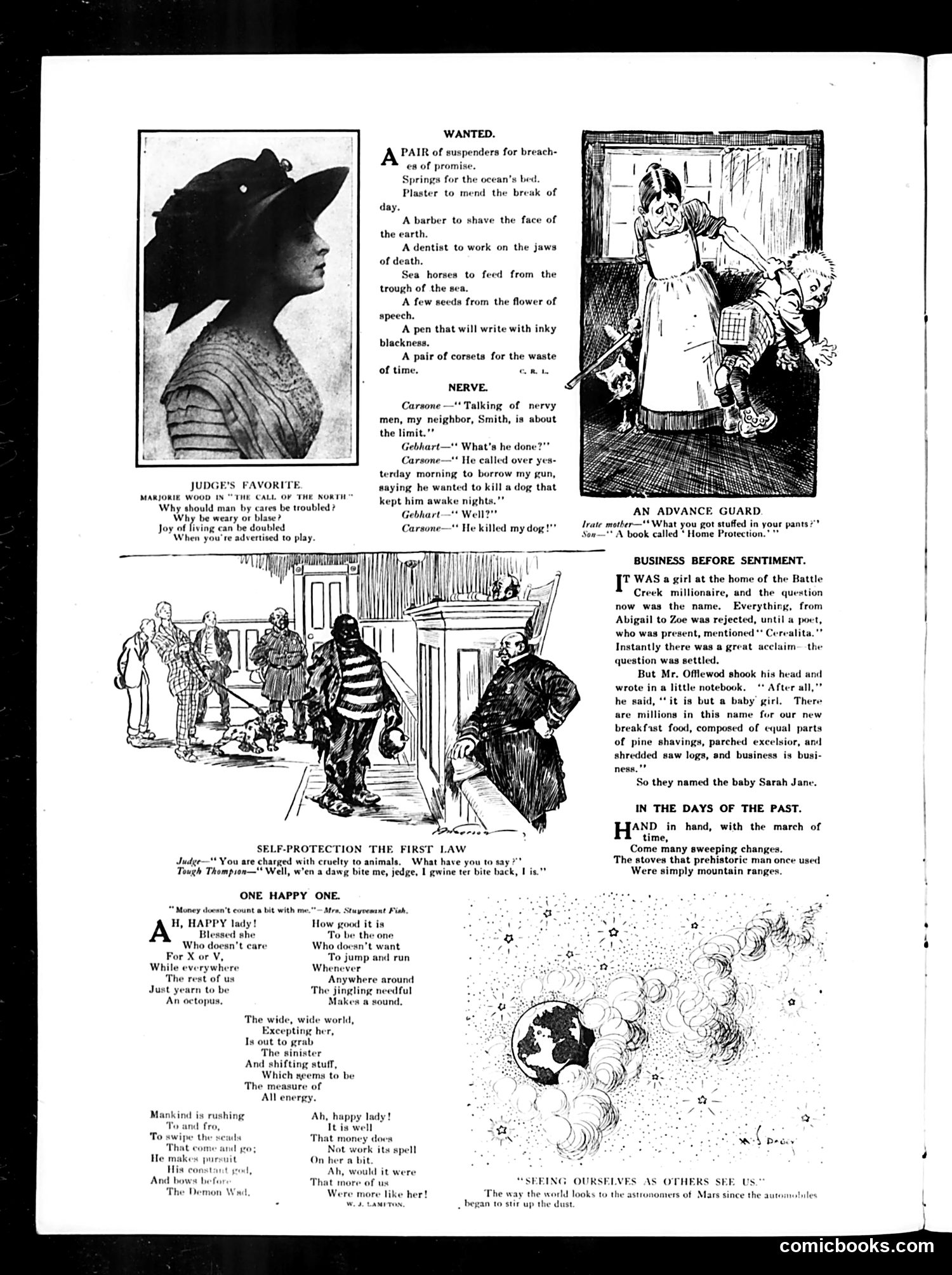
This page from Judge magazine contains several short satirical pieces typical of early 20th-century American humor: **"Self-Protection the First Law"**: A judge charges a man with animal cruelty; the defendant claims he bit a dog back in self-defense. The satire mocks both poor grammar and brutal logic. **"One Happy One"**: Satirizes wealthy society women (likely referencing the real socialite Mrs. Stuyvesant Fish), praising one woman for not chasing money like everyone else—a backhanded jab at materialism among the rich. **"Nerve"**: A brief anecdote where a man asks to borrow his neighbor's gun to kill a dog, then reveals he actually killed the neighbor's dog instead—absurdist humor about audacity. **"An Advance Guard"**: A mother discovers her child stuffed a "Home Protection" book down his pants—mocking parental advice books as unwieldy and impractical. **"Business Before Sentiment"**: A millionaire names his daughter after a breakfast cereal ("Cerealita") for marketing purposes, then renames her Sarah Jane for actual business calculations—satirizing corporate opportunism. **"Seeing Ourselves as Others See Us"**: Martians view Earth's automobiles stirring up dust—mocking the automobile industry's environmental impact.
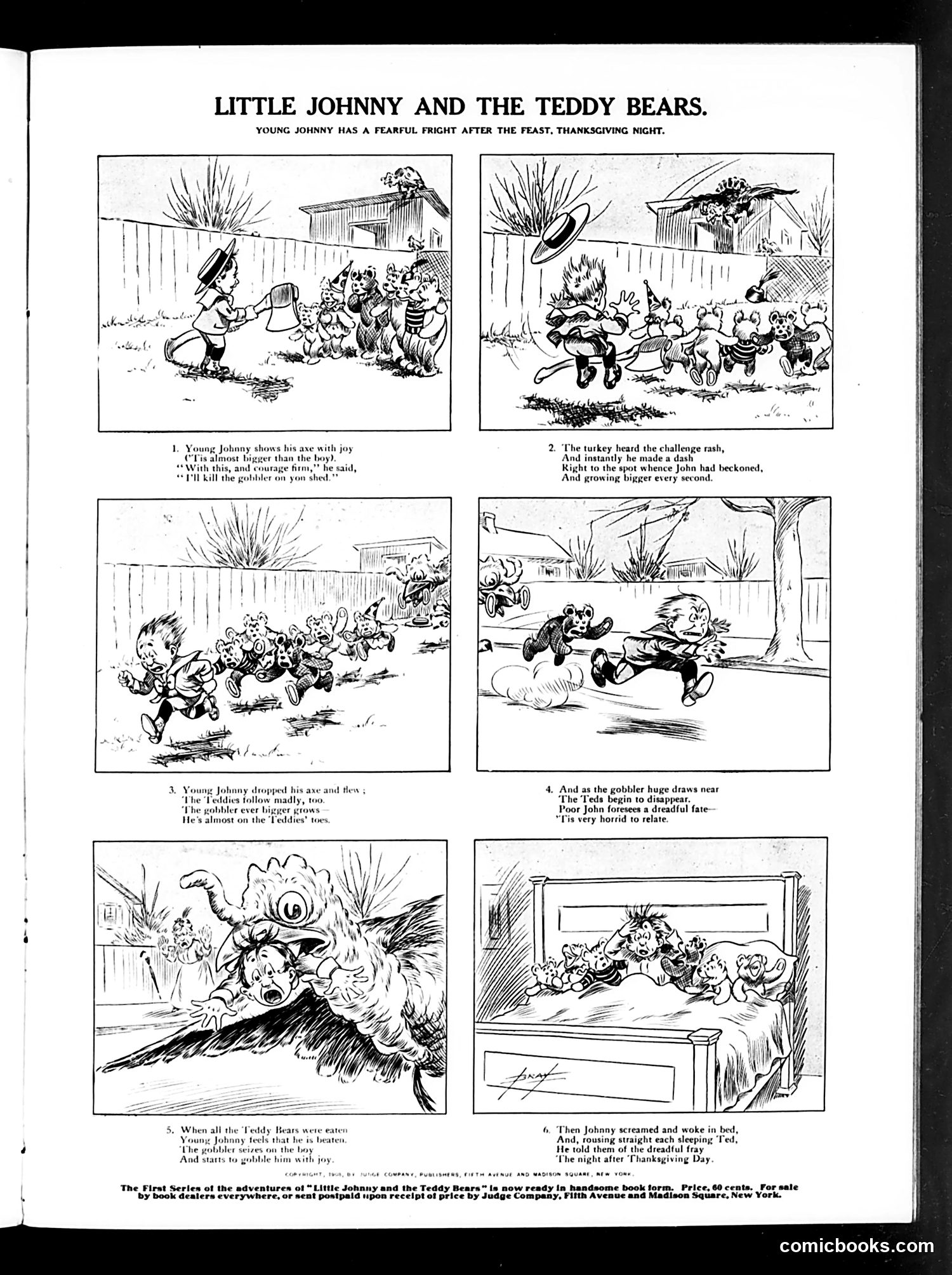
This is a children's comic strip rather than political satire. It depicts a Thanksgiving nightmare: young Johnny plays with his "Teddy Bears" (stuffed animals named after President Theodore Roosevelt, whose popularity made them a commercial phenomenon in the early 1900s), then dreams a turkey he challenged comes alive and grows menacingly larger. His teddy bear companions vanish as the giant gobbler approaches. Johnny wakes screaming and tells his toys about the frightening dream. The humor relies on childhood fears and the surreal logic of dreams—a common theme in early-20th-century children's comics. The "Teddy Bears" are simply toys, not political figures. The strip serves primarily as advertisement for a 60-cent book collection available from Judge Company, suggesting this was a popular recurring series.
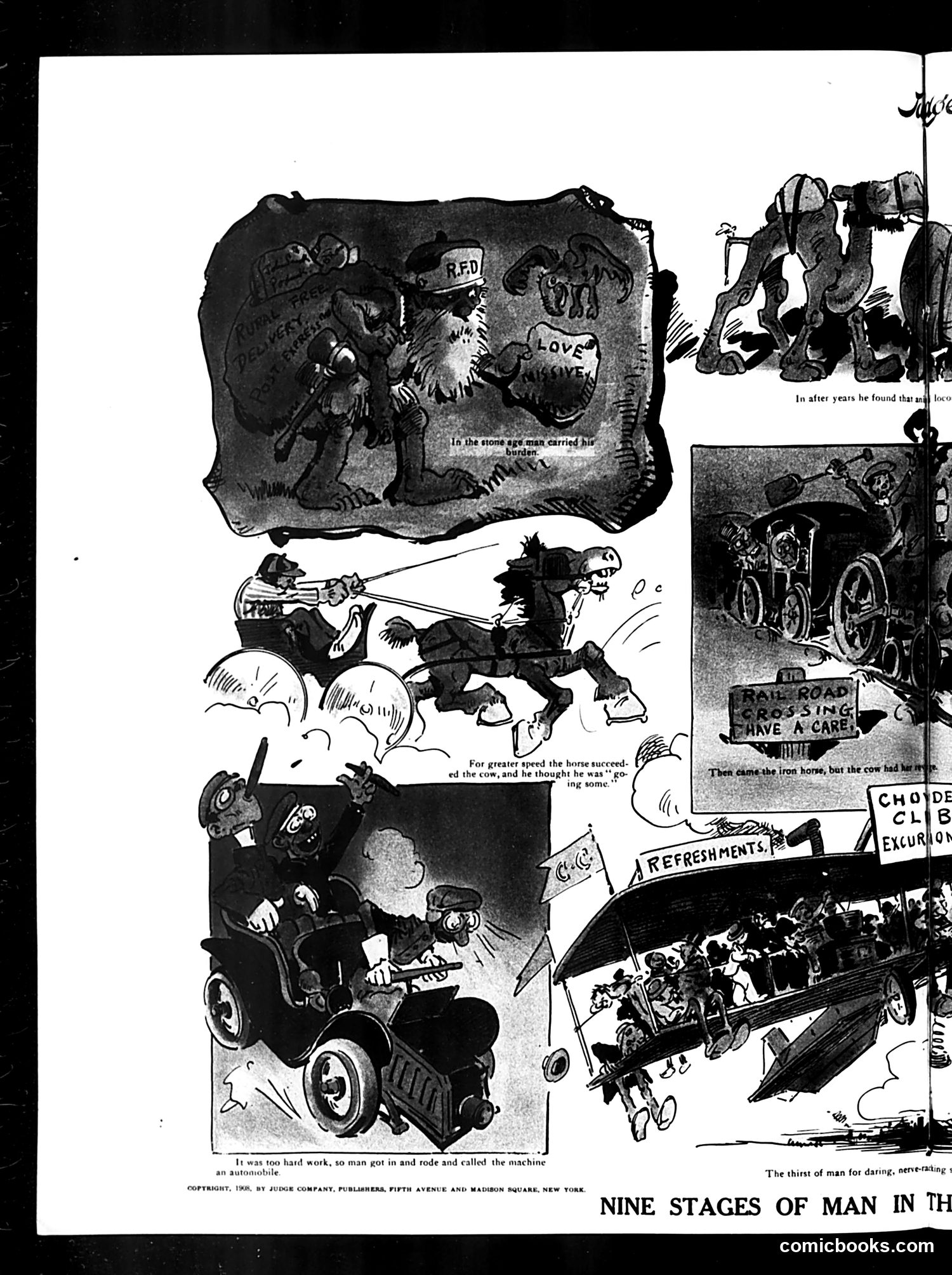
This satirical comic traces human progress through transportation, culminating in the automobile. The sequence shows man evolving from stone-age burden-bearer, through horseback riding, to operating increasingly complex mechanical vehicles—ultimately crowding into a motorcar. The humor satirizes the era's obsession with speed and "progress." Early captions mock man's satisfaction with each innovation ("he thought he was 'going some'"). The final panels show the automobile age creating chaos: cyclists colliding, pedestrians endangered, and people packed together despite warnings like "Road Crossing Have a Care." The satire suggests that technological advancement, while celebrated as civilization's triumph, has created new dangers and cramped conditions. It's a commentary on early-1900s automobile culture's chaotic social impact.
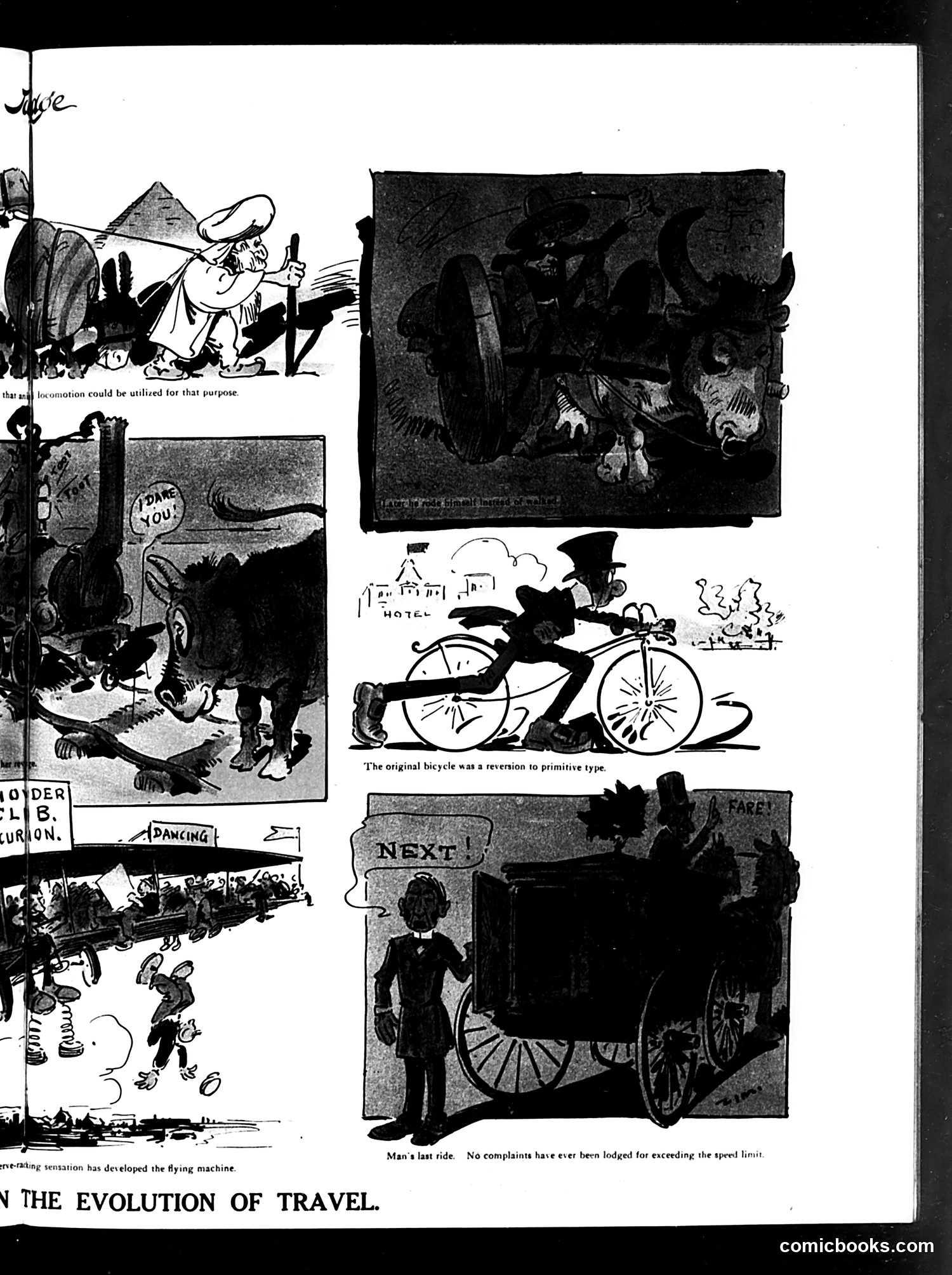
This page satirizes the evolution of transportation technology. The title "In the Evolution of Travel" frames a series of vignettes showing increasingly modern modes of transport—from primitive locomotion through bicycles to carriages and automobiles. The central joke appears to be ironic commentary on speed and safety regulations. The caption "Man's last ride. No complaints have ever been lodged for exceeding the speed limit" suggests dark humor: the final image shows what appears to be a hearse or funeral carriage, implying that death is the only "ride" where speed violations go uncomplained-about because the passenger is deceased. This reflects early-1900s anxieties about automobile safety and speed, common themes in Judge's satirical content about modern technology.
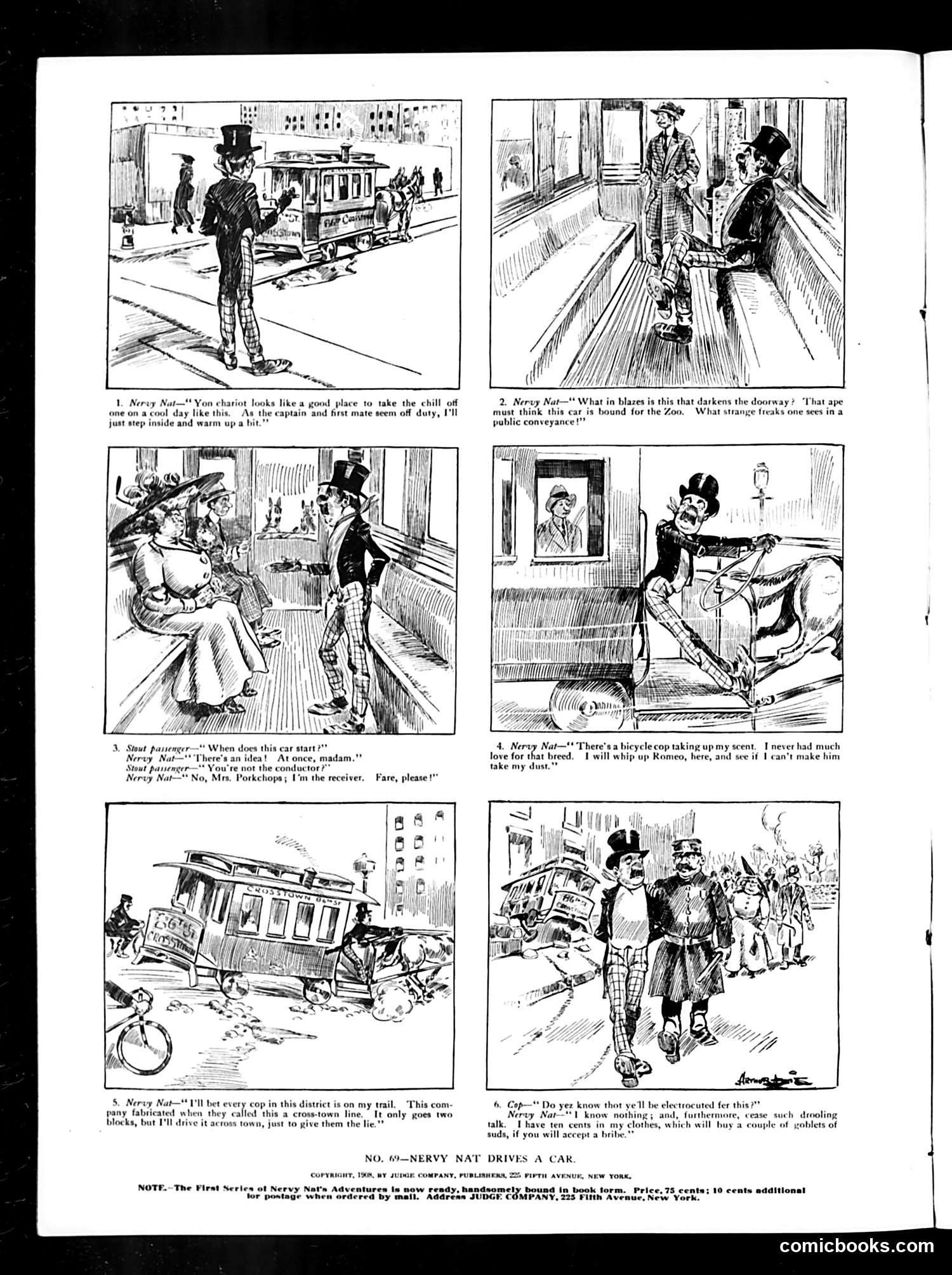
This six-panel comic strip satirizes early automobile culture and a roguish character named "Nervy Nat." The humor centers on Nat's audacious theft or commandeering of a streetcar, his evasion of police, and his casual criminality. Key points: - **The setting**: Urban transportation (streetcars, bicycles, cops) in what appears to be the early 1900s - **The character**: Nervy Nat is a con artist/criminal who steals a car, outruns a bicycle cop, and attempts to bribe an arresting officer with ten cents - **The satire**: The comic mocks both Nat's brazen disregard for law and the ease with which he apparently operates—suggesting social commentary on urban crime or police corruption - **The joke**: Nat's supreme confidence despite obvious criminal activity; his casual bribery attempt This appears to be part of an ongoing comic series marketed to Judge magazine readers as a book series.
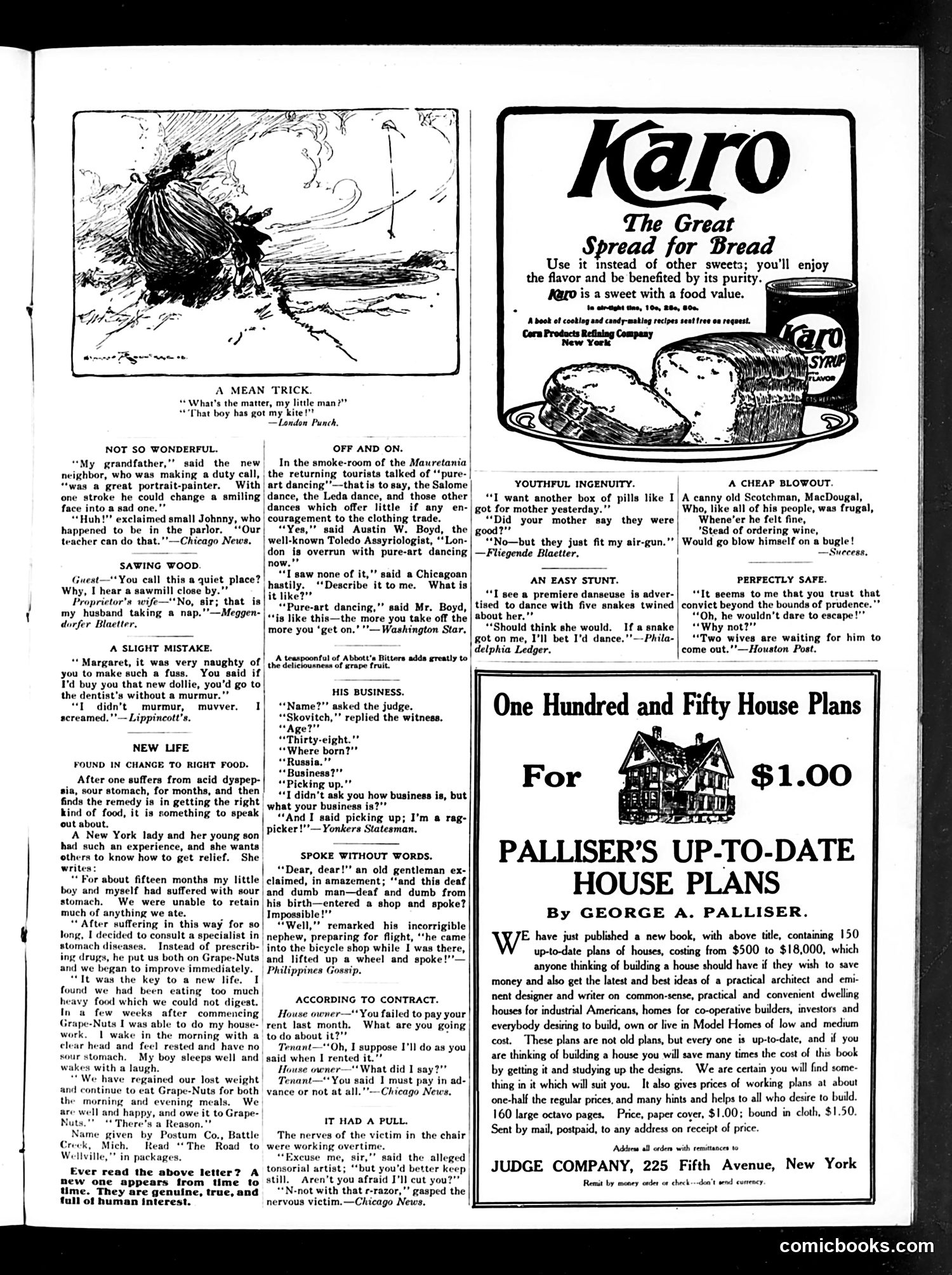
This page contains short humorous anecdotes typical of early 20th-century American humor magazines, plus advertisements. **The Cartoons/Jokes:** The top illustration depicts a child being scolded—likely illustrating "A Mean Trick," where a boy insults his teacher's ability to change expressions. The humor relies on childhood impertinence. Other brief jokes include: - A teacher who can change smiling faces to sad ones (implying stern discipline) - A child who "screamed" rather than "murmured" at the dentist - Wordplay about "pure-art dancing" (Salome and Leda dances, likely referencing early 20th-century exotic dances that scandalized society by revealing bodies) - A deaf-mute man who "spoke" by lifting a bicycle wheel—pun-based humor **Context for Modern Readers:** These are genteel, pun-dependent jokes reflecting Victorian/Edwardian sensibilities. The "pure-art dancing" reference suggests contemporary moral anxiety about modern dance. The page also features testimonial advertising for Grape-Nuts cereal and Abbott's Bitters—patent medicines disguised as food products—reflecting an era before FDA regulations.
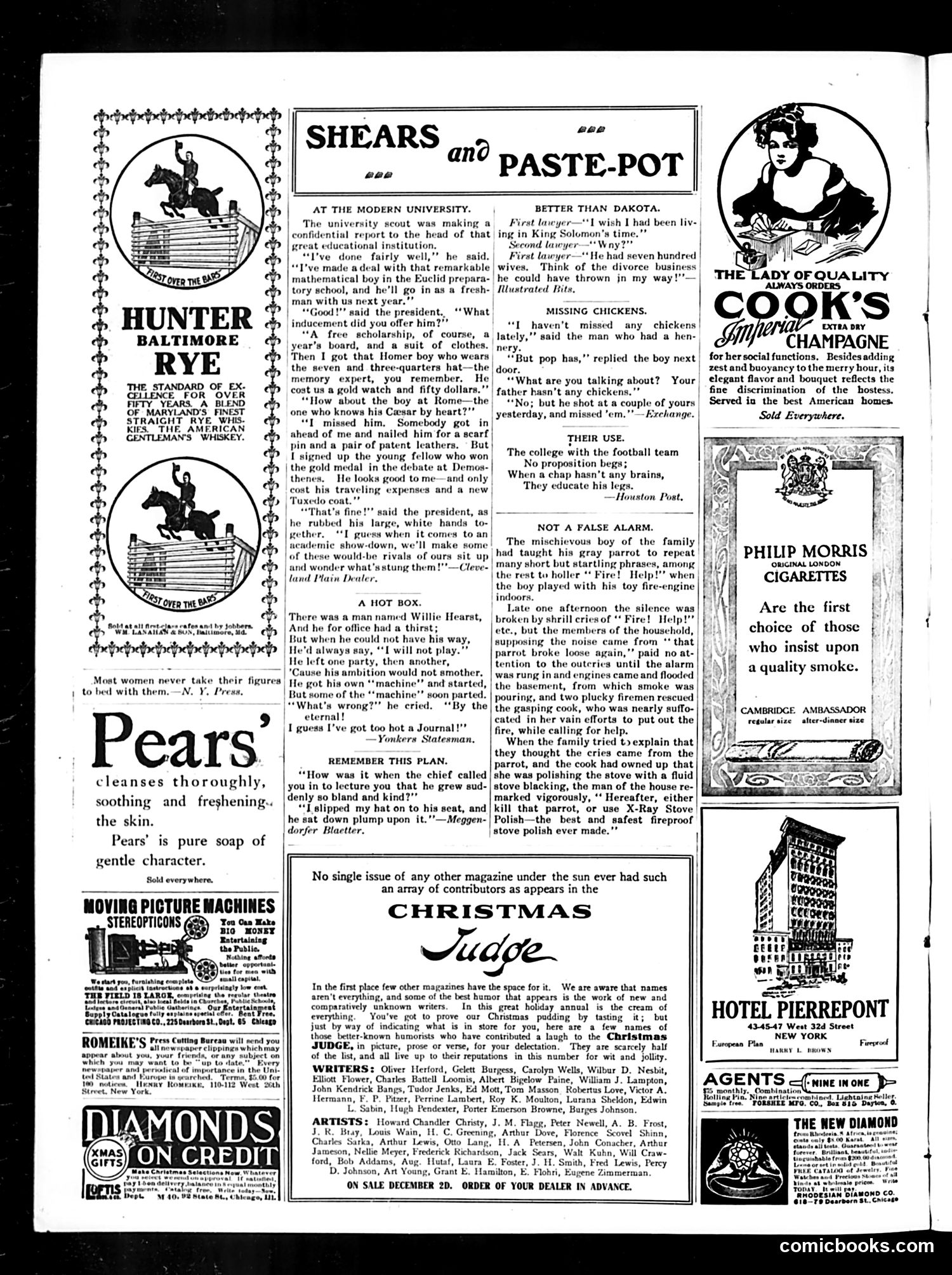
This page from *Judge* magazine consists primarily of **advertisements and brief humorous anecdotes** rather than political cartoons. The main content includes satirical short stories mocking contemporary institutions: 1. **"At the Modern University"** — Satirizes higher education's focus on athletics and fame over academics. A university scout negotiates scholarships with students based on non-academic achievements (memory feats, debate medals), suggesting colleges prioritize sports and spectacle. 2. **"A Hot Box"** — A comedic tale of a boy whose toy fire-engine and parrot cause domestic chaos, mistaken for a real fire alarm. 3. **"Better than Dakota"** — A lawyer jokes about wishing he'd lived in King Solomon's era for divorce business opportunities. The page is dominated by period **advertisements** for whiskey, soap, diamonds, and other products. The satire reflects early 20th-century American anxieties about commercialism in education and the sensationalism of modern life, but remains light and humorous rather than sharply political.
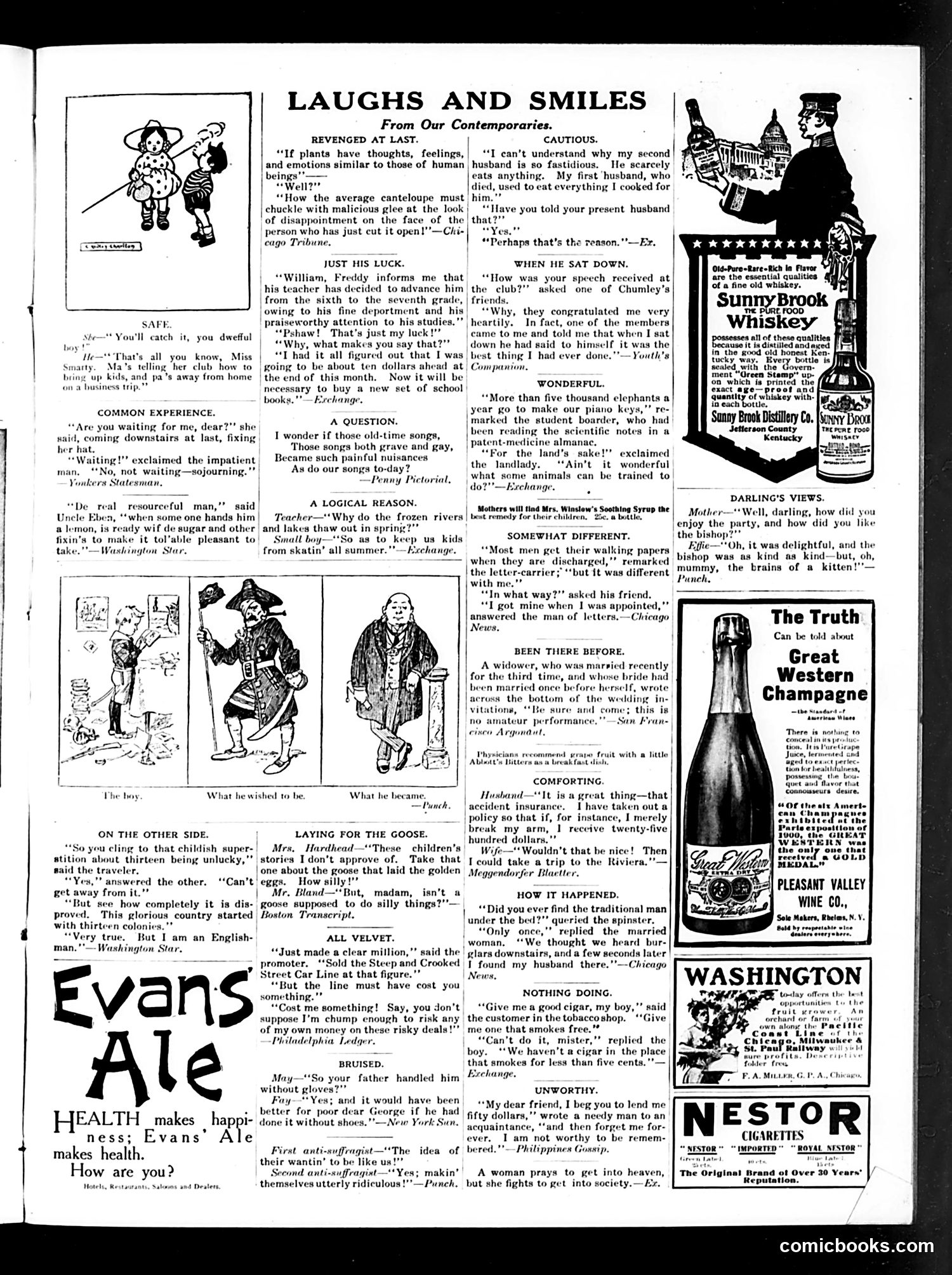
This is a humor page from *Judge* magazine featuring short jokes and quips labeled "Laughs and Smiles." The cartoons and text satirize everyday domestic and social situations of the early 20th century. Key items include: **"REVENGED AT LAST"**: Jokes about plants having feelings—mocking pseudo-scientific sentiment about nature. **"JUST HIS LUCK"**: A boy advances in school due to good behavior, but his father is disappointed because he'd counted on saving money from tuition costs—satirizing parental selfishness. **"CAUTIOUS"**: A woman's second husband won't eat her cooking (implying she's a bad cook), while her first husband ate everything—dark humor about her husband's survival instincts. **"WHEN HE SAT DOWN"**: A man's club speech was well-received, but a friend told him he'd left before the actual speech—satirizing false flattery. The page also contains advertisements (Evans' Ale, Sunny Brook Whiskey, Nestor Cigarettes) and reflects period concerns about marriage, domestic life, and social propriety.
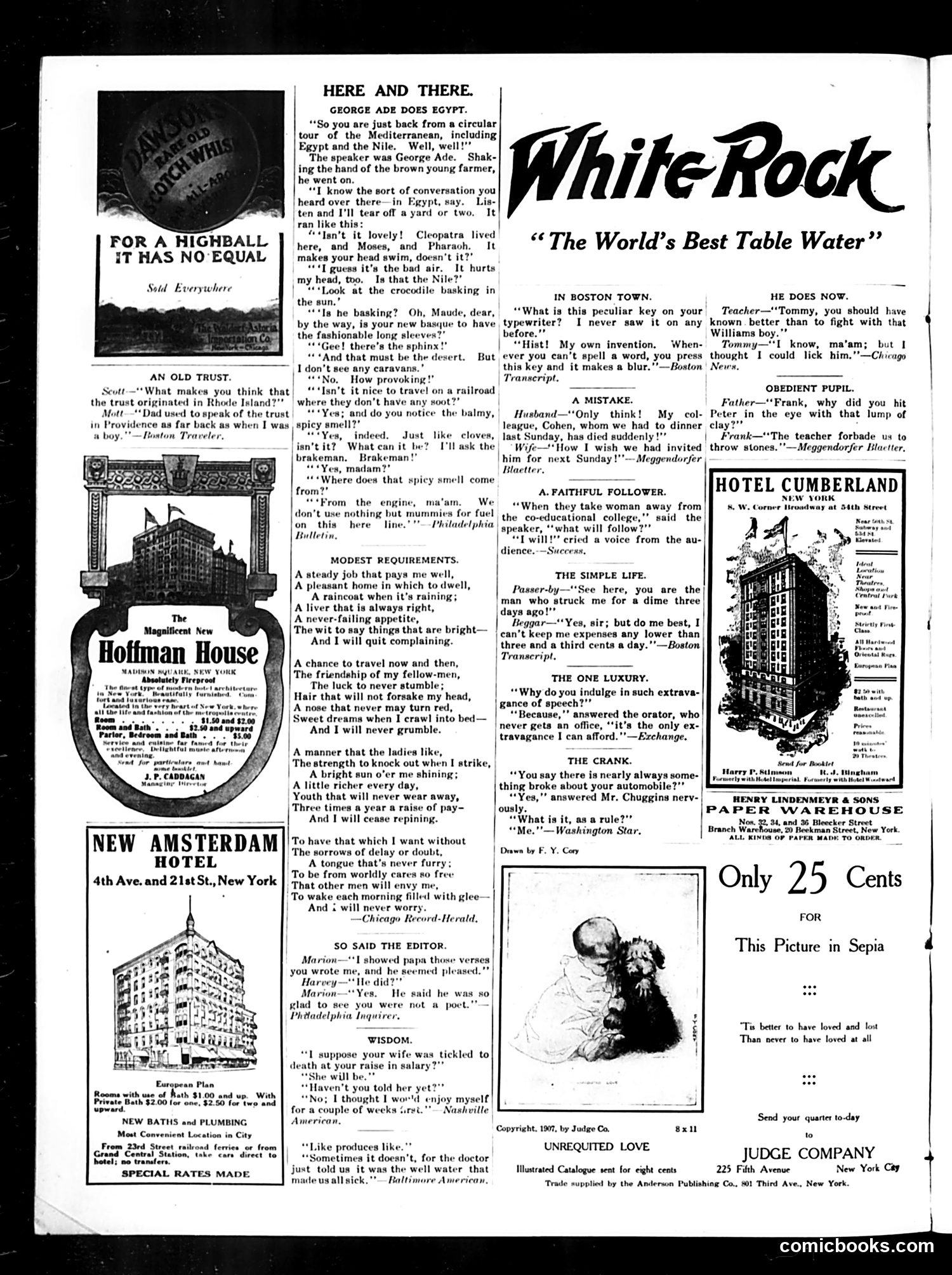
This page from *Judge* magazine consists primarily of **humorous prose sketches and light satirical commentary**, not political cartoons. The main content is a piece by **George Ade** (a famous humorist of the era) mocking the predictable, clichéd conversations tourists have in Egypt—about Cleopatra, Moses, the Nile, crocodiles, and the Sphinx. Ade satirizes the banality of tourist speech and wonder. Other brief jokes target: - **A typewriter key** that "makes a blur" to hide spelling errors—mocking modern technology - **Marriage dynamics** and dinner-party etiquette - **Beggars' economics** (the humor of a beggar calculating his "cost of living") - **Coeducational colleges** and what happens when women are removed The page is largely filled with **hotel and product advertisements** (White Rock water, Hoffman House hotel, etc.). There are no identifiable political figures or events—this is humor aimed at everyday American middle-class life and tourist culture of the early 1900s.
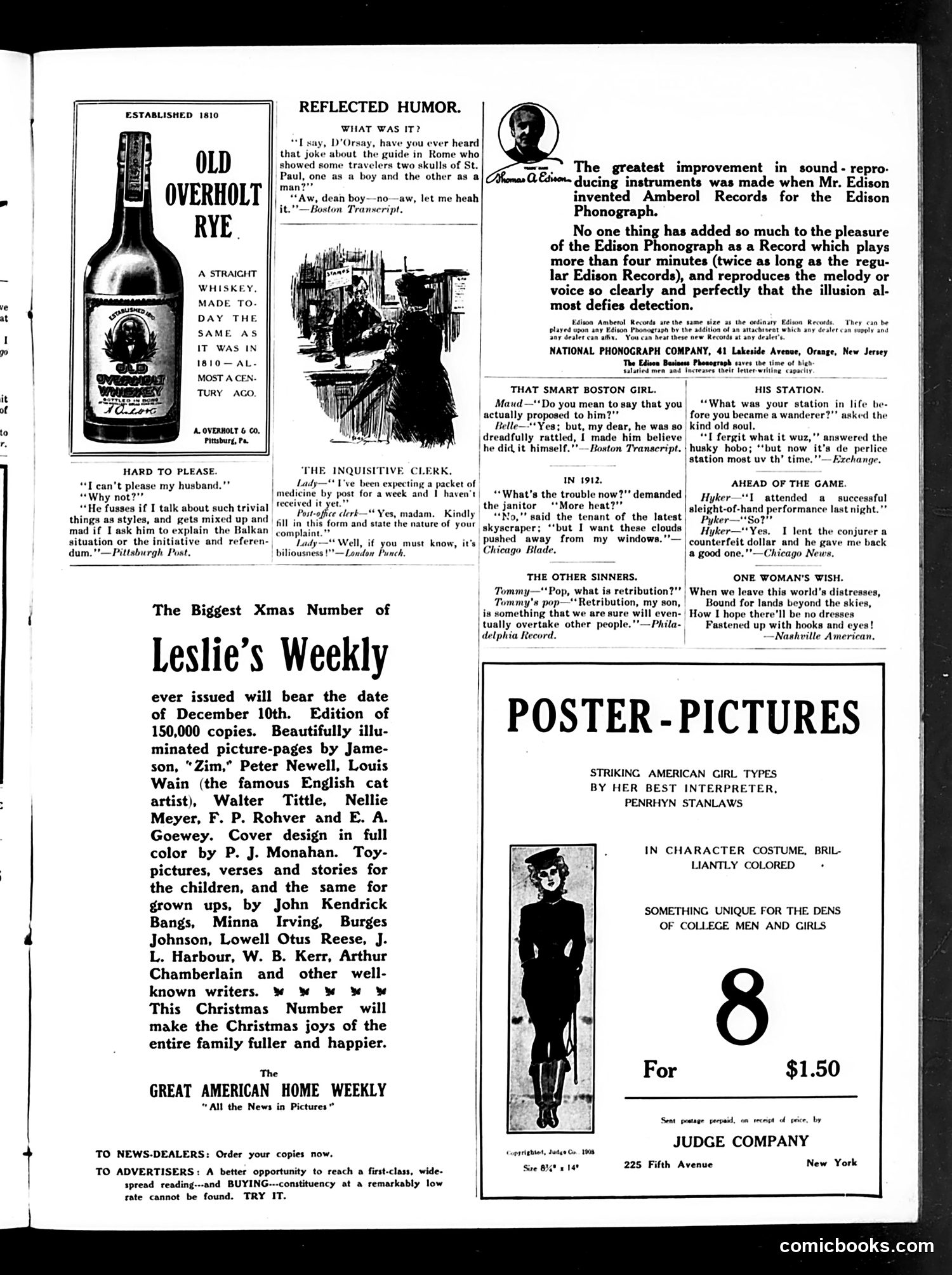
This page is primarily **advertising and promotional content** rather than political satire. It includes: 1. **Old Overholt Rye whiskey ad** (left) - a straightforward product advertisement establishing the brand's 1810 founding. 2. **"Reflected Humor" section** (top right) - a collection of brief jokes and humorous anecdotes from various sources, including a quip about Edison phonograph records and various domestic humor pieces. These appear to be reader submissions or reprinted jokes. 3. **Leslie's Weekly Christmas promotion** (center) - advertising their upcoming December 10th special edition with 150,000 copies featuring illustrations and stories. 4. **Judge Company poster-picture advertisement** (right) - promoting eight character costume illustrations by artist Penrhyn Stanlaws for college audiences, priced at $1.50. The page functions as a magazine contents/advertising section rather than satirical commentary.
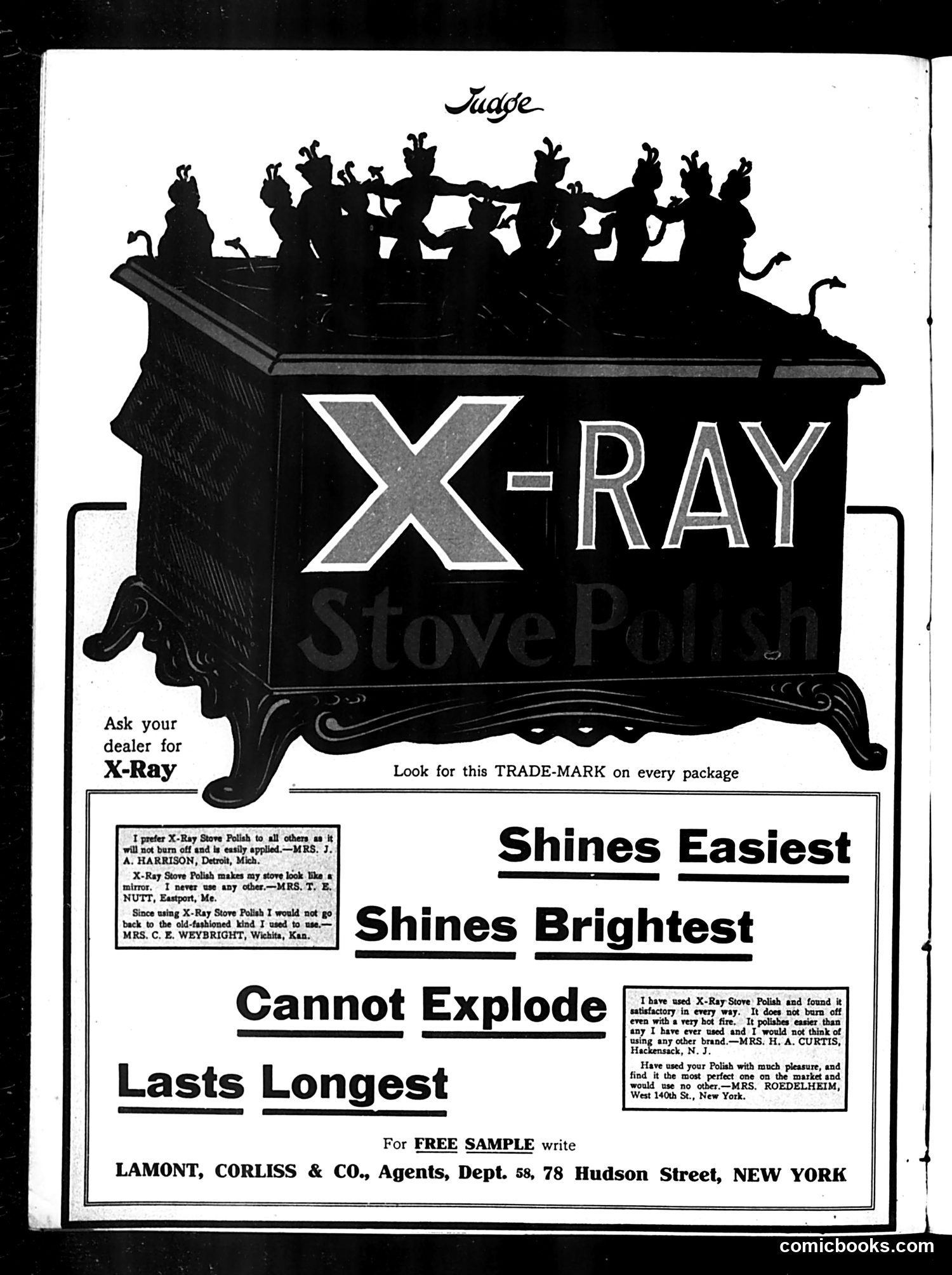
This page is primarily a **product advertisement**, not political satire. It promotes X-Ray Stove Polish, a household cleaning product from the early 20th century. The visual shows a decorative ornamental stove with silhouetted figures of judges seated atop it—a playful reference to Judge magazine itself, establishing brand association with authority and respectability. The advertisement's key selling points are listed: the polish "Shines Easiest," "Shines Brightest," "Cannot Explode," and "Lasts Longest." The last claim was likely important to consumers—exploding stove polish was apparently a documented concern in this era. Customer testimonials from named women in different cities vouch for the product's superiority. The company offers free samples and is located in New York. This represents typical early-1900s advertising: emphasis on safety, testimonials for credibility, and clever visual branding through the magazine's own identity.