
A complete issue · 17 pages · 1908
Judge — June 27, 1908
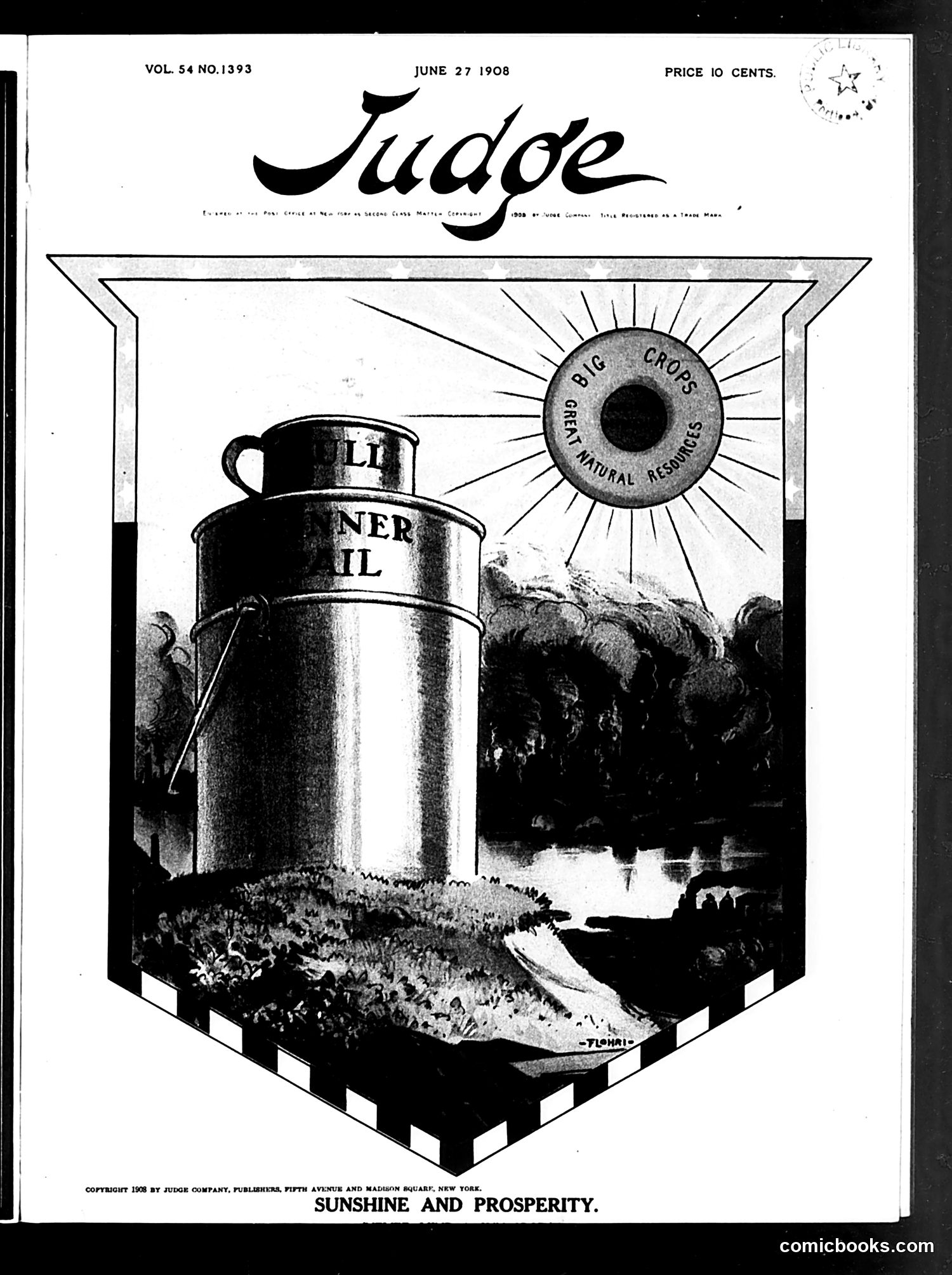
This cover depicts an enormous oil derrick or industrial storage tank labeled "GENERAL OIL" (likely referencing Standard Oil), positioned prominently against a radiant sun. The sun's rays are inscribed "BIG GROSS GREAT NATURAL RESOURCES." The satirical message appears to criticize American industrial monopolies—specifically the oil industry—as dominating the nation's natural wealth. The tank dwarfs the landscape, while crowds gather below, suggesting how corporate interests overshadow ordinary citizens. The caption "SUNSHINE AND PROSPERITY" is likely ironic, questioning whether industrial concentration genuinely benefits the average American or merely concentrates wealth among corporate titans. This aligns with 1908 Progressive Era concerns about monopolies and resource control, issues central to that year's presidential election.
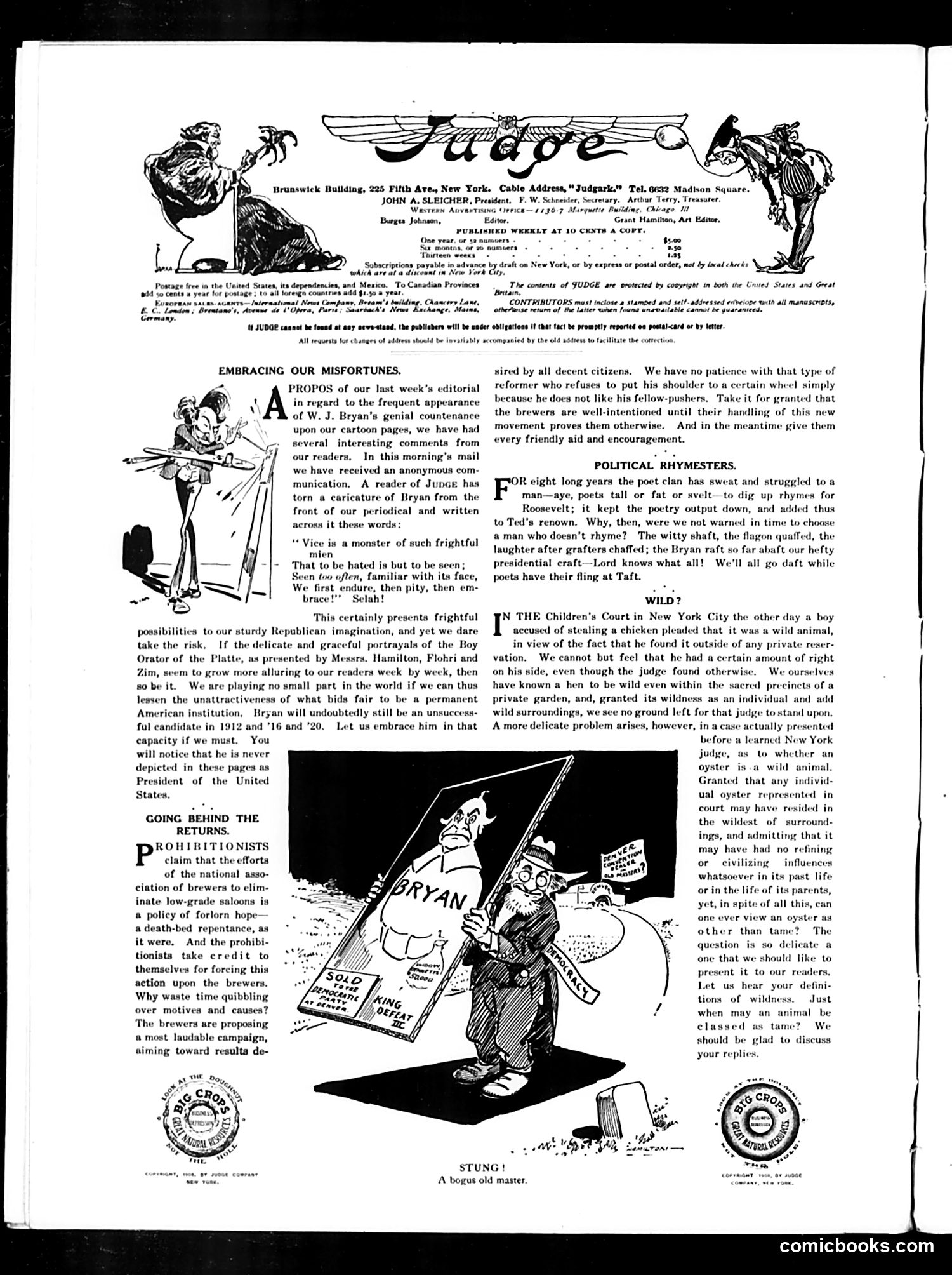
This Judge magazine page contains several editorial sections satirizing contemporary issues (date unclear from excerpt). **"Embracing Our Misfortunes"** criticizes a Boy Scout depicted as the "Boy Orator of the Platte" — likely referencing William Jennings Bryan's famous speech. The text suggests Republicans are risk-takingly using this young figure as a candidate. **"Going Behind the Returns"** attacks prohibitionists, mocking their crusade against brewers and alcohol as self-righteous and wasteful. **"Political Rhymesters"** jokes that poets like Bryan lack talent, and asks whether they'll "ding" verses at Taft. **"Wild?"** debates whether a child's stolen oyster demonstrates "wildness" or simply animal behavior needing civilizing. The cartoons use exaggeration and caricature to mock reform movements, political figures, and prohibition advocates—typical Judge satire of the Progressive Era.
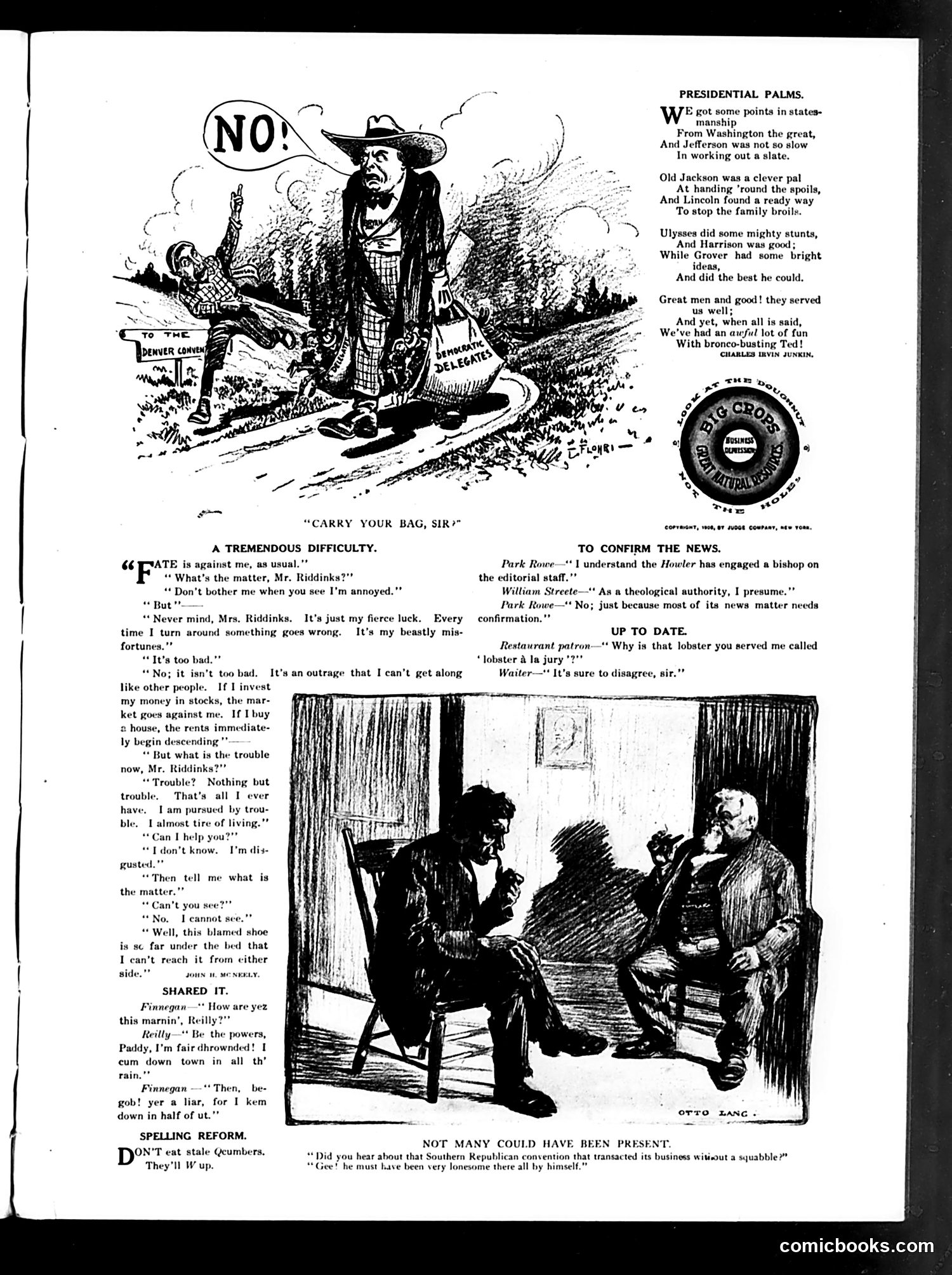
The top cartoon, titled "Carry Your Bag, Sir," depicts a figure saying "NO!" to what appears to be a political proposition. The accompanying poem "Presidential Palms" celebrates past presidents (Washington, Jefferson, Jackson, Lincoln, Grant, Harrison, Cleveland) for their accomplishments, contrasting them with apparent contemporary political failings. The bottom cartoon by Otto Lang shows two men in conversation about a Southern Republican convention conducting business "without a squabble"—the humor suggesting this was remarkably rare or unlikely. The caption sarcastically notes "not many could have been present," implying the convention's conduct was unusually harmonious, perhaps worthy of comment. Both items critique early 20th-century Republican politics and governance, though specific figures and dates remain unclear without additional context.
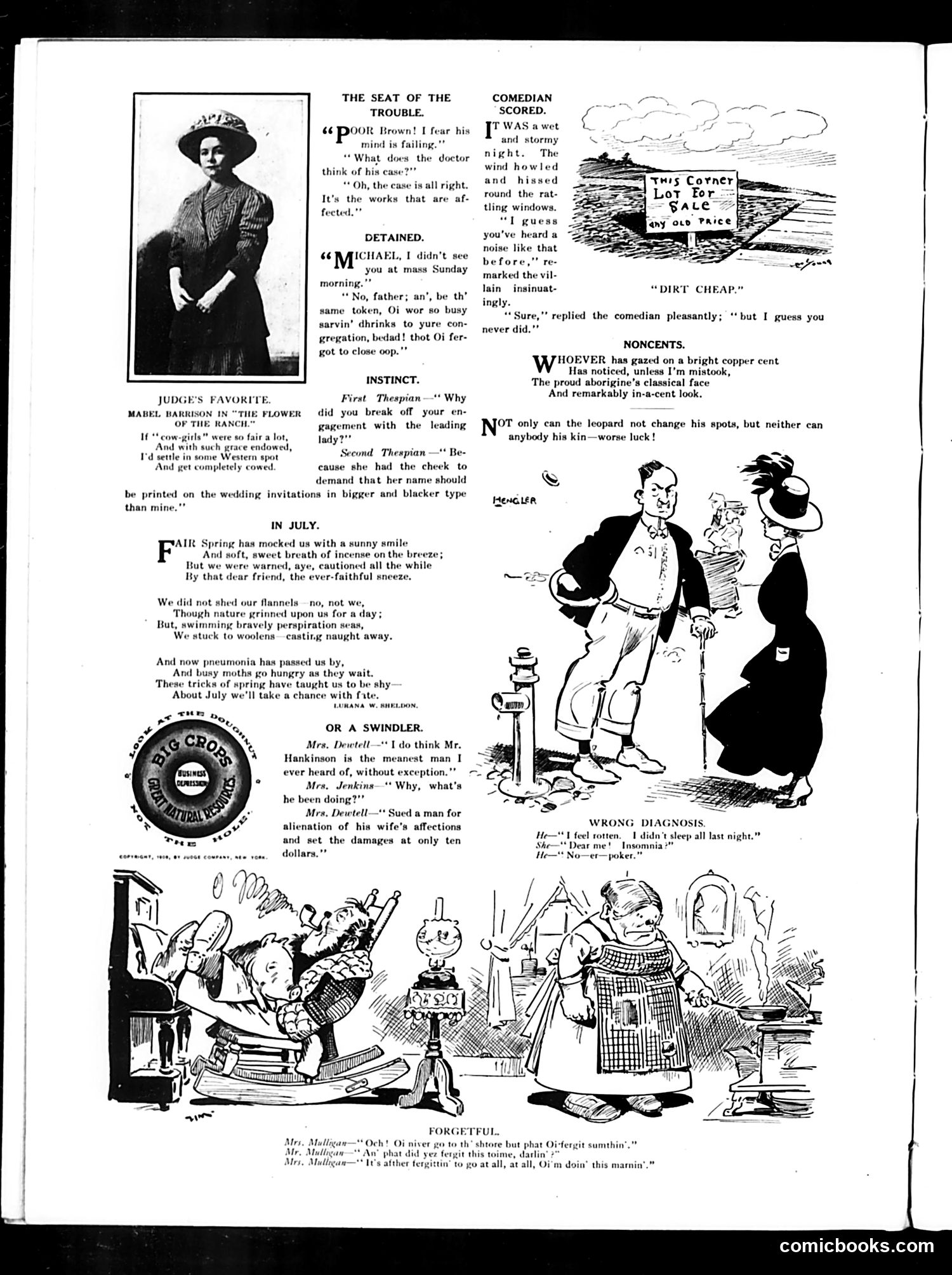
This page contains several unrelated satirical pieces typical of early 20th-century Judge magazine: **"The Seat of the Trouble"** and **"Detained"** appear to be brief comedic dialogues about domestic/medical situations, using wordplay common to the era. **"In July"** is a poem about spring's false promises, mocking deceptive weather. **"Instinct"** presents a therapist joke about engagement rings and wedding invitation typography—satirizing materialistic marriage concerns. The cartoon **"Wrong Diagnosis"** shows a patient and doctor, with dialogue suggesting misidentified illness—likely poking fun at medical incompetence. **"Forgetful"** depicts a domestic scene where a woman repeatedly forgets her husband's name, satirizing absent-minded spouses. The page lacks overt political content; instead, it features domestic humor, medical satire, and relationship comedy typical of Judge's general satirical approach to American life.
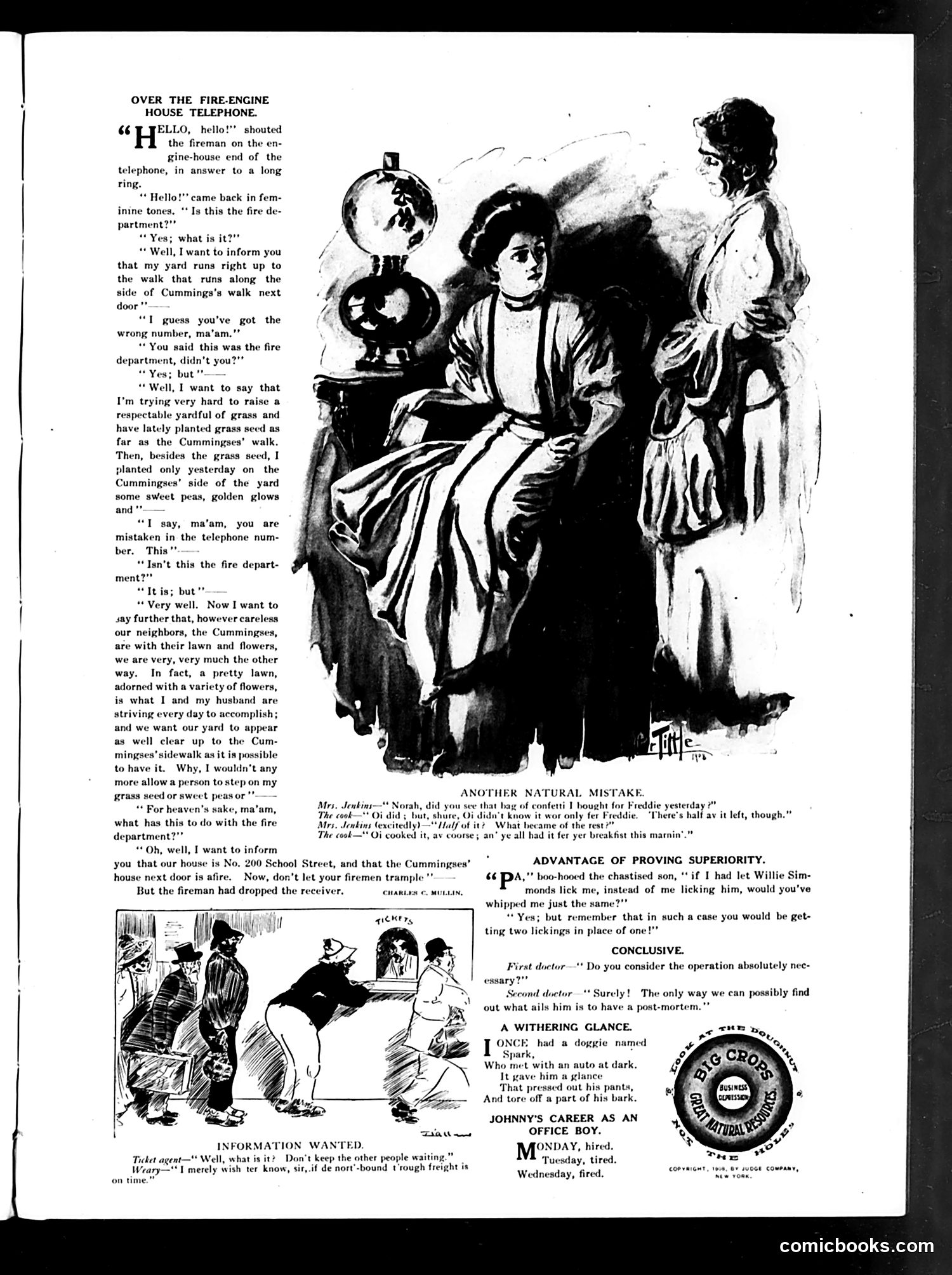
This page contains multiple unrelated humor pieces typical of early 20th-century Judge magazine: **"Over the Fire-Engine House Telephone"** depicts a woman calling the fire department with a complaint about neighbors' yard aesthetics rather than an emergency—a satire on trivial complaints and misuse of emergency services. **"Another Natural Mistake"** shows confusion about a confetti-throwing incident, likely satirizing miscommunication or misunderstandings between neighbors. **"Advantage of Proving Superiority"** jokes about corporal punishment ("two lickings in place of one"), reflecting period attitudes toward discipline. **"A Withering Glance"** is a brief verse about a dog named Spark hit by a car—dark humor typical of the era. The remaining items are short humorous sketches and advertisements. The overall tone reflects turn-of-the-century American urban middle-class anxieties and period humor conventions.
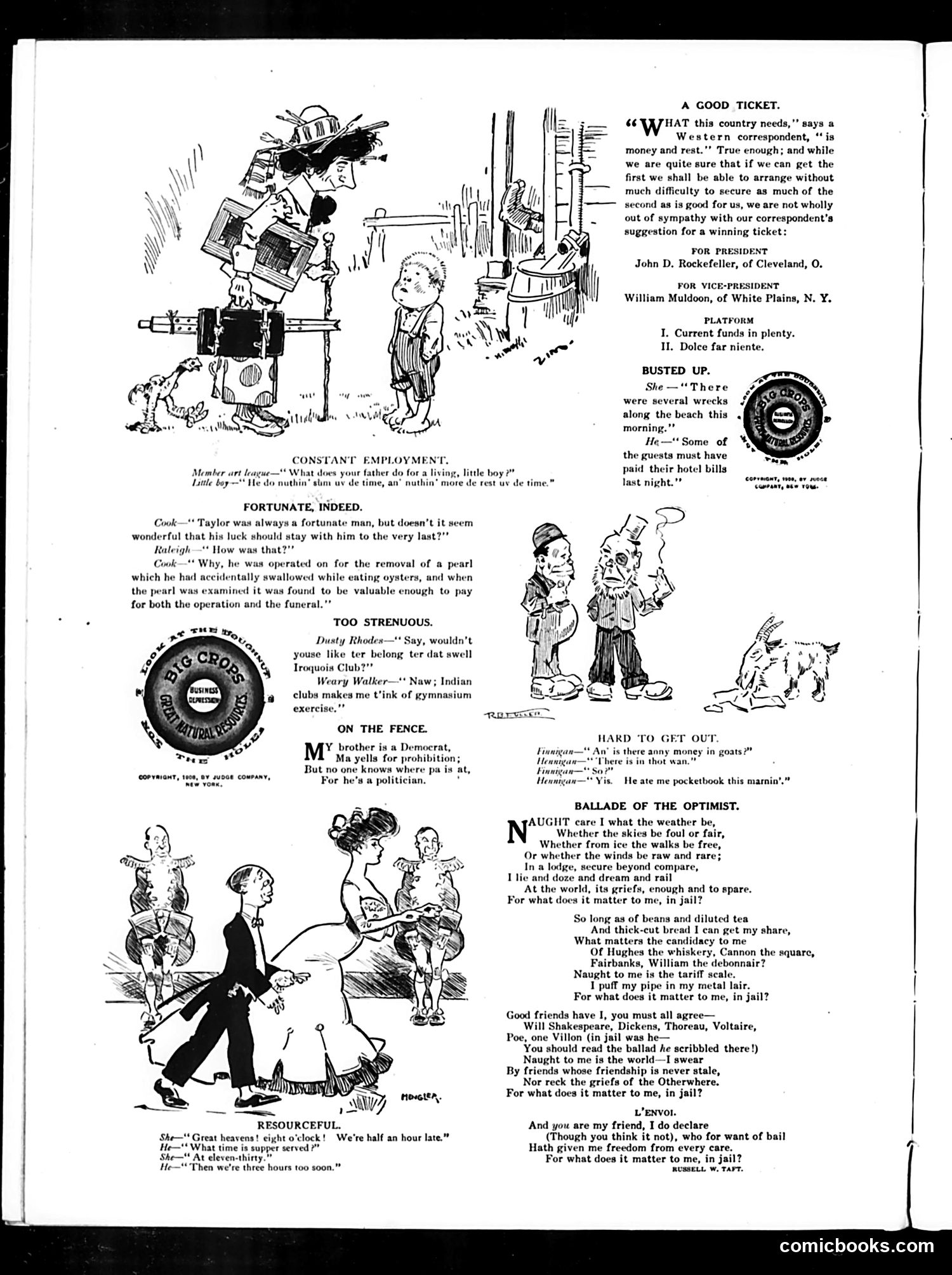
This 1904 page satirizes American wealth and politics. "A Good Ticket" proposes John D. Rockefeller (the era's richest industrialist) for president and William Muldoon (a famous wrestler/physical culture promoter) for vice-president, with a platform of "money and rest"—mocking public desire for economic security amid the Gilded Age's inequality and labor unrest. The "Ballade of the Optimist" features a jailed man philosophizing that wealth inequality doesn't matter since he has books and beans. References to "Hughes," "Cannon," and "Fairbanks" appear to be contemporary political figures (likely Roosevelt-era Republicans). The poem satirizes either naive optimism or resigned acceptance of social injustice. Other minor cartoons mock employment instability, luck, and class struggles. The overall tone: sardonic commentary on how wealth concentration and political corruption left ordinary Americans economically insecure and philosophically resigned.
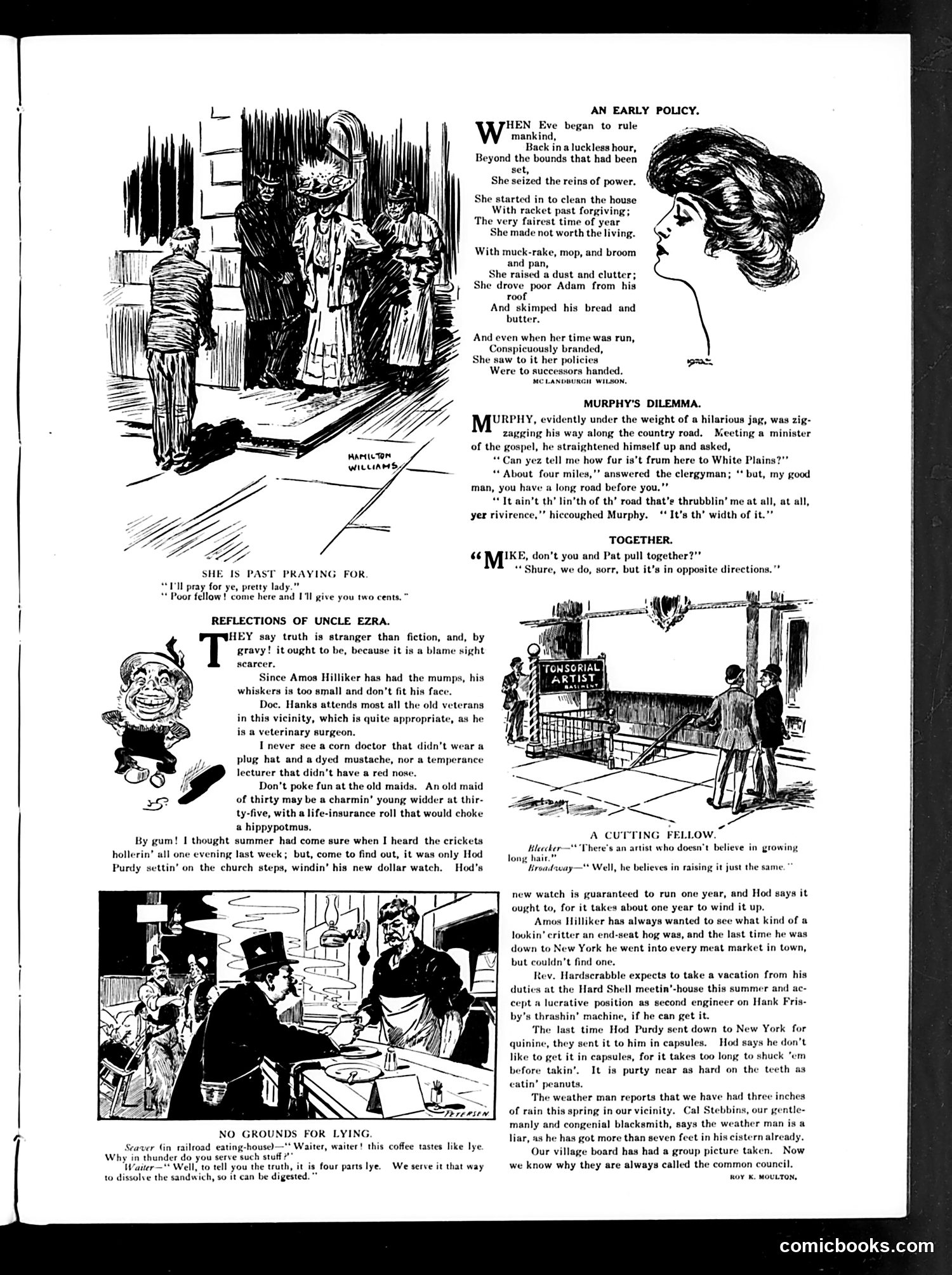
This page contains several satirical pieces attacking women's activism and Irish immigrants—common targets in early 20th-century American humor. **"An Early Policy"** uses Eve's Biblical story as a thinly-veiled attack on women's suffrage and domestic reform movements. The poem sarcastically portrays Eve (representing women entering public life) as destructive—creating chaos through housecleaning and driving "poor Adam from his roof," implying women's activism disrupts the natural male-dominated order. **"Murphy's Dilemma"** and **"Together"** mock Irish immigrants through ethnic stereotypes: an drunk Irishman ("Murphy") and two Irish laborers ("Mike" and "Pat") who "pull in opposite directions." These are crude caricatures relying on anti-Irish prejudice common to the era. **"Reflections of Uncle Ezra"** offers rural American humor—folksy observations about small-town life and local characters, less politically pointed than the other sections. The overall page reflects Judge's target audience: educated, urban, likely Anglo-Saxon readers amused by satire mocking both women's equality movements and immigrant populations.
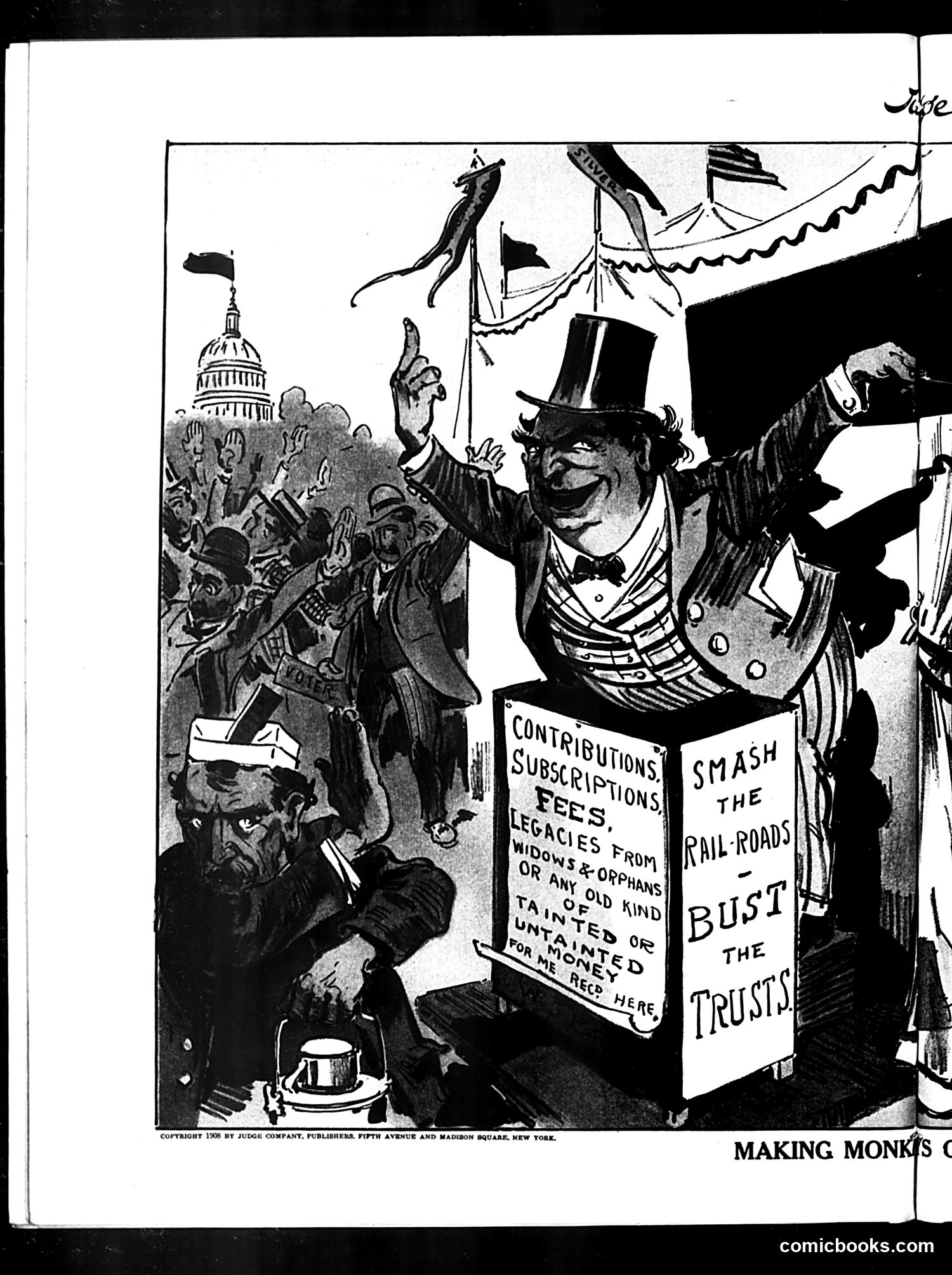
This 1908 Judge magazine cartoon satirizes financial corruption and monopolistic practices. A grotesque figure in top hat and formal wear—likely representing a wealthy industrialist or railroad baron—stands triumphantly before the U.S. Capitol. He displays signs advertising schemes to extract money through "contributions," "subscriptions," "fees," and "legacies," while promoting "Smash the Rail-Roads" and "Bust the Trusts." The title "Making Monks" suggests these wealthy figures are creating a subservient class—people stripped of resources like monks stripped of worldly goods. The caricatured poor figure at lower left emphasizes the exploitation. This reflects Progressive Era anxieties about unchecked corporate power, monopolies, and how the wealthy manipulated both public sympathy and government institutions for profit while claiming to fight against trusts.
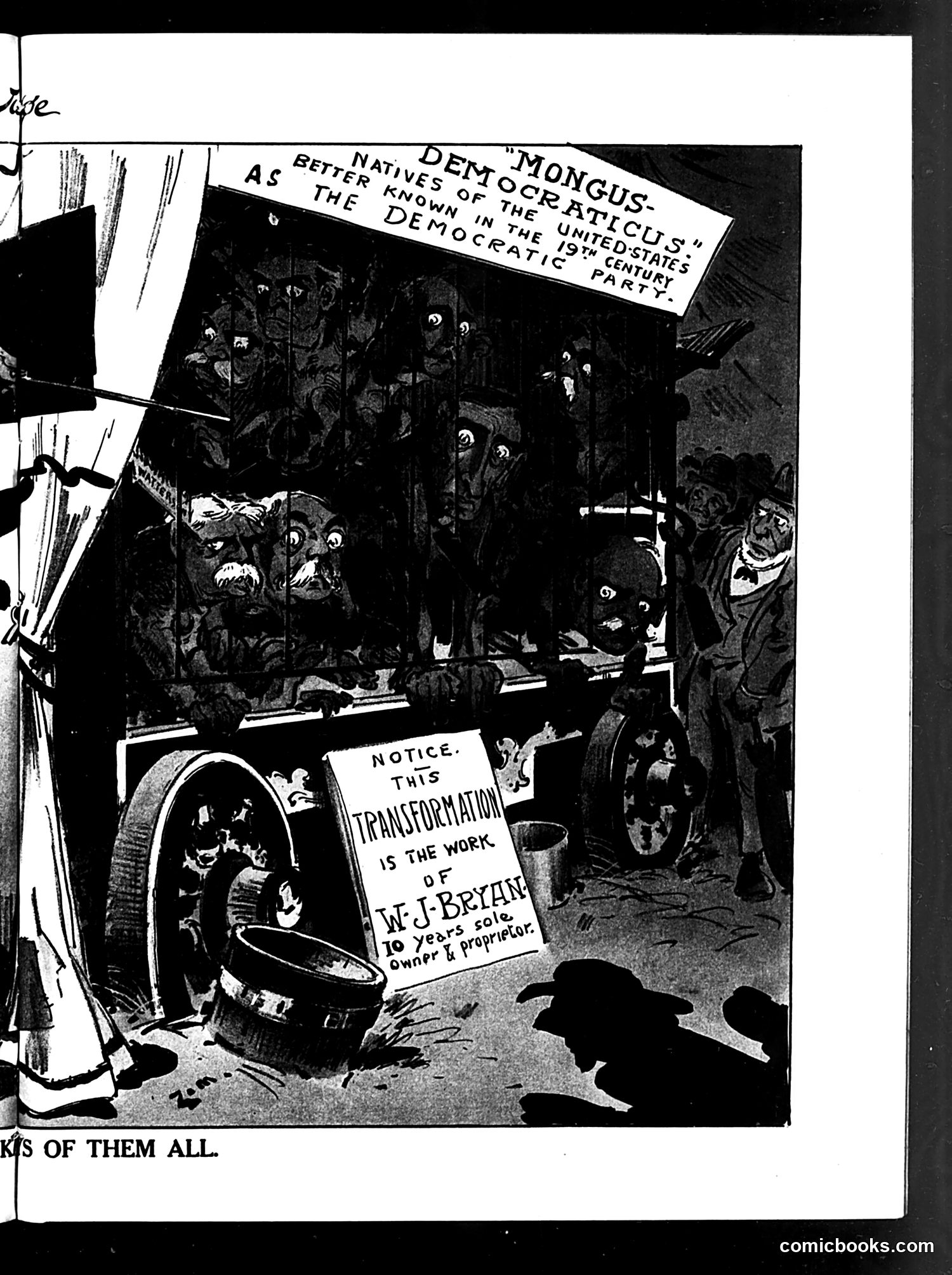
This Judge magazine cartoon satirizes Democratic Party leadership using animal imagery. The top banner identifies "Mongus-Demoraticus" as "better known in the United States in the 19th century Democratic Party" — presenting the party as a caged creature displaying chaotic behavior. The cage contains multiple animals (likely representing different Democratic factions or leaders) appearing agitated or confused. A notice on the cage reads "Trampfortation is the work of W.J. Bryan, 10 years' cage owner & proprietor," referencing William Jennings Bryan, the prominent three-time Democratic presidential candidate. The satire suggests the Democratic Party under Bryan's influence was internally fractious, disorganized, and zoo-like — a common Republican criticism during this Progressive Era period. The cartoon mocks Democratic leadership and party unity.
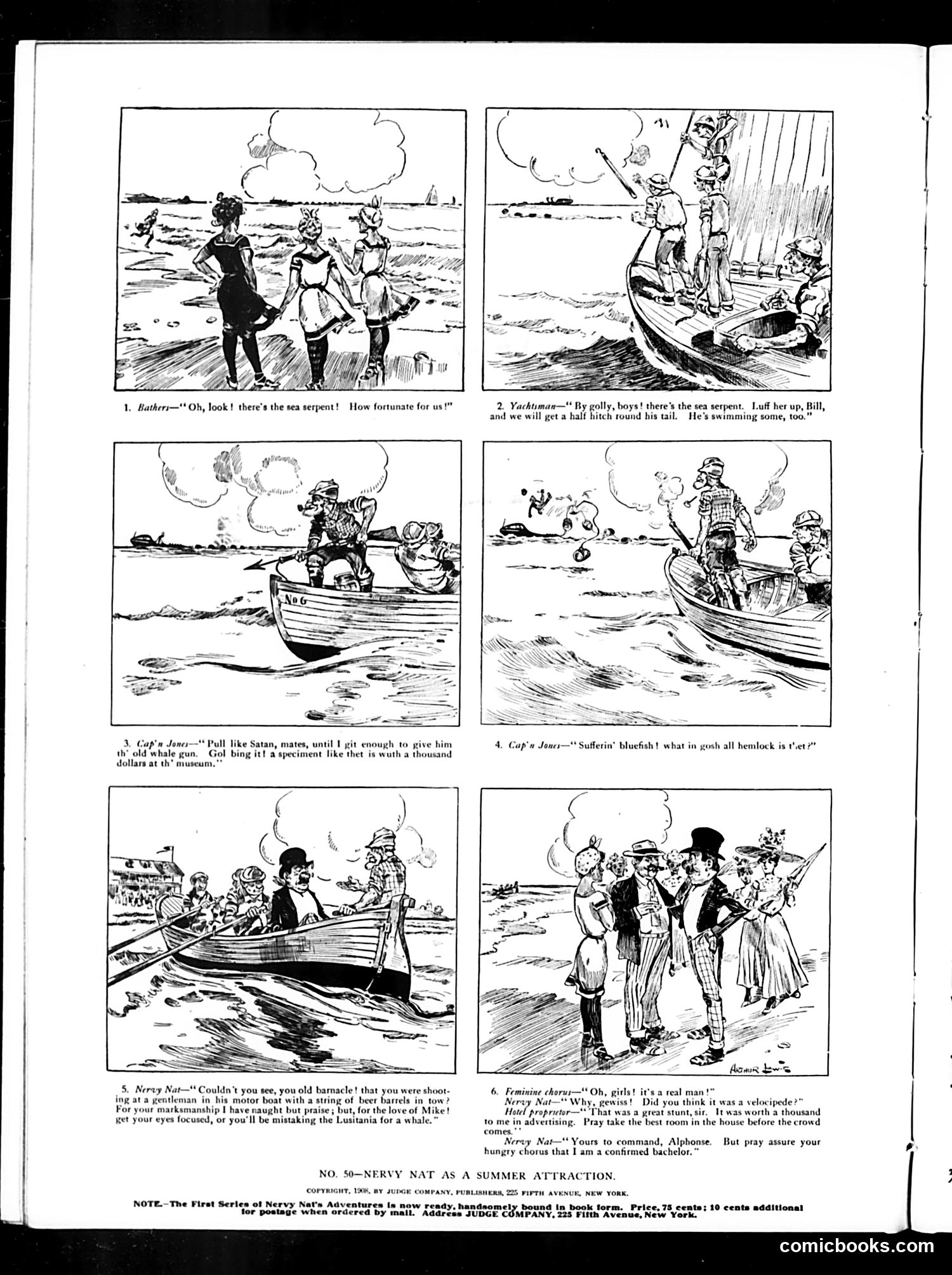
This comic strip satirizes early 1900s seaside tourism and the public's gullibility about sensational attractions. The recurring character "Nervy Nat" creates chaos at a beach resort by shooting at what he *thinks* is the famous "sea serpent"—a creature that periodically captivated public imagination as supposed evidence of undiscovered marine life. The joke: Nat actually shoots at a motorboat towing beer barrels, mistaking it for the legendary monster. The hotel proprietor, however, cynically recognizes the publicity value—he praises Nat's "stunt" as excellent advertising, despite the danger and absurdity. The satire targets both credulous tourists desperate for exotic experiences and shrewd business owners exploiting their desire for thrills. The reference to potentially mistaking a ship (the Lusitania) for a whale underscores the recklessness of Nat's "adventure." Nat's final boast about being a "confirmed bachelor" adds comic deflation to his would-be heroic persona.
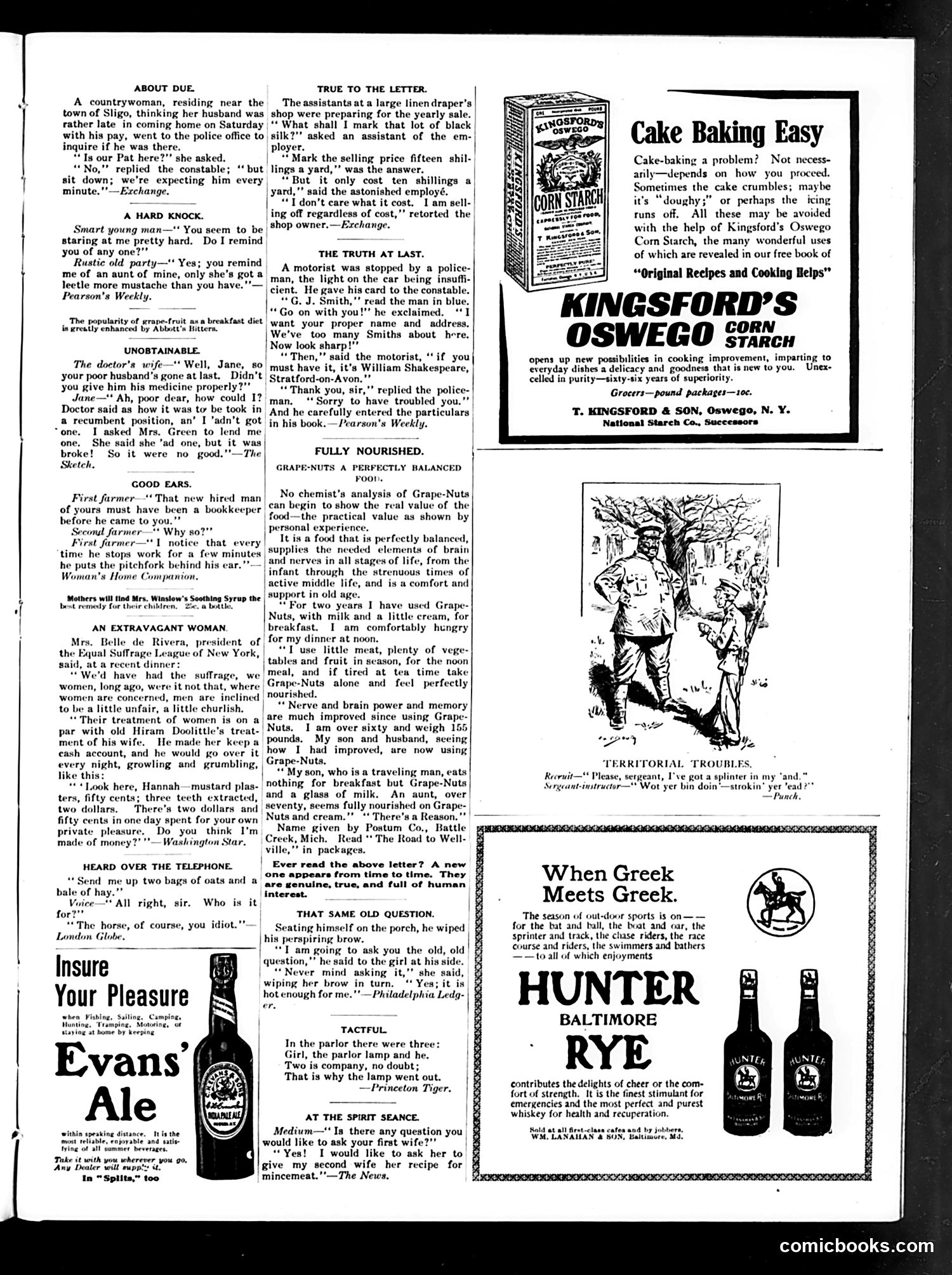
This page contains primarily **humorous short anecdotes and advertisements** rather than political cartoons. The jokes address early 20th-century domestic and social life: **Key Anecdotes:** - "About Due": An Irish countrywoman checks if her late husband is at the police station - "Hard Knock": A young man resembles an older woman's aunt - "Good Ears": A hired man puts a pitchfork behind his ear during breaks (implying stupidity) - "Territorial Troubles": A sergeant and instructor discussing military matters (unclear specifics) - Various other brief jokes about marriage, motoring, and commerce **Advertisements:** The page features prominent ads for **Evans' Ale**, **Kingsford's Oswego Corn Starch**, **Grape-Nuts cereal**, and **Hunter Baltimore Rye whiskey**. **Tone:** The humor relies on physical comedy, marital tension, and Irish or rural stereotypes typical of early-1900s American magazines. The overall page reflects period attitudes toward gender, class, and regional identity more than specific political satire.
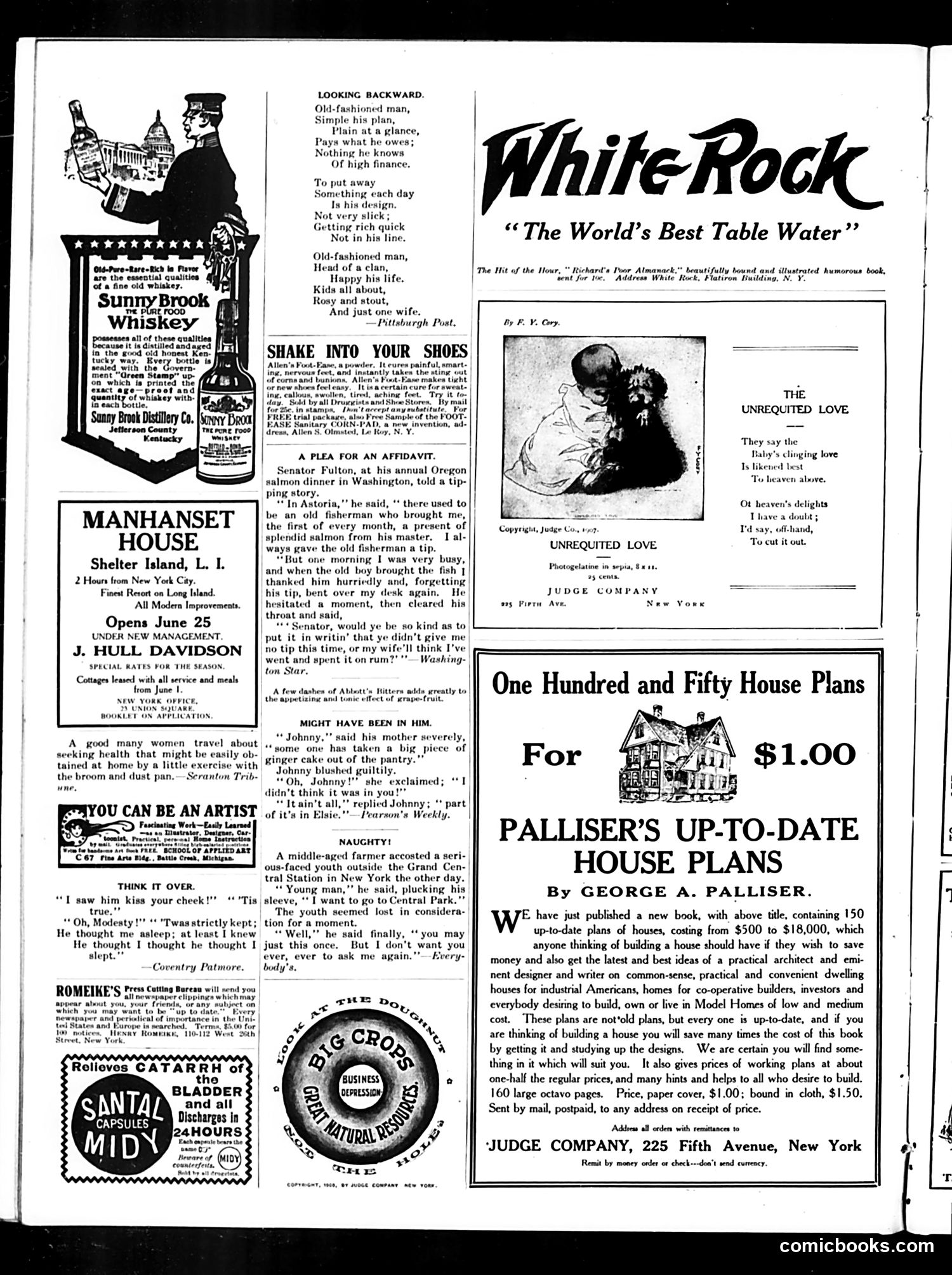
This page is primarily **advertising and light humor content** rather than political satire. The cartoons and jokes reflect early 20th-century domestic life: **"Looking Backward"** contrasts an old-fashioned man—thrifty, saving money gradually, with multiple children and one wife—against modern attitudes favoring quick wealth. It's **nostalgic social commentary** on changing values, not political satire. The scattered jokes mock everyday situations: a woman catching her husband's deception ("I saw him kiss your cheek"), a boy stealing cake, a farmer's crude proposition to a youth at Grand Central Station. These are **generic humor**, playing on domestic embarrassment and rural ignorance. The page is dominated by **product advertisements**: Sunny Brook whiskey, the Manhanset House resort, artist correspondence courses, shoe powder, and most prominently, Palliser's house-plan book (150 designs for $1.00). There's no identifiable political figure or event being satirized here—it's a typical magazine page mixing light domestic humor with commercial pitches aimed at middle-class readers.
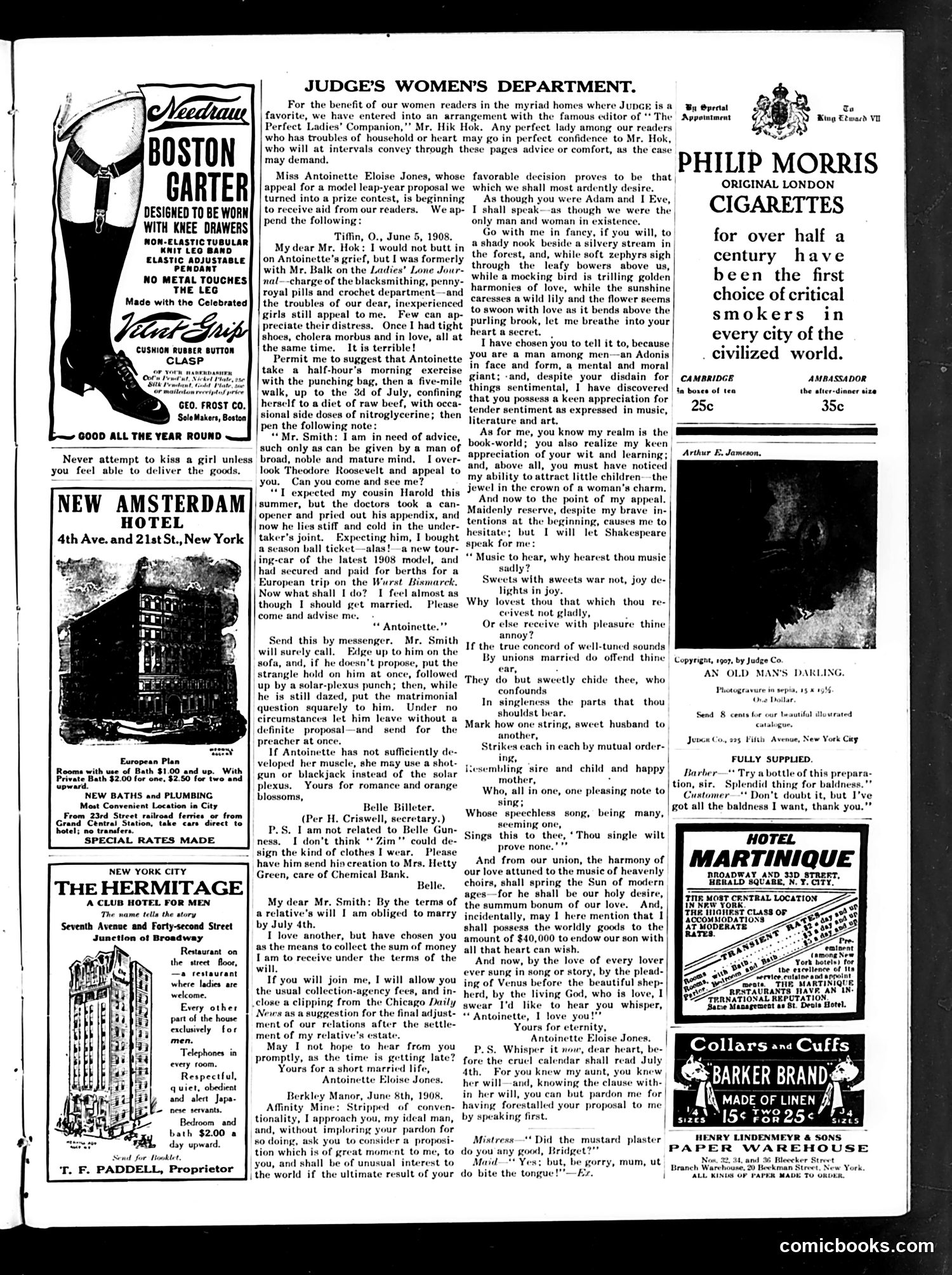
This page is primarily **advertising and advice content**, not political satire. The main feature is a humorous "Dear Advice" column about "Antoinette," a woman seeking marriage proposals. **The Joke:** The column satirizes leap-year tradition (when women propose to men) by having readers offer absurd "advice" to Antoinette on how to secure a husband. One respondent suggests she take up boxing, eat raw beef, and physically coerce a man into proposing—escalating to violence ("solar-plexus punch," "strangle hold," shotgun). A follow-up letter reveals Antoinette actually needs marriage to collect an inheritance, making her desperation darkly comedic. **Context for Modern Readers:** This reflects early 1900s gender dynamics where marriage was economically crucial for women. The exaggerated "advice" mocks both courtship customs and the absurdity of women's limited options. The references to Theodore Roosevelt and contemporary hotels ground this in 1908 America. The remaining page space contains hotel and product advertisements typical of Judge magazine.
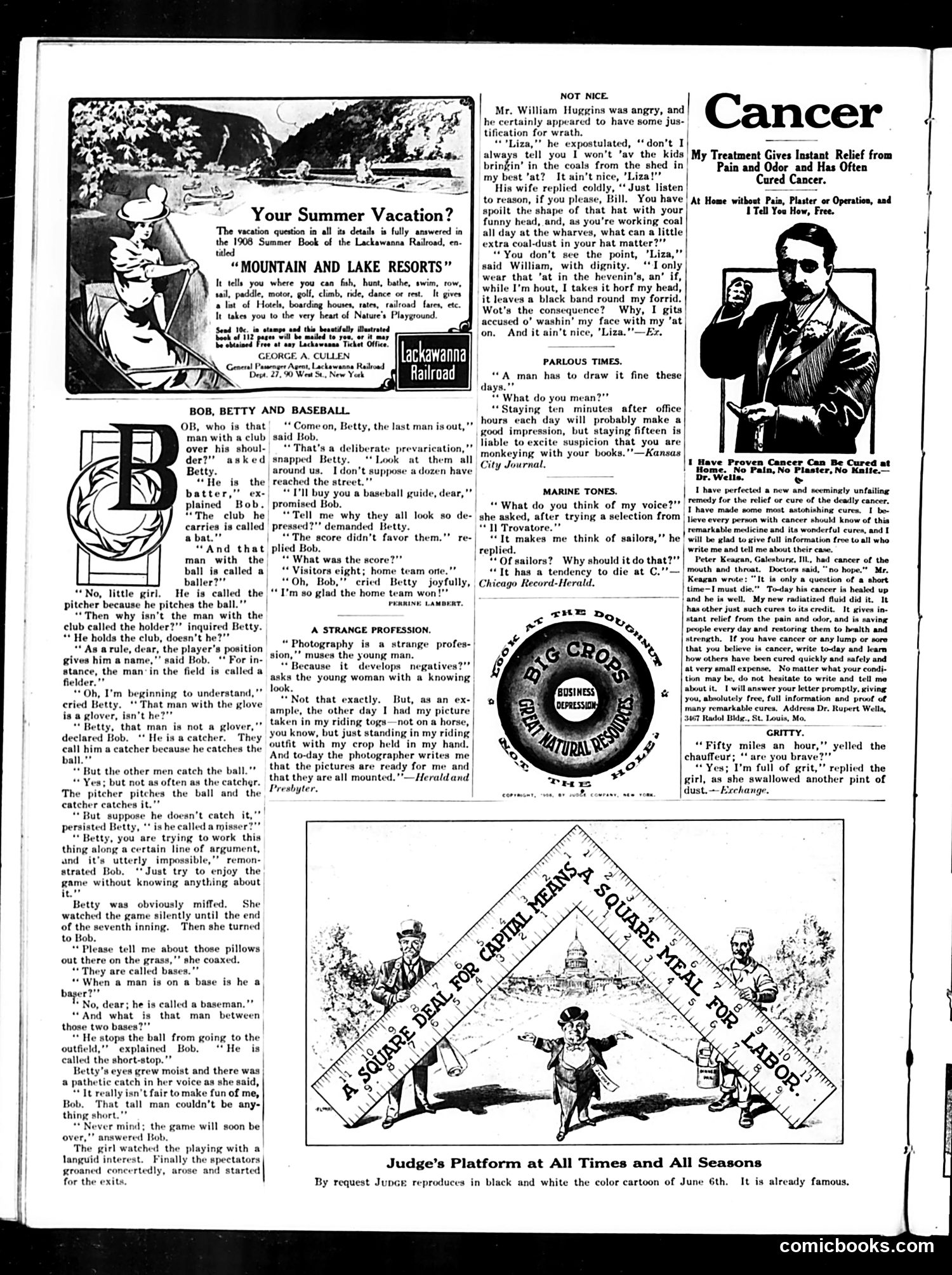
This page from Judge magazine (circa 1908) contains several distinct humorous pieces: **"Bob, Betty and Baseball"**: A dialogue where Betty, unfamiliar with baseball, asks innocent questions about player positions. Bob explains that players are named by their roles (pitcher, catcher, fielder). The humor derives from Betty's literalist misinterpretation—she assumes the "catcher" should be called a "glover" based on his glove, missing the actual function-based naming system. **"A Strange Profession"**: A photographer complains that after being photographed in riding clothes, the prints are ready but his "negatives" haven't developed—a pun on photographic negatives versus negative character traits. **"Not Nice"** and **"Marine Tones"**: Brief comedic vignettes about working-class complaints and misunderstandings. The page also includes a Lackawanna Railroad advertisement promoting summer vacation destinations. These pieces exemplify Judge's light, pun-based humor aimed at middle-class readers, with gentle satire rather than sharp political commentary.
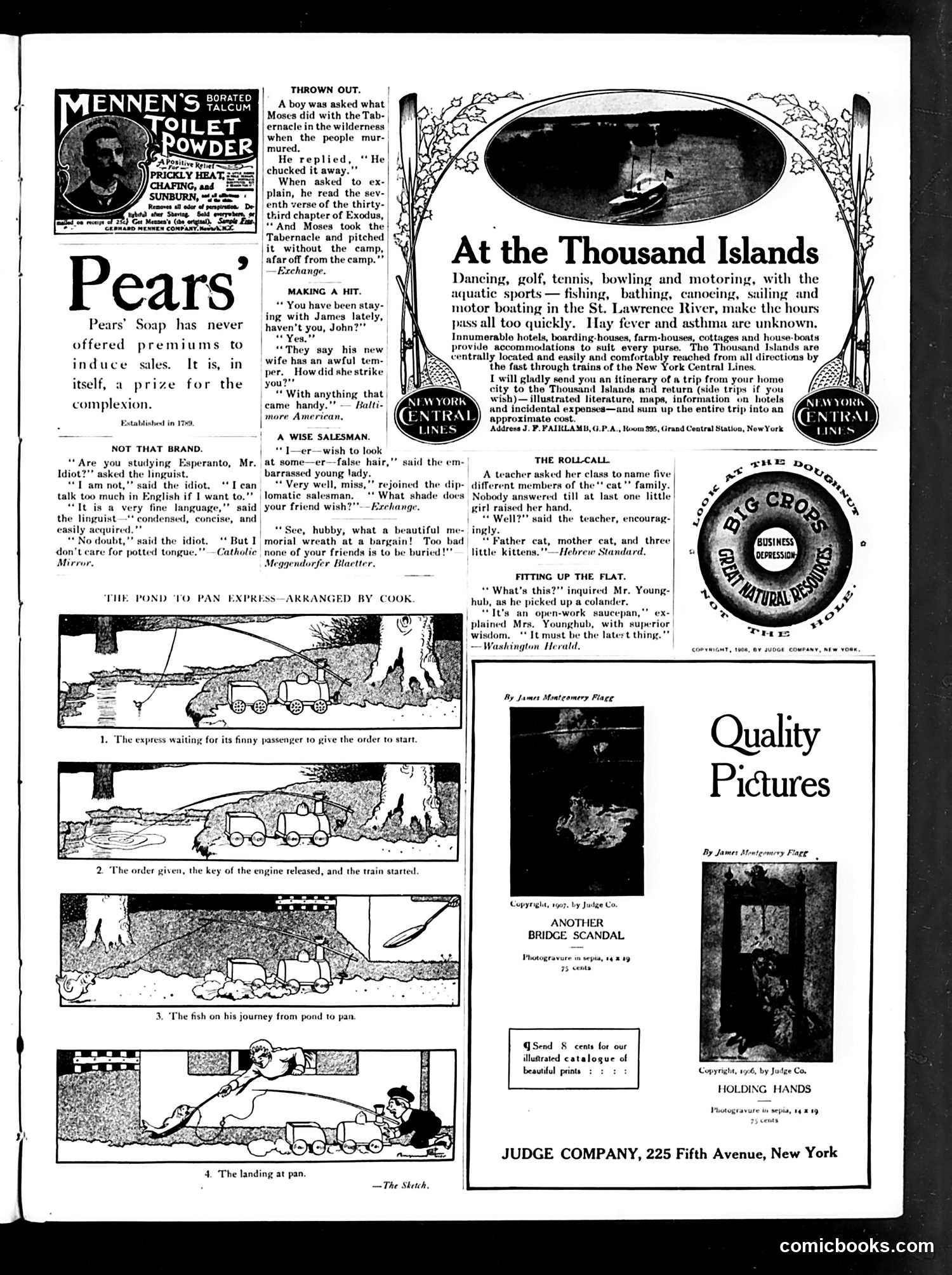
This page from Judge magazine (early 1900s) contains mostly **advertisements and light humor** rather than political satire. The advertisements dominate: Mennen's Toilet Powder, Pears' Soap (emphasizing its quality over gimmicks), and NYC Central Railroad promoting the Thousand Islands resort destination. The **humor content** consists of short jokes typical of the era: - A child misunderstanding Biblical references - Linguistic wordplay about potted tongue - A diplomat's wife with a temper - A teacher's lesson on animal families The one notable illustration, "**The Pond to Pan Express**" (by The Sketch), depicts a whimsical four-panel sequence showing a fish traveling via miniature train from a pond to a cooking pan—a visual pun on the journey from nature to dinner table, though it's more absurdist than satirical. The page also advertises "Quality Pictures" by James Montgomery Flagg, featuring photographs titled "Another Bridge Scandal" and "Holding Hands." Overall, this is a **typical period magazine page blending commercial advertising with gentle, family-friendly humor**—not political commentary.
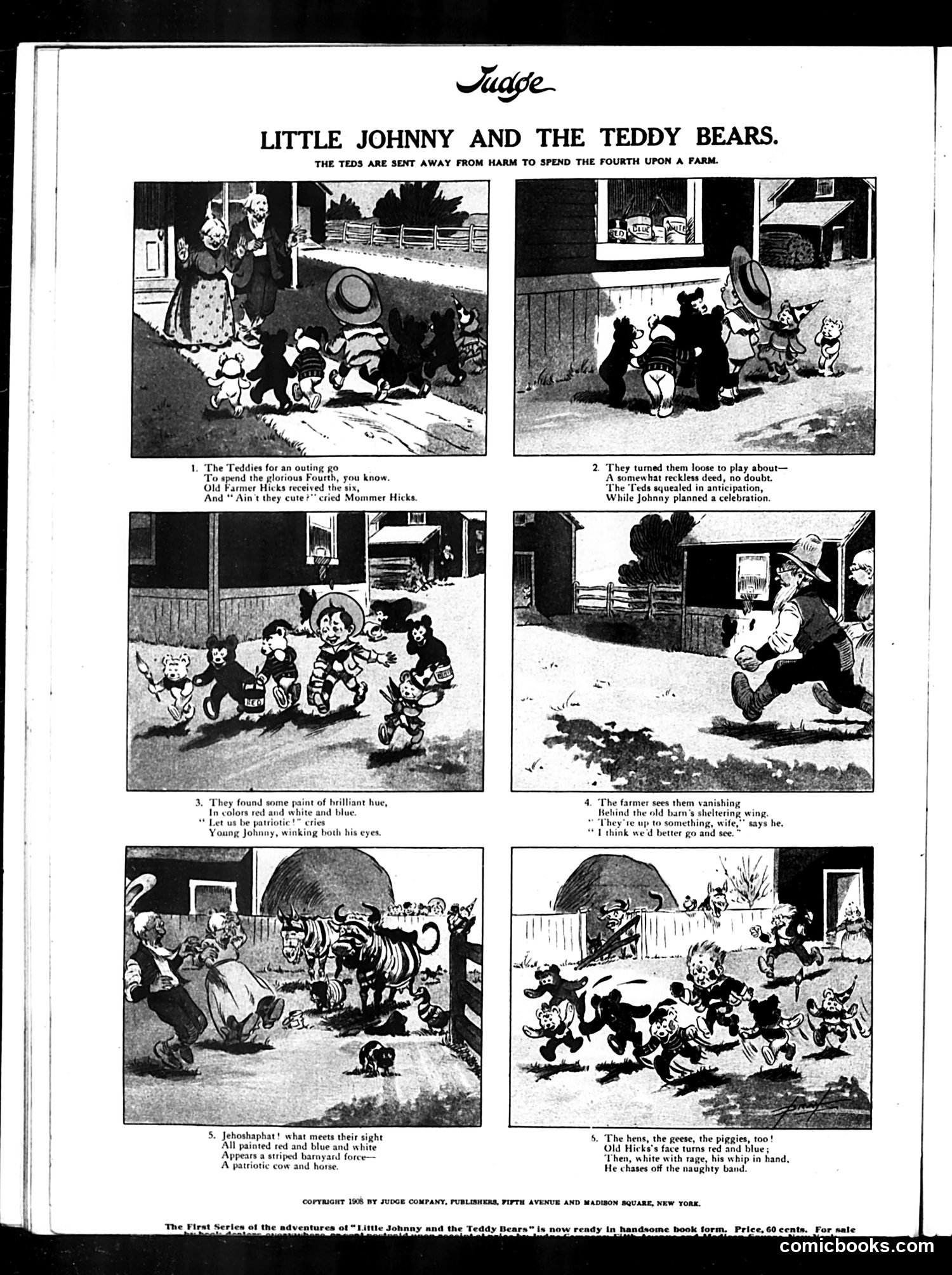
This is a children's comic strip satirizing the popular "Teddy Bear" craze of the early 1900s—toy bears named after President Theodore Roosevelt. The narrative follows Little Johnny and six teddy bears sent to a farm for Fourth of July celebrations. The humor derives from escalating mischief: the bears are initially cute and patriotic (painted red, white, and blue), but when unsupervised, they cause farm chaos—terrorizing livestock and generally wreaking havoc. Farmer Hicks pursues them angrily with a whip. The satire appears gentle: it mocks both the sentimentality around "Teddy Bears" as wholesome toys and parental naiveté in believing children's playthings will behave responsibly. The final image of a patriotically-painted cow and horse suggests the bears' destructive "patriotism" has extended to livestock. This reflects Judge's typical style: lighthearted domestic humor with subtle social commentary about American consumer culture and childhood.

I can see this is a page from *Judge* magazine, as indicated by the watermark, but the page appears to be nearly blank—just white space with minimal visible content or text. Without clear images, caricatures, headlines, or body text to analyze, I cannot identify specific political figures, social references, or satirical points. This could be a title page, advertising section, or a page where the original printing was very faint. To provide accurate historical context about the cartoons or content, I would need a page with legible illustrations and text. I cannot responsibly speculate about content I cannot clearly see.