
Judge, 1908-06-27 · page 6 of 17
Judge — June 27, 1908 — page 6: what you’re looking at
What you’re looking at
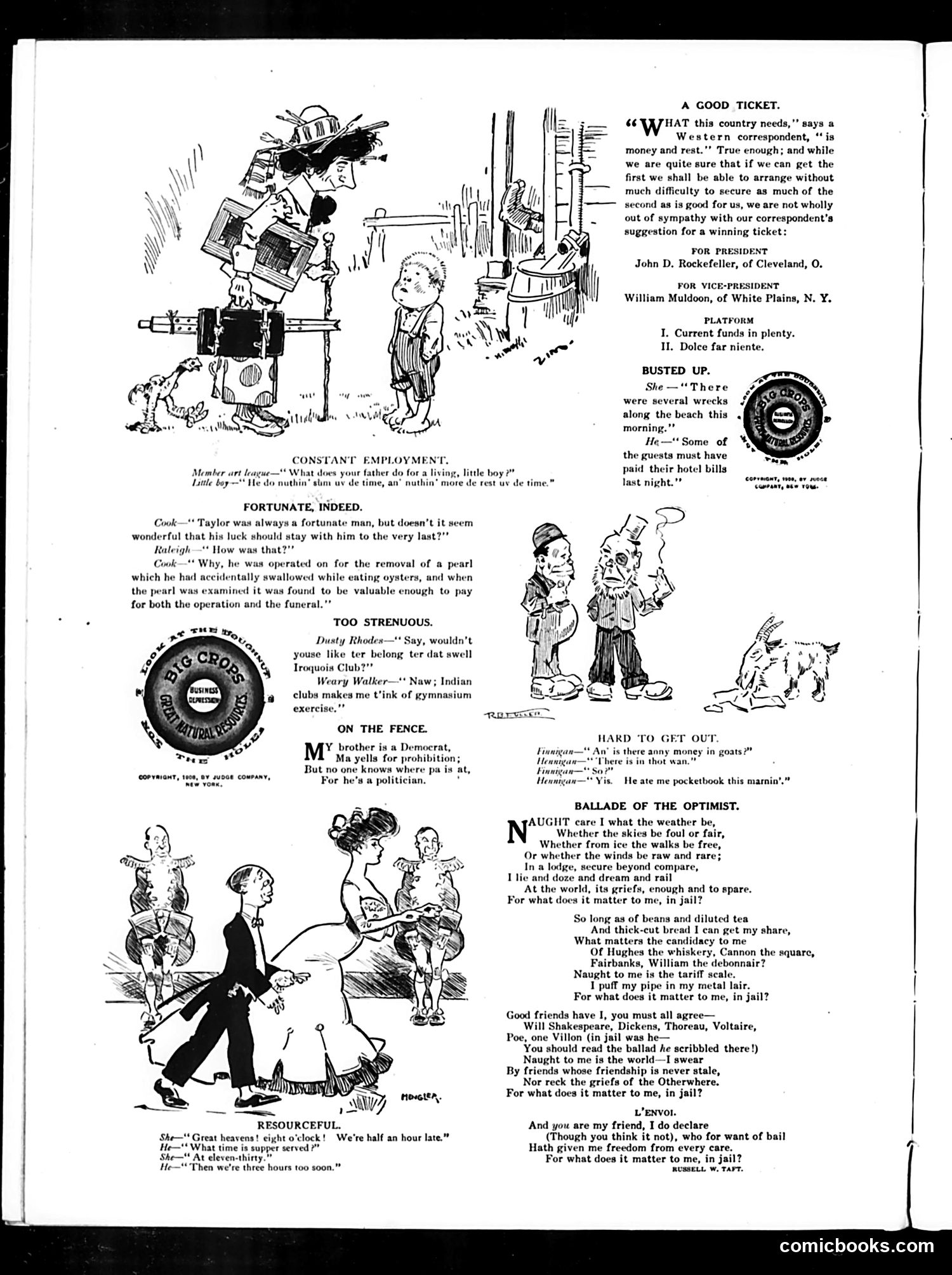
This 1904 page satirizes American wealth and politics. "A Good Ticket" proposes John D. Rockefeller (the era's richest industrialist) for president and William Muldoon (a famous wrestler/physical culture promoter) for vice-president, with a platform of "money and rest"—mocking public desire for economic security amid the Gilded Age's inequality and labor unrest. The "Ballade of the Optimist" features a jailed man philosophizing that wealth inequality doesn't matter since he has books and beans. References to "Hughes," "Cannon," and "Fairbanks" appear to be contemporary political figures (likely Roosevelt-era Republicans). The poem satirizes either naive optimism or resigned acceptance of social injustice. Other minor cartoons mock employment instability, luck, and class struggles. The overall tone: sardonic commentary on how wealth concentration and political corruption left ordinary Americans economically insecure and philosophically resigned.
📄 Transcribed text from this page (OCR, searchable)
Machine-transcribed from the original scan — historical spelling and the odd misread are preserved.
A GOOD TICKET. 66 YVJHAT this country needs," says a Western correspondent, “is money and rest."’ True enough; and while we are quite sure that if we can get the first we shall be able to arrange without much difficulty to secure as much of the second as is good for us, we are not wholly out of sympathy with our correspondent’s suggestion for a winning ticket: FOR PRESIDENT John D, Rockefeller, of Cleveland, O. FOR VICE-PRESIDENT William Muldoon, of White Plains, N. Y. PLATFORM I. Current funds in plenty. Il. Dolce far niente. BUSTED UP. She —“ There were several wrecks along the beach this morning."” He—“Some of the guests must have ag, litdle boy 2” paid their hotel bills re de rest uv de time.” last night.” “Joon ae row CONSTANT EMPLOYME ur father do for a li time, Member art league—' Litle boy —* Ne do What does y uth muy FORTUNATE, INDEED. Cook—* Taylor was always a fortunate man, but doesn’t i wonderful that his luck should stay with him to the very last How was that?"’ ‘vok—* Why, he was operated on for the removal of a pearl which he had accidentally swallowed while ting oysters, and when the pearl was examined it was found to be valuable enough to pay for both the operation and the funeral." 2 oy TOO STRENUOUS. Dusty Rhodes—"* Say, wouldn't youse like ter belong ter dat swell Iroquois Club Weary Walker—* Naw; Indian clubs makes me t'ink of gymnasium exercise,”” ON THE FENCE. 'Y brother is a Democrat, leigh HARD TO our. Finnigan—" A th nn c goats?” Ma yells for prohibition; ieee Thebiniete But no one knows where pa is at, Finnigan—" So? rveer, bron eee ees For he's a politician. , Hennigan—** Vis. He ate me pocketbook this marnin’ BALLADE OF THE OPTIMIST. AUGHT care I what the weather be, N Whether the skies be foul or fair, Whether from ice the walks be free, Or whether the winds be raw and rare; In a lodge, secure beyond compare, 1 lie and doze and dream and rail At the world, its griefs, enough and to spare. For what does it matter to me, in jail? So long as of beans and diluted tea And thick-cut bread I can get my share, Of Hughes the whiskery, Cannon the square, Fairbanks, William the debonnair? Naught to me is the tariff scale. I puff my pipe in my metal lair. For what does it matter to me, in jail? Good friends have I, you must all agree— Will Shakespeare, Dickens, Thoreau, Voltaire, Poe, one Villon (in jail was he— You should read the ballad he scribbled there!) Naught to me is the world—I awear By friends whose friendship is never stale, Nor reck the griefa of the Otherwhere. | | | For what does it matter to me, in jail? L’ENVOI. RESOURCEFUL. And you are my friend, I do declare She—"' Great heavens! eight o'clock! We're half an hour late.” (Though you think it not), who for want of bail He—"‘ What time is supper served ?” Hath given me freedom from every care. She— At eleven-thirty.”” For what does it matter to me, in jail? He—“ Then we're three hours too soon.” RUSSELL W. TAI } comicbooks.com