
A complete issue · 16 pages · 1907
Judge — November 30, 1907
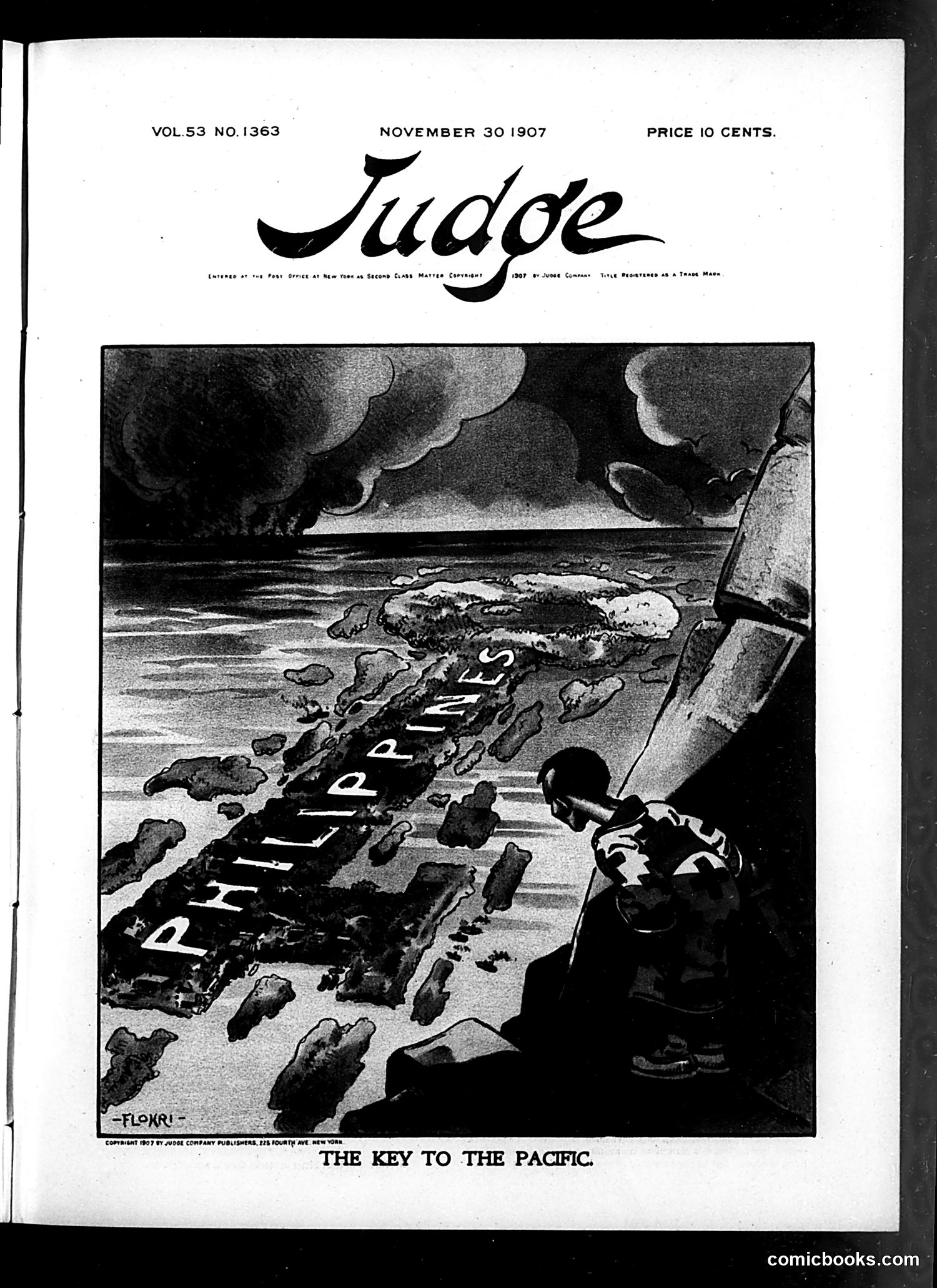
This 1907 *Judge* cartoon satirizes American imperial ambitions in the Pacific. The illustration shows a figure (likely representing the United States) holding a large key labeled "THE PHILIPPINES," which unlocks a chain of rocks or islands stretching across the Pacific Ocean. Dark storm clouds loom overhead, suggesting danger or uncertainty ahead. The cartoon critiques U.S. acquisition of the Philippines following the Spanish-American War (1898). The "key" metaphor suggests the islands serve as America's strategic gateway to Asian markets and influence. The ominous weather and treacherous terrain imply the cartoon's artist doubts this imperial expansion will succeed smoothly or beneficially. The satire questions whether controlling the Philippines truly advances American interests.
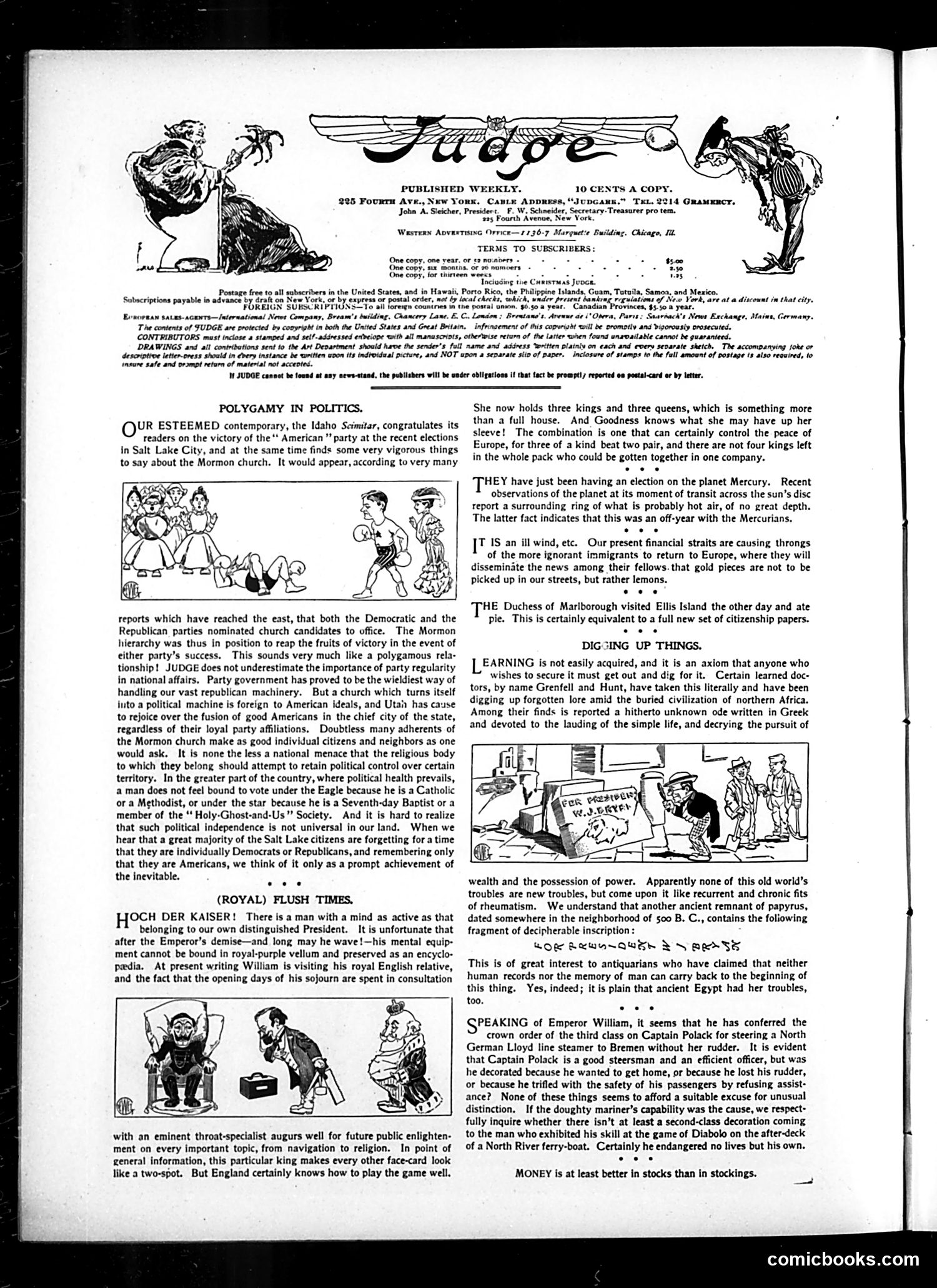
This page contains political commentary rather than narrative comics. The main article "Polygamy in Politics" critiques the Idaho Senate election and Mormon Church influence in Utah politics. The author argues that party loyalty ("polygamy") has corrupted American democracy, with both Democrats and Republicans compromising principles to gain power. The accompanying illustrations satirize political compromise: a figure juggling multiple balls labeled with party positions, and politicians depicted as duplicitous operators. A secondary section, "Royal Plush Times," mocks an unnamed President's pretentious lifestyle and intellectual inadequacy, suggesting his staff compensates for his incompetence through elaborate consultation processes. The overall message: American politics has become morally compromised and absurdly theatrical.
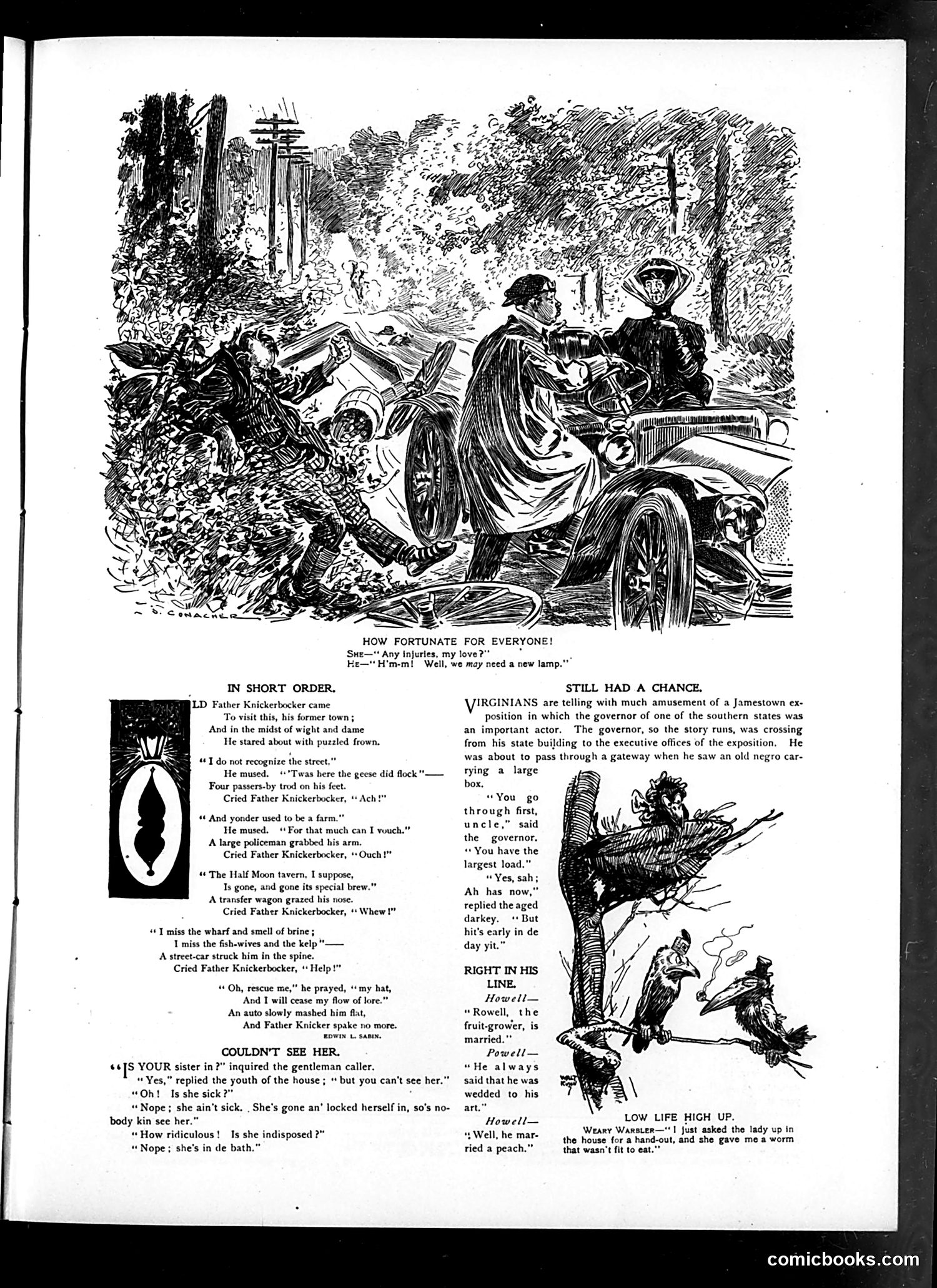
**Top Cartoon**: Shows an automobile accident where a woman asks her injured companion about damages. His response—needing "a new lamp"—is darkly comedic understatement given the vehicle's destruction. This satirizes early automotive culture's dangers and the casual attitude some took toward serious crashes. **Text Stories**: Include period humor about urban life (Father Knickerbocker observations), a anecdote about a Virginia governor avoiding a Black person's vegetable cart, and various short jokes about marriage, farms, and social mishaps. **Overall Context**: This appears to be general humor and satire typical of early 20th-century Judge magazine—mixing automobile-age comedy with social commentary. The Virginia governor anecdote reflects the era's casual racism. The content targets middle-class urban readers with relatable domestic and modern-life situations.
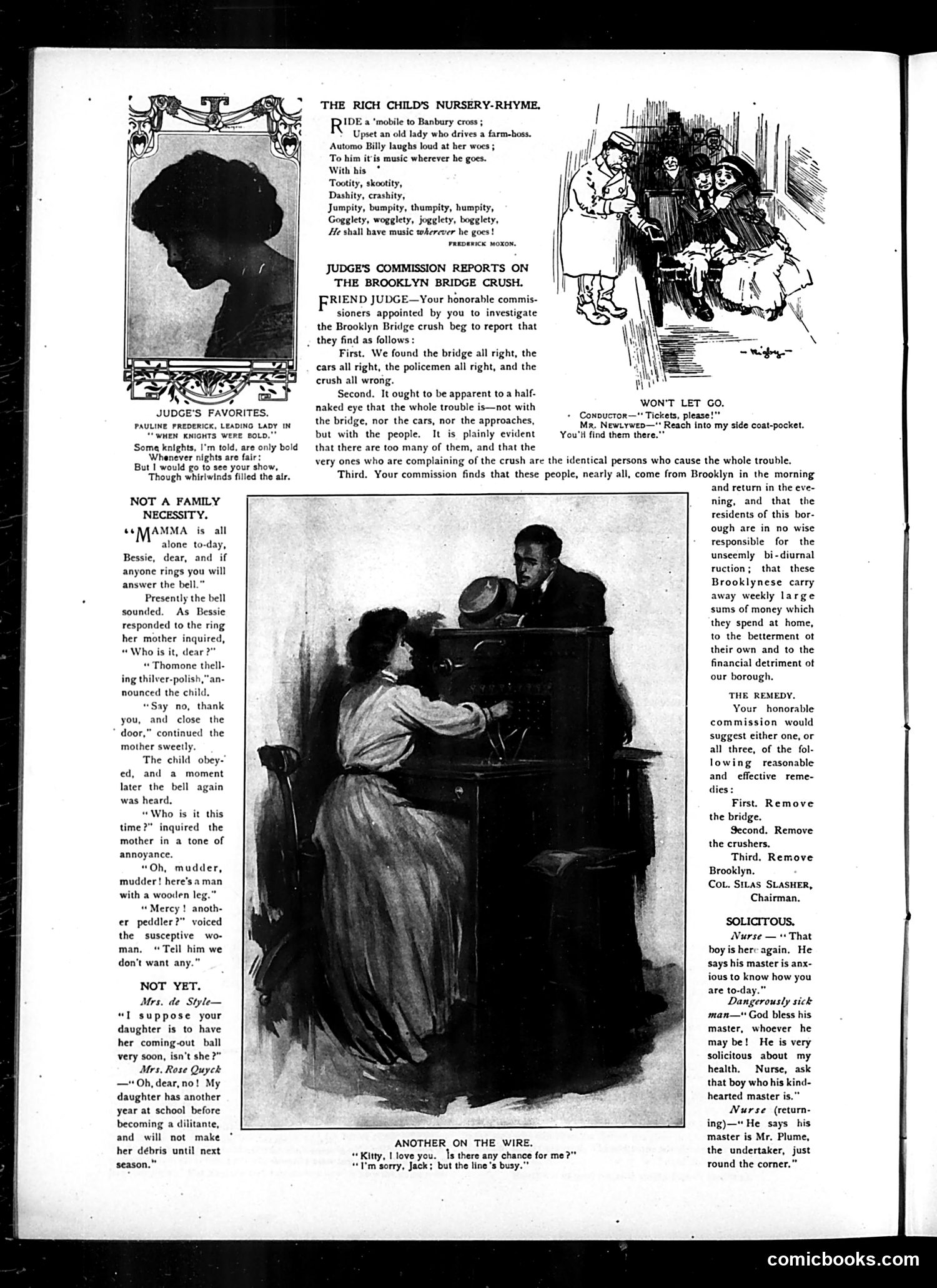
This page satirizes the 1883 Brooklyn Bridge opening and its subsequent crush of pedestrians. The "Judge's Commission Reports" section mocks official investigations, using a humorous commission finding that blamed the victims—Brooklyn residents who commuted into the city—rather than the bridge's design or management. The satire suggests authorities absurdly claimed the crush was "all wrong" while finding the bridge, cars, and police "all right." The accompanying illustrations include domestic scenes and street life. "Another on the Wire" depicts a love-struck couple on a telephone—early technology satire, perhaps about distracted communication. The content reflects Judge's typical use of exaggerated situations to critique urban infrastructure failures and bureaucratic incompetence while poking fun at contemporary manners and social pretension.
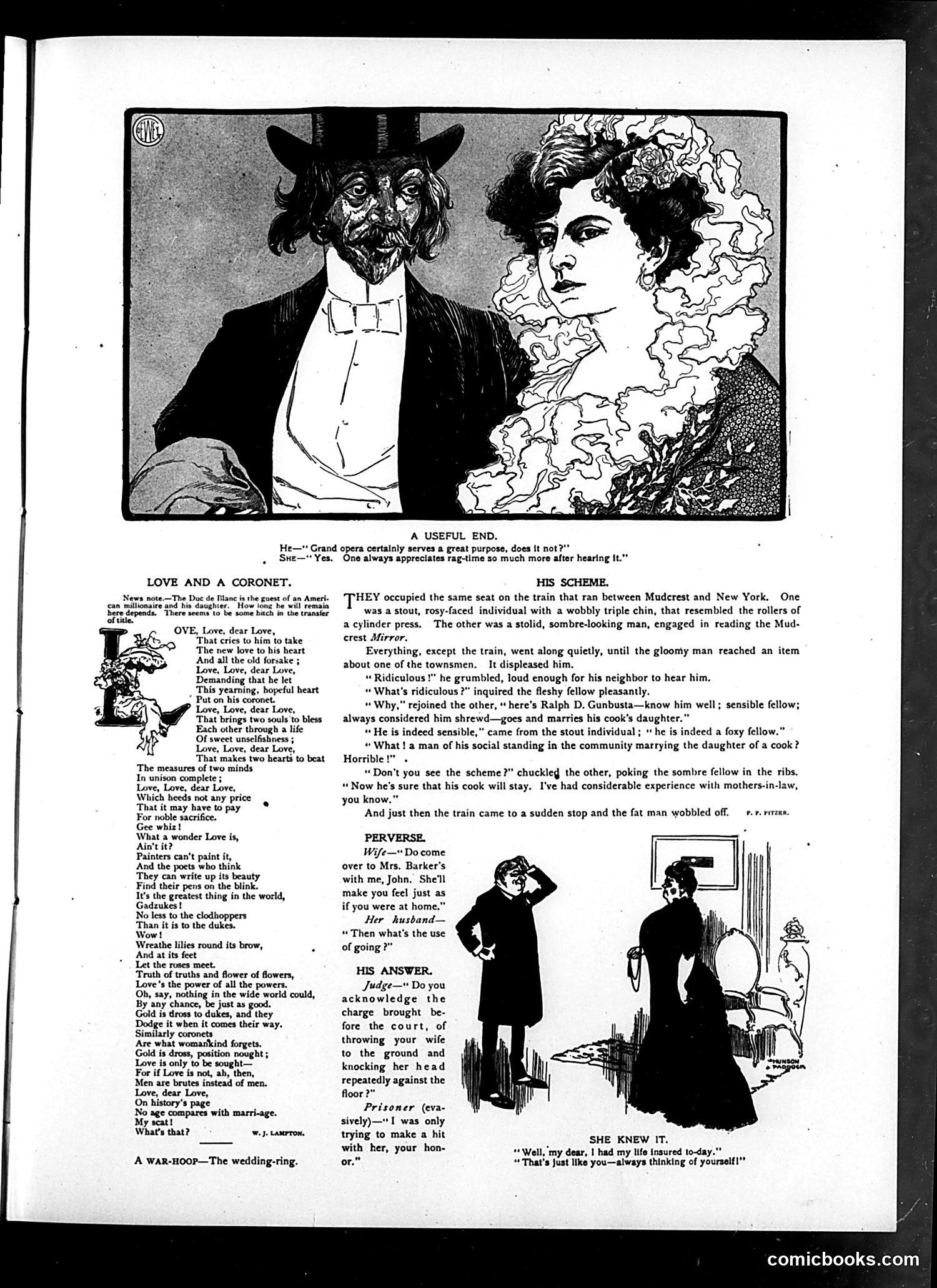
The top cartoon depicts a demonic or devilish man in formal attire with a woman wearing elaborate lace—a stark visual contrast suggesting moral opposition. The caption jokes about grand opera serving a "great purpose" by making audiences appreciate "rag-time" afterward. Below, "His Scheme" satirizes a social scandal involving a man of wealth attempting to marry beneath his class. The narrative follows two train passengers discussing a cook's daughter: one character (apparently wealthy, "Ralph D. Gunbusta") plans to marry her, drawing ridicule from his companion about the impropriety of such a union. The humor targets class pretensions and the absurdity of wealthy men pursuing servants while expecting social acceptance—typical early-20th-century American satirical commentary on rigid class boundaries.
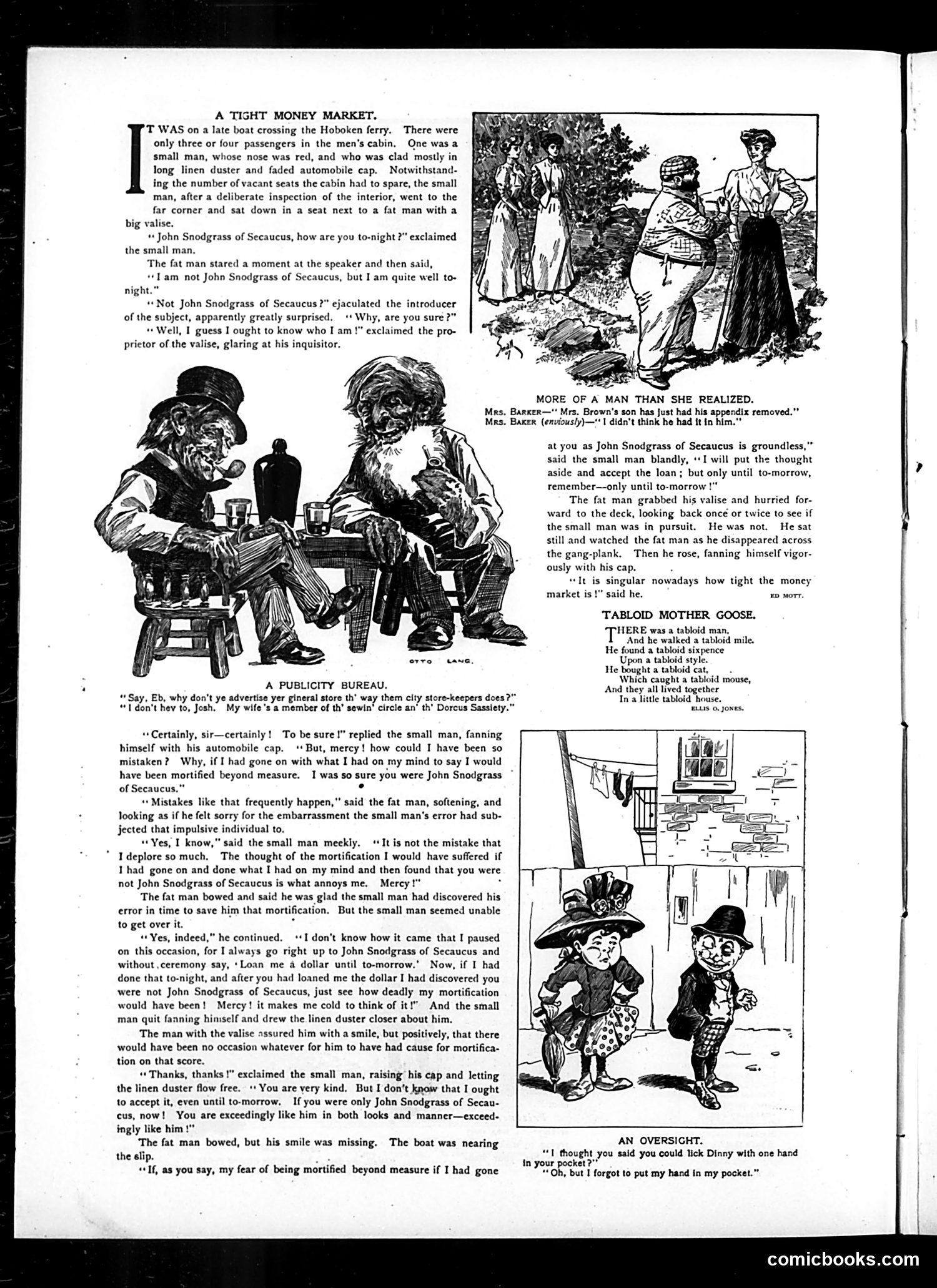
This story satirizes a common con scheme of the era. A shabby stranger approaches a well-dressed fat man carrying a valuable suitcase on a ferry, pretending to mistake him for "John Snodgrass of Secaucus." When corrected, the con artist feigns embarrassment, then gradually manipulates the victim through flattery and reverse psychology—repeatedly saying he'd normally ask to borrow money but fears mortification. The fat man, reassured and sympathetic, essentially invites the loan himself. The satire targets both the con artist's manipulative tactics and the victim's gullible vanity. The title "Tight Money Market" suggests financial desperation that makes people vulnerable to such schemes. This reflects early 1900s concerns about urban con games and the psychology of financial persuasion.
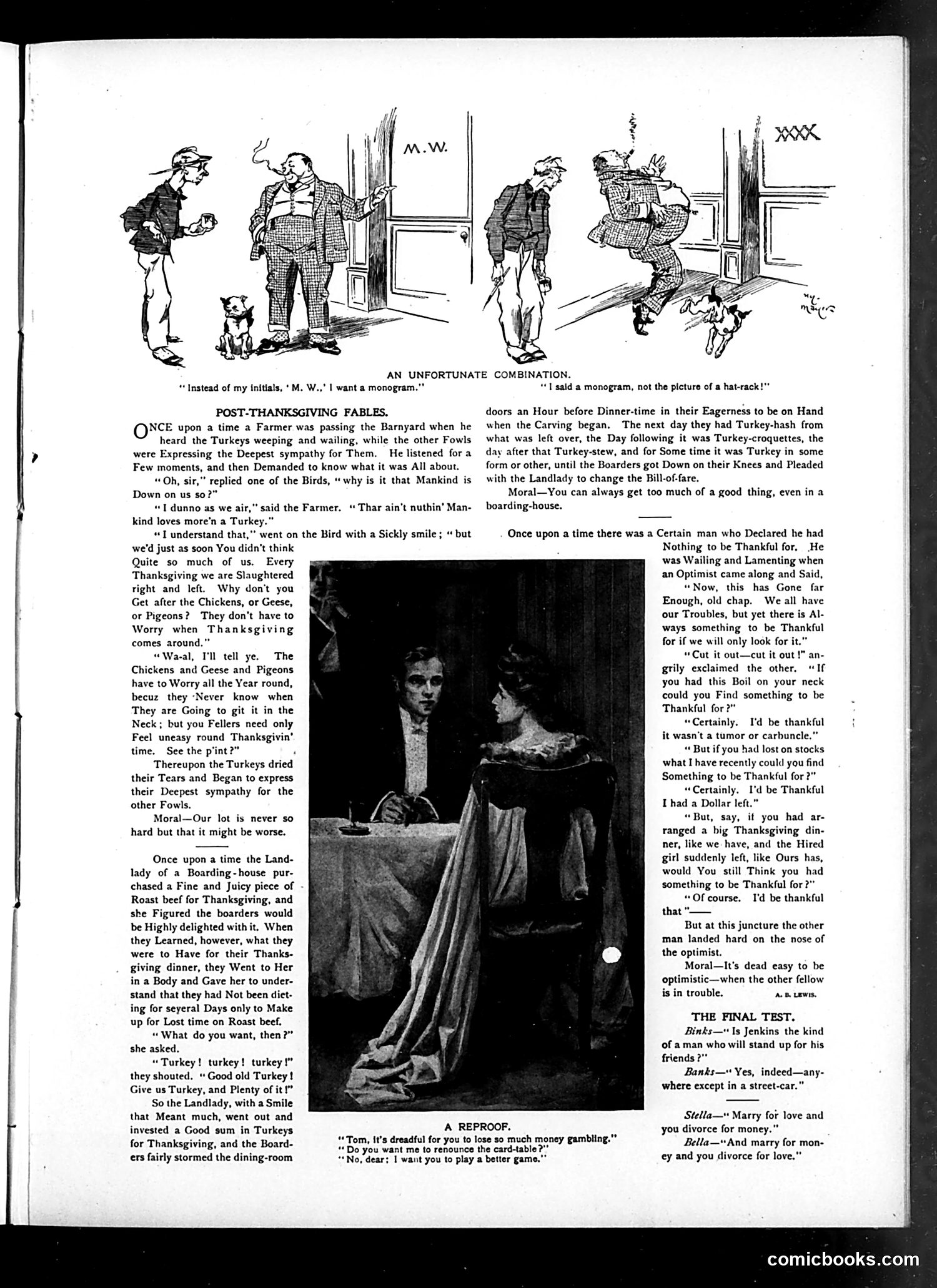
**The cartoons illustrate post-Thanksgiving satirical fables:** The top comic strip shows a monogram mix-up—a customer requesting initials "M.W." receives an unflattering hat-rack design instead, a visual pun on the similar shapes. **The main content comprises three moral tales:** 1. **Turkeys' complaint**: Farmyard birds realize turkeys only fear Thanksgiving slaughter, while other fowl worry year-round. Moral: "our lot is never so hard but that it might be worse"—a cynical take on finding comfort in comparative suffering. 2. **Boarding-house excess**: Landlady invests in turkeys after boarders demand them over roast beef. They're then force-fed turkey hash, croquettes, and stew until begging relief. Moral: even good things become unbearable in excess. 3. **The optimist**: A pessimist rejects finding gratitude despite troubles (boils, stock losses, absent hired girls). The fable mocks aggressive optimism—finding silver linings seems absurd when genuinely afflicted. The satire targets both American consumerism and forced cheerfulness around Thanksgiving.
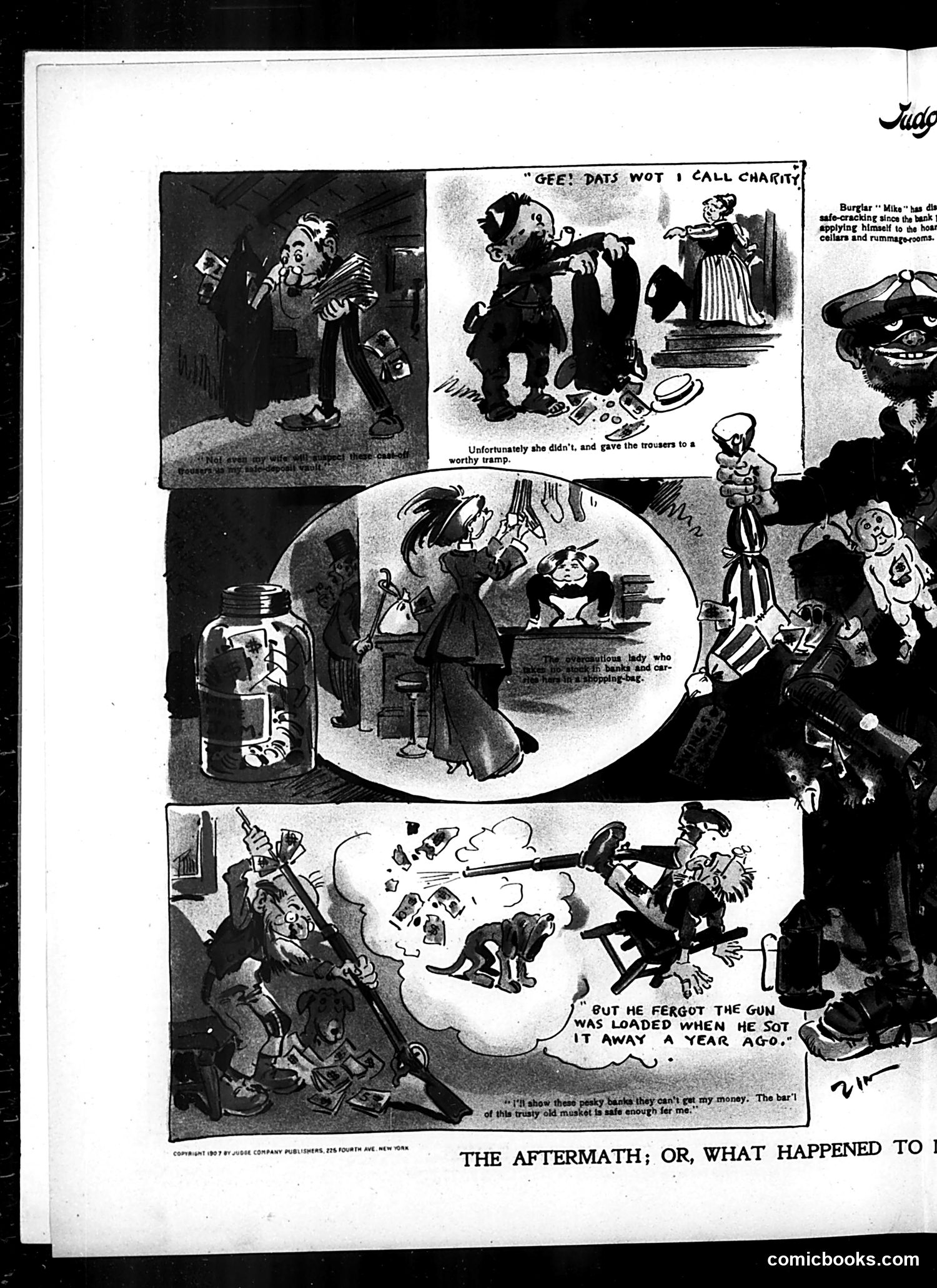
This appears to be a multi-panel comic titled "The Aftermath; Or, What Happened to [...]" from *Judge* magazine. The narrative follows a burglar ("Mike") who steals from a wealthy household. The satirical sequence shows: 1. Mike's initial theft 2. A wealthy woman charitably giving stolen trousers to a vagrant/tramp instead of returning them 3. The vagrant later using a loaded gun hidden in the trousers pocket, creating unintended consequences The satire critiques wealthy people's careless "charity"—they donate items without proper inspection, potentially causing harm. The gun in the pocket represents how thoughtless generosity can have dangerous, ironic outcomes. The joke plays on the gap between charitable intentions and actual responsibility, suggesting the upper class enables problems through negligent goodwill.
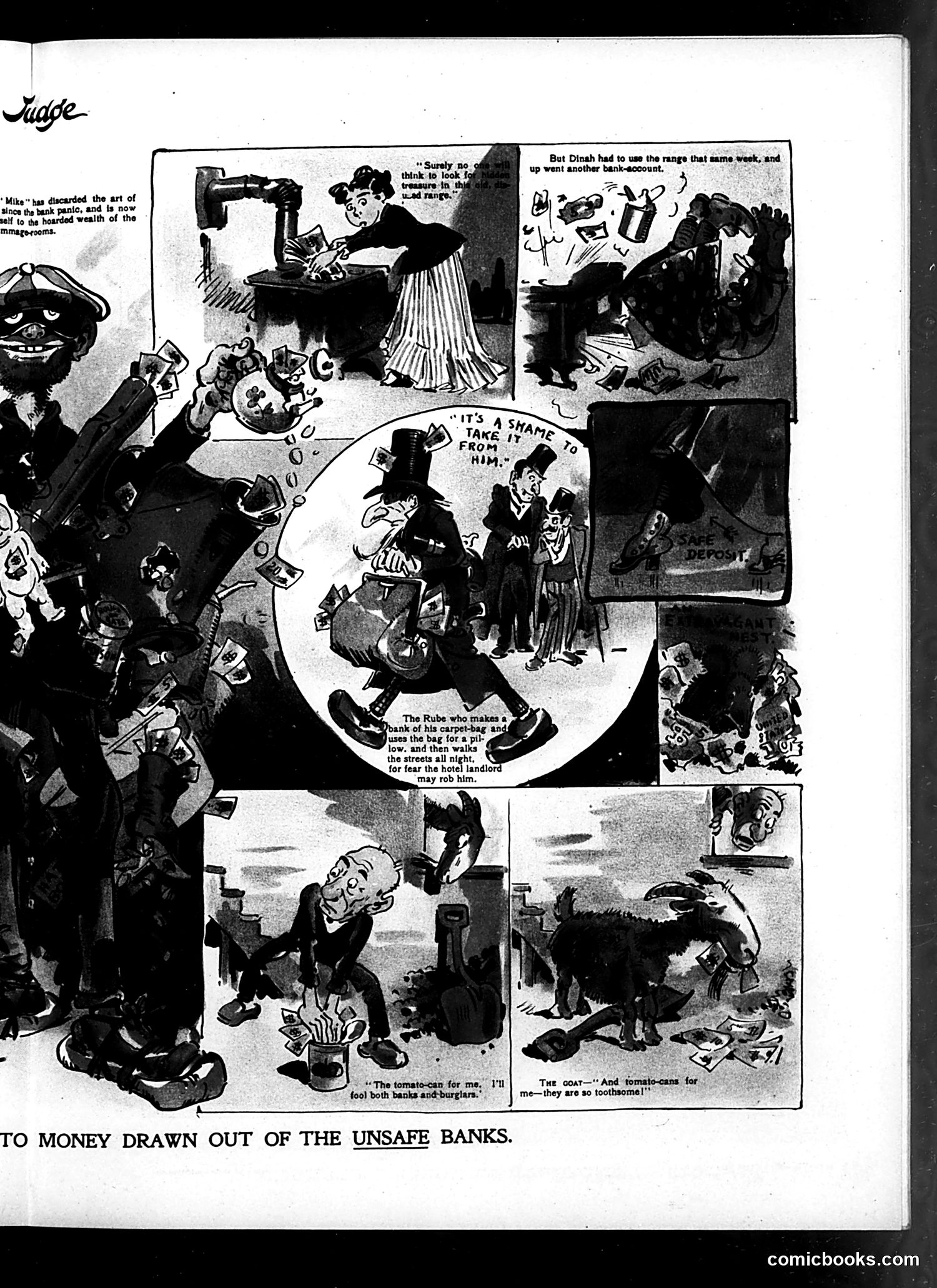
This Judge magazine cartoon satirizes bank failures and financial instability of the era (appears to be early 20th century). The narrative follows characters named Mike and Dinah who withdraw their savings from unsafe banks, then struggle to safely store the cash at home. The satire works on two levels: First, it mocks the panic and paranoia surrounding bank collapses—people hoarding money in makeshift containers (tomato cans, carpet bags) rather than trusting financial institutions. Second, it highlights the absurdity and dangers of keeping cash at home: the characters' money gets used as pillows, cooking implements, and fuel, or lost to theft. The caricatured figures (appearing to be working-class individuals) represent ordinary depositors caught between two bad options: unsafe banks or unsafe home storage. The cartoon criticizes both the banking system's unreliability and the desperation it forces upon common people.
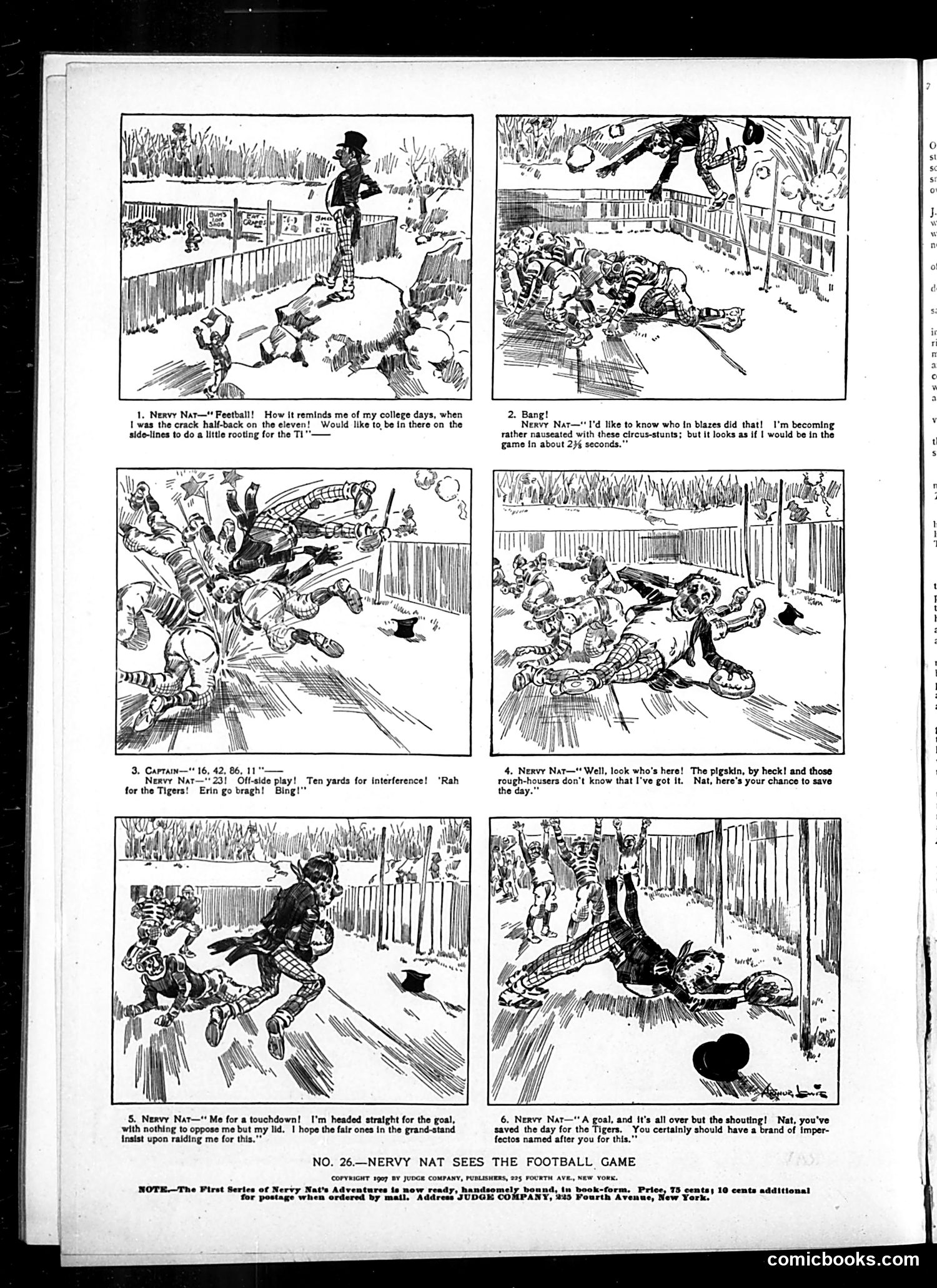
This is a slapstick comedy comic strip, not political satire. The character "Nervy Nat" attends a college football game and becomes accidentally entangled in the action, despite being a spectator. The joke relies on physical comedy: Nat boasts about his college football days, then gets repeatedly knocked down, trampled, and ejected into the game itself by colliding players. His repeated insistence that he's "headed straight for the goal" contrasts with his actual chaotic involvement. The strip plays on turn-of-the-century nostalgia (Nat waxes sentimental about his playing days) and the increasingly rough nature of early American football. The final panel suggests he inadvertently scores a winning touchdown, accidentally becoming the hero. The advertisement at bottom promotes the "First Series of Nervy Nat's Adventures" as a bound collection, indicating this was a popular recurring character in *Judge* magazine.
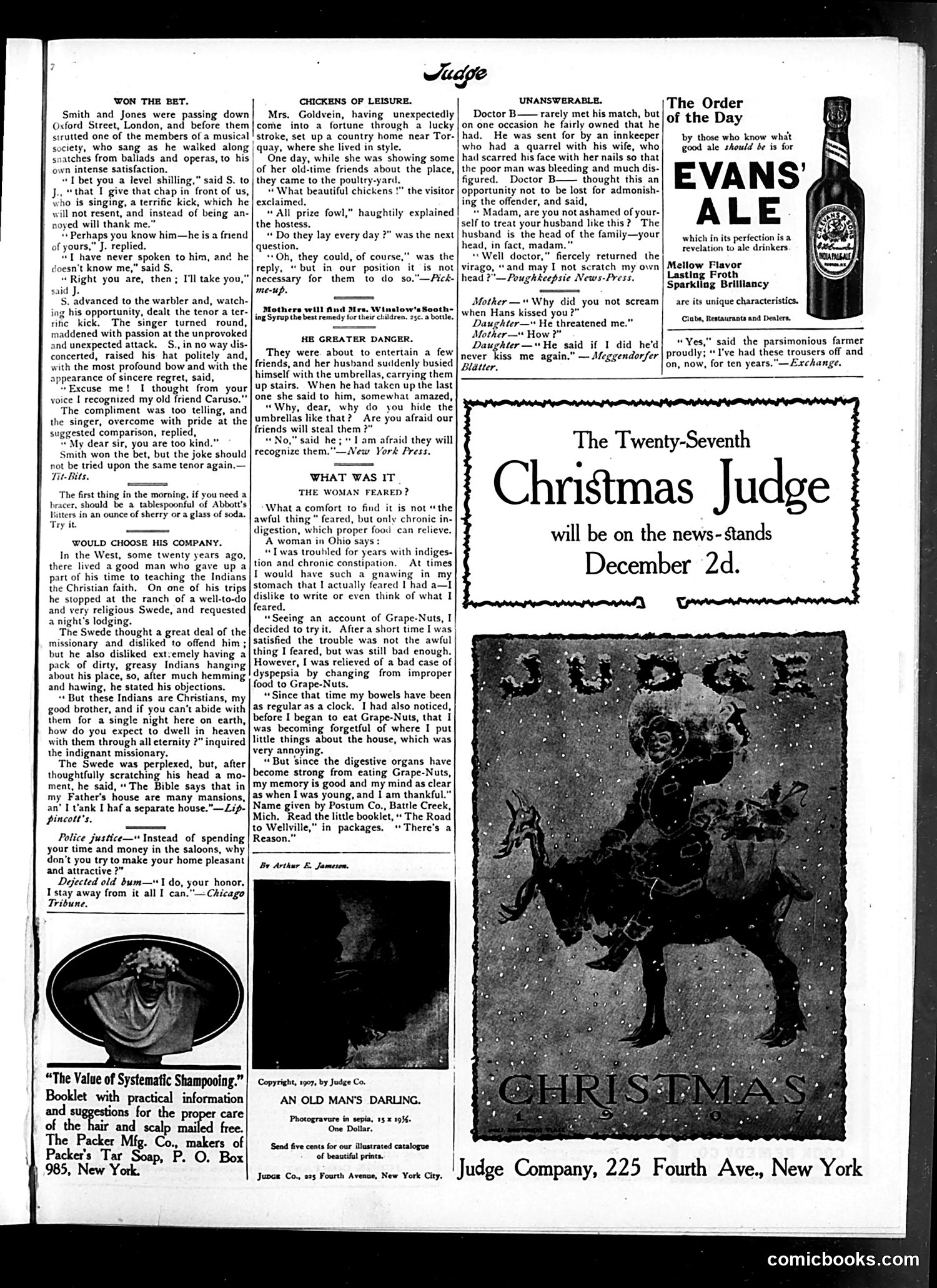
This page contains several short humorous anecdotes typical of early 20th-century satirical magazines: **"Won the Bet"** mocks a street musician by flattering him with a comparison to Enrico Caruso (the famous opera tenor), turning his anger into pride after being kicked unprovoked. **"Would Choose His Company"** satirizes religious hypocrisy: a Swedish rancher claims he'll go to heaven with Native Americans but insists on a separate mansion—using scripture to justify segregation. **"Police Justice"** presents a jobless man honestly admitting he avoids going home, implying his home is unpleasant—criticism of poverty and poor living conditions. **"Chickens of Leisure"** mocks newly wealthy people (Mrs. Goldvein) who affect aristocratic indifference to productivity, claiming their prize chickens needn't lay eggs because they're now rich. The page emphasizes class pretension, hypocrisy, and social climbing—common Judge magazine targets.
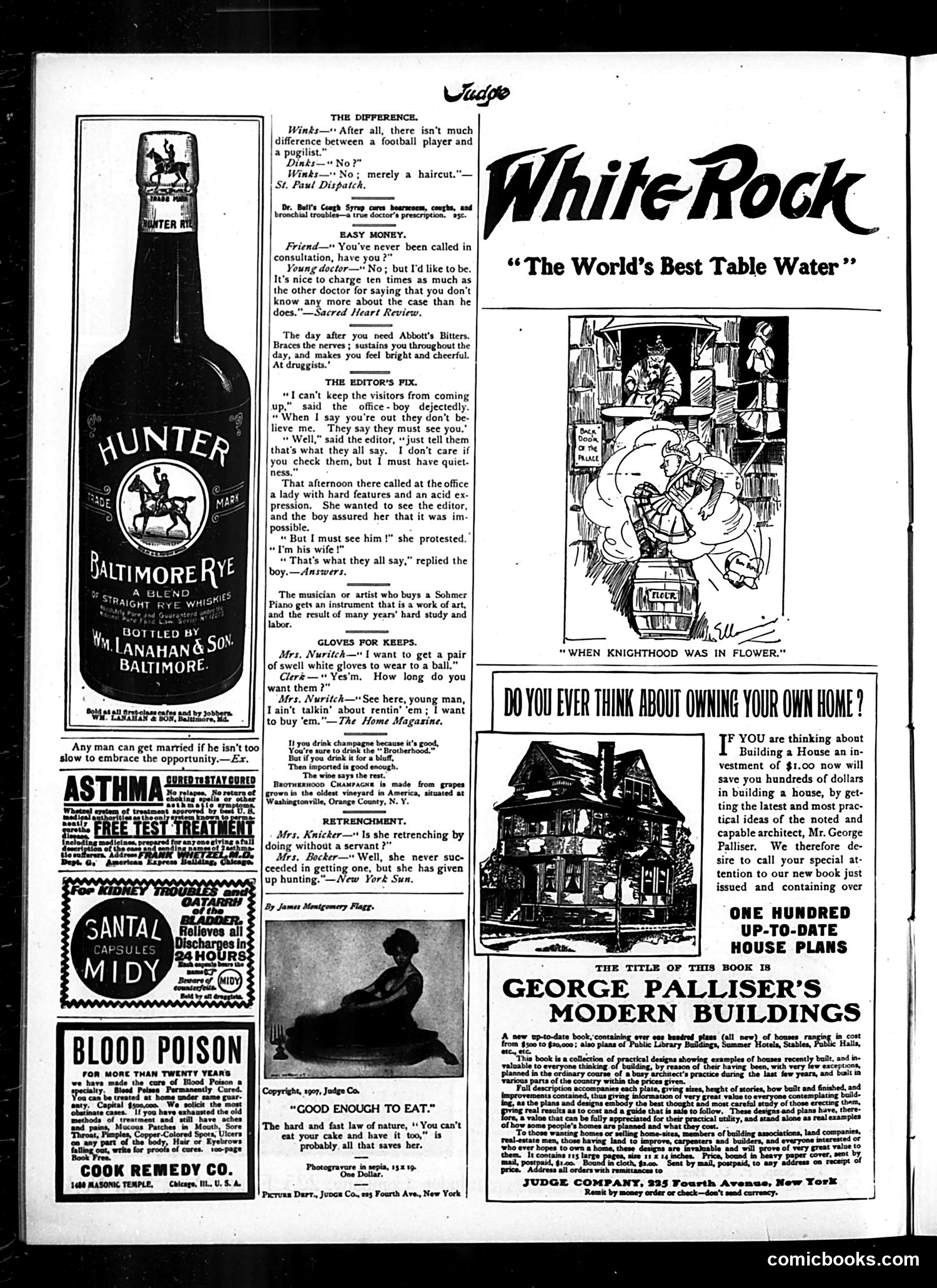
This page from Judge (a satirical weekly) consists primarily of **humorous anecdotes and advertisements** rather than political cartoons. The jokes target **professional pretension and social manners**: a doctor charging high fees while admitting ignorance; an editor avoiding visitors by claiming all visitors say the same thing (implying his excuse is transparent); a woman buying expensive gloves permanently rather than renting them; servants feigning wealth they cannot afford. One cartoon by James Montgomery Flagg shows a woman with the caption "Good Enough to Eat"—a double-entendre joke about her appearance that modern readers would recognize as crude objectification. The advertisements include whiskey, patent medicines (for asthma and blood poison), pianos, and champagne—typical of early-1900s magazines. The page's main content is **social satire aimed at middle-class pretension and professional hypocrisy**, reflecting Judge's satirical mission, rather than political commentary.
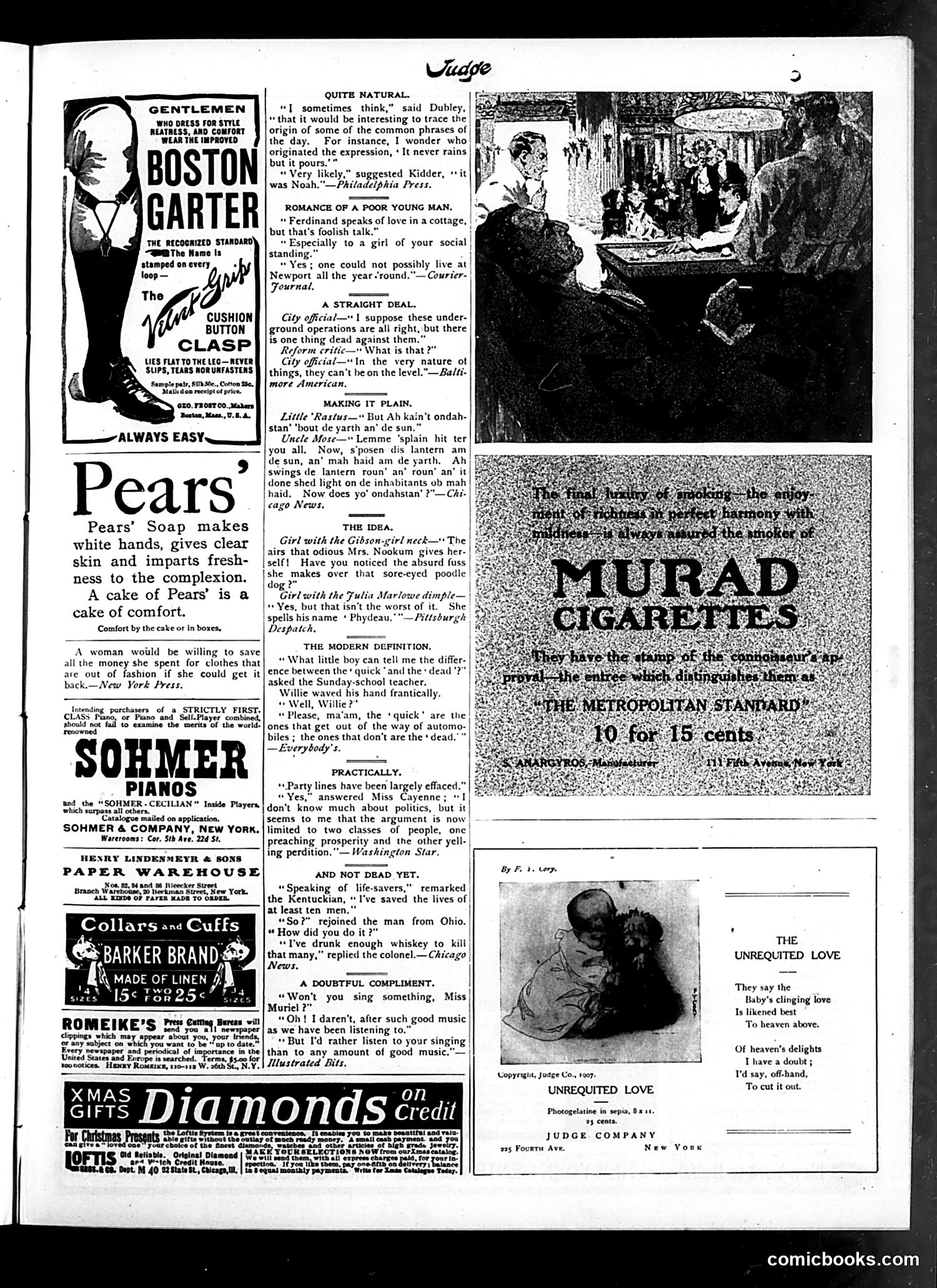
This page is primarily **advertising**, with miscellaneous short humorous anecdotes rather than political cartoons. The upper left features a Boston Garter advertisement, while other ads promote Pears' Soap, Sohmer Pianos, and paper products. The text consists of brief jokes and witticisms typical of early-20th-century periodicals: - "QUITE NATURAL": A pun attributing the phrase "it never rains but it pours" to Noah - "ROMANCE OF A POOR YOUNG MAN": Social satire about a poor suitor unable to afford Newport society - Several dialect-humor pieces featuring "Little Rastus" and "Uncle Mose" (reflecting the casual racism of the era) - "THE MODERN DEFINITION": A joke about automobiles versus traditional definitions of "quick" and "dead" The page reflects Judge's format: light satire on contemporary manners, fashion, and social pretension, mixed with commercial advertising. No specific political figures or events are referenced on this particular page.
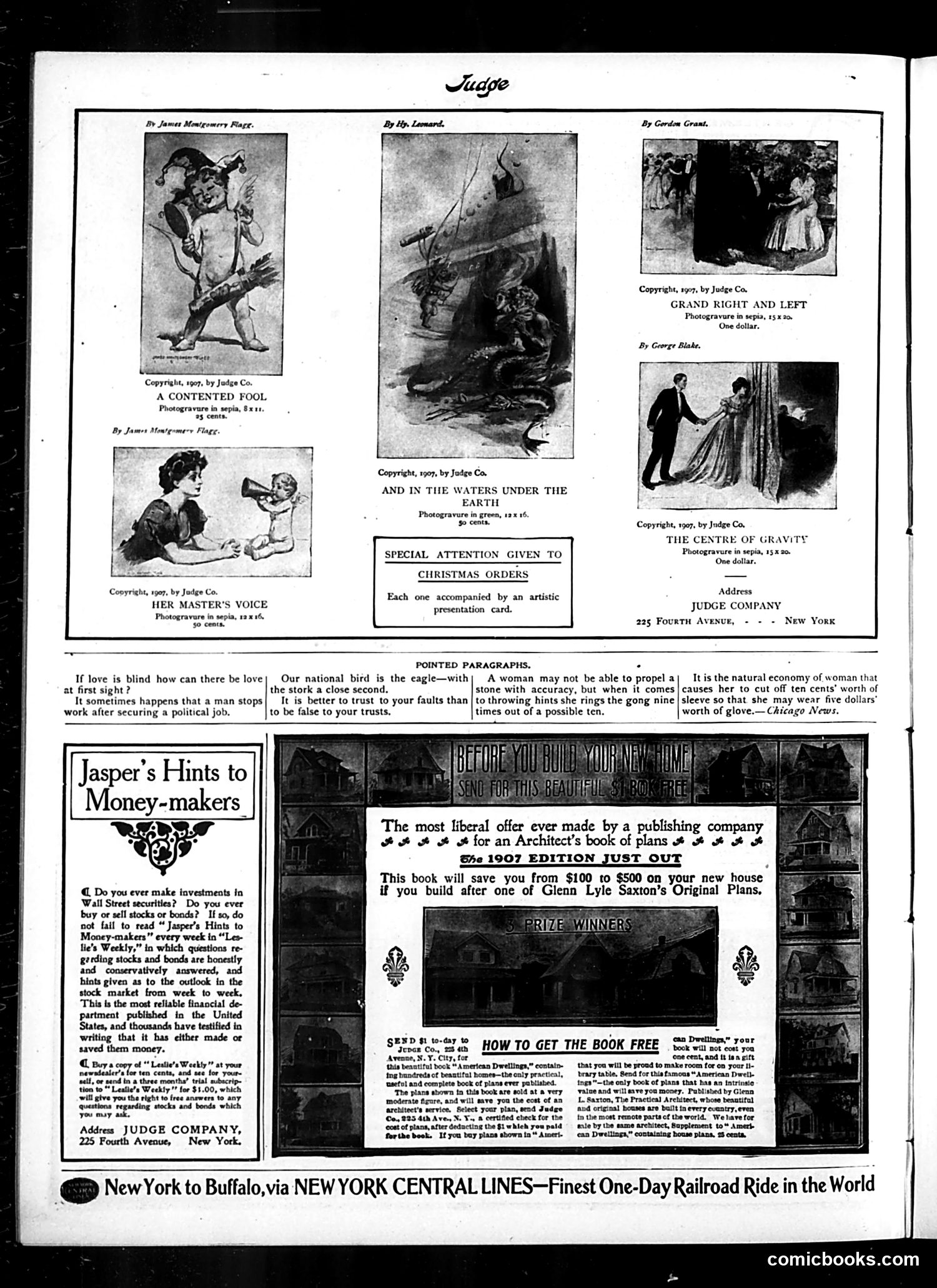
This page is primarily a **catalog/advertisement section** rather than political satire. It showcases Judge Company's 1907 merchandise offerings—art prints and illustrated books available for purchase. The upper section displays four photogravure reproductions by artists James Montgomery Flagg, Mr. Lunard, and George Blake, titled works like "A Contented Fool" and "Her Master's Voice," priced from 2 cents to one dollar. Below are **"Pointed Paragraphs"**—brief humorous observations about universal human behavior (love, politics, gender economics) rather than topical satire. These appear to be filler content typical of the era's magazines. The lower half contains advertisements: "Jasper's Hints to Money-makers" (a financial advice column in Leslie's Weekly), an architect's house-plan book offering, and a railroad advertisement. The page reflects Judge's dual function as both satirical magazine and commercial catalog, typical of early 20th-century publications.
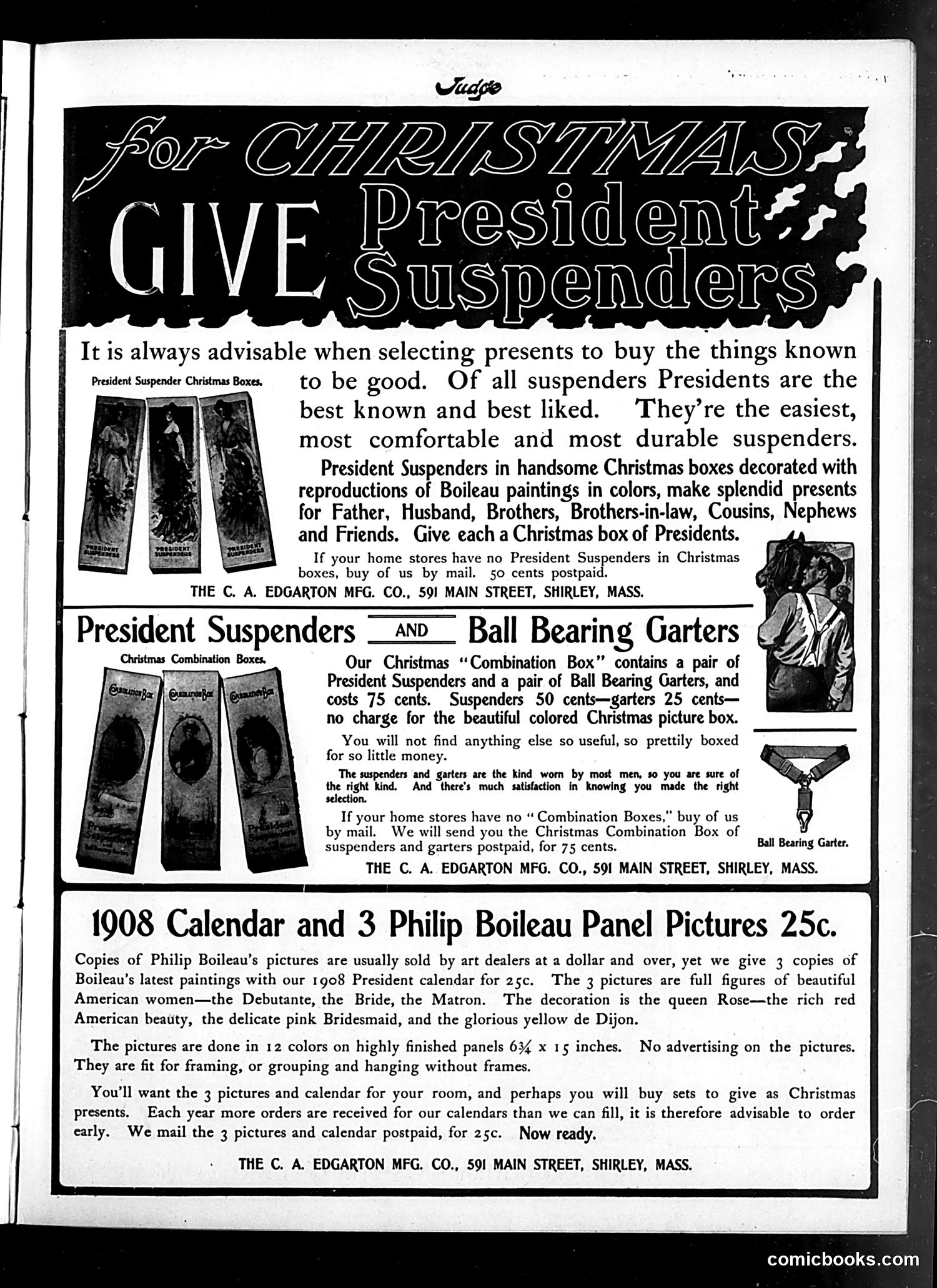
This is **not a cartoon**—it's a full-page advertisement from Judge magazine for President brand suspenders and garters, with bonus calendar art. The ads exploit the word "President" as a product brand name to create satirical wordplay. The headline "GIVE President Suspenders" puns on gift-giving advice, treating a mundane clothing item as if it were a prestigious choice. References to "Philip Boileau paintings" and elegant packaging suggest the product capitalizes on refined aesthetics to sell practical menswear. The humor is gentle—the ads promise durability and comfort while wrapping cheap merchandise (50 cents) in attractive Christmas boxes featuring famous artwork reproductions. For modern readers, this reveals early 1900s advertising strategy: marketing ordinary goods through association with art, status (the "President" brand name), and celebrity artist endorsements (Boileau). The combination box bundling suspenders with "Ball Bearing Garters" suggests these were complementary men's accessories of the era.
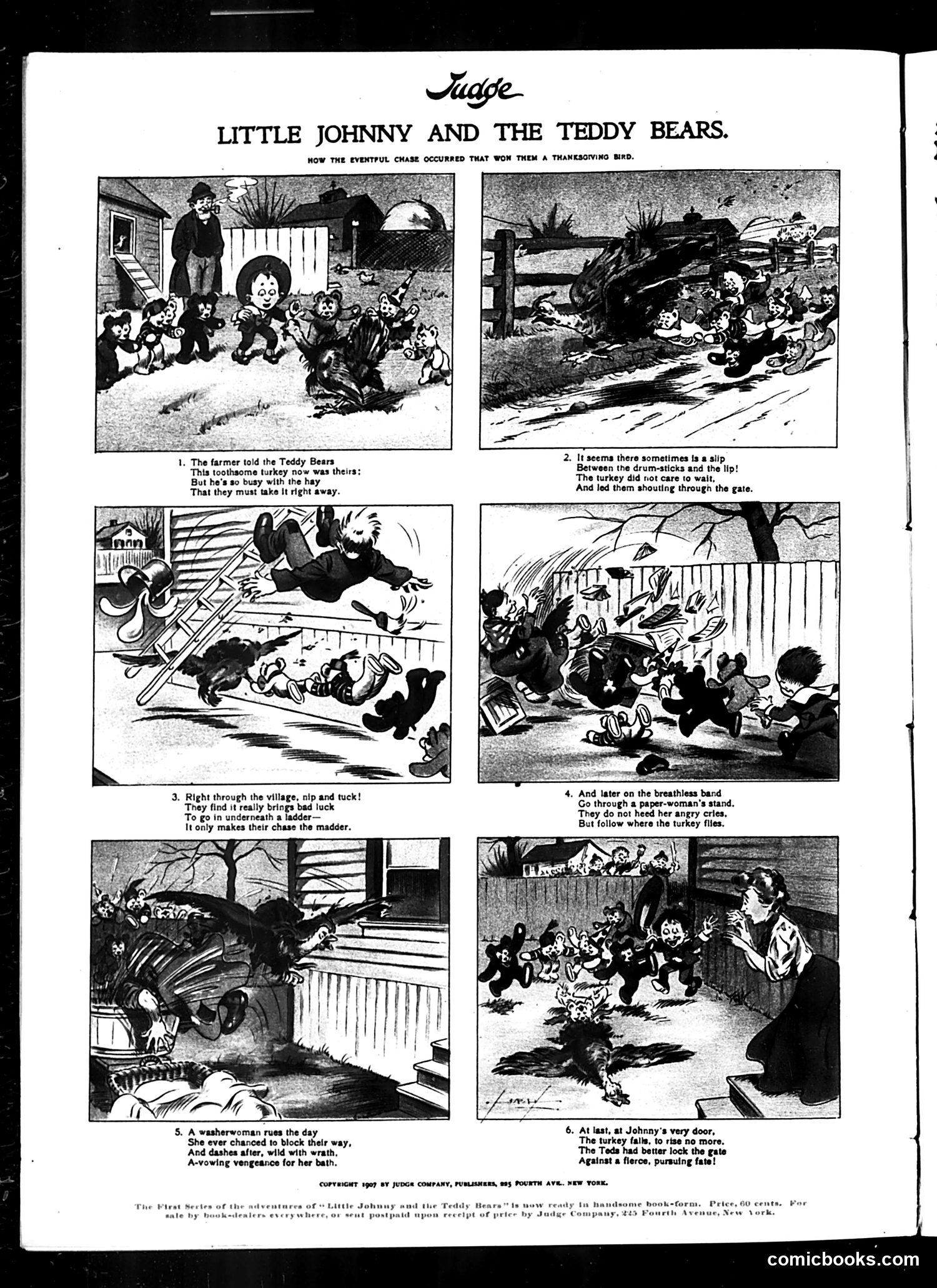
This is a humorous children's story comic showing teddy bears chasing a wild turkey through a village to win it as a Thanksgiving prize. The narrative follows their chaotic pursuit: the farmer sends them after the bird, they chase it past a ladder (invoking superstition about bad luck), through the village streets causing disruption, past an angry washerwoman whose laundry they disturb, and finally to Johnny's doorstep where the exhausted turkey collapses. The satire appears gentle—playing on the teddy bear craze of the early 1900s (related to President Theodore Roosevelt) by depicting these popular toys as animated characters. The comic mines humor from slapstick chaos and collateral damage to bystanders. The "Thanksgiving bird" prize frames the entire adventure as a lighthearted pursuit of holiday spoils, typical of Judge's mix of gentle social observation and children's entertainment content from the era.