
A complete issue · 16 pages · 1907
Judge — November 16, 1907
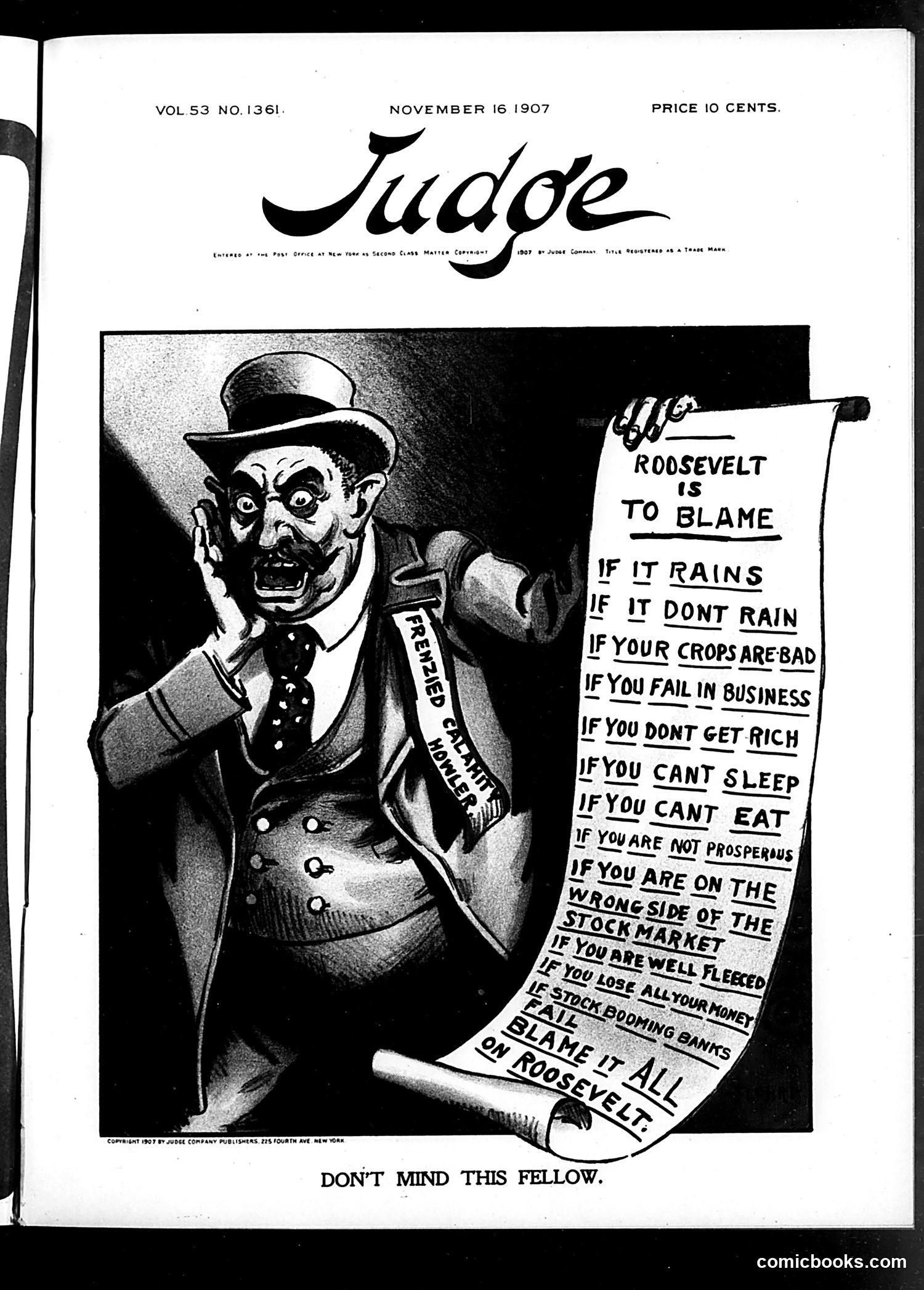
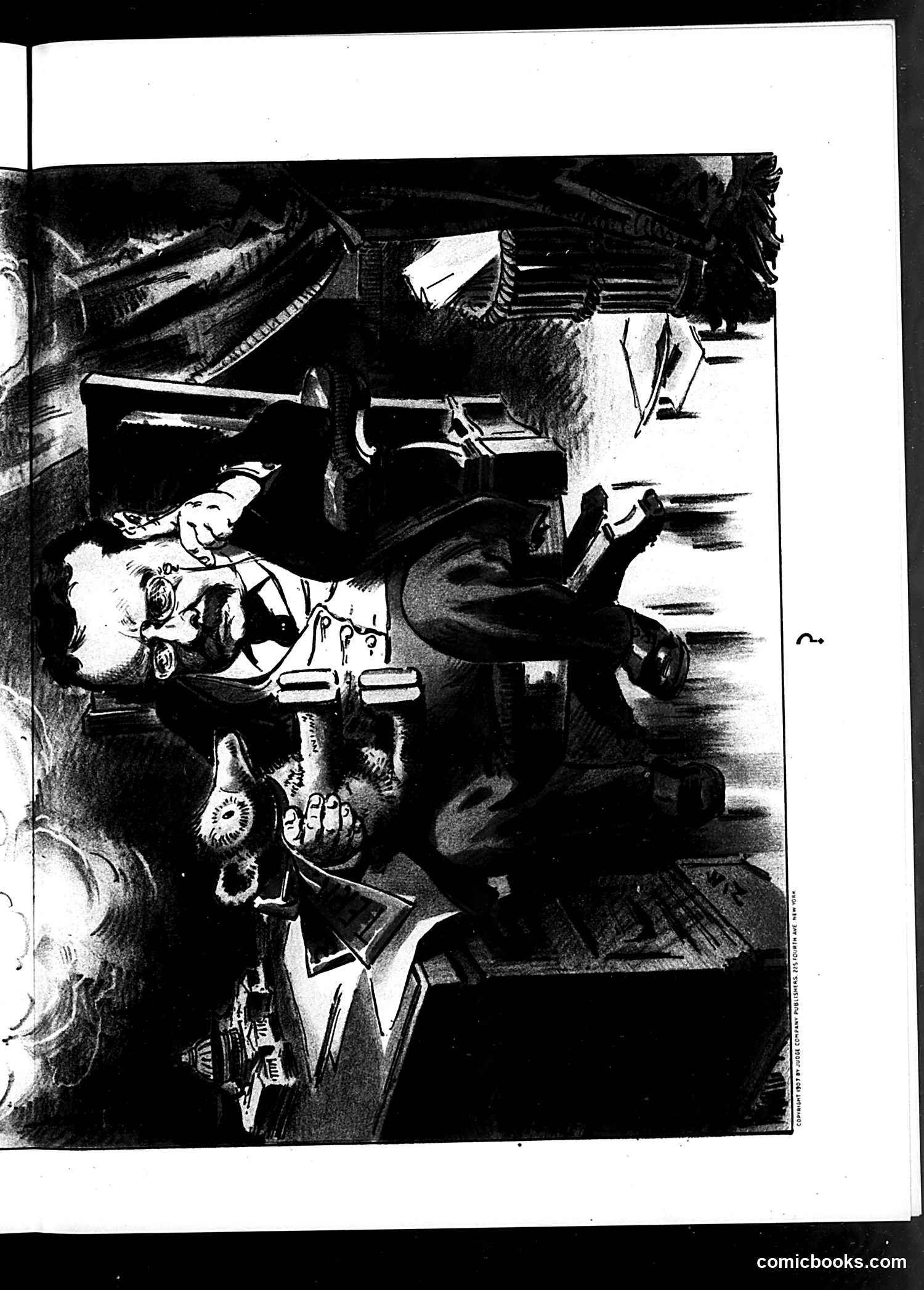
This political satire attacks President Theodore Roosevelt by depicting a caricatured figure holding a long scroll labeled "Roosevelt is to Blame." The scroll lists numerous grievances—bad weather, crop failures, business downturns, insomnia, poverty, and stock market losses—attributing all of them to Roosevelt's policies or leadership. The caption "Don't Mind This Fellow" suggests the cartoon is mocking critics who blame the president for every societal problem, regardless of whether those problems fall under presidential control. The exaggerated, grotesque facial features and theatrical pose emphasize the absurdity of indiscriminate fault-finding. The satire defends Roosevelt by ridiculing his opponents' tendency to blame him for matters beyond any president's actual authority.
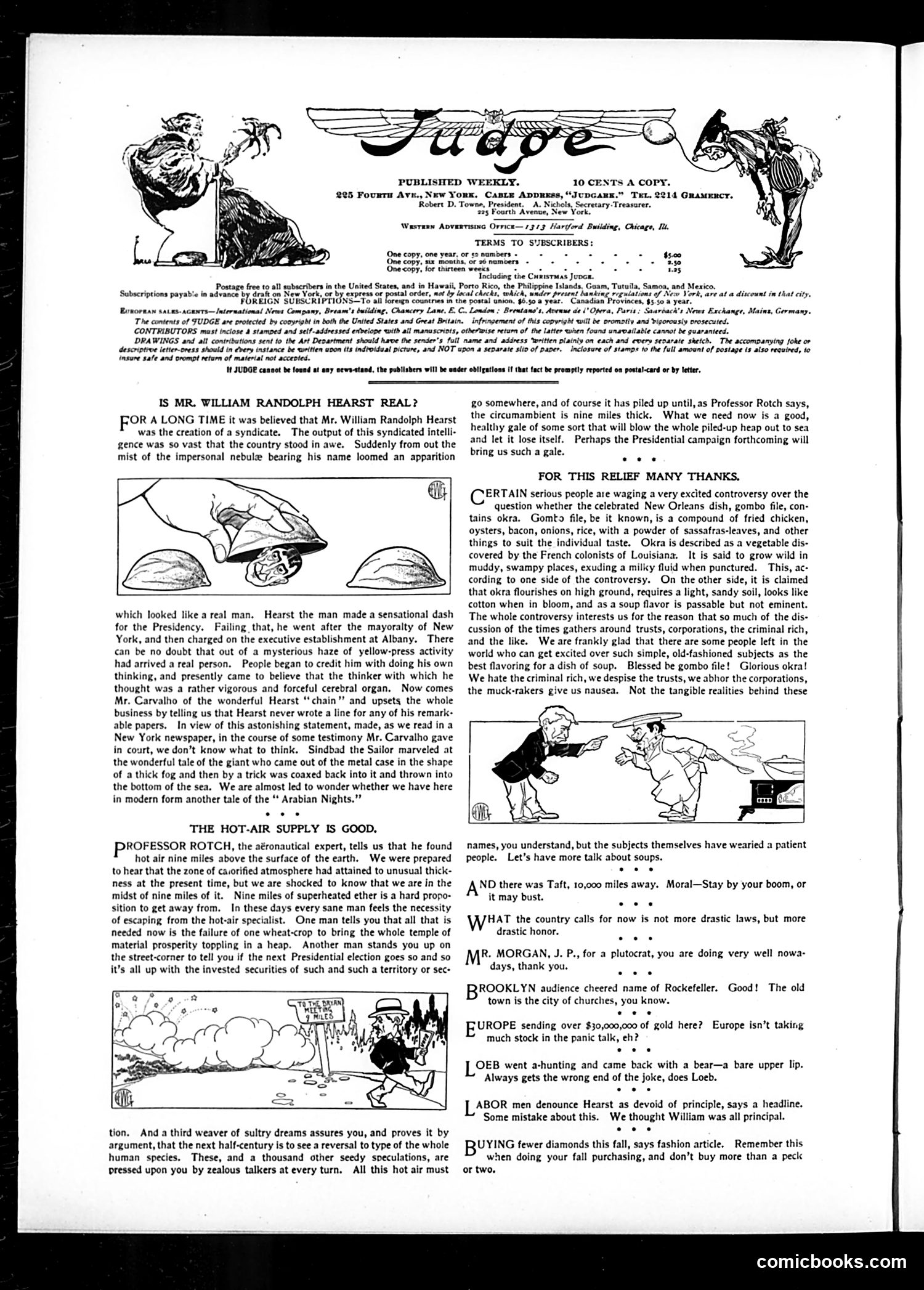
This page contains **satirical commentary** on early 20th-century American topics: **"Is Mr. William Randolph Hearst Real?"** questions whether the newspaper magnate actually exists or is a syndicate creation—a jab at Hearst's enormous media empire and sensationalist journalism practices. **"The Hot-Air Supply is Good"** mocks Professor Rotch's claims about atmospheric conditions, sarcastically suggesting Americans are drowning in empty political rhetoric rather than substantive policy. The scattered brief items mock contemporary figures: Taft (moral failings), Morgan (plutocratic excess), Rockefeller, labor organizing, and European financial panics. The cartoons—showing exaggerated characters and fantastical scenarios—employ visual humor typical of Judge's satirical style, targeting wealthy industrialists, politicians, and media manipulation as corrupt forces dominating American life.
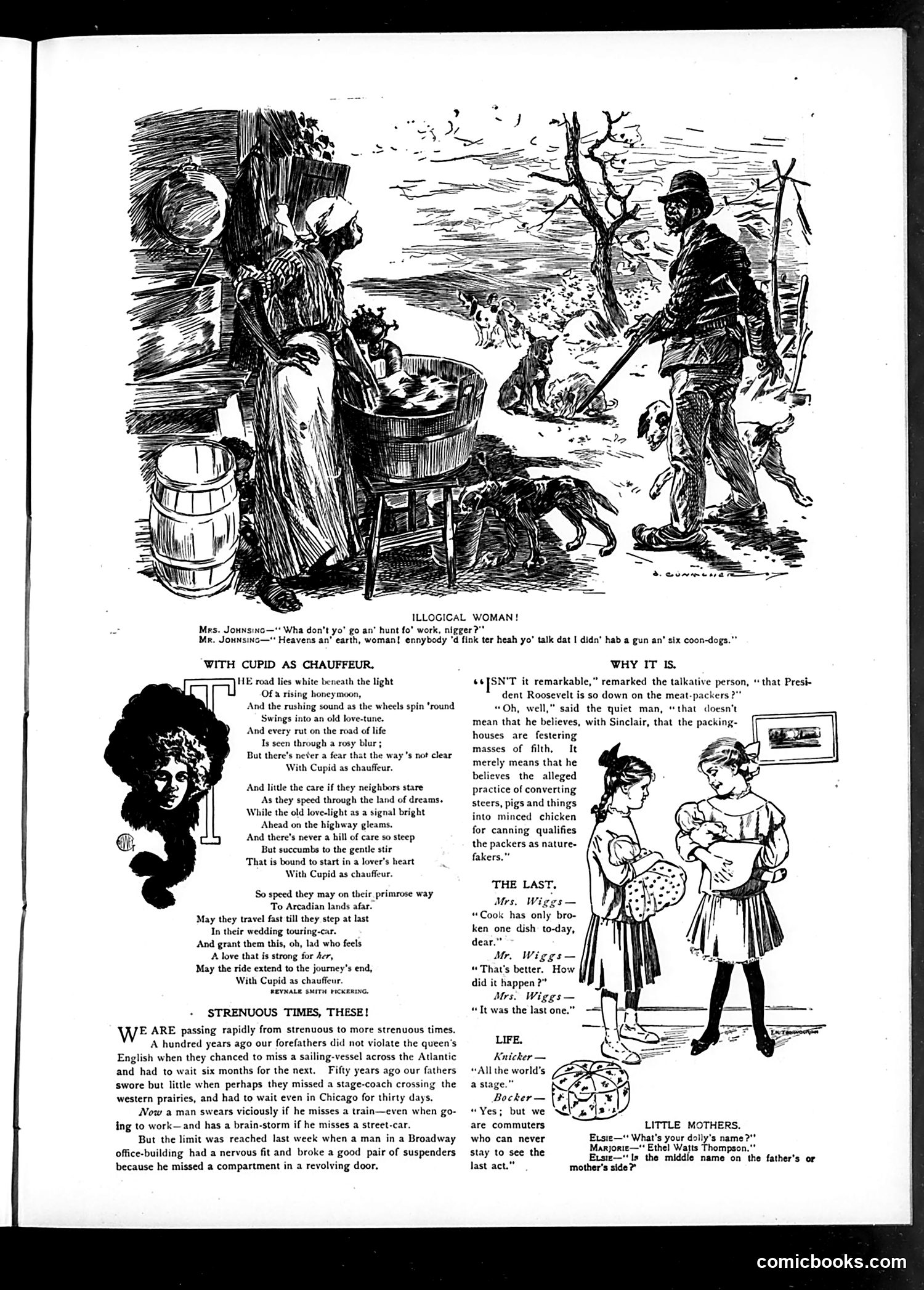
This page contains multiple satirical pieces typical of Judge's commentary. "A Illogical Woman" depicts a domestic scene where a woman contradicts herself—she won't let her husband hunt for work (calling it dangerous) yet demands he provide income. The humor relies on highlighting perceived female illogic. "With Cupid as Chauffeur" is a poem romanticizing automobile travel, reflecting early 1900s fascination with cars as symbols of modernity and courtship. "Strenuous Times, These!" compares modern inconveniences (missed trains, street cars, Broadway office buildings) to historical hardships, satirizing contemporary complaints as trivial. The smaller pieces—"Why It Is," "The Last," and "Little Mothers"—offer brief social commentary on contemporary life, including domestic topics and changing social customs.
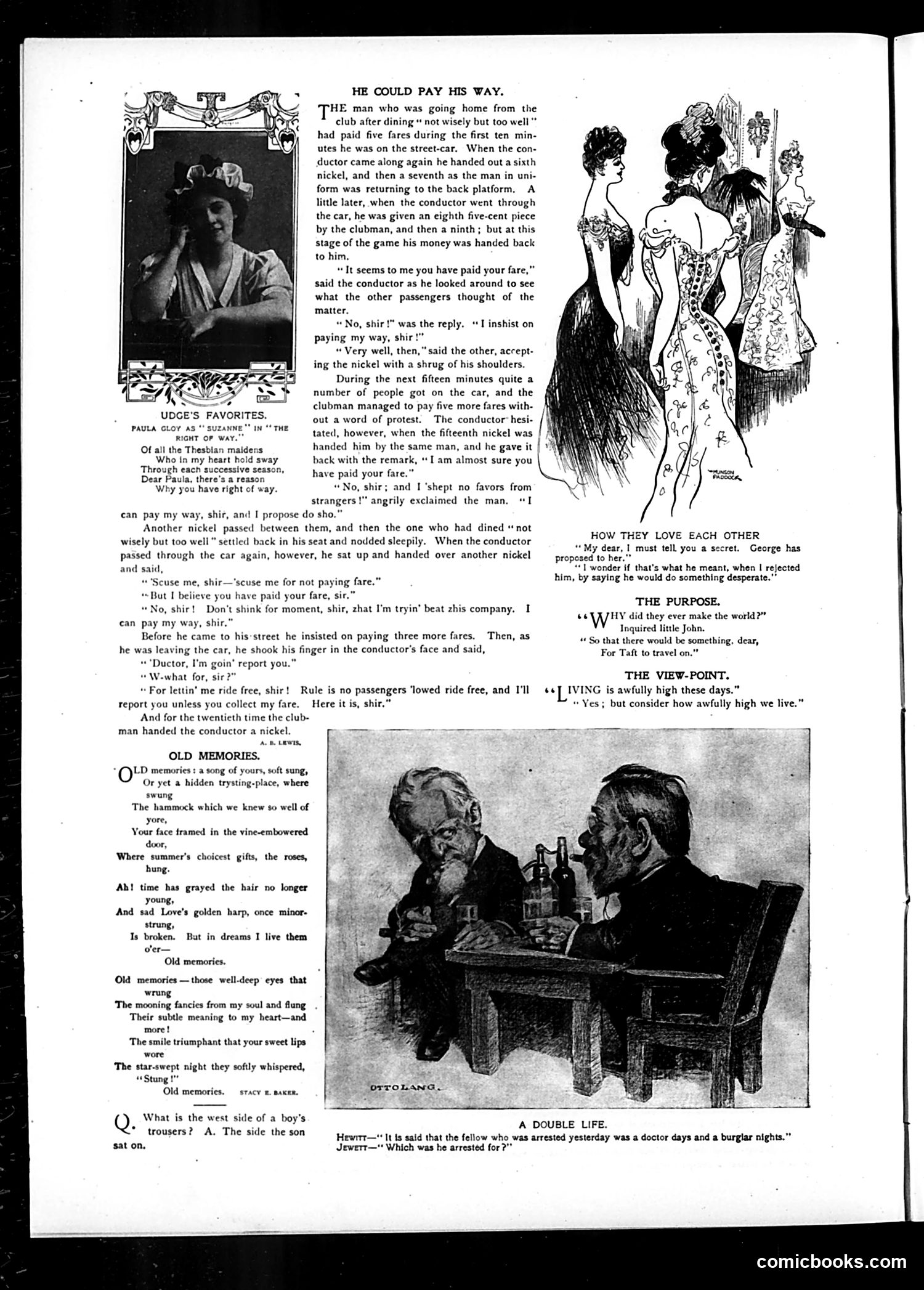
This page contains multiple distinct pieces: **"He Could Pay His Way"** (main story, left): A humorous anecdote about a man exiting a trolley who repeatedly insists on paying his fare despite the conductor's attempts to waive it. The man becomes increasingly belligerent, eventually paying twenty times over. The satire targets stubborn pride and excessive independence—poking fun at someone so determined to maintain self-reliance that they become absurd. **Right side illustrations**: "How They Love Each Other" and other domestic humor sketches depicting romantic couples, typical Judge fare of the era. **"Old Memories"** (poem): A nostalgic verse about lost youth and love. **"A Double Life"** (bottom): A joke illustration of two men at a table with the caption about a fellow arrested yesterday as both a doctor and burglar. The overall page reflects early 20th-century American humor emphasizing character flaws and domestic situations.
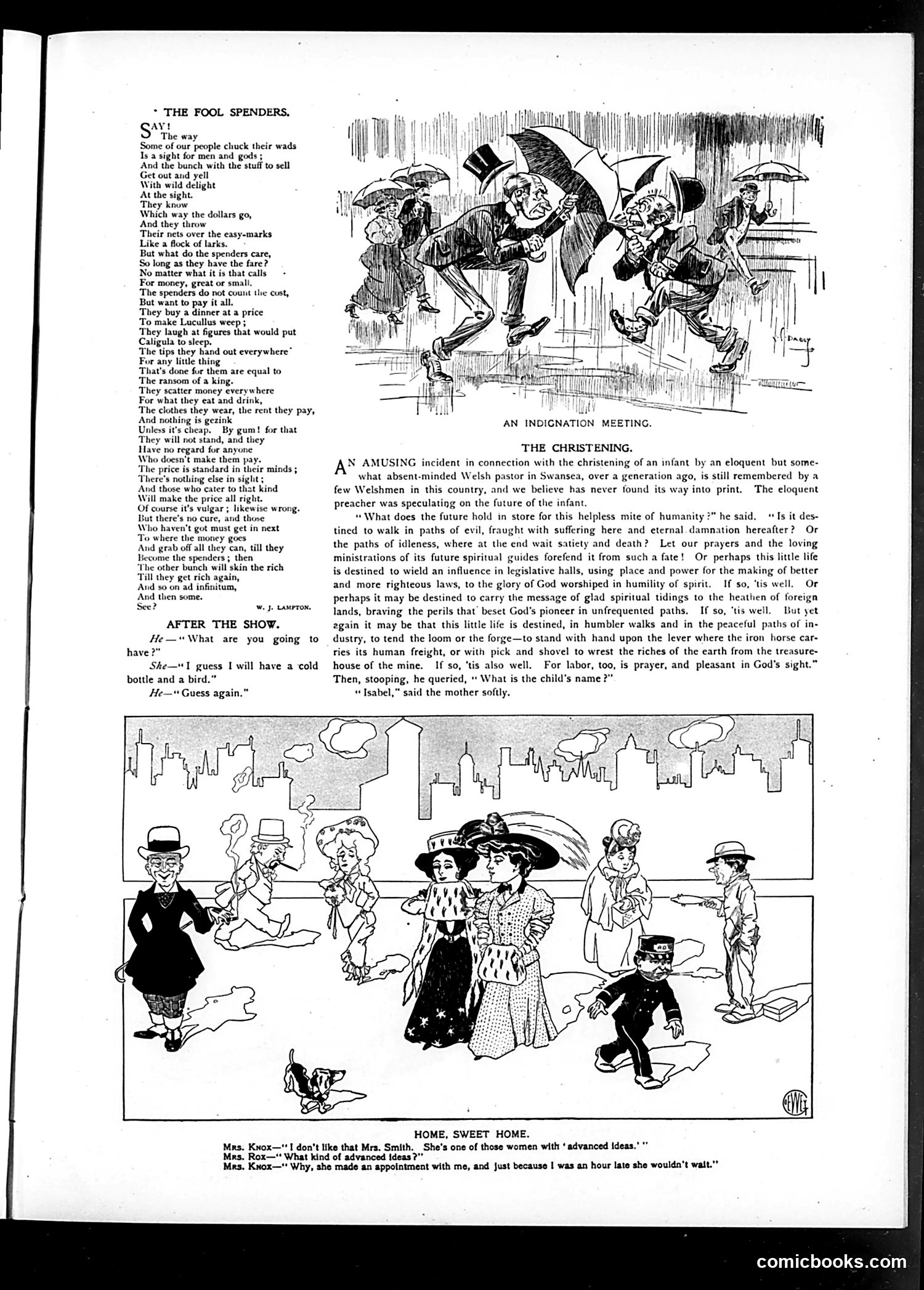
This page contains three distinct pieces of satirical content: 1. **"The Fool Spenders"** (poem): A critique of wealthy individuals who wastefully spend money on luxuries—fine clothes, expensive dinners, and frivolous entertainment—while appearing respectable in society. The satire suggests their ostentatious consumption masks moral emptiness. 2. **"An Indignation Meeting"** (top cartoon): Depicts well-dressed figures in rain, likely satirizing public protests or political gatherings of the era. The specific event referenced is unclear without additional context. 3. **"Home, Sweet Home"** (bottom cartoon): Shows urban tenement life with poor families. The dialogue references "advanced ideas" and a woman who kept an appointment despite being an hour late—satirizing either women's independence or modern social behavior among the working poor. The overall theme critiques class disparities and social pretensions of the era.
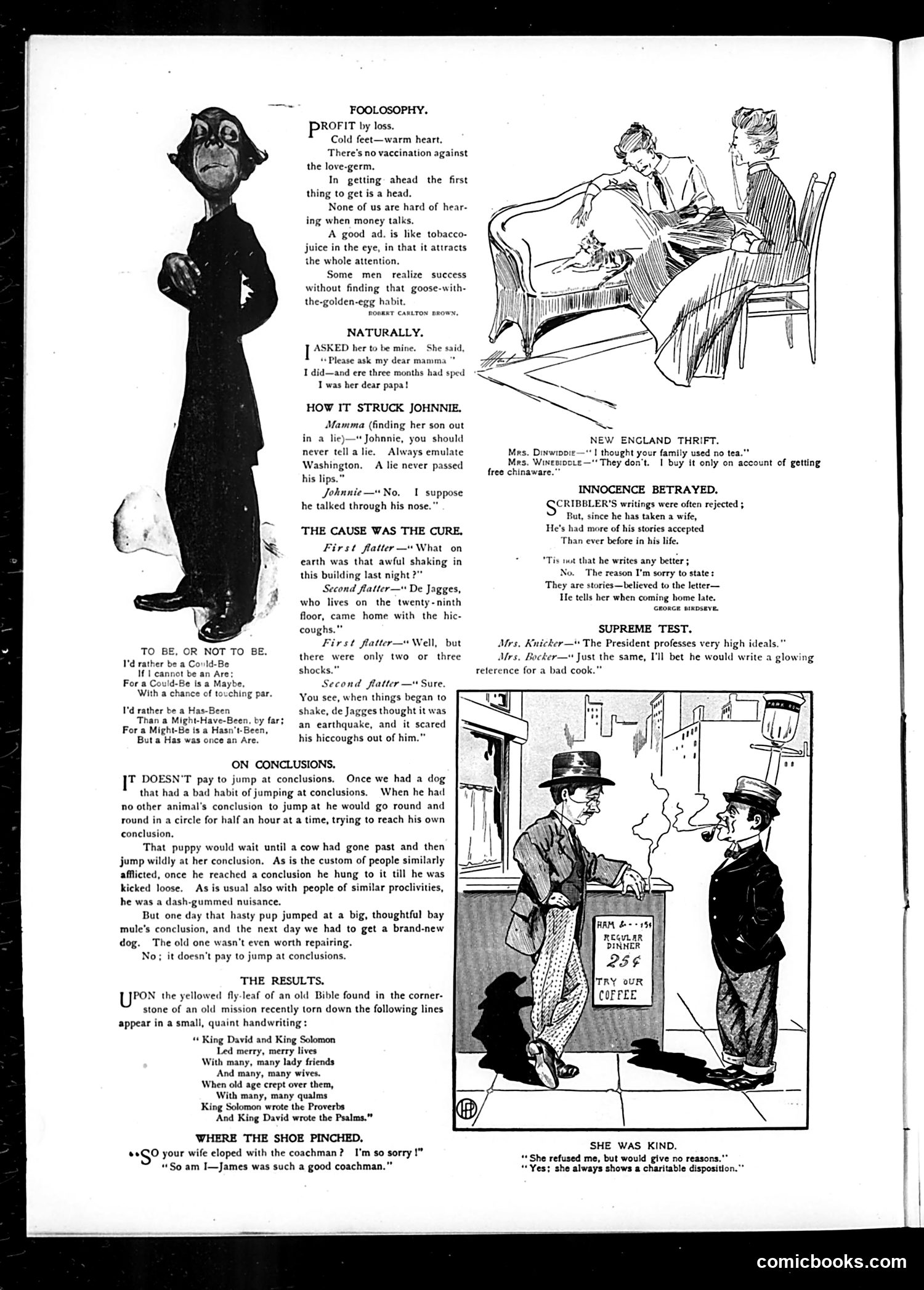
This page from **Judge** magazine contains multiple satirical pieces mocking American social conventions and human nature. The main cartoons target: 1. **"On Conclusions"** — A lengthy joke about a dog that literally jumps at conclusions, used as a metaphor for people who make hasty judgments without thinking. 2. **"The Results"** — A sardonic poem suggesting that King David and Solomon wrote the Psalms and Proverbs only *after* age and experience wore them down—implying wisdom comes too late. 3. **"Supreme Test"** — Mocks presidential ideals by suggesting even a high-minded leader would compromise ethics to secure a good cook (a servant household concern of the era). 4. **"New England Thrift"** — Ridicules frugal New Englanders who claim to avoid tea while secretly buying it for included "free" china premiums—satirizing self-deception about consumption. The page's "Foolosophy" section offers cynical one-liners about human nature: love, success, advertising, and hypocrisy. Overall, it's genteel satire targeting middle-class American pretension and poor reasoning.
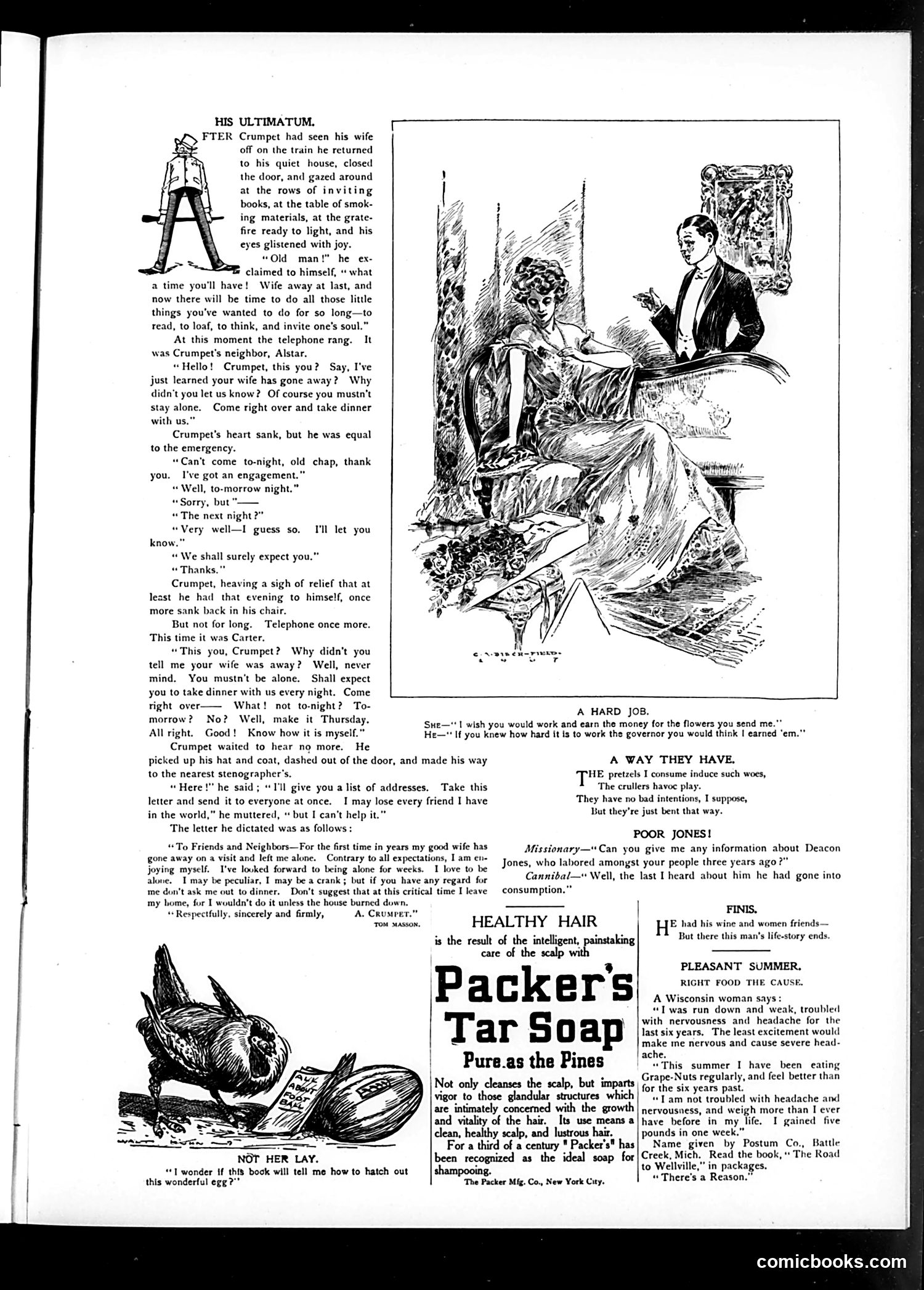
This page primarily contains a humorous short story satirizing the modern married man's dilemma. Crumpet eagerly anticipates solitude while his wife travels, but neighbors immediately telephone demanding his dinner company—reflecting early-20th-century social obligations and the difficulty of refusing invitations without offense. His solution: a mass letter declaring his desperate need for solitude, signed formally to emphasize he'll sacrifice friendships rather than abandon his home. The satire targets both social convention (neighbors' automatic concern) and masculine independence—the joke being that even a man's explicit, printed ultimatum cannot protect his privacy from well-meaning social circles. The surrounding advertisements (Packer's Tar Soap, food testimonials) and brief jokes ("Poor Jones," "Finis") are typical Judge magazine filler content from this era, unremarkable by modern standards.
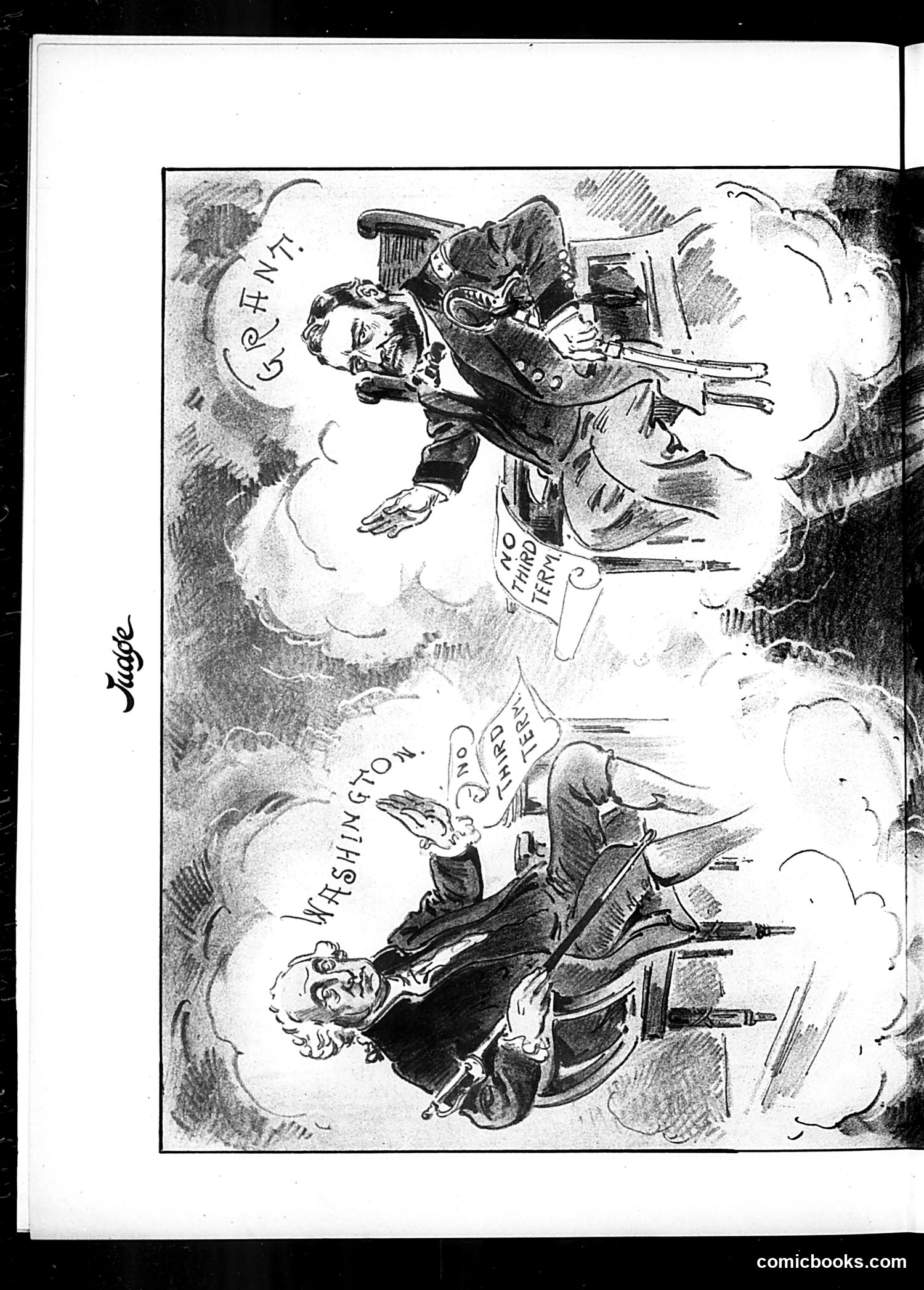
This Judge magazine cartoon depicts two figures in clouds labeled "MISGIVING" and "GRAFT." The top figure, labeled "GRAFT," appears to be a corrupt official or politician wielding various implements of exploitation. The bottom figure, labeled "MISGIVING," seems to represent doubt or conscience about such corruption. The cartoon satirizes government corruption and dishonest dealings of the era. The "GRAFT" figure's aggressive posture and tools suggest the systematic nature of political corruption, while "MISGIVING" represents the public's growing concerns about such practices. Without a visible date or specific names, the exact historical incident remains unclear, though this reflects Judge magazine's typical focus on exposing Gilded Age and Progressive Era political corruption and malfeasance.
I can see this is a black and white satirical illustration from *Judge* magazine, but the image quality and rotation make it difficult to read specific details clearly. The cartoon appears to depict a figure in formal dress (possibly military or official attire based on visible medals/insignia) in an exaggerated or compromising position, likely meant as political satire. However, without legible text or clearer visibility of identifying features, I cannot confidently determine which specific political figure or event this references, or what the precise satirical point intended to be. The artistic style is consistent with early-to-mid 20th century American editorial cartooning, but I cannot assert the specific subject or meaning with the accuracy this task requires.
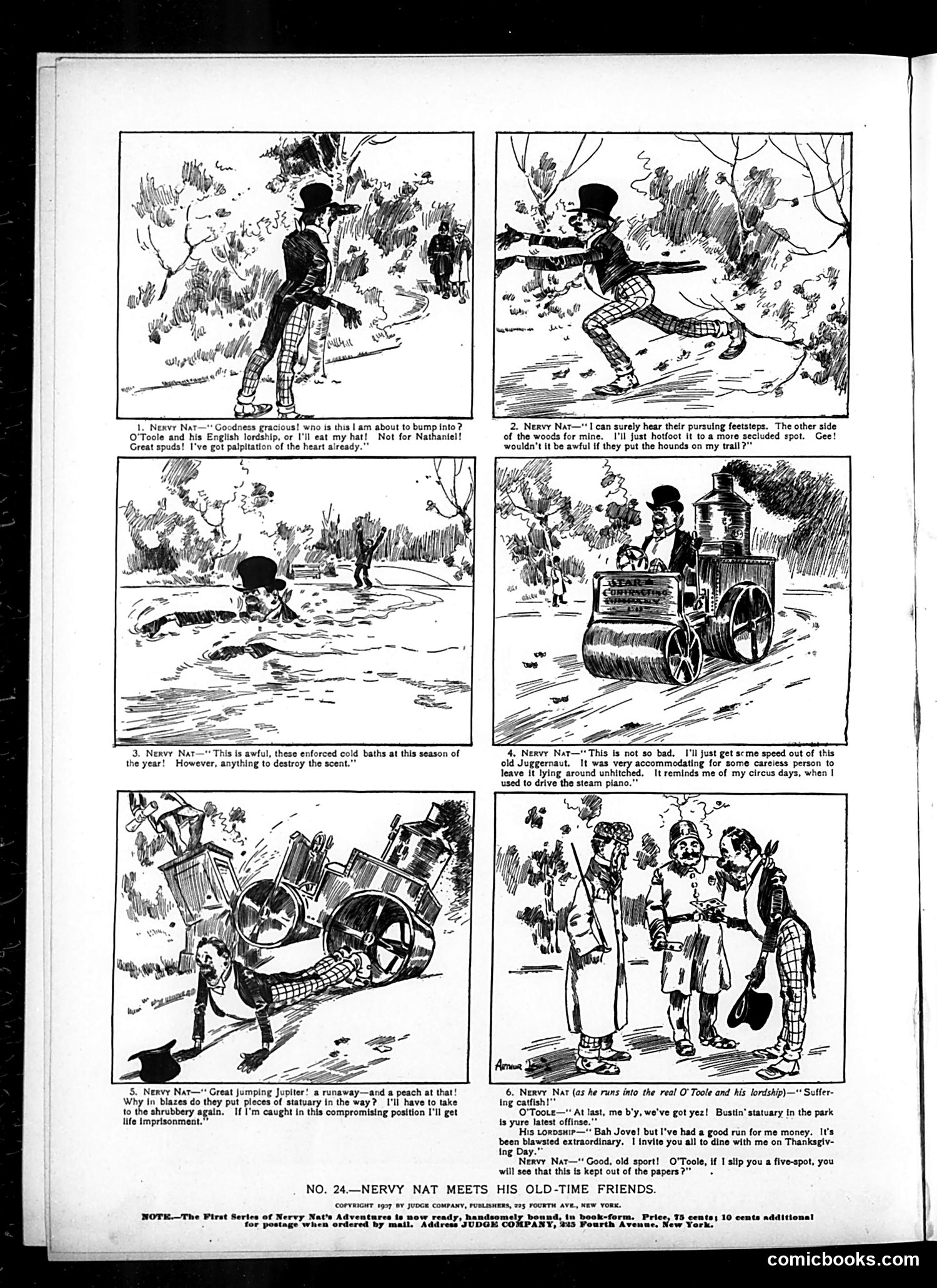
This is a slapstick comic strip featuring the recurring character "Nervy Nat," a scheming rogue. The narrative follows Nat as he flees from pursuing O'Toole and "his English lordship" through the woods. His attempts to evade capture escalate absurdly: he wades through cold water to destroy his scent, commandeers an unmanned steam-powered vehicle (a "Juggernaut"), and collides with statuary while running. The joke's resolution arrives when Nat literally crashes into the real O'Toole and his lordship. Rather than arrest or violence, they greet him warmly as an old friend. The final panel reveals Nat's true character: undeterred by the chaos he's caused, he attempts to bribe O'Toole to keep the incident out of newspapers. The satire targets opportunistic con-men and their shameless amorality—Nat causes destruction and trouble, then assumes money can erase consequences. His casual corruption reflects period attitudes toward minor criminals and the corruptible press.
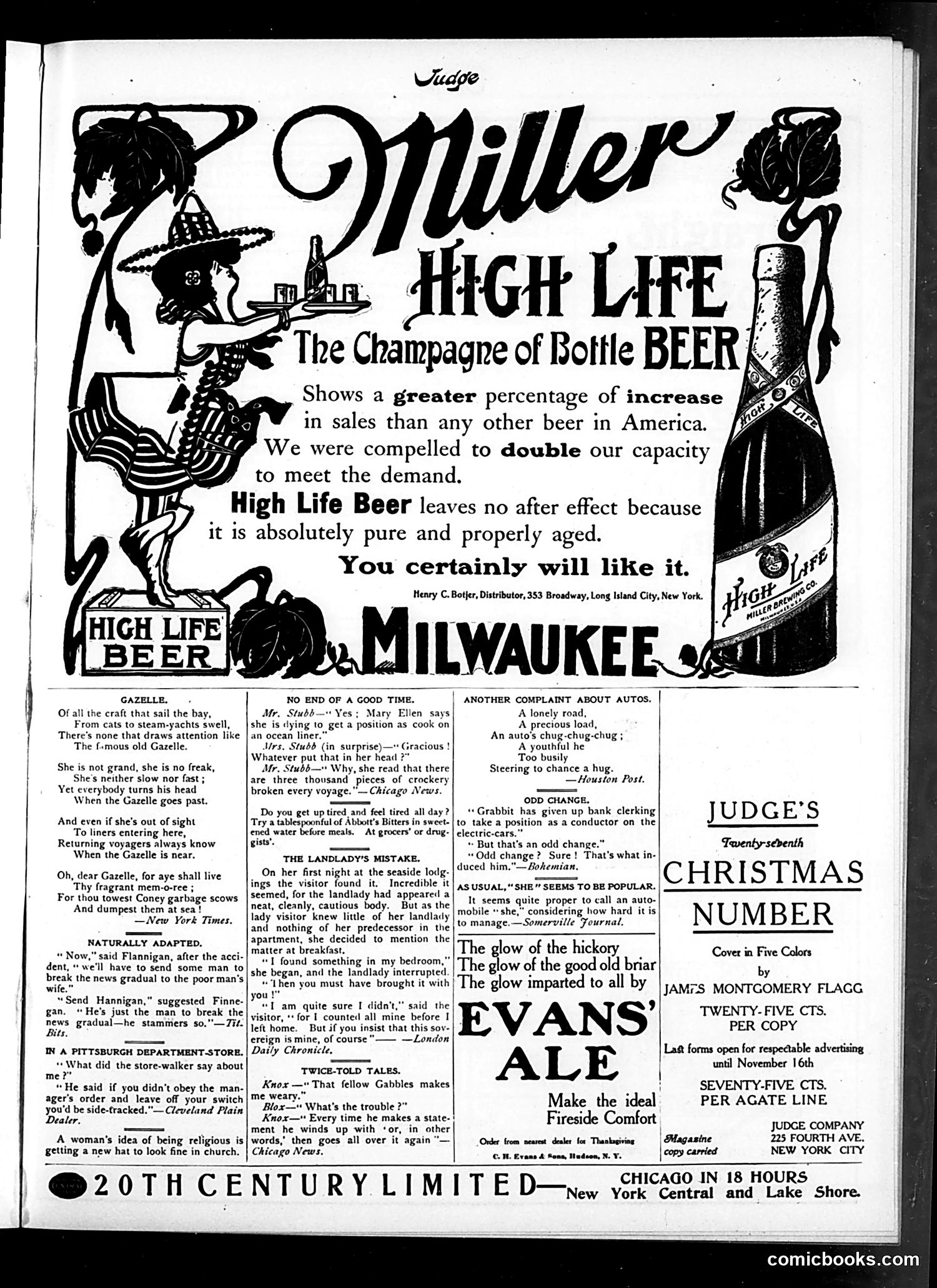
This page is primarily **advertising and filler content**, typical of Judge magazine's format. The dominant feature is a **Miller High Life Beer advertisement** showing a stylized male figure in a jester-like costume, emphasizing the beer's sales growth and purity. The remainder consists of **brief satirical jokes and anecdotes** under humorous headings like "Gazelle," "Naturally Adapted," and "Odd Change." These are mild social commentary: a joke about a ship that hauls garbage, observations about women's ambitions (a cook wanting ocean liner work), automobile inconveniences, bank clerks becoming conductors, and miscommunications at seaside lodgings. The tone is **genteel, domestic humor** typical of early 20th-century magazines—no sharp political edge. The jokes target everyday urban life, class pretensions, and gender stereotypes in ways designed to amuse middle-class readers. The page also advertises Judge's **Christmas Number** coming soon.
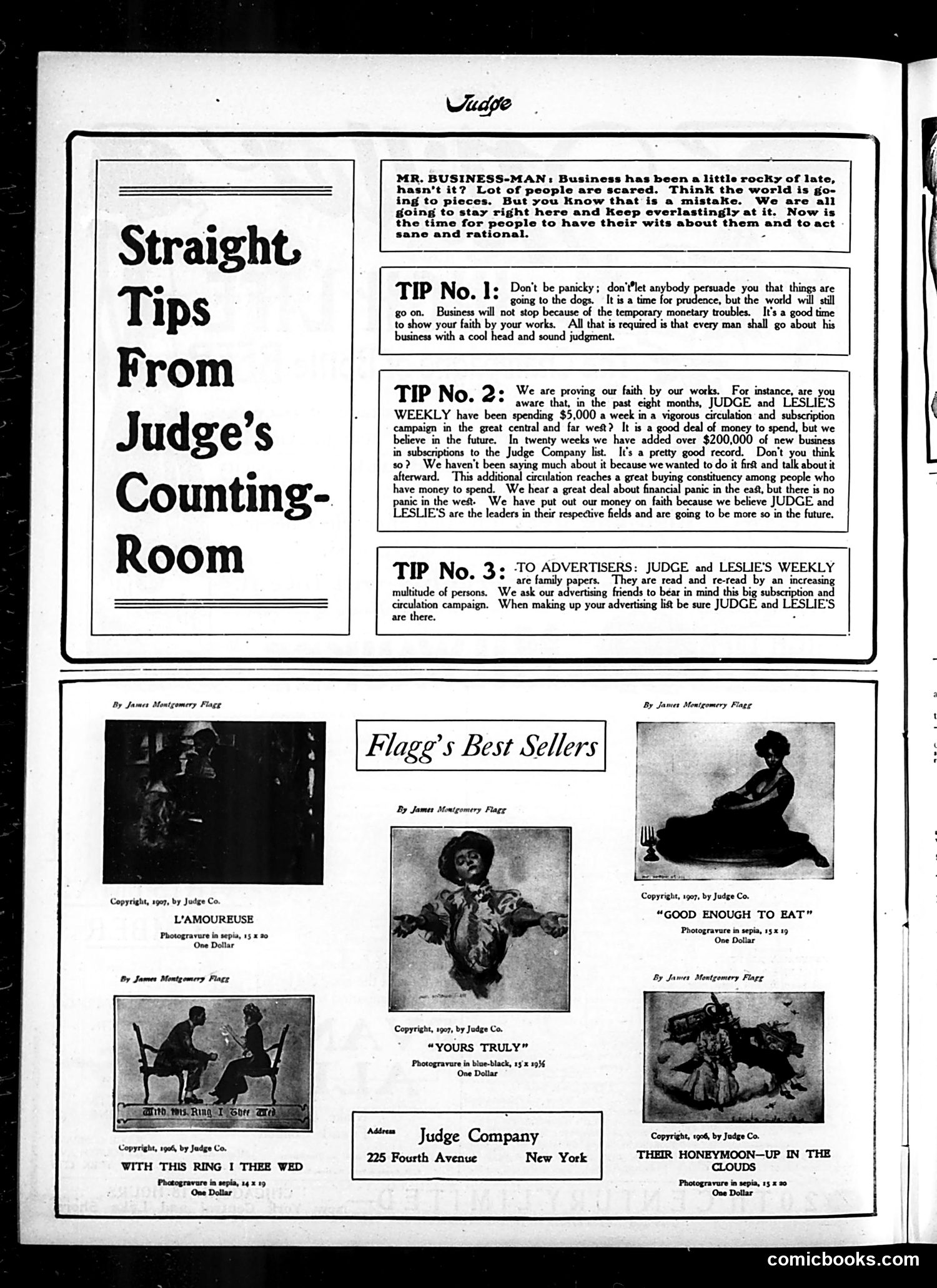
This page combines editorial messaging with product advertising. The upper half presents "Straight Tips From Judge's Counting-Room"—advice to businessmen during what appears to be an economic downturn (likely the 1907 panic). The Judge Company addresses panic and uncertainty by urging rational confidence, then uses this as a sales pitch: they've invested $5,000 weekly in circulation campaigns for *Judge* and *Leslie's Weekly*, adding $200,000 in subscriptions in twenty weeks. This demonstrates faith in the future and positions their magazines as reaching wealthy western readers unaffected by eastern financial crisis. The lower half advertises James Montgomery Flagg illustrations available as photogravures—romantic/sentimental subjects like "L'Amoureuse," "With This Ring I Thee Wed," and "Their Honeymoon—Up in the Clouds." These were sold as one-dollar art prints. The page blurs editorial content and self-promotion, using economic anxiety as leverage to encourage both reader subscriptions and advertiser participation.
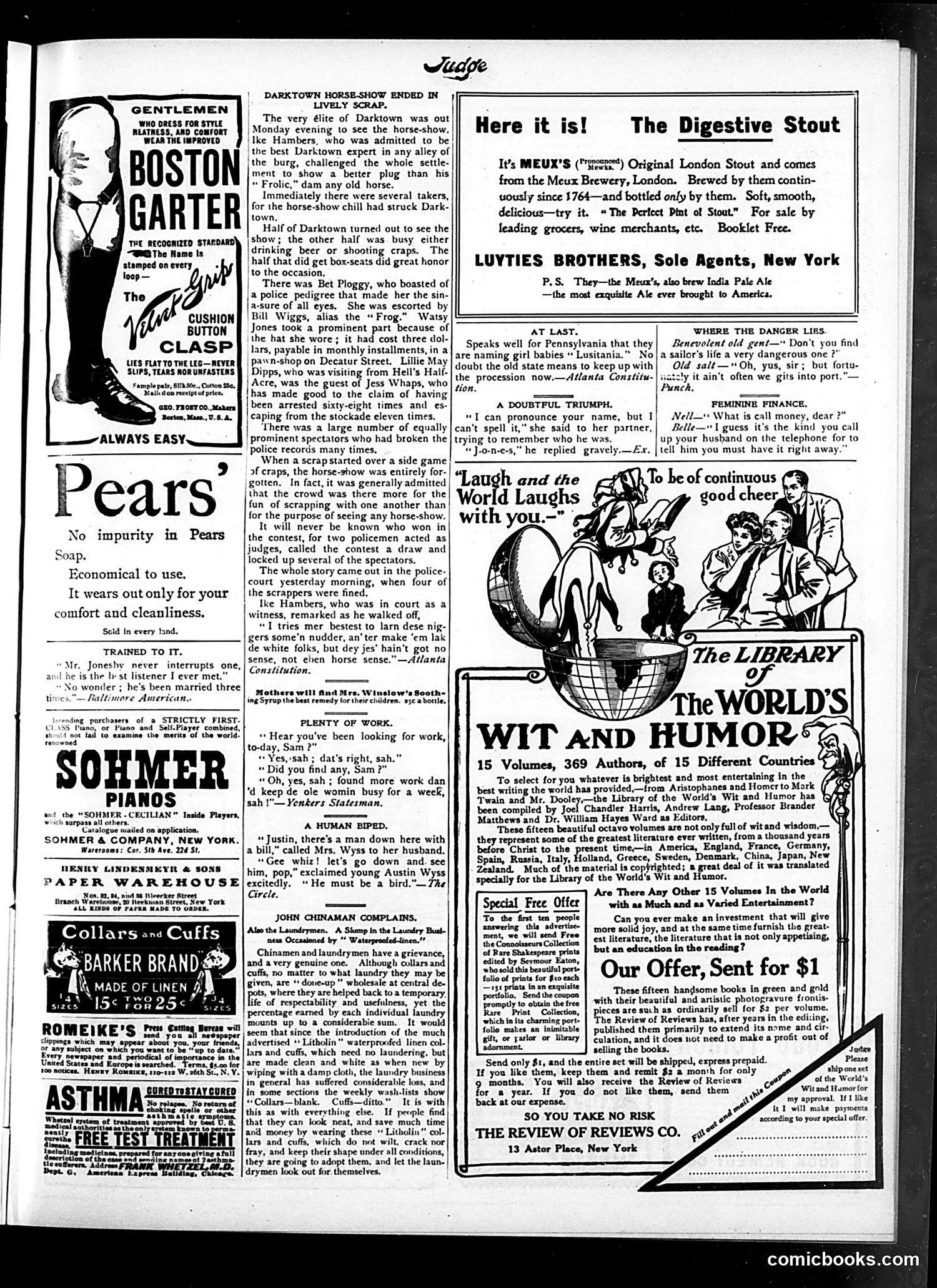
This page primarily contains **advertisements and brief humorous items** rather than political cartoons. The main satirical content is a "Darktown" sketch—a racist genre popular in early 20th-century American humor that stereotyped Black Americans. The narrative describes a horse-show among African American characters with exaggerated dialect, portraying them as prone to violence, drinking, and petty crime. Characters like "Bet Ploggy" and "Ike Hambers" engage in craps games and fighting rather than watching horses. The humor relies on crude racial caricature and stereotypes common to the era. The page also includes brief joke items ("Where the Danger Lies," "A Doubtful Triumph," "Feminine Finance") with typical period humor about courtship, money, and professional life. Advertisements dominate the lower portion, promoting products like Pears Soap, Sohmer Pianos, and collars—typical Judge magazine content mixing satire with commercial messaging.
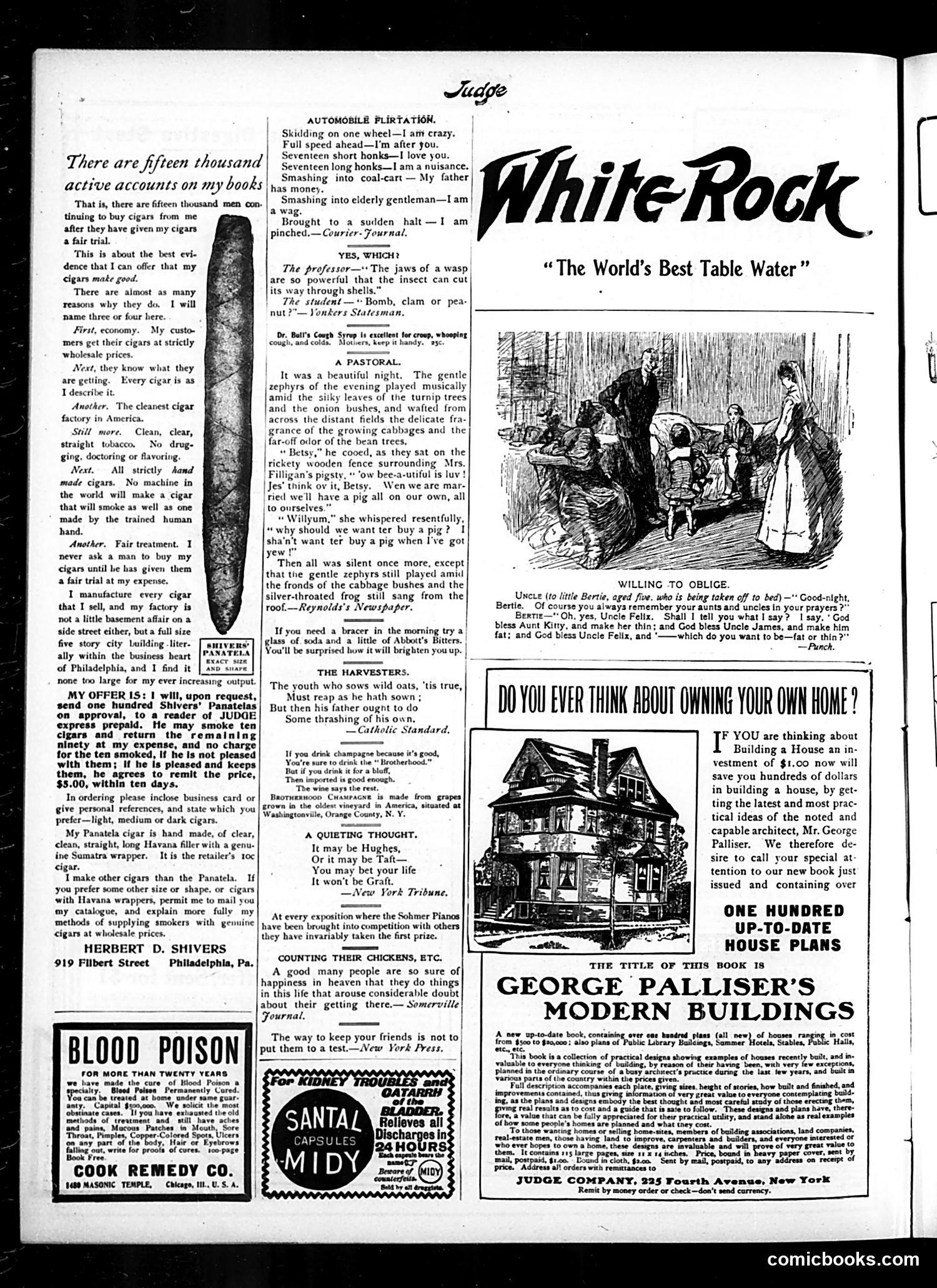
This page contains **primarily advertisements** interspersed with brief humor pieces typical of Judge magazine's satirical format. The main content includes: 1. **"Automobile Flirtation"** — A humorous list equating car behaviors with romantic or social meanings (skidding = crazy, honking patterns = declarations of love or nuisance). This satirizes the novelty and social awkwardness of early automobile culture. 2. **"Yes, Which?"** — A brief professor-student joke playing on double meanings (the student misunderstands "shells" as clam/pea shells rather than mollusk shells). 3. **"A Pastoral"** — A sentimental parody of romantic rural scenes, humorously depicting two working-class characters discussing marriage while sitting on a pigsty fence, undermining pastoral conventions. The advertisements include cigars, medical treatments (blood poison cures), and table water — typical early 20th-century patent medicines and consumer goods. The page reflects Judge's mix of light social satire targeting modern developments (automobiles) and human follies.
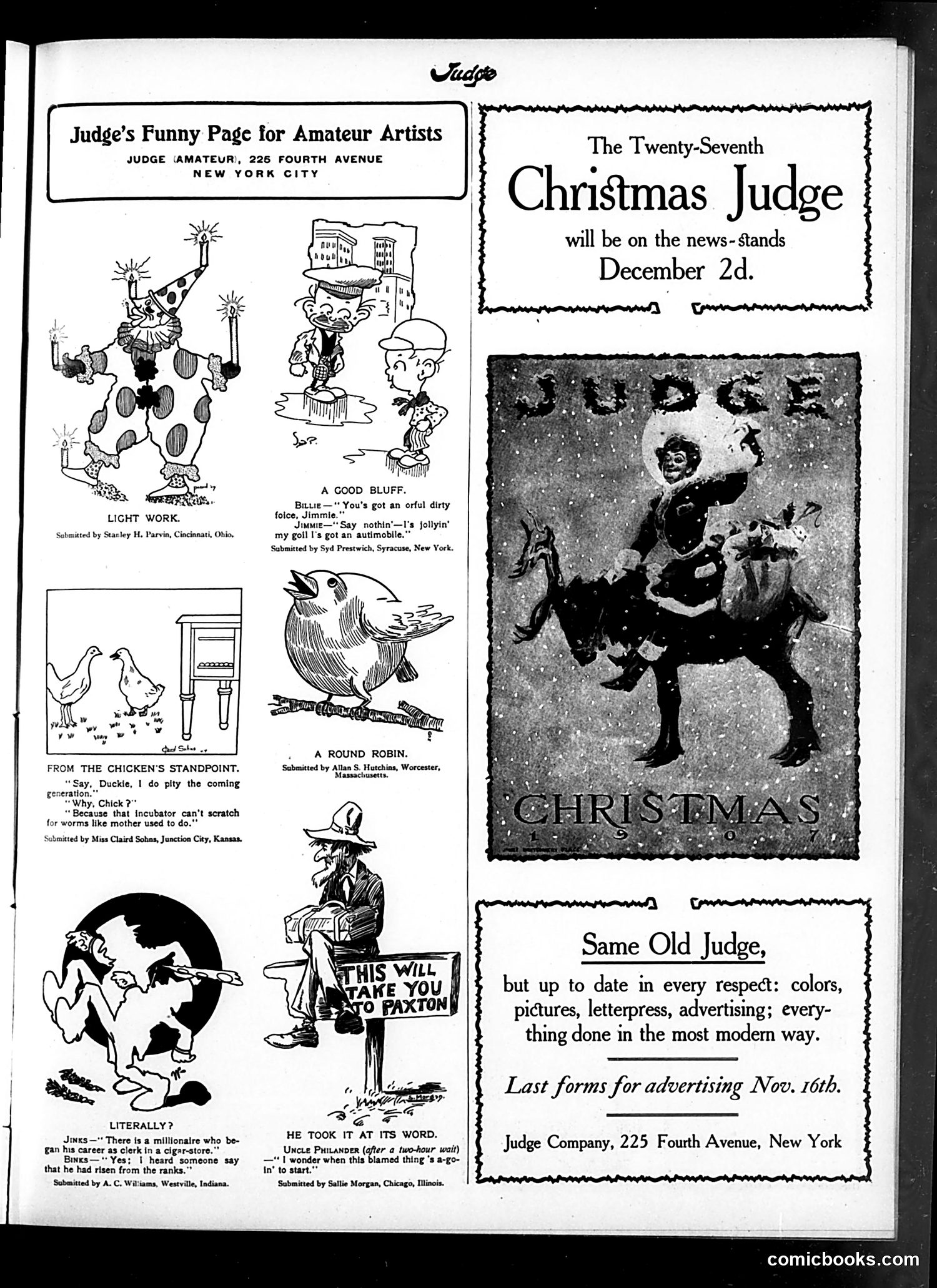
This is a **reader-submission humor page** featuring amateur-drawn cartoons with jokes submitted by readers nationwide. The content reflects early 20th-century domestic humor: **Key Cartoons:** - **"Light Work"**: Visual gag about juggling - **"From the Chicken's Standpoint"**: Rural humor—a duck laments that modern incubators can't scratch for worms like mother hens did, commenting on agricultural mechanization - **"Literally"**: Wordplay—a man "rose from the ranks" (military term) is misunderstood as literal physical ascent - **"A Good Bluff"**: Dialect humor where an African American character mimics wealthy behavior by claiming an automobile - **"He Took It at Its Word"**: Uncle character frustrated with a malfunctioning automobile **Context**: These jokes rely on **early automobile culture**, **rural vs. urban life tensions**, and **ethnic/dialect humor** typical of the era. The page also advertises an upcoming Christmas issue of *Judge* magazine itself, promoting its modern production values.
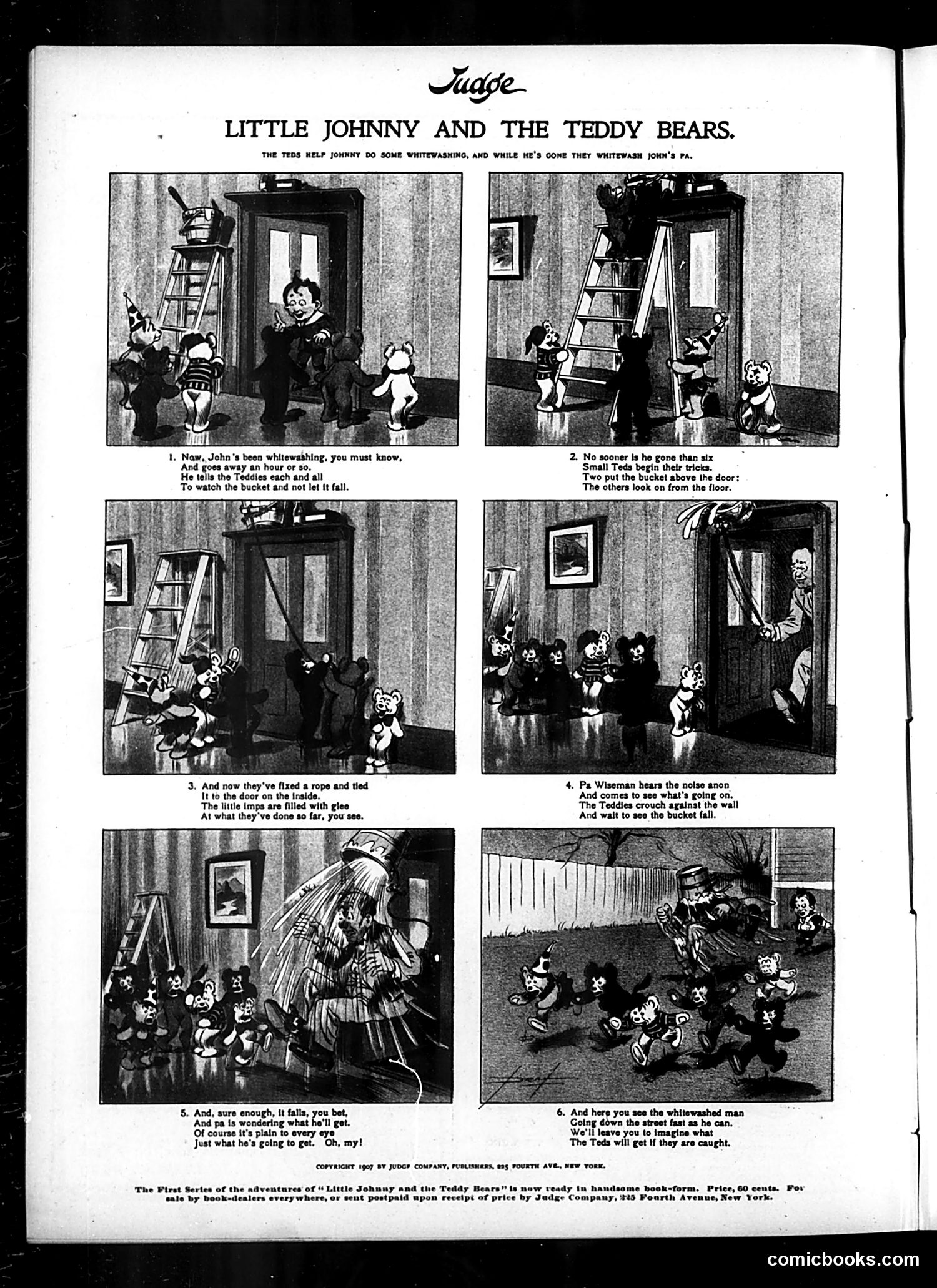
This is a children's comic strip about mischievous teddy bears who help a boy named Johnny whitewash a fence—then prank his father by rigging a bucket of whitewash above a door. When Johnny's father enters, the bucket falls and covers him in whitewash, sending him running down the street. The humor is straightforward slapstick: the teddy bears conspire with Johnny to embarrass an authority figure (the father). "Whitewashing" references both literal fence-painting and the contemporary political meaning—covering up wrongdoing—though the strip uses it only literally here. The reference to "Teddy Bears" likely capitalizes on the toy craze inspired by President Theodore Roosevelt's 1902 bear-hunting incident. This appears to be the first in a planned book series, as the footer advertises the collection. The satire is gentle and domestic rather than political—poking fun at paternal authority through childish pranks rather than social commentary.