
Judge, 1907-11-16 · page 3 of 16
Judge — November 16, 1907 — page 3: what you’re looking at
What you’re looking at
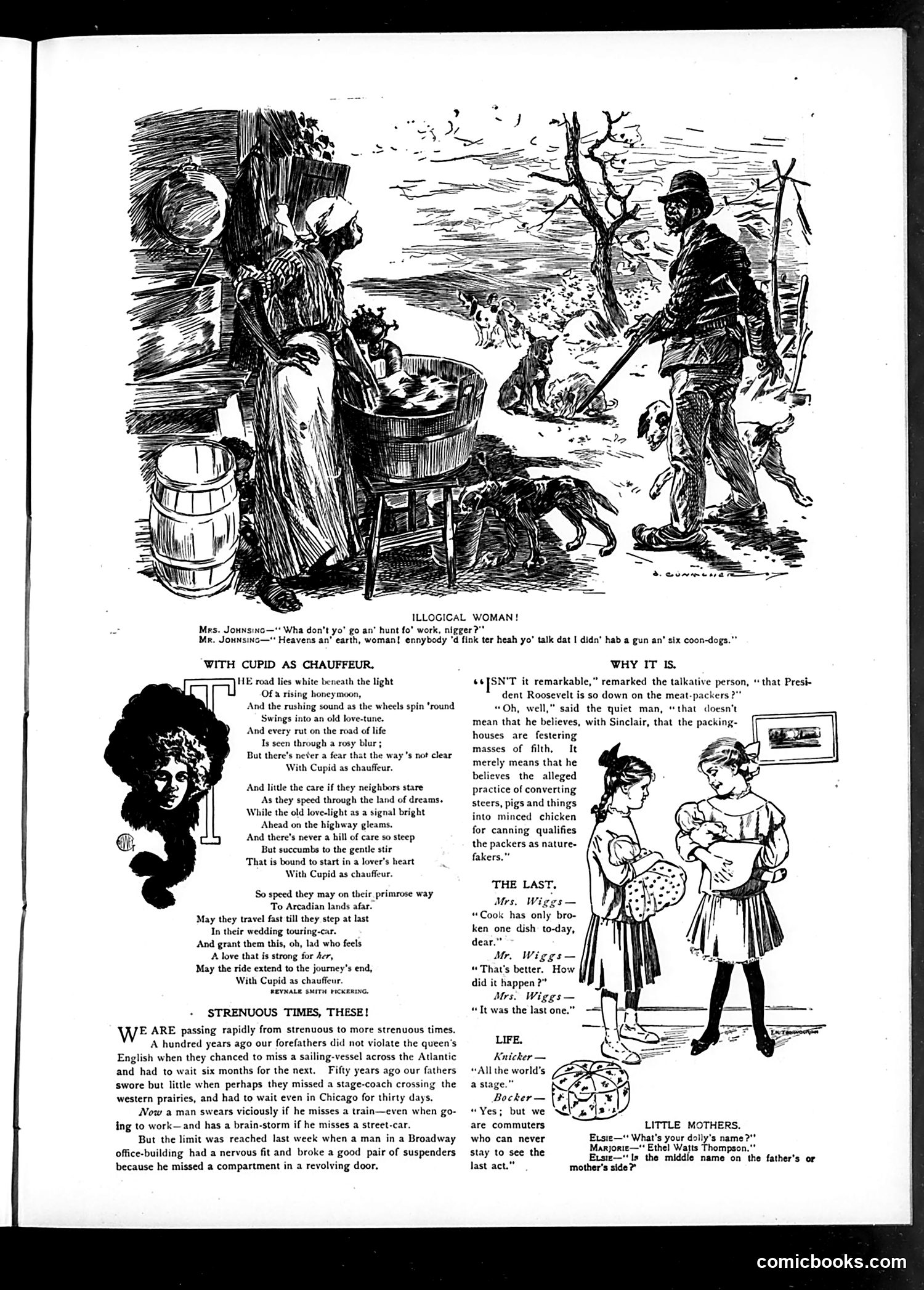
This page contains multiple satirical pieces typical of Judge's commentary. "A Illogical Woman" depicts a domestic scene where a woman contradicts herself—she won't let her husband hunt for work (calling it dangerous) yet demands he provide income. The humor relies on highlighting perceived female illogic. "With Cupid as Chauffeur" is a poem romanticizing automobile travel, reflecting early 1900s fascination with cars as symbols of modernity and courtship. "Strenuous Times, These!" compares modern inconveniences (missed trains, street cars, Broadway office buildings) to historical hardships, satirizing contemporary complaints as trivial. The smaller pieces—"Why It Is," "The Last," and "Little Mothers"—offer brief social commentary on contemporary life, including domestic topics and changing social customs.
📄 Transcribed text from this page (OCR, searchable)
Machine-transcribed from the original scan — historical spelling and the odd misread are preserved.
= — BO ee ILLOGICAL WOMAN! Mes. Jonns: Mr. Jonnsin: WITH CUPID AS CHAUFFEUR. HE road lies white beneath the light Of a rising honeymoon, And the rushing sound as the wheels spin 'round ‘Swings into an old love-tune. And every rut on the road of life Is seen through a rosy blur ; But there's never a fear that the way 's not clear With Cupid as chauffeur. And little the care if they neighbors stare As they speed through the land of dreams. While the old love-light as a signal bright Ahead on the highway gleams. And there's never a hill of care so steep But succumbs to the gentle stir ‘That is bound to start in a lover's heart With Cupid as chauffeur. So speed they may on their primrose way To Arcadian lands afar. May they travel fast till they step at last In their wedding touring-car. ‘And grant them this, ob, lad who feels A love that is strong for Aer, May the ride extend to the journey’s end, With Cupid as chauffeur. REYNALE SSITH PICKERING. + STRENUOUS TIMES, THESE! E ARE passing rapidly from strenuous to more strenuous times. A hundred years ago our forefathers did not violate the queen's English when they chanced to miss a sailing-vessel across the Atlantic and had to wait six months for the next. Fifty years ago our fathers swore but little when perhaps they missed a stage-coach crossing the western prairies, and had to wait even in Chicago for thirty days. Now a man swears viciously if he misses a train—even when go- ing to work—and has a brain-storm if he misses a street-car. But the limit was reached last week when a man in a Broadway office-building had a nervous fit and broke a good pair of suspenders because he missed a compartment in a revolving door. “Wha don't yo" go an’ hunt fo’ work, nigger?” Heavens an’ earth, woman! ennybody ‘d fink ter heah yo’ talk dat I didn’ hab a gun an’ six coon-dogs."” WHY IT Is, se[SN'T it remarkable,” remarked the talkative person, “that Presi- dent Roosevelt is so down on the meat-packers ?”" “Oh, well," said the quiet man, “that doesn’t mean that he believes, with Sinclair, that the packing- houses are festering masses of filth, It merely means that he believes the alleged practice of converting steers, pigs and things into minced chicken for canning qualifies the packers as nature- fakers.” THE LAST. Mrs. Wiggs— “Cook has only bro- ken one dish to-day, dear.” Mr. Wiggs— “ That's better. How did it happen 2” Mrs. Wiggs — “Tt was the last one.” LIFE, Knicker — “All the world’s a stage.” Bocker— “Yes; but we are commuters who can never Stay to see the last act.” LITTLE MOTHERS. Exsie—"* What's your dolly's name ?"" Marjorie— Ethel Watts Thompson."* Etsie—"‘Is the middle name on the father's or mother's side? comicbooks.com