
A complete issue · 16 pages · 1907
Judge — November 2, 1907
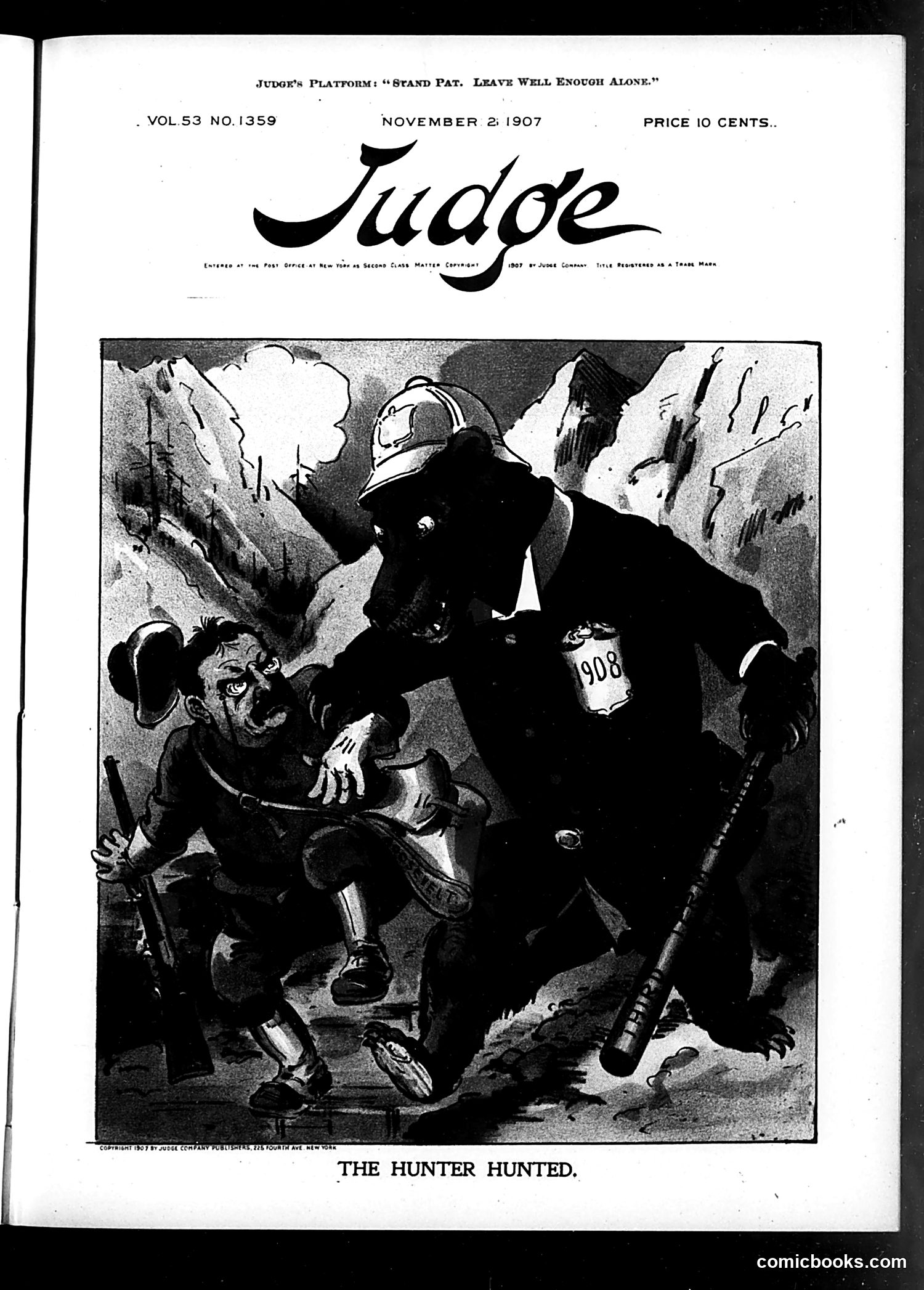
This November 2, 1907 *Judge* cartoon depicts a policeman (badge 908) pursuing a small, demon-like creature through rocky terrain. The title "The Hunter Hunted" suggests role reversal—the hunter becoming the hunted. Without additional context from the page's text or contemporary events, the specific political/social reference remains unclear. The demonic figure likely represents a particular vice, criminal element, or unpopular political figure of the era that readers would have immediately recognized. The policeman's determined pursuit suggests law enforcement action against some threat. The cartoon's satire appears to critique either the target's comeuppance or, conversely, the difficulty authorities face in apprehending the represented danger. The 1907 date and *Judge*'s satirical nature suggest this comments on a specific contemporary issue, but that context is not fully evident from the image alone.
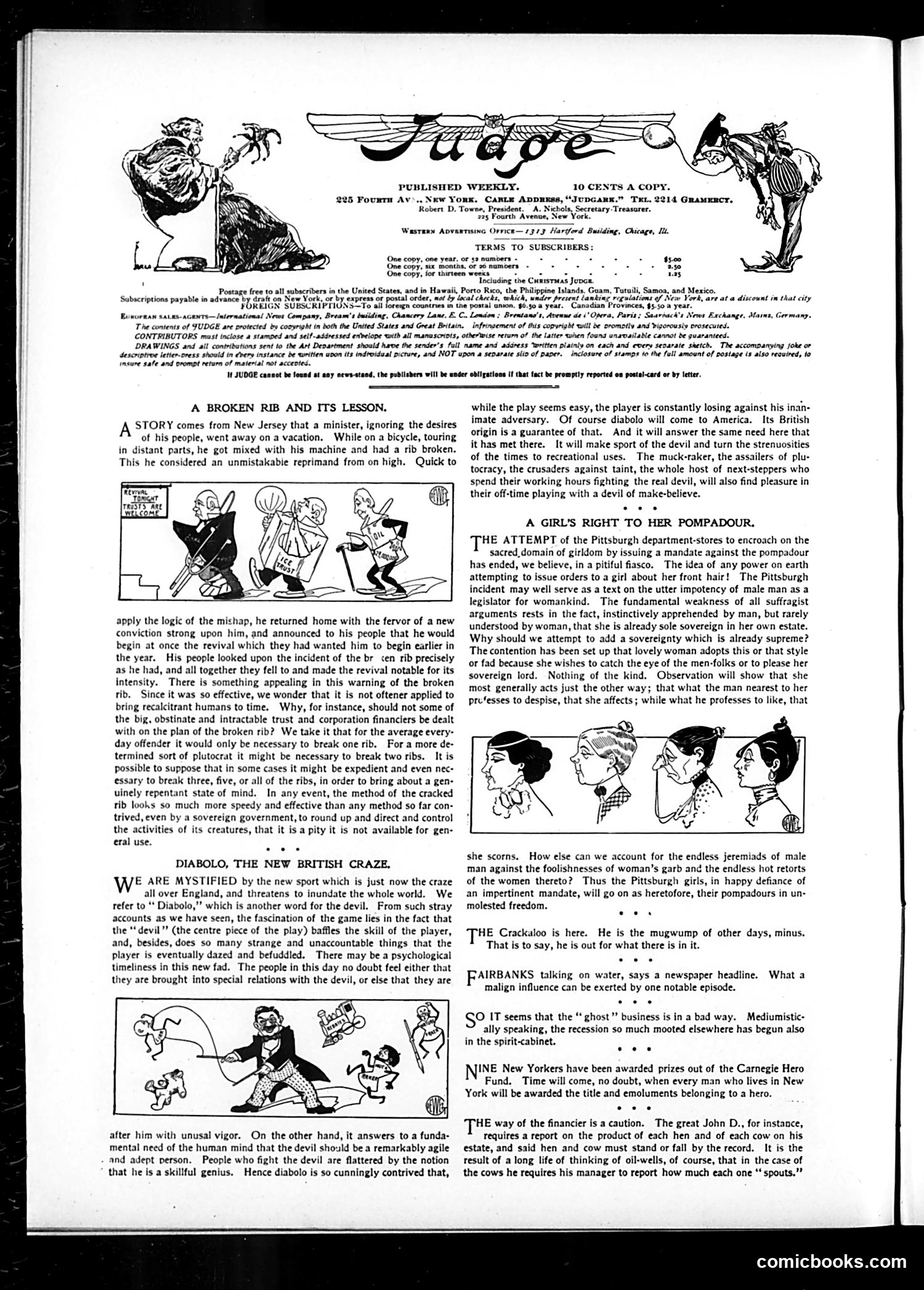
This page contains several satirical pieces targeting early 20th-century social issues: **"A Broken Rib and Its Lesson"** mocks a New Jersey minister who ignored parishioners' wishes and toured on a bicycle with a broken rib, viewing it as an "unmistakable repriman[d] from on high." The satire suggests divine punishment for ignoring community desires. **"A Girl's Right to Her Pompadour"** critiques Pittsburgh department stores attempting to regulate women's hairstyles (the fashionable "pompadour" style). The piece argues this overreach demonstrates male authority's absurdity and women's natural sovereignty over their own estate. **"Diabolo, the British Craze"** discusses a fashionable game (diabolo) recently imported to America, analyzing why people are drawn to games involving risk and the devil's agency. The illustrations are small, comedic sketches supporting these social commentary pieces rather than standalone political cartoons.
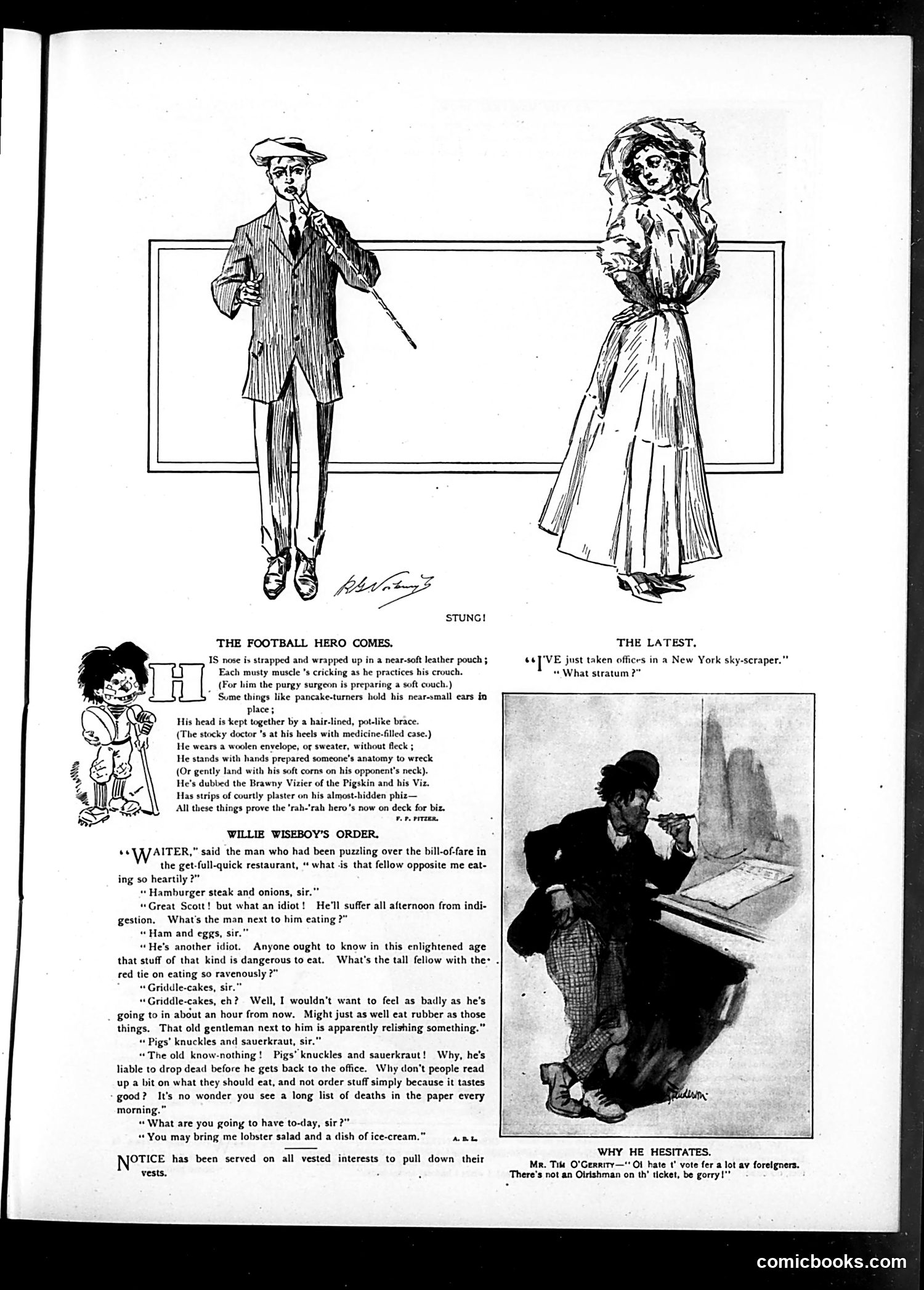
This page contains three distinct satirical pieces from early 20th-century Judge magazine: 1. **"Stung!" (top)**: A man and woman discuss a New York skyscraper, with the woman claiming she's taken offices there. The "sting" appears to be that she's been deceived about the building's quality or location. 2. **"The Football Hero Comes"**: A humorous poem mocking an athletic young man obsessed with physical prowess but intellectually unprepared for adult responsibilities—satirizing shallow athleticism. 3. **"Willie Wisboy's Order"**: A waiter and customer exchange about food, where the customer's repeated indigestion from strange eating habits is mocked. The satire targets either poor judgment or hypochondria. 4. **"Why He Hesitates" (photograph)**: A caption suggesting political hesitation, likely about voting, with a pun on Irish-American identity and citizenship concerns. The page satirizes vanity, poor judgment, and social pretension typical of Judge's humor.
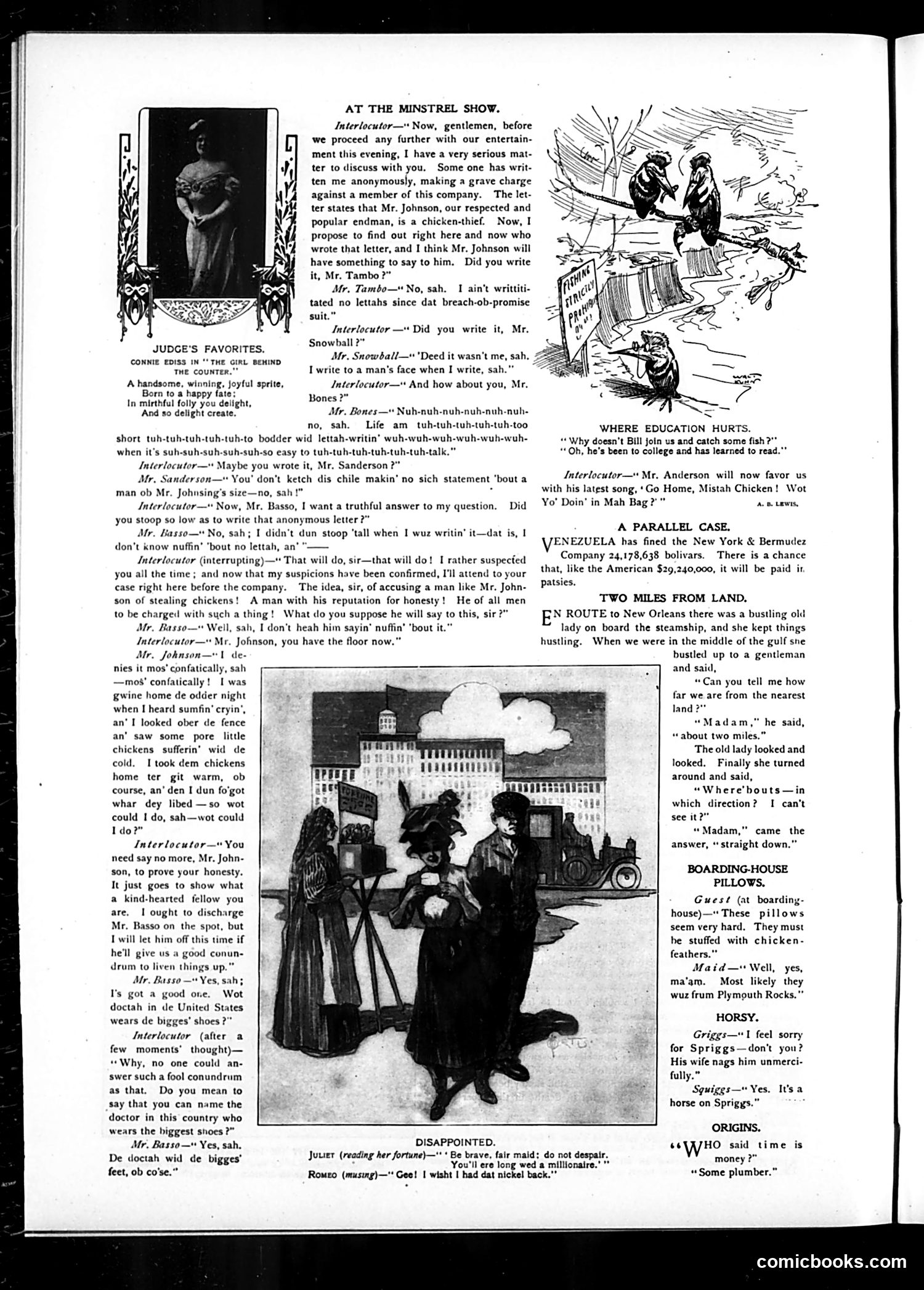
This page contains theatrical comedy sketches rather than political cartoons. "At the Minstrel Show" depicts a variety performance where an interlocutor addresses audience concerns about a Mr. Johnson, who apparently wrote an anonymous letter accusing someone in the company of dishonesty. The sketch involves comedic dialect exchanges between characters (Mr. Tambo, Mr. Snowball, Mr. Bones, Mr. Johnson, Mr. Basso) typical of minstrel-show format. The other sketches—"Where Education Hurts," "A Parallel Case," "Two Miles from Land," "Disappointed," "Boarding-House Pillows," "Horsy," and "Origins"—are brief humorous vignettes about everyday situations and relationships. The page focuses on entertainment rather than satire, representing early-20th-century popular comedy conventions.
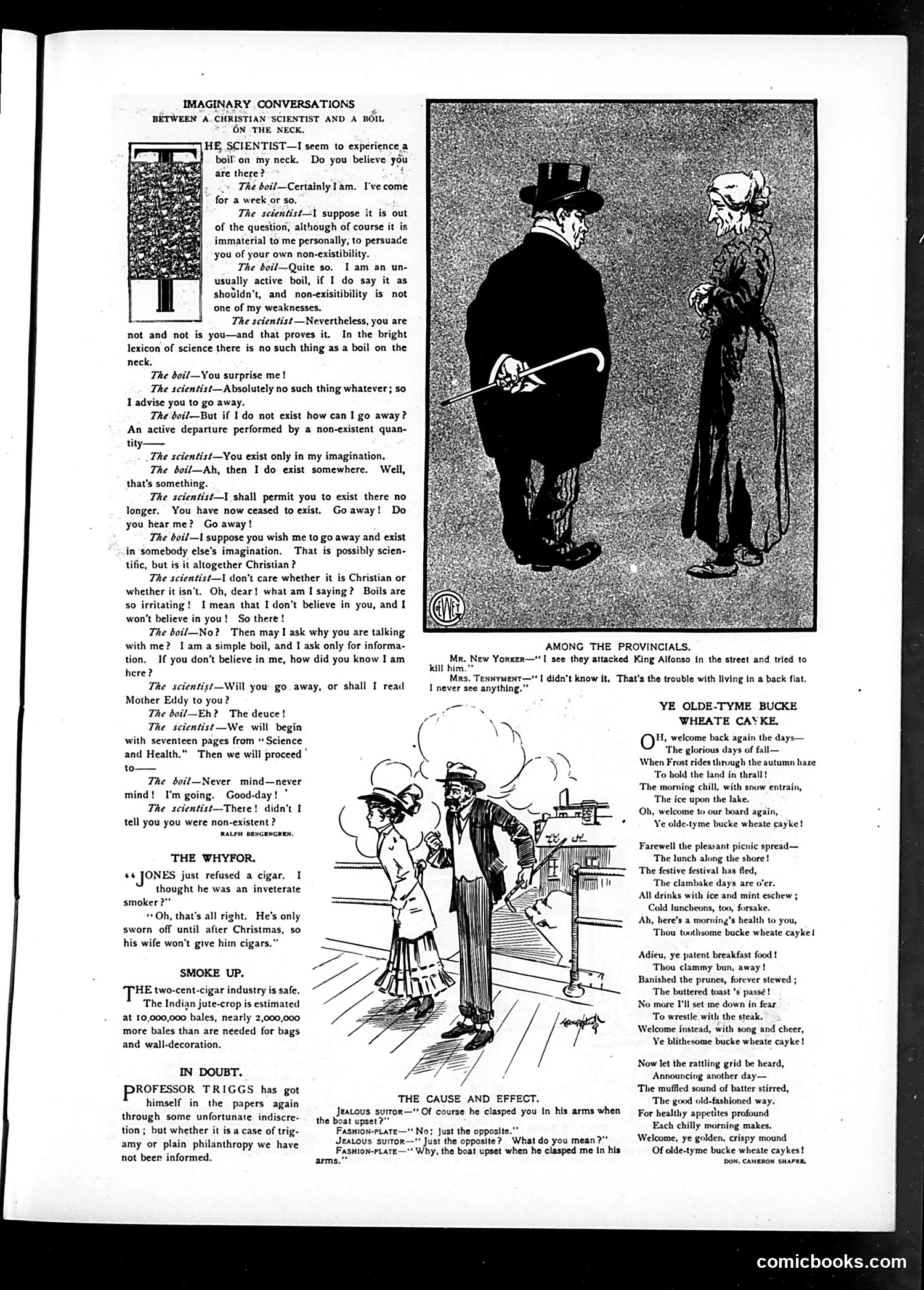
This page contains several satirical pieces: **"Imaginary Conversations Between a Christian Scientist and a Boil on the Neck"** mocks Christian Science's denial of material reality. The scientist argues the boil doesn't exist; the boil counters that if non-existent, it can't leave—highlighting the logical absurdity of denying physical ailments while experiencing them. **"Among the Provincials"** cartoon depicts urban newcomers (appearing to be a couple) struggling with tenement life, with dialogue about the impossibility of privacy in cramped housing. **"Ye Olde-Tyme Bucke Wheate Cake"** is nostalgic verse about autumn harvests and traditional comfort foods—likely advertising the product. The remaining pieces—"The Whyfor," "Smoke Up," and "In Doubt"—are brief humorous anecdotes about cigars and relationships typical of Judge's light satirical content.
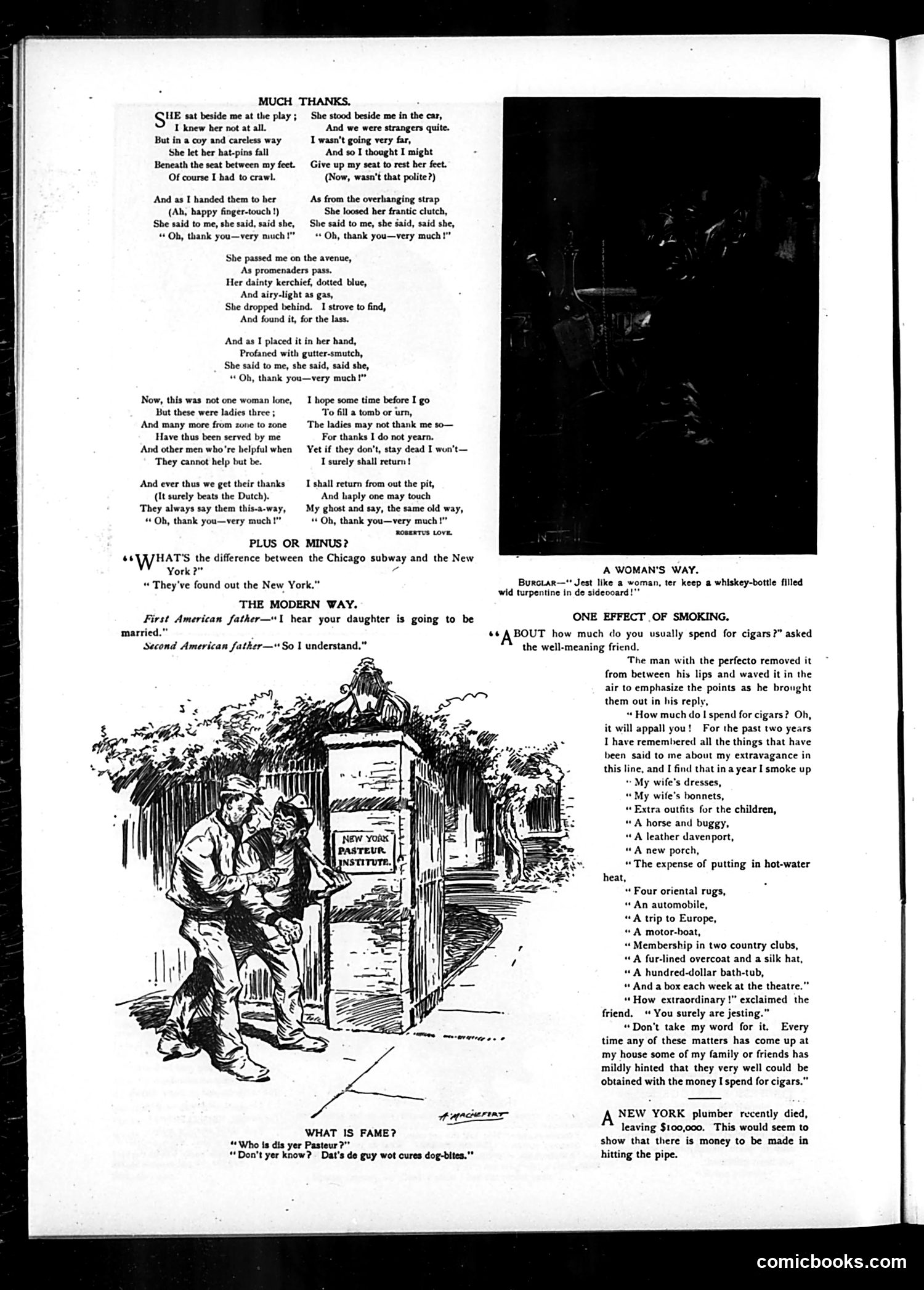
This page contains several satirical pieces typical of early 20th-century American humor: **"Much Thanks"** is a poem mocking the performative gratitude of women. It depicts a man repeatedly helping a woman (retrieving hatpins, returning a handkerchief, offering his seat), each time receiving effusive thanks. The satire suggests women's expressions of gratitude are insincere social rituals—they thank multiple men in identical ways, implying the sentiment is hollow rather than genuinely felt. **"Plus or Minus?"** is a brief joke about gender differences between American cities, with the punchline playing on women's supposed ignorance. **"The Modern Way"** contrasts old and new generations regarding marriage announcements—likely satirizing how American attitudes toward courtship had changed. **"One Effect of Smoking"** mocks a husband's defensive spending justification: he claims his cigar expenses actually represent smaller portions of his wife's dresses, bonnets, furniture, and luxuries—inverting the blame for household extravagance onto his wife rather than his smoking habit. The overall tone reflects period stereotypes about women as frivolous spenders and users of male courtesy.
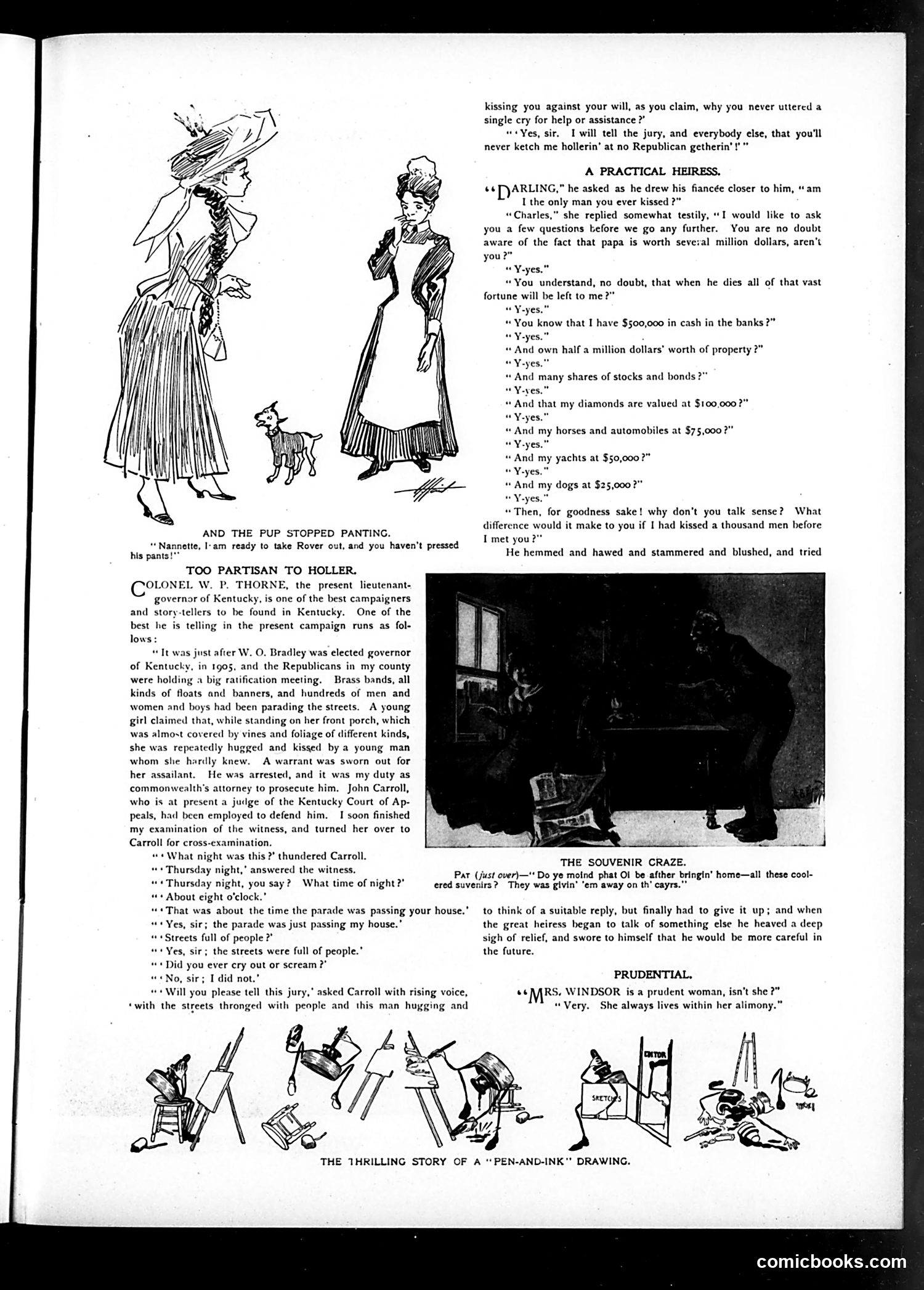
This page contains three satirical pieces typical of early 20th-century American humor: **"Too Partisan to Holler"** references the 1905 Kentucky gubernatorial election (W.O. Bradley). The joke: a young woman assaulted during a Republican parade refuses to cry out for help because she won't give Republicans the satisfaction of her screaming at their gathering. The satire targets partisan political tribalism—prioritizing political identity over personal safety. **"A Practical Heiress"** mocks wealthy women's mercenary attitudes toward marriage. A fiancée interrogates her suitor about his fidelity only *after* establishing her vast fortune ($millions in assets), implying her concern isn't morality but protecting her wealth. The joke is her frank materialism. **"The Souvenir Craze"** appears to be a short joke about someone collecting cheap promotional items from streetcars or public events. All three pieces satirize contemporary social behaviors: political extremism, gold-digging marriages, and consumerism. The cartoon illustrations supplement these written satirical anecdotes typical of Judge's format.
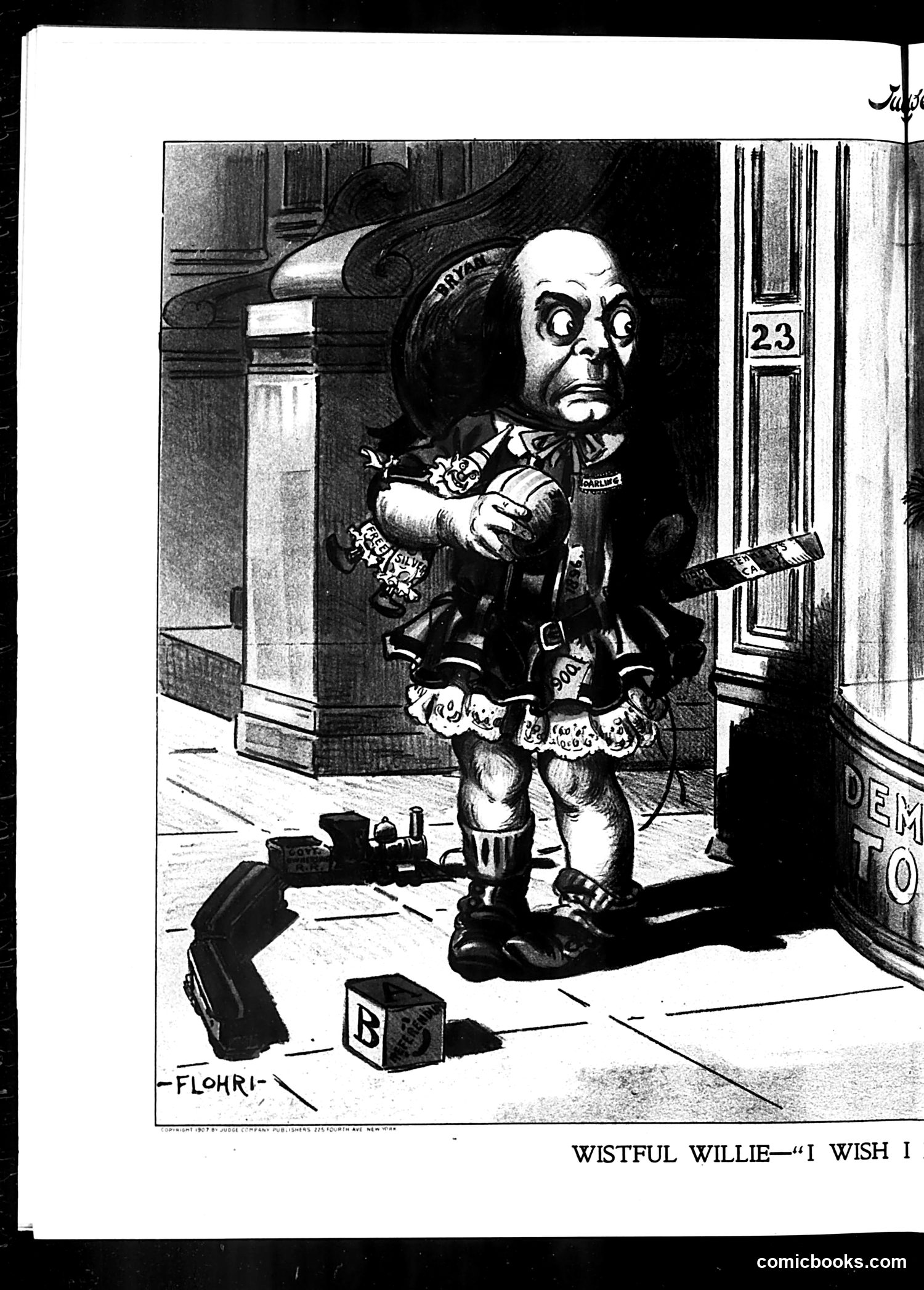
This cartoon by Flohr depicts a character in military uniform standing outside what appears to be a government building (marked "23"). The figure displays exaggerated facial features typical of early 20th-century caricature style. The incomplete caption "I WISH I" suggests the cartoon comments on unfulfilled desires or regrets, likely regarding military or political matters. The military dress and the building setting suggest commentary on war, policy, or government action. Without the complete caption text, the specific target of satire remains unclear—it could reference a military leader's wishes, wartime decisions, or political aspirations. The "wistful" tone indicates ironic or critical commentary on someone's stated or implied desires, typical of Judge magazine's satirical approach to contemporary political issues.
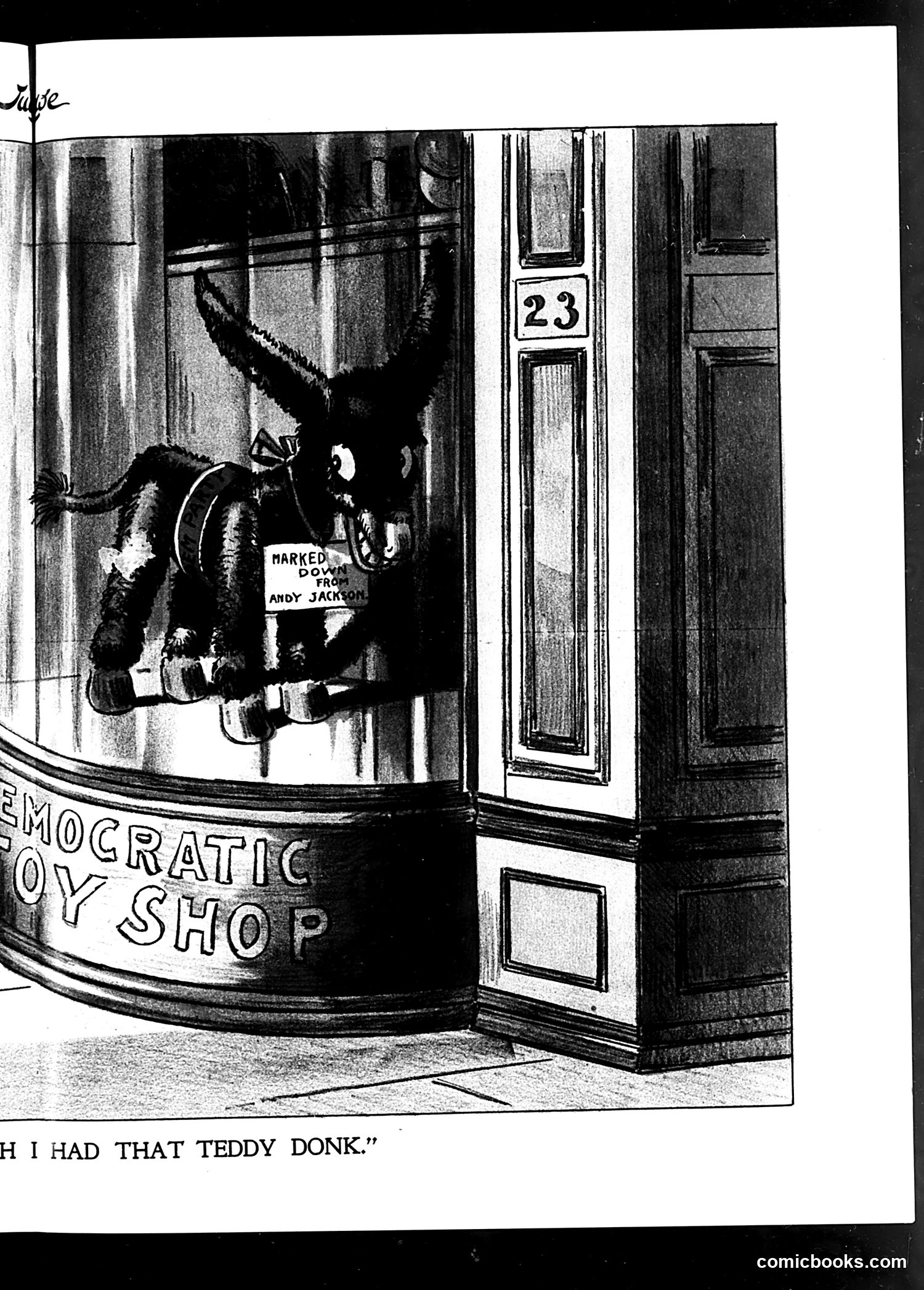
This cartoon depicts a donkey marked with a sign reading "MARKED FOR REMOVAL BY ANDY JACKSON" standing in a storefront window marked "23" at what appears to be a "Democratic Toy Shop." The caption reads "I HAD THAT TEDDY DONK." The satire references President Andrew Jackson's policy of removing Native Americans from their lands (the Indian Removal Act era). The donkey—traditionally the Democratic Party symbol—is "marked for removal," suggesting Jackson's aggressive policies would harm the Democratic Party itself. The toy shop setting and "Teddy Donk" reference appear to mock both Jackson's approach and contemporary Democratic politics, implying that the party's own foundational positions were being dismantled or discarded, much like the forced removal policy itself.
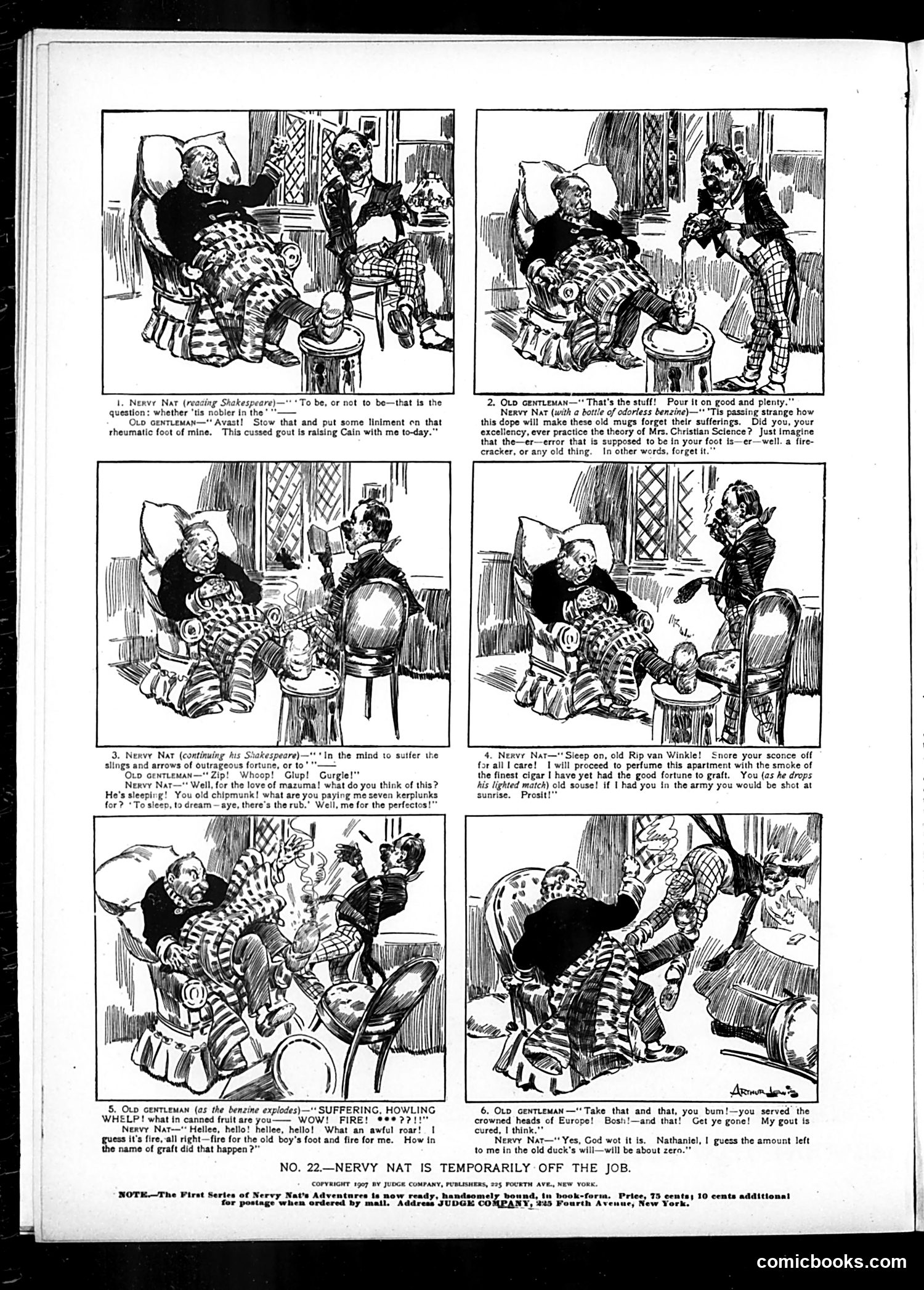
This 1907 Judge comic strip follows "Nervy Nat," a character attempting to cure an elderly gentleman's gout using unconventional remedies, particularly "odorless benzine." The satire targets two contemporary trends: **Christian Science** (the faith-healing movement popular in early 1900s America) and patent medicines/dubious medical cures that flooded the market. Nat mockingly quotes Mrs. Eddy's Christian Science principle that illness is merely "error" to be forgotten, then applies it absurdly to physical ailments. The humor escalates when Nat's benzine treatment literally explodes, causing chaos. The elderly gentleman, despite the disaster, credits the concoction for curing his gout—reflecting real-world gullibility toward unproven remedies. The underlying joke: Americans eagerly embraced pseudoscientific "cures" and faith-based healing without evidence. The strip mocks both the charlatans peddling such treatments and the desperate patients willing to try anything, no matter how ridiculous or dangerous.
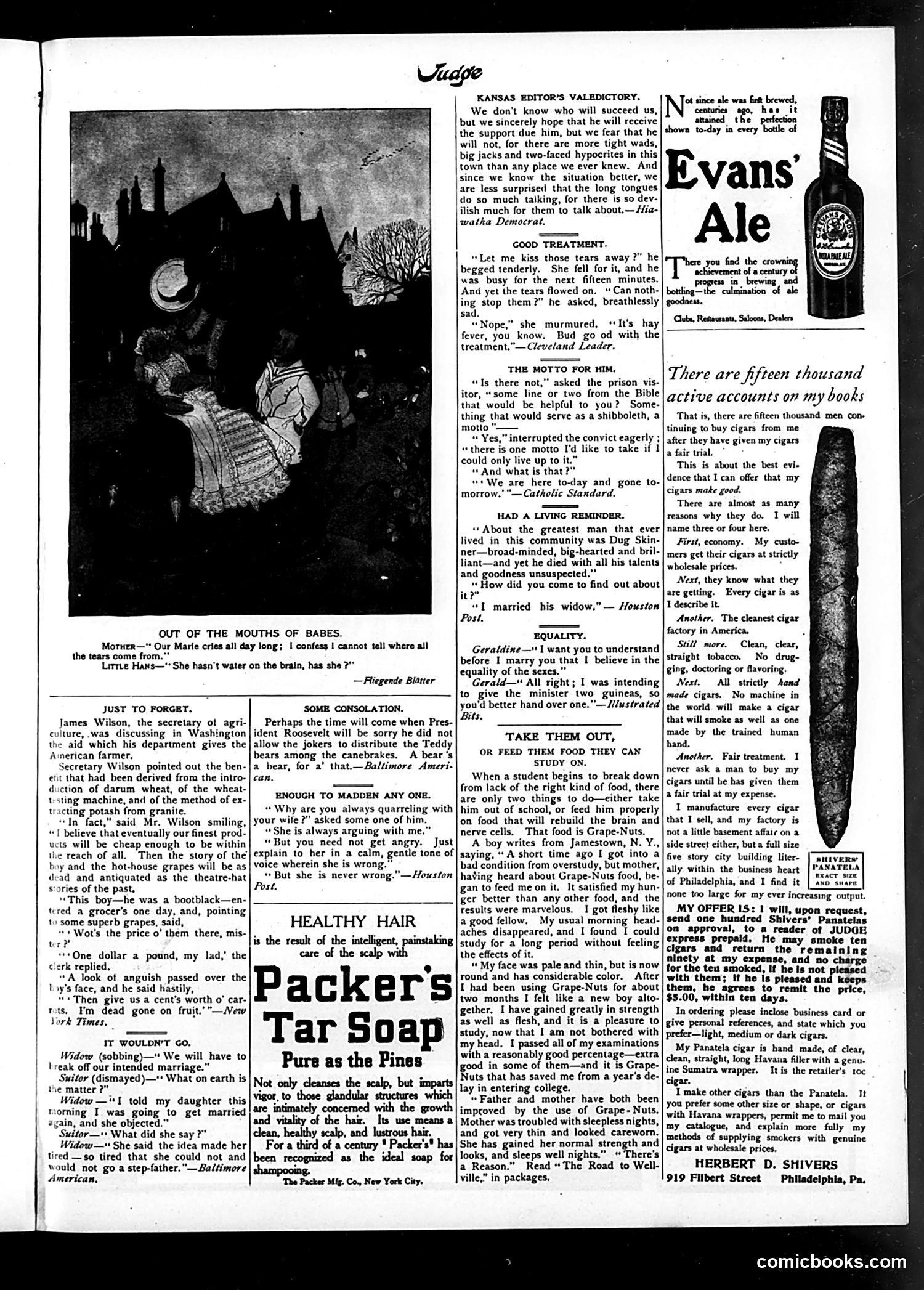
This page contains mostly short humorous anecdotes and advertisements rather than political cartoons. The main illustrated cartoon ("Out of the Mouths of Babes") shows a nighttime domestic scene with a mother and crying baby—a visual pun on the saying that children speak truth. The joke is the father's confusion about where the baby's tears originate. Other jokes satirize contemporary figures and situations: Secretary of Agriculture Wilson's optimism about farm technology; President Roosevelt's decision regarding Teddy bears (referencing the famous 1902 bear-hunting incident); and a Kansas newspaper editor's bitter farewell, criticizing his town's hypocrisy and gossip. The ads promote Packer's Tar Soap and Evans' Ale, standard patent medicines/products of the era. A cigar seller advertises his "fifteen thousand active accounts," targeting repeat customers. The humor is gentle, domestic satire typical of Judge magazine's early 1900s audience—observational rather than cutting political commentary.
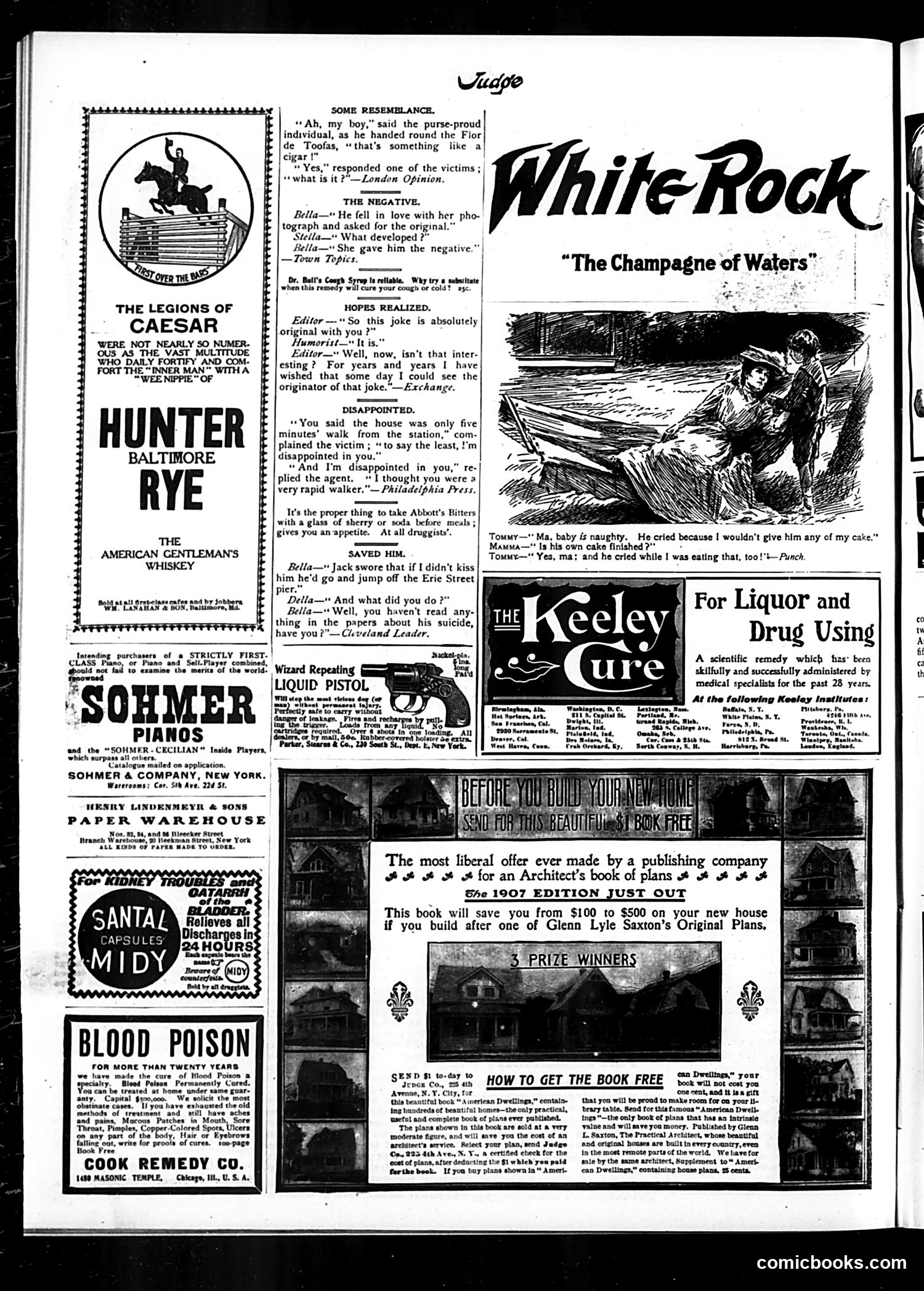
This page is primarily **advertising** interspersed with brief satirical jokes typical of Judge magazine's format. The visible cartoons are minor—short humorous exchanges about photography, romantic disappointment, and parenting mishaps. They lack political content; instead they offer gentle social comedy about courtship and domestic life. The page is dominated by **period advertisements**: Hunter Rye whiskey, Sohmer pianos, Abbott's Bitters, Dr. Ball's Cough Syrup, the Keeley Cure (an addiction treatment), blood poison remedies, and notably a major advertisement for Glenn Lyle Saxton's architectural plan book offering to save homebuyers $100-$500. The Keeley Cure and blood poison ads reflect **early 1900s medical concerns**—widespread treatments for venereal disease and alcohol/drug addiction that were heavily advertised in mainstream publications. The architectural book promotion suggests this Judge issue targets **middle-class readers** with disposable income for home construction, reflecting an era of suburban expansion. Overall, this appears to be a typical Judge page circa 1907, mixing light humor with commercial appeals to its affluent readership.
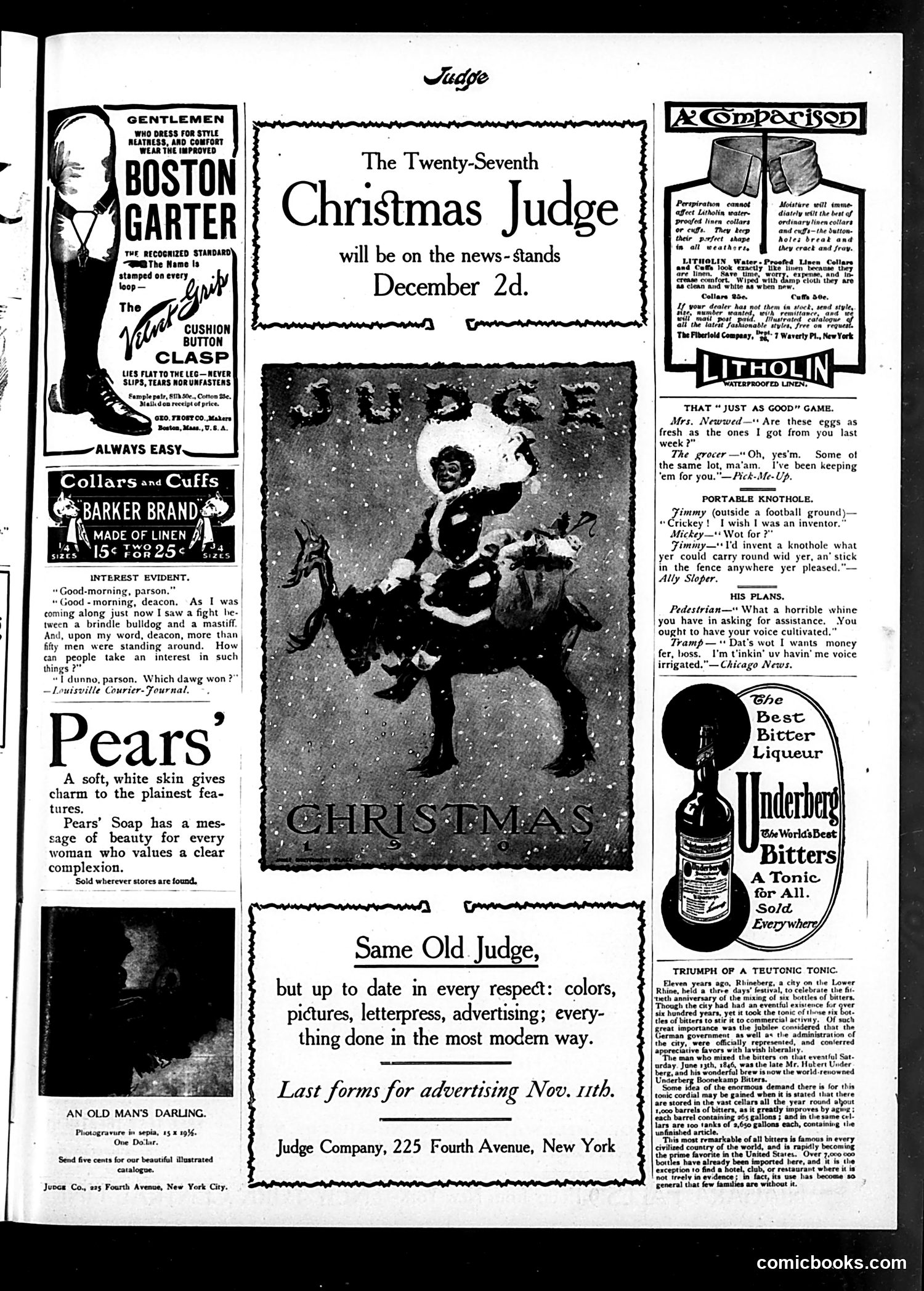
This page is primarily **advertisements and filler content** for Judge magazine's December 2nd Christmas issue (announced at top center with a Christmas illustration). The central cartoon, "Interest Evident," is a brief joke: a parson complains that fifty men gathered to watch a bulldog fight a mastiff, questioning why people care about such things. The deacon's response—asking which dog won—satirizes **hypocrisy**: the parson feigns moral disapproval while clearly curious himself. It's gentle social satire about human nature. The remaining content is **commercial advertising** for period products (Boston garters, collars/cuffs, Pears' soap, Underberg bitters) interspersed with brief humorous snippets and a photogravure portrait. The bottom section promotes Judge's own quality, claiming it's "up to date in every respect." The page reflects early 20th-century magazine format: satirical magazine served as vehicle for advertising, with light humor and product pitches mixed together.
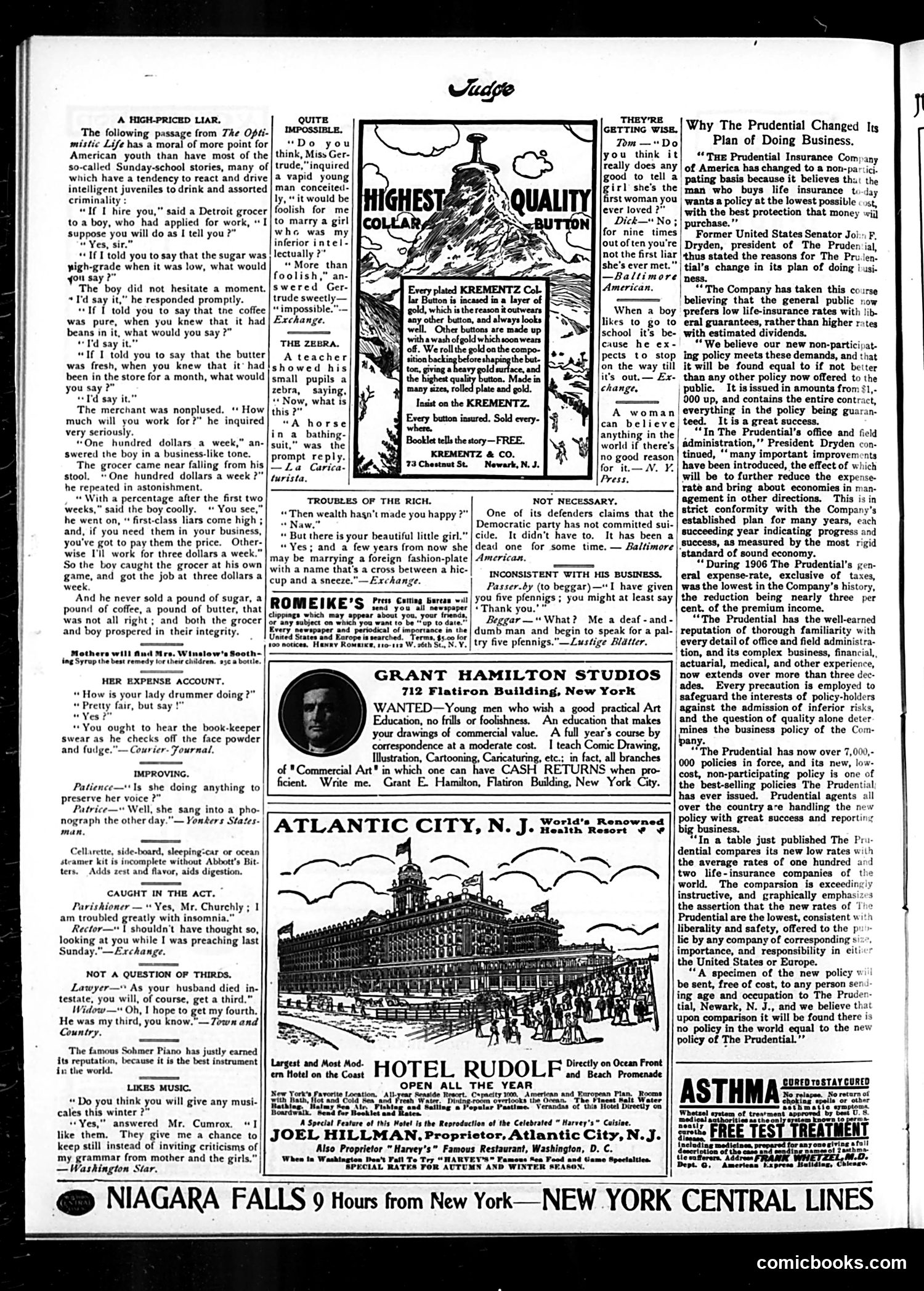
This page from **Judge** (an American satirical magazine) contains multiple brief humorous anecdotes and advertisements rather than a single political cartoon. The main satirical piece, "A HIGH-PRICED LIAR," presents a moral paradox: a Detroit grocer tests a boy's honesty by asking if he'd lie about product quality. The boy agrees—then demands $100/week as payment, claiming "first-class liars come high." The joke's irony: the boy refuses to actually lie and prospers through integrity, satirizing business dishonesty while showing that even criminals recognize their own worth. Other pieces mock common hypocrisies: a clergy member dozing during sermons, a widow hoping for a "fourth" marriage after three, and a woman discouraging a man from marrying someone "inferior intellectually" (implying he shouldn't marry at all). The page also includes the Prudential Insurance advertisement explaining their shift to non-participating policies—straightforward marketing rather than satire. Overall, the page reflects Judge's style: poking fun at American social pretense, business ethics, and everyday human contradictions through brief, punchy humor pieces.
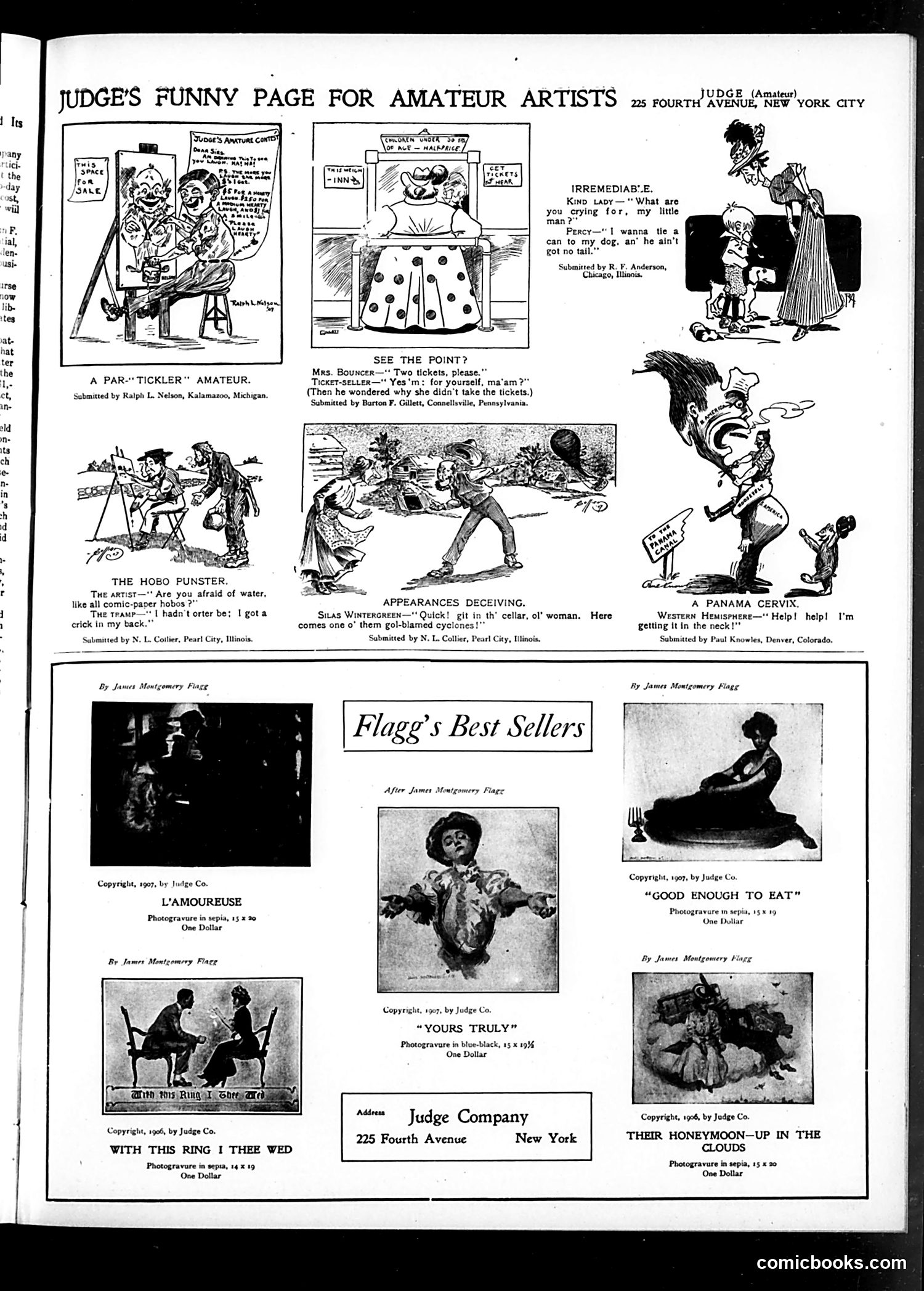
This page combines amateur cartoon submissions with advertisements for James Montgomery Flagg's popular prints. The amateur cartoons use simple visual gags common to early 1900s humor: **"A Par-Tickler Amateur"** plays on a tramp's complaint of back pain ("crick") when asked if he fears water—a pun on "crick" vs. actual injury. **"See the Point?"** depicts a ticket-seller's confusion when a woman asks for two tickets "for yourself, ma'am"—the joke being her ambiguous phrasing suggests she's alone, so why buy two? **"Panama Cervix"** likely references the Panama Canal construction, personified as the "Western Hemisphere" getting "it in the neck"—political commentary on American intervention. The remaining cartoons use similar slapstick and wordplay humor typical of the era. The page's bulk consists of advertisements for Flagg's commercially-successful art prints, indicating his work's popularity and commercial value in this period.
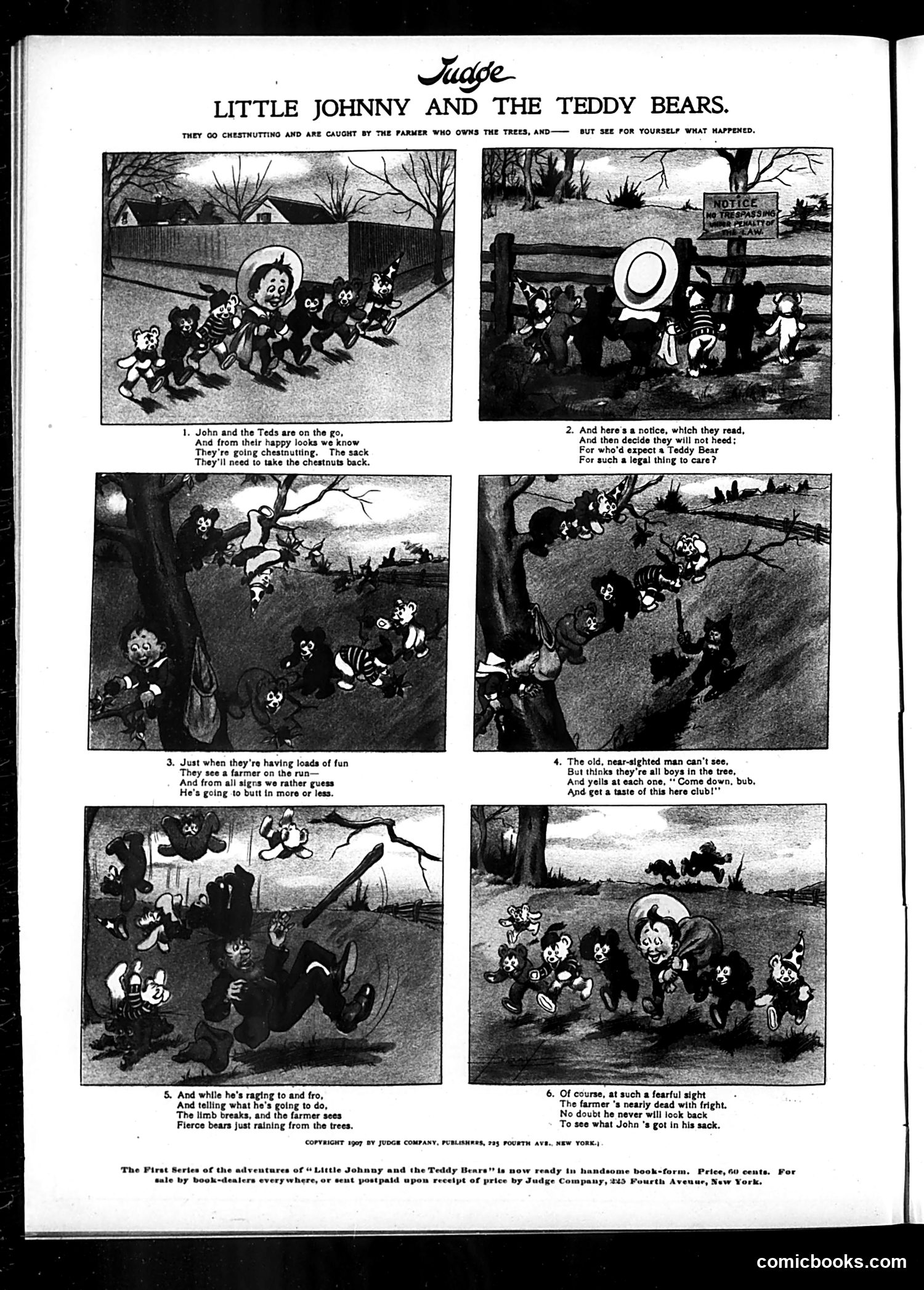
This is a humorous six-panel story exploiting the early 1900s "Teddy Bear" craze. Little Johnny and his toy teddy bears go chestnut-picking on a farmer's property despite a "No Trespassing" sign. When the farmer catches them and climbs a tree in pursuit, a branch breaks, sending what he believes are real bears raining down on him. The farmer flees in terror, never discovering the "bears" were actually Johnny's stuffed toys. The joke relies on two ironies: the farmer's near-sightedness causes him to misidentify toys for dangerous animals, and the Teddy Bears—named after President Theodore Roosevelt and wildly popular as children's toys—inadvertently protect Johnny through the farmer's fearful misconception. The satire gently mocks both the farmer's gullibility and contemporary Teddy Bear mania.