
A complete issue · 16 pages · 1907
Judge — September 14, 1907
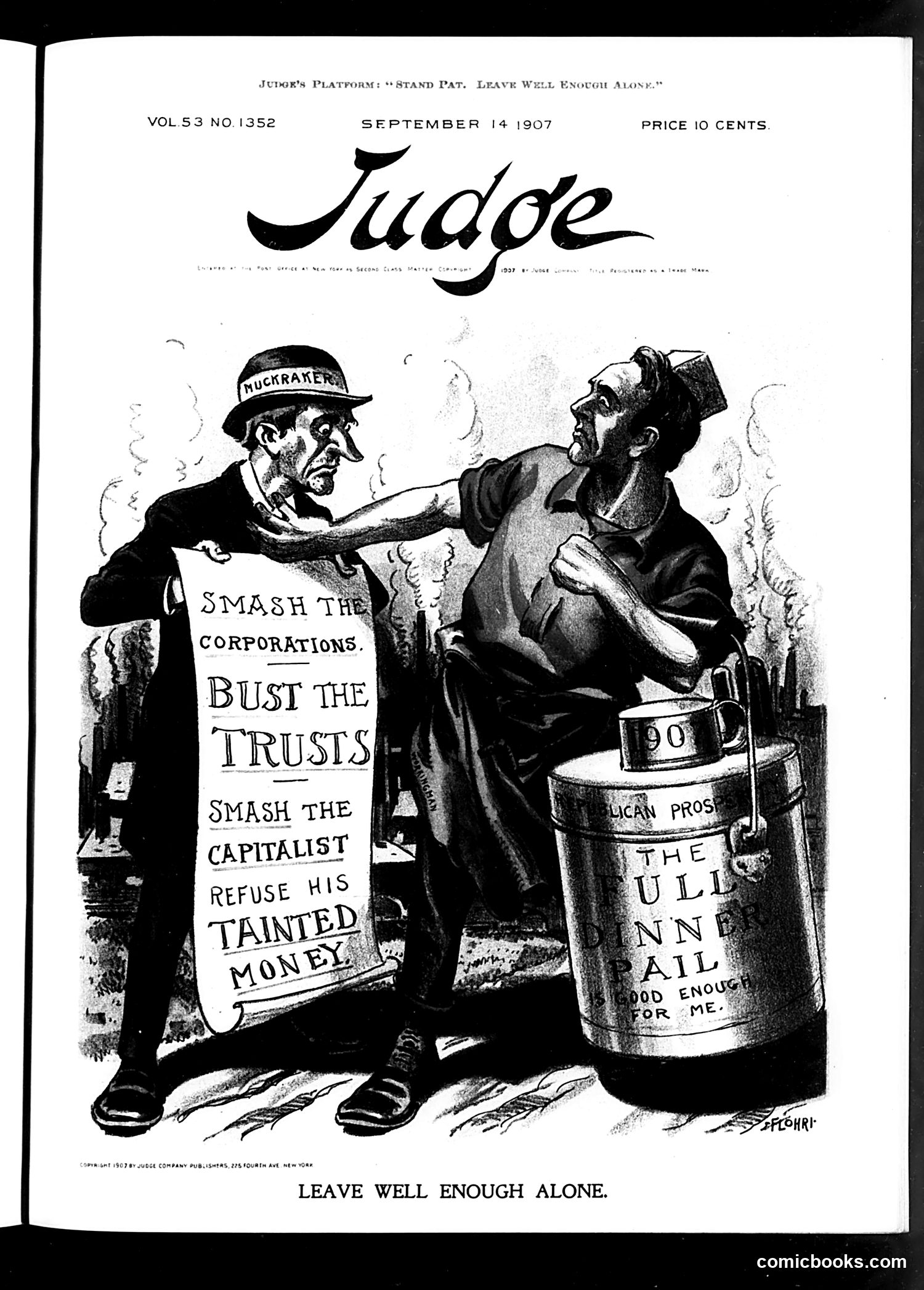
This political cartoon depicts two figures in conflict over competing ideologies. The left figure, labeled "Muckraker" (wearing a cap), holds a sign advocating radical reform: "Smash the Corporations. Bust the Trusts. Smash the Capitalist. Refuse his Tainted Money." The right figure appears to be a wealthy capitalist holding what looks like a large can or container labeled with text about "Ullendale" and "good enough for me." The cartoon satirizes the contradiction between muckrakers—Progressive Era journalists and activists who exposed corporate corruption—and their reliance on the very capitalist system they condemned. The title "Leave Well Enough Alone" suggests irony about whether radical reform is truly desirable. The satire critiques the hypocrisy of accepting benefits from the system one publicly attacks.
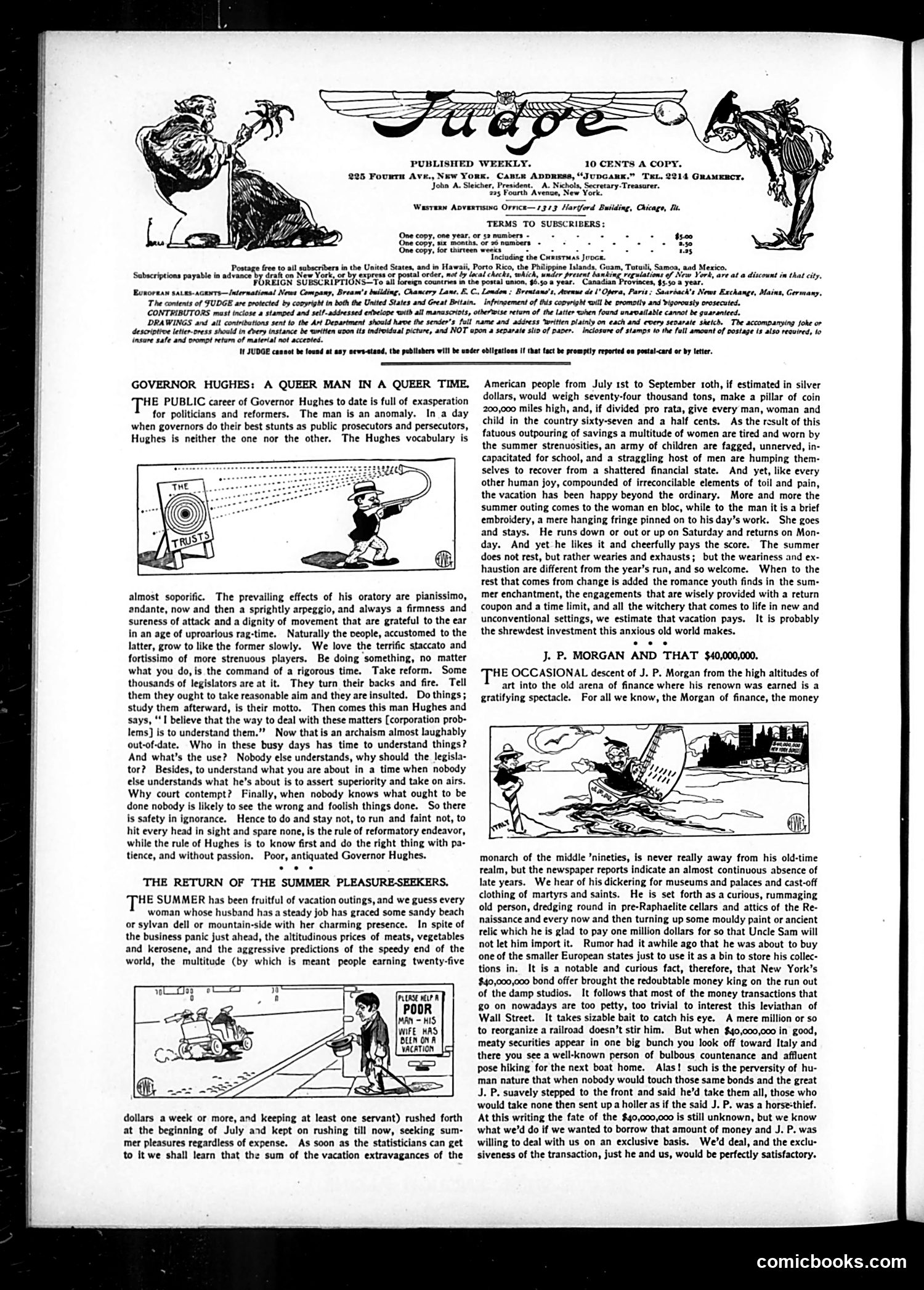
This page contains three satirical pieces mocking prominent figures: 1. **"Governor Hughes: A Queer Man in a Queer Time"** critiques Governor Hughes' public persona as a reformer and prosecutor, suggesting his rhetoric is grandiose but his actual accomplishments are minimal. The satire attacks his verbose oratory style and questions legislators' ability to understand his complex arguments. 2. **"J. P. Morgan and That $40,000,000"** mocks the financier J. P. Morgan's art collecting and wealth. The text sarcastically notes Morgan's continuous acquisitions despite claiming to be retired, highlighting the absurdity of his spending habits and his influence over American finance. 3. **"The Return of the Summer Pleasure-Seekers"** satirizes vacation culture, showing the chaotic nature of summer travel and leisure spending among wealthy Americans.
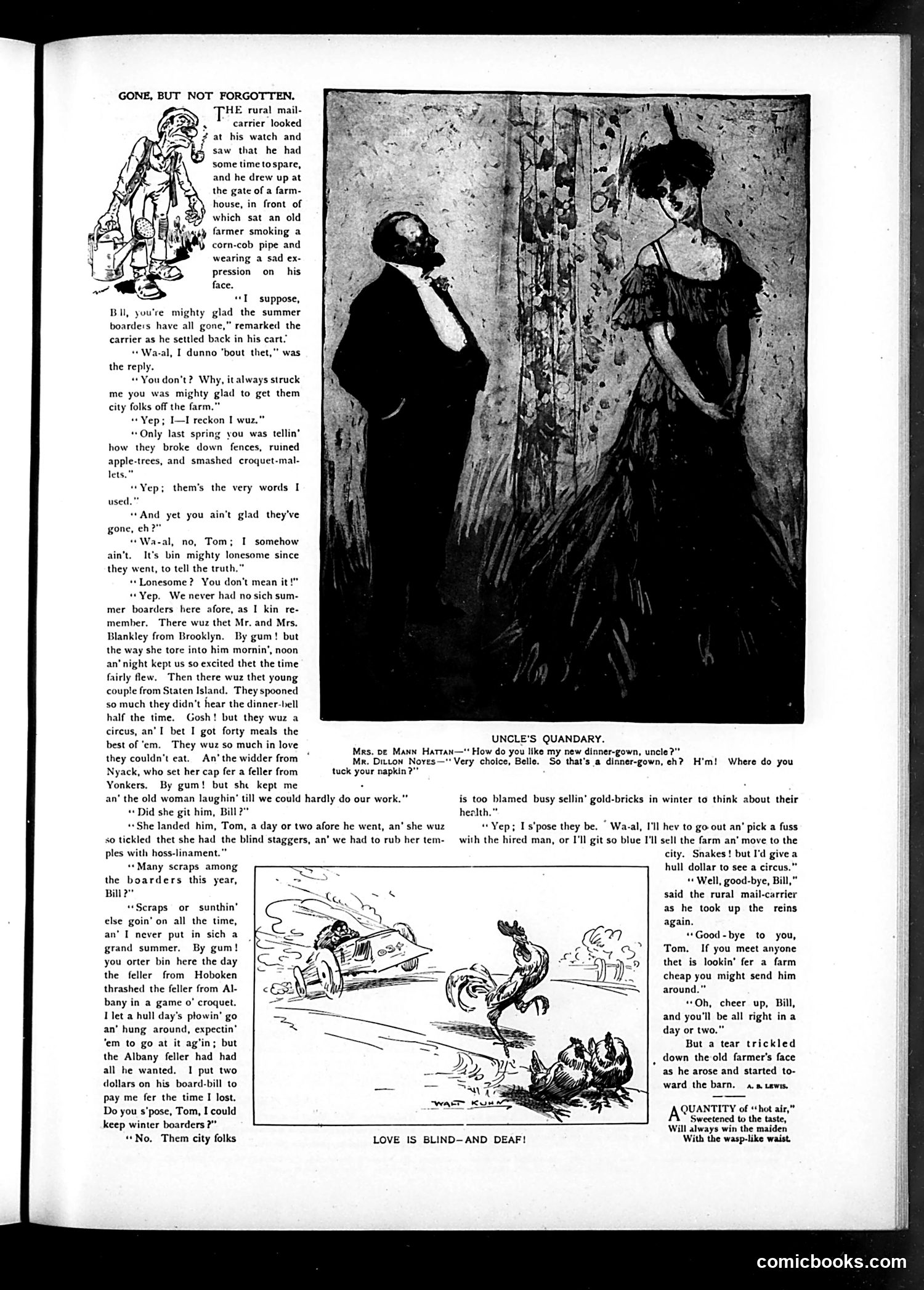
This page contains a narrative story with illustrations rather than political satire. The text describes rural life tensions: a mail carrier discusses summer boarders (city visitors) who damaged local property—breaking fences, ruining apple trees. The farmer expresses ambivalence; while he resented the destruction, he benefited financially from hosting these temporary residents. The two main illustrations show: (1) "Uncle's Quandary"—a domestic scene with figures at a door, and (2) "Love is Blind—and Deaf!"—depicting a horse startled by an automobile, satirizing the clash between rural traditions and modern technology. The page's theme appears to be rural-urban cultural conflict during the early automotive era, exploring the economic and social impacts of city people visiting the countryside.
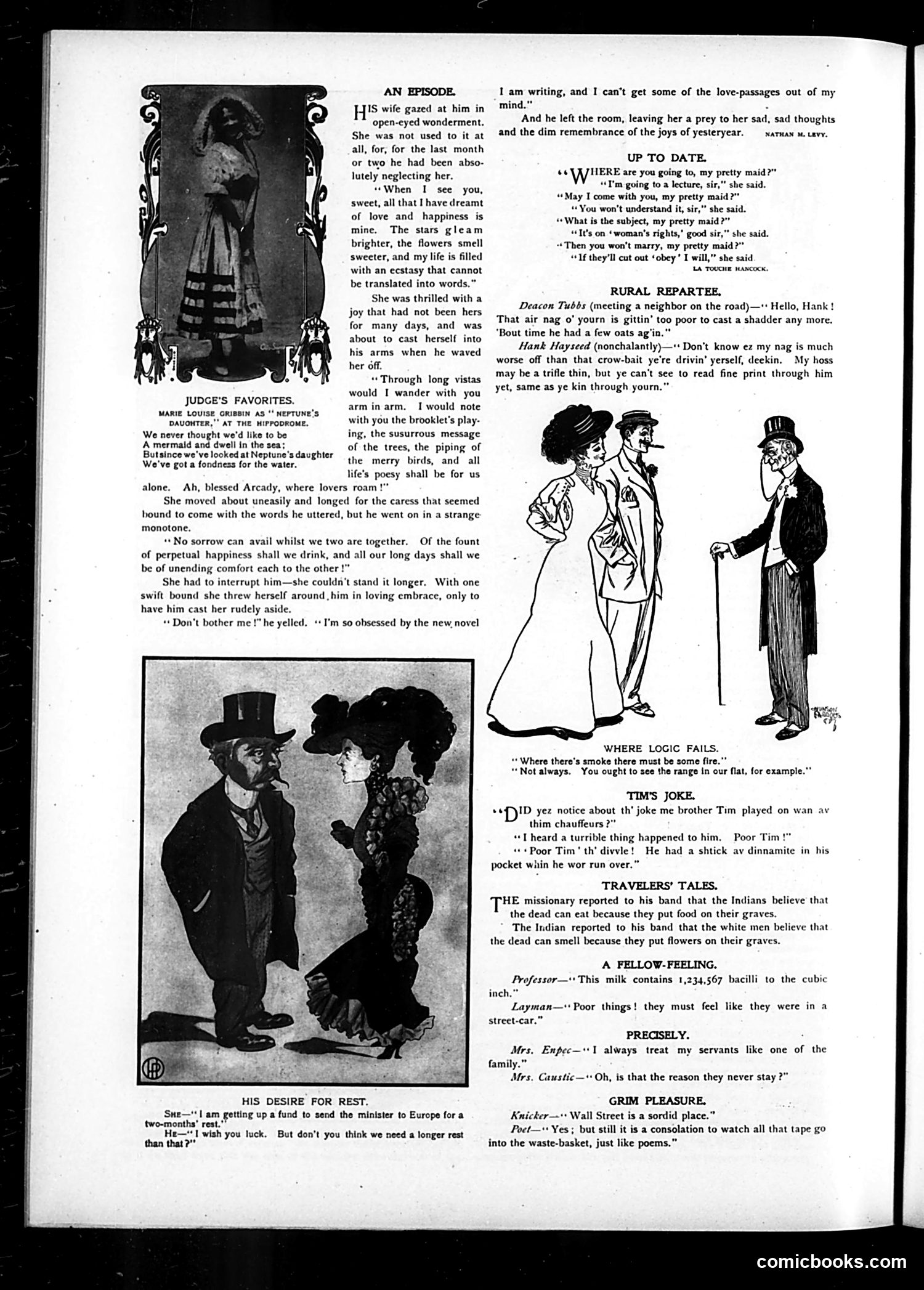
This page contains several short humor pieces and illustrations typical of Judge's satirical format: **"An Episode"** features a romantic passage with accompanying portrait photograph labeled as "Judge's Favorites," presenting sentimental love poetry. **"Up to Date"** appears to satirize modern courtship dialogue between a gentleman and woman discussing "woman's rights"—reflecting early 20th-century debates about female suffrage and independence. **"Rural Reporter," "Tim's Joke," and "Travelers' Tales"** are brief anecdotes using rural and immigrant dialects for comedic effect, common in period humor. The illustrated cartoons—including "Where Logic Fails," "His Desire for Rest," and others—use simple visual gags and wordplay typical of Judge's style, mocking everyday social situations and human nature rather than specific political figures or events.
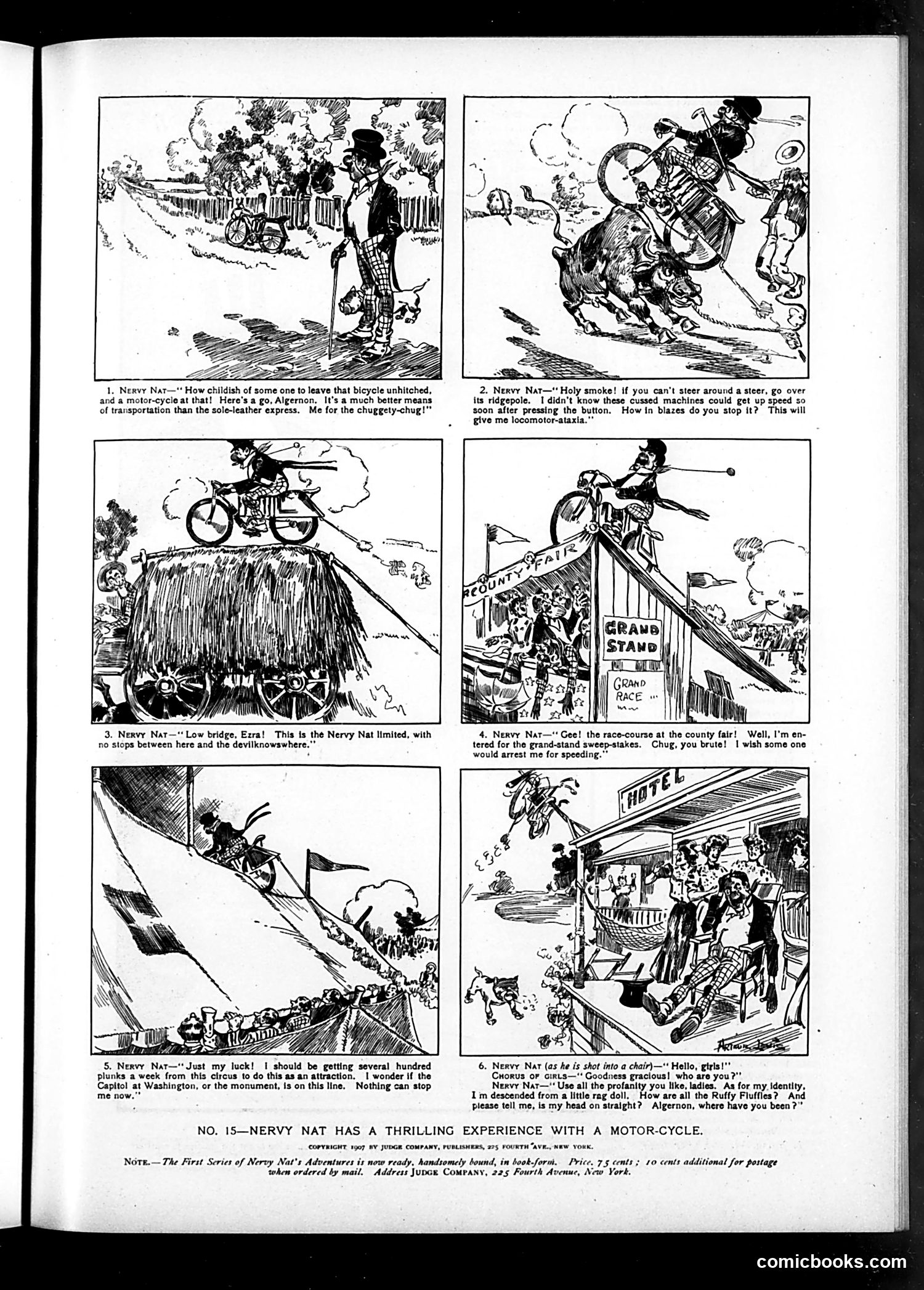
This is a comic strip about a character named "Nervy Nat" encountering a motorcycle—then a novel and dangerous technology. The humor derives from early-20th-century anxiety about automobiles and motorcycles as unpredictable, menacing machines that could cause chaos. The strip shows Nat repeatedly endangered by the motorcycle: he's nearly hit by it, chased by it, and nearly thrown from various structures. The joke plays on contemporary fears of motorized vehicles as chaotic forces threatening traditional order, plus Nat's comically bad luck. The title character appears to be Judge magazine's recurring protagonist—a hapless everyman whose misadventures satirized modern life's hazards.
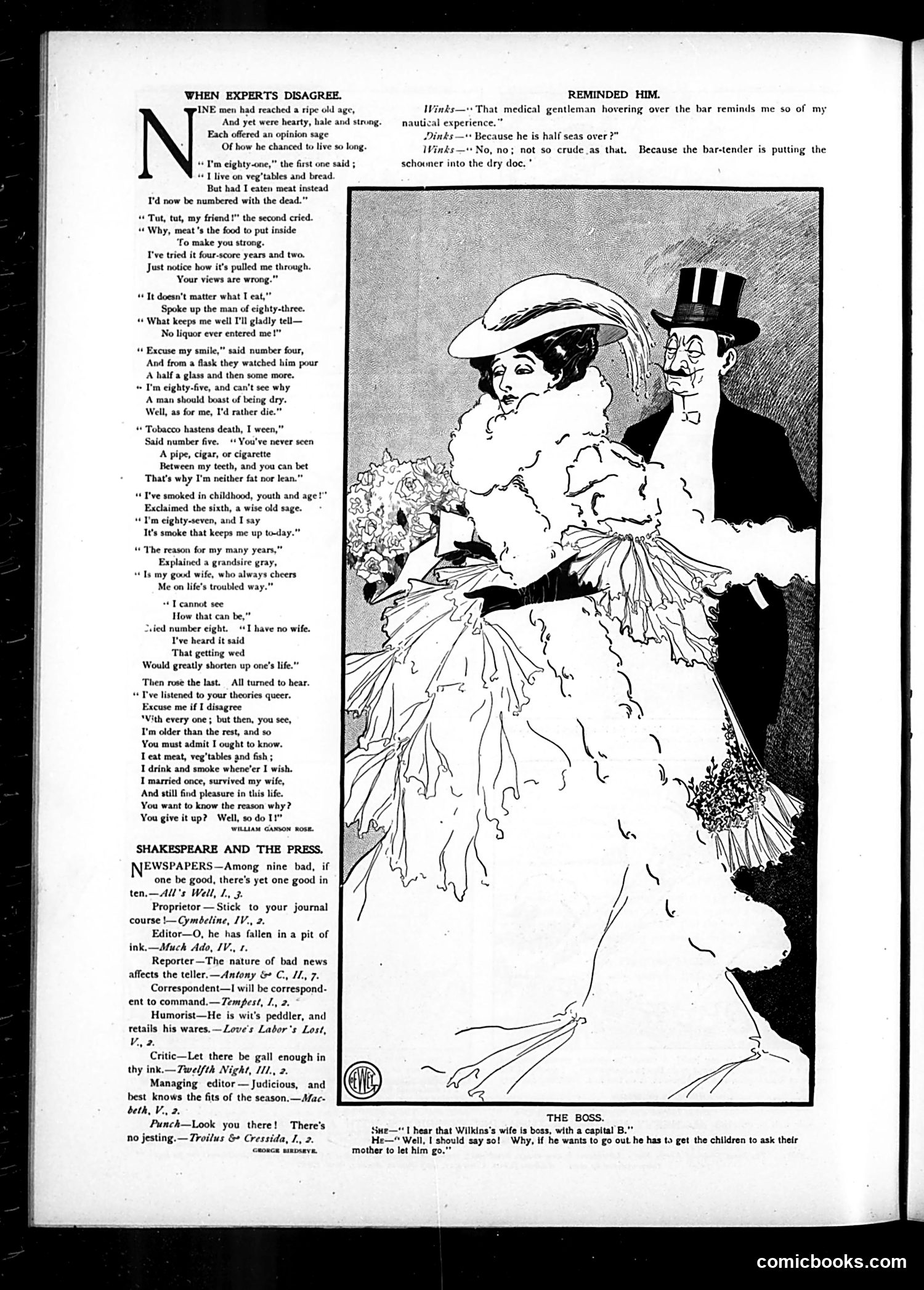
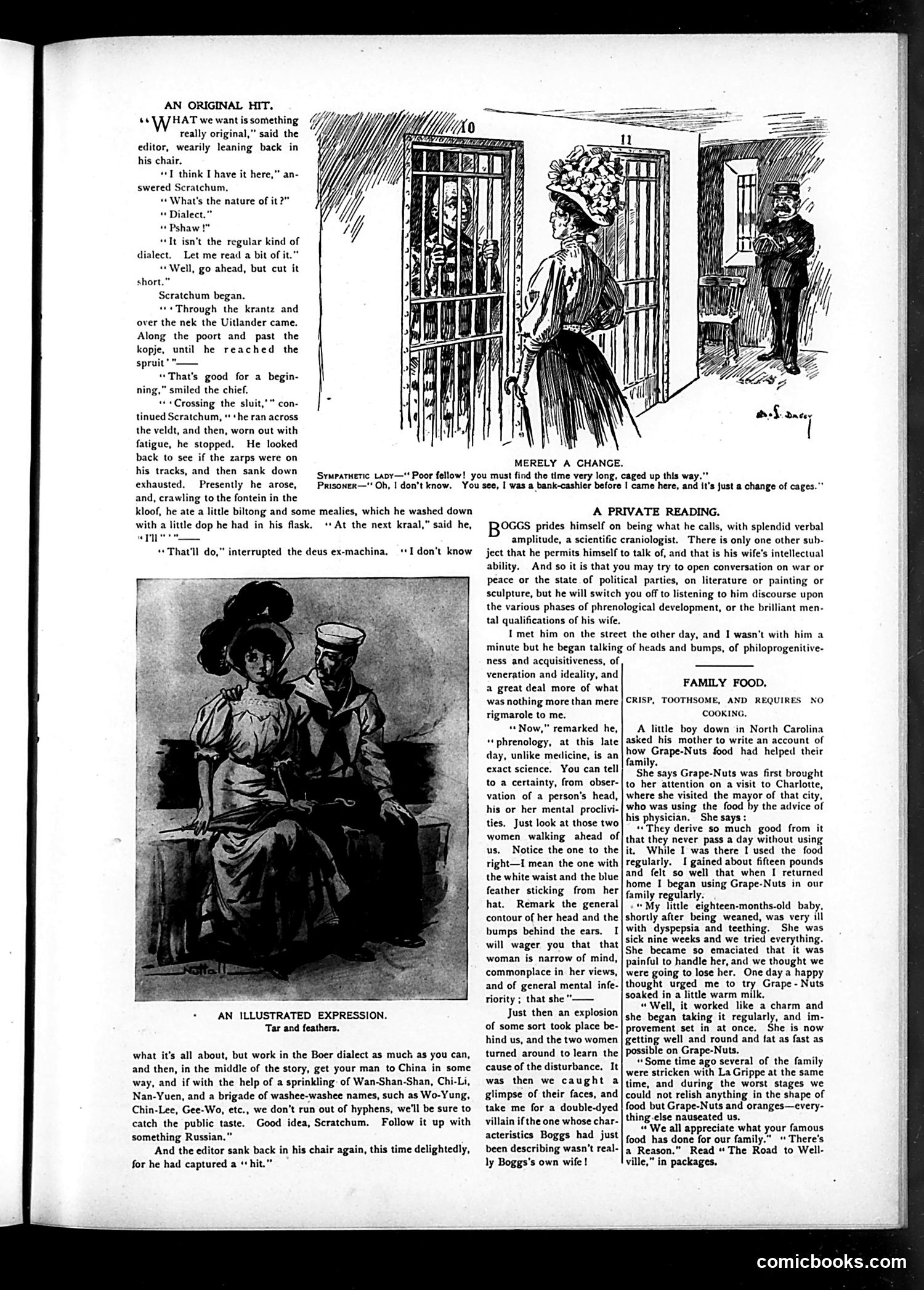
This page satirizes both literary pretension and American magazine publishing conventions circa the Boer War era (early 1900s). The top cartoon mocks editors' desperate hunger for "originality." When writer Scratchum proposes mixing incompatible exotic dialects—South African Boer terminology with Chinese names—the editor enthusiastically embraces this absurd pastiche, believing random linguistic exoticism equals genuine creativity. The joke exposes how publications chased sensationalism and ethnic stereotypes rather than actual literary merit. The middle illustration, "Merely a Change," depicts a prisoner telling a sympathetic guard that being caged is merely exchanging one confinement for another—he was previously a bank cashier. The dark humor suggests white-collar work is itself imprisonment. "A Private Reading" ridicules pseudoscientific phrenology (analyzing personality through skull bumps). Boggs pompously lectures about a woman's narrow mind based on her head's shape, only to discover—when she turns around—that she's his own wife, undermining his supposed expertise. These pieces collectively mock intellectual charlatanism and editorial mediocrity prevalent in early-1900s periodicals.
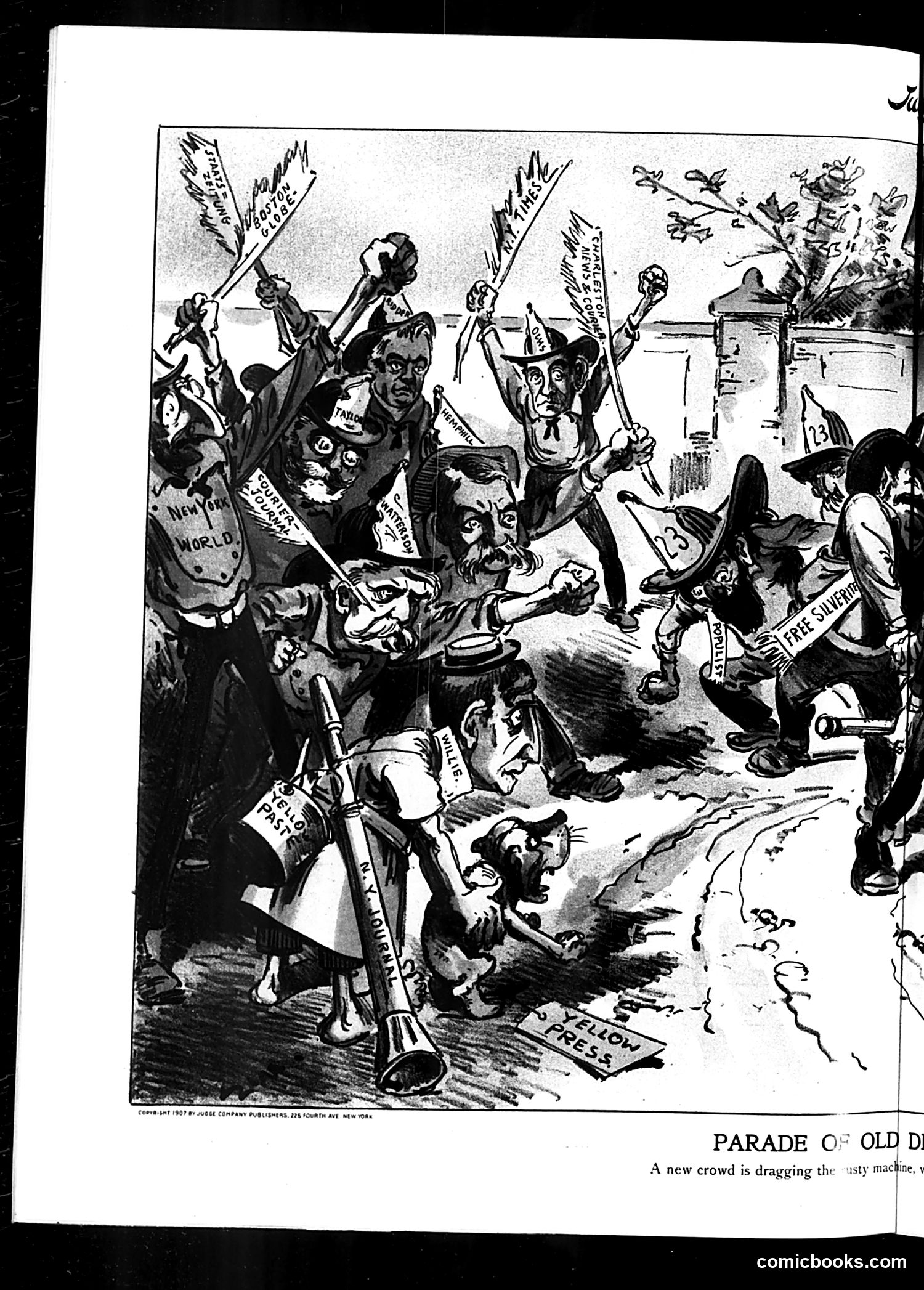
This political cartoon satirizes what appears to be a resurgence of outdated social problems or political movements. The image shows grotesque, demon-like figures wielding torches and banners, being paraded or driven forward by a crowd. The caricatured figures have exaggerated, menacing features typical of Judge magazine's style. The caption "Parade of Old Demons" and subtitle about "a new crowd is dragging the dusty machine" suggests the cartoon critiques how seemingly-defeated problems are being revived or perpetuated by contemporary society. The torch-bearing figures likely represent old prejudices, failed ideologies, or discredited movements being resurrected. The exact historical moment is unclear without the full date, but this reflects Judge's typical Progressive-era criticism of backward social forces.
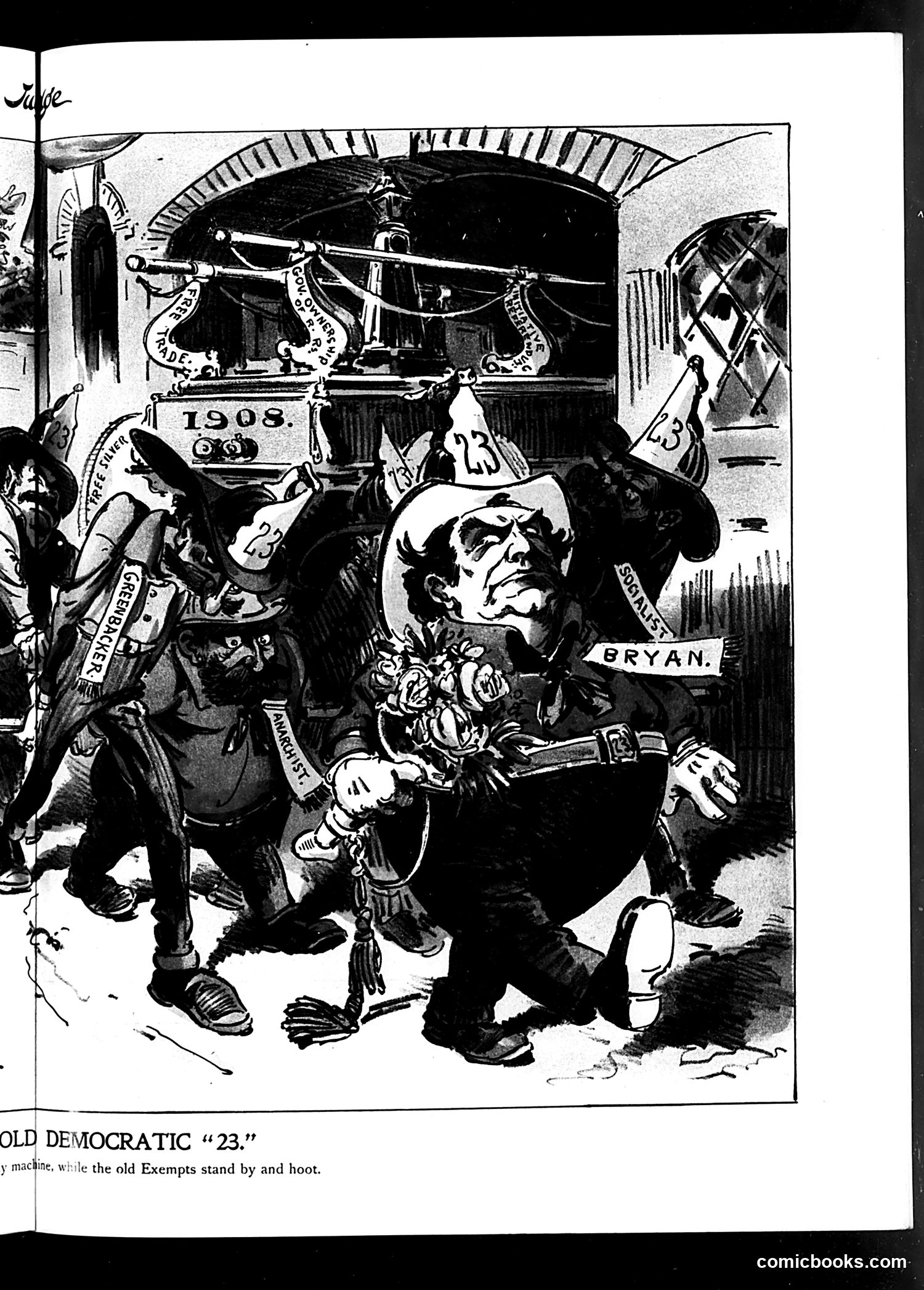
This 1908 Judge magazine cartoon satirizes the Democratic Party's political machinery. The central figure labeled "BRYAN" (likely William Jennings Bryan, the three-time Democratic presidential candidate) is depicted as an aging, worn-out political operator surrounded by party operatives and machinery marked "1908." The cartoon mocks the "old Democratic '23'"—apparently referencing outdated Democratic tactics or power structures. "Bryan" appears decrepit and ineffective, while the mechanical apparatus around him suggests the party relies on worn machinery rather than fresh ideas. The reference to "old Exempts" standing by suggests party insiders or establishment figures watching passively as the system fails. The satire criticizes Democratic leadership as obsolete and ineffective heading into the 1908 election.
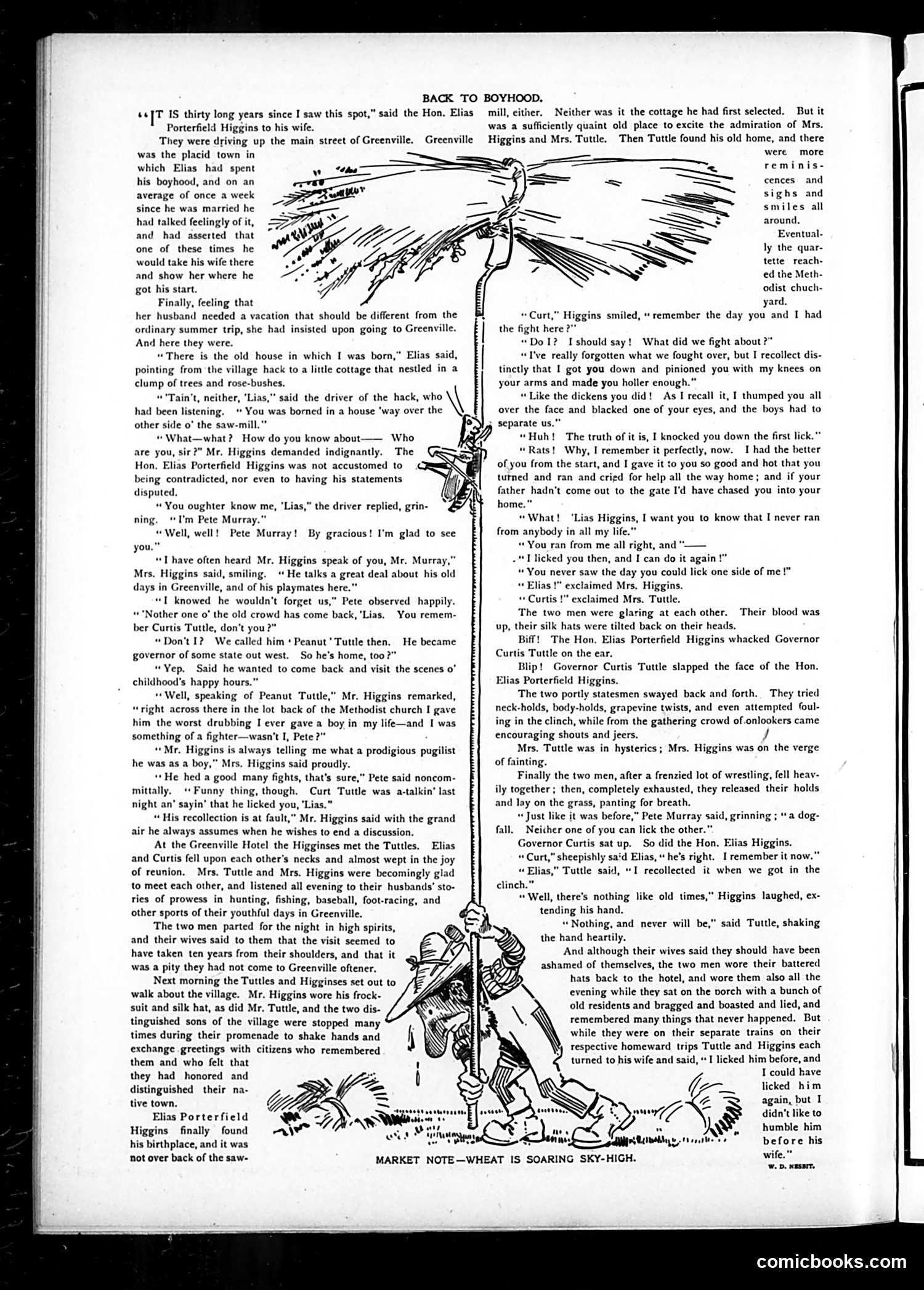
This is a humorous short story about a pompous politician, Hon. Elias Porterfield Higgins, returning to his hometown Greenville after 30 years. The satire mocks his self-aggrandizing nostalgia and false memories. **The joke:** Higgins constantly boasts about his childhood achievements—winning fights, athletic prowess—but is repeatedly contradicted by Pete Murray, an old acquaintance who remembers the actual events differently. Most notably, Higgins claims he "gave" Curtis Tuttle (now a state governor) "the worst drubbing," but Tuttle remembers *he* defeated Higgins. **The political angle:** The story satirizes how successful men romanticize their pasts and reinvent history to suit their importance. Higgins's wife uncritically celebrates his inflated stories, while ordinary people (the hack driver) know the truth. The cartoon illustrations show two men fighting, emphasizing the contrast between Higgins's grandiose version and reality. Judge magazine used such stories to deflate pomposity among America's elite.
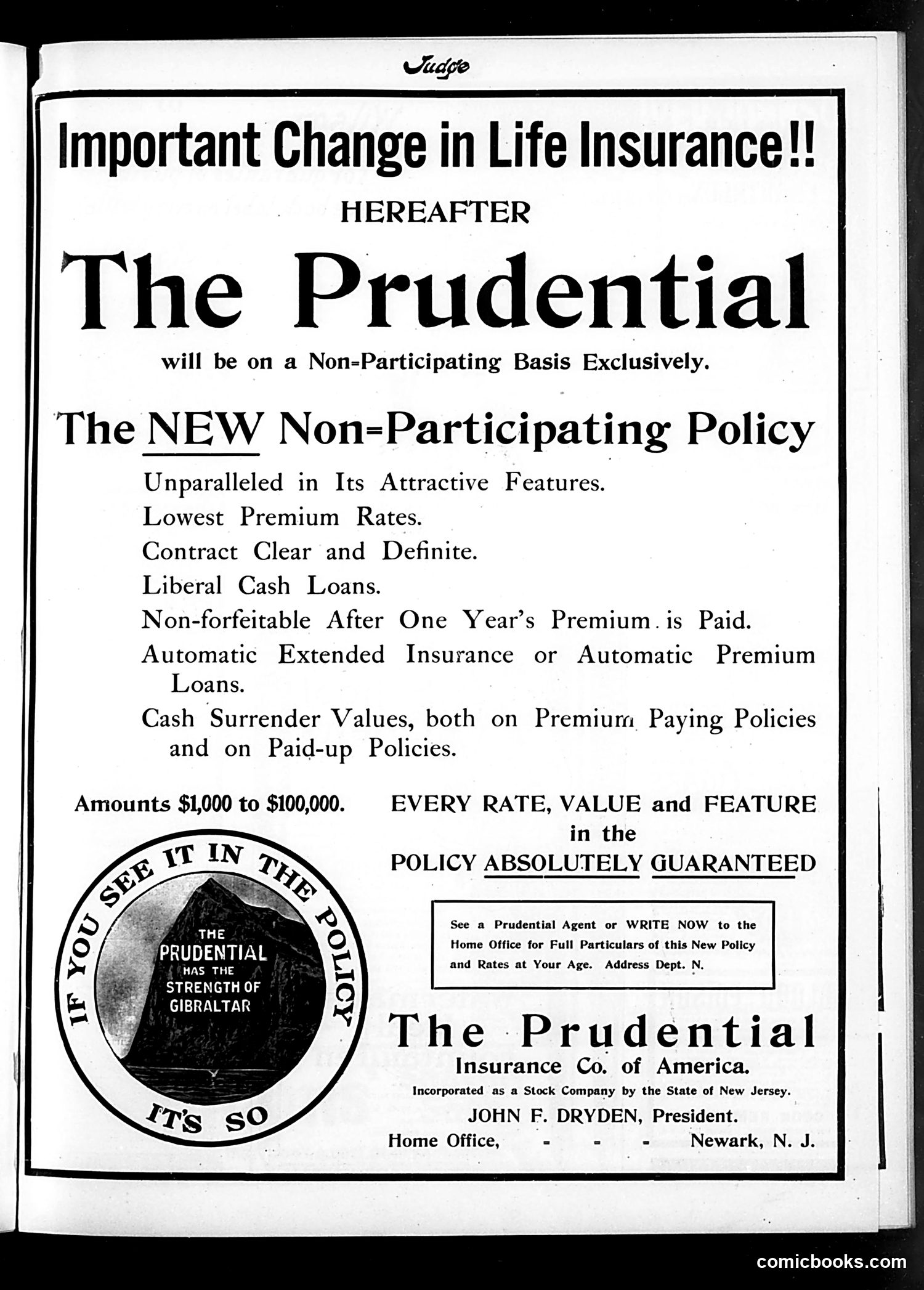
This page is **primarily an advertisement**, not a satirical cartoon. It announces The Prudential Insurance Company's major policy change to non-participating (non-dividend) insurance exclusively. The only visual element is the company's logo—a circular seal featuring the Rock of Gibraltar with text "If You See It in the Policy It's So," emphasizing the company's strength and reliability through this geographical metaphor. The "satire" here, if any exists, is implicit rather than explicit: Judge is running this advertisement, which makes claims about "lowest premium rates" and "absolute guarantees." For a satirical magazine's readership, the irony might be self-evident—insurance companies making sweeping promises in bold type. However, without accompanying commentary or caricature, this reads as straightforward corporate advertising rather than pointed satire. The page likely represents Judge's commercial advertising revenue rather than editorial content.
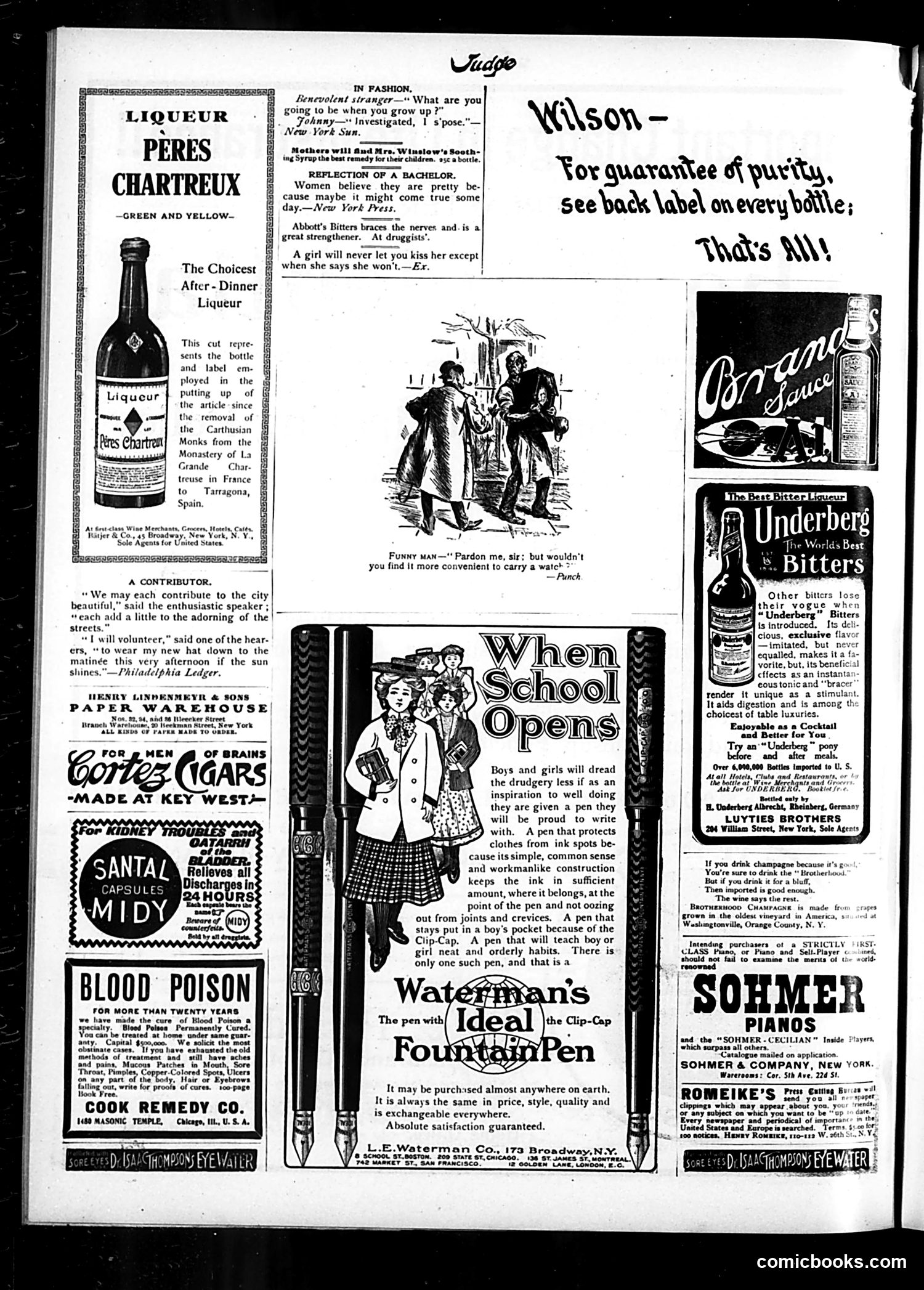
This is primarily an **advertising page** from Judge magazine, with one small cartoon at the top. ## The Cartoon The single cartoon ("In Fashion") depicts a benevolent stranger asking a child what they'll be when grown up. The child's answer is cut off, but the joke appears to be about childhood ambitions. The context suggests it's satirizing whatever aspirational answer a child might give—though the specific punchline is unclear from the visible text. ## The Advertisements The page is dominated by period product ads (liqueurs, bitters, fountain pens, blood poison remedies, cigars, pianos) typical of early 20th-century magazines. Notable is the mix of dubious medical claims alongside legitimate products—reflecting an era before modern FDA regulations when such advertisements were common. The **Waterman's Ideal Fountain Pen** ad is most prominent, marketing it as practical for schoolchildren with its leak-proof design. The page contains no significant political or social satire beyond the single small cartoon at top.
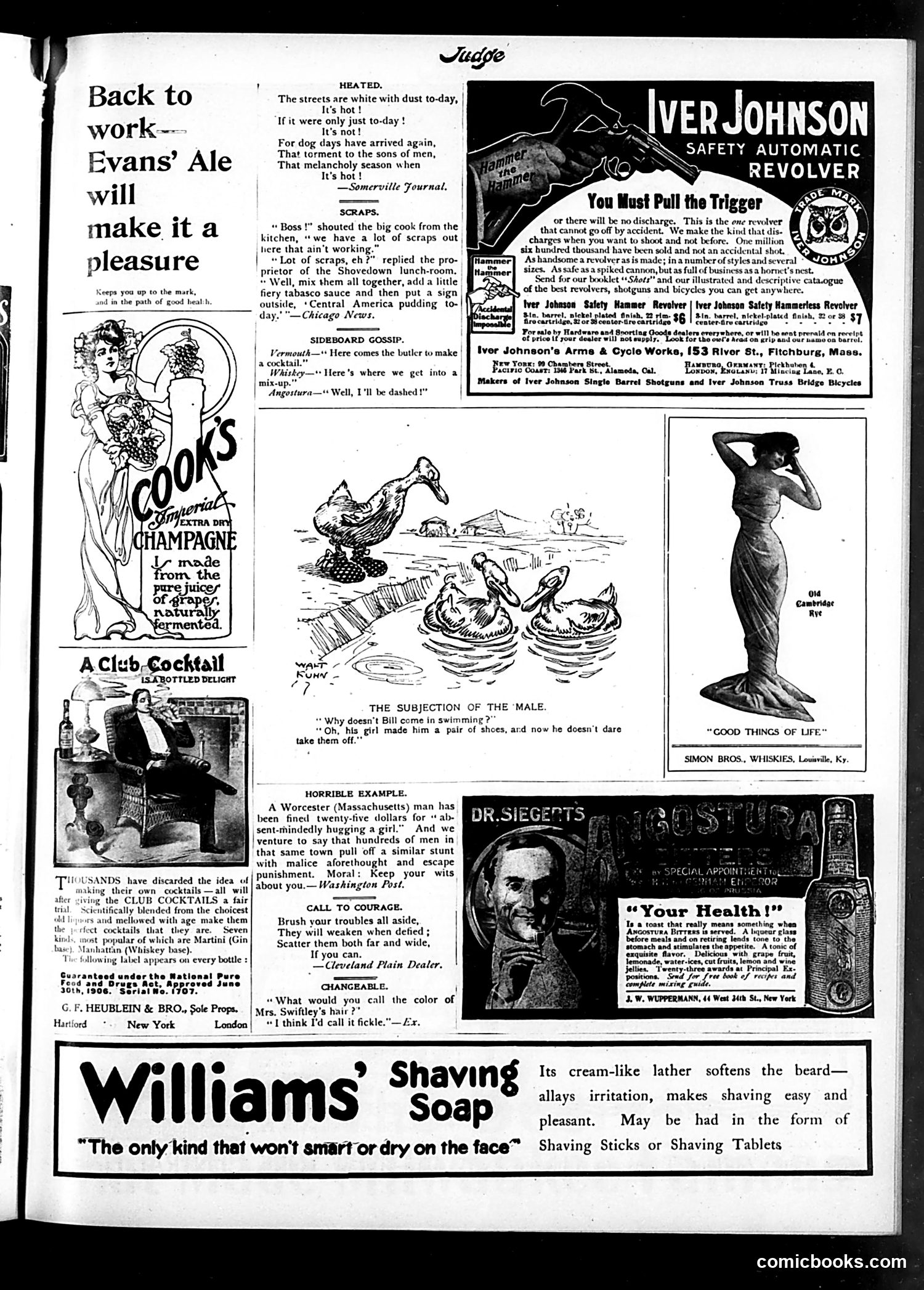
This page from Judge magazine (an American satirical weekly) contains multiple short jokes and advertisements typical of early 20th-century humor. **Main Content:** The page's cartoons mock social conventions. "The Subjection of the Male" depicts birds in water, with a caption joking that a man won't swim because his girlfriend made him shoes and "now he doesn't dare take them off"—satirizing male subservience to female partners, a common Judge theme. "Horrible Example" criticizes a Worcester man fined for hugging a girl without permission, suggesting this minor consequence won't deter similar behavior elsewhere. **Advertisements:** Prominent ads include Evans' Ale (promising work productivity), Iver Johnson revolvers (emphasizing safety—"cannot go off by accident"), Cook's Champagne, Club Cocktails, Dr. Siegert's Angostura bitters, and Williams' Shaving Soap. The page is primarily **advertising-driven humor**—short jokes interspersed between product endorsements typical of Judge's revenue model. The satire targets contemporary social anxieties about gender relations and consumer culture.
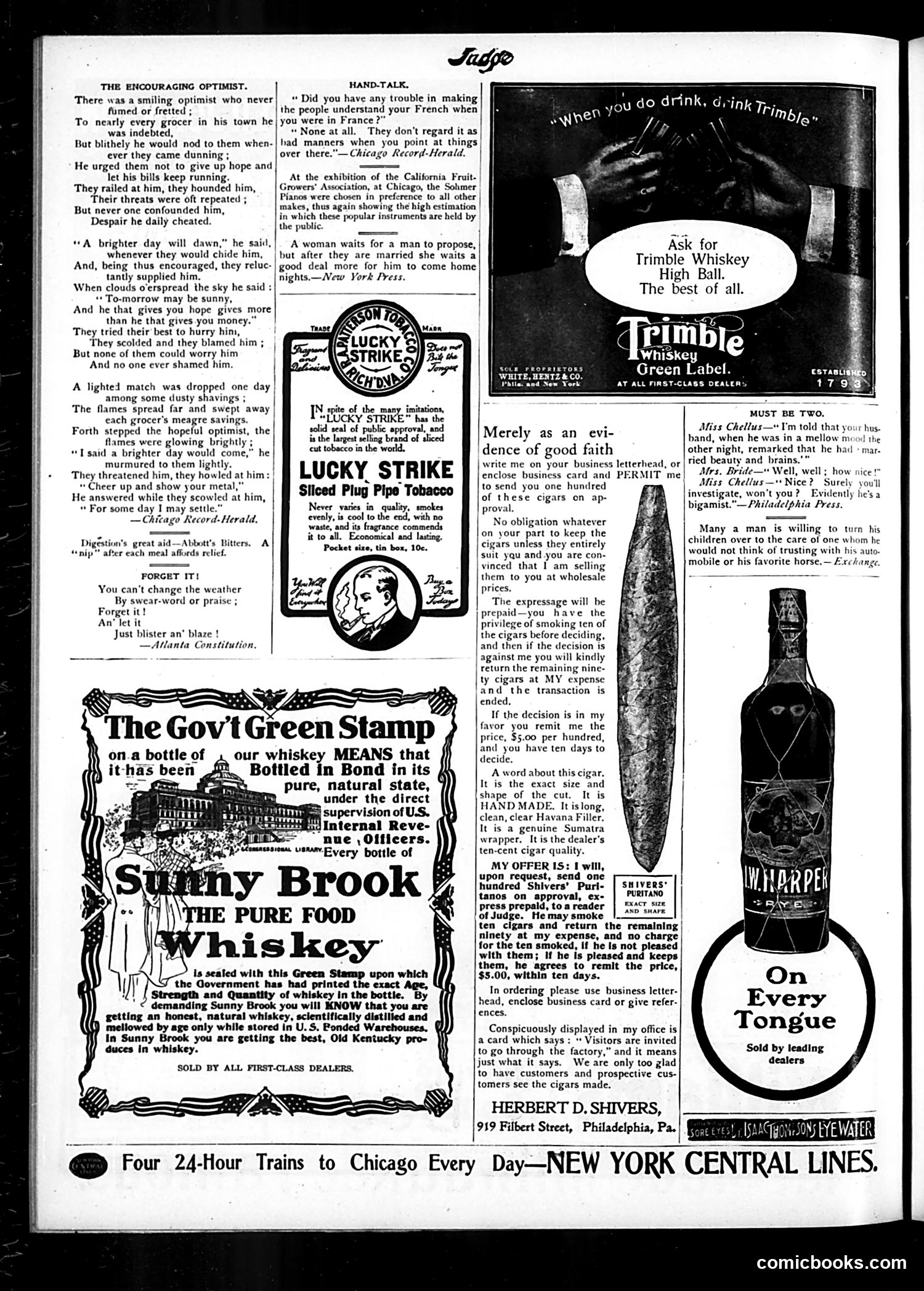
This page contains **primarily advertisements** interspersed with brief humorous poems and jokes typical of Judge magazine's satirical format. The main content includes: 1. **"The Encouraging Optimist"** — A poem mocking a delusional debtor who remains cheerful despite mounting bills and angry creditors, suggesting naive optimism in the face of financial ruin. 2. **Brief jokes** on hand gestures in France, marriage, and cigar quality — standard light humor. 3. **Large advertisements** for whiskey (Trimble, Sunny Brook), cigars (Lucky Strike), and eyewater, dominating the page. The Sunny Brook ad emphasizes the government green stamp indicating "pure" whiskey "bottled in bond." 4. **"Must Be Two"** — A short joke about a husband remarking his wife married "beauty and brains," implying he possesses neither. The page reflects early 20th-century consumer culture with heavy advertising, while the poetry satirizes American financial irresponsibility and optimistic denial — common Judge themes of the era.
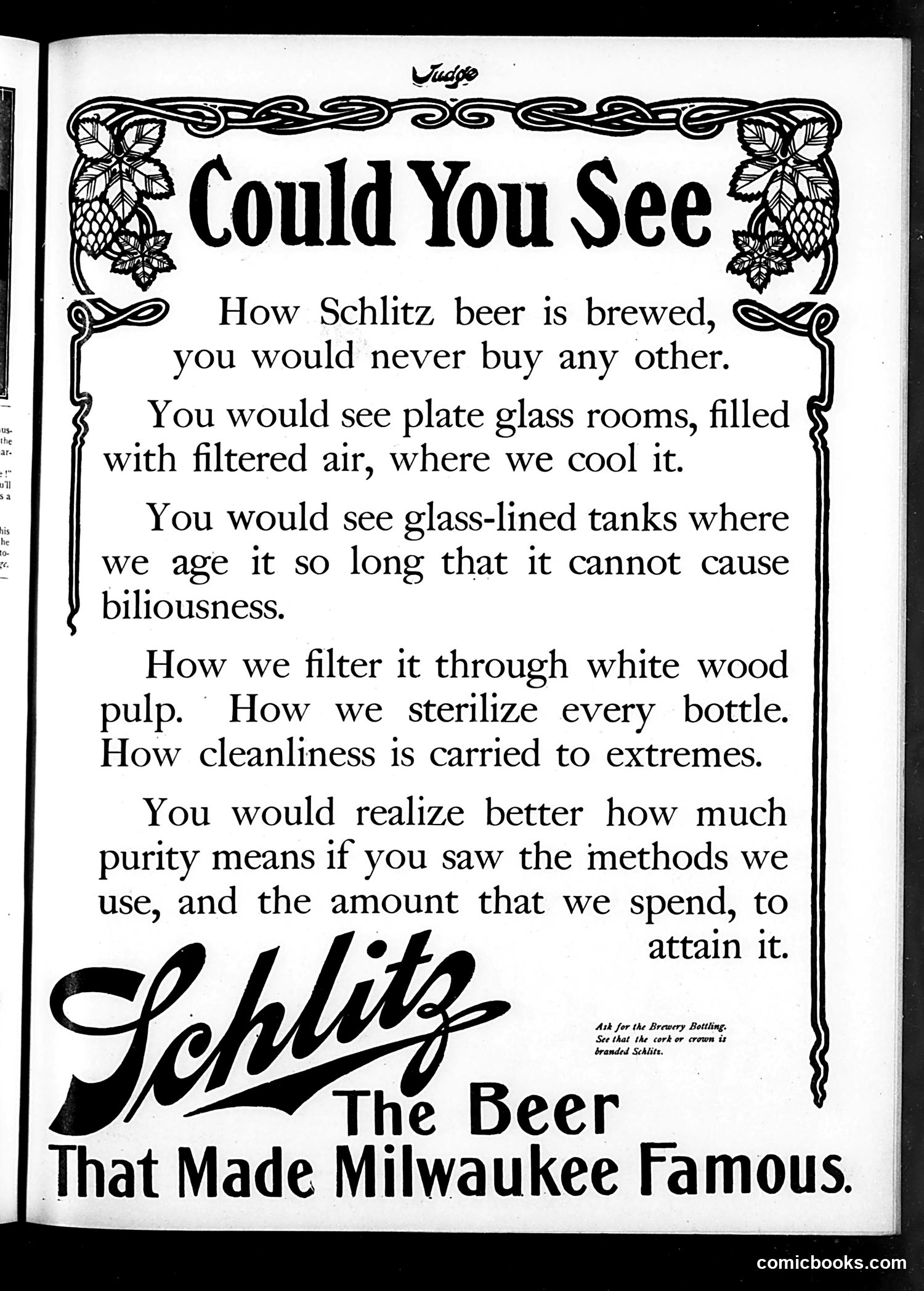
This is a **full-page advertisement**, not satire or political content. It promotes Schlitz beer, a major Milwaukee brewery, by inviting consumers to imagine touring their production facilities. The ad emphasizes manufacturing purity and quality control—plate glass rooms with filtered air, glass-lined aging tanks, white wood pulp filtration, and sterilized bottles. The phrase "cannot cause biliousness" (stomach upset) addresses a genuine contemporary concern about beer quality and digestive health. The tagline "The Beer That Made Milwaukee Famous" positions Schlitz as synonymous with the city's brewing reputation. This appears to be early 20th-century advertising, when industrial transparency and scientific cleanliness were novel selling points meant to reassure consumers about product safety.
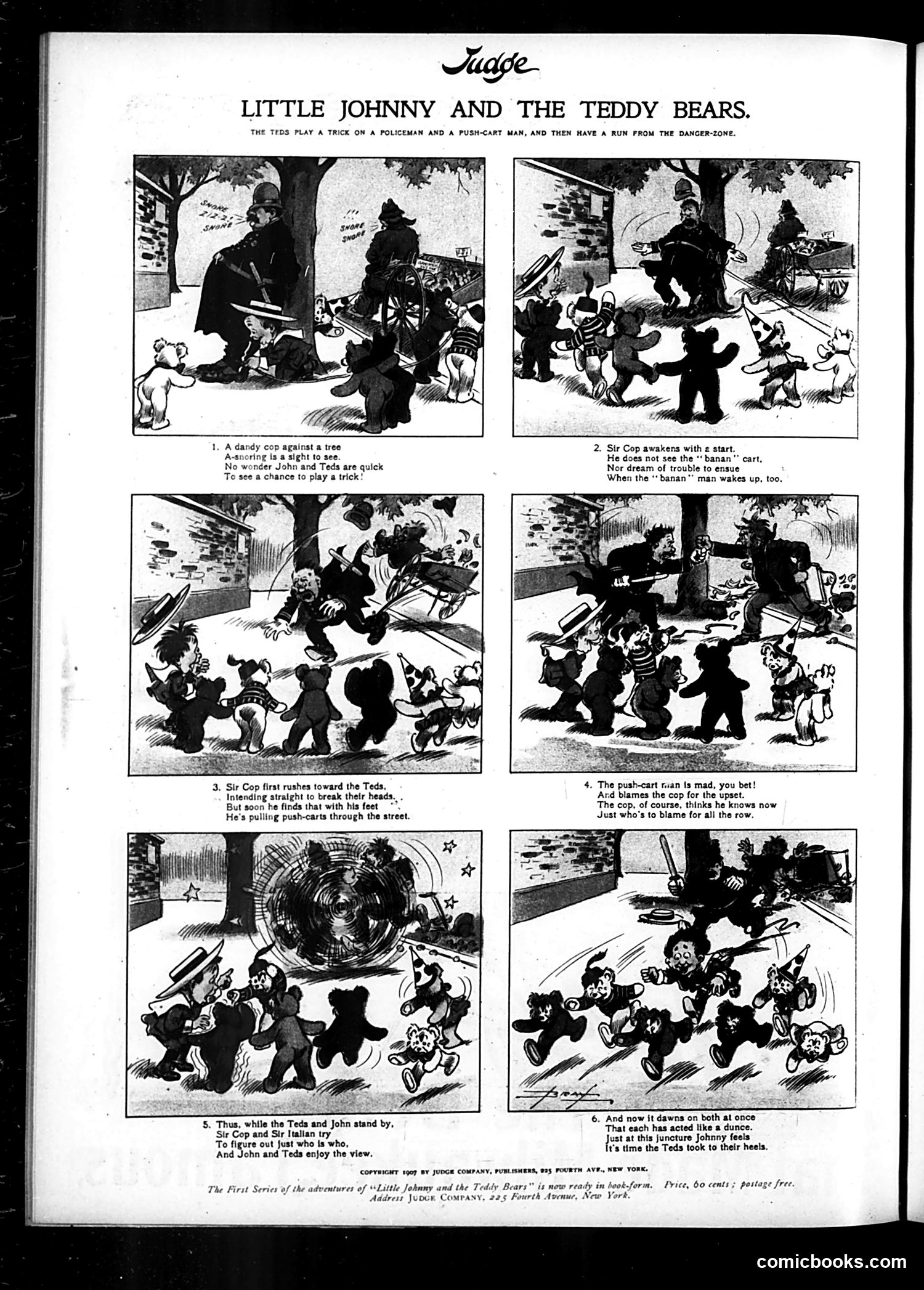
This is a humorous children's comic strip, not political satire. It depicts "Little Johnny" and anthropomorphic "Teddy Bears" (toys named after President Theodore Roosevelt, popular in the early 1900s) playing pranks on urban authority figures. The plot: mischievous characters trick a sleeping policeman by positioning him near a banana cart vendor. When the cop awakens and stumbles into the cart, chaos ensues—the cop blames the vendor, the vendor blames the cop, and neither realizes the children orchestrated it. The children escape before consequences arrive. The humor relies on slapstick (physical comedy) and the irony of authority figures wrongly blaming each other while the actual culprits flee. It's lighthearted entertainment advertising a book series, with no deeper political meaning. The "Teddy Bears" reference was simply a marketable novelty based on the popular toy craze of that era.