
Judge, 1907-09-14 · page 2 of 16
Judge — September 14, 1907 — page 2: what you’re looking at
What you’re looking at
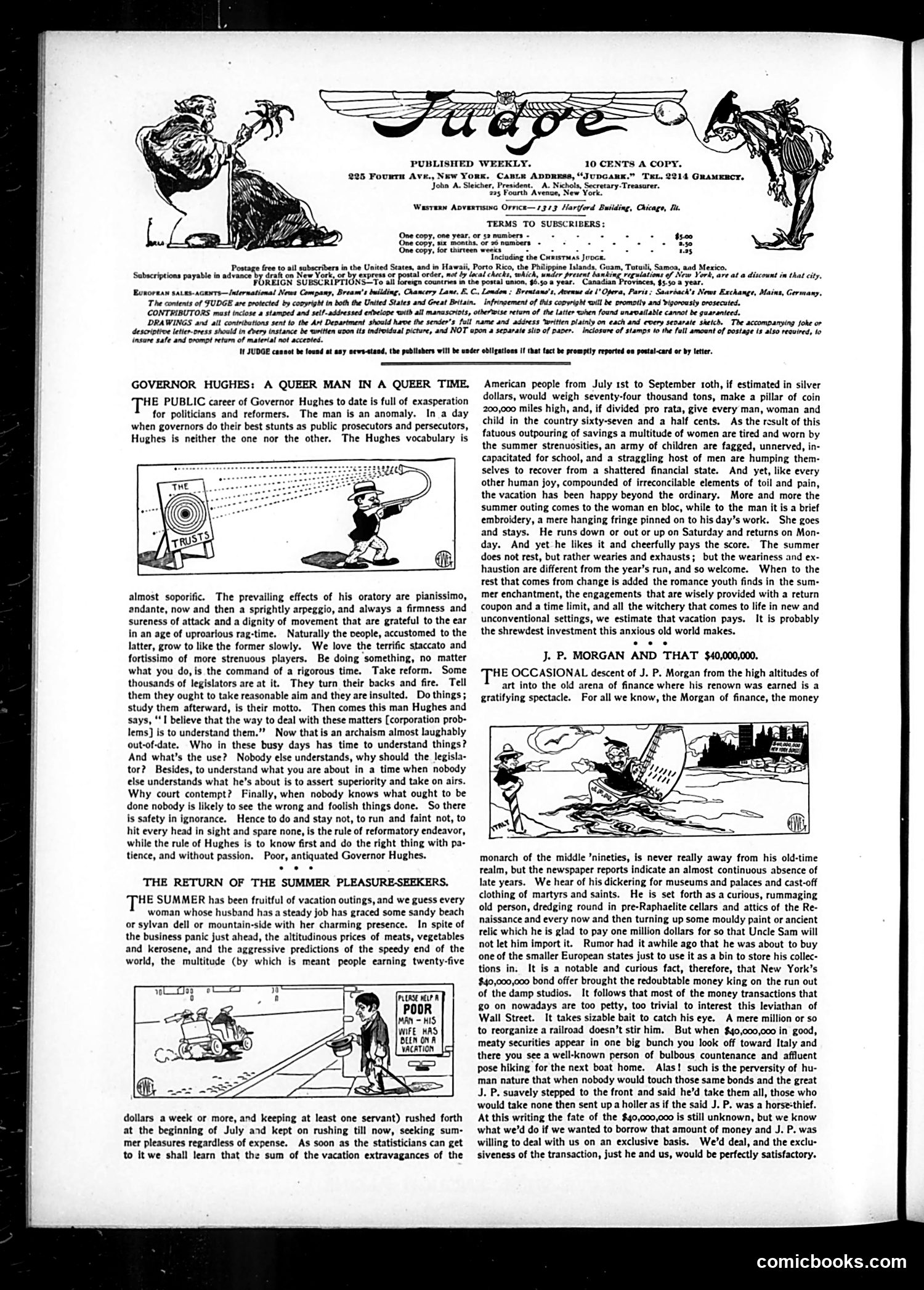
This page contains three satirical pieces mocking prominent figures: 1. **"Governor Hughes: A Queer Man in a Queer Time"** critiques Governor Hughes' public persona as a reformer and prosecutor, suggesting his rhetoric is grandiose but his actual accomplishments are minimal. The satire attacks his verbose oratory style and questions legislators' ability to understand his complex arguments. 2. **"J. P. Morgan and That $40,000,000"** mocks the financier J. P. Morgan's art collecting and wealth. The text sarcastically notes Morgan's continuous acquisitions despite claiming to be retired, highlighting the absurdity of his spending habits and his influence over American finance. 3. **"The Return of the Summer Pleasure-Seekers"** satirizes vacation culture, showing the chaotic nature of summer travel and leisure spending among wealthy Americans.
📄 Transcribed text from this page (OCR, searchable)
Machine-transcribed from the original scan — historical spelling and the odd misread are preserved.
Ss ne, L— Ariss Lq_ZfLbg IOS SS Lg 71D, PUBLISHED WEEKLY. 10 CENTS A COPY. 225 Fourrm Ave., New Yore. Canre Appness,“‘Jupcaux.” Txr. 2214 Gramencr. John A. Sleicher, President. 235 Wasraew Apvarrisinc 0} One copy, one year. orsamumbers- = =e 3 months. or sonumoers.- ee thirteen weeks, One copy, One cop} A. Nichols, Secretary ‘Treasurer. th Avenue, New York. sat 1313 Harvford Building, Chicago, Mt. TERMS TO SUBSCRIBERS: $300 830. jae a nas Inctuding the Cwmistaas Jooce. Postage free to ail subscribers in the United States, and in Hawaii, Porto Rico, the Philippine Islands, Guam, Tutuili, Samoa, aad Mexico. Subscript ible in ad: ‘by draft on New York, or by express or tal order, mot by lacal checks, which, yee! CRIPTIONS To all foreign ai anton, REIGN SUBSCRI’ ‘counines in the post inder present bank: regulations of New York, ave at a discount in that city, ‘Canadian’ % 7 ‘a year. vinces, $5.50 a year, Evnoraan saLes-acewts—/nternational News Company, Bream’s building, Chancery Lane. F.C. London : Brentans's, Avenue de |" Opera, Paris : Saarbach's News Exchange, Mains, Germany, The contents of FUDGE are protected by covyright in both the United States and Great Britain. infringement of this copyright wll be promotty and bigoroasly orosecuted. CONTRIBUTORS mast inciose a stamped and self-addressed entveiope with all manascriots, otherwise return of the Latter when found unavailable cannot be guaranteed. DRAWINGS and ail contribations sent to the Art ‘should have the sender's fall name and address Ywritten plainly on each and seoarate sheich. The ing foke or Department accompanyé descriptive letier-oress should in every instance be written upon its indtoidval picture, and NOT upon a separate slip of paver. inclosure of stamps to the full amount of postage (3 also required, 10 insare safe and orompt retarn of material not accented. 1 JUDGE cannot be found at asy sews-stand, the publishers will be under obligations if that fact be promptly reported ox postal-card or by letter. GOVERNOR HUGHES: A QUEER MAN IN A QUEER TIME. THE PUBLIC career of Governor Hughes to date is full of exasperation for politicians and reformers. The man is an anomaly. In a day when governors do their best stunts as public prosecutors and persecutors, Hughes is neither the one nor the other. The Hughes vocabulary is almost soporific. The prevailing effects of his oratory are pianissimo, andante, now and then a sprightly arpeggio, and always a firmness and sureness of attack and a dignity of movement that are grateful to the ear in an age of uproarious rag-time. Naturally the people, accustomed to the latter, grow to like the former slowly. We love the terrific staccato and fortissimo of more strenuous players. Be doing something, no matter what you do, is the command of a rigorous time. Take reform. Some thousands of legislators are at it. They turn their backs and fire. Tell them they ought to take reasonable aim and they are insulted. Do things; study them afterward, is their motto. Then comes this man Hughes and says, ‘I believe that the way to deal with these matters [corporation prob- lems] is to understand them.” Now that is an archaism almost laughably out-of-date. Who in these busy days has time to understand things? And what’s the use? Nobody else understands, why should the legisla- tor? Besides, to understand what you are about in a time when nobody else understands what he’s about is to assert superiority and take on airs. Why court contempt? Finally, when nobody knows what ought to be done nobody is likely to see the wrong and foolish things done. So there is safety in ignorance. Hence to do and stay not, to run and faint not, to hit every head in sight and spare none, is the rule of reformatory endeavor, while the rule of Hughes is to know first and do the right thing with pa- tience, and without passion. Poor, antiquated Governor Hughes. THE RETURN OF THE SUMMER PLEASURE-SEEKERS. THE SUMMER has been fruitful of vacation outings, and we guess every woman whose husband has a steady job has graced some sandy beach or sylvan dell or mountain-side with her charming presence. In spite of the business panic just ahead, the altitudinous prices of meats, vegetables and Kerosene, and the aggressive predictions of the speedy end of the world, the multitude (by which is meant people earning twenty-five PLUaSe nur A POOR MAN = HIS dollars a week or more, and keeping at least one servant) rushed forth at the beginning of July and kept on rushing till now, seeking sum- mer pleasures regardless of expense. As soon as the statisticians can get to it we shall learn that the sum of the vacation extravagances of the American people from July 1st to September roth, if estimated in silver dollars, would weigh seventy-four thousand tons, make a pillar of coin 200,000 miles high, and, if divided pro rata, give every man, woman and child in the country sixty-seven and a half cents. As the result of this fatuous outpouring of savings a multitude of women are tired and worn by the summer strenuosities, an army of children are fagged, unnerved, in- capacitated for school, and a straggling host of men are humping them- selves to recover from a shattered financial state. And yet, like every other human joy, compounded of irreconcilable elements of toil and pain, the vacation has been happy beyond the ordinary. More and more the summer outing comes to the woman en bloc, while to the man it is a brief embroidery, a mere hanging fringe pinned on to his day’s work. She goes and stays. He runs down or out or up on Saturday and returns on Mon- day. And yet he likes it and cheerfully pays the score. The summer does not rest, but rather wearies and exhausts; but the weariness and ex- haustion are different from the year’s run, and so welcome. When to the rest that comes from change is added the romance youth finds in the sum- mer enchantment, the engagements that are wisely provided with a return coupon and a time limit, and all the witchery that comes to life in new and unconventional settings, we estimate that vacation pays. It is probably the shrewdest investment this anxious old world makes. J. P. MORGAN AND THAT $40,000,000. HE OCCASIONAL descent of J. P. Morgan from the high altitudes of art into the old arena of finance where his renown was earned is a gratifying spectacle. For all we know, the Morgan of finance, the money monarch of the middle ’nineties, is never really away from his old-time realm, but the newspaper reports indicate an almost continuous absence of late years. We hear of his dickering for museums and palaces and cast-off clothing of martyrs and saints. He is set forth as a curious, rummaging old person, dredging round in pre-Raphaelite cellars and attics of the Re- naissance and every now and then turning up some mouldy paint or ancient relic which he is glad to pay one million dollars for so that Uncle Sam will not let him import it. Rumor had it awhile ago that he was about to buy one of the smaller European states just to use it as a bin to store his collec- tions in. It is a notable and curious fact, therefore, that New York’s $40,000,000 bond offer brought the redoubtable money king on the run out of the damp studios. It follows that most of the money transactions that go on nowadays are too petty, too trivial to interest this leviathan of Wall Street. It takes sizable bait to catch his eye. A mere million or so to reorganize a railroad doesn’t stir him. But when $40,000,000 in good, meaty securities appear in one big bunch you look off toward Italy and there you see a well-known person of bulbous countenance and affluent pose hiking for the next boat home. Alas! such is the perversity of hu- man nature that when nobody would touch those same bonds and the great J. P. suavely stepped to the front and said he’d take them all, those who would take none then sent up a holler as if the said J. P. was a horse:thief. At this writing the fate of the $40,000,000 is still unknown, but we know what we’d do if we wanted to borrow that amount of money and J. P. was willing to deal with us on an exclusive basis. We'd deal, and the exclu- siveness of the transaction, just he and us, would be perfectly satisfactory. comicbooks.com