
Judge, 1907-09-14 · page 7 of 16
Judge — September 14, 1907 — page 7: what you’re looking at
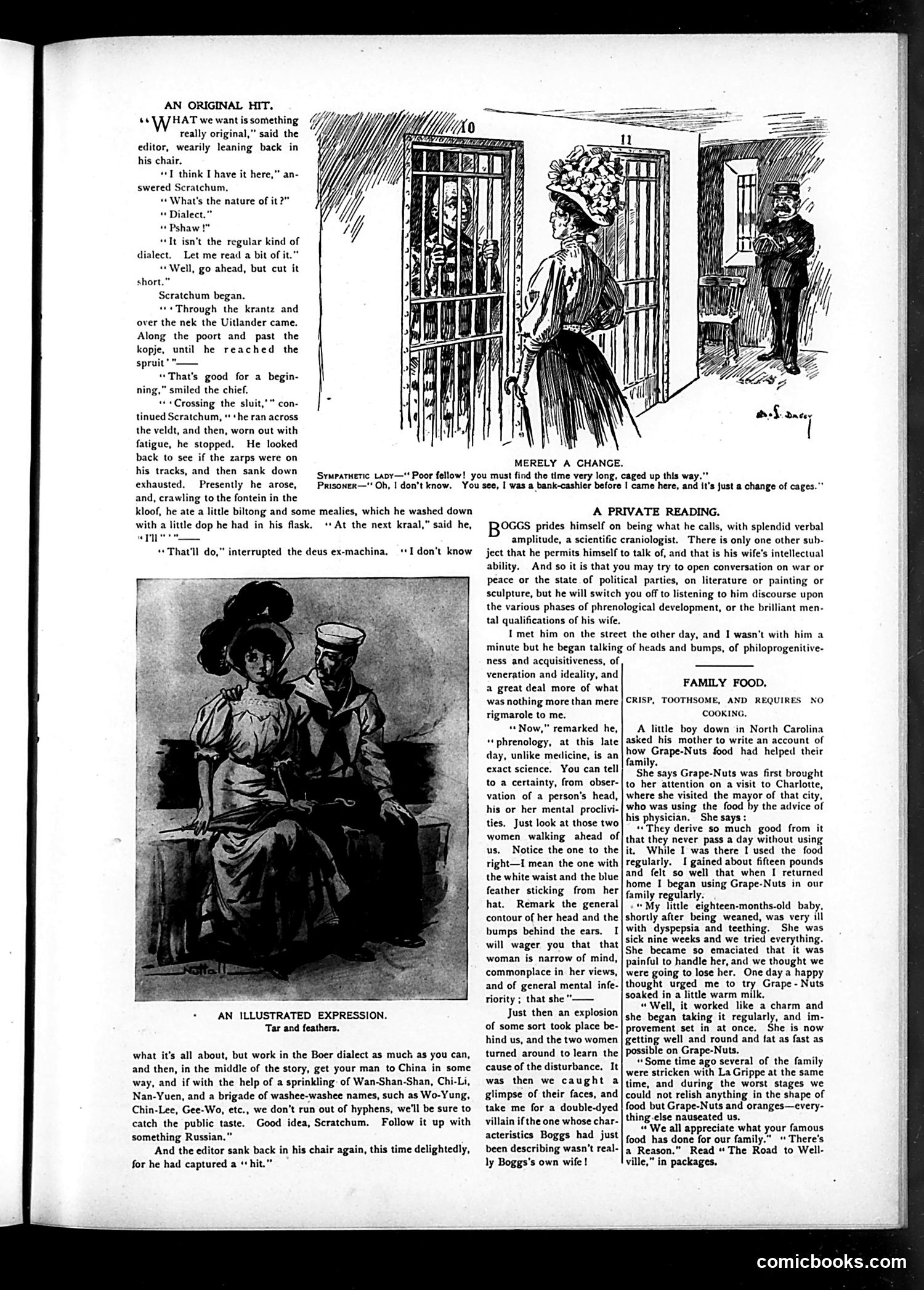
What you’re looking at
This page satirizes both literary pretension and American magazine publishing conventions circa the Boer War era (early 1900s). The top cartoon mocks editors' desperate hunger for "originality." When writer Scratchum proposes mixing incompatible exotic dialects—South African Boer terminology with Chinese names—the editor enthusiastically embraces this absurd pastiche, believing random linguistic exoticism equals genuine creativity. The joke exposes how publications chased sensationalism and ethnic stereotypes rather than actual literary merit. The middle illustration, "Merely a Change," depicts a prisoner telling a sympathetic guard that being caged is merely exchanging one confinement for another—he was previously a bank cashier. The dark humor suggests white-collar work is itself imprisonment. "A Private Reading" ridicules pseudoscientific phrenology (analyzing personality through skull bumps). Boggs pompously lectures about a woman's narrow mind based on her head's shape, only to discover—when she turns around—that she's his own wife, undermining his supposed expertise. These pieces collectively mock intellectual charlatanism and editorial mediocrity prevalent in early-1900s periodicals.
📄 Transcribed text from this page (OCR, searchable)
Machine-transcribed from the original scan — historical spelling and the odd misread are preserved.
AN ORIGINAL HIT. rvs HAT we want is something really original,” said the editor, wearily leaning back in his chair, “T think I have it here,” an- swered Scratchum, «* What's the nature of it?” “Dialect.” « Pshaw !" “Tt isn't the regular kind of dialect. Let me read a bit of it.” “Well, go ahead, but cut it short.” Scratchum began. «Through the krantz and over the nek the Uitlander came. Along the poort and past the kopje, until he reached the spruit’"— “That's good for a begin- ning,” smiled the chief. ««*Crossing the sluit,’” con- tinued Scratchum, * ‘he ran across the veldt, and then, worn out with fatigue, he stopped. He looked back to see if the zarps were on his tracks, and then sank down exhausted. Presently he arose, and, crawling to the fontein in the kloof, he ate a little biltong and some mealies, which he washed down with a little dop he had in his flask. + At the next kraal,” said he, THe “That'll do,” interrupted the deus ex-machina. Prisoner—"* Oh, | don’t know. “I don't know AN ILLUSTRATED EXPRESSION. Tar and feathers. what it’s all about, but work in the Boer dialect as much as you can, and then, in the middle of the story, get your man to China in some way, and if with the help of a sprinkling: of Wan-Shan-Shan, Chi-Li, Nan-Yuen, and a brigade of washee-washee names, such as Wo-Yung, Chin-Lee, Gee-Wo, etc., we don’t run out of hyphens, we'll be sure to catch the public taste. Good idea, Scratchum. Follow it up with something Russian.” ‘And the editor sank back in his chair again, this time delightedly, for he had captured a “hit.” SSS MERELY A CHANGE. Srurateric taoy—‘* Poor fellow! you must find the time very long, caged up this way. You see, I was a bank-cashler before | came here, and it's just a change of cages.” A PRIVATE READING. BOGGS prides himself on being what he calls, with splendid verbal amplitude, a scientific craniologist. There is only one other sub- ject that he permits himself to talk of, and that is his wife's intellectual ability. And so it is that you may try to open conversation on war or peace or the state of political parties, on literature or painting or sculpture, but he will switch you off to listening to him discourse upon the various phases of phrenological development, or the brilliant men- tal qualifications of his wife. I met him on the street the other day, and I wasn’t with him a minute but he began talking of heads and bumps, of philoprogenitive- ness and acquisitiveness, of veneration and ideality, and a great deal more of what was nothing more than mere rigmarole to me. “Now,” remarked he, ««phrenology, at this late day, unlike medicine, is an exact science. You can tell to a certainty, from obser- vation of a person's head, his or her mental proclivi- ties. Just look at those two women walking ahead of| us. Notice the one to the right—I mean the one with the white waist and the blue feather sticking from her hat. Remark the general contour of her head and the bumps behind the ears. I will wager you that that woman is narrow of mind, commonplace in her views, and of general mental infe- riority ; that she "—— Just then an explosion of some sort took place be- hind us, and the two women turned around to learn the cause of the disturbance. It was then we caught a glimpse of their faces, and take me for a double-dyed villain ifthe one whose char- acteristics Boggs had just been describing wasn't real- ly Boggs’s own wife! FAMILY FOOD. CRISP, TOOTHSOME, AND REQUIRES NO. COOKING. A little boy down in North Carolina asked his mother to write an account of how Grape-Nuts food had helped their family. She says Grape-Nuts was first brought to her attention on a visit to Charlotte, where she visited the mayor of that city, who was using the food by the advice of his physician. She says: «They derive so much good from it that they never pass a day without using it. While I was there I used the food regularly. I gained about fifteen pounds and felt so well that when I returned home I began using Grape-Nuts in our family regularly. . My little eighteen-months-old baby, shortly after being weaned, was very ill with dyspepsia and teething. She was sick nine weeks and we tried everything. She became so emaciated that it was painful to handle her, and we thought we were going to lose her. One day a happy thought urged me to try Grape - Nuts soaked in a little warm milk. “Well, it worked like a charm and she began taking it regularly, and im- provement set in at once. She is now getting well and round and fat as fast as possible on Grape-Nuts. “Some time ago several of the family were stricken with La Gripe at the same time, and during the worst stages we could not relish anything in the shape of food but Grape-Nuts and oranges—every- thing-else nauseated us. “ We all appreciate what your famous food has done for our family.” “ There's a Reason.” Read “The Road to Well- ville,” in packages, comicbooks.com