
A complete issue · 16 pages · 1907
Judge — July 20, 1907
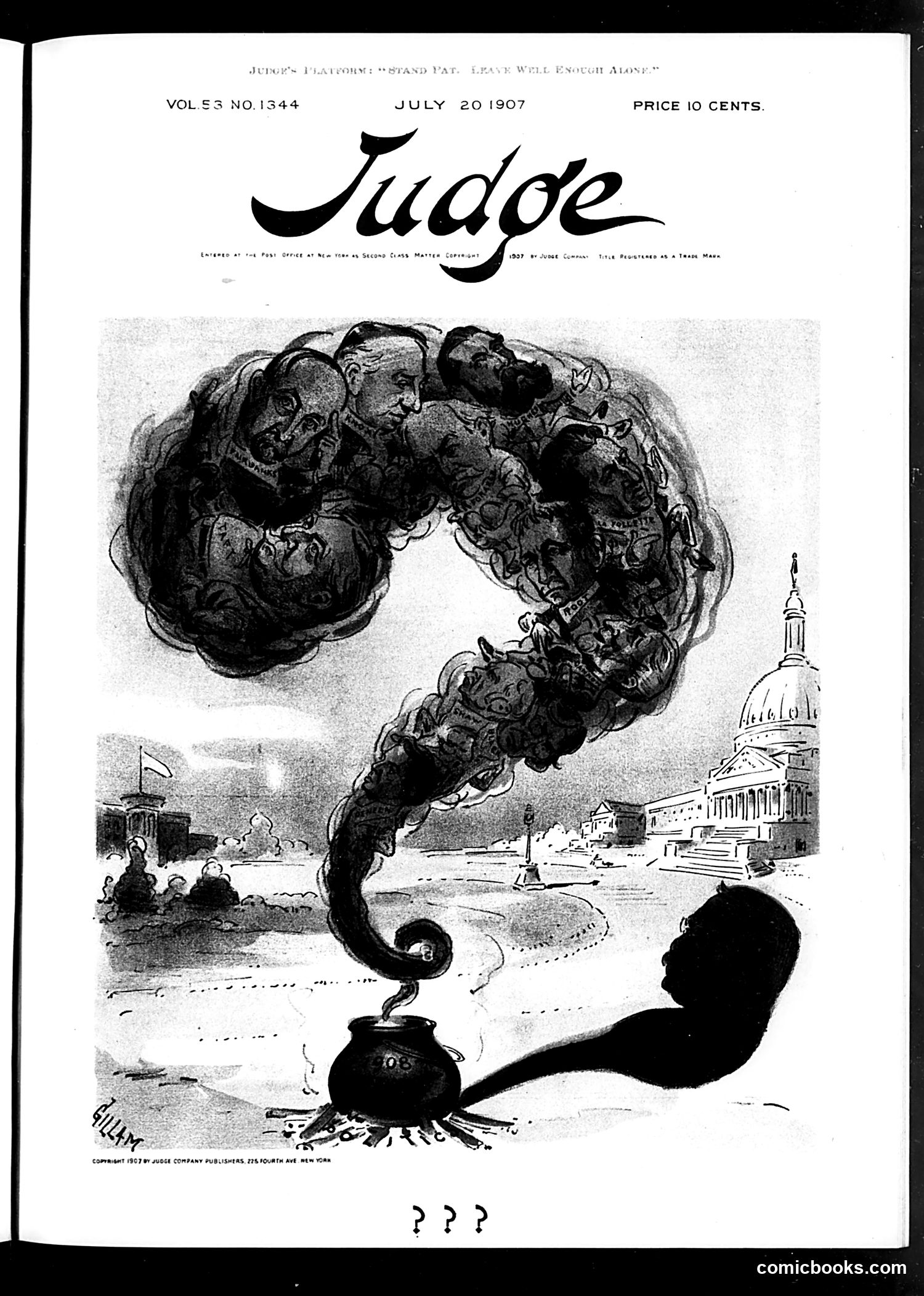
**July 20, 1907** This satirical cartoon depicts a massive genie or demon emerging from a pot/bomb labeled with a question mark, looming over Washington D.C.'s Capitol building. The creature's body is formed from dozens of grotesque human faces twisted together. The imagery appears to reference a political or social crisis of 1907—likely the financial panic that struck that year. The question marks suggest uncertainty about consequences or solutions. The bomb/pot suggests an explosive situation, while the demon genie represents chaos or danger unleashed upon the nation. The silhouetted hand at right may represent a political figure or the public, seemingly powerless before the crisis. Without additional text identifying specific targets, the exact political critique remains somewhat unclear, though it clearly warns of impending disaster.
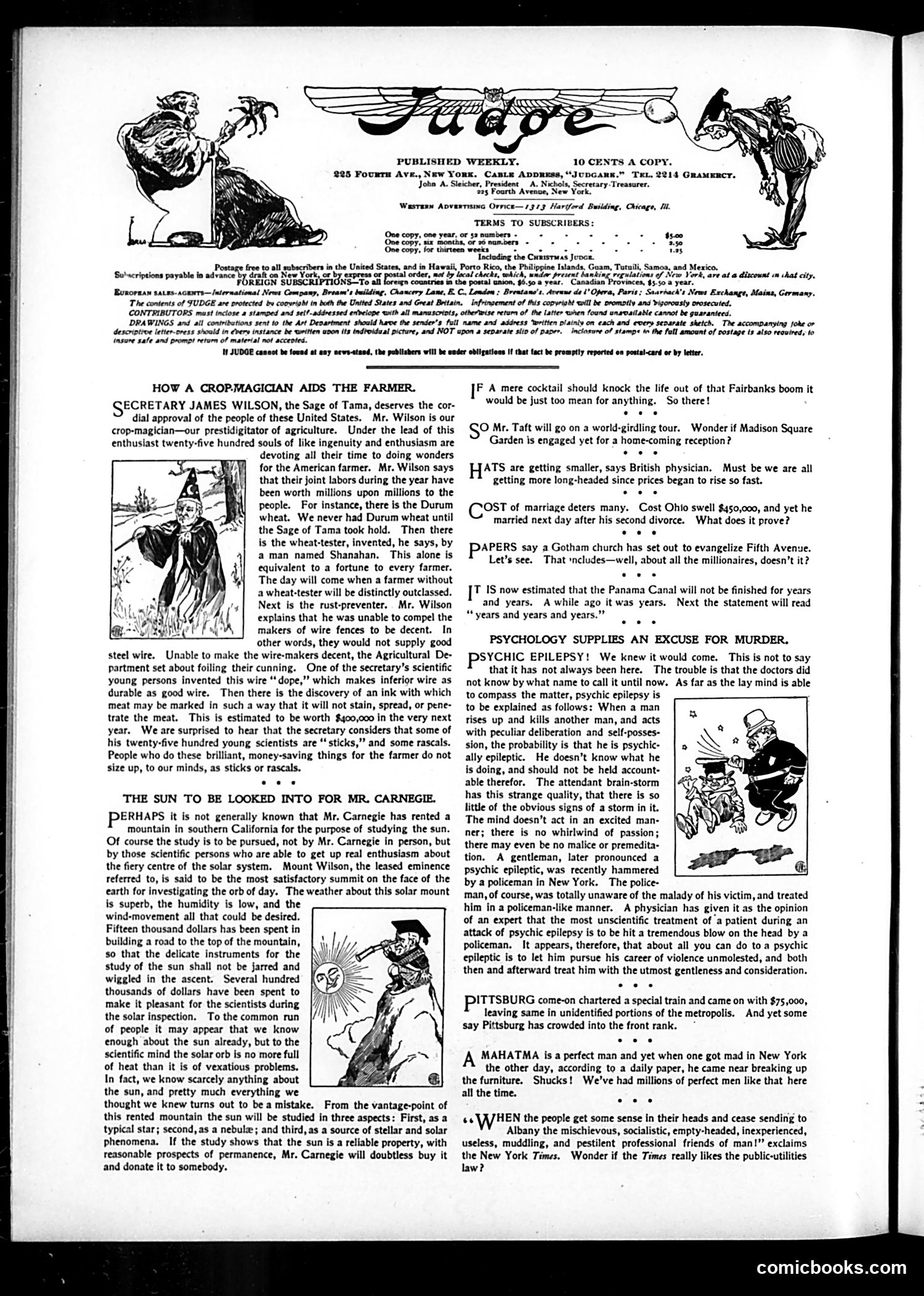
This page contains several satirical pieces typical of Judge magazine's commentary style: **"How a Crop-Magician Aids the Farmer"** features Secretary James Wilson of the Department of Agriculture, depicted as performing magic tricks. The satire suggests Wilson's agricultural initiatives are more theatrical illusion than practical benefit to farmers—a common critique of government programs that promised much but delivered little. **"The Sun to Look Into Mr. Carnegie"** mocks Andrew Carnegie's expensive solar observatory project, questioning whether studying the sun represents a worthwhile use of his vast wealth compared to direct philanthropic benefit. The remaining items are brief satirical observations on contemporary topics: hat sizes, marriage costs, church fundraising, and the Panama Canal delays—typical social commentary of the era.
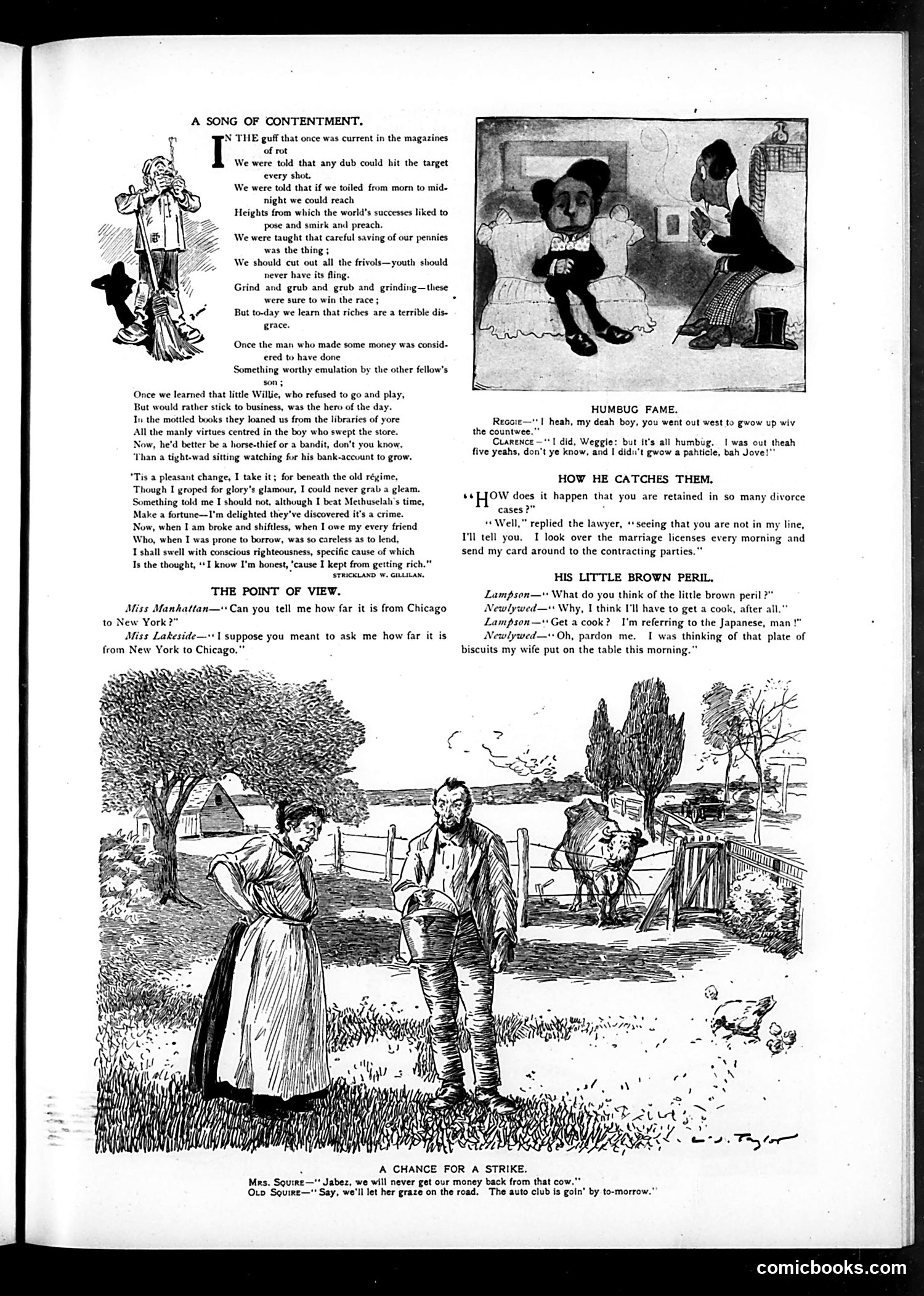
This page contains several satirical pieces reflecting late 19th/early 20th-century social anxieties: **"A Song of Contentment"** mocks working-class advice about financial restraint—saving pennies, avoiding frivolous spending—while the wealthy accumulate riches. The poem's bitter conclusion reveals the hypocrisy: the wealthy man who "made some money" earns "emulation" while workers remain poor despite following prescribed frugality. **"Humbug Fame"** satirizes a man's boastful claims about his son's supposed success, which proves fabricated—a commentary on American pretension and empty bragging. **"The Point of View"** is a simple geographic/perspective joke about directions between cities. **"A Change for a Strike"** depicts rural poverty, with a farmer's wife resigned to never recovering lost money, accepting their desperate circumstances. Overall, the page reflects Judge's satirical focus on class disparity, false promises, and economic hardship of ordinary Americans.
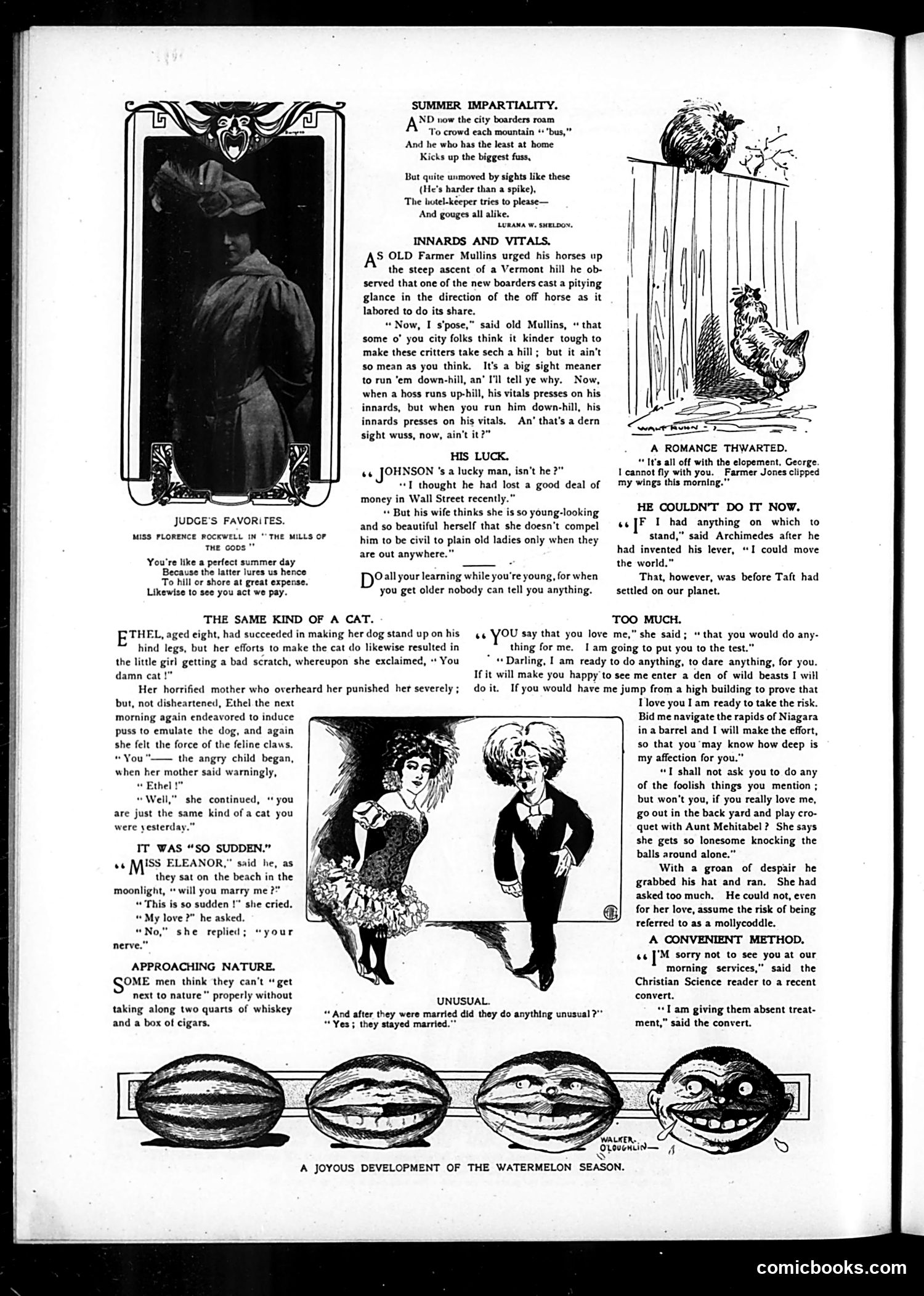
This page contains several humorous vignettes rather than political cartoons. The pieces include: **"Summer Impartiality"** and **"Innards and Vitals"**: Rural humor about city people struggling with farm life—the joke being that running uphill strains different body parts than running downhill. **"Judge's Favorites"**: A photograph of Miss Florence Rockwell from "The Mills of the Gods." **"His Luck"** and **"He Couldn't Do It Now"**: Romantic comedies about courtship and marriage, playing on contemporary dating anxieties. **"Too Much"**: A woman testing her suitor's love through increasingly ridiculous challenges. **"Approaching Nature"**: Men who can't enjoy nature without alcohol. **Bottom cartoon**: A visual gag showing watermelon progression, anthropomorphized with increasingly silly faces. The page reflects early 20th-century American middle-class concerns: rural-urban divides, romance, and leisure pursuits.
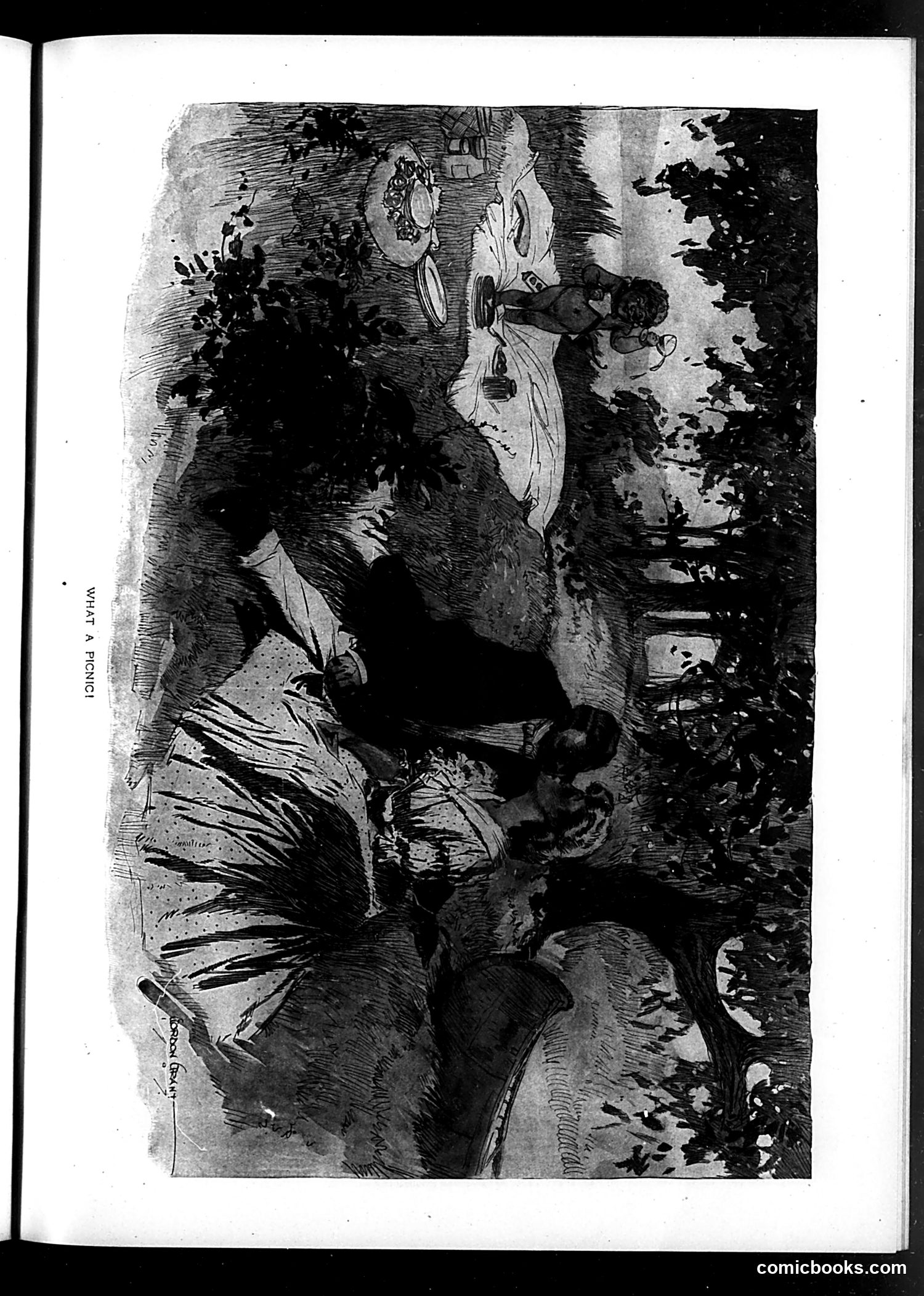
The image appears to be rotated 90 degrees, making it difficult to read clearly, but the engraving style and layout suggest this is a satirical Judge magazine illustration, likely from the late 19th century. The OCR text provided contains only "JUDGE'S PENCILINGS" (the magazine's section header) and a website reference, offering no contextual information about the cartoon's subject, figures, or satirical message. **I cannot reliably identify the specific figures, political references, or satirical intent without legible text or clearer imagery.** To provide accurate analysis, I would need either a properly oriented image or OCR text that includes captions, labels, or article content accompanying this illustration. Guessing at identities or meanings would violate the accuracy-first principle requested.
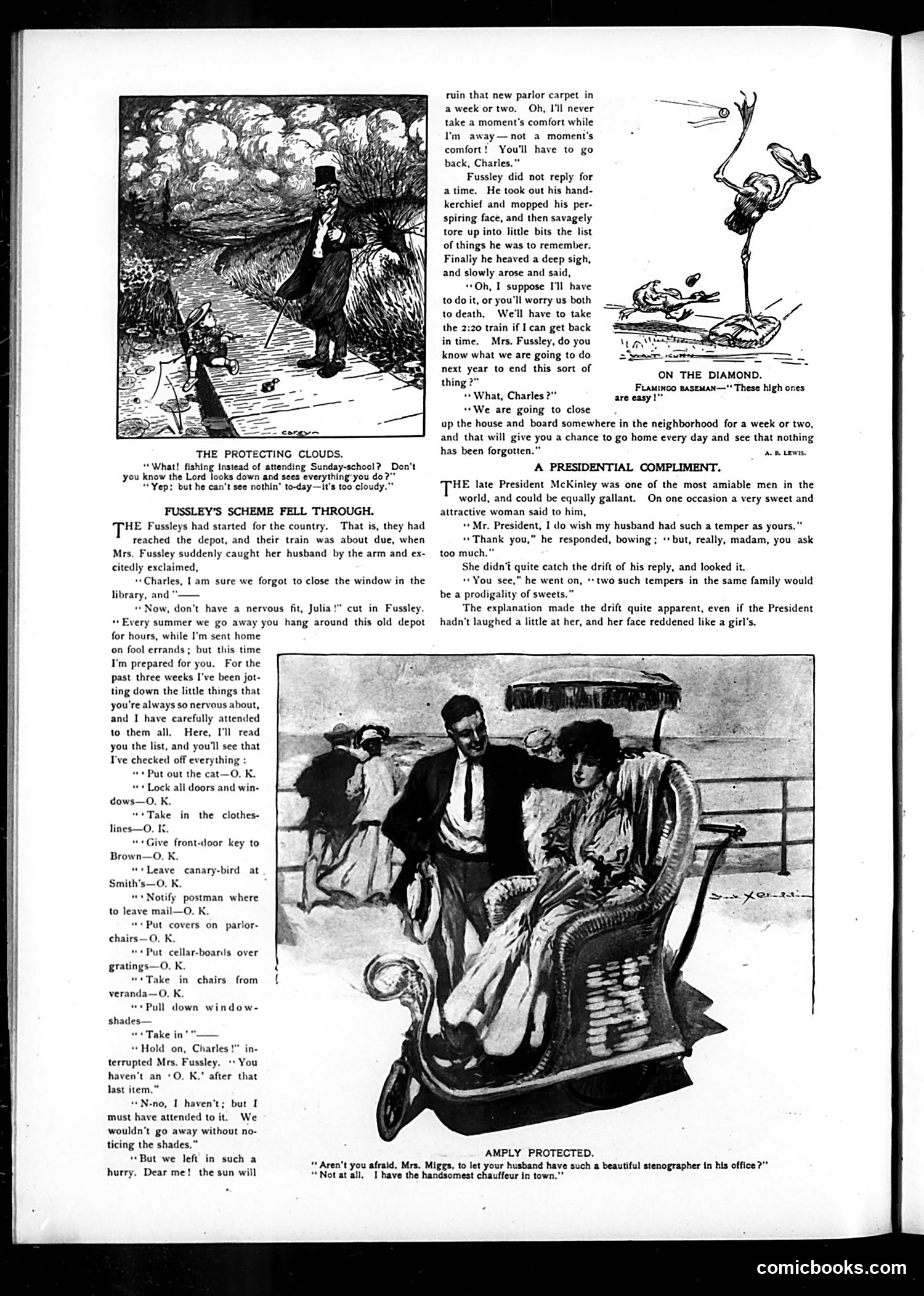
This page contains three satirical pieces about domestic life and manners circa early 1900s: **"Fussley's Scheme Fell Through"** mocks anxious wives and hen-pecked husbands. Mr. Fussley meticulously prepares a checklist for their country trip to prevent his nervous wife's complaints, but she immediately finds an unchecked item, undermining his efforts. The joke satirizes the stereotype of nagging wives and defeated husbands. **"A Presidential Compliment"** references the late President McKinley, depicting him as gallant and witty. When a woman wishes her husband had McKinley's temper, he cleverly responds that two such temperaments in one family would be excessive—a polite deflection that makes her blush. This flatters McKinley's reputation for affability. **"Amply Protected"** is a brief joke about marital jealousy: a wife isn't worried about her husband's attractive stenographer because she employs a handsome chauffeur—suggesting mutual "protection" through counter-temptation. All three pieces reflect early-20th-century gender dynamics and domestic anxieties.
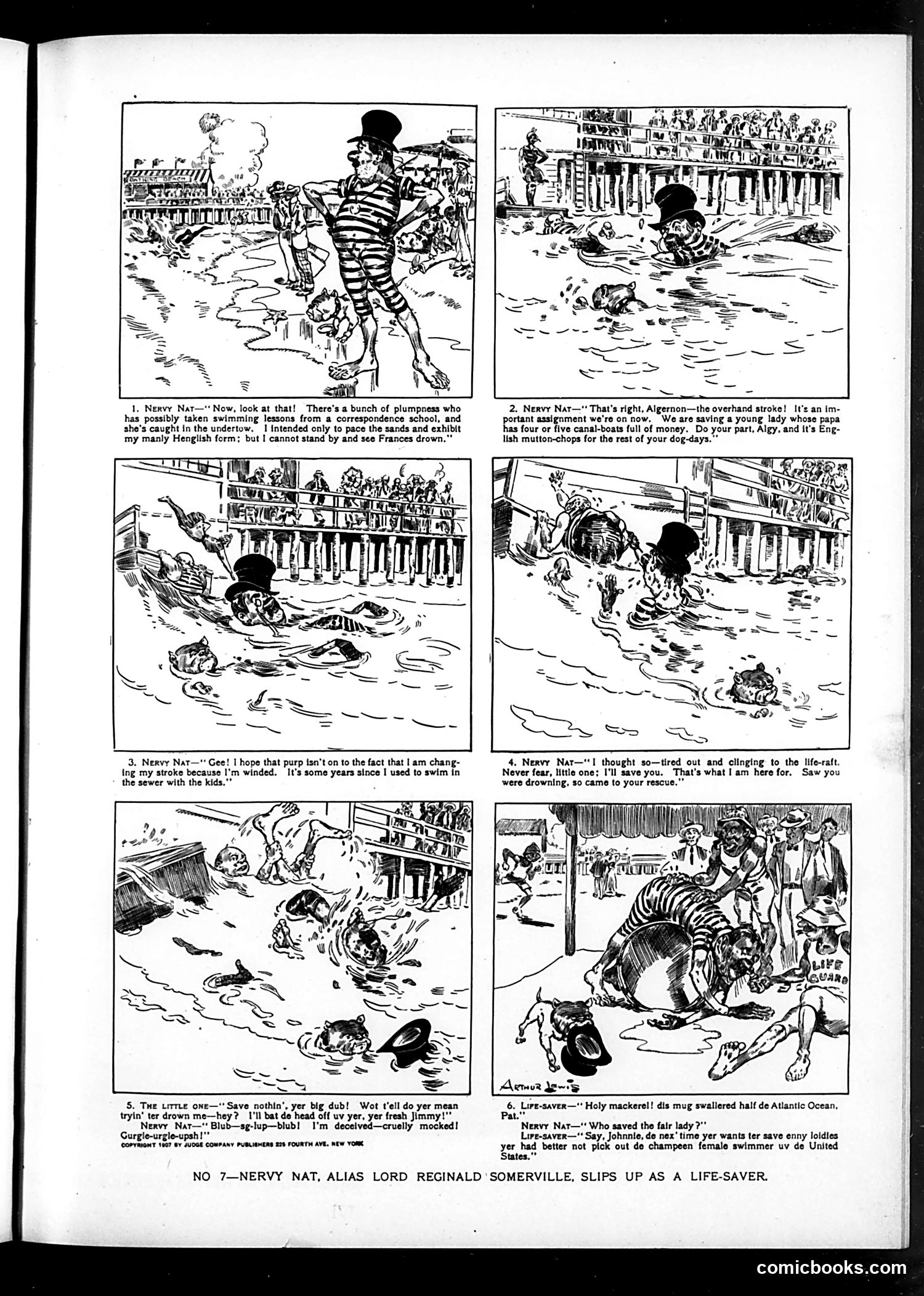
This six-panel comic strip satirizes a pompous British character ("Lord Reginald Somerville," nicknamed "Nervy Nat") who attempts to rescue a drowning woman to impress her wealthy father. The satire works through ironic deflation: Nat poses as a noble rescuer motivated by chivalry, but his aside reveals he's actually motivated by the prospect of financial reward ("four or five canal-boats full of money"). His pretensions to English superiority ("manly Henglish form") crumble when he discovers his supposed victim is actually a champion female swimmer who nearly drowns *him* instead. The final panel delivers the joke's moral: his class-based assumptions about who needs saving prove spectacularly wrong. The working-class life-saver's dialect-heavy conclusion mocks Nat's bumbling incompetence while celebrating authentic capability over affected gentility. The cartoon uses physical comedy and social reversal to lampoon snobbery and false gallantry.
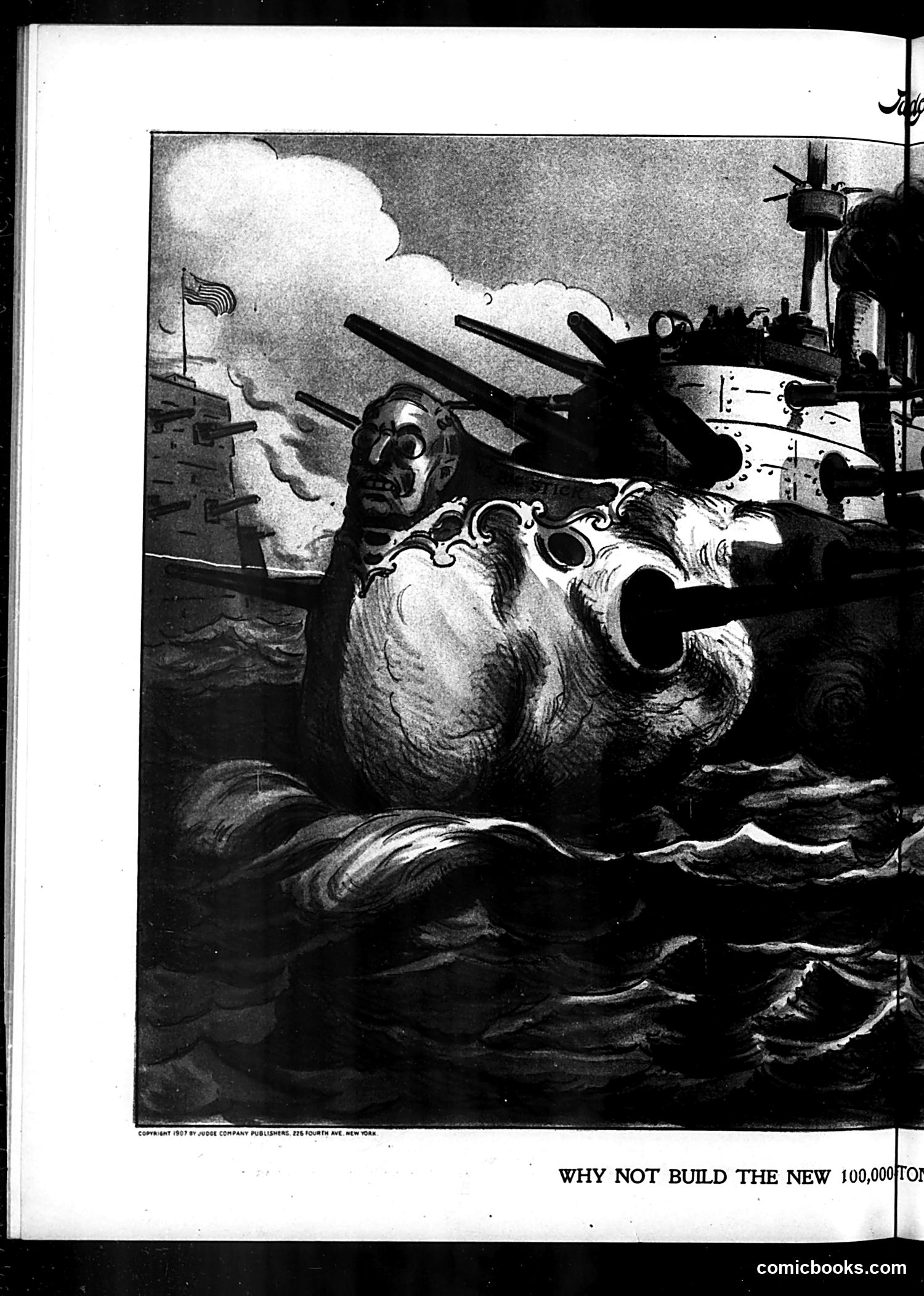
This appears to be a WWI-era political cartoon from Judge magazine. The image depicts a grotesque, corpulent figure (likely representing Germany or Kaiser Wilhelm II) surrounded by military hardware—cannons, aircraft, and a warship. The figure's bloated appearance and distressed expression suggest the costs of militarism and warfare. The partially visible text below reads "WHY NOT BUILD THE NEW 100,000 TO[N]..." referring to American military expansion or naval construction proposals. The cartoon's message appears critical of military buildup generally, using caricature and grotesque imagery to satirize the human and financial toll of warfare and arms racing. The contrasting scale between the figure and military machinery emphasizes how war consumes resources and lives.
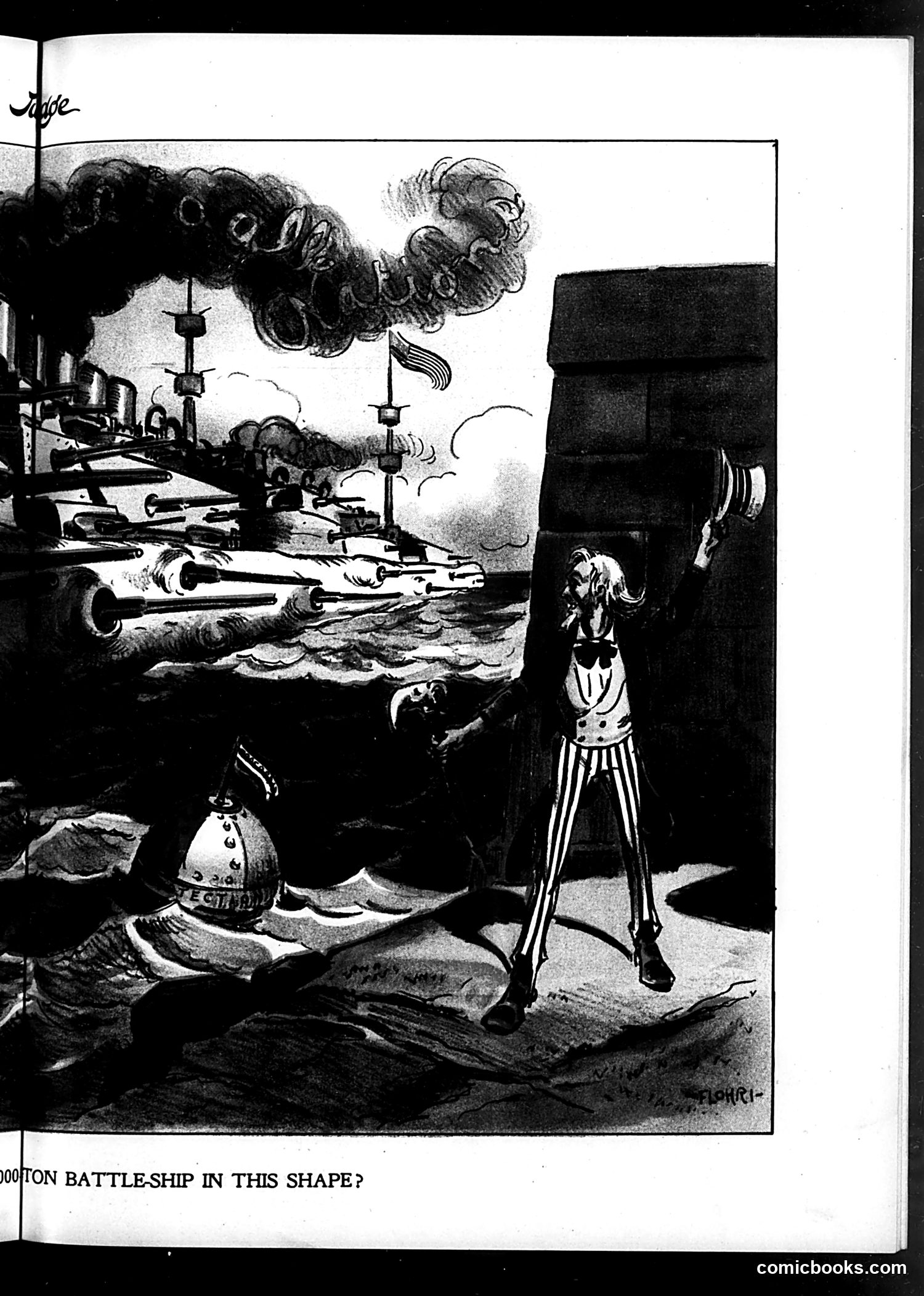
This appears to be a satirical cartoon from *Judge* magazine depicting a military or naval scene. A figure in striped clothing stands before what seems to be a fortified position or battleship, surrounded by cannons, ammunition, and military equipment with smoke billowing above. The partially visible text at bottom reads "...TON BATTLESHIP IN THIS SHAPE?" suggesting commentary on the condition or state of a specific battleship (likely a U.S. Navy vessel). The cartoon's satirical intent seems to critique either military preparedness, naval policy, or the physical condition of warships—a common topic in early 20th-century American political humor. Without the complete caption or date, specific figures remain unclear, though the scene clearly mocks some aspect of American military readiness.
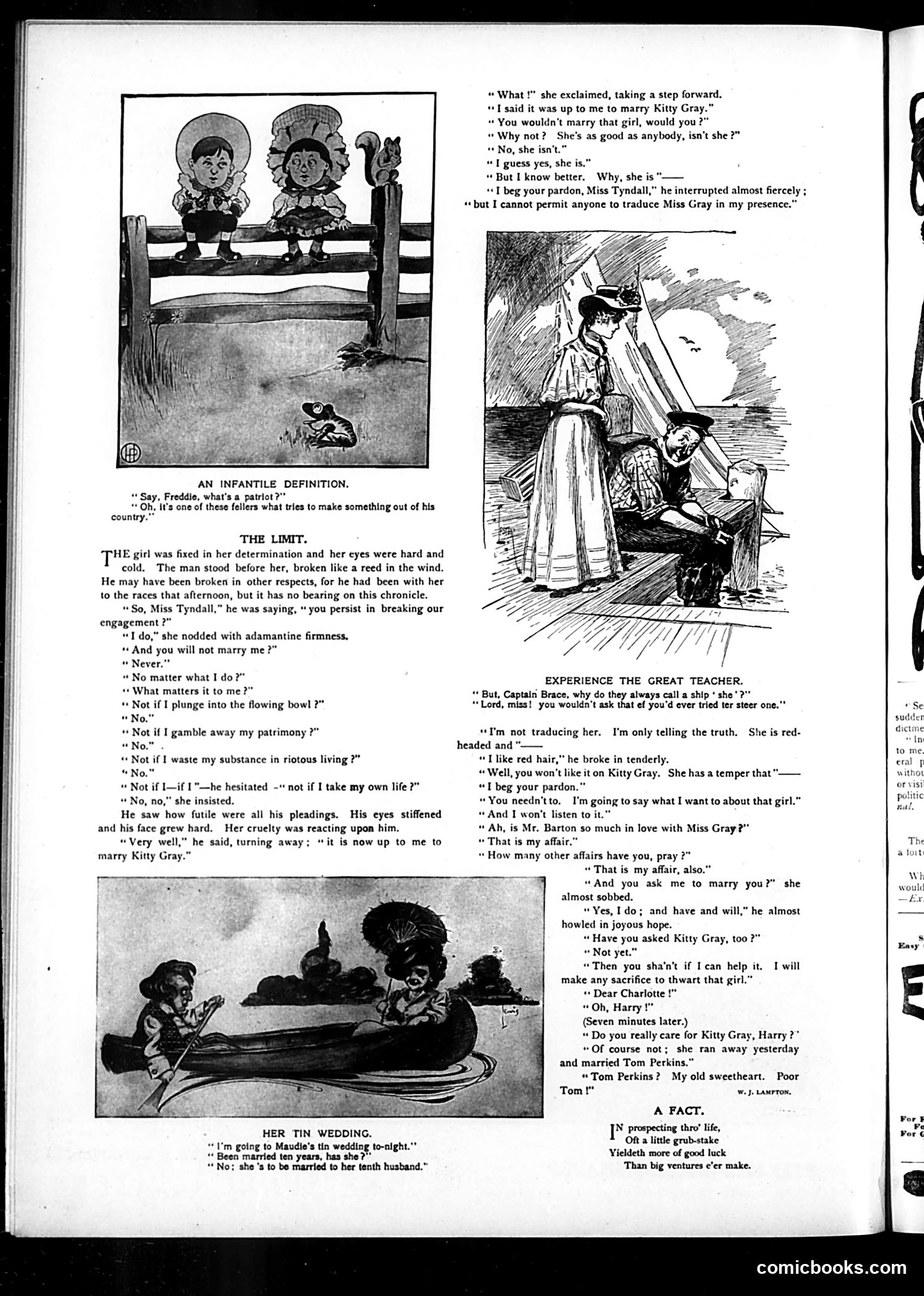
This page contains three satirical stories mocking romantic entanglement and social hypocrisy: **"The Limit"** depicts a man begging his fiancée Miss Tyndall not to break their engagement, offering increasingly desperate pledges (even suicide). She remains unmoved—until he announces he'll marry Kitty Gray instead. Suddenly the rival appears irresistible; he defends "Miss Gray" fiercely against any criticism, claiming to love her red hair and temperament. The joke: his "love" is pure spite—he's weaponizing romance as retaliation for rejection. **"Her Tin Wedding"** is a brief joke about serial marriage: a woman attending her friend's "tin wedding" reveals the bride is marrying her *tenth* husband, not celebrating ten years of marriage. **"Experience the Great Teacher"** shows a ship captain explaining why vessels are called "she"—because steering one is as difficult as managing a woman. The satire targets masculine smugness about female nature. The cartoons and accompanying illustrations reinforce themes of romantic manipulation, shallow male understanding of women, and the absurdity of social conventions around courtship and marriage.
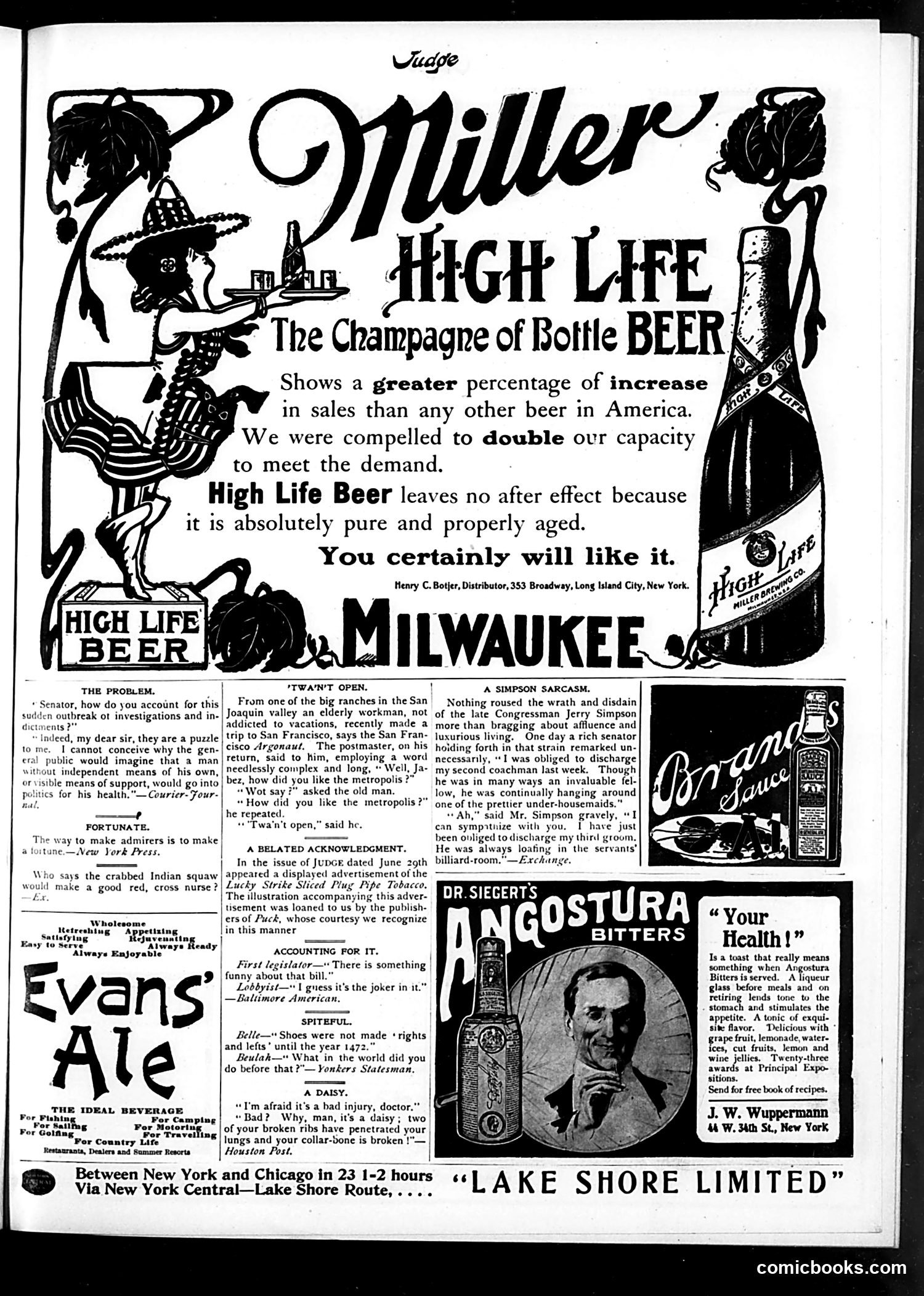
This page is primarily **advertising**, featuring a large Miller High Life beer advertisement at the top. The ad claims the beer shows greater sales increases than competitors and must have doubled capacity to meet demand—a boast common in early 20th-century beer marketing. The remainder consists of **short humorous anecdotes** typical of Judge's content: - "The Problem" satirizes a senator investigating others while benefiting from corruption himself - "A Simpson Sarcasm" references **Jerry Simpson**, a late 19th-century Populist congressman known for criticizing the wealthy; the joke shows a rich senator complaining about servant problems while Simpson, famously humble, sympathizes sarcastically - Other brief jokes cover mundane topics (a ranch worker's trip, shoe construction history, medical injuries) The page also includes advertisements for **Evans Ale** and **Dr. Siegert's Angostura Bitters**, typical patent medicine/alcohol ads of the era. The satirical content is mild and domestic, lacking sharp political edge. The Simpson reference is the only item with historical weight—appealing to readers familiar with Populist-era class conflict debates.
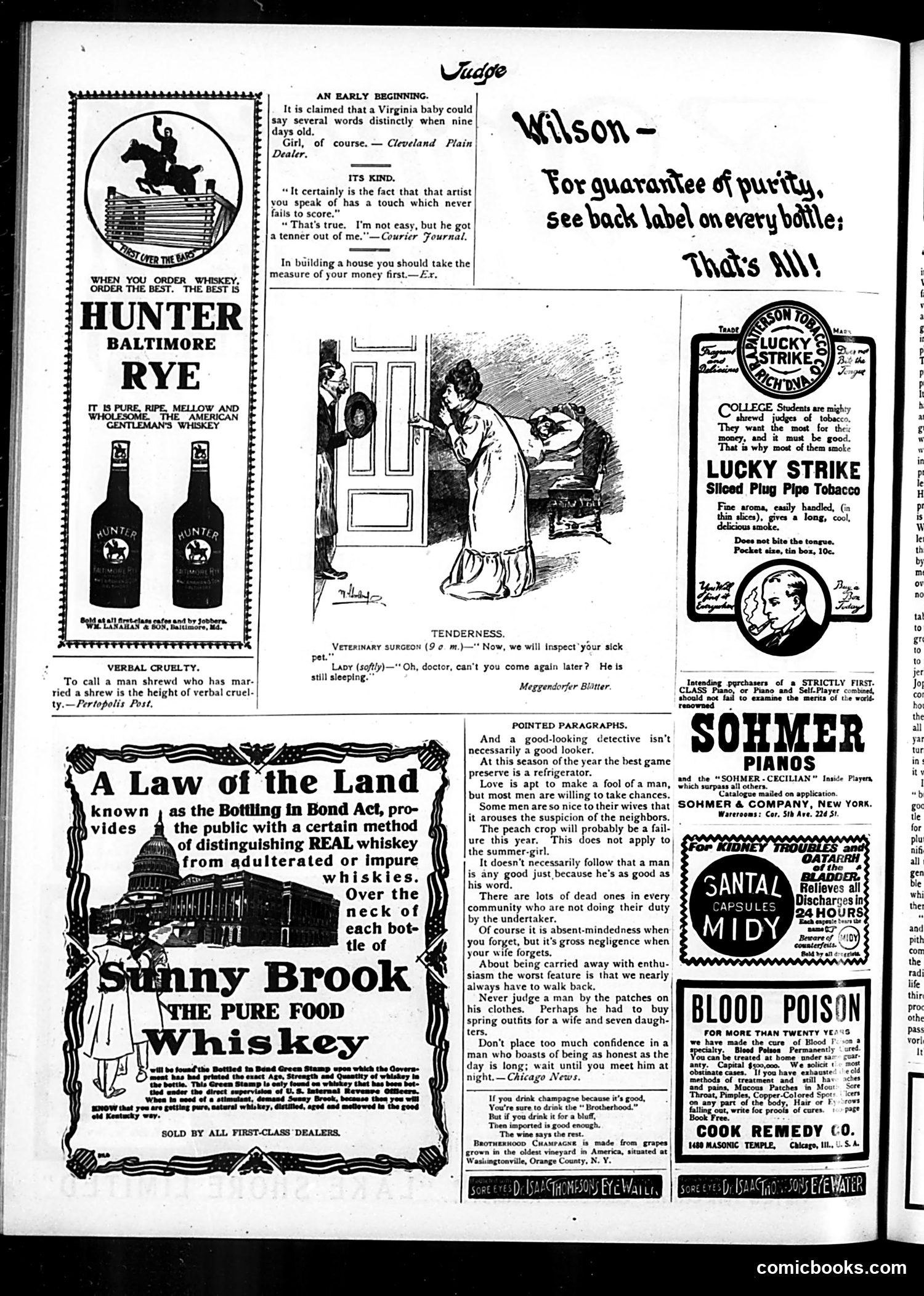
This page is primarily **advertising**, featuring multiple whiskey and patent medicine ads typical of early 20th-century magazines. The small editorial content includes: **"Verbal Cruelty"** and **"Tenderness"**: Brief humor pieces—one a pun about calling a shrewd man who married a "shrew" clever, the other a joke about a veterinarian visiting a sleeping sick pet. **"Pointed Paragraphs"**: Generic witticisms about love, marriage, and human nature (e.g., "Love is apt to make a fool of a man"). **The main cartoon** shows a domestic scene of a woman in a nightgown confronting a man at a doorway—likely illustrating one of the marital humor pieces. The bulk consists of **advertisements**: Hunter Baltimore Rye whiskey, Sunny Brook whiskey, Lucky Strike tobacco, Sohmer pianos, and dubious patent medicines (Santal Capsules for venereal disease, Cook Remedy Co. for "Blood Poison"). These ads reflect both the era's heavy alcohol marketing and the prevalence of fraudulent medical treatments—a significant social concern of the period.
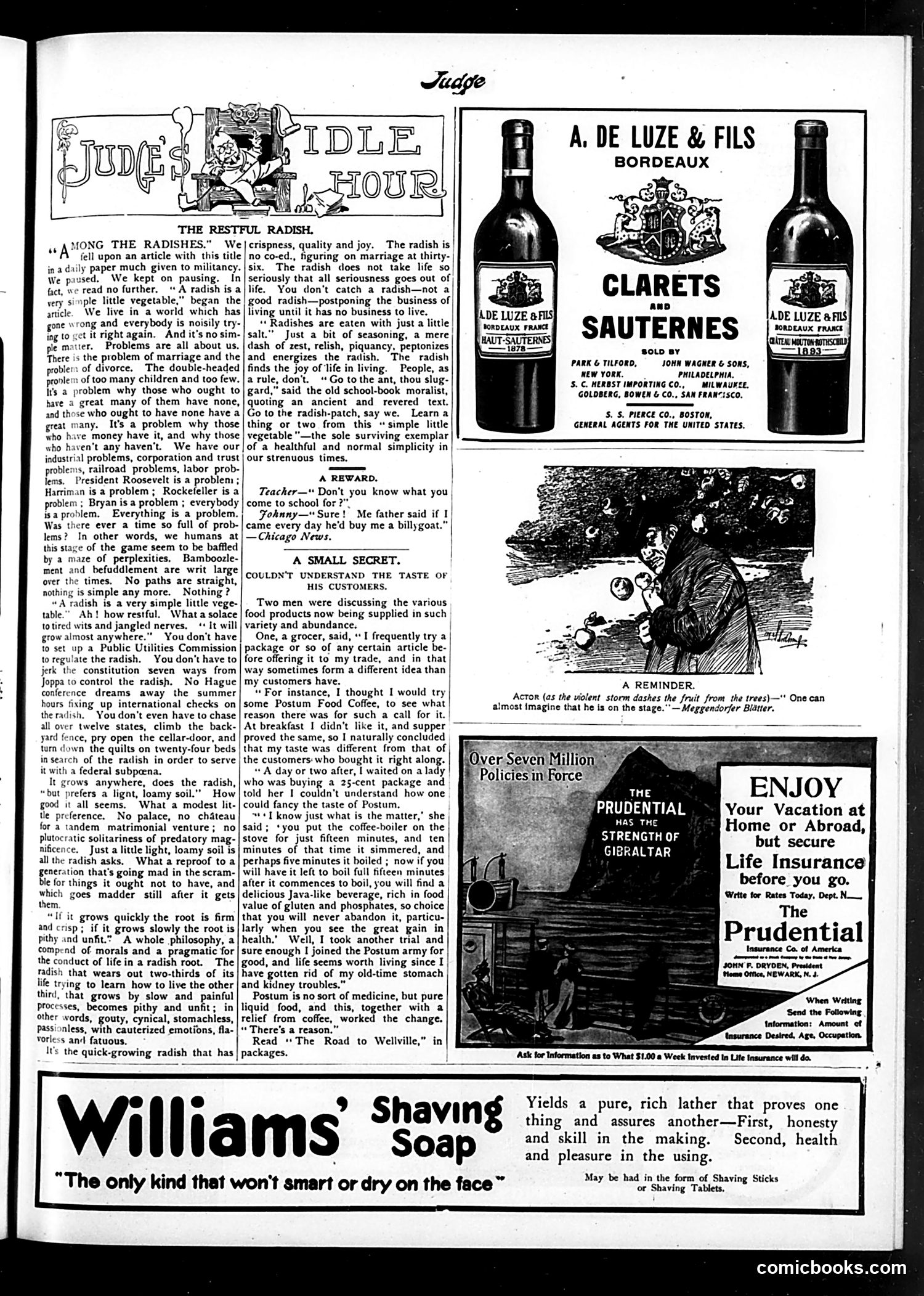
This essay-cartoon uses the radish as philosophical satire about early 1900s American anxieties. The author contrasts the radish's simplicity with the era's overwhelming complexity: problems plague everything—marriage, divorce, labor, corporations, railroads, and prominent figures like Roosevelt, Harriman, Rockefeller, and Bryan. The radish becomes an ironic moral exemplar. It thrives anywhere without regulation (no "Public Utilities Commission"), grows quickly and vigorously, accepts modest conditions ("light, loamy soil"), and finds joy in simple seasoning and living. This mocks contemporary society's obsessive problem-solving, its demand for luxurious conditions, and its tendency toward cynicism and over-intellectualization. The satire suggests Americans have lost the radish's straightforward vitality—becoming "gouty, cynical, stomachless" through slow, painful striving. The piece urges returning to simplicity and quick action rather than endless deliberation. It's simultaneously humorous advice-column wisdom and sharp social critique of Progressive-era anxieties.
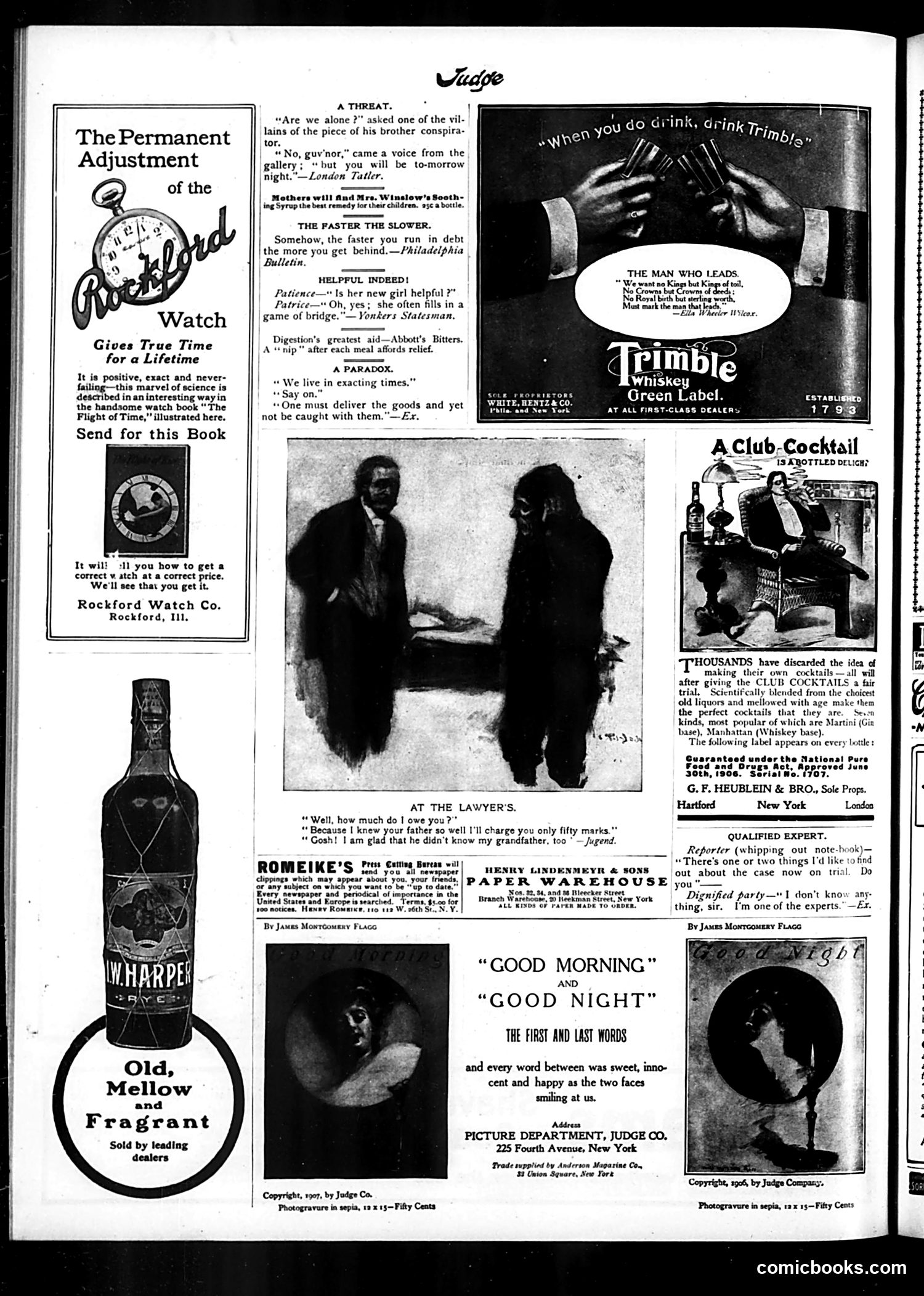
This page mixes advertisements with humor pieces typical of early 1900s satirical journalism. The main content includes: **Cartoons/Jokes:** Brief one-liners satirizing everyday situations—a theater audience member threatening villains, a servant helping with bridge games, legal fees, and marital affection. These are generic social humor rather than political commentary. **Advertisements:** The page heavily features product ads (Rockford watches, Trimble whiskey, Club Cocktails, Harper whiskey, paper warehouse services) alongside the editorial content—standard magazine monetization of the era. **Illustrated Stories:** Two sentimental domestic scenes ("Good Morning" and "Good Night") depicting couple interactions, reflecting period taste for romantic imagery. **Notable:** The "Qualified Expert" dialogue jokes about a reporter and witness in a trial, mocking courtroom procedures common to readers' experience. There are no identifiable political figures or current-events satire visible. This appears to be a typical Judge issue mixing light social humor, sentimental illustration, and commercial advertisements for a general audience.
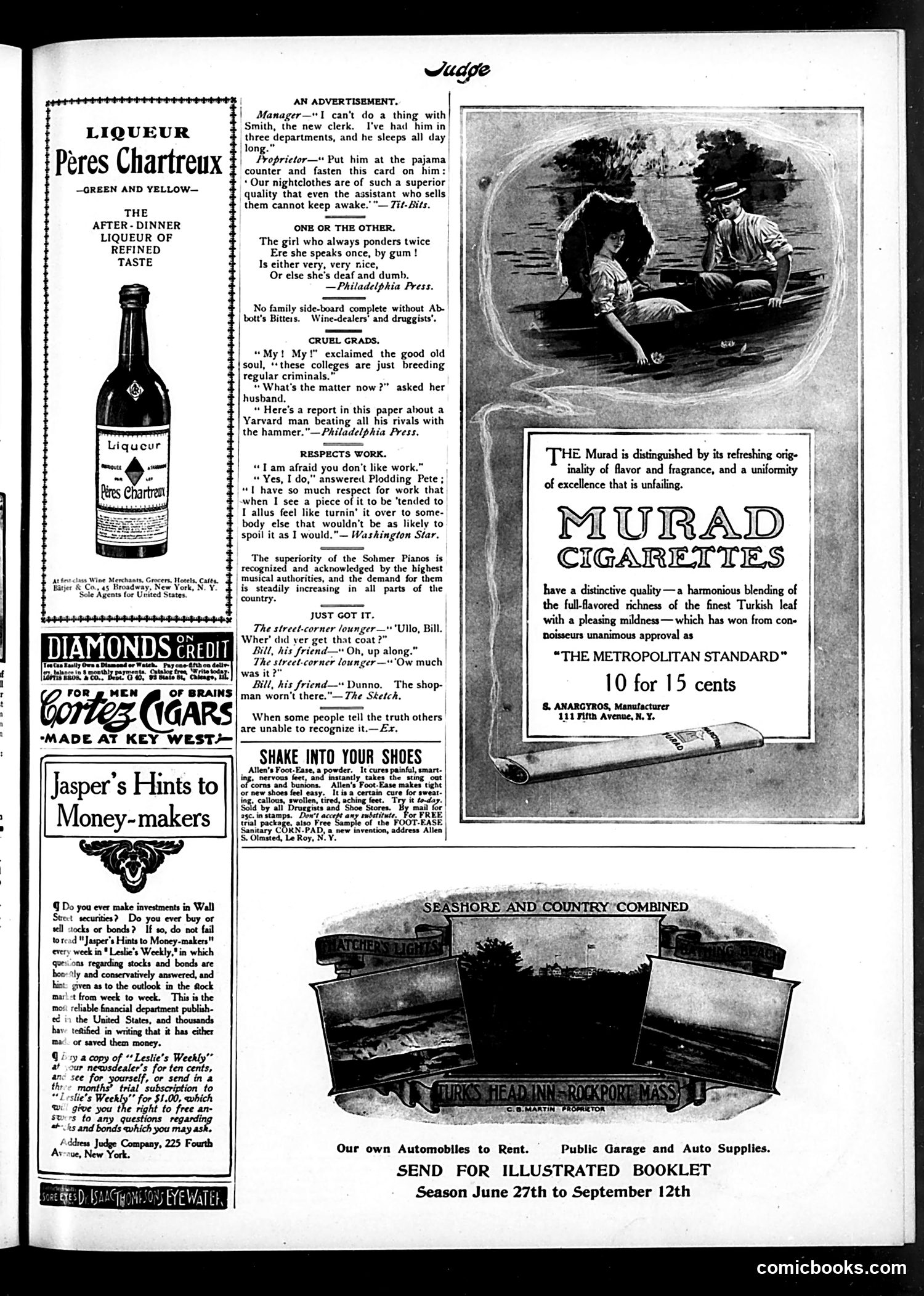
This page is primarily composed of advertisements and brief humorous items typical of Judge magazine's satirical format. The main cartoon content consists of short joke items scattered throughout. One notable piece mocks Harvard students as "criminals," referencing a newspaper report about a Harvard man "beating all his rivals with the hammer"—likely referring to a track-and-field hammer throw competition, which the joke misrepresents as violent criminality to satirize both sensationalist newspaper reporting and elite college culture. Another item jokes about work ethic: a character named "Plodding Pete" claims to respect work so much he always delegates it to others, satirizing the hypocrisy of those who claim virtue while avoiding labor. A third joke plays on a street-level transaction where a man acquired a coat from a shop with no shopkeeper present—implying theft, treated as a lighthearted urban anecdote. The page is otherwise dominated by period advertisements for liqueurs, cigars, diamonds, foot powder, and cigarettes—typical commercial content interspersed with Judge's satirical humor.
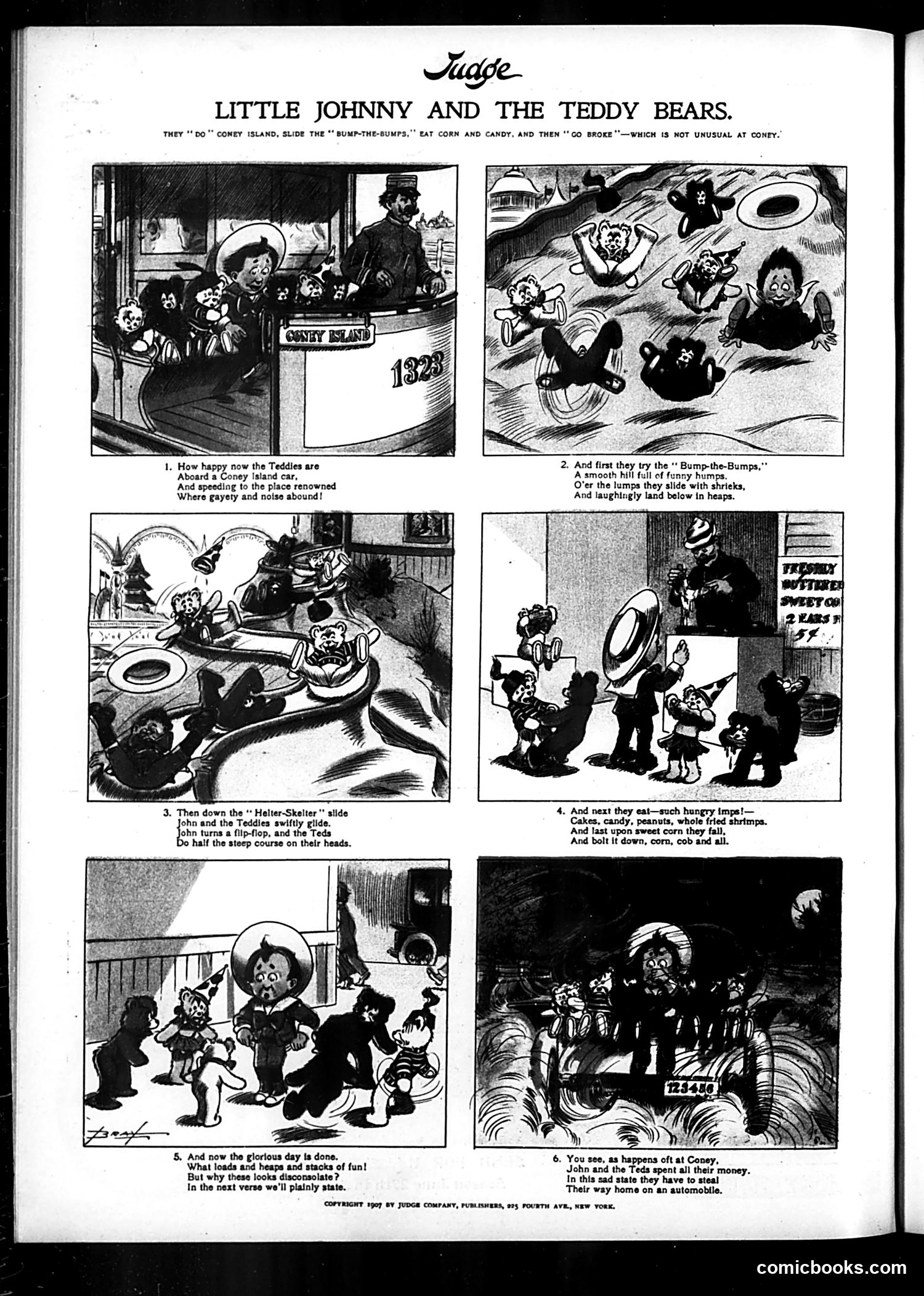
This six-panel comic strip depicts children ("Teddies," likely named after President Theodore Roosevelt's popular "Teddy Bear" toys) enjoying a day at Coney Island amusement park in New York. They ride attractions like the "Bump-the-Bumps" and "Helter-Skelter" slide, then eat carnival food until broke. The satire appears in the final panel: having spent all their money at Coney Island, the children must steal an automobile to return home—presented as a humorous but caustic commentary on the consequences of frivolous spending and the casual criminality that might result. The joke plays on the contrast between wholesome family fun and the darker reality of financial desperation, suggesting that even innocent pleasures at this popular amusement destination lead to moral compromise.