
Judge, 1907-07-20 · page 3 of 16
Judge — July 20, 1907 — page 3: what you’re looking at
What you’re looking at
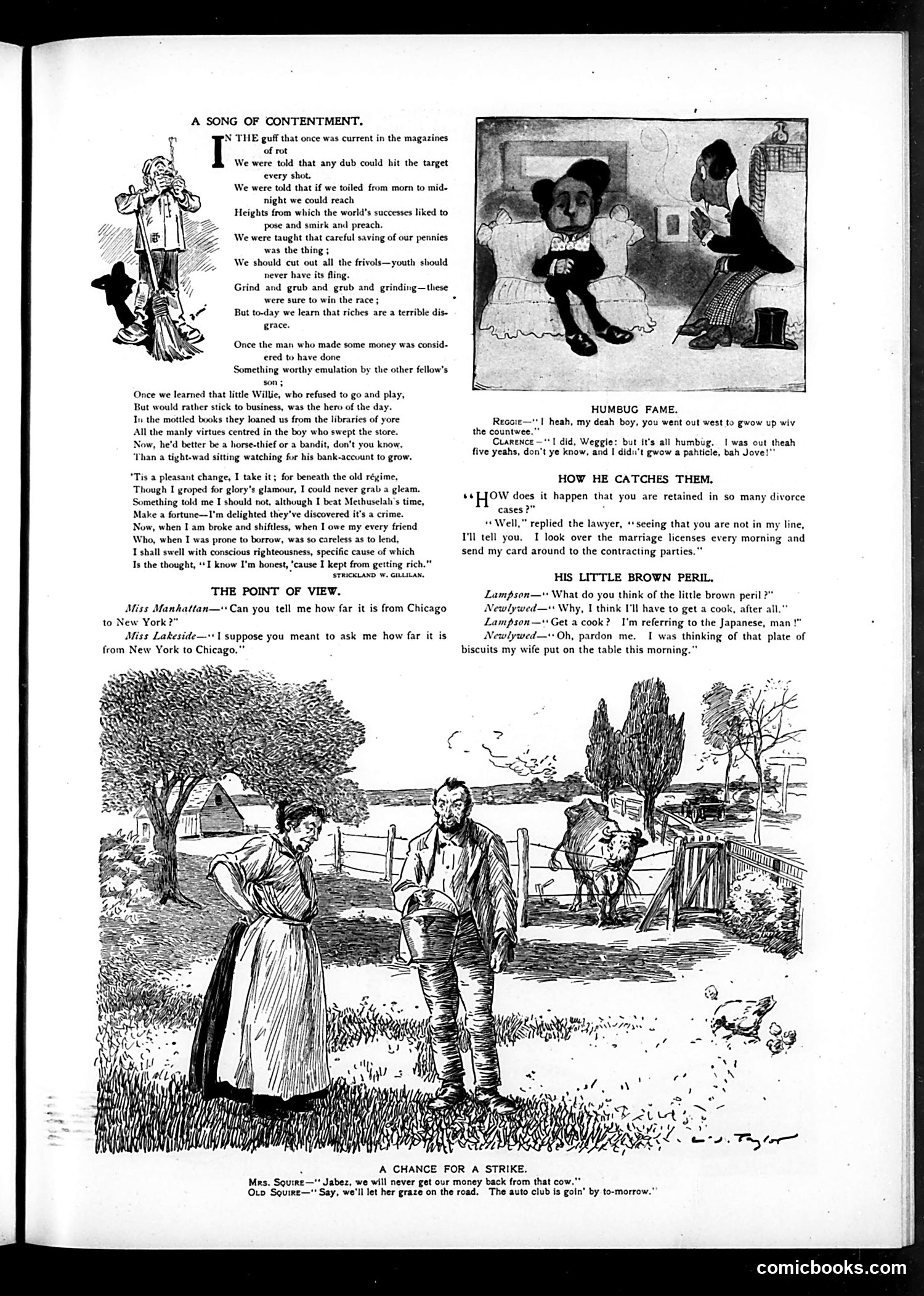
This page contains several satirical pieces reflecting late 19th/early 20th-century social anxieties: **"A Song of Contentment"** mocks working-class advice about financial restraint—saving pennies, avoiding frivolous spending—while the wealthy accumulate riches. The poem's bitter conclusion reveals the hypocrisy: the wealthy man who "made some money" earns "emulation" while workers remain poor despite following prescribed frugality. **"Humbug Fame"** satirizes a man's boastful claims about his son's supposed success, which proves fabricated—a commentary on American pretension and empty bragging. **"The Point of View"** is a simple geographic/perspective joke about directions between cities. **"A Change for a Strike"** depicts rural poverty, with a farmer's wife resigned to never recovering lost money, accepting their desperate circumstances. Overall, the page reflects Judge's satirical focus on class disparity, false promises, and economic hardship of ordinary Americans.
📄 Transcribed text from this page (OCR, searchable)
Machine-transcribed from the original scan — historical spelling and the odd misread are preserved.
A SONG OF CONTENTMENT. N THE guff that once was current in the magazines I of rot We were told that any dub could hit the target every shot. We were told that if we toiled from morn to mid night we could reach Heights from which the world’s successes liked to pose and smirk and preach. We were taught that careful saving of our pennies was the thing ; We should cut out all the fri never have its fling. s—youth should Grind and grub and grub and grinding—these were sure to win the race ; But to-day we learn that riches are a terrible dis- grace. Once the man who made some money was consid ered to have done Something worthy emulation by the other fellow’s son; Once we learned that little Willie, who refused to go and play, But would rather stick to business, was the hero of the day. Iu the mottled books they loaned us from the libraries of yore Alll the manly virtues centred in the boy who swept the store. Now, he'd better be a horse-thief or a bandit, don’t you know, ‘Than a tight-wad sitting watching for his bank-accuunt to grow. "Tis a pleasant change, I take it; for beneath the old régime, Though I groped for glory's glamour, I could never grab a gleam. Something told me I should not, although I beat Methuselah’s time, Make a fortune—I'm delighted they've discovered it's a crime. Now, when I am broke and shiftless, when I owe my every friend Who, when I was prone to borrow, was so careless as to lend, T shall swell with conscious righteousness, specific cause of which Is the thought, ‘I know I'm honest, ‘cause I kept from getting rich." STRICKLAND W, GILLILAM. THE POINT OF VIEW. Miss Mankattan—Can you tell me how far it is from Chicago to New York?” Miss Lakeside—| suppose you meant to ask me how far it is from New York to Chicago.” SAH 4 4 hie . A} iy Hi P HUMBUG FAME, Recoie—* | heah, my deah boy, you went out west to gwow up wiv the countwee. Cuarence —"' I did, Weggie: but it's all humbug. | was out theah five yeahs, don't ye know, and I didn't gwow a pahticle, bah Jove!" HOW HE CATCHES THEM. ++ FJOW does it happen that you are retained in so many divorce cases 2” : +“ Well,”' replied the lawyer, «seeing that you are not in my line, T'll tell you. I look over the marriage licenses every morning and send my card around to the contracting parties." HIS LITTLE BROWN PERIL. Lampson—+ What do you think of the little brown peril ?" Newlywed—« Why, I think I'll have to get a cook, after all."" Lampson—* Get a cook? I'm referring to the Japanese, man !”" Newlywed—“Oh, pardon me. I was thinking of that plate of biscuits my wife put on the table this morning.” A CHANCE FOR A STRIKE. Mrs. Souire—“‘ Jabez, we will never get our money back from that cow.”" Oro Souire—*‘ Say, we'll let her graze on the road. The auto club is goin’ by to-morrow.” comicbooks.com