
A complete issue · 16 pages · 1907
Judge — June 22, 1907
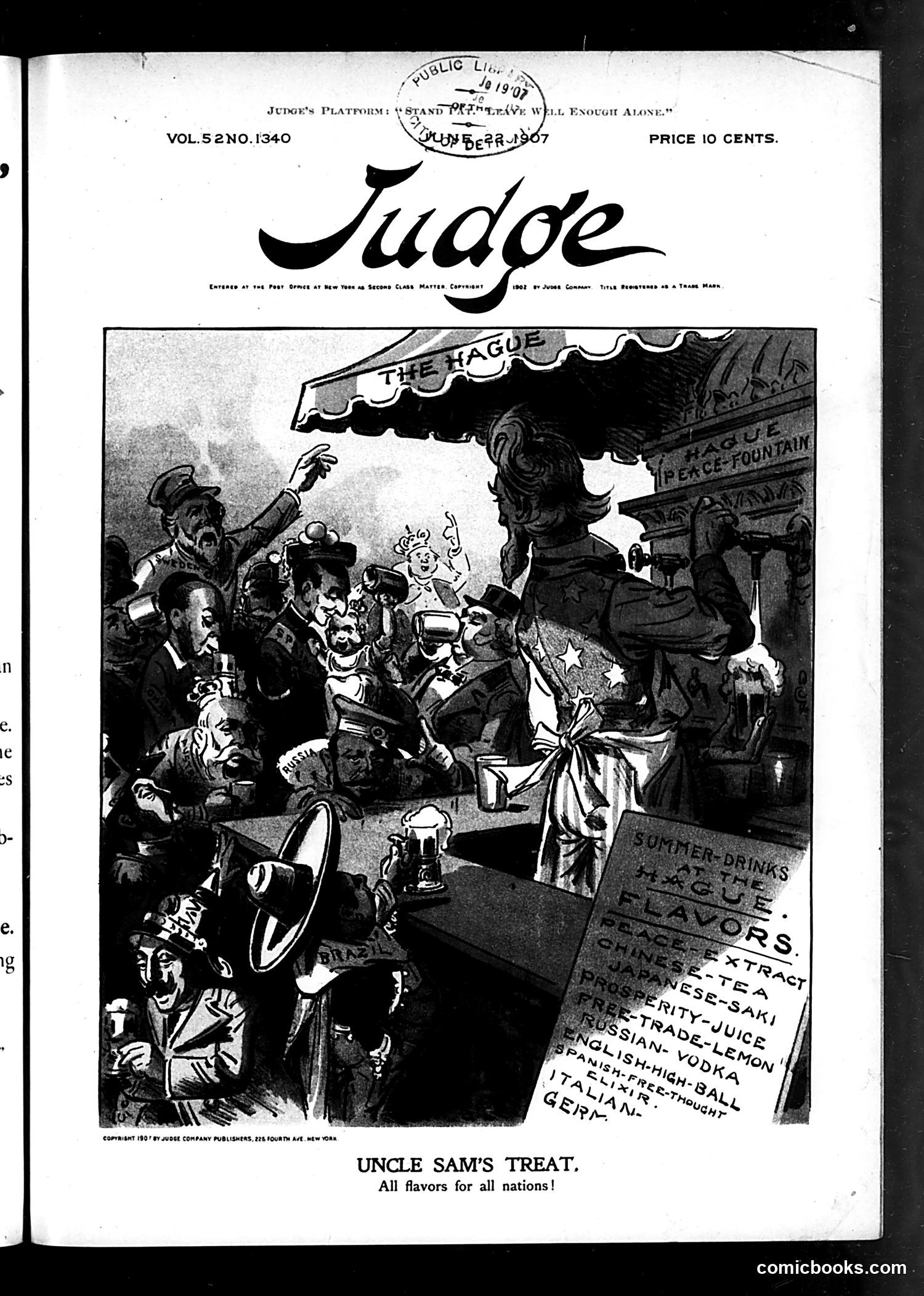
This 1907 *Judge* cartoon satirizes American diplomatic hospitality and trade expansion. Uncle Sam (the tall figure on right) serves exotic beverages at "The Vague" establishment to international representatives—identifiable by their distinctive national dress and caricatures. The listed "flavors" (Summer Drinks, Peace, Chinese Tea, etc.) appear to represent different trade agreements or diplomatic offerings America extends globally. The crowded, jovial scene suggests Uncle Sam generously accommodating diverse nations' interests, though the chaotic composition hints at the complexity or potential absurdity of managing multiple international relationships simultaneously. This reflects early 20th-century American imperialism and expanding commercial influence under Theodore Roosevelt's administration, depicting the U.S. as the magnanimous host to world powers.
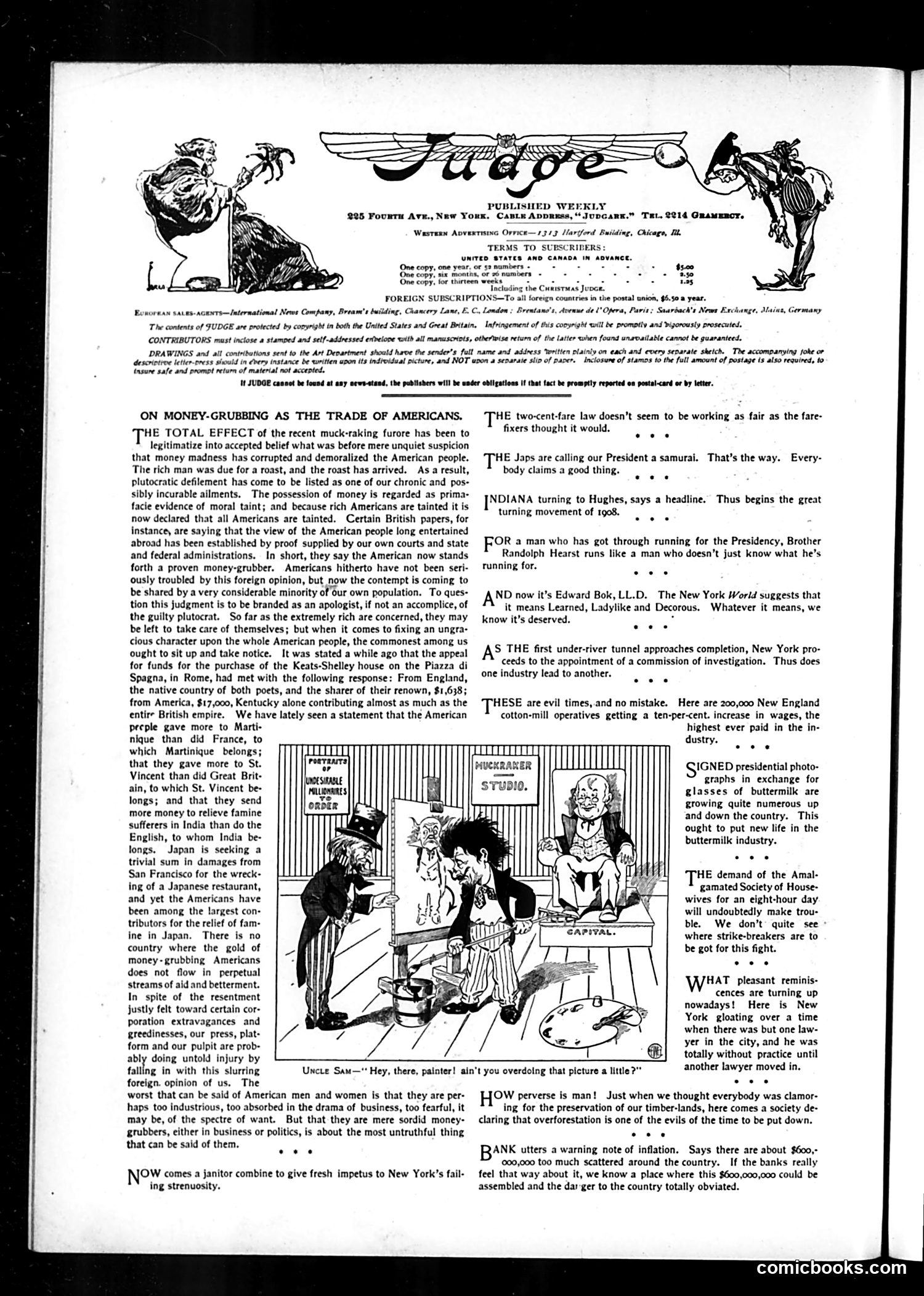
The main cartoon depicts "Uncle Sam" confronting a painter in his studio, saying "Hey, there, painter! ain't you overdoing that picture a little?" The painter appears to be exaggerating a portrait, likely satirizing how American media and politicians were distorting reality during this period. The accompanying editorial discusses "money-grubbing as the trade of Americans," criticizing how financial corruption has "demoralizes" American people. The text references recent scandals involving bribery and moral decay among the wealthy and politicians. The satire suggests that just as the painter exaggerates his portrait, American institutions were exaggerating or misrepresenting the truth for profit and power, undermining national integrity and public trust during what appears to be the early 1900s.
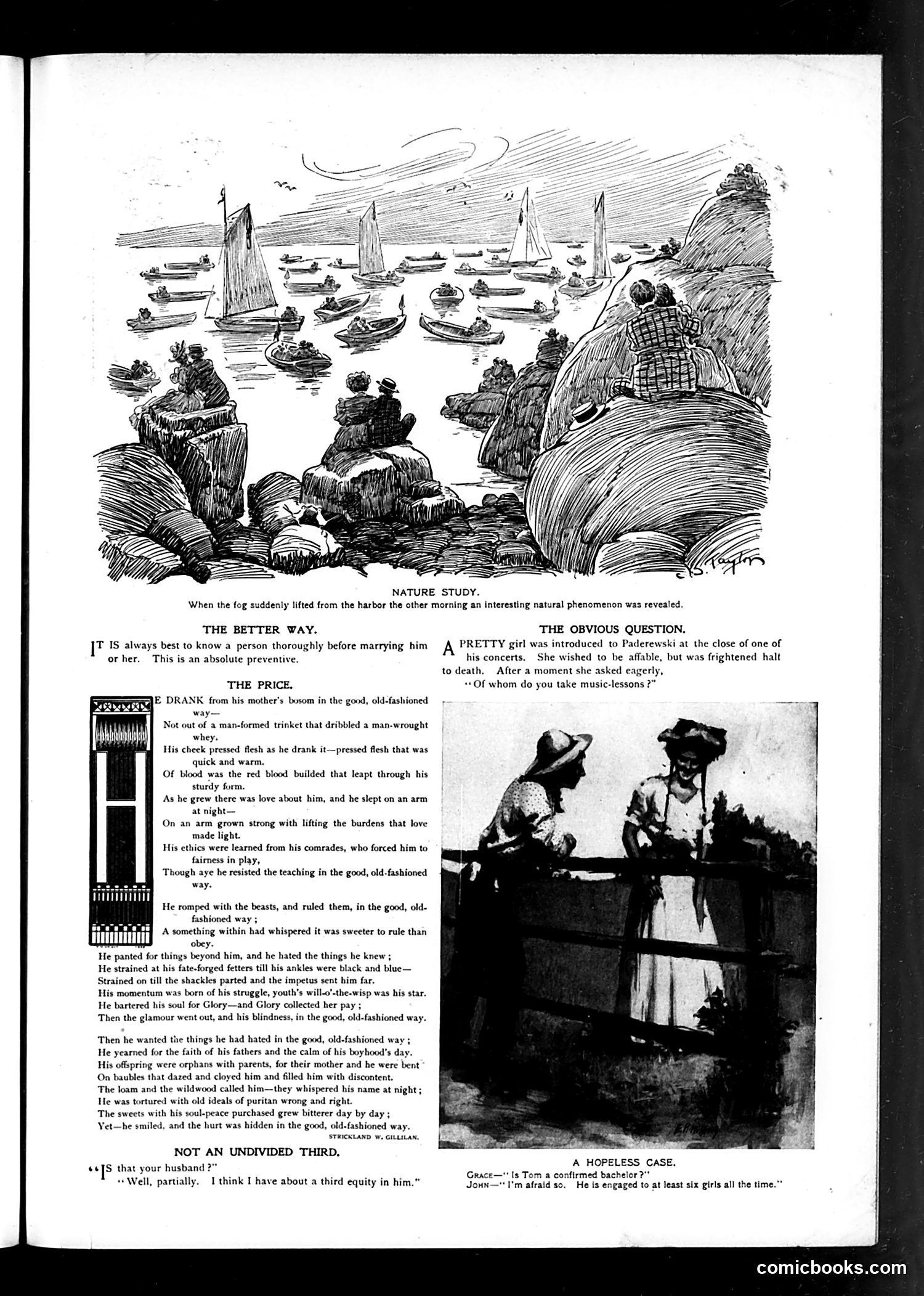
**Top Cartoon ("Nature Study"):** A sketch shows people on rocks observing sailboats in a harbor, captioned about fog lifting to reveal "an interesting natural phenomenon." The satire appears to mock leisurely observation of ordinary scenes as if they were scientific study—poking fun at affected intellectualism or pretentious nature appreciation among the leisure class. **Text Pieces:** Three short humorous vignettes follow: - "The Better Way" and "The Price" appear to be sentimental/ironic verses about traditional values - "The Obvious Question" jokes about a girl asking a music teacher whom he takes lessons from - "Not an Undivided Third" and "A Hopeless Case" are brief comic dialogues about marriage and bachelorhood The page mixes gentle domestic humor with social satire typical of Judge's era.
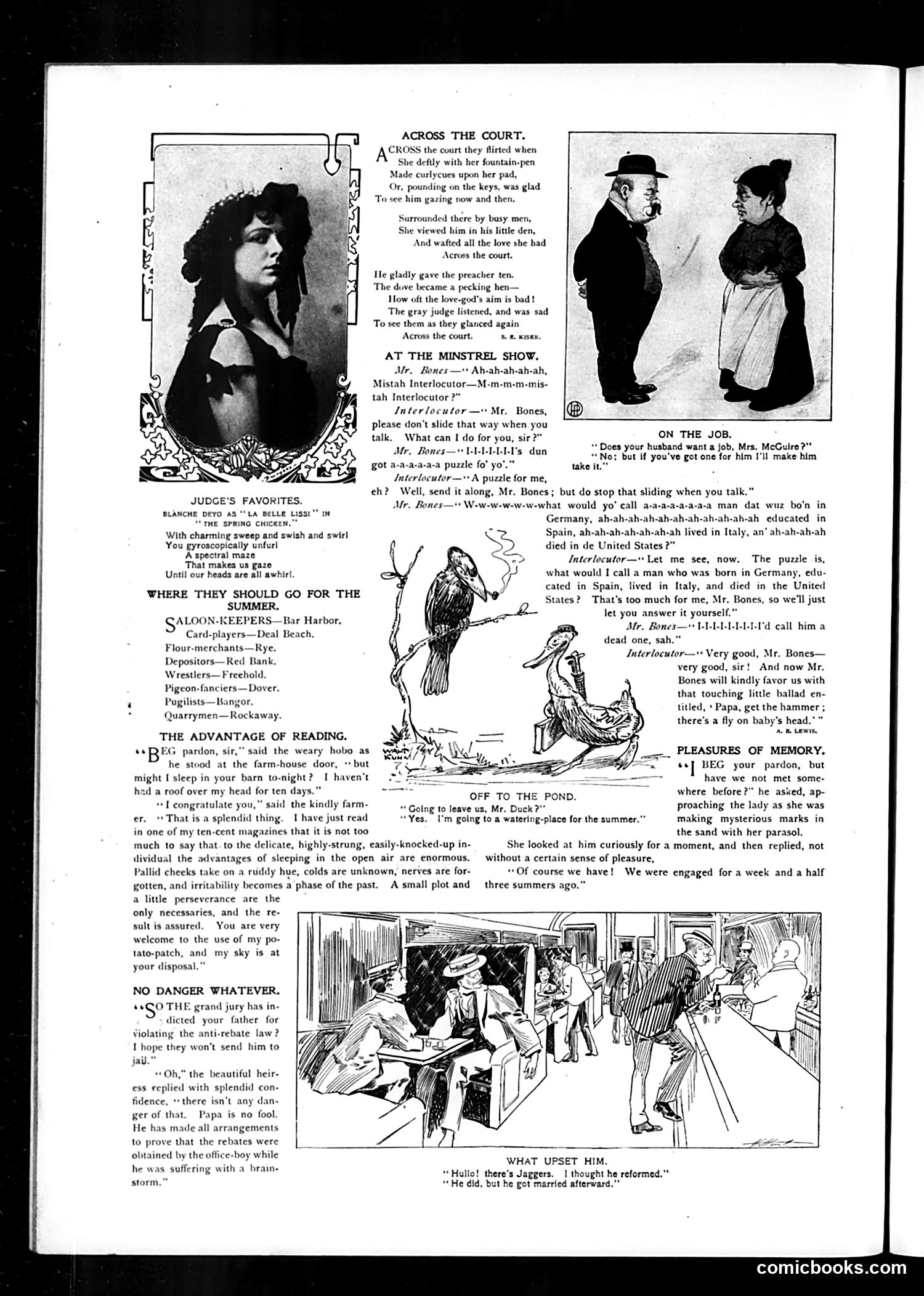
This page contains several short humorous pieces and illustrations typical of Judge's satirical format: **"Across the Court"** presents a poem about a woman making eyes at a man in court, with the judge and others noticing their romantic distraction. **"At the Minstrel Show"** satirizes the popular minstrel show tradition, featuring dialogue where "Mr. Bones" (a classic minstrel character) engages an interlocutor in wordplay—a characteristic minstrel comedy routine. The humor relies on puns and deliberately mangled speech patterns typical of minstrel entertainment. **Other sections** include light social commentary ("Where They Should Go for the Summer," "The Advantage of Reading") and domestic humor pieces. The page reflects early 20th-century American entertainment and social attitudes, including the prevalent minstrel show tradition, which modern readers should understand as a now-recognized form of racist entertainment that was then mainstream.
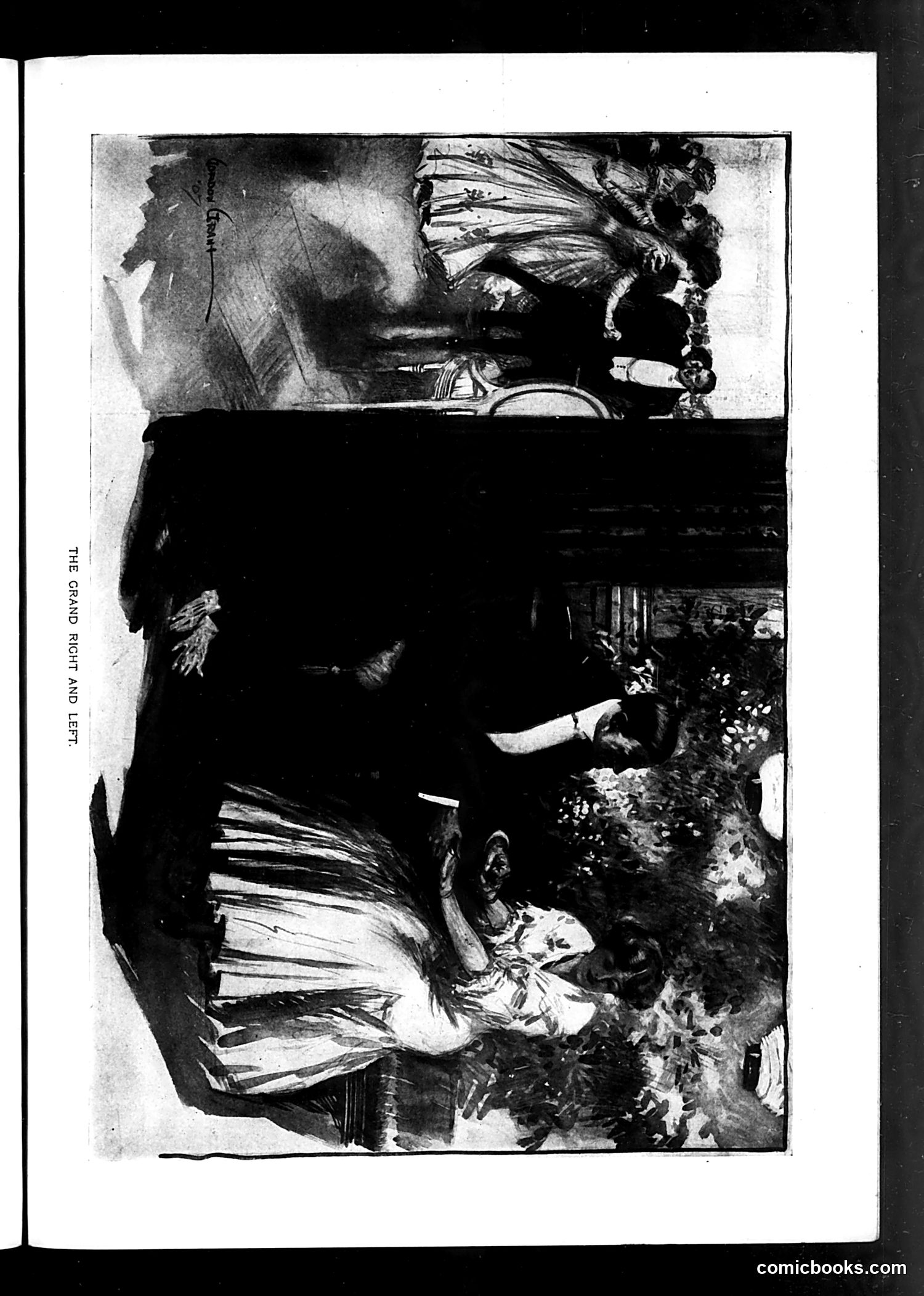
I can see this is a black and white illustration from Judge magazine, but the image quality and orientation make it difficult to read clearly. The page appears to contain a satirical cartoon, but I cannot reliably make out: - The specific figures or characters depicted - The title or caption text - The political or social context being satirized The illustration shows what appears to be an interior scene with multiple figures, but without legible text or clearer image resolution, I cannot confidently identify who the caricatures represent or what contemporary event or issue is being mocked. To provide accurate historical context as you've requested, I would need either a higher-quality image or confirmation of the publication date and cartoon title.
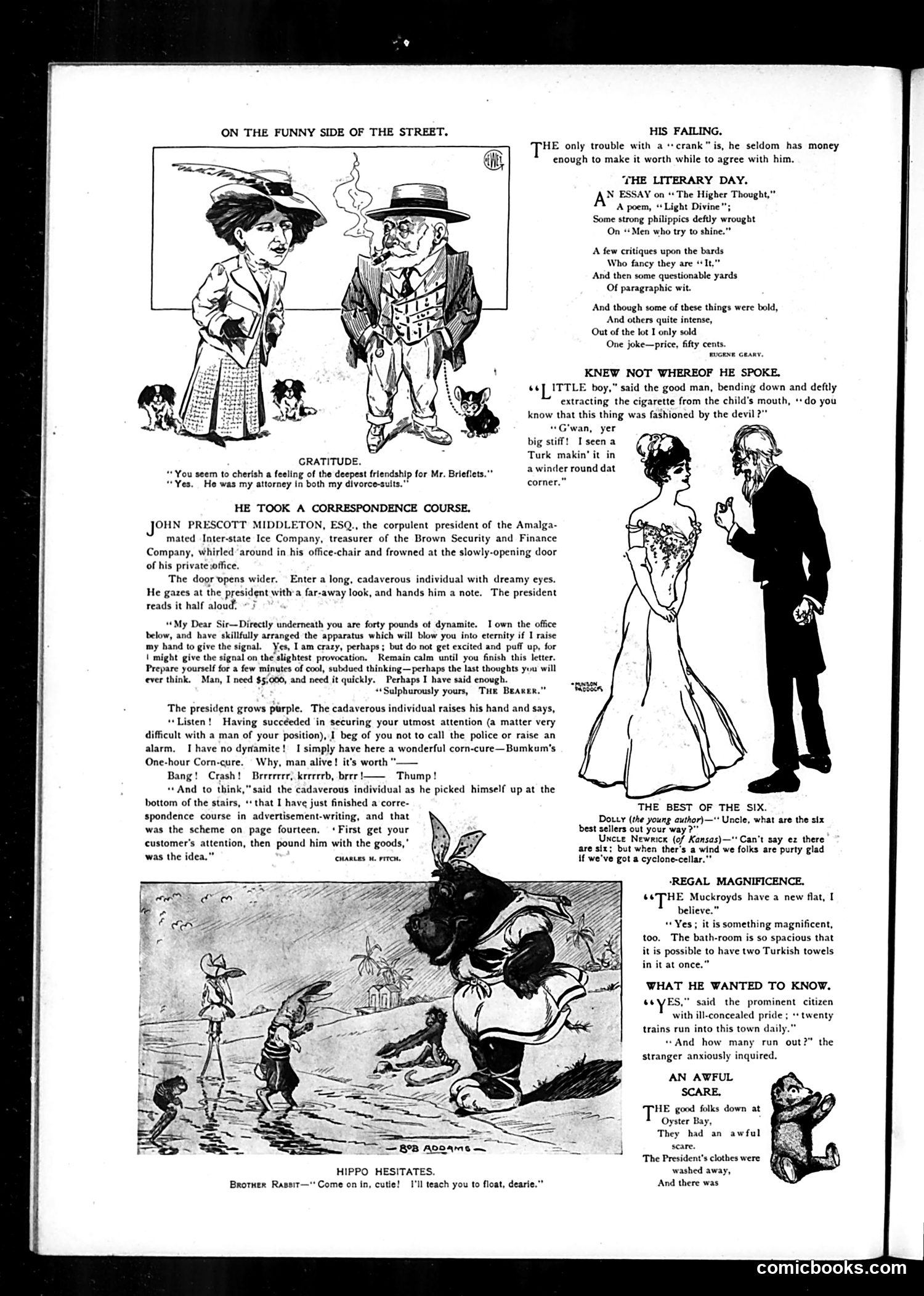
This page contains several unrelated satirical pieces typical of Judge magazine's format: **"His Failing"** mocks reformers ("cranks") who lack wealth to persuade others to support their causes. **"The Literary Day"** by Eugene Geary satirizes literary pretension—essays on "Higher Thought," pompous poetry, and self-important writers—suggesting most such output is worthless (only one joke sold for fifty cents). **"Knew Not Whereof He Spoke"** shows a moralist telling a child cigarettes are "fashioned by the devil," but the street-smart child counters he's seen a Turk making them in a shop window—mocking sanctimonious preaching disconnected from reality. **"He Took a Correspondence Course"** by Charles M. Fitch ridicules mail-order advertising courses. A con man delivers an elaborate bomb threat letter to extort money, claiming it's a sales technique from his correspondence course. When discovered, he's literally blown down the stairs—the satirist's comment on the scheme's actual worthlessness. Other brief pieces mock divorce lawyers, literary pretension, and small-town boasting.
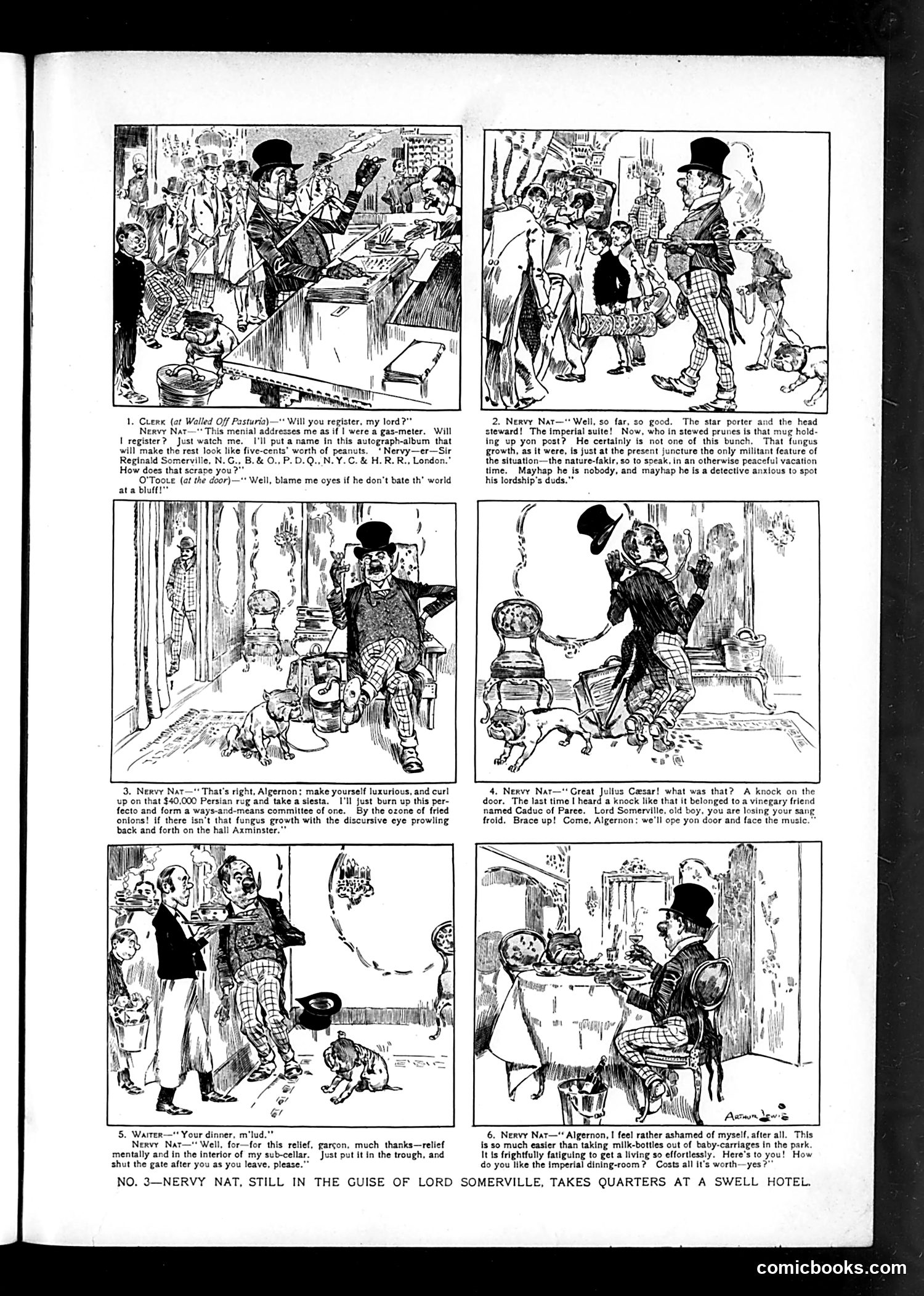
This is a comic strip satirizing American social climbing and pretense. "Nervy Nat" is an impostor posing as "Lord Somerville," a British nobleman, to gain entry into exclusive hotel spaces and services. The humor centers on his elaborate fake credentials and affected speech patterns ("m'lud," references to railroad lines and British titles). The satire targets multiple subjects: 1) American deference to foreign nobility; 2) The ease with which a con artist can exploit class-consciousness; 3) The absurdity of the wealthy's lifestyle (expensive rugs, imperial suites); 4) Nat's criminal opportunism—he explicitly compares this fraud to stealing from baby carriages, suggesting he's a career criminal. The joke is that Nat successfully infiltrates "swell" society simply through bluffing and affected manners, exposing how superficial and gullible the wealthy are.
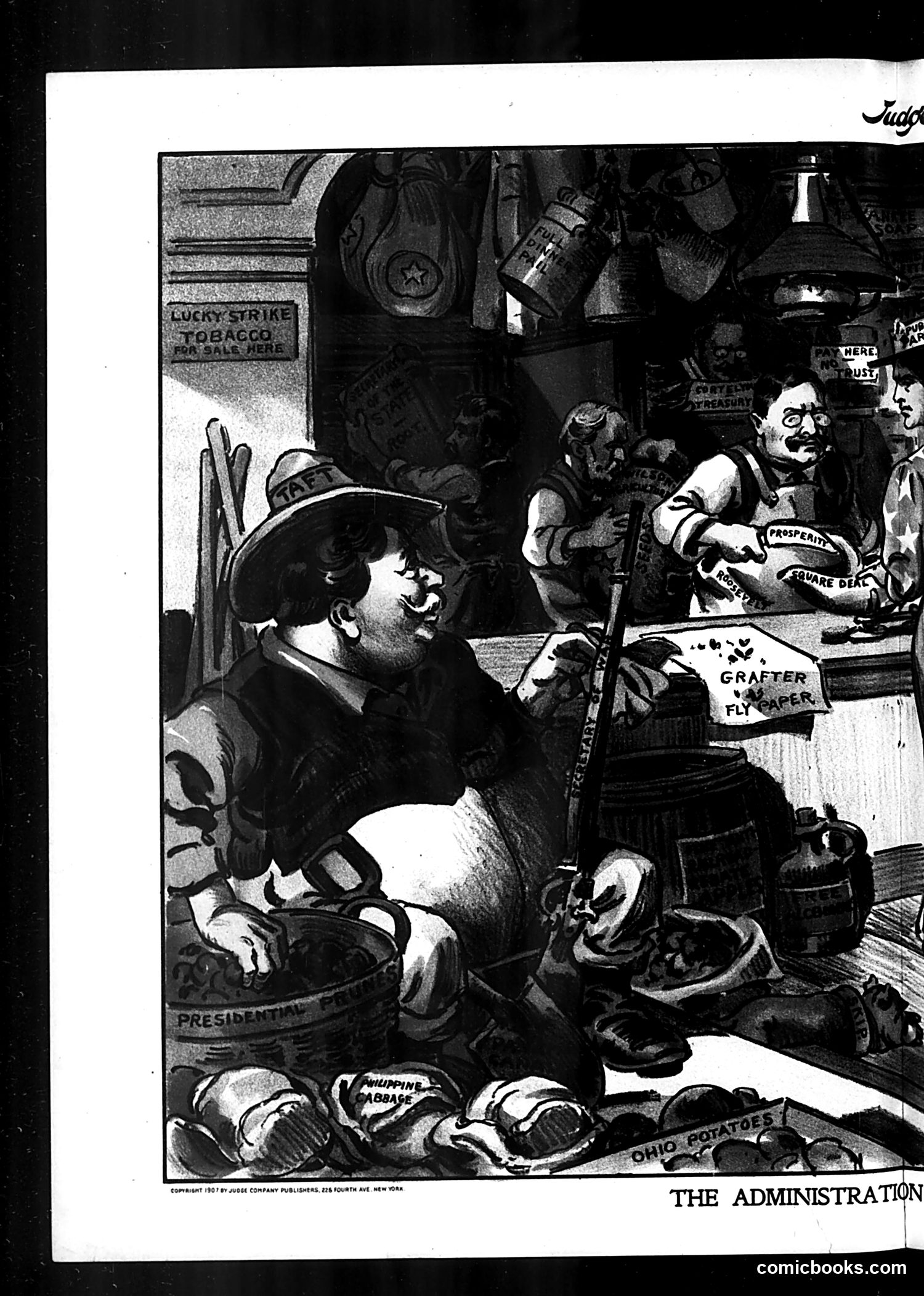
This Judge magazine cartoon satirizes **"The Administration"** (likely early 20th century, based on style). The central figure, a rotund man in a hat seated prominently, appears to be a government official or president surrounded by various corrupt influences and schemes. Visible labels reference: - **Lucky Strike Tobacco** (left) - **Presidential** matters (bottom) - Various products and schemes (graffer, fly cager, Ohio potatoes, Philippine garbage) The cartoon criticizes administrative **corruption and cronyism**—portraying the leader as surrounded by lobbyists, special interests, and dubious commercial schemes competing for his attention and approval. The jumbled array of labeled items suggests chaotic mismanagement and the administration's susceptibility to corporate influence rather than serving public interest.
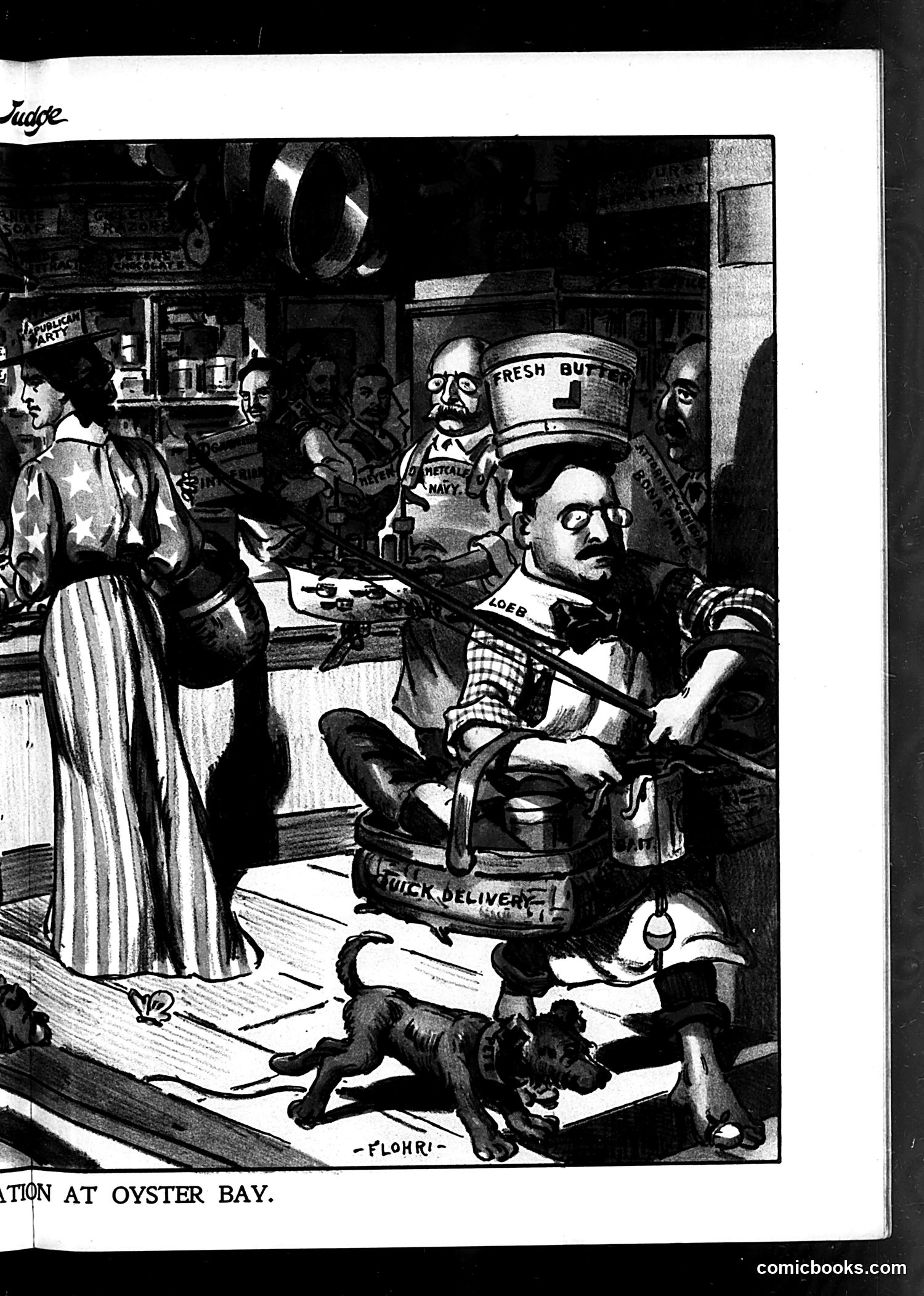
This Judge magazine cartoon satirizes President Theodore Roosevelt at his Oyster Bay, Long Island home. The scene depicts Roosevelt (identifiable by his distinctive mustache and military attire) surrounded by military and naval figures, with labels visible including "FRESH BUTTER" and references to "NAVY" and "DELIVERY." The satire appears to mock Roosevelt's aggressive military posturing and expansionist policies during his presidency. The cluttered, chaotic composition—filled with armed men, supplies, and a small dog—suggests criticism of militaristic buildup or naval expansion. The "Fresh Butter" and "Delivery" references likely mock the domestic impact or commercial aspects of military spending. The cartoon's tone is decidedly critical of Roosevelt's jingoistic approach to American foreign policy and military preparedness during the early 1900s.
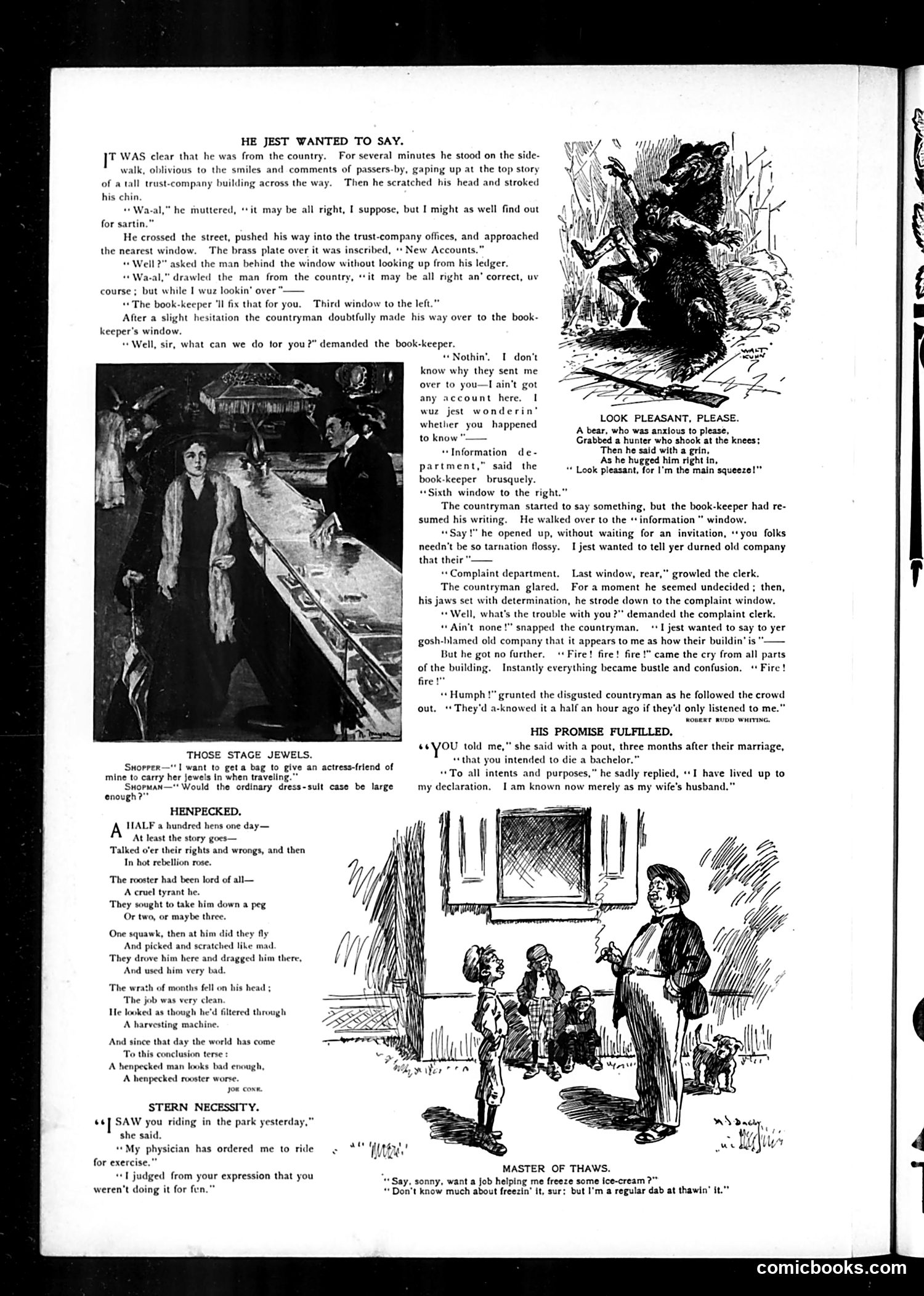
This page contains three satirical pieces about American social types: **"He Jest Wanted to Say"** (main story): A country farmer visits a big-city trust company (bank) to make a simple complaint, but gets shuffled between departments—"New Accounts," "Information," "Complaint"—before a fire alarm interrupts him. The satire mocks both the farmer's rural naïveté and corporate bureaucracy's coldness. The joke: his simple message never gets heard because modern business is needlessly complicated and dismissive of ordinary people. **"Henpecked"** (poem with illustration): A cautionary tale about hens rebelling against a rooster-tyrant, then turning on him violently. The satire uses animal behavior to comment on marital power dynamics, suggesting that wives dominating husbands ("henpecked") is absurd and unnatural—a common Victorian anxiety about women's growing independence. **"His Promise Fulfilled"** (brief joke): A husband tells his new wife he "intended to die a bachelor"—meaning he'd stay unmarried—but now he's living that way in spirit: he exists as merely "his wife's husband," stripped of individual identity. All three pieces reflect early-20th-century anxieties about urbanization, bureaucracy, and changing gender roles.
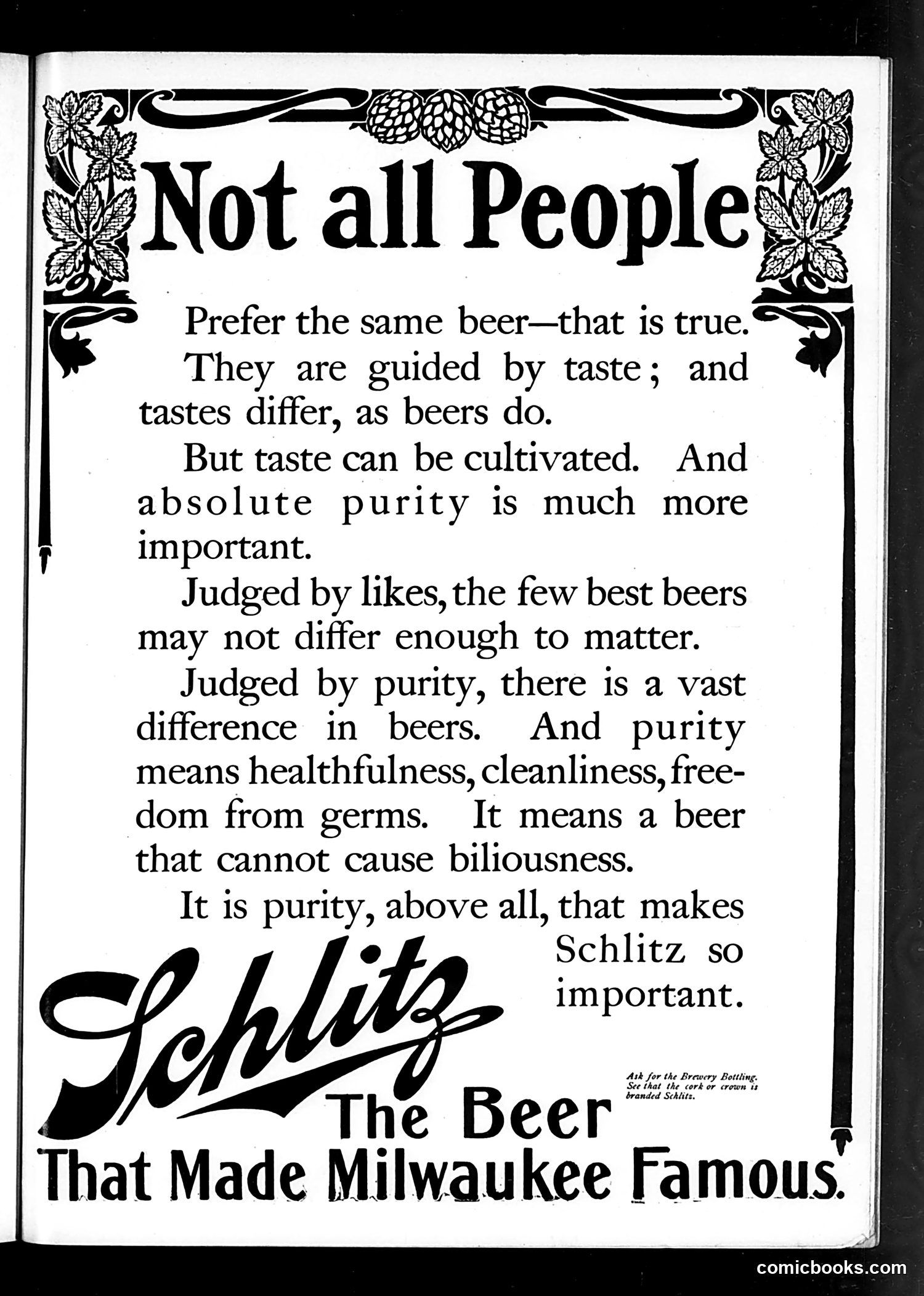
This is primarily a **Schlitz beer advertisement**, not political satire. The page argues that while beer drinkers have varying tastes, purity should be the deciding factor when choosing beer. The ad's logic: taste is subjective and cultivated, but purity—defined as healthfulness, cleanliness, freedom from germs, and inability to cause digestive upset—is objectively measurable and more important. Therefore, Schlitz's claimed purity superiority outweighs competitors' taste preferences. The ornamental border and formal typography were typical Judge magazine design. This represents early-20th-century beer marketing emphasizing hygiene and health claims, likely responding to contemporary concerns about contaminated food and beverages. The tagline "The Beer That Made Milwaukee Famous" references Milwaukee's historical prominence in American beer brewing. This is commercial advertising rather than editorial satire.
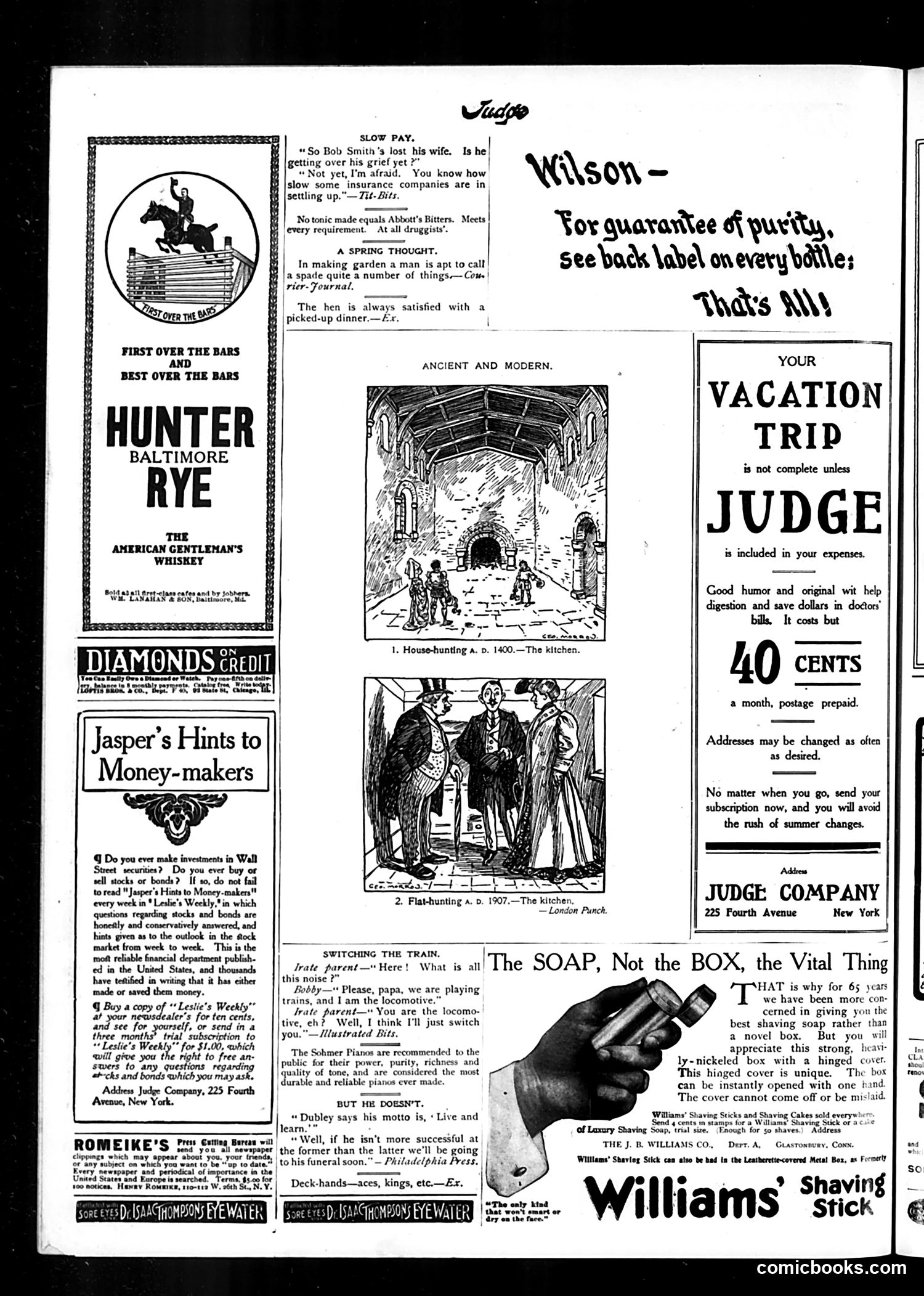
This page is primarily **advertisements and filler content** rather than satirical cartoons. The two small illustrated sketches—"House-hunting" and "Flat-hunting"—are brief humorous anecdotes with accompanying images, showing antiquated domestic scenes with captions offering mild period jokes (parents disciplining children, wordplay about housing searches). The majority of the page consists of product advertisements: Hunter Baltimore Rye whiskey, Judge magazine subscriptions, diamonds on credit, Jasper's investment tips in Leslie's Weekly, Williams' Shaving Stick, and Sohmer Pianos. These ads are interspersed with short joke snippets (about insurance adjusters, railway play-acting, pianos) that function as filler between advertisements rather than sustained satire. The layout suggests this is likely an **interior page** of Judge magazine designed to generate advertising revenue, not a showcase for the publication's satirical editorial content.
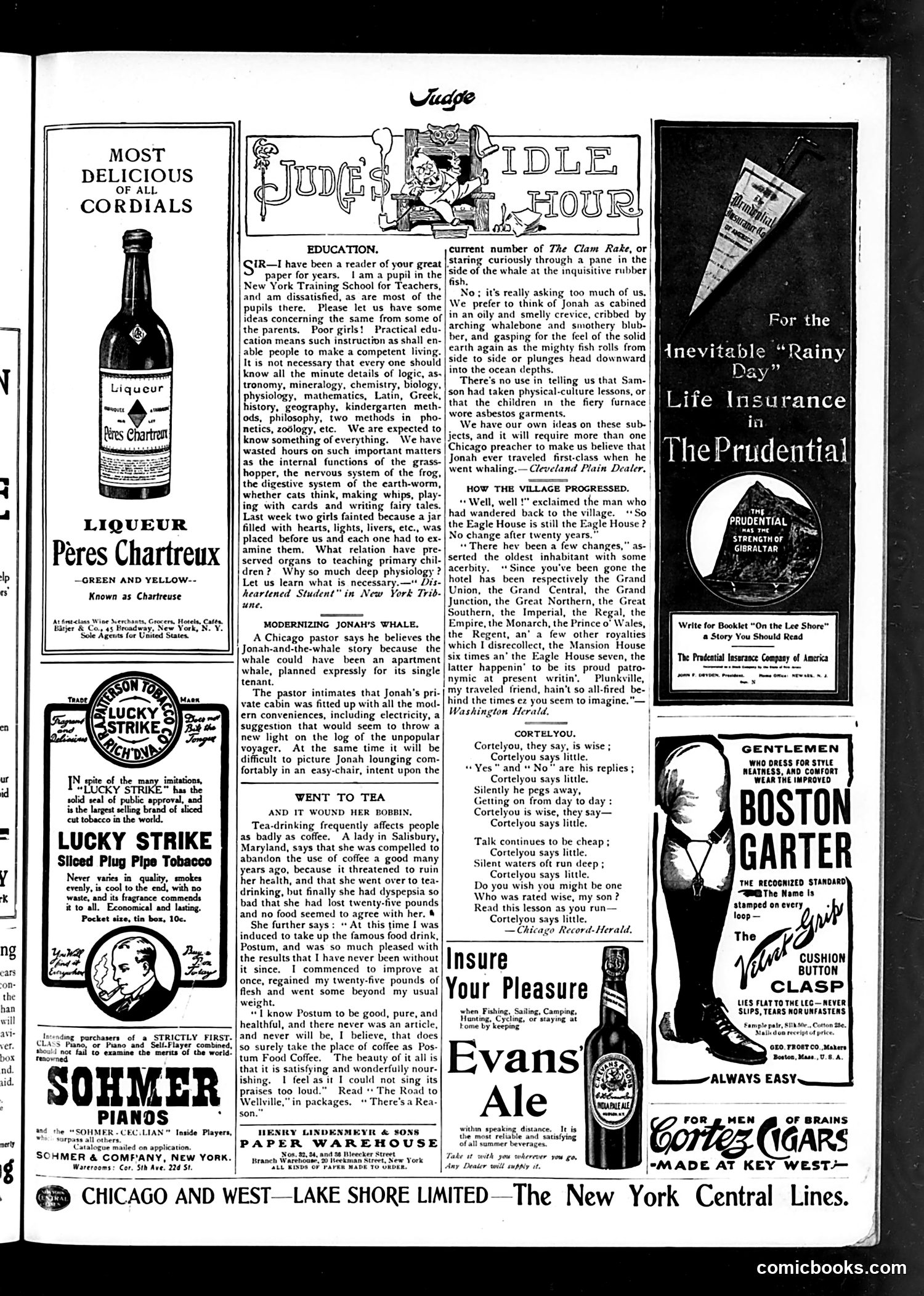
This page is primarily **advertising**, with one brief satirical section titled "Judge's Idle Hour." The main content is the "Idle Hour" column, which publishes reader letters mocking social issues: 1. **First letter**: A teacher-in-training complains that her curriculum wastes time on impractical subjects (dissecting grasshoppers, studying worm digestion) instead of practical education for making a living. The satire targets overly theoretical education. 2. **Second item**: A joke about modernizing the biblical Jonah story—a Chicago pastor claims the whale was actually an "apartment whale" with modern conveniences like electricity, satirizing how people rationalize ancient religious texts through contemporary technology. 3. **Third letter**: A testimonial (likely tongue-in-cheek) about a woman who switched from coffee to Postum cereal drink and supposedly recovered her health. The advertisements throughout promote liqueur, tobacco, pianos, insurance, and ale—typical period products. The page reflects early-20th-century concerns about education reform and consumer culture.
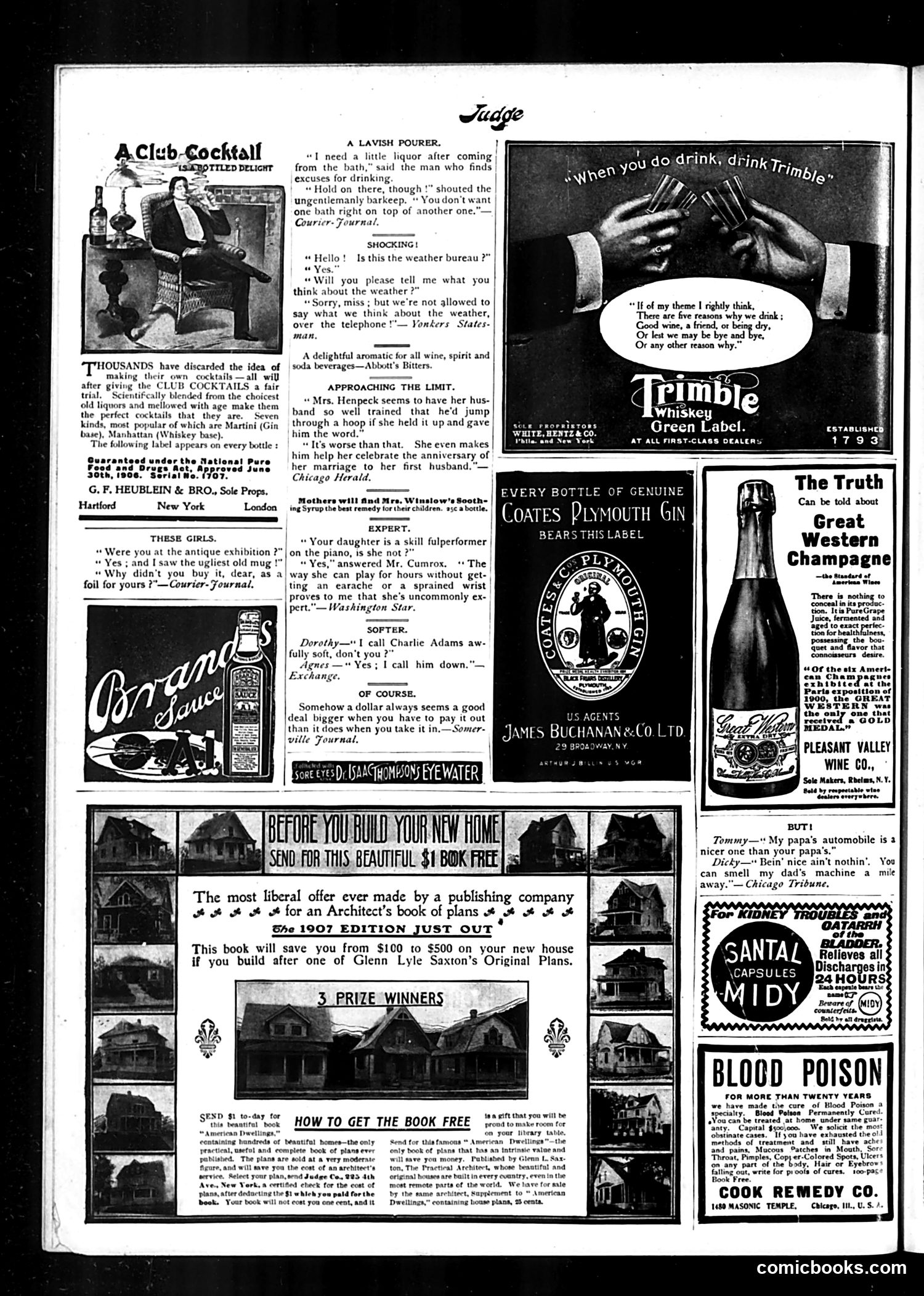
This page from Judge magazine (circa 1907) consists primarily of **advertisements and short humor pieces** rather than political cartoons. ## Notable Content: **The humor pieces** are mild observational jokes: a man excuses his drinking by claiming he just bathed (the bartender's retort: don't add another bath); a weather bureau employee can't express opinions over the phone; a man whose wife makes him celebrate her anniversary to her *first* husband. **The advertisements dominate**, hawking period products: Heublein cocktails, Trimble whiskey, Coates Plymouth gin, Western Champagne, and notably a "Blood Poison" remedy—reflecting the era's widespread patent medicine industry, often exploitative. **The architecture book** offering offers house plans from "Glenn Lyle Saxton's Original Plans" for $1, positioned as a money-saving service. The humor is gentle, domestic, and apolitical—reflecting Judge's shift toward lighter, society-focused satire rather than hard political commentary. The advertisements reveal common consumer anxieties and commercial practices of the Edwardian period.
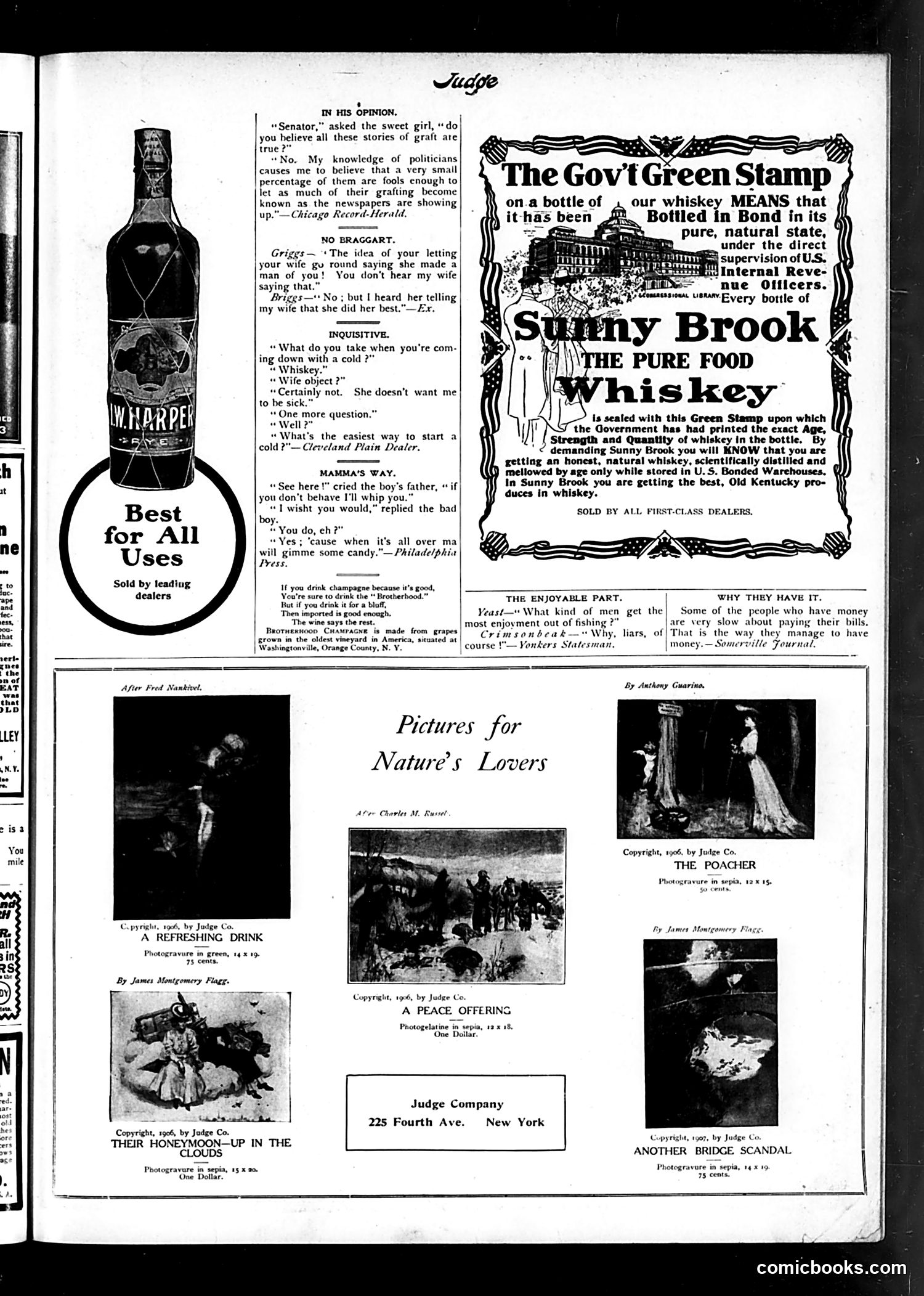
This page combines **short satirical jokes** with **whiskey advertising** and **fine art reproductions** — typical of Judge's commercial-editorial mix. ## The Satire The upper jokes mock **political corruption and domestic dynamics**: - A senator cynically admits politicians are too *smart* to get caught grafting (referencing the Progressive Era's corruption scandals) - Marital jokes play on gender dynamics: wives either nag about graft or take credit for "making" their husbands - A boy prefers whipping because his mother rewards him afterward with candy — dark humor about parenting ## The Advertising The prominent **Sunny Brook Whiskey ad** emphasizes the federal "Green Stamp" proving the whiskey's age, purity, and legitimacy — responding to **food safety scandals** of the era (the 1906 Pure Food and Drug Act was recent). The ad reassures consumers against adulteration and fraud. ## The Art Section Bottom half showcases **photogravures** by respected artists (Flagg, etc.) — nature scenes and portraits — positioning Judge as culturally refined despite its lowbrow humor. The page reflects early 1900s concerns: **political graft, consumer trust, and moral respectability**.
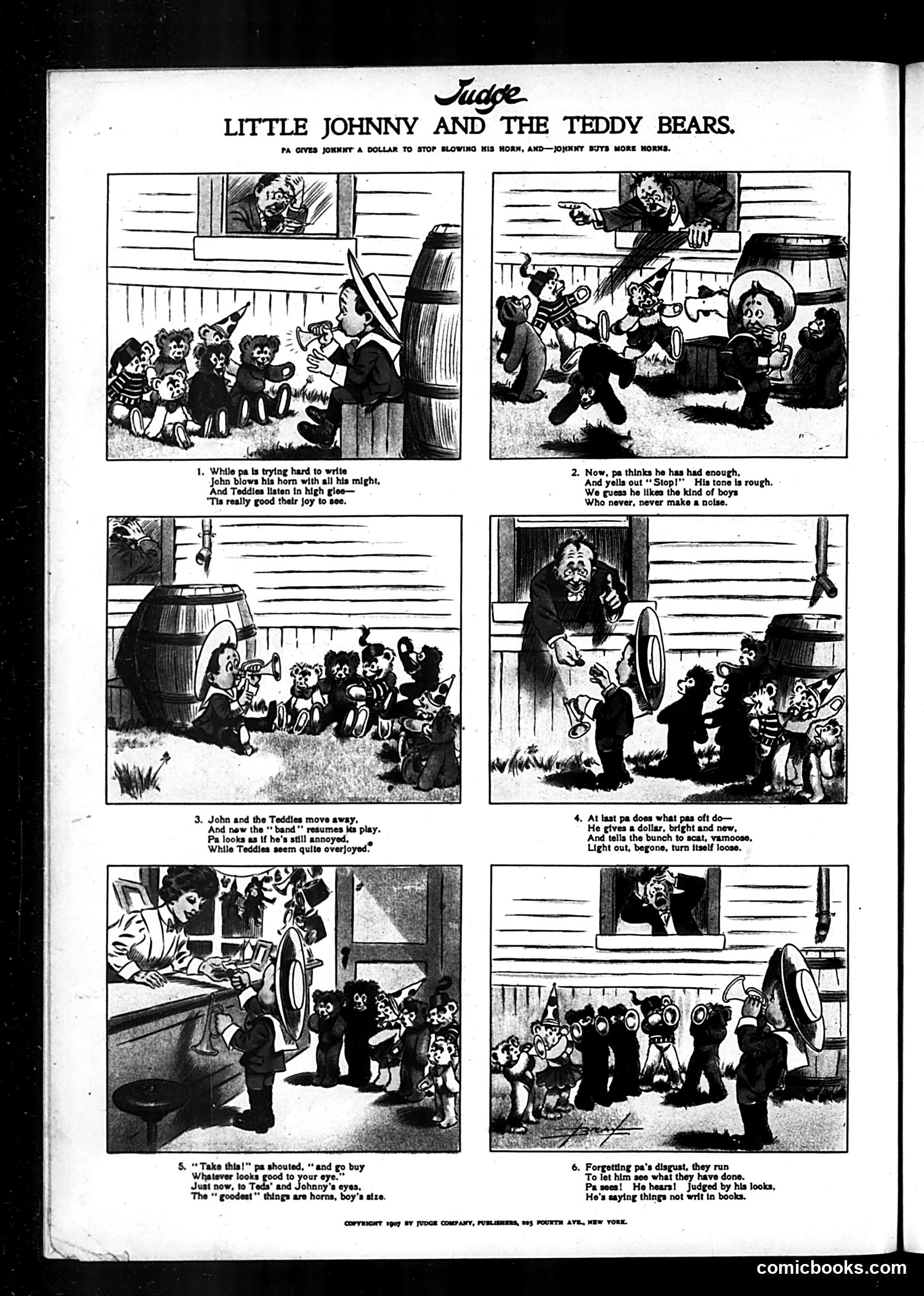
This is a six-panel domestic comedy about a father's failed attempt to buy peace and quiet from his noisy son. Johnny repeatedly blows his horn, annoying his father (Pa) who's trying to write. When Pa gives Johnny a dollar to stop, Johnny uses it to buy *more horns*—defeating the purpose entirely. The "Teddy Bears" are Johnny's stuffed toys, which appear as anthropomorphized companions enjoying the noise. The satire targets parental exasperation: no matter what bribe or punishment fathers employ, mischievous boys will inevitably choose chaos over obedience. The final panel shows Pa's frustrated resignation—he's essentially given up, muttering things "not writ in books" (unprintable curses). The humor reflects early 20th-century middle-class anxieties about child-rearing and masculine authority within the home. The teddy bear reference dates the piece post-1902 (when the toy became popular).