
A complete issue · 16 pages · 1907
Judge — June 15, 1907
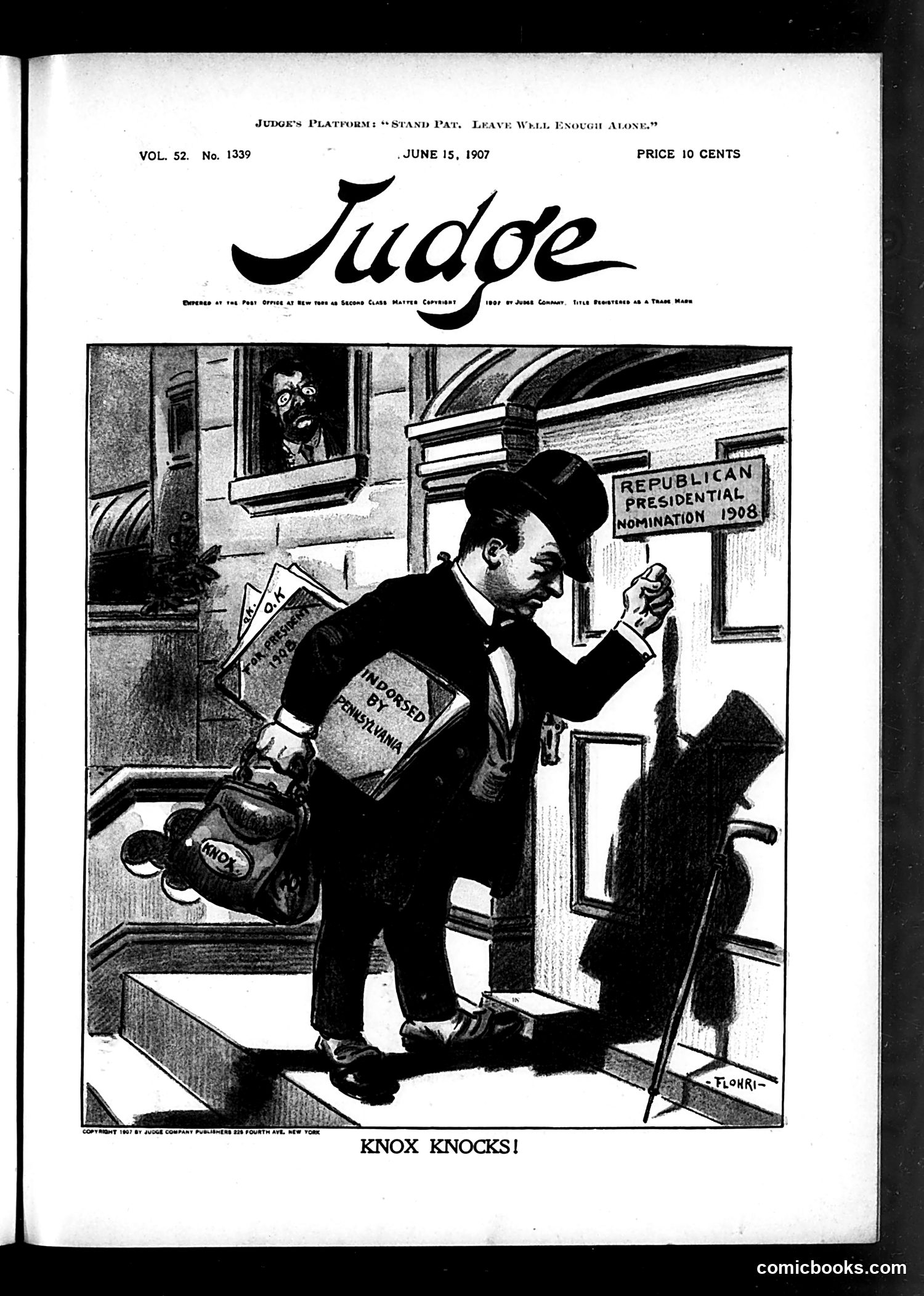
This cartoon satirizes **Philander C. Knox** (identifiable by the label on his coat), who was Secretary of State under President Theodore Roosevelt. The figure carries multiple bundles labeled "ENDORSED BY TAFT" and various endorsements, approaching a door marked "REPUBLICAN PRESIDENTIAL NOMINATION 1908." The satire suggests Knox is actively seeking the 1908 Republican presidential nomination by collecting endorsements—particularly from William Howard Taft, who was Roosevelt's chosen successor. The "knocking" at the door references both Knox's name and his political maneuvering. The caricatured observer in the window suggests public scrutiny of these nomination activities. The cartoon mocks Knox's bid for the nomination through backroom endorsements rather than genuine popular support.
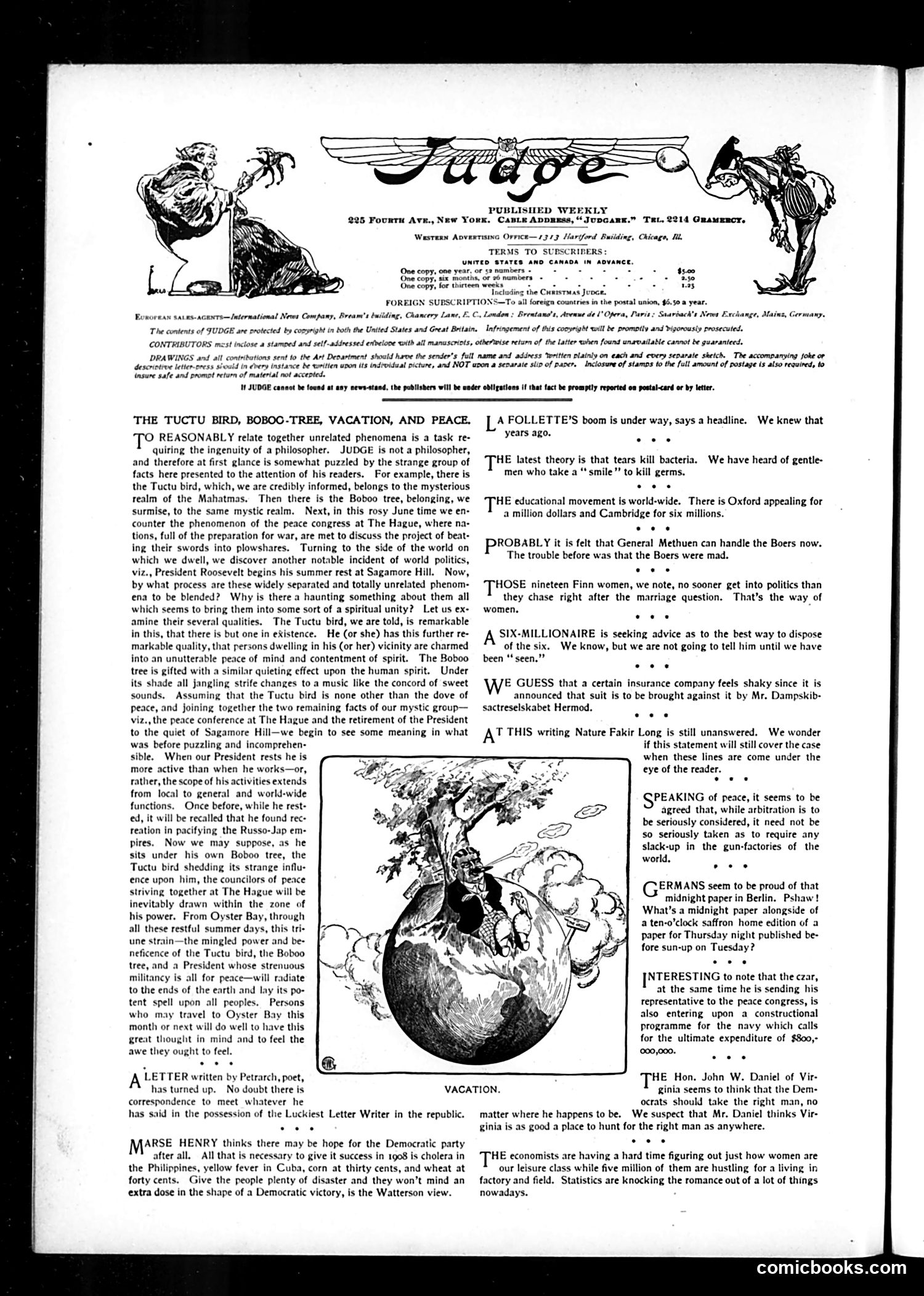
This page contains editorial commentary rather than political cartoons. The main illustration shows a figure sitting on a globe, likely representing a world leader or statesman contemplating global affairs. The text discusses several contemporary issues: 1. **"The Tuctu Bird, Boboo-Tree, Vacation, and Peace"** - A satirical philosophical essay using metaphorical animals (the Tutcu bird, Boboo tree) to discuss post-war peace efforts and presidential authority. 2. References to **General Methuen** handling the Boers (South African War context). 3. Commentary on **women's suffrage** and **insurance company practices**. 4. Criticism of German military spending and naval expansion. The tone is sardonic, critiquing political leadership's handling of peace negotiations, military buildup, and social issues typical of early 1900s American political satire.
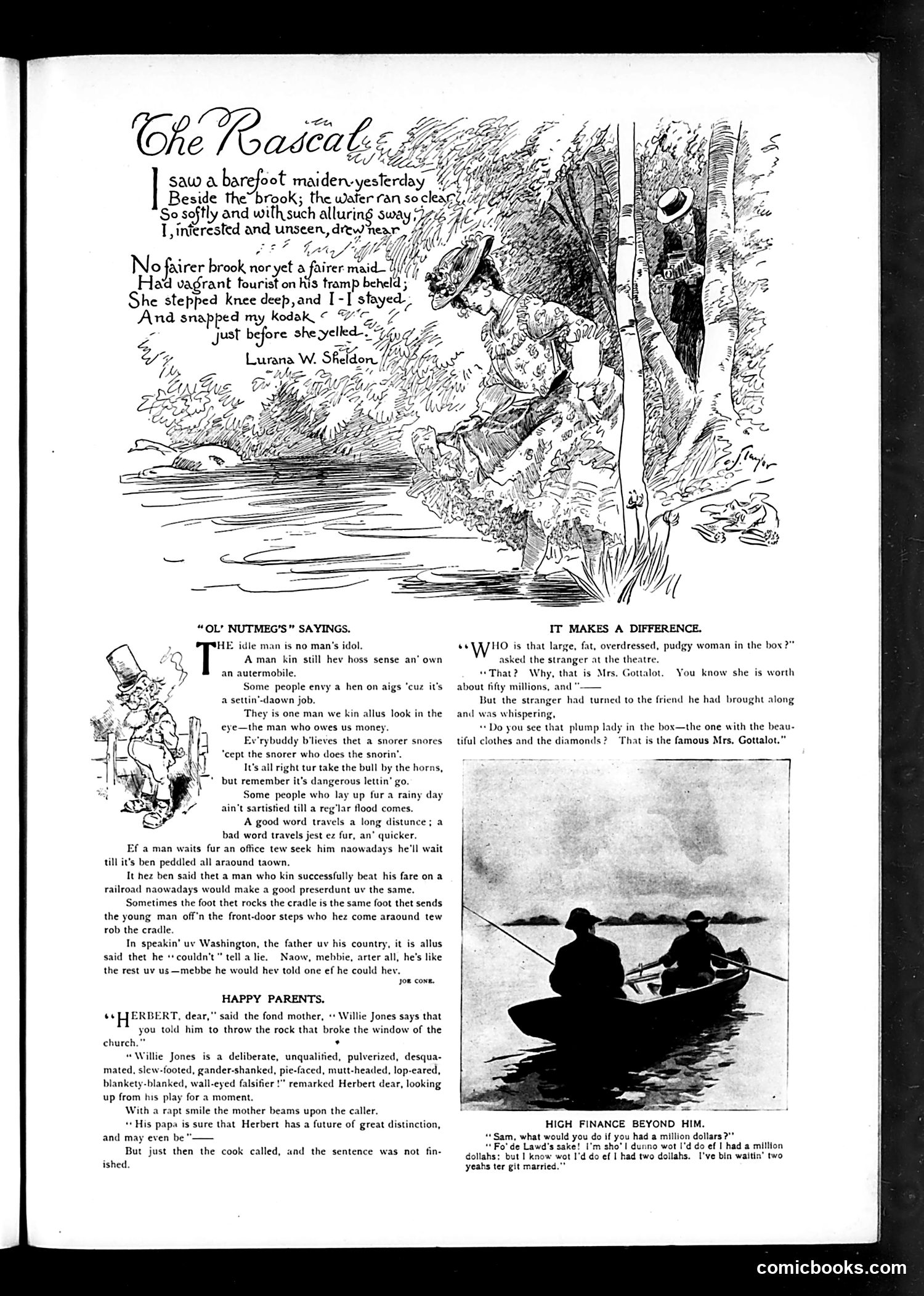
This page contains three separate pieces of light humor rather than political satire: 1. **"The Rascal"** (top): A illustrated poem about a barefoot maiden by a brook whom the narrator attempts to photograph but she escapes. It's sentimental romantic verse with accompanying sketch. 2. **"Ol' Nutmegs' Sayings"** (bottom left): Folk wisdom presented as proverbs about idleness, money, and character—appears to be a regular column offering homespun advice. 3. **"Happy Parents"** and **"High Finance Beyond Him"** (bottom right): Two brief humorous anecdotes about children and domestic life, accompanied by photographs rather than drawings. The page contains no identifiable political figures or partisan satire. It represents Judge's lighter content—general humor about romance, domesticity, and common sense rather than topical social commentary.
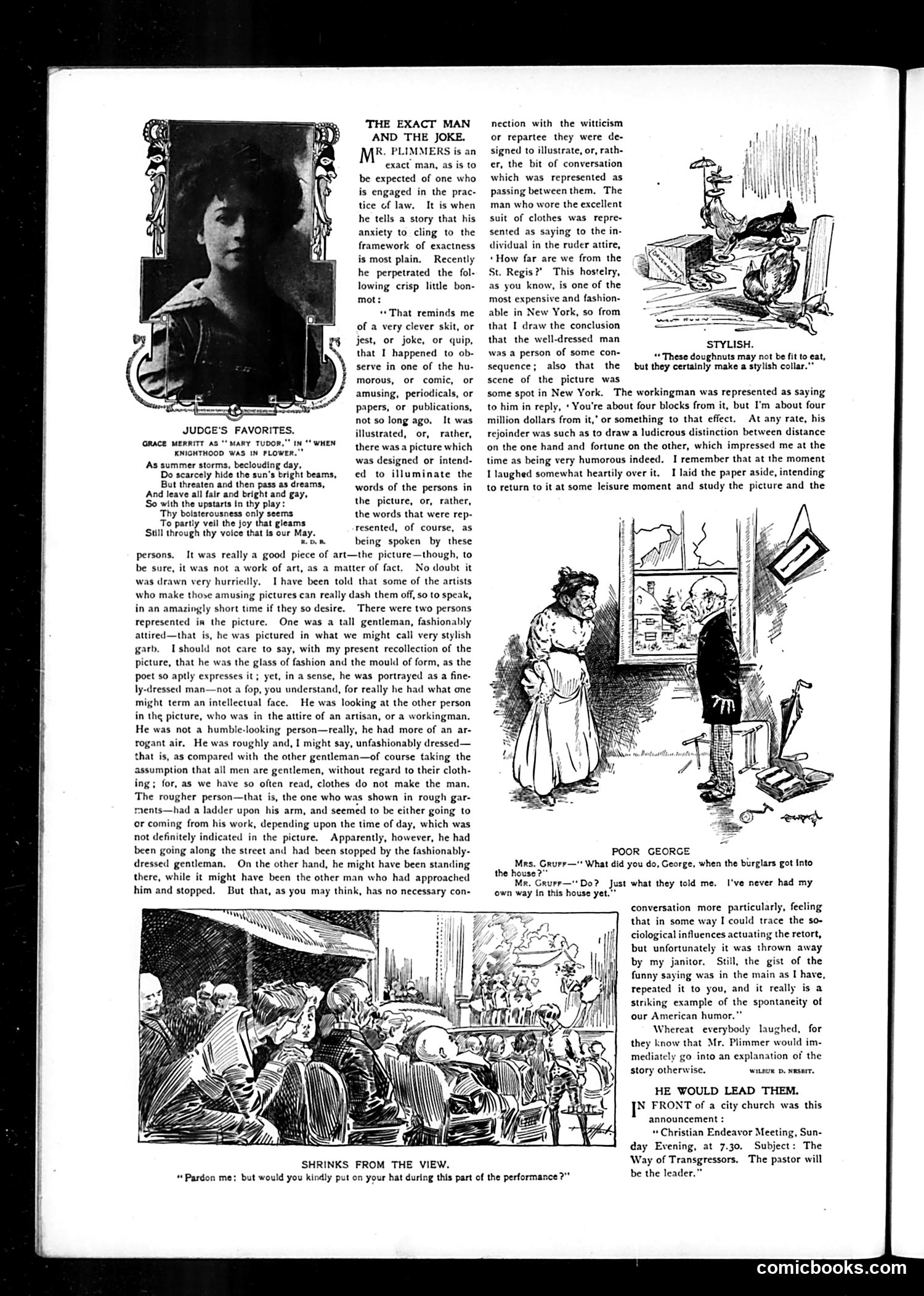
This page satirizes **Mr. Plimmers**, a lawyer known for exact precision in speech. The main article "The Exact Man and the Joke" critiques how Plimmers obsesses over literal accuracy while missing humor's essence. The cartoons illustrate this theme: "Stylish" shows a fashionable man discussing New York's wealthy, while "Poor George" depicts a burglar's comedic excuse to a homeowner. "Shrinks from the View" shows audience members disturbed by performance content. The satire targets a recognizable personality type—the pedantic professional who cannot enjoy spontaneous humor because he's fixated on factual precision. This reflects broader Gilded Age tensions between rigorous professionalism and American informality. The page ultimately defends American humor's value against over-intellectualization.
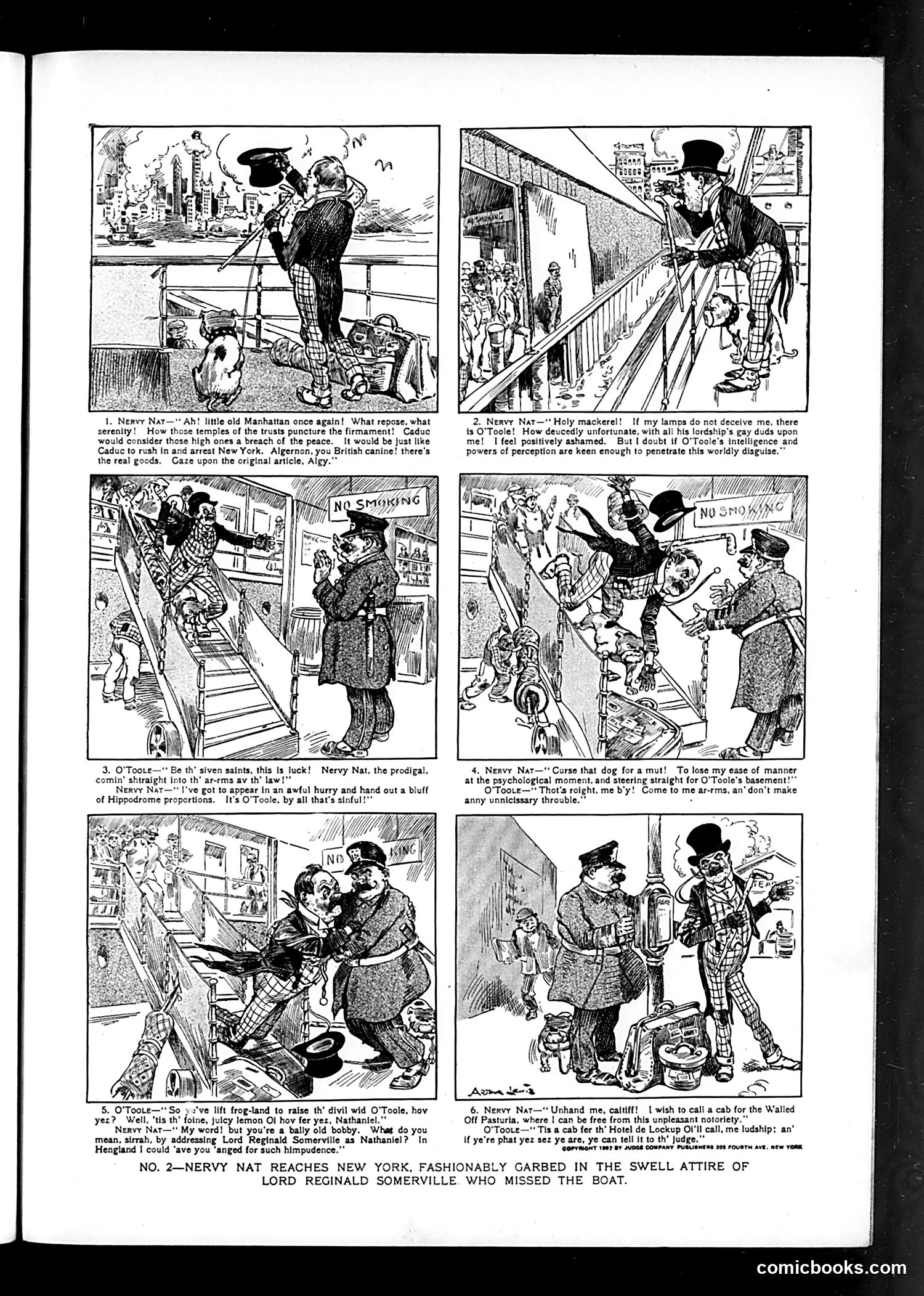
This comic strip satirizes a character named "Nervy Nat" arriving in New York, fashionably dressed in a plaid suit and top hat. The humor derives from his aggressive, socially inappropriate behavior aboard public transportation and city streets. The satire targets nouveau riche or working-class affectation—a man adopting upper-class fashion while behaving rudely. His interactions with police, other passengers, and a dog demonstrate deliberate disregard for social conventions and "no smoking" signs. The strip's title references Lord Reginald Somerville, who "missed the boat," suggesting this is parody of a specific social scandal, though the exact reference is unclear from the image alone. The humor appeals to readers' class anxieties about proper urban conduct and social climbing.
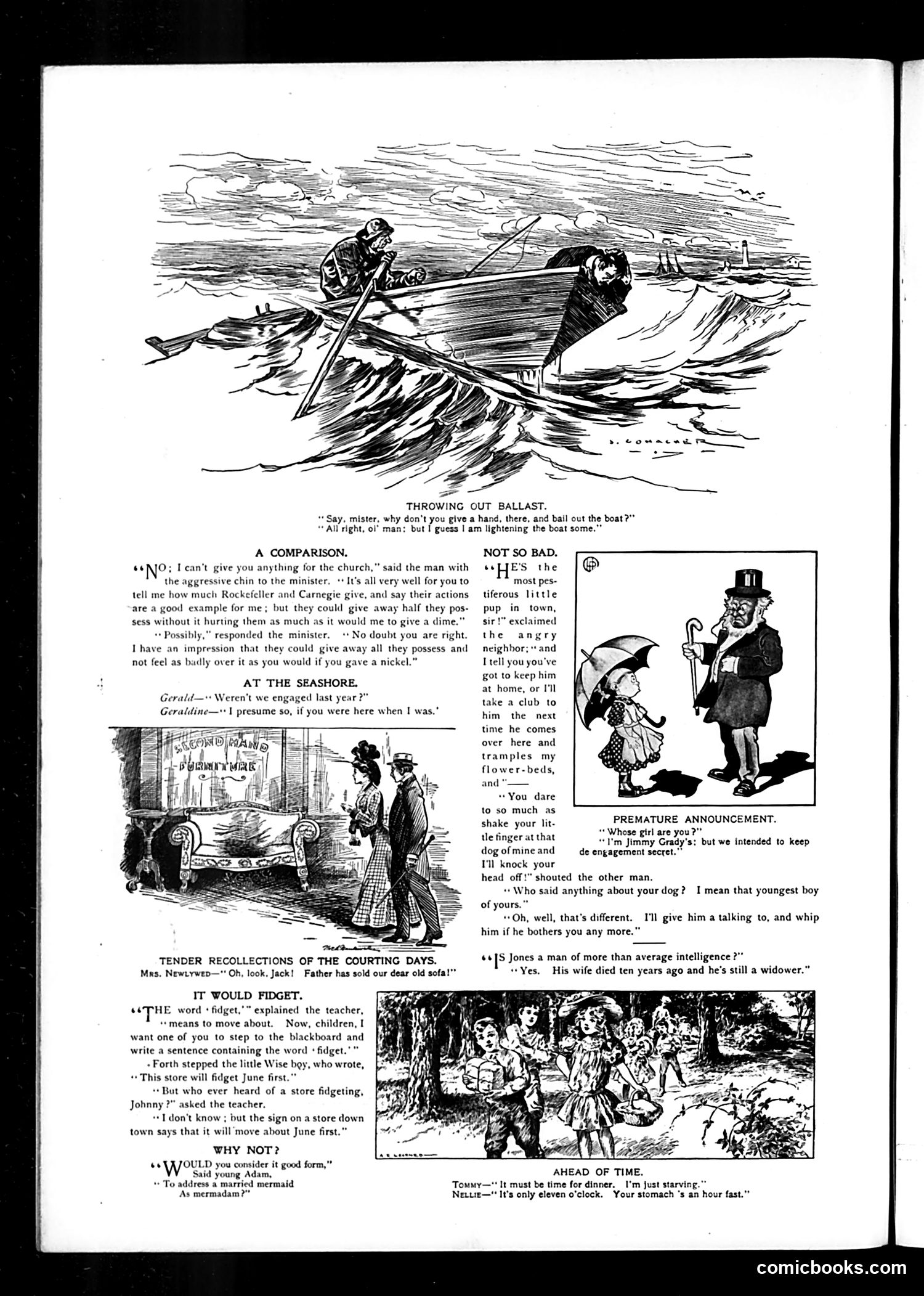
This page from *Judge* magazine contains multiple brief satirical pieces typical of the publication's style: **"Throwing Out Ballast"** depicts a man bailing water from a sinking boat while claiming he's "lightening" it—satirizing someone making excuses while failing to address the real problem. **"A Comparison"** mocks a stingy donor who refuses church donations by comparing himself unfavorably to Rockefeller and Carnegie, then admits he'd feel worse giving a dime than they'd feel giving away their entire fortunes—exposing the absurdity of his rationalization. **"At the Seashore"** and **"Tender Recollections"** are light romantic humor about engagement and marriage. **"It Would Fidget"** presents a child's literal misreading of a store's moving advertisement—innocent wordplay humor. The remaining pieces are brief jokes about social etiquette, neighbors, and domestic situations. The page represents *Judge's* mix of political/social commentary with genteel domestic humor aimed at middle-class readers.
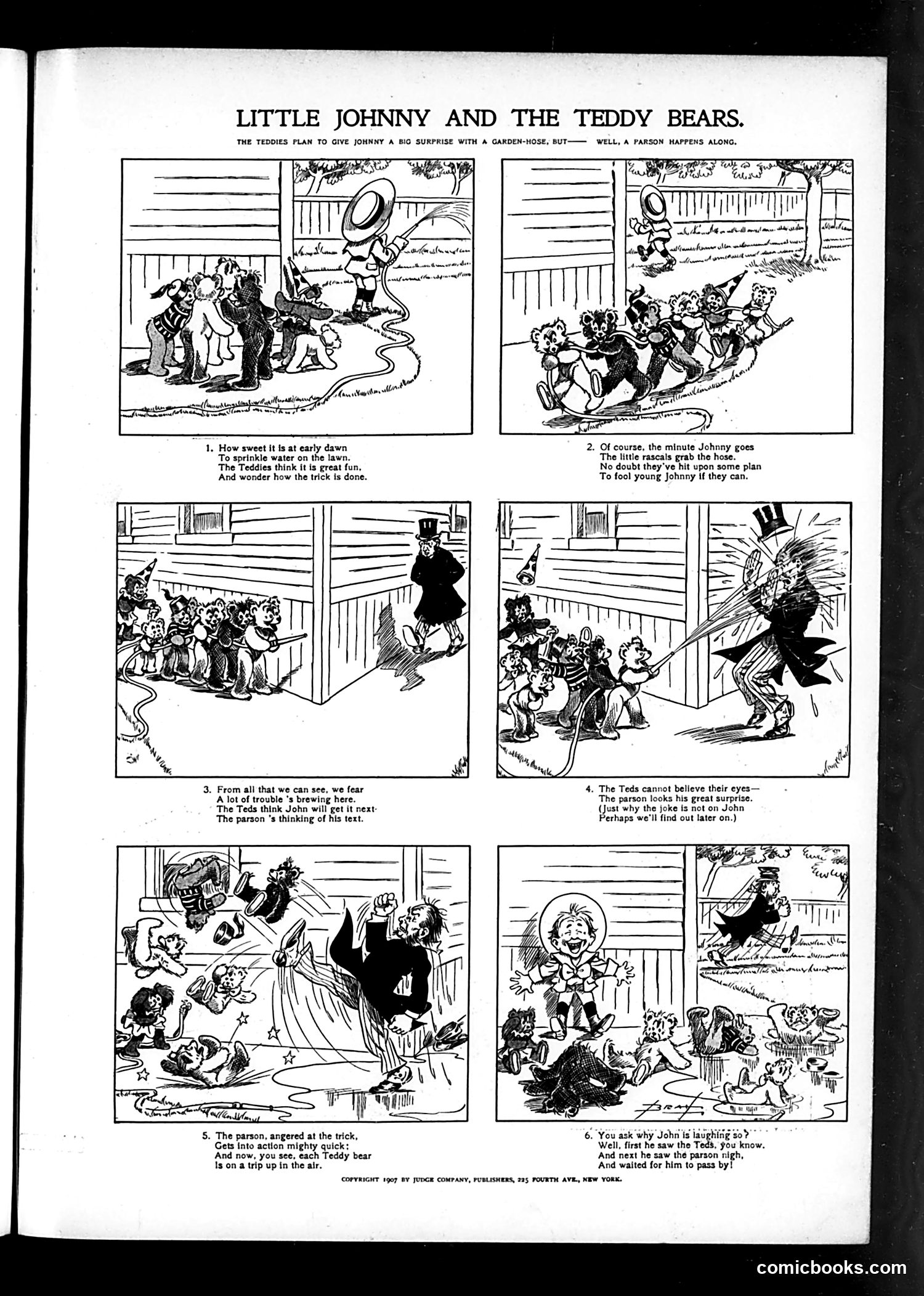
This is a humorous children's comic strip, not political satire. It depicts "Teddy Bears"—toys named after President Theodore Roosevelt, whose popularity made them a craze in the early 1900s—planning a prank on a boy named Johnny. The joke: The bears intend to spray Johnny with a garden hose as a "surprise," but when a parson (minister) unexpectedly arrives, the bears panic and spray *him* instead. Johnny, seeing the chaos unfold, wisely hides to avoid blame. The final panels show the parson's angry reaction and each bear being launched into the air by the hose's force. The humor relies on slapstick chaos, mistaken targets, and clever avoidance—typical early-1900s comic entertainment. The "Teddy Bear" reference anchors it to Roosevelt-era popular culture, though the strip itself contains no political commentary.
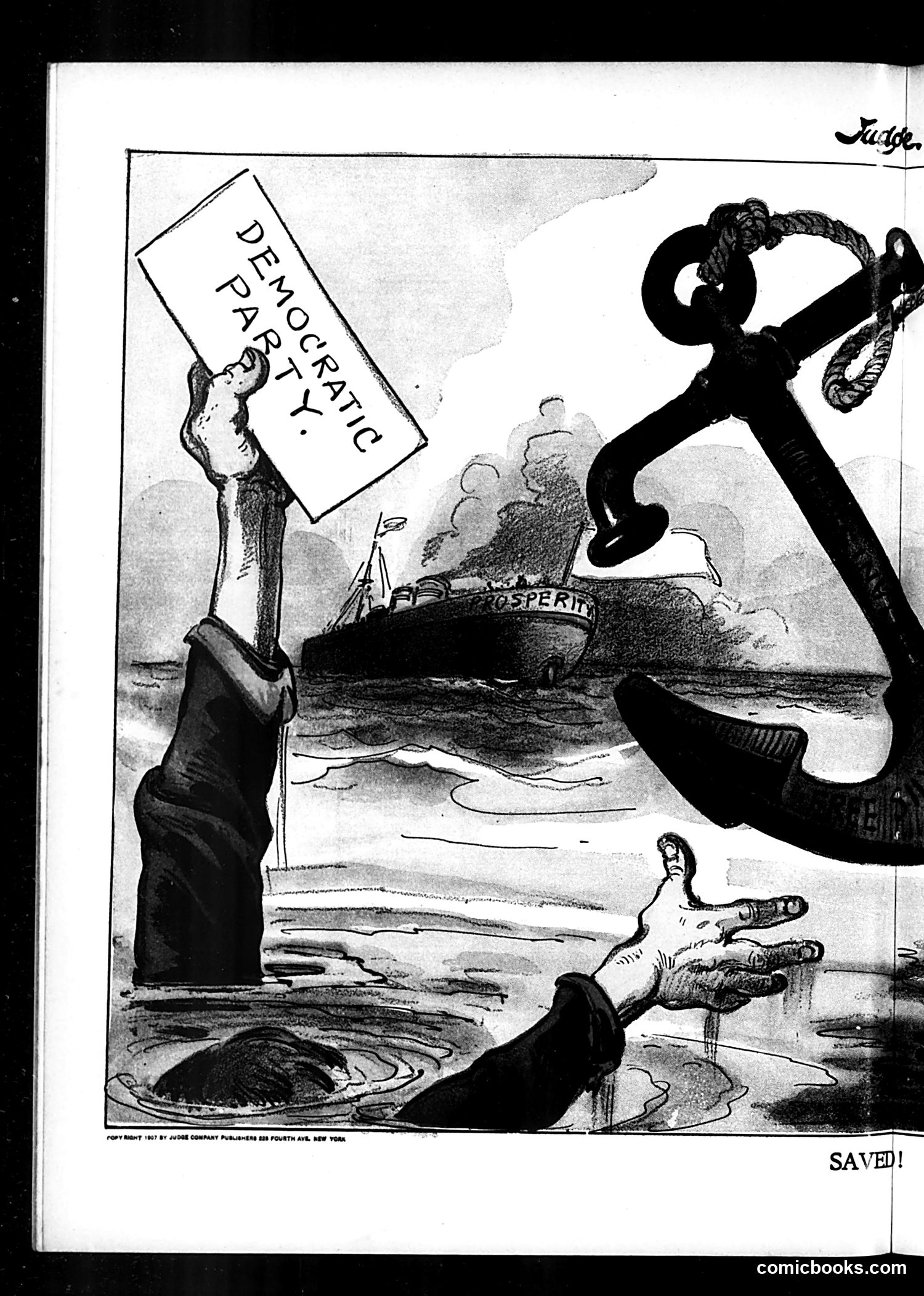
This Judge magazine cartoon depicts **Democracy under threat from Autocracy**. On the left, a figure labeled "DEMOCRACY PARTY" holds a sign while struggling in turbulent waters. On the right, an octopus-like creature (representing autocratic or tyrannical forces) reaches menacingly toward a drowning figure with cannons. A ship labeled "ESPERIT" (likely "Espérit" or spirit of hope) appears in the background. The word "SAVED!" at the bottom suggests democracy has been rescued from authoritarian threats. The cartoon likely comments on contemporary political tensions—possibly related to early 20th-century concerns about autocratic governments or domestic threats to democratic institutions. The drowning imagery emphasizes democracy's precarious position and the urgency of defending it against authoritarian forces.
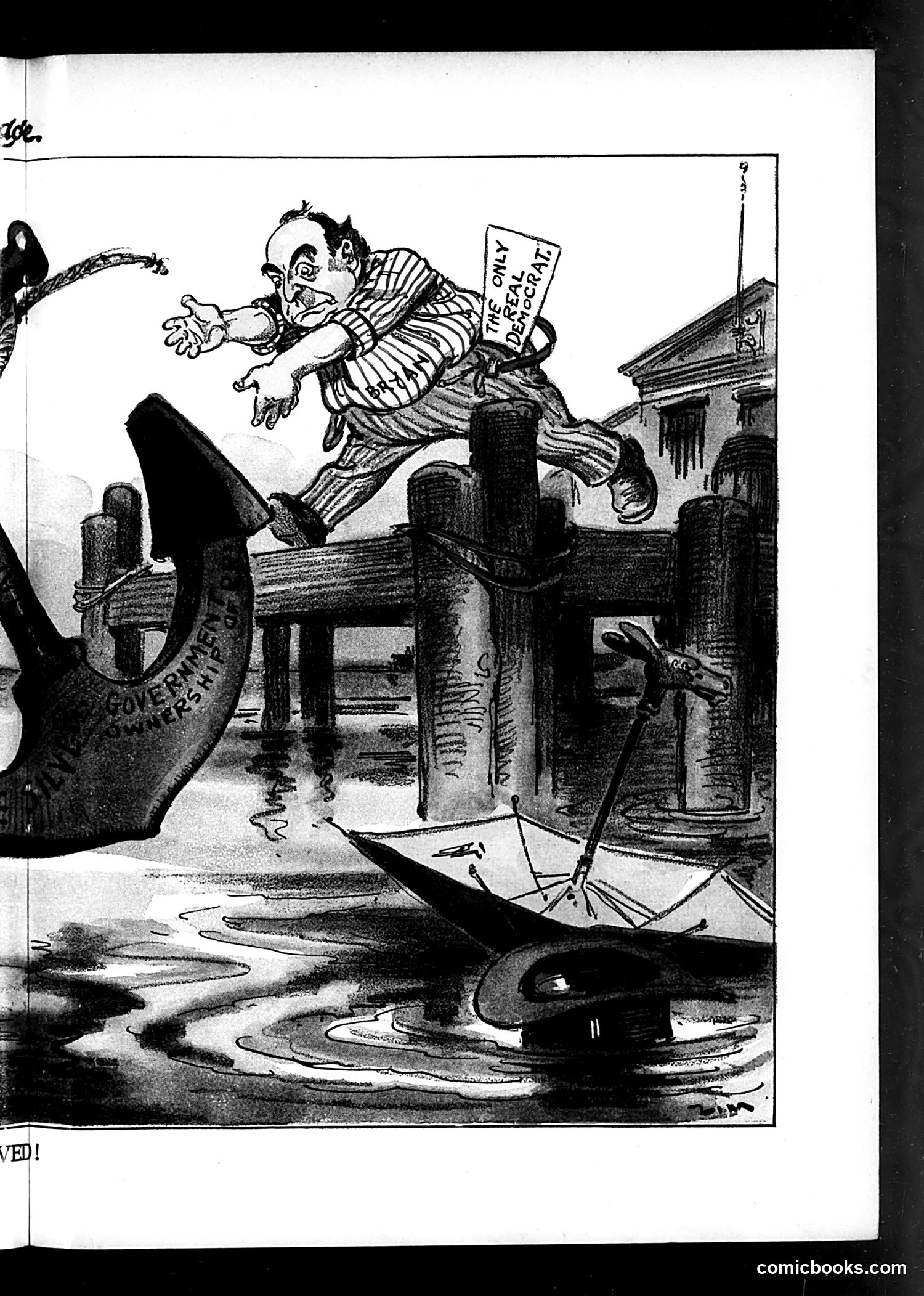
This is a satirical cartoon from *Judge* magazine depicting a grotesquely caricatured figure balanced precariously on a fence rail above floodwaters. The figure holds a sign reading "ONLY THE ONLY" (text partially unclear) and appears to be a political figure in an unstable situation. The flooded landscape with a classical building (possibly representing government) in the background suggests a crisis or disaster scenario. The cartoon likely satirizes a politician attempting to maintain a precarious political position during turbulent times—possibly related to flooding, economic crisis, or political controversy. The exaggerated caricature style and unstable pose emphasize the figure's vulnerable, ridiculous position. Without clearer text or date information, the specific political reference remains unclear to modern readers, though the visual metaphor of drowning circumstances is evident.
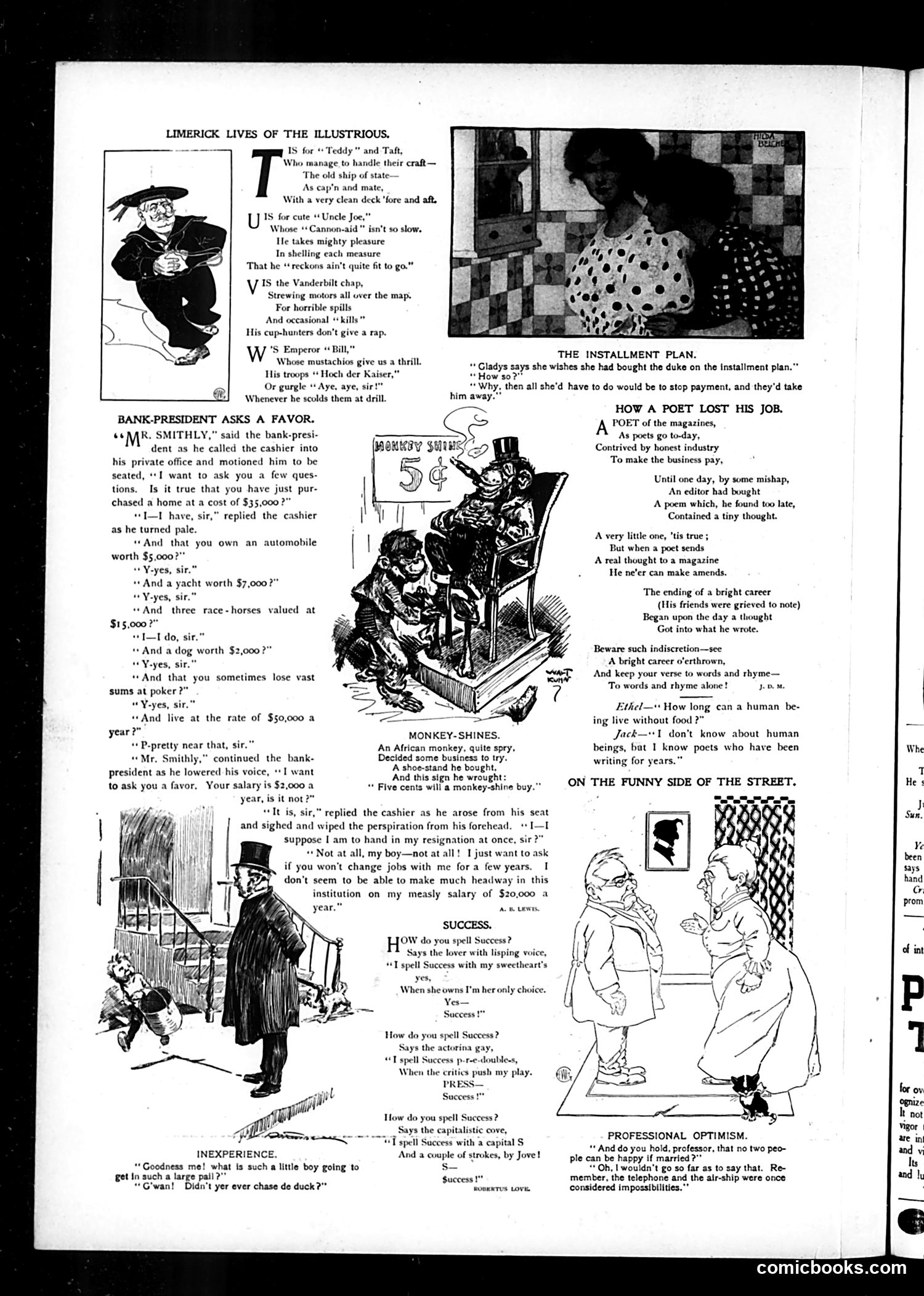
This page contains several satirical pieces critiquing American society circa 1908-1910: **"Limerick Lives of the Illustrious"** mocks prominent figures: President Theodore Roosevelt and his successor William Howard Taft ("Teddy" and "Taft"), Congressman Joseph Cannon (known for blocking legislation), railroad magnate Vanderbilt (whose automobile accidents caused deaths), and German Emperor Wilhelm II (caricatured with his famous mustache). **"Bank-President Asks a Favor"** satirizes wealth inequality: a bank president earning $20,000 annually questions his cashier (earning $2,000) about owning a $35,000 home, yacht, and racehorses—then asks to swap jobs, implying the cashier's extravagant lifestyle is mysterious given his modest salary. **"How a Poet Lost His Job"** mocks magazine editors who reject poetry containing actual ideas, preferring empty verse. **Other pieces** ridicule installment plans, human inconsistency, and false optimism. The humor relies on contemporary references to wealth, class anxiety, and editorial gatekeeping now largely historical.
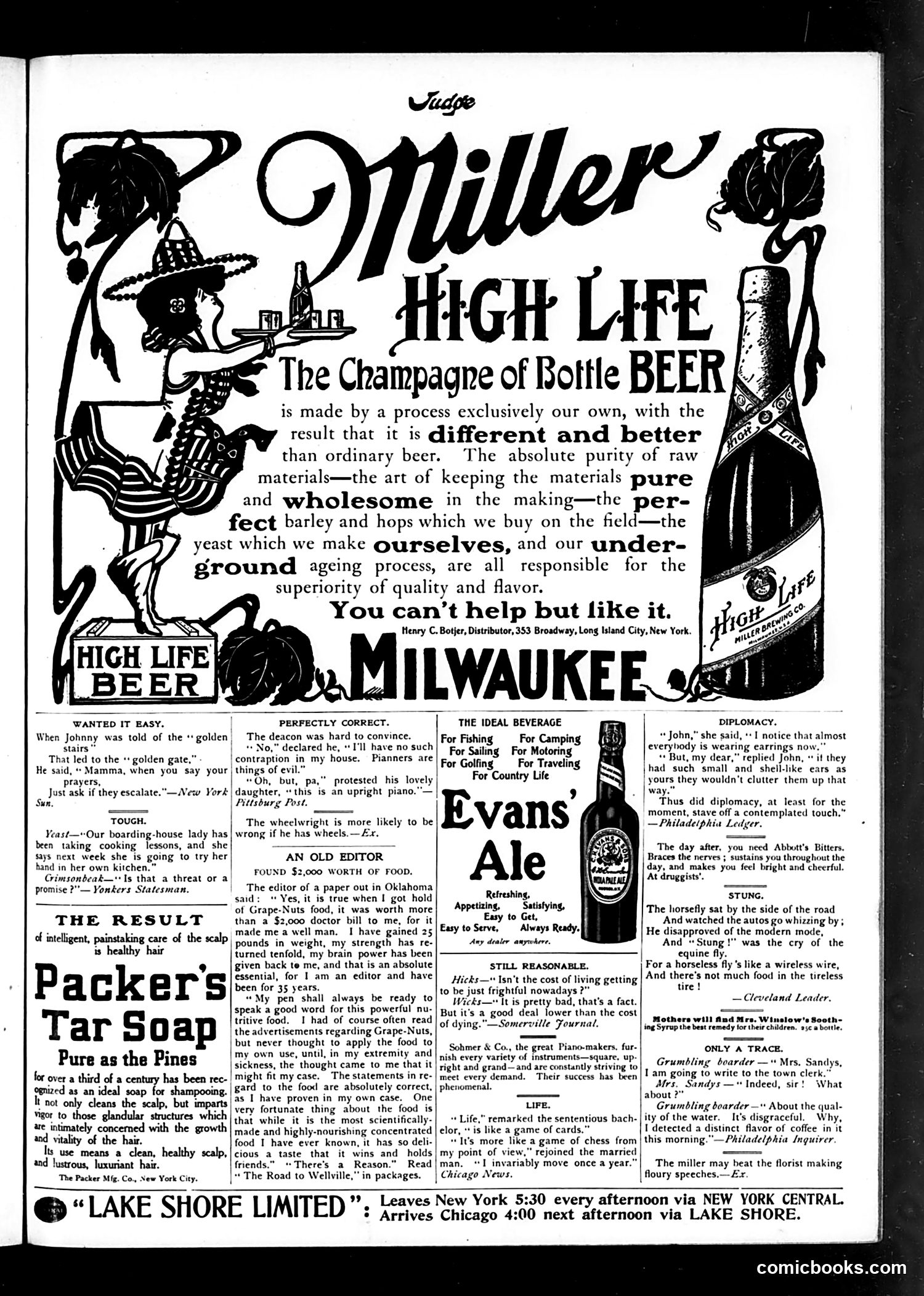
This page is primarily **advertising** interspersed with brief jokes and anecdotes typical of Judge's format. The main feature is a **Miller High Life beer advertisement** (top half), which uses decorative Art Nouveau-style figures and makes claims about the product's exclusive brewing process, purity, and superior quality—standard advertising language for the era. Below are smaller **paid advertisements** for Evans Ale, Packer's Tar Soap, and Sohmer & Co. pianos, along with **humorous filler content**: short jokes about a child wanting escalating prayers ("golden stairs"), a boarding-house cook taking lessons, a piano being "upright" (moral pun), and a testimonial from an Oklahoma editor praising Grape-Nuts food for restoring his health. The page also includes jokes about the cost of living versus dying, and a married man's chess analogy for life. There are **no political cartoons or caricatures**—this is a standard commercial/entertainment page from an early 20th-century humor magazine, showing how such publications funded themselves through advertising.
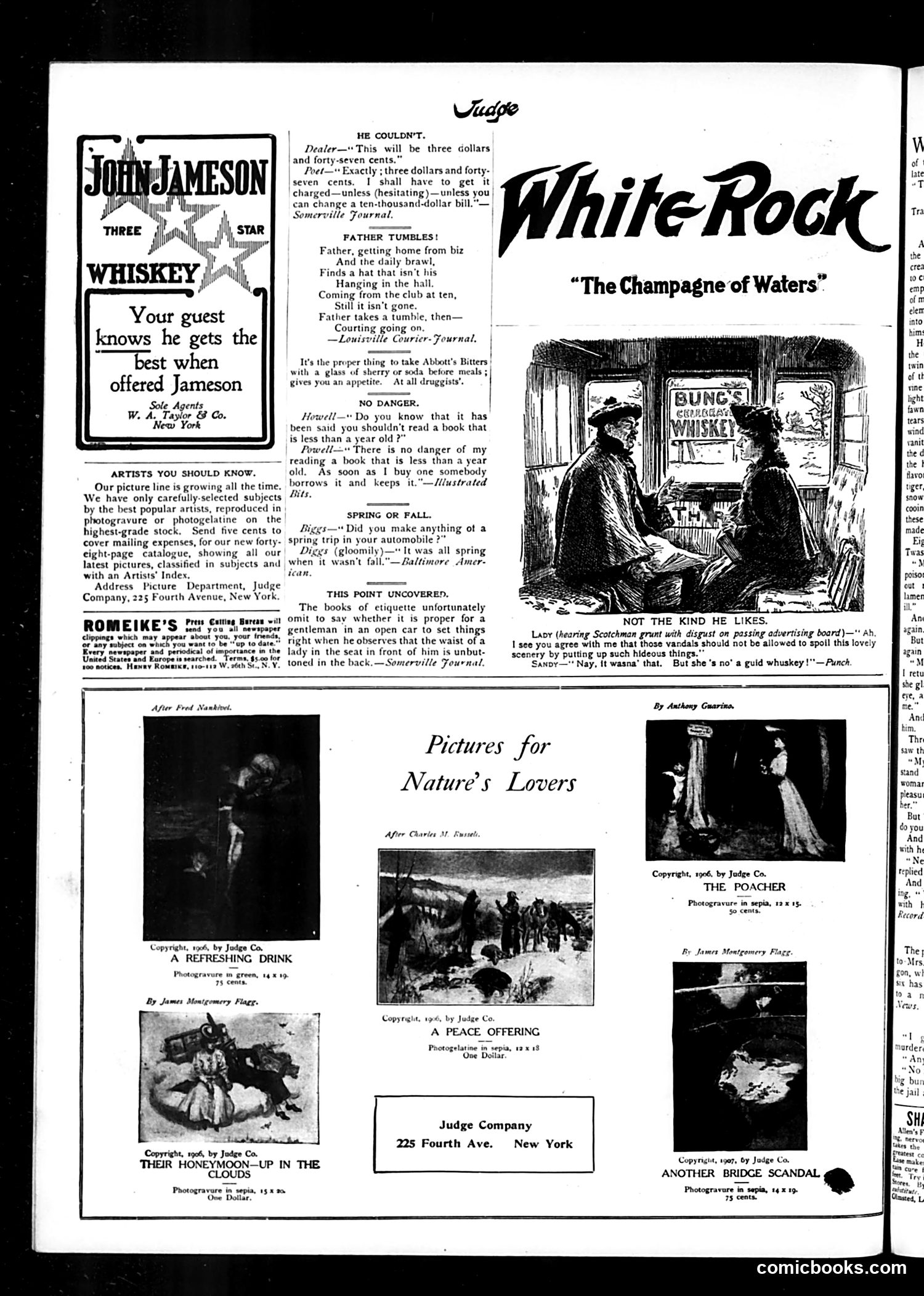
This page is primarily **advertising and catalog content** rather than editorial cartoons. The main elements are: **Top section:** Three brief humorous anecdotes (likely reprinted from other publications): - A joke about a poor poet unable to change a ten-thousand-dollar bill - A rhyme about a father discovering a strange hat, implying his daughter is courting - A Scotsman complaining about whiskey quality in an advertisement, not the landscape **Bottom section:** A catalog advertisement for the Judge Company's picture line, promoting art prints by popular contemporary artists (Charles M. Russell, James Montgomery Flagg, and others) available for purchase—including titles like "The Poacher," "A Peace Offering," and "Another Bridge Scandal." The page also includes advertisements for John Jameson Whiskey and White Rock mineral water. **No significant political satire appears here**—this is largely a commercial page showcasing the magazine's related business ventures.
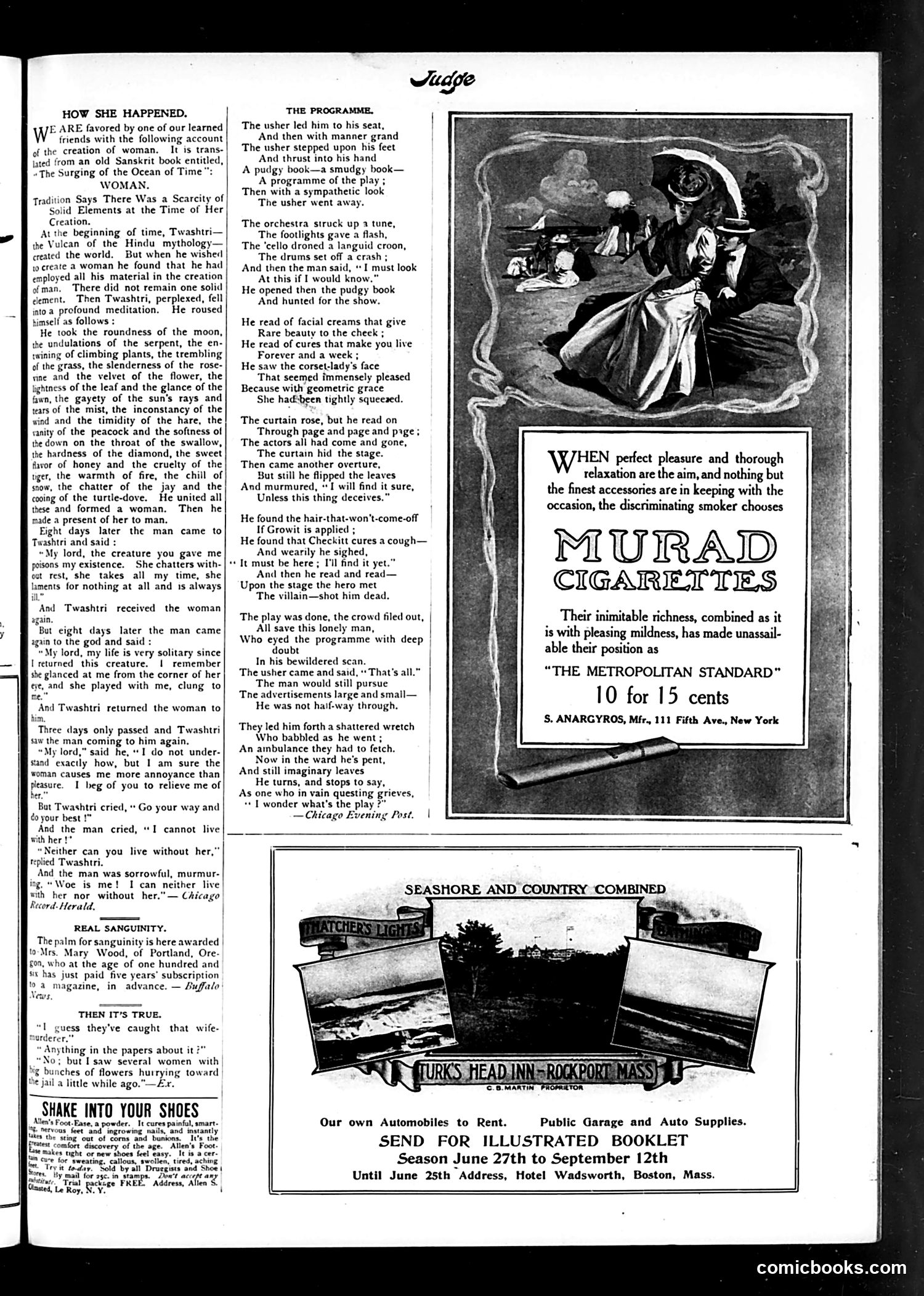
This page contains two distinct pieces of social satire: **"Woman" (left column):** A satirical Hindu creation myth explaining women's contradictory nature. The joke: Twashti creates Woman from incompatible elements (moon's roundness, serpent's undulation, peacock's vanity, etc.), making her impossible to live with—yet impossible to live without. This mocks Victorian-era male complaints about women being simultaneously fascinating and frustrating, presenting female "inconsistency" as inherent to their very creation. **"The Programme" (center/right):** A theater-goer spends an entire play reading advertisements in the program instead of watching the stage, desperately searching for the actual play listing among beauty cream and patent medicine ads. The satire targets both the excessive advertising cluttering theater programs and the audience member's obliviousness—a commentary on consumer culture's invasion of entertainment. The Muraid Cigarettes advertisement below is unrelated editorial content.
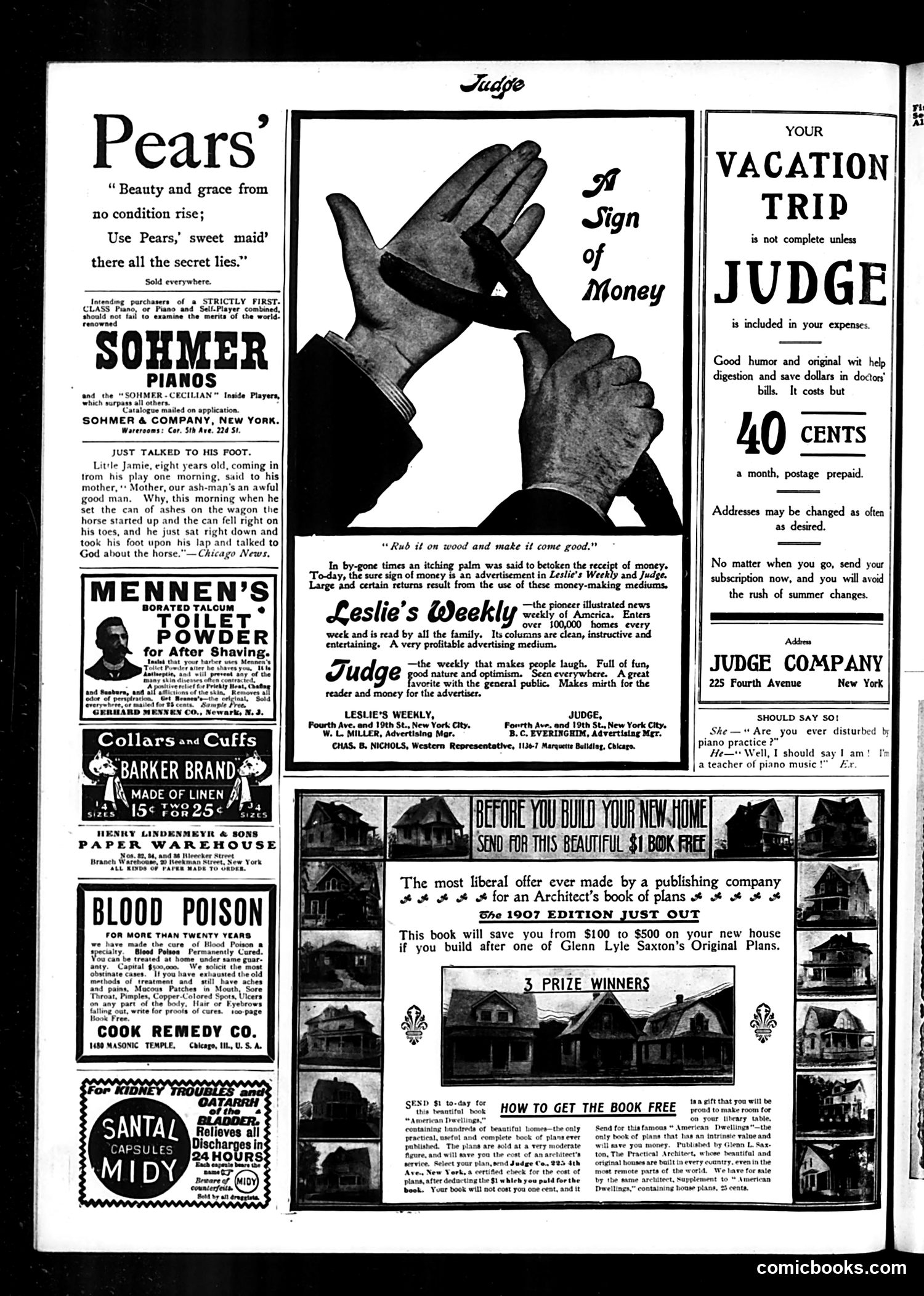
This page is primarily **advertising**, typical of early 1900s magazines. The central cartoon is minimal—a simple illustration of a hand with money, captioned "Rub it on wood and make it come good," accompanying text about how advertisements in *Leslie's Weekly* and *Judge* are reliable sources of income for advertisers (an ironic self-promotional claim). The advertisements themselves reveal period concerns: Sohmer pianos, Pears' soap, Mennen's talcum powder, and notably, treatments for "Blood Poison" (likely syphilis), suggesting such conditions were openly advertised despite social stigma. A "Santal Capsules" ad promises kidney/bladder relief within 24 hours—typical of dubious patent medicines. The only satirical content is a brief anecdote ("Just Talked to His Foot") about a child reporting an ash-man's pious reaction to injury—gentle humor about working-class religiosity. The page mostly serves as a revenue vehicle for the magazine itself, advertising *Judge* subscriptions and promoting architectural home-design books.
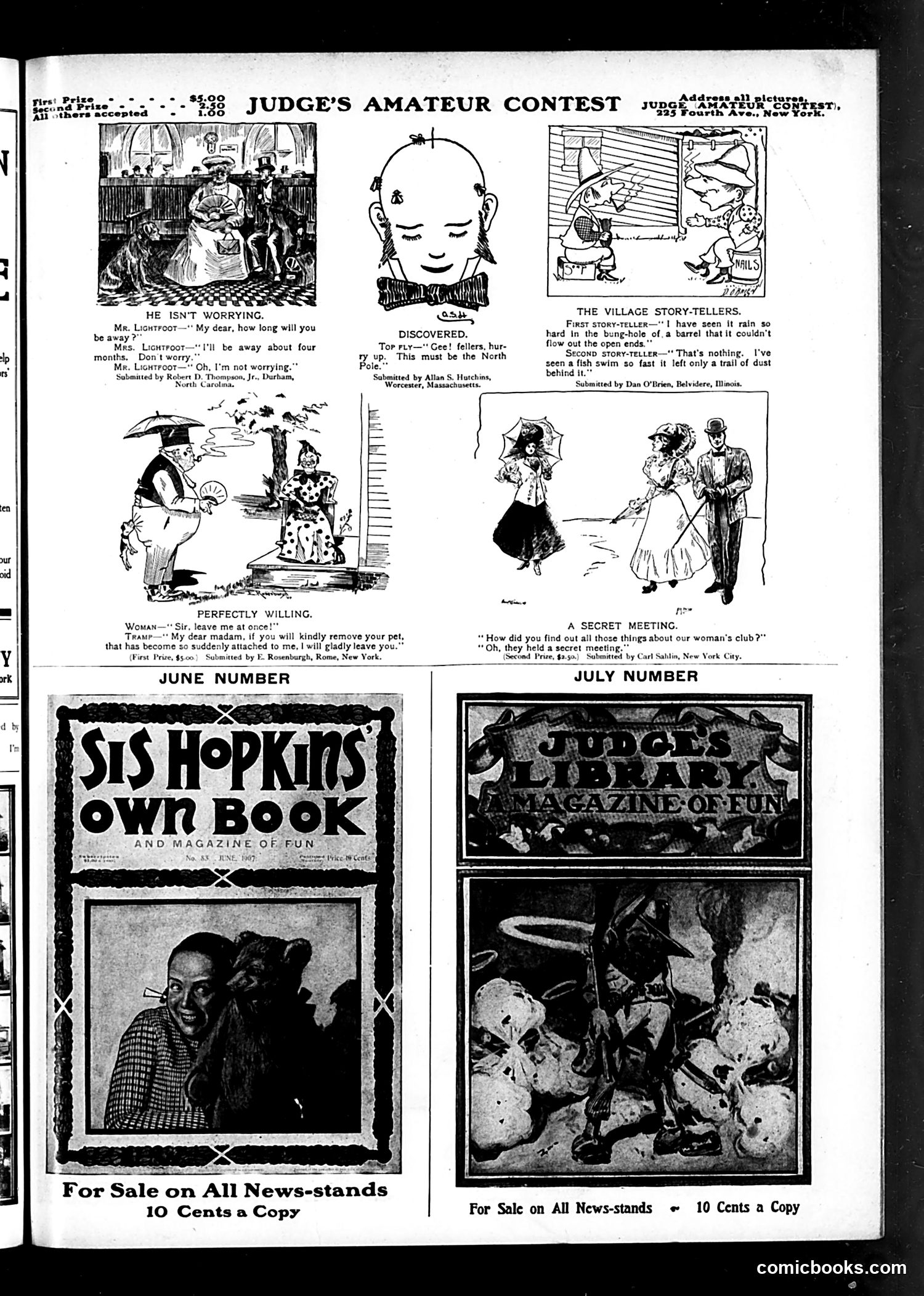
This page showcases Judge's amateur humor contest—readers submitted comic captions and jokes for publication and prizes. The content reflects early-20th-century domestic comedy conventions. The cartoons employ gentle, domestic satire typical of the era: a husband unconcerned about his wife's extended absence ("He Isn't Worrying"), a woman rejecting an unwanted suitor ("Perfectly Willing"), and explorers at the North Pole ("Discovered"). "The Village Story-Tellers" mocks rural exaggeration—fishermen competing with absurdly tall tales. "A Secret Meeting" plays on social anxiety about exclusive women's clubs (a concern of that era), with a woman's pet dog being the embarrassing "secret" revealed. The page also advertises *Sis Hopkins' Own Book* (June) and what appears to be *Judge's* July issue, both ten-cent publications sold on newsstands. The humor is innocent by modern standards—focused on marital dynamics, social anxiety, and gentle mockery of contemporary institutions.
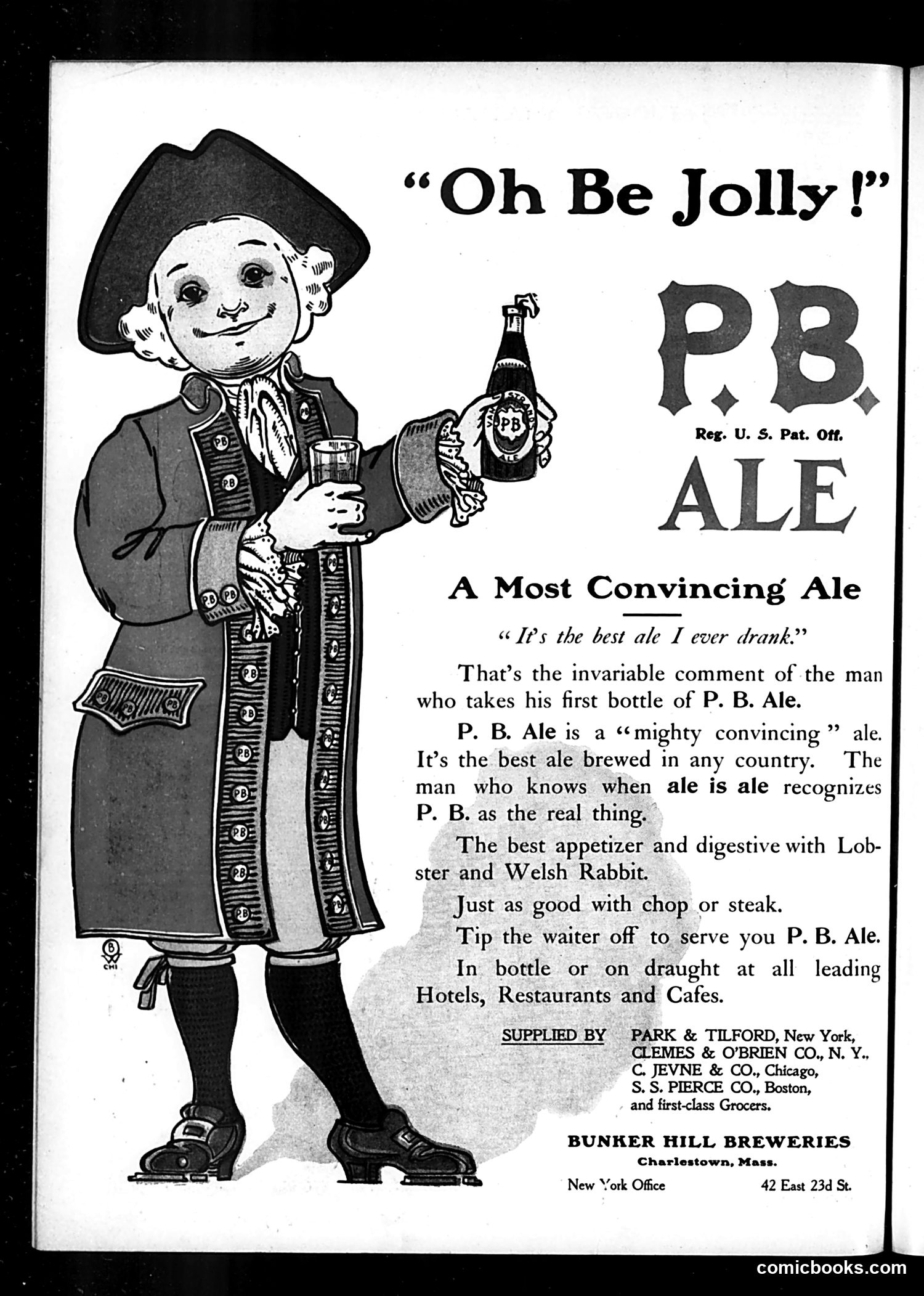
This is primarily a **beer advertisement**, not political satire. It features a jovial, cartoonish character in colonial-era clothing (tricorn hat, period coat) holding a glass and bottle of P.B. Ale, with the tagline "Oh Be Jolly!" The colonial costume appears designed to evoke American tradition and respectability—likely referencing the Bunker Hill Breweries' Massachusetts location. The figure's exaggerated, cheerful appearance is meant to suggest the product's appeal and the satisfied customer testimonial ("It's the best ale I ever drank"). The ad emphasizes quality, versatility with meals, and availability at upscale establishments (hotels, restaurants, first-class grocers). This represents typical early 20th-century alcohol advertising targeting middle-to-upper-class consumers through appeals to tradition, sophistication, and conviviality.