
Judge, 1907-06-15 · page 4 of 16
Judge — June 15, 1907 — page 4: what you’re looking at
What you’re looking at
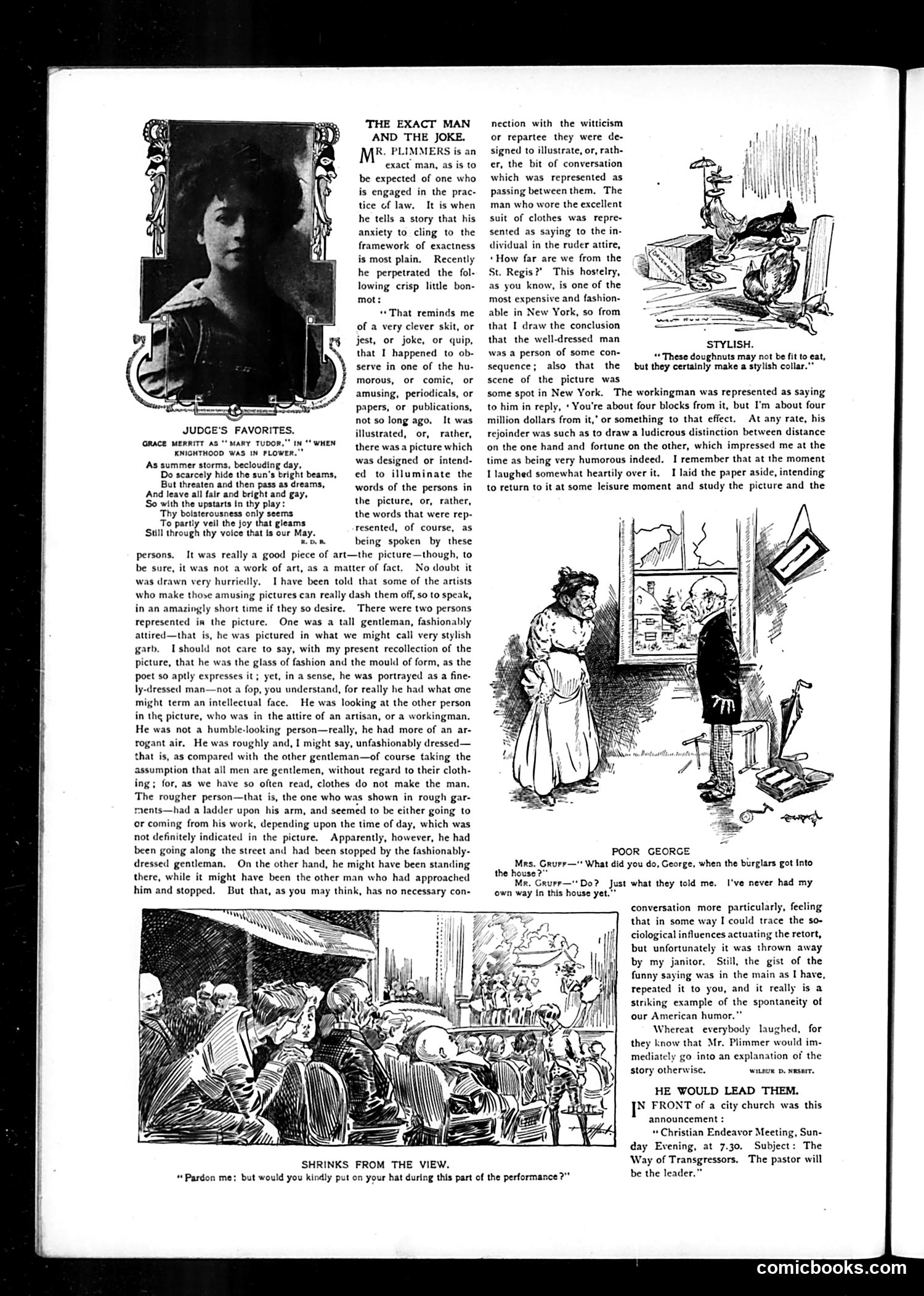
This page satirizes **Mr. Plimmers**, a lawyer known for exact precision in speech. The main article "The Exact Man and the Joke" critiques how Plimmers obsesses over literal accuracy while missing humor's essence. The cartoons illustrate this theme: "Stylish" shows a fashionable man discussing New York's wealthy, while "Poor George" depicts a burglar's comedic excuse to a homeowner. "Shrinks from the View" shows audience members disturbed by performance content. The satire targets a recognizable personality type—the pedantic professional who cannot enjoy spontaneous humor because he's fixated on factual precision. This reflects broader Gilded Age tensions between rigorous professionalism and American informality. The page ultimately defends American humor's value against over-intellectualization.
📄 Transcribed text from this page (OCR, searchable)
Machine-transcribed from the original scan — historical spelling and the odd misread are preserved.
‘THE EXACT MAN AND THE JOKE. R, PLIMMERS is an exact’ man, as is to be expected of one who is engaged in the prac- tice of law, It is when he tells a story that his anxiety to cling to the framework of exactness is most plain. Recently he perpetrated the fol- lowing crisp little bon- mot: «That reminds me of a very clever skit, or jest, or joke, or quip, that I happened to ob- serve in one of the hu- morous, or comic, or amusing, periodicals, or papers, or publications, not so long ago, It was illustrated, or, rather, RACE MORIN AS: ARS SUC there was a picture which KNIGHTHOOD WAS IN FLOWER. ‘As summer storms, beclouding day, was designed of Intend- Do scarcely hide the sun's bright beams, ed to illuminate the But threaten and then pass as dreams, d i And leave all fair and bright and gay, words of:the: persons tn So with the upstarts in thy play: the picture, or, rather, Thy boisterousness only seems the words that were rep- To partly veil the joy that gleams eeachled,, Of COUR, a8 being spoken by these ‘Still through thy voice that is our May. om persons, It was really a good piece of art—the picture—though, to be sure, it was not a work of art, as a matter of fact, No doubt it was drawn very hurriedly, Ihave been told that some of the artists who make those amusing pictures can really dash them off, so to speak, in an amazingly short time if they so desire. ‘There were two persons represented in the picture. One was a tall gentleman, fashionably attired—that is, he was pictured in what we might call very stylish garb. Ishould not care to say, with my present recollection of the picture, that he was the glass of fashion and the mould of form, as the poet so aptly expresses it; yet, in a sense, he was portrayed as a fine- ly-dressed man—not a fop, you understand, for really he had what one might term an intellectual face. He was looking at the other person in thg picture, who was in the attire of an artisan, or a workingman, He was not a humble-looking person—really, he had more of an ar- rogant air. He was roughly and, I might say, unfashionably dressed— that is, as compared with the other gentleman—of course taking the assumption that all men are gentlemen, without regard to their cloth- ing; for, as we have so often read, clothes do not make the man. The rougher person—that is, the one who was shown in rough gar- ments—had a ladder upon his arm, and seemed to be either going to or coming from his work, depending upon the time of day, which was not definitely indicated in the picture. Apparently, however, he had been going along the street and had been stopped by the fashionably- dressed gentleman. On the other hand, he might have been standing there, while it might have been the other man who had approached him and stopped. But that, as you may think, has no necessary con- nection with the witticism or repartee they were de- signed to illustrate, or, rath- er, the bit of conversation which was represented as passing between them, The man who wore the excellent suit of clothes was repre- sented as saying to the in- dividual in the ruder attire, * How far are we from the St. Regis?” This hostelry, as you know, is one of the most expensive and fashion- able in New York, so from that I draw the conclusion that the well-dressed man was a person of some con- sequence; also that the scene of the picture was some spot in New York. The workingman was represented as saying to him in reply, ‘You're about four blocks from it, but I'm about four million dollars from it,’ or something to that effect. At any rate, his rejoinder was such as to draw a ludicrous distinction between distance ‘on the one hand and fortune on the other, which impressed me at the time as being very humorous indeed. I remember that at the moment I laughed somewhat heartily over it, I laid the paper aside, intending to return to it at some leisure moment and study the picture and the STYLISH. «These doughnuts may not be fit to eat, but they certainly make a stylish collar." POOR GEORGE Mrs. Grurt What did you do, George, when the burglars got Into the house?” Mr. Grurr—‘Do? Just what they told me. I've never had my ‘own way in this house yet.” conversation more particularly, feeling SHRINKS FROM THE VIEW. “Pardon me: but would you kindly put on your hat during this part of the performance ?” that in some way I could trace the so- ciological influences actuating the retort, but unfortunately it was thrown away by my janitor. Still, the gist of the fanny saying was in the main as I have, Tepeated it to you, and it really is a striking example of the spontaneity of our American humor.” Whereat everybody laughed, for they know that Mr. Plimmer would im- mediately go into an explanation of the story otherwise. HE WOULD LEAD THEM. N FRONT of a city church was this announcement : “ Christian Endeavor Meeting, Sun- day Evening, at 7.30. Subject: The Way of Transgressors. The pastor will be the leader.” WILEUR D. RSBIT, comicbooks.com