
A complete issue · 16 pages · 1907
Judge — June 1, 1907
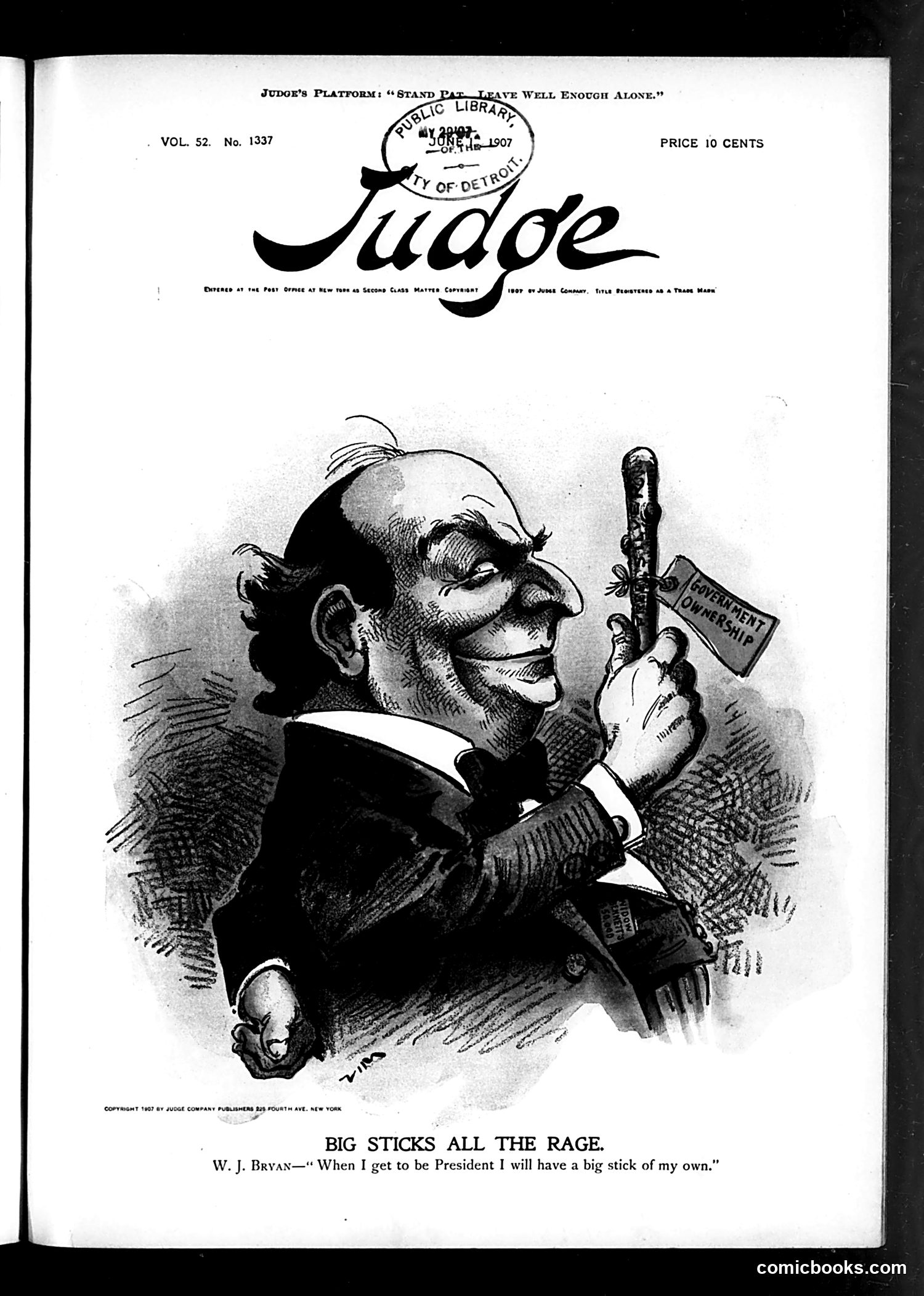
This cartoon satirizes **W.J. Bryan**, the prominent Democratic politician and three-time presidential candidate. The caricature depicts him holding a document labeled "Government Ownership" while making a boastful statement: "When I get to be President I will have a big stick of my own." The satire operates on two levels: First, it mocks Bryan's perennial presidential ambitions and repeated electoral failures. Second, it references **Theodore Roosevelt's "Big Stick" diplomacy**—his famous foreign policy approach. By showing Bryan claiming he too will wield a "big stick," the cartoonist ridicules Bryan's political rhetoric and suggests his ambitions exceed his actual power or likelihood of success. The exaggerated facial features employ period-standard caricature conventions emphasizing his distinctive appearance.
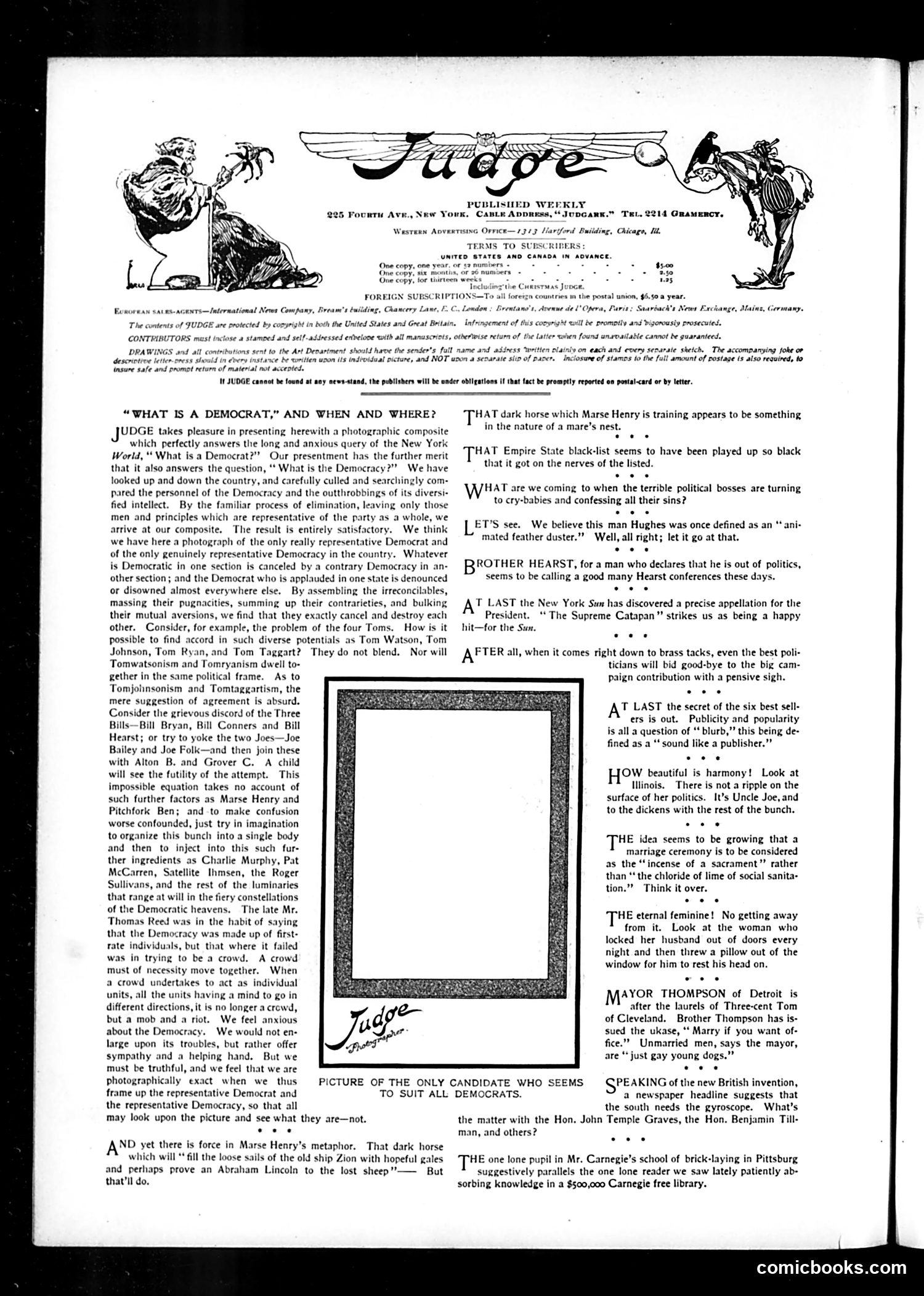
This page features political commentary titled "What is a Democrat?" The article criticizes Democratic Party unity, arguing that Democrats cannot truly coalesce because their party contains fundamentally incompatible factions. The author lists prominent Democratic figures—seemingly referencing Tom Johnson, Tom Bryan, and Tom Taggart—claiming they "don't blend" and cannot gather "in the same political frame." The central blank box appears designed for a political cartoon (likely showing a Democratic candidate), captioned "Picture of the Only Candidate Who Seems to Suit All Democrats." The satire mocks Democratic internal divisions and suggests no single candidate can satisfy the party's diverse constituencies. Additional shorter items mock targets like Mayor Thompson of Detroit and criticize contemporary political practices. The overall thrust: Democrats are too fractious to govern effectively.
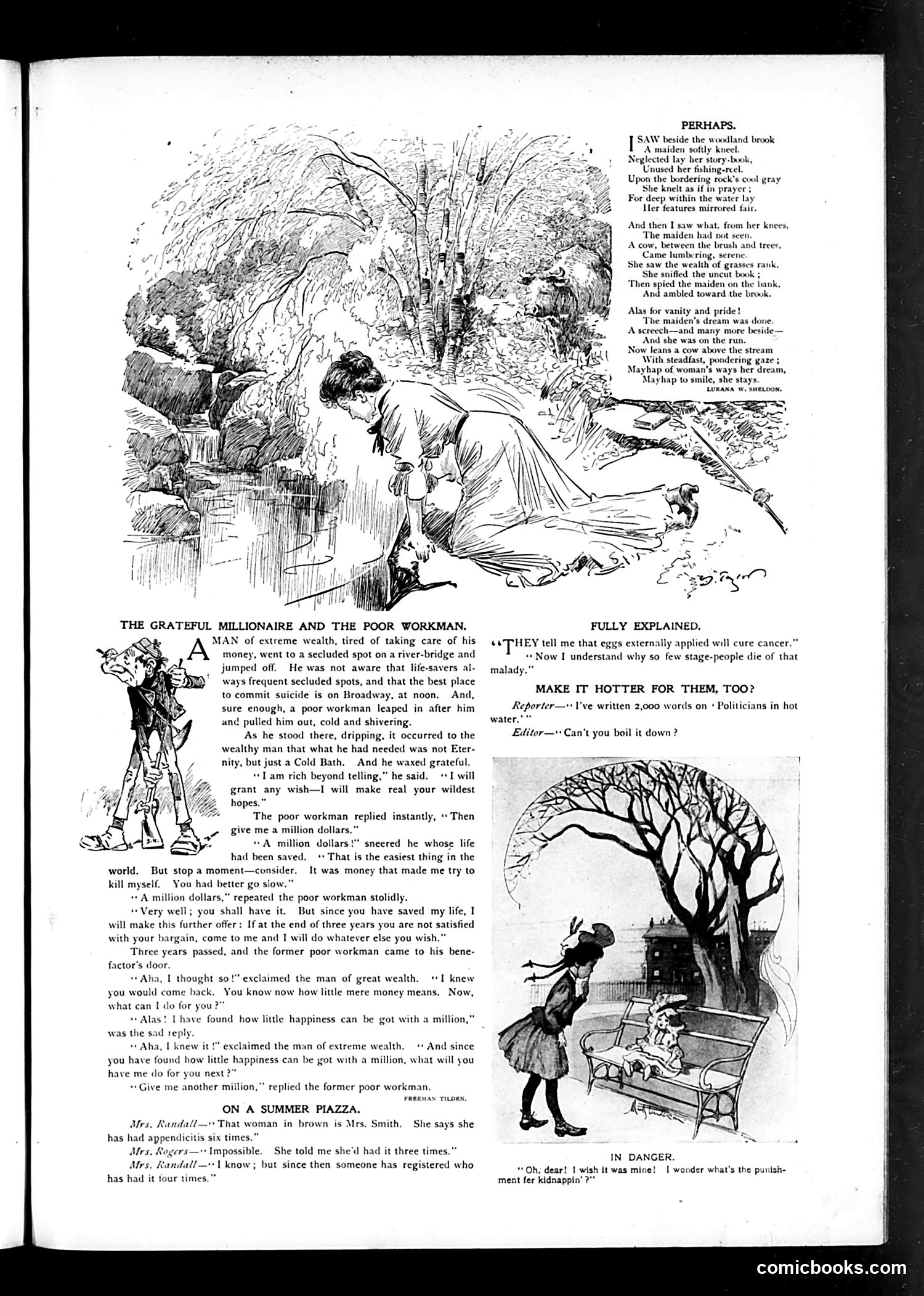
This page contains several distinct satirical pieces rather than one unified cartoon: 1. **"Perhaps"** (top): A narrative poem with illustration depicts a maiden by a stream—likely satirizing Romantic-era poetry and idealized femininity through melodramatic verse about "vanity and pride." 2. **"The Grateful Millionaire and the Poor Workman"**: A dialogue-based satire where a wealthy man offers a poor workman one million dollars as reward for saving his life. The workman initially refuses, then accepts—but the millionaire keeps raising conditions, ultimately offering nothing. This mocks wealthy individuals' false generosity and exploitative attitudes toward working-class people. 3. **Additional brief comic exchanges** about medical claims and social gossip fill the remaining space, typical of Judge's general satirical style targeting contemporary pretension and absurdity.
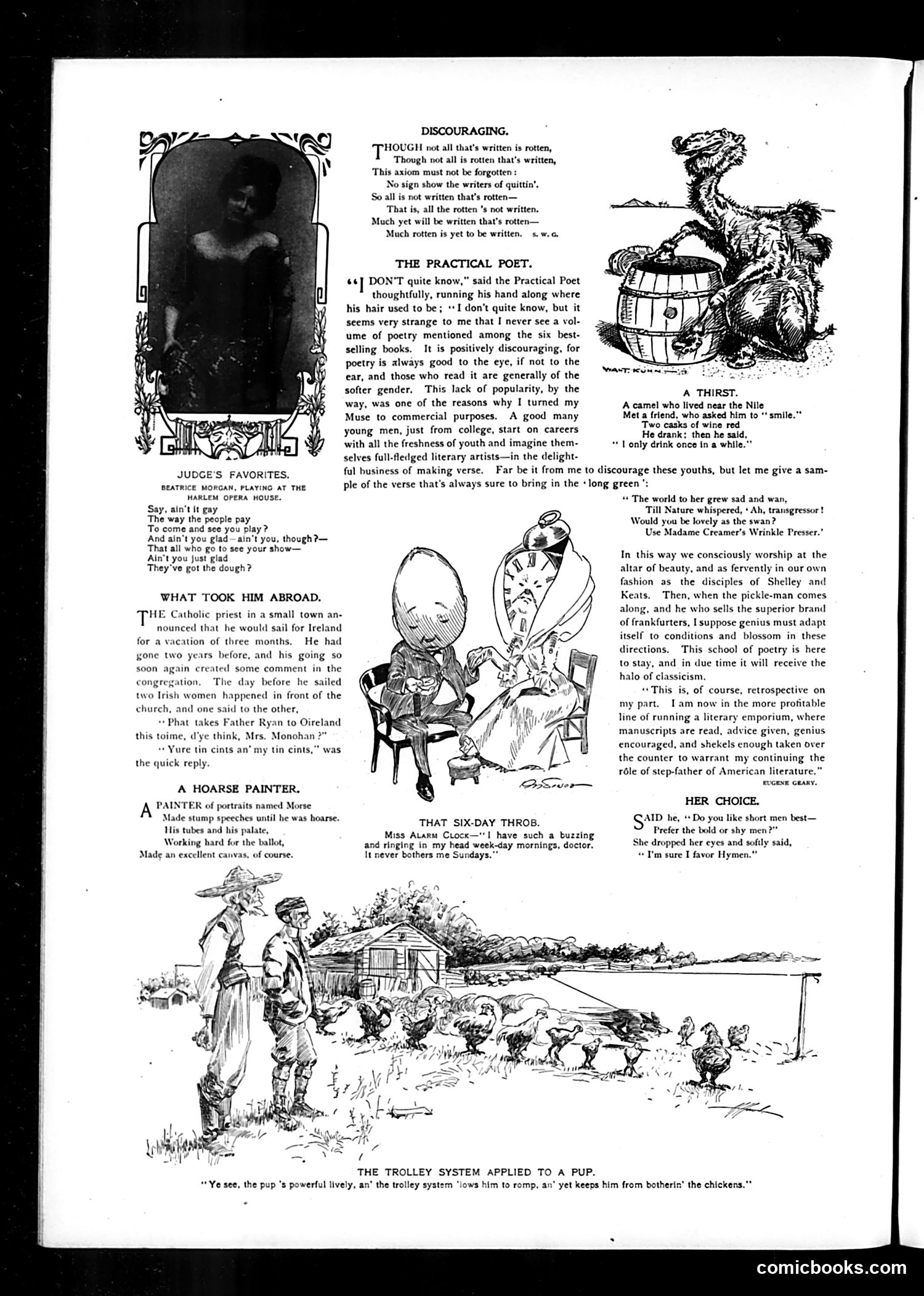
This page from *Judge* magazine contains several short humorous pieces and illustrations rather than a cohesive political cartoon. **"Discouraging"** opens with a poem about written versus unwritten work, likely mocking pretentious literary discussions. **"The Practical Poet"** satirizes young college graduates pursuing poetry as a career, with the Practical Poet dismissing verse as commercially impractical—a common theme in early 20th-century American humor about artistic ambitions versus practical concerns. The remaining pieces ("What Took Him Abroad," "A Hoarse Painter," "That Six-Day Throb," "Her Choice," and "The Trolley System Applied to a Pup") are brief anecdotal jokes with accompanying illustrations, typical of *Judge*'s format. They appear to address everyday life, occupations, and domestic situations without specific political references.
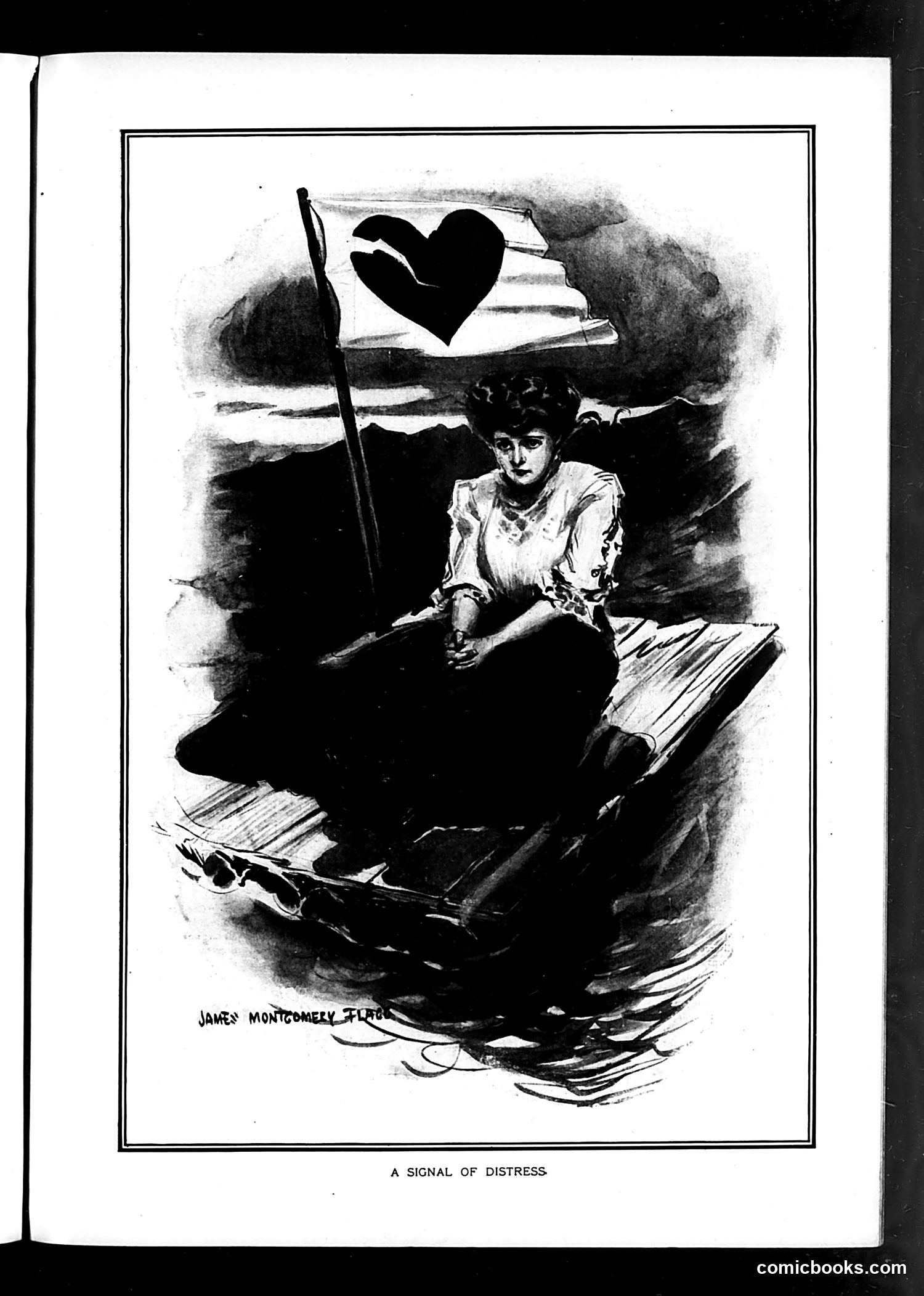
This illustration by James Montgomery Flagg depicts a woman in a small boat holding a flag bearing a heart symbol—literally a "signal of distress." The title plays on the dual meaning: she's signaling for rescue while her emotional distress is conveyed through the heart imagery. The sketch appears to be romantic or sentimental commentary, likely from Judge magazine's satirical coverage of relationships and courtship. The woman's distressed expression and vulnerable position in the small boat suggest she's in some kind of emotional or romantic predicament. Without additional context from surrounding page content, the specific social or political situation referenced remains unclear, though the artwork exemplifies the magazine's use of visual metaphor to comment on contemporary social situations.
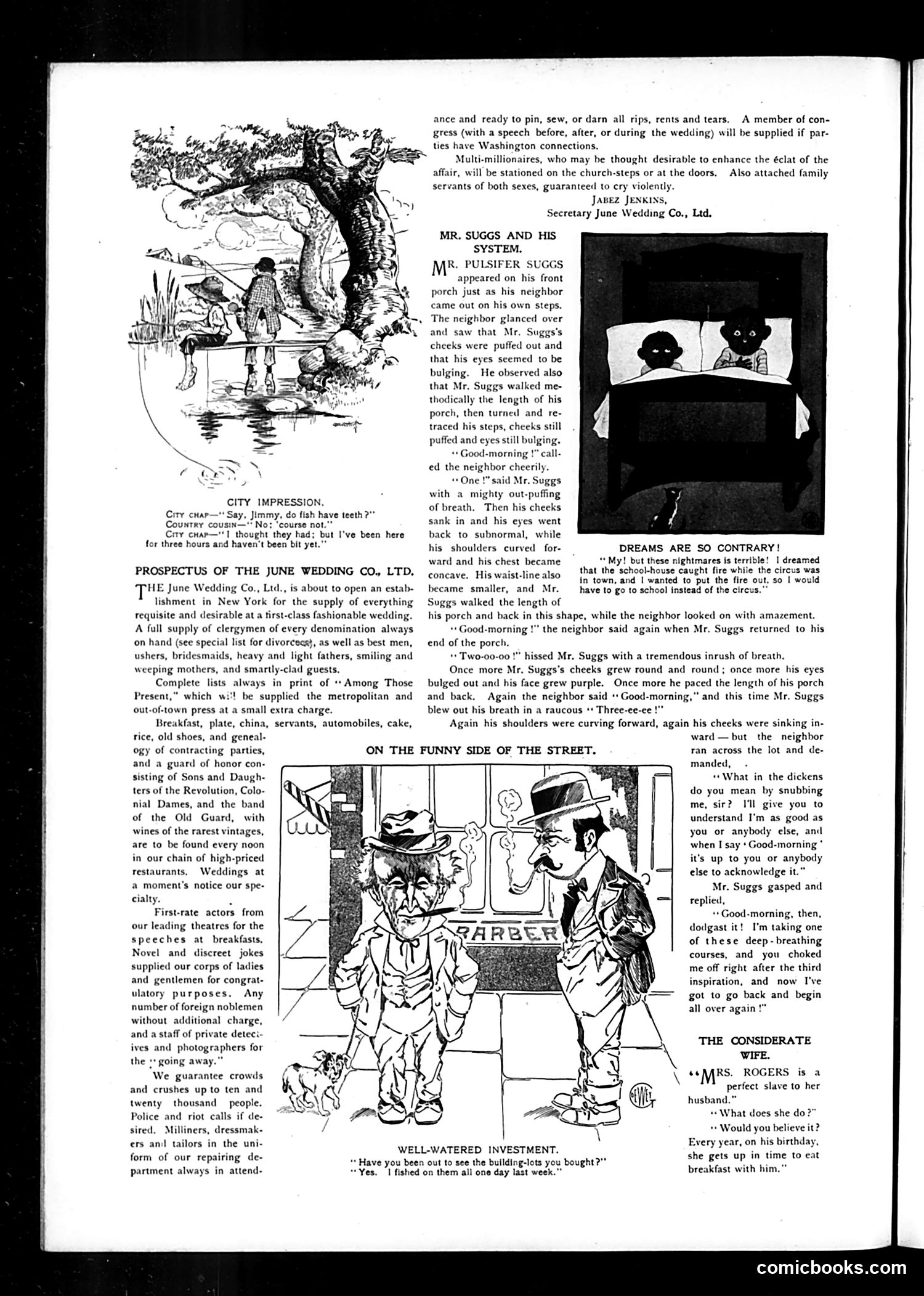
This page contains three satirical pieces mocking American social conventions: 1. **"City Impression"**: A simple joke contrasting urban and rural ignorance—a city boy asks if fish have teeth; a country cousin denies it; the city boy hasn't been bitten in three hours, implying the country cousin is wrong. 2. **"June Wedding Co., Ltd."**: Satirizes the commercialization of high-society weddings. The mock advertisement offers everything "requisite" for fashionable weddings—clergy (with a special list for divorcees), hired guests, newspaper announcements, and notably, congressmen with speeches and millionaires positioned to add prestige. It mocks how weddings become expensive theatrical productions for the wealthy. 3. **"Mr. Suggs and His System"**: Depicts a man performing an odd breathing/posture exercise (puffing cheeks, walking his porch rhythmically), apparently a health fad. The neighbor's bewilderment underscores the absurdity of contemporary wellness trends. The underlying satire targets pretension, consumerism, and gullibility among the American middle and upper classes.
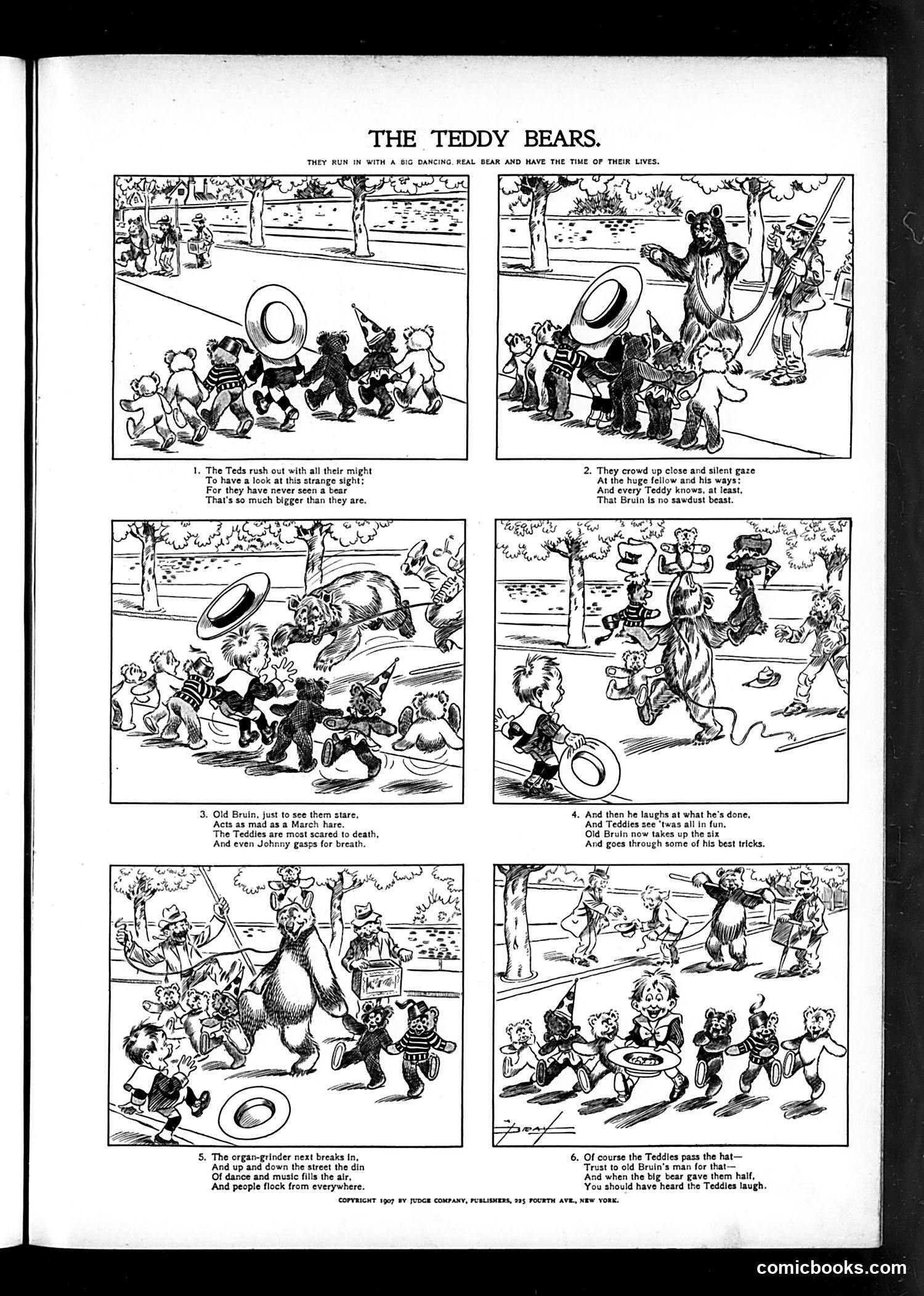
This is a whimsical children's story, not political satire. "Teddy bears"—the toys named after President Theodore Roosevelt—encounter a real bear with an organ grinder. The narrative follows the toys' fear, the bear's playful antics, and a street performance where the bear's handler passes a hat for donations. The bears receive half the collection. The humor relies on contrasting stuffed toys with an actual animal, and the surprise that "Old Bruin" performs tricks and shares money. The 1907 date places this during the peak of teddy bear popularity following Roosevelt's 1902 hunting incident. The story celebrates innocence and working-class street entertainment, with no apparent political commentary—it's simply entertainment featuring the era's beloved toy phenomenon.
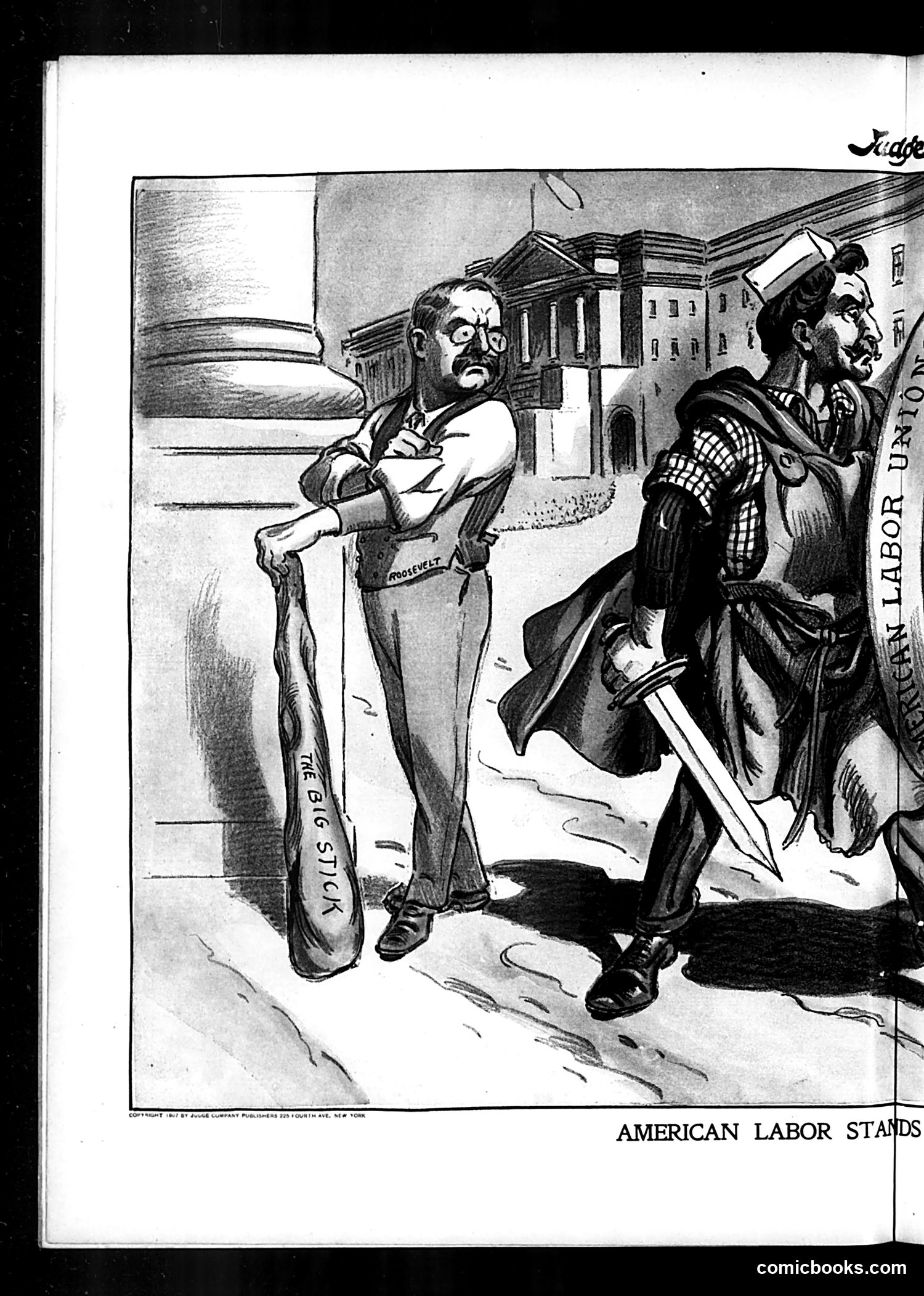
This political cartoon depicts labor's resilience during what appears to be early 20th-century labor unrest. The central figure, a muscular workman labeled "THE BIG STICK" (likely referencing Theodore Roosevelt's famous "speak softly and carry a big stick" philosophy), stands firm against two figures on the right—one appears to be a wealthy industrialist or capitalist (in formal dress with top hat) and another figure behind him. The cartoon suggests that organized American labor represents a powerful force that cannot be easily pushed aside by capital or political pressure. The "big stick" imagery ironically appropriates Roosevelt's rhetoric to defend working-class interests rather than executive power. The monumental classical architecture in the background emphasizes labor's foundational importance to American society.
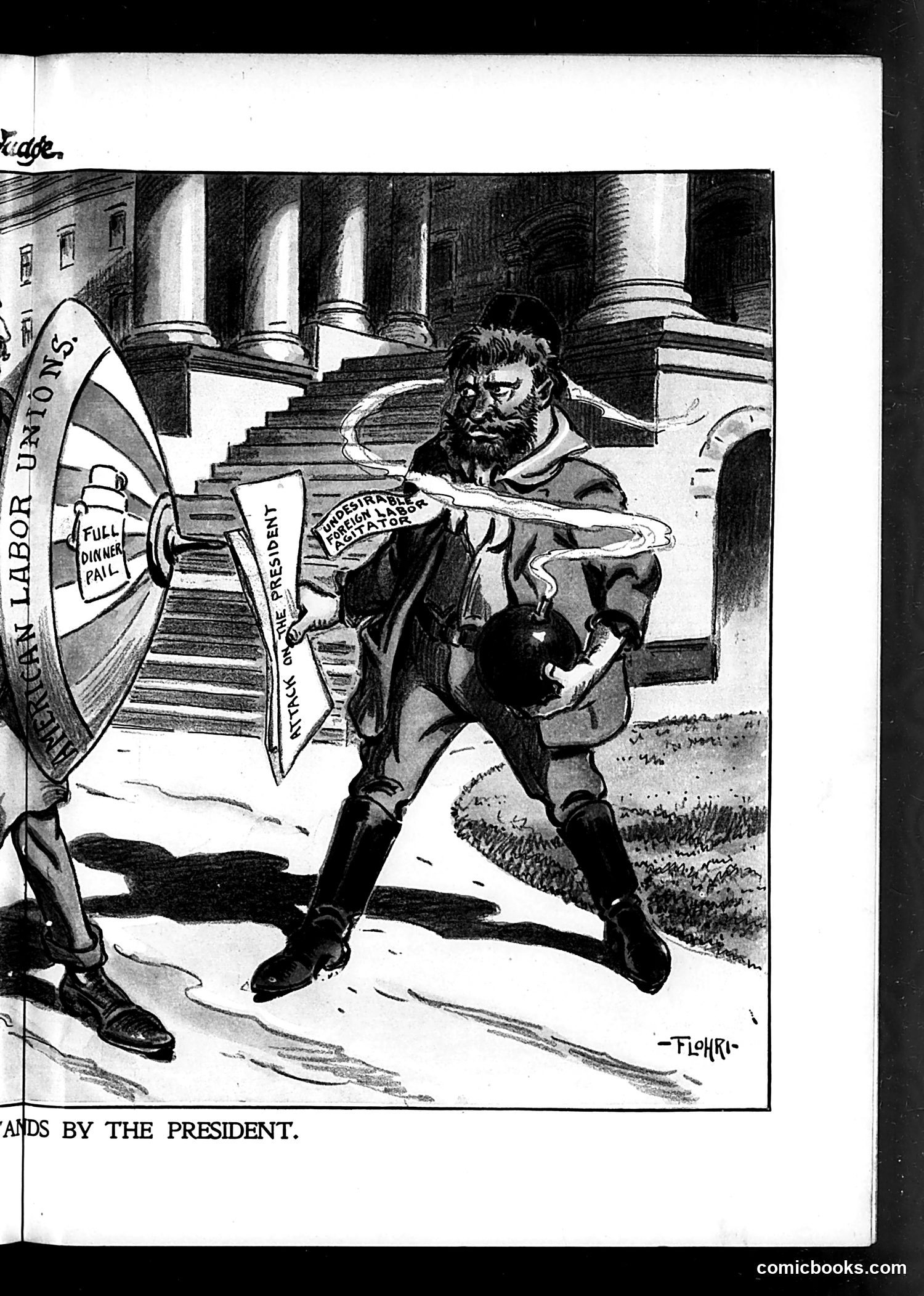
This cartoon satirizes presidential labor policy. A bearded figure representing organized labor or a labor leader grapples with a large wheel labeled "FULL DINNER PAIL" (a political slogan promising worker prosperity). The wheel also bears text reading "PROTECT[ED] LABOR" and similar pro-labor phrases. The cartoon's title references "HANDS BY THE PRESIDENT," suggesting the president's policies allegedly control or manipulate labor issues. The figure struggles against the wheel, implying labor leaders find presidential promises hollow or that workers aren't actually benefiting despite rhetorical support. This appears to be critical commentary on a president's labor stance—likely early 20th century, given the "full dinner pail" reference and Judge magazine's era. The satire questions whether presidential rhetoric matches actual worker protections.
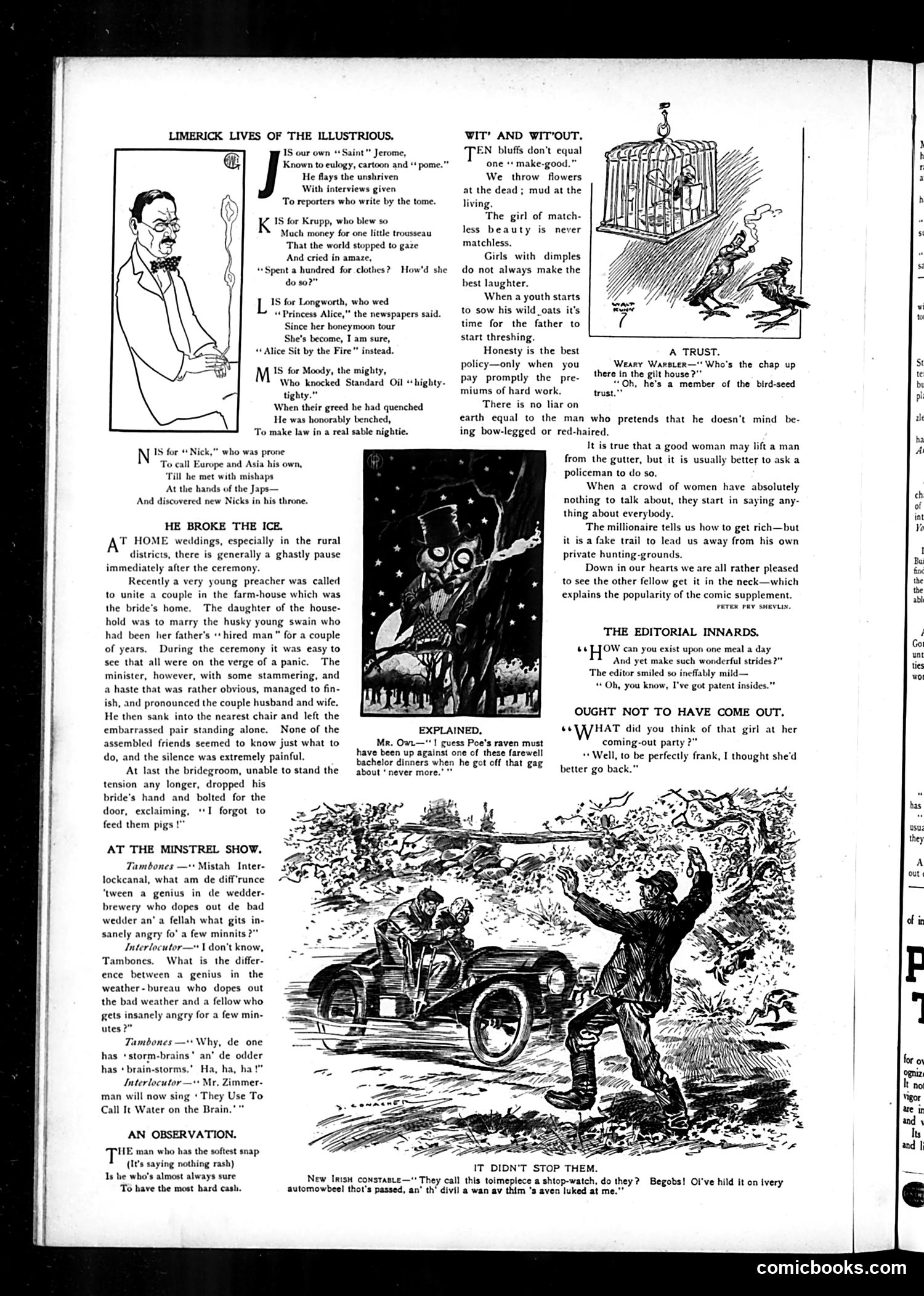
This page from *Judge* contains political and social commentary typical of early 20th-century American humor: **"Limerick Lives of the Illustrious"** mocks public figures: "Saint Jerome" (a reporter who aggressively interviews subjects), Krupp (a German industrialist known for lavish spending), Longworth (likely Alice Roosevelt Longworth, whose honeymoon tour was widely publicized), Moody (appears to reference a trust-busting official), and "Nick" (unclear reference, possibly Theodore Roosevelt's nickname, mocking his imperialist ambitions in Asia). **"He Broke the Ice"** is a humorous anecdote about rural wedding awkwardness—the bridegroom breaks uncomfortable silence by fleeing to feed pigs. **Remaining sections** offer light social commentary on human nature: observations about wealth, minstrel show humor (period-typical but offensive by modern standards), and witticisms about romance, honesty, and class relations. The overall tone satirizes American society's pretensions, wealth inequality, and romantic conventions through gentle humor rather than sharp political critique.
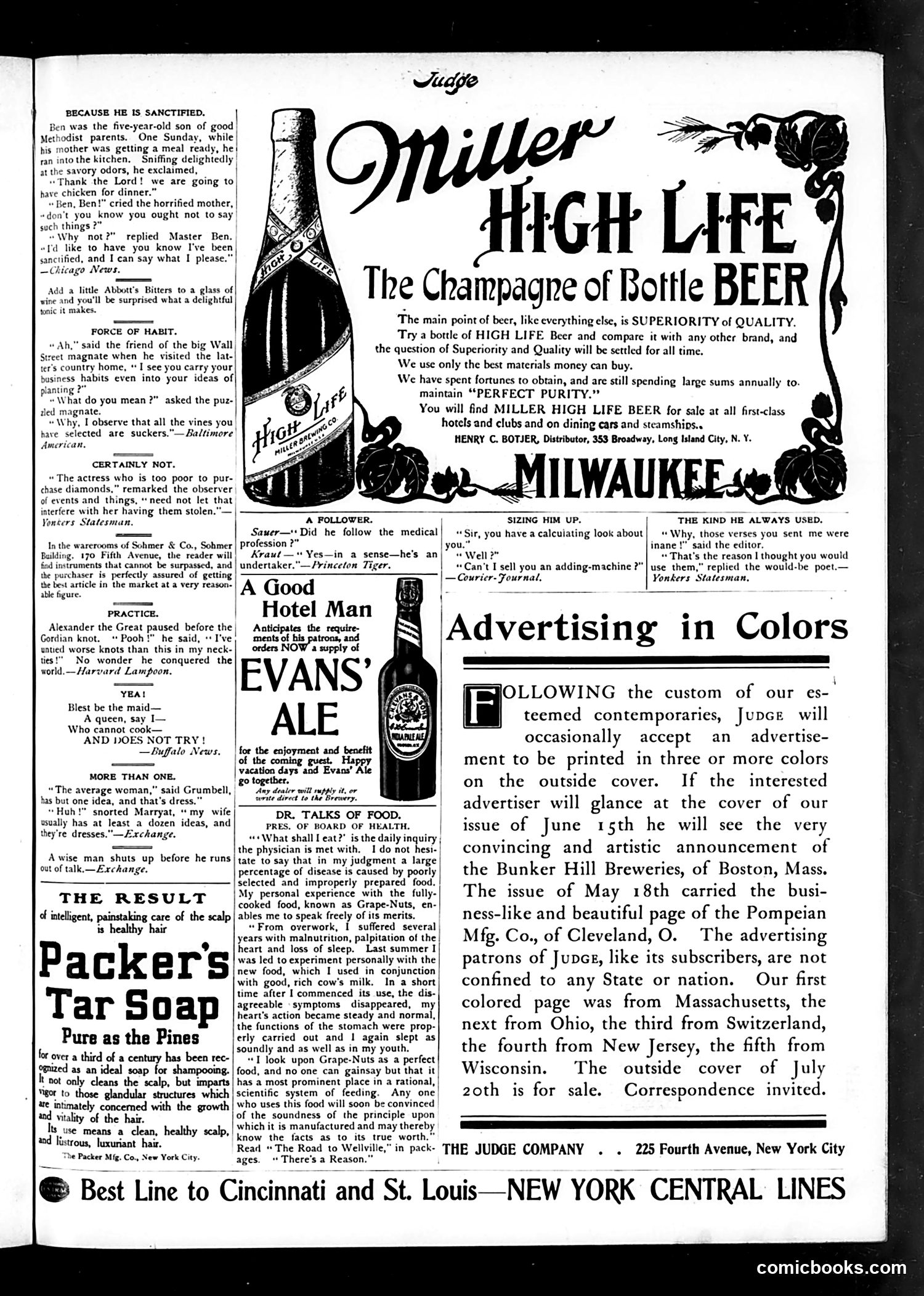
This page from Judge magazine contains primarily **short humorous anecdotes and advertisements**, rather than political cartoons. The jokes satirize American social conventions and hypocrisy: 1. **"Because He Is Sanctified"** mocks religious self-righteousness—a young boy claims his Methodist "sanctification" permits him to speak irreverently. 2. **"Force of Habit"** jokes that a Wall Street magnate plants only "suckers" (parasitic vines), reflecting his business mentality of exploiting others. 3. **"Certainly Not"** darkly quips that poor actresses needn't buy diamonds since they can have them stolen instead. 4. Gender humor appears in "More Than One," where a husband jokes his wife has a dozen dress ideas rather than one. The page is dominated by **period advertisements**: Miller High Life Beer (emphasizing "purity"), Packer's Tar Soap, Evans' Ale, and Abbott's Bitters. These represent early 20th-century consumer goods marketing typical of Judge's revenue model. No specific political figures or events are referenced; the satire targets universal human behaviors—greed, vanity, religious pretense, and marital stereotypes.
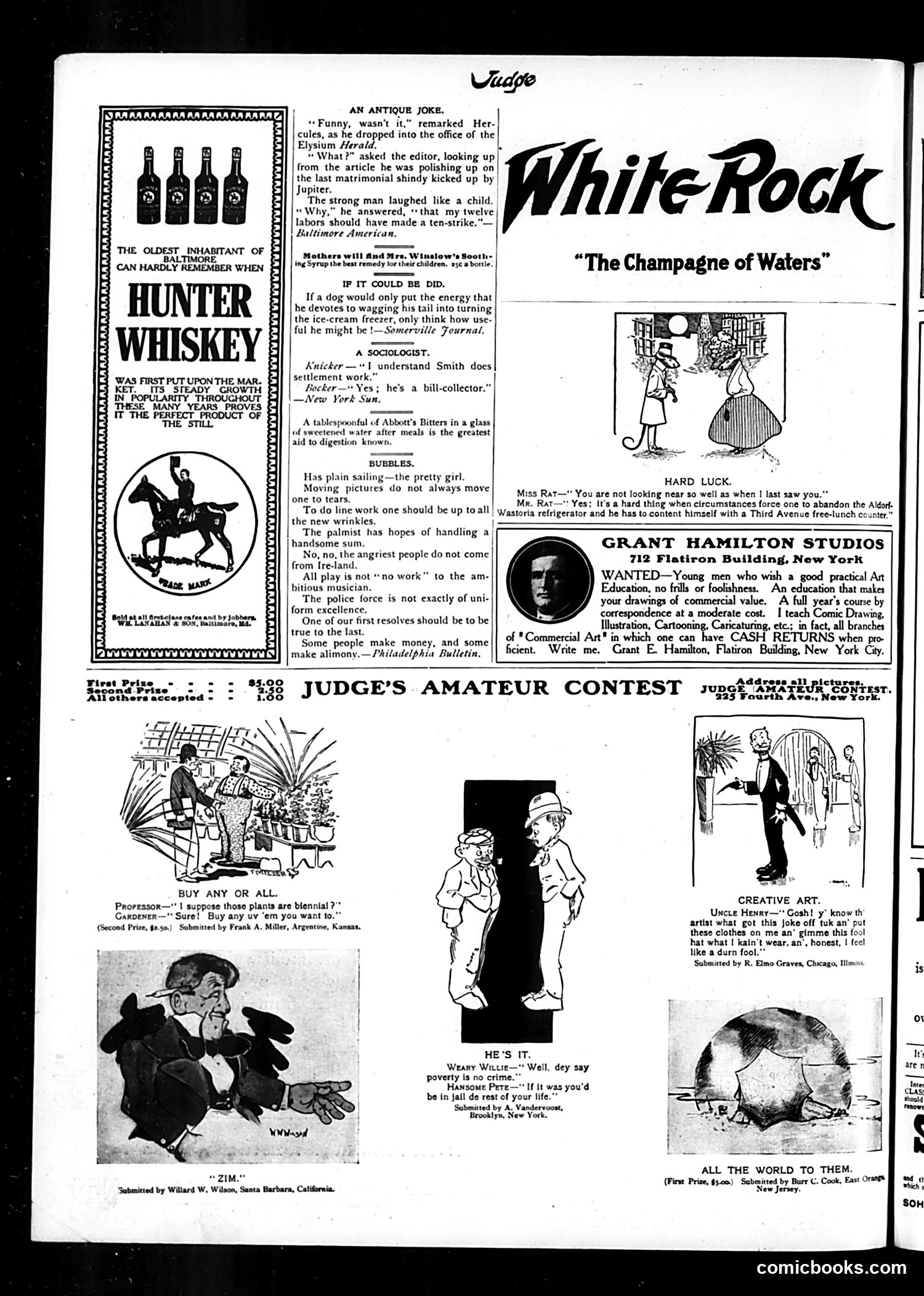
This page from Judge magazine (date unclear from image) contains several brief satirical items typical of early 20th-century American humor: **Main content includes:** - **Hunter Whiskey advertisement**: Nostalgic copy claiming the product has been Baltimore's favorite for generations—typical period advertising - **Short joke submissions**: Scattered witty one-liners mocking various social types: pompous professors, would-be settlement workers who are actually bill collectors, and marriage scandals - **Judge's Amateur Contest**: Reader-submitted cartoons with captions, including jokes about poverty ("not a crime"), artists exploiting subjects for material, and a couple's mutual devotion - **Grant Hamilton Studios ad**: Offers commercial art training with promises of cash returns The satire targets pretension (the "sociologist" bill-collector), human folly (dogs wasting energy), and working-class humor. The content reflects Judge's formula: urbane mockery of genteel society mixed with populist jokes, all framed around reader participation contests and advertising.
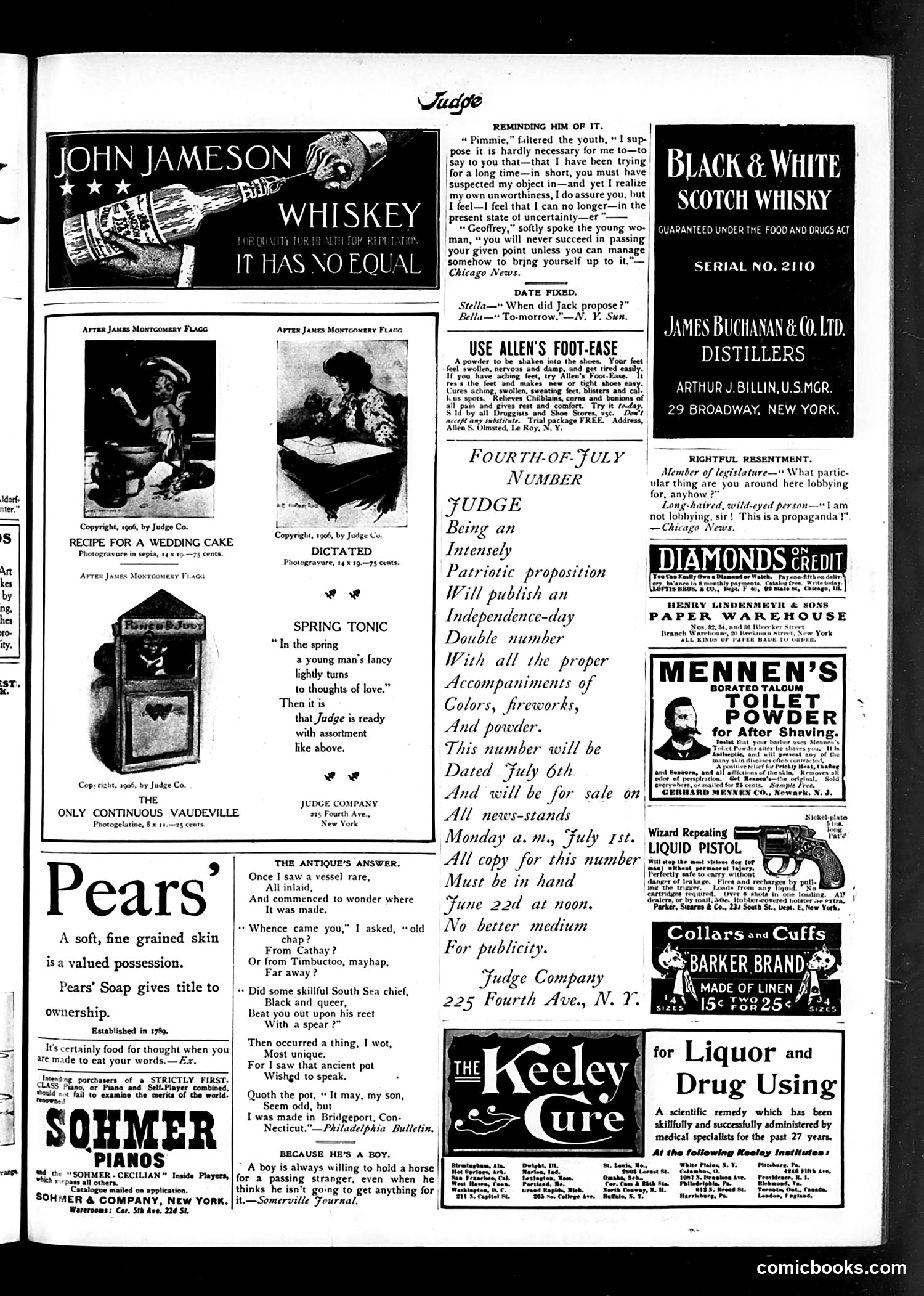
This page is primarily **advertising and announcement**, with several brief humorous anecdotes rather than political cartoons. **Key Content:** The main editorial announcement promotes Judge's Fourth of July "Double Number" (dated July 6th), emphasizing patriotic themes—colors, fireworks, powder—typical holiday magazine fare. **Humor pieces include:** - "Reminding Him of It": A young man's stammering marriage proposal interrupted by his girlfriend's sarcastic advice to "bring yourself up to it"—mocking verbose courtship rhetoric. - "The Antique's Answer": A joke where an ornate vessel supposedly from exotic lands reveals it's manufactured in Bridgeport, Connecticut—satirizing American pretensions to imported sophistication. - "Rightful Resentment": A legislator mistakes a lobbyist's "propaganda" for lobbying—light political humor about advocacy. The page reflects early-1900s middle-class American concerns: courtship etiquette, consumer aspirations, and mild skepticism toward political persuasion. Advertisements for whiskey, soap, and pianos dominate the layout.
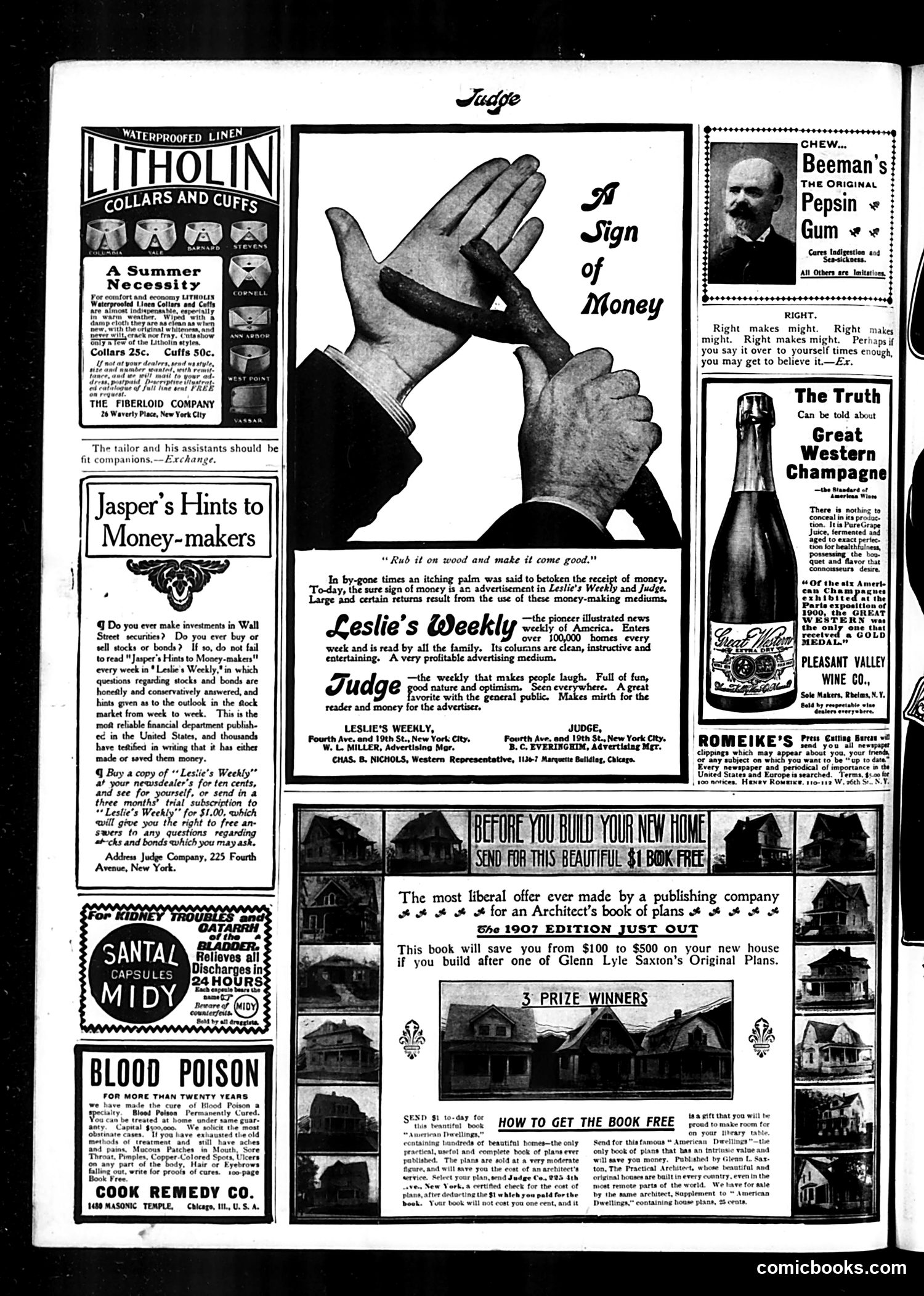
This page is primarily **advertising**, not editorial satire. The dominant feature is a central illustration titled "A Sign of Money" showing hands exchanging currency, with accompanying text promoting *Leslie's Weekly* and *Judge* magazines as advertising mediums for reaching affluent readers. The page contains multiple product advertisements typical of early 1900s magazines: Litholin collars, Beeman's Pepsin Gum, Santa capsules for digestive relief, and a "Blood Poison" remedy (likely mercury-based treatment for syphilis, frankly advertised). There's also a prominent offer for a free architectural book on house plans. The satirical content is minimal—mainly a small column titled "Jasper's Hints to Money-makers" suggesting that advertising in *Leslie's Weekly* and *Judge* is "the sure sign of money" today, a self-promotional joke. A brief quote at top suggests cynicism about power ("Right makes might"). Rather than political commentary, this page demonstrates how early 20th-century magazines monetized through advertising to affluent, educated readers interested in home improvement and dubious patent medicines.
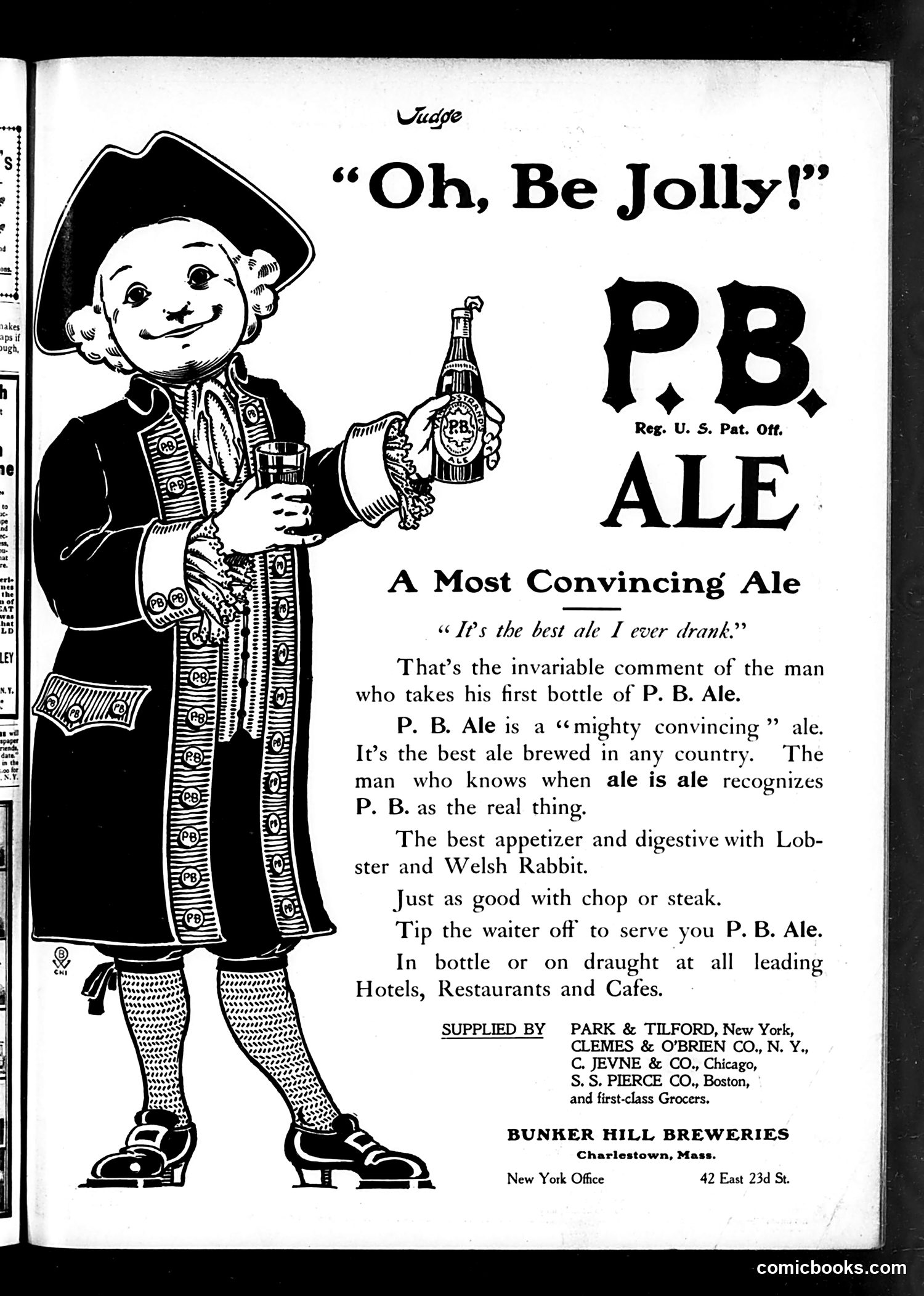
This is primarily a **full-page advertisement**, not political satire. It features a cheerful, rotund figure in colonial/Revolutionary War-era costume (tricorn hat, period coat) holding a bottle and glass of P.B. Ale, with the slogan "Oh, Be Jolly!" The colonial imagery appears designed to invoke American patriotism and tradition—connecting the product to American heritage. The figure's jovial demeanor reinforces the advertiser's message that P.B. Ale from Bunker Hill Breweries (Charlestown, Massachusetts) represents quality American brewing. The copy emphasizes the ale's superiority ("best ale brewed in any country") and suggests it pairs well with food and social occasions. Distribution channels listed (hotels, restaurants, first-class grocers) indicate this targets middle-to-upper-class consumers. The page appears in Judge, a satirical magazine, but functions here as a straightforward commercial advertisement rather than commentary or satire. The historical costume is purely marketing strategy.
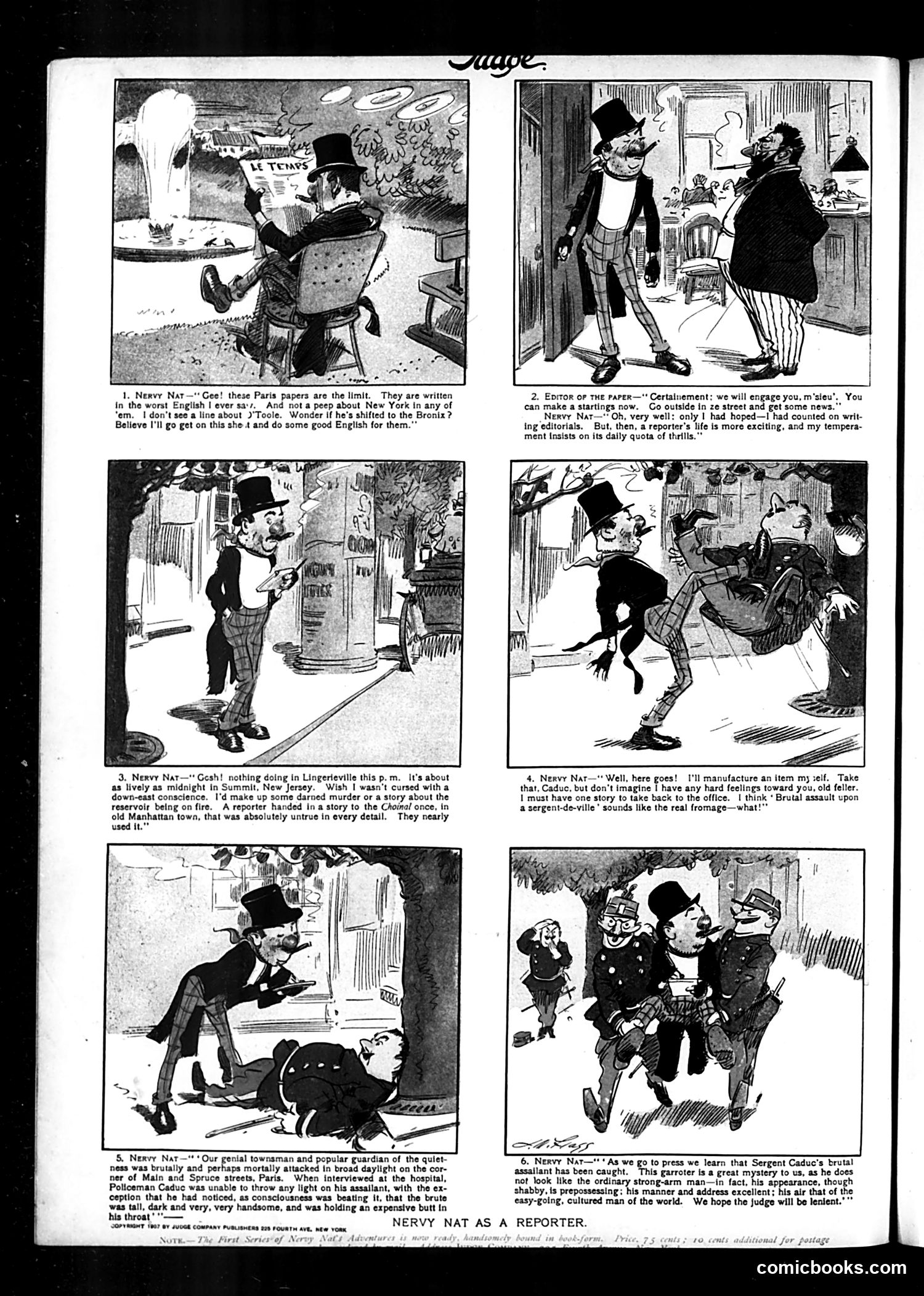
This comic strip follows "Nervy Nat," an American reporter in Paris struggling to find newsworthy stories. The satire centers on journalism ethics: Nat complains that Paris newspapers lack English-language coverage of New York, then grows increasingly desperate. When his editor assigns him actual reporting work, Nat admits he'd prefer writing editorials for "thrills" rather than gathering real news. The humor escalates as Nat, finding nothing happening, considers fabricating stories—even referencing a Manhattan reporter who invented a tale "absolutely untrue in every detail" that was still published. He ultimately manufactures a crime story about a "brutal assault," complete with invented details ("tall, dark and very, very handsome"), which gets picked up as news. The satire mocks both lazy, unethical journalism and the arbitrary nature of what becomes "news"—particularly the invented, sensationalized kind that sells papers regardless of truth.