
A complete issue · 16 pages · 1907
Judge — May 25, 1907
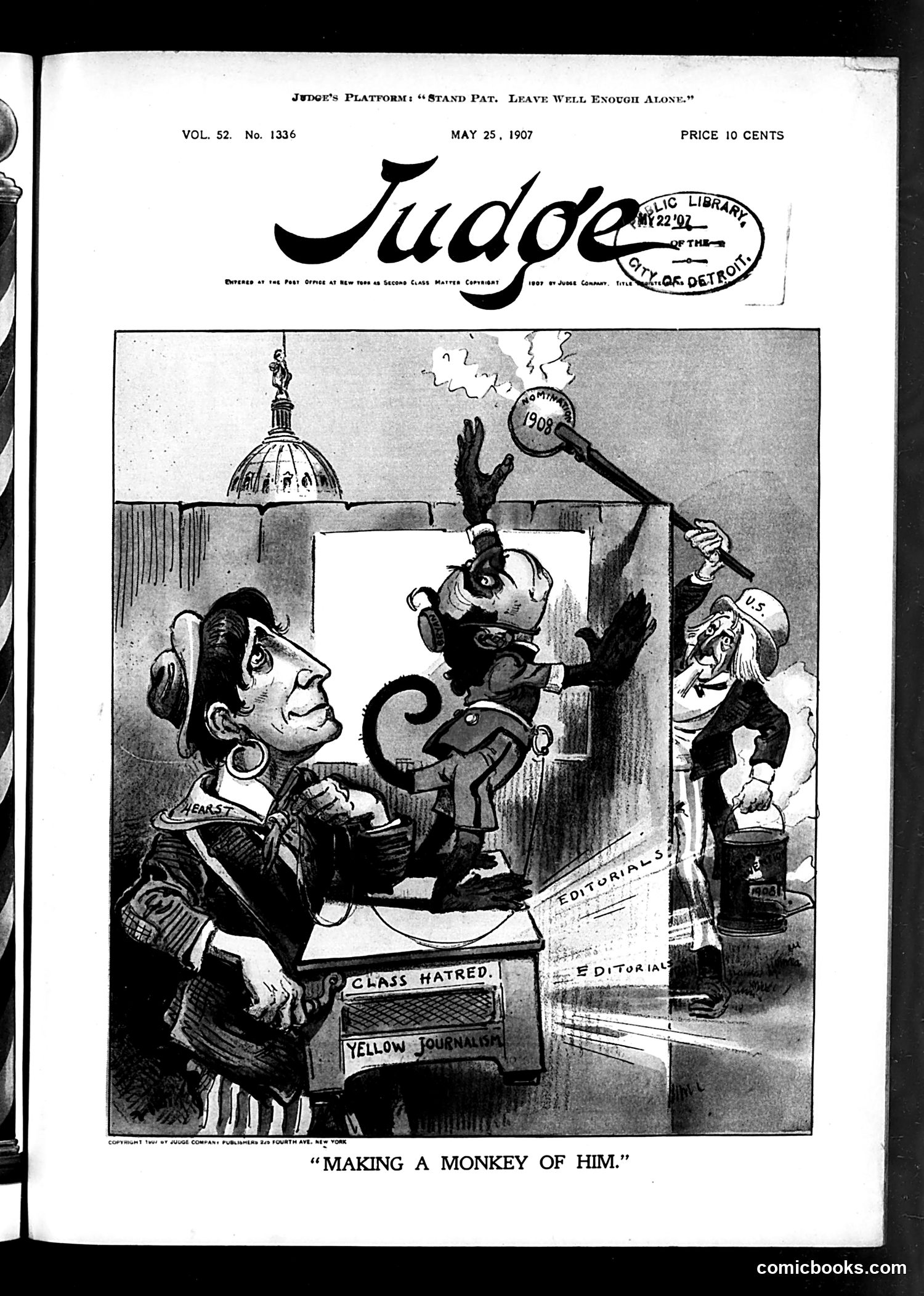
This 1907 *Judge* cartoon satirizes media manipulation and yellow journalism. A caricatured figure on the left (appearing to represent a politician or public figure) operates a monkey puppet labeled "1908"—likely referencing the upcoming 1908 presidential election. The Capitol dome visible in the background confirms this is about Washington politics. The surrounding labels reference "Glass Hatred," "Yellow Journalism," and "Editorials," suggesting the cartoon criticizes how newspapers and partisan commentary control public perception and political discourse. The title "Making a Monkey of Him" indicates the cartoonist believes yellow journalism and editorial spin are manipulating the American public and political process, rendering serious governance into mere puppet theater. The satirical point: media outlets pull the strings of political narratives.
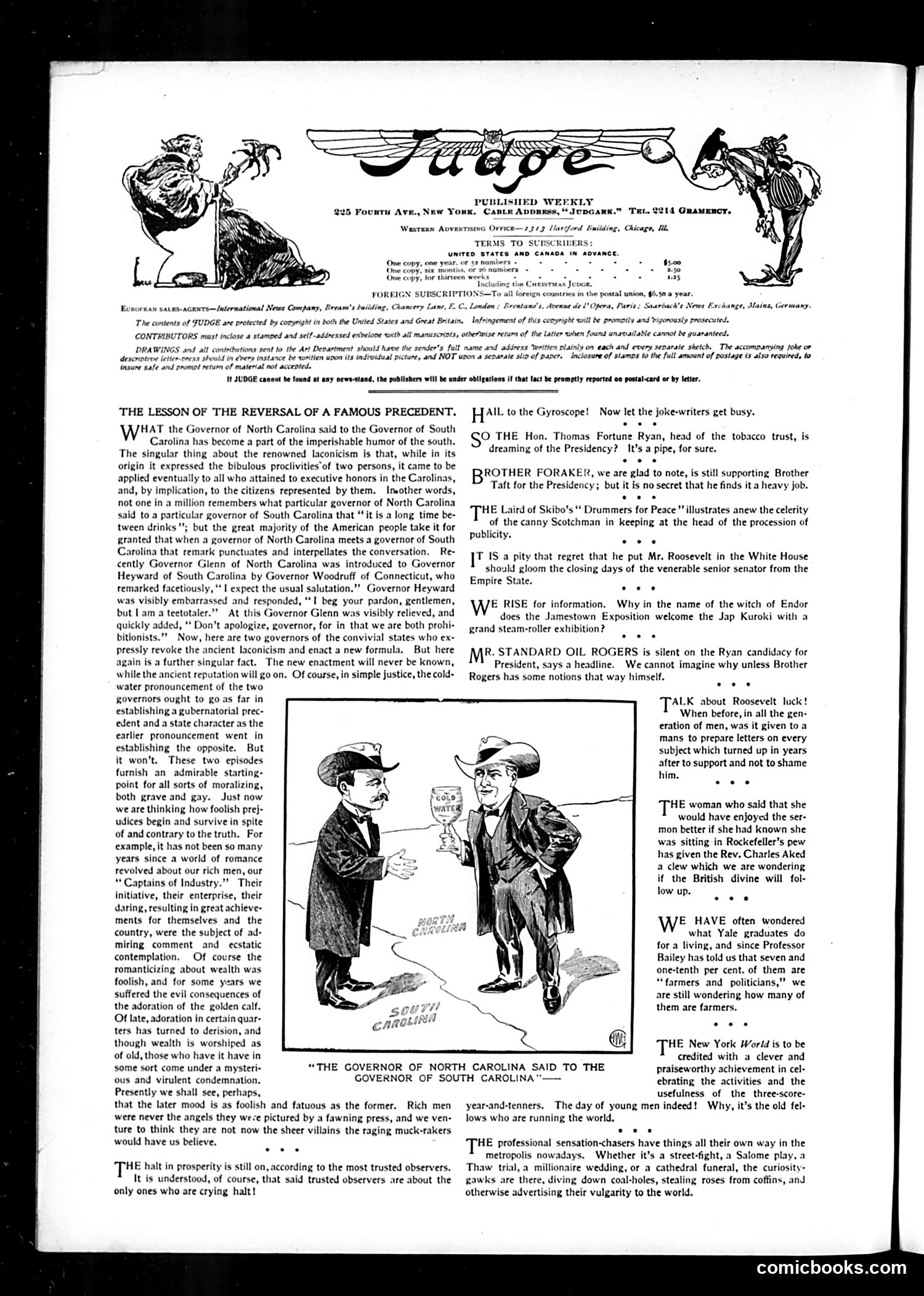
This cartoon satirizes a conversation between two state governors about regional pride and political rivalry. The main article recounts how North Carolina's governor supposedly told South Carolina's governor that their state's advantage is its lack of famous loafers—a backhanded compliment suggesting South Carolina harbors idle, unproductive citizens. The cartoon depicts two men in conversation, labeled with their respective states. The satire targets Southern regional pride and interstate competition during what appears to be the early 20th century. The joke plays on the tension between states' claims of superiority, using the stereotype of laziness as the distinguishing characteristic. It's a commentary on Southern politics and regional identity through humorous insult.
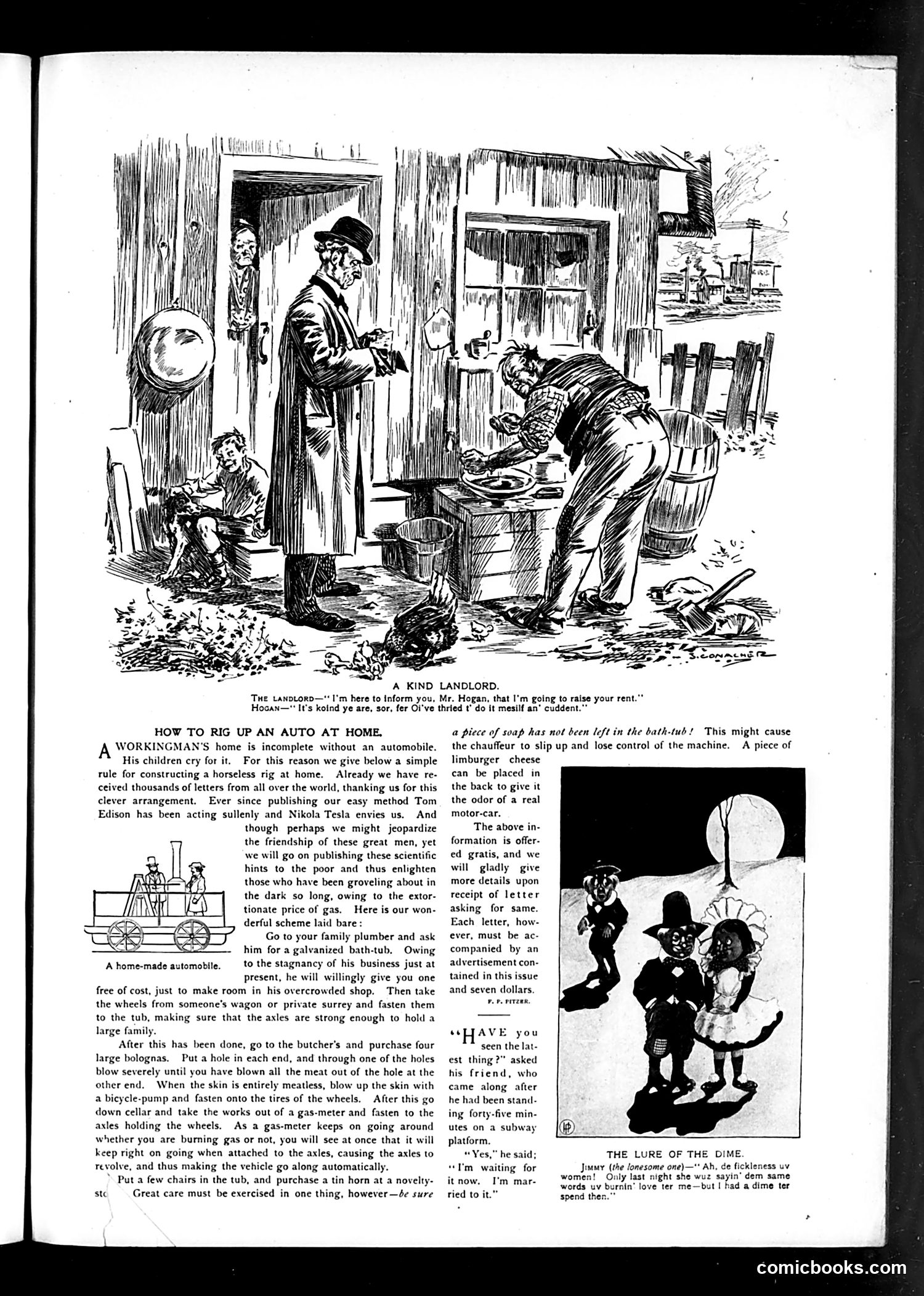
The top cartoon, "A Kind Landlord," satirizes landlord-tenant relations. A poorly dressed man (tenant) confronts his landlord about rent increases, while a child watches from below and a woman bends over inside the dwelling. The satire targets the landlord's callousness toward struggling working-class renters. The main article, "How to Rig Up an Auto at Home," offers humorous DIY automotive instructions for working-class readers who cannot afford proper cars. It mocks both the aspiration to automobile ownership among the poor and the absurdity of constructing vehicles from wagon wheels and plumbing supplies. The lower section contains brief illustrated jokes about everyday urban life, typical of Judge's satirical humor targeting social class disparities of the era.
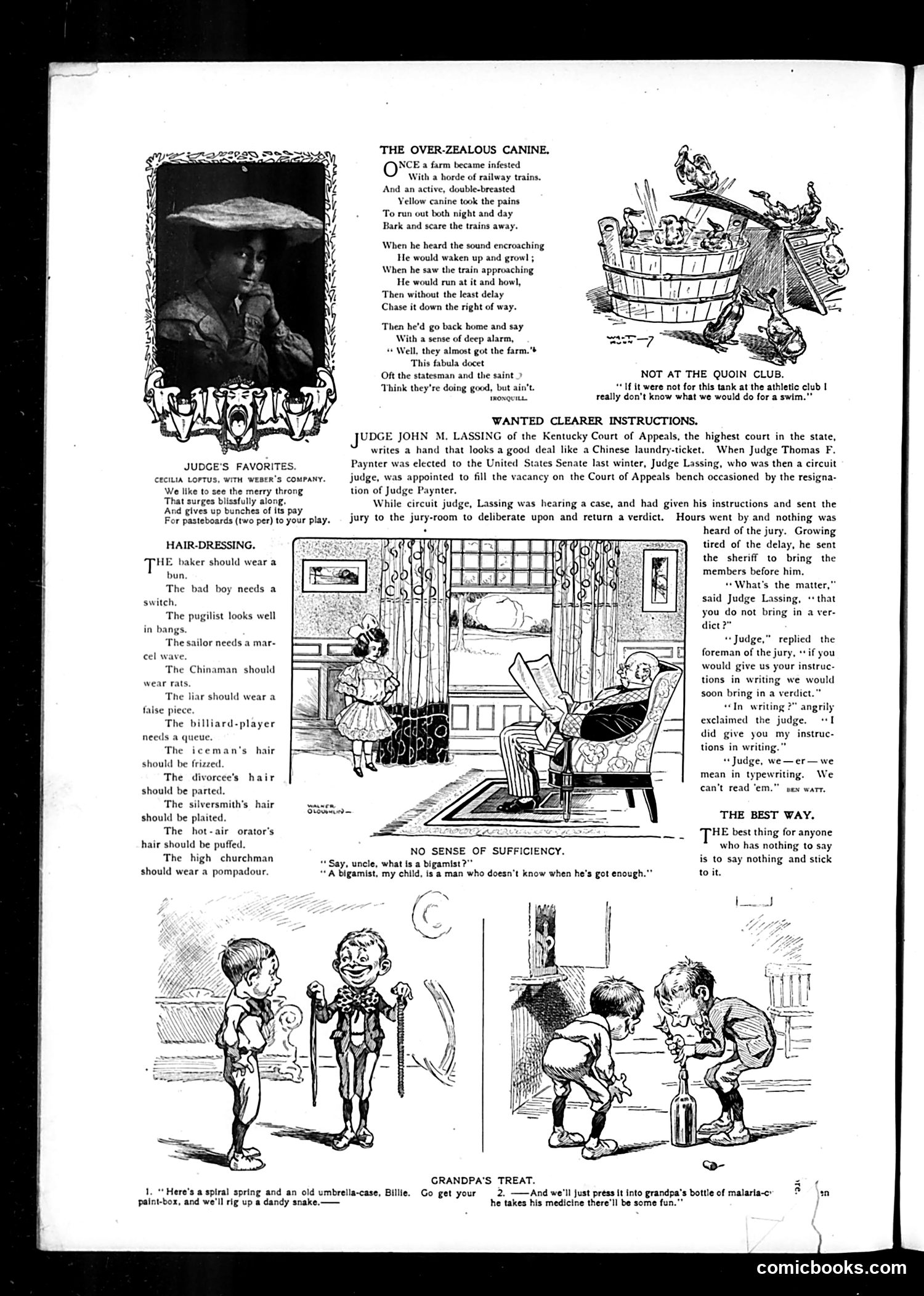
This page contains several satirical pieces typical of early 20th-century Judge magazine: **"The Over-Zealous Canine"** is a humorous poem about a yellow dog obsessively chasing trains, illustrated with the dog's anxious expression. **"Wanted Clearer Instructions"** satirizes Judge John M. Lassing of Kentucky's Court of Appeals, who apparently had poor handwriting. The joke centers on a jury foreman unable to read the judge's written instructions, highlighting bureaucratic incompetence and unclear communication. **"Hair-Dressing"** offers tongue-in-cheek advice about various hairstyles for different professions. **"No Sense of Sufficiency"** and **"Grandpa's Treat"** are brief comic sketches about greed and mischief, using exaggerated caricatures common to the era's satirical style. The page reflects Judge's focus on everyday social absurdities and institutional inefficiency rather than major political issues.
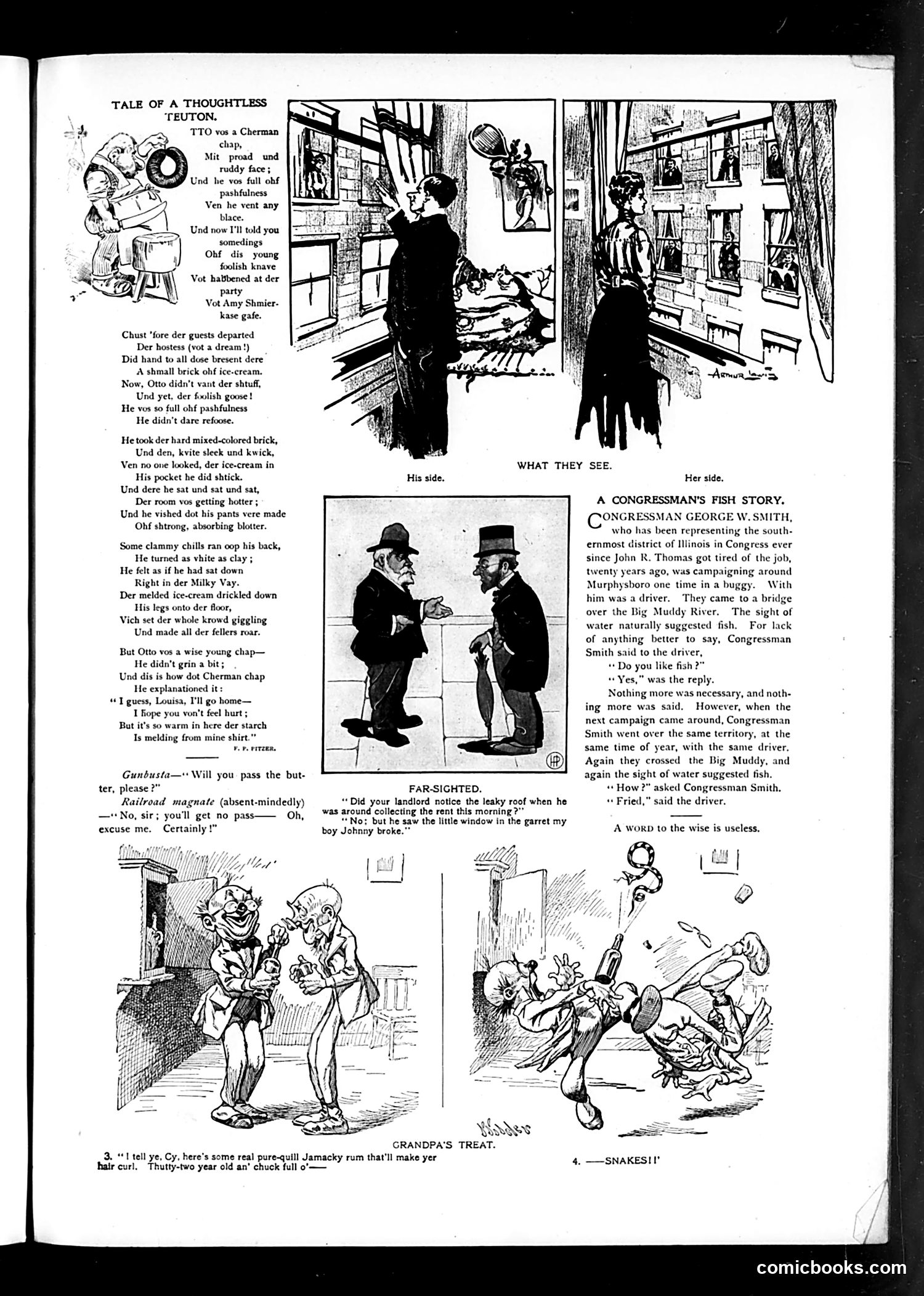
This page contains two distinct pieces of satire: **"Tale of a Thoughtless Teuton"** (top left): A German character poem mocking German stereotypes—clumsiness, rudeness, and lack of sophistication. The verses describe a "Cherman chap" who bungled various social situations (stealing ice cream, breaking things, being ejected from establishments). This reflects anti-German sentiment common in American publications of the era. **"A Congressman's Fish Story"** (right side): A humorous anecdote about Congressman George W. Smith from Illinois. The joke involves Smith repeatedly seeing fish in the same location, claiming to the driver he "didn't see fish" on return trips—suggesting he's either forgetful or dishonest. The caption "A word to the wise is useless" implies the congressman lacks sense. Both pieces use ethnic and political humor typical of early 20th-century Judge magazine satire.
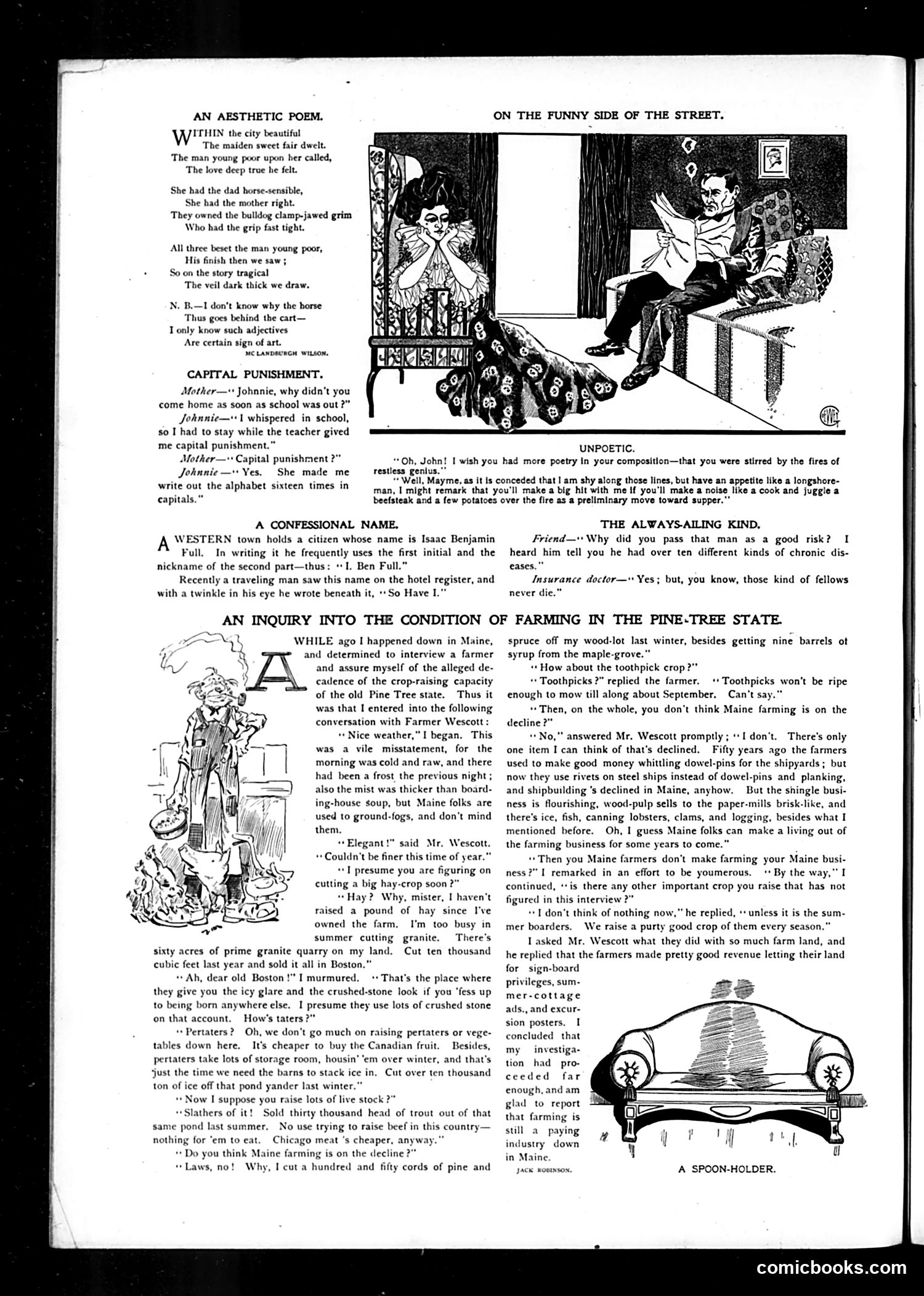
This page contains several brief humorous pieces mocking pretension and social absurdity: **"An Aesthetic Poem"**: Parodies overwrought Victorian poetry and the "aesthetic movement" (art-for-art's sake trend). The deliberately clumsy, affected language ("dad horse-sensible," "bulldog clamp-jawed grim") ridicules artistic pretension. The author's note about not understanding why the horse goes behind the cart—yet calling it "certain sign of art"—mocks how obscurity gets passed off as sophistication. **"Capital Punishment"**: A pun-based joke where a child misunderstands "capital punishment" as literally writing capital letters—gentle wordplay humor. **"A Confessional Name"**: Plays on the unfortunate name "I. B. Full" (phonetically "I Be Full"), which a traveling salesman recognizes and mimics. The remaining pieces mock romantic sentimentality, chronic complainers, and rural Maine farming decline through exaggerated anecdotes about quarrying and ice-cutting instead of agriculture—satirizing economic shifts away from traditional farming.
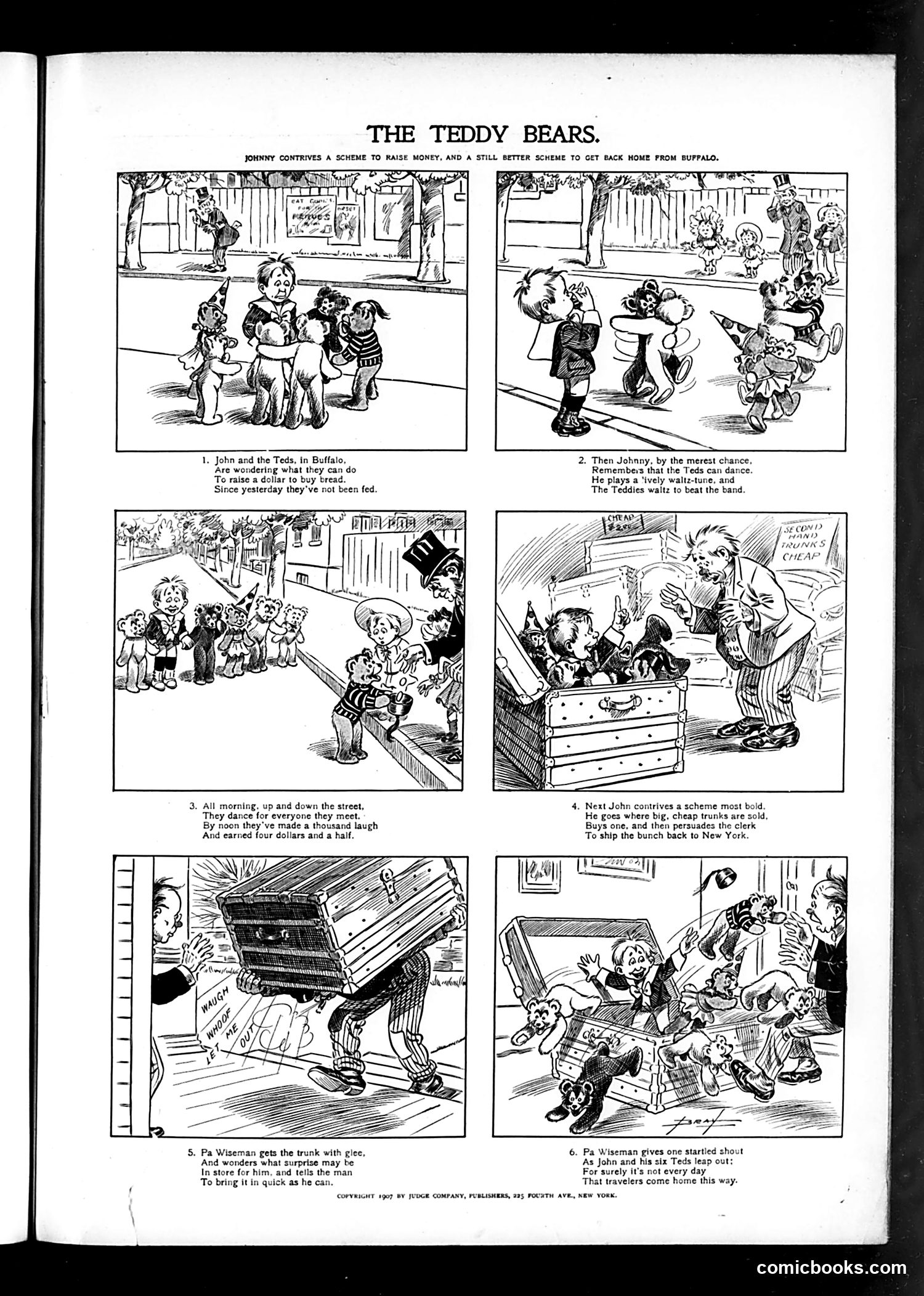
This comic strip satirizes the "Teddy Bear" craze of the early 1900s—stuffed toys named after President Theodore Roosevelt. The story follows a boy named Johnny and his six teddy bears in Buffalo, who are penniless and hungry. Johnny's scheme: they perform street dances that attract crowds and earn money. He then buys a cheap trunk, packs the bears inside, and ships it to New York to a man named Pa Wiseman as a surprise delivery. When opened, the bears (and presumably Johnny) leap out. The satire likely mocks both the era's obsession with Teddy Bear merchandise and the get-rich-quick schemes common among working-class children. It's gentle humor about entrepreneurial desperation, using the toys' popularity as the joke's engine. The "travelers coming home" ending suggests an absurdist punchline rather than social commentary.
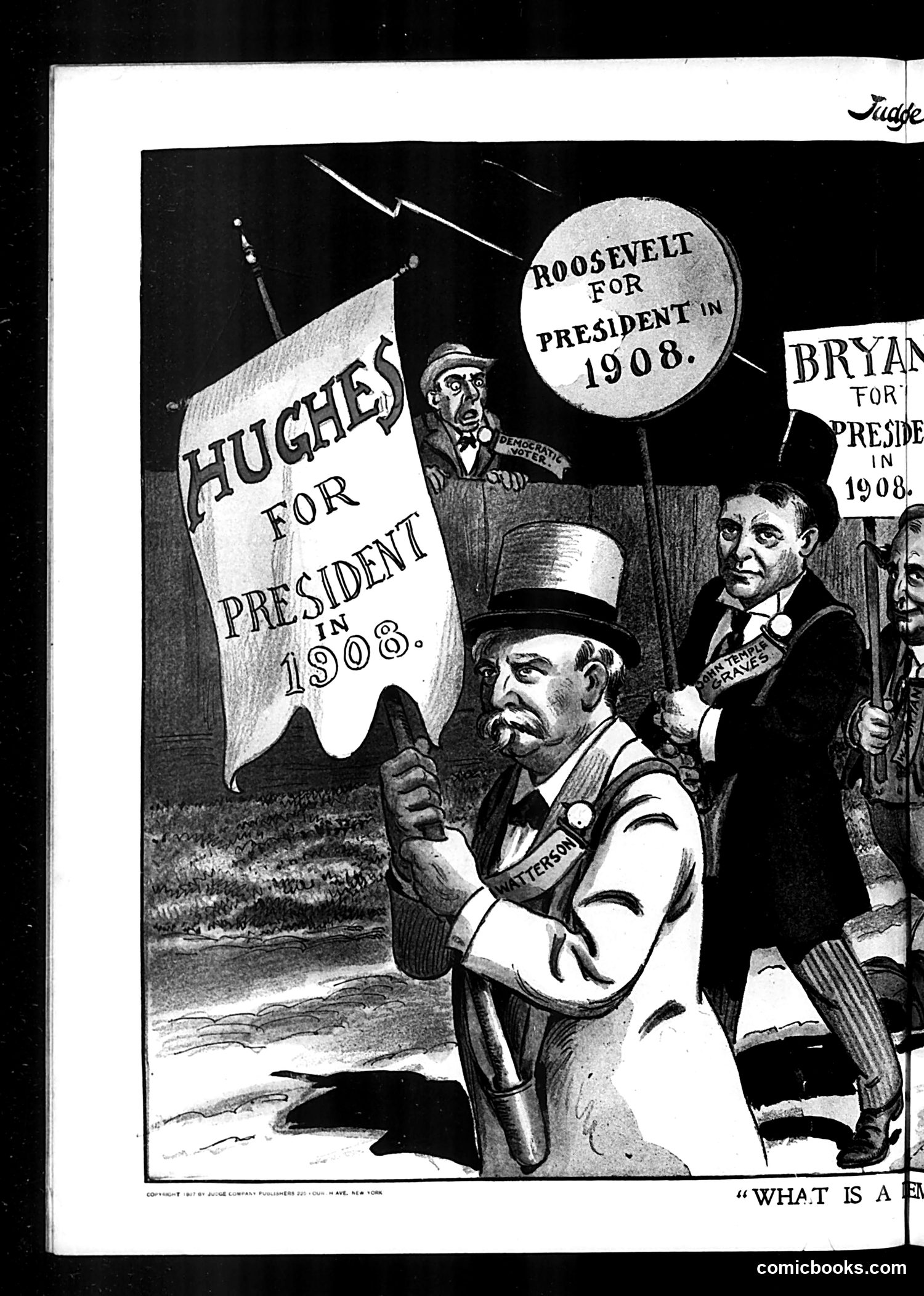
This cartoon depicts the 1908 U.S. presidential race. The figure in the foreground holding a "Hughes for President in 1908" banner appears to be a supporter of Charles Evans Hughes (the Republican candidate). Behind him, another figure holds a "Roosevelt for President in 1908" sign, while a third figure on the right carries a "Bryan for President in 1908" banner (William Jennings Bryan, the Democratic candidate). The satire likely mocks the confusion or fractured support among political factions during this election. The cartoon's incomplete caption ("What is a...") suggests it's asking a rhetorical question about political identity or allegiance, satirizing the competing candidacies and the uncertainty of voters navigating multiple candidates and platforms during this pivotal election year.
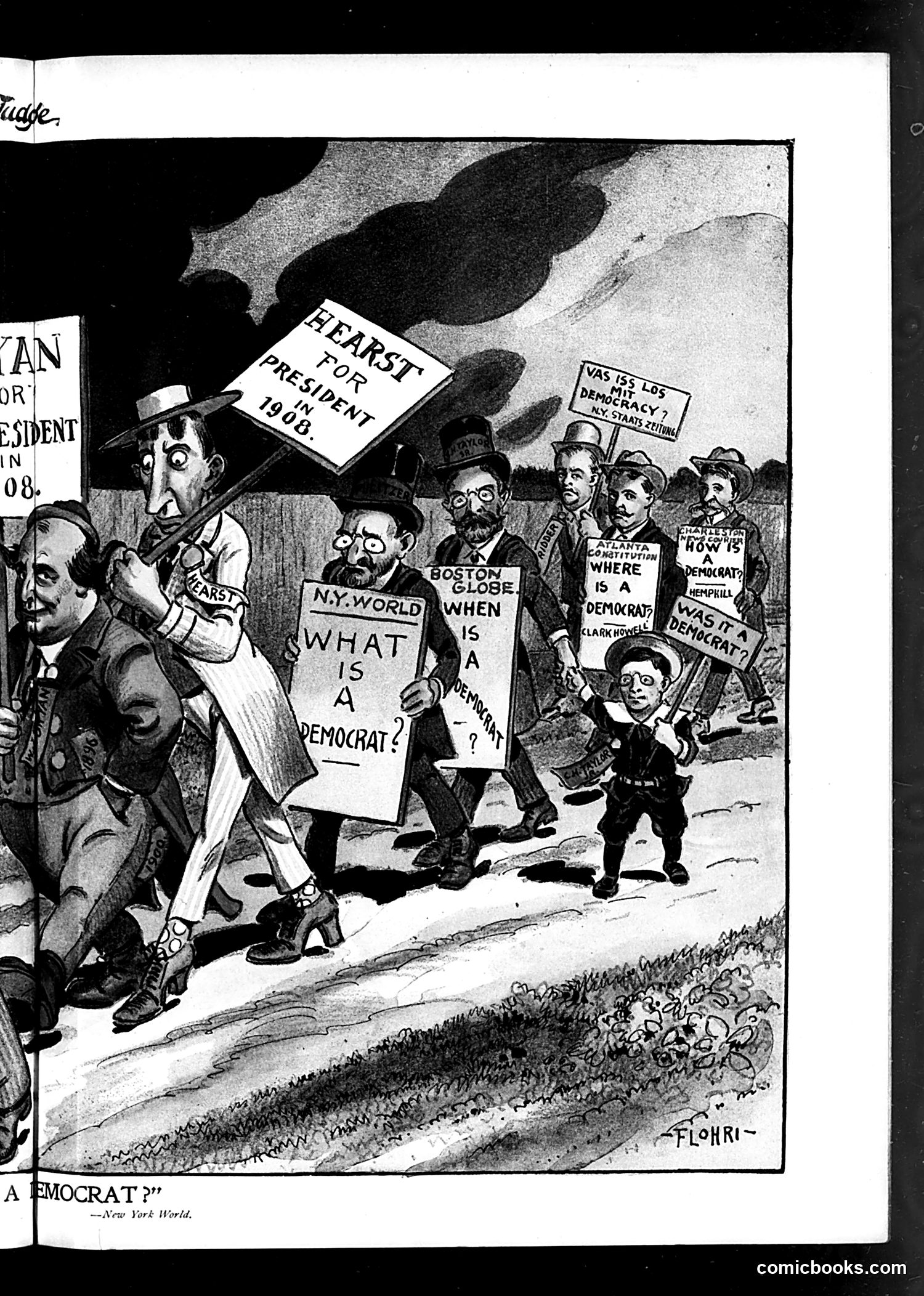
This political cartoon from *Judge* magazine satirizes confusion about Democratic Party identity during the 1908 presidential election. A large, shadowy figure labeled "Hearst for President 1908" looms over a parade of bewildered newspaper editors and political figures holding signs asking "What is a Democrat?"—referencing publications like the *N.Y. World*, *Boston Globe*, and others. The satire targets William Randolph Hearst's contentious 1908 presidential ambitions and the chaos his candidacy created within Democratic ranks. The cartoon suggests Hearst's influence was so disruptive that party members no longer understood their own platform or identity. The exaggerated caricatures and confused expressions emphasize the Democrats' internal fragmentation during this election cycle.
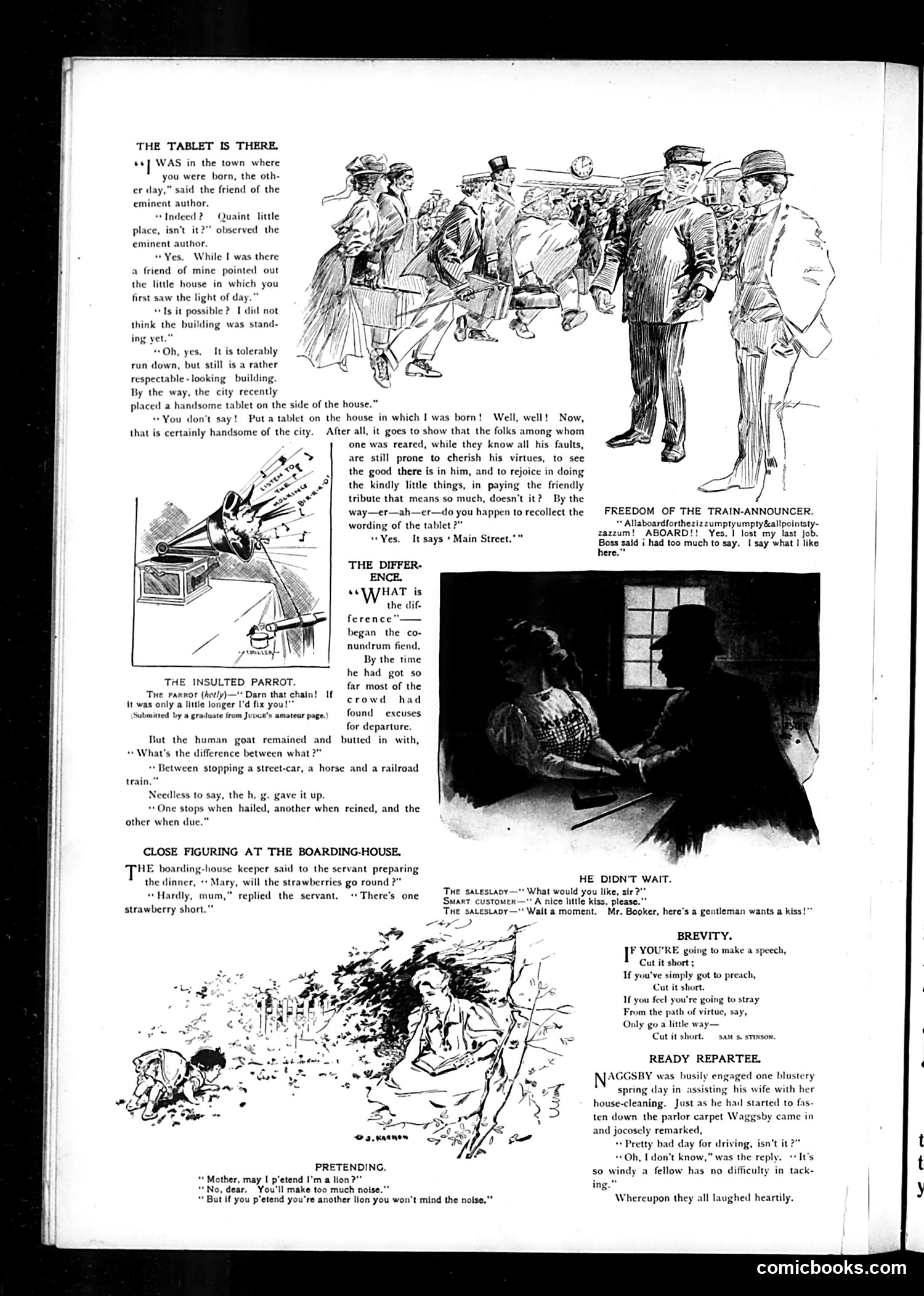
This page contains several brief humorous sketches satirizing American social conventions and absurdities: **"The Tablet is There"**: Mocks vanity and self-importance. An eminent author learns his birthplace received a commemorative tablet—only to discover it merely reads "Main Street," not honoring him at all. The satire targets pretentious writers who assume public monuments celebrate their significance. **"The Difference"**: A one-liner ridiculing tedious "conundrum fiends" who plague social gatherings with worn-out riddles. People flee before hearing the punchline. **Additional sketches** mock domestic penny-pinching ("Strawberry Short"), salespeople, children's behavior, and verbose train announcers who "say what I like" after losing jobs for talking too much. **"Ready Repartee"**: Humorously depicts a husband helping with spring cleaning, making a sailing pun about windy weather. The overall tone reflects Judge's characteristic satirizing of middle-class American life—vanity, social awkwardness, domestic friction, and professional incompetence. The humor relies on wordplay and situational irony familiar to contemporary readers.
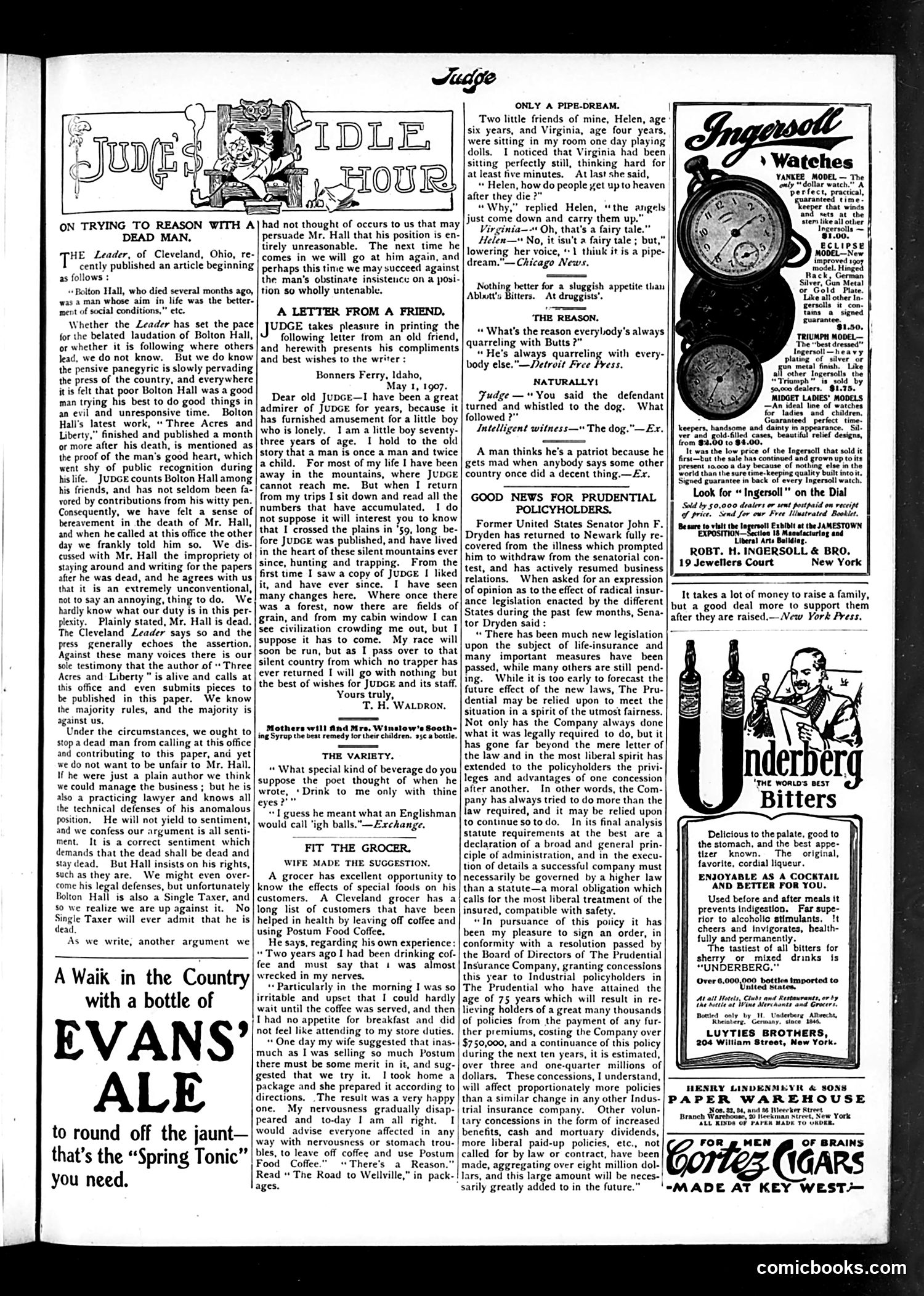
This satirical piece mocks **Bolton Hall**, a social reformer and Single Taxer (advocate of Henry George's land-tax philosophy) who died but apparently continued submitting articles to Judge magazine. The joke plays on the absurdity of the situation: Cleveland's newspaper published a laudatory obituary for Hall, yet Hall himself kept showing up at Judge's office with new contributions. Judge's editors find themselves in an awkward position—they have journalistic evidence he's dead (the obituary), but he refuses to act deceased and "calls at this office...and even submits pieces." The satire crescendos with a jab at Single Taxers: even logic and argument cannot persuade Hall to accept his own death because, as the writer notes, "No Single Taxer will ever admit that he is dead"—suggesting radical political ideologues are obstinate to the point of absurdity. It's quintessential Judge humor: gentle mockery of both a specific person and a broader ideological position.
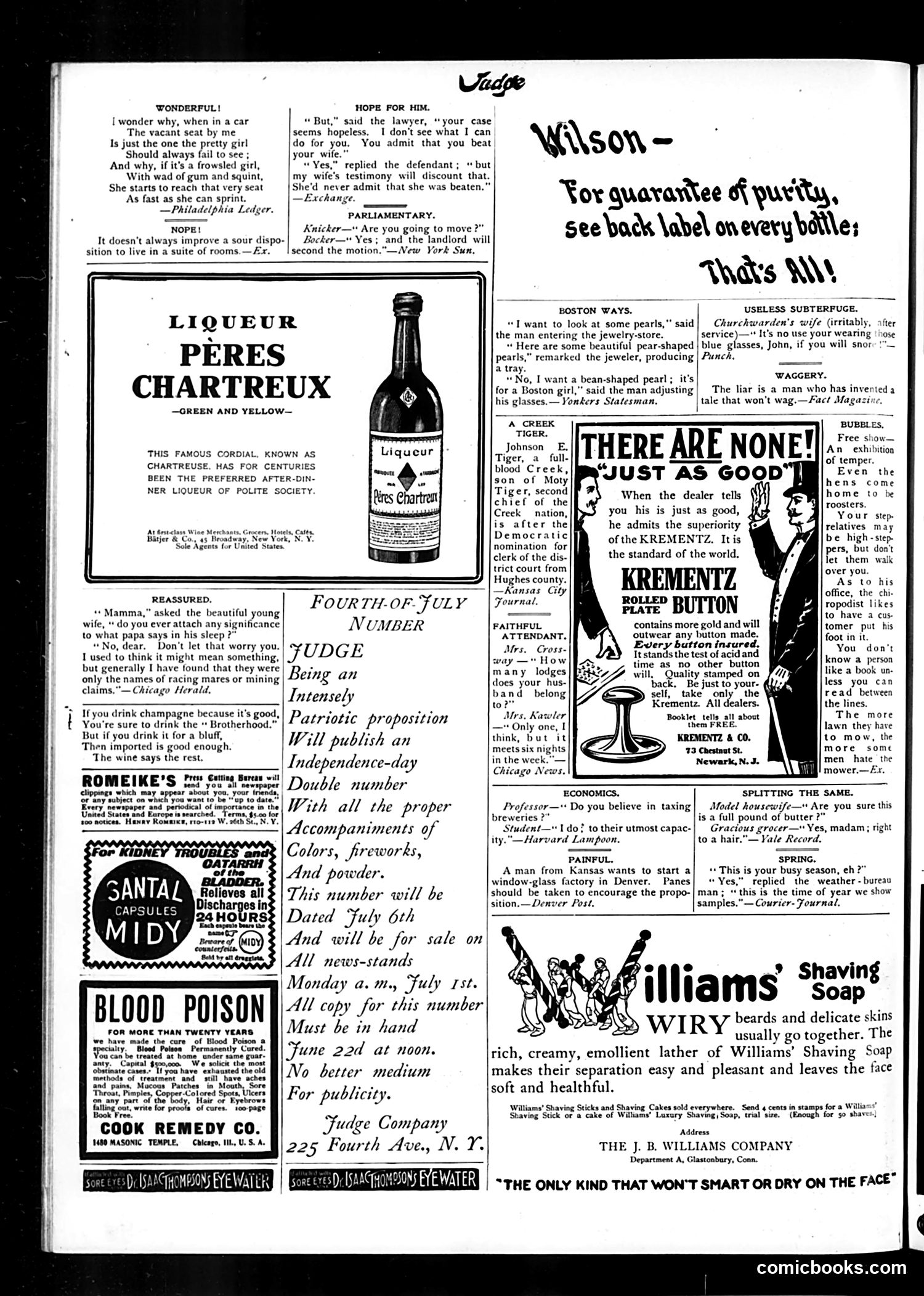
This Judge magazine page (circa early 1900s) is primarily **advertising and filler content**, with brief satirical quips typical of the era. **Key satirical items:** - **"Wonderful"/"Nope"**: Observations about inexplicable social behavior—why attractive women avoid empty car seats while unattractive ones rush to them. - **"Parliamentary"**: A landlord-tenant joke about eviction ("moving"). - **"Reassured"**: Mocking marital dynamics—a wife explains her husband's sleep-talk means nothing, just mentions of racehorses and mining claims (implying he gambles/invests foolishly). - **Brief quips** scattered throughout mock Boston pretension ("bean-shaped pearls"), male vanity, workplace situations, and human nature. **Advertisements occupy most space**: liqueur, shaving soap, blood poison treatments, and eye-water remedies—typical turn-of-century product pitches. The satire assumes readers recognize period-specific social conventions and advertising tropes; the humor is gentle, domestic-focused, and relies on observational comedy rather than political commentary.
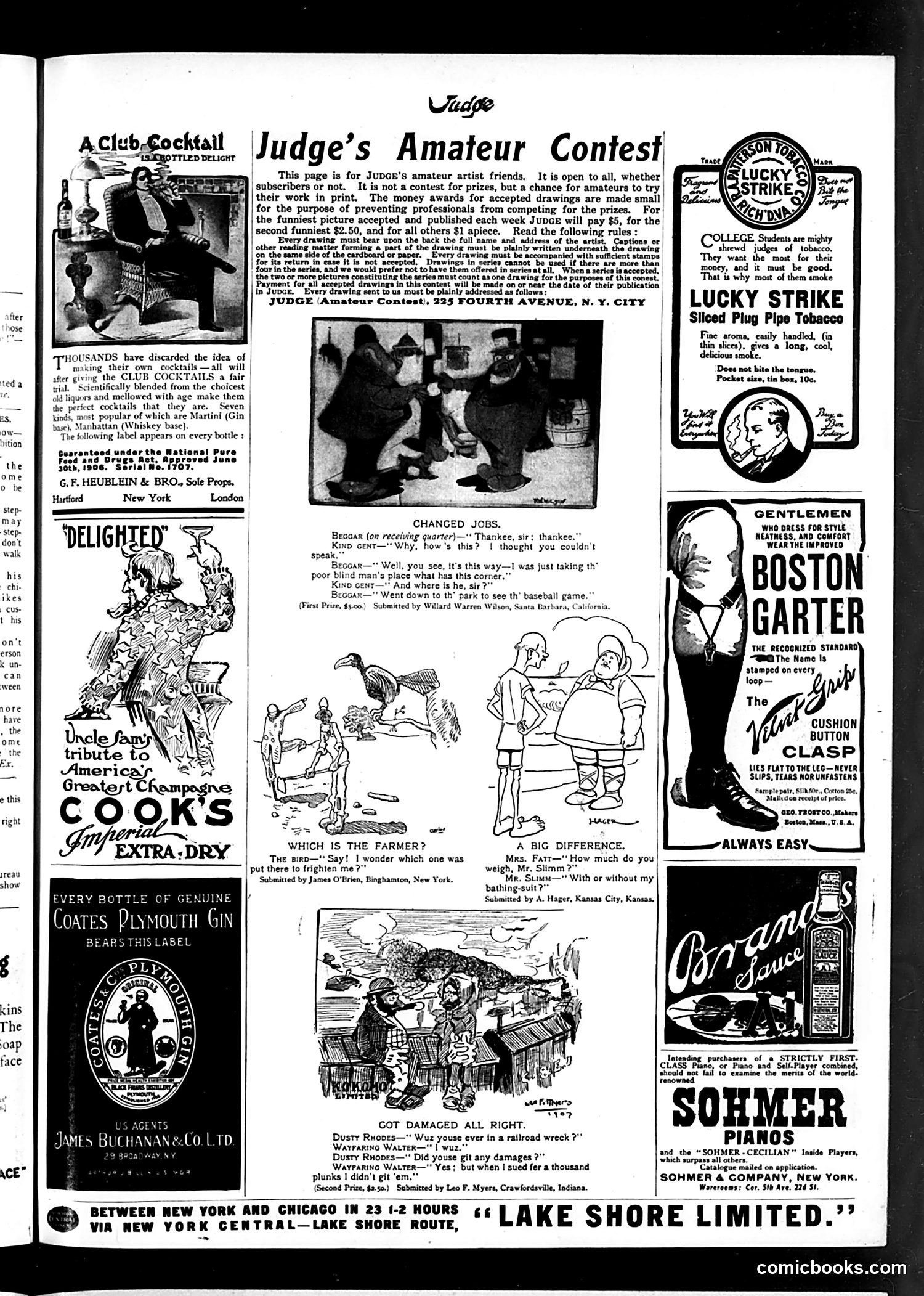
This page is primarily an **amateur art contest** featuring humorous cartoons submitted by readers, with small cash prizes ($5, $2.50, $1). The cartoons employ slapstick and gentle social humor typical of early 20th-century American comedy. **Key cartoons shown:** - **"Changed Jobs"**: A beggar reveals he's taken a blind man's regular panhandling spot while the man watches a baseball game—humor from occupational displacement and deception. - **"Which is the Farmer?"**: Rural vs. urban appearance jokes, playing on stereotype differences. - **"A Big Difference"**: A weight-conscious woman asks her husband if he means with or without his bathing suit—domestic humor about body image and vanity. - **"Got Damaged All Right"**: A railroad wreck survivor describes injuries—physical comedy about accidents. The page is also filled with period **advertisements** (Lucky Strike tobacco, Boston Garter, Sommer Pianos, Coates Gin) typical of Judge's commercial content. The amateur contest democratized cartooning, allowing nonprofessional artists to publish work in a major satirical magazine.
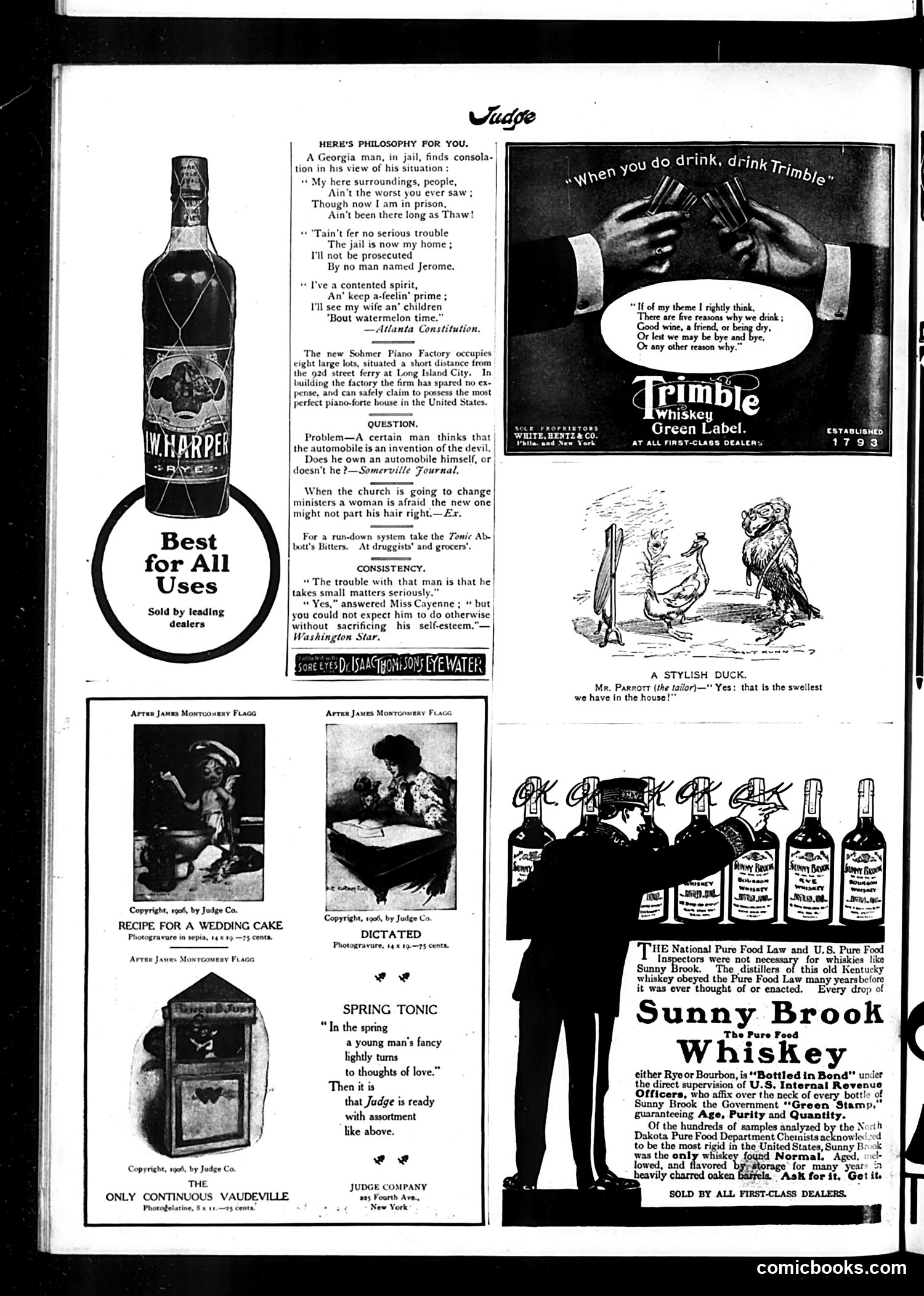
This page mixes satirical commentary with period advertising. The main content includes: **"Here's Philosophy for You"**: A humorous poem about a Georgia prisoner finding consolation in jail, notably referencing **Harry Thaw**—a wealthy man involved in a sensational 1906 murder case who faced prosecution by District Attorney **Jerome**. The joke is that the prisoner considers himself fortunate compared to Thaw's legal troubles. **Short Jokes**: Including satirical takes on automobiles as "inventions of the devil," church minister etiquette, and a man who won't acknowledge his automobile ownership for fear of losing self-respect. **Illustrations**: Include period magazine cartoons like "A Stylish Duck" (tailor humor) and recipe/tonic advertisements typical of the era. **Heavy Advertising**: The page is dominated by whiskey and patent medicine ads (Trimble, Sunny Brook Whiskey, Judge's Bitters, Spring Tonic), reflecting early-1900s magazine culture before strict FDA regulations. The satire assumes readers knew about contemporary scandals like the Thaw case to appreciate the prisoner's comparative relief.
This is **not a cartoon or satire**, but rather a **straightforward advertisement** for Schlitz beer from Judge magazine. The page promotes Schlitz's brewing quality by listing specific ingredients and processes: deep-well water, selected barley, Bohemian hops, and a proprietary yeast strain "no one can duplicate." The ad emphasizes that Schlitz spends more on purity than competing breweries—a marketing claim positioning quality as justification for presumably higher prices. The decorative hop motifs and the tagline "The Beer That Made Milwaukee Famous" reflect Schlitz's actual historical prominence in early 20th-century American brewing. This appears to be a genuine product advertisement rather than satirical content, suggesting Judge magazine accepted paid advertising alongside its humorous editorial material.
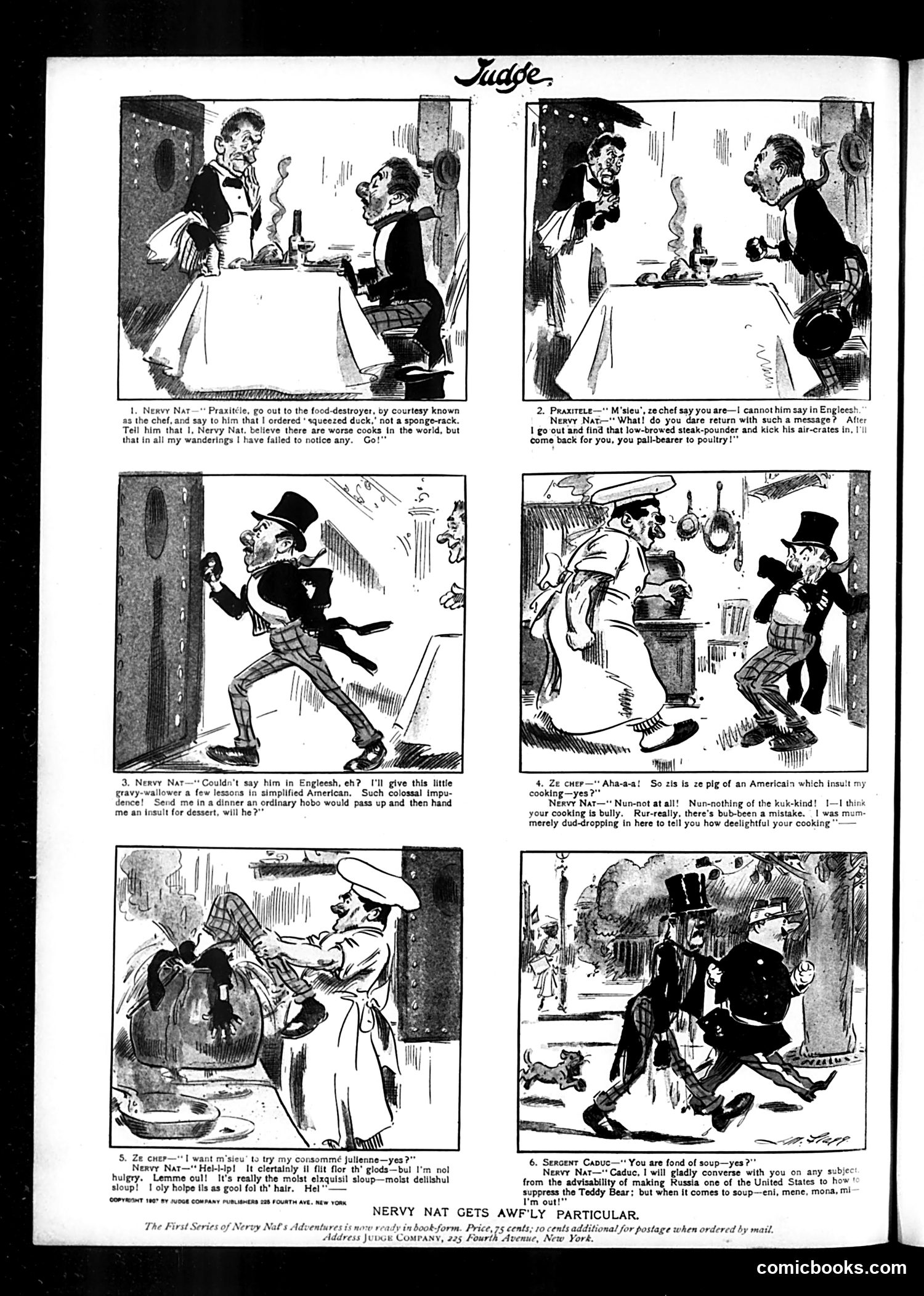
This six-panel comic strip satirizes an American ("Nervy Nat") dining at a French restaurant with a temperamental French chef. The humor relies on ethnic stereotypes: the chef speaks in exaggerated French-accented English ("Ze cHer," "Praxitéle"), while Nat affects mock-French gibberish when trying to complain or appease him. The satire mocks both characters: Nat for his brash American rudeness and presumption in criticizing the chef's cooking, and the chef for his pompous arrogance and thin-skinned reaction to criticism. The physical comedy escalates from verbal complaint to Nat chasing and kicking the chef, then reversing into obsequious flattery. The strip plays on early 20th-century tensions between American and European (particularly French) cultural attitudes—Americans seen as uncouth, Europeans as pretentious. The joke's appeal depends on caricatures that modern readers would recognize as offensive ethnic stereotyping.