
Judge, 1907-05-25 · page 6 of 16
Judge — May 25, 1907 — page 6: what you’re looking at
What you’re looking at
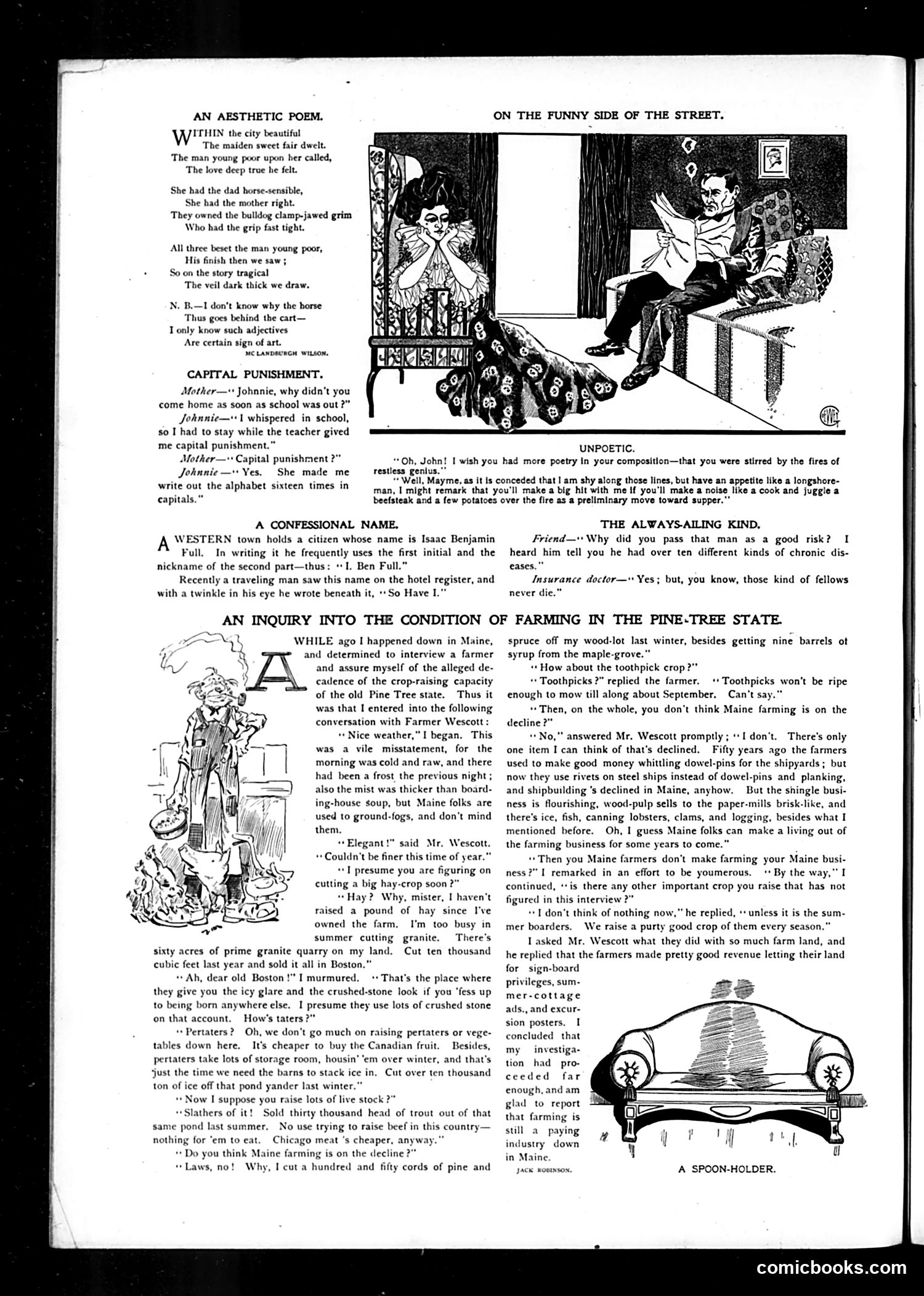
This page contains several brief humorous pieces mocking pretension and social absurdity: **"An Aesthetic Poem"**: Parodies overwrought Victorian poetry and the "aesthetic movement" (art-for-art's sake trend). The deliberately clumsy, affected language ("dad horse-sensible," "bulldog clamp-jawed grim") ridicules artistic pretension. The author's note about not understanding why the horse goes behind the cart—yet calling it "certain sign of art"—mocks how obscurity gets passed off as sophistication. **"Capital Punishment"**: A pun-based joke where a child misunderstands "capital punishment" as literally writing capital letters—gentle wordplay humor. **"A Confessional Name"**: Plays on the unfortunate name "I. B. Full" (phonetically "I Be Full"), which a traveling salesman recognizes and mimics. The remaining pieces mock romantic sentimentality, chronic complainers, and rural Maine farming decline through exaggerated anecdotes about quarrying and ice-cutting instead of agriculture—satirizing economic shifts away from traditional farming.
📄 Transcribed text from this page (OCR, searchable)
Machine-transcribed from the original scan — historical spelling and the odd misread are preserved.
AN AESTHETIC POEM. WITHIN the city beautiful The maiden sweet fair dwelt. ‘The man young poor upon her called, The love deep true he felt. She had the dad horse-sensible, She had the mother right. ‘They owned the bulldog clamp-jawed grim Who had the grip fast tight. All three beset the man young poor, His finish then we saw ; So on the story tragical The veil dark thick we draw. N. B.—I don't know why the horse Thus goes behind the cart— Tonly know such adjectives Are certain sign of art. MCLANDRURGH WILSON, CAPITAL PUNISHMENT. Mother— Johnnie, why didn't you come home as soon as school was out ?” Johnnie—«1 whispered in school, so I had to stay while the teacher gived me capital punishment.” Mother—* Capital punishment Johnnie—" Yes, She made me write out the alphabet sixteen times in capitals.” restless genius.”” A CONFESSIONAL NAME. A WESTERN town holds a citizen whose name is Isaac Benjamin Full. In writing it he frequently uses the first initial and the nickname of the second part—thus: Ben Full.” Recently a traveling man saw this name on the hotel register, and with a twinkle in his eye he wrote beneath it, ++ So Have I." man, | might remark that you'll make a big hit with me if you'll make a nois beefsteak and a few potatoes over the fire as a preliminary move toward supper. ON THE FUNNY SIDE OF THE STREET. UNPOETIC. “Oh, John! I wish you had more poetry in your composition—that you were stirred by the fires of “Well, Mayme, as it is conceded that | am shy along those lines, but have an appetite like a longshore- like a cook and juggle a THE ALWAYS-AILING KIND. Friend— Why did you pass that man as a good risk? I heard him tell you he had over ten different kinds of chronic dis- eases,” Insurance doctor—** Yes ; but, you know, those kind of fellows never die.” AN INQUIRY INTO THE CONDITION OF FARMING IN THE PINE-TREE STATE. WHILE ago I happened down in Maine, and determined to interview a farmer and assure myself of the alleged de- cadence of the crop-raising capacity of the old Pine Tree state. Thus it was that I entered into the following conversation with Farmer Wescott : ice weather," I began. This was a vile misstatement, for the morning was cold and raw, and there had been a frost the previous night ; also the mist was thicker than board- ing-house soup, but Maine folks are used to ground-fogs, and don’t mind them, + Elegant!" said Mr. Wesco + Couldn't be finer this time of year.” +I presume you are figuring on cutting a big hay-crop soon ?” + Hay? Why, mister, I haven't raised a pound of hay since I've owned the farm, I'm too busy in summer cutting granite. There's sixty acres of prime granite quarry on my land. Cut ten thousand cubic feet last year and sold it all in Boston.” ++ Ah, dear old Boston !"" I murmured, ++ That's the place where they give you the icy glare and the crushed-stone look if you "fess up to being born anywhere else, I presume they use lots of crushed stone on that account. How's taters 2” + Pertaters? Oh, we don't go much on raising pertaters or vege- tables down here, It's cheaper to buy the Canadian fruit. Besides, pertaters take lots of storage room, housin’ ‘em over winter, and that's just the time we need the barns to stack ice in. Cut over ten thousand ton of ice off that pond yander last winter.” ++ Now I suppose you raise lots of live stock 2” Slathers of it! Sold thirty thousand head of trout out of that same pond last summer. No use trying to raise beef in this country— nothing for ‘em to eat. Chicago meat ’s cheaper, anyw: + Do you think Maine farming is on the decline Laws, no! Why, I cut a hundred and fifty cords of pine and spruce off my wood-lot last winter, besides getting nine barrels ot syrup from the maple-grove.” “« How about the toothpick crop ?” “ Toothpicks ?" replied the farmer. ++ Toothpicks won't be ripe enough to mow till along about September. Can't say.” “Then, on the whole, you don’t think Maine farming is on the decline?” ++ No," answered Mr. Wescott promptly ; ‘I don't. There's only one item I can think of that's declined. Fifty years ago the farmers used to make good money whittling dowel-pins for the shipyards; but now they use rivets on steel ships instead of dowel-pins and planking, and shipbuilding 's declined in Maine, anyhow. But the shingle busi- ness is flourishing, wood-pulp sells to the paper-mills brisk-like, and there's ice, fish, canning lobsters, clams, and logging, besides what I mentioned before. Oh, 1 guess Maine folks can make a living out of the farming business for some years to come.” “Then you Maine farmers don’t make farming your Maine busi- ness?" I remarked in an effort to be youmerous. + By the way," I continued, ‘+is there any other important crop you raise that has not figured in this interview 2?” ++I don't think of nothing now,” he replied, ++ unless it is the sum- mer boarders. We raise a purty good crop of them every season.” lasked Mr. Wescott what they did with so much farm land, and he replied that the farmers made pretty good revenue letting their land for sign-board privileges, sum- mer-cottage ads,, and excur- sion posters. I concluded that my investiga- tion had pro- ceeded far enough, and am glad to report that farming is still a paying industry down in Maine. JACK ROBINSON, = A A SPOON-HOLDER. comicbooks.com