
A complete issue · 16 pages · 1907
Judge — May 4, 1907
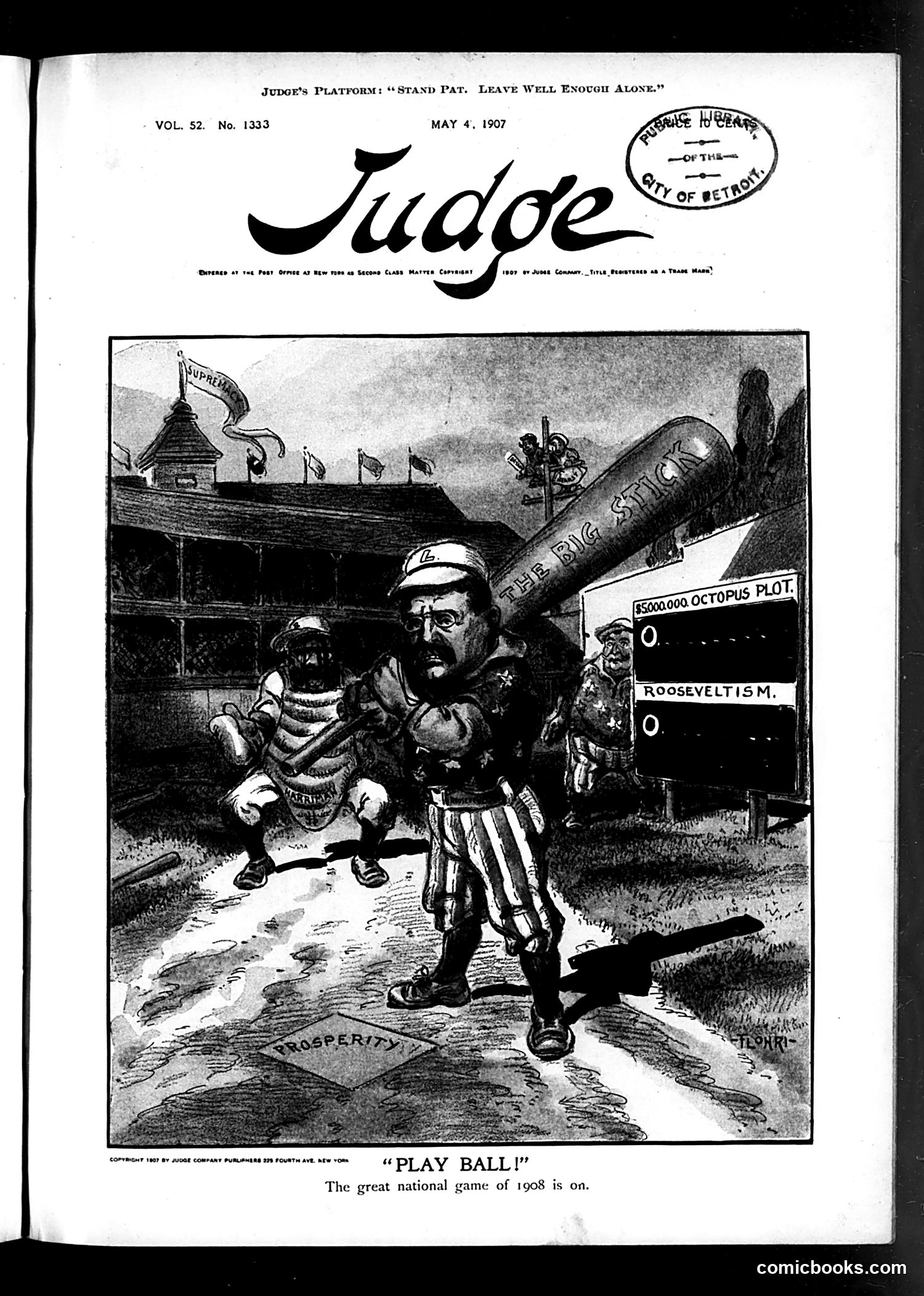
This political cartoon depicts what appears to be **President Theodore Roosevelt** (identifiable by his distinctive mustache and military bearing) as a baseball pitcher at a stadium. He's winding up to throw a large cannonball labeled "The Big Stick" toward home plate. The scoreboard shows "$5,000,000 Octopus Plot" versus "Rooseveltism," with zeros on both sides—suggesting a contest or confrontation. The caption reads: "The great national game of 1908 is on." **The satire**: Roosevelt's presidency was marked by trust-busting and aggressive enforcement against large monopolies (the "octopus"). This cartoon frames his political campaigns as a competitive sport, with his famous "Big Stick" policy weaponized as aggressive action against corporate trusts. The 1908 reference alludes to the coming presidential election.
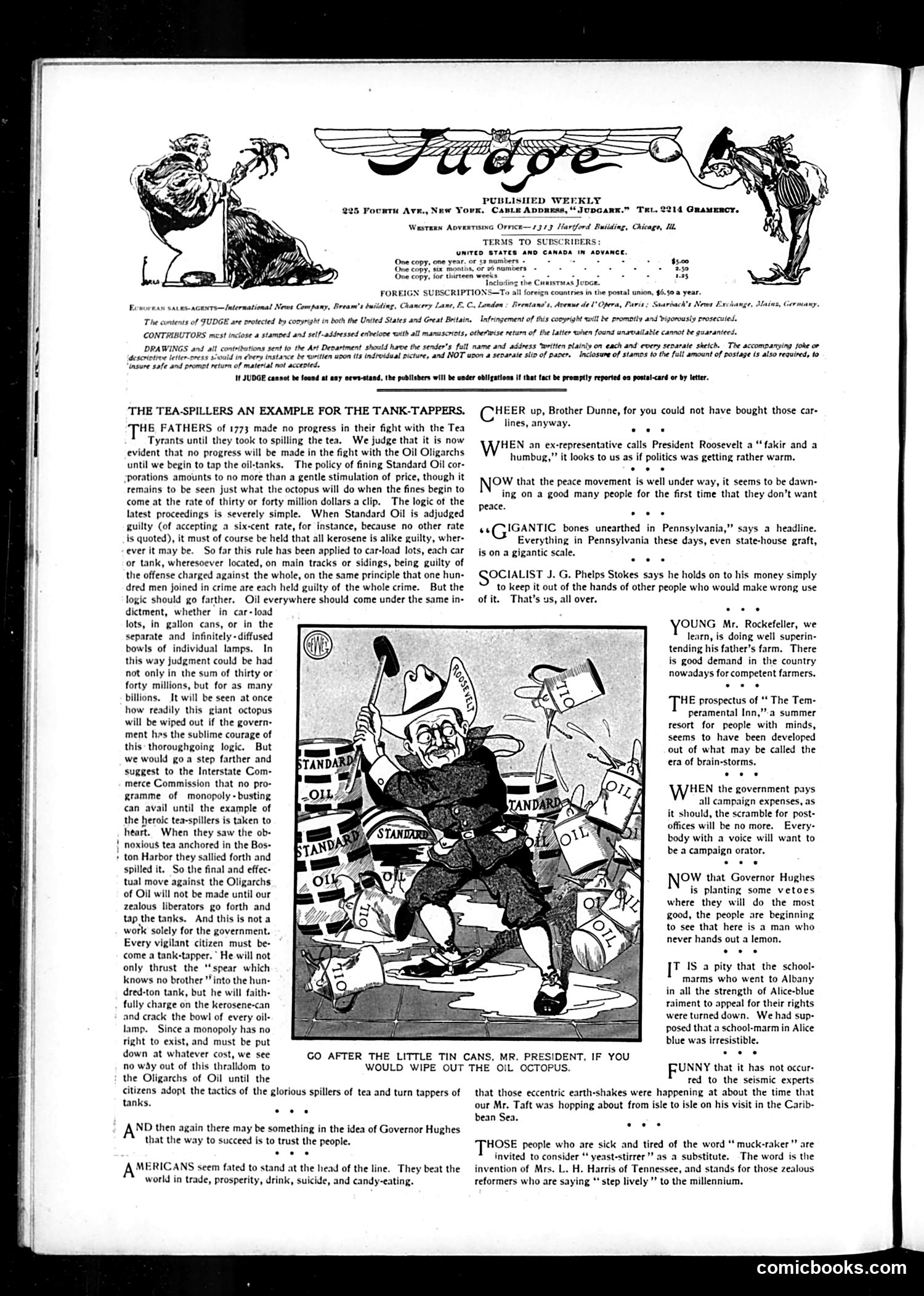
This Judge cartoon satirizes **Standard Oil's monopolistic practices** through an "Oil Octopus" image—a creature with multiple tentacles labeled "STANDARD OIL" strangling various industries and sectors. The accompanying article criticizes the **Tea Spillers** (presumably referring to the original Boston Tea Party rebels) for failing to break Standard Oil's grip, arguing that unlike earlier American resistance movements, current efforts against monopolies lack sufficient vigor. The cartoon urges the President (appears to reference **Theodore Roosevelt's anti-trust efforts**) to aggressively pursue the octopus—Standard Oil—suggesting government intervention is necessary. The satire mocks both the oil monopoly's pervasive control and the perceived weakness of reformers attempting to challenge it through conventional means.
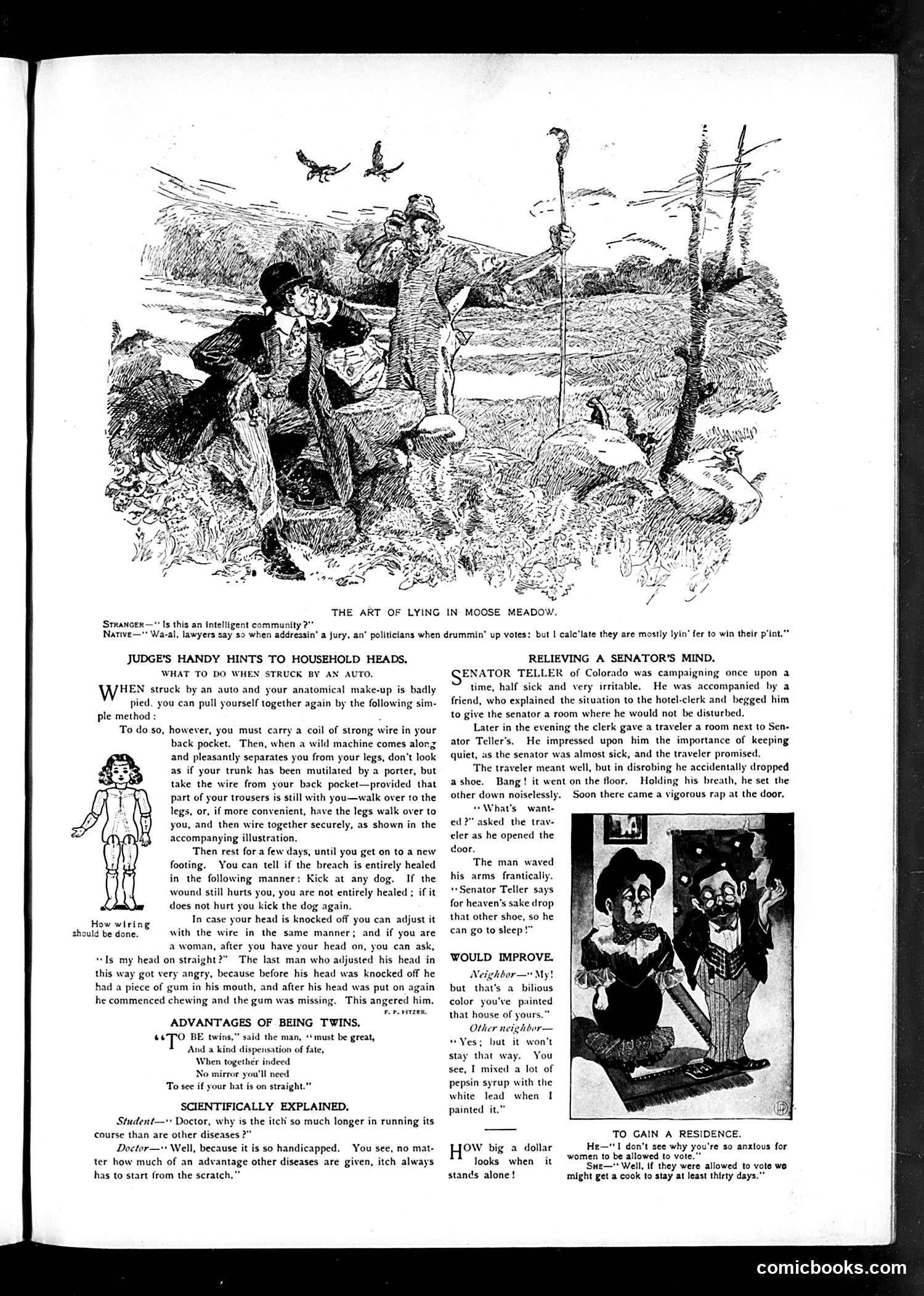
This page contains multiple satirical pieces typical of Judge magazine's humor: **"The Art of Lying in Moose Meadow"** (top): A cartoon mocking politicians' dishonesty, with a character noting that lawyers and politicians lie constantly when seeking votes—suggesting this was routine political behavior readers recognized. **"Judge's Handy Hints to Household Heads"**: Practical domestic advice about treating auto accident injuries, presented humorously. **"Relieving a Senator's Mind"**: A story mocking Senator Teller of Colorado's vanity and gullibility, where a hotel clerk plays pranks on him. **"Would Improve," "Scientifically Explained," and "To Gain a Residence"**: Brief joke items satirizing neighborhood disputes, medical explanations, and women's voting rights ("anxious for women to be allowed to vote"). The page reflects turn-of-century concerns about corruption, domestic life, and emerging women's suffrage debates.
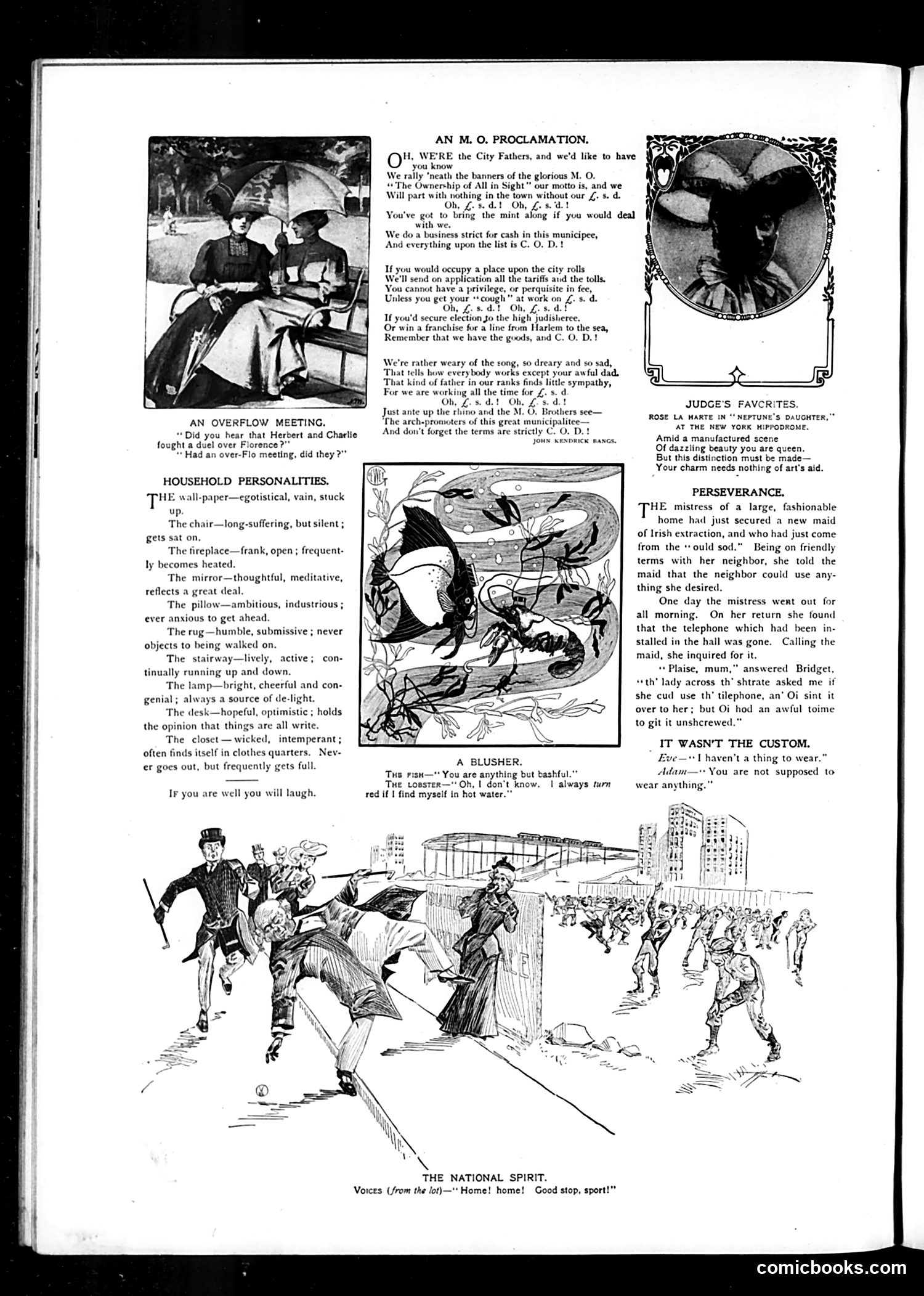
This page contains multiple unrelated satirical pieces typical of Judge magazine's format. **"An M.O. Proclamation"** mocks the Municipal Ownership movement through pseudo-poetic verse with repeated "C. O. D." (Cash on Delivery) references, suggesting skepticism about M.O. promises requiring actual payment. **"Household Personalities"** offers humorous character sketches of domestic types—the wallpaper-covered wife, long-suffering chair, heated fireplace—personifying household objects as commentary on domestic life. **"A Blusher"** is a brief joke about embarrassment and modesty. **"The National Spirit"** cartoon depicts a chaotic baseball or sports scene with crowds and players, captioned with voices shouting "Home! home! Good stop, sport!"—satirizing American enthusiasm for sports as a unifying national passion. The page reflects early 20th-century American domestic humor and urban politics.
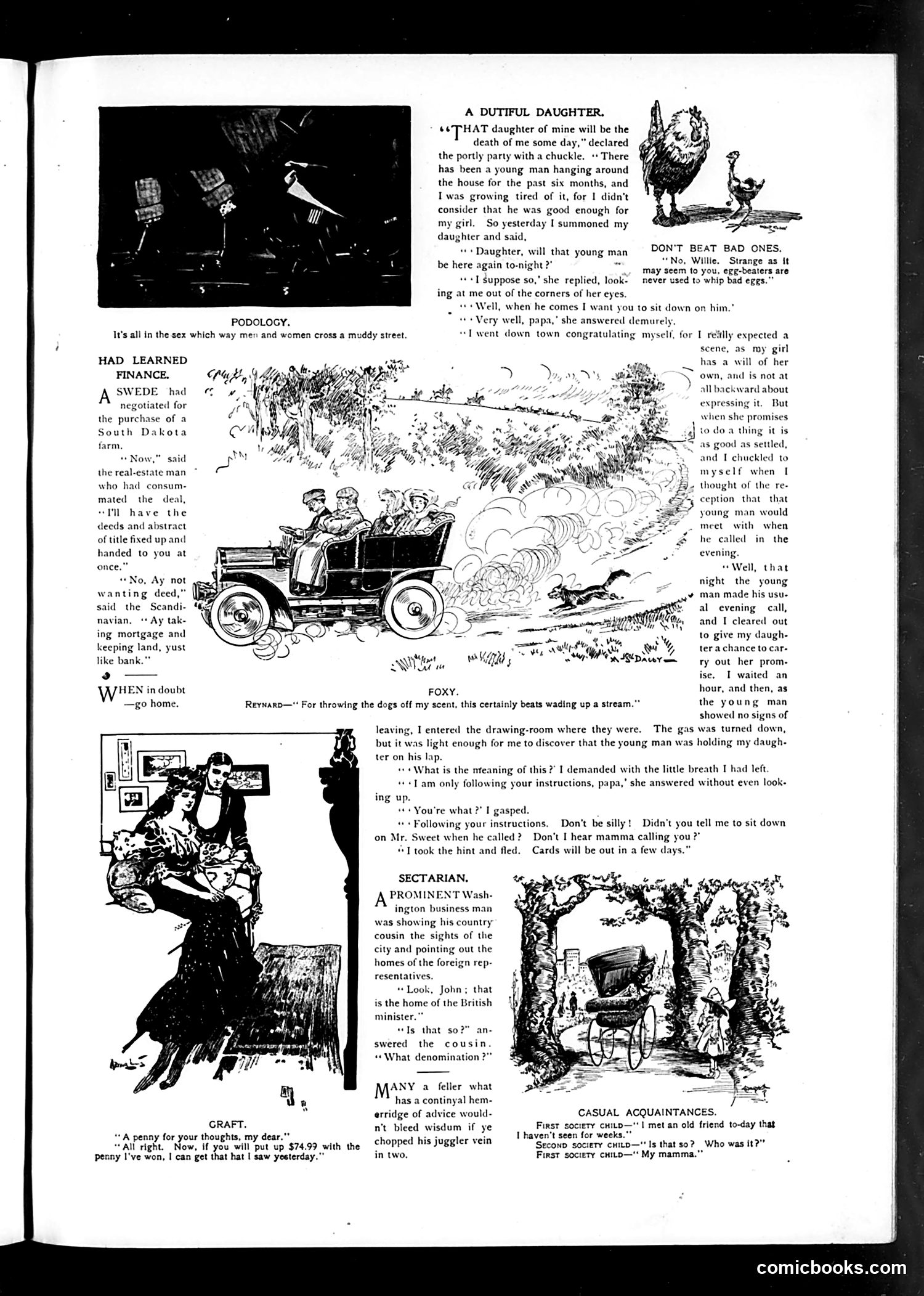
This page contains several unrelated satirical pieces and humorous anecdotes typical of Judge's format. **"A Dutiful Daughter"** mocks a young woman's obedience to her father's command to sit with an unwanted suitor, only to discover the man never showed up—suggesting commentary on parental authority over women's romantic choices. **"Hard Earned Finance"** depicts a Swedish immigrant negotiating land purchase, playing on contemporary stereotypes about foreign laborers and property ownership. **"Foxy"** jokes about a fox's superior hunting compared to wasteful human effort. **"Sectarian"** satirizes religious sectarianism through a conversation about denominations among wealthy businessmen visiting foreign dignitaries' homes. **"Casual Acquaintances"** offers brief humorous exchanges between society members. The page emphasizes class dynamics, immigration attitudes, and social conventions of the era.
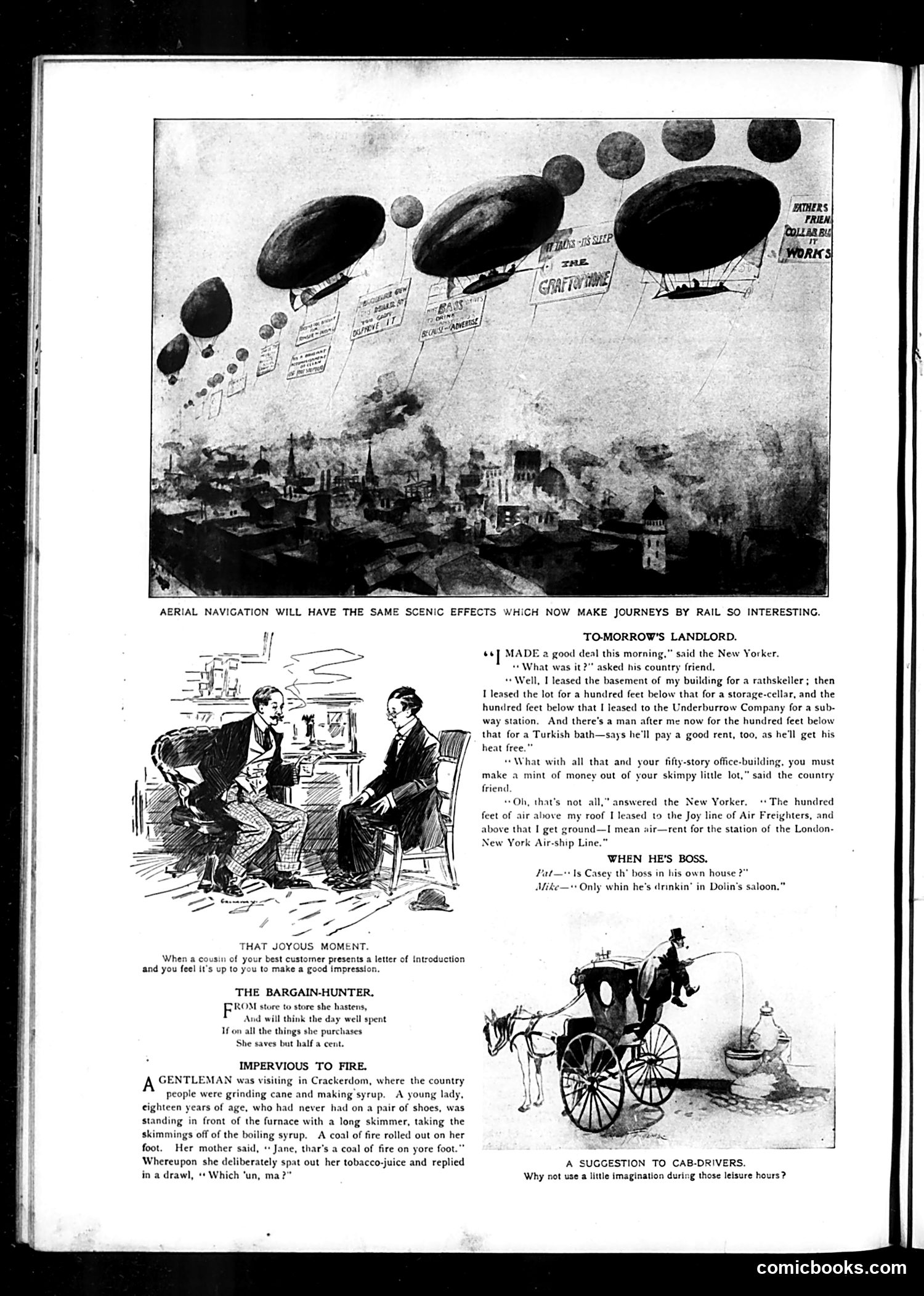
This page satirizes rapid urban development and commercialization in early 20th-century New York City. The main cartoon depicts a New Yorker who's monetized every conceivable space—leasing underground levels to a rathskeller, storage, subway station, and Turkish bath, while renting airspace above his building to air freight and an airship line. The joke mocks the obsessive real-estate speculation and vertical intensification of Manhattan, where landlords extracted profit from every cubic foot. The top illustration showing airships over a city references the futuristic speculation about aerial transportation that was contemporary to Judge's publication. The surrounding snippets ("When He's Boss," "The Bargain-Hunter," "Impervious to Fire," "Cab-Drivers") are unrelated humor items typical of Judge's miscellaneous joke format.
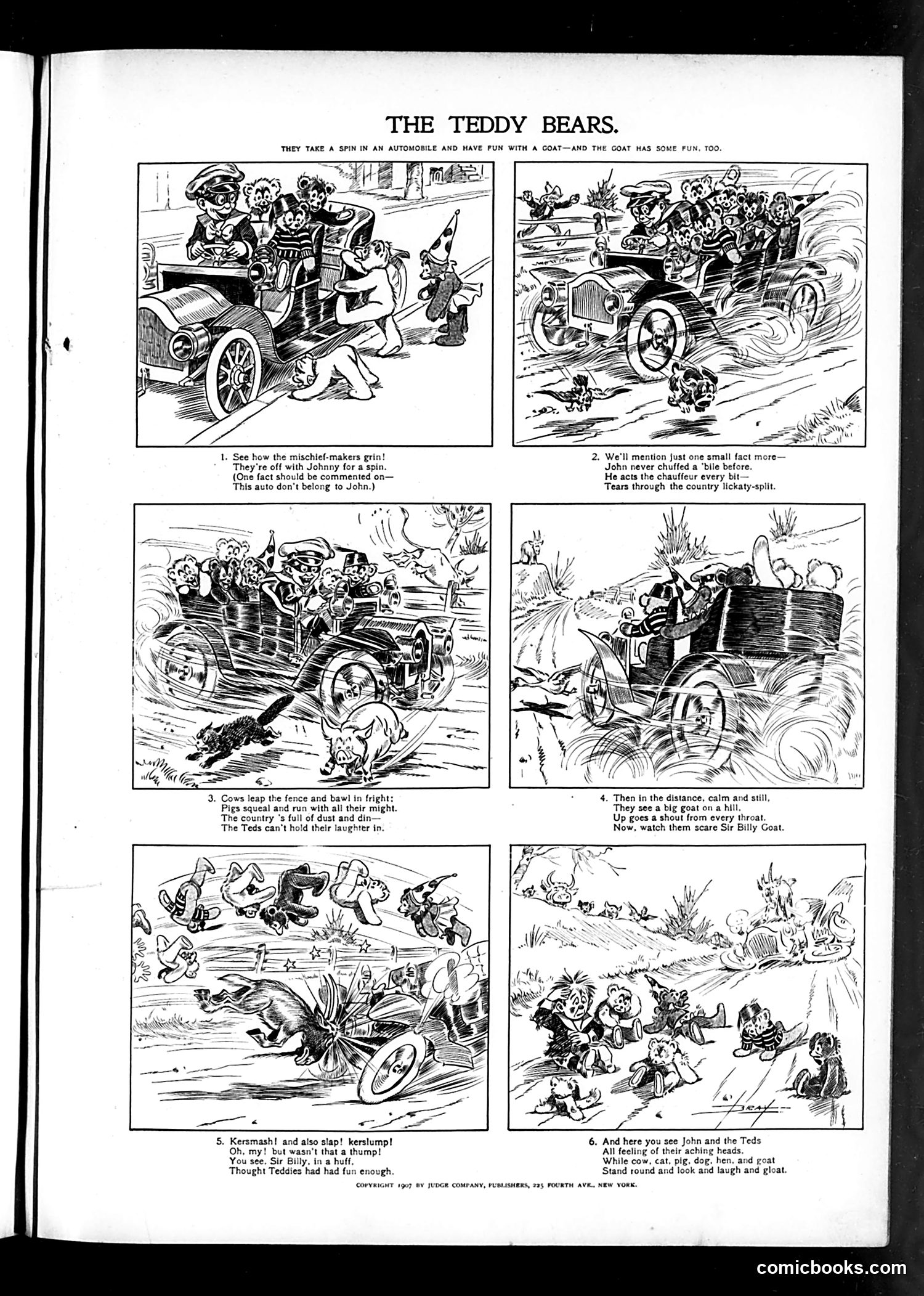
This comic strip satirizes the "Teddy Bear" craze—stuffed toys named after President Theodore Roosevelt—by personifying them as mischievous characters. The joke centers on their reckless joyride in a borrowed automobile (which "don't belong to John"), causing rural chaos: spooked livestock, dust clouds, and ultimately a collision with "Sir Billy Goat." The humor reflects early-1900s anxieties about automobiles as dangerous, reckless novelties driven by foolish young people. The goat's revenge—throwing the bears and John into the mud—provides comeuppance. The final panel shows animals "laughing" at human humiliation, reversing the typical power dynamic. The satire targets both the Teddy Bear fad itself and the irresponsibility of early motorists, mocking contemporary car culture as chaotic and destructive to rural life.
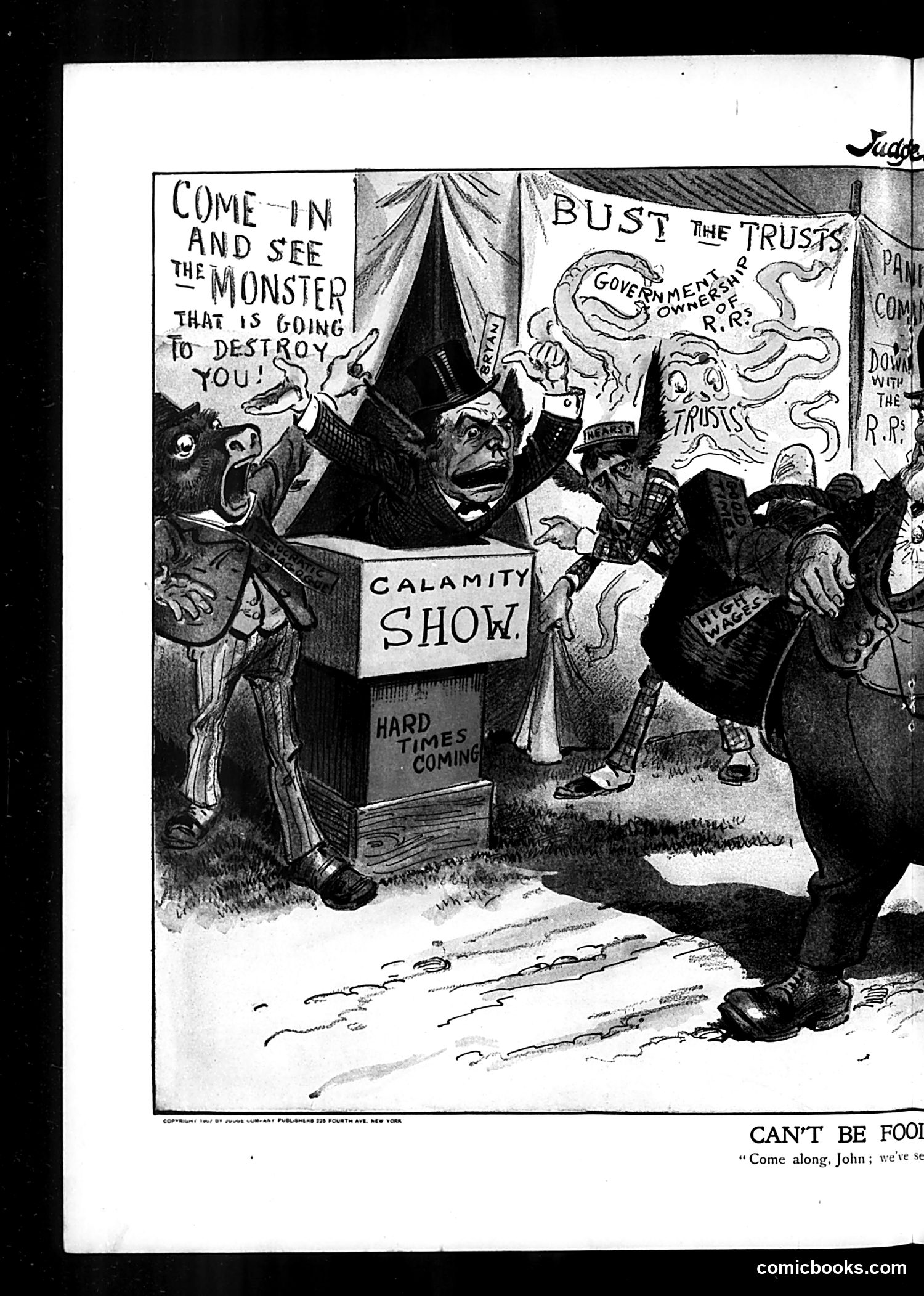
This Judge magazine cartoon satirizes public gullibility during economic anxiety. A carnival barker operates a "Calamity Show" tent advertising "Hard Times Coming," while displaying signs reading "Bust the Trusts" and "Government Ownership" — likely referencing populist or socialist political movements. The cartoon's title, "Can't Be Fooled," is ironic: despite the barker's obvious scare tactics (the "monster" appears to be theatrical props), crowds of ordinary citizens eagerly approach, seemingly drawn to fear-mongering political rhetoric. The satire targets how politicians and activists exploit public worries about monopolies (trusts) and economic hardship to gain support through exaggerated doom-saying. The cartoon suggests citizens are naive for buying into such theatrical political messaging, even when the manipulation is transparent.
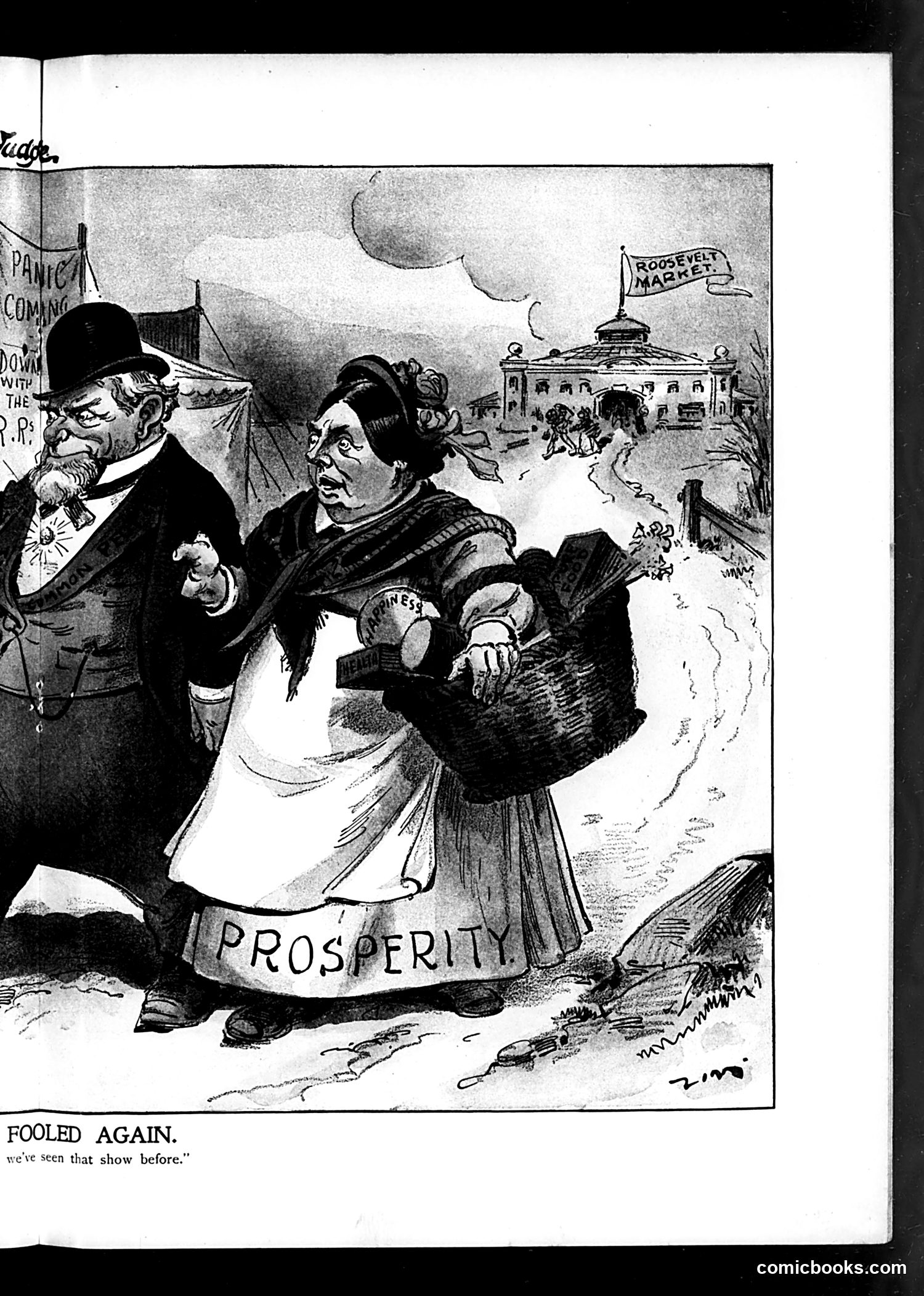
This cartoon depicts a woman labeled "Prosperity" being presented to a skeptical man (likely representing the American public or voter). The man on the left appears to be a politician or businessman showing off the woman as if she's a commodity or promise. The title "Fooled Again" and the caption "we've seen that show before" suggest this is satirizing repeated political promises of economic prosperity that have failed in the past. The woman's exaggerated, caricatured features and the theatrical presentation mock the artificiality of such campaign rhetoric. The "Roosevelt Market" sign visible in the background likely dates this to Theodore Roosevelt's presidency (1901-1909) or the New Deal era under Franklin Roosevelt. The cartoon critiques cyclical political deception—suggesting voters have been promised prosperity before, only to be disappointed.
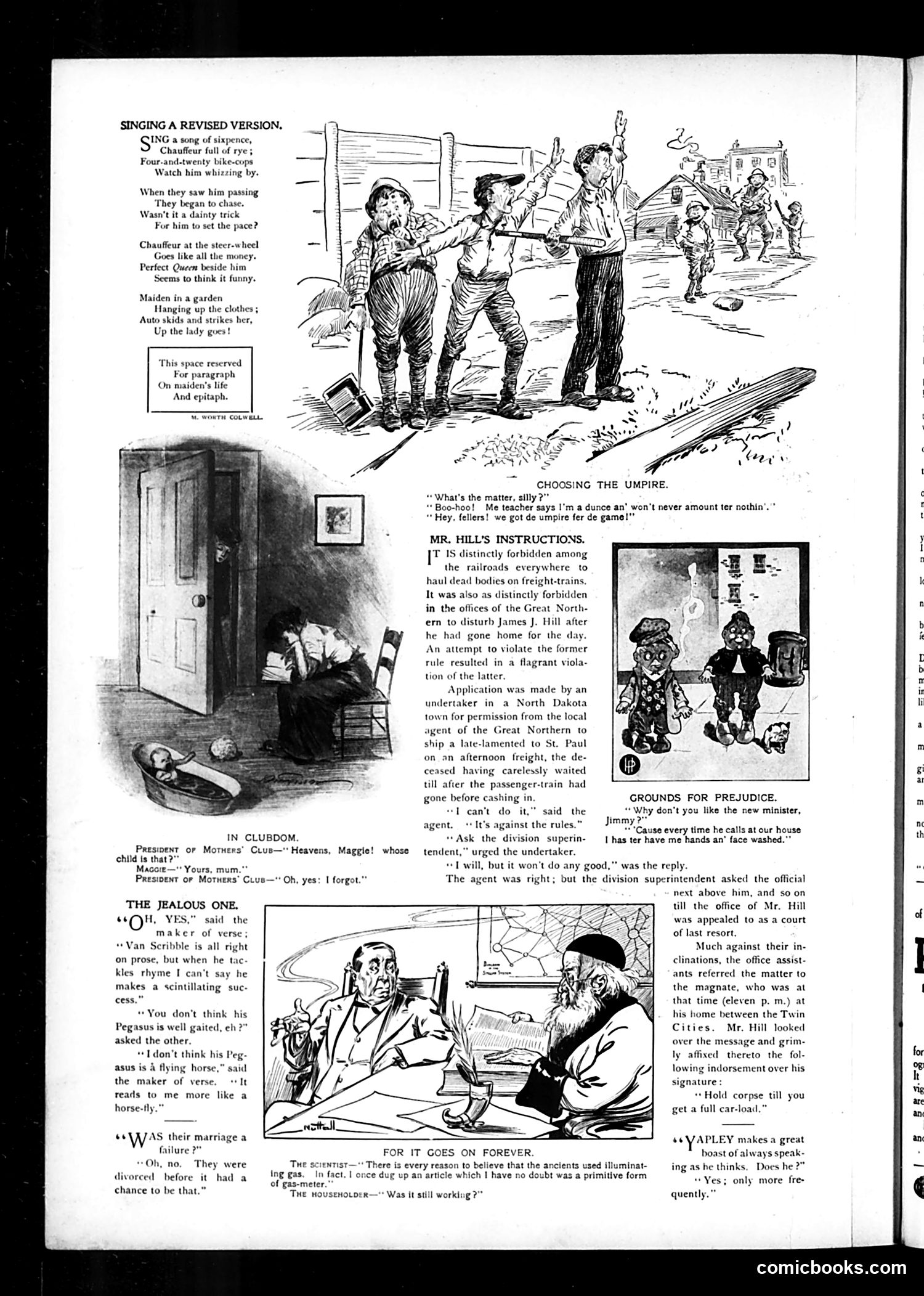
This page from *Judge* contains multiple satirical pieces mocking contemporary concerns circa early 1900s: **"Singing a Revised Version"** parodies the nursery rhyme "Sing a Song of Sixpence," replacing it with dark humor about automobiles killing pedestrians—a new menace of the motor age. The joke targets reckless drivers and society's casual attitude toward early car fatalities. **"Mr. Hill's Instructions"** satirizes James J. Hill, the powerful Great Northern Railroad magnate. The anecdote ridicules his absolute authority: even railroad policy against shipping corpses on freight trains gets overruled when Hill personally intervenes, ordering a body held until they can fill a railcar—treating the deceased as cargo to maximize efficiency. **Other sketches** include marital humor, poetry criticism, and children's jokes about school and religion—typical light filler for the magazine. The overarching targets are industrial-age excess (automobile danger, railroad ruthlessness) and the unchecked power of wealthy magnates over civic rules.
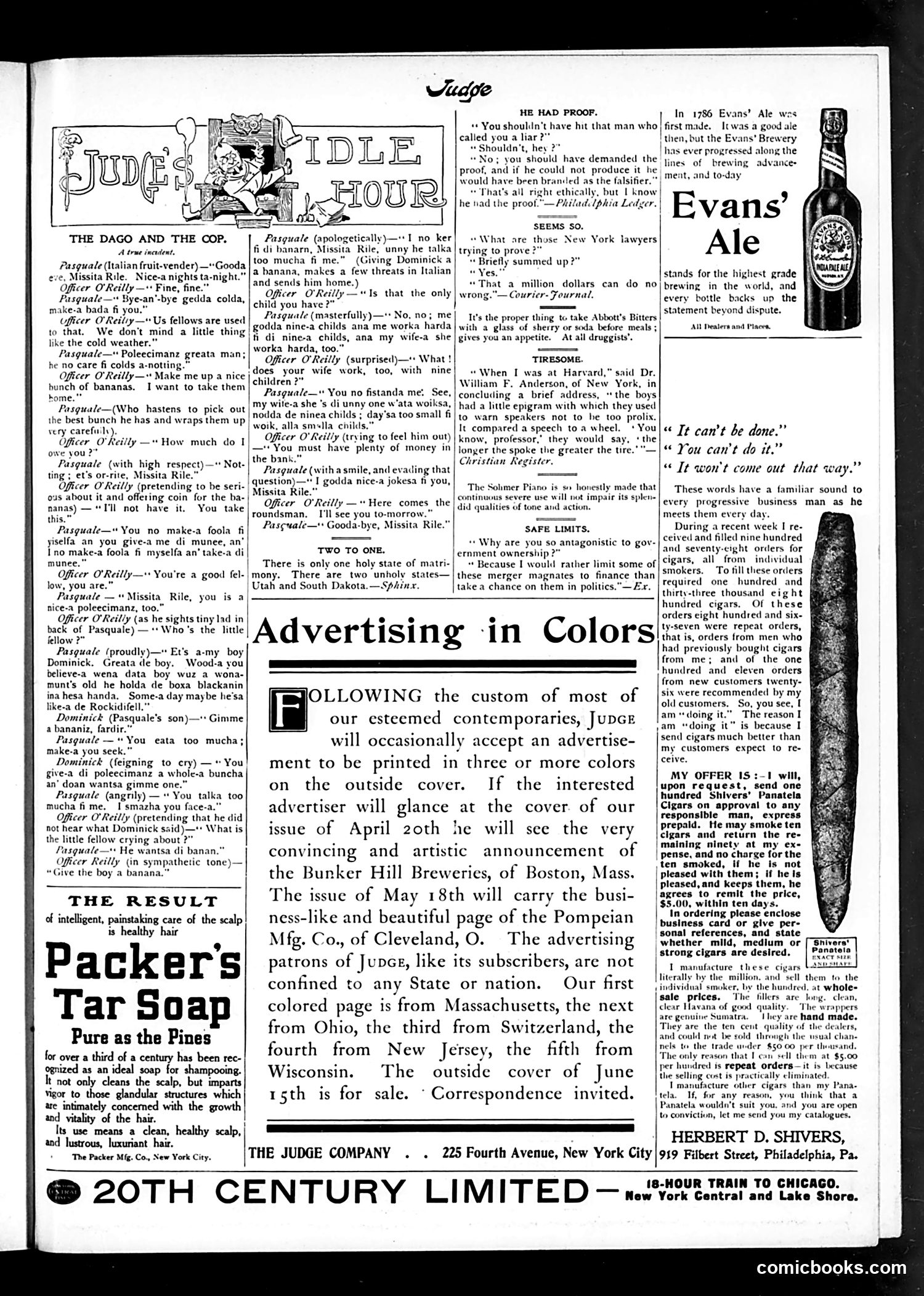
This cartoon depicts a stereotypical interaction between an Irish police officer (O'Reilly) and an Italian fruit vendor (Pasquale). The humor relies on ethnic caricature: Pasquale speaks in exaggerated broken English with Italian phonetic spelling ("Gooda eve," "wif-a"), while the officer treats him paternalistically but kindly. The "joke" turns on class and ethnic dynamics: O'Reilly accepts free fruit; Pasquale refuses payment, framing it as mutual face-saving ("no make-a foola fi yiselfa"). When Pasquale's son Dominick demands fruit, the father threatens him in Italian. O'Reilly intervenes sympathetically, and Pasquale yields—suggesting the Irish cop's authority shapes immigrant family dynamics. The satire critiques neither group harshly; rather, it presents ethnic stereotypes as amusing human interest. By modern standards, the cartoon's casual use of "dago" (a slur) and caricatured dialect are offensive, though contemporary *Judge* readers found such material entertainment.
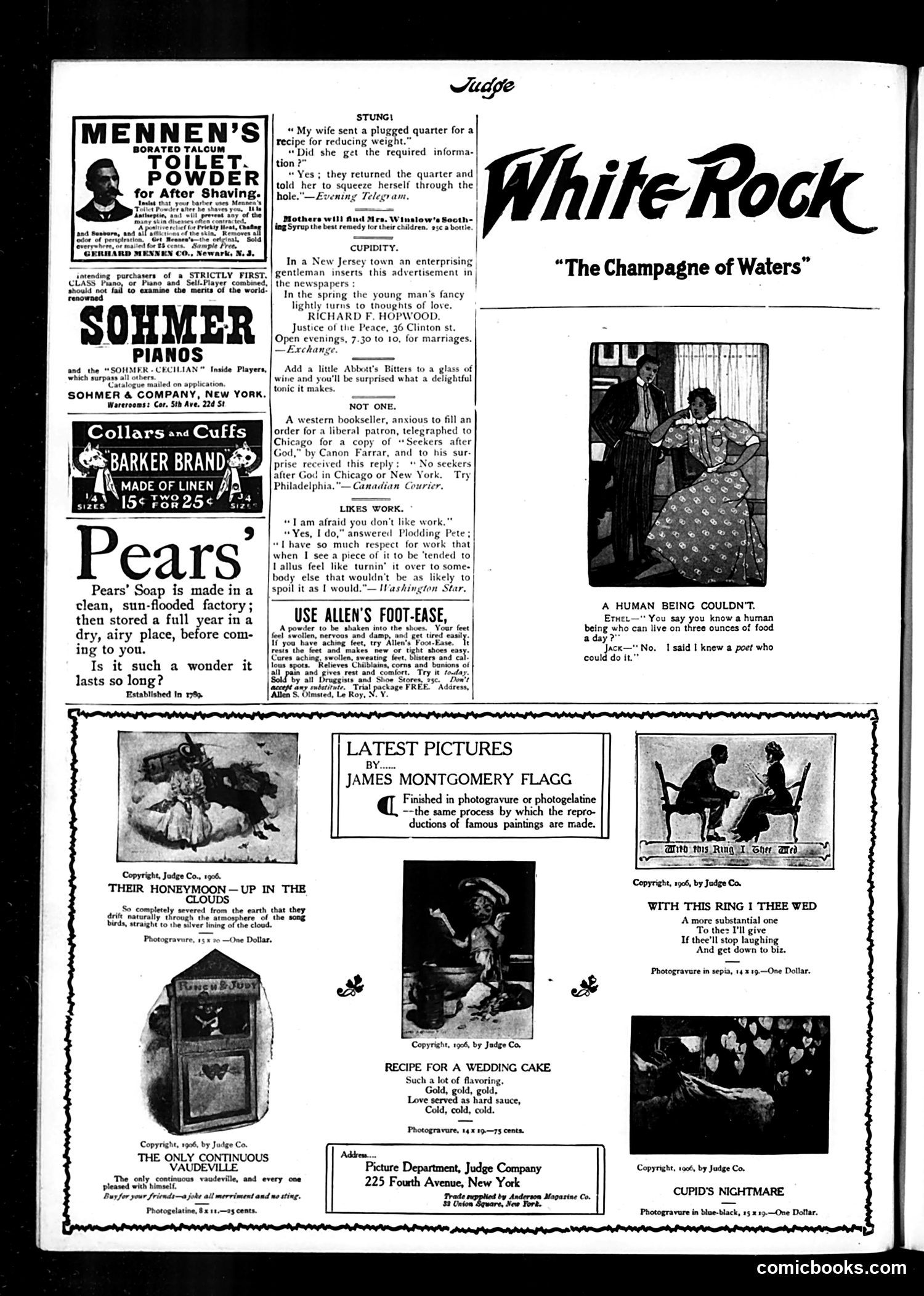
This page is primarily **advertising with comic filler content**, typical of early 1900s satirical magazines. The advertisements dominate (Mennen's talcum powder, Sohmer pianos, Pears' soap, etc.). The scattered jokes are brief social commentary rather than sustained satire: - **"Stung"**: A woman mails a plugged (fake) quarter to a weight-loss scheme; they return it, suggesting she squeeze through a hole instead—mocking both mail-order weight-loss fraud and female vanity. - **"Cupidity"**: A New Jersey justice of the peace advertises marriage services in spring, when "young man's fancy turns to thoughts of love"—gentle mockery of commercialized romance. - **"Not One"**: A bookseller can't find *"Seekers After God"* anywhere, implying atheism/skepticism was widespread—social commentary on American irreligion. - **"Likes Work"**: A laborer respects work so much he gives it to others—absurdist humor about work avoidance. The page's bottom half features **James Montgomery Flagg film stills** with captions like "Their Honeymoon—Up in the Clouds" and "Cupid's Nightmare," promoting current picture shows. Overall: advertising-heavy with lightweight humor reflecting period anxieties about commerce, courtship, and faith.
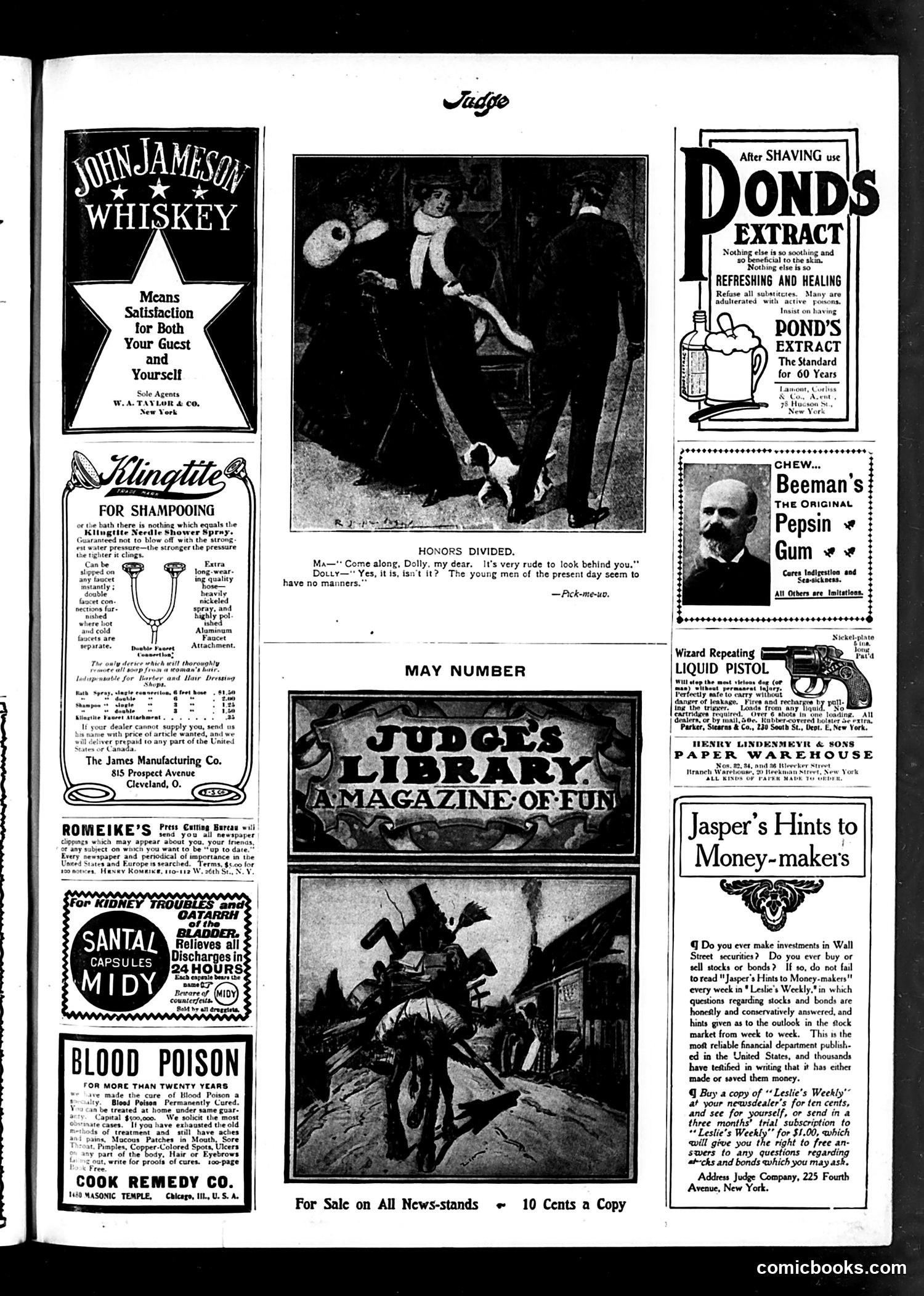
This page is primarily **advertising** rather than editorial content. The central cartoon titled "HONORS DIVIDED" depicts a couple where the woman says it's "very rude to look behind you" while the man responds "Yes, it is, isn't it? The young men of the present day seem to" (text cuts off). The joke appears to reference **flirtation or impropriety**—the implication being that the woman is looking at other men, and the man is commenting on modern courtship behavior. The surrounding advertisements promote patent medicines (blood poison cures, kidney remedies), personal grooming products (shaving extracts, shampoo nozzles), and financial investment advice in Leslie's Weekly. This reflects the era's ubiquity of dubious medical claims and emerging consumer culture. The magazine cost **10 cents**.
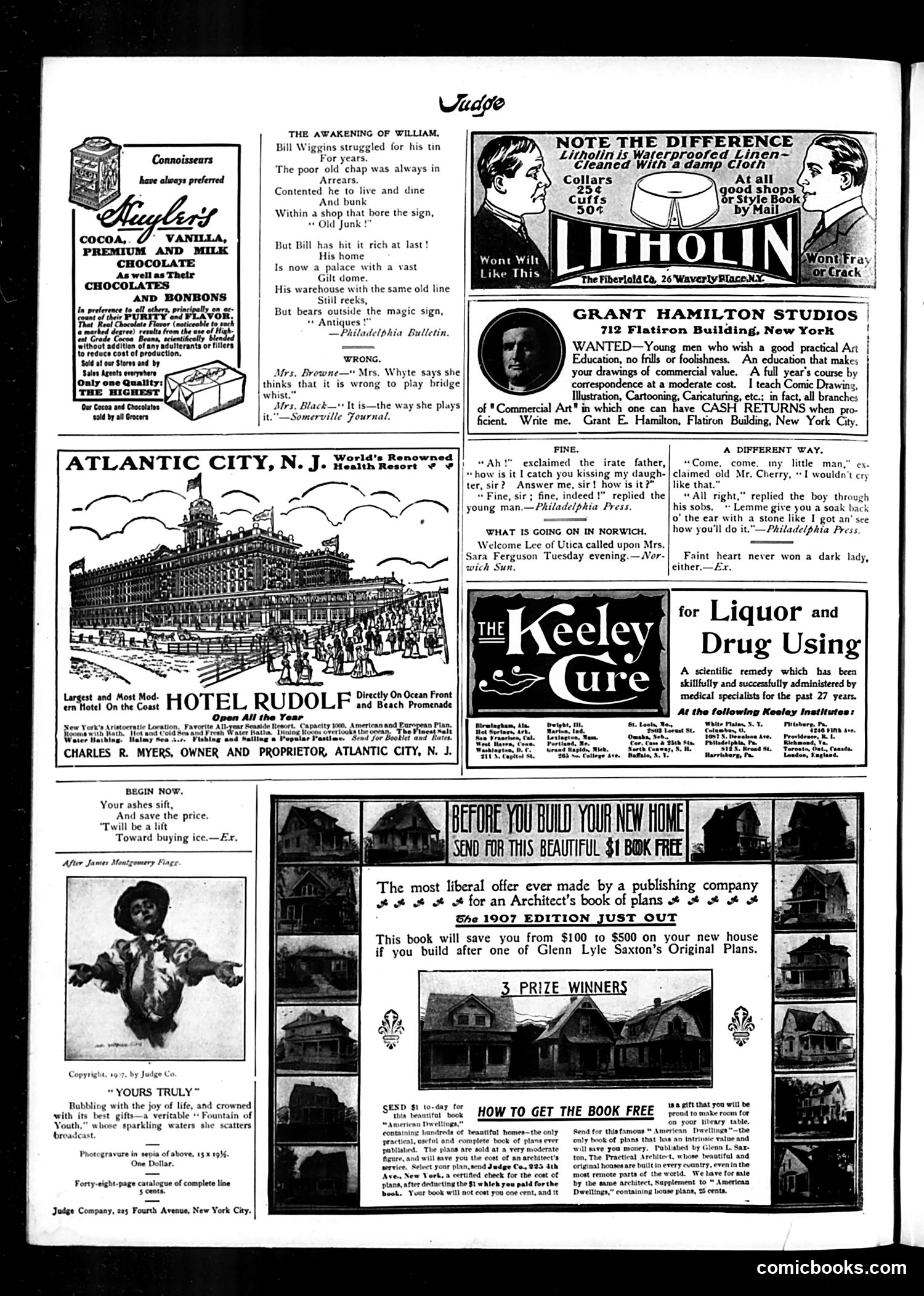
This page is primarily **advertising and humor filler** rather than political satire. The main cartoon, "The Awakening of William," presents a simple rags-to-riches narrative: Bill Wiggins, a poor junk dealer, suddenly becomes wealthy and builds a palatial home—yet his warehouse still reeks. The satire is gentle social commentary on nouveau riche excess and the disconnect between newfound wealth and actual refinement. The page is dominated by **period advertisements**: Neubert's cocoa, Litholin collar cleaner, Grant Hamilton's art studios, Atlantic City's Hotel Rudolf, and—most notably—**The Keeley Cure**, a treatment for alcoholism and drug addiction (a real, famous 19th-century institution). Other content includes light humor snippets ("Wrong," "Fine," "A Different Way")—brief jokes about card games, romantic situations, and parenting. The bottom third advertises a **free 1907 architecture book** by Glenn Lyle Saxton for homebuilders. This reflects Judge's mixed approach: satirical cartoons alongside contemporary advertisements and miscellaneous humor to fill space.
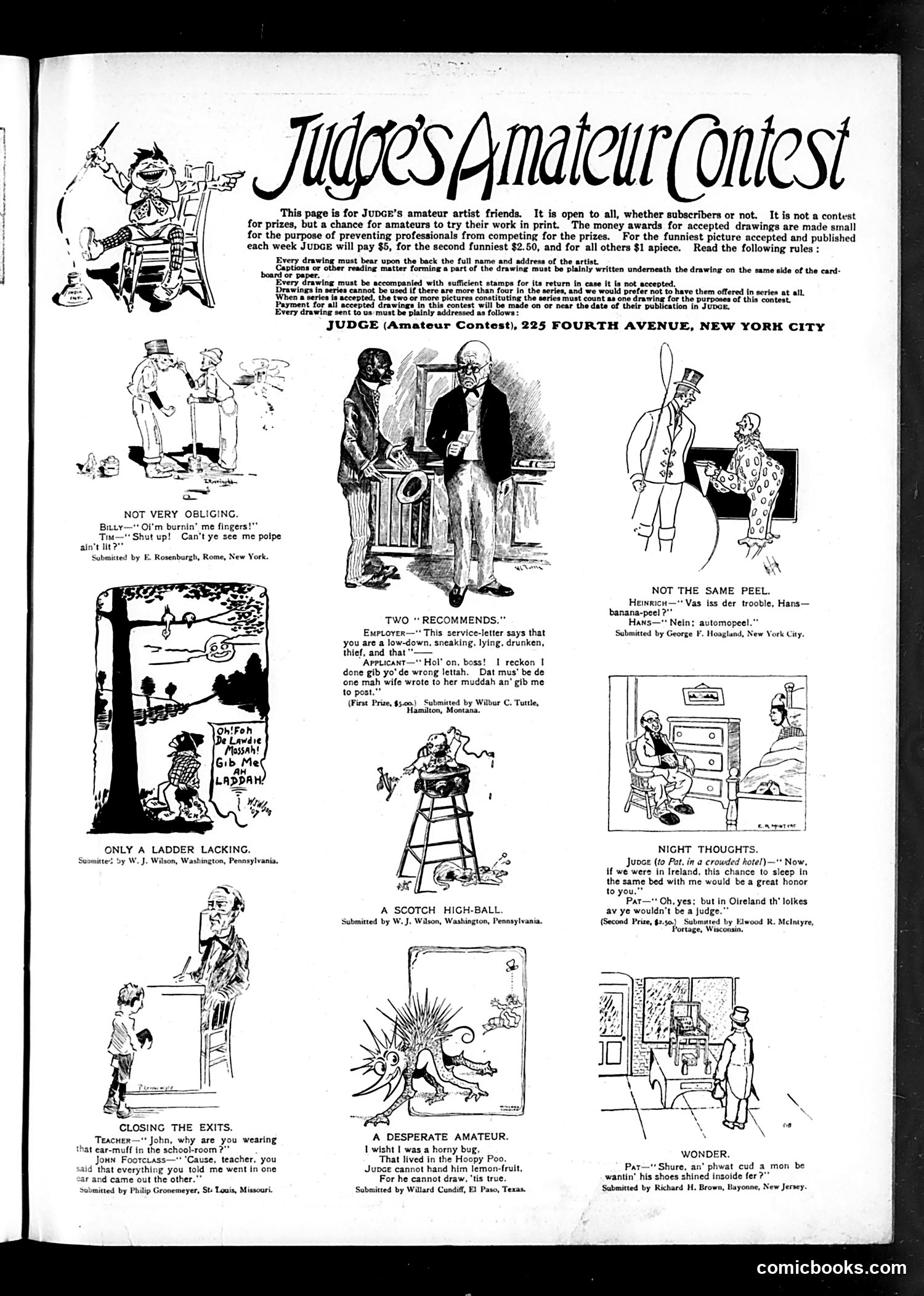
This page showcases submissions to Judge magazine's weekly amateur cartoonist contest, offering small monetary prizes ($5, $2.50, $1) to encourage non-professionals. The cartoons employ ethnic and class-based humor typical of early 20th-century American satire. Several use Irish and German accents and dialects for comedy—references to "Oireland," Irish laborers, and German immigrants ("Hans," "Heinrich"). Others mock working-class characters and domestic situations: a wife's scathing letter mistakenly posted, a schoolboy's excuse, servant recommendations revealing character flaws. The humor relies heavily on stereotyping and wordplay around accents ("automopeel" for automobile peel, "horny bug" mishearing). One cartoon references a judge character, playing on the magazine's name. The contest format democratized cartooning by welcoming amateurs while explicitly excluding professionals—positioning Judge as a venue for ordinary contributors, not just established artists.
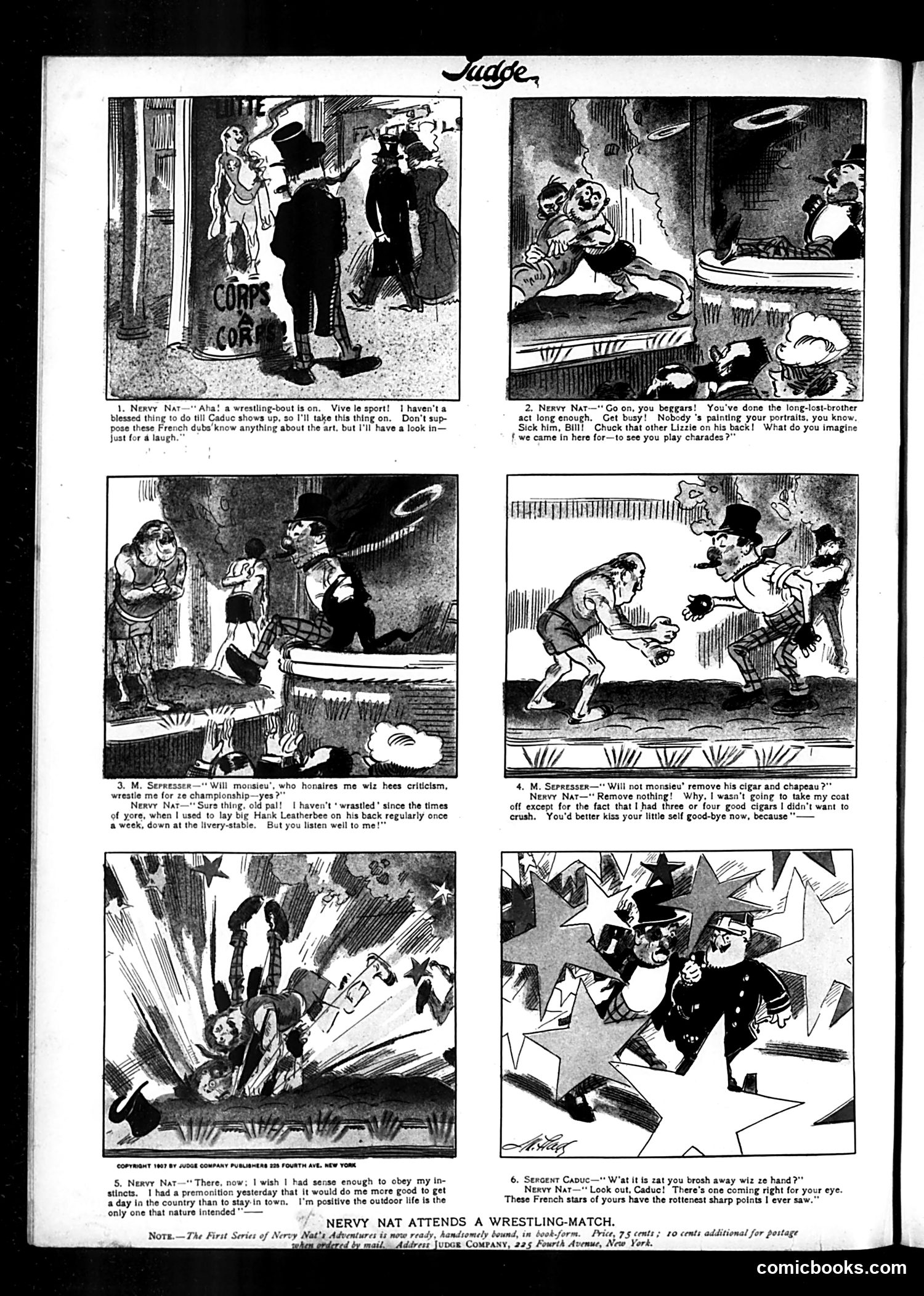
This is a six-panel comic strip featuring "Nervy Nat," a recurring character in Judge magazine. The strip follows Nat attending a professional wrestling match in France, where he encounters French wrestlers and a character named "Sergeant Caduc." The humor relies on ethnic stereotyping common to 1907: French characters are depicted with exaggerated accents (written phonetically: "monsieu'," "ze," "zat") and portrayed as pretentious and effeminate—one wrestler wants recognition for his "championship" while Nat dismisses French culture as artificial. Nat himself embodies the brash American tourist archetype, refusing to remove his coat or cigar, treating the wrestling match casually, and ultimately getting physically battered by the French wrestlers. The satire targets both French affectation and American rudeness abroad. The final panels show Nat literally knocked around, suggesting comeuppance for his arrogance. The strip's appeal to Judge's audience lay in its nationalist humor—celebrating American toughness while mocking foreign pretension.