
A complete issue · 16 pages · 1907
Judge — March 16, 1907
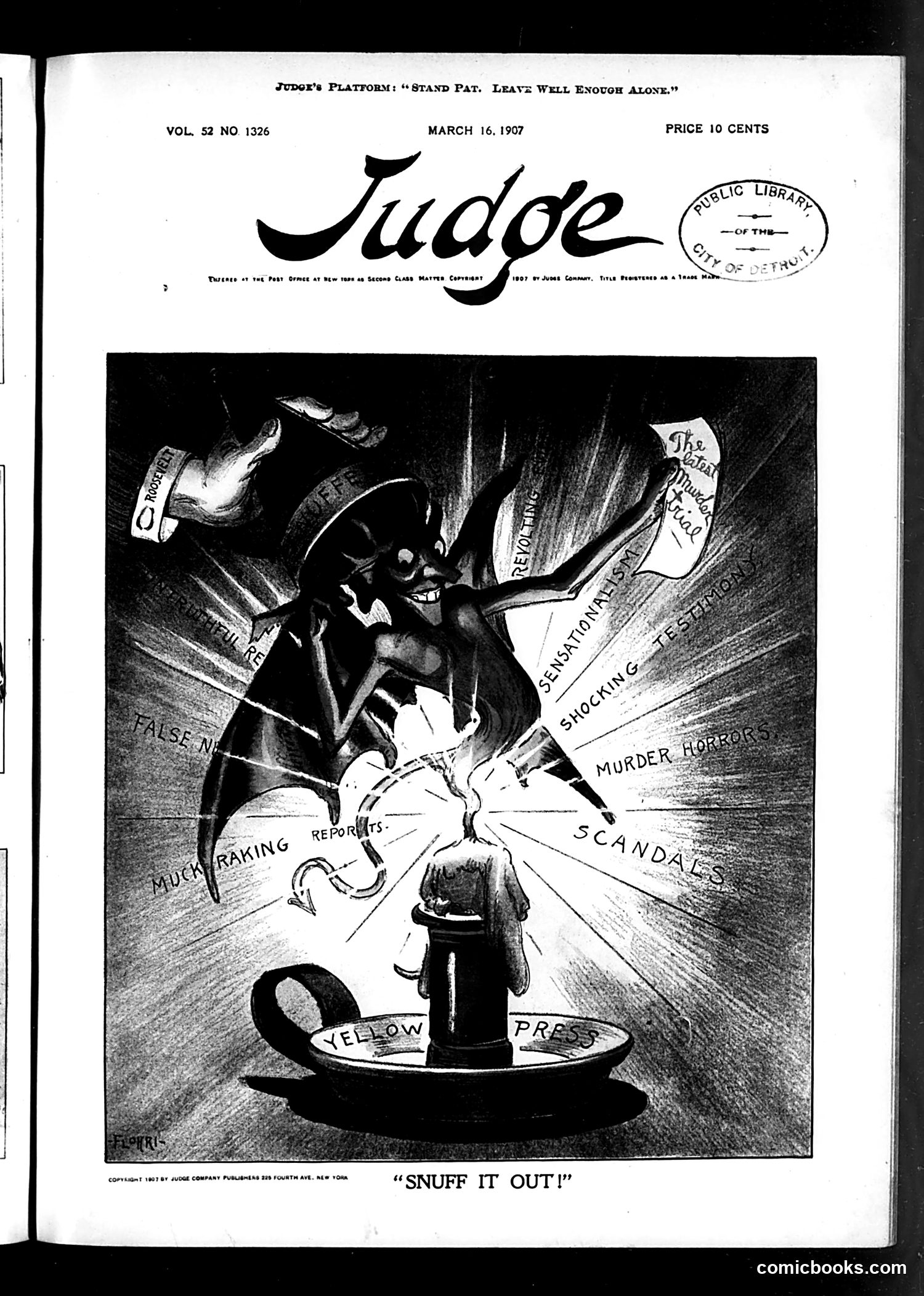
This political cartoon depicts a demonic or devil-like figure surrounded by labeled "scandals" and problematic issues that need suppression. The tentacles or appendages reach outward toward labels reading "FALSE REPORTS," "MURDERING REPORTS," "SHOCKING STATEMENTS," "SCANDALS," and other negative elements, alongside what appears to be "YELLOW PRESS." The central figure seems to represent either sensationalist journalism or corruption itself. The cartoon's title, "Snuff It Out!", suggests the need to extinguish these problems—likely referring to calls for controlling or censoring yellow journalism and scandal-mongering in the early 1900s press. The work critiques media sensationalism and suggests these inflammatory reports should be eliminated, reflecting Progressive Era concerns about journalistic ethics and irresponsible newspaper practices.
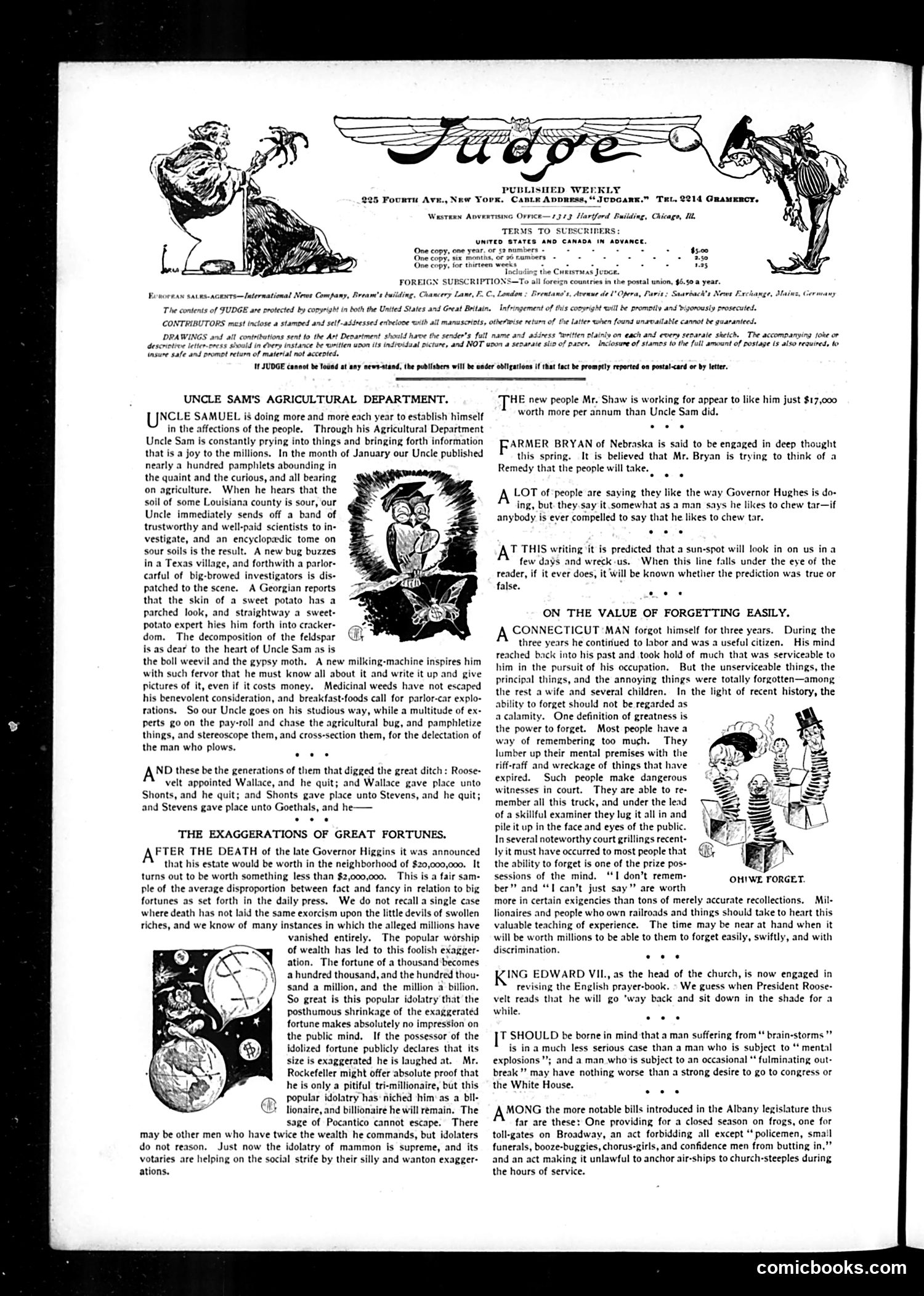
This page contains several satirical columns without clearly identifiable political cartoons. The main sections discuss: 1. **Uncle Sam's Agricultural Department**: Satirizes Uncle Sam's efforts to educate farmers through government pamphlets and agricultural experts, mocking the bureaucratic approach to rural problems. 2. **The Exaggerations of Great Fortunes**: Critiques sensationalized claims about deceased Governor Higgins's wealth ($20-200 million), arguing such exaggerations mislead the public and distort perceptions of actual fortunes. 3. Various brief satirical notes on contemporary topics including Governor Hughes, Nebraska farmer Bryan, and Albany legislature bills. The illustrations appear decorative rather than directly tied to specific political figures. The satire targets government inefficiency, media sensationalism, and wealth mythology rather than named individuals.
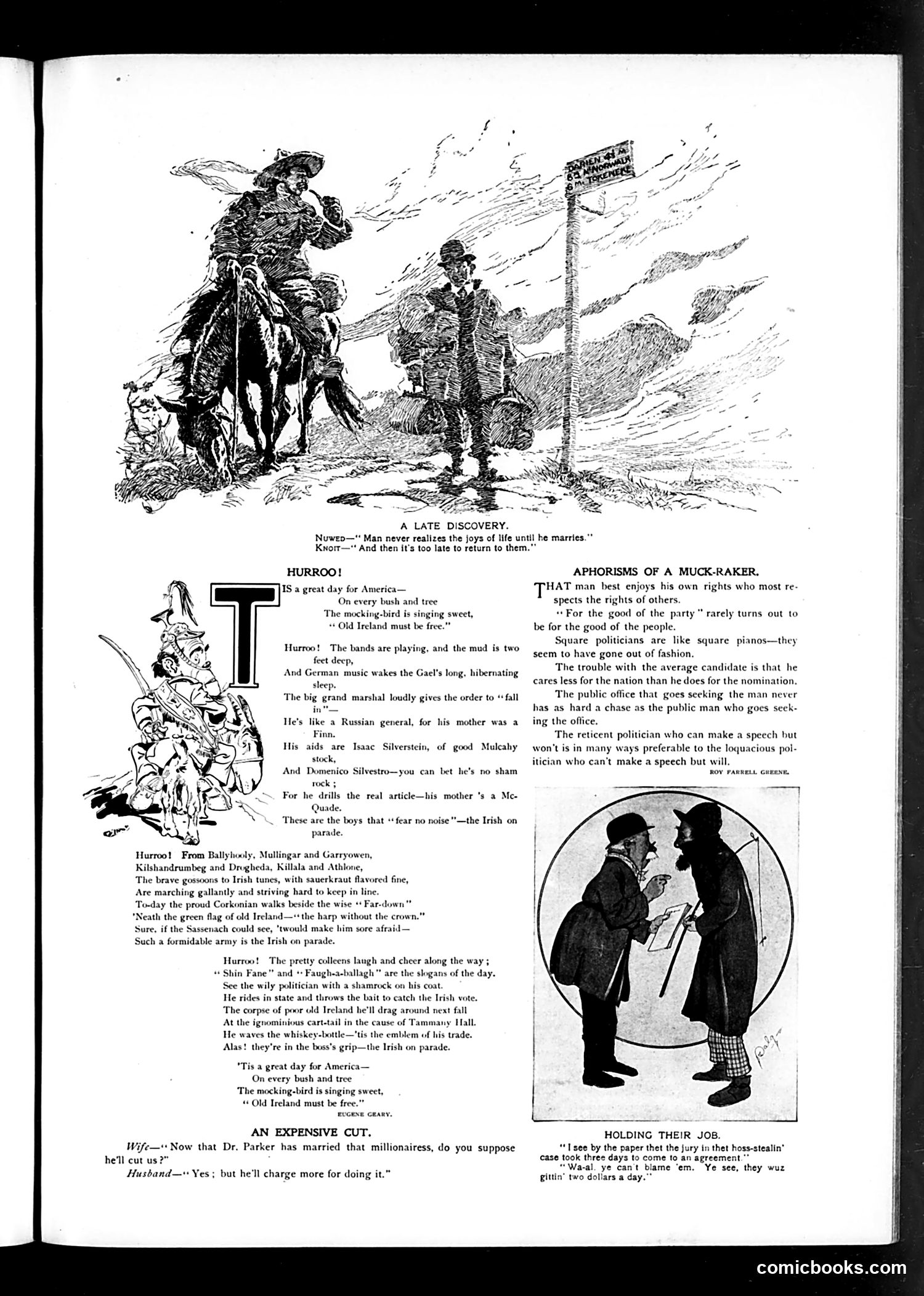
**"A Late Discovery"** (top): A dialogue joke about marriage revealing life's joys too late to enjoy them—standard domestic humor of the era. **"Hurroo!"** (left): A satirical poem celebrating Irish identity and Irish soldiers in what appears to be a military parade context. References specific Irish locations (Ballybody, Mulingar, Garryowen, etc.) and mocks English/American attitudes toward Irish immigrants, particularly their representation in politics and military service. The repeated "Hurroo!" celebrates Irish pride while the detailed verse suggests the Irish were prominent in contemporary military or political discussions. **"Aphorisms of a Muck-Raker"** (right): Political commentary criticizing politicians who prioritize personal nomination over public service—suggesting corruption or self-interest in politics. **"An Expensive Cut"** and **"Holding Their Job"** (bottom): Brief joke-format items about wealth and labor negotiations. The page emphasizes Irish-American themes and political critique.
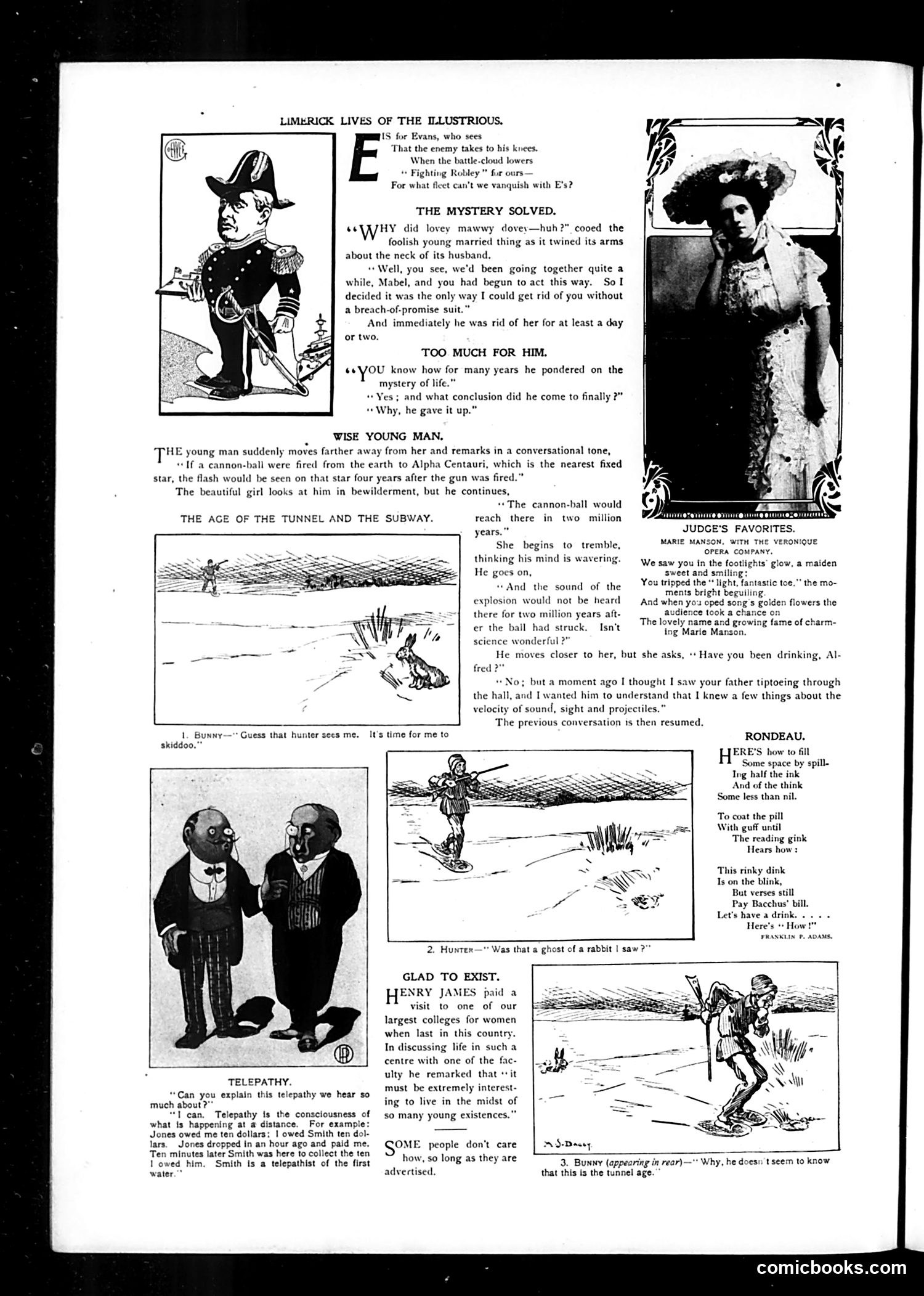
This page from *Judge* contains several disconnected satirical pieces rather than a unified political cartoon. **"The Mystery Solved"** and **"Too Much for Him"** appear to be domestic humor about marriage and infidelity—standard fare for the era's satirical magazines. **"Telepathy"** jokes about long-distance communication, with a setup about someone collecting ten minutes of gossip—likely satirizing the novelty and limitations of early telephone technology. **"The Ace of the Tunnel and the Subway"** features illustrations of hunting/outdoor scenes with captions suggesting physical comedy or mishaps. **"Rondeau"** is a poem about drinking. The page includes a photograph labeled "Judge's Favorites—Marie Manson, with the Veronique Opera Company," suggesting theatrical promotion alongside humor content. Without clearer political context or identified figures, most pieces appear to be general social satire rather than commentary on specific events or politicians.
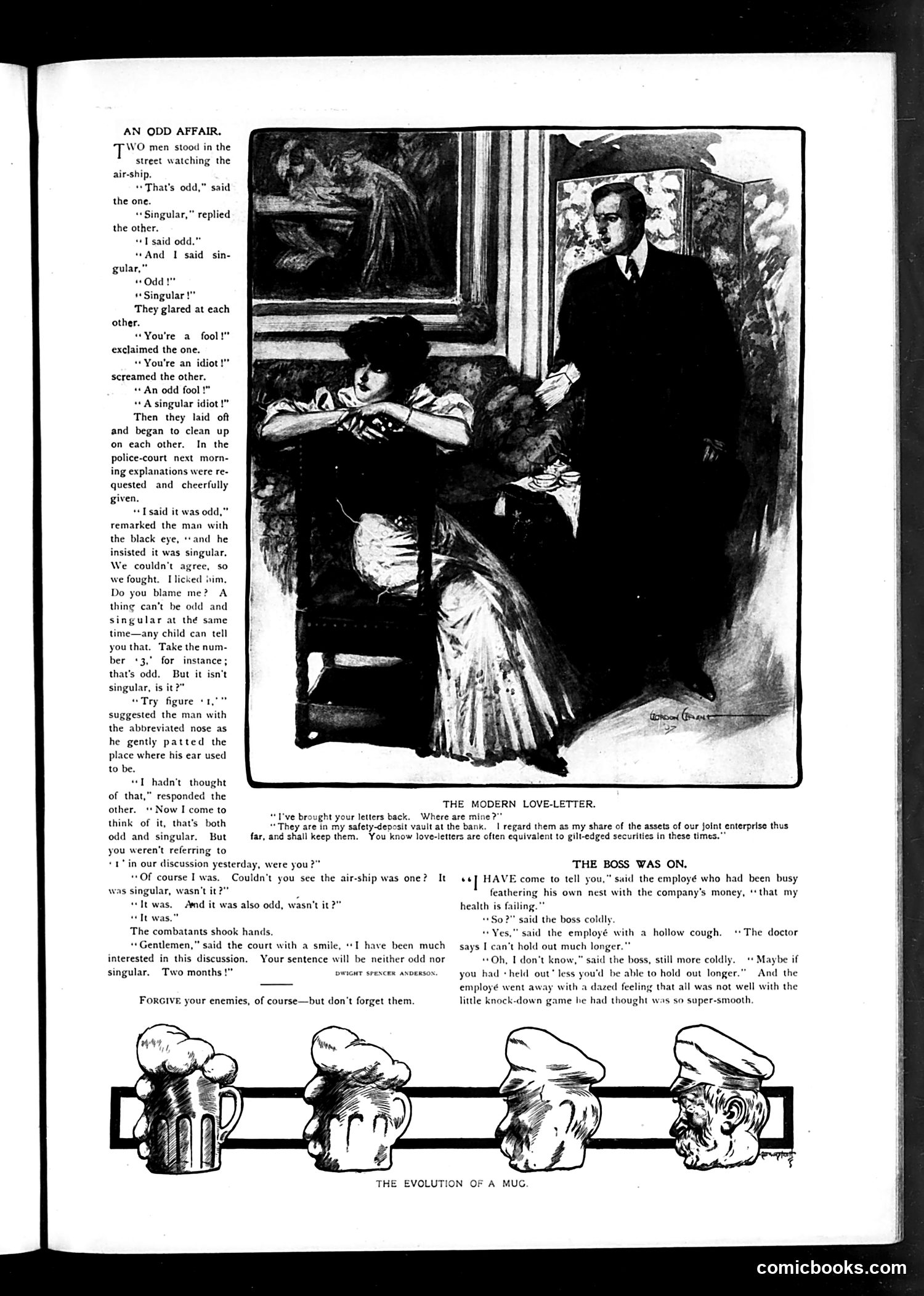
**Top Story: "An Odd Affair"** This humorous dialogue describes two men arguing about whether an airship sighting was "odd" or "singular." The joke plays on wordplay—they literally cannot agree on synonyms, escalating to insults ("fool," "idiot"), then fighting. The satire mocks petty disputes over trivial semantics, suggesting human conflict often stems from pointless disagreements rather than substantive disagreement. **Middle Illustration: "The Modern Love-Letter"** The sketch depicts a businessman confronting a woman, apparently about love letters. The dialogue suggests romantic betrayal or infidelity, with the man recovering letters and accusing the woman of deceiving him with shared "assets." This satirizes modern romantic complications and dishonesty in relationships. **Bottom: "The Evolution of a Mug"** This sequence shows four beer mugs with faces, depicting aging or degradation, likely satirizing drinking culture or physical decline.
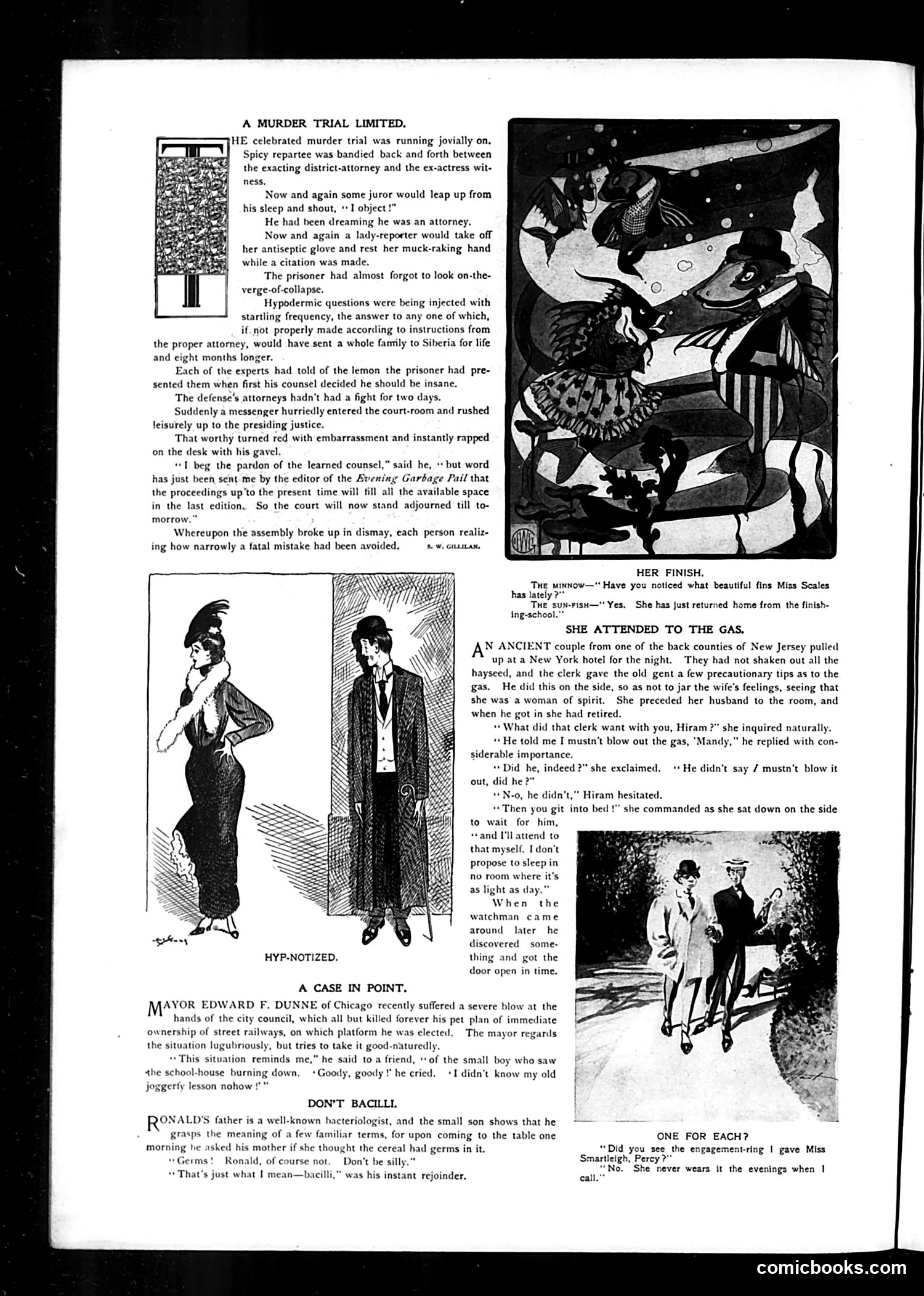
This page contains several satirical pieces typical of Judge's early 20th-century humor: **"A Murder Trial Limited"** mocks the circus atmosphere of sensational trials and yellow journalism. The satire targets how newspaper deadlines ("Evening Garbage Pail") interrupt court proceedings, and how the trial itself becomes theatrical—with experts giving predetermined testimony, lady reporters present, and the judge prioritizing press accommodations over justice. **"She Attended to the Gas"** ridicules rural/"hayseed" newcomers to the city. A Jersey couple checks into a New York hotel; the clerk warns the husband about gas lighting (a safety concern). The wife, overhearing only that he "mustn't" blow it out, assumes he means she can—and leaves the gas on, nearly causing disaster. The joke mocks both rural ignorance and the wife's contrarian stubbornness. **"A Case in Point"** references Mayor Edward F. Dunne's failed Chicago street-railway initiative, comparing his disappointment to a boy celebrating a school fire without understanding consequences. **Minor jokes** include puns on fish scales/finishing school and bacteriologist humor. The page primarily satirizes urban modern life's absurdities and rural-urban cultural clash.
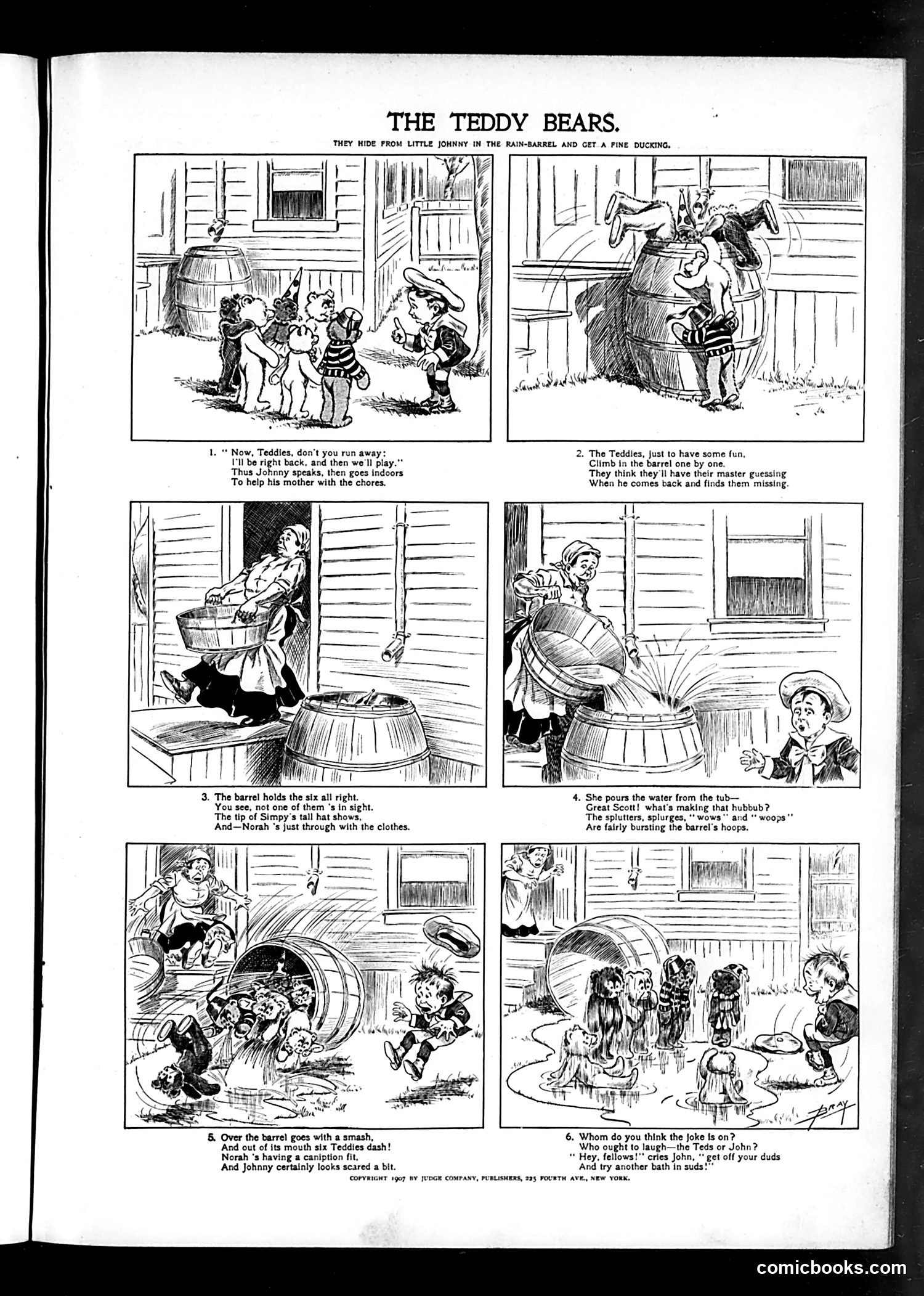
This is a children's comic strip playing on the "Teddy Bear" craze—plush toys named after President Theodore Roosevelt, hugely popular in the early 1900s. The humor is straightforward slapstick: young Johnny hides his toy bears in a rain barrel as a game. His mother, Norah, unknowingly dumps the barrel's water while doing laundry, drenching the toys and creating chaos. The joke culminates with Johnny cheerfully suggesting the soaked bears take a bath in soapsuds—turning disaster into fun. There's no political satire here. It's simply a domestic comedy exploiting the era's Teddy Bear fad and the physical humor of toys getting unexpectedly soaked. The strip reflects early-20th-century family life and children's entertainment, relying on visual gags rather than social commentary.
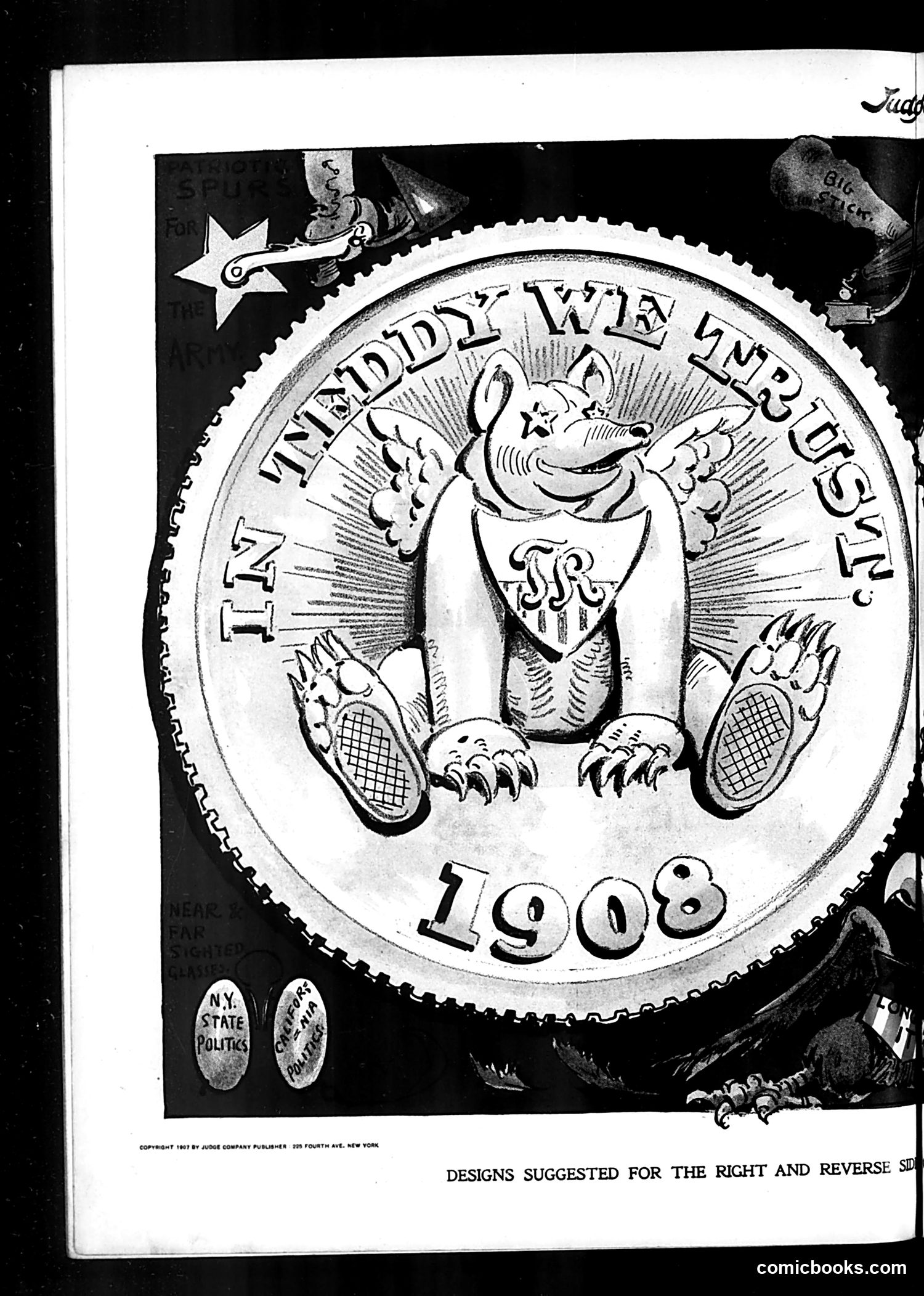
This page shows a proposed coin design for 1908, featuring an anthropomorphic bear wearing a vest with "TR" (Theodore Roosevelt's initials). The bear stands upright on hind legs with radiating lines suggesting importance or power. Text around the rim reads "IN MIDDLY WE INTRUST" — a play on "In God We Trust," the actual motto. The satire appears to mock Roosevelt's political dominance and the intense public devotion to him during his presidency. The bear reference likely alludes to the popular "Teddy Bear" named after Roosevelt. The left side shows small oval badges labeled "N.Y. STATE POLITICS," suggesting commentary on New York political machinery. The bottom caption references "designs suggested for the right and reverse side," treating this as a mock-official currency proposal. This ridicules Roosevelt's seemingly monarchical or personality-cult status in American politics circa 1908.
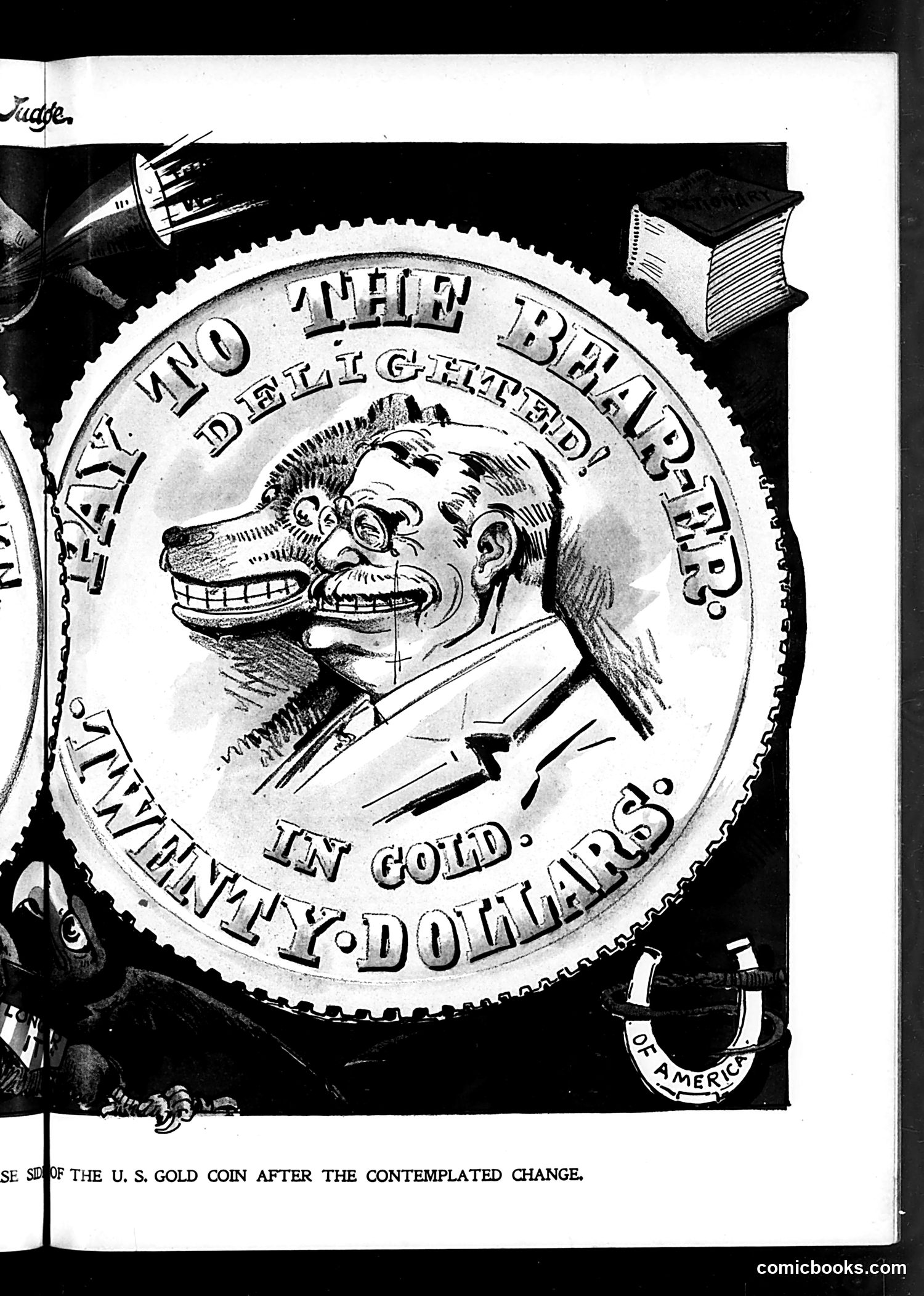
This cartoon satirizes a proposed redesign of U.S. gold coinage. The circular coin design shows a grotesque, grinning face with exaggerated features—appearing almost demonic or bestial—labeled "The Believer" with text reading "In Gold Twenty Dollars." The caption indicates this depicts "the reverse side of the U.S. gold coin after the contemplated change," suggesting the cartoon mocks a specific proposed modification to American currency design that was under consideration. The ugly, unflattering caricature serves as political satire, implying the proposed design change was absurd or aesthetically offensive. Without knowing the exact historical moment, the specific proposal being referenced remains unclear, but the cartoon's purpose is obvious: ridicule through grotesque visual exaggeration.
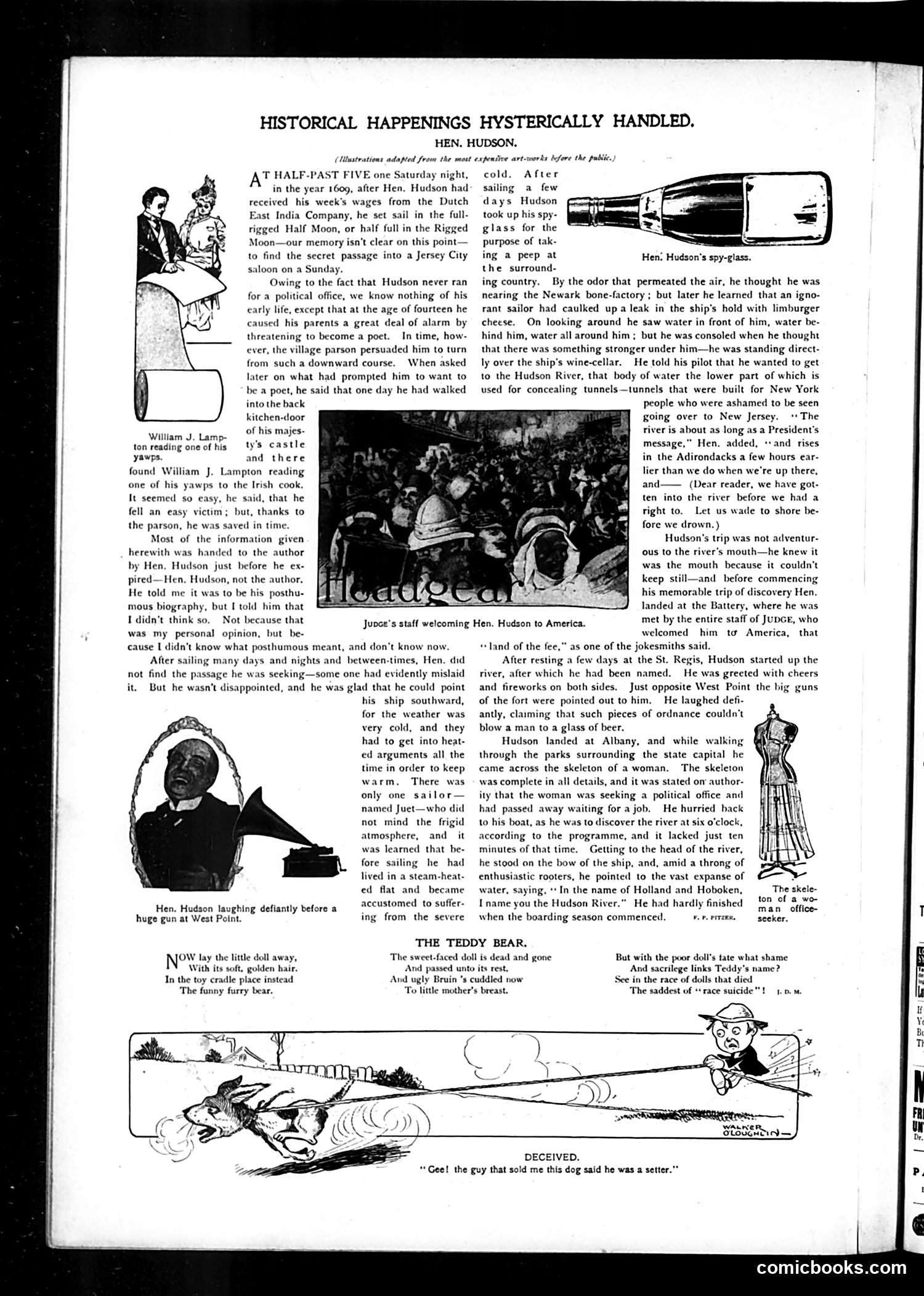
This is a satirical retelling of Henry Hudson's 1609 voyage, illustrated with humorous cartoons. The piece mocks the explorer through absurdist humor—fabricating biographical details (Hudson wanting to be a poet, saved by a parson) and making ridiculous claims about his journey (the ship's leak caulked with limburger cheese; comparing the Hudson River's length to a President's message). The satire targets American expansion and infrastructure: Hudson's stated goal is reaching "a Jersey City saloon on a Sunday," and the Hudson River is described as being used for "concealing tunnels—tunnels that were built for New York people who were ashamed to be seen going over to New Jersey." This lampoons contemporary urban development and regional snobbery. The accompanying illustrations show Hudson with period costumes and a "spy-glass," with what appears to be Judge's staff greeting him as a historical figure. The overall tone is irreverent mockery of America's founding narratives and self-importance.
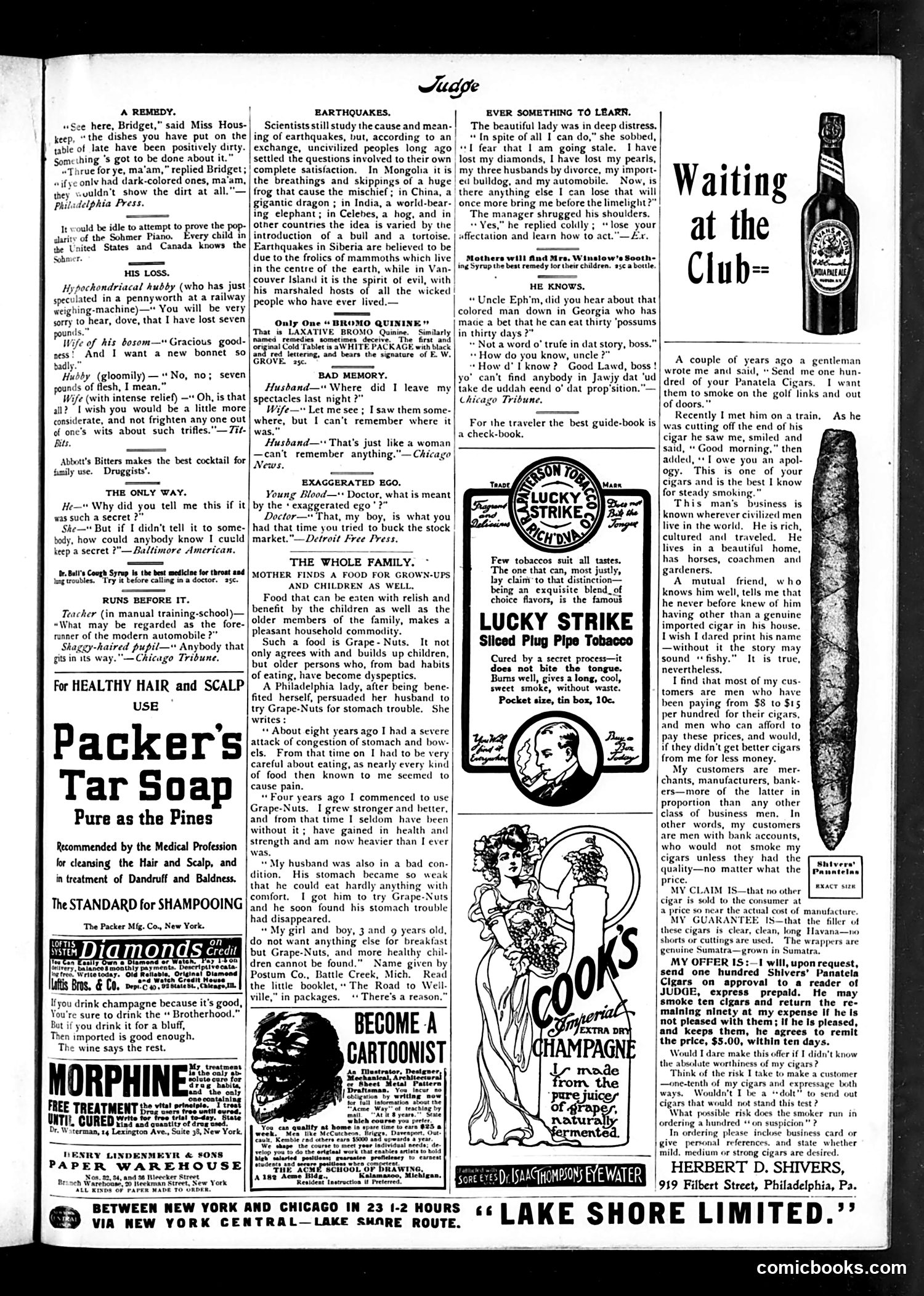
This page from *Judge* magazine consists primarily of **short humorous anecdotes and advertisements** rather than political cartoons. The jokes target domestic life and social foibles: a maid's solution to hiding dirty dishes (use dark ones), a hypochondriac husband's vanity, a woman's inability to keep secrets, and a schoolboy's quip about automobiles preceding automobiles (a motorcar dodges pedestrians). These reflect turn-of-the-century middle-class anxieties about servants, marriage dynamics, and modernization. The advertisements—for patent medicines (morphine treatments, cough syrup), hair products, and champagne—reflect contemporary consumer culture and the era's unregulated pharmaceutical industry (morphine addiction treatment was openly advertised). The "Earthquakes" section humorously contrasts scientific inquiry with "uncivilized" folk explanations (giant frogs, dragons, elephants causing tremors), reflecting period assumptions about cultural hierarchy. There are **no significant political cartoons or caricatures** on this page—it's primarily light domestic satire and commercial advertising typical of early 1900s American humor magazines.
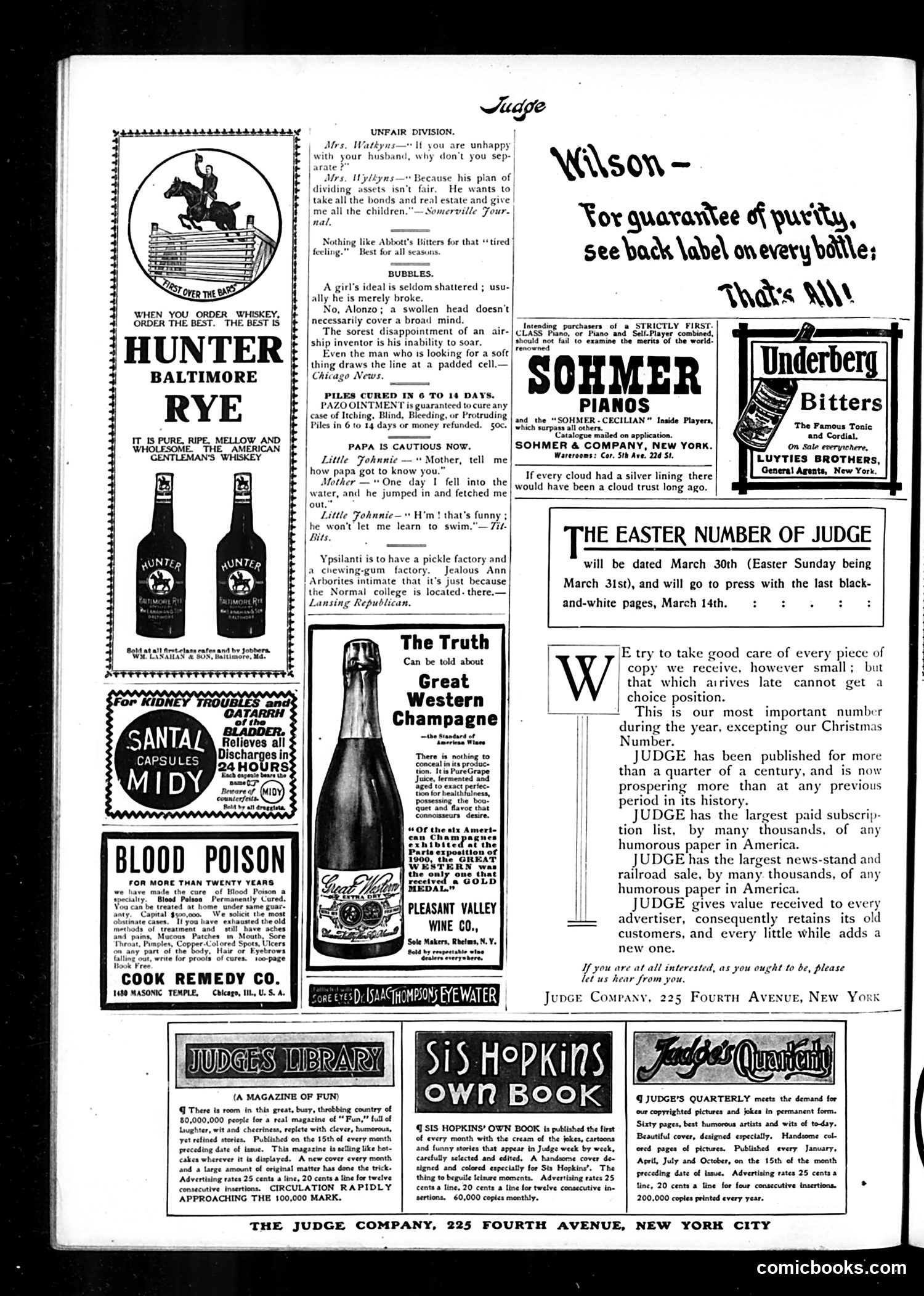
This is primarily an **advertising page** from Judge magazine, with minimal editorial content. The page includes: ## Editorial Content: A brief humor section titled "UNFAIR DIVISION" depicts a marital dispute where a wife complains her husband's divorce settlement plan is unfair—he wants to keep bonds and real estate while giving her the children. It's a satirical jab at how men valued property over family obligations during this era. Several short joke snippets mock conventional wisdom: a girl's idealism being replaced by broken romance, swollen heads lacking broad minds, and airship inventors' failures. ## Advertisements: The page is dominated by product ads (Hunter Rye whiskey, blood poison cures, hemorrhoid treatments, champagne, pianos) typical of early 20th-century magazines. These reflect both the era's medical quackery and legitimate products. A notable section promotes Judge's **Easter issue** (March 30th) and boasts of the magazine's circulation success and advertiser value. No clear political cartoons or caricatures appear on this page—it's primarily commercial rather than satirical content.
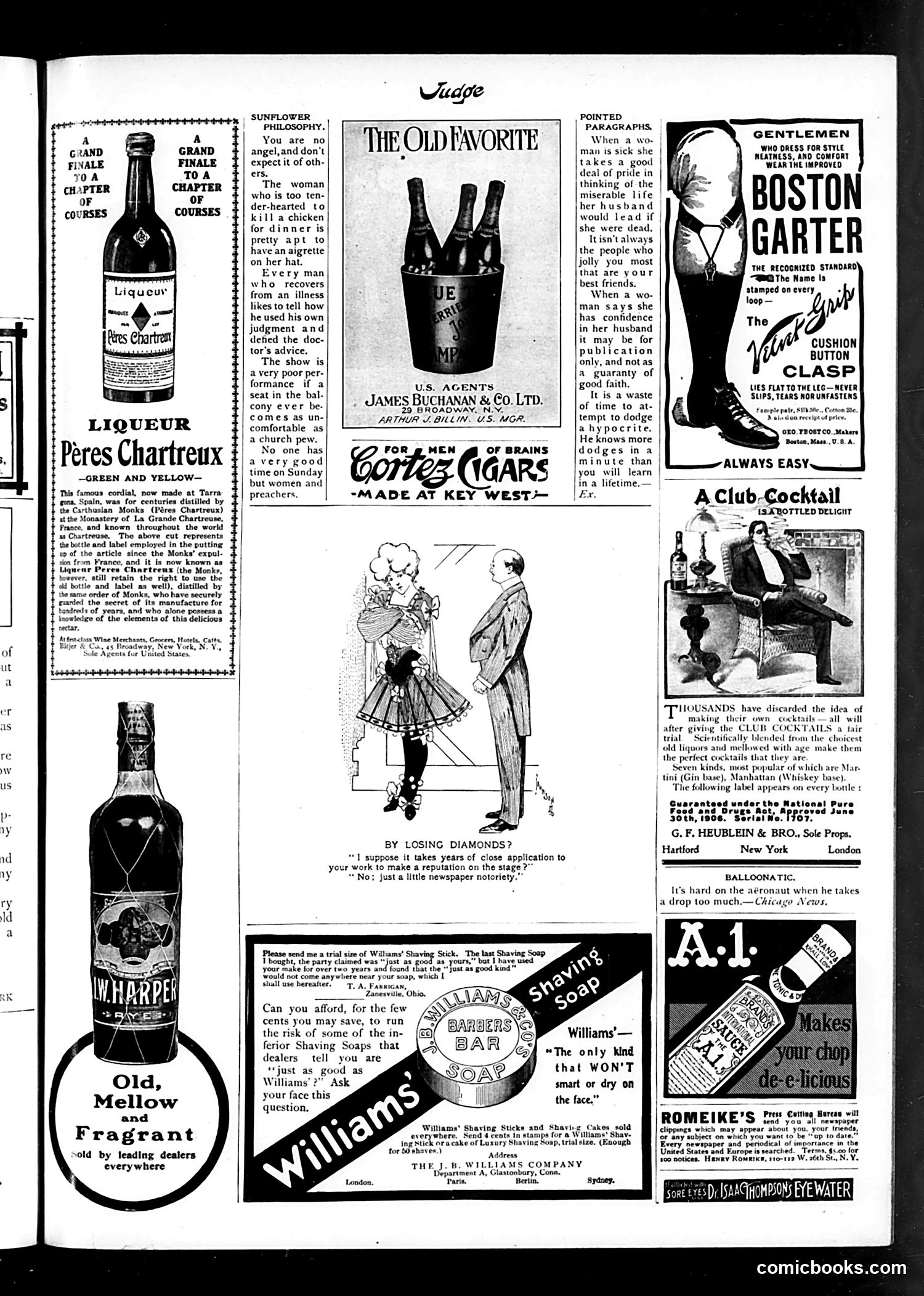
This page is primarily **advertising with sidebar humor**. The main content includes liqueur, cigars, shaving products, garters, and cocktail mix ads typical of early 20th-century Judge. The "Pointed Paragraphs" column offers satirical social commentary on gender relations and hypocrisy—standard Judge fare mocking Victorian conventions. Notable: critiques of women's vanity (wearing aigrettes/feathers while refusing to kill chickens), marital discord, and the performative nature of social confidence. The central cartoon titled "By Losing Diamonds?" depicts a stage conversation where an aspiring actress asks if success requires years of dedication. The reply—"No; just a little newspaper notoriety"—satirizes how cheap scandal-seeking generates undeserved fame, mocking both theatrical ambition and sensationalist journalism. The testimonial letters for Williams' Shaving products and other items represent typical early Judge advertising, embedding endorsements within editorial voice to appear more credible than outright ads.
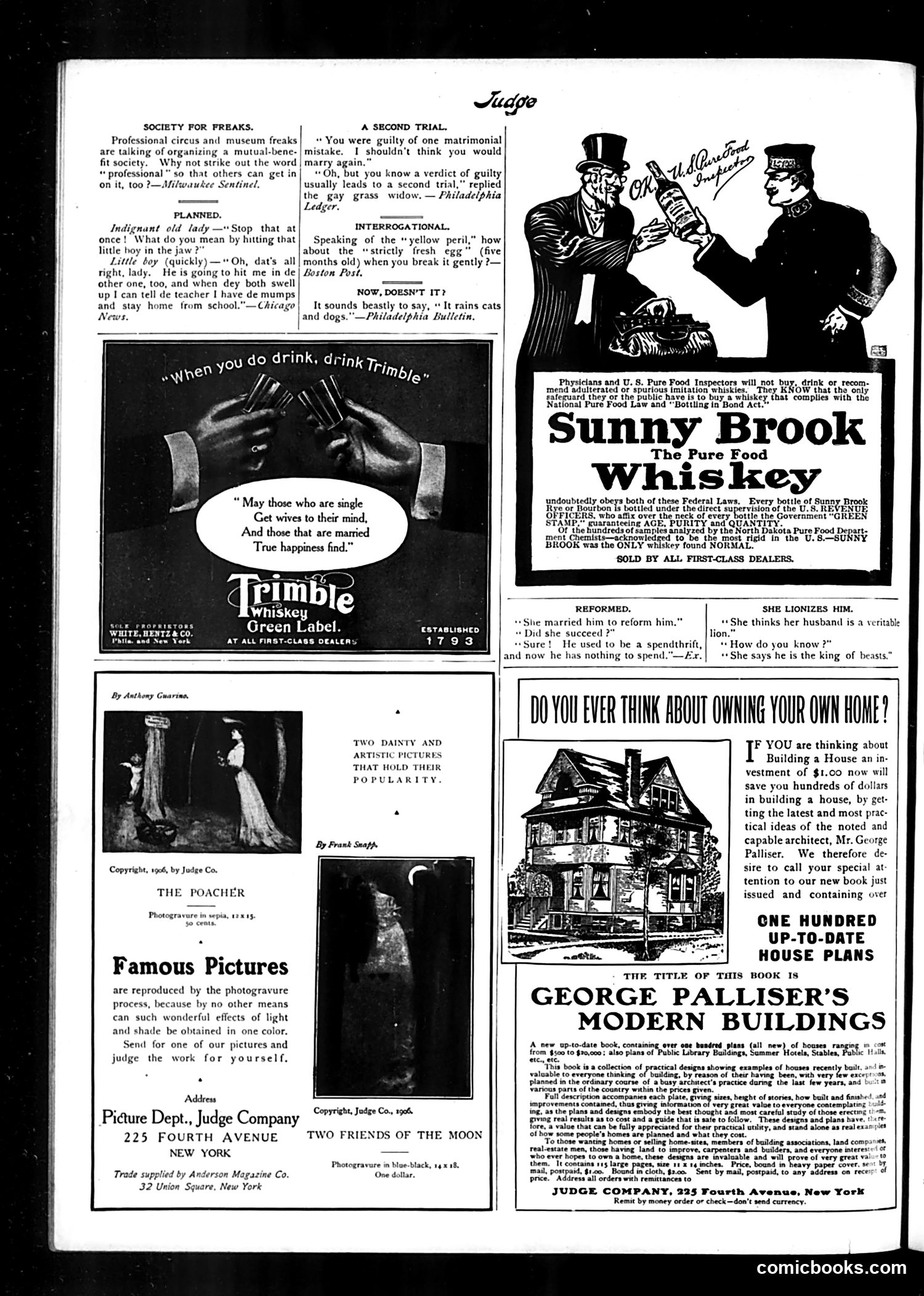
This page consists primarily of **advertisements and short humor items**, typical of Judge's satirical magazine format. The main content includes: **Humor bits** (top section): Brief jokes about unconventional topics—a "society for freaks," a boy planning to fake mumps, a "grass widow" seeking remarriage after a guilty verdict, and wordplay about "yellow peril" eggs and cats-and-dogs rain. **Advertisements**: The page is dominated by ads for **Sunny Brook Whiskey** (emphasizing Pure Food Law compliance, a contemporary regulatory concern), **Trimble Whiskey**, and **George Palliser's Modern Buildings** (house plans). **Art reproductions**: Small sections advertising photogravure reproductions and house-plan books. **Social commentary**: The humor reflects turn-of-century anxieties—food safety, divorce/remarriage ("grass widow"), and the "yellow peril" (anti-Asian sentiment common in that era). The page is largely commercial rather than politically editorial, representing how Judge balanced satire with advertising revenue.
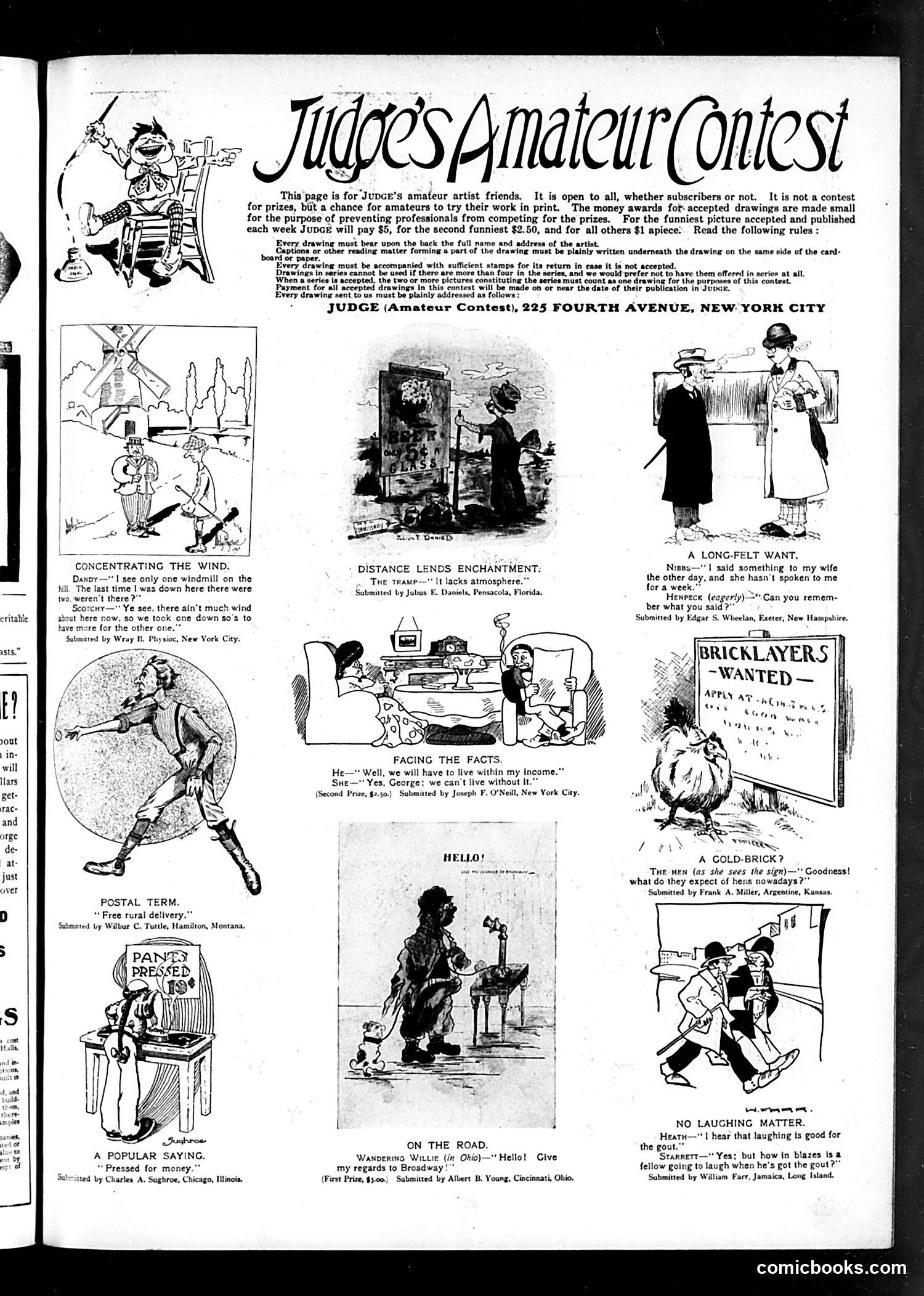
This page showcases Judge magazine's weekly amateur cartoon competition, open to unpaid contributors. Cartoonists submitted humorous drawings with brief captions for cash prizes ($5, $2.50, or $1). The cartoons use simple, genteel humor typical of early 20th-century American magazines: - **"Concentrating the Wind"**: Rural inefficiency—a farmer dismantled one windmill to strengthen another, missing the obvious solution. - **"Facing the Facts"**: Middle-class domestic anxiety—a husband realizes they can't exceed his income, his wife matter-of-factly agrees. - **"A Long-Felt Want"**: Marital silence as punishment for an unremembered offense. - **"Gold-Brick?"**: A hen questions why employers expect productivity from hens (metaphorical complaint about labor demands). - **"No Laughing Matter"**: Ironic contradiction—gout sufferers can't laugh despite laughter's supposed health benefits. The humor relies on wordplay, domestic situations, and gentle satire of working-class and middle-class life.
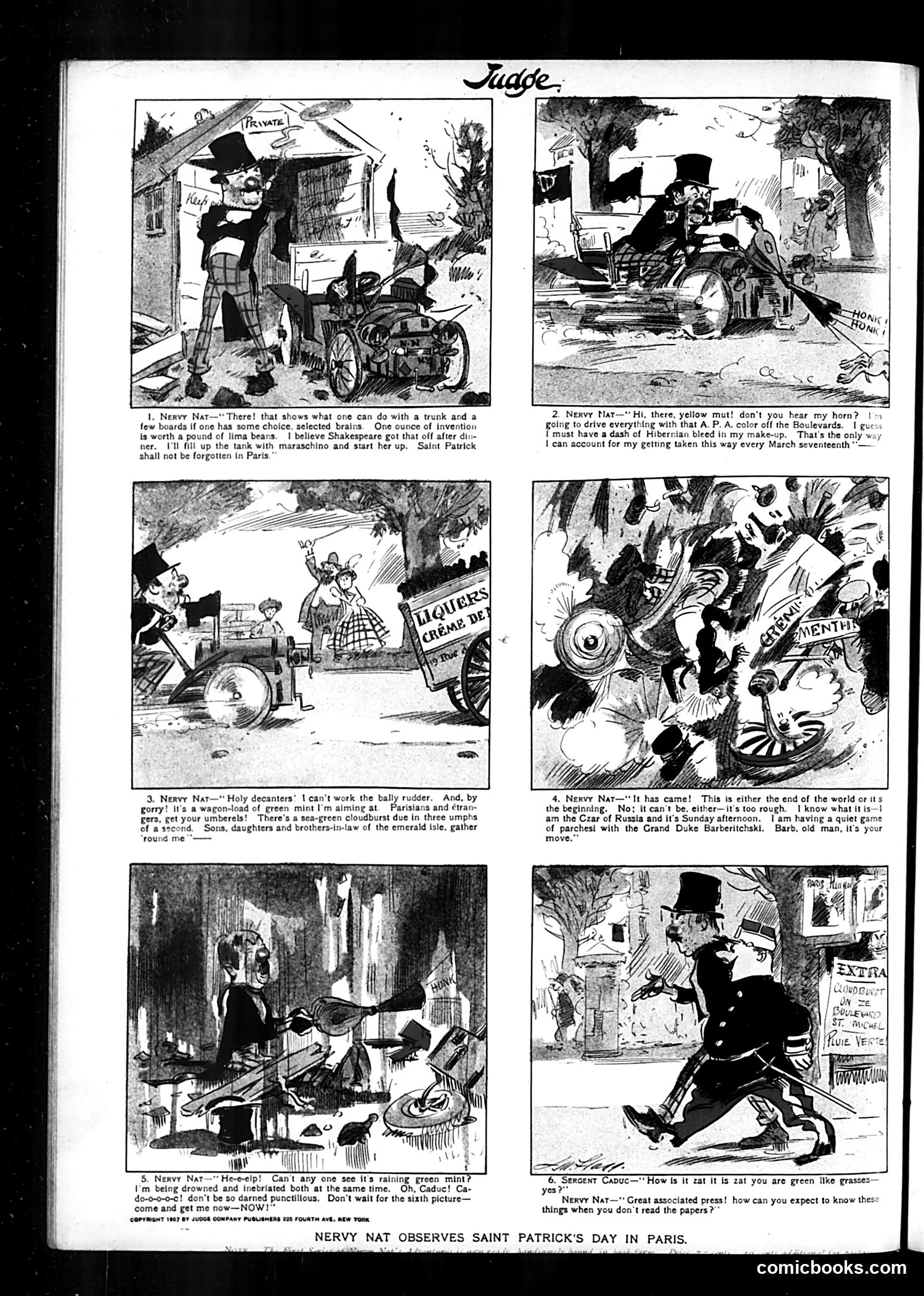
This six-panel comic strip follows an Irish character named "Nervy Nat" causing chaos in Paris on Saint Patrick's Day. The humor centers on Irish stereotypes: Nat is portrayed as drunk, accident-prone, and obsessed with Irish identity. Key elements include: - **Panel 1-2**: Nat invents contraptions and drives recklessly, speaking in exaggerated Irish dialect - **Panel 3**: He causes a "sea-green cloudburst" of mint liqueur, calling out to "sons, daughters and brothers-in-law of the emerald isle" - **Panel 5**: A Frenchman ("Sergeant Caduc") asks why Nat is "green like grasses"—referring to both the mint disaster and Irish association with green - **Panel 6**: A press representative asks how Nat expects news without reading papers The satire mocks both Irish-American stereotypes (heavy drinking, recklessness, ethnic pride) and satirizes the American press. The A.P.A. reference (panel 2) alludes to anti-immigrant sentiment, making this simultaneously anti-Irish and critical of nativism.