
Judge, 1907-03-16 · page 10 of 16
Judge — March 16, 1907 — page 10: what you’re looking at
What you’re looking at
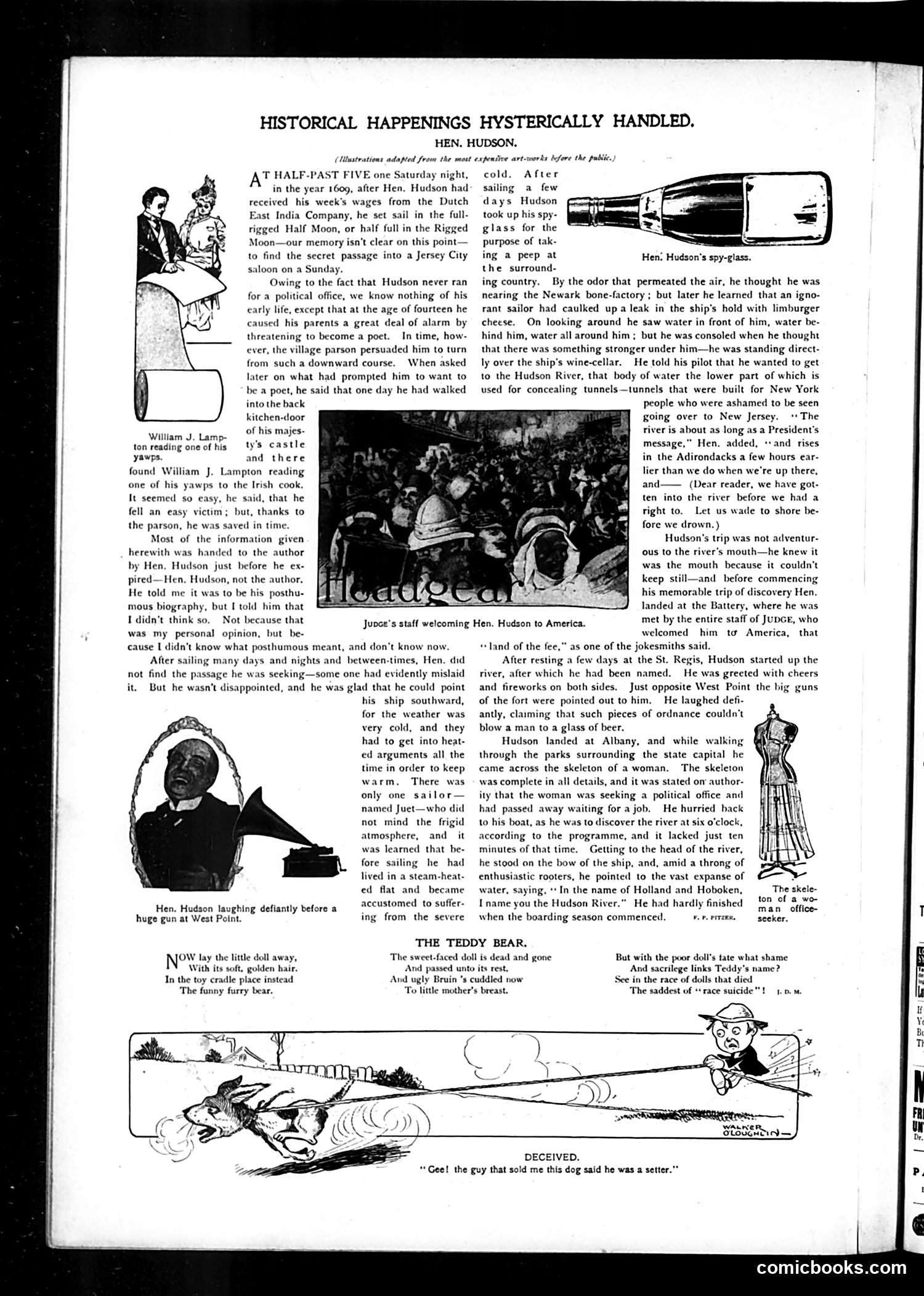
This is a satirical retelling of Henry Hudson's 1609 voyage, illustrated with humorous cartoons. The piece mocks the explorer through absurdist humor—fabricating biographical details (Hudson wanting to be a poet, saved by a parson) and making ridiculous claims about his journey (the ship's leak caulked with limburger cheese; comparing the Hudson River's length to a President's message). The satire targets American expansion and infrastructure: Hudson's stated goal is reaching "a Jersey City saloon on a Sunday," and the Hudson River is described as being used for "concealing tunnels—tunnels that were built for New York people who were ashamed to be seen going over to New Jersey." This lampoons contemporary urban development and regional snobbery. The accompanying illustrations show Hudson with period costumes and a "spy-glass," with what appears to be Judge's staff greeting him as a historical figure. The overall tone is irreverent mockery of America's founding narratives and self-importance.
📄 Transcribed text from this page (OCR, searchable)
Machine-transcribed from the original scan — historical spelling and the odd misread are preserved.
HISTORICAL HAPPENINGS HYSTERICALLY HANDLED. HEN. HUDSON. (Mlustrations adapted from the most expeniive arts T HALF-PAST FIVE one Saturday night, in the year 1609, after Hen, Hudson had received his week’s wages from the Dutch East India Company, he set sail in the full- rigged Half Moon, or half full in the Rigged Moon—our memory isn’t clear on this point— to find the secret passage into a Jersey City saloon on a Sunday. Owing to the fact that Hudson never ran for a political office, we know nothing of his carly life, except that at the age of fourteen he caused his parents a great deal of alarm by threatening to become a poet. In time, how- ever, the village parson persuaded him to turn from such a downward course. When asked later on what had prompted him to want to be a poet, he said that one day he had walked into the back kitchen-door William J. Lamp. OF his majes- ton reading oneof his ty'S castle yawps. and there found William J. Lampton reading one of his yawps to the Irish cook. It seemed so easy, he said, that he fell an easy victim; but, thanks to the parson, he was saved in time. Most of the information given herewith was handed to the author by Hen, Hudson just before he ex- pired—Hen. Hudson, not the author. He told me it was to be his posthu- rhs before the pubic.) cold. After sailing a few days Hudson took up his spy- glass for the purpose of tak- ing a peep at the surround- ing country. By the odor that permeated the air, he thought he was nearing the Newark bone-factory ; but later he learned that an igno- rant sailor had caulked up a leak in the ship's hold with limburger cheese, On looking around he saw water in front of him, water be- hind him, water all around him ; but he was consoled when he thought that there was something stronger under him—he was standing direct- ly over the ship's wine-cella He told his pilot that he wanted to get to the Hudson River, that body of water the lower part of which is used for concealing tunnels—tunnels that were built for New York people who were ashamed to be seen going over to New Jersey. The river is about as long as a President's message," Hen. added, + and rises in the Adirondacks a few hours ear- lier than we do when we're up there, and (Dear reader, we have got- ten into the river before we had a right to. Let us wade to shore be- fore we drown.) Hudson's trip was not adventur- ous to the river's mouth—he knew it was the mouth because it couldn't keep still—and before commencing his memorable trip of discovery Hen. Hen: Hudson's spy-glass. mous biography, but I told him that I didn't think so. Not because that was my personal opinion, but be- cause I didn’t know what posthumous meant, and don’t know now After sailing many days and nights and between-times, Hen. did not find the passage he was seeking—some one had evidently mislaid it, But he wasn’t disappointed, and he was glad that he could point his. ship southward, for the weather was very cold, and they had to get into heat- ed arguments all the time in order to keep warm, There was only one sailor— named Juet—who did not mind the frigid atmosphere, and it was learned that be- ng he had lived in a steam-heat- ed flat and became accustomed to suffer- Hen. Hudson laughing defiantly before a ing from the severe huge gun at West Point. Juvce’'s staff welcoming Hen. Hudson to America. landed at the Battery, where he was met by the entire staff of Jupce, who welcomed him ta America, that land of the fee," as one of the jokesmiths said. After resting a few days at the St. Regis, Hudson started up the after which he had been named, He was greeted with cheers and fireworks on both sides. Just opposite West Point the big guns of the fort were pointed out to him, He laughed defi- antly, claiming that such pieces of ordnance couldn't blow a man to a glass of beer. Hudson landed at Albany, and while walking through the parks surrounding the state capital he came across the skeleton of a woman. The skeleton was complete in all details, and it was stated on’ author- ity that the woman was seeking a political office and had passed away waiting for a job. He hurried back to his boat, as he was to discover the river at six o'clock, according to the programme, and it lacked just ten Getting to the head of the river, id a throng of river, minutes of that time. he stood on the bow of the ship, and, an enthusiastic rooters, he pointed to the vast expanse of water, saying, “In the name of Holland and Hoboken, Iname you the Hudson River.” He had hardly finished when the boarding season commenced. The skele- ton of a wo- man office- rzEx. seeker. THE TEDDY BEAR. NOW lay the litle dott away, With its soft, golden hair. idle place instead furry bear. In the toy © The funn The sweet-faced doll is dead and gone And passed unto its rest, And ugly Bruin 's cuddled now To little mother’s breast. But with the poor doll's tate what shame And sacrilege links Teddy's name? See in the race of dolls that died The saddest of race suicide” DECEIVED. “Geel the guy that sold me this dog said he was a setter." comicbooks.com