
Judge, 1907-03-16 · page 3 of 16
Judge — March 16, 1907 — page 3: what you’re looking at
What you’re looking at
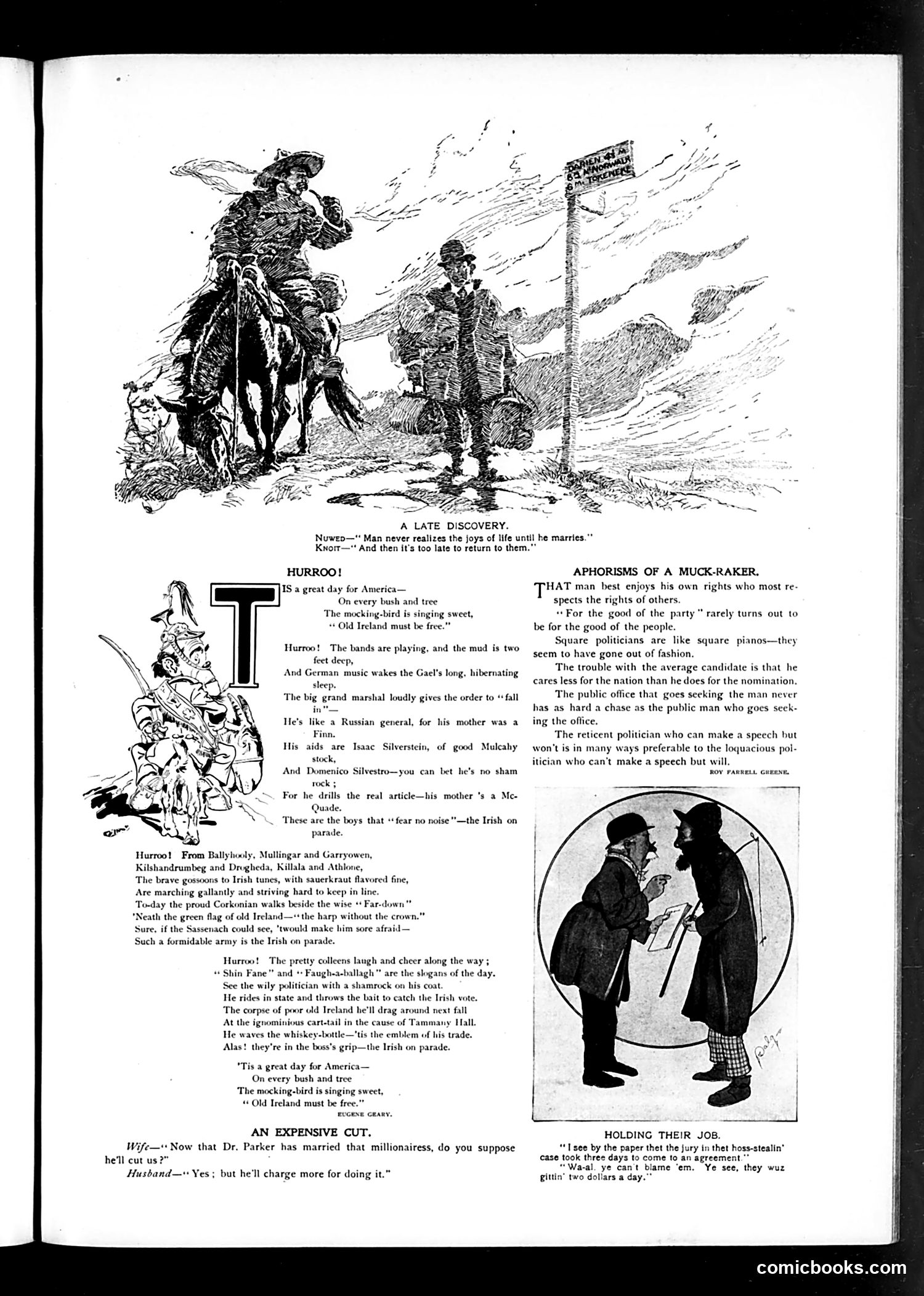
**"A Late Discovery"** (top): A dialogue joke about marriage revealing life's joys too late to enjoy them—standard domestic humor of the era. **"Hurroo!"** (left): A satirical poem celebrating Irish identity and Irish soldiers in what appears to be a military parade context. References specific Irish locations (Ballybody, Mulingar, Garryowen, etc.) and mocks English/American attitudes toward Irish immigrants, particularly their representation in politics and military service. The repeated "Hurroo!" celebrates Irish pride while the detailed verse suggests the Irish were prominent in contemporary military or political discussions. **"Aphorisms of a Muck-Raker"** (right): Political commentary criticizing politicians who prioritize personal nomination over public service—suggesting corruption or self-interest in politics. **"An Expensive Cut"** and **"Holding Their Job"** (bottom): Brief joke-format items about wealth and labor negotiations. The page emphasizes Irish-American themes and political critique.
📄 Transcribed text from this page (OCR, searchable)
Machine-transcribed from the original scan — historical spelling and the odd misread are preserved.
A LATE DISCOVERY. Man never realizes the joys of life until he marries.” * And then it's too late to return to them.” IS a great day for America— On every bush and tree The mocking-bird is singing sweet, ++ Old Ireland must be free.” Hurroo! The bands are playing, and the mud is two feet deep, man music wakes the Gael’s long, hibernating sleep. ‘The big grand marshal loudly gives the order to ‘fall He's like a Russian general, for his mother was a Finn. His aids are Isaac Silverstein, of good Mulcahy stock, And Domenico Silvestro—you can bet he's no sham rock 5 he drills the real article—his mother 's a Mc- Quade. ‘These are the boys that «fear no noise "—the Irish on parade. Hurroo! From Ballyhooly, Mullingar and Garryowen, Kilshandrumbeg and Drogheda, Killala and Athlone, The brave gossoons to Irish tunes, with sauerkraut flavored fine, Are marching gallantly and striving hard to keep in line. To-day the proud Corkonian walks beside the wise « Far-down"* "Neath the green flag of old Ireland—* the harp without the crown. Sure, if the Sassenach could see, ‘twould make him sore afraid — Such a formidable army is the Irish on parade. Hurroo! T “Shin Fane" and See the wily politician wit his coat. He rides in state and throws the bait to catch the Irish vote. next fall mmany Hall. his trade. Alas! they're in the boss's grip—the Irish on parade. The corpse of poor old Ireland he'll drag aro At the ignominious cart-tail in the cause of T He waves the whiskey-bottle—tis the emblem « ‘Tis a great day for America— On every bush and tree ‘The mocking-bird is singing sweet, “ Old Ireland must be free.” EUGENE GEARY. AN EXPENSIVE CUT. Wife—« Now that Dr. Parker has married that millionaires, do you suppose he'll cut us?” Husband—* Yes ; but he'll charge more for doing it.” APHORISMS OF A MUCK-RAKER. THAT man best enjoys his own rights who most re- spects the rights of others. “For the good of the party” rarely turns out to be for the good of the people. Square politicians are like square pianos—they seem to have gone out of fashion. The trouble with the average candidate is that he cares less for the nation than he does for the nomination. The public office that goes seeking the man never has as hard a chase as the public man who goes seck- ing the office. The reticent politician who can make a speech but won't is in many ways preferable to the loquacious pol- itician who can’t make a speech but will. ROY PARRELL GREENE, HOLDING THEIR JOB. “see by the paper thet the jury in thet hoss-stealin’ case took three days to come to an agreement.” “Wa-al. ye can't blame ‘em. Ye see, they wuz gittin’ two doliars a day.” comicbooks.com