
A complete issue · 16 pages · 1907
Judge — March 9, 1907
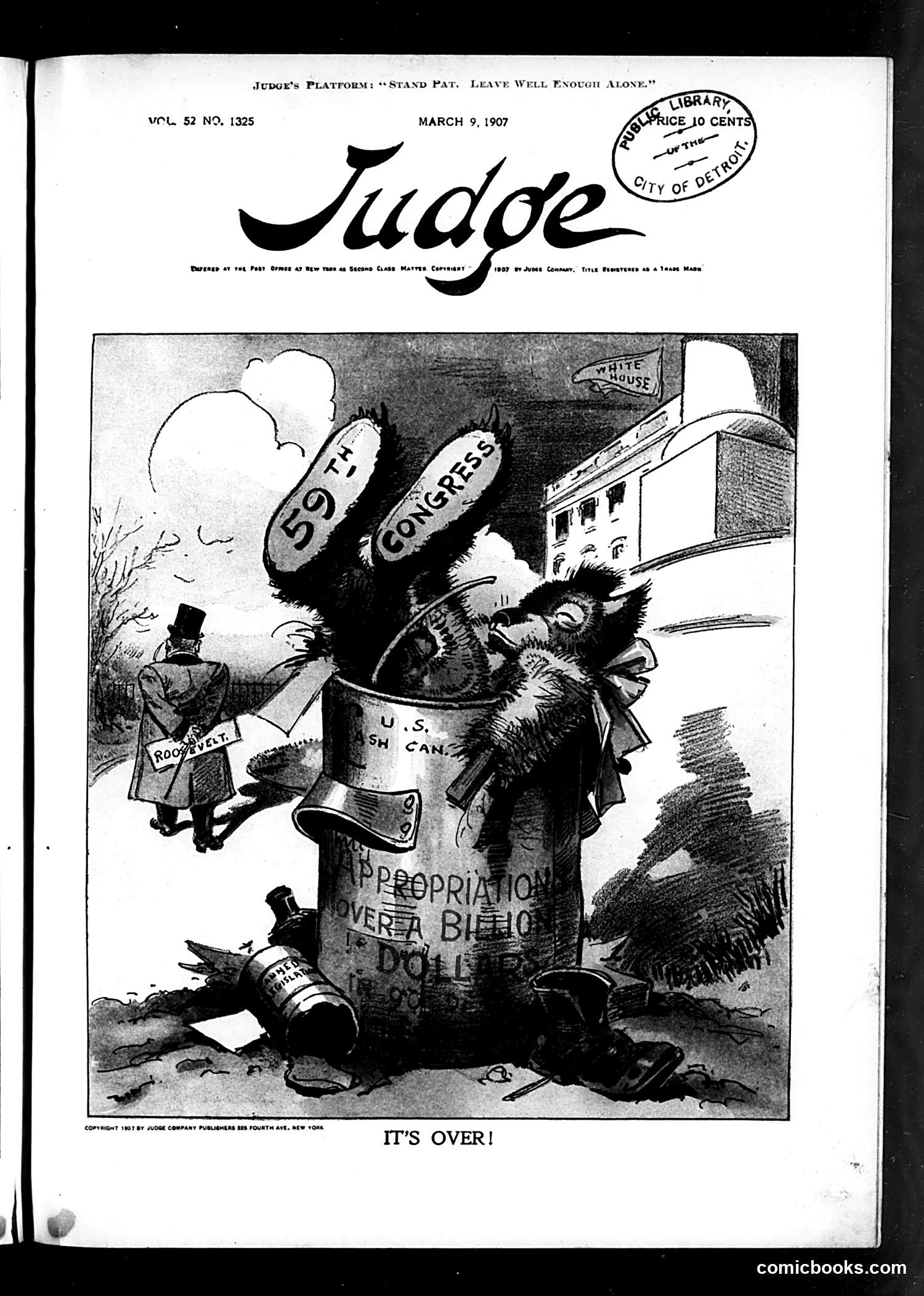
This cartoon depicts Congress as a cauldron exploding with various legislative matters. The labels visible include "S.S.F." (possibly railroad legislation), "CONGRESS," and text referencing "APPROPRIATION OVER A BILLION DOLLARS." A figure labeled "ROOSEVELT" stands to the left, observing the chaos. The cartoon satirizes the overwhelming legislative agenda and budgetary pressures facing Congress during Theodore Roosevelt's presidency. The erupting pot symbolizes legislative gridlock and competing demands for federal spending and oversight. The caption "IT'S OVER!" suggests either resolution of a particular crisis or, more likely, resignation about the perpetual chaos of congressional business. The White House is visible in the background, emphasizing executive-legislative tensions of the era.
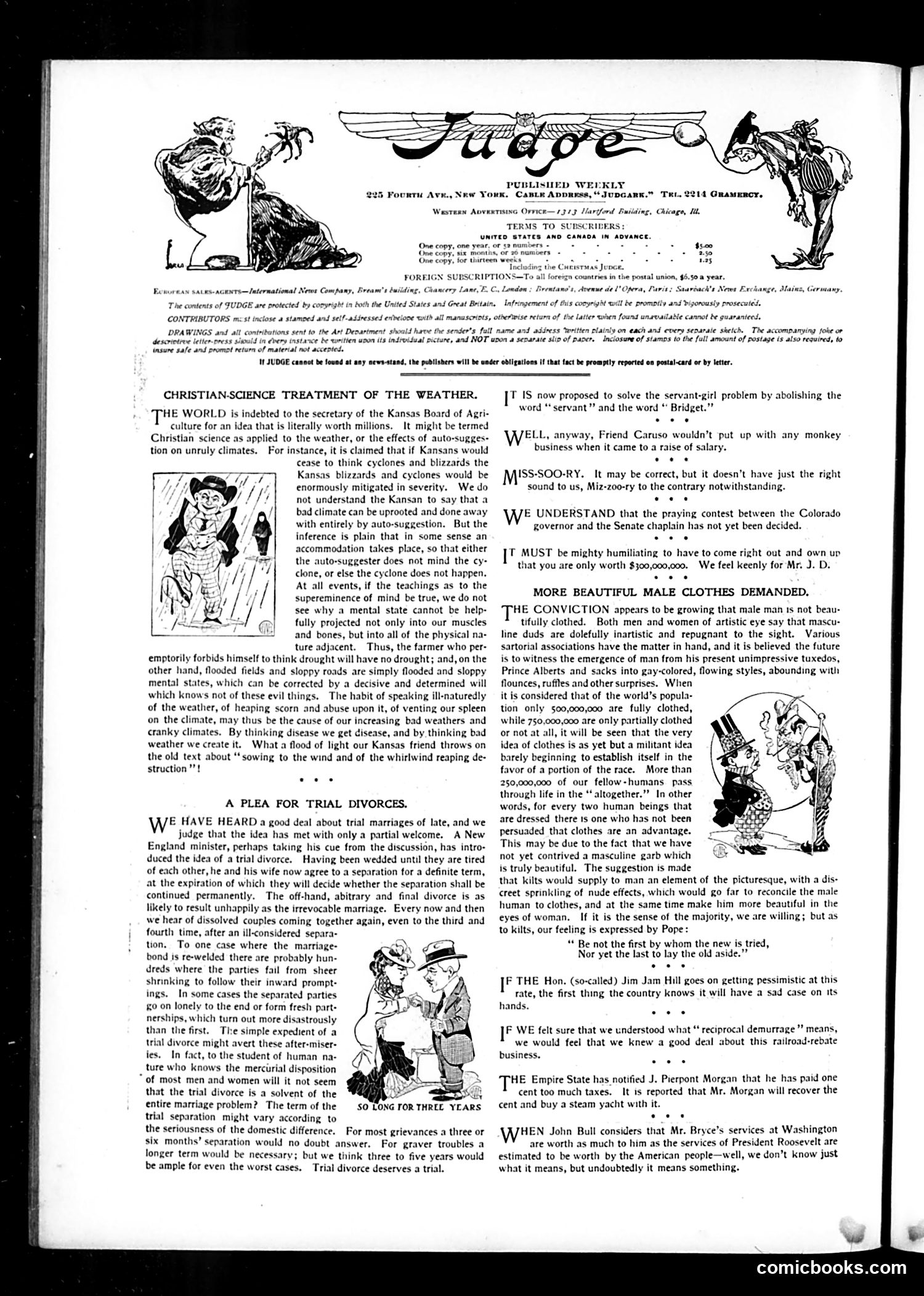
This page contains several satirical pieces targeting early 20th-century American society: **"Christian-Science Treatment of the Weather"** mocks Christian Science's claims that prayer can control natural disasters, depicting a man praying during a storm—the satire being that Kansas cyclones prove otherwise. **"A Plea for Trial Divorces"** argues for temporary trial marriages with defined separation terms rather than permanent divorce, satirizing both marriage instability and the growing divorce rate among the wealthy. **"More Beautiful Male Clothes Demanded"** advocates for men to wear more decorative clothing like kilts, playfully arguing that men's fashion is culturally disadvantaged compared to women's. The remaining items are brief satirical notes on contemporary figures and events, including references to J.D. Rockefeller, Jim Jam Hill, and J. Pierpont Morgan's tax disputes—typical of Judge's topical humor targeting wealthy businessmen and public figures.
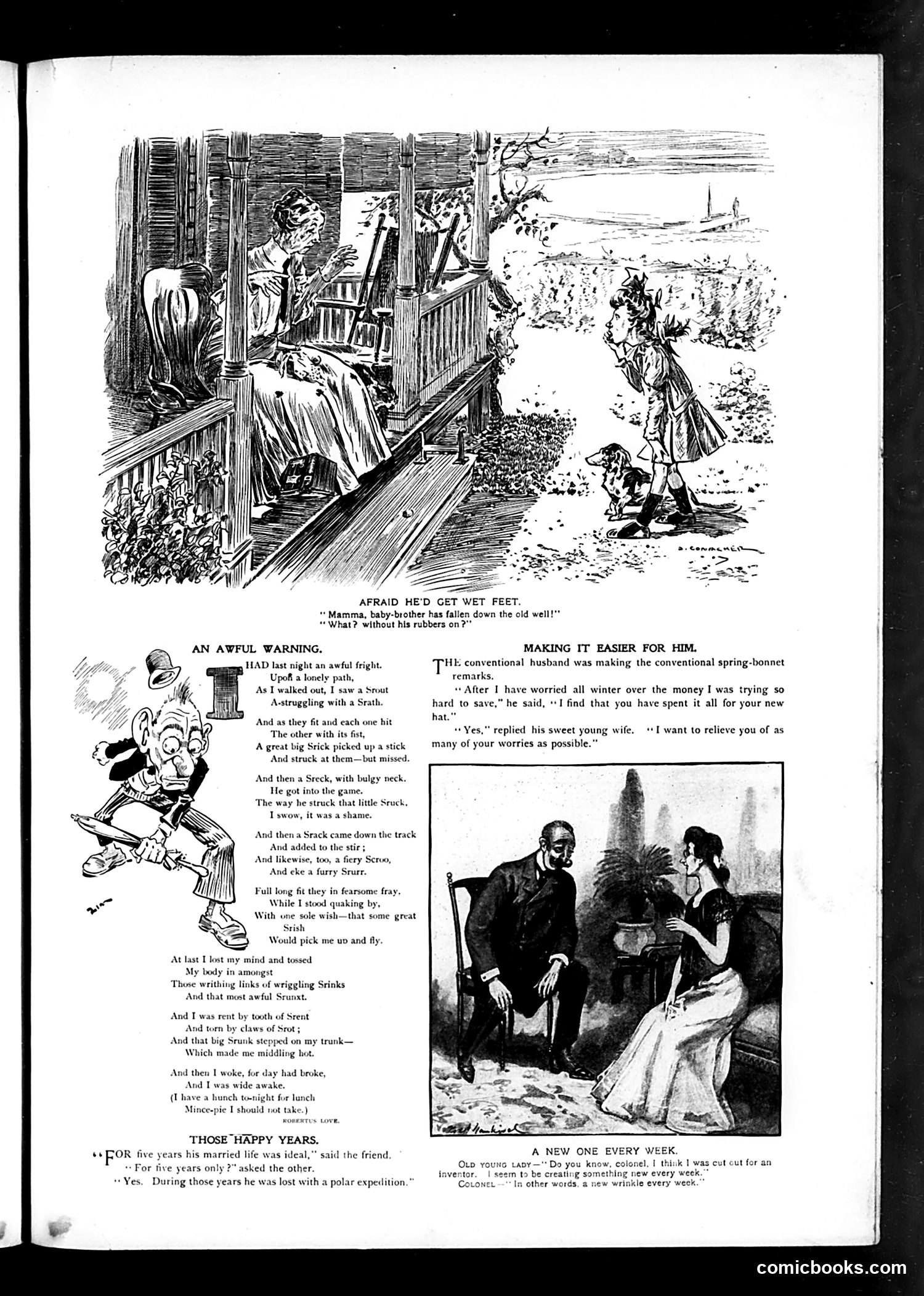
This page contains three distinct pieces of early 20th-century domestic humor: **"Afraid He'd Get Wet Feet"** (top): A seaside scene where a mother worries her baby has fallen down a well. The joke plays on middle-class anxiety about children's safety and mothers' overprotectiveness. **"An Awful Warning"** (left): A cautionary poem about a man struck by various misfortunes (a Snout, Struts) after mistreating someone. It appears to be a moral fable about comeuppance, common in Judge's satirical content. **"Making It Easier for Him"** and **"A New One Every Week"** (right): Two brief domestic sketches about marriage—one about a husband's financial worries, another about a wife creating weekly surprises. These mock conventional marriage dynamics and middle-class domestic life. The illustrations use exaggerated caricature typical of Judge's satirical style.
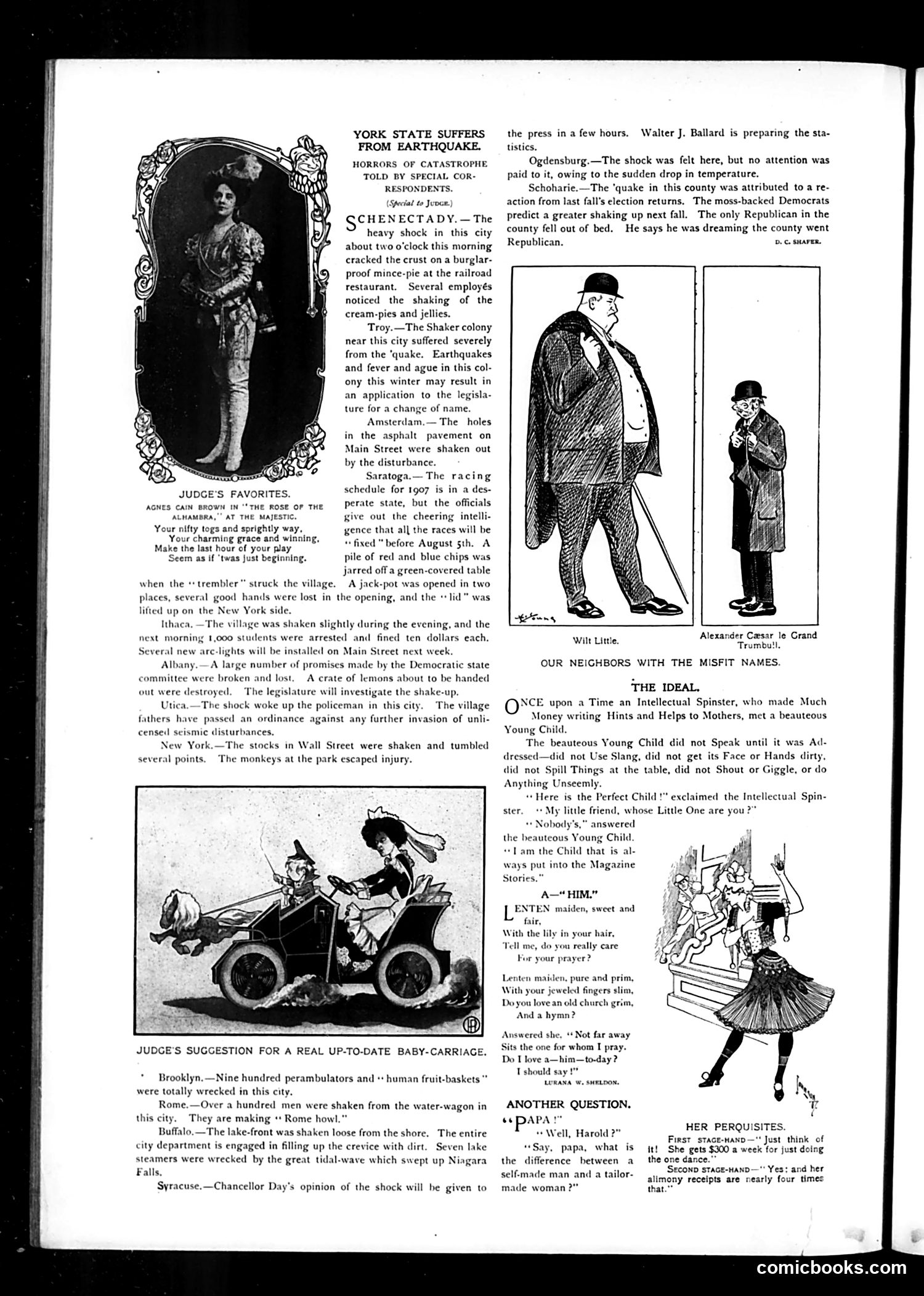
This page reports on an actual 1906 earthquake affecting New York State, with various towns describing minor damage—cracked buildings, shaken goods, etc. The humor is gentle: celebrating that the tremor caused little real harm. The cartoons mock contemporary society: 1. **"Judge's Suggestion for a Real Up-to-Date Baby-Carriage"** shows a motorized vehicle, satirizing Americans' obsession with automobiles as a status symbol, even for impractical purposes. 2. **"Our Neighbors with the Misfit Names"** features caricatured figures labeled "Will Little" and "Alexander Caesar in Grand Triumph"—jokes about ordinary people with grandiose or absurd names. 3. **"The Ideal"** and accompanying verses mock pretentious morality and affected propriety in child-rearing. The overall tone is light social commentary on contemporary American manners and fashions.
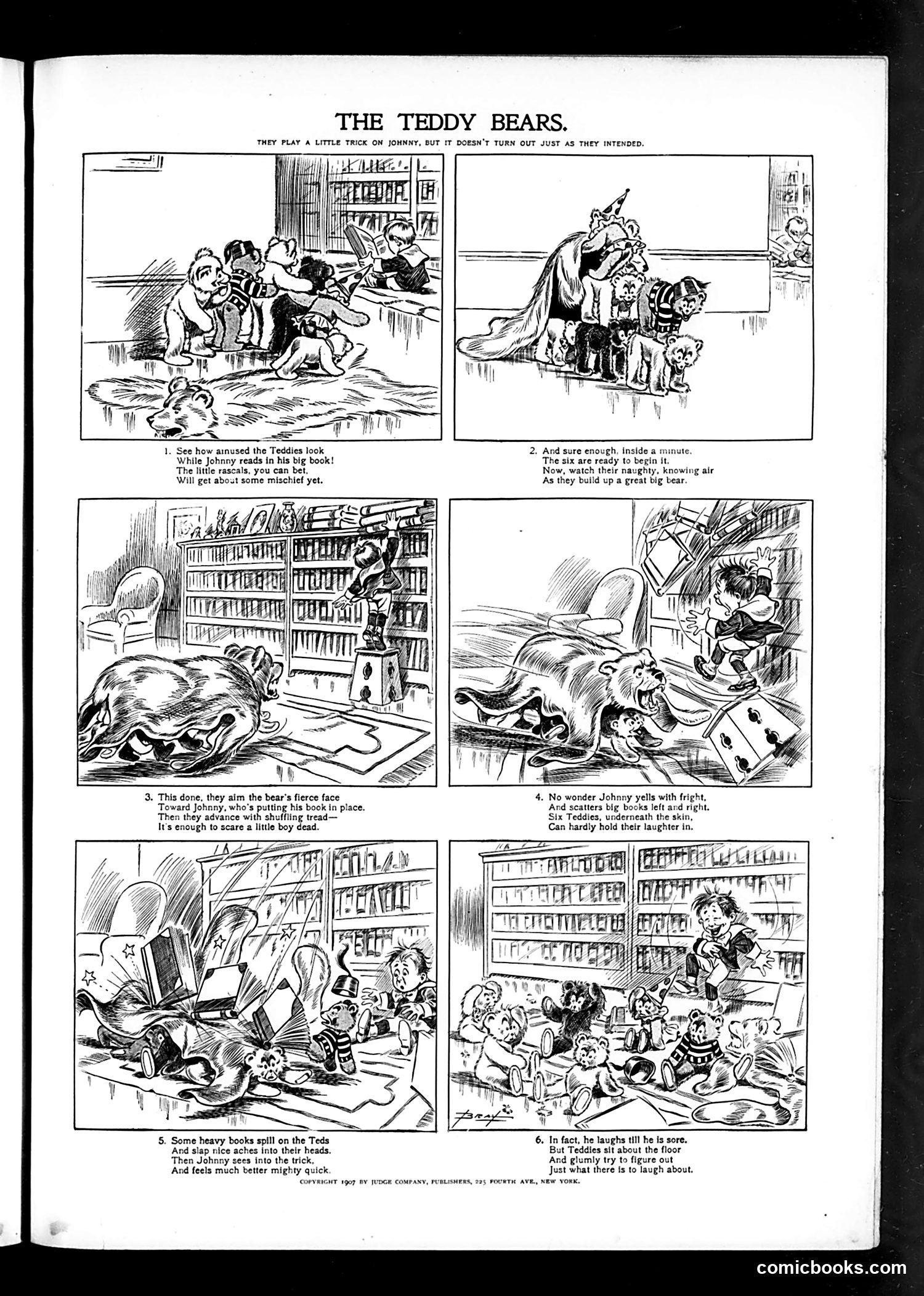
This is a children's story comic, not political satire. The narrative follows six panels depicting teddy bears (referred to as "Teddies") playing a prank on a character named Johnny. The bears read from a book, dress in costumes including a cape and crown, create a fierce bear face to frighten Johnny, scatter books in a library, and ultimately cause chaos while Johnny watches, unable to stop laughing. The humor derives from the bears' mischievous antics—their elaborate costume play and the resulting mayhem—rather than from political commentary. This appears to be entertainment content typical of Judge magazine's family-friendly material, using anthropomorphized stuffed animals as comedic characters.
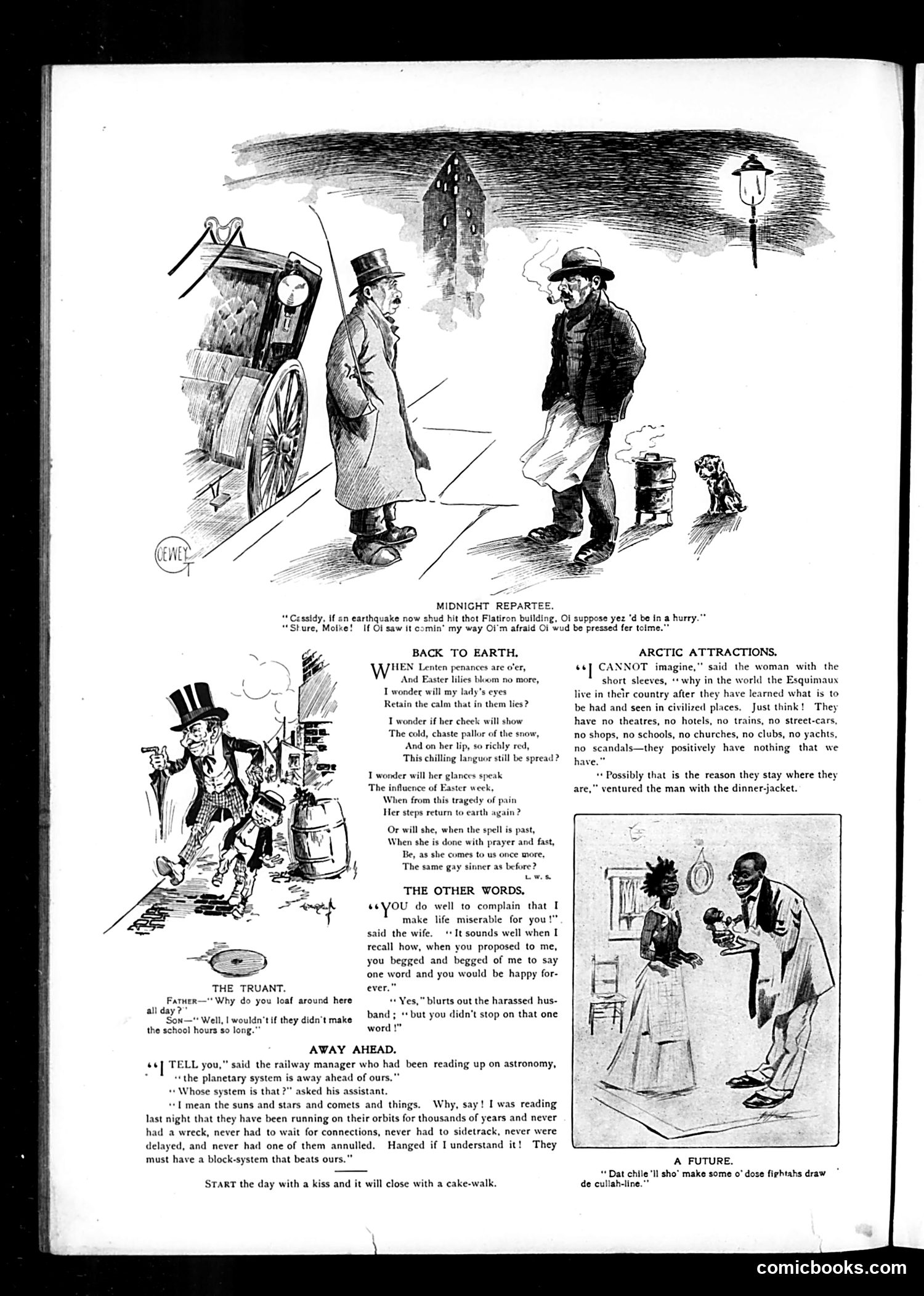
This page contains several unrelated satirical sketches typical of early 20th-century American humor: **"Midnight Repartee"** depicts Irish immigrants (suggested by names "Cassidy" and "Motke") discussing the Flatiron Building—a famous New York skyscraper completed 1902—with casual indifference to earthquake danger. **"Back to Earth"** is sentimental verse about whether a woman will maintain Easter piety after Lenten season ends, satirizing shallow religious observance. **"The Other Words"** and **"The Truant"** are domestic humor sketches about marital nagging and school truancy. **"Away Ahead"** satirizes railroad inefficiency by contrasting it with celestial mechanics—the railway manager marvels that planets never wreck or experience delays, implicitly criticizing American rail service. **"Arctic Attractions"** mocks civilized pretension: a woman lists "luxuries" (theaters, hotels, scandal) Esquimaux lack, while a man suggests they wisely avoid such complications. The page showcases Judge's formula: topical New York references mixed with class-conscious humor targeting immigrants, domestic friction, and institutional incompetence.
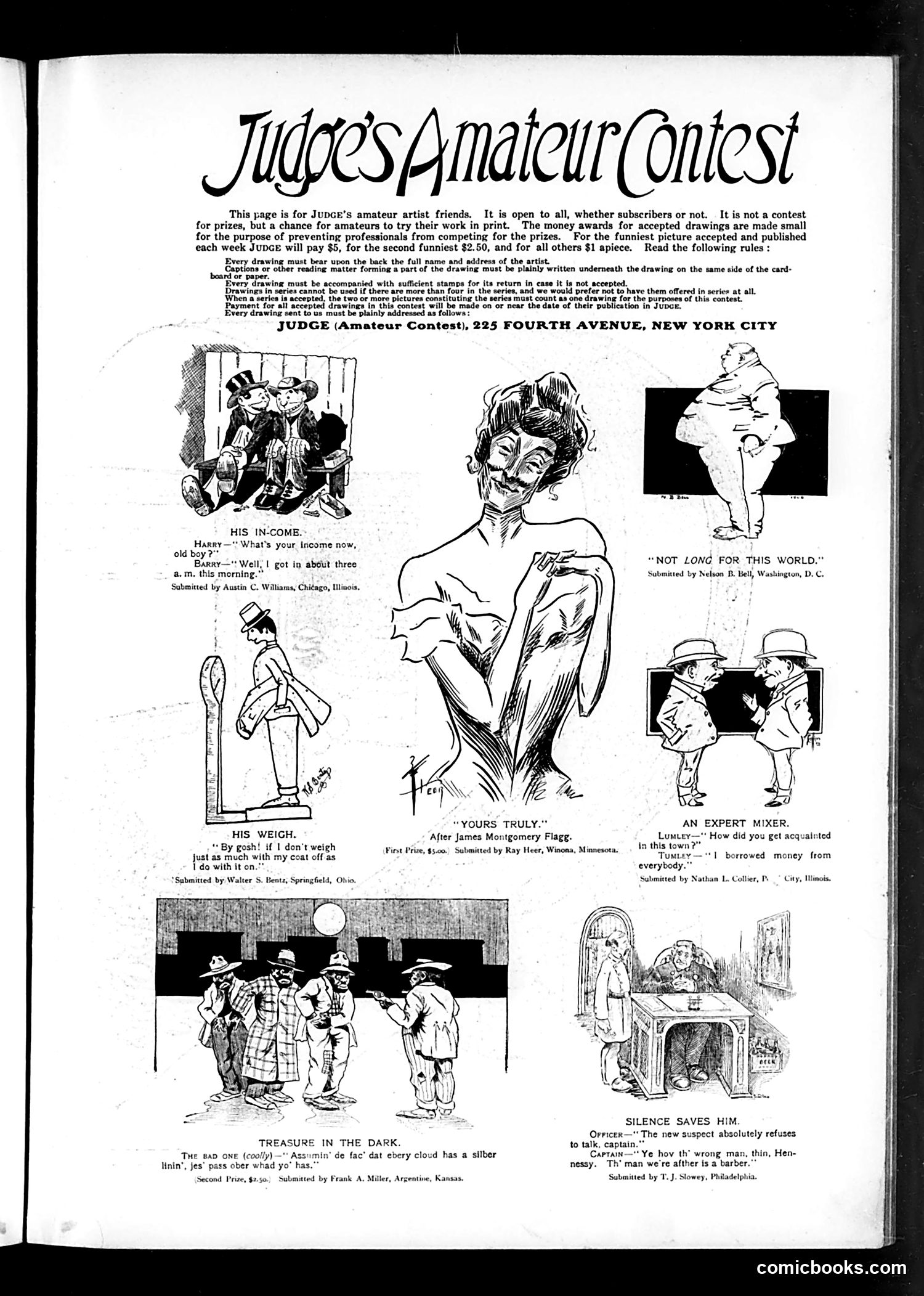
This page showcases amateur cartoon submissions to Judge magazine's weekly contest, offering small cash prizes ($5, $2.50, $1) to encourage amateur artists while excluding professionals. The cartoons employ early 20th-century humor conventions: - **"His In-Come"** plays on a pun about income timing (arriving at 3 a.m.) - **"His Weight"** uses the old joke format of weighing oneself with/without clothing - **"Yours Truly"** appears to be a caricature study (credited to professional James Montgomery Flagg) - **"Treasure in the Dark"** uses dialect humor and the proverb about silver linings - **"An Expert Mixer"** relies on double meaning—someone who "borrows money from everybody" to appear social - **"Silence Saves Him"** presents Irish-accented police dialogue with a twist ending about a barber suspect The humor is largely pun-based, reliant on wordplay, ethnic dialect stereotypes, and situational comedy typical of early Judge magazine. Most jokes require no specific historical context beyond understanding period comedic conventions.
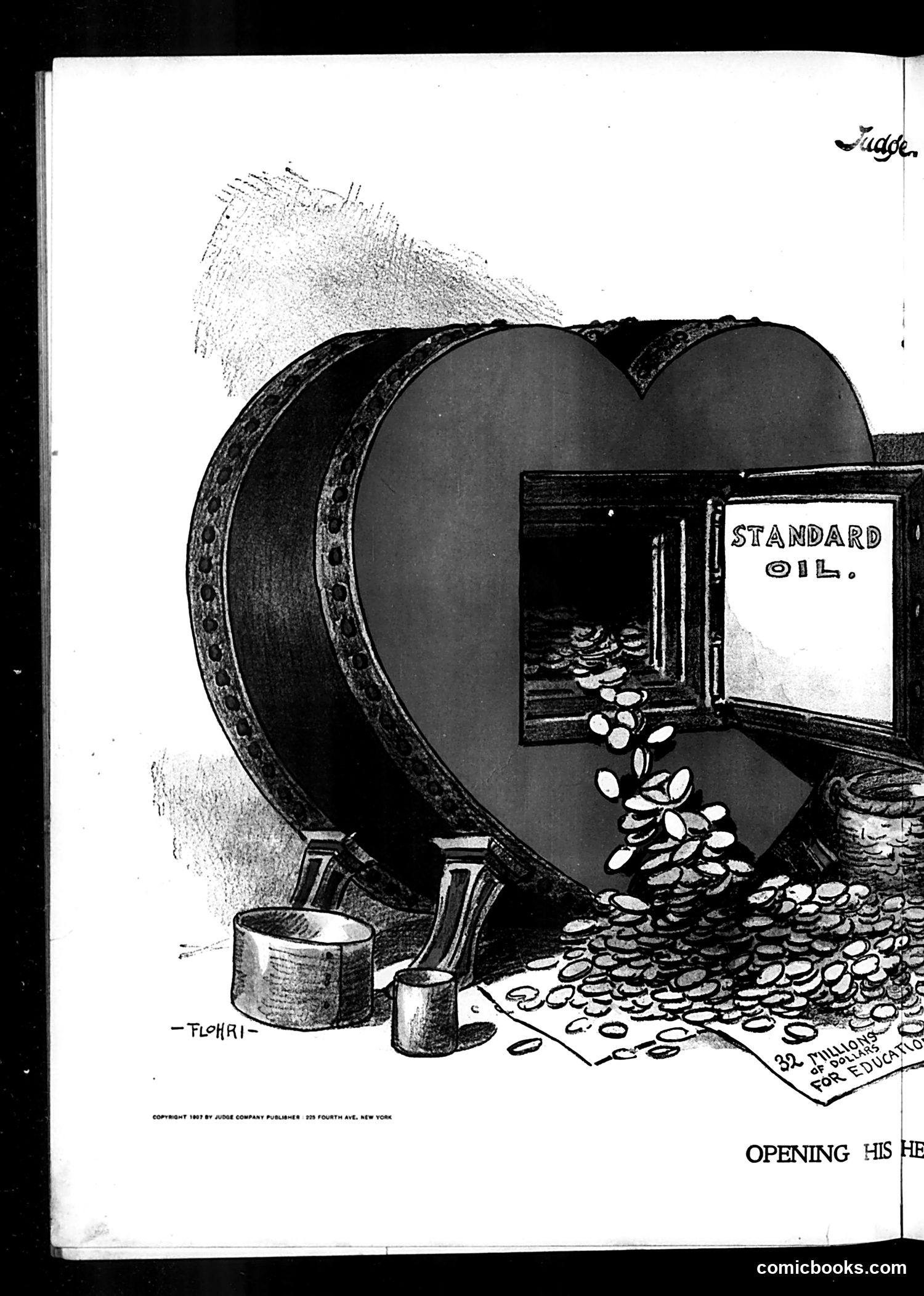
This Judge magazine cartoon satirizes **Standard Oil's vast wealth and power**. The illustration shows an enormous barrel labeled "STANDARD OIL" overflowing with coins—depicted as a cornucopia of money pouring out endlessly. A small spigot labeled "STANDARD OIL" sits beside collection vessels, while text references "$2 MILLIONS FOR EDUCATION," suggesting the company's philanthropic gestures. The satire's point: Standard Oil possesses such extraordinary profits that even massive charitable donations represent negligible expenditures. The artist criticizes how the monopoly uses modest educational contributions as public relations cover for its enormous wealth accumulation. This reflects early 20th-century anxiety about corporate monopolies and their social influence during the Progressive Era, when Standard Oil faced intense scrutiny and eventual antitrust action.
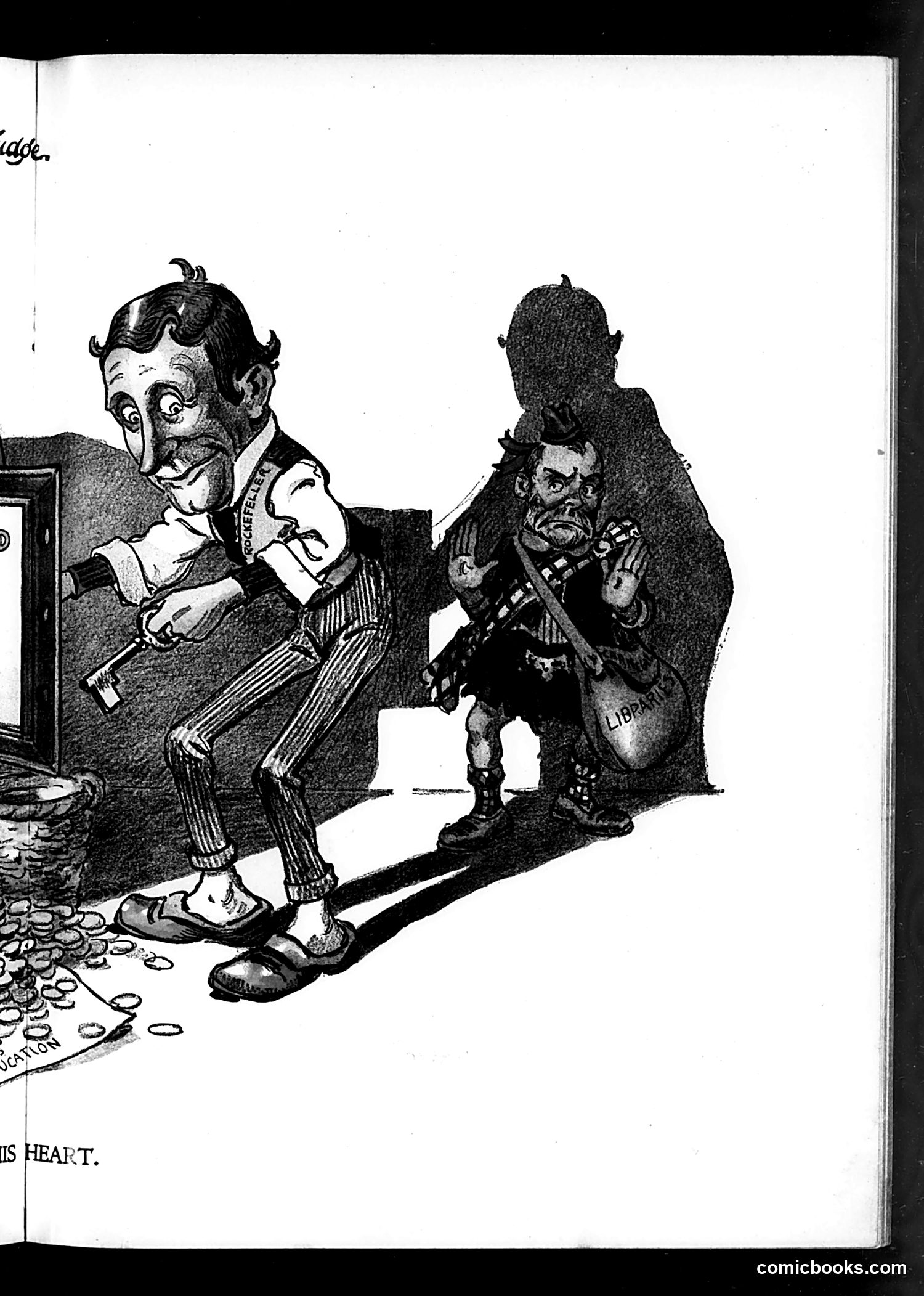
This appears to be a satirical cartoon from *Judge* magazine depicting a wealthy, well-dressed figure being robbed or confronted by two menacing characters—one large and shadowy, one smaller with exaggerated features. The well-dressed man clutches money (visible coins scattered on the ground), suggesting themes of theft, corruption, or extortion. The text fragment "HIS HEART" (visible at bottom left) is incomplete, making the specific political message unclear. Without a date or full caption, I cannot definitively identify the figures or the particular event being satirized. The cartoon likely comments on contemporary corruption, theft of public funds, or predatory economic practices targeting the wealthy—common *Judge* satirical themes—but the exact target and meaning remain uncertain from this partial page.
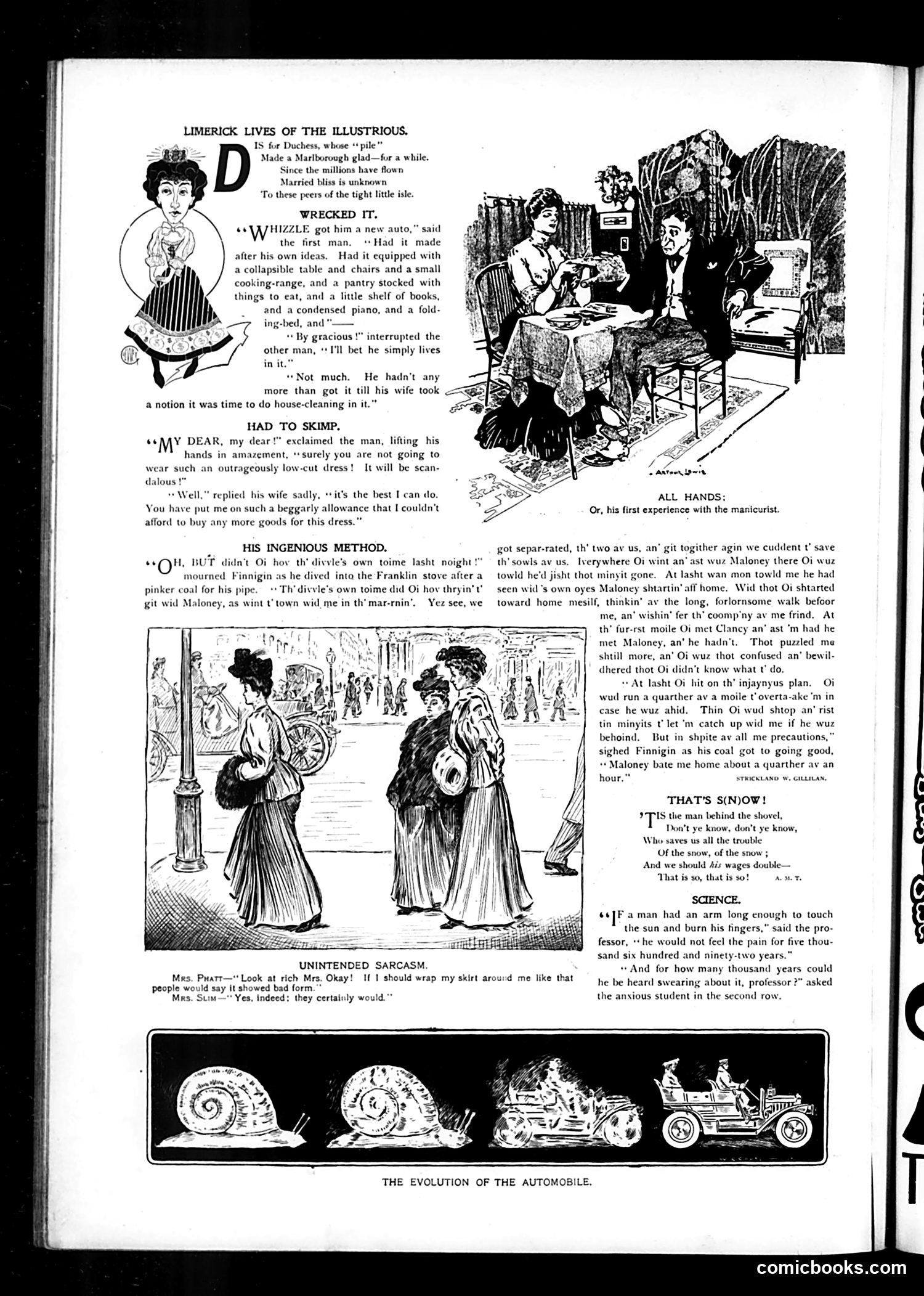
This page from *Judge* magazine collects humorous short sketches satirizing early 1900s American life: **"Wrecked It"** mocks newly wealthy men's impracticality: a man customizes his automobile with elaborate domestic furnishings, only to have his wife immediately use it for house-cleaning—defeating the purpose entirely. **"Had to Skimp"** critiques marriage dynamics and gender economics: a husband criticizes his wife's revealing dress as scandalous, but she reveals she cannot afford fabric because he gives her inadequate household money. **The Irish dialect story** (Finnigin and Maloney) appears to be a lengthy, rambling Irish-immigrant anecdote about getting lost, employing stereotypical phonetic spelling common in period humor. **"Unintended Sarcasm"** jokes about class assumptions regarding manicure services. **"Science"** is a physics joke about light-speed time delays. The page concludes with "The Evolution of the Automobile"—a humorous visual sequence showing automobiles' development from snails to primitive vehicles, satirizing their novelty and rapid technological change.
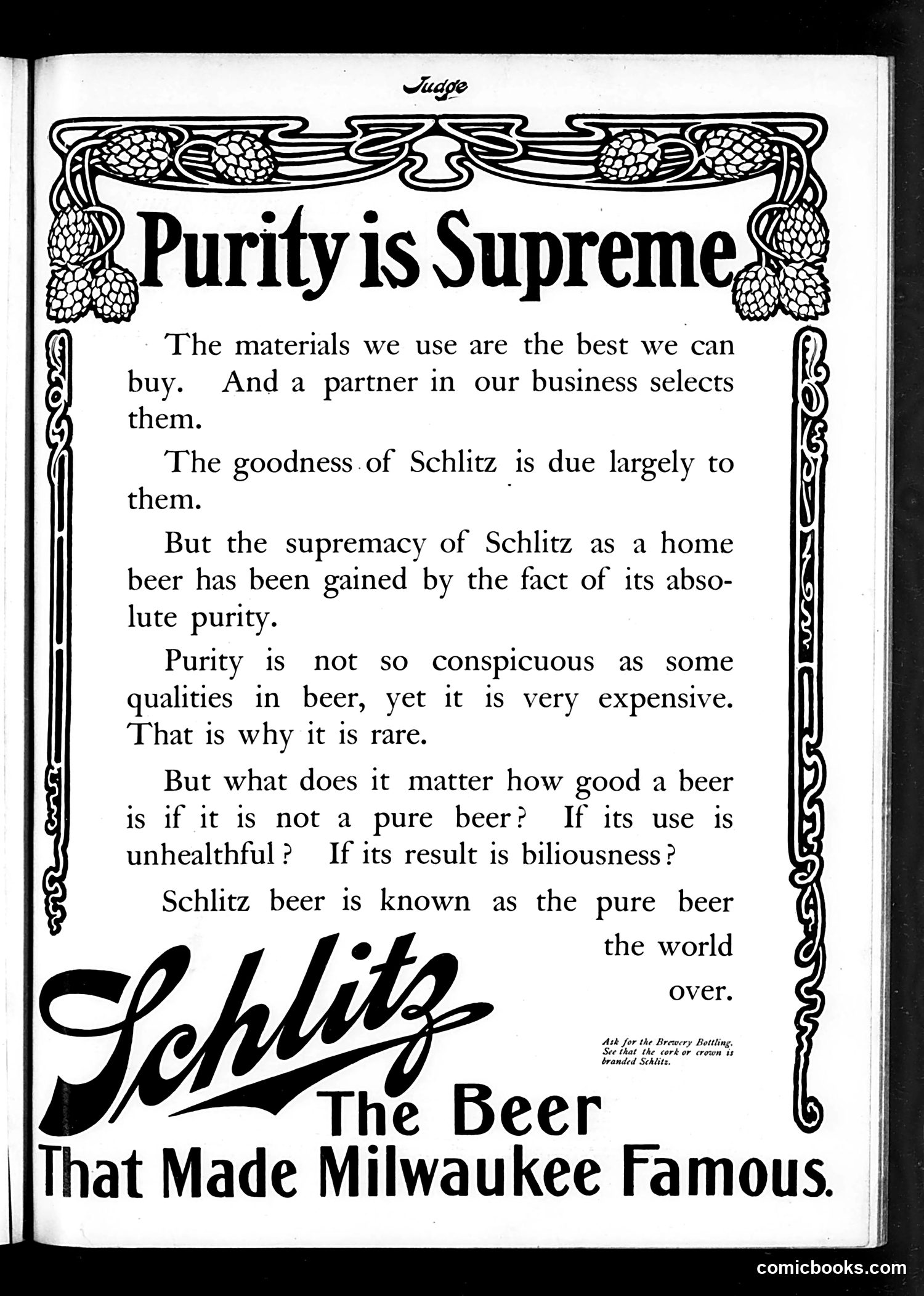
This is a **full-page advertisement**, not a satirical cartoon. It's a promotional piece for Schlitz beer, a major Milwaukee brewery, appearing in *Judge* magazine. The ad argues that **purity is Schlitz's competitive advantage**. Rather than emphasizing taste or popularity, it takes a moralistic angle: other beers may taste good but could be impure, unhealthful, or cause digestive problems ("biliousness"). Schlitz positions itself as the ethical choice—"the pure beer the world over." This reflects early 20th-century advertising strategy, when **purity claims** were common sales pitches for consumables (particularly relevant during the Progressive Era, when food safety was a genuine public concern). The ornamental border design and formal typography suggest this is a premium brand marketing to upscale readers of *Judge*. There is no satire present here—this is straightforward period advertising.
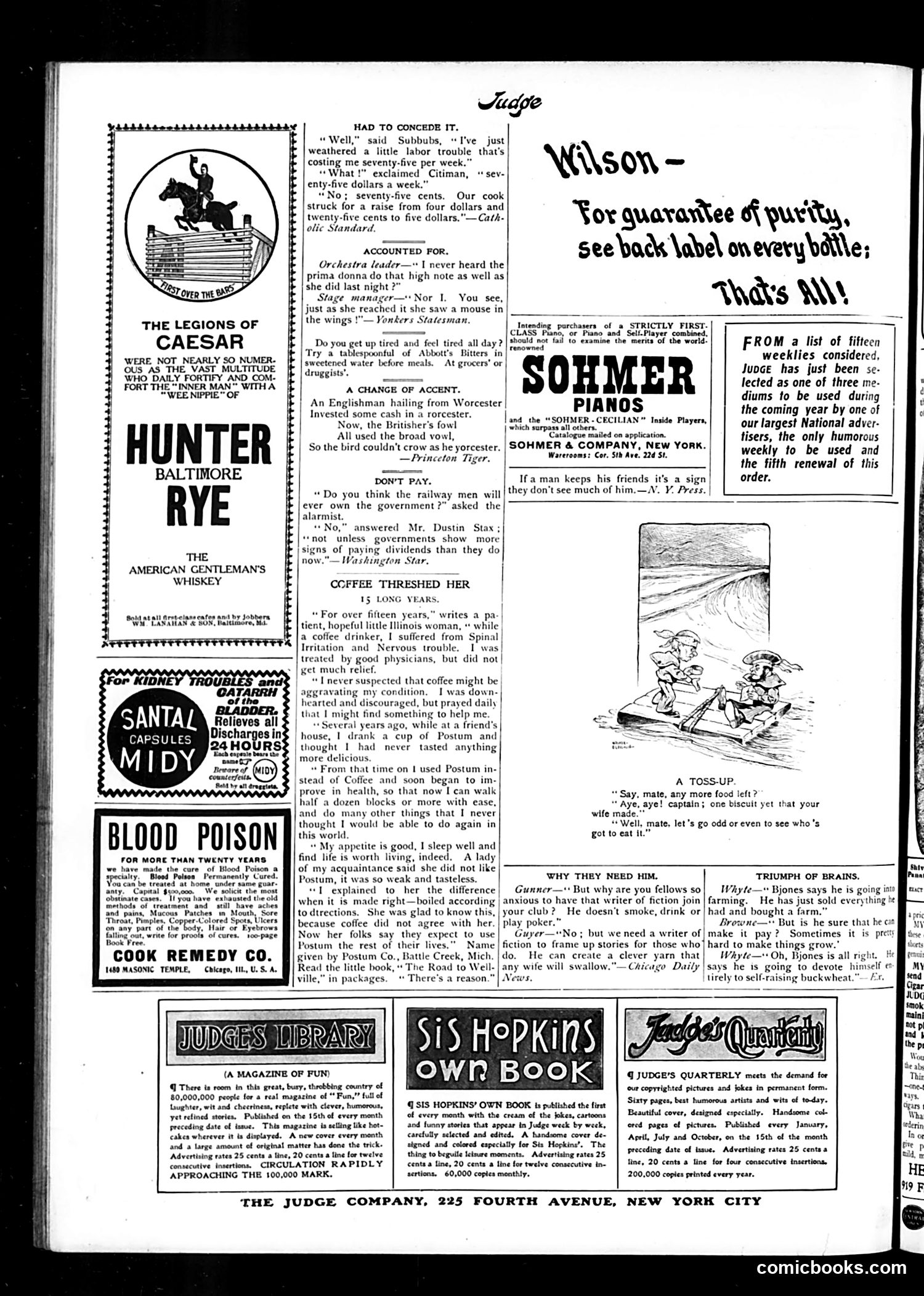
This page from *Judge* is primarily **advertising and filler content** rather than political satire. The layout consists of multiple commercial ads and brief humorous anecdotes. The notable elements include: **"Wilson" advertisement** (top right): A whiskey brand ad playing on the surname of President Woodrow Wilson, using his name for commercial purposes—common practice of the era. **Humorous vignettes** scattered throughout satirize mundane complaints: a cook's labor strike for fifty cents weekly wages, a prima donna hitting high notes, an Englishman's wordplay about Worcester, and railway workers owning government. **Product advertisements** dominate: Hunter Baltimore Rye whiskey, Sohmer Pianos, Santa Midy capsules for "kidney troubles," Blood Poison cure, and Postum coffee substitute (marketed as cure for nervousness caused by regular coffee). The **satire is mild and domestic**—no major political commentary. The page reflects early 20th-century concerns: labor disputes, nervousness (attributed to caffeine), and commercial remedies. The Judge Library advertisement claims circulation of 100,000, suggesting this was a popular publication despite its modest satirical content.
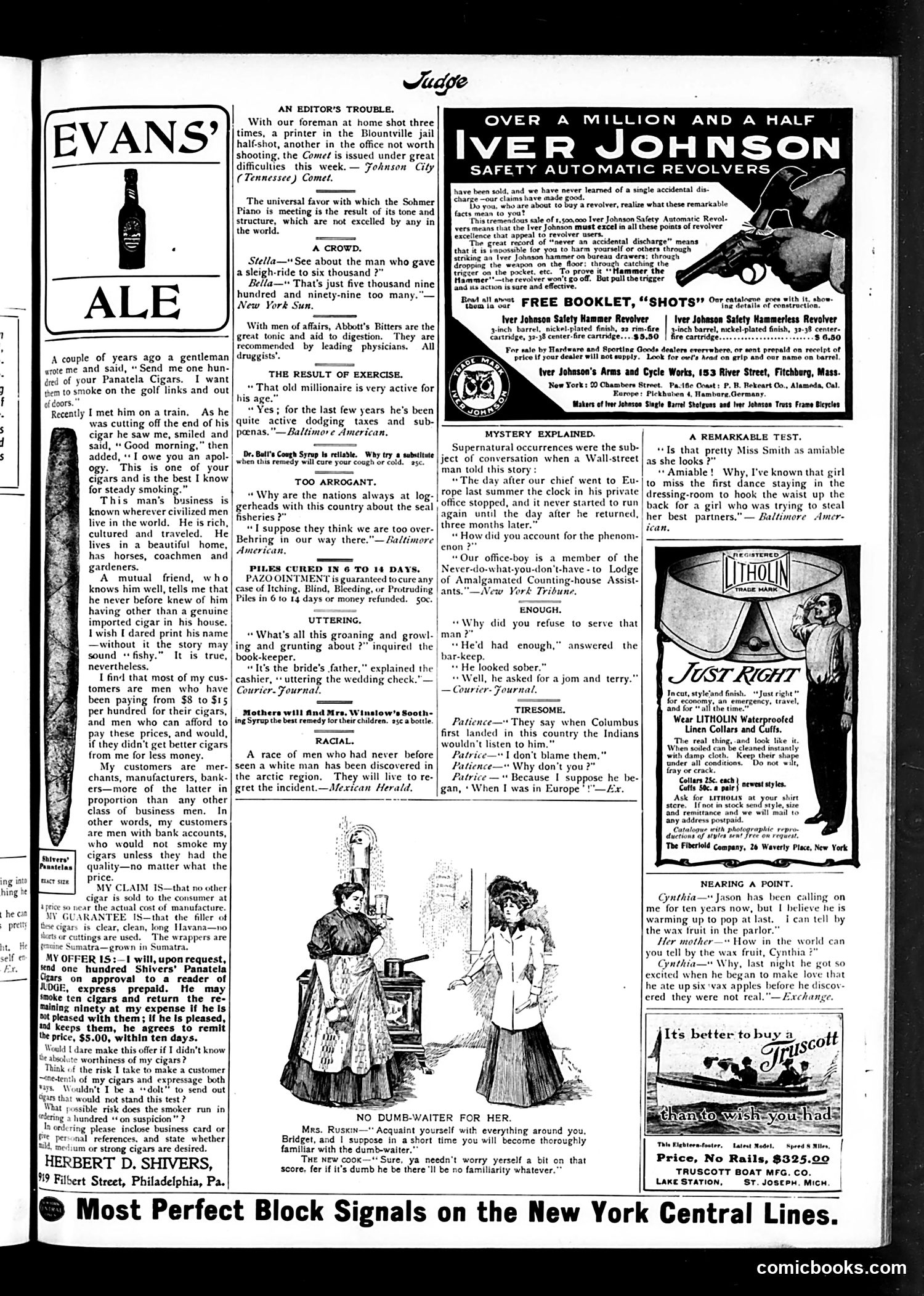
This page is primarily **advertising and humor columns** rather than political editorial cartoons. The content includes: **Main Features:** - Multiple product advertisements (Evans' Ale, cigar sellers, Iver Johnson revolvers, Truscott boats) - Short humor pieces and jokes (typical of Judge's "filler" content) **The One Notable Cartoon:** A small illustration labeled "NEARING A POINT" shows a domestic scene with implied marital conflict—a woman questioning a man about his activities. The caption jokes about his transparent lies regarding his whereabouts and activities. **Historical Context:** This appears to be an early 1900s magazine page. The ads (revolvers, cigars, boats) reflect period consumer goods. The humor relies on period-specific references like tax evasion jokes and seal fishing disputes that would require historical context to fully appreciate. **For Modern Readers:** The cartoons are minor and the page functions mainly as a vehicle for late-Victorian/Edwardian advertising and mild domestic humor—reflecting how print magazines monetized through ads while filling space with short comic pieces.
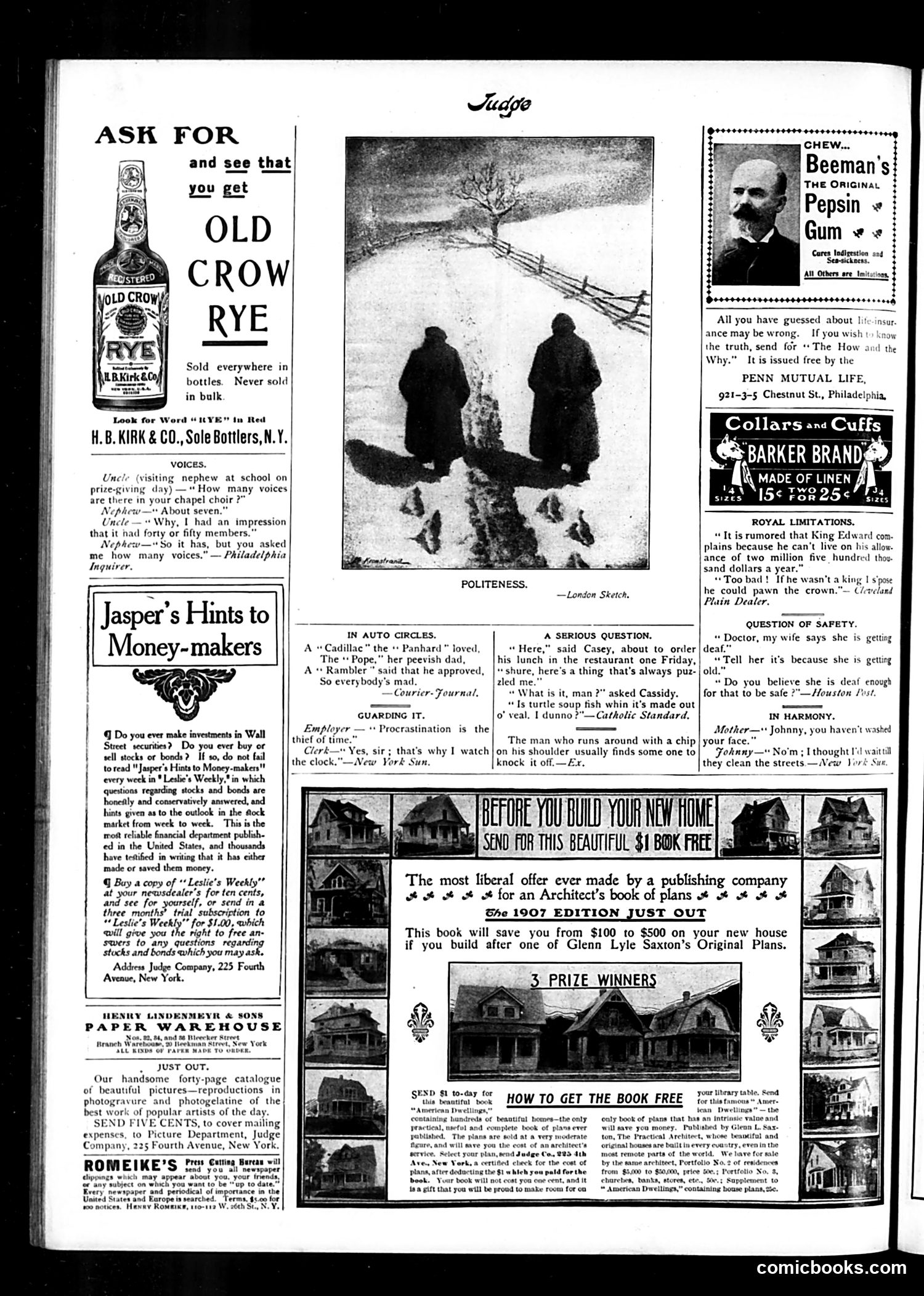
This is primarily an **advertising page** with scattered humorous filler content typical of early-1900s magazines. The main cartoon, "**Politeness**" (center), depicts two figures sitting in snow by a bare tree—a scene illustrating the caption's ironic commentary on mannered behavior in harsh circumstances. The page includes several short **joke sections** with names like "In Auto Circles" and "A Serious Question"—lighthearted pieces about automobiles, marriage, and domestic life, using the pun-heavy humor style of the era. **Advertisements dominate**: Old Crow Rye whiskey, Beeman's Pepsin Gum, Barker Brand collars, and prominently, a **$1 architectural book offer** claiming to save homeowners $100-$500 on construction costs. This last ad appears three times, suggesting significant editorial space was sold to this publisher. The content reflects **early-1900s consumer culture** and gentle domestic humor rather than sharp political satire. The page functions more as a revenue vehicle than substantive commentary.
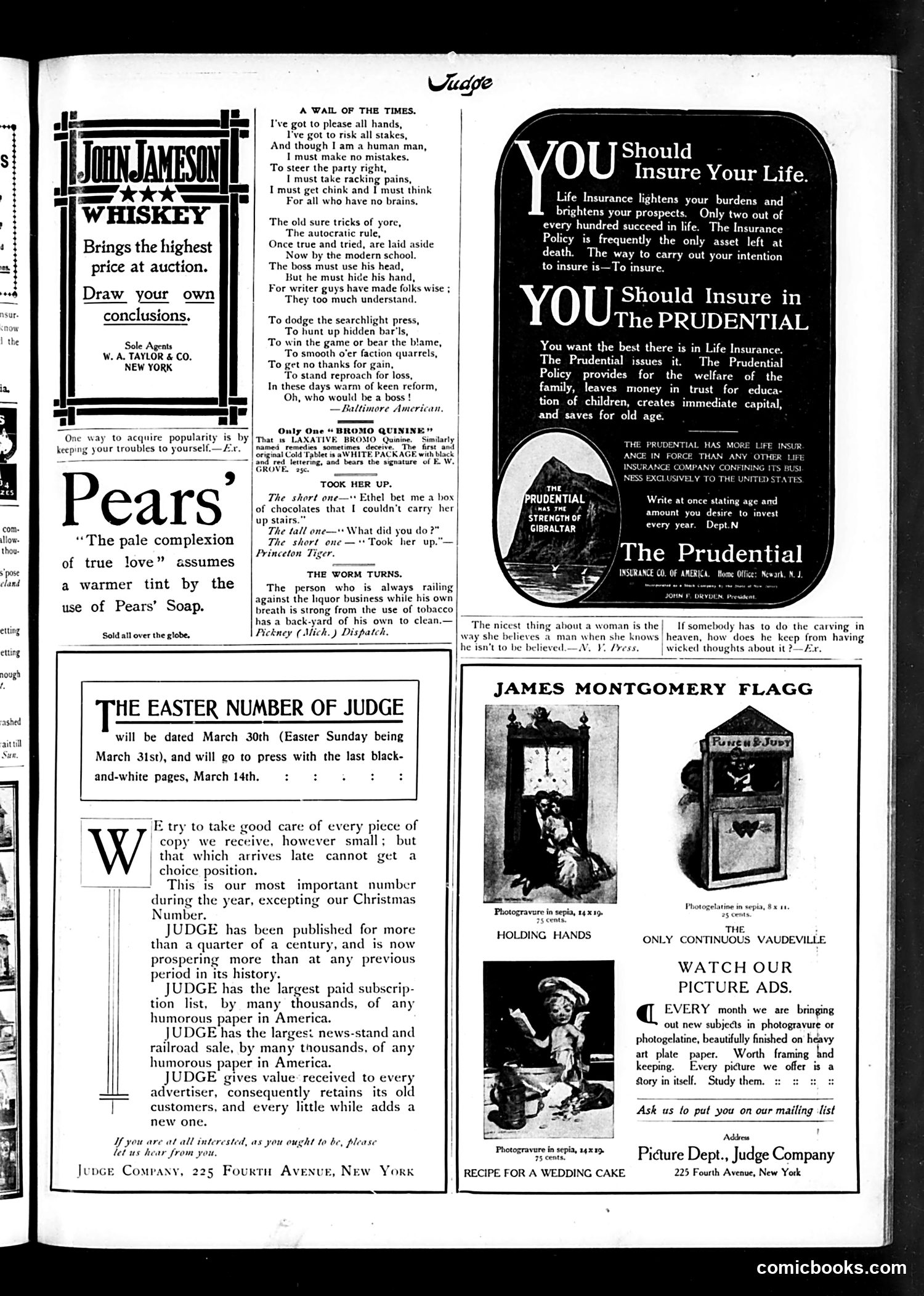
This page is primarily **advertisements and editorial content** rather than satirical cartoons. The main notable item is the poem "A Wail of the Times," which appears to address **political leadership challenges** during the Progressive Era. The speaker—likely a political figure or party leader—laments having to "please all hands," avoid mistakes, navigate between "old sure tricks" and "modern school," and manage faction quarrels while remaining invisible ("hide his hand"). This reflects early 20th-century tensions between traditional politics and Progressive reform movements. The rest of the page consists largely of **period advertisements**: John Jameson Whiskey, Pears' Soap (playing on complexion), The Prudential Insurance Company (multiple ads), and photographs available through Judge Company's picture department. Minor humor items include brief jokes like "The Worm Turns" (about hypocrisy regarding alcohol and tobacco) and "Took Her Up" (a pun on carrying someone upstairs). The page functions mainly as a **revenue vehicle** through advertising rather than satirical commentary.
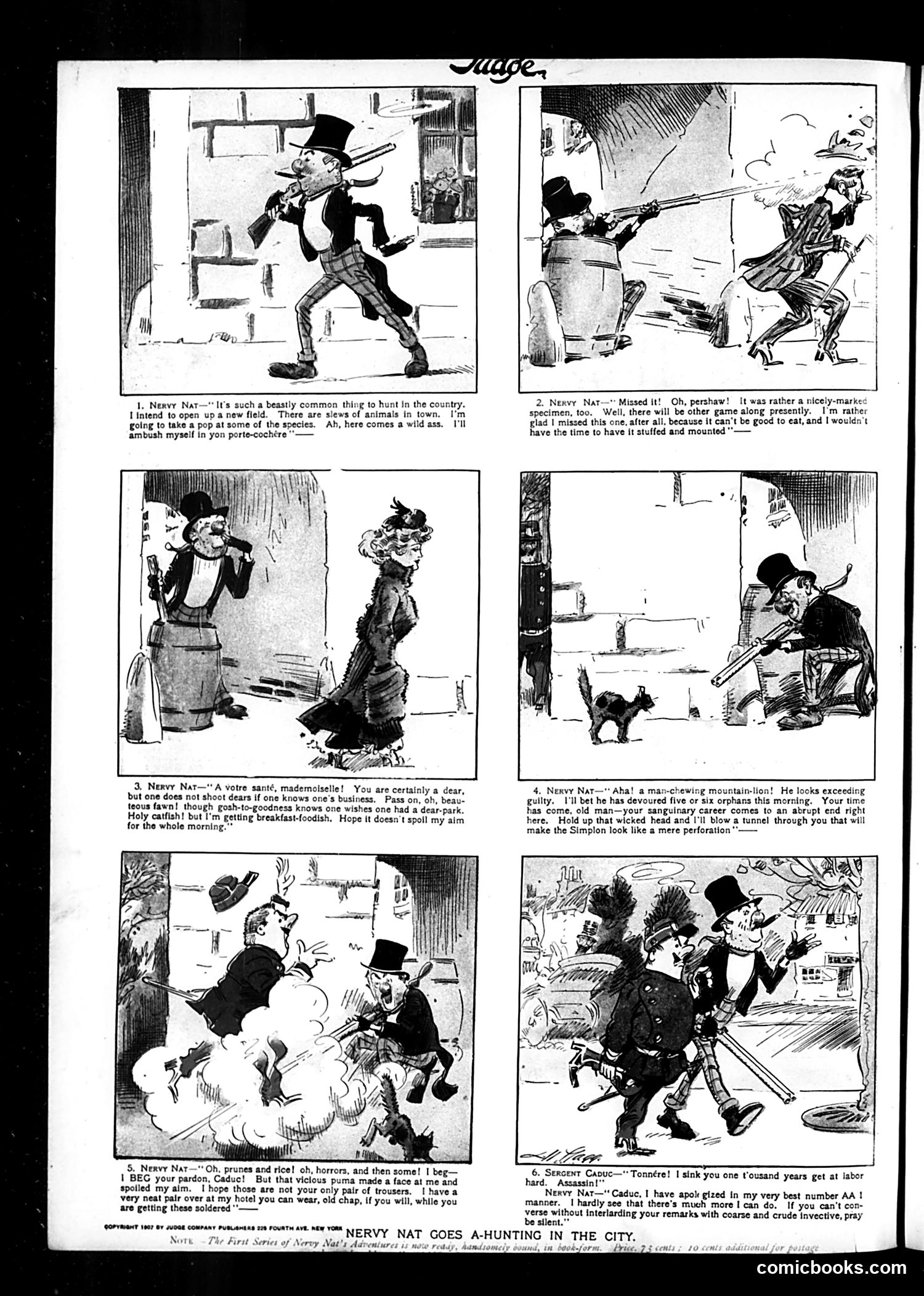
This satirical comic strip mocks upper-class affectation and foolishness. "Nervy Nat," a wealthy dandy (identifiable by his top hat and affected speech), decides hunting in the countryside is passé and declares he'll hunt in the city instead—treating urban residents as game animals. The joke escalates absurdly: he attempts to shoot a woman (calling her a "wild ass"), mistakes a lady for a "dear," hunts an imaginary "man-chewing mountain-lion," and accidentally shoots a man's trousers. The humor targets the ridiculousness of bored aristocrats seeking novelty and their obliviousness to actual harm caused by their capricious pursuits. The final panel references "Cadue," likely a servant, who responds with exasperation to Nat's chaos. The satire critiques wealthy dilettantes who treat serious matters (and people) as entertainment, showing how their careless frivolity endangers ordinary citizens.