
A complete issue · 16 pages · 1907
Judge — January 19, 1907
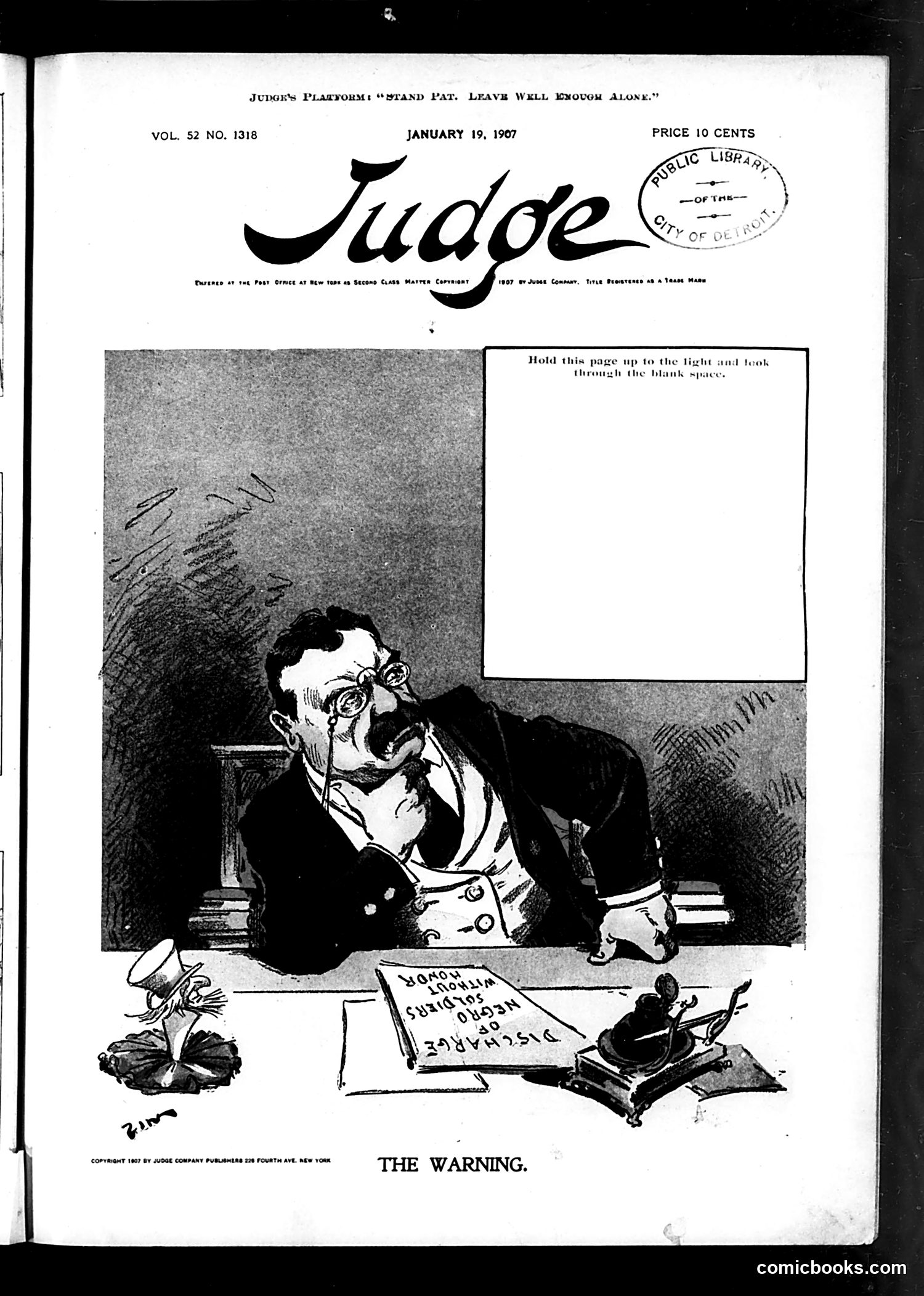
This political cartoon depicts a caricatured figure at a desk, appearing anxious or contemplative while reading what appears to be an official document labeled "DISCONTINUE SUBSIDIARY ORGAN" (text partially unclear). The figure wears glasses and formal attire typical of early 1900s editorial depiction. The blank box labeled "Hold this page up to the light and look through the blank space" suggests hidden content—a common Judge technique for revealing concealed messages or satirical commentary. Without additional context about specific 1907 political events or figures, the exact target of satire remains unclear. The title "The Warning" and the formal document suggest criticism of some institutional or political action, but the specific reference requires knowledge of contemporary news events from that period.
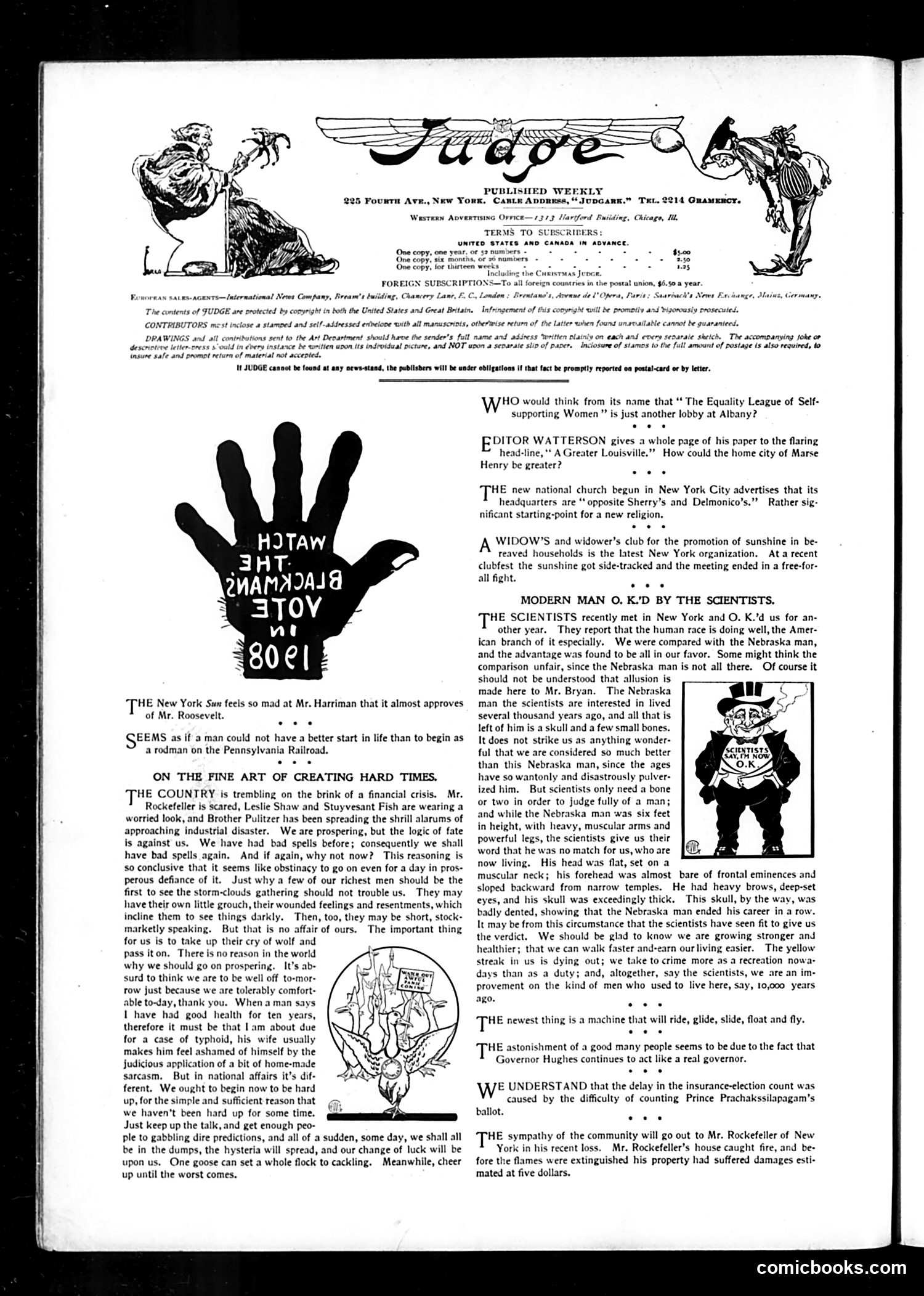
The prominent hand illustration on this page appears to reference "The Equality League of Self-Supporting Women"—a women's suffrage organization. The satirical point seems to be mocking the group's name or activist approach, though the exact critique is unclear from the image alone. The page also contains editorial commentary on various contemporary topics, including a piece titled "Modern Man O. K.'d by the Scientists" that sarcastically compares a Nebraska man to scientific specimens, suggesting the scientists found him evolutionarily unremarkable. Additional brief items mock Governor Hughes, discuss financial crisis concerns, and comment on a fire at Rockefeller's property in New York. The overall tone is typical Judge-style political and social satire targeting progressive movements, scientific claims, and public figures of the era.
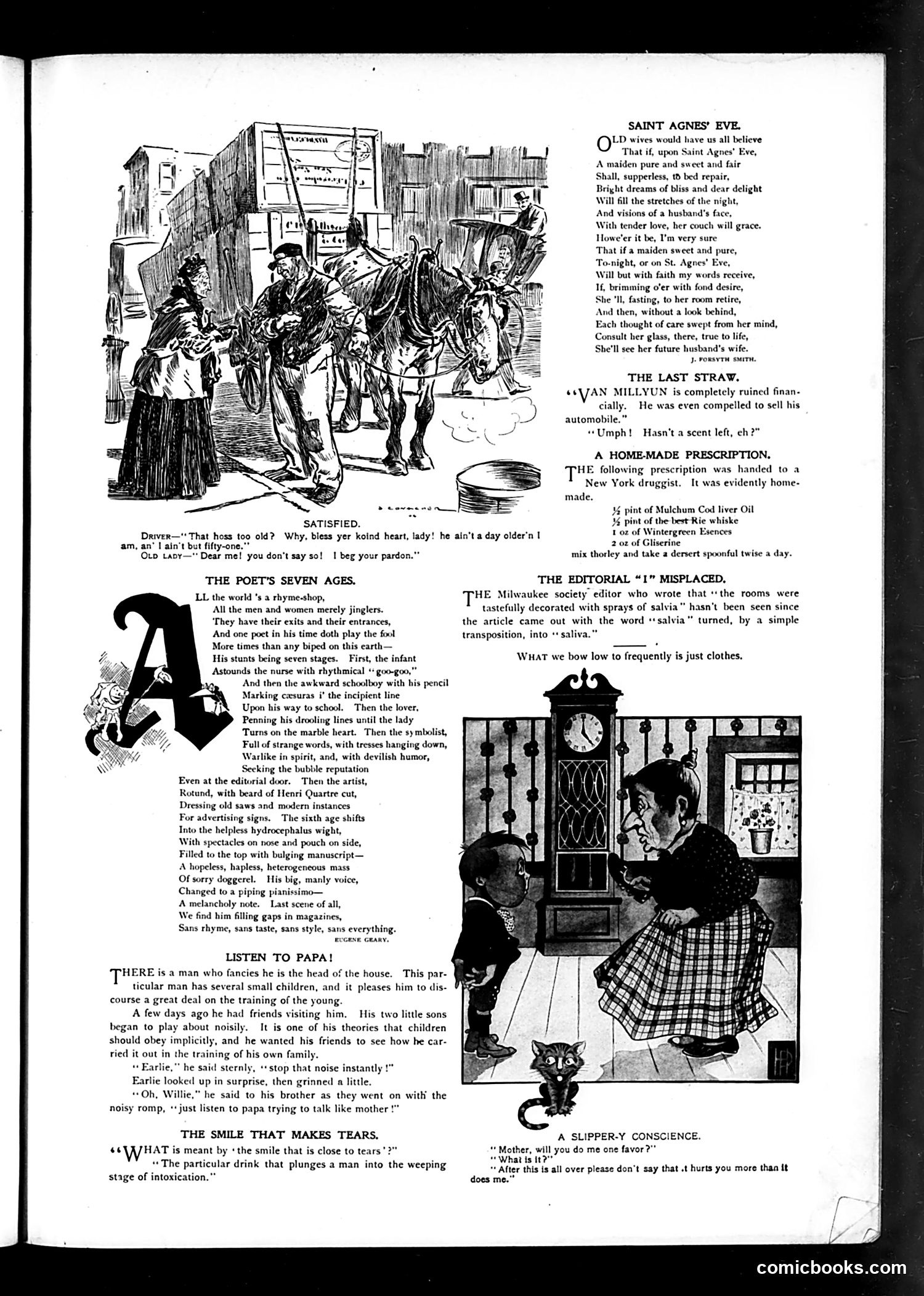
This page from the satirical magazine **Judge** contains several humorous pieces rather than a unified political cartoon. The main illustration titled "SATISFIED" depicts a street scene where a driver addresses an elderly woman, joking about her age in patronizing terms—typical of early 20th-century humor about aging. "THE POET'S SEVEN AGES" is a lengthy poem satirizing life stages, likely referencing Shakespeare's "Seven Ages of Man" but applying it to contemporary urban society and social types. Other sections include light domestic humor pieces like "LISTEN TO PAPA!" and "THE SMILE THAT MAKES TEARS"—examples of genteel family comedy common to the era. The content reflects *Judge*'s formula: mixing social observation, gentle domestic satire, and whimsical verse rather than sharp political commentary. No specific political figures or events appear prominently on this page.
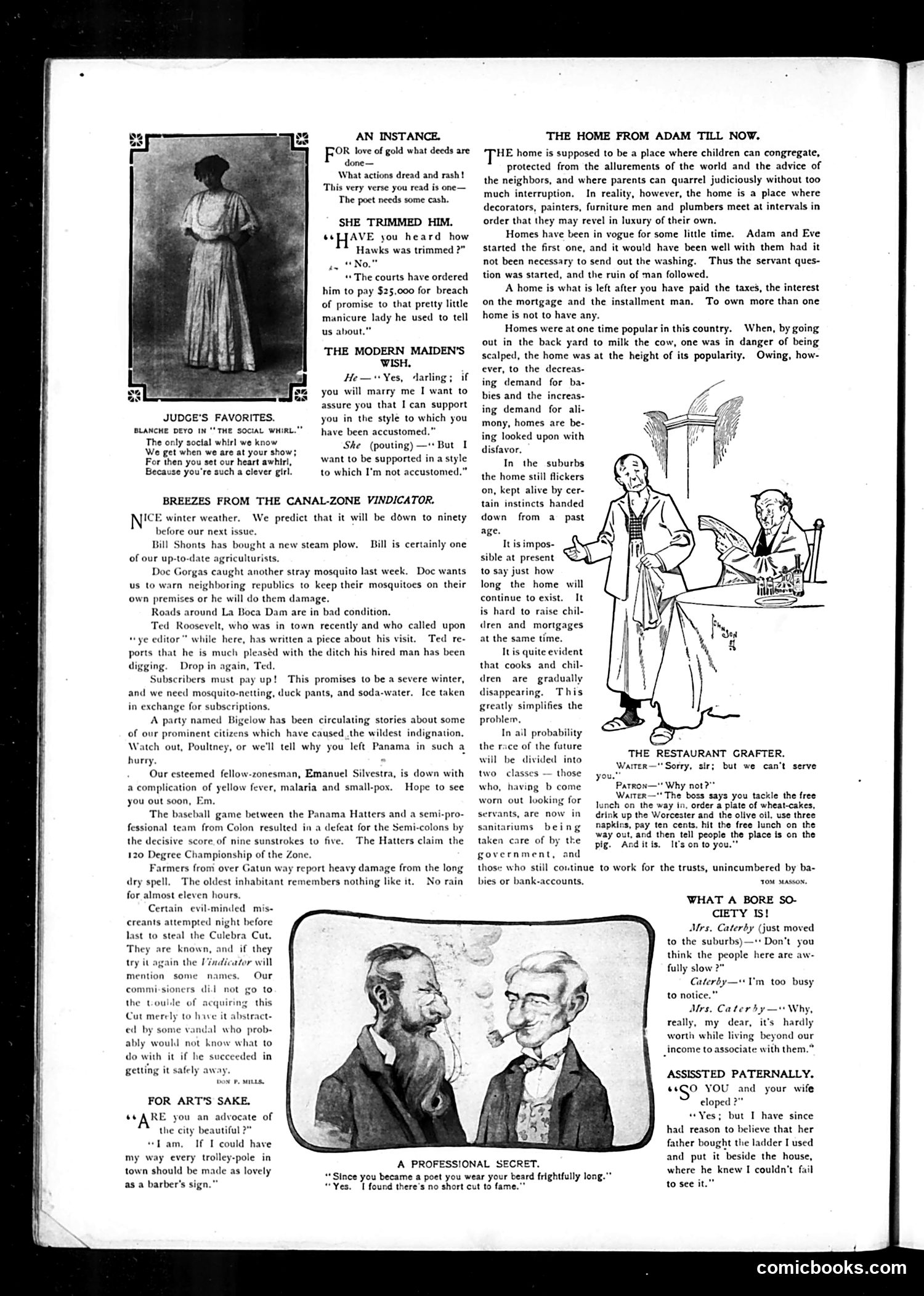
This page contains several satirical pieces typical of early 20th-century Judge magazine: **"The Home from Adam Till Now"** argues that homes have declined in desirability due to increased costs (taxes, mortgages) and disappearing domestic servants. The piece satirizes modern economic anxieties—homes once symbolized stability but now represent financial burden. **"A Professional Secret"** (cartoon with two men) appears to joke about beards and fame, with one figure suggesting a beard helped his success as a poet. **"The Modern Maiden's Wish"** depicts a woman stating she wants marriage but financial support, satirizing debates about women's economic dependence and changing social expectations. The content reflects pre-WWI American concerns about home ownership, domestic labor, and evolving gender roles in an modernizing economy.
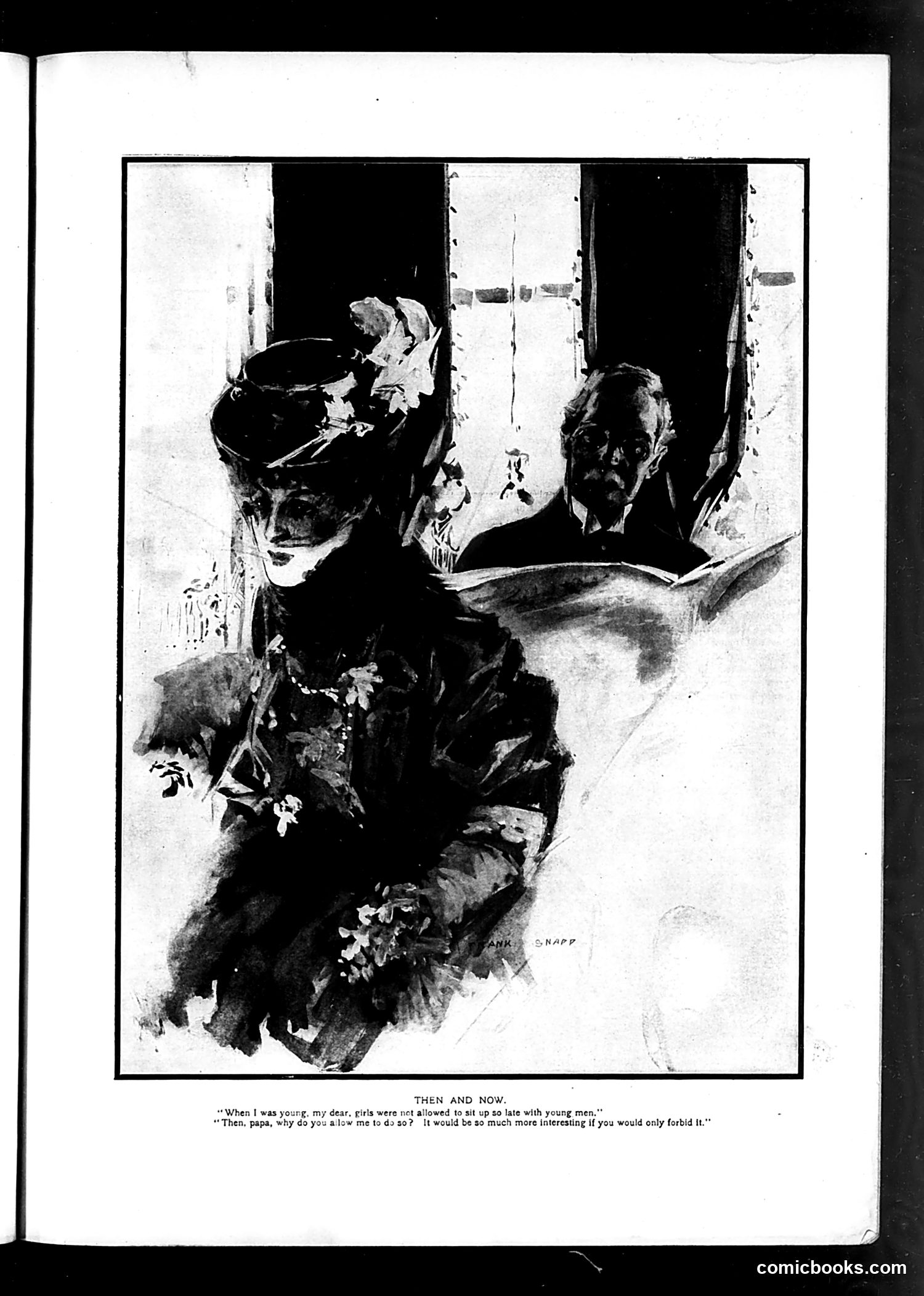
This illustration, titled "Then and Now," contrasts generational attitudes toward courtship and parental supervision. The image shows a woman in elaborate dress and hat (representing an earlier era) and a man in the background, accompanying dialogue about dating restrictions. The satire mocks the loosening of Victorian-era parental controls. The older woman recalls being forbidden from staying up late with young men, while her father questions why he would forbid it—suggesting it would be "much more interesting if you would only forbid it," implying that young people actually desire forbidden activities. The cartoon critiques both outdated strict parenting and the ironic psychology of prohibition, using the contrast between "Then" (restrictive) and "Now" (permissive) to highlight evolving social norms around courtship and authority.
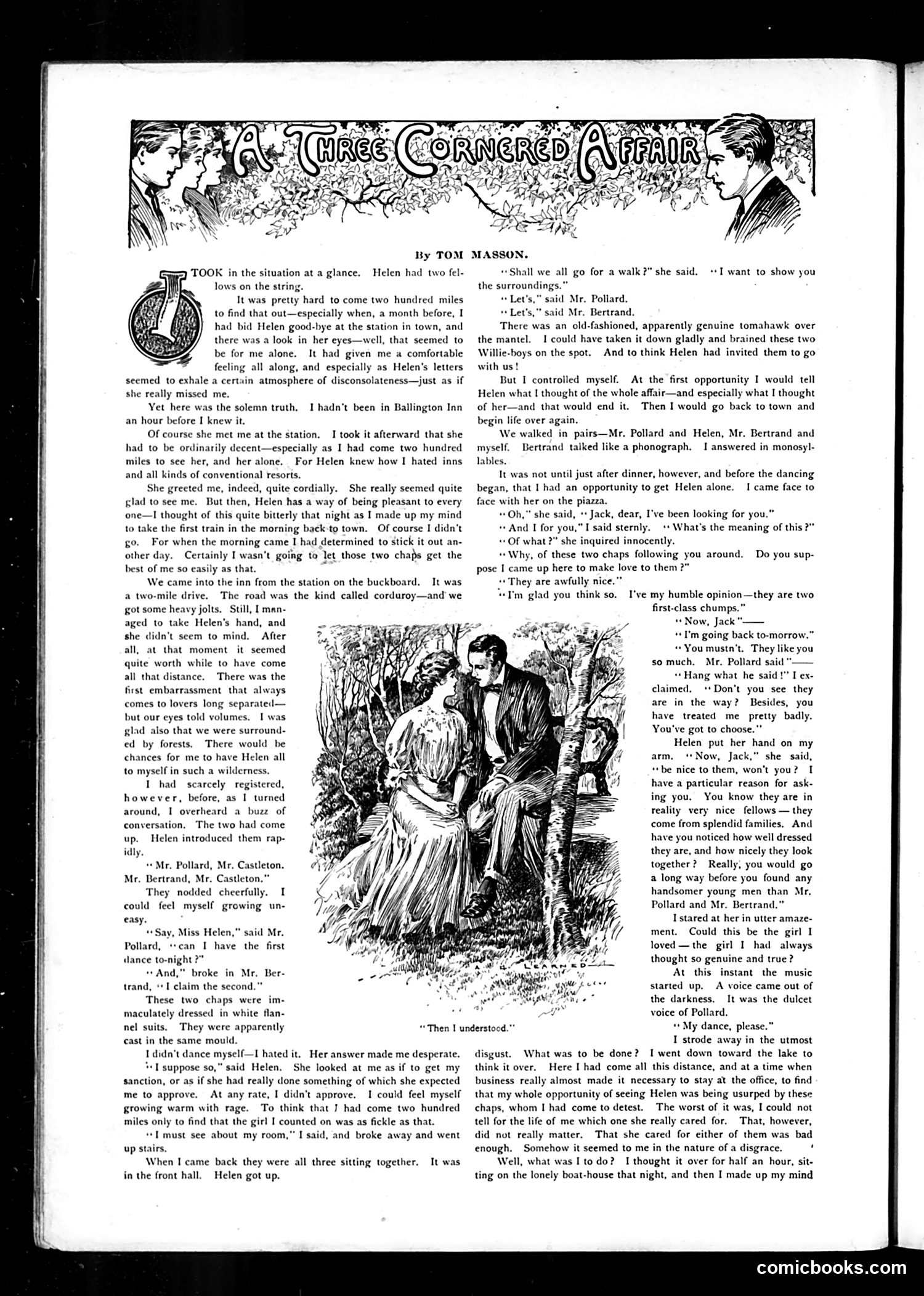
This is a romantic short story rather than a political cartoon. The narrative concerns a man who travels 200 miles to visit his sweetheart, Helen, only to discover she's romantically involved with two other suitors—Mr. Pollard and Mr. Bertrand—both wealthy, well-dressed men staying at the same inn. The story satirizes early 20th-century romance and male jealousy. The protagonist's rage at Helen's flirtatiousness (she accepts dance requests from both men) is played for comic effect, particularly in his violent fantasy about the tomahawk. The two rivals are portrayed as interchangeable "Willie-boys"—presumably wealthy, leisured types—highlighting class tensions and the narrator's sense of inadequacy. The piece gently mocks romantic conventions: the protagonist's assumption that Helen's letters promised exclusive devotion, his dramatic threat to leave, and his inability to actually do so. Judge magazine used such stories to humorously critique courtship rituals and male ego.
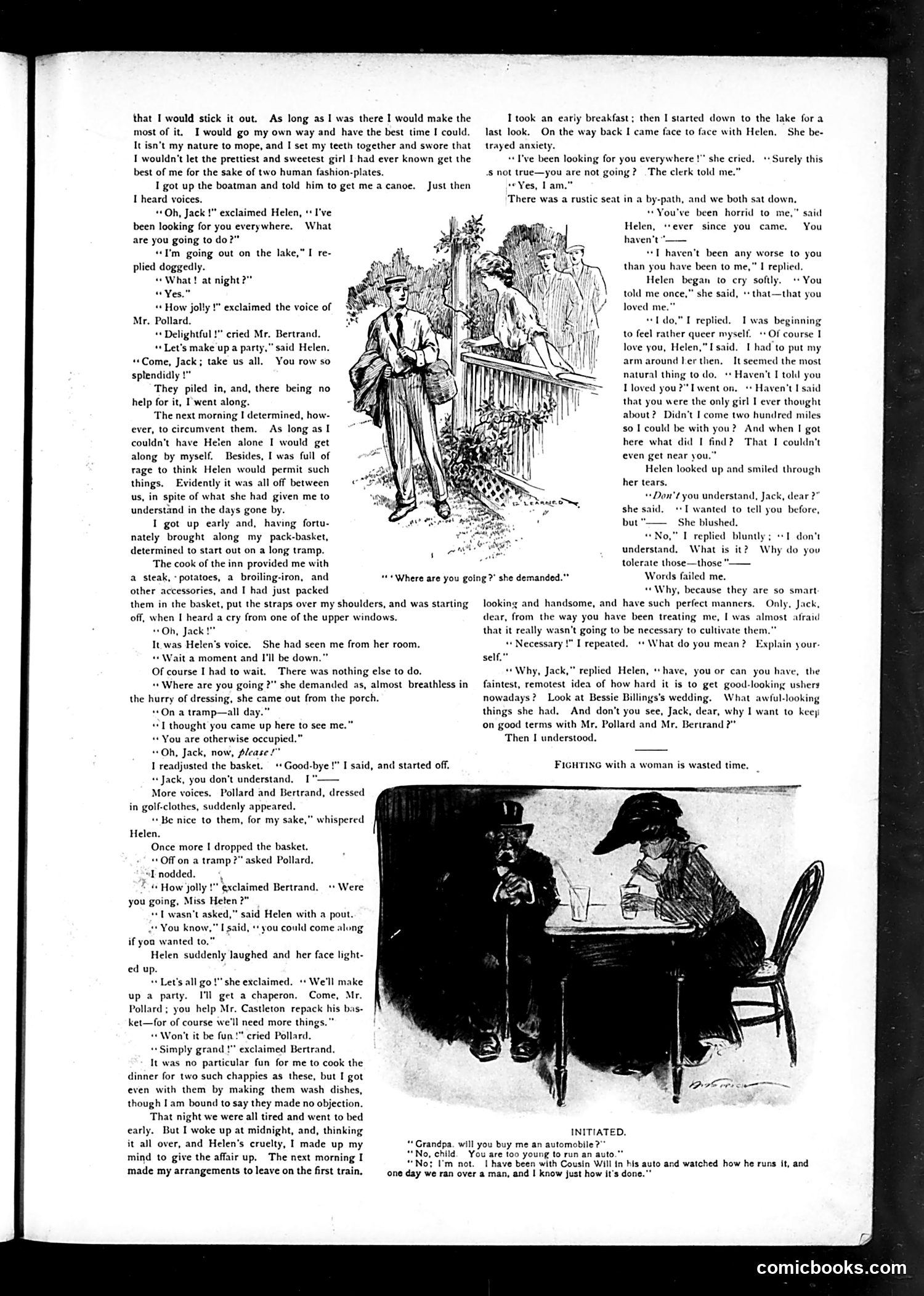
This page presents a serialized romantic narrative rather than political satire. The story depicts a young man (Jack) vacationing with Helen, a woman he cares for, but who is being pursued by two rivals: Mr. Pollard and Mr. Bertrand (described as "fashion-plates"). Jack attempts to avoid Helen by taking a solo canoe trip and hiking alone, but Helen and her suitors repeatedly insert themselves into his plans. The narrative explores themes of romantic frustration and social awkwardness typical of early 20th-century domestic fiction. The illustration labeled "INITIATED" at page's bottom shows two men at a table, possibly depicting the rivals or a comedic scene from the story. This appears to be light comedy-drama content rather than Judge magazine's typical political satire. The page prioritizes narrative storytelling over satirical commentary on current events or social issues.
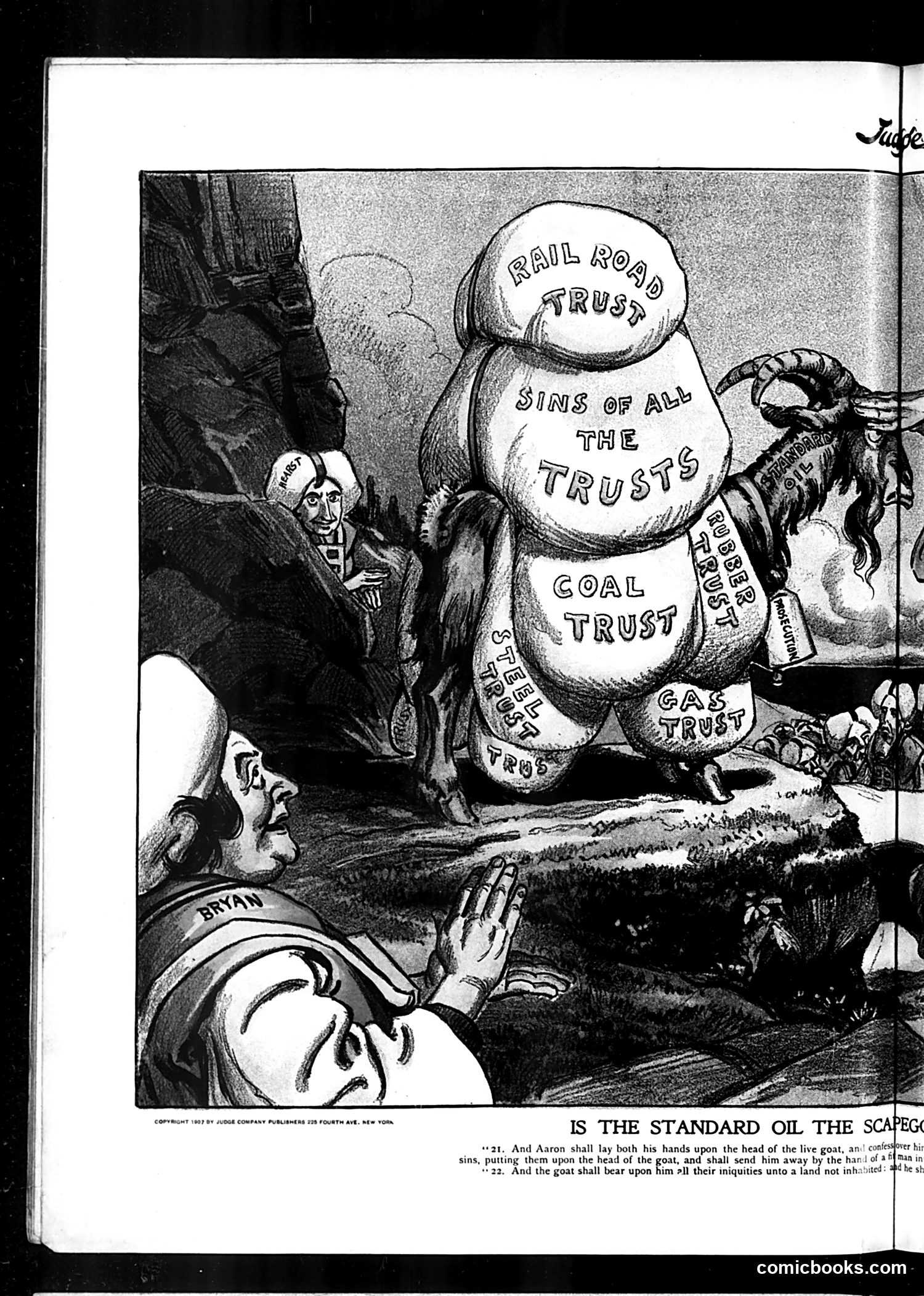
This Clifford Berryman cartoon satirizes major American industrial trusts using the Biblical scapegoat imagery. The massive figure represents consolidated corporate trusts labeled "Rail Road Trust," "Coal Trust," "Gas Trust," and "Steel Trust"—monopolies that dominated the early 20th-century economy. The small figure labeled "Bryan" (likely William Jennings Bryan, the progressive political leader) appears to be the scapegoat being sent away to bear the sins of these trusts. The cartoon critiques how powerful corporations were blamed for economic problems while remaining largely unpunished. The Biblical reference suggests these trusts were using society as their scapegoat mechanism—transferring blame elsewhere while maintaining control.
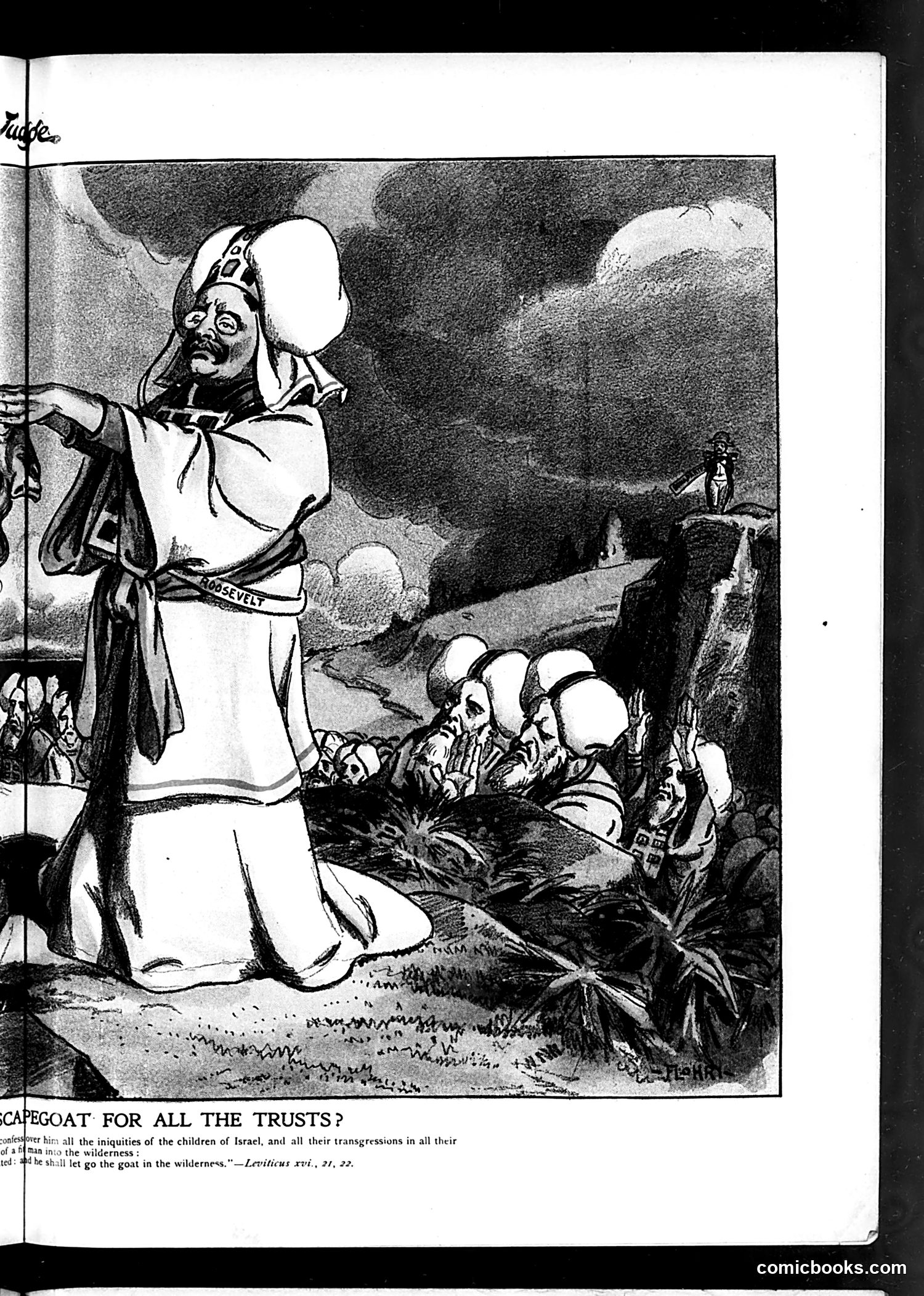
This political cartoon uses the biblical scapegoat ritual (Leviticus 16) as metaphor. A large figure labeled "ROOSEVELT" kneels while smaller figures (appearing to be children of Israel/the public) place burdens upon him. The cartoon satirizes President Theodore Roosevelt's trust-busting efforts, suggesting he's being made a scapegoat for all economic problems caused by monopolistic trusts. The religious reference implies that blaming one man—even the president—for systemic corporate wrongdoing is futile or unfair, like the ancient ritual of symbolically transferring sins to a goat sent into wilderness. The satire critiques whether Roosevelt's aggressive antitrust policies genuinely address root causes or merely serve as symbolic gesture placating public anger at big business.
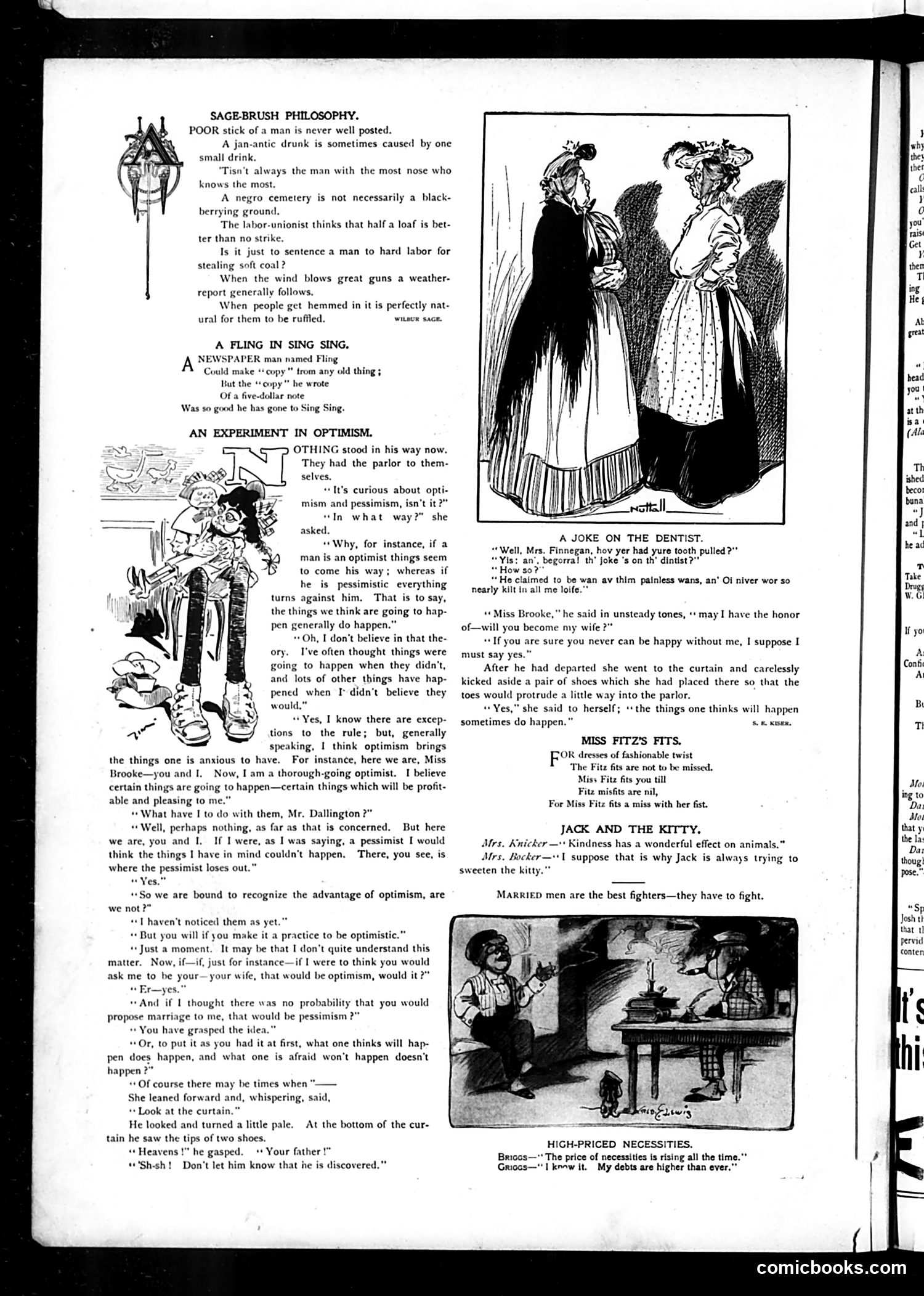
This page contains several satirical pieces typical of early 20th-century American humor: **"An Experiment in Optimism"** (center): A young couple discusses whether positive thinking makes good things happen. Mr. Dallington uses this philosophy to propose marriage. The joke's twist: Miss Brooke deliberately placed shoes under the parlor curtain to simulate her father's presence, making Dallington think they're being observed. Her trick proves the opposite—she manipulated events through deception, not optimism. **"A Joke on the Dentist"** (right): An Irish woman jokes that a dentist advertising "painless" extractions nearly killed her, so the joke is on him—she survived despite his promises. **"Sagebrush Philosophy"** (top left): Cynical aphorisms mocking conventional wisdom and labor disputes. **"A Fling in Sing Sing"** (left): A newspaper man named Fling counterfeited currency so expertly it got him imprisoned at Sing Sing prison—his journalistic skills became criminal. The overall tone reflects Judge's irreverent social satire.
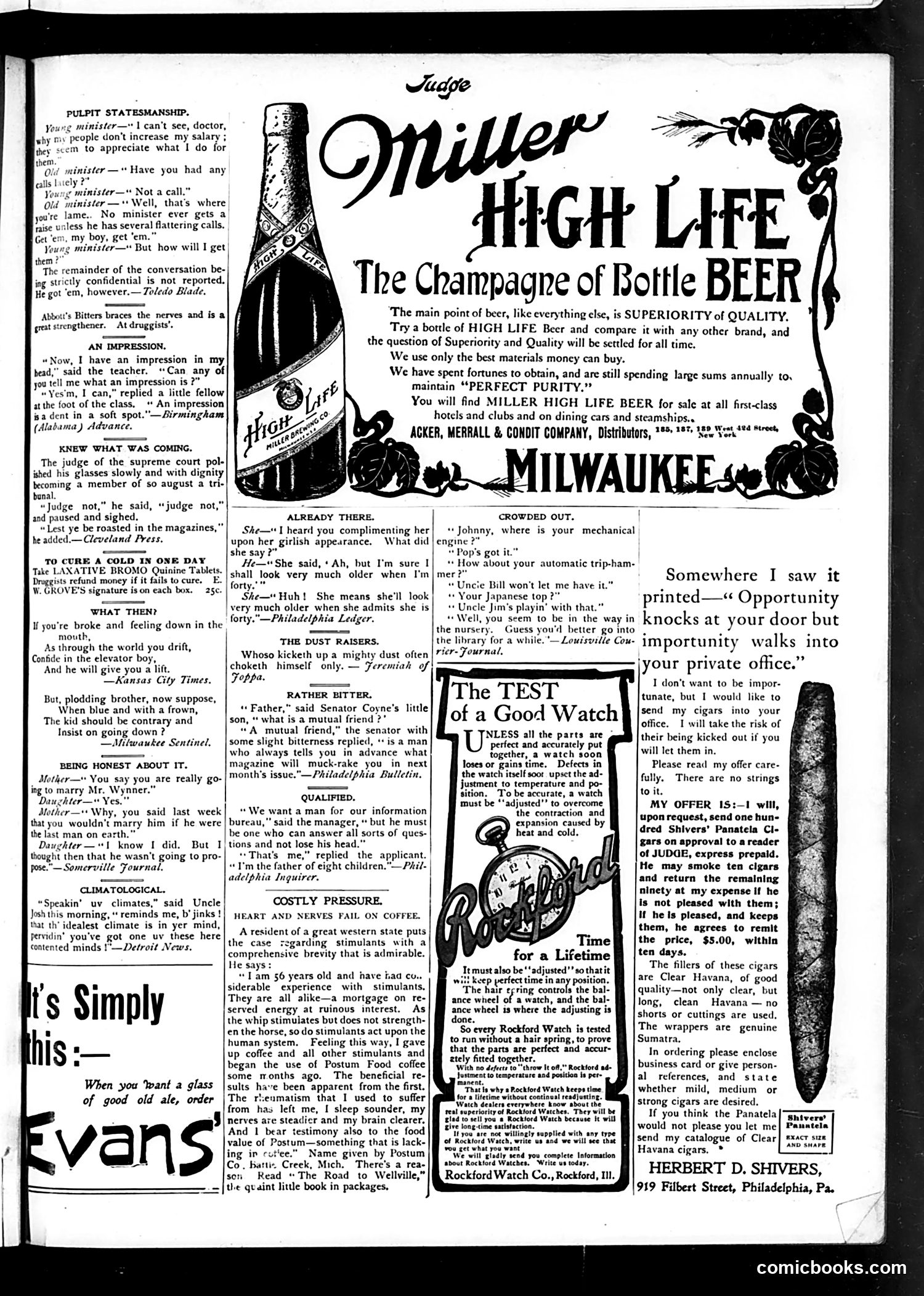
This page is primarily **advertising and filler content** rather than political satire. The dominant feature is a large **Miller High Life beer advertisement** emphasizing product quality and purity. The page contains multiple **brief humorous anecdotes** typical of Judge's format: - A "Pulpit Statesmanship" joke about a minister fabricating flattering church "calls" to justify a salary increase - A Supreme Court judge's self-aware quip about being "roasted in magazines" (satirizing press criticism of courts) - Various domestic humor sketches about courtship, honesty, and everyday situations **Political/social context**: The magazine assumes readers understand ministerial culture, judicial dignity, and middle-class social conventions. The humor is gentle and domestic rather than sharply satirical. The page also advertises **Evans ale** and **Rockford watches**, reflecting Judge's dual function as satirical commentary and commercial vehicle. No identifiable political figures or specific current events are referenced. This appears to be a general-interest humor page from an era when Judge blended sophisticated satire with mainstream entertainment and advertising.
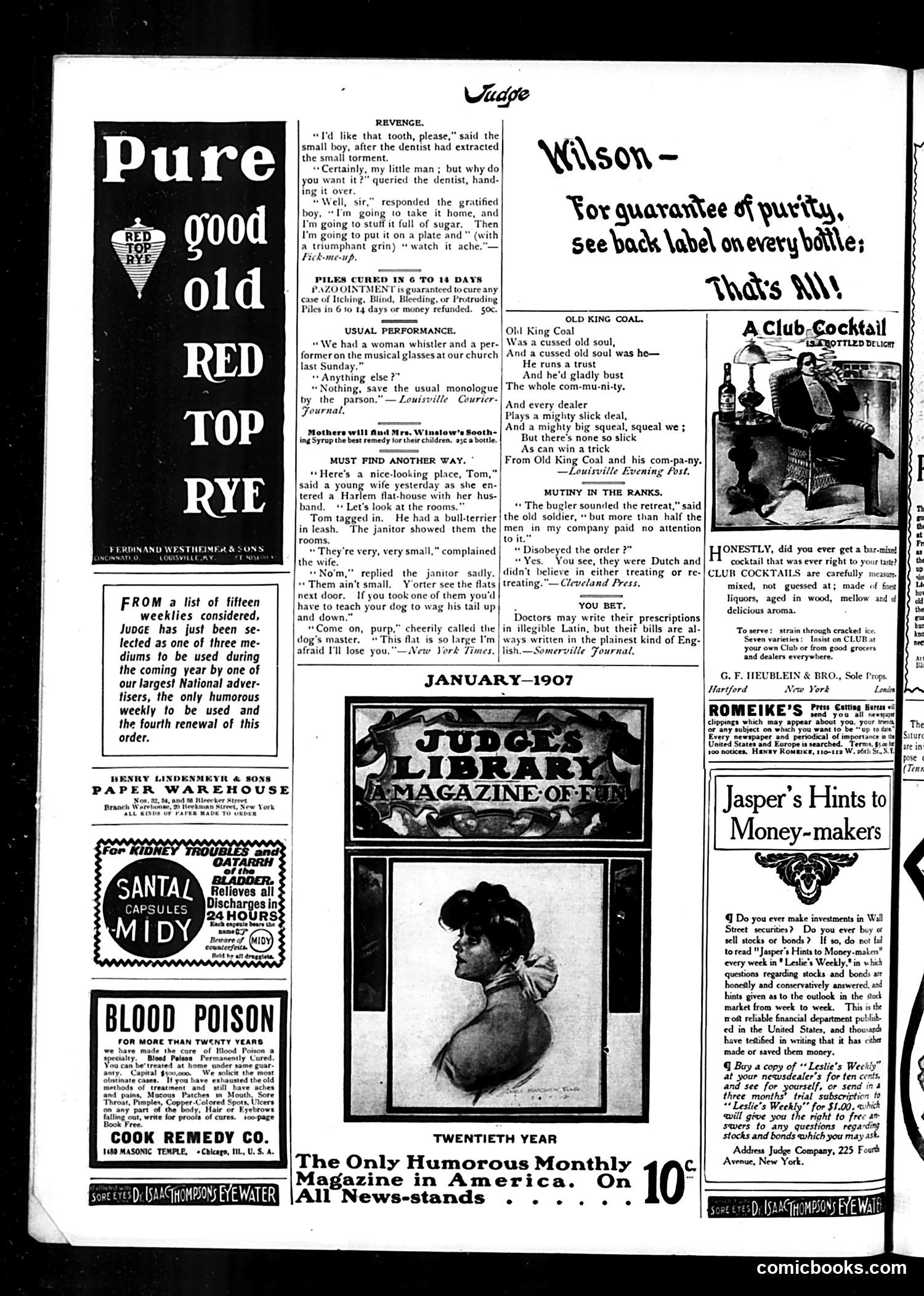
This page is primarily **advertisements and short humor pieces**, not political cartoons. The content reflects early 1900s American concerns: **Main Satirical Content:** - "Revenge" joke: A boy extracts a tooth and plans to fill it with sugar to watch it ache—dark humor about childish spite - "Old King Coal" poem mocks coal industry monopolies ("trust") and price-fixing by dealers - "Mutiny in the Ranks" plays on ethnic stereotypes, joking that Dutch soldiers refused orders about "treating or retreating" (likely a pun) - "Usual Performance" satirizes church services as tedious **Advertisements** dominate, hawking dubious patent medicines (blood poison cures, hemorrhoid ointment) and alcohol products (Wilson whiskey, Club Cocktails)—standard for the era. **Context:** This reflects Judge's role as a humor magazine mixing light jokes with aggressive advertising for products we'd now consider snake oil. The ethnic humor and medical quackery reflect 1907 attitudes.
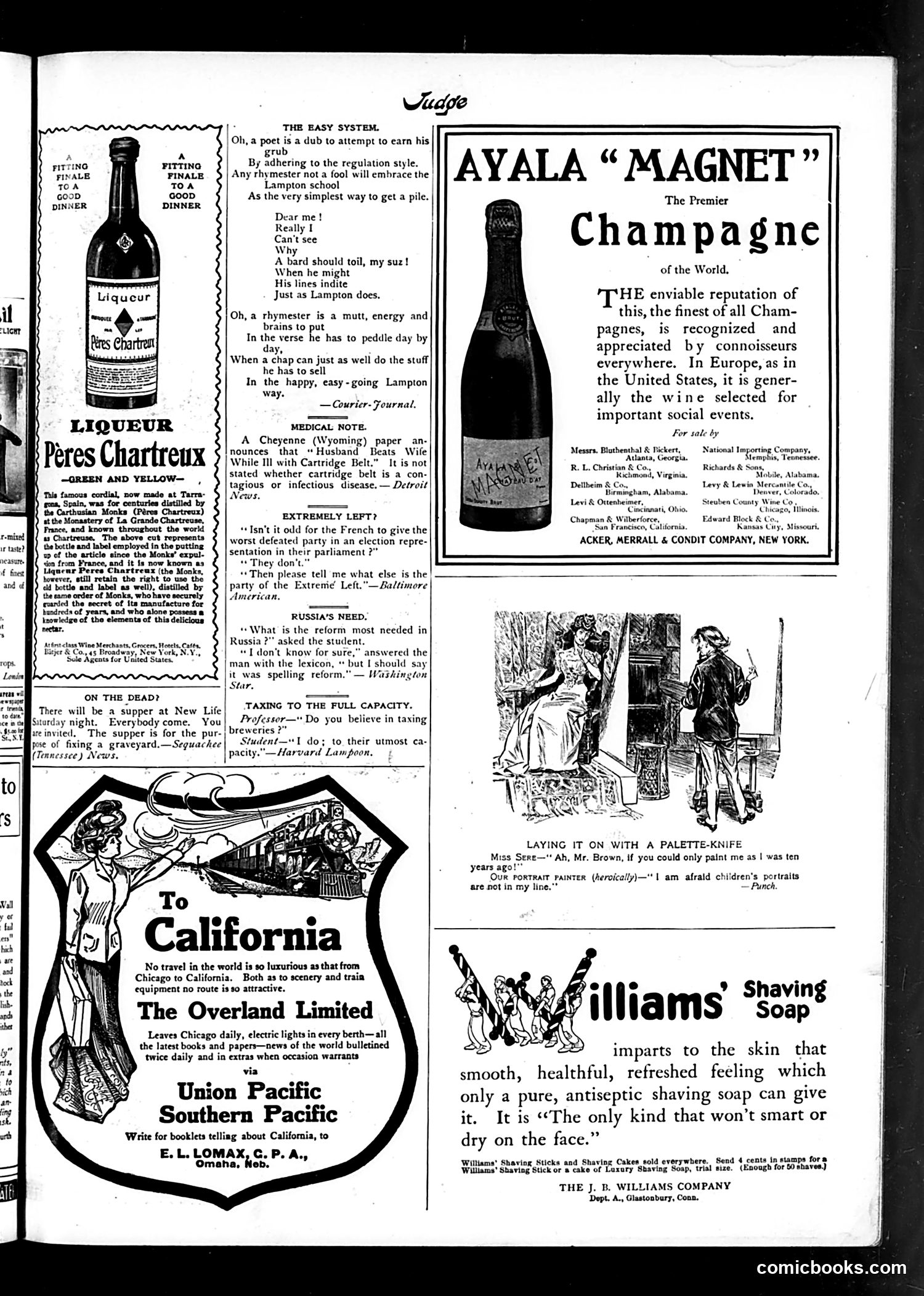
This page from *Judge* magazine contains several brief satirical humor pieces typical of early 20th-century American wit: **"The Easy System"** mocks poor poets who abandon proper poetic form for easier verse-writing—a criticism of lowered literary standards. **The medical and political jokes** rely on absurdist incongruity: a newspaper headline mentioning "Cartridge Belt" mistaken for a disease; a French parliamentary system joke suggesting the defeated Left party receives disproportionate representation; and a Russian student's wordplay about needing "spelling reform." **"Painting a Portrait"** features a painter claiming he can't paint children's portraits, implying he cannot add 10 years of aging to Miss Sere's appearance—a common vanity joke about women wanting to appear younger. The **advertisements** for Pérès Chartreux liqueur, Ayala Magnet Champagne, Williams' Shaving Soap, and California train travel represent standard commercial content filler. Overall, this represents *Judge*'s lightweight, genteel satirical style targeting literary pretension, political absurdity, and social vanity rather than serious political commentary.
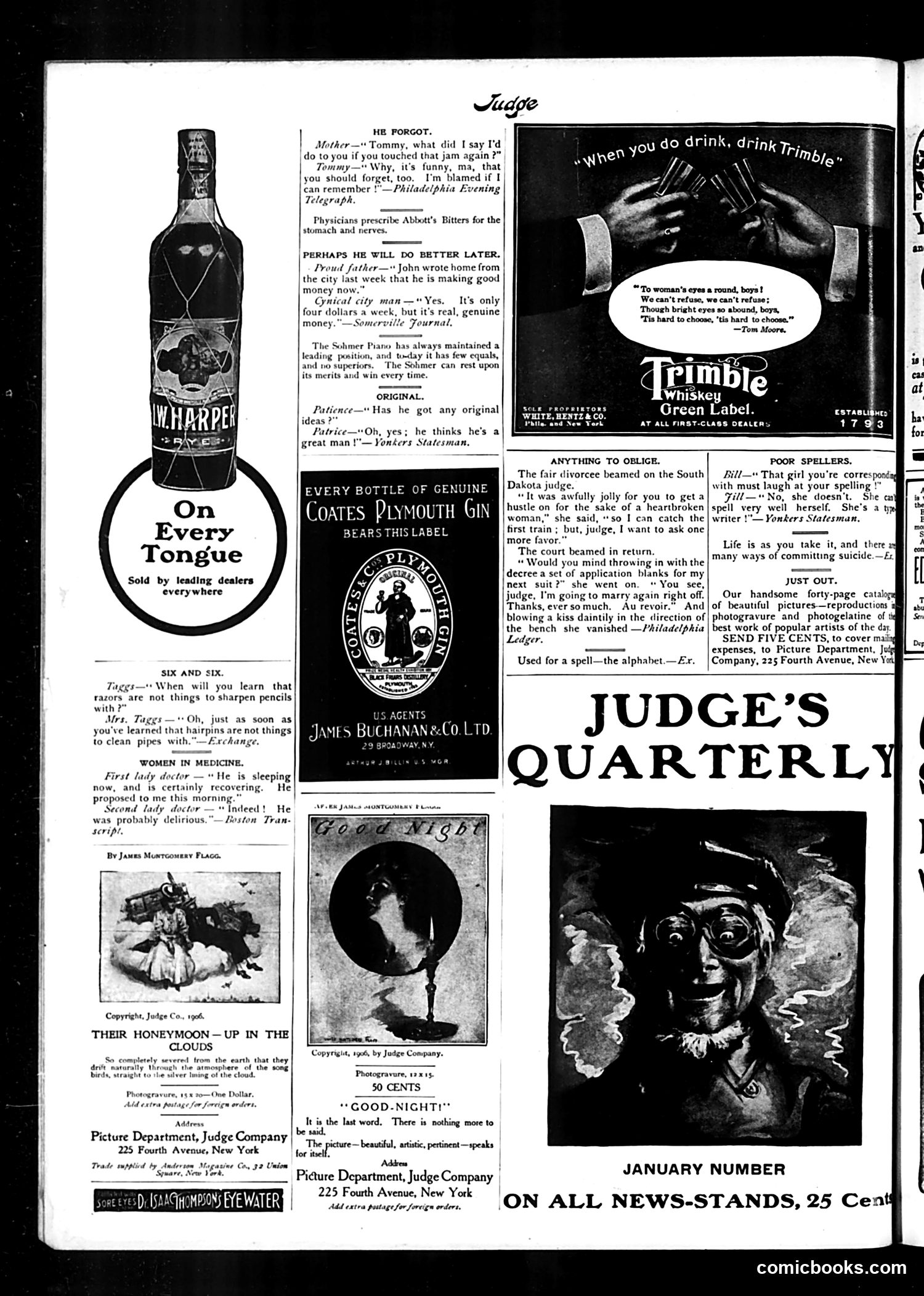
This is primarily an **advertising and humor miscellany page** from Judge magazine (likely early 1900s based on style). Rather than a unified political cartoon, it contains scattered brief jokes and advertisements. **Key content:** - **W.M. Harper whisky ad**: Features bottle imagery with slogan "On Every Tongue" - **Coates Plymouth Gin ad**: Emphasizes authenticity with label imagery - **Trimble Whiskey ad**: Shows hands toasting with period-appropriate drinking etiquette messaging - **Humor items**: Short, disconnected jokes about domestic life (mothers and children, newlyweds, lady doctors), spelling, and divorce—typical of Judge's light satirical approach - **Judge's Quarterly promotion**: Advertises photogravure reproductions **Social context for modern readers:** The page reflects early 20th-century attitudes: women as professionals (lady doctors) presented as unusual/comic, easy divorce, gender stereotypes in marriage. The heavy alcohol advertising reflects pre-Prohibition attitudes. This is **not political commentary**—merely entertainment advertising typical of the era's satirical magazines.
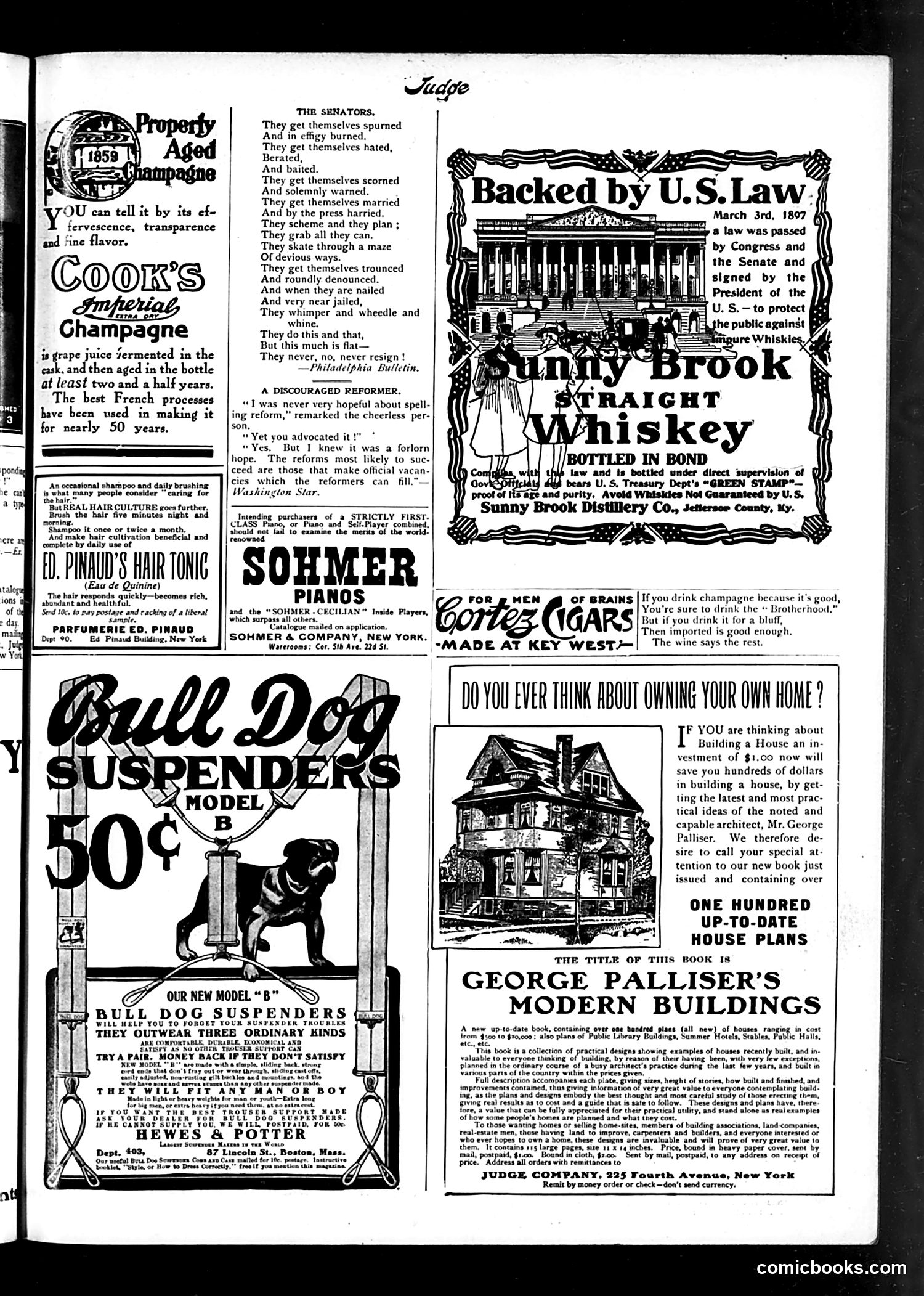
This page contains primarily **advertisements** rather than political cartoons. The main notable content is a poem titled "THE SENATORS" at the top, which satirizes U.S. senators as corrupt, self-serving politicians who: - Scheme and grab what they can - Navigate "devious ways" - Never resign despite scandals - "Whimper and wheedle" when caught rather than face consequences The poem criticizes senators' hypocrisy and refusal to be held accountable. The rest of the page advertises consumer products typical of the era: champagne, hair tonic, pianos, dog suspenders, cigars, whiskey (notably "backed by U.S. Law"), and architectural house plans. The advertisements reflect early 1900s consumer culture and the magazine's business model, while the senator poem reflects Judge magazine's satirical purpose—mocking government corruption and political figures who evade accountability despite public pressure.
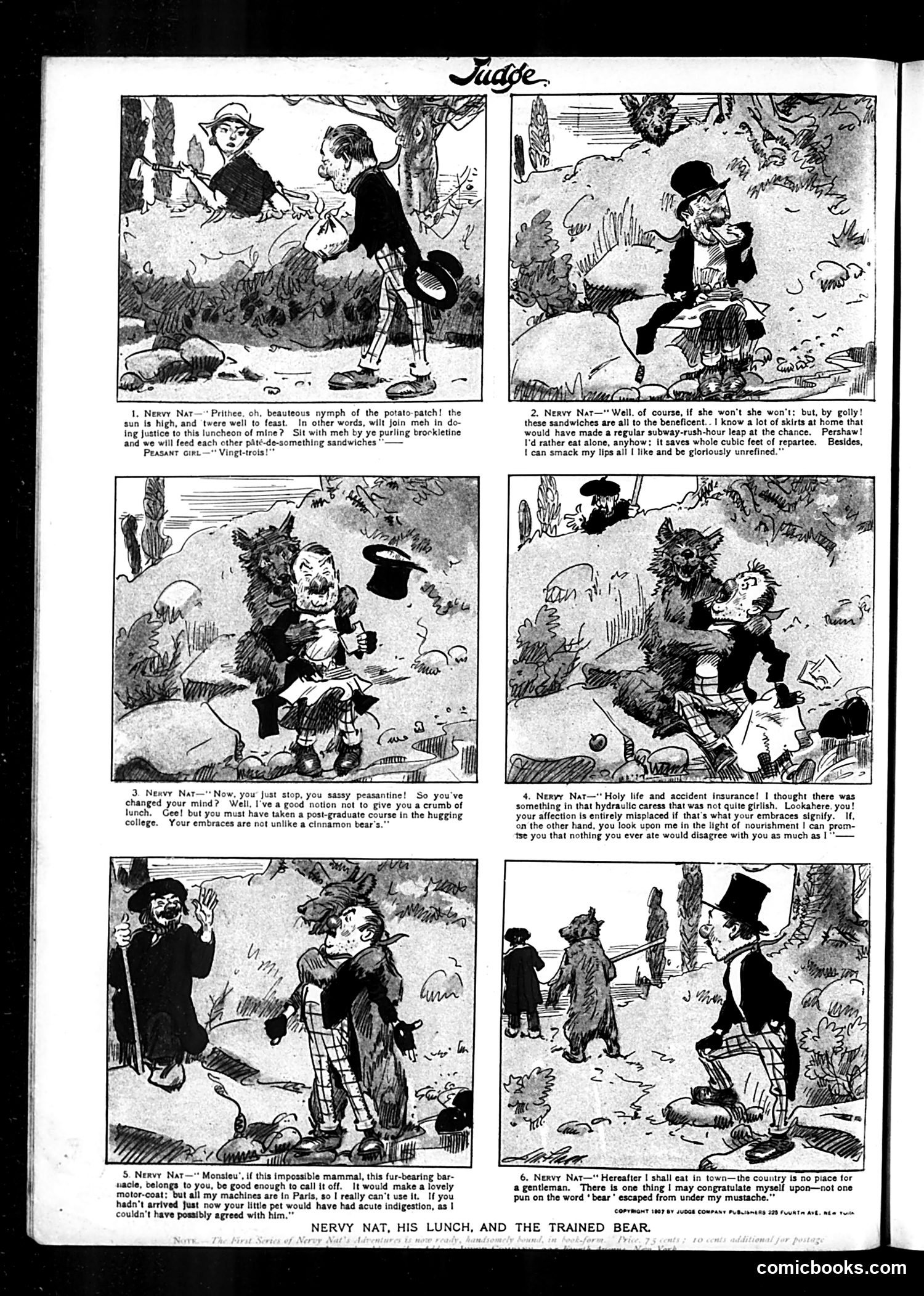
This is a six-panel comic strip featuring "Nervy Nat," a recurring Judge character known for affected, pretentious speech and romantic misadventures. Here, Nat attempts to seduce a peasant girl with flowery language and lunch invitations in a rural setting. She initially accepts his advances enthusiastically ("Vingt-trois!"—twenty-three, suggesting eagerness). The joke centers on mistaken identity: what Nat assumes are the girl's romantic embraces are actually those of her trained bear, which he mistakes for her affection. When he realizes the truth, he flees, complaining about the country and ironically noting he avoided making puns on the word "bear"—a meta-joke about the comic itself. The satire targets pretentious city men attempting rural seduction with flowery language and class assumptions, only to be humiliated.