
Judge, 1907-01-19 · page 6 of 16
Judge — January 19, 1907 — page 6: what you’re looking at
What you’re looking at
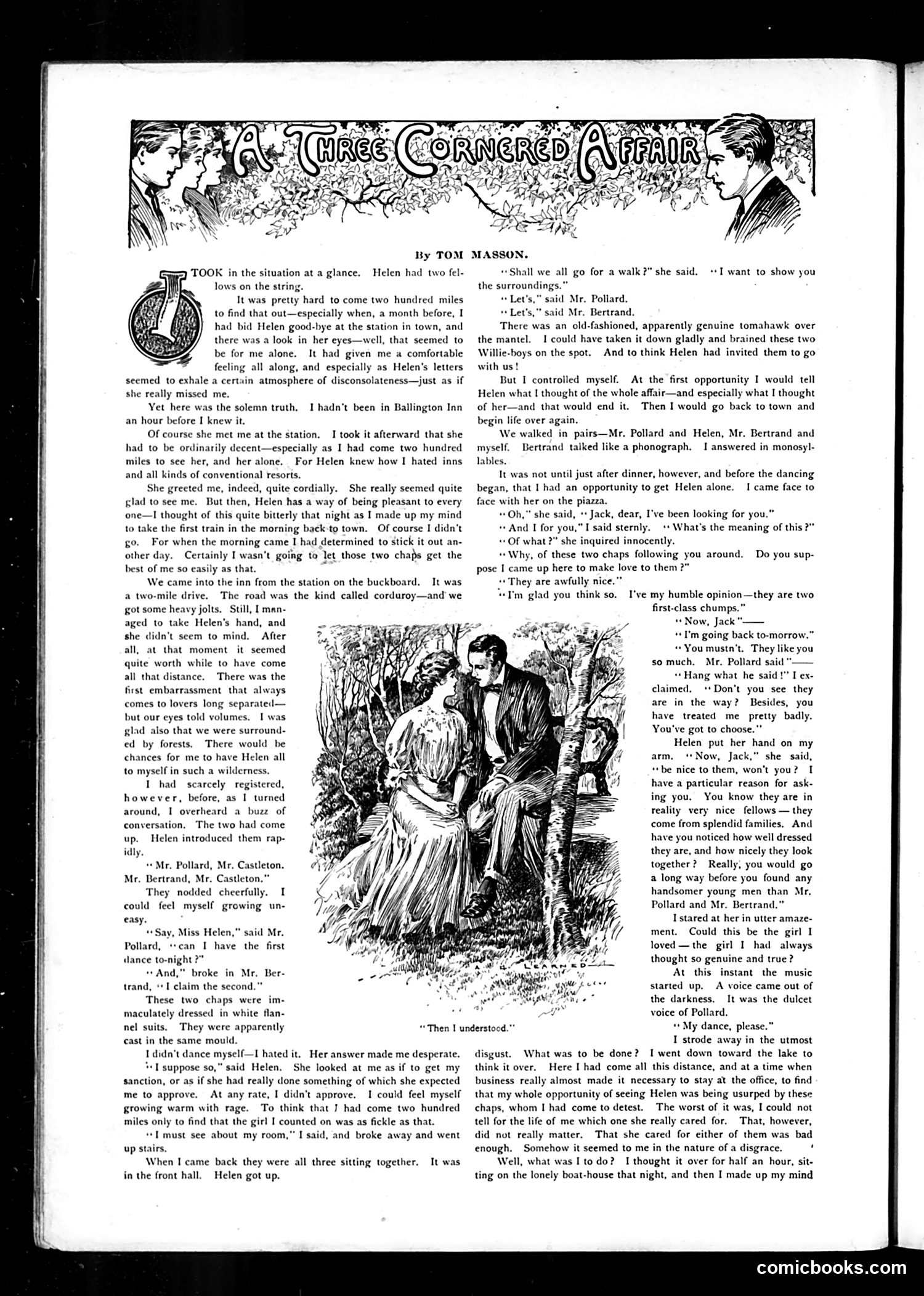
This is a romantic short story rather than a political cartoon. The narrative concerns a man who travels 200 miles to visit his sweetheart, Helen, only to discover she's romantically involved with two other suitors—Mr. Pollard and Mr. Bertrand—both wealthy, well-dressed men staying at the same inn. The story satirizes early 20th-century romance and male jealousy. The protagonist's rage at Helen's flirtatiousness (she accepts dance requests from both men) is played for comic effect, particularly in his violent fantasy about the tomahawk. The two rivals are portrayed as interchangeable "Willie-boys"—presumably wealthy, leisured types—highlighting class tensions and the narrator's sense of inadequacy. The piece gently mocks romantic conventions: the protagonist's assumption that Helen's letters promised exclusive devotion, his dramatic threat to leave, and his inability to actually do so. Judge magazine used such stories to humorously critique courtship rituals and male ego.
📄 Transcribed text from this page (OCR, searchable)
Machine-transcribed from the original scan — historical spelling and the odd misread are preserved.
By TOM TOOK in the situation at a glance. Helen had two fel- lows on the string, It was pretty hard to come two hundred miles to find that out—especially when, a month before, I had bid Helen good-bye at the station in town, and there was a look in her eyes—well, that seemed to be for me alone, It had given me a comfortable feeli all along, and especially as Helen's letters seemed to exhale a certain atmosphere of disconsolateness—just as if she really missed me. Yet here was the solemn truth, an hour before I knew it. Of course she met me at the station. I took it afterward that she had to be ordinarily decent—especially as I had come two hundred miles to see her, and her alone. For Helen knew how I hated inns and all kinds of conventional resorts, She greeted me, indeed, quite cordially, She really seemed quite glad to see me. But then, Helen has a way of being pleasant to every one—I thought of this quite bitterly that night as I made up my mind to take the first train in the morning back-to town. Of course I didn’t g0. For when the morning came I had determined to stick it out an- other day. Certainly I wasn't going to let those two chaps get the best of me so easily as that. ° We came into the inn from the station on the buckboard. a two-mile drive. The road was the kind called corduroy—and we got some heavy jolts, Still, [man- aged to take Helen's hand, and she didn't seem to mind. After all, at that moment it seemed quite worth while to have come all that distance. There was the first embarrassment that always comes to lovers long separated — but our eyes told volumes. glad also that we were surround- ed by forests. There would be chances for me to have Helen all to myself in such a wilderness. I had scarcely registered, however, before, as I turned around, I overheard conversation, The two had come up. Helen introduced them rap- idly. Thadn't been in Ballington Inn I was a buzz of “Mr. Pollard, Mr. Castleton. Mr. Bertrand, Mr. Castleton,” They nodded cheerfully. I could feel myself growing un- easy. ‘ Miss Helen,” said Mr. Pollard, ‘can I have the first dance to-night ?" “And,” broke in Mr. Ber- trand, «1 claim the second.” These two chaps were im- maculately dressed in white flan- nel suits. They were apparently cast in the same mould. I didn’t dance myself—I hated it. Her answer made me desperate. 41 suppose so,” said Helen, She looked at me as if to get my sanction, or as if she had really done something of which she expected me to approve. At any rate, I didn’t approve. I could feel myself growing warm with rage. To think that J had come two hundred miles only to find that the girl I counted on was as fickle as that. “Tmust see about my room," I said, and broke away and went up stairs. When I came back they were all three sitting together. in the front hall. Helen got up. Tt was “Then I understood." ad} MASSON. “Shall we all go for a walk?” she said. the surroundings.” “Let's,” said Mr, Pollard. “+ Let's,” said Mr. Bertrand. There was an old-fashioned, apparently genuine tomahawk over the mantel. I could have taken it down gladly and brained these two Willie-boys on the spot. And to think Helen had invited them to go with u But I controlled myself. “T want to show you At the first opportunity I would tell Helen what I thought of the whole affair—and especially what I thought of her—and that would end it, begin life over again. We walked in pairs—Mr, Pollard and Helen, Mr, Bertrand and Then I would go back to town and myself. Bertrand talked like a phonograph. I answered in monosyl- lables. It was not until just after dinner, however, and before the dancing began, that I had an opportunity to get Helen alone. I came face to face with her on the piazza. + Oh,” she said, ** Jack, dear, I've been looking for you.” ++ And I for you," I said sternly. ++ What's the meaning of this ?” ++ Of what ?” she inquired innocently. “Why, of these two chaps following you around. pose I came up here to make love to them ?” They are awfully nice.” “I'm glad you think so. Do you sup- I've my humble opinion—they are two first-class chumps.” “Now, Jack "—— ++ I'm going back to-morrow.” “You mustn't. They like you so much. Mr. Pollard said "—— «Hang what he said!" Lex- claimed, Don't you see they are in the way? Besides, you have treated me pretty badly. You've got to choose.”” Helen put her hand on my arm, ‘Now, Jack,” she said, ‘be nice to them, won't you? I have a particular reason for ask- ing you. You know they are in reality very nice fellows — they come from splendid families. And have you noticed how well dressed they are, and how nicely they look together? Really, you would go a long way before you found any handsomer young men than Mr. Pollard and Mr. Bertrand.” ny at Istared at her in utter amaze- sf leg Ey bie Could this be the girl I Rag he) hs loved —the girl I had always thought so genuine and true? At this instant the music started up. A voice came out of the darkness, It was the dulcet voice of Pollard. « My dance, please.” I strode away in the utmost disgust. What was to be done? I went down toward the lake to think it over, Here I had come all this distance, and at a time when business really almost made it necessary to stay at the office, to find that my whole opportunity of seeing Helen was being usurped by these chaps, whom I had come to detest. The worst of it was, I could not tell for the life of me which one she really cared for. That, however, did not really matter. That she cared for either of them was bad enough. Somehow it seemed to me in the nature of a disgrace. ‘ Well, what was Ito do? I thought it over for half an hour, sit- ting on the lonely boat-house that night, and then I made up my mind comicbooks.com